



Abstract
The factors that affect journal choice for manuscript submission vary, depending on the researcher’s career and field. Although several guidelines are available, information is limited on which criteria are used by Turkish authors. We aimed to evaluate the factors that affect Turkish medical researchers’ journal choice decisions using semi-structured in-depth video conference interviews. The participants identified journal prestige as the major factor, mainly Science Citation Index-Expanded (SCIE) indexing and journal impact factor (JIF), along with acceptance and rejection rates, the age of the journal, and journal audience. Participants identified high publishing costs and mandatory paid open access policy as negative factors. Future policies on covering publishing costs institutionally would be helpful to remove obstacles during journal choice. Turkish medical researchers should be informed on using various indexes and scientometric data to better understand journal performance, rather than only SCIE and JIF.
Keywords
1. Background
Publishing in peer-reviewed medical journals is the primary formal format for disseminating scientific information [1]. Publishing makes the research results publicly available to the related community to use and review [2]. Researchers participate in this effective communication by publishing original articles, reviews, case reports, or other papers; which is an important of being in the academic world. The motivation to conduct and publish research is both for the benefit of the public and that of researchers [3]. In the modern era where scientific publications have become currency for academic promotion and position, the role of the journal is as a mediator for science serving both authors and readers. For authors, journals serve the purpose of peer reviewing and publishing the submitted paper, which will receive attention from relevant audiences. For readers, journals aim to serve novel, peer-reviewed and high-quality science [4,5].
According to the International Association of Scientific, Technical and Medical Publishers (STM) report, there are roughly 42,500 active scientific peer-reviewed journals [6]. In addition to the large number journals, recent changes in the publishing paradigm, due to online publishing and newer publishing models, such as open access publishing, provide both new challenges and opportunities to all parties [7,8]. Factors such as turnaround time, peer-review quality, publishing costs and the journal’s target audience also affect journal choice [9–11]. Moreover, increased pressure on academics to publish in ‘high-ranking’ journals has complicated the selection of journals for publication.
Considering these factors, choosing an appropriate journal to submit is difficult, since choosing poorly will result in loss of time and effort and usually rejection. Apart from technical problems with the manuscript, topics irrelevant to the journal’s audience are a major cause of rejection [12,13]. Therefore, choosing a medical journal wisely before submission is crucial in achieving success in publication.
Although several editorials and review articles on choosing the appropriate journal for manuscript submission have been published [9–11,14,15], limited information is available on which criteria are the main factors for article submission for authors. Therefore, in this study, we aim to evaluate the factors that affect the decisions of Turkish medical researchers when choosing a journal for publication and to evaluate the attitudes and practices of the authors towards medical journals.
2. Methods
2.1. Study design
We conducted qualitative research using a phenomenological approach to evaluate the thoughts and observations of the journal selection criteria. We conducted in-depth interviews with the participants using video conferencing due to COVID-19 precautions.
2.2. Participant recruitment and sampling
We recruited participants through purposive and snowball sampling and included Turkish medical researchers from different groups regarding age, gender, year since first publication, medical department (i.e. basic sciences, clinical sciences and surgical sciences) and academic position to ensure data diversity (Table 1). Sample size was determined according to data saturation. We terminated the interview process when new themes stopped emerging during the interviews. We contacted the Turkish Medical Network Telegram app group, including more than 3000 confirmed academic members for study recruitment. Members interested in participating received a written description of the project and an invite for interview by e-mail. Data saturation was attained after 26 interviews, and 11 more participants from a diverse group of medical departments with varying academic positions were interviewed to verify the saturation [16].
Characteristics of participants.

2.3. Interviews
We conducted a qualitative study using semi-structured and in-depth video conference calls when participants were available for an interview. The first and second authors conducted the interviews. We recorded all interviews with the permission of the participants. Before the interview, we questioned each participant’s age, department, academic degree and first year of publication. We prepared and developed an interview guide based on a literature review search. We asked three main questions in the interview:
What are the main factors affecting your journal selection criteria?
What factors do the quality of a journal depend on?
What issues do you complain about in the article publishing process?
In addition, to increase the depth of the discussion, we asked the participants the following questions: ‘Please give more information about this topic’, ‘Can you please be more explanatory?’ and ‘Can you give an example?’
We collected and analysed data simultaneously. We transcribed audio recordings verbatim. All authors analysed interview data using an interpretive phenomenological approach to data analysis and coded the preliminary categories. During the data analysis, all researchers identified the underlined discourse. After data collection, we re-reviewed all transcripts by applying the final set of codes to identify major themes. All researchers were checked and approved the results.
2.4. Data analysis
All authors independently reviewed the texts to determine the important sentences and emphasised points in the interviews. Meaningful statements were summarised, and themes were created. The contradictory opinions about the content of the themes were discussed and resolved. Participants’ demographic characteristics were summarised with basic descriptive statistics, using counts and frequencies for categorical data and median (min–max, interquartile range (IQR)) for continuous variables.
2.5. Ethics
We conducted this study according to ethical principles for medical research, as described in the Declaration of Helsinki. [Sakarya University Medical Faculty] University Medical Faculty Ethics Committee approved this study (Approval number: E.14841, Date: 2 March 2021).’] We informed participants verbally on the purpose of the study, and we obtained verbal consent during the interview. We informed the participants that the interviews would be audio- and video-recorded and that all identifying information would be anonymized. We used unique identifiers to label the interviews, and we removed all personal identifiers during the analysis.
3. Results
3.1. Participant characteristics
We have conducted in-depth interviews with 37 participants during the study. The median age of the participants was 41 (range: 30–67 years, IQR: 36–48 years). Twenty participants (54%) were male and 17 (46%) were female. The median number of years since the first publication was 9 (range: 3–39 publications, IQR: 6–12 publications). We selected participants from a diverse group of medical departments (12 from basic sciences, 14 from clinical sciences and 11 from surgical sciences) and a diverse group of academic positions, ranging from specialist to professor. The characteristics of the participants are presented in Table 1.
3.2. Themes and subthemes
We noted three major themes within our interviews that were relevant to the Turkish medical researchers choosing a journal to publish: (1) prestige perception of the journal; (2) costs of publishing and open access policy; and (3) the publication processes. Subthemes and citations of the noted themes are presented in respective tables.
3.2.1. Theme 1: prestige perception of the journal
All participants noted that the journal’s prestige was the first and most important factor in selecting a journal for submission. The perception of prestige relied on several primary factors: indexing, scientometrics and acceptance and rejection rates.
All participants considered the indexing important for selecting a journal for submission, but for various reasons. Although the main reasoning appeared to be increasing visibility (i.e. for more reads and citations) in indexes with higher recognition and reliability, 28 out of 37 (75.6%) participants considered Science Citation Index-Expanded (SCIE) as the index with the highest recognition and reliability. In contrast, others considered it as the primary index to look for because academic progression in Turkey requires publishing in such journals. Other citation indexes, such as Emerging Sources Citation Index (ESCI) and Scopus, were considered secondary indexes to look for by 7 and 5 participants out of 37, respectively.
All participants also considered the scientometric data of a journal as a part of the journal’s prestige. Thirty-one out of 37 (83.7%) participants considered the journal impact factor (JIF) the primary scientometric data to consider. By contrast, six (16.2%) participants also considered Hirsch (h)-index and scientific journal ranking (SJR) sourced from Scopus to have a broader understanding of the journal’s performance, and four (10.8%) also considered quartiles provided by Clarivate Analytics, because they affect the academic incentive payments and other scientometric data.
All participants considered acceptance and rejection rates as a factor affecting a journal’s prestige. Five (13.5%) participants also noted that journals publicly announcing acceptance and rejection rates were probably higher-prestige journals, which can be used as a factor for journal choice. By contrast, two (5.4%) participants thought it would be futile to upload an article to a journal with a high rejection rate; therefore, they considered high rejection rates negatively in choosing a journal to submit to.
Twenty-two out of 37 (59.4%) participants considered the journal age as an important factor in selecting a journal for publication. Participants considered older journals to be journals with proven quality. However, five (13.5%) participants mentioned that the journal age was not a criterion for journal selection, as long as the journal was indexed in SCIE. Two (5.4%) participants also mentioned that the journal age was irrelevant for journal selection if an international society or a university was publishing the journal. The remainder of the participants were indifferent to the journal age as a criterion for journal selection.
Finally, the target audience of the journal was uniformly considered a criterion for journal selection, but for different reasons. Twenty-nine out of 37 (78.3%) participants considered the target audience a critical factor because it affected who read and cited their papers. Of these 29 participants, 12 (32.4%) specifically considered wider audiences to be better for higher impact potential. By comparison, the other eight (21.6%) participants prioritised journals of specific publication organs (such as journals published by societies, universities or federations) because the specific publication area could reach a particular audience (Table 2).
Prestige perception of the journal.

SCIE: Science Citation Index-Expanded; ESCI: Emerging Sources Citation Index; JIF: journal impact factor; SJR: scientific journal ranking.
3.2.2. Theme 2: costs of publishing and open access policy
All participants noted that the cost of publishing was considered a criterion for journal selection. All participants noted that some journals had very high submission and publication fees and that these journals could not be selected even if they were otherwise ideal. Seven participants (18.9%) specifically mentioned that they feel some journals and publishers ‘do business’ rather than be a part of academic community. Four (10.8%) participants further noted that they feel journals that asked for fees were predatory and that they specifically chose subscription-based journals for submission.
Although all participants stated that it was a criterion for journal selection, they were divided on open access publishing being a positive criteria. Seventeen out of 37 (46%) agreed that open access publishing increases the number of reads and citations of published articles and considered open access publishing as a positive factor. Four (10.8%) participants expressively stated that they had paid for open access publishing previously. Although open access publishing may have potential benefits, 20 (54%) of the participants stated that they would not submit to paid open access journals because they are considered predatory by governing bodies in Turkey in terms of academic progression, although 10 (27%) of the participants disagree with this decision (Table 3).
Costs of publishing and open access policy.
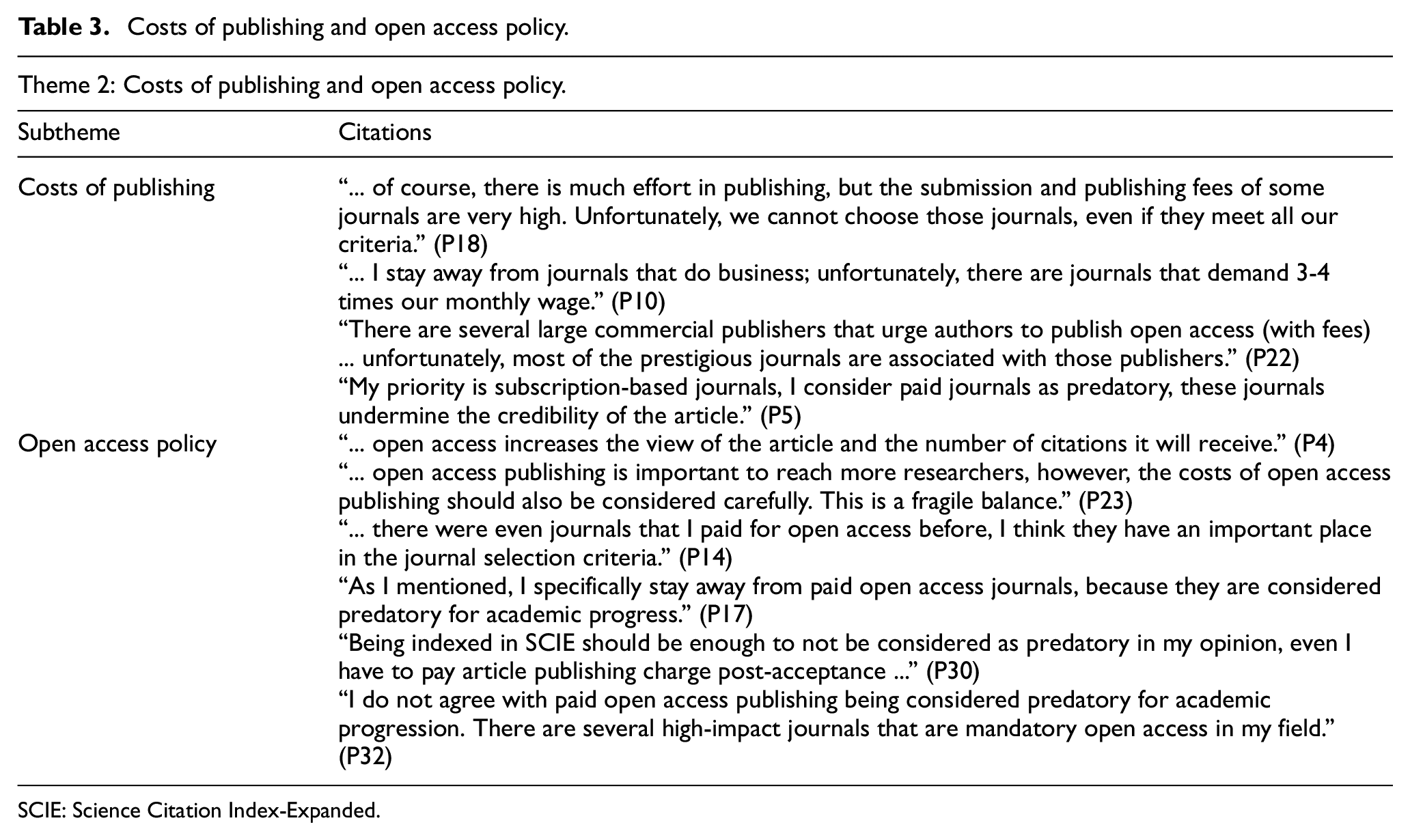
SCIE: Science Citation Index-Expanded.
3.2.3. Theme 3: publication processes of the journal
All participants noted that several publication processes were important in selecting a journal for submission. The main factors used for journal selection criteria were submission processes, and turnaround and publishing timeline.
Twenty-seven out of 37 (72.9%) participants stated that editing the paper for the journal format is as important as writing the paper itself. Only seven (18.9%) participants stated that preparing papers for submission was a cumbersome job and that preparing the paper and required forms was a hassle and increased formalities. However, all participants agreed that journals with extensive rules for the submission process are usually journals with higher quality; therefore, this could affect their journal selection.
All participants uniformly noted that short turnaround and publication times were important factors when selecting a journal, in addition to keeping data up to date and considering other publication options. Four (10.8%) participants stated that very short turnaround times are suspicious, since it is a strategy used by predatory publishers and journals. Three (8.1%) participants specifically added that turnaround and publication times should be publicly available because they tended to stay away from journals with long turnaround and publication times. (Table 4).
Publication processes of the journal.

4. Discussion
The motivation to conduct and publish research could be idealistic, such as progressing knowledge or improving healthcare; however, authors may also choose to publish scientific information for causes such as documenting scientific information, claiming ownership of findings, competing, being financially reimbursed, or surviving in academia [17]. Moreover, medical publication is changing rapidly, with increasing online and open access journals [7,8]. In this evolving and growing landscape, it is academically important for researchers to choose the right journal to reach the relevant audience. In this study, we evaluated the factors that affect the decisions of Turkish medical researchers when choosing a journal for publication. We have demonstrated that three main themes play major roles during journal choice: (1) prestige perception, which mainly includes indexing and scientometrics; (2) the costs of publishing and the open access policy of the journal; and (3) publication processes, including submission processes and turnaround times.
The perception of ‘journal prestige’ is a subjective and vague term that includes multiple subcategories. The objective indicators for quality (such as JIF or other scientometric data and journal age) are only a part of the subjective ‘prestige perception’, in which other factors such as indexing, affiliations, brand name and the editorial board are also included [18,19]. Several survey studies have also reported that journal prestige and/or scientometrics (namely JIF) were almost universal factors that affected journal choice [9,18–25].
In our study, respondents defined prestige using several factors: indexing, scientometrics, acceptance and rejection rates, journal age and target audience. Although it is crucial to choose journals indexed in well-known databases [26], there are no clear-cut criteria for high quality, since there are also inferior quality counterparts within the same indexes and high-quality journals that are not indexed [17]. Our results revealed that SCIE was the primary index researchers looked for, but this choice may also be due to the obligation to publish in SCIE indexed journals for academic progression in Turkey. In an India-based study on journal selection, the authors reported that the indexing of a journal was the most valued factor [22]. Similar to Turkey, India employs a points system for academic promotion, in which journals indexed in PubMed or Medline are awarded higher points [27,28]. Although the authors state that this point system is promising for incentivizing research among academics, there are several pitfalls that may lead to scientific misconduct [22]. In another developing region, Nigeria, a study revealed that Nigerian medics valued indexation as a main factor in journal choice [21]. Nevertheless, journals that are indexed in high-quality indexes, such as SCIE or Scopus, may increase the prestige of the journal, since authors are usually advised to choose a ‘good-standing’ journal, which is sponsored by a known national or international society, published by a well-known commercial publisher, and indexed in a high-quality index [29].
Scientometric data are used as an objective factor that ‘measures’ the prestige of a journal. Although authors use them extensively as decision-making tools [9,18–25], none are ideal, and most are heavily criticised. The JIF is the most commonly used scientometric data, which is based on Web of Science and has been under heavy criticism [30]. The San Francisco Declaration on Research Assessment (DORA) recommended that the use of JIF as a promotional factor to be reduced [31]. We have demonstrated that most of the respondents used JIF as the primary scientometric data, whereas several stated that they used quartiles due to its role in academic incentive payments, and several used h-index and SJR. Using more than one set of scientometric data when choosing a journal is recommended, and furthering knowledge among Turkish medical researchers is needed [32].
Acceptance and rejection rates can also be used as an objective measure of the journal’s prestige, which all respondents in our study noted. Although several respondents noted that they would like the acceptance and rejection rates to be publicly available, it should also be noted participants were divided on using acceptance and rejection rates as a positive or negative criteria for choosing a medical journal. Higher rejection rates were considered ‘a reduction of success rate’ by some participants, whereas others noted that these journals have higher rates of rejection to increase quality, therefore high rates of rejection can be considered as a positive criteria.
The journal age was previously demonstrated as a factor that affected journal choice [18]. In our study, journal age was considered a criterion as well, with older journals considered as journals that could be chosen; however, SCIE indexing and being published by an international professional society made journal age redundant for some participants.
Journal audience and research that fit well with the journal were among the main factors reported in the literature for journal choice [9,24]. Our respondents also used the target audience as a criterion for various reasons: (1) the respondents seek a better fit for their paper, (2) wider audiences mean more citations and (3) journals published by societies and federations can reach specific audiences more efficiently.
The cost of publishing and the open access policy of a journal complement each other when choosing a journal for submitting a manuscript. The number of mandatory open access journals and the costs of open access publishing increase each year [7]. However, the literature regarding the actual benefit of open access publishing on citations and scientometric data remains controversial, as previous data have demonstrated a 1.3 times increase in citation count with open access publishing; by contrast, our previous studies demonstrated little to no benefit [33–35]. An online survey also demonstrated that 60% of respondents judged open access publishing as a vital factor that affected journal choice [9], whereas survey data from the developing world also revealed that open access publishing (with costs) was not a factor for journal selection, and sometimes it was considered as a negative factor [20,22,25]. The cost of publishing was uniformly considered a criterion for journal selection by Turkish medical researchers as well, as all mentioned high fees and viewed this criterion as a negative factor. Four participants even noted that they considered journals that asked for fees for any reason as predatory.
Apart from publishing costs, respondents were divided regarding open access publishing, with most agreeing that the model increased reads and citations. Half of the participants expressively stayed away from paid open access journals because they were considered predatory for Turkey’s academic progression. The number of transformative journals, which are transitioning from a hybrid open access model (journals that publish subscription and open access) to a full open access model, is rising. With Plan S taking effect in 2021, which requires all research funded by public or private grants provided by national, regional and international research councils and funding bodies to be published in full open access journals on open access platforms without embargo [36], Turkish medical researchers will be caught between a rock and a hard place, where open access publishing is under threat of being considered predatory, while many prestigious journals are switching to full open access models. These future changes will possibly change how medical researchers and governing bodies approach the open access publishing paradigm.
Publication processes were also used as a selection criterion for journals by respondents. Most respondents were unaffected by journal-specific paper editing before submission and claimed that more requirements might be interpreted as higher quality. Turnaround time was widely considered a factor for journal selection in the literature [9,18,19], sometimes to a lesser extent than journal prestige [21]. Turnaround time was among the three main determinants in Elsevier’s Author Feedback Programme [23], whereas an international survey facilitated by Taylor and Francis involving 1085 corresponding authors demonstrated that review speed was not a primary concern, whereas the speed of publishing was [25]. Our respondents uniformly noted that shorter turnaround and publication times were important factors. Although authors use turnover time as a factor for journal choice, journals that promise publishing in suspiciously short amounts of time should also be avoided [29].
This study had several limitations. First, due to the study’s qualitative nature, a statistical representation of all Turkish medical researchers has been excluded. Although we worked with an experienced group of medical researchers, due to the time-consuming and labour-intensive nature of the study, we did not aim to gather more researchers of different academic status. However, a strength of this study is that we employed a qualitative method to provide thoughts and observations, rather than using a pre-formed survey to quantify data. Moreover, to further solidify our results, although data saturation was reached early independent of academic status, we included more participants from a diverse group of medical departments with varying academic positions to verify the saturation.
5. Conclusions
In the information age, publishing medical research is the leading media for disseminating new and peer-reviewed information and advancing academically. In this ever-growing and rapidly evolving media of spreading information, understanding why medical researchers choose the journal they publish in is essential since this choice impacts library and information sciences, bibliometrics and scientometrics, in addition to economic impacts related to medical publishing. Therefore in this study, we aimed to evaluate factors that affect the decisions of Turkish medical researchers when choosing a journal for publication, as these data will provide insights regarding the new and peer-reviewed medical information output of Turkish medical researchers. We have demonstrated that Turkish medical researchers mainly rely on journal prestige (SCIE indexing and JIF), journal audience, and research compatibility with the journal, the cost of publishing and open access publication, and turnaround times for journal selection criteria. Considering the current issues in medical publishing, the main areas of further education for Turkish medical researchers are as follows: (1) understanding the various indexes and using more than one index for journal selection; (2) utilising multiple sets of scientometric data to obtain a better sense of objective journal performance; and (3) having discussions of future policies regarding the cost of publishing and open access policy, which medical publishing is currently moving in, and regarding what Turkish medical researchers can do to keep up with these changes.
Footnotes
Author contributions
All authors designed the study and collected data, performed the statistical analysis and interpretation of the results, and wrote the manuscript. All authors read and approved the final manuscript.
Consent to participate
All volunteers provided informed consent for participation in the study.
Declaration of conflicting interests
The author(s) declared no potential conflicts of interest with respect to the research, authorship, and/or publication of this article.
Ethics statement
This study was approved by the Ethics Committee of the Sakarya University Medical Faculty (Approval number: E.14841, Date: 2 March 2021).
Funding
The author(s) received no financial support for the research, authorship, and/or publication of this article.
