



Abstract
The H-index has been investigated in various studies; this index has many strengths that have made it popular. However, it also has weaknesses, due to which other indicators have been developed. This study aims to identify the strengths and weaknesses of the H-index and provide the minimum set of necessary components for developing a comprehensive author-level index. In this systematic literature review, Scopus, PubMed, Web of Science, Emerald, and ProQuest databases were searched to identify relevant studies. From the number of 14,253 retrieved studies, after two stages of screening, 81 studies were selected according to the eligibility criteria for data extraction. The findings of the study led to the identification of 15 strengths in the three categories of Quality Features, Simplicity, and Suitability, and 13 weaknesses in the six categories of Publications, Citations, Academic Age, Author Credit Allocation, Variety of Fields, and mathematical calculation for H-index. Finally, 28 components were identified as the minimum set of necessary components to develop a comprehensive author-level index to help evaluate researchers more realistically and fairly. The minimum components that need to be considered in developing a comprehensive author-level index can be proposed as follows: Quality Features, Simplicity, Suitability, Publications, Citations, Academic Age, Author Credit Allocation, Variety of Fields, and mathematical calculation.
Keywords
1. Introduction
Conducting different types of research is necessary for the advancement of science, improvement of processes and improvement of human life. Today, scientists from different subject areas are increasingly competing with each other for recruitment as faculty members [1–4], holding organisational positions [5], receiving funding and research grants [1,2,4,6], winning scientific prizes and awards [3,4], obtaining Scholarships and study opportunities [7], directing research projects [7–9] and the like. Therefore, it is necessary to measure the quality of their research correctly. The need to measure the quality of research has led to the growth of scientific metrics and the emergence of new types of combined indicators [10]. Each of these scientometrics indicators has been created to evaluate the scientific productions of researchers based on a specific aspect and have their strengths and weaknesses. In other words, none is completely inclusive and exclusive.
One of the most famous indices for measuring the research performance of authors is the H-index [11], which has its strengths and weaknesses. The H-index, combining quantity and quality [12], evaluates a person’s research performance through the balance between the number of articles and the number of citations [13]. Among the strengths of the H-index, we can point out the simplicity of its calculation [14] and the display of only one integer [15]. Some of the weaknesses of the H-index include considering only scientific productions with citations and insensitivity to high citations and low citations, and negative citations [16]; not paying attention to the scientific age of researchers [17]; and not calculating the role and position of the author [18].
Since other developed indicators also have their strengths and weaknesses and the philosophy of creating them is usually to eliminate the weaknesses of other indicators [10], the process of criticising the existing indicators and compiling new indices to develop a more suitable index is continuous and endless. The development of a comprehensive index that measures both the quantity and quality of scientific productions in different aspects and takes into account the factors affecting these aspects requires identifying the strengths of the compiled indices and using them, and being aware of the weaknesses and correcting them in the index [10]. It seems for developing a comprehensive index, considering all quantitative and qualitative aspects of people’s scientific output in a precise way, the needs and subject area of different scientific productions [19], and various aspects of individuals’ research evaluation and giving weight to these aspects, are essential.
One of the most important components that should be considered in the evaluation of researchers is the role of the author, the number of authors, the order of authors, the position of each author, and the subject area of expertise of individuals [20]. For example, is the position of authors the same in articles with a small number of authors as in kilo papers with a large number of authors? [21], or is the subject of the article related to the author’s specialisation and field of study considered in the indicators? [22]. It seems that less attention has been paid to the importance of such cases in compiling indices.
The existence of similar names is another effective factor in the research evaluation of authors, which can cause many problems in calculating the index score of each researcher, so that the scientific productions of one author are calculated for another author with the same name [23]. Different spellings of names can also lead to problems in the calculation of indices. The type of scientific productions, such as letters to the editor, short articles, original articles, review articles, books, conference articles, educational guides, etc. [24], is another case that is often considered the same in scientometric indicators. However, each of the scientific productions can also be published in different information media, such as books, conference proceedings or scientific journals that have different indices [25], which have different views and citations. Among the types of information media, journals have different peer review systems or even without them, which makes both the value of the journal and the value of the published articles different [26]. Although in most of the indicators, all these items have been given the same value.
The method of assigning credit to authors is also different. So, in some indices, all authors are assigned the same value; in some, the fractional value [2], and in some, it has been calculated harmonically [27]. However, different subject areas [28] and citation patterns specific to each subject area [29] have also received less attention in the compilation of metrics. Another thing that has received less attention in the compilation of indicators is the effectiveness of scientific productions and their applicability [30].
Several review studies have been published regarding the types of scientometric indicators, each of which has only described some indicators individually [10,13,18,19,22,31–41]. The difference between this review and other review studies related to scientometric indices is that this study tries to extract and categorise the strengths and weaknesses of the H-index by examining relevant evidence. The premise of this study is that each of the weaknesses of the H-index has created a strong point in the next new index, which will be identified in this study. These results can pave the way for compiling a more appropriate and comprehensive global author-level index.
2. Method
This systematic literature review was conducted to identify the strengths and weaknesses of the H-index and the strengths of the existing global author-level indices based on the H-index using the Preferred Reporting Items for Systematic Reviews and Meta-Analyses (PRISMA). In this research, four stages of the PRISMA flowchart were performed. In the first stage, the desired articles were retrieved in the databases. In the second stage, the retrieved articles were screened and a decision was made regarding the eligibility of the studies, and finally, the eligible articles were included in the study. In the ‘Results’ section, these steps and their results are presented.
2.1. Search strategy
In this study, Web of Science, Scopus, PubMed, Emerald and ProQuest databases were searched to retrieve relevant sources from the beginning until December 31, 2022. Also, to complete the results, a hand search was performed in related scientometrics journals and Google Scholar. In addition, after the final studies were identified, their references were reviewed to find further relevant studies. Retrieving related sources in databases was done using the search strategy presented in Table 1. Also, the search strategy for each database is in Supplementary material 3.
General search strategy.

2.2. Inclusion/exclusion criteria
The inclusion criteria were (1) all quantitative and qualitative studies; (2) original and review articles, theses and conference papers and (3) studies published in English. Exclusion criteria were (1) abstracts, short communications and book reviews and (2) studies whose full text could not be accessed by the research team.
2.3. Study selection
The process of selecting studies was done in two stages. In the first stage, the title and abstract of the studies were matched with the eligibility criteria by the researcher (Reviewer 1), and irrelevant items were removed. In the second stage, the full text of the remaining studies was reviewed by two reviewers (Reviewer 1, Reviewer 2) independently based on the eligibility criteria. Disagreements between the two browsers were resolved through consensus.
2.4. Data extraction
The information of each study including the author’s name, title, journal name, year of publication, country, study design, study sample, strengths of H-index, weaknesses of H-index and solutions was extracted using the data extraction form. For each study, information was extracted independently by two reviewers (Reviewer 1, Reviewer 2) and disagreements were resolved through consensus. If the two reviewers did not agree, the disagreements were resolved with the opinion of the third reviewer (Reviewer 3).
2.5. Data synthesis
Data were summarised, combined and classified using a descriptive method. Then, it was reported narratively and in the form of a table.
3. Results
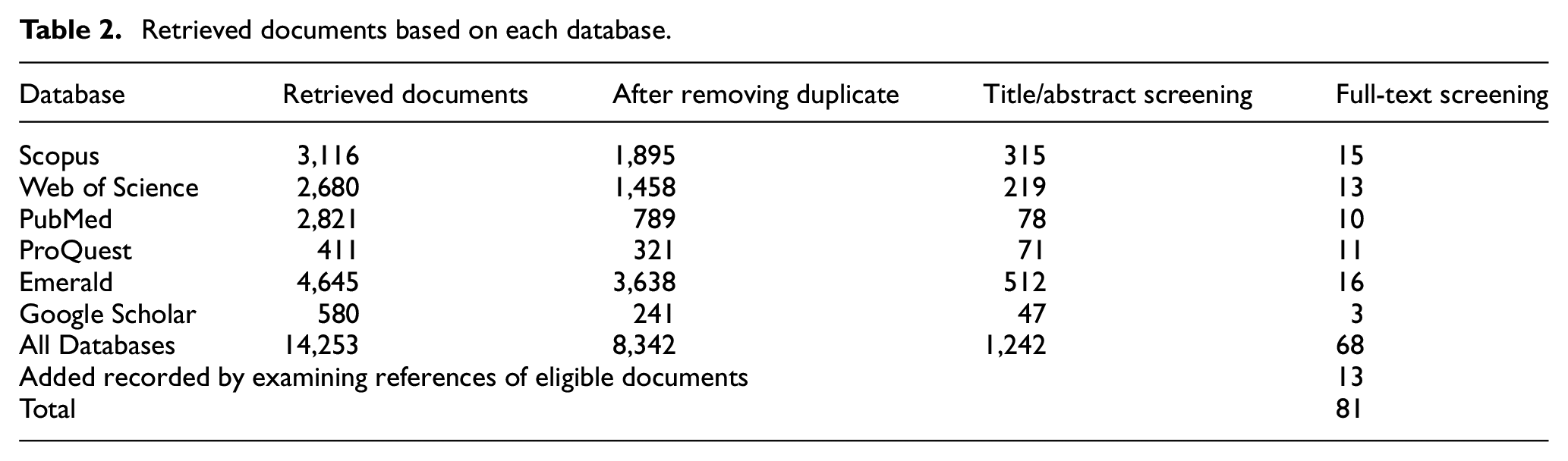
During the database search, a total of 14,253 studies were found. After removing duplicates using EndNote X8, 8,342 items remained. After screening the title and abstract, 1,242 records of relevant studies were identified, and 68 studies remained in the full-text screening stage. The selection of the full text of the studies was done by two reviewers independently. Finally, in the reference review of the selected studies, 13 other studies were included. Finally, 81 studies found the inclusion conditions (Table 2 and Figure 1).
Retrieved documents based on each database.
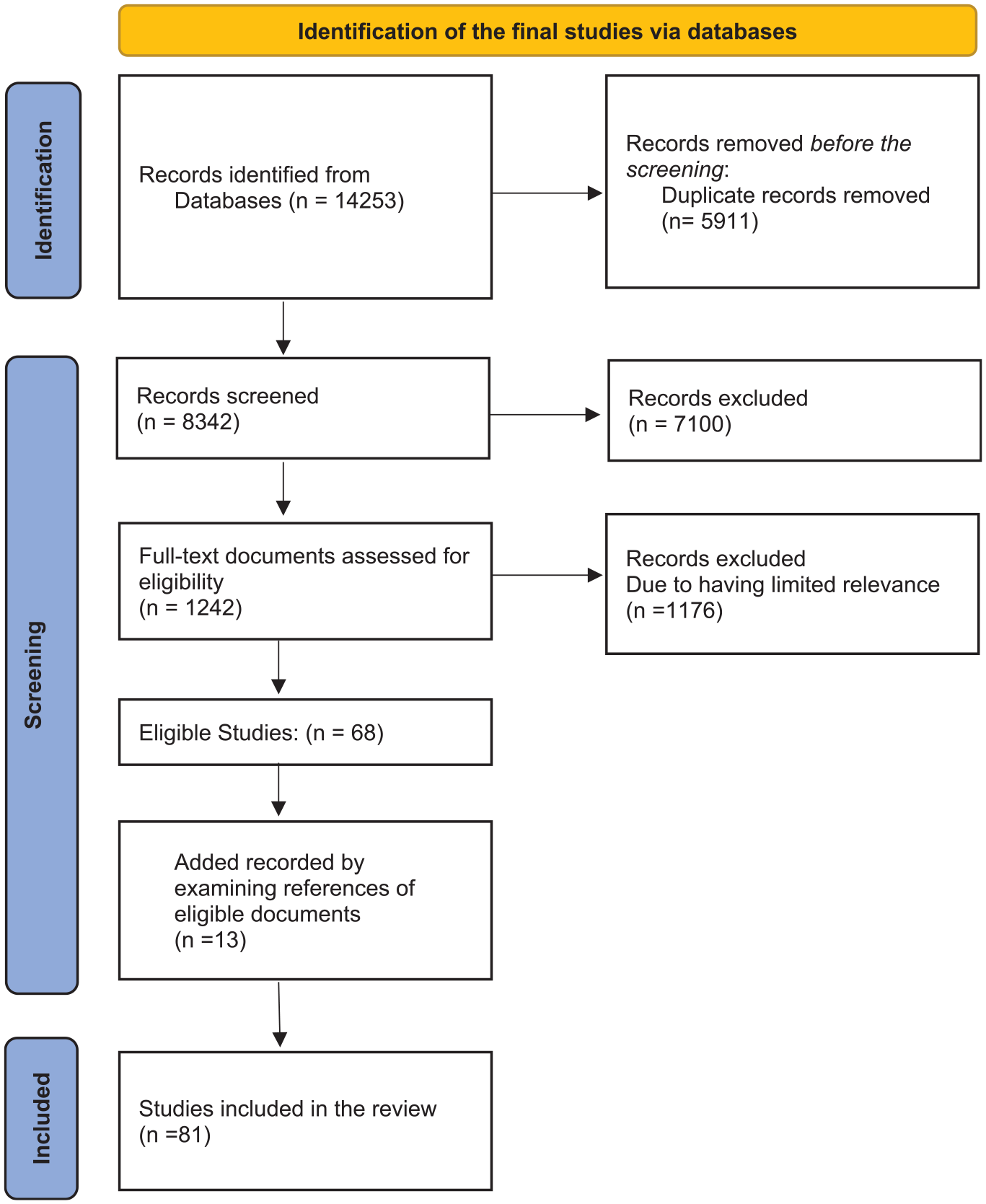
PRISMA flow diagram.
Based on the findings, 15 strong points for the H-index were identified in three general categories, which can be taken into consideration in compiling a comprehensive index (Table 3).
Strengths of the H-index obtained from studies.

Also, the review of studies led to the identification of 13 weak points of the H-index in six general categories. Paying attention to these cases and avoiding them can be useful in creating a comprehensive author-level index (Table 4).
Weaknesses of the H-index and suggestions for improving them obtained from studies.

4. Discussion and conclusions
There are many scientometrics indicators to evaluate the scientific production of researchers. These indicators claim to examine the quantity and quality of a researcher’s scientific production [6,24,29,69]. However, the main weakness of all existing indicators is that they consider one or more specific components for measurement and are not comprehensive. Some review studies have categorised the existing indicators into different groups of quantitative, qualitative, combined, supplementary H and adjusted indicators based on the scientific age of the researcher and the like [10]. In some cases, they have pointed out the strengths and weaknesses of each index, and how to calculate and use it in research evaluation [22,24]. In this study, while examining the strengths and weaknesses of the H-index, using the solutions provided in the H-based indices [8,16,32,47], the authors extracted, introduced and proposed the effective components in compiling a comprehensive index to evaluate the scientific productions of researchers. These proposed components are minimum necessary for compiling a comprehensive index.
In a general summary, the advantages of the H-index can be divided into three general categories: (1) quality features; (2) simplicity and (3) suitability. The details of these three categories are presented in Table 3 in the ‘Results’ section. Therefore, in developing an index, it is necessary to pay attention to all the strengths in these three general categories (Table 3).
The disadvantages and shortcomings of the H-index can also be divided into six general categories: (1) Insensitivity to Publication Types; (2) Insensitivity to Citation Patterns; (3) Insensitivity to Academic Age; (4) Insensitivity to Author Credit Allocation; (5) Insensitivity to type of fields and (6) Mathematical Calculation. The details of each of these six categories are presented in Table 4 in the ‘Results’ section. Therefore, it is necessary to avoid all the weak points in these six general categories in developing a comprehensive index (Table 4).
Also, the H-based indices have proposed solutions to solve the deficiencies of the H-index. For example, the H-index only calculates scientific productions that have citations and ignores a significant amount of published scientific productions without citations and unpublished ones [4]. Therefore, the H-index alone is not able to evaluate the comprehensive performance of a researcher. Another shortcoming of the H-index is its inability to distinguish between authors who have very different co-authorship patterns [6,91,104,105]. Since, in different subjects, the number of authors and their level of co-authorship are different, assigning credit to the contributors of research-h work is a challenging issue [20,21,77,98,106]. In some evidence, it has been suggested that the way to assign credit to each researcher is better to be based on the citation pattern of that subject area and the position of the researcher in the research work, and maybe some other factors [99]. The scientific age of the researcher [49,93], the scientific age of scientific productions [11,30,49,71,95], the received citation age [52,72], the citing resource and its credibility level [90], the frequency of citations in that resource [45,71,80,81], the type of source [90,107] and its affect in the scientific community and its affect in the scientific community should also be considered in developing an index. The issues related to the type of citation to distinguish true citation from false citation [91], self-citation [45,82,84,88,89,108,109] and other types of citation should also be considered in the evaluation of a researcher, although these are a bit difficult to calculate. Paying attention to the differences between field [2,29,44,49,70,89,98] citation patterns [4] and group co-authorship [44,101] of each field is also an important issue that has always been criticised by researchers.
Finally, by integrating the strengths of the H-index with the proposed solutions of H-based indices (Tables 3 and 4), the minimum components that need to be considered in developing a comprehensive author-level index can be proposed as follows (Figure 2). The first three categories are currently observed in the H-index and H-based indices, but other cases have been neglected, and it is hoped that all these cases will be included in a new index, so that researchers can be evaluated more realistically, and with less error.
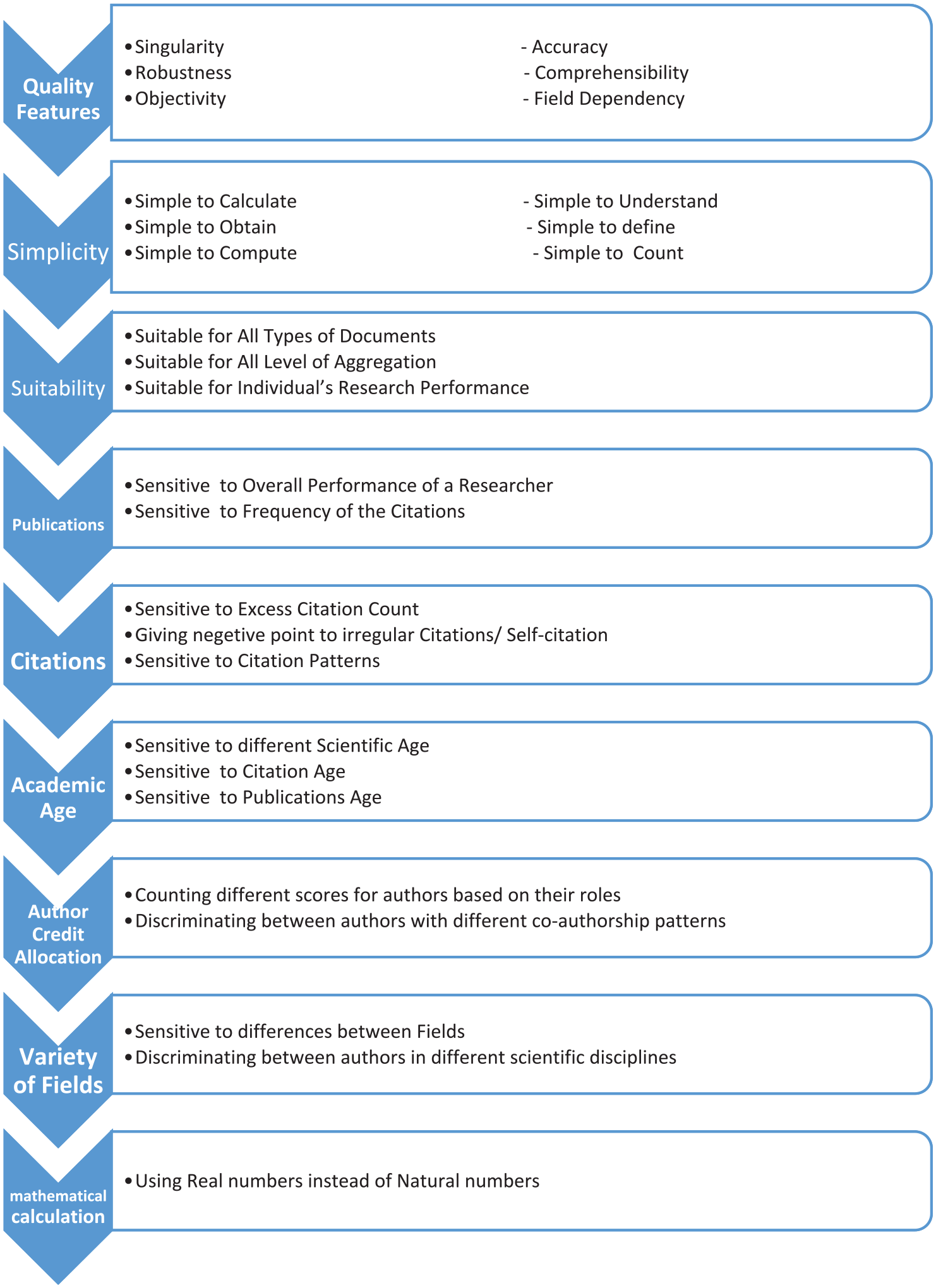
The minimum set of suggested components for developing a comprehensive author-level index.
Supplemental Material
sj-docx-1-jis-10.1177_01655515241293761 – Supplemental material for H-index and research evaluation: A suggested set of components for developing a comprehensive author-level index
Supplemental material, sj-docx-1-jis-10.1177_01655515241293761 for H-index and research evaluation: A suggested set of components for developing a comprehensive author-level index by Ali Norouzi, Parastoo Parsaei-Mohammadi, Firoozeh Zare-Farashbandi, Elahe Zare-Farashbandi and Ehsan Geraei in Journal of Information Science
Footnotes
Declaration of conflicting interests
The author(s) declared no potential conflicts of interest with respect to the research, authorship, and/or publication of this article.
Funding
The author(s) disclosed receipt of the following financial support for the research, authorship, and/or publication of this article: This research was supported by the Isfahan University of Medical Sciences with Scientific code 3400516 and ethical code IR.MUI.NUREMA.REC.1400.110.

Data availability
Data are available.
Supplemental material
Supplemental material for this article is available online.
References
Supplementary Material
Please find the following supplemental material available below.
For Open Access articles published under a Creative Commons License, all supplemental material carries the same license as the article it is associated with.
For non-Open Access articles published, all supplemental material carries a non-exclusive license, and permission requests for re-use of supplemental material or any part of supplemental material shall be sent directly to the copyright owner as specified in the copyright notice associated with the article.
