



Abstract
Background
The literature regarding the relationship between HRM and customer orientation in the service context largely ignores the processes and expected management actions outside marketing, and particularly within Human Resource Management. This has hampered the wider adoption of the Service Profit Chain (SPC) model. The present article is an attempt to rectify this problem; it draws on intellectual capital literature and the group psychology theory pioneered by Mary Follett to propose the Intellectual Capital Profit Chain (ICPC) model.
Objective
The paper links HRM and intellectual capital to the key marketing variables of customer orientation, customer satisfaction and to business performance in a full model that has not previously been presented.
Results
The ICPC model recasts intra- and inter-organizational activities as contributing to the accumulation of intellectual capital, in turn driving both engagement and customer orientation.
Conclusions
The development of the ICPC model forms the main contribution of this paper as it can serve as a framework for building and managing HRM configurations that align with human, social, and organizational capital to promote customer orientation.
Keywords
Introduction
Within the overarching discipline of management, the increasing divergence and specialization within sub-disciplines has long inhibited integrative approaches to understanding organizations. 1 Yet marketing and human resource management (HRM) are both areas of organizational practice focused on communication with understanding of other human parties. It is thus not surprising that a growing number of authors seek to connect the two, most commonly with employee customer orientation (CO) as the linchpin.2,3 One area which requires disciplinary integration between HRM and marketing is CO, involving the engagement of the members of the organization in activities 4 and relationships that extend beyond its boundaries. Because of its impact on performance, CO is important for all functions in the company, including but not limited to marketing, HRM, finance, and therefore requires a cross-disciplinary approach. Research devoted to market orientation, since the founding work of Kohli and Jaworski 5 and Narver and Slater 6 has essentially probed the relationship between market orientation and organizational performance. The publication of two meta-analyses7,8 and, more recently, the study of Pekovic and Rolland 9 have largely settled the issue, indicating that the company performance increases significantly when efforts are directed towards customer satisfaction. Hogreve et al. 10 have long sought to bridge this gap, calling for interdisciplinary research linking HRM and marketing practices through CO, conceptualizing internal service quality as systems of HRM practices. The most popular integrative framework conceptualizing this linkage is provided by the service profit chain (SPC) model, connecting the perspectives of HR, marketing, and finance. SPC links internal service quality and external service quality through employee satisfaction, which in turn leads to customer satisfaction and loyalty, generating revenue and profitability. The extended SPC model 11 supplements the above path to profit with the social identification path, positing that employee-company identification positively affects customer orientation and customer-firm identification, feeding, along with the satisfaction-based path, customer loyalty, willingness to pay and performance. Yet this framework carries some shortcomings. Hogreve et al. 10 suggest that future research should pinpoint HRM systems that determine internal service quality, SPC models do not include upstream HRM practices 11 and are based on marketing literature that may not be familiar to HR and finance managers. As a result, SPC has received limited attention from outside marketing. The SPC literature also remains largely silent on how specific HRM practices combine to enhance performance, and the original SPC model’s fit is not outstanding, indicating that SPC researchers should consider additional mechanisms that link internal and external marketing with firm performance. One of the reasons for this is that, despite their value, these previous studies propose essentially linear views of SPC, which are likely too simple and remote from the actual process. 10 Specifically, an improved model should include feedback loops within and between the different phases. There are, however, presently very few hints as to where these loops take place. The aim of this article is to fill this knowledge gap by identifying the various feedback loops existing and the role of Intellectual Capital (IC) to drive these loops. The core contribution of this study is to enhance and refine the current SPC models.
This article takes the form of a conceptual paper. More specifically, in Jaakkola’s 12 typology of four approaches towards designing conceptual papers, it represents a theory adaptation of the SPC model. The latter is found to be incomplete based on literature review, as it fails to integrate human resource systems upstream of the internal relationships in the managed organization. The study introduces Intellectual Capital as an alternative frame of reference to extant conceptualizations. Analogical reasoning (see Holyoak 13 for the methodology and Micheaux et al. 14 for an application from the marketing literature) is used to support the viability of this new frame of reference, and social learning and group psychology theory are brought in as method theories for CO, enabling the study to integrate IC and SPC within a single model. The underlying assumption that structures the argumentation of this study is that the alignment of HR systems with IC and CO viewed as a system provides a coherent systemic overview that allows the identification of HR practice systems that increase CO through the components of IC. Figure 2 shows the alignment of the three systems (HR, IC, CO) discussed in this paper.
The remainder of this paper is as follows. The next section discusses SPC, its developments and shortcomings in more detail. The third section brings in insights from the work of the management studies pioneer 15 and shows that the IC approach to the relationship between CO and satisfaction is congruous with the SPC approach. This analogical reasoning shows that IC incorporates these relationships in a new conceptualization that fits the target domain. The study proposes the IC perspective further contributes a multilevel dynamic that is not explicit in the SPC. Beyond its role in mediating the relationship between HRM practices and performance, 16 IC encompasses and nurtures the customer orientation-satisfaction relationship. Drawing on evidence from extant empirical studies, the fourth section argues that HRM practices targeted at the growth of each IC component and at increasing interactions between the components will increase CO, customer satisfaction and thereby the performance of the company. The result of the study is the Intellectual Capital Profit Chain (ICPC) model, a multidisciplinary model which integrates insights from SPC but addresses its main shortcomings noted above. The new theoretical view of the relationship between HRM practices and CO through IC allows the elements of the process to be organized in a multidisciplinary model that best fits the service context and shows the pathway to increased customer satisfaction. As a multidisciplinary framework, it is better fitted to the collaborative context allowing managers to use it to improve current practices. By establishing a new association between Guest’s 17 broad HRM objectives and IC concept in the marketing services context, this article answers his unanswered question “what combinations of practices can be effective in given circumstances?” The paper concludes by summarizing the theoretical contribution and proposing managerial implications.
The service profit chain and its limitations
The SPC illustrates how investments in internal service quality translate into external service quality, in turn leading to satisfied and loyal customers the basis of superior firm performance.10,18 The SPC model, particularly in its extended form (Figure 1), offers a useful framework for understanding how HRM practices can increase companies’ financial performance through employee CO. This model has two paths to performance: the satisfaction-based path found in traditional SPC models and a social identity-based path that integrates customer relationship characteristics. Internal service quality or supporting services and policies that enable employees to deliver results to customers, translates into service performance through mechanisms not limited to employee satisfaction. Extended SPC adapted from Homburg et al.
11
(p. 40).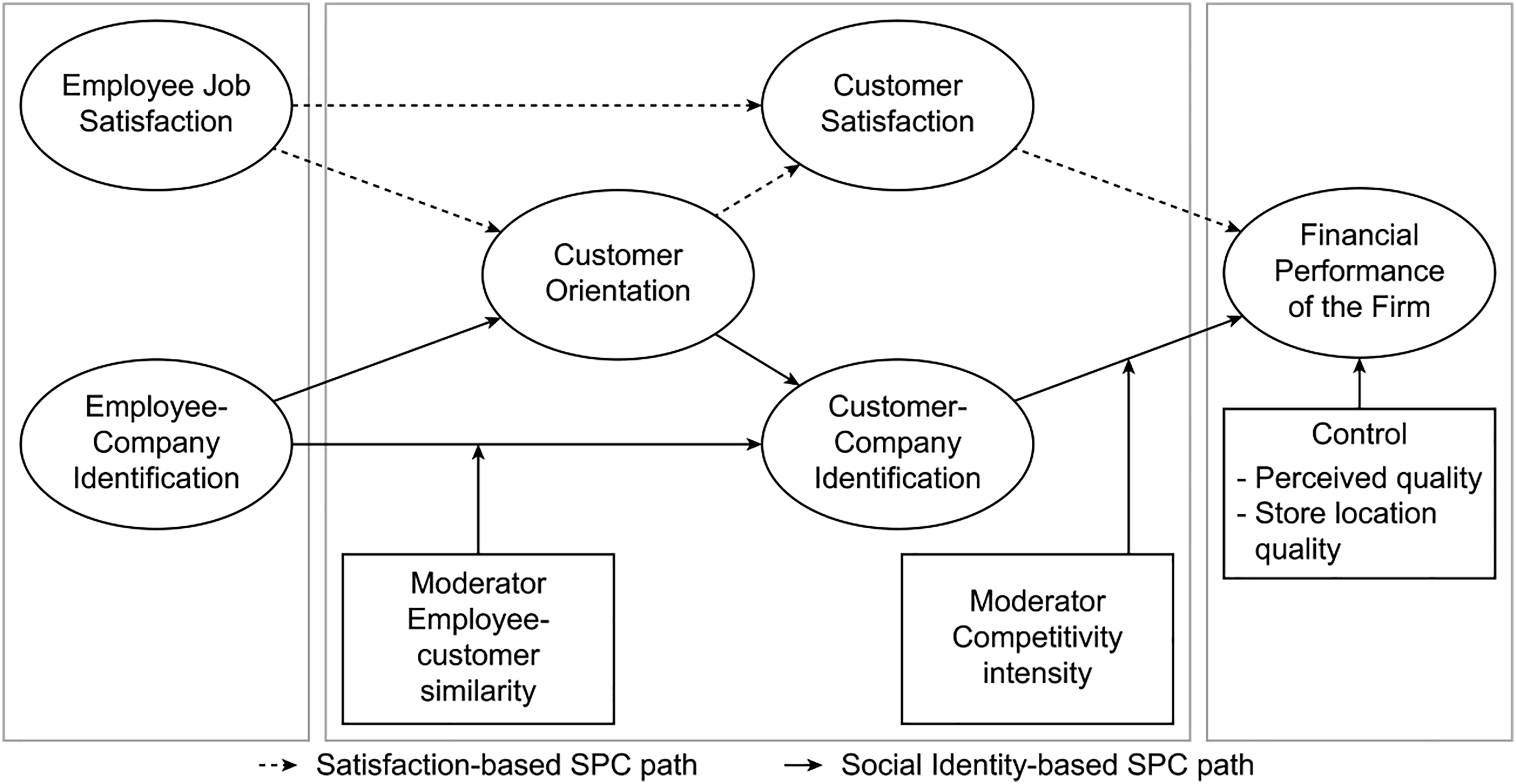
Nevertheless, SPC literature remains largely silent on how specific HRM practices combine to enhance performance. Hogreve et al.’s meta-analysis of 518 studies 19 shows that the empirical evidence on SPC remains fragmented and somewhat ambivalent, and the authors ask future researchers to provide empirical evidence on a broader range of internal service quality practices and direct links between internal marketing, external marketing, and organizational performance. While some of these shortcomings are addressed by the extended SPC model, this paper argues that the problem is wider, and that deeper rethinking is needed to account for the non-linear and feedback effects. Consequently, the study posits IC as the missing conceptual element. The SPC model has three parts, each with distinct mechanisms based on employee, customer, and financial data, suggesting specific roles for the managers of each functional department of the organization. However, the model does not encourage collective focus and investment decisions on common elements. Moreover, the call for defining the HRM practices that should be plugged upstream of the SPC has not yet been answered.10,11 Saxe and Weitz 20 (p. 344) define CO as “the degree to which salespeople implement the marketing concept by trying to help customers make purchasing decisions that meet their needs.” Satisfaction is defined as the satisfaction of customer expectations of a product or service. 21 Because customer-oriented employees are intrinsically motivated to engage in behaviours aimed at increasing customer satisfaction, the relationship between the two constructs is implicit in the definition of CO. CO can be conceptualized at the strategic organizational level 22 and at the individual employee level. According to the extended SPC, employees develop and adjust their service standards, and the customers do the same for their expectations through identification with the company, a social learning process that is rooted in self-esteem. 23 Therefore, the customer-satisfaction relationship can be seen as a system of norms that is adjusted through multiple interactions within and outside the company. These interactions include one-on-one service interactions, digital marketing interactions designed to optimize the customer experience, 24 employee collaboration, including through the digital tools that increasingly equip frontline workers. It follows that investments in HRM practices to increase customer orientation will have an impact at several levels: at the organizational, strategic level, to provide the corporate culture, structures and processes needed to promote the company’s customer orientation; at the individual level to equip employees with the knowledge and skills they need to provide high quality service; and at the social group level to encourage mutual learning among employees and foster the quality of relationships within and outside the company. Marketers and employees with specialist knowledge and skills design and produce these digital experiences. How these skills are developed and relate to customer orientation is not explicitly addressed in the SPC. Although implicit in the social identification process, the relationships between employees in the production and use of collective intelligence to improve the customer service experience are not mentioned. These shortcomings limit the operationalization of SPC. In traditional satisfaction-based SPC path, strategic CO assumes a “direct link between superior customer service and sustainable profit growth” through “employee engagement, customer satisfaction and retention, profitability and value creation” 25 (p. 627). However, such a link has not been observed in practice or in follow-up studies. This study proposes the underlying dynamic is better represented through the lens of IC than through the SPC. Taking a broad systems view of the underlying mechanisms of IC that drive customer orientation and customer satisfaction allows to align HRM practice systems with the components of IC in a parsimonious model 26 that better fits the service context and is more easily operationalized than plugging HRM practices directly upstream of the SPC. There already exists a well-established body of literature that justifies IC as a mediator between HRM practice systems and performance. 27 But these contributions have not yet been explicitly included in the discussion around customer orientation and remain outside the scope of more marketing-focused reflections. Combining these theoretical streams allows for the contextualization of the HRM-intellectual capital-performance model in the service sector. Furthermore, IC, as an intangible asset, incorporates knowledge management 28 and digital tools, whereas the SPC does not explicitly include these important contributors to high quality customer service.
IC and social learning as a complement to SPC
While minor differences exist in defining IC, Subramaniam and Youndt’s broad description of the concept as “the sum of all knowledge firms utilize for competitive advantage” 29 (p. 451) can serve as a useful starting point. Since the notion of useable knowledge covers a wide variety of forms of knowing and of holding knowledge, three forms of IC are commonly distinguished in management literature: human, social, and organizational capital. 29 This study follows this delineation. Despite gaining some traction within the domain of HRM, the concept of IC is still little used in marketing other than for the measurement of intangible value such as buyer-seller relationships, 30 competitive intelligence 28 or marketing assets. 26 Despite apparent compatibility of the concept with business perspective, there is a need for pedagogy because managers can use IC concept without really understanding it. 31 IC is composed of human, social and organizational capital. It is a form of “disinterested” capital in Bourdieu’s 32 sense. In other words, although IC is built on economic capital through mercantile transactions and self-interested exchanges, its economic root is concealed. IC includes, through the collective dimension of human capital, Bourdieu’s cultural capital, i.e., the knowledge embodied by individuals, derived from early exposure to art, literature, etc., objectified in terms of the production of writings, paintings, monuments, etc. and institutionalized in the form of academic qualifications. It includes Bourdieu’s social capital in the form of connections, the collectively owned resources constructed through relationships that involve mutual recognition, enriched by the collective dimension of cultural capital that the network incorporates. The human, social and organizational components of IC form the set of intrinsically linked cognitive structures and processes on which firms build their performance.16,33 Youndt and Snell 27 distil from the literature the following definitions of the components of IC: Human capital “refers to individual employees’ knowledge, skills and expertise” and organizational capital “represents institutionalized knowledge and codified experience stored in databases, routines, manuals and structure.” Importantly, social capital includes the value of all relationships, including those with customers34,35 and other stakeholders, such as suppliers, the government or related industry associations. With this preliminary understanding of the IC perspective, it is useful to consider Murthy and Mouritsen’s 25 study of a bank whose attempt to invest in customer data technology did not yield positive results. This contradicts SPC expectations, but, from an IC perspective, the failure can be recast as a failure to recognize that the relationship between human, social, and organizational capital and to realize that performance is a long-term concern, 35 whereas the implementation of customer-oriented technologies generates short-term costs. Murthy and Mouritsen highlight the interweaving of IC’s components and its dynamic nature. “The mobilization of IC involves, surprisingly, first its decomposition to make it manageable, then its continuous reconstruction to make it practicable” 25 (p. 623). In this dynamic and iterative view of IC development and its impact on performance, each component is affected by structural links and repeated interactions with other components. The contribution of information technologies and digital business tools is assessed in terms of human and social capital. Organizational capital cannot be developed without human input. Customer relationship quality depends on employee expertise, 36 supported by the network of employee interactions. It seems difficult to distinguish, as Bontis 35 does, between IC and the continuous organizational learning process that constitutes it. As Bourdieu 32 underlines, all forms of capital are interlinked and are accumulative in nature. Murthy and Mouritsen’s 25 study suggests that, rather than disaggregating investment in each component of IC, it would be more efficient to target investment in combined elements of IC while aiming to increase human capital. A recent study by Bamahros 37 highlights also that external influences, including personal characteristics of significant organizational stakeholders, play an important role in constituting IC within the organization.
Investment in organizational capital in the form of digital tools that help employees in their daily work life will increase job satisfaction, creating positive effects on employees’ customer orientation, consistent with the satisfaction based SPC path. Moreover, if these tools truly lighten employees’ workload, they create motivation to adopt prosocial behaviours 38 that benefit both colleagues and customers. Furthermore, prosocial behaviours are fostered by servant leadership, which is anchored in social identity theory, 39 consistent with the social-identification path of the extended SPC. Bontis 35 (p. 66) defines structural capital as “the mechanisms and structures of the organization that can help support employees in their quest for optimum intellectual performance and therefore overall business performance.” However, Bontis 35 transcends the emphasis on tools and processes to focus on transforming an organizational culture into a people-centred culture. “An organization with strong structural capital will have a supportive culture that allows individuals to try, fail, learn and try again.” Encouraging risk-taking and the right to make mistakes and giving employees the freedom of action are transformational and servant leadership behaviours (see Eva et al. 39 for a review) that provide employees with a sense of psychological security, fostering creativity and effective teamwork. 40 A servant leader 41 is primarily concerned with serving the employees with whom he or she interacts. Servant leadership influences the service quality, customer-oriented citizenship behaviour and customer-oriented prosocial behaviour of employees in contact with customers. 40 Consistent with Homburg et al.’s 11 finding that customer satisfaction is not very strongly dependent on employee job satisfaction, the relationship between organizational capital and customer satisfaction is better explained by the development of a corporate culture and leadership style that values front-line employees and fosters their intrinsic motivation to satisfy customers. The satisfaction based SPC path can be understood at an individual or collective level. The social identity based SPC path pertains to individual psychology in relation to the group. The IC concept integrates this multilevel construction: customer orientation is forged in the singular competencies that form human capital, develops as social capital, and is structured through investment in organizational capital. Follett’s 15 group psychology theory provides further insight into the pivotal role of social capital in fostering customer orientation. Similarly, the social identity branch of the extended SPC 11 uses self-categorization through group membership to describe the process of employee-firm and customer-firm identification. However, Follett’s 15 concept of the “circular response” further contributes to the integrative properties of the dynamics of social capital: the frequency and diversity of interactions within social capital build identity and strengthen or degrade self-esteem. During each person’s actions and interactions, the “relational arcs” from each individual to his or her set of norms adjust and self-regulate, offering, with all the intelligence and effort required, the possibility of “integrating desires” into a new creation rather than creating a compromise that cannot be satisfied. When members of a group use strategies of “power with” rather than “power over,” they create new ideas that respond to the desires of each individual rather than denying desires or making compromises. Thus, customer orientation operates as “power with,” and the relationship between employee customer orientation and customer satisfaction can be defined as a system that integrates desires. Conceptualizing the employee-customer encounter as a system of paired norms that synchronize to create joint employee and customer satisfaction contributes a systemic view of the service encounter, consistent with HRM practice systems and IC as a dynamic, multilevel system. Follett’s group psychology theory can also be used to conceptualize the interdependence of individual and collective levels of IC and the transfer between these levels. In their multilevel study, Wang, Yen, and Liu 42 show the positive relationship between increasing IC and individual performance (human capital) under conditions of interdependence (social capital); increasing collaborative interactions strengthens both the autonomy and the interdependence of individuals. This collaboration leads to the construction of shared cognition, contingent on effective teamwork. The synchronization of the employee’s and the customer’s behavioural norms constitutes an integrative cognitive construction. This creative process embodies the “power with” approach and forges, through their intertwined relational arcs, the union of the employee and the customer with the whole. Therefore, HRM practices aimed at increasing the transfer dynamics between the levels of human and social capital, the interdependence of the actors, the frequency of their interactions and promoting the co-construction of shared cognition will favour the process of employee and customer identification with the organization. Similarly, under the condition of the interdependence of stakeholders, investments in structural capital will promote stakeholders’ autonomy and performance for successful co-construction. Because it integrates both the reinforcement of the employee’s self-concept in relation to that of the customer and the collective process of social identity construction, IC is congruent with and can substitute for the social identity path elements between HRM practices and customer satisfaction in the SPC. Moreover, through its dynamic properties and multilevel structure, IC better reflects the interactions, interdependence and transfers between individuals and groups in the organizational context. As a parsimonious, transdisciplinary concept used in accounting and finance 37 as well as systems and knowledge management it provides a better collective representation and common investment focus for managers from different disciplines.
Intellectual capital as a mediating factor integrating HRM and CO
The literature describes HRM as a set of practices that impact the competencies of individuals in such a way as to positively affect organizational performance 43 by ensuring a high learning capacity. 44 HRM emphasizes the human factor, thus promoting the company’s sustainability. The achievement of the company’s objectives depends fundamentally on the effective collaboration of its employees. An employee who is fully integrated into the company is an employee who cares about the company’s future and is aligned with it. The company’s success is his or her own success. Snell and Dean 45 (p. 473) noted that the primary way in which firms invest in their employees is through their human resource practices. Rather than directing HRM efforts to increasing internal service quality or company-employee identification, according to the SPC, this paper proposes that HRM practices should be targeted at each of the components of IC. The growth of each IC component and the increase in interactions between the components will increase customer orientation, customer satisfaction and thereby the performance of the company. By introducing IC as a mediating construct, Youndt and Snell 27 demonstrate how HRM systems drive organizational performance. They suggest that HRM activities do not directly improve performance at the organizational level but enhance IC through its components, which in turn drive organizational performance. The influence of HRM practices on customer satisfaction is mediated by IC. Satisfaction is linked to performance at the organizational level through the company’s customer-oriented strategy. 46 This strategic consideration leads the company to invest in the different components of IC. Each of these components can play a role in customer and performance orientation. 43 The work of Lin et al. 46 is encouraging when considering the relationship between HRM and customer orientation, although it does not integrate the components of IC. Lin et al. emphasize the role of individuals in developing customer orientation and show how HRM influences citizenship behaviour. Therefore, HRM practices can strengthen employees’ customer orientation by increasing IC. HRM is not only the primary means by which firms can influence and shape the skills, attitudes and behaviour of individuals, 47 it also creates a supportive organizational structure and environment in which firms can develop knowledge and resources. 48 The mediating role of IC allows to integrate both the direct effects of customer-oriented HRM practices on human capital (e.g., training), social capital (e.g., deployment of corporate social networks) and organizational capital (e.g., customer databases) and the indirect effects via the increase in interlevel dynamics, promoting social identification 23 and creativity 40 ; through the interactions of the individual employees with the group. 15 Soo et al. 47 point out that theoretical inputs are still lacking to guide the transfer of human capital inputs between the individual and organizational levels of IC. Conceptualizing the relationship between IC and employee customer orientation in a marketing context helps clarify this shift in level. Mirroring the human, social and organizational levels of IC, consistent with Follett’s group psychology theory, marketing focuses on three levels of analysis, represented by individuals, groups, and society as a whole. The relational arcs formed between these entities and the cross-level dynamics of the circular response concept are precursors to Bandura’s 23 social learning theory, included in self-concept identity construction theory. As argued supra, these processes are implicit in IC. Because of its multilevel structure and intrinsic relational nature, IC is positioned at the point of contact between consumers and the company agents that serve them, including all the actors that produce its products and services as well as the customers’ relationships with them.
Intellectual capital profit chain: A multidisciplinary model to fit the services context
Following Lindgreen et al.,
49
this study proposes a mid-range theory conceptual model that emerges from the general theoretical IC perspective and integrates insights from HRM as well as from SPC. The model, the Intellectual Capital Profit Chain, or ICPC, shown in Figure 2, is thus interdisciplinary, takes a systems perspective, and is service context specific with the aim of guiding managerial practices. It is a process model that “seeks to unveil the ‘big picture’ patterns, connections, and mechanisms rather than specific causal relationships”
49
(p. A4). Intellectual Capital Profit Chain model.
The right-hand side of the model results from the transposition of extended SPC to the meta-level conceptual system provided by IC theory, which better represents the phenomena of interest. The following sections inform this theory from the extant HRM and organizational learning literature, with the underlying assumption that aligning HRM and IC systems will be more effective in increasing CO than plugging bundled HRM practices directly into CO. Based on the understanding and domain knowledge of IC and HRM systems, a useful managerial framework emerges that presents the underlying mechanisms of the HRM-IC-CO system leading to performance.
There is a great deal of interest in systems of coherent or “bundled” HRM practices that enhance the firm’s performance.17,50 Yet the effect is not direct: at best, HRM practices can enrich the individual’s knowledge and skills (human capital), facilitate group interaction and knowledge sharing (social capital), 48 contribute to the institutionalization of organizational know-how, disseminate key characteristics of the firm’s culture, values, and beliefs, and reinforce shared interpretations (organizational capital). 51 Over time, these developments can impact organizational performance. Although Youndt and Snell 27 and following works allowed for integrating corporate strategy and HRM through intellectual capital, the resultant discussion never became multidisciplinary or contextualized. As a result, the existing literature tends to be restricted to a human capital-focused view of HRM. Studying the relationship between HRM practices and customer orientation through IC would benefit more from a wider approach to HRM. Guest’s17,52 objectives for HRM, i.e., quality (both in terms of required worker attributes and worker performance), workforce flexibility, employee commitment and strategic integration of HRM policies and practices, extend beyond human capital. These include organizational-level goals as they relate to the cultural aspects of organizational capital, flexibility that encourages employee empowerment and creative teamwork conducive to customer orientation, and quality as an essential component of the service-profit chain. Therefore, practice systems that integrate these goals in relation to IC as well as the learning processes that foster the interlevel transfer mechanisms should achieve a better fit in the services context than the set of practice systems that has been proposed. 27 Drawing on this rationale, we propose a new model, the Intellectual Capital Profit Chain, which integrates both a functional logic of the components of IC and the implementation of social and HRM mechanisms to reinforce individual and organizational learning. 48 The arguments developed below are shown in Figure 2.
How HRM systems develop customer orientation through human capital aspect of IC
Human capital is the most important organizational resource because without people, no business can function. The HR development’s mission is to ensure its mobilization, renewal, and development. Crucial to customer satisfaction in the service encounter, human capital is not immune to depreciation and therefore requires constant nurturing. As an alternative to the HRM acquisition configuration that promotes human capital through recruitment, Kang, Morris and Snell 48 and Youndt and Snell 27 propose the developmental system that leverages the existing human capital of generalists and specialists to supplement the company’s knowledge stock. Specialists have knowledge embedded and invested in very specific areas of knowledge. 48 Operational services that require specialized human capital may include travel, installation, software, or web development services involving technology-related skills. Generalists tend to be multiskilled with a diverse arsenal of skills that can be used in various situations. Strategic consulting services require generalist human capital. The definition and maintenance of skills repositories, job specification, rotation, and training are elements of the developmental system that are strongly linked to human capital growth. According to Kang, Morris and Snell, 48 specialist development requires a tight definition of skills and low rotation, while generalist development involves cultivating the ability to generate new ideas that encompass future developments in professional knowledge and a relatively higher rotation to encourage versatility. In the following decade, authors argued that all employees should be encouraged to develop their knowledge through job rotation, internal promotion, training, supportive feedback, and compensation that rewards skill and knowledge acquisition. Youndt and Snell’s 27 developmental HRM configuration is retained in ICPC. In the developmental system, HRM must ensure that employees possess and mobilize their skills for the benefit of the company. The developmental system meets Guest’s17,52 goal of quality in a broad sense. Customer relationship quality depends on employee expertise. 36 The more knowledgeable an organization’s employees are, the better they will understand customer needs and be able to retain them, increasing relational capital. 35 These relationships develop over time as employees’ knowledge and skills grow and through their use in customer relationships. Being able to satisfy the customer will strengthen the employee’s self-concept, reinforcing the desire to satisfy more. In addition, the company’s investment of time in the transmission of cultural capital to often low-skilled service employees can compensate for a primitive acquisitive deficit that, as Bourdieu 32 points out, can be seen as a handicap to be made up. Repairing this injustice in the nurturing environment of the firm will generate reciprocal organizational citizenship behaviour.
How HRM systems develop customer orientation through social capital aspect of IC
Youndt and Snell 27 found that social capital exerted the strongest of the effects of IC components on performance. To increase social capital, it is essential for the company to stimulate the information exchange through the connections that develop between individuals, groups, and the organization. HRM practices that focus on the development and promotion of social capital should create opportunities for employees to establish social relationships, increase their efforts to develop social relationships, and enhance their ability to maintain and improve these relationships. 48 Network-building HRM practices help and motivate employees to enlarge their social capital 40 It is therefore important to mobilize collaboration and remove barriers to it. This is particularly important in the services sector, where the product is knowledge-based and collaboration among employees leads to faster resolution of customer service issues. Therefore, willingness to share knowledge and the successful integration of service employees into the group are essential to the growth of social capital. Renzl 53 showed that trust in management reduces the fear of employees working on knowledge-intensive projects of losing their unique value, thus increasing their willingness to share knowledge, a prosocial behaviour in alignment with customer orientation. Trust underpins the affective dimension of the three dimensions of social capital, defined by Kang and Snell, 54 the other two dimensions being the structural configuration of networks (strength and density) and the cognitive dimension (degree of partiality of shared knowledge to the whole). Among the relational archetypes proposed by these authors, the cooperative archetype relates to internal collaboration among employees that share architectural knowledge through their day-to-day work, networks are strong and dense, and trust is generalized through social belonging. As the level of societal trust in an organization is positively linked to customer orientation 55 the cooperative relational archetype that operates an exploitative learning mode 54 deepening and extending existing knowledge is therefore the best fit for the services context. Kang, Morris and Snell 48 describe the employee relations system as a set of HRM practices including attachment, socialization, advancement, and inducement that are strongly attached to social capital. An employee relations system based on the internal labour market includes internal promotion, collective-based compensation, and socialization, including mentoring and team structures. 54 Cooperative social capital extends beyond the boundaries of the firm. 54 In the service encounter, employee-client relationships based on dyadic trust are entrepreneurial relational archetypes where the common knowledge component is restricted to the specific knowledge needed for the provision of the service. However, through the process of social identification, the synchronization of employee and customer norms, dyadic trust will evolve into generalized trust as the standards become institutionalized. Therefore, the integration of the customer orientation-satisfaction system with IC helps reconcile exploitative and exploratory learning. In other words, HRM practices that increase social capital with the aim of customer orientation will further reinforce cooperative social capital and organizational capital through the synchronized standards of customers and employees. Youndt and Snell 27 show that the effect of the collaborative HRM configuration on performance is mediated by social capital. A collaborative configuration is based on interpersonal skills, team building, a multiple-source appraisal system (such as peer reviews), group-based incentives, cross-functional teamwork and includes cross-boundary teams such as customer-employee teams and networks, and both allows and encourages knowledge sharing based on trust among members. 56 Through the relational arcs that form during social interaction with customers and colleagues, customer-oriented employees create new ideas with colleagues and customers rather than refusing desires or making compromises. 15 The intimacy that develops in effective teams is contingent on a climate of psychological safety, conducive to creativity. 40
How HRM systems develop customer orientation through organizational capital aspect of IC
Beyond institutionalized knowledge and the codified systems, documents, and processes that define it, 27 organizational capital extends to include supportive organizational culture. This aspect is of primary importance to customer orientation because a people-centred culture, generalized trust, and a flexible, teamwork-oriented organizational design encourage organizational citizenship behaviours that include customer orientation. Many researchers have argued that the organizational context in which teams operate will influence their performance and effectiveness, as it can be either constraining or facilitating toward teams. 57 Research highlights the role of teamwork in organizational performance. 58 Functional synchronization 59 between employees of achievable standards that satisfy customers can take place within the psychological safety of the team. For psychological safety to exist, there must be an organizational culture that accepts error. Bontis 35 argues that firms with strong structural capital will have supportive cultures that will allow trial and error. It is interesting to note the parallel with the primitive acquisition of cultural capital described by Bourdieu 32 in the context of the safety of the parental home, enriched with cultural artifacts. Encouraging trial and error is the role of management as parents in the nurturing organization. Error-embracing HRM high-performance configurations develop organic organizational capital, as opposed to error-avoiding high-control configurations that develop mechanistic organizational capital 54 (p. 81). Organic organizational capital “encourages individuals to develop a variety of behavioural repertories and to flexibly adjust them to perceived situations.” HRM systems that grow organic organizational capital through exploratory learning are appropriate to the services context because they empower employees to deal with situations in creative ways. In the service encounter, employee empowerment allows us to resolve situations that condition the customer’s experience at the “moment of truth,” decisive for the outcome of the relationship. 60 Guest’s 17 HRM goal of flexibility or adaptability entailing flexible organizational structures, job content and employees is adapted to growing organic organizational capital in service contexts. Characteristics of flexibility include a non-rigid organizational structure, autonomous work groups, the ability to manage change, project management, versatility, and a willingness of the workforce to rotate between tasks. But flexibility is only possible “if employees at all levels display high organizational commitment, high trust and high levels of intrinsic motivation” 52 (p. 514). Commitment has been shown to be linked to organizational citizenship behaviour. When commitment is high, the employee’s values are aligned with the organization, and he or she desires to do what is best for the organization. 61 The high-commitment system 62 develops HRM strategies that emphasize flexibility, teamwork, and job design. The system promotes organizational capital through a minimum of control structures that provide both effective stability and flexibility for improvisation or modification as well as encouraging creativity. 63 According to Pfeffer, 62 the high-commitment system, consistent with the ideas of Walton, 64 includes employment security and internal labour markets, teamwork, and high compensation contingent on performance. The high-commitment system is based on a managerial philosophy at the centre of which is the belief that “eliciting employee commitment will lead to enhanced performance” 64 (p. 80). The model is best suited to environments “requiring intricate team-work, problem solving, organizational learning and self-monitoring.” The premise is that high-commitment HRM systems shape employee behaviours and attitudes by developing psychological links between organizational and employee goals. The model is anchored in the concept of organizational commitment and the psychological contracts between individuals and the organization. “Stretch objectives” that emphasize continuous quality improvement serve as high performance goals instead of rigid corporate standards or minima. 64 Jobs are designed to provide meaning, autonomy, and collaborative responsibility for work areas. Participatory decision-making, problem-solving and counselling practices secure individual trajectories and generate trust. Finally, performance is rewarded according to a logic of collective equity through variable compensation practices based on profit sharing. The high commitment model fits the services context for HRM practices aimed at increasing customer orientation through developing the organizational culture and design that supports organic capital growth. It promotes organizational citizenship behaviour, contributes to generalized trust and empowers employees to satisfy the customer in situations that arise in the service encounter. Implementing high commitment conditions with employees nurtures workers’ performance capabilities, provides them with performance opportunities and motivates them to achieve company goals.56,65 High-performing employees are more likely to create a positive service experience. 66 The commitment system grows organizational capital through flexibility and error-embracing culture and social capital through collaboration and nurtures human capital through internal promotion and supportive feedback. Among the examples of companies implementing the commitment model cited by Walton 64 was the joint effort between the Communication Workers of America industrial union and AT&T to promote quality of working life. Greenleaf, 41 a former executive of AT&T, introduced servant leadership, which has been shown to be linked to employee commitment to the organization and to change. A “manager-leader” who sees themselves first and foremost as a servant of the organization and of their followers plays a different role and adopts different attitudes and behaviours than a traditional manager. 39 Servant leadership stems from an intrinsic motivation on the part of the line manager to help, enrich and elevate others to new possibilities and new levels of professional achievement, both as an individual and as a team member. 67 Indeed, McCune Stein and Ai Min 68 found a negative interaction between servant leadership and high commitment HRM on employee engagement and empowerment: the two approaches substitute each other. However, the substitution occurred only when employees did not perceive their manager as a servant leader: in other words, when the declared managerial approach was not the one experienced by the employee. As Walton 64 (p. 80) points out, to achieve the performance gains expected from the high commitment model, managers at all levels of the company must “invest extra effort, develop new skills and relationships, cope with higher levels of ambiguity and uncertainty and experience the pain and discomfort associated with changing habits and attitudes.” Therefore, servant leadership should be integrated into high-commitment HRM for its positive effects on the quality of working life and, consequently, on organization-wide customer orientation. High commitment should thus be seen as an organization-wide cognitive capacity “habitus,” 32 built through an investment of time to develop human and social capital, which, in turn, is converted into performance through the social learning and reciprocal behaviour of employees and customers; IC is a collectively owned construct that extends beyond the boundaries of the firm.
Conclusion
This paper highlights the role of IC as a set of social and organizational learning processes that promote not only the strategic customer orientation of the company but also employee customer orientation, thus integrating the satisfaction and social identity facets of the service-profit chain. 11 Rather than adapting individual practices to the components of the SPC model, the association of HRM practices with IC allows for a more synthetic indicator 26 and for a broad HRM practice approach. In this, the firm is considered as a nurturing organization that helps grow human capital in a service context where new employees can arrive with a primary time-handicap in acquired cultural capital. The issue has become all the more important, as the recent, COVID-19 health crisis highlighted the importance of social capital for human capital development. 69 Drawing on the dynamic nature of intellectual capital, the ICPC model allows integration of HRM and marketing practices through social learning implicit in the conversion processes between the components of IC and economic performance. The development of the ICPC model forms the main contribution of this paper, as it can serve as a framework for building and managing HRM configurations that align with human, social, and organizational capital to promote customer orientation. By proposing a parsimonious model with concepts that can be observed in the field, this article attempts to accommodate Guest’s 17 unanswered question, “what combinations of practices can be effective in given circumstances?” At the organizational level, exploratory learning that is necessary for dealing with new situations that occur in customer relationships is complementary to the exploitative learning processes that are linked to specialist human capital and cooperative social capital. 48 Therefore, synergistic HRM systems that combine to increase specialist human capital, cooperative social capital and organic organizational capital are adapted to operational service contexts. Consistent with prior research, three HRM systems have been identified. The HR development system combines skills requirements, job specification, rotation, and training to target human capital, which is essential to customer orientation. In the services context, social capital requires a relational HRM system that privileges the internal labour market and promotes collaboration. Finally, organizational capital fosters and benefits from the reciprocal, social relations embedded in the company. These extend beyond the boundaries of the organization to include dyadic relationships and cross-border employee-customer teams. There is scope at this level for HRM that promotes quality and employee flexibility. To this end, a high-commitment HRM system contributes to the supportive, error-embracing corporate culture that builds organic capital. For the high-commitment HRM configuration, the ICPC promotes integration of servant leadership that could eventually reduce the costs of the HRM system while improving QWL, affective commitment, and psychological empowerment and promoting organizational citizenship behaviours, among which customer orientation. Providing digital tools and customer databases that help front-line workers in the service encounter, with an emphasis on improving their quality of working life, also contributes to organizational capital and promotes customer orientation within the scope of the high commitment configuration. This framework may be useful to researchers and managers seeking to relate HRM practices to customer orientation.
Statements and Declarations
Footnotes
Acknowledgements
The authors contributed equally to this work.
Author contributions
Conception: Micheaux A. & Aribi A.
Preparation of the manuscript: Aribi A.
Revision for important intellectual content: Kociatkiewicz J. & Aribi A.
Supervision: Micheaux A.
Conflicting interests
The authors declared no potential conflicts of interest with respect to the research, authorship, and/or publication of this article.
Funding
The authors received no financial support for the research, authorship, and/or publication of this article.
