



Abstract
Introduction
One lesson from the COVID-19 crisis is that Human Resources Management (HRM) has a strategic role in digital business empowerment.1–3 HRM brings the excessive demands to a manageable balance through personnel development, occupational health, and safety.4–7
Even after the pandemic, digitalization continues to gain momentum, and for some employees, Information and Communication Technology (ICT) has become a permanent crisis due to uncertainty and technostress.8–10 Employees are concerned that Artificial Intelligence (AI) threatens their jobs11,12 and fear a professional upheaval.13,14
To address these challenges, HRM needs to rethink its practices in the new digital transformation era15,16 to support employees in shifting their focus away from demands and toward their resources. Recent studies confirm that employees’ resources are crucial in mastering digital change,17–21 so resource orientation as a young paradigm in HRM research becomes valuable for the discourse.22–27
In addition to the specific instruments of resource diagnostics, comprehensive resource analyses28,29 and applied heuristics such as resource taxonomies are required.19,30,31
Our research examines 12 resource taxonomies from HRM-related research disciplines. Our result is that research must update the resource taxonomies for the digital work context. So far, the existing resource taxonomies have only mapped part of the spectrum of employee resources for mastering the digital transformation.19,31
Our article aims to develop a context-specific resource taxonomy by applying the empirical-to-conceptual approach based on Nickerson, Varshney & Muntermann (2013). 32 Our central research question guides the research process: Which dimensions form a taxonomy for employee resources in the digital work context? The following subordinate questions support the conceptualization: Which employee resources reflect the HRM literature in the digital work context, and which resource dimensions result in the resource taxonomy?
We refer to current literature of the Job Demands-Resources Model (JD-R) to answer the research question as well as the existing resource taxonomies.
This research is relevant for HRM research as the Human Resources (HR) function aims to maintain employability in the future, 33 requiring knowledge of employees' resources. 34 Recent research confirms that resource orientation matters,19,31 and resource taxonomies enable researchers to capture the knowledge complexity of the dynamic research field and make it usable for practice. In contrast to other heuristic research methods, resource taxonomies result in artifacts and give ex-post impulse for theory development.32,35 For HRM practitioners, the resource taxonomy serves as a search compass 30 for digital transformation to identify relevant employee resources.
Our article provides HRM research with a state-of-the-art overview of resource taxonomies and promotes the reinvention of HRM by using the resource paradigm. Our research is based on a proven method 32 and it is innovative because we explicitly reintroduce technical resources as a resource dimension by exploring the JD-R literature from the digital work context.
Background
In recent years, HRM research has been more interested in determining employee resources in different contexts to identify predictors of employee behavior.36–40 The JD-R model has become an established theoretical framework,29,34,39 distinguishes between job demand and resources, and describes the effect on employee motivation and health.39,41,42
The heuristic model defines resources as fostering factors for health-related, motivational, and learning-enhancing processes.39,42,43 The JD-R model initially focused on job resources, particularly positive job characteristics, organizational aspects, and social support factors. These motivate achieving work goals and promote development, reducing job demands and stress.42,43 Later, JD-R research integrated personal resources, like psychological characteristics and traits, because they showed a moderator effect.39,43–47 More recently, the JD-R model explores technology-related job resources20,21,48,49 and discusses social, organizational and home resources as separate resource dimensions.18,29,31,39
The continuous development of the JD-R model and its popularity,39,43 accompanied by increasing complexity, emphasizes the need to differentiate employee resources systematically. Developing a resource taxonomy helps organize knowledge,31,50 identify and group the empirically studied employee resources into a central overview.31,32,35
Therefore, our research complements and supports JD-R research by mapping the variation of employee resources19,31,51–53 to reinvent HRM and support digital transformation through resource orientation.19,23,26
Objectives and research design
Our research aims to create a taxonomy for employee resources related to the digital work context based on existing resource taxonomies and reflecting current JD-R literature.
Research design based on Nickerson, Varshney & Muntermann (2013).
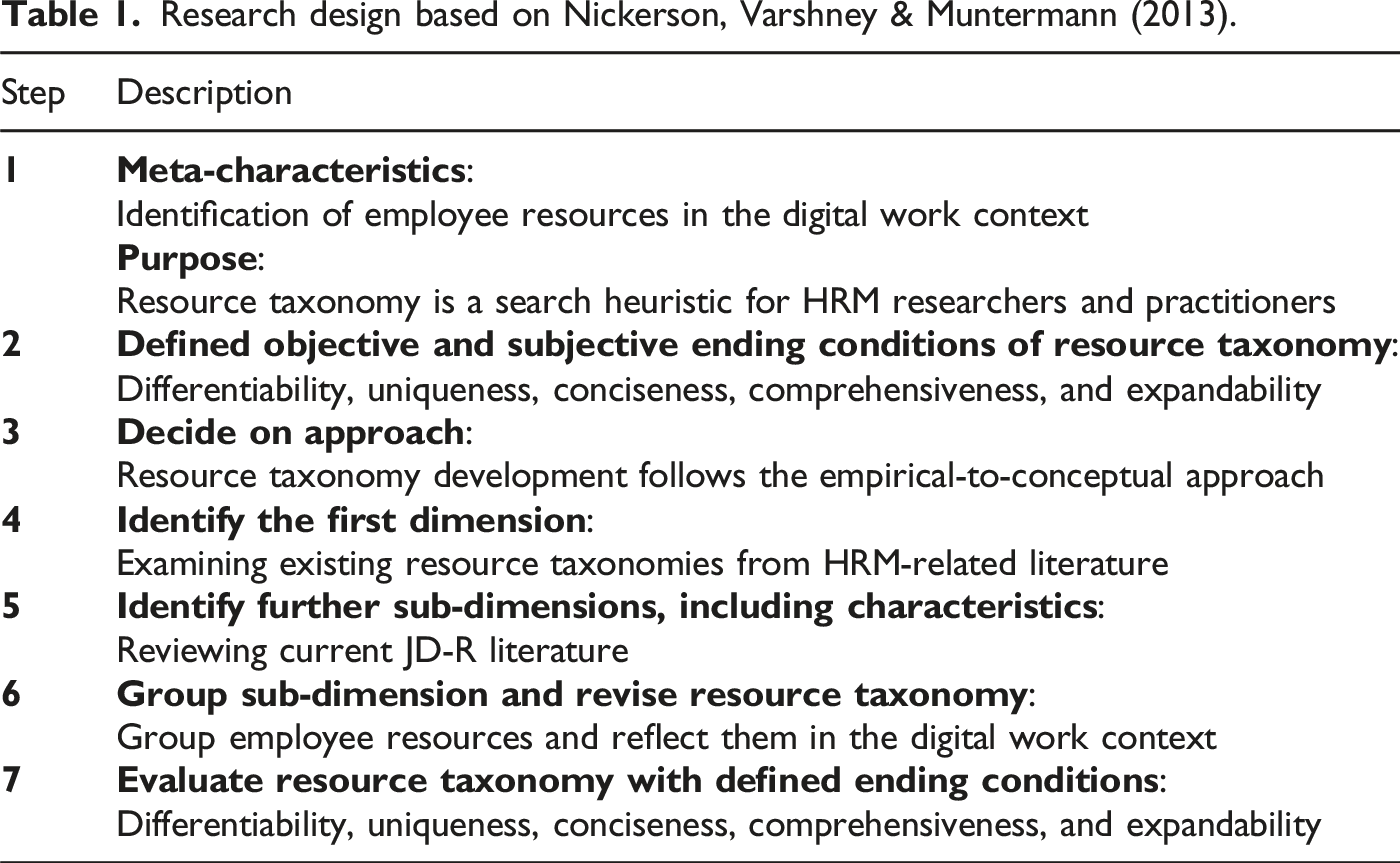
Table 1 shows that the first step is determining the taxonomy’s meta-characteristic and purpose. 32 In our case, we aim to identify and categorize employee resources in the digital work context to provide a search heuristic for HRM researchers and practitioners. Taxonomies have proven helpful as a guide for resource-orientated questions research and practice.30,31,52,53
The second step involves defining the taxonomy’s objective and subjective ending conditions to increase applicability. When defining the ending conditions, we specify that each resource dimension distinguishes between at least two objects, and each characteristic is unique. Furthermore, our resource taxonomy is concise, comprehensive, and expandable. 32
In the third step, Nickerson, Varshney & Muntermann (2013) recommend to choose a specific approach. We selected the empirical-to-conceptual approach because we have access to extensive literature and are already familiar with the development focus.32,54,55 Our research excludes the conceptual-empirical approach, as JD-R research has already provided numerous studies.31,34,39
In the fourth step, we determine the first dimension of our resource taxonomy with the deductive analysis of resource taxonomies from HRM-related literature to follow the line of tradition.
Subsequently, in the fifth step, we identify further resource sub-dimensions and their characteristics by reflecting current JD-R literature and incorporating recent findings on categorizing employee resources. 32
In the sixth step, we summarize the resource sub-dimensions and revise the resource taxonomy. For clarity, we use keywords to describe the resource sub-dimensions and their characteristics. We will choose keywords that are well-known in HRM and retrievable in JD-R research. This approach of using familiar keywords ensures that we fulfill the purpose of our resource taxonomy, which is to become a search heuristic for HRM researchers and practitioners.30,32
In the seventh step, we evaluate the resource taxonomy with our defined ending conditions. 32
As a result, the empirical-to-conceptual approach leads to a resource taxonomy that summarizes and structures current HRM research on employee resources. 32 The novel combination of resource constructs in a transparent classification scheme and reflection on the digital work context provides a new impetus for future research. 56 Furthermore, it represents a proposed solution to reduce the complexity of the investigated resource constructs from the JD-R literature.31,43
Results
The literature-based development of the resource taxonomy followed the steps described in Table 1 and involved five iterations. The previous chapter clarified the framework for developing our resource taxonomies (steps 1–3). In the following, we reflect on the development of existing resource taxonomies that shaped our first resource dimension and discuss their applicability as search heuristics (step 4). Subsequently, we present our proposal for a resource taxonomy in the digital work context as a research result, incorporating the findings of the JD-R literature (steps 5–6). In conclusion, we evaluate our research process and reflect on our resource taxonomy with the defined ending conditions (step 7).
Reflecting existing resource taxonomies for taxonomy development
Our literature analysis focuses on existing resource taxonomies from work and health psychology to identify the first dimension of our resource taxonomy, which is part of step 4 of the taxonomy methodology. 32 These resource taxonomies emerged from pioneering work in clinical psychology and social work.51–53,57–63
Our interdisciplinary research involves abstract and specific resource taxonomies in the HRM literature, which is why we have to make a selection. We chose to focus on abstract resource taxonomies that incorporate the elements of specific resource taxonomies, such as the structuring of social resources64–66 or theoretical models like the Job Characteristic Model (JCM) according to Hackman & Oldman (1976). 67 This decision is based on our belief that abstract resource taxonomies provide a broader perspective necessary to understand and derive the structure of the first resource dimension. 32 However, excluding specific resource taxonomies also means that details on specific employee resources may remain hidden. This limitation aligns with our research objective and creates new research opportunities by analyzing specific resource taxonomies and subsequently integrating them into our resource taxonomy.
Resource taxonomies from the employee perspective in HRM-related literature.
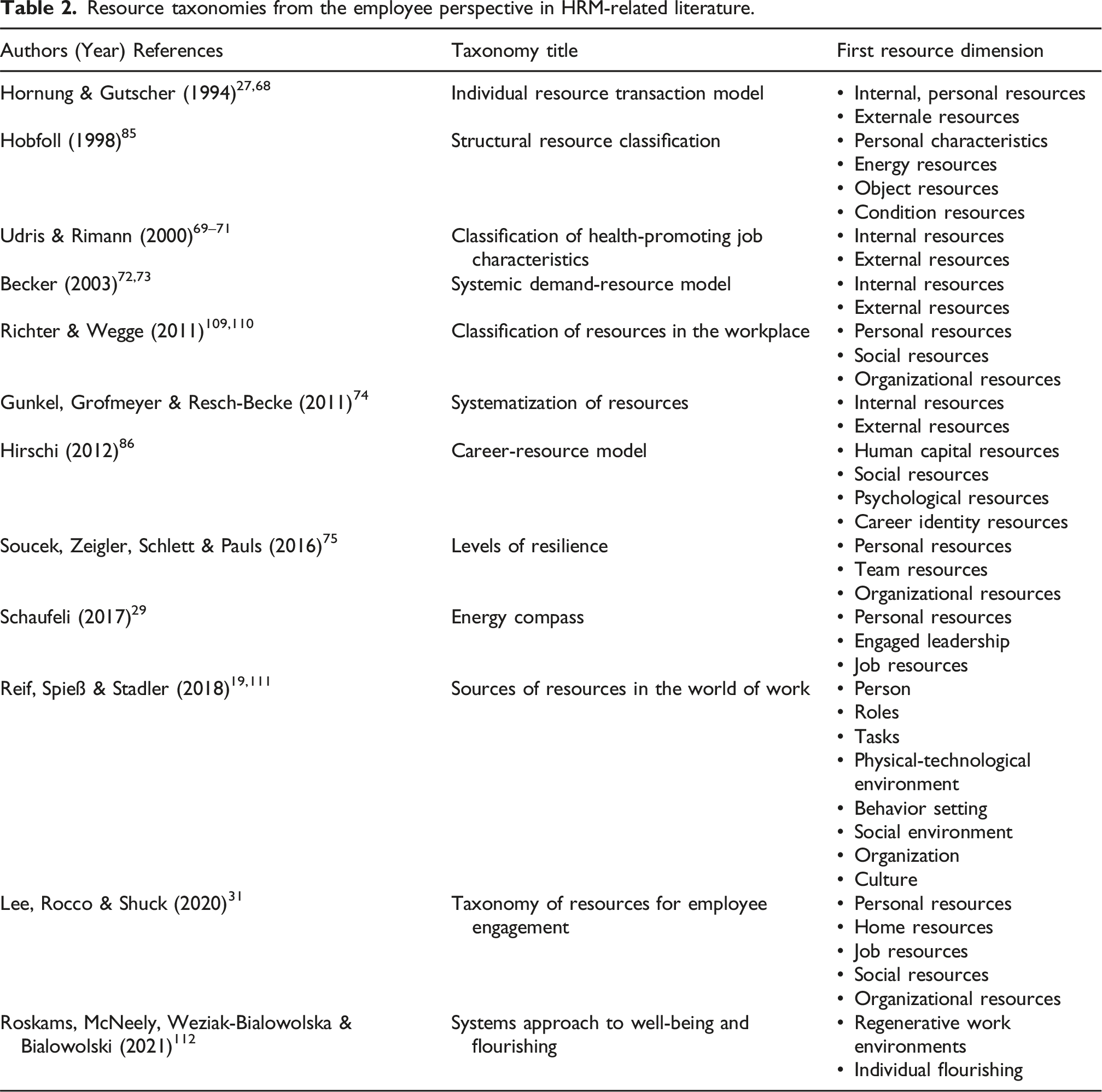
Table 2 illustrates that resource taxonomies have no uniform structure. Simultaneously, it shows that comprehensive taxonomies for mapping employee resources distinguish between personal and environmental resources,53,57 although the taxonomies show different interpretations. Resource taxonomies often synonymously use internal and external resources, and JD-R researchers use the terms personal and job resources.39,42
In evaluating existing resource taxonomies, we come to the following conclusion regarding the first resource dimension of our resource taxonomy. While older resource taxonomies offer differentiability and clarity 32 in the first resource dimension (internal and external resources),27,68–74 their abstraction leads to a lack of conciseness and meaningfulness, making them unsuitable as search heuristics. In our view, a comprehensive resource taxonomy already expresses completeness in the first dimension30,32 and highlights the variation in employee resources in the digital work context.
Recent resource taxonomies in the HRM-related literature tend to specify the first resource dimension but only give examples of employee resources at the lower levels.19,31 As a result, they show between two and eight resource dimensions at the first level, often reflecting employee resources from micro, meso, and macro perspectives.19,31,75 This development shows the increasing relevance of the resource paradigm in HRM research.
In step 4, we try to identify the first resource dimension for our resource taxonomy. 32 Table 2 reveals the following resource dimensions: personal resources (10 of 12 resource taxonomies), social resources (4 of 12 resource taxonomies), organizational resources (4 of 12 resource taxonomies), and work resources (3 of 12 resource taxonomies). These resource dimensions are differentiated, concise, and clear. 32 They have a high level of meaning and express the source of employee resources. 19
However, to complete the resource taxonomy in the digital work context, we must emphasize digital technologies as a source of employee resources.17,19,76
Table 2 shows that Reif, Spieß & Stadler (2018) indicate a technical resource dimension with the dimension “physical-technological environment,” 19 and Hornung & Gutscher (1994) have a technical resources sub-dimension. We contemplate raising it to the first level27,68 to enhances the applicability of our resource taxonomy for HRM researchers and practitioners. 32
The possibility of structuring the resource taxonomy based on research objects, such as humans, social environment, tasks, organization, and digital technologies, seems reasonable to show taxonomy users the variation of employee resources.19,31,51–53 Furthermore, it allows for systematic expandability of the resource taxonomy 32 by considering specific resource taxonomies or novel resource constructs from active JD-R research.31,39,43
Proposal for a resource taxonomy in the digital work context
This chapter proposes a context-specific resource taxonomy based on a deductive approach. 32 The proposal builds on existing resource taxonomies from Table 2 and reflects current JD-R literature. Our resource taxonomy aims to map the spectrum of employee resources in the digital work context, providing a valuable search heuristic for HRM researchers and practitioners.30,32,52,53
The comprehensive exploration of the JD-R literature includes theoretical contributions, systematic literature reviews, and meta-analyses on employee resources predominantly from 2020 to 2024. We have collected and organized around 1,000 examples of employee resource, merging duplications to develop the structure of our taxonomy.
The research challenge was that these examples included not only validated constructs (e.g., optimism) but also circumscriptions (e.g., positive mindset) and indicators (e.g., positive future expectation). The literature exploration confronted us with opposing concepts (e.g., pessimism or naivety), which generally represent a job demand. However, in the sense of a “demand-resource continuum,” they also imply the resource perspective.77,78
This example illustrates that the additional literature review is necessary to complete the first resource dimension (step 4), identify the resource sub-dimensions and characteristics (step 5), and group them (step 6). 32 The literature-based analysis allows us to discover the variation of employee resources studied with the JD-R model and to identify their mutual and distinguishing attributes, which is crucial to structuring the resource taxonomy.19,31,32,51–53
The exploratory literature review’s temporal focus enables us to identify, above all, newer resource constructs, such as technology-related resource constructs, which have been increasingly investigated with the JD-R model in recent years,17,79–84 but resource taxonomies from Table 2 insufficiently integrated them.
Resource taxonomy in the digital work context.
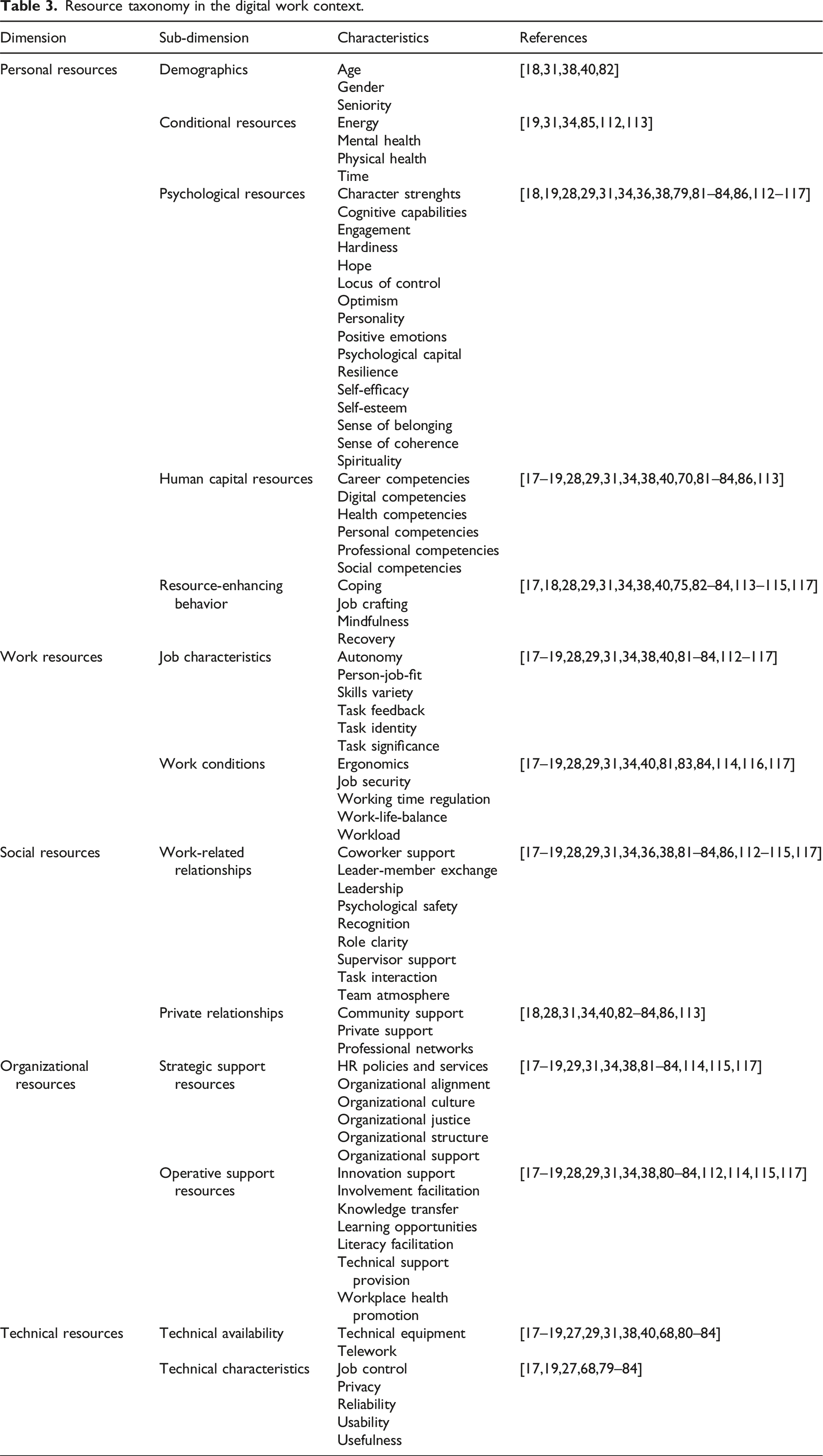
Our result in Table 3 shows five resource dimensions, 13 resource sub-dimensions, and 76 characteristics consisting of relevant resource constructs for the digital work context. To provide taxonomy users with a clear and concise representation of the spectrum of employee resources,32,51–53 we categorized the first resource dimension as personal, work, social, organizational, and technical resources. With the first resource dimension, we follow the current trend of further specifying employee resources.18,19,31
When systematizing dimension personal resources, we follow the definition of the JD-R model. Personal resources describe personal or psychological aspects of an individual that maintain and promote health, well-being, and development.43–46 Personal resources are the only person-related dimension at the first level of our resource taxonomy. We also tested the specifications of personal resources by categorizing them into health and performance resources. However, these categories did not meet our defined ending conditions. 32 Therefore, we differentiate the person-related sub-dimension more strongly: demographics, conditional resources, psychological resources, human capital resources, and resource-enhancing behavior.75,85,86
The dimension of work resources is inspired by Schaufeli (2017), who used the term to increase the understanding of work- and task-related resources in the JD-R model and distinguish them from other job resources. 29 In general, we choose well-known terms when developing our resource taxonomies, for example, by integrating “job characteristics” as a resource sub-dimension to refer to the JCM. 67
Our dimension of social resources provides clarity in the current JD-R discourse and contributes to the theoretical understanding of social support. 66 Currently, JD-R researchers divide social support resources into different contexts in the JD-R model. Social support resources from the work context are summarized as “social resources,” while “home resources” express social support from the private domain.18,31 Since there are no subcategories for home resources, 31 they cannot be a separate dimension in our resource taxonomy. 32 Moreover, the definition of social support includes different forms, sources, and attributes.19,66,87 Current JD-R research also recognizes that social support from the private context significantly predicts employees' job and life satisfaction, motivation, and health.18,31,88 With our resource taxonomy, we propose to unite the social resources to increase clarity and follow the theoretical basis of the social sciences.66,87
Along with the previous external employee resources, the dimension of organizational resources is derived from the JD-R definition of job resources. Organizational resources include aspects of the physical and organizational environment that positively affect achieving work goals, reducing work demands, or promoting development processes.18,29,42,43 We divide these resources from the macro-level into strategic and operational sub-dimensions, a standard categorization in HRM literature. 89
With our resource taxonomy developed for the digitalization context, we propose a dimension for technical resources. In this way, we give technical research disciplines space to investigate the effect of techno-related factors and technical characteristics with the JD-R model10,49,90,91 and to expand the resource taxonomy. 32 In addition, we respond to the positive technology approach, which not only presents ICT and AI as job demands but also perceives them as a resource.17,20,21,48,49,76,92–96
In summary, the structure of the resource taxonomy shows various research objects of HRM, such as humans, social environment, tasks, organization, and digital technologies. 19 This way, we satisfactorily meet the defined ending conditions, as the taxonomy is clear, differentiable, concise, complete, and expandable. 32 The categorized resource constructs support users in identifying employee resources for practical and scientific resource-orientated questions.
Evaluation of the research process for developing the resource taxonomy
Five iterations were required to incrementally conceptualize our resource taxonomy in the digital work context, as shown in Table 3.32,54
The first iteration was conservative. After conducting general research on resource taxonomies, we initially assumed two resource dimensions: personal and environmental resources.
At the end of step 4, when we analyzed the existing resource taxonomies, we found that additional resource dimensions are needed to fulfill our defined ending conditions. 32
With this conclusion and a better understanding of resource taxonomies, we completed the second iteration. As a result, we defined seven resource dimensions: health resources, performance resources, social resources, work resources, developmental resources, organizational resources, and technical resources.
At this point, we wanted to divide personal resources into health and performance resources to represent the health- and motivation-related outcomes of the JD-R model.39,86 With the differentiation, we wanted to clarify that employee health is a prerequisite for action capability.97,98
When we started with step 5 and consulted current JD-R literature to identify additional resource sub-dimensions, 32 we decided on six resource dimensions: health resources, performance resources, social resources, work resources, organizational resources, and technical resources.
Accordingly, in the third iteration, we removed development resources. Schaufeli (2017) proposed the resource dimension with the resource constructs performance feedback, learning opportunities, and career prospects. 29 When examining the defined ending conditions, we missed concise and unique characteristics for development resources, 32 as these resource constructs also apply to the organizational or social resource dimensions.
Based on this finding, we conclude that JD-R research needs more clarity about the processes that promote learning. Therefore, we appeal to intensify JD-R research in this area and validate the learning-promoting factors in the digital work context from business education research.99–101
With this conclusion, we finalized the grouping of the resource sub-dimensions in step 6. As a result of the fourth iteration, we decided on five resource dimensions: personal resources, social resources, work resources, organizational resources, and technical resources.
Accordingly, we reduced the differentiation of personal resources because structuring the resource taxonomy according to research objects is more comprehensible than naming individual resource dimensions according to their outcomes. 32 Our result, therefore, only represents the sources of employee resources (inputs) 19 and not the health-, motivation- and learning-promoting processes (outcomes) of the JD-R model.39,42,43
Finally, in the fifth iteration, initiated from the peer review process, we critically examined the resource taxonomy, particularly the defined ending conditions of the taxonomy development method of Nickerson, Varshney & Muntermann (2013). 32 Despite maintaining the five resource dimensions, there are significant changes at the level of sub-dimensions and characteristics.
In the fourth iteration, the resource constructs were still on the sub-dimension (e.g., self-efficacy), and the characteristics included the resource sub-constructs (e.g., generalized, professional, technical self-efficacy) and/or indicators (e.g., confidence in one’s competencies).
The final result presents single- and multi-level resource constructs at the characteristic level, enhancing the resource taxonomy’s conciseness and usability as a search heuristic.30,32 By omitting the resource constructs' details and specifications, we have made the artifact more user-friendly. The resource constructs, now the lowest element, are sufficient to derive the theoretical models and concepts (e.g., self-efficacy theory according to Bandura (1977) 102 ) that JD-R researchers need to specify for their research process in any case.
At the same time, we meet all defined ending conditions of the Nickerson, Varshney & Muntermann’s (2013) taxonomy approach. The resource taxonomy provides a complete and clear overview of employee resources in the digital work context. As explained, it is comprehensive and expandable. On a content level, we avoid overlaps and similarities, thus ensuring differentiation. 32
The final resource taxonomy is more than just a collection of exemplary employee resources19,31; it is systematic and purpose-driven. 32 It improves on previous resource taxonomies because it was developed as a search heuristic for employee resources. 30 Furthermore, it gives HRM researchers and practitioners an understanding of the variation in employee resources in the digital work context without getting overloaded by the increasing complexity of the JD-R research literature.18,43 The resource taxonomy is a valuable guide for JD-R researchers at the beginning of the research process; it also serves HRM practitioners in the operational analysis process to efficiently identify employee resources for supporting digital transformation.30,32
Conclusions, limitation, and future research
This article contributes to the debate on reinventing HRM in the new digital transformation era by supporting resource orientation as an innovative HRM practice.19,23,26 Since resource orientation requires knowledge about employees' resources, our article aimed to transform and systematize current knowledge from JD-R research into a resource taxonomy. 32
Resource taxonomies are effective for structuring knowledge.32,50 Thus, our article shows a variety of abstract resource taxonomies in the HRM literature, shown in Table 2.
Our resource taxonomy is innovative because it reflects employees' resources in the digital work context and highlights technical resources as a resource dimension. Since we assume that the digital world of work will no longer be distinguishable from the analog one in the coming years, 103 our taxonomy represents an essential summary of validated resource constructs from the JD-R literature. It offers room for extensions and adaptations. 32
To answer the research question of which resource dimensions form a taxonomy for employee resources in the digital work context, we use a deductive approach. 32 Our knowledge base included existing resource taxonomies and current JD-R literature. As a result, we identified 76 resource constructs, which we grouped in five iterations into the following five resource dimensions: personal, work, social, organizational, and technical resources. Our result demonstrates that the resource paradigm has gained importance in HRM research in recent years.31,34,43
As a consequence, the resource dimensions are more differentiated than in the past; however, researchers shape the structure according to their preferences.18,29,31 The heuristic nature of the JD-R model increases the complexity and makes it difficult for interested researchers and practitioners to gain an overview of relevant employee resources.31,43
Our resource taxonomy is a proposal to contribute to a consensus on the dimension of employee resources in the JD-R model. In our view, such a consensus is essential to investigate employee resources. For example, the role of personal resource constructs in the JD-R model still needs to be determined.34,39,43 In our resource taxonomy, personal resources are on the same level as job resources; together, they form the objective employee ‘resource repertoire'. The term ‘repertoire' from Klemenz (2003), similar to Hobfoll’s (2002) expression ‘armamentarium', illustrates the importance of resource variation and exemplifies individuals’ ability to develop resources.18,30,51–53,104,105
With our resource taxonomy, researchers can easily integrate new resource constructs into the JD-R model. For example, the technical resource dimension represents a reinvention in our resource taxonomy. We rediscovered it when analyzing the existing resource taxonomy of Hornung & Gutscher (1994). 68 With the technical resource dimension, we want to activate technical JD-R research and give them a place to test further the effects of techno-related resource constructs.17,20,48,49
Our research’s limitation is that the taxonomy methodology, according to Nickerson, Varshney & Muntermann (2013), only provides three levels of categories. 32 However, further differentiation would be interesting because of the multi-level resource constructs (e.g., psychological capital 106 ). Furthermore, our artifact cannot make any statements about the quality of individual resource spectrum.32,56
About future research, the resource taxonomy, as already explained, is expandable 32 and offers the opportunity to integrate new resource constructs. Moreover, we see a research gap in integrating learning-promoting factors into the JD-R model. 29 Although business education research extensively studies these factors in the workplace,99–101,107,108 we rarely encountered them in the JD-R literature.
Finally, the research approach of Nickerson, Varshney & Muntermann (2013) recommends alternating between inductive and deductive approaches.32,55 In this article, we have focused on the deductive approach. In future studies, we will additionally validate the resource taxonomy inductively.
Our article encourages resource-oriented questions in research and practice that help reinvent, reimagine, and reshape HRM. The change of perspective refers to all resource dimensions because mastering digital transformation requires a variation in employee resources.19,51–53
Statements and declarations
Footnotes
Acknowledgements
The article was written in collaboration with Reiner, Annen, and Murry. There are no conflicts of interest or financial support related to this publication that could have influenced the outcome. Reiner’s PhD position is partly funded by the InnoPROF project, funded by the Federal Ministry of Education and Research and the Ministry of Science, Research and the Arts of Baden-Württemberg. We used the plagiarism checker Turnitin to ensure the originality of our work, the translation tool Deepl and the writing assistant Grammerly to improve the language and style of our paper, all contributing to a high-quality English research paper. We would like to thank the participants of the “MakeLearn, TIIM & PIConf International Conference” and the reviewers for their constructive feedback.
Author contributions
Conception: Reiner, Annen, Murry.
Methodology: Reiner, Annen, Murry.
Data collection: Reiner.
Interpretation or analysis of data: Reiner, Annen, Murry.
Preparation of the manuscript: Reiner.
Revision for important intellectual content: Annen, Murry.
Supervision: Annen, Murry.
Conflicting interests
The author(s) declared no potential conflicts of interest with respect to the research, authorship, and/or publication of this article.
Funding
The author(s) disclosed receipt of the following financial support for the research, authorship, and/or publication of this article: This work was supported by the Federal Ministry of Education and Research and the Ministry of Science, Research and the Arts of Baden-Württemberg.
