



Abstract
Background
Paradoxical leadership and alignment between innovation culture and organizational goals are crucial for successful digital transformation. Leaders should balance stability with innovation and foster an agile environment conducive to transformation.
Objective
This study aims to investigate the impact of paradoxical leadership on digital transformation, using dynamic capability theory to analyze the roles of organizational agility and innovation culture.
Methods
Data was collected in two-time intervals from 258 employees involved in DT initiatives across various sectors in Pakistan. The study utilized PLS-SEM to test the hypothesized relationships.
Results
The findings confirm that paradoxical leadership significantly enhances organizational agility, which in turn positively influences digital transformation. However, contrary to existing literature, the study reveals that an innovation culture, underdeveloped or misaligned with organizational goals, can weaken the positive effect of organizational agility on digital transformation.
Conclusions
The study underscores the importance of adaptive leadership and supportive organizational culture in driving digital transformation, particularly in developing regions, where these factors can significantly impact social and economic development. The insights are valuable for leaders and policymakers striving to overcome digital transformation challenges in similar contexts.
Keywords
Introduction
Jack Welch’s famous observation, “When the rate of change inside the organization becomes slower than the rate outside, the end is near,” underscores the critical need for change as a vital component of organizational success. In the current era, digital technologies and innovation evolve at an incredibly fast pace. 1 This transformation is evident in the emergence of industry giants such as Netflix, Uber, and Tesla, which have redefined markets through their digital prowess.2,3 Organizations that do not continuously innovate and adopt, risk being disrupted by more agile and tech-savvy competitors, as the external environment, driven by technological advancements and shifting consumer expectations, is constantly evolving.4,5 Thus, organizations must be dynamic to thrive, making digital transformation (DT) a critical aspect of staying relevant and competitive.
DT is not merely about adopting new technologies; it requires organizations to be agile, adapting to rapidly changing technologies and market conditions.6,7 However, with increased flexibility comes the challenge of maintaining control over systems, processes, and data. Striking the right balance between being responsive and maintaining oversight can be paradoxical, as too much flexibility can lead to chaos, while too much control can stifle innovation. 8 Organizations must manage the paradox of accelerating digital transformation while ensuring that these changes are sustainable and aligned with long-term goals. 9
Existing literature on digital transformation often focuses on the technical aspects of digital transformation, such as selecting and integrating new technologies like cloud computing, big data analytics, artificial intelligence, the Internet of Things, and automation.10–12 Technology undoubtedly plays a central role; however, successful digital transformation is not just about adopting new tools and systems; it is about managing human and organizational changes accompanying technological shifts. Literature often overlooks how employees adapt to or resist digital transformation initiatives.13,14 Central to the success of DT initiatives is effective leadership that can navigate the complexities and contradictions, such as balancing stability with agility or control with flexibility, inherent in such profound change.15,16 This gap highlights the need for a more holistic approach to studying digital transformation, including leadership and cultural dimensions.
This study bridges the gap in literature by examining the critical role of paradoxical leadership in managing the tensions and contradictions that arise during digital transformation. The other leadership styles including transformational or ambidextrous leadership tend to underplay the simultaneous demands for stability, control, and risk mitigation that surface during large‐scale digital transformation initiatives. In contrast to these approaches, paradoxical leadership uniquely embraces and leverages competing demands, such as innovation alongside consistency and autonomy alongside accountability, simultaneously enabling leaders to foster both creative experimentation and disciplined execution throughout the digital transformation journey. Thus, it moves beyond the purely technological perspective and addresses the human and cultural dynamics that are essential to manage paradoxes of digital transformation.
This research contributes to the body of knowledge by offering a more comprehensive understanding of how paradoxical leaders can navigate the complexities of digital transformation, balancing innovation with stability, agility with control, and short-term flexibility with long-term sustainability. Practically, the findings provide actionable insights for leaders and organizations in Pakistan and other developing countries navigating the complexities of DT. This study provides strategies for cultivating a leadership style that embraces paradoxes and fosters a culture of adaptability and resilience. Highlighting the importance of managing both technological and human factors help organizations achieve a more effective and sustainable digital transformation, ensuring that they remain competitive in an ever-evolving digital landscape.
Dynamic capability theory
DCT is a theoretical framework that has garnered significant attention in strategic management, particularly in understanding how organizations can maintain and extend their competitive advantage in rapidly changing environments. 9 Rooted in the works of Teece 17 and others, DCT posits that the abilities and strengths of an organization to survive and prosper in volatile markets depend not just on its existing resources and capabilities but, more critically, on its capacity to adapt, reconfigure, and renew these resources in response to external changes. This is crucial in a fast-changing business environment, where simply relying on existing capabilities is insufficient. 18 Organizations that can develop and deploy dynamic capabilities, which are deeply embedded in organizational processes, are better positioned to maintain their advantage. 19 Therefore, DCT offers a powerful lens to examine how firms can successfully navigate such challenges.
DCT emphasizes that dynamic capabilities are specific to each organization, shaped by its history, resources, and the unique challenges it faces. 18 These capabilities cannot be easily replicated by competitors, providing organization with a sustained competitive edge. 20 DT require organizations to use these capabilities to innovate and adapt to technological advancements continuously.1,4 PXL aligns with DCT’s emphasis on adaptive capabilities, helping organizations sense and seize emerging opportunities while maintaining operational control.21,22 The balancing act of PXL is essential for organizations to reconfigure their capabilities in line with the demands of DT. 23 The ability of leaders to juggle paradoxes such as control versus flexibility reflects the need for dynamic capabilities that enable organizations to adapt while keeping their core operations intact. 24
Organizational agility is a critical dynamic capability that allows firms to rapidly adapt to changes in their environment, especially when responding to digital disruptions or market shifts.25,26 Organizational agility aligns with DCT’s core tenet of reconfiguration. In addition, innovation culture is a vital enabler of dynamic capabilities. DCT argues that a culture that encourages innovation supports an organization’s ability to seize new opportunities and reconfigure resources to adapt to changes.
27
The emphasis on fostering an innovation culture is directly aligned with the theoretical underpinnings of DCT, where organizational culture plays a critical role in sustaining long-term competitive advantage.
28
The conceptual framework based on DCT is presented in Figure 1. Conceptual framework for the study. Source: Authors’ own work.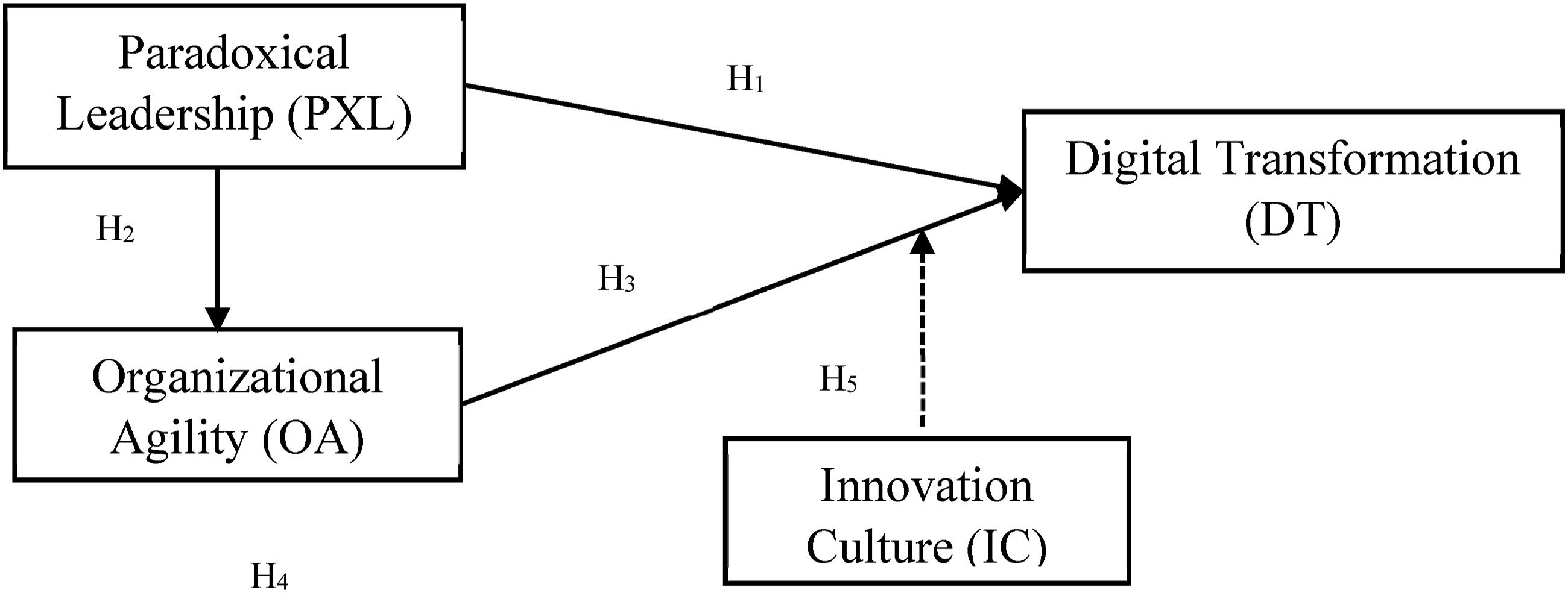
Hypothesis development
The role of paradoxical leadership in driving digital transformation
PXL refers to a leadership style that involves managing and reconciling seemingly opposing or contradictory demands within an organization.29,30 Paradoxical leaders are adept at balancing competing needs, such as stability versus change, innovation versus tradition, and flexibility versus control. 21 Rather than viewing these contradictions as problems to be solved, paradoxical leaders embrace them as essential components of organizational life.31,32 They are skilled at exploring new digital opportunities while ensuring that core business operations remain resilient and stable, which is essential for enhancing and long-term success of DT efforts. 33 This leadership style is particularly important in dynamic and uncertain environments, where organizations must remain agile while maintaining core structures and values. 34 PXL is increasingly recognized as vital for Industry 4.0, where managing complex, contradictory environments is essential for driving innovation and achieving strategic goals. 35
DT represents a comprehensive organizational change driven by adopting digital technologies that align business strategies, people, and leadership styles with significant technological shifts.36,37 The strategic vision provided by PXL is crucial in aligning diverse organizational efforts and managing contradictions, both of which are fundamental to achieving DT objectives.8,38 One of the key paradoxes that organizations face during DT is the tension between stability and change.4,13 While technological innovation demands rapid adaptation and flexibility, organizations must also ensure that their core operations remain stable to avoid disruptions. 23 Paradoxical leaders are skilled at managing this balance. They enable organizations to embrace digital innovations and new technologies while ensuring that essential operations and values remain intact.12,34 They empower teams to explore new opportunities while ensuring that the integration of new technologies does not disrupt core business functions. 24
In Chinese manufacturing sector, Yang
32
found that PXL significantly enhances an organization’s ability to manage the dual demands of maintaining operational stability while embracing digital innovation. Trieu et al.
33
found that PXL fosters organizational resilience by promoting flexibility and adaptability in information technology firms in the United States. Hossain et al
35
examined the role of PXL in driving DT in the context of Industry 4.0 within the European automotive sector. The study revealed that paradoxical leaders were particularly effective in navigating the complex and often contradictory demands of integrating advanced digital technologies, such as artificial intelligence and robotics, into existing production processes. Building on these insights, it can be hypothesized that:
Paradoxical leadership and organizational agility
Organizational agility refers to a firm’s ability to rapidly respond to changes in the external environment while maintaining efficient operations internally.39,40 DCT presents OA as a dynamic capability that organizations develop over time by reconfiguring their resource base. 41 Agility is not simply about being flexible or adaptable; it also involves maintaining a balance between stability and flexibility required to pivot in response to external disruptions, such as market changes or technological advancements.42,43 This balancing act between responsiveness and stability is at the heart of organizational agility and requires adaptive leadership approach. 32
PXL is particularly valuable in fostering organizational agility because it helps leaders and teams embrace strategic contradictions as opportunities for growth and learning, rather than as obstacles that must be avoided or eliminated. 22 Leaders who practice PXL cultivate an environment of adaptability by encouraging teams to approach change and stability as complementary rather than opposing forces. 44 They foster a work culture that embraces flexibility without compromising the core stability required for long-term success. Without PXL, firms often struggle to sustain long-term agility, as rigid leadership styles either overemphasize stability (leading to stagnation) or excessive change.24,33
Empirical studies across various industrial and national contexts support the positive influence of PXL on OA. For instance, Zhang and Han
45
found that in the Chinese manufacturing sector, PXL significantly enhanced corporate development by improving the firm’s adaptive capabilities. Niu et al
46
observed that in service-oriented organizations in the United States, PXL promoted organizational citizenship behavior, enhancing OA through greater employee engagement and flexibility. In a study of Australian financial services firms, Zhaohui
47
found that PXL is aligned with the core principles of ambidexterity a critical component of OA allowing organizations to balance exploration and exploitation activities effectively. This balance is essential for maintaining agility in a highly regulated and competitive industry. Therefore, it can be hypothesized that:
Organizational agility and digital transformation
DCT suggests that dynamic capabilities enable firms to swiftly adapt and maintain competitiveness. 18 In the context of DT, agility becomes even more critical as organizations must quickly integrate digital technologies and realign operational processes.37,48,49 The rapid pace of technological innovation and the constant disruption in industries demand that firms continuously adapt to new tools, optimize their workflows, and restructure their business models. 50 Organizational agility (OA) enables firms to rapidly process information, identify new opportunities, and implement digital strategies effectively—essential components for achieving successful DT outcomes.42,51 It allows firms to make faster decisions, adopt new technologies seamlessly, and improve their overall responsiveness to changes. 40 It helps organizations respond to external drivers of DT, including technological advancements, industry disruptions, regulatory shifts, and shifting consumer expectations.26,39,52
Unlike traditional rigid organizations that may struggle with digital integration due to lack of flexibility or slow decision-making, agile organizations are quick to embrace emerging digital tools, optimize their operations, and restructure their business models. 25 This proactive approach is essential for maximizing the potential benefits of digital technologies, as it allows firms to be both responsive and ahead of the curve in a competitive digital environment.26,53 Highly agile firms are better positioned to align new technologies with business processes and make strategic shifts that are necessary to capitalize on new digital opportunities. 42 Agility does not simply facilitate reactive change but enables proactive transformation by continuously scanning digital opportunities and adapting organizational strategies to integrate them effectively. 54
Jaafar et al
55
found that industry 4.0 organizations that demonstrated high levels of agility were more successful in implementing digital initiatives, particularly in the retail and financial services sectors. Similarly, Li et al
41
found that in the Chinese e-commerce industry, OA played a crucial role in aligning technology capabilities with business processes, leading to more effective DT outcomes. Similarly, Ghasemaghaei et al
56
showed that Canadian manufacturing firms with strong data analytics capabilities were better positioned to enhance their DT efforts. AlNuaimi et al
39
found that OA in organizations in the United Arab Emirates was instrumental in responding to external isomorphic pressures, such as governmental regulations and competitive dynamics, thereby facilitating DT. Therefore, it can be hypothesized that:
Mediating role of organizational agility
The relationship between PXL and the effectiveness of DT is complex and influenced by several dynamic capabilities. 33 Leaders who practice PXL create an environment that encourages adaptive behavior, allowing teams to navigate these contradictions and balance seemingly incompatible goals. 34 The unique capacity of PXL leaders to manage tensions—such as the need for operational stability alongside the urgency for digital innovation—directly enhances organizational agility. 30 Organizations that are led by paradoxical leaders tend to exhibit greater flexibility and resilience, which are core attributes of organizational agility.8,32
OA serves as a bridge between PXL and the success of digital transformation efforts. The core role of OA in mediating the relationship between PXL and DT effectiveness lies in its ability to enable rapid decision-making and flexible processes.
55
Agile organizations are better equipped to process and implement digital strategies swiftly, responding to the fast-paced changes in digital technologies, consumer behaviors, and industry disruptions.
57
While PXL creates the right mindset and environment for embracing change, it is OA that ensures the organization adapt operationally to these changes in a timely and effective manner.
22
Without OA, even the best paradoxical leadership may struggle to implement DT initiatives effectively because the organization may lack the internal mechanisms and flexibility needed to act on strategic decisions and new opportunities.
48
The contradictions managed by paradoxical leaders might remain theoretical or strategic, without manifesting in concrete, actionable outcomes that drive successful DT. Cubillas-Para et al
58
found that, organizations with high levels of OA were better able to respond to environmental changes, resulting in enhanced performance and successful DT. In the manufacturing sector, Shahruddin and Husain
49
documented that PXL significantly contributes to OA, which drives effective DT initiatives. Therefore, it can be hypothesized that:
Moderating role of innovation culture
Innovation culture (IC) fosters an environment where creativity, experimentation, and risk-taking are encouraged, which are crucial for navigating the complexities of DT. 27 Without a robust IC, organizations may struggle to leverage their agility fully, limiting their strengths to innovate and adapt swiftly to the demands of digitalization. 36 Thus, IC is not just a background element but an active enabler that enhances the organization’s dynamic capabilities. 59 An IC does this by encouraging behaviors and mindsets aligned with agility, such as openness to new ideas, tolerance for risk, and a proactive approach to problem-solving. 28 DCT posits that dynamic capabilities are most effective when embedded in an organizational culture that supports innovation. 19 Thus, cultural alignment ensures that the agility within the organization is not merely reactive but a proactive strategic capability that drives the organization’s DT. 17
Cannas
60
argued that IC provides the social and cognitive foundation necessary for employees to engage fully with the organization’s dynamic capabilities, particularly in digitalization. Mehralian et al
61
highlighted that organizations with strong IC are better equipped to meet the increasing demands for high-quality, adaptable, customized products and services. Al-Khatib et al
27
investigated that Middle Eastern firms with a strong IC were better able to leverage their agility to drive DT. Ghasemzadeh et al
62
found that an IC significantly enhances the effectiveness of OA in the DT process in Iranian technology firms. Hooi and Chan
63
found that Southeast Asian firms with strong IC adapted more quickly to the technological advancements associated with Industry 4.0. Therefore, it can be hypothesized that:
Moderated mediation effect
The relationship between PXL and the effectiveness of DT is mediated by OA that facilitates the effective integration and adaptation of new digital technologies. The moderated mediation hypothesis suggests that the positive influence of PXL on DT effectiveness, via OA, is stronger in organizations with a robust IC. In contrast, organizations lacking strong IC may experience weaker mediation effects, as their agility is less effectively leveraged to drive DT. Therefore, it is hypothesized that:
Methodology
Data collection and sampling
The sample was drawn from employees involved in DT initiatives across the technology, finance, and manufacturing sectors in Pakistan. Both private and public sector organizations were included to ensure diversity in perspectives. In the private sector, industries like technology, finance, and manufacturing were prioritized, while in the public sector, government agencies and institutions engaged in DT were targeted. We used purposive sampling for the selection of participants to identify employees who are actively engaged in DT or affected by it. This approach ensured the inclusion of participants with direct, hands-on experience in digital transformation initiatives, providing insights aligned with the research objectives. However, these nonprobability sampling techniques may introduce self-selection bias. To mitigate potential biases, we ensured a diverse representation across industries, including technology, finance, and manufacturing, thus enhancing the external validity of our findings. 64
The data was collected in two-time intervals. In time 1, the structured online questionnaire on digital transformation, organization agility, and innovation culture was distributed electronically to 920 respondents. Multiple follow-ups, including reminder emails and phone calls, boosted participation. After data cleaning and deleting incomplete responses, 312 usable responses were retained with a 34% response rate. The respondents were assigned unique IDs. After 4 weeks of Time 1 respondents were requested to share their perception of PXL. The complete responses were received from 258 respondents. G Power software was utilized to conduct a priori power analysis to ensure the sample size’s adequacy. A “G Power 3.1 analysis” was used to determine the required sample size for detecting medium effect sizes (f2 = 0.15) at a 95% confidence level with 80% statistical power. The analysis recommended a minimum of 238 participants, confirming that our final sample size of 258 exceeded this threshold, ensuring statistical reliability. The sample was skewed towards male participants, with approximately 65% (168 respondents) identifying as male and 35% (90 respondents) identifying as female. This distribution aligns with the demographic realities of many sectors, particularly in developing countries, where male employees often constitute a larger proportion of the workforce.
Measurement
The items in the questionnaire used to collect primary data from respondents were measured on a 7-point Likert scale, ranging from 1 (strongly disagree) to 7 (strongly agree). These items were carefully adapted from established literature to ensure their relevance and accuracy in measuring the constructs of interest. Prior to full-scale data collection, the questionnaire underwent rigorous pre-testing through a pilot study to assess its clarity and effectiveness. A panel of 10 research experts reviewed the questionnaire to ensure the instrument’s face validity. Their feedback led to minor revisions in the wording of several statements, which enhanced the clarity and comprehension of the questions. Following these adjustments, the revised questionnaire was administered to a pilot group of 30 respondents from the industry. The findings from this pilot test indicated that participants had no difficulty understanding any of the questionnaire items, confirming the instrument’s suitability for the target population. The value of reliability estimates, Cronbach’s alpha, and composite reliability were greater than the 0.70 threshold value. The value of AVE for convergent validity was greater than 0.50. Therefore, the questionnaire was found valid and reliable for further data collection.
PXL was measured through twenty-two items adapted from Zhang et al. 44 The sample item is “I manage subordinates uniformly but consider their individualized needs”. Six items were adapted from AlNuaimi et al 39 to measure OA. The sample item is “My organization can rapidly respond to customers’ and government’s needs.” The DT was measured by five items adapted from Nasiri. 6 The sample item is “In my organization; we aim to digitalize everything that can be digitalized.” Three statements were adapted from Martín-de Castro et al 59 to measure IC. The sample item is “My company encourages creativity, innovation and/or the development of new ideas, as cultural values.”
Results
Descriptive statistics, factor loadings, and reliability.

Here PXL = Paradoxical Leadership, DT = Digital Transformation, OA = Organizational Agility, IC = Innovation Culture, SD = Standard Deviation, α = Cronbach’s Alpha, AVE = Average Variance Extracted, CR = Composite Reliability.
Sources: Author’s original work.
Model validation and fitness indexes.

Notes: N = 258, PXL = Paradoxical Leadership, DT = Digital Transformation, OA = Organizational Agility, IC = Innovation Culture, CFI = Comparative Fit Index, TLI = Tucker–Lewis Index, NNFI = Non-Normed Fit Index, RNI = Relative Fit Index, RMSEA = Root Mean Square Error of Approximation. The bold italicized numbers in the diagonal represent the square root of the AVE.
Sources: Author’s original work.
Path analysis
Path analysis estimation.

Notes: N = 258, PXL = Paradoxical Leadership, DT = Digital Transformation, OA = Organizational Agility, IC = Innovation Culture, SD = Standard Deviation.
Sources: Author’s Own Creation.
The negative path coefficients at all levels of innovation culture suggest that the moderation effect of innovation culture on the relationship between paradoxical leadership, organizational agility, and digital transformation is not supported. Whether the innovation culture is low (IC − 1SD), average (IC Mean), or high (IC + 1SD), the results indicate a consistently negative relationship. This may indicate that innovation culture does not enhance or positively moderate the pathway from paradoxical leadership to organizational agility and ultimately digital transformation.
Discussion
The findings of this study offer both confirmation and new insights when compared with existing literature on DT, PXL, OA, and IC. This study extends the understanding of these relationships by examining them within the context of a developing country—Pakistan—where resource constraints and cultural resistance present unique challenges. While prior studies conducted in developed economies often emphasize the benefits of strong leadership and agile practices,31,33 they may overlook the contextual factors that can impede these processes in less developed regions. The positive relationship between PXL and OA observed in this study endorses the findings of Zhang and Han 45 in the Chinese manufacturing sector and Niu et al 46 in U.S. service-oriented organizations, both of which emphasize PXL’s role in enhancing a firm’s adaptive capabilities. The results also support the work of Zhaohui, 47 who demonstrated that PXL facilitates ambidexterity, a critical component of OA, in Australian financial services firms. However, this study’s findings extend the understanding of PXL’s impact on OA by highlighting the challenges faced in the Pakistani context, where the balance between stability and change is often more precarious due to limited resources and infrastructural constraints. The ability of paradoxical leaders to navigate these contradictions is crucial in such environments where traditional business practices may conflict with the need for rapid innovation.
The significant positive effect of OA on DT, as identified in this study, is consistent with the literature.26,39,48 The literature highlights the critical role of agility in aligning technology capabilities with business processes to achieve successful DT outcomes. Similarly, this study confirms that higher OA contributes to more effective DT efforts in Pakistan. However, the contextual factors specific to Pakistan, such as regulatory hurdles and technological infrastructure, mean that OA’s impact on DT may be more complex and multifaceted compared to more developed regions. This suggests that while the core relationship between OA and DT is robust, the mechanisms through which agility drives transformation may differ significantly across contexts.
The finding that innovation culture (IC) undermines the effectiveness of OA in driving DT is particularly intriguing and opposes the prevailing view in literature. For example, Ghasemzadeh et al 62 found that in Iranian technology firms, a strong IC significantly enhanced the effectiveness of OA in the DT process. Similarly, Hooi and Chan 63 demonstrated that Southeast Asian firms with robust ICs adapted more quickly to technological advancements associated with Industry 4.0. However, the results of this study suggest that in contexts like Pakistan, where IC may be underdeveloped or misaligned with organizational goals, the introduction of digital capabilities may encounter resistance or fail to achieve the intended strategic objectives. This misalignment can create friction and reduce the effectiveness of agile initiatives, leading to the counterintuitive results observed. One reason could be overly rigid innovation processes creating bureaucratic inertia. This understanding was not captured in earlier studies focused on more developed regions, highlighting the cultural and contextual factors in leadership and organizational studies. Moreover, in organizations with less IC, the workforce may lack the mindset and skills to fully embrace and leverage digital innovations. This gap can result in a situation where the potential benefits of OA are not fully realized because the cultural foundation needed to support and sustain these agile practices is weak or nonexistent. Therefore, rather than enhancing DT, a weak IC can create friction and reduce the effectiveness of agile initiatives, leading to the counterintuitive results observed in this study.
Conclusion
Our study provides key insights into the intricate relationships between PXL, OA, IC, and DT. It highlights the importance of leadership and agility in navigating the complexities of DT. One of the most significant findings of this research is the counterintuitive role of IC. Contrary to the widely accepted view that a strong IC invariably supports OA and DT, this study found that in Pakistan, a misaligned or underdeveloped IC can undermine the effectiveness of agility in driving DT. This suggests that in environments where IC is not fully embedded, efforts to leverage agility for DT may encounter resistance, leading to suboptimal outcomes. This finding underscores the importance of considering cultural and contextual factors when implementing DT initiatives, particularly in developing countries. This study offers practical implications for leaders and policymakers in developing regions, emphasizing the need to cultivate agility and a supportive innovation culture to navigate the DT journey successfully.
Theoretical implications
This study makes several significant contributions to existing literature by examining DT through the lens of DCT. Firstly, this research demonstrates the critical role of PXL in enhancing OA and implementing DT initiatives. It highlights how PXL helps organizations navigate the inherent contradictions of stability versus change and tradition versus innovation, particularly in environments with resource constraints and cultural resistance. This finding extends the theoretical framework of PXL by emphasizing its importance in less explored, challenging contexts, thereby broadening the applicability of PXL theory beyond developed economies. Secondly, DCT has traditionally focused on how organizations can adapt and thrive in rapidly changing environments by developing dynamic capabilities. By positioning OA as a mediator between PXL and DT, the research provides an understanding of how leadership drives agility, enabling organizations to implement and sustain transformational initiatives. This integration enriches DCT by illustrating the specific mechanisms through which leadership influences dynamic capabilities in the context of DT. Thirdly, contrary to the prevailing view that a strong IC universally supports OA and DT, the study reveals that in contexts where IC is underdeveloped or misaligned with organizational goals, it can undermine agility’s effectiveness in driving DT. This challenges the existing assumption in the literature and suggests that the relationship between IC and DT is more complex than previously understood. It calls for re-evaluating how IC is conceptualized and operationalized in different cultural and economic contexts, particularly in developing countries.
Practical implications
Managers should recognize the value of PXL in driving successful DT. PXL’s ability to balance stability with innovation and manage contradictions effectively is crucial for navigating the complexities of DT. Organizations should prioritize developing and fostering PXL traits among their leaders, as these leaders are better equipped to guide teams through the dynamic challenges DT poses. Training and development programs should be designed to cultivate these leadership qualities, enabling leaders to handle the dual demands of maintaining operational stability while embracing innovation. In addition, managers should focus on building and enhancing their organization’s agility by promoting a culture of flexibility, adaptability, and responsiveness. This can be achieved through strategic initiatives that encourage cross-functional collaboration, continuous learning, and quick decision-making processes. The findings underscore the importance of having a well-aligned and supportive innovation culture to maximize the benefits of OA in driving DT. Policymakers and managers should work together to develop an innovation culture that closely aligns with the organization’s objective. This alignment is critical for ensuring that innovation efforts support, rather than hinder, DT initiatives. Organizations should invest in programs encouraging creativity, risk-taking, and continuous improvement while ensuring these activities align with broader strategic goals. Finally, managers should establish continuous feedback and adaptation mechanisms throughout the DT process and make necessary adjustments.
Limitations and future research directions
Organizations in different regions face unique challenges, such as regulatory constraints, resource availability, and market dynamics, which can influence the applicability of these insights. While the study provides valuable perspectives, further research is needed to explore how these dynamics unfold in various economic and institutional environments. Expanding the research to include a comparative analysis across different countries or regions could provide a more comprehensive understanding of how cultural and economic contexts influence the relationships studied. Further, exploring other leadership styles and their interaction with OA and DT in various sectors could yield deeper insights into effective management practices.
Footnotes

Author contributions
All authors made significant contributions. Here are brief details: Author 1 contributed to the conception, data collection, analysis of data, and manuscript preparation. Author 2 contributed to methodology, data analysis, conception, and manuscript preparation. Author 3 contributed to the revision of important intellectual content, data collection, supervision, and methodology. Author 4 contributed to data analysis, discussion, and manuscript preparation. Author 5 contributed to the conceptualization, discussion, implications, and the preparation of the manuscript. Author 6 contributed to the theoretical framework development, theoretical and practical implications, and the preparation of the manuscript.
Funding
The authors received no financial support for the research, authorship, and/or publication of this article.
Declaration of conflicting interests
The authors declared no potential conflicts of interest with respect to the research, authorship, and/or publication of this article.