




Abstract
Background
The use of artificial intelligence (AI) within education has proven to be a change agent towards Academic Excellence (AE). AI facilitates learning through innovative tools, effective resource utilization, and evidence-driven decision making. Not many studies, however, look into the impact of certain AI-related elements on this.
Objective
The present research examines AI-related influences on AE. It also tests the moderating function of Digital Learning (DL) for these relations. The research is conducted within the contextual framework of the University of Hail within the Kingdom of Saudi Arabia (KSA).
Methods
The students at the University of Hail, KSA, were surveyed with a structured form. Structural equation modeling (SEM) was used to examine hypothesized relationships among AI factors, DL, and AE, examining direct and moderated effects.
Results
Perceived usefulness (PU), Perceived ease of use (PEU), AI-driven personalization (AI-DP) showed remarkable positive influences on AE. In addition, DL strongly moderated Perceived usefulness, Perceived ease of use, AI’s availability and accessibility, and Academic Excellence together with Student Engagement.
Conclusions
AI-related features and DL are essential for promoting AE. Schools must focus on AI tool development, improving learning experiences with personalization, and offering DL education for teachers and students. Furthermore, encouraging collaboration among AI developers and instructors would help ensure tools are aligned with learning objectives for a more effective, inclusive learning experience.
Keywords
Introduction
The rapid advancement of AI technologies has significantly impacted various sectors, particularly education. These innovations offer numerous opportunities to enhance teaching and learning, driving a fundamental shift in educational methodologies. An increase in the use of AI to improve learning experiences and academic performance is evident. 1 AI systems streamline administrative tasks, such as grading and attendance management. Consequently, educators can better prioritize essential teaching activities. Beyond efficiency, AI enriches learning environments through adaptive assessments, gamification techniques, and immersive technologies such as virtual reality. 2 These advancements align with global trends emphasizing technological integration to enhance teaching efficiency and learning outcomes.3–6 Furthermore, AI effectively addresses diverse learner needs, facilitating personalized educational experiences. By modernizing educational processes, AI fosters interactive and engaging learning environments. Thus, AI plays a pivotal role in reshaping traditional education systems. It serves as a crucial tool to transform education, meeting the evolving requirements of the 21st-century learner.
KSA’s Vision 2030 outlines a national strategy to transform the education sector through the integration of advanced technologies, particularly AI.7,8 The initiative emphasizes improving learning outcomes by promoting AI adoption, enhancing digital infrastructure, and offering professional development programs for educators. 7 However, despite these progressive goals, several socio-cultural and institutional barriers hinder effective implementation. Gender segregation within universities restricts equal access to AI technologies, particularly for female students. 9 These constraints stem from traditional gender norms that limit their participation in AI-driven educational activities. Additionally, faculty resistance poses a significant challenge. Many educators are reluctant to adopt AI due to concerns about disrupting conventional teaching practices and a lack of adequate training. 10 These socio-cultural forces and institutional constraints must be overcome so that AI is integrated successfully. Confronting them is necessary for unlocking AI’s full potential for use within higher education, and for reaching the long-term educational goals envisioned by Vision 2030. 8
AI has the ability to revolutionize education by providing students with tailored learning experiences that enhance learning engagement and students’ performance.1,11 Nevertheless, effective integration of AI is contingent upon various factors. These include the availability of adequate infrastructure, faculty readiness to adopt new technologies, and the level of student engagement with AI tools 12
According to the Technology Acceptance Model (TAM), two key variables influence technology adoption: PU, and PEU. 11 In educational contexts, AI tools must clearly demonstrate benefits and be simple to integrate into existing systems. AI-driven personalization and accessibility enable tailored learning experiences. These features help accommodate diverse learning needs and foster inclusive academic environments. 11 Although there is promise, a number of challenges limit effective use of AI within tertiary education. Low digital literacy among students and instructors impairs full utilization. Differing engagement of students impacts learning. In addition, ethical issues, including data privacy and bias within algorithms, threaten stakeholder confidence and willingness.12,13 Addressing these challenges is essential to fully realize the academic benefits of AI.
The purpose of this study is to examine the impact of AI tools in achieving academic excellence within a technologically driven learning environment at the University of Hail, KSA. The research questions of this study are as follows: (1) How PU, PEU, AI-DP, availability and accessibility (AA), and student engagement (SE) with AI impact AE? (2) What is the role of DL in impacting the AE? (3) Which AI attributes and their interactions with digital literacy significantly contribute to enhancing or hindering AE in a digital learning environment?
Despite KSA’s commitment to modernizing its education sector under Vision 2030,7,8 there remains a significant empirical gap. Limited studies have explored the relationship between AI-related factors and academic excellence in higher education.9,10 In particular, there is a lack of evidence on how digital literacy moderates the impact of AI tools on academic outcomes. 9 This study addresses that gap by empirically investigating how PU, PEU, AI-DP, AA, and SE influence A. It further examines how DL strengthens or weakens these relationships in a digitally mediated learning environment. By applying the TAM, the study offers theoretical validation of technology adoption constructs in the academic context. 14 It also provides practical guidance for policymakers and educators to enhance AI integration and digital literacy training. Aligned with Vision 2030, these insights support the design of effective, inclusive, and transformative AI-driven educational strategies.
Literature review and hypotheses
Several studies have examined the adoption of AI in education globally, but few have focused specifically on KSA. According to Alotaibi and Alshehri, 14 AI adoption in Saudi universities is still in its early stages, with infrastructure and faculty preparedness being significant barriers. However, the government’s push to implement AI as part of Vision 2030 is accelerating its integration in higher education institutions. For example, the King Saud University AI Initiative has seen significant investments in AI research and development. The focus is on enhancing student learning experiences. It aims to improve academic outcomes through AI tools. 11
PU and PEU are critical constructs in understanding technology adoption. These constructs have been widely studied in the TAM, but their applicability in the Saudi educational context needs further investigation. While PU reflects the extent to which students believe AI tools will enhance their learning, PEU measures how easy they find these tools to use. This study extends existing research by examining how these constructs impact academic achievement in Saudi universities. It focuses on gender-segregated classrooms and varying levels of digital literacy.AI has improved learning experiences, personalized interventions, and improved academic outcomes in education. 12 The TAM’s PU is also one of the most critical factors affecting technology adoption and performance. 13 Different studies identify that PU leads to enhancements in motivation, engagement, and academic success, especially those emanating from AI tools such as intelligent tutoring systems. 7 While the research on AI’s impact is mainly concentrated in Western and Asian contexts, very little has been explored in KSA.2,4,5,7–9 Despite the higher adoption of AI in universities across KSA under Vision 2030, proof of PU’s role in fostering academic excellence (AE) remains limited. Evidence on this relationship is still scarce.9,12 The following hypothesis will be tested in this study to fill the research gap within the special context of the University of Hail, KSA:
The PEU of technology is one of the core constructs of TAM proposed by Davis.
13
It points out that the easier a technology is to use, the more likely people will adopt it and make good use of it. PEU engenders confidence in users, reduces mental efforts, and fosters involvement that leads to improved outcomes across diverse fields.
10
In education, PEU has been reported to enhance students’ acceptance of digital tools, thereby facilitating better academic performance through greater engagement and self-efficacy.15,16 Though research into Western and Asian contexts supports the role of PEU in improving academic outcomes, few studies address its relevance in KSA educational institutions.9,12 With AI-based technologies rapidly being integrated under KSA’s Vision 2030, it becomes very important to understand the role of PEU in academic excellence.
12
In order to fill the research gap, this study requires to test the following hypothesis with a special context of University of Hail KSA:
AI-driven personalization means the use of AI in the personalization of learning experiences to meet individual needs, preferences, and capacities.
17
Personalized learning has gained interest worldwide as a means of improving academic achievement through the development of engagement and motivation, and by effective knowledge acquisition.
18
AI-powered tools, such as adaptive learning platforms and recommendation systems, have achieved great success in optimizing learning pathways and learning outcomes across different educational contexts.19,20 Increasing AI adoption in education within KSA has been underlined by its Vision 2030 with an emphasis on personalized approaches to learning.14,21 Yet few of them probe into the special influence that AI-driven personalization might have on AE in distinctive socio-cultural and institutional contexts. This may prove to be of prime importance. AI adoption has been influenced by various factors. These include, but are not limited to, issues such as digital literacy and technological infrastructure.
22
In order to fill the research gap, this study requires to test the following hypothesis with a special context of University of Hail KSA:
The availability and accessibility of AI technologies are crucial. They form the bedrock for ensuring equal opportunities for all. These factors promote AE through the use of innovative learning tools. When AI tools are available and accessible, they afford students a variety of learning resources, enhance efficiency, and improve learning outcomes in various ways.
23
The availability of AI-driven platforms has been related to increased engagement and better academic performance, especially in those institutions that are well-equipped digitally.
24
While the globe has focused on digital inclusion, KSA still faces challenges in ensuring equity in access to AI technologies. It is due to disparities in digital literacy, resource allocation, and infrastructure.12,22 The KSA’s Vision 2030 aims at modernizing and promoting AI in education.14,21 However, empirical evidence is still scant on the availability and accessibility of AI in an improvement of AE. In order to fill the research gap, this study requires to test the following hypothesis with a special context of University of Hail KSA:
Student engagement is considered to be one of the most vital factors in determining learning outcomes.
25
This is substantially facilitated by interactive and adaptive technologies like AI. On the other hand, various AI-based learning tools have been substantially helpful in enhancing student participation, motivation, and academic performance.
26
These AI-based learning tools includes gamified learning platforms, virtual assistants, and systems for real-time feedback. By creating active learning, AI holds students’ attention and interest, which are important in striving for AE.
27
The existing literature provides substantial evidence that AI positively influences engagement and learning outcomes in both Western and Asian contexts.28–32 However, it lacks empirical evidence from KSA. KSA has increased investments in educational technologies due to Vision 2030.14,21 However, how distinctive institutional and socio-cultural factors eventually impact student engagement with AI is not well investigated in this context.
22
In order to fill the research gap, this study requires to test the following hypothesis with a special context of University of Hail KSA:
Digital literacy refers to the person’s ability to use digital technologies effectively for learning and problem-solving.
33
Digital literacy has become the backbone of academic success in the current educational settings.
34
It was indicated that digitally literate students are better equipped in finding, assessing, and applying digital resources with a view to improving their academic performance.
35
The higher the levels of digital literacy, the better the AI-powered educational platforms.
36
Students possessing digital learning can negotiate and leverage to their benefit in developing efficient resource management and problem-solving skills that further promote better learning outcomes.
37
Research from Western and Asian context indicated a strong link between high levels of digital literacy and excellence in academic performance.28–31 The linkage between digital literacy and AE should be propagated along with the KSA’s desire of the Vision 2030 appeal for a digitized movement. However, little is still known about this relationship for the educational institutions in KSA.9,22 In order to fill the research gap, this study requires to test the following hypothesis with a special context of University of Hail KSA:
DL is a pivotal enabler of technology adoption and its effective use in education. It equips users with the skills to navigate and leverage digital tools, enhancing their PU and PEU.
33
Similarly, DL plays a critical role in maximizing the benefits of AI-driven personalization, availability and accessibility of AI, and student engagement with AI.
34
Studies indicate that digital literacy moderates the relationship between technology attributes and educational outcomes. For instance, digitally literate students are more likely to perceive AI tools as beneficial.
10
They engage more effectively with personalized learning systems, translating these interactions into AE. However, the existing research largely focuses on Western and Asian contexts.28–31 The existing research leaves a gap in understanding the moderating role of DL in KSA, where regional disparities in digital literacy are evident.
9
This gap is critical given the rapid digital transformation in KSA’s higher education system and the unique cultural and technological landscape. In order to address this gap, this study tests the following hypothesis within the specific context of the University of Hail, KSA:
The study requires to test a number of hypotheses with the support of existing literature and using the TAM. These required set of hypotheses are indicated in Figure 1 as conceptual model of this study.
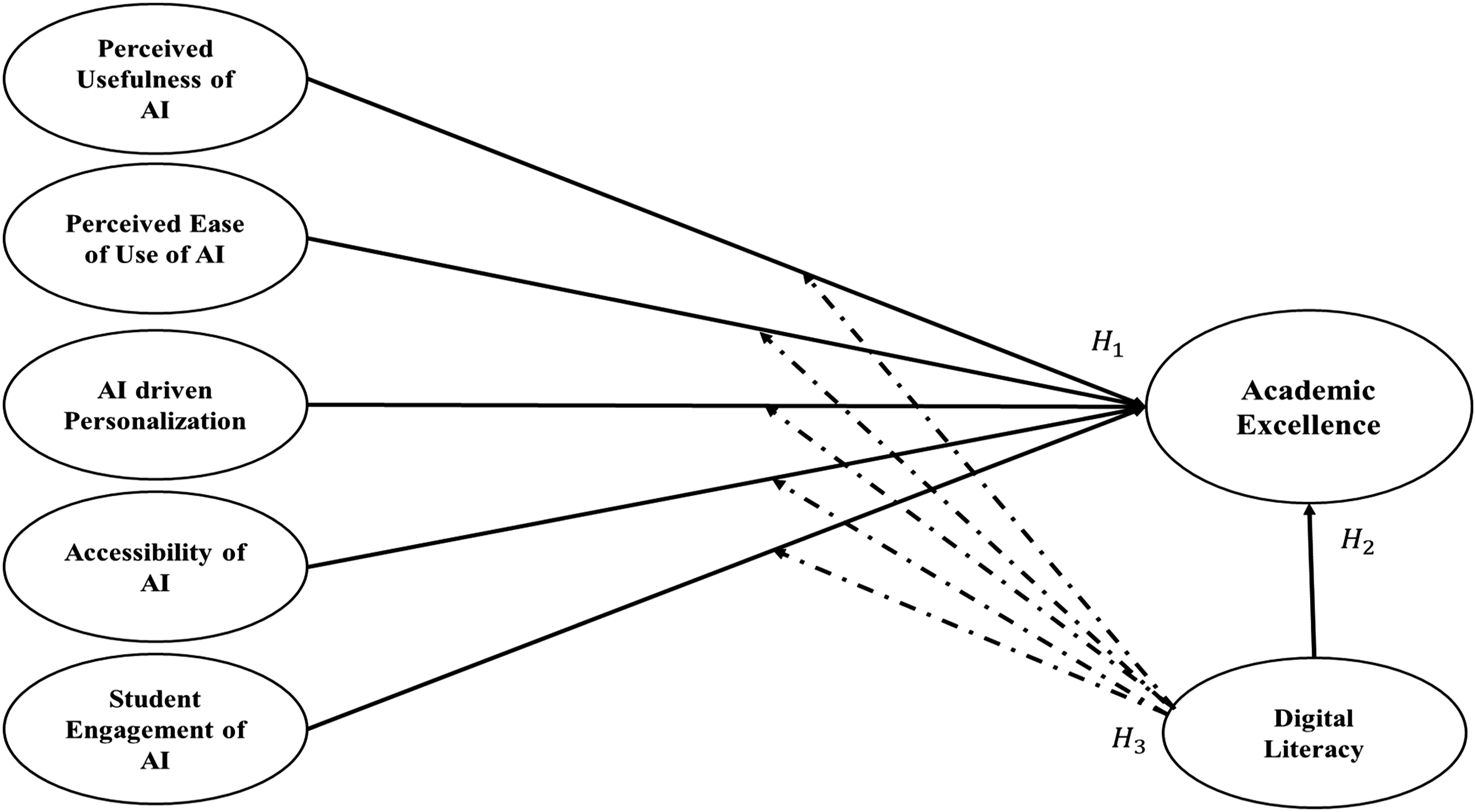
Conceptual model.
Data and methodology
Research design
This study follows a positivist research philosophy, emphasizing objectivity, measurable data, and generalizable findings. 38 The research has adopted a quantitative approach because it is especially suitable for the purpose of testing hypotheses related to the relationships between constructs quantitatively. 39 The framework followed in this research is deductive reasoning. The theoretical underpinning moves from theoretical backgrounds, such as TAM, to hypothesis testing. It also involves empirical validation. Deductive reasoning is appropriate in the establishment of established theories within specific contexts. 40 A cross-sectional survey design has been adopted. Data for this study was collected at a single point in time. The aim is to reflect the contemporary influence of AI on academic excellence.
Population and sampling
The sample frame includes undergraduate students who enrolled for studies at the University of Hail in Saudi Arabia at various levels. Stratified random sampling was used to ensure a representative sample across key variables, including academic discipline, gender, and year of study. Students were grouped into strata based on their field of study (e.g., engineering, business, and humanities), gender, and year (e.g., first year and second year). This approach ensured balanced representation and minimized bias, capturing a diverse range of perspectives on AI adoption in education. A total of 500 questionnaires were distributed, with 468 being the completed responses and the response rate was 93.6%. This sample size enabled SEM analysis with good estimates of reliability. The inclusion criteria allowed analyzing the sample with varied exposure to AI-driven educational tooling for capturing a wide perspective on AI adoption and impact.
Research instrument and data collection
Data collection was done through a structured questionnaire with scales and items validated from prior studies. This instrument was divided into sections: demographic information, AI adoption constructs, and academic excellence items. Items were measured on seven-point Likert scales anchored “strongly disagree” to “strongly agree.” Online questionnaires were distributed in this regard. This is to enhance feasibility and ease in the collection exercise. Confidentiality and anonymity were assured to encourage honest responses.
Variables’ measures
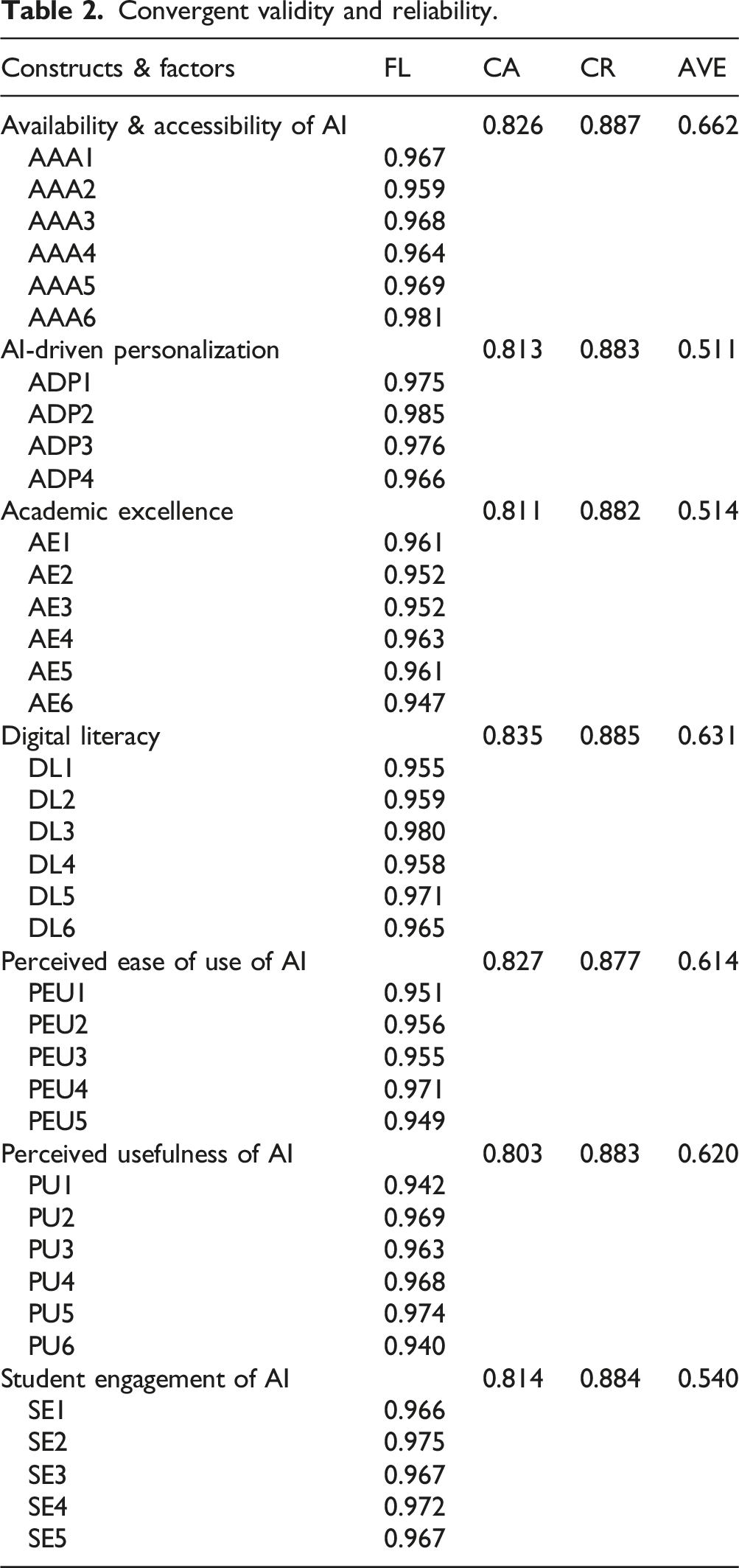
The AI tools include PU of AI, PEU of AI, AA of AI, and AI-DP. The measure of PU of AI was adapted using 6 items. PEU of AI was adapted using 5 items. Both measures were adapted from Yao and Wang. 10 Furthermore, the measure of AA of AI was adapted (using 6 items) from Wang and Chuang. 41 Moreover, the measure of AI-DP was adapted (using 4 items) from Lim and Zhang. 42 However, the DL was measured (using six items) adopted from Amin, Malik. 43 The AE, which is the dependent variable, was adopted (using six items) from Keržič, Alex. 44 Each construct was operationalized with multiple items as a measure to ensure that constructs are valid and reliable. All measures demonstrated considerable internal consistency, having Cronbach’s alphas greater than 0.8. This strong methodology provides reliability for the findings and widens possibilities for generalizing results across educational settings.
The measurement scales used in this study, including PU, PEU, and DL, are commonly used in technology adoption research. However, these scales have not been pre-tested or validated for Saudi students and educators. Their applicability in the Saudi context may require further validation. While these scales have been validated in international settings, cultural and institutional factors could influence how they are perceived in Saudi universities. Through this research, the scales will be validated within Saudi Arabia’s educational settings. Future research should pilot test these scales with Saudi students and educators, adapting items to the local context to ensure cultural relevance. Additionally, the language of AI interfaces and educational infrastructure may affect the validity of these scales. For example, Arabic-language interfaces may align better with students’ cognitive processes. Thus, future studies should adapt the scales to Saudi higher education’s cultural and infrastructural contexts.
Methods of estimations
This study applied the PLS-SEM approach in examining the hypothesis and testing of the theoretical framework, inclusive of constructs that have been adopted from the TAM. PLS-SEM has been employed since the test theory befits a predictive research setting, mostly in situations of extending those well-established models, say TAM, to new contexts like the field of education with AI technology adoption. 45
PLS-SEM was selected for this study due to its advantages over CB-SEM, particularly in relation to the research design. Firstly, PLS-SEM is more effective for studies with smaller sample sizes, as it can produce reliable path coefficient estimates without requiring large samples 45 This is crucial for this study, which involves 468 respondents, a relatively modest sample compared to CB-SEM’s typical requirements. Secondly, PLS-SEM is better suited for complex models with multiple constructs and moderating relationships. Unlike CB-SEM, which requires reflective measurement models, PLS-SEM accommodates both reflective and formative constructs. 45 This flexibility is key to analyzing the interrelationships between AI adoption factors (e.g., perceived usefulness, ease of use, and AI-driven personalization) and academic excellence, while considering the moderating role of digital literacy. Additionally, PLS-SEM is ideal for predictive research, particularly in new or under-researched fields like AI adoption in Saudi Arabian higher education.
Data analysis and results
Participants characteristics summery.
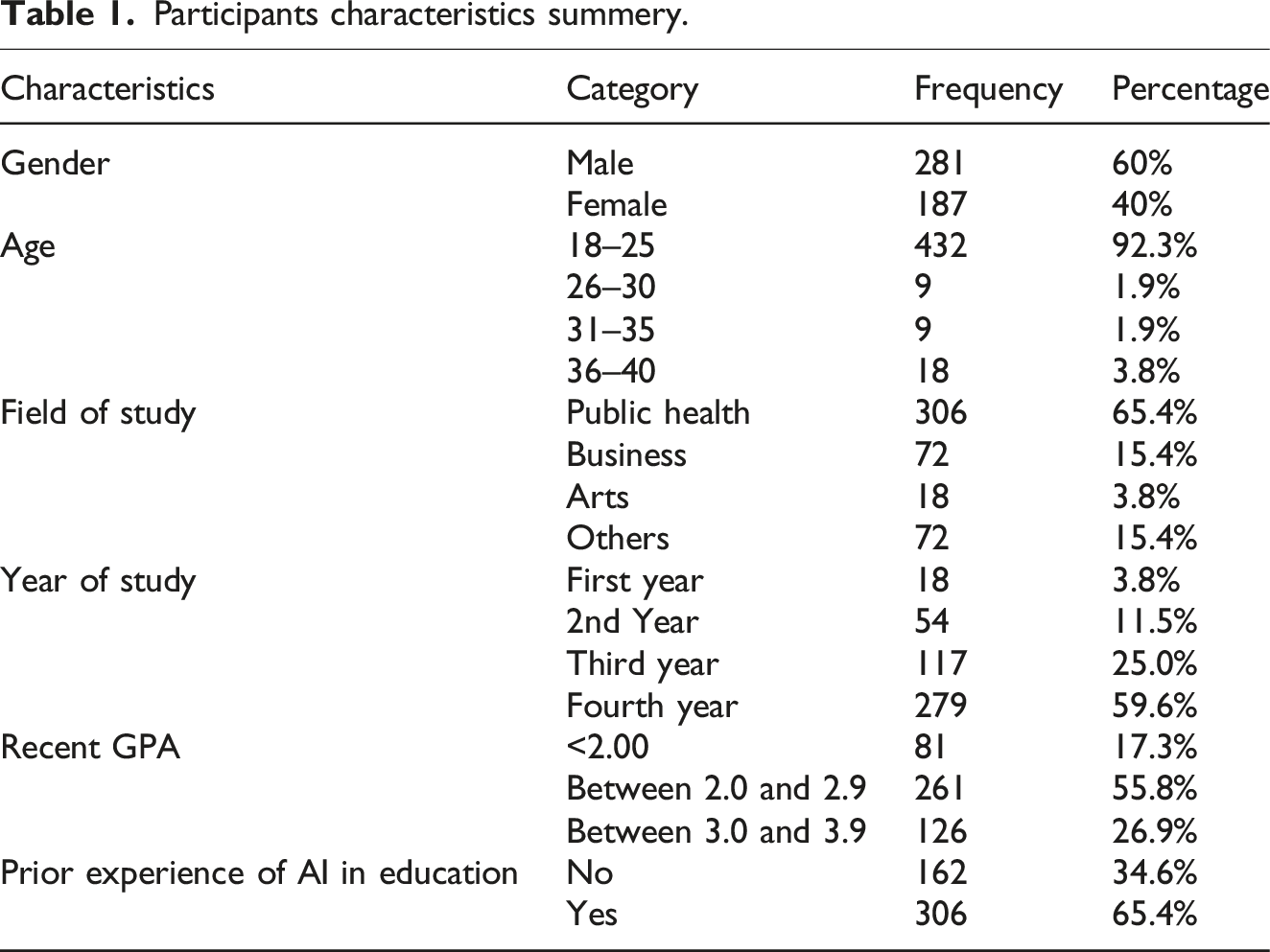
This study used stratified random sampling for diversity, but Public Health students were overrepresented, making up 65.4% of the sample. This overrepresentation may limit the generalizability of findings, as AI adoption and digital literacy differ across disciplines, particularly between STEM and non-STEM fields. The gender distribution (60% male, 40% female) also reflects a skew, which may impact findings, especially regarding gender-segregated classrooms. Future research should aim for a more balanced sample, considering diverse academic disciplines and genders. Data from multiple institutions across Saudi Arabia would enhance the external validity and provide a more comprehensive understanding of AI adoption.
Convergent validity and reliability.

Measurement model.
HTMT ratios.

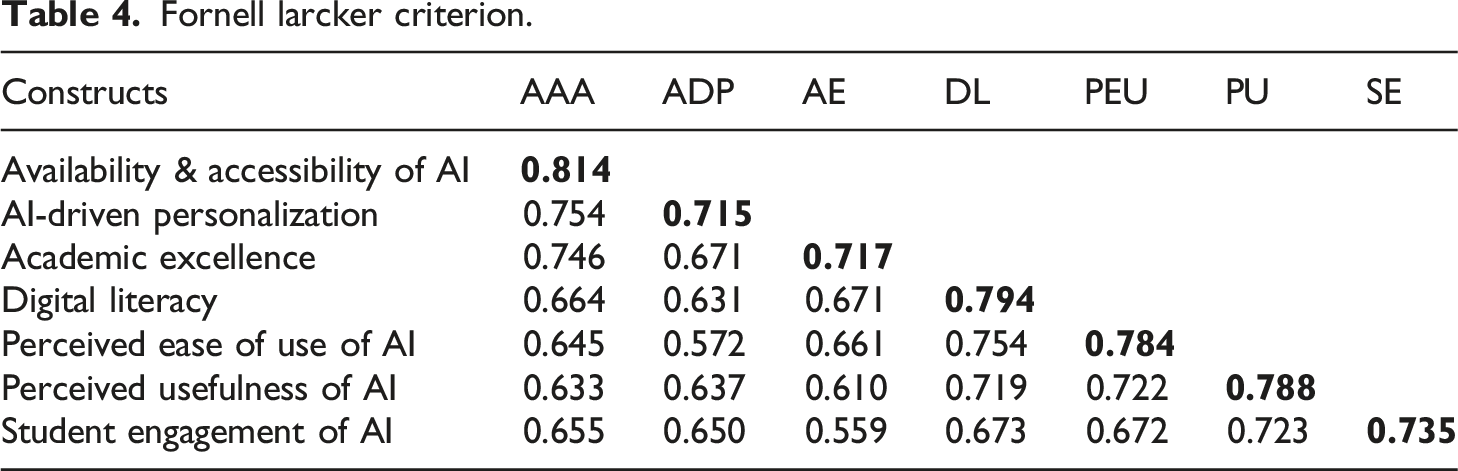
Fornell larcker criterion.
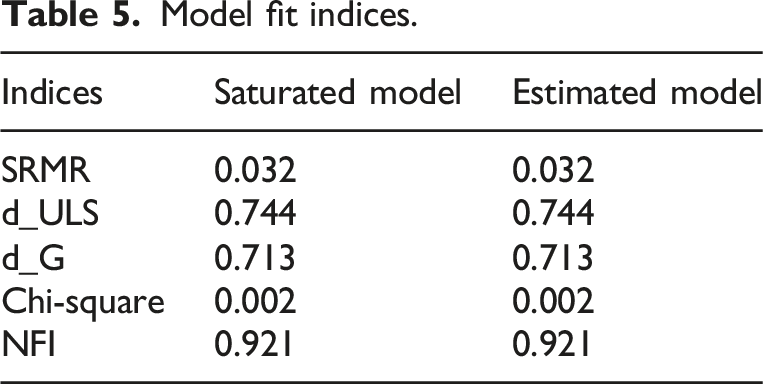
Model fit indices.
Hypothesis testing using SEM.
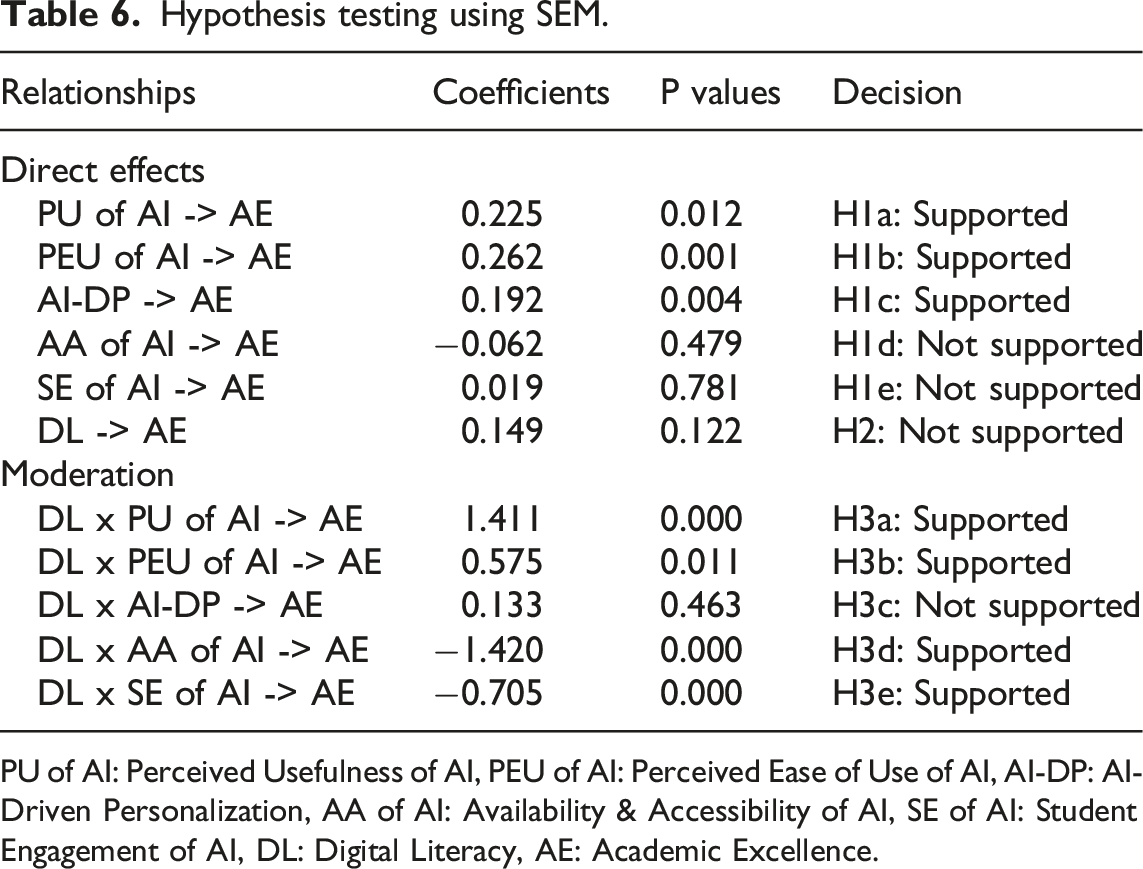
PU of AI: Perceived Usefulness of AI, PEU of AI: Perceived Ease of Use of AI, AI-DP: AI-Driven Personalization, AA of AI: Availability & Accessibility of AI, SE of AI: Student Engagement of AI, DL: Digital Literacy, AE: Academic Excellence.
First, the direct effects of PU, PEU, and AI-DP on AE were all found to be significant. PU of AI showed a positive impact on AE with β as 0.225 and p value as 0.012. It supports Hypothesis 1a. Likewise, PEU of AI significantly influenced AE with β as 0.262, and p value as 0.001. It supports Hypothesis 1b. Furthermore, AI-driven Personalization (AI-DP) also positively affected AE with β as 0.192, and p value as 0.004. It supports Hypothesis 1c. These findings suggest that AI’s usefulness, ease of use, and its ability to personalize learning experiences contribute positively to academic excellence. This is evident at the University of Hail in KSA.
However, the relationships between AA of AI and SE with AI and AE were not significant. AA of AI showed no meaningful effect on AE with β as −0.062, and a p value as 0.479. It leads to the rejection of Hypothesis 1d. Similarly, SE of AI did not significantly contribute to AE with β as 0.019, and p value as 0.781. Thus, Hypothesis 1e was not supported. These results indicate that while these factors may be important, their direct influence on academic excellence in this context is minimal.
The analysis of the relationship between AA, SE, and AE revealed no direct, significant impact of AA or SE on AE. This may be attributed to infrastructure issues at the University of Hail, which limit the effective availability and accessibility of AI tools. Despite theoretical availability, challenges such as inadequate hardware, poor internet connectivity, and insufficient technical support may hinder students’ use of AI tools, reducing their effectiveness. 50 Additionally, limited student engagement with AI tools could result from poor integration into courses or academic activities. 32 If AI tools are not meaningfully incorporated into the curriculum, their impact on academic excellence may be minimal. Additionally, if students are not given opportunities to engage with them in their academic work, the impact will remain limited. 51 Thus, while AI tools may be available, without meaningful engagement, their potential to enhance academic performance remains limited.
Further, the analysis explored the moderating role of DL. The results indicate that DL significantly moderates the relationship between PU of AI and AE with a β as 1.411, and a p value as 0.000. It supports Hypothesis 3a. Similarly, DL moderates the relationship between PEU of AI and AE with β as 0.575, and a p value as 0.011. It supports Hypothesis 3b. Additionally, DL significantly moderates the relationship between AA of AI and AE with β as −1.420, and a p value as 0.000. It supports Hypothesis 3d. DL also moderates the relationship between SE of AI and AE with β as −0.705, and a p value as 0.000. It supports Hypothesis 3e. These findings suggest that DL enhances the effectiveness of AI-related factors in improving academic excellence. However, DL did not moderate the relationship between AI-DP and AE with β as 0.133, and a p value as 0.463. It results in the rejection of Hypothesis 3c. This indicates that, in this case, the role of AI-driven personalization in achieving academic excellence is not significantly influenced by DL.
Discussion and implications
Discussion
The results of this study provide critical insight into the factors affecting AE in the context of AI integration within Saudi educational institutions. The study found that PU, PEU, and AI-DP significantly contribute to AE. These findings are supported by the literature and highlight the positive role AI tools play in making learning more individualized to suit each student’s needs.10,15 Specifically, students who perceive AI-powered tools as useful and easy to use tend to report higher academic success. The growing influence of AI-driven personalization on AE confirms that personalized learning and student engagement foster higher achievement. 42
However, the study revealed that AA of AI tools and SE with AI did not significantly influence AE. This outcome may stem from several factors, including the limited availability of AI tools across various departments and institutions at the University of Hail. The uneven distribution of resources restricts AI integration, preventing widespread use and impact. Additionally, a poor strategy for implementing AI tools and a lack of training impede educators and students from making full use of AI tools. The second main problem is a lack of engaging students with AI tools. The lack of engagement restricts AI’s potential for contributing significantly to AE. In order for universities to deal with all of these issues, there is a need for prioritization of institutional support, organized training programs, and steady exposure to AI tools. Research for the future could consider how limited access of AI technologies serves as a constraint against academic excellence.
One of the significant contributions of this research is DL’s moderating influence. DL moderates substantially the effects of PU, PEU, AA, and SE on AE. This supports the importance of equipping students with digital competencies for leveraging AI technologies for maximum benefits. DL, however, failed to moderate AD-DP-AE. This is an important finding, implying influences by factors outside of digital literacy. Broadly, findings point towards a comprehensive approach towards AI integration within education. Focusing simultaneously on technology adoption and digital literacy is essential.11,14
This research also points out the important influence of socio-cultural issues on AI adoption within Saudi universities. Though AI has the ability to improve students’ achievements, issues with segregation by gender and resistance from instructors hold back full integration. Expectations based on gender restrict female students from interacting with AI tools, particularly within segregated classes by gender where exposure is limited. Instructors’ resistance makes AI adoption even more challenging. Some instructors are reluctant to integrate AI due to concerns about disrupting traditional teaching methods or a lack of training. Additionally, the readiness of both students and faculty to engage with AI is crucial. The readiness of cultures, with a willingness among faculties and preparedness among students, has a direct impact on AI tool integration effectiveness. Cultural and institutional barriers need to be overcome for AI integration into education to be successful.
Aligning with Vision 2030, Saudi universities are fast moving towards adopting AI technologies for classroom use. Reforms based on Vision 2030 are working towards simplifying AI deployment by making infrastructure, training, and finances available. However, even such measures are beset with challenges such as faculty preparedness and student engagement. These must be addressed if AI potential is to be realized to enhance learning outcomes, an important aspect of education change within Vision 2030. Alotaibi and Alshehri 14 confirmed that there are great challenges for Saudi universities adopting AI, such as limited infrastructure, resistance from teachers, and unequal opportunities. The findings of this research further highlight the necessity of eliminating such challenges for effective AI application in Saudi education.
Implications
Practical implications
The conclusions of this research present valuable information about what influences AE with regard to AI integration into Saudi education. PU, PEU, and AI-DP were shown by the research to impact AE. These are supported by literature and demonstrate the facilitating role AI tools have in individualizing learning for individual students.10,15 Students viewing AI tools as helpful and straightforward find themselves scoring greater academic achievements. The increased impact of AI personalization on AE attests that student engagement and learning tailored to individuals ensure greater accomplishment. 42 Universities should prioritize AI tools that are perceived as user-friendly and tailored to students’ needs.
The study revealed that AA of AI tools and SE with AI did not significantly influence AE. This outcome may stem from several factors. The limited availability of AI tools at the University of Hail restricts AI integration. A lack of proper implementation strategies and insufficient training hinders both educators and students. Another critical issue is the insufficient emphasis on engaging students with AI tools, limiting AI’s potential to contribute to AE. Universities must prioritize institutional support, structured training programs, and consistent access to AI tools. Future research could explore how limited accessibility acts as a barrier to academic excellence.
A key contribution of this study is the moderating role of DL. DL significantly enhances the impact of PU, PEU, AA, and SE on AE, highlighting the importance of digital skills for maximizing AI’s benefits. However, DL did not moderate the relationship between AI-DP and AE, suggesting that other factors may influence how personalized learning fosters academic excellence. Additionally, Arabic-language AI tools cater to the linguistic and cultural needs of Saudi students, enhancing engagement and improving learning outcomes. The availability of AI tools that support Arabic ensures accessibility for all students, especially those with limited English proficiency. Personalized learning platforms and culturally relevant tools are essential for making AI-driven education more inclusive and effective.
This study also highlights the significant role of socio-cultural factors in AI adoption at Saudi universities. Despite AI’s potential to enhance academic achievement, challenges such as gender segregation and faculty resistance hinder full integration. Gender-based expectations limit female students’ engagement with AI tools, especially in gender-segregated classrooms where exposure is restricted. Faculty resistance complicates AI adoption as some instructors are reluctant to integrate AI due to concerns about disrupting traditional teaching methods. The readiness of students and faculty to engage with AI is crucial. Cultural readiness, including faculty willingness to adapt and students’ preparedness, directly influences AI tool integration effectiveness. Addressing these cultural and institutional barriers is essential for the successful integration of AI in education.
In line with Vision 2030, Saudi universities are making progress in adopting AI tools for the classroom. Vision 2030s educational reforms aim to facilitate AI integration by providing necessary infrastructure, training programs, and financial resources. However, challenges remain, particularly in faculty readiness and student engagement. These barriers must be addressed to fully realize AI’s potential to enhance educational outcomes, a critical aspect of Vision 2030s educational transformation. This study’s findings underscore the importance of addressing these barriers to ensure effective AI implementation in Saudi education.
Theoretical implications
This research is based on the TAM as proposed by Davis, 13 which stipulates that PU and PEU are the fundamental determinants of technology adoption and usage. The results confirm TAM, showing that both PU and PEU positively influence AE in cases when students perceive AI tools as useful and easy to use. Furthermore, the moderating role played by DL fully aligns with the emphasis laid by the model on external factors influencing technology adoption. This study extends the TAM by including DL as a critical enabler. The absence of DL severely limits the effectiveness of AI technologies in the educational context.
Conclusion, limitations, and future recommendations
Conclusion
The main objective of the research has been to explore and delineate the impact that AI-related aspects exert on academic excellence with specific reference to the University of Hail’s given structure within the KSA. Part of a major emphasis of the research has been an investigation into digital literacy’s moderating influence upon such relationships. The findings demonstrate that perceived usefulness, perceived ease of use, and AI-driven personalization contribute substantially to enhancing AE. These factors highlight the importance of ensuring that AI tools are not only functional but also intuitive and user-friendly to maximize their potential impact on educational outcomes.
Additionally, it became apparent that DL strongly moderated relationships among PU, PEU, and AI accessibility and availability with student engagement, impacting AE. This clearly points toward the dynamic function that DL serves by magnifying AI technologies’ effectiveness within learning environments. The results suggest the critical need for strengthening the integration and functionality of AI tools in academic settings. Institutions must focus on improving the quality, accessibility, and usability of AI systems while fostering a supportive environment for both educators and students. These efforts are essential for maximizing the transformative potential of AI in achieving academic excellence.
Limitations
Although this research is informative, it has a number of limitations that must be taken into account. First, it took place at Hail University in Saudi Arabia, a distinctive cultural context. This limits the applicability of the findings beyond that site or among education systems with dissimilar structures. The sample was limited to students from this university, which may not represent the diversity of students at other institutions. This could affect the applicability of the results to different academic populations. Furthermore, the study relied on self-reporting methods, which can introduce biases such as social desirability and response bias. These biases may have impacted the accuracy of the findings.
This research mainly examined the direct impact of AI on AE and DL’s moderating function. Other potential influencing factors mediating AI’s relationship with academic performance were not taken into account. Furthermore, the research did not look into the longer-term consequences of AI integration on academic performance. Such an exploration could offer a deeper understanding of how AI tools influence student outcomes over time. Lastly, the study did not differentiate between the specific types of AI tools used. This could have provided insights into the varying impacts of different AI technologies on academic excellence.
Recommendations for future research
Subsequent studies must expand on this research by assessing the impact of AI on AE in different education systems and cultures outside of Saudi Arabia. Generalizability of findings would be increased. Researching AI adoption for various fields of academia would generate a more comprehensive picture of impact. Additionally, future research could explore other moderating factors such as teaching strategies, institutional support, and students’ prior experiences with technology. Including these variables could offer a more comprehensive view of how AI can effectively improve academic performance.
Future studies are also strongly suggested to examine the extended impact of AI integration on student performance. The studies would provide important knowledge about AI tools’ contribution to consistent improvement in school performance. Such studies would inform whether AI technologies could impact education consistently over a period of time. Moreover, future research should aim to identify specific AI tools that are most effective in enhancing AE, comparing their applicability across various educational contexts. A detailed analysis of these technologies could refine AI implementation strategies. This would ensure that strategies are tailored to the unique needs of different educational settings and disciplines.
Footnotes

Consent to participate
A signed informed consent form was distributed to the University of Haíl students in Saudi Arabia. The purpose of the study was sufficiently explained, and those who declined to take part in the survey were made aware of their freedom to discontinue participation at any time.
Author contributions
Conception: Dr. Ajay Singh
Data Curation: Dr. Ajay Singh
Analysis Of Data: Dr. Ajay Singh
Preparation of The Manuscript: Dr. Ajay Singh
Revision for Important Intellectual Content: Dr. Ajay Singh
Supervision: Dr. Ajay Singh.
Funding
The author received no financial support for the research, authorship, and/or publication of this article.
Declaration of conflicting interests
The author declared no potential conflicts of interest with respect to the research, authorship, and/or publication of this article.
Data Availability Statement
The data will be available from the corresponding author upon reasonable request.