



Abstract
Purpose
This study investigates the role of emotional intelligence (EI) and self-efficacy in mitigating the fear of COVID-19 and burnout among healthcare professionals. It seeks to develop a research model with COVID-19 anxiety as the independent variable and self-efficacy, emotional intelligence, and burnout as dependent variables.
Methodology
The study was conducted in public and private hospitals across Hyderabad, India, utilizing a sample size of 654 hospital employees. Data collection was carried out in two phases to minimize common method bias. Confirmatory factor analysis was performed to ensure the reliability and validity of the model. Structural equation modeling was employed to analyze the data, revealing significant relationships between COVID-19 anxiety, emotional intelligence, self-efficacy, and burnout. Mediation analysis confirmed the mediating roles of emotional intelligence and self-efficacy between COVID-19 anxiety and burnout.
Findings
The study concludes that enhancing emotional intelligence and self-efficacy can alleviate fear and burnout among healthcare professionals. It emphasizes the importance of developing training programs to improve stress tolerance and quality of work among healthcare workers.
Originality
This study contributes to the existing literature by examining the interplay between COVID-19 anxiety, emotional intelligence, self-efficacy, and burnout among healthcare professionals. It provides valuable insights into the factors that influence the mental health and job satisfaction of healthcare workers, highlighting the need for interventions to support their well-being.
Introduction
The outbreak of novel coronavirus pandemic induced numerous interpersonal and workplace related challenges in the daily lives of healthcare providers. The fear of contracting infectious disease, among several other challenges, was the most prevalent source of distress among these professionals. Ref. 1 finds that this fear led to emotional exhaustion, burnout, and reduced productivity in the workplace. Prior research2–7 highlights that burnout arising out of challenging environment, excessive workload, and psychosocial conditions in the healthcare sector has long been a matter of grave concern among medical professionals. Increased stress-levels and demanding work environments during the coronavirus pandemic exacerbated the issue of burnout among medical professionals.8–12
Several studies2,13–15 emphasize the crucial role of emotional intelligence and self-efficacy in mitigating burnout among healthcare professionals. Emotional intelligence plays a vital role in understanding and managing emotions, which can help healthcare workers cope with stress and anxiety related to the pandemic. Self-efficacy, on the other hand, empowers individuals to believe in their ability to overcome challenges, thereby reducing fear and burnout. 16 Studies have shown that emotional intelligence acts as a protective factor against burnout, positively correlating with job performance, motivation, and client satisfaction. Additionally, high emotional intelligence has been associated with lower burnout levels among medical students, indicating that enhancing emotional intelligence through training could be an effective intervention for reducing burnout. 17 Ref. 18 observes that emotional intelligence can be used to predict burnout and help manage emotional and physical burnout. Similarly, self-efficacy plays a significant role in reducing burnout among healthcare professionals. Existing research suggests that high self-efficacy can lead to lower burnout levels among nurses. Furthermore, studies have highlighted the importance of self-efficacy in preventing burnout among university students, where academic self-efficacy was found to significantly influence the prevention of academic burnout. 19
While acknowledging the role of emotional intelligence and self-efficacy in mitigating employee burnout, the present study aims to investigate the impact of coronavirus pandemic on these psychological variables amongst healthcare workers. Specifically, this study seeks to examine the impact of COVID-19 anxiety on the emotional intelligence and self-efficacy of healthcare workers, as well as its relationship with burnout among medical professionals. A priori, it is hypothesized that the fear related to COVID-19 negatively affects burnout, with emotional intelligence and self-efficacy serving as protective factors in mitigating this effect. In this regard, the present study is a novel attempt to underscore the interlinkages among COVID-19 anxiety, emotional intelligence, self-efficacy, and burnout. A comprehensive examination of these factors allows for the design of interventions that support healthcare professionals in managing stress, reducing burnout, and enhancing their psychological well-being during challenging times such as the COVID-19 pandemic.
Literature review
There is a wealth of literature available on investigating the role of emotional intelligence and self-efficacy on managing anxiety and addressing burnout among professionals. 20 finds that individuals having high levels of self-efficacy are likely to remain relatively composed and in control of their anxiety encountered during challenging working conditions. Ref. 21, in a study among Iranian college students, observes self-efficacy to be negatively associated with COVID-19 threat. Similarly, Ref. 22 reports that self-efficacy acts as a buffer to the distress related to fear of COVID-19 especially among older adults. In consonance with these studies, Ref. 23 observes that efficacy acts as a strong positive moderator on the relationship between fear of COVID-19 and employee engagement, extending the idea that self-efficacy can protect employees against fear. Furthermore, the relationship between fear, self-efficacy, and related influences on mental health has also been extensively covered in earlier scholarly works. Refs. 19 and 24 find a negative relation between self-efficacy and negative mental health outcomes associated with the pandemic as anxiety and stress. Ref. 25 observes poor self-efficacy as a source of psychological distress, characterized by predominant fear, resulting in compromised mental health. Refs. 13 and 26 examined the impact of coronavirus pandemic on healthcare workers’ work-related stress in Italy. The findings obtained from their study indicated a positive correlation between hopelessness and several burnout dimensions. Additionally, it was found that emotional intelligence played a mediating role in the relationship between hopelessness and burnout dimensions. Ref. 27 investigated into the impact of COVID-19 stress on work performance and counterproductive behaviors of in a sample of 1048 professionals working in multiple occupational categories. The authors underscored the importance of emotional intelligence as a key trait in reducing stress and counterproductive behaviors. Ref. 28 examined the mental well-being and self-efficacy of healthcare workers in Saudi Arabia during the coronavirus pandemic. Out of a total sample of 1046 respondents, more than one-fifths had negative mental well-being scores, and more than one-thirds had low self-efficacy scores. Additionally, the authors also reported a negative relationship between self-efficacy scores and age of the respondents. Ref. 29 analyzed the relationship among fear of death, emotional intelligence, and resilience of healthcare workers during the COVID-19 pandemic in Spain. The findings obtained from the study indicated significant differences in emotional intelligence values by gender and service areas. Additionally, the authors reported anxiety being a prevalent negative emotion among the frontline female healthcare workers.
Hypothesis formulation
As per the surveyed literature for this study, the following research hypotheses are proposed:
COVID-19 fear is negatively correlated with self-efficacy.
Ref. 30 observes that healthcare workers who treated COVID-19 patients were more likely to suffer from depression, anxiety, insomnia, and distress. In a study of 180 physicians and nurses at a hospital affiliated with Wuhan University School of Medicine, Ref. 2 reports that the sampled participants providing medical treatment to COVID-19 patients had higher levels of fear and stress. Likewise, Ref. 31 finds an enhanced level of burnout and emotional distress among, in comparison to normal circumstances, healthcare professionals during the COVID-19 pandemic. Therefore, it is postulated that COVID-19 fear is negatively associated with self-efficacy.
COVID-19 fear is positively correlated with job burnout.
Ref. 32 posits that individuals experienced more psychological distress than usual during the coronavirus pandemic, which impaired their emotional intelligence abilities. Furthermore, it is suggested that those who are extremely fearful of COVID-19 undergo more psychological strain, such as anxiety and depression, and this likely lowers their emotional intelligence. Likewise, Ref. 33 observes that emotional intelligence plays a protective role in psychological consequences of exposure from pandemic and hence asserts that lower emotional intelligence leads to greater anxiety and depression during the pandemic.
Also, the importance of emotional intelligence in mediating the effects faced in stressful situations has also been clearly delineated. Research suggests that emotionally intelligent people manage to view stressors in a more constructive way and use efficacious strategies to cope with stressors. This leads to the conclusion that emotional intelligence may act as a buffer when individuals are being subjected to the debilitating response of fear and anxiety. On the other hand, individuals with lower emotional intelligence may not be able to manage stress in an adequate manner which may, in turn, make the urge to panic even higher. 34 This clearly indicates that fear and emotionality are interconnected, which subsequently influences an individual’s psychological well-being. In this regard, notwithstanding the regulation of emotions, fear itself may magnify negative emotions and therefore may interfere with appropriate emotional control.
COVID-19 fear is negatively correlated with emotional intelligence.
Several studies exist19,35,36 that highlight the important role played by emotional intelligence in managing emotions and improving efficacy by managing burnout. In a study of healthcare professionals in Greece, Ref. 36 finds that high emotional intelligence is negatively correlated with burnouts when it comes to dealing with emotions. When it comes to fear stability, emotional stability is associated with emotional intelligence because it allows emotion regulation and emotional understanding. 37 Hence, the following hypothesis is proposed.
Self-efficacy is negatively related to burnout.
Self-efficacy refers to a belief in one’s own ability to perform specific tasks in an efficient manner. It helps people avoid health-threatening behaviors by organizing their social, emotional, cognitive, and behavioral competencies to attain certain objectives. Several studies exist38–40 that point out a negative association between self-efficacy and burnouts. The findings obtained from these studies indicate that increasing self-efficacy leads to a decrease in burnout symptoms in individuals. Therefore, it is posited that self-efficacy is negatively related to burnouts.
Self-efficacy has a positive impact on emotional intelligence.
The research conducted aims to show that self-efficacy and emotional intelligence are two positively correlated factors among secondary vocational students, with self-efficacy serving as an internal factor that facilitates the expansion of emotional intelligence.41,42 According to another study, there was a positive and statistically significant relationship between self-efficacy and emotional intelligence. This study also reaffirms the idea that self-efficacy and self-confidence are significant forecasters of emotional intelligence. 43 Self-efficacy was further highlighted as a mediating variable in the relationship between the levels of emotional intelligence and clinical communication skills among nursing students. 44 These results all indicate that boosting self-efficacy will make it possible for emotional intelligence to be enhanced, which is necessary for good social interactions.
Emotional intelligence is negatively related to burnout.
Individuals having high levels of COVID-19 related stress are prone to possess diminished emotional intelligence. The importance of emotional intelligence in managing stressful situations has been well documented in the available literature. Ref. 45 observes that individuals having level of emotional intelligence develop better coping strategies toward challenging times. Ref. 32 finds that, during the pandemic, the decline in people’s psychological functioning became more evident than in other periods. Additionally, studies such as Refs. 33 and 46 have reported a negative association between threats of COVID-19 and individual’s mental health. It is reasonable to argue that emotional intelligence may serve as a protective resilience under such circumstances that are likely to elicit anxiety and stress in individuals. Hence, it is postulated that emotional intelligence is negatively related to burnouts.
Self-efficacy mediates the relationship between job burnout and COVID-19.
The present study concentrates on healthcare professionals considering coronavirus pandemic indicators as stressors and some psychological characteristics that may be important for self-efficacy acting as a mediator between COVID-19 fear and burnout in healthcare workers. There is a dearth of such research, especially during the pandemic. Previous studies on firefighters, paramedics, and medical technicians found that stress was related to professional quality of life among rescue workers, but only in a group with a lower level of self-efficacy.47,48 There was no significant relationship in subjects with higher levels of self-efficacy. Thus, self-efficacy worked as a shield between perceived stressful events at work and the quality of life of the rescue workers as a group. 49 This finding suggests that in predicting burnout due to work-related stress, self-efficacy may play a significant role. Physicians are vulnerable to physical as well as mental health damage as a result of high occupational stress because they are exposed to a number of risk factors in their workplace to save many lives. A physician’s daily work involves various issues that can be classified as traumatic events, eliciting natural feelings of fear, helplessness, and so on. As a result, the current study was designed to examine the mediating role of self-efficacy between burnout and COVID-19 fear.
Emotional intelligence mediating role between COVID-19 anxiety and job burnout.
Emotional intelligence (EI) has been found to be positively related to the three aspects of organizational commitment: affective commitment, perseverance commitment to work by managing stress, and normative commitment. It has been observed that a person with a high EI will understand and control his or her own and others’ emotions, resulting in a significant contribution to workplace productivity. A person with a high EI will also show less stress and higher organizational commitment.50,51 The EI instils hope and incorporates the trait of emotional flexibility that improves an individual’s ability to encounter conflicts of an interpersonal nature. Employees who are emotionally sound are adaptable in their optimism, shifting their focus from fault-finding to conflict resolution. 52 Another study reported that individuals who have higher EI are well in terms of mature emotions compared to those who have low EI. On the other hand, people with higher EI have the ability to deal with stress and other work-related issues. 50 Hence, the following hypothesis is proposed.
Methodology
Figure 1 presents the research model used in this study. Self-efficacy, emotional intelligence, and burnout are dependent variables, whereas COVID-19 anxiety serves as the independent variable in the model. The model, shown in Figure 1, has been developed with the help of literature surveyed for this study, which identified COVID-19 anxiety as the independent variable and self-efficacy, emotional intelligence, and burnout as dependent variables. In addition, self-efficacy and emotional intelligence which act as mediators in the model have also been illustrated. Proposed research model.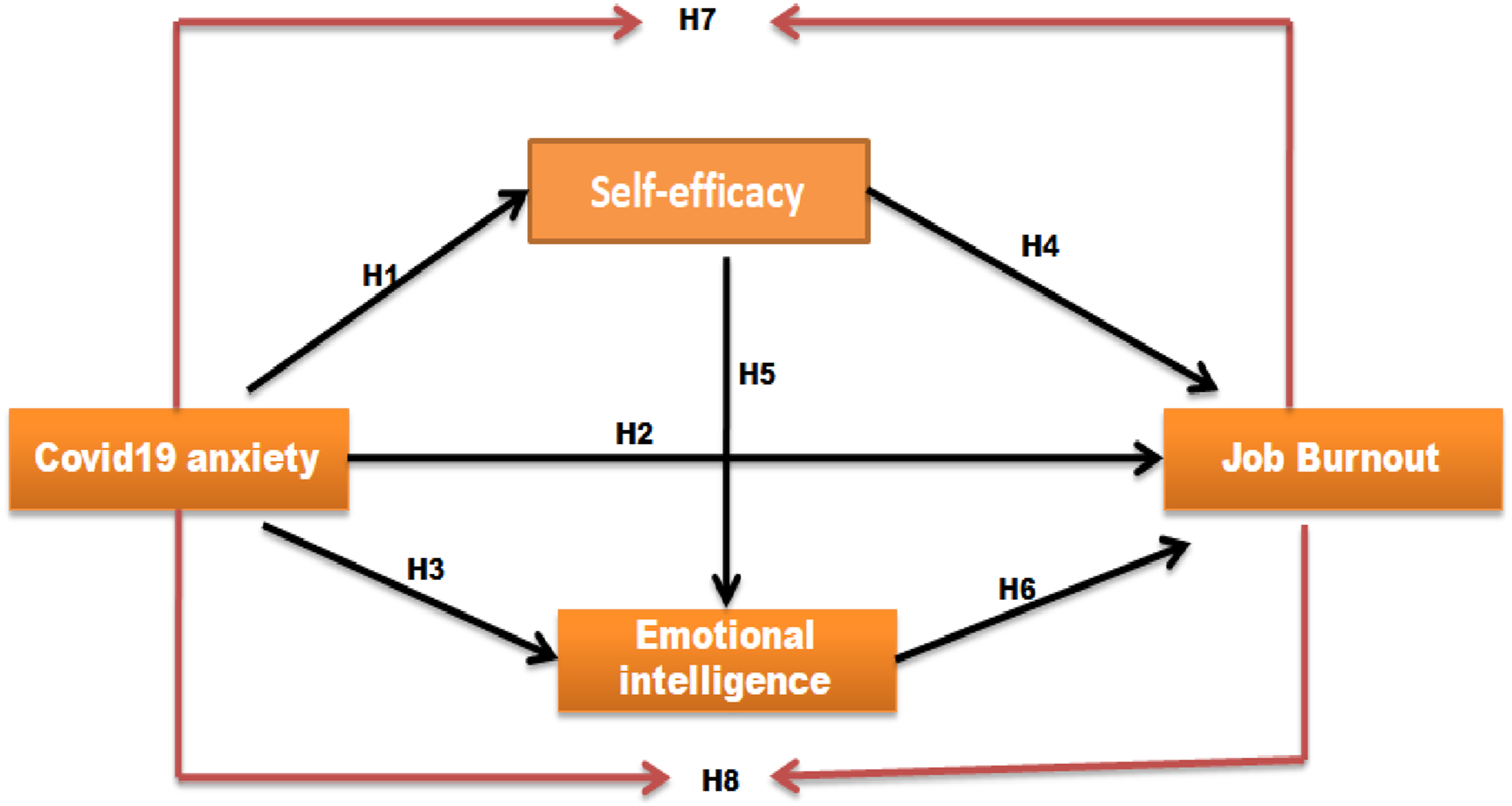
Research design
The present study was designed using quantitative cross-sectional research to test the interactions of COVID-19 anxiety, self-efficacy, emotional intelligence, and burnout among hospital employees in Hyderabad, India. The model was constructed, and COVID-19 anxiety is set as independent variable due extensive review on literature; emotional intelligence and self-efficacy are set as dependent and mediating variables; finally, burnout is the outcome dependent variable. The design allowed hypothesis testing by means of structural equation modeling (SEM), enabling the simultaneous examination of multiple direct and indirect paths within the proposed conceptual framework.
The rationale for this design is because it has good power for theory testing, and when the model involves complex inter-relationships between latent constructs. 41 In addition, SEM can be performed with several indicators of each construct, making the whole analysis less sensitive to measurement error.
Data collection
This study was conducted in several public and private hospitals located in the city of Hyderabad, India. A stratified random sampling method was employed to collect data from a representative sample of the considered population. The sample size was calculated based on the following formula: X = standard deviation 2Z2 = D2, where X = size of the sample, Z = standard score, and D = amount of precision or allowable error in the sample. 53 The application of this formula resulted in a sample size of 640. Accordingly, 680 questionnaires were distributed among hospital staff of private and government hospitals. Around 669 questionnaires were actually received back from the respondents; however, of these 15 were rejected due to missing responses. The study utilized a sample of 654 hospital employees across diverse occupational levels, each possessing a minimum of 1 year of work experience. The educational attainment of the sampled participants ranges from illiterate to postgraduate or doctorate degrees, including postgraduate nonprofessional courses as well. The authors visited these hospitals and obtained a permit from the hospital administration for the purpose of data collection from the employees. Employees were instructed to complete the questionnaire and return it to the hospital’s administrative office in a box.
Shows the description of respondents.

Source: SPSS output.
Measures
Emotional intelligence
EI for this study was measured using the 10-item scale as developed by BEIS. 57 An example item is “I know why my emotions change” α = .82).
Self-efficacy
Self-efficacy was measured by a three-item scale originally developed by Ref. 58. A sample item reads “I am self-assured about my capabilities to perform my work activities” α = 0.89.
Burnout
Burnout was assessed by a six-item scale originally developed by Ref. 59. An example item is “during my work, I often feel emotionally drained” (α = .78).
All the responses collected were recorded on a 5-point Likert scale, ranging from strongly disagree to strongly agree.
Reliability and validity analysis
Model fit of confirmatory factor analysis.

Note. χ2/df -Chi-Square/degrees of freedom, GFI - Goodness of Fit Index, AGFI - Adjusted Goodness of Fit Index, TLI - Tucker-Lewis Index, CFI - Comparative Fit Index, and RMSEA - Root Mean Squared Error of Approximation.
Source: AMOS output.
Convergent validity
Factors loadings, convergent validity, and reliability.

Note. Loadings are standardized regression weights. All loadings are significant at 0.01 level. CV1–CV5 are the manifest variables of COVID-19 anxiety, EI1–EI10 are the manifest variables of emotional intelligence, BO1–BO6 are the manifest variables of burnout: and SE1–SE3 are the manifest variables of self-efficacy. SL = standard loadings, M = mean, SD = standard deviation. AVE refers to average variance extracted; CR refers to composite reliability and SMC represents squared multiple correlations.
Source: AMOS output.
Discriminant validity
Discriminant validity.

Note. The values at diagonals are calculated using the square root of AVE. To establish discriminant validity, the diagonal values must be greater than the inter-construct correlations, **p < 0.01, CV represents COVID-19 anxiety, EI represents emotional intelligence, BO represents burnout, and SE represents self-efficacy.
Source: AMOS output.
Results
Structural equation modeling results.

Note. *** Significant for p < 0.001; CR - critical ratio, s.e. - standard error, CV - COVID-19 anxiety, EI - emotional intelligence, BO - burnout, and SE - self-efficacy.
Source: AMOS output.
The findings of this study suggested the tremendous impact of COVID-19 anxiety on emotional intelligence (β = −0.57, CR = −7.99, p < .001), followed by self-efficacy (β = −0.51, CR = −9.24, p < .001). Hence, it can be claimed that H1 and H3 were well supported. Moreover, it was also found that there is a significant impact of emotional intelligence on burnout (β = −0.37, CR = −8.68, p < .001), followed by self-efficacy (β = 0.628, CR = 15.74, p < .001) leading to acceptance of H4 and H5. However, H2 was developed to examine the effect of COVID-19 anxiety on the burnout variable (β = 0.67, CR = 10.40, p < .001), and H6 was framed to assess the impact of self-efficacy on burnout (β = −0.534, CR = −9.72, p < .001). As the results indicated both of these hypotheses were sufficiently supported.
Mediation analysis
Mediation results.

Note. CV- COVID-19 anxiety, EI - emotional intelligence, BO - burnout, and SE - self-efficacy. s.e. - standard error, LLCI - lower limit confidence interval, ULCI - upper limit confidence interval; *indirect effects were tested using the bootstrapping procedures with 5000 bootstrap samples.
Source: SPSS output.
Discussion
The main purpose of this study was to investigate whether there was a link between COVID-19 fear, job burnout, emotional intelligence, and self-efficacy. The findings revealed a negative relationship between COVID-19 fear and self-efficacy, indicating that fear of infection causes feelings of helplessness, sickness, and death in medical health workers, limiting professional work and affecting mental health. The fear also causes some changes in the cognitive system and restricts attention levels.7,36 These results are consistent with social cognitive theory, 67 which suggests the heightened physiological and affective arousal manifest fear which can undermine efficacy beliefs, particularly in high demand clinical environments. The fear also causes changes in the cognitive system and restricts attention capacity which may further affect confidence in one’s ability to perform.30,68 Consequently, physiological symptoms such as an increase in pulse, muscle stiffness, and breathing acceleration develop, limiting the person’s ability to work effectively. Self-efficacy is a personal attribute that greatly helps a person to overcome his negative self-defeated cognitive distortion such as jumping toward the conclusion that increases the physiological condition of an individual in a stressful and demanding workplace. These findings have been confirmed by the literature.2,3,5,38 The findings of the present study also showed that COVID-19 fear of medical health professionals is positively correlated with burnout. These findings are in line with the findings of the existing studies conducted by.3,19,69 During the COVID-19 pandemic, there is a high risk of burnout, which is characterized by widespread fear of infection and a high workload for physicians. These findings reinforce the stress-strain logic of the burnout model by demonstrating that disease-specific psychological stressor contributes meaningfully to burnout outcomes in frontline workers. 70 After dealing with COVID-19 cases, many doctors have withdrawn or suggested self-isolation. Fears of infection and a lack of social support during isolation are two important factors that can contribute to burnout. Furthermore, the findings show that psychological factors (COVID-19 fear) that cause severe emotional distress as COVID-19 fear are negatively correlated with emotional intelligence. 7 Intense long-lasting fear acts like a mental drain which weakens the ability to focus, understand feelings, and losing control over reactions. People with high EI can struggle to use those skills effectively when fear exhausts their mental health. COVID-19 fear can be overcome with EI, which entails efficient processing and management of emotional cues. EI is regarded as a significant protective factor among medical health professionals from fear-related symptoms generated due to treatment of the patients of the coronavirus. 19 Similar findings were confirmed from previous research work.2,3,38,50 Additionally, interdependence suggests that confidence in one’s abilities reinforces emotional regulation capacity and vice versa. Furthermore, during the pandemic, the level of burnout experienced by medical health professionals is evident, and researchers have discovered that emotional intelligence in healthcare professionals significantly reduces the tendency to be incompetent and incapable of achieving goals. By being able to use different emotions to generate optimal solutions to everyday problems, healthcare professionals can combat feelings of dissatisfaction, bitterness, and mistrust. Reviewing the literature, key findings emerged that emotional intelligence and self-efficacy are positively correlated with each other among physicians. Previous research has also found that EI is associated with a positive emotional state and high self-esteem. The relationship between EI and SE strengthens the self-concept through effective management in stressful situations. Refs. 71 and 72 have also been explored. The ability to be aware of one’s own thoughts and feelings is also developed through EI and SE. 72 Furthermore, it prevents people from becoming absorbed in negative or critical beliefs, thereby boosting their self-esteem; additionally, emotional regulation helps people cope with stressful situations.48,73,74 Furthermore, a negative correlation between self-efficacy and burnout suggests that SE is one of the influencing factors in burnout prediction. People with a high SE have a high tolerance for stress and a less tendency to experience burnout. Self-efficacy enables individuals to manage and regulate their emotions effectively, thereby mitigating burnout. These findings add to the existing research on self-efficacy and burnout among nurses and doctors in the context of pandemic-related stress. In such a situation, having confidence in one’s ability to control infection and adapt to changing roles can be helpful in preventing burnout. These findings are also coined from past research.38,39,49,75,76 With respect to mediation of EI, COVID-19 fear, and burnout, emotional intelligence is considered influential with burnout and fear perception. Emotional intelligence and work-related behavioral responses are linked. Emotional intelligence is a personality trait that refers to people’s ability to recognize and manage their positive and negative emotions.77,78 Individuals with a high EI score are better at recognizing and responding to the emotions that stewards face in their demanding environment, as research reports.52,79 Ref. 80 claimed that EI is a collection of distinct emotional and reasoning abilities, not just a positive characteristic. 3 Individuals with high EI differ from others in that they are more satisfied with their lives, enjoy their families, and participate in others’ emotions. They are also more organized, successful, motivated, and optimistic.18,37 All of the model’s observed parameters are interdependent, according to the findings. The highest levels of correlation exist between the observed variables of EI, emotional exhaustion, and burnout. In addition to the above-mentioned confirmed relationship between COVID-19 fear and job burnout, the role of EI as a mediating factor was investigated. 36 With regards to the findings, it showed that EI has a direct, positive, and significant effect on overcoming fear and management of burnout among medical health professionals. These findings explain the role of EI as a core psychological resource that enables individuals to regulate emotions, maintain composure and sustain professional performance under extreme stress. Such evidence is consistent with prior studies that argue EI facilitates adaptive coping, enhances emotional regulations, and fosters resilience in high pressure healthcare environment. According to the findings, EI has a direct, negative, and significant impact on burnout of health professionals. As a result, people with a high EI are less susceptible to job burnout and stress. As a result, increasing EI can help to reduce job burnout and fear. EI enables health professionals to understand and manage their emotions, stay calm under pressure, and handle stressful situations in better way. The research findings are in line with previous findings.3,19,37,50–52,69,75,77–79,81,82 Further, low levels of self-efficacy are linked to high levels of occupational stress and COVID-19 fear, suggesting that self-efficacy may act as a mediator between work-related stress and COVID-19 fear. Individuals with higher self-efficacy were better able to manage stress and did not let pandemic-related fear escalate into burnout. Personal accomplishment was found to be positively associated with professional self-efficacy, while depersonalization and emotional exhaustion were found to be negatively associated. 75 This means that when people believe in their ability to handle challenges, they feel more effective and motivated and less likely to experience the negative emotional states that lead to burnout. Individuals with lower generalized self-efficacy had more emotional exhaustion, while those with lower professional self-efficacy had more cynicism and less organizational commitment. 76 Our results aligned with these findings show that self-efficacy were able to resist high level of stress without it leading to strain or burnout.
The relationship between stressors and burnout experience was found to be more strongly mediated by generalized self-efficacy than by role specific beliefs. These findings were vividly related to previous literature.38,39,47,49,75,76,83
Conclusion
This paper examined the combined influence of COVID-19 fear, emotional intelligence (EI), self-efficacy (SE), and job burnout among medical health professionals. Confirming prior evidence that heightened fear undermines SE and EI, while intensifying burnout,7,67,70 COVID-19 fear was negatively related to SE and EI, as well as positively with likelihood of burnout. Both EI and SE have served as buffers, associated with lower levels of burnout, a higher degree of stress resistance, and better functioning at work.37,38,76
These mediating roles (EI and SE) point to interventions aimed at reducing pandemic-related psychopathology and bolstering the stress-coping capacity of frontline workers dealing with demands for healthcare: resilience training, emotional regulation workshops, and self-efficacy building. Future health crises will similarly threaten the well-being and functioning of the workforce. So, it is important to build these personal resources, which are required for maintaining well-being in the long term.
Implications of the study
Training programs that are imparted in Hyderabad, India, can take actions to highlight different viewpoints of self-efficacy and emotional intelligence to train the minds for stress tolerance, how to get better with self-efficacy and emotional intelligence, and how to manage the decrease of their job burnout and disease-related fear. This will also assist in improving the self-efficacy and quality of work in Hyderabad India. For the improvement of EI, more appropriate programs should be planned and presented. Concerning the impact of job burnout on efficacy, it is suggested that consulting services for healthcare professionals be expanded, as well as preventive programs. A strategy should be devised to reduce job burnout and improve relationships with employees. It is necessary to improve one’s welfare situation. It is critical to use the media to improve spiritual status. Entrepreneurial self-efficacy can be improved by combining a number of factors. 84
Research limitations
The relationship between the variables cannot be explained causally. Medical healthcare professionals in private hospitals should also be the part of study in addition to the government hospitals. Longitudinal research, in this case, is more likely to reveal the relationship between the variables. Moreover, the sample size selected in this study was limited. In addition to it, the evaluations are not supported by clinical examinations. Future research shall explore and examine other variables such as optimism, ability to recover, emotional competence, perfectionism, and emotional instability.
Footnotes

Ethical considerations
The study involved human participants for data collection. The present study was approved by ethical committee from the Department.
Consent to participate
The participants were assured of the confidentiality of their responses and informed consent was obtained from all the participants.
Funding
The authors received no financial support for the research, authorship, and/or publication of this article.
Declaration of conflicting interests
The authors declared no potential conflicts of interest with respect to the research, authorship, and/or publication of this article.