



Abstract
Background
Human resources are the organization’s key strategic assets, and organizations need to leverage them strategically to foster innovation and remain competitive.
Objectives
The purpose of the study is to examine how AMO-enhancing practices become contagious and influence the innovation behavior, focusing on high-performance work practices (HPWPs). It also explores the mediation effect of knowledge sharing (KS) on employees’ innovation initiatives (EII).
Methods
The study uses structural equation modeling to test the proposed hypotheses, drawing on survey data from 380 professional employees across different service organizations. We have investigated how HPWPs (i.e., AMO framework) can influence employees’ own actions to drive innovation initiatives.
Results
The study provides valuable insights that organizations can foster EII by maximizing organizational HPWPs through KS among employees. HPWPs can support EII by strengthening their ability to develop creative ideas, while KS can enhance innovativeness.
Conclusion
To remain competitive, organizations should invest in employee motivation and opportunity-enhancing practices and establish robust KS frameworks. The study would offer a distinctive perspective to HRM by providing a novel model for EII.
Introduction
Innovativeness enables firms to adapt to growing demands, enter new markets, and renew existing products, 1 contributing substantially to employment in both developed and developing economies. 2 They are widely recognized for their agility and responsiveness, which enable them to adapt quickly to market shifts and operate within highly competitive environments.3,4 Existing research highlights the importance of knowledge management in influencing the link between HR practices and workforce optimization.5,6 In a similar vein, Naqshbandi et al. 6 contend that effective knowledge management becomes crucial when employees recognize the tangible benefits of the knowledge sharing (KS) process. Studies in this domain indicate that management should adopt suitable people and knowledge management practices, as these support organizational learning.6,7 For instance, employees tend to engage in KS when HR practices enhance their task-related motivation and provide opportunities to develop and utilize their skills within the workplace.2,8–11
The innovation domain within the service industry has attracted considerable research interest.5,7 Among the studies addressing HR-related aspects, Naqshbandi et al. 6 investigated how competency, motivation, opportunity, and knowledge sharing contribute to innovation within firms in the United Kingdom. In addition, Than et al. 5 analyzed the impact of high-commitment HRM practices and knowledge sharing on exploitative and exploratory innovation, with particular emphasis on power and autonomy practices. Further, Naqshbandi et al. 6 highlighted the role of competency, motivation, opportunity, organizational learning culture, and knowledge sharing on open innovation. Similarly, Alkhalaf and Al‐Tabbaa 8 examined innovation performance in SMEs in France, focusing on ability, motivation, opportunity, and innovativeness. At the same time, Nasiri et al. 9 highlighted the role of flexibility-oriented HRM and leadership on organizational ambidexterity. Despite this broad research base, relatively little attention has given to how Ability, motivation, and opportunity (AMO) practices relate to employees’ innovation initiatives,10,11 in South Korea compared to studies conducted in Western economies.6,8,9 Although Alkhalaf and Al‐Tabbaa 8 emphasize the need to examine distinct bundles of HR practices and their contingent effects in fostering innovation performance, limited research has investigated how KS influences specific HR practices in driving employee innovation initiatives (EII).6,8,9,11,12
Accordingly, this study is motivated by ongoing research attention suggesting that employees’ KS activities enhance creativity across the workplace,5,9,11,13 which, in turn, fosters a culture oriented toward creativity and innovation.8,14 In support of this view, Naqshbandi et al. 5 highlight that knowledge sharing at the individual level positively associated with open innovation processes. When employees are able and encouraged to exchange their experiences, new knowledge is generated among organizational members, thereby stimulating innovation. 15 This dynamic ultimately aligns with the development of a KS culture to promote innovation.16,17
The literature has shown some linkages among HR practices, KS, and innovation, but these associations have often been examined separately under the theoretical lens of AMO and SET.18–20 Social exchange of information and experience has been found to influence innovation18,21 significantly. But their focus narrowly concentrates on AMO HR practices and EII through KS. Evidence shows that HRM enhances employees’ innovativeness across sectors such as manufacturing,
22
service,
17
SMEs,
11
and education.
23
AMO practices form a comprehensive framework for developing the essential relationships needed to manage knowledge and drive innovation.
1
In this study, we extend the literature of the role of AMO HR practices in fostering employees’ innovation initiatives by combining AMO model
7
and SET.
21
Most of the literature based on the AMO model often uses the term “ability” interchangeably with “competencies,” referring to the knowledge and skills individuals possess (e.g., know-how and know-what).6,24 Building on this prior research, we aim to address the following research questions. RQ1: How does HPWPs (as a systematic set of AMO practices) influence KS and EII? RQ2: How does KS mediate HPW practices and EII?
To answer those questions, we formulated and empirically validated a conceptual framework that investigates the value of adopting more structured HPWPs (AMO framework) for improving KS and overall service innovativeness.2,25,26 In particular, knowledge resources are considered essential for promoting EII and ensuring long-term success in today’s highly competitive business environment.19,27
Our findings provide three significant theoretical contributions. First, we introduce and validate a conceptual model that clarifies the mediating role of KS between AMO practices and EII in service sectors. This model fills prior research limitations by combining KS as a mediating variable to investigate the effects of HPW practices that strengthen employee AMO to drive innovation. 24 Our study adds depth to existing work on the drivers and mechanisms of service innovation 3 by showing how HPWPs can strategically navigate to stimulate innovation. Additionally, our results identify ability, motivation, and opportunity-based HRM practices that boost workforce capabilities and enable employees’ innovativeness 7 through KS. These insights hold practical value for service business owners, managers, and policymakers seeking to drive innovation in their organizations.
Second, employees’ innovation initiatives as a source of competitiveness and performance24,27 of the organization, and the development of a culture of sharing knowledge and experiences become determinants for inspiring and enabling employees to engage in innovativeness. Our analysis shows that HRM practices strongly influence employees’ professional and cognitive behavior in knowledge exchange, ultimately accelerating organizational performance. We posit HPWPs focusing on AMO bundles have a positive effect on nurturing knowledge, skills, and abilities to exploit and explore new information.24,28 By underscoring the importance of HRM in developing workforce capabilities to improve KS and innovation in service sectors, our study contributes to AMO and SET by integrating AMO bundles, KS, and EII into a unified framework.
Third, it extends knowledge on promoting employees’ innovation initiatives by highlighting the significant impact of HPWPs on EII through KS, with implications for leaders and managers in motivating and influencing employees to innovate in ever-changing, demanding service environments. Finally, this study extends the SET by highlighting the mediating role of KS between HPWPs and EII.
Theoretical foundation and hypothesis development
Ability, motivation, and opportunity (AMO) theory and social exchange theory (SET)
The Ability, Motivation, and Opportunity (AMO) theory6,9,18 provides a valuable foundation for analyzing HRM practices. It highlights three types of HRM practices that enhance service innovation: those aimed at strengthening employee abilities, boosting motivation, and expanding opportunities for participation.8,19 Effective HR practices facilitate knowledge transmission across the organization, 6 thereby conveying information to employees and shaping employees’ behavior to innovation.9,20 The design and execution of HRM vary substantially from one firm to another, one industry to another, resulting in different interpretations of the field. 29 Some scholars define HRM practices differently, intended to promote knowledge creation and innovativeness. 1 Prior research outlines three main perspectives on how HRM influences organizational innovation: the situational approach, the contingency perspective, and the HPWPs-bundles approach.1,18,29 Among these, the HPWPs-bundles approach (i.e., AMO approach) is frequently adopted by the service industry because it is both valuable and adaptable.5,30 In addition, leadership strengthens the effect of HRM practices on the development of employee ambidextrous capabilities to mitigate exploratory and exploitative tensions at work and support practical task completion. 17 In contrast, leadership facilitates Performance through KS. 28
Furthermore, service business implements HRM practices differently from manufacturing firms, regardless of whether these practices are formal or informal.7,18 These practices may also be structured within the AMO framework.17,31 The AMO framework examines the connection between AMO and innovation outcomes.8,17 Prior studies have proposed and empirically tested that AMO enhances employees’ knowledge, skills, abilities, and learning, thereby enabling innovative behavior.6,10,24 Through the implementation of HPWPs, organizations motivate employees to achieve superior performance by utilizing effective HR practices such as training and development programs, improved performance appraisal systems, and related mechanisms that encourage KS and the generation of new ideas, which are essential for innovation.6,24,29 However, existing literature has yet to clarify the role of knowledge sharing in linking the AMO framework to employees’ innovation initiatives in service firms. 8 By adopting such practices, organizations can generate value by attracting and retaining the best talent, expanding organizational knowledge, and recognizing employee education. 32 This alignment ultimately enhances innovation, engagement, and overall organizational effectiveness. Employees within organizations often engage in social interaction, with mutual understanding and the sharing of experiences and information.21,27 Therefore, social exchange theory can provide a lens on information exchange among employees to strengthen innovation.3,21
According to Social Exchange Theory (SET),21,33 social exchange facilitates KS
34
by involving HRM
30
and implementing AMO practices to achieve innovation performance and competitiveness.15,17 Mutual exchange of experiences, knowledge, and skills fosters understanding among employees, enabling them to identify and implement innovative ideas in the workplace. But hiding knowledge may hinder a business’s innovation and competitiveness.
15
Islam et al.
17
demonstrated the role of social capital, which includes three interpretational dimensions (structural, cognitive, and relational), and the behavior of an individual, which is related to ability, motivation, and opportunity to mitigate knowledge-sharing barriers. However, the mere existence of AMO practices does not, in itself, drive innovation unless abilities, motivation, and opportunities are embedded in knowledge exchange and enable employees to share experiences to develop innovative ideas or improve performance.17,24,34 These are essential conditions for resource exchange and combination,
34
but the literate have little or no understanding of the connections between HPW practices, KS, and EII. Accordingly, we propose the research model presented in Figure 1. Research Model. Source: Author (s) own work.
HPWP and employee innovation initiatives
Based on the AMO framework, which emphasizes critical HRM practices for achieving competitive advantage and fostering innovation, 17 prior research consistently demonstrates that well-structured HRM practices in service sectors enable the effective development and management of employee capabilities.1,5 Building on existing literature, 30 conceptualize HRM practice as the integration of three dimensions: abilities, motivation, and opportunities. Broadly, the AMO practices strengthen employees’ discretionary effort. 18
Ability refers to the knowledge, skills, and proficiencies that can be coordinated or shared within an organization’s network. 1 It includes both operational competencies and cognitive abilities linked to creativity and innovation. 34 To develop a capable workforce, organizations typically rely on recruitment and selection activities to identify applicants whose physical and mental skills, competencies, and qualifications meet job requirements, thereby ensuring the hiring of competent, knowledgeable employees. Different studies across sectors show a positive association between ability and innovativeness.11,17 These practices have been shown to directly foster the development of creative ideas and services, leading to increased KS and innovation. 2 Consequently, strengthening abilities and knowledge through learning has been recognized as a key contributor to performance. 9
Motivation refers to the internal force that directs, energizes, and sustains behavior, 1 or the willingness and enthusiasm employees demonstrate when engaging in tasks. 38 Research shows that HRM can use motivational practices to align employee behavior with organizational objectives. 34 Within the AMO model, 7 identifies a bundle of motivational HR practices that significantly influence individual innovativeness. These include performance evaluations, financial incentives for outstanding innovation, health-related benefits, performance-based pay, and opportunities for career development and promotion. Subramony, 33 meta-analysis provides evidence of a strong positive association between these motivational practices and positive employee behaviors, particularly in large firms. Related studies17,21 also show that implementing motivation-enhancing practices can improve innovative performance by increasing job satisfaction, employee engagement, and encouraging employees to generate new ideas.
Organizations enhance opportunities by improving work environments and empowering employees to contribute to organizational objectives.16,37 Shahzad 34 defines opportunity as the contextual and organizational mechanisms that enable and support innovation. Companies that invest in employee development and well-being tend to encourage participation and commitment toward collective objectives. 31 Moreover, providing employees with autonomy in decision-making strengthens their confidence and sense of empowerment, 38 which is associated with improved innovation.11,13,23,34
While the literature highlights the value of structured HPWPs, some studies report mixed effects on knowledge creation and innovation. But 31 found only a weak relationship between motivational practices and innovation. This inconsistency indicates the need for further investigation into how HRM practices contribute to innovation. Accordingly, we propose.
HPW practices (1) ability, (2) motivation, (3) opportunity positively influence EII.
HPWPs on knowledge sharing
Good HRM practices are widely recognized for ensuring knowledge exchange within organizations. According to Shahzad, 34 HRM plays a significant role in encouraging employees to share ideas and expertise, ultimately driving learning and growth. The ability to identify, absorb, and apply knowledge is essential because it underpins organizational learning and performance, 13 while the transfer of knowledge between individuals remains inherently challenging. 32 Even when employees have both the opportunity and motivation to exchange knowledge, a lack of ability can still impede KS. 37 The confidence and competencies required to recognize knowledge needs and tailor knowledge exchange processes are closely associated. The ability of employees to cultivate a supportive knowledge-creation environment. 1
Motivation plays a crucial role in shaping employees’ willingness to share knowledge.3,33 Individuals choose to engage in KS when they perceive that the benefits of exchanging knowledge outweigh the costs. 34 Externally, strong norms of reciprocity can create a sense of obligation to share knowledge, 1 while internally, intrinsic motivation has shown to further encourage KS behaviors. 29 A collective sense of identity and social cohesion within an organization 4 fosters collaboration and enhances employees’ willingness to exchange knowledge. 11
The AMO framework1,22 assesses whether situational conditions encourage action, whether opportunities are distributed equally among co-workers, and whether navigating these opportunities leads to desired employee behavior. 26 Without adequate abilities, motivation, and opportunities, employees may fail to recognize or act upon the benefits of combining and exchanging knowledge. 1 According to SET, KS involves making individual knowledge accessible, amplifying it, exchanging it, and integrating it into the organization’s broader objectives. 28 KS entails transferring explicit knowledge among organizational members and is facilitated by enabling conditions such as managerial support, employee autonomy, organizational structures, and supportive environments.1,34 From this perspective, the effectiveness of HRM practices is closely tied to employees’ behaviors, initiative, and eagerness to exercise decision-making power. 25 These opportunities are significant because the transfer of tacit knowledge is a continuous, complex, and time-intensive process that often resembles KS. 2
AMO framework and KS practices in enhancing learning and innovation.6,24 Naqshbandi et al. 9 reported that ability, motivation, and opportunity are positively related to knowledge sharing in UK firms. In contrast, researchers such as Bhatti et al. 24 provided evidence that only ability and motivation-enhancing HR practices have a significant effect on innovation performance through the mediating role of KS. Overall, Alkhalaf and Al‐Tabbaa, 8 identified significant relationships between AMO-enhancing HR practices on innovativeness and innovation performance. But motivation and opportunity have been found to have no significant association with knowledge creation. 37 These inconsistencies indicate the need for further research to examine how HPWPs foster KS. Based on these underprints, the following hypotheses are proposed.
The higher the level of HPW practices (4) abilities, (5) motivation, and (6) opportunity, the higher the level of KS.
Knowledge sharing and employees’ innovation initiatives
Prior research has emphasized the significance of KS within organizations.6,14,24 However, its effects have received comparatively limited attention, with multiple performance outcomes, including organizational learning, innovation, and improved innovation performance.9,17,24 KS constitutes a fundamental component of social exchange and has been examined at both the organizational level6,9 and the individual level.3,17 At the personal level, KS refers to the extent to which employees disseminate the knowledge they have acquired to others within the organization.18,21 KS helps employees learn new ways to identify and execute new ideas. 33 KS is likely to enhance employees’ skills more rapidly and to provide opportunities for generating new and innovative ideas. 24 Conversely, insufficient opportunities for KS can lead to adverse outcomes, affecting not only employees’ skill development but also their morale in forming social capital. 17
KS promotes collaboration and the transfer of ideas, thereby fostering creativity and innovation. Consequently, effective KS practices are expected to cultivate an organization’s innovative capacity by Pak et al. 35 Accordingly, Le and Le 14 introduced a six-phase creative knowledge process, including concept formulation, initiation, dissemination, polyphony (multiple perspectives), imagination, and consolidation, that drives innovation. Kumar et al. 13 demonstrated that KS among tourism employees directly supports innovation-oriented behaviors. Based on this reasoning, we propose the following hypothesis.
Knowledge-sharing significantly influences EII.
The mediating role of knowledge sharing
Weerakoon et al. 31 argued that ability, motivation, and opportunity foster social capital formation through knowledge creation, thereby substantially increasing employees’ capacity to produce superior innovation outcomes. KS practices are considered central to the cumulative relationship between HR practices and innovation capability, as innovative outcomes reflect firms’ investments in managing knowledge effectively. 3 Bhatti et al. 24 suggested that HPWPs help organizations establish a structured and supportive infrastructure that enables employees to acquire, assimilate, and share knowledge, thereby enhancing innovation. Similarly, Islam et al. 11 demonstrated that HPWPs foster a supportive culture that encourages KS, ultimately improving firm ambidexterity.
The importance of knowledge processes has been increasingly recognized, with recent studies applying the AMO framework to explain how knowledge is created and transferred among employees.6,9,24,31 Bhatti et al. 24 found that stronger AMO-oriented behaviors among employees allow others to benefit more extensively from shared knowledge, thereby positively influencing innovation performance. Consequently, employees’ KS behavior plays a critical role in organizational performance and must be embedded in organizational routines to create value.21,22,27
Consistent with prior studies3,5,12 the present study adopts a behavior-based view of KS, focusing on employees’ frequency of participation and level of involvement in KS activities. Existing evidence indicates that KS is significantly associated with open innovation 6 and innovation performance. 24 Accordingly, this study examines KS among employees working in the service industry. 3 It proposes that HR practices grounded in the AMO framework enhance KS, which in turn leads to EII in service sectors. Such environments are expected to encourage employees to be more critical, creative, and effective in generating new knowledge. Based on these arguments, the following hypotheses are proposed.
KS mediates the relation between (a) ability and EII, (b) motivation and EII, and (c) opportunity and EII.
Methodology
Procedures
We have targeted the service industry for data collection, using a convenient sampling method with a structured questionnaire to survey 60 tourism firms from the Jeju and Busan regions, renowned for providing tourism services in South Korea. We have considered tourism firms due to higher customer involvement of customers with employees and the necessity to be innovative and response in real-time. We also communicated with the relevant organizations to obtain permission to collect employee data for academic research. After receiving informed consent from participants, including a demographic questionnaire, participants asked to complete surveys within 60 working days. We sent the online questionnaire link for them to complete at their convenience. The data collection process took place between 01 April 2025 and 31 May 2025. We sent a questionnaire to 600 respondents; 412 provided feedback. After data screening and cleaning, we selected 380 valid and useful responses for further analysis, removing 32 invalid responses from the dataset. Soper’s 38 calculator determined the minimum sample size for this study to be 376, based on an effect size of 0.2 and a statistical power of 0.8. Therefore, our model is consistent with Urbach et al., 39 and structural equation modeling (SEM) is suitable for detecting effects.
Measures
High-performance work practices
This study employed the AMO framework to examine HPWPs in service organizations. Drawing on prior research by Bhatti et al., 24 we adopted the AMO framework scale, which is grounded in the premise that employees may “experience and interpret the same set of HR practices differently” Alkhalaf and Al‐Tabbaa,. 8 Employees’ perceptions of HRM practices were measured using 12 items derived from earlier studies and assessed on a 5-point Likert scale.6,9,10 Consistent with previous research applying the AMO framework,7,8,11,24 These practices are classified into three categories, each with four items: ability, motivation, and opportunity-enhancing HR practices.
Ability-enhancing practices
They included HR activities such as training, selection, and supervisory feedback. Sample items included “The company provides training for me to learn new ways to do my job,”
Motivation-enhancing practices
Were assessed by asking respondents to evaluate whether their compensation was competitive relative to other service firms and whether they were involved in their performance appraisal process. Sample items included: “I regularly (at least once a year) receive a formal evaluation of my performance.”
Opportunity-enhancing practices
Were measured by evaluating employees’ perceptions of their involvement in decision-making and the level of autonomy they experienced in their roles, particularly with respect to job-related decisions, to demonstrate improved performance. Sample items included “If there is a decision to be made, I have opportunities to participate in the decision-making”.
Knowledge sharing
It was adapted from Rahman et al. 28 and comprised four items based on earlier studies by Bhatti et al. 24 and Hussein et al. 18. This scale captured both the frequency of knowledge-sharing activities and the extent of employees’ involvement in such practices. A sample item was: “Our firm provides a supportive and collaborative environment for knowledge sharing.”
Employee innovation initiatives
The scales were adopted from Alkhalaf and Al‐Tabbaa, 8 which was initially developed based on the work of Breznik et al.. 23 Employees asked to evaluate the innovation initiatives of their service organizations using a 5-point Likert scale. Sample items included “developing new services and functionalities totally influences my intention to think about new.”
Analysis and results
Participants
The majority of participants have at least 16 years of experience (55.8%) in the service industry. A considerable segment, however, reported having between six and 15 years of experience (36.8%), while the remaining respondents reported over 16 years of industry experience (7.4%). The gender distribution shows a higher rate (86.1%) of men’s participation in the service sector when compared to other service industries. In terms of educational qualifications, the bulk of respondents hold a bachelor’s degree (55.0%), followed by a master’s degree (26.8%), and the majority are between 28 and 34 years of age (62.6%), representing a significant portion of young service providers.
Confirmatory factor analysis
Common method bias (CMB) was assessed using Harman’s single-factor test. The cumulative variance was 28.767%, which is below the recommended threshold of 50% for the presence of CMB, indicating that no CMB in data Podsakoff et al.. 40 Because of criticism of Harman’s single-factor approach, a common latent factor test was conducted for the proposed research model using confirmatory factor analysis (CFA) to verify the factor structure and assess overall fit. The complete CFA model included all five constructs examined in the study. The goodness-of-fit statistics for the five-factor model indicated an acceptable fit, as they met the recommended cutoff of. 41 The chi-square to degrees of freedom ratio was 2.43 < 3; GFI value was 0.902 > 0.9; RMSEA 0.043 < 0.1; SRMR 0.078 < 0.09; while the CFI reached 0.906 < 0.95 but 0.925 > .90.
The KMO value of 0.798 exceeds the acceptable minimum of 0.50, and Bartlett’s test of sphericity is significant (χ2 = 7962.287, p < 0.000), supporting the suitability of the data for factor analysis. 41
Measurement model test
The constructs in this study are reflectively measured. As recommended by Hair et al., 41 the evaluation includes checks for indicator reliability, convergent validity, composite reliability, and discriminant validity using smart-PLS4.01. Indicator reliability is assessed based on the proportion of variance in each indicator explained by the corresponding construct. 41 This refers to outer loadings, which should exceed 0.70.41,42 The model demonstrated discriminant validity across its five constructs, with eigenvalues ranging from 2.349 to 7.392, Cronbach’s alpha values above .88, and a cumulative explained variance of 83.460%, surpassing the recommended minimum of 60% (Hair et al. 41 ).
Measurement model.

VIF variance Inflation Factor, AVE Average Variance Extracted, CR Composite Reliability.
Reliability was confirmed using Cronbach’s alpha, composite reliability, and rho_A coefficients, with most values exceeding the 0.70 threshold (Streukens and Leroi-Werelds 44 ). Specifically, rho_A, which lies between Cronbach’s alpha and composite reliability in stringency, 40 also surpassed 0.70, affirming strong internal consistency. 43 All reliability indicators in the study were found to be robust and suitable for further analysis.
Discriminant validity.
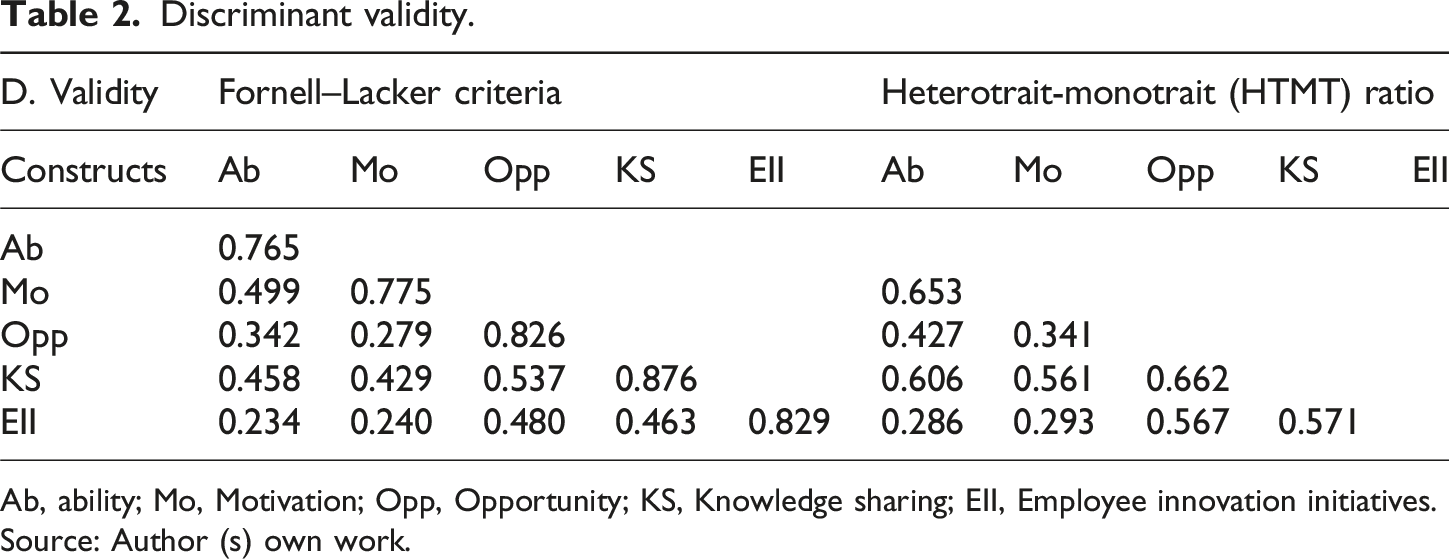
Ab, ability; Mo, Motivation; Opp, Opportunity; KS, Knowledge sharing; EII, Employee innovation initiatives. Source: Author (s) own work.
However, the Fornell–Larcker criterion has been found inadequate for accurately assessing discriminant validity. As a result, we use a more reliable method, the Heterotrait-Monotrait (HTMT) ratio, to assess discriminant validity (Table 2). According to Henseler, 43 a conservative threshold suggests that the HTMT value between two constructs should not exceed 0.85. The findings confirm that the constructs exhibit strong discriminant validity for hypothesis testing.
Structural model
Following Hair et al., 41 a bootstrapping technique was applied to assess the significance of path coefficients. In line with the recommendations of (Streukens Leroi-Werelds 44), 5000 bootstrap samples were used. The bootstrap analysis with 5000 samples resulted in a 95% confidence interval. A confidence interval that includes the path coefficient is more informative than p-values alone, indicating a statistically significant relationship.
The structural model presented in Figure 2 incorporates the anticipated hypotheses outlined in the research framework, along with their corresponding P-values and beta coefficient values. The results of the analysis reveal that ability significantly and positively affects EII (β = 0.319, t = 4.446, p = 0.000), thereby confirming H1. Motivation also has a substantial positive influence on KS (β = 0.186, t = 3.683, p = 0.000), thus confirming H5; opportunity also has a significant positive influence on KS (β = 0.205, t = 3.697, p = 0.000), therefore supporting H6. Regarding H4, ability positively and significantly influences KS (β = 0.431, t = 7.070, p = 0.000). KS positively and substantially impacts EII (β = 0.319, t = 4.446, p = 0.000), indicating support for H7. Structural model with path coefficient insignificant path. Source: Author (s) own work.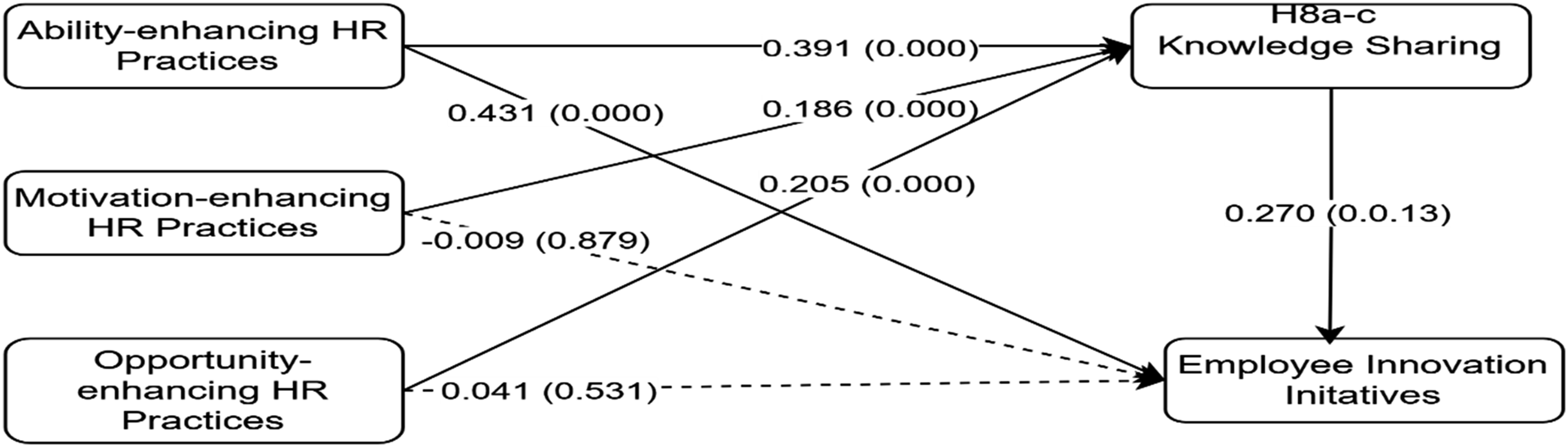
Explanatory power analysis.
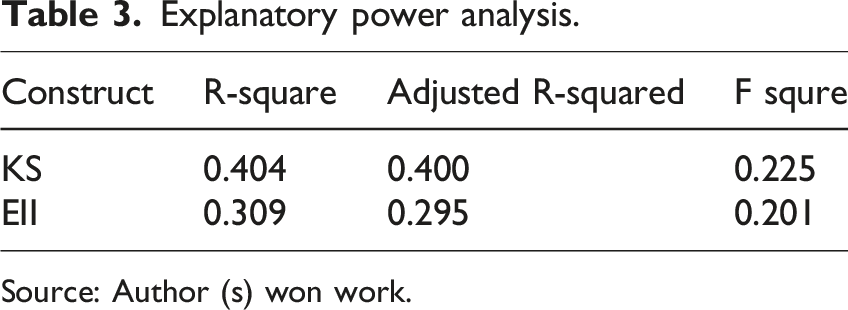
Source: Author (s) won work.
Mediation analysis
Mediation analysis.

Source: Author(s) won work P < 0.01**
Discussion
The objectives of the study were to explore the association between HPWPS and EII, with KS as a mediating variable. A previous study highlighted limitations in employees’ immediate supervisor responses and measurement issues (Bhatti et al. 24 ). Therefore, we aimed to overcome these limitations by using employees’ data, focusing on their innovation initiatives. This study broadens the concept of innovation by applying it to a new, previously underexplored service sector in South Korea. Earlier research has primarily examined the conditions that support innovativeness and innovation performance1,5,31; the drivers of firm-level innovativeness 5,7; and the influence of innovativeness on organizational performance.17,31 This study focuses on innovation differently (i.e., innovation initiatives) in the service sector of South Korea.
The findings support a significant positive association between ability and EII, confirming Alkhalaf and Al‐Tabbaa 8 and highlighting the critical role of strengthening employees’ physical and intellectual skills to encourage creativity and take innovative initiatives. Employee recruitment and training policies are closely linked to ability development, enabling individuals to engage in creative initiatives and contribute to new product innovations. 9 In this regard, employees’ abilities reflect their education level, training, and accumulated knowledge, which help them to perform their responsibilities effectively 31.33. However, motivation and opportunity yielded results that contrasted with those found by Bhatti et al.. 24 However, the study by9,34 supports an insignificant relationship between motivation and innovation. This may arise from a lack of sufficient motivational and opportunity-driving programs within the organization to promote innovation. 8
Our study also deepens the understanding of innovation initiatives in SMEs by identifying the mediating role of KS in the relationship between HPWPs (i.e., AMO) and EII, offering compelling evidence for H8a, H8b, and H8c. Our findings demonstrate that ability has a clear and meaningful influence on KS, offering strong confirmation for H4. Encouraging employees to be actively involved in KS, propose knowledge creation, and pursue differentiation acts as a pathway through which practices aimed at strengthening individual abilities translate into performance. 1 In the context of service firms, managers play a central role in shaping employees’ initiatives by cultivating a supportive KS environment that reduces both physical and psychological withdrawal and motivates employees to innovate, supporting the findings of.6,14,24 Notably, the effect size indicates that motivational activities such as competitive pay, reward systems, and performance appraisal are closely associated with KS within the studied firms. 15 Opportunity-enhancing practices positively affect KS, thereby supporting H6. Prior research connects these opportunities to KS through a well-designed work environment, the cultivation of value-driven cultures supportive of KS, and the encouragement of cooperation, teamwork, and participation. 29 Such conditions enable employees to channel their efforts more effectively.14,36 The widespread KS behaviors within firms stimulate idea generation and facilitate the development of innovative solutions that yield competitive advantages and strengthen innovativeness. Our study supports the findings of Bashir et al. 15 and confirms a positive relationship between KS and EII in hypothesis 7. Our results extend the contributions of21,23 by demonstrating that opportunities that encourage participation in decision-making and foster organizational commitment significantly accelerate KS within the firm, thereby promoting innovation initiatives. 29
The central importance of HPWPs identified in our study underscores their role in driving KS to accelerate innovation, thereby converting creative ideas into concrete actions.34,36 Collectively, our findings stress that fostering KS is vital within service firms; failure to do so may restrict innovation initiatives due to limited exchange of skills, experience, and opportunities,1,24 ultimately influencing them.
Theoretical implications
This study extends the literature on knowledge spillovers and innovation by examining, within a unique framework, how HPWPs (i.e., AMO practices), and KS influence complex innovation initiatives in several essential ways. First, the core contribution of the study lies in combining AMO theory with social exchange theory to propose and validate a conceptual model that explains how HPWP (i.e., AMO) fosters EII through KS Some scholars have explored the effect of AMO on innovation,1,21,33 but their focus has not been updated at the employee level with the emphasis on KS. For example, it identifies how employees engage in social interactions in line with expectations of contributing to business decisions. When HPWPs are associated with AMO practices, employees are likely to be involved in KS, which is essential for innovation. 24 Through our validated model examining how HPWPs drive innovation in the service industry, we offer new insights that address two ongoing debates in the literature: (1) the extent to which specific HPWPs are associated with KS and EII, and (2) which underlying mechanisms best explain how HPWPs stimulate innovation. 33
Secondly, HR practices can enable KS by influencing employees’ ability, motivation, and opportunity. HR systems influence the organizational climate, which develops employees’ ambidexterity 9 and shapes their attitudes and behavior, which directly influence social interactions and the exchange of experiences, driving learning and innovation.6,28
Thirdly, our study highlights the importance of HPWPs in shaping employees’ professional and cognitive skills while fostering an appropriate culture that drives innovation. This perspective aligns with the SET, which argues that distinctive KS environments are central to achieving performance objectives. 11 Well-structured HR practices can mitigate the tendency to hide knowledge within the organization while strengthening KS’s influence to develop social capital within the organization. 17 Importantly, this supports a key principle of social exchange: a supportive, collaborative environment drives superior performance. So, firms must act strategically to develop such environments effectively, as emphasized by scholars such as Bashir et al., 15 Rahman. 28 The structured practices embedded in the AMO theory help cultivate a KS culture in the service industry, ensuring employees have the ability, motivation, and opportunity to use their resources effectively.
Practical implications
The study has significant practical implications for both employers and employees to cultivate a culture of KS to accelerate innovation. Given that AMO has been proven to positively influence KS, 9 thereby developing employees’ ambidexterity 15 to drive innovation. HPWPs can shape employees’ behavior and attitudes, thereby develop human capital and accelerate firms’ competitiveness.15,30 By creating a culture of KS associated with AMO that supports successful innovations and learning from failures, HPWPs foster an environment conducive to creativity and innovation initiatives 6. HRM should strategically introduce HPWPs through comprehensive planning, commitment, and a supportive KS culture. This culture may include the AMO model (ability, motivation, and opportunity) through training, performance appraisal, and autonomy that recognize innovative initiatives. For example, adopting HPWPs can complement the KS culture and ensure innovativeness. 24
This study introduces a unique business model designed to help service firms navigate intense competition by leveraging human resources, reshaping internal systems, and adopting new approaches to attract and retain clients. South Korea’s service industry, especially tourism, faces persistent challenges, including insufficient training and development programs, which hinder its ability to meet customer service demands. Our findings further highlight the mediating role of KS in the relationship between HPWPs and learning. 9 HR practices facilitate experience and knowledge exchange rather than hiding knowledge, thereby promoting employee ambidexterity 10 and fostering innovation. A well-structured motivation and opportunity in HR practices will support the organization in KS and maintain key service innovation decisions that clearly align with strategic objectives, such as incorporating women or lower-level employees.
Among other practical implications, the study highlights employees’ social exchange of information. It provides environments for sharing positive information and experiences at work, 21 promoting contributions to organizational change through innovation and creativity. This study provides new insights for strengthening HPWPs, particularly in the service industry across Asia and beyond through KS practices.
Conclusion
This study demonstrates a comprehensive role for AMO as a “mechanism of knowledge exchange” to drive innovation initiatives, a role that has been overlooked in prior investigations. Our study highlighted that KS is crucial for developing a culture of innovation initiatives, which is strengthened by AMO-based HPWPs. HR practices associated with AMO are likely to facilitate KS, thereby motivating employee-level innovation initiatives. The findings highlight a significant relationship between HPWPs and KS, particularly in how managers can inspire and motivate employees by fostering an environment that facilitates information and skill exchange among stakeholders. The study’s insights have significant theoretical and practical implications for managers regarding how the introduction of HPWPs drives innovation.
Limitations and recommendations
This study offers several significant contributions and several limitations to be addressed in future research. First, the sample was drawn exclusively from South Korea, raising questions about whether the study’s findings can be generalized to other developing or developed economies. Future studies should therefore incorporate larger and more diverse samples. Comparative analyses across multiple countries and sectors would also improve the reliability and robustness of the conclusions.
Second, limitations related to data collection must be acknowledged. Because all data were obtained exclusively from employees of different service firms, potential common method bias cannot be completely ruled out. Future research could invite executives to participate along with employees to generate paired datasets. Experimental designs also facilitate overcoming the limitations of self-report surveys and provide stronger causal evidence.
Although this study relied on AMO theory and SET to explain how HPWPs influence EII, given its close connection with KS, other theoretical perspectives may also be relevant. Frameworks such as resource-based theory or self-determination theory could provide additional explanations, suggesting that other critical mediating mechanisms remain unexplored. Future research should therefore explain alternative psychological variables, including job fit, leadership support, and proactive personality, to deepen understanding of the antecedents of EII.
Finally, EII is shaped by factors operating at the individual, team, and organizational levels, which may interact by substituting for one another. Future studies are encouraged to adopt cross-level research designs to capture these complex dynamics.
Footnotes
Acknowledgment
We want to express our sincere gratitude to all the individuals and organizations that supported us throughout this project.

Ethical considerations
Ethical clearance for this study is waived, as it exclusively investigates human innovative initiatives using survey setting and does not involve any experimentation with humans or animals.
Consent to participate
The authors secured full consent from the respondents through the questionnaire during the data collection process. Respondents were thoroughly briefed on their rights and the objectives of this study. They could withdraw from the survey at any point during the research. Consent was obtained from the respondents to use their responses for academic research purposes.
Consent for publication
Each author has reviewed and approved the final manuscript, indicating collective agreement on the work and findings presented. In addition, the authors give their full consent to publish the manuscript in human system management journal if accepted.
Author contributions
Conception: Md Habibur Rahman, Jinkyo Shin; Methodology: Md Habibur Rahman, Jinkyo Shin, Dr. Md Alamgir Mollah; Data Collection: Md Habibur Rahman, Dr. Md Alamgir Mollah, Mamadaliev Mamirjon Makhammatjonovich; Interpretation or Analysis of Data: Mamadaliev Mamirjon Makhammatjonovich; Preparation of the Manuscript: Md Habibur Rahman, Jinkyo Shin, Dr. Md Alamgir Mollah; Revision and Editing: Md Habibur Rahman, Jinkyo Shin, Dr. Md Alamgir Mollah, Mamadaliev Mamirjon Makhammatjonovich; Supervision: Jinkyo Shin.
Funding
The authors received no financial support for the research, authorship, and/or publication of this article.
Declaration of conflicting interests
The authors declared no potential conflicts of interest with respect to the research, authorship, and/or publication of this article.
Data Availability Statement
The data used in this study cannot be publicly shared due to confidentiality concerns. However, the data can be made available upon reasonable request from the corresponding author.