Abstract
This article analyzes the relationships between project performance and the team’s ability, motivation, and opportunity (AMO). We contribute to the project management literature by exploring which combinations of AMO factors are best for project performance at different levels of complexity. We test our hypotheses on a sample of 285 projects. Our study shows that in simple projects, ability is the key factor both as a main effect and as a constraining factor that acts as a bottleneck for project performance. In the case of complex projects, the multiplicative model is superior given the significant interaction effects of motivation.
Introduction
Firms use team-based projects to manage activities and resources in an integrated way and to share knowledge and best practices internally (Gupta & Govindarajan, 2000; Sydow et al., 2004). Project teams are comprised of employees with varied knowledge, expertise, and experience who work together over the life span of a project to achieve a common objective of either developing an incrementally or radically new concept, service, product, activity, or generating change (Chiocchio, 2015). As such, team members are interdependent in the performed tasks (Gladstein, 1984; Guzzo & Dickson, 1996). However, the temporary and discontinuous character of projects can impose barriers to learning if abilities, motivations, and opportunities are not properly managed (Bartsch et al., 2013). Therefore, an understanding of the antecedents of project performance on the team level is particularly important, especially given the increasing performance pressures faced by project managers (Zimmerer & Yasin, 1998).
When examining the factors that contribute to a project’s success, scholars have pointed to the resources and competences held by team members, the human resource management (HRM) practices applied, and the characteristics of the performed task (Floricel et al., 2016; Popaitoon & Siengthai, 2014; Tabassi et al., 2017). As Huemann et al. (2007) argue, “human resource management (HRM) can be viewed as core processes of the project-oriented company, affecting the way the organization acquires and uses human resources, and how employees experience the employment relationship.” With that in mind, a recent review concludes that “by drawing on theoretical and methodical resources from the HRM field, project studies can benefit from a more refined focus on levels of analysis and practices” (Keegan et al., 2018, p. 129).
We respond to this call by bringing together the HRM literature on work performance and the literature on project performance. Individuals working in project teams need the proper set of abilities, motivations, and opportunities to perform effectively. The HRM literature has widely explored such factors in the context of high-performance work systems. In this perspective, work performance is seen as a function of an employee’s ability (A), motivation (M), and opportunity (O), which together form the AMO framework (Appelbaum et al., 2000; Blumberg & Pringle, 1982; Boxall, 2003). The HRM literature has mainly used AMO as a guiding framework in studies of human resource (HR) practices and their effects on individual employee performance (Andreeva & Sergeeva, 2016; Beltrán-Martín & Bou-Llusar, 2018; Siemsen et al., 2008).
At the team level, ability, motivation, and opportunity may facilitate intraproject learning, and contribute to organizational learning as well as performance (Argote et al., 2003; Bartsch et al., 2013). However, in general, the project management literature has not explored the contributions of AMO factors to team and project performance. A notable exception is the study by Raidén et al. (2006), who recognized that the combination of the three factors may provide a better understanding of project requirements in line with organizational priorities, employee needs, and employee preferences. Nevertheless, the authors do not test the model or the interplay among the AMO factors. We aim to introduce the AMO framework to the project management literature by testing the combined effects of teams’ abilities, motivations, and opportunities. We also examine combinations of AMO factors at the team level to find the combinations that best predict project performance.
Several studies have focused on the reinforcing effects of ability, motivation, and opportunity (Kim et al., 2015; Reinholt et al., 2011), whereas others have highlighted that one of the three factors might be a constraining factor that creates a bottleneck for performance (Siemsen et al., 2008). However, the exact interplay among the AMO factors is still an open issue (Argote et al., 2003), especially in the project management literature, which has ignored the three factors when studying the antecedents of project performance. As Keegan et al. (2018) note, testing whether “the outcomes found in non-project contexts that are linked to HRM practices are replicated in a project context” might be of value. We address this gap in the literature by comparing three competing models of interplay among the AMO factors (an additive, a multiplicative, and a constraining factor model) in terms of their effects on project performance.
As events in more complex projects are not always predictable, they require different problem-solving responses and more intense knowledge generation than less complex projects (Turner et al., 2014). Therefore, we also consider differences in project complexity and suggest that the AMO factors interact differently in simple projects and in complex projects. In this regard, we answer calls in the project management literature for a deeper understanding of the capabilities needed to perform given different levels of project complexity (De Rezende et al., 2018).
Moreover, while most studies have been conducted on the individual level with a focus on individual performance, we conduct our analysis at the team level with a focus on team performance. One cannot simply aggregate from the individual level to the team level and expect the AMO factors to work in the same ways on both levels (Klein & Kozlowski, 2000). In fact, the team level involves interactions that introduce a different dynamic. As such, we respond to the call to extend AMO research to the team level (Bouwmans et al., 2019; Jiang et al., 2013). Our research questions are the following: In what ways do a team’s ability, motivation, and opportunity affect project performance? How do these factors interact? To what extent does the effect depend on the complexity of the project?
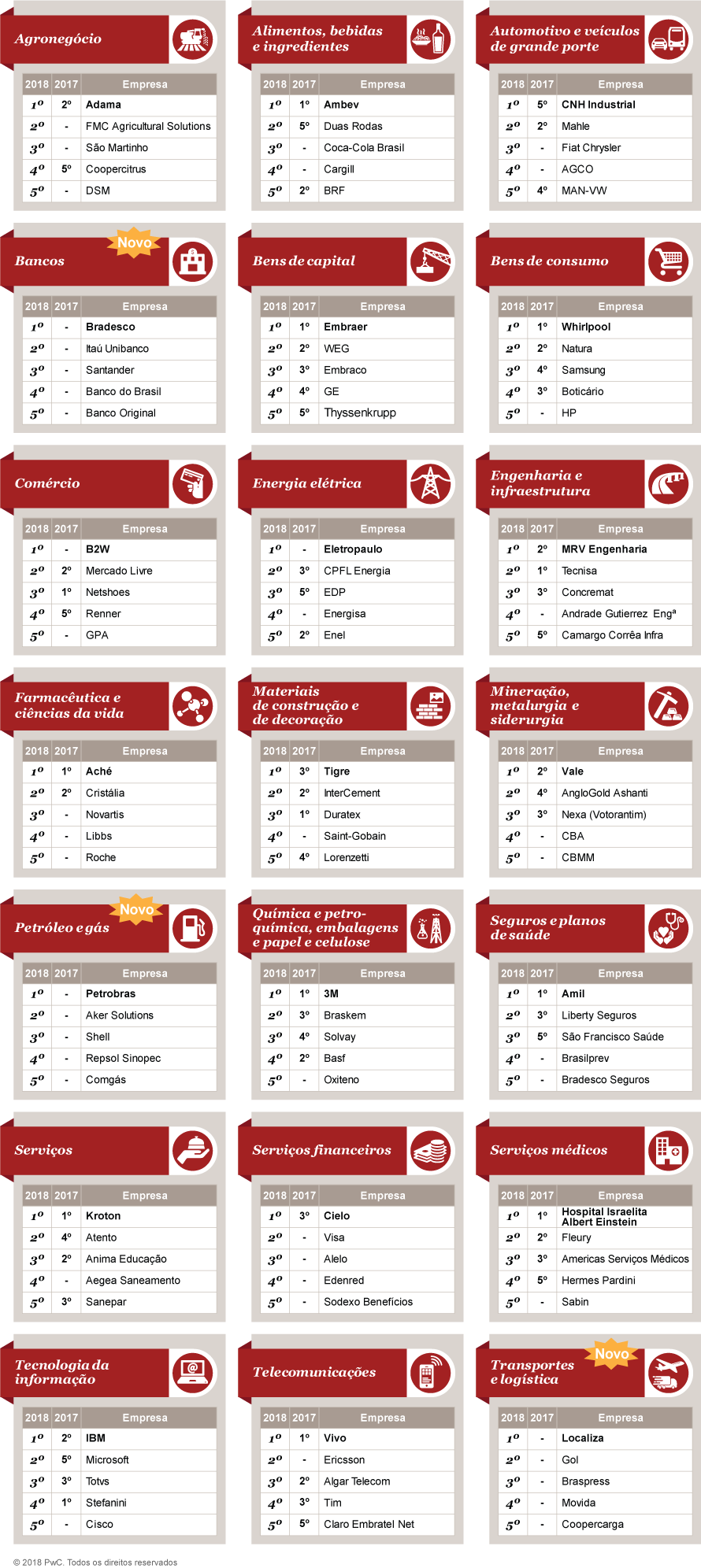
We conducted our study at InterCement, a multinational producer of cement, lime, and special mortars headquartered in Brazil. InterCement is a project-based organization (PBO; Hobday, 2000) that is particularly suitable for this study because of its predominant focus on team-based process- and management-innovation projects. In fact, it was recognized by Strategy& (part of the PwC network) as one of the five most innovative companies in the construction materials and decoration sector in the Valor Brazil Innovation Yearbook (Prêmio Valor Inovação Brasil, 2018). We tested our hypotheses on 285 projects.
We contribute to the literature in three ways. First, we introduce insights from the HRM literature on factors that can enhance project performance to the project management literature. Second, we explore the predictive capacity of the AMO framework and compare three models of the interplay among these factors at the team level; as such, we extend the literature, which has mostly focused on the individual level. Third, we introduce project complexity as a contextual variable that affects the optimal combination of AMO factors. By advancing our understanding of the antecedents of project performance at different levels of complexity, we hope to help managers to more efficiently allocate their teams’ competences and resources.
AMO Models and Project Performance
Firms make extensive use of teams as a way of integrating and recombining knowledge in order to reach project goals. Previous research has analyzed variables such as the team’s size and composition, its motivation, the difficulty of achieving goals, and the type of leadership as predictors of project performance and effectiveness (Gladstein, 1984; Guzzo & Dickson, 1996; Keller, 1986; Tabassi et al., 2017). HRM practices have been found to affect project organization and performance in multiple ways (Belout & Gauvreau, 2004; see Huemann et al., 2007; Keegan et al., 2018, for reviews on the cross-fertilization between HRM and project management).
For instance, the project management literature highlights the importance of education, technical competences, and leadership skills for conducting successful projects (Rumeser & Emsley, 2019; Zimmerer & Yasin, 1998). It also shows that the motivational climate in which teams operate is highly relevant in determining project managers’ behavior and performance (Caniëls et al., 2019; Seiler et al., 2012). Other aspects explored by project studies are the roles of situational factors, such as project complexity (De Rezende et al., 2018; Lechler et al., 2012; Rumeser & Emsley, 2019) and the importance of managerial support (Gardner et al., 2011; Srivastava et al., 2006).
However, the factors that might contribute to project teams’ performance are scattered throughout the project management literature and links to HRM theories are limited. On the one hand, as Huemann et al. (2007) note, “in the project management literature, a limited amount of research has considered HRM.” On the other hand, “the leading HRM literature neglects projects as a new working form and the specific implications of project-oriented work for HRM” (Huemann et al., p. 318). We bridge these two streams of literature by taking a closer look at HRM theories and their relevance for project performance at the team level.
The HRM literature proposes that performance is an outcome of three factors—ability (A), motivation (M), and opportunity (O)—which together form the AMO framework (Appelbaum et al., 2000; Blumberg & Pringle, 1982; Boxall, 2003). Ability, which refers to the capacity to perform, is closely connected to knowledge base and skills. Motivation includes attitudinal variables and refers to an individual’s willingness to perform. Opportunity reflects the means through which abilities and motivation can be converted into outcomes (Jiang et al., 2013). Several empirical studies have adopted and validated this conceptual framework (Batt, 2002; Liao et al., 2009; Subramony, 2009). For instance, Bailey et al. (2001) found that high performance work systems (HPWS), which are characterized by incentives to encourage employee participation and human resource practices that ensure a skilled workforce and opportunities to participate in decisions, positively affect earnings in several industries.
The reasoning for including these variables together is found in Gestalt psychology—their combined effects may be greater than the isolated effects of each element (Rock et al., 1990). For instance, previous studies suggest that the AMO model is more effective for predicting organizational outcomes than the three individual practices on their own (Obeidat et al., 2016; Subramony, 2009).
Although there is empirical evidence of the positive impact of the AMO factors on performance (Caligiuri, 2014), less is known about their complementarity or whether one factor is more important under certain conditions (Kim et al., 2015; Siemsen et al., 2008). Therefore, scholars have called for empirical explorations of how ability, motivation, and opportunity work together to create value (Argote et al., 2003).
This is particularly important at more aggregated levels, such as the team level, because of the dynamics and interactions among team members (Popaitoon & Siengthai, 2014). Team ability is different from the sum of the individual members’ abilities, as it includes the synergies and interdependencies of members’ skills (Jane Zhao & Anand, 2009). In fact, in many cases, a team is more than the sum of its parts, such as when people with technical and business knowledge collaborate, or when players on a sports team have different skills that complement each other to create a team ability that is greater than the sum of each player’s ability. The same is true for team motivation and team opportunity, which relate to complementarity and variation among team members rather than just the sum of the individuals. Notably, the very reason for forming the teams is that some synergies are created by putting individuals together. This approach, which is referred to as the “jigsaw puzzle approach,” considers whether or not team members complement each other to achieve the team’s highest potential based on specific combinations of several variables associated with each member (Allen & O’Neill, 2015). Additionally, HRM policies, processes, and practices in project-oriented companies are expected to be different from those in traditional organizations where the emphasis is on routine products and services (Huemann et al., 2007). Therefore, the most effective combination of AMO factors at the team level might be distinct from the most effective AMO combination at the individual level.
Initial research on these issues utilized an additive or linear model in which an increase in one of the three factors was assumed to have a direct, positive effect on performance (Boxall, 2003; Cummings & Schwab, 1973). In an additive model, each factor has instant, linear, and independent effects on performance (Cummings & Schwab, 1973). One implication of this model is that the absence of one factor can be offset by increases in the other two factors. However, in most cases, this model does not accurately reflect how the AMO factors determine project performance, simply because the three factors are rarely independent of each other.
Team members need the right skills to perform tasks that are generally characterized by (sequential or reciprocal) interdependencies. A lack of these abilities can seldom be offset by willingness or organizational support. Instead, the tasks will be delayed or performed poorly, thereby affecting the performance of the entire project (Garud & Kumaraswamy, 2005; Gladstein, 1984). Similarly, we expect the team’s motivation to be a factor that cannot be offset by the other two factors. A high level of team motivation is related to trust and collaborative behavior in which individuals strive to achieve collective outcomes (Cabrera & Cabrera, 2005; Collins & Smith, 2006). Low levels of motivation might imply that team members trust each other less or they may not be committed to the project’s goals, resulting in relationship conflicts and poorer performance (Lin et al., 2007; Liu et al., 2011). With regard to the opportunity factor, extant research offers empirical evidence of the importance of the individual’s positioning (Reinholt et al., 2011) and organizational support (e.g., empowered leadership and management’s commitment) for project performance (Gardner et al., 2011; Srivastava et al., 2006). Beyond these direct effects, we expect organizational support to reinforce team members’ abilities and motivation by strengthening their knowledge base through internal knowledge sharing and by reinforcing their self-confidence.
Consequently, models that account for complementarities among the AMO factors might better predict performance at the team level. Thus, our first set of hypotheses (H1a and H1b) highlight the likely superior predictive power of two competing models—the multiplicative model and the constraining factor model—relative to that of the additive model. In fact, some investigations point to specific conditions that might have either a reinforcing effect between factors (i.e., the multiplicative model; Kim et al., 2015; Reinholt et al., 2011) or a constraining effect (i.e., the constraining factor model).
The multiplicative model claims that the three factors reinforce each other (Jiang et al., 2012). The team’s ability is expected to positively interact with the team’s motivation by reducing role confusion and increasing feelings of efficacy and commitment (Gardner et al., 2011). High levels of efficacy are positively related to team performance (Srivastava et al., 2006). As mentioned earlier, the opportunity factor also has reinforcing reciprocal effects with ability and motivation. First, opportunities such as training and professional recruitment enhance the team’s abilities. Second, when leaders are supportive and involved, team members can learn from their tactical and managerial skills and obtain guidance on how to apply their knowledge (Gardner et al., 2011; Srivastava et al., 2006). Along the same lines, a team with a richer knowledge base has more opportunities to find solutions internally, thereby promoting knowledge exchange, which also strengthens the development of a collaborative climate (Jiang et al., 2012).
We also expect a reinforcing effect between motivation and opportunity in relation to project performance. First, members who perceive that their contributions are highly valued by others or that others might help in their future career development feel obligated to reciprocate, which enhances the collaborative climate (Cabrera & Cabrera, 2005; Gagné & Deci, 2005) and affective commitment (Gardner et al., 2011). Second, highly supportive teams with empowered leaders raise the level of intrinsic motivation by allowing individuals to be autonomous. In addition, these contextual conditions allow individuals to share their own ideas and potential solutions.
Therefore, a multiplicative model that includes interactions among the three factors might better explain project performance. Accordingly, we hypothesize:
However, teams do not always benefit from the complementarities among the three factors. The dynamics and characteristics of teamwork (e.g., the complexity of the project, the tacitness of the knowledge being shared) might call for a different model. At the individual level, Siemsen et al. (2008) apply the notion of resource constraints to the AMO framework for individuals’ knowledge sharing and they propose a constraining factor model. Siemsen et al. identify cases in which the value of one factor (i.e., the minimum for ability, motivation, or opportunity) acts as a bottleneck, such that unless a minimum is reached, the other factors have a limited effect. For example, in a context without any motivation, motivation may act as a behavioral constraint in relation to improving project performance, even in the presence of high ability and opportunity.
The constraining factor model proposes that the factor that is present to the least extent has the greatest effect on the team’s performance because it constrains the effects of the two other factors if it is too low. Therefore, increasing the level of the lowest factor will strengthen the other factors as well (Siemsen et al., 2008). In fact, project teams establish a division of labor based on abilities, especially when their members are already specialized and accustomed to handling specific tasks. For these reasons, a failure to achieve a minimum level of one of the factors (e.g., lacking a specific ability needed to perform a task) postpones, at least in the short term, the achievement of potential synergies related to the other factors and affects the project’s performance. Therefore, we hypothesize:
A key characteristic that might illuminate which of the two suggested models is the most appropriate is the project’s complexity, which is a relevant source of uncertainty and risk (Floricel et al., 2016; Nuhn et al., 2018). In this article, we focus on short-term projects that aim to improve efficiency. These projects are more exploitative of extant knowledge, and their level of complexity varies depending on factors such as the institutional environment’s complexity or organizational complexity (Floricel et al., 2016). De Rezende et al. (2018) show that project complexity has structural, uncertainty, novelty, dynamics, pace, sociopolitical, and regulative dimensions that require different team and organizational capabilities. Thus, we differentiate between simple and complex projects (Baccarini, 1996; Geraldi et al., 2011).
Simple projects are characterized by less variety, fewer tasks, and lower technological and structural complexity (Baccarini, 1996). Therefore, the interdependencies in simple projects are straightforward and easier to manage (Geraldi et al., 2011). It is possible to identify and foresee the tasks that must be undertaken and plan how to perform them, and there is more certainty (Geraldi et al., 2011) about potential problems. If problems do occur, the team members are expected to possess the abilities and experience needed to address them. In this case, the work can be managed with an emphasis on execution as efficiency (Edmondson, 2008; Turner et al., 2014). In contrast, complex projects are characterized by high levels of structural complexity owing to interactions among a large number of elements. Team members managing complex projects often confront confusing and unpredictable situations in which present knowledge and experience might be of little use (Baccarini, 1996; Geraldi et al., 2011). In these projects, it is more difficult to identify and define possible courses of action, and to manage interdependencies among team members. In such cases, projects can require new knowledge interactions to be managed as execution as learning (Edmondson, 2008; Turner et al., 2014). Therefore, as project complexity increases, more intense efforts and diversified knowledge may be needed in order to develop an absorptive capacity for problem solving (Cohen & Levinthal, 1990).
Under such conditions, we expect the two competing AMO models—the multiplicative model and the constraining factor model—to differ in terms of their ability to predict performance. On the one hand, we expect the constraining factor model to be the optimal model for simple projects, as it reflects the idea that minimum levels of ability, motivation, and opportunity are required for the synergies among the AMO factors to unfold. The investment of more resources does not provide significant complementary benefits because of the simplicity of the tasks and the low level of uncertainty. For these reasons, we hypothesize:
On the other hand, we expect the multiplicative model to be a better predictor of performance for complex projects. Team members allocated to complex projects generally have a certain level of ability, as they are assigned to projects based on their abilities. We also expect the presence of some level of motivation related to possibilities for career development (extrinsic motivation) or task identification (intrinsic motivation). We also expect these teams to have some organizational support, as their projects are more likely to be of strategic relevance. Under these conditions, investments in one AMO factor trigger synergic effects in at least one other factor. For instance, the implementation of training programs aimed at augmenting team members’ knowledge should enhance feelings of competence and increase members’ motivations (Lee-Kelley, 2006). Similarly, increasing the frequency and strength of communication among members should enhance members’ knowledge and help them adjust to unexpected environmental changes (Floricel et al., 2016). Because of the structural complexity and uncertainty, complex projects require that all three AMO factors complement each other along the entire scale in order to achieve the project goal. Thus, we hypothesize:
The identification of the factor that matters most for each type of project is highly relevant, as it helps managers better allocate resources. In the case of simple projects, we argue for the existence of a constraining factor—team ability—that acts as a bottleneck for the two other factors, as the project’s success is mainly determined by team members’ cognition.
Individual cognition is related to the knowledge the individual possesses as well as the processes of knowing, attending, remembering, and reasoning (Helfat & Peteraf, 2015). When individuals face routine or familiar tasks, their responses can be quasi-automatic if they retrieve the knowledge needed from their memories (Helfat & Peteraf, 2015). In this sense, education and experience are valuable inputs for individuals making decisions on simple projects as they can lead to heuristic processes and speed in mental processing. As the level of uncertainty in simple projects is expected to be low, individuals should not need to engage in more sophisticated information processing in order to create new, innovative solutions. Instead, they need to apply their extant knowledge and experience to specific tasks. Therefore, we suggest:
When teams manage complex projects with difficult, highly interdependent tasks and in which unforeseen problems might arise, their performance is determined by complementarities among the three factors. From self-efficacy theory (Ajzen, 1991; Bandura, 1977), we know that individuals’ perceived self-efficacy (ability) depends on their own judgments regarding how well they can execute the courses of action required to deal with specific situations. Gagné and Deci (2005) argue that self-efficacy is directly related to intrinsic motivation, as it triggers feelings of competence and autonomy. Teams with the right knowledge and experience might feel more confident when facing complex and difficult tasks. Moreover, they can perceive such complexity as interesting and challenging, which promotes feelings of autonomy and intrinsic motivation. For instance, Rumeser and Emsley (2019) show that experience with project management work improves team decision-making performance in highly complex situations.
Along the same lines, a team’s motivation interacts with organizational support (opportunity). Like individual behavior, a team’s actual behavior depends on its perception of control—the extent to which it believes that, in general, its performance is determined by that behavior (internal control) and by other contingencies (external control; Ajzen, 1991; Lee-Kelley, 2006). In simple projects, teams might believe that most things are within their control, such that they depend less on external circumstances. However, as complex projects are characterized by high levels of uncertainty and ambiguity, the locus of control would be viewed as more external. Therefore, the more confident and motivated the team, the more it will be able to convince the organization to provide the required training, financial support, and extra time needed to conduct the tasks (Lee-Kelley, 2006). Highly supportive organizations will accept part of the responsibility and stand by members. Managers can provide support by, for instance, providing up-to-date and relevant information that guides the team’s behavior and by creating a supportive climate that reduces feelings of fear, anxiety, or stress (Srivastava et al., 2006).
As argued earlier, the team’s motivation plays a key role in releasing the complementarities among the AMO factors in complex projects. Hence, we hypothesize:
Methods
We test our hypotheses in the context of the Brazilian multinational company, InterCement. InterCement produces and sells cement, lime, and special mortars all over the world. It has 40 business units spread across eight countries: Brazil, Argentina, Paraguay, Portugal, Mozambique, Cape Verde, Egypt, and South Africa. It exports to 17 countries, has 7,735 employees worldwide, and generates a total of €1.9 billion (US$2.0 billion) in revenue (2016).
Knowledge management is a corporate function at InterCement, as the transfer of best practices across the organization is viewed as critical. One key initiative is the Continuous Improvement Program, which has directly affected the company’s overall performance and contributed about €2.5 million (US$2.63 million) in savings per year.
The purpose of the program is to establish, monitor, and foster improvement projects. As InterCement is a commodity firm, these projects usually aim to reduce costs or increase sustainability by setting targets for energy efficiency, the use of alternative raw materials, and cost reductions (e.g., to develop new chemical substances to improve the cement’s quality and to reduce the thermal consumption of the accumulated kiln). As such, the program encompasses projects that focus on improvements in existing processes (i.e., solution-oriented projects) rather than radical innovations.
Approximately 150 to 200 projects are launched within the program each year. Most projects last for one year and some for up to two years. Thus, the company typically has about 300 continuous improvement projects underway. In order to promote and keep track of these projects, InterCement uses a plan, do, check, act (PDCA) tool through which all information is entered into an online platform that all business units can access. The PDCA, also known as the Deming Cycle, is a management tool based on Lean Six Sigma/total quality management principles. Other studies, such as those by Chen and Belcher (2010) and Maruta (2012), cite the use of PDCA as important for a firm’s absorptive capacity, innovation, and improvement.
Typically, the corporate systems director defines the program’s objectives for the year, which then trickle down into the organization. Each unit has its own systems manager, who proposes continuous improvement projects that fall within that unit’s responsibilities and are in line with the premises established by headquarters. The unit’s systems manager assigns a project leader to handle the day-to-day work and operational issues for projects being undertaken in that unit. 1
Each project has only one team in charge of its tasks and its specific goals, including expected financial results. Therefore, in this study we use the terms project and project teams interchangeably. A project comprises a project leader and team members (6.4 team members on average, with a range from 2 to 19). The project leader is responsible for assigning team members to the project. Once the project starts, the project leader continuously enters information on the project’s performance into the online PDCA platform, which is monitored by corporate management. Realized financial gains are reported when the project is finalized.
Measures
In this article, we use data on projects finalized in 2015 and 2016, which we combine with HR data on each project-team member. The project data are based on the project level, while the HR data are based on the individual level. The project data capture the workings of the project and include information on each project’s goals, level of complexity (simple vs. complex), links to corporate strategic objectives, team composition (number of people and team members), average participation in meetings, reported problems, and performance (see Appendix B for additional information on the distribution of team-level variables). The HR data provide basic information on all employees of InterCement, such as hierarchical position, function, department, and level of education (see Appendix B for additional information on the distribution of individual-level variables).
By matching the names of employees in the HR data with the names of team members in the project-team data, we are able to calculate the composition of team members in terms of different dimensions. This enables us to aggregate the individual-level information to the project level not just by calculating the means for the individuals but also by using the diversity among team members to construct compositional measures at the team level. Recall that the team-level variables are not just the sum of the individual features; rather, they are compositional measures of the individual features that capture the synergies and add a team-level component. As such, all variables are tangible measures rather than intangible, latent constructs. Also, the operationalization of the AMO variables at the team level aims to shed light on actionable measures from a managerial perspective. As we are able to use the HR data to calculate the compositional features of project teams (the team-level measures), these two data sources allow us to examine interactions among the team members’ skills (ability), the team’s behavior (motivation), and contextual factors (opportunity) in relation to project performance. Therefore, the data are especially suitable for testing our hypotheses regarding the effects of team-level AMO factors on project performance. The data are unlikely to suffer from common method bias, as we draw from two separate data sources that are relatively objective (data reported in the online system and monitored at higher levels in the company, and fact-based HR data). All of the applied variables are single-item measures that are calculated based on one of the two data sources (project data or HR data).
Dependent Variable
Our dependent variable is project performance, which is measured as the financial gains obtained at the end of the project. These financial gains, which reflect the actual cost savings or revenue increases that result from each project, are reported by the project leader. They are monitored by corporate management, which checks the accuracy of the uploaded information. Although project performance has different dimensions and can be measured in various ways, we follow Dvir et al.’s (2003) suggestion of focusing on the key stakeholder’s objectives. In this case, the key stakeholder is corporate management, which initiates projects and promotes knowledge sharing and financial goals. Nevertheless, we conducted different robustness checks with alternative specifications of project performance, including time spent, delays, gaps between financial targets and final results, and goal achievement (as a percentage). None of these alternative specifications provided more robust results.
Independent Variables
The independent variables are the AMO factors: ability, motivation, and opportunity. Ability is measured as the percentage of team members in each project with a university degree. Education is described by Blumberg and Pringle (1982) as one of the variables related to the ability component. Minbaeva et al. (2003) also emphasize the importance of education for building up employees’ abilities. Ultimately, education enhances employees’ absorptive capacity and innovative capabilities (Leiponen, 2005). We obtained information on the educational level (i.e., elementary school, high school, technical education, or university degree) of all project members from the HR data, and then calculated the share of project members with a university degree for each project (average of 8% for all projects). Highly skilled team members are typically the critical factor in realizing complementarity among the individual skills of team members. A similar measure of team ability was applied by Bailey et al. (2001).
Team participation serves as a proxy for motivation, as it measures the percentage of project members actually engaged in the team’s meetings with the monitoring body (average of members taking part in each meeting relative to the total number of members in the project; reported in the project data; average of 72% for all projects). As attendance at meetings is not mandatory at InterCement, team participation indicates that the team is motivated and engaged with the projects. High team participation in these meetings reduces free riding, enhances the cross-fertilization of ideas, increases the generation of solutions, and leads people to act (e.g., fewer delays that might affect costs). High participation implies that team members collectively affect the team’s knowledge, mindset, and motivation (Keegan et al., 2018). This form of team motivation can, in turn, inspire, encourage, and stimulate individuals to achieve common goals through teamwork (Peterson, 2007). As such, we follow Bailey et al.’s (2001) logic of measuring the tangible behavioral outcome of motivation in terms of engagement and commitment rather than attempt to measure intangible aspects of the minds of individuals. Employee participation in problem solving and decision making has previously been used to operationalize the motivation to collaborate and share knowledge (Kim et al., 2015).
Opportunity is measured as the percentage of project members in management positions. The HR data for each project member include information on hierarchical position, which spans eight levels from blue-collar workers (lowest level) to CEO (highest level). The three highest levels (i.e., CEO, directors, and managers) hold management responsibilities. For each project, we calculate the share of project members with management responsibilities (average of 3% for all projects). As participation in projects is voluntary at InterCement, a higher share of managerial involvement reflects an opportunity, as it implies that the decision makers are close to the project. As such, they may provide more direct access to resources and be more aware of external circumstances that might hinder the project’s success. Managerial involvement is also important for increasing knowledge sharing and innovation (Le & Lei, 2019; Park, 2011). Other AMO studies operationalize opportunity as the situational support received from the corporation (Bos-Nehles et al., 2013; Bouwmans et al., 2019). Similarly, we operationalize opportunity as the support and involvement of management in each project.
Control Variables
We include three control variables. The size of the project team, which is measured as the number of members within a team (average of 6.4 for all projects), is a structural variable that reflects the amount of knowledge that a team has as well as its ability to handle the job (project data). The premise is that the bigger the team, the more knowledge it has and the easier it will be for the team to carry out more actions. The need to further explore the effect of team size on project outcomes has been raised by studies pointing to the critical effect of team membership on knowledge sharing (Bakker et al., 2006).
The share of overloaded project members is measured as the share of project members involved in more than 10 projects at the same time. This variable controls for the possibility that team members may struggle to complete the focal project because they have too many commitments (Oppenauer & Van De Voorde, 2018). Although there is no consensus in the literature on the number of projects that leads to overload (Gustavsson, 2016; Zika-Viktorsson et al., 2006), interviews with members of InterCement’s corporate management team suggested that more than 10 projects would be “too many.” As described in Appendix A, members are expected to meet twice per month for each project, regardless of the project’s complexity. This implies more than 20 meetings per month (roughly daily meetings) for overloaded members. As shown in Appendix B, 14% of all project members meet this overload threshold (i.e., team members for more than 10 projects). This also implies that most projects have some project members who are overloaded. We ran robustness checks with alternative thresholds of 5, 7, or 15 projects, but the results were qualitatively similar to the results obtained with the threshold of 10 projects.
The number of problems identified captures unforeseen difficulties in the project (project data; average of 5.1 for all projects). When hidden problems are discovered, a certain amount of reworking—with implications for costs and scheduling—can be expected (Browning, 2019). Therefore, the identification of a problem implies an escalation to a higher level, which leads to additional actions. Awareness of this likelihood reduces over confidence and allows for early action to be taken.
In addition, we undertook a split-sample analysis in which we divided the sample into simple and complex projects to account for project complexity. This distinction is based on the systems manager’s classification using the guiding criteria of the project’s complexity (this is a dummy variable obtained from the project data). In simple projects, the solution is typically known, whereas one does not have enough knowledge or control to establish the outcome in complex projects. The systems manager supervises all projects in his or her unit, so he or she is well positioned to identify simple versus complex projects.
Model Specification
Three models—additive, multiplicative, and constraining factor—are used to test the relationships among the three factors of ability (A), motivation (M), and opportunity (O) and project performance.
The additive model claims that the three AMO factors are independent of each other and that they all affect project performance separately. The specification comprises the main effects:

The multiplicative model suggests that the three factors are interdependent and that they reinforce each other. It adds three interaction terms to the specification:

The logic here is that the three AMO factors are complementary in driving project performance and that the complementarity is across the entire scale—a lower level of one factor will reduce the reinforcing effect of the other factors, whereas a high value for one factor will strengthen the amplifying effect of the other factors. As such, it imposes a continuous change in the size of the reinforcing effect over the whole scale.
The constraining factor model also proposes complementarity among the three factors. However, it only does so at the extremes rather than across the entire scale. A factor with a low value might act as a bottleneck and have a deterring effect on the two other factors without having an amplifying effect at the other end of the scale. This model is specified as follows:

Θ
A and θ
O are dummy variables that are set equal to 1 if
Results
We obtained full information (no missing values) on 285 projects that were finalized either in 2015 or 2016. As the variables were measured using different scales, we standardized them (mean = 0; standard deviation = 1). We took this step because we applied interaction effects and compared the minimum values across the three AMO factors, which only makes sense if all variables are on the same scale. The correlation matrix is shown in Table 1. None of the independent variables has correlations that indicate problems of multi-collinearity, as all correlations among the independent variables are below the commonly accepted threshold of 0.4. The highest correlation of 0.36 is between team size and overload, which is expected. We also ran the model without team size and the results remained qualitatively the same. In addition, both motivation and opportunity are positively correlated with project performance, whereas ability is uncorrelated.
Correlation Matrix (N = 285)*

Note. *All variables are standardized with mean = 0 and standard deviation = 1, except for complexity (which is a binary variable). Values above |0.12| are significant at the 5% level.
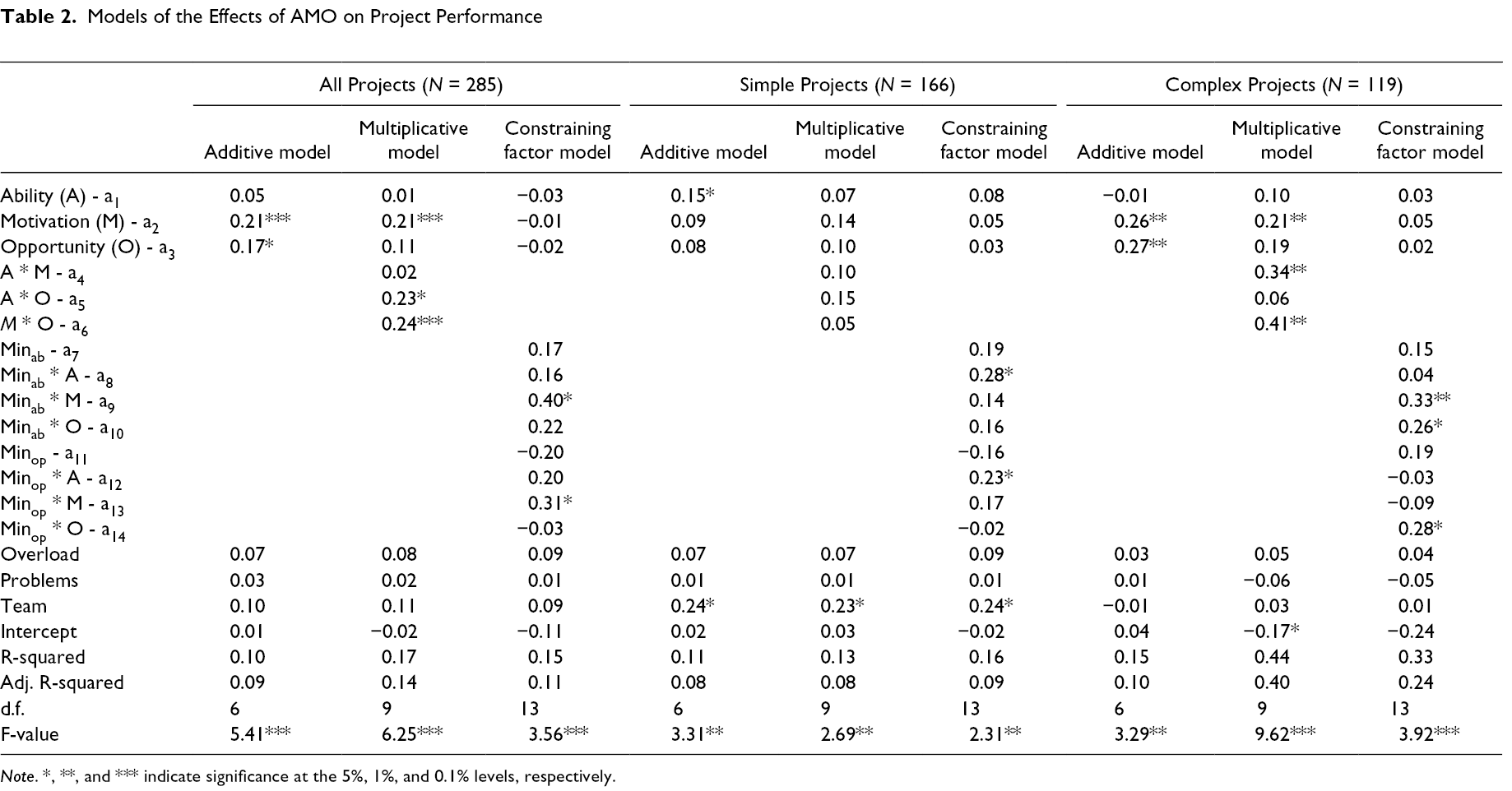
The results of the three alternative specifications of the impact of the AMO factors on project performance are listed in Table 2. The table includes nine models, as each of the three alternative specifications is conducted for “all projects” (Models 1–3), “simple projects” (Models 4–6), and “complex projects” (Models 7–9).
Models of the Effects of AMO on Project Performance
Note. *, **, and *** indicate significance at the 5%, 1%, and 0.1% levels, respectively.
The significance of the solutions and explained variances of Models 1 to 3 comprising “all projects” indicate that the multiplicative model offers the best solution with an F-value of 6.25 and an adjusted R-squared of 0.14, whereas the constraining factor model (CFM) has an F-value of 3.56 and an adjusted R-squared of 0.11. The additive model is almost as good as the CFM—it has a higher F-value but a lower adjusted R-squared. Therefore, we reject H1b, which suggests that the CFM is superior to the additive model, while we find support for H1a, which proposes that the multiplicative model is superior to the additive model. In the multiplicative model, the main effect of motivation, and the interaction effects between opportunity and motivation and between opportunity and ability are positive and significant.
When considering the simple projects (Models 4–6) and the complex projects (Models 7–9) separately, a richer picture emerges. For complex projects, the multiplicative model clearly provides the best solution with an F-value of 9.62 and an adjusted R-squared of 0.40, which is in line with H2b. This indicates that the AMO factors are complementary and that they reinforce each other not just at the extremes but across the entire scale. For simple projects, the results are more ambiguous, as the CFM has a slightly higher adjusted R-squared but a slightly lower F-value than the two other models. Therefore, H2a is only partially supported.
When we compare the two additive models (Models 4 and 7), we find that ability is significant for simple projects but not for more complex projects. On the other hand, motivation and opportunity seem important for complex projects but less so for simple projects. This is confirmed in the multiplicative models (Models 5 and 8), where the interaction effects for motivation and ability and for motivation and opportunity are highly significant for complex projects, whereas no interaction effects are significant for simple projects. Therefore, we can further qualify our initial findings—the complementarity among the AMO factors for the complex projects is closely related to motivation, which amplifies the two other factors across the whole scale (and not just at the extremes). This supports H3b.
The CFM adds to these findings in the sense that ability turns out to be a constraining factor in the case of simple projects (Model 6), whereas the coefficient for ability is 0.36 (0.28 + 0.08) when ability is the lowest of the three factors. This is clearly higher than the coefficient of 0.15 in the additive model (Model 4), which indicates that ability is more important for simple projects when it has a lower value than motivation and opportunity. Both motivation and opportunity have lower values in the CFM (0.05 and 0.01, respectively) than in the additive model (0.09 and 0.08, respectively), which indicates that they are not constraining factors. Therefore, H3a is supported.
In the case of complex projects (Models 7 and 9), only opportunity has slightly higher coefficients in the CFM (0.28 + 0.02 = 0.30) than in the additive model (0.27). However, this increase in the coefficient is not significant.
In the simple projects, the effect of increasing ability is greater than the effect of increasing the two other factors. In fact, when ability is the lowest, raising it by one standard deviation increases project performance by 0.36 of a standard deviation (Model 6), whereas it otherwise increases project performance by 0.32 of a standard deviation (Model 5). This is greater than the effects of increasing motivation or opportunity in simple projects. In complex projects, increasing motivation by one standard deviation improves project performance by 0.96 of a standard deviation (Model 8), whereas the effects of increasing opportunity and ability by one standard deviation are 0.66 and 0.50, respectively.
Discussion
Studies of the application of AMO factors to individual performance are hardly new. However, this article aimed to bring together the HRM literature on the effect of the AMO factors and the literature on project performance by scrutinizing how ability, motivation, and opportunity interact at the team level to determine project performance. While numerous studies show that all three factors affect work performance at the individual level, we had little knowledge about how they affect each other in determining performance at the team level.
An understanding of the mechanisms that promote project performance at the team level can guide managers’ allocations of resources to teams. Each of the three models analyzed here has different implications. Our study shows that the interplay among the AMO factors depends on the team’s work context. In simple projects, ability seems to be the key factor both as a main effect and, if it is too low, as a constraining factor acting as a bottleneck for project performance. Firms undertaking simple, routine projects should prioritize those interventions aimed at achieving the minimum level of knowledge and skill needed within the team, so that members can apply their cognitive capabilities and efficiently make decisions. Other interventions aimed at increasing the team’s motivation by augmenting team members’ participation through the involvement of top managers (opportunities) will have an insignificant effect unless the team has the minimum level of ability. In this regard, our results extend those obtained by Popaitoon and Siengthai (2014), who found a positive direct effect of teams’ realized absorptive capacity on short-term performance. In that study, HRM practices did not significantly moderate this direct effect. Our study shows a more nuanced view, which distinguishes between simple and complex tasks. We agree with Popaitoon and Siengthai (2014) that teams working with simple tasks and under time pressure are more focused on solving the immediate tasks at hand. Therefore, having the right skills to exploit the absorbed knowledge is the key factor.
In complex projects, there is more scope for HRM intervention, as the multiplicative model seems superior with significant interaction effects over the entire scale. In particular, our results highlight the pivotal role of motivation when teams perform interdependent, complex tasks. In other words, strong team motivation positively moderates the relationship between ability and project performance and the relationship between opportunity and project performance. In this regard, our study responds to Keegan et al.’s (2018) claim that research on how employee participation benefits project-based organizations is needed. Indeed, we show that participation increases the sharing of tacit and explicit knowledge, and motivates team members by increasing their feelings of competence and their commitment to goals.
In addition, our study demonstrates how the dynamics associated with project complexity affect the efficacy of the main antecedents of project performance. We thus answer calls in the project management literature to explore dimensions of project complexity and the capabilities needed to perform at varying levels of complexity (De Rezende et al., 2018). While simple tasks require managers to provide the team with the required cognitive capabilities, complex and uncertain tasks put the team’s motivation at the center of its knowledge-sharing processes. Consequently, our research is in line with recent theoretical developments that call for a better understanding of how contextual heterogeneity affects knowledge processes at lower levels of analysis (Foss et al., 2010).
In this study, we introduced team-level measures of the AMO factors, because collective team factors are fundamentally different from the aggregation of individuals within the team. A team is not just a group of independent individuals. It encompasses complementarities, synergies, and interdependencies that go beyond the simple aggregation of its members. In fact, these collective features of teams are at the core of their existence.
Likewise, our research contributes to the HRM literature (Jiang et al., 2013) by examining how differences in teams’ dynamics require different combinations of abilities, motivation, and opportunities. Teams are a relevant work context for employees. However, in efforts to increase a team’s effectiveness, contextual factors should be considered. Such factors include uncertainty and task interdependencies that might require greater organizational support in order to release team members from the responsibility of coping with complex project tasks. Thus, it is necessary to implement HRM practices that effectively operate at the team level.
Our results have several notable implications for managers. In simple projects, the greatest improvement in project performance can be obtained by enhancing the team’s ability, which can be achieved by selecting team members with the required knowledge and skills or through training, communication, and incentives. In complex projects, the greatest improvements in project performance can be achieved by increasing motivation. In addition to its own positive effect, this will amplify the effects of ability and opportunity.
Our article has two main limitations. First, even though we gathered our data from two sources, our measures are based on single items. Single-item measures may not adequately represent conceptually complex constructs and they do not allow for the calculation of internal consistency estimates (Fisher et al., 2016). However, single-item measures may be good substitutes for multi-item measures in circumstances where administering large surveys is unfeasible (Dolbier et al., 2005). Additional research must explore other potential measures for capturing collective aspects of the workings in teams. In addition, although our focus on one firm provided data on a large number of projects and teams and enabled us to compare projects that varied in terms of complexity, it limits the generalizability of our conclusions. One way to extend our knowledge and derive a better understanding of the underlying mechanisms would be to conduct field experiments involving interventions related to teams’ abilities, motivations, and opportunities.
Footnotes
Appendix A. Workings of Projects and the Roles of Managers
Appendix B. Descriptive Statistics
Declaration of Conflicting Interests
The author(s) declared no potential conflicts of interest with respect to the research, authorship, and/or publication of this article.
Funding
The author(s) received no financial support for the research, authorship, and/or publication of this article.
Note
Author Biographies