




Abstract
Background
Artificial intelligence (AI) is a key driver of technological transformation. According to a McKinsey survey, 88% of organizations have already entered the nascent stage of AI technology. However, it is also changing workflows with implications for work–family balance.
Objectives
This study aims to investigate how AI technology adoption influences employees’ work–family conflict by analyzing the impact-response chain.
Methods
Grounded in conservation of resources theory, we surveyed 346 employees who had adopted AI technology at work. Data were analyzed using Mplus 8.3 and SPSS 27.0 to test the moderated sequential mediation model.
Results
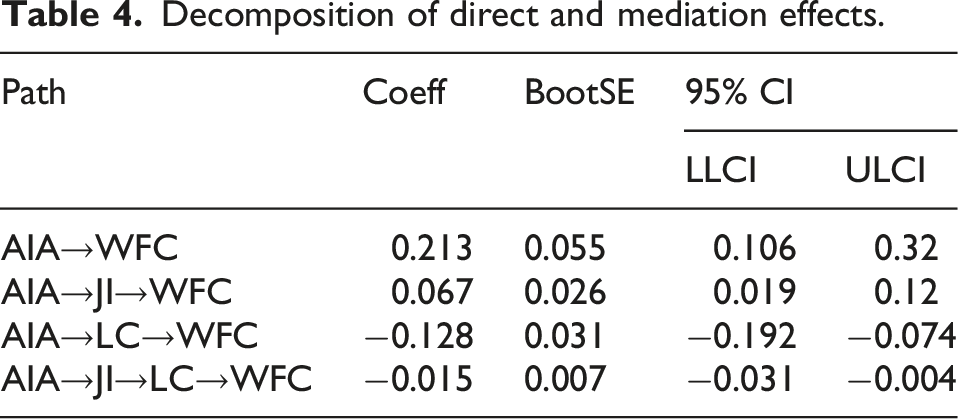
AI technology adoption has both positive and negative effects on work–family conflict and is associated with increased conflict. However, job insecurity and leisure crafting mediate this relationship; job insecurity worsens conflict, whereas leisure crafting reduces conflict. Psychological detachment strengthens this effect by positively moderating the relationship.
Conclusion
AI’s impact on work–family conflict is not simply positive or negative, but both threat and opportunity, clarifying contradictions in past research and provides new answers for managing AI technology adoption.
Keywords
Introduction
Artificial intelligence (AI), the theme of contemporary development, 1 has become a key driver of industrial transformation and economic growth. It has become a tool for organizational transformation, enabling cost reduction, efficiency gains, and sustainable competitive advantage. Consequently, its application and depth of integration continues to expand. 2 With the widespread adoption of AI, the technology is reshaping work processes and job content, 3 posing real challenges for employees accustomed to traditional practices. 4 Understanding employees’ AI technology adoption behavior is therefore critical for effective organizational management and digital transformation.
Previous studies on AI technology adoption primarily focused on antecedents from organizational, individual, and technical perspectives, including AI satisfaction, security, and privacy.5,6 However, few studies have examined its outcomes, and those that do predominantly focus on one-sided effects, such as perceived technological threat or knowledge-sharing behavior.7,8 Moreover, existing research has largely focused on the work domain, overlooking spillover effects into the family domain. 9 This limits a full understanding of AI technology adoption, as work and family are interdependent life domains. 10 We cannot reasonably understand the full effect of AI technology adoption on employees if we only consider its effect in the work domain and not its effect in the non-work domain. 11 Therefore, examining spillover effects beyond work is crucial for understanding AI’s implications for employee well-being during technological transition. 12 Earlier studies have insufficiently addressed subjective behaviors associated with AI technology adoption. 13 Accordingly, this study focuses on the behavioral and psychological responses to AI technology adoption and its implications for employees’ work–family conflict.
AI technology adoption has altered work practices and benefit allocations, 14 potentially increasing job insecurity.15,16 Meanwhile, the emotions and behaviors experienced in the work domain can spill over into the family domain. 17 As a typical workplace stressor, the negative effects of job insecurity might spill over into the non-work domain, leading to a major source of work–family conflict. 18 Accordingly, job insecurity is modeled as a key mediator. By replacing repetitive and inefficient tasks, AI can free up employees’ time, 19 enabling greater engagement in leisure crafting, which refers to individuals’ proactive attempts to improve their internal or external leisure environment for personal development and work-life balance. 20 Through leisure crafting, employees can arrange leisure activities in a more flexible and proactive manner, thereby obtaining psychological resources and developmental momentum.21,22 This enables them to better pursue learning and development goals, 23 adapt to the occupational changes brought about by AI technology, and consequently bridge the tension between work and family roles, which will enable them to alleviate work–family conflict. Based on this, we propose another possible mediating variable and analyze the sequential mediating effects of job insecurity and leisure crafting. Gaining or losing resources is influenced by psychological traits. Employees with higher psychological detachment are more able to detach from their jobs physically and mentally, 24 and reinvest resources in leisure crafting because they are aware of resource investment. Thus, it can reduce work–family conflicts and help them access new resources. Therefore, psychological detachment was introduced as a moderating variable, and a moderated sequential mediation model was developed.
This study examines the spillover effect of employee AI technology adoption on the family domain and its impact mechanism on work–family conflict. This study also contributes to achieving work–family balance in management practices and extends prior research by linking technology, work, and family within an integrated framework. Moreover, by developing a moderated sequential mediation model with both positive and negative effects, it extends the conservation of resources theory to the digital transformation context.
Theoretical framework and development of hypotheses
Conservation of resources theory
This study applied the conservation of resources (COR) theory to examine how AI technology adoption affects employees’ work–family conflict. The COR theory, proposed by Hobfoll, 25 posits that individuals seek to obtain, retain, improve valued resources and that resource gains or losses directly influence psychological state. Resource loss at work generates stress and strain; however, individuals actively invest in and protect remaining resources to cope with actual or anticipated loss. Specifically, when employees adopt AI technology, they invest a great deal of resources in the work domain to deal with environmental pressures. If these resources are not adequately replenished, it will eventually lead to a reduction in resource investments in other domains. For an employee, the loss of resources in the family domain due to work makes it difficult for the person to meet their family responsibilities. However, to protect and acquire new resources, employees proactively engage in resource investments through various means to balance their resources. The COR theory has been applied across multiple domains, including workplace stress and work–family balance, providing a framework for understanding how individuals cope with stressful situations. This study explains the potential impact of AI technology adoption and highlights how employees can leverage resources to alleviate work–family conflict. 26 As AI becomes more embedded in the workplace, balancing one’s psychological resources and alleviating work–family conflicts thus becomes very important for the sustainable development of employees. This is also the core starting point for our exploration based on the COR theory.
AI technology adoption and work–family conflict
AI is any technology that correctly interprets external data and flexibly applies it to a specific task or goal. 27 Existing research on AI has primarily focused on the technology, including its adoption or acceptance. 4 Individual AI technology adoption is the process by which an individual willingly accepts to use AI technology, integrating it into their tasks or routines. It encompasses an individual’s initial willingness or behavior to adopt, 28 as well as continued behavior after initial adoption, including the continuance, routinization, and adaptation of the technology. 29
COR theory posits that people tend to use key resources to cope with stressful situations. Resource scarcity increases self-protective responses, reducing resource investment in other domains. 30 AI technology adds higher job demands for employees. To adapt to technological change and overcome challenges posed by new work processes, employees may need to invest significant energy or time and are frequently confronted with technostress or emotional exhaustion arising from the complexities of the technology. 31 If these depleted resources are not promptly replenished, an individual’s resources will continue to decline, triggering employees to engage in self-protection to avoid further resource loss. Work–family conflict is an inter-role conflict arising from incompatible work and family demands. 32 If employees face continuous resource depletion from work demands without timely replenishment, they may reduce investments in the family domain. This prevents them from fulfilling their family responsibilities, leading to incompatibility between their work and family roles. Moreover, AI technologies are often characterized by their “anytime, anywhere” accessibility, which blurs the spatial and temporal boundaries between work and family, ultimately exacerbating the likelihood of work–family conflict. 33 Thus, we propose the following hypothesis:
AI technology adoption positively affects employee work–family conflict.
Mediating role of job insecurity
Job insecurity refers to employees’ perceived threat of losing their jobs and the associated uncertainty regarding continued employment. It involves worry and unease about losing their current job 34 and reflects a negative state arising from perceived inability to cope with change or uncertainty. With the rapid development and application of AI technologies, employees’ perceptions of job security are undergoing profound changes. 15 Existing research confirms that the large-scale application of AI technology is closely related to job insecurity. 35 AI technology adoption causes employees to re-evaluate their own job value. This directly triggers survival anxiety about being replaced by AI technology, placing unprecedented pressure on employees’ job stability. According to COR theory, when employees struggle to gain new resources in the work domain, such as skill development or career advancement,36,37 while simultaneously facing threats of resource loss, such as job status or income security,38,39 they experience significant dual psychological pressure, which can manifest as job insecurity. As both an outcome of resource loss and a stressor, job insecurity further accelerates resource depletion, 40 triggering a loss spiral in which initial resource loss leads to further losses. Through role spillover, these effects extend from the work domain to the family domain.41,42 Consequently, resource depletion undermines employees’ emotional regulation capacity as well as the time and energy to fulfill family responsibilities, thereby worsening work–family conflict. Thus, we propose the following hypotheses:
Job insecurity mediates the relationship between AI technology adoption and work–family conflict. AI technology adoption indirectly and positively affects work–family conflict through job insecurity.
Mediating role of leisure crafting
Leisure crafting refers to goal-oriented, proactive leisure activities that individuals pursue and implement to develop themselves, expand relationships, and enhance learning abilities. 43 It is an expansion of job crafting into the leisure domain, perceived as a special resource for escaping work pressure or emotional exhaustion. It emphasizes the dynamic behaviors in which individuals seek growth and development through leisure. Unlike the resource loss pathway, represented by job insecurity, leisure crafting reveals a more proactive resource investment pathway. Specifically, high job demands are more likely to trigger leisure-crafting behaviors in individuals. 44 The technological change and capability challenges brought about by AI represent a typical high job-demand status. Individuals may see this as a new impetus for development. 45 They may engage in crafting behaviors to compensate for potential negative reactions to work stress. This is an effective strategy for coping with sudden changes in the external environment. Therefore, leisure crafting holds significant resource potential, helping employees replenish the substantial energy expended at work, 21 thereby enabling individuals to balance their work–family responsibilities and alleviate work–family conflict. According to the COR theory, driven by awareness of resource acquisition and investment, employees may engage in leisure crafting. This increases their resource-gaining behavior and actively builds and protects existing resources. Furthermore, leisure crafting can restore individual energy levels and offset energy depletion. Faced with the environmental uncertainty brought by AI technology adoption, employees achieve physical and mental relaxation through leisure activities. 46 Examples include participating in AI-themed puzzle games or using generative AI for creative projects. Through leisure activities, they can complete their resource replenishment and self-improvement. Existing research shows that online leisure crafting helps individuals achieve family thriving 47 and reduces conflicts. Leisure crafting can help individuals recover more quickly from resource depletion caused by AI technology adoption. Thus, we propose the following hypotheses:
Leisure crafting mediates the relationship between AI technology adoption and work–family conflict. AI technology adoption indirectly and negatively affects work–family conflict through leisure crafting.
Sequential mediating roles of job insecurity and leisure crafting
Individuals’ cognition is coherent, extending across work and non-work domains. Therefore, this study introduces two variables—job insecurity (work domain) and leisure crafting (non-work domain)—to examine their sequential mediating effects. During AI technology adoption, employees deplete their resources to cope with changes and uncertainty. This further increases job insecurity. 48 The initial loss of resources triggers further resource loss and causes job insecurity, as a stressor, to further deplete the employee’s personal resources. The COR theory posits that resource replenishment and gain are particularly important in the event of resource loss, especially for individuals with limited resources. In response, individuals build and protect their existing resource reserves. When employees cannot replenish their resource losses in the work domain, they proactively redirect their resource investments toward a more controllable leisure domain. In this context, leisure crafting shifts from passive recovery to an active strategy for resource replenishment. By setting and accomplishing meaningful leisure goals, employees rebuild the energy depleted by work within the non-work domain, thereby securing stable psychological resources outside of work. This enables them to return to their families with greater vitality, reducing the negative spillover from work to the family domain and consequently reducing work–family conflict. Therefore, leisure crafting becomes an effective strategy for coping with changes in the external environment. 44 Through this pathway, employees can protect their resources from depletion and thus better balance their work and family roles. Thus, we propose the following hypotheses:
Job insecurity and leisure crafting play sequential mediating roles in AI technology adoption and work–family conflict.
Moderating role of psychological detachment
Psychological detachment is defined as an individual’s ability to detach from work psychologically and physically during non-work time, without being preoccupied by work-related matters. 49 COR theory suggests that individual characteristics are likely to affect resource gain, loss, and depletion. Such characteristics affect individuals’ emotions, which in turn feed back into individual behavior through emotional reactions. 50 Existing research has shown that psychological detachment can serve as a recovery experience, helping employees replenish the energy consumed at work. 51 In this context, psychological detachment significantly shapes whether the awareness of resource investment triggered by job insecurity can be effectively translated into actual resource gain. When employees feel insecure because of the impact of AI technology, those with high psychological detachment are better able to disengage from work-related strain, thereby reducing resource depletion. This enables them to redirect and invest resources in the leisure domain, where such investments can generate new resources and support personal development. Employees with low psychological detachment, even if driven by job insecurity, engage in resource investment behaviors (such as leisure crafting) to gain new resources, and their low level of detachment will prevent effective resource investment. Therefore, where job insecurity drives leisure crafting, employees with high psychological detachment can ensure that this resource investment—leisure crafting—produces expected resources and helps them achieve resource balance. Thus, we propose the following hypotheses:
Psychological detachment positively moderates the positive effect of job insecurity on leisure crafting.
Furthermore, this study considered a moderated sequential mediation model. Specifically, the stronger the psychological detachment, the more pronounced the positive effect of job insecurity on leisure crafting, thereby alleviating work–family conflict. This pathway represents a threat-coping mechanism. Job insecurity arising from the adoption of AI technology is typically perceived as a negative anticipation of resource loss. Paradoxically, when employees possess a high capacity for psychological detachment, this negative anticipation serves as a catalyst for engaging in leisure crafting. By mentally disengaging from work during non-work hours, individuals transform job insecurity into an opportunity for self-enhancement, facilitating resource recovery within the leisure domain, and ultimately preventing the negative spillover of insecurity into the family domain. Thus, psychological detachment not only helps employees engage in leisure crafting more effectively but also helps them balance role conflict between work and family to achieve resource balance. Eden
52
resource replenishment during non-work hours leads to resource gain spirals. Whether from work breaks
53
or on weekends,
54
psychological detachment helps individuals detach themselves from work. This allows for successful resource recovery. For employees whose traditional work environment has changed owing to the adoption of AI technology, psychological detachment can help them learn and improve their skill levels during work breaks, to say nothing about vacations. This helps them better utilize their leisure time created by AI technology. This achieves a resource balance between work and family, reducing the dilemma of being unable to focus on family activities due to work pressures. The theoretical model is illustrated in Figure 1. In summary, we propose the following hypotheses: Theoretical model.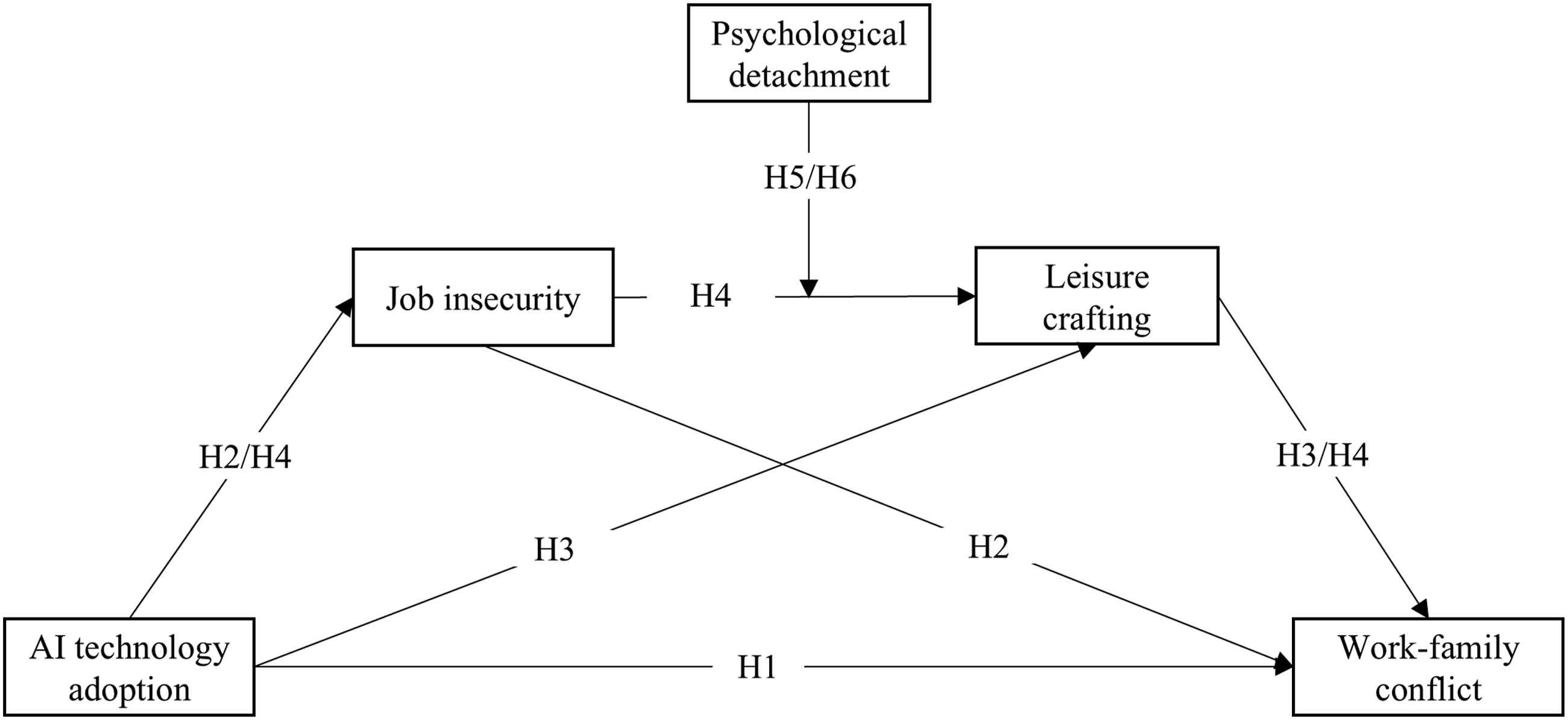
Psychological detachment moderates the sequential mediating effect of AI technology adoption on work–family conflict through job insecurity and leisure crafting.
Method
Sample and procedure
This study employed a cross-sectional survey design using standardized quantitative tools, consistent with established research practices.55,56 Data were collected from December 2024 to January 2025 using a convenience sampling method to efficiently and rapidly access employees who frequently used AI technology in their work. This method is widely applied in organizational research as it balances feasibility and sample relevance. 57 Data collection was coordinated by a university-based survey research center with extensive experience in questionnaire administration. The center recruited and trained upper-level undergraduate or graduate students in survey procedures and ethical standards. After receiving instructions on the research objectives and sampling criteria, these assistants distributed the questionnaire through online channels, including personal contacts and social media platforms. All measurement scales were adapted from published literature in reputable journals, providing researchers with clear and reliable tools for investigation. The questionnaire comprised three parts. The first part introduced the study, assured anonymity and confidentiality, and provided completion instructions. Prior to the main survey, participants were asked whether they had used AI technology in their work. The study included only respondents who indicated adoption of AI technology in their work; those who did not meet this criterion were directed to exit the survey. The second part was the survey content, including AI technology adoption, job insecurity, leisure crafting, psychological detachment, and work–family conflict. The third part included demographic information, such as gender, age, education, and monthly income. To common method bias, procedural control measures recommended by Podsakoff et al. 58 were adopted, including anonymity assurance and reasonable setting of question order. A total of 442 questionnaires were distributed. After excluding invalid responses characterized by identical answers (e.g., selecting “5″ for all items) or patterned responses (e.g., a “1-2-3-4-5″ cycle), 346 valid questionnaires were obtained, yielding an effective response rate of 78.3%. The final valid sample consisted entirely of employed workers in China across 26 provinces, including Jilin, Shandong, and Guangdong. The sample was 40.5% male and 59.5% female; 56.6% were aged ≤25, 22.3% were 26–40, 17.9% were 41–55, and 3.2% were >55. Regarding education, 3.2% had junior high school or below, 7.8% high school/vocational, 16.8% college, 66.2% bachelor’s, and 6.1% master’s or above. Monthly income distribution was 50.9% below 4000 Yuan, 29.2% between 4001 and 8000 Yuan, 11.6% between 8001 and 12,000 Yuan, 3.2% between 12,001 and 16,000 Yuan, and 5.2% above 16,000 Yuan.
Measures
The questionnaire was fully examined, validated scales were employed to guarantee reliability, and a five-point Likert-type response format ranging from 1 (“strongly disagree”) to 5 (“strongly agree”) was used. AI technology adoption was evaluated through a set of eight items cited by Dong et al., 59 with example items such as “I need AI to help me do my work” and a Cronbach’s alpha of 0.86. Job insecurity was evaluated through a set of five items cited by Mauno et al., 60 with example items such as “Your job is insecure.” and Cronbach’s alpha of 0.758. Leisure crafting used the nine-item scale cited by Petrou and Bakker, 43 with example items such as “I try to build relationships through leisure activities,” and Cronbach’s alpha of 0.864. Work–family conflict employed the four-item scale cited by Liu et al., 61 with example items such as “After work, I often cannot relax due to work-related matters,” and Cronbach’s alpha of 0.748. Psychological detachment was assessed using a four-item scale cited by Sonnentag and Fritz, 62 with example items such as “I forget about work.” and Cronbach’s alpha of 0.813. The Cronbach’s alpha for this study exceeded 0.7, which, according to the literature, indicates good reliability for all constructs. 63 In addition, drawing on previous studies, gender, age, education level, and monthly income were selected as control variables.
Results
Discriminant validity and confirmatory factor analysis
Results of confirmatory factor analysis.
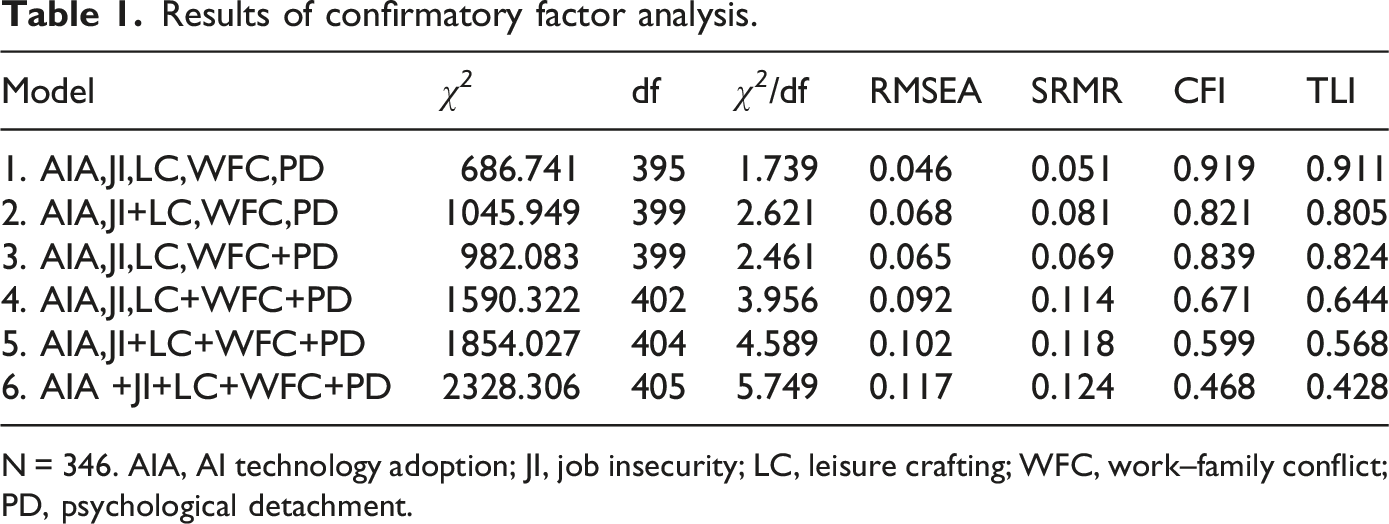
N = 346. AIA, AI technology adoption; JI, job insecurity; LC, leisure crafting; WFC, work–family conflict; PD, psychological detachment.
Common method variance
The independent, dependent, mediating, and moderating variables in this study were all self-reported; therefore, common method bias may exist. To address this, Harman’s single-factor test was conducted to examine common method variance. An unrotated exploratory factor analysis including all variables extracted six factors with eigenvalues greater than 1. The first factor accounted for 23% of the variance, which is below the threshold of 40 %, indicating no significant common method bias.
Descriptive statistics
Descriptive statistics and correlations among study variables.
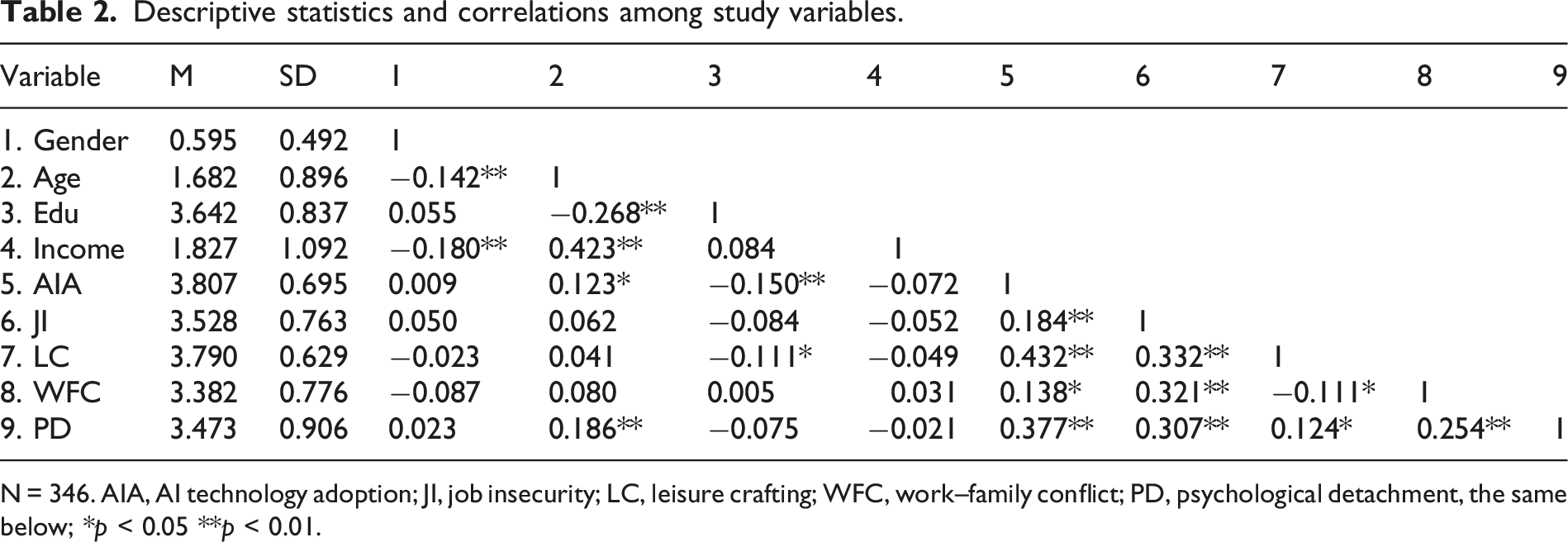
N = 346. AIA, AI technology adoption; JI, job insecurity; LC, leisure crafting; WFC, work–family conflict; PD, psychological detachment, the same below; *p < 0.05 **p < 0.01.
Hypothesis testing
Direct and mediation effect testing
Regression results for main, mediation effects.
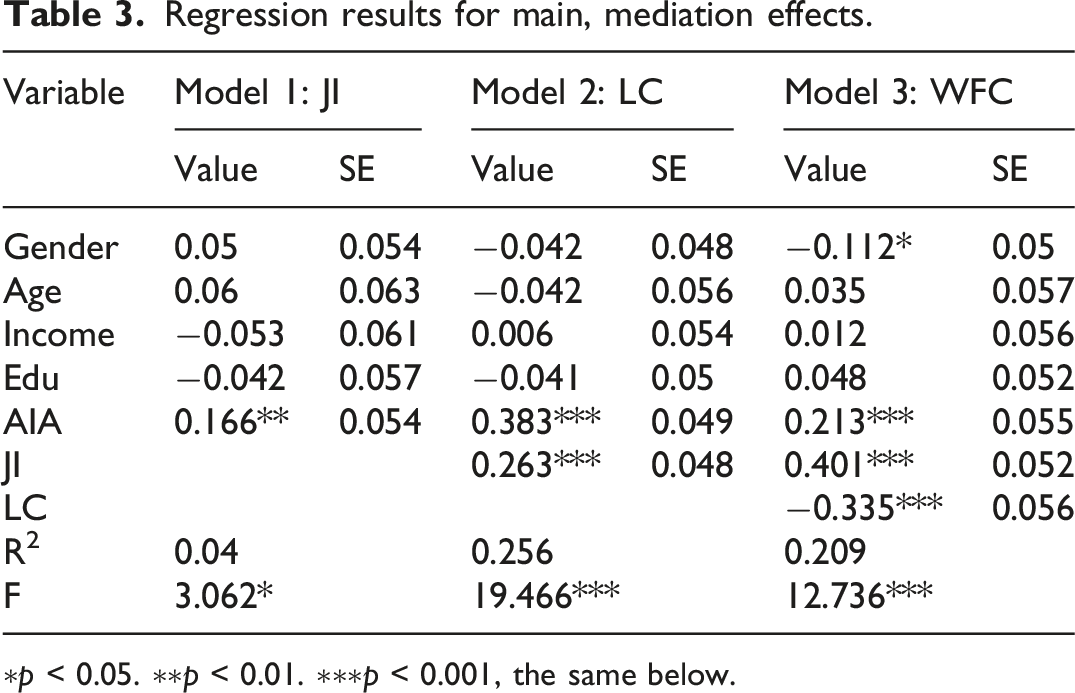
∗p < 0.05. ∗∗p < 0.01. ∗∗∗p < 0.001, the same below.
Decomposition of direct and mediation effects.
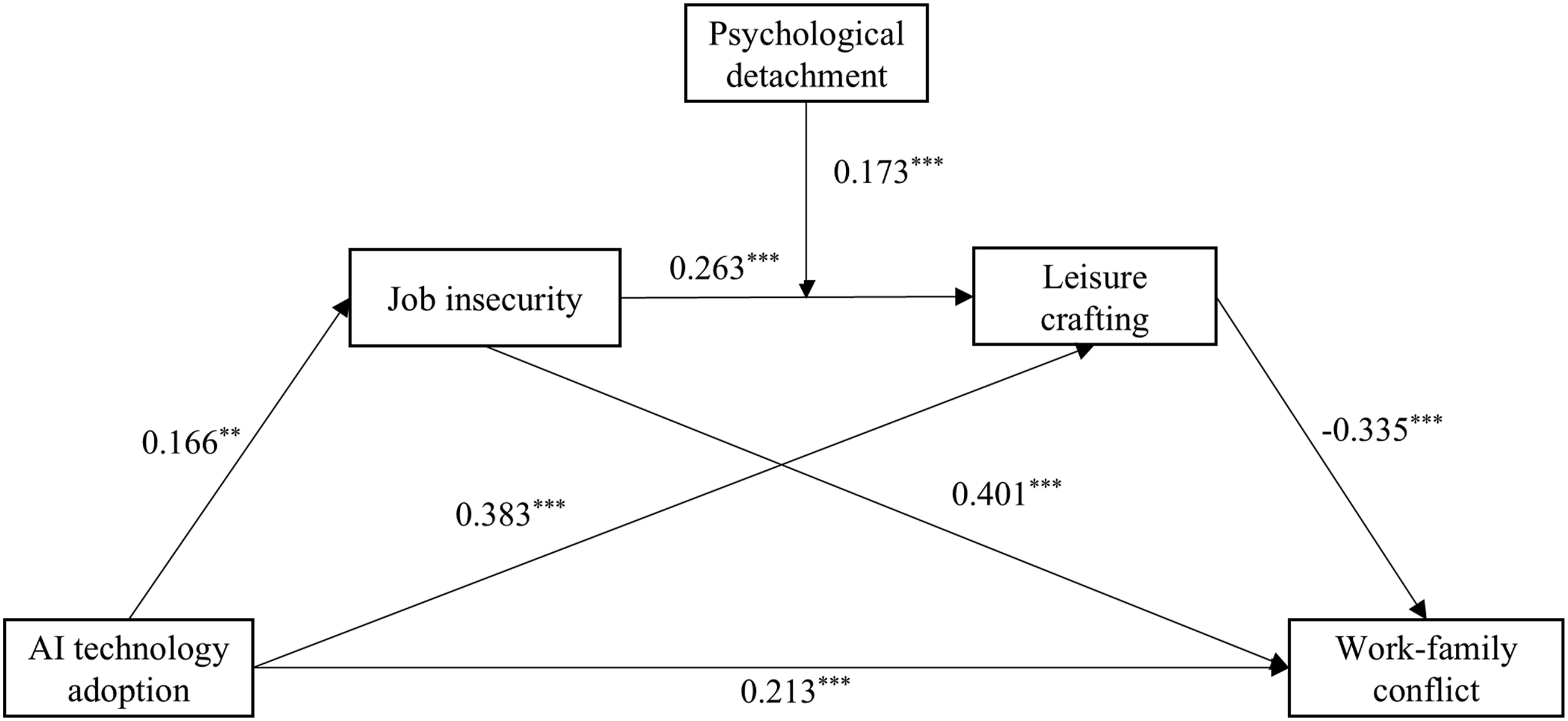
Results of path coefficient analysis.
Moderation effect testing
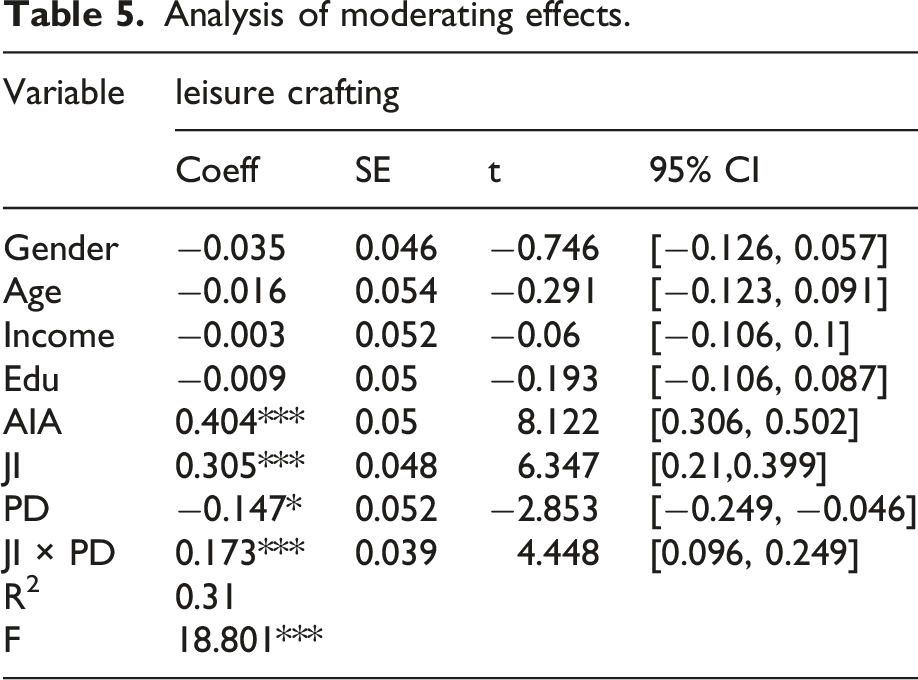
Analysis of moderating effects.
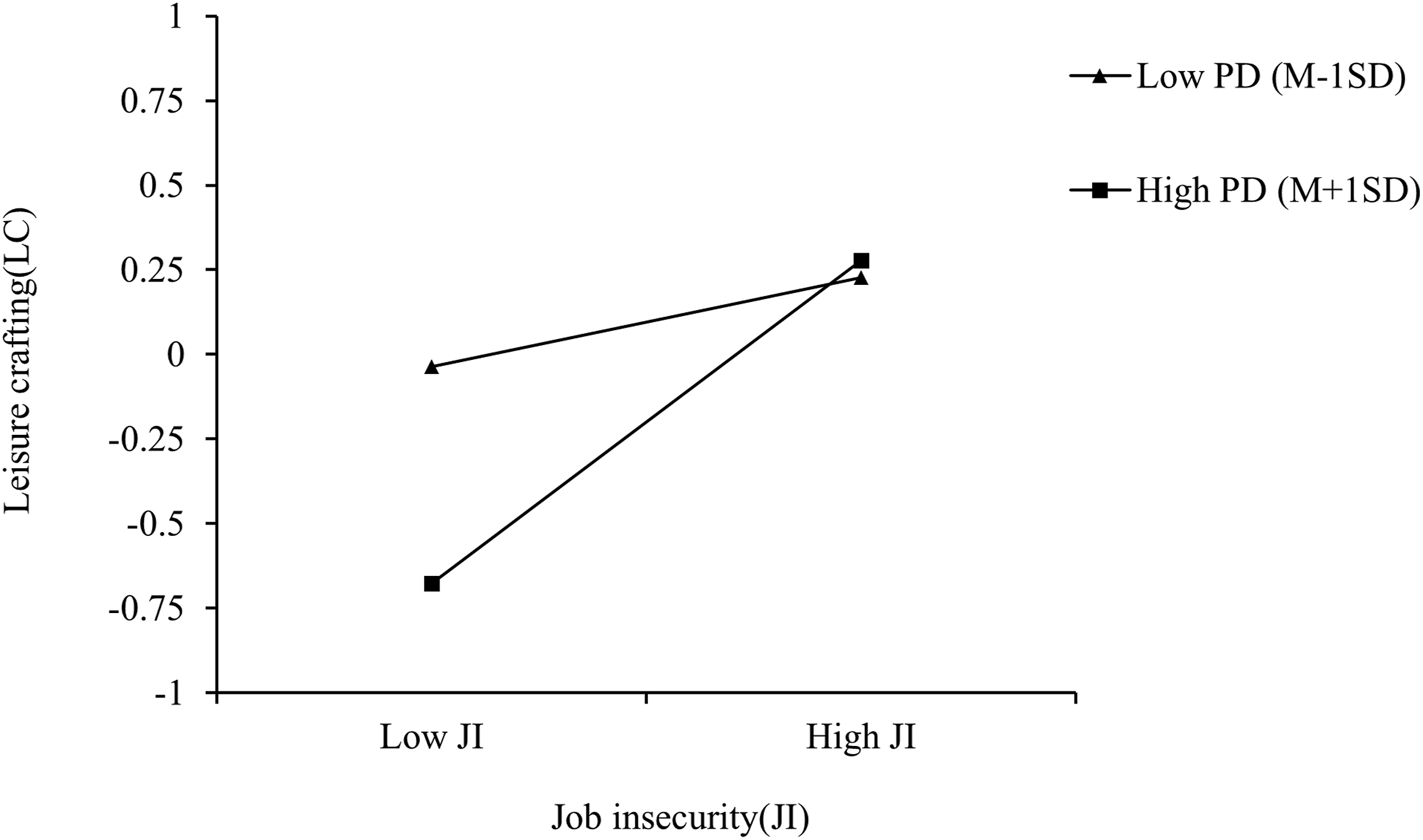
The moderating role of psychological detachment.
To further examine moderated mediation, the indirect effect of AI technology adoption on work–family conflict through job insecurity and leisure crafting was analyzed. For the high psychological detachment group, the indirect effect was −0.027, with a 95% CI of [−0.051, −0.008], excluding zero. In contrast, for the low psychological detachment group, the indirect effect was −0.007, with a 95% CI of [−0.022, 0.002], which includes zero. The difference between the indirect effects at high and low levels of psychological detachment was −0.019, with a 95% CI of [−0.039, −0.004], excluding zero. Thus, the moderated sequential mediation effect was statistically significant, confirming H6.
Discussion
Our study examined the effect of AI technology adoption on employees’ work–family conflict. Based on COR theory, we propose a moderated sequential mediation model. The model included job insecurity, leisure crafting, and psychological detachment as mediating variables. Our findings unpack multiple pathways and boundary conditions linking AI technology adoption to work–family conflict.
First, AI technology adoption exacerbates work–family conflict by increasing job insecurity. This aligns with prior research indicating that AI technology adoption results in negative effects, 67 such as job insecurity and a sense of technological threat,35,68 which deplete employees’ psychological resources, thereby affecting their family life. 69 Based on this, this study verifies the indirect conflict that technological change imposes on employees’ non-work domains. Second, the study shows that AI technology adoption can reduce work–family conflict via a leisure crafting pathway. This pathway indicates that employees are not passive when faced with technological change. Related research has indicated that AI technology can lead employees to form a challenge appraisal, which in turn fosters positive employee behaviors or strengthens behavioral motivation, 59 thereby facilitating outcomes such as job crafting. 70 This study reveals that under the influence of AI technology, employees are able to proactively adjust their leisure activities to achieve a better balance between work and family life, supporting the view that, in some circumstances, high job demands can lead to active coping strategies used by employees 71 and breaks the singular vision of employees as passive pressure recipients of technological change. Third, driven by job insecurity, employees use leisure crafting intentionally to reduce the risk of resource loss and acquire new resources, which allows them to coordinate their work and family roles, reducing work–family conflict. This demonstrates the compensatory and spillover effects of leisure crafting and offers a new perspective for interpreting the internal logic of employees’ stress and adaptation after AI technology adoption. This finding further illustrates that contexts of resource loss may activate individuals’ proactive resource investment awareness to forestall further resource depletion, which is consistent with the assertion made by Hobfoll et al. 30 regarding the driving mechanism of resource investment. Fourth, individuals with higher psychological detachment performed better at transforming job insecurity into motivation. They participate in active leisure crafting to cope with stress, and work–family conflict is less likely. As a psychological resource, psychological detachment enhances an individual’s adaptability and resilience in the context of technological change, reflecting their capacity to shift attention from resource threats at work to resource investment in the leisure domain. This finding aligns with the perspective of Sonnentag et al. 51 that psychological detachment facilitates employee recovery and energy replenishment. Additionally, AI technology adoption positively and negatively affects work–family conflict. This differs from the one-sided view of previous research on AI technology adoption that AI effects are either positive or negative. Adopting a resource gain-loss perspective, this study examines how AI technology adoption reshapes work–family conflict. Prior research has largely portrayed employees as passive recipients of technological change, emphasizing resource depletion, diminished well-being, 72 and heightened work–family conflict. Although this perspective identifies potential threats, it overlooks employee agency and the capacity for resource investment under stressful circumstances. AI technology entails both “threats and opportunities.” 73 Consistent with this view, prior research reveals that AI technology can stimulate employees’ developmental motivation. 59 Building on this premise, the present study identifies a previously underexplored compensatory pathway—namely, the buffering effect of leisure crafting. The findings indicate that AI technology adoption does not merely intensify conflict through a resource depletion pathway; rather, AI technology and the job insecurity it engenders can prompt proactive self-enhancement in the leisure domain. Through leisure crafting, employees replenish resources and develop capabilities, thereby mitigating work–family conflict. This discovery extends prior research, which has predominantly focused on negative effects. This suggests that AI-induced strain does not inevitably intensify conflict in a unidirectional manner. Instead, the impact of AI technology adoption emerges from the concurrent operation of both resource depletion and resource investment mechanisms. Therefore, this provides an integrated framework for fully understanding the complex effects of technological change on employees’ work–family relationships.
Theoretical implications
This study enriches the literature on the outcomes of AI technology adoption. The adoption of AI technology in the workplace may have multiple impacts on employees’ psychology and behavior, 13 which may spill over to various aspects of life and family. By introducing job insecurity and leisure crafting as mediating variables, this study develops an integrated “technology-work-family” analytical framework and extends AI technology adoption outcomes from the work domain to the family domain, linking work, leisure and family systems. This approach enhances understanding of non-work outcomes and clarifies multiple pathways through which AI technology adoption affects work–family conflict, thereby providing a more comprehensive perspective for future research. Second, this study addresses the limitations of one-dimensional perspectives on AI technology adoption outcomes by examining its complex transmission mechanisms. Prior research has indicated that when confronted with emerging technologies, employees exhibit distinct psychological reactions and behaviors contingent upon variations in individual characteristics and environmental factors,74,75 and these effects are often neither positive nor negative. Grounded in COR theory, this study develops a moderated sequential mediation model capturing both resource loss and gain processes. It thus reveals the multiple “threat-compensation” pathways of AI technology adoption: on one hand, it increases work–family conflict by leading to job insecurity; on the other hand, it reduces conflict via leisure crafting, which enables resource compensation and spills over into the family domain. In addition, this study clarifies that if individuals encounter job insecurity (perceived resource threat) as a result of AI technology adoption, they are not completely put into passive defense. Instead, driven by awareness of resource acquisition, they may proactively engage in resource investment and reconstruction through leisure crafting. Their goals were to compensate for resource loss in the work domain and prevent further depletion. This finding clearly presents the logic behind employees’ proactive adjustments to technological changes. It provides an integrated explanatory framework to resolve contradictions in past research that offer singular positive or negative conclusions. Finally, this study extends COR theory to digital transformation contexts by explaining how resource loss and recovery processes operate in an AI-enabled work environment. It demonstrates how work-domain resource dynamics spill over into the family domain, thereby broadening the theory’s applicability and explanatory power in contemporary organizational settings.
Management insights
This study primarily focuses on the multiple pathways through which AI technology adoption affects employees’ work–family conflict and the moderating role of psychological detachment. Enterprises should pay more attention to the multilayer impact of AI technology on employees’ psychology and behavior in the digital-intelligent transformation. Managers should implement systemic management measures to help employees achieve a balance between work and family life.
First, organizations should anticipate and intervene in the pressure that AI technology adoption places on employees. When confronted with new technologies, employees inevitably experience a degree of apprehension and psychological resistance. 76 The research confirms that AI technology adoption adversely influences work–family conflict in a direct way or does so indirectly by increasing job insecurity. Organizations can implement regular AI technology training and adaptation courses and clarify that AI technology is an assistive rather than replacement technology, helping employees understand that technological change may shape job value but does not replace roles. At the same time, it is important to ensure transparent employee communication channels. Timely communication of a company’s AI strategy and development plans can reduce employee anxiety about job continuity. This addresses the source, reducing resource depletion caused by job insecurity and its spillover effects into the family domain. Second, organizations may encourage employees to engage in leisure crafting and achieve a high degree of psychological detachment. Our research shows that leisure crafting can effectively resolve work–family conflict. Thus, employees with higher psychological detachment can better translate job insecurity into motivation for resource investment. Well-utilized leisure time can enhance employees’ sense of meaning and self-efficacy, thereby facilitating comprehensive self-improvement. 21 Organizations should respect and protect employees’ non-work time. They need to ensure that after completing work tasks, employees can enjoy both fragmented and extended leisure time for their leisure activities. Furthermore, organizations can help finance leisure activities to gain skills and cultivate interests. This guides employees to transform their leisure time into opportunities for resource regeneration and capability enhancement, thereby shifting from passive consumption to active construction. Finally, build a “technology-work-family” support system holistically. The essence of organizational competition lies fundamentally in the contest for talent and the safeguarding of employee well-being. 77 Integrating employee well-being into both organizational development strategies and the evaluative criteria for digital and intelligent transformation is conducive to achieving sustainable organizational development. Employees’ work–family status and AI technology usage are regularly checked through surveys or interviews. Establish Employee Assistance Programs (EAP) to provide psychological counseling and resource referral services for employees and their families facing significant transformation pressure. Employees’ family roles are considered in management decision-making. For example, when adopting or assigning AI systems, think about how they affect the employee’s schedule and family responsibilities. Make appropriate humanized adjustments to this effect so that the organization can respect and support employees’ full-life roles.
Limitations and prospects
Our study has some limitations. First, the data were self-reported, which may have introduced common method bias. Future research should utilize multi-time, multi-channel, and repeated measure designs to mitigate this issue. Second, although this study controlled for demographic variables such as sex, age, education level, and monthly income, other confounding factors may still exist. For instance, organizational-level variables (e.g., perceived organizational support, organizational culture, leadership style) may influence employees’ AI technology adoption78,79; family-level variables (e.g., presence of minor children, spouse employment status, family caregiving responsibilities) may have a direct impact on work–family conflict.80,81 Additionally, individual variables (e.g., personality traits, technology self-efficacy) may play a role in the relational pathways examined in this study.82,83 Furthermore, we did not collect information on organizational characteristics (e.g., industry, size), limiting further analysis. Future research should employ multilevel modeling to incorporate macro-level variables (e.g., organization type and depth of AI technology adoption) and better identify boundary conditions of AI effects on work–family relationships. Finally, the cross-sectional design limits causal inference. As AI technology adoption is dynamic, future research should use longitudinal designs to track organizational AI implementation and examine changes in employees’ psychological and behavioral responses over time.
Footnotes

Ethical considerations
Ethical review and approval was not required for the study on human participants in accordance with the local legislation and institutional requirements. Written informed consent from the patients/participants or patients/participants legal guardian/next of kin was not required to participate in this study in accordance with the national legislation and the institutional requirements.
Author contributions
YG: Conceptualization, Project administration, Resources, Supervision, Validation, Writing—review & editing. LW: Methodology, Formal analysis, Software, Writing—original draft, Writing—review & editing.
Funding
The authors declare that financial support was received for the research and/or publication of this article. The present research was supported by the Youth Fund Project of Humanities and Social Sciences Research, Ministry of Education, 2025 (Project Title: The Impact of AI Technology Adoption on Two-Way Intergenerational Knowledge Transfer among the “Cross-Generational Labor Force” and Its Acceleration Mechanism, Grant No: 25YJC630035).
Declaration of conflicting interests
The authors declared no potential conflicts of interest with respect to the research, authorship, and/or publication of this article.
Data Availability Statement
The raw data supporting the conclusions of this article will be made available by the authors, without undue reservation.