




Abstract
Paper examines the relationship between the extent of implementation of modern human resource management (HRM) tools and the perceived importance of managerial competencies in tourism enterprises in Central and Eastern European countries. The research is based on a questionnaire survey conducted among 1107 managers in the tourism sector, with correlation and regression analyses applied to identify links between the use of HR tools and the relevance of different competencies. The results confirm a significant positive relationship between the application of modern HR tools and technical or analytical managerial competencies, while no statistically significant relationship was observed for social competencies. The strongest associations were found between HR process digitalisation and analytical thinking, and between performance monitoring and strategic thinking.
Keywords
Introduction
In a hyper-turbulent era driven by innovation and automation, tourism enterprises face new challenges requiring transformations in human resource management. 1 Technological advancements are reshaping work, services, and customer expectations, 2 necessitating the development of new managerial competencies essential for innovation management. 3 Modern HRM approaches are emerging as strategic tools for sustaining competitiveness.4–6
While technological innovations in tourism often focus on enhancing the customer experience,7,8 an equally critical challenge is the implementation of new HR strategies for effective change management. 9 Digital HR tools, e-learning, gamification, and predictive analytics create opportunities for developing managerial capacities10,11 and improving workforce planning.12,13 Enterprises investing in innovative workforce management strengthen their ability to anticipate and adapt to future challenges.
A fundamental question remains: to what extent are tourism enterprises in Central and Eastern Europe that already implement modern HRM tools 14 better able to plan and develop the managerial competencies needed for technological and organisational innovations? A positive correlation could significantly support broader implementation of innovative HRM approaches in the tourism sector.
This paper aims to interpret the relationship between the application of modern HR tools and the perceived importance of key managerial competencies in tourism enterprises in Central and Eastern Europe. The analysis focuses on the links between HR practices and respondents’ expectations about changes in managerial leadership. The findings may offer valuable insights for developing strategies to ensure sustainable managerial performance and long-term competitiveness.
Theoretical background
Trends in human resource management in the context of technological and social change
With the advancement of digital transformation, human resource management (HRM) is shifting from an administrative to a strategic role, aimed at fostering the sustainable development of organisations. 15 Modern HRM tools enable more effective human resource management, 16 process optimisation, 17 and the enhancement of organisational competitiveness. 18 The transition from traditional methods to automated and data-driven approaches in HR is significantly reshaping the entire employee lifecycle—from workforce planning and recruitment, through performance evaluation, to the development of training programmes and talent management.16,19 HR departments are already making use of information systems for employee data management, attendance tracking, performance evaluation systems, and e-learning solutions.19,20 Artificial intelligence (AI) assists HR professionals and managers in identifying talent, analysing performance, assessing engagement levels, and predicting learning needs, thereby enhancing transparency and the personalisation of human resource management.18,21,22
The added value of modernisation in processing big data, including the automation of administrative HR tasks, allows HR managers to focus on strategic areas such as talent acquisition and development, organisational culture enhancement, and work environment optimisation.23,24 In recruitment, modern predictive analytics tools use historical candidate data to identify individuals with long-term success potential, thereby reducing potential recruiter bias and improving the efficiency of the selection process. 19 Digital analytics tools also enable ongoing monitoring of employee productivity and satisfaction, 25 analysis of feedback, identification of problem areas, and even prediction of turnover, 26 which enables organisations to implement targeted measures for retaining key talent.20,22 Such data-driven HR management strengthens the sustainable competitiveness of organisations.15,16
New demands on managers in the context of technological and social change
Managerial competencies were traditionally focused on performance control, organisational skills, and directive leadership. 27 However, current developments in the work environment require a significant shift in the structure and content of these competencies. Contemporary managerial competencies are increasingly oriented toward agile management methods,28,29 the ability to adapt flexibly, solve complex problems, lead participatively, and integrate new technologies.30,31
With rapidly advancing digitalisation and technological transformation, it is becoming evident that traditional management models are no longer sufficient to effectively address current challenges. Today’s managers are expected to maintain continuous agility, engage in creative and proactive problem solving, and communicate intensively across diverse teams and cultures. 32
In order to manage businesses or their individual units effectively in today’s hyperdynamic environment, managers must possess competencies in analytical and critical thinking, 33 innovation capabilities, 34 digital literacy,35,36 and emotional intelligence. 37 These competencies enable managers to cope effectively with uncertainty, enhance their responsiveness to change, and support psychological resilience to stress and pressure. 30
Organisations should therefore respond flexibly to changing conditions by systematically developing managerial competencies through targeted training.38–40 This training should be long-term and continuous in nature, preparing not only current but also future leaders for ongoing and future dynamic changes.41,42 Modern HR tools provide new opportunities not only to identify the potential of future managers but also to predict their educational needs, which significantly increases the effectiveness of development initiatives.
Managerial competencies can be categorised into three main groups43,44:
The combination of these three areas forms the foundation for successful managerial decision-making and effective organisational leadership.68–70
With the rise of data-driven management, future managers must be not only effective leaders but also skilled in data interpretation. In an increasingly digital and dynamic environment,71–74 strategic planning for managerial development becomes crucial. Anticipating future competency needs is now a major challenge for HRM and a key factor for long-term competitiveness.63,75
Organisations that are already implementing modern HRM tools, fostering a culture of continuous learning and adaptability, and purposefully investing in digital innovations demonstrate greater potential in anticipating future leadership competency requirements. A key role in this process is played by AI-driven talent prediction, 76 which, when combined with advanced data analytics, 77 can enable HR specialists to identify employees with high leadership potential even before the need for their deployment in managerial positions arises. 78
Another critical factor in enhancing preparedness for future challenges is the digitalisation of training processes,79,80 which provides companies with the opportunity to flexibly and individually develop employee competencies in real time. 81 Such development approaches not only enable more effective adaptation to changing conditions but also allow for more precise targeting of development activities in alignment with the strategic goals of the organisation. Particular attention should also be given to gamification as a modernised educational tool, 82 which, due to its ability to stimulate interest, increase engagement, 83 and foster the ability to solve complex problems, 84 has the potential to enhance the overall effectiveness of learning initiatives.
Most existing research addressing HR trends focuses on the overall impact of HR digitalisation on business management.16,18,58,74,79,80 However, less attention has been paid to the specific ways in which particular HR tools—such as gamification, e-learning, and HR analytics—influence different types of managerial competencies. There is a pressing need to identify whether, and to what extent, individual HR technologies contribute to the development of social, technical, and strategic managerial capabilities.
This study therefore aims to determine whether the degree of HR process digitalisation is associated with a greater organisational capacity to prepare for future human resource challenges. The authors systematically examine whether organisations that currently adopt modern HRM tools are better equipped to anticipate and develop the managerial competencies required for the future. The focus is placed on analysing the relationship between the level of HR digitalisation and the organisation’s ability to strategically plan the development of managerial capacities. The findings of this study may contribute to a deeper understanding of how specific HR technologies influence organisational preparedness for future human capital demands and what actions managers can take to enhance their adaptability in an evolving work environment.
Building on the theoretical background presented above, this study formulates a set of research hypotheses aimed at examining the relationship between the application of modern HRM tools and the perceived importance of key managerial competencies. Accordingly, the following general hypothesis was formulated:
Modern HR tools have a statistically significant impact on the perceived importance of managerial competencies.
Based on the categorisation of competencies into social, technical, and strategic domains, the following specific hypotheses were proposed:
HR tools have a positive effect on managers’ social competencies.
Supported by the increasing role of emotional intelligence, communication, and intercultural sensitivity in digital work environments.48,52
HR tools have a positive effect on managers’ technical competencies.
Aligned with the need for advanced technological and analytical skills in modern management. 59
HR tools have a positive effect on managers’ strategic competencies.
Reflecting the growing importance of analytical thinking, foresight, and flexibility in leadership.63,67
Furthermore, based on prior empirical findings and preliminary analyses, additional hypotheses were formulated regarding the impact of specific HR tools on selected managerial competencies:
Digitalised HR processes have a positive impact on analytical competencies.
Organisations using big data and real-time analytics expect enhanced analytical skills among managers.25,77
HR gamification positively affects creativity.
Gamification fosters creative thinking and problem-solving abilities.82,84
Employee performance monitoring positively influences project management skills.
Continuous performance tracking supports more effective project coordination and management. 20
Predictive HR analytics positively affects strategic thinking.
Predictive models enhance the capacity for strategic foresight and planning.76,80
The hypotheses are tested in the subsequent empirical section based on data collected from managers operating in the tourism sector in Central and Eastern Europe.
Methodology
The survey explored the relationship between the use of modern HR tools and the perceived importance of managerial competencies. An online questionnaire was distributed via Google Forms between January and December 2023 to managers and business representatives in the Central and Eastern European tourism sector. Respondents assessed the current implementation level and the anticipated strategic importance of modern HR tools using a five-point scale (1 = lowest, 5 = highest). The questionnaire included closed-ended and Likert-scale items focusing on HR innovations and context-specific managerial competencies within the Industry 4.0 framework.
The questionnaire included closed-ended items and Likert-scale statements assessing the use of modern HR tools and context-specific managerial competencies within the Industry 4.0 framework. Prior to the main survey, a pilot study on a small sample of businesses was conducted to validate and refine the questionnaire based on feedback. Additionally, HR experts from the Slovak Academic Association for Personnel Management evaluated the instrument to ensure content validity.
The research was conducted in five sequential phases. First, the questionnaire was developed based on the theoretical framework addressing modern HR tools and managerial competencies in the context of Industry 4.0. Second, the instrument was pilot-tested and subsequently reviewed by HR experts to ensure clarity, relevance, and content validity. Third, the main data collection phase was carried out between January and December 2023 through an online survey distributed to managers and business representatives in tourism enterprises across six Central and Eastern European countries. Fourth, the collected data were screened and prepared for statistical processing. Finally, the data were subjected to advanced statistical analyses to examine the relationships between the studied variables.
Data were analysed using Principal Component Analysis (PCA) with dimensionality reduction determined by parallel analysis. Correlation and regression analyses were then used to test the hypotheses and examine relationships between variables. Statistical analyses were conducted using R (version 4.1.2).
To ensure regional diversity, stratified random sampling based on geographical distribution was applied. The questionnaire was distributed to 1548 managers in the tourism sector across six Central and Eastern European countries (Lithuania, Poland, Slovakia, Slovenia, Hungary, and the Czech Republic), with 1107 complete responses collected (72% response rate). The study’s conclusions are based on the analysis of this sample.
The sample reflected both geographical and organisational diversity. In terms of company size, 41.5% of respondents represented micro-enterprises (1–9 employees), 51.9% small enterprises (10–49 employees), and 6.7% medium-sized enterprises (50–249 employees). Geographically, respondents were drawn from Poland (23.1%), Slovakia (21.1%), the Czech Republic (20.6%), Hungary (16.9%), Slovenia (11.2%), and Lithuania (7.0%).
The questionnaire was designed to assess the level of application of modern HR tools and their influence on the perception of future managerial competencies. The questions were grouped into several thematic areas:
Thematic areas of the questionnaire
The questionnaire was structured into the following thematic areas: - Application of Modern HR Tools ○ Assessment of the use and strategic importance of innovations such as e-learning, gamification, HR analytics, predictive analytics, virtual HRM functions, and digital interaction platforms. - Prediction of Future Managerial Competency Needs ○ Evaluation of organisations’ ability to forecast changes in leadership requirements due to technological and social transformations. - Managerial Competencies Analysed ○ Strategic Competencies: Independent learning, critical thinking, creativity, analytical thinking, strategic thinking. ○ Technical Competencies: Project management, quality management, IT and technological skills, time/task management. ○ Social Competencies: Teamwork, communication skills, intercultural sensitivity, self-motivation, customer and employee orientation. - HRM Tools and Concepts ○ Key tools included: employee autonomy roles, meaningfulness of work, employer branding, team-based rewards, informal feedback, big data and real-time analytics, predictive analytics, and digitalisation of HR processes.
Data processing and statistical methods
Advanced statistical methods were employed to reduce variables and identify relationships between modern HR tools and managerial competencies. Principal Component Analysis (PCA) was used to reduce data dimensionality and identify the main factors explaining variance in the responses. As a result, managerial competencies were grouped into three core categories: social competencies, technical competencies, and strategic competencies.
In addition, the study explored whether latent factors could be identified in the application of modern HR tools. Regression analyses were used to test the relationships between variables and to identify the factors influencing the application of managerial competencies. Correlation analysis was carried out to determine the relationship between the current use of HR tools and the perceived future importance of managerial competencies. This analysis provides quantitative evidence for examining the relationship between modern HR practices and managerial readiness for future challenges.
Several potential sources of bias should be acknowledged. First, the study relied on self-reported assessments by managers, which may introduce subjective perception bias or social desirability effects. Second, because both predictor and outcome variables were collected from the same respondents using a single survey instrument at one point in time, the possibility of common method bias cannot be fully excluded. Finally, the study focused specifically on tourism enterprises in Central and Eastern Europe, which may limit the broader generalisability of the findings to other sectors or geographical contexts.
Results
Overall relationships between HR tools and managerial competencies
The results of the regression analyses indicate a positive and statistically significant relationship between the application of modern HR tools and managerial competencies. Testing of the main effects confirmed that HR tools have a strong impact on the development of managerial competencies (Beta = 0.434, p < .001). The total explained variance of the model (R2) was 31%, suggesting that modern HR tools account for approximately one-third of the variation in applied managerial competencies. Based on this result, hypothesis H1 is confirmed.
Principal component analysis (PCA) and data reduction
Responses were reduced using Principal Component Analysis (PCA) performed on a polychoric correlation matrix. The number of components (factors) capturing the shared variance among the items was determined using Parallel Analysis (PA). In this approach, in addition to PCA on the real data, PCA is simultaneously performed on a series of simulated datasets (in our case, 500 PCA runs on 500 random data sets). This allows for the identification of how many components from the real data exceed what would be expected by chance.
According to established conventions, only those components whose proportion of explained variance exceeds the 95th percentile of the corresponding component’s variance in the simulated data are retained. In other words, this threshold indicates that the probability of a component being a product of random sampling error is less than 5%. The outcome of the parallel analysis indicates how many components surpass this threshold, and this number is then specified in the subsequent PCA.
Parallel analysis suggested that the data could be reduced to three components (see Figure 1). The Kaiser-Meyer-Olkin (KMO) measure confirmed the sampling adequacy for factor analysis (Overall MSA = .93), indicating excellent suitability of the dataset for component reduction. Results of parallel (PCA) analyses.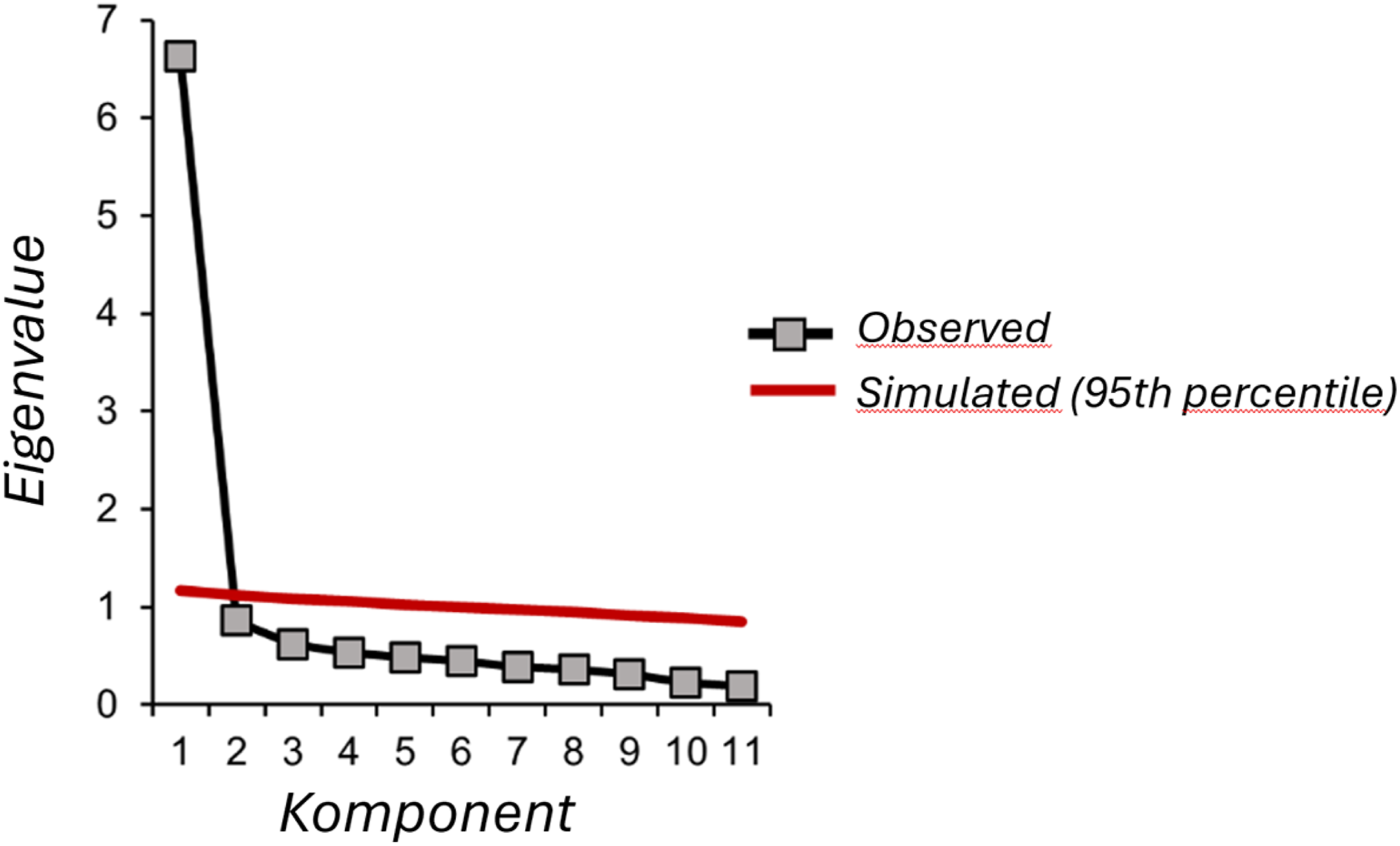
The analysed managerial competencies can thus be classified into the following three core clusters: • Social Competencies (communication, teamwork, intercultural sensitivity, employee orientation)—28% of variance • Technical Competencies (project management, IT skills, quality management)—19% of variance • Strategic Competencies (critical thinking, analytical thinking, creativity, strategic thinking)—22% of variance
Together, these three factors accounted for 69% of the total variance in the dataset, indicating that they represent robust and meaningful categories of managerial competencies.
Correlation analysis between current use of HR tools and perceived importance of future managerial competencies
The correlation analysis yielded the following key findings:
Strong correlations (r ≥ 0.60, p < .001):
Employee performance monitoring ↔ Strategic thinking (r = 0.74): The strongest relationship suggests that organisations systematically monitoring employee performance also place high importance on strategic thinking as a future managerial competency.
Digital HR systems ↔ Analytical thinking (r = 0.68): Automated data processing and analytical HR tools are correlated with a greater emphasis on analytical thinking among managers.
Based on these results, hypothesis H5 is confirmed.
Moderate correlations (0.40 ≤ r < 0.60, p < .001):
HR methods supporting team collaboration ↔ Project management skills (r = 0.59): Firms that emphasise collaboration also tend to view project management as an important managerial competency.
Based on this result, hypothesis H7 is confirmed.
Employee performance evaluation ↔ Critical thinking (r = 0.54): The use of performance appraisal methods appears to be associated with the perceived importance of critical thinking in managerial roles.
Based on this result, hypothesis H3 is confirmed.
Weak correlations (0.20 ≤ r < 0.40, p < .05):
Gamification in HR ↔ Creativity as a managerial competency (r = 0.41): While HR tools such as gamification are somewhat related to creativity, the correlation is only moderately significant.
Based on this result, hypothesis H6 is not rejected.
Use of predictive analytics in HR ↔ Strategic thinking (r = 0.37): Predictive models in HR may support strategic thinking among managers, but the relationship is less pronounced compared to other competencies.
Based on this result, hypotheses H4 and H8 are not rejected.
Non-significant correlations (r < 0.20, p > .05):
Talent management systems ↔ Communication skills (r = 0.18): The expected link between talent management and managerial communication skills was not statistically significant.
Digital HR learning tools ↔ Employee orientation (r = 0.12): Digital learning platforms in HR show no direct relationship with employee-oriented management.
No statistically significant positive relationship was found between HR tools and social competencies. Hypothesis H2 is therefore rejected.
Summary of Key Correlations
The strongest correlations were observed between employee performance monitoring and strategic thinking (r = 0.74), and between digital HR systems and analytical thinking (r = 0.68), confirming hypotheses H5 and H7, which posit a positive effect of digitalisation and performance monitoring on analytical and technical competencies. These findings also support the main hypothesis H1, which asserts that modern HR tools significantly influence the perception of managerial competencies.
Moderate correlations were also identified in the domain of project management (r = 0.59), aligning with hypothesis H3, and in the area of strategic competencies, where the use of predictive analytics (r = 0.37) supports hypothesis H8. While the overall impact of HR tools on strategic competencies was less pronounced, it was statistically significant, thus hypothesis H4 is not rejected.
In contrast, no statistically significant relationship was found for social competencies (e.g., r = 0.18), leading to the rejection of hypothesis H2. Similarly, tools such as gamification (r = 0.41) did not show a strong link to creativity, although some association was observed, which led to hypothesis H6 not being rejected. This may indicate that certain HR tools are not yet fully recognised in practice as key contributors to managerial competency development, or that their potential remains underutilised.
Summary of statistical analyses and hypothesis testing results.

Note. β = standardized regression coefficient; r = Pearson correlation coefficient; R2 = explained variance. The overall relationship between modern HR tools and managerial competencies (H1) was tested using linear regression, while specific hypotheses concerning individual competency domains were examined through correlation analysis.
Discussion
The findings confirm a statistically significant relationship between the implementation of modern HR tools and the perceived importance of managerial competencies. The overall regression model indicated a moderate positive effect (β = 0.434, p < .001), with modern HR tools explaining 31% of the variance in managerial competency perceptions. This suggests that organisations more actively implementing innovative HR practices are also more likely to emphasise the future importance of managerial capability development.
More specifically, the strongest empirical relationships were identified between employee performance monitoring and strategic thinking (r = 0.74, p < .001), as well as between digital HR systems and analytical thinking (r = 0.68, p < .001). These findings suggest that organisations adopting data-driven HR approaches increasingly value competencies related to information processing, evaluation, and long-term decision-making. By contrast, weaker associations were found between predictive HR analytics and strategic thinking (r = 0.37) and between HR gamification and creativity (r = 0.41), indicating that some modern HR tools may currently play a less prominent role into strategic managerial development practices.
Interestingly, no statistically significant positive relationship was found between HR tools and social competencies, leading to the rejection of H2. This may suggest that while digital HR innovations support analytical and technical capability development, they do not automatically foster interpersonal leadership competencies such as communication, collaboration, or employee orientation.
These findings are consistent with several studies analysing the impact of digitalisation on changes in the work environment and processes, as well as the growing need to develop and apply new competencies among managers. For example, Wawer and Muryjas 85 highlight the increasing importance of analytical competencies due to the digitalisation of business processes and emphasise the need to foster these skills in future managers through adjustments to higher education curricula. Peesker et al. 86 similarly stress the relevance of analytical skills among professionals operating in today’s technologically advanced environment. Blazek, 87 in the context of Industry 4.0 development, identifies analytical, diagnostic, and design capabilities as key managerial skills necessary for effectively managing digital transformation. Likewise, Lesková et al. 88 point to the necessity for graduates of management programmes in the digital economy to master interdisciplinary analytical tools and address complex tasks using modern technologies. Bresinsky and Willner, 89 focusing on competence development through simulations and virtual collaboration, likewise underline the importance of digital and analytical skills in responding to changing conditions in the digital economy.
The weaker impact of modern HRM tools on strategic thinking may be attributed to the fact that strategic capabilities typically require long-term development and are not directly influenced by the implementation of digital and technological innovations alone. This interpretation aligns with Piórkowska et al., 90 who argue that strategic thinking evolves gradually through experience, learning, and self-reflection rather than through one-time interventions. Similarly, Madzík and Sieber 91 note that digitalisation does not fundamentally alter the nature of strategic competencies themselves, but rather increases the need for their application in dynamic and digitally transformed environments.
To maintain competitiveness, attention must focus on holistic managerial competency development. In the digital era, the emphasis has shifted towards digital and technical skills, while the development of strategic thinking has weakened. The rapid expansion of digitalisation and associated innovations, including Big Data analytics, has accelerated the development of analytical capabilities. However, the cultivation of strategic thinking requires long-term planning and a systematic approach to education. For instance, McKinsey highlights the importance of strategic thinking in the context of workforce planning in the era of widespread adoption of artificial intelligence software, recommending that organisations anticipate future competency needs, plan for multiple scenarios, and systematically develop talent. 92
Furthermore, it is essential to better integrate the use of modern HR tools with long-term strategic planning. Businesses often concentrate on short-term solutions such as performance monitoring, while aspects like succession planning, talent management, and forecasting managerial needs remain neglected. 93 Several studies indicate that talent management and succession planning are not systematically implemented in many organisations, which reduces their ability to respond to change and ensure leadership continuity. 94 However, investment in aligning HR systems with long-term personnel strategies could significantly improve the preparation of future leaders and thus support the sustainability of human resource management.
The need for a comprehensive approach to managerial competency development therefore includes not only the implementation of modern HR tools but also systematic planning and education focused on strategic thinking and the long-term objectives of the organisation.
Conclusion
The findings of this study confirm that the application of modern HR tools has a statistically significant, albeit moderate, positive impact on the perceived importance of managerial competencies in tourism enterprises across Central and Eastern European countries. The strongest associations were observed in the domains of technical and analytical skills, reflecting the increasing role of digitalisation and HR analytics in human resource management. Strategic competencies demonstrated weaker correlations with the use of digital tools, indicating that their development is likely influenced by other factors, such as systematic education, mentoring, and long-term planning.
While the results support the existence of relationships between HR tools and competencies, several limitations of the present study should be acknowledged. First, the cross-sectional design does not allow for conclusive causal inferences. It remains unclear whether organisations with a heightened perception of competency needs were more likely to adopt HR technologies, or whether the tools themselves contributed to elevating the perceived importance of these competencies. Second, the findings are based on self-reported managerial perceptions, which may be influenced by subjective judgement or social desirability effects. Third, because both predictor and outcome variables were collected using the same survey instrument, the possibility of common method bias cannot be fully excluded. Finally, the study focuses specifically on tourism enterprises in Central and Eastern Europe, which may limit the broader generalisability of the findings to other sectors or geographical contexts.
Therefore, longitudinal research is recommended to track changes over time and enable more precise identification of causal mechanisms. A mixed-methods approach—combining quantitative and qualitative techniques (e.g., case studies)—could further enrich the analysis by uncovering the motivations, barriers, and practical implications of HR innovation in organisational practice. Other variables, such as organisational culture, individual managerial capabilities, and the strategic orientation of the enterprise, also play a significant role and warrant further investigation. The authors are currently conducting a follow-up study aimed at identifying potential trends and shifts related to the implementation of HR tools and the evolution of managerial competencies.
The findings presented in this article underscore the need for a multidimensional and strategically aligned approach to developing managerial capacities. Modern HR tools can support managerial development, but they are insufficient on their own to ensure sustainable competitiveness in a transforming business environment.
Footnotes

Funding
The authors disclosed receipt of the following financial support for the research, authorship, and/or publication of this article: This research was funded by [Scientific Grant Agency Ministry of Education] grant number [No. 1/0498/25] and The Cultural and Educational Grant Agency of the Ministry of Education [No. 008TnUAD-4/2026].
Declaration of conflicting interests
The authors declared no potential conflicts of interest with respect to the research, authorship, and/or publication of this article.
Data Availability Statement
The data will be made available upon receipt of a reasonable request by the corresponding author.
Institutional Review Board Statement
The study was conducted according to the guidelines of the Declaration of Helsinki. The study also followed the ethical standards of the researchers’ institutions, and approved by the Ethics Committee of the Faculty of Social and Economic Relations (protocol no. CEA/15/2024, date of approval September 5, 2024).