



Abstract
Since the late 1980s governments in the Middle East and North Africa (MENA) have created commercial institutions in order to promote regional economic integration. The primary aim of this policy has been regarded as the promotion of economic welfare gains at the national level. The second, albeit less-emphasized goal, has been to promote regional peace through economic interdependence. This study examines the prospects for a liberal peace in the MENA by analyzing two stages of the commercial institutional peace. First, the study considers whether commercial institutions have promoted intra-regional trade in the MENA. Second, it examines whether economic interaction has had an impact on promoting peace within the region. Twenty states are considered here and the unit of analysis is the dyad-year over a 25-year period from 1990 to 2014. This study finds that commercial institutions in the MENA have only a limited positive correlation with trade volume and while there is a direct positive correlation between economic integration and peace in the region, this is quite limited. These findings suggest that the conclusions made by previous studies demonstrate a direct positive correlation between commercial institutions (and economic integration more generally) and peace, may be less applicable to some regions such as MENA.
Introduction
Since the late 1980s many governments in the Middle East and North Africa (MENA) have adopted policies aimed at integrating their national economies with the broader global economy as well as with each other in order to promote domestic economic welfare gains (Fakhri, 2010; Galal & Hoekman, 2003; Hakimian & Nugent, 2005; Hoekman & Messerlin, 2002). A second aim has been to promote regional peace through economic interdependence and political cooperation (Gross & Sagi, 2000; Kilchevsky, Cason, & Wandschneider, 2007; Momani, 2007). The impact of these policies on promoting trade within the region, and their impact on regional peace, is not yet understood. Yet, understanding how to promote peace in the region is perhaps more pressing now than at any time in the post-Cold War era (Davidson, 2013). The region faces a myriad of security challenges including the rise of extremism, proxy wars at the regional level, and the negative effects of climate change. Furthermore, the region continues to play a major role globally, with regional security issues having a clear destabilizing effect on neighboring regions and the global hydrocarbon market.
Commercial institutional 1 peace (CIP) theory is used in this study in order to assess the impact of national trade policies, and the impact of economic integration on regional peace. The underlying thesis of this theory is that commercial institutions help to promote peace between states by increasing economic interdependence between trading partners (Oneal & Russett, 1999). This approach has developed since the 1990s, but has its limitations and needs further development. For example, CIP analysis tend to consider all states in the global system and apply generalizable conclusions to all regions and states equally. Yet, a deeper analysis of the impacts of commercial institutions and trade in the MENA (and other regions) may reveal a different story about the ways in which trade influences state behavior. This study tests the validity of the CIP theory in the context of the MENA, and investigates if trade influences peace and security in interstate relations in the region. Like previous studies that have analyzed the relationship between economic integration, interdependence, and political cooperation/peace (see Barbieri, 1996; Bearce, 2003; Copeland, 1996; Gartzke, Li, & Boehmer, 2001; Goldsmith, 2013; McDonald, 2004; Oneal, Russett, & Berbaum, 2003) this study has clear policy implications for current and future political leaders in the MENA and elsewhere.
This study considers the prospects for a liberal peace in the MENA by analyzing two separate but interconnected stages of the CIP. First, the study explores whether commercial institutions in the region have promoted intra-regional trade. Second, it analyzes whether trade has an impact on promoting peace within the region. One hypothesis is tested at each stage of this study:
The study begins by summarizing the main assumptions of CIP and charts the development of this approach through a review of existing literature. Through a critique of CIP literature, we are able to identify the limitations of applying this theory to regional-level analysis. The study then proceeds to outline commercial institutions in the MENA and discusses how these have emerged out of the pursuit of national economic welfare and international peace. By critiquing the literature on commercial institutions, economic integration, and peace in the MENA this study then develops a bespoke methodology that introduces new variables into the analysis of the correlation between commercial institutions, economic integration, and peace. This study then uses this methodology to analyze the relationship between commercial institutions, trade, and peace between 20 states 2 in the MENA by dyad-year (a total of 380 dyads). The unit of analysis is the dyad-year over the period 1990–2014, totaling 9,500 dyad-years. Statistical Package for the Social Sciences (SPSS) is used to test for correlations among 12 variables that tell us about the nature of economic and political interactions in the region relevant to this study, by conducting bivariate correlation analysis using Pearson R to test for multivariable correlation by dyad-year. A discussion of the findings is then presented, followed by final conclusions on the validity of the CIP for the MENA, and prospects for regional peace through economic integration. The conclusions drawn here are that commercial institutions in the MENA have only a very limited positive correlation with trade volume, and that economic integration has a limited positive correlation with peace.
Commercial Institutional Peace
As part of the liberal peace research agenda, we can identify a body of literature that investigates the relationship between trade-promoting government policies (commercial institutions) and peace/conflict (see Bearce & Omori, 2005; Goldsmith, 2013; Reuveny, 2001). As part of this research agenda, scholars in International Relations (IR) and International Political Economy (IPE) have argued that states that interact with each other through commercial institutions will experience high levels of cooperation in their overall relationship (Aydin, 2010; Bearce, 2003; Goldsmith, 2013; Oneal & Russett, 1999; Polachek, Robst, & Chang, 1999). The underlying thesis is relatively straightforward here: commercial institutions facilitate trade by removing both tariff and non-tariff barriers to economic exchange, this in turn increases trade volume. Over time, increased trade volume leads to greater levels of economic integration and interdependence between states (Aydin, 2010; Benson & Niou, 2007; Kilchevsky et al., 2007). Economic interdependence, in particular, raises the costs of defection (in other words engaging in conflict/war), from any peaceful and cooperative trading relationship, while at the same time increasing the rewards of cooperation and the maintenance of peace (Gartzke et al., 2001; Kilchevsky et al., 2007). The end result is embedded interstate cooperation, international stability, and peace (Bearce & Omori, 2005; Oneal et al., 2003). This thesis is inspired by Norman Angell’s Great Illusion (1913)—the illusion being that in an interdependence system, national interests can be achieved through conflict and war rather than peaceful interactions.
This area of investigation forms part of what Oneal et al. (2003) termed “the causes of peace.” This thesis is based on Kantian logic and the examination of the three legs of the Kantian tripod (republican constitutions, cosmopolitan law [free trade and economic interdependence], and international law) with Oneal et al. seeing the second as the most important (ibid., p. 372). They highlight the policy implications of the peace research agenda, and in particular the importance of understanding the relationship between each Kantian element when recommending “that policymakers promote democracy and trade internationally and participate in international organizations as a means of promoting world peace” (ibid.). CIP theory is undoubtedly rich with policy implications. The IR and IPE scholarships on commercial institutions have focused on whether or not trade promotes peace through reducing the prevalence of armed conflict. Here, peace is often understood as the absence of militarized interstate disputes (MIDs). The incidence of armed interstate conflict has been the measure of the success or failure of economic integration as a means to prevent conflict and promote peaceful cooperation. For example, Bearce (2003) has attempted to “grasp” the CIP by analyzing how commercial institutions “help reduce the incidence of militarized inter-state conflict” (ibid., p. 347). Similarly, McDonald (2004, p. 547) explores how “higher levels of free trade […] reduce military conflict between states”, and Bearce and Omori (2005), Saez (2008), Aydin (2010), and Goldsmith (2013) have all studied different aspects of the trade and interstate conflict relationship.
While this area of peace research has developed and is garnering increased attention, CIP is not yet a fully formed approach with some studies undermining it. There are still questions about the assumptions made and critical studies exist that call the fundamental tenet (that trade and peace are directly and positively related) into question.
Polachek et al. (1999) find that foreign aid and contiguity increase the gains from trade, while tariffs have the opposite effect. Furthermore, their findings concretely demonstrate that the benefits from trade (and therefore, the promotion of peace and cooperation) are greater for small states when they trade with large states, than for small state-small state trade. Likewise, for large states greater benefits are experienced when trading with other large states than with small states (ibid., p. 418). In many ways a front-runner to more recent analyses, Polachek et al. argue that third party considerations have an impact on how trade affects conflict. They state that “[a]n actor with improved terms of trade […] with a target [country] will decrease conflict with a third party […] if the third party and target are friends” (ibid., p. 411). Furthermore, “[a]n actor with improved terms of trade with a target will increase conflict with a third party, if the third party and target are rivals” (ibid.).
After examining 6,000 dyads and approximately 150,000 observations from 1885 to 1992, Oneal and Russett find that “democracy, economic interdependence, and involvement in international organizations reduce the incidence of [MIDs]” (ibid., p. 34). In terms of trade, this effect is very significant with important trade integration leading to a reduction in the likelihood of MIDs by over half. At the systemic level, Oneal and Russett conclude that “the international system is more peaceful when there are more democracies and when trade is greater” (ibid.). Like most of the other literature on the Kantian peace or broader CIP research, Oneal and Russett’s findings represent a universally applicable set of conclusions as the data they analyze cover all states.
In similar research, Bearce and Omori (2005) have built an earlier CIP research by investigating how “regional commercial institutions produce their observed pacific effect” (ibid., p. 659). They tested three causal arguments: first, that commercial institutions increase opportunity costs for war; second, that commercial institutions provide information on trading partners’ military capabilities, thus increasing their ability to bargain for peace; and third, that commercial institutions regularly bring high-level state leaders and decision-makers together which can help build trust (ibid.). By using a statistical model that includes a range of variables and applying it to all region-specific politically relevant dyad-years from 1951 to 1985, Bearce and Omori conclude that only the third thesis tested is accurate (ibid., pp. 668–669).
Of particular importance here is the way in which Bearce and Omori deal with the problem of which actors experience opportunity costs of war. If we consider states as unitary actors, then we can rather superficially argue that increased trade raises the opportunity cost of war through loss of trade. However, as Bearce and Omori (ibid., p. 662) highlight, “it is societal actors who conduct the bulk of international commerce, and thus, directly earn the profits of this exchange.” As commercial institutions are created and maintained by state actors, we need to question how they benefit from economic interdependence, or how higher opportunity costs of war affect their decision making. Bearce (2003) offers one solution here by considering states as an autonomous actors that are not impacted by societal (or market) actors. In this way, it is possible to explore whether state actors directly suffer economically through war. However, this approach is limited when studying commercial institutions if most of the benefits are received by market actors. Instead, we can approach states as autonomous actors that need vibrant markets in order to raise revenue through tax, thus reinforcing the interest that states have in promoting economic growth and raising their opportunity costs of war (Bearce & Omori, 2005, p. 663). Another solution is proposed in this study and draws on work by Polachek (1992) and Polachek and McDonald (1992), and highlighted by Barbieri (1996), in which “[l]eaders are deterred from initiating conflict against important trading partners for fear of losing welfare gains associated with trade” (ibid., p. 31).
In a related study, Aydin (2008) examines the relationship between trade and its “broader political implications on state behavior” (ibid., p. 1098) and not just its impact in MIDs. In particular, Aydin looks beyond dyads consisting of trading partners and considers trade’s impact on states’ decisions to assist their trading partners militarily (when they are in conflict with third parties). Using a similar methodology to that employed in her 2010 work, Aydin (ibid.) finds that “[w]hen third parties have important trade interests in a conflict participant, they join with their partners to protect their economic stakes.” This approach offers us an interesting way of examining trade’s broader effects beyond dyadic analysis. In particular, Aydin (ibid., p. 1099) argues that “[t]hird party states that are interdependent with conflict participants fear disruption of trade” and will, therefore, have an interest in conflicts that they are not (at least initially) involved in militarily. This model of “conflict expansion” demonstrates that economic interdependence and international peace/conflict are related and are more complex than dyadic analyses have proven. This conclusion has implications for understanding the pacific benefits of trade at the regional level and suggests a complex regional system of trading relationships and subsequent economic interdependence will magnify the potential for regional involvement in promoting peace and/or fighting wars.
With regard to trade, Oneal et al. (2003) find that there is a pacifying effect, with economic interdependence having a significant impact on reducing the risk of fatal disputes and wars (ibid., pp. 387–388). Interestingly, however, the nature of governing regimes is also found to have robust impact on promoting peace, with democracies that trade significantly with each other being least likely to engage in militarized conflict. This finding has implications for an assessment of the impact of commercial institutions in the MENA as most states considered here are authoritarian. Central to McDonald’s (2004) approach is the observation that increasing trade tends to increase overall national economic prosperity but at the same time also alters the domestic distribution of income. Some domestic groups (e.g., actors in import-competing sectors), therefore, are likely to resist greater economic integration and will not “lobby the state for a pacific foreign policy that promotes expanding transnational economic ties” (ibid.). Free trade removes the foundations of domestic privilege for those groups who are likely to resist economic integration in the form of imports, and thus reduces the capabilities of these groups to “reduce the capacity of free-trading interests to limit aggression in foreign policy” (ibid., p. 549).
Not all research has been as optimistic about the value of trade- promoting policies as a means to peace. Kim and Rousseau (2005) find that “states that share preferential trading agreement(s) […] are more likely to be interdependent with each other; but, economic interdependence is higher between states across regions rather than within regions” (p. 540). Nevertheless, their key finding is that economic interdependence does not have a pacifying effect. Likewise, Barbieri’s (1996) work has furthered the CIP research agenda by re-examining the relationship between economic interdependence and peace/conflict by considering the impact of varying levels of interdependence on state behavior. She takes a historical approach and analyzes the impact of economic interdependence on interstate relations during the nineteenth and twentieth centuries, and finds that “[r]ather than inhibiting conflict, extensive economic interdependence increases the likelihood that dyads will engage in militarized interstate disputes” (ibid., p. 29). Furthermore, “[e]xtreme interdependence, whether symmetrical or asymmetrical, has the greatest potential for increasing the likelihood of conflict” (ibid.). These conclusions run counter to the dominant hypothesis that trade promotes peace and Barbieri’s work encouraged further investigations to test her model. Key to this approach is consideration of both the benefits and costs of trade. The latter has generally been ignored by liberal scholars who focus on the positive effects of trade as a means to understand increased opportunity costs and increased rewards from trade. Barbieri (ibid., p. 31) finds that if costs are greater than benefits then trade may lead to conflict rather than peace, especially in an asymmetric trading relationship.
According to the results of the full interdependence model employed in her study, Barbieri concludes that “the extension of trade linkages will inevitably lead to an increased probability that dyads engage in militarized disputes” (ibid., p. 40). Furthermore, “when interdependence is at its maximum, dyads are 25 times as likely to engage in a MID than when interdependence is at its minimum” (ibid.). These findings are contrary to much of the scholarship that supports the liberal peace thesis. A reason for this disparity may be the differences in time periods analyzed (with Barbieri focusing on the pre-World War II period, and other studies considering longer periods with data up to the 2000s). Another might be the exclusion of some variables such as the impact of the perceptions of state leaders; the impact of trust, norms, and formal mechanisms for state leaders to communicate; cultural similarity; and historical relations.
Saez (2008) argues “that under certain specific conditions, trade interdependence is unlikely to occur and therefore the expected palliative effect of trade on militarized interstate conflict cannot take place” (p. 698). While his study still focuses on the relationship between trade and interstate war (which limits our understanding of how trade can promote political cooperation in other areas of IR), his assessment of the limits of trade occurrence is highly valuable. Saez’s conclusions have direct implications for the effect of trade on various aspects of political cooperation (not just conflict reduction) and can be used to demonstrate when commercial institutions do not lead to greater trade and economic integration. His central thesis draws on neorealist literature and states that “trade is inherently conflictual” (ibid.) and especially where the following conditions apply “where there is intermittent military friction [and] asymmetry among players” and where there this a regional hegemon, which “is likely to be hostile to the interests of its neighbors” (ibid.). A second argument posited by Saez is that states that have a history of military conflict with each other will not increase bilateral trade with each other, instead finding alternative partners to economically integrate with (ibid., p. 699). Yet, as Page (2000, p. 62) highlights, “it is precisely former enemies which may want to institutionalize the end of conflict.” Understanding when enemies become former enemies is, therefore, important. To test this position further, it is necessary to examine the impact of commercial institutions on creating or diverting trade between member states at the regional level.
There are also implications for research that focuses on specific regions here. Saez’s main findings are that “some regional economies are not structurally disposed to undertake trade” (2008, p. 713); and that trade does not lead to peace when “the conflict-reducing options that are contingent upon the nature of economic interdependence are not present” (ibid.). One limitation with these conclusions, however, is that they are used interchangeably to support the central thesis that trade does not promote peace, when perhaps there are two separate questions being addressed that relate to whether trade takes place, and if it does what is the impact on conflict reduction. The relevance of Saez’s work for the present study is how the first question is addressed and not the broader question of whether or not trade (when it does occur and when economic integration leads to interdependence) leads to peace. This study reflects on Saez’s conclusions about the former question.
Reflecting on studies that have both supported and contradicted CIP theory is necessary to promote a more heterodox approach to the analysis of commercial institutions, economic integration, and peace. An intriguing finding made by Reuveny (2001), for example, is that there are differences in the relationship between trade and conflict/cooperation when considering relations between eastern and western states on the one hand, and between states within the West on the other. Specifically, Reuveny finds that “the East–West trade and conflict nexus is generally more significant than the West–West nexus and is potentially more sensitive to conflict” (ibid., p. 132). The implications of this finding are that trade does not have one universally applicable effect on other areas of IR (and vice versa) and that different regions can experience the impact of trade in various ways. This raises questions about the impact of trade within specific regions (and not just between states across regions) outside of the West. In the context of this current study: the MENA. The overarching finding made by Reuveny is that “trade and conflict theories may miss important elements, pointing out the need for richer, more microfounded theoretical models” (ibid.).
Likewise, Goldsmith (2013) concludes that trade can have both positive and negative effect on IR at different times. In some cases, trade does inhibit conflict between states, but it can also facilitate it under certain conditions (ibid., p. 575). Specifically, he finds that “trade interdependence inhibits the onset of militarized disputes, trade volume increases the risk of the onset of militarized disputes, there is no relationship between trade interdependence and conflict escalation, and trade volume inhibits the escalation of militarized disputes to deadly interstate violence” (ibid.). The second conclusion is perhaps the most interesting and unexpected if one adopts widely held assumptions about the liberal peace. This suggests an avenue for research concerning the effects of commercial institutions, trade volume, and interdependence at the regional level in the MENA. Goldsmith’s study centers on the hypothesis “that trade interdependence, representing the opportunity costs of conflict, is likely to deter conflict onset, but that high volumes of trade, by increasing potential sources of tension, will make onset more likely [but] these roles reverse once a conflict has begun and states consider escalation to war” (italics in original) (ibid., p. 556).
Bearce (2003) has noted that while much work has been done to advance the CIP agenda, and “this research program now provides stronger empirical evidence that commercial institutions produce positive security externalities in the developing world, it still fails to delineate clearly how such institutions matter” (italics in original) (ibid., p. 348). Using a similar approach to Oneal et al. (2003), Bearce (2003) tests the argument that commercial institutions influence IR in several ways: first, by “increasing the opportunity costs of war for the state”; second, providing state leaders with information “about other states’ military capabilities and […] intentions”; and third, building trust between state leaders by bringing them together on a regular basis. One limitation with this final argument, however, is that the role of security apparatus is quite prominent in Bearce’s analysis. In particular, if the commercial institution being studied is embodied in an international organization (and not just an agreement) that deals with security in a traditional sense (considering war, sovereignty, military security, and survival) then the argument that commercial institutions offer state leaders the opportunity to meet to discuss security issues stands up. But if the commercial institution exclusively relates to liberalizing trade between member states, and is just one agreement (among potentially many) formulated and maintained by an organizational forum that deals with economic and social issues (such as the Arab League’s Economic and Social Council that oversees Greater Arab Free Trade Area (GAFTA)) then the argument is harder to support.
Benson and Niou note “that asymmetries in economically integrated dyads are likely to create incentives for the less dependent actor to exploit its bargaining leverage to manipulate the more dependent actor” (2007, p. 39). This approach certainly has some value and has helped to further our understanding of the trade–peace relationship; however, it risks placing too much emphasis on state actors without considering society/market actors and their role in initiating and maintaining trade. This poses problems because states are not the primary actors engaged in the production and exchange of goods and services. As Barbieri (1996, p. 31) notes, at least for liberal scholars, “trade patterns emerge naturally as a result of given heterogeneous factor endowments”. While Benson and Niou’s claim that the “[f]ailure to endogenize decision-makers’ choice to trade is a critical shortcoming of existing trade studies” (p. 40) is valid, this critique ignores the possibility that state leaders do not in fact have the power to decide whether or not to trade. Analyzing market forces can prove far more fruitful in understanding why and how trade takes place as this approach allows us to examine the actual actors involved in production, exchange, and consumption (which includes state actors only to some extent). Indeed, if the argument that states decide whether to trade or not is accurate then the establishment of commercial institutions would automatically result in an increased trade. This is, however, not guaranteed and empirical studies have shown that the implementation of an FTA does not always have any impact on trade patterns. Studies that fail to differentiate between states and markets often prove ineffective (see Strange, 1994).
We can consider the domestic-stability effects of economic growth in the MENA as being highly important to perhaps the most central policy goal of governing regimes in the region: regime survival (T. Ismael, J. Ismael, & Perry, 2015). As most states in the region express authoritarian as opposed to democratic tendencies, tenure in office is not lightly considered, and the notion of political change as a normal process is often not respected. We can, therefore, consider economic gains by market actors as highly relevant to the state actors engaging in regional commercial institutions. If society gains from increased trade, so too do states through increased stability, likewise if society experiences economic hardship, for example, from war, then states also suffer through increased instability. Furthermore, the distinction between state and “societal” actors that Bearce and Omori highlight only applies in an ideal-type capitalist economy. The relationship between MENA governments and big business, for example, is highly complex and often ruling elites and economic elites are synonymous with each other. These considerations inform the methodology applied in this study as discussed in the following.
Commercial Institutions in the MENA
The history of commercial institutions in the MENA is significant in terms of the number of initiatives and governmental commitment to creating such institutions. However, the impact of these institutions has been less impressive (Ekanayake & Ledgerwood, 2009). The region has a number of bilateral and multilateral FTAs, and a common market (the Gulf Cooperation Council, GCC) that are exclusive to the region—and when considering the international and global levels, MENA states are involved in several dozen commercial institutions. The governments in the region have created this plethora of MENA-specific commercial institutions in order to promote domestic economic welfare at home (Konan, 2003), and broader integration and cooperation at the regional level. The most encompassing agreement is the GAFTA which was signed at the League of Arab States General Meeting on February 19, 1997 in Amman, Jordan (El-Anis, 2011, pp. 90–92). According to Zarouk (2003), GAFTA was created, at least in part, in order to promote intra-Arab trade in light of broader international agreements and processes, for example, the signing by a number of MENA states of Association Agreements with the EU, and the Uruguay Round of World Trade Organization (WTO) negotiations. GAFTA was an attempt to revive the Arab League’s moribund 1981 Agreement for Facilitation and Promotion of Trade, and has resulted in the full liberalization of trade in goods (services are not included in the agreement) between member states. The following states are members of GAFTA: Algeria, Bahrain, Egypt, Iraq, Jordan, Kuwait, Lebanon, Libya, Morocco, Oman, Palestine, Qatar, Saudi Arabia, Sudan, Syria, Tunisia, the UAE, and Yemen.
The 1980s saw the creation of the GCC and the Arab Maghreb Union (AMU). The former, consisting of Bahrain, Kuwait, Oman, Qatar, Saudi Arabia, and the UAE is a common market (Low & Salazar, 2011) and since 2008 the group has been pursuing the establishment of a single market. Internal trade and movement of people and capital is fully liberalized. The AMU was established by Algeria, Libya, Mauritania, Morocco, and Tunisia in 1989 and sought to create a common market (Darrat & Pennathur, 2002). However, most policies created in this forum have not been implemented, or have been under implemented. GAFTA has had a somewhat uneven development with some members implementing the agreement at different rates (Al-Atrash & Yousef, 2000). This in part encouraged Egypt, Jordan, Morocco, and Tunisia implemented the Agadir Agreement (also known as the Mediterranean Arab Free Trade Agreement (MAFTA)) on February 25, 2005 (Peridy, 2005). This FTA seeks to liberalize all trade between the member states. In addition to these agreements, there are a number of bilateral trade agreements (including some FTAs) between Arab League member states and Turkey, Israel, and Iran.
CIP theory has developed since the 1990s, yet we can still identify limitations in terms of the assumptions made and the absence of the MENA from the research agenda. Kilchevsky et al. (2007, p. 647), for example, have highlighted the need to “move from the general insight offered by past studies to more region-specific models and analyses at lower levels of aggregation.” Given the limited levels of intra-regional trade in the MENA and the fact that the region has “for the most part, avoided the global trend of regionalism” (ibid., p. 648) it is perhaps more useful to analyze trade patterns and policies across the region. This study thus analyzes a large-scale set of relations that demonstrate a greater level of embedded economic, political, and institutional engagement in the MENA as this can provide further insights into the relationship between economic interactions, political cooperation, peace, and security at the regional level.
In order to develop our understanding of the potential for peace in the region, we need to bring economic considerations into the discussion. Abboud and Minow (2002, p. 14) put forward the case for an “economics first” approach arguing that “economic interaction often leads to political adhesion” and noting that “examples can be found in Western Europe and Eastern Europe and increasingly in Asia. Politics follows commerce because commerce provides mutual benefits across the broad expanse of the population, regardless of race, color, religion, or ideology” (ibid.). The experiences of the world of business (where risks are taken far more readily than in the world of politics) certainly lend support to this notion. However, as Abboud and Minow admit, “[g]etting agreement on the stabilizing potential of economic development is easy. Translating that agreement into actual progress on the ground is tough” (ibid.). Investigating the ways in which state policies in the MENA exhibit agreement that “trade is good” is an important step, but analyzing how commercial institutions are established only takes us so far in our understanding of the political economy of trade and peace in the MENA. Exploring how agreements translate into actual progress on the ground in terms of peace is an interesting avenue for research.
It is also important to address the lack of analysis of the correlation between economic and political processes at the regional level of analysis. Aydin (2010, p. 523) notes the limitations of focusing solely on the direct deterrent effects of trade in any given bilateral relationship. This rather narrow research interest, it is argued, has been the dominant focus of much of the literature on economic interdependence and international conflict, which has tended to omit bilateral trade’s indirect effect on third-party states. By going beyond the dyad-level analysis, Aydin concludes that “extended deterrence success is most likely in cases where the defender and target are economically integrated through regional trade institutions as well as conducting heavy trade” (ibid.). The conclusion that regional trade institutions (in this study referred to as a specific form of commercial institution) are important to the promotion of peace and stability is particularly noteworthy. Indeed, Aydin shows that an assessment of the impact of trade on political behavior and relations between multiple states requires an appreciation of the role of regional commercial institutions and a large number of overlapping dyadic analyses. Furthermore, an analysis of this kind can offer insights into the impact that trade has on states directly engaged in trade with each other as well as the deterrent effect of economic and institutional integration on third-party states (states that are not directly engaged in said integration) (ibid., p. 524), in other words an entire region.
As highlighted earlier, research on the relationship between economic integration and peace has developed since the mid-1990s, yet the MENA has largely been ignored. Perhaps this is a result of the rather inaccurate perception of what Henwood (1993) refers to as “the missing Middle East” in processes of global economic integration. Studies that have tackled economic integration and peace in the MENA have been few in number and somewhat limited in scope. Momani (2007) has analyzed economic interdependence and peace in the context of the Bush Doctrine, highlighting the Bush Administration’s plan of “expanding trade and economic relations with friendly Middle East states [to] advance America’s strategic interests” (ibid., p. 1682). Momani examined the so-called Middle East Free Trade Area (MEFTA) and the USA interest behind it, as well as the structural barriers to intra-regional trade in the MENA. Momani argues that there are four key structural problems: first, low comparative advantage; second, the small size of MENA economies; third, income disparity between MENA states; and fourth, high-tariff and non-tariff barriers to trade. While this study contributes to our understanding of these structural limitations, and US policy interests, it does little to advance our knowledge of the actual potential for increased economic integration to achieve the overall objective of promoting peace and stability in the region. Ultimately, Momani concludes that “[t]he current structural impediments to intra-regional economic cooperation […] will inhibit the prospects for of an integrated Middle East economic system” (ibid., p. 1698). This is undoubtedly a significant conclusion, but leaves unanswered questions related to the pacific benefits of trade when it does take place.
A final problem to overcome is that studies of trade policy in the MENA often focus on governmental strategies and less so on the impact of economic interactions. For example, Zineldin (2002) has explored different strategies “needed to achieve the Arab shared objective of co-operation and peaceful coexistence” (p. 35) by considering both micro- and macroeconomic factors that promote and hinder integration. It must be noted here that non-Arab MENA states are excluded from his analysis—which is certainly a limitation given the roles played by Iran and Turkey, in particular, in the region’s economy. Zineldin sees emergent regional trading blocs resulting from the pressure of increased competition (both economic and political) stemming from globalization. Trade for Arab states, Zineldin argues, is as much as about regional defense against the global economy as it is about synergy between them. He argues that a strategy is needed to promote economic integration between Arab states in order to better ensure their survival and development in the twenty-first century (ibid., p. 37). However, in a similar analysis to Momani’s, Zineldin does not consider the effects of economic integration on political cooperation and MIDs. Rather, an effect is assumed—to positively reinforce cooperation and coordination between trading partners in the Arab world.
Methodology
Analyzing the relationship between commercial institutions and peace/conflict is complex and various methodological approaches have been used to this end. The multiplicity of methodologies exists in part because no single approach has proven sufficient to explain this contested area of investigation. As with debates surrounding the underlying theoretical assumptions about commercial institutions and peace/conflict, there are competing arguments about which variables need to be analyzed in order to understand if there is a CIP. At the same time, no “ready-made” methodology to analyze the MENA experience is available. Kilchevsky et al. (2007) offer one of the more coherent (of a small number of) studies that seek to investigate how “economic interdependence can be converted from a theoretical construct to a concrete reality” (p. 648) in the MENA. By using three least square regression analysis with conflict as the dependent variable and trade patterns as the independent variable they find that the four countries tested are more peaceful when they are more economically integrated (ibid.). However, limiting their study to Egypt, Israel, Jordan, and Turkey, may distort the conclusions as the dyadic relationships tested are Egypt–Israel, Jordan–Israel, and Turkey–Israel, each of which is a relationship influenced by other independent variables such as treaties of peace which also provide for joint economic ventures (in the cases of Egypt–Israel and Jordan–Israel) or close defense ties (Turkey–Israel). Egypt–Jordan, Egypt–Turkey, and Jordan–Turkey are not tested as dyads and little can be learned about whether or not they are more or less peaceful toward each other given greater or lesser levels of economic integration by an analysis that ultimately puts Israel as the central dyadic partner. Relationships between Egypt and Jordan, for example, are influenced by rather different interests, identities, histories, and processes to Egyptian–Israeli relations, some but not all of which are used as control variables by Kilchevsky et al. (who use: conflict, salience, symmetry, interdependence, relative power, difference in democratization, contiguity, and IGO membership as control variables).
While Kilchevsky et al. offer a useful methodological starting point, understanding the nature of economic integration and its impacts on political interactions in the MENA requires a more comprehensive analysis that takes into account a larger range of dyadic relationships, and that considers a greater number of variables that inform trade policies and patterns. J. R. Oneal, F. H. Oneal, Maoz, and Russett (1996) have evaluated the “effects of regime type and interdependence on the likelihood that a pair of states will become involved in a militarized interstate dispute” (ibid., p. 11). They do this by controlling for growth rates in per capita income, alliances, geographic contiguity, and relative power and use logistic regression analyses for a large number of dyads from 1950 to 1985. As the time this work was published (1996), it was evident that as Oneal et al. state, “political scientists have shown less interest in the consequences of free trade and economic interdependence” (ibid.) than in the relationship between democracy and international conflict. While this is no longer quite the case, given the research that has been carried out since the mid-1990s, Oneal et al.’s work still resonates with scholars trying to fully understand how economic interdependence promotes peace. In all, Oneal et al. analyze MIDs and limit their study to dyads that are politically relevant and contiguous (ibid., p. 14). This offers some ground for the methodology employed in this study to develop from in a similar way to other studies that followed Oneal et al.’s work (see Benson & Niou, 2007).
One limitation here, however, is that no rigorous method/justification for defining which states are politically relevant. Furthermore, in today’s era of globalization the rapid advancement of travel and communication technologies, as well as the increasingly global nature of research and design, production, marketing, and sales processes, trade is no longer focused on neighbors (see Ohmae, 1994). In short, we need to take into account trade between states that are not contiguous while still considering the impact of distance and borders. This position raises some important questions for the deterrence and peace-promoting effects of regional agreements like the GAFTA when considering that, as demonstrated by Elkhafif, Tagdhisi-Rad, and Elagraa (2012), Rouis (2012), Romagnoli and Mengoni (2009), Abedini and Péridy (2008) among others, the evidence suggests that this agreement has had only a modest impact on increasing trade within the region, and much of this has been within subregions of the MENA.
It is clear that a methodology that considers a large number of variables is needed. Polachek et al. (1999) have demonstrated this by building on some of the earlier peace research literature by introducing new variables into older models. They argue that foreign aid, tariffs, contiguity, and relative country-size also need to be analyzed as independent variables (ibid., p. 405). By integrating these additional factors into their methodology they are able to demonstrate how trade affects conflict/ peace in a more robust manner than earlier studies that only considered total levels of bilateral trade and levels of interdependence by dyad-year. Yet, while Polachek et al.’s approach has developed our understanding of the impacts of trade on conflict/peace, there are still limitations in terms of the independent variables measured. Their model leaves no room for an assessment of the impact of a range of variables that according to other works are demonstrably important, including, cultural affinity and military capabilities. A limitation with many of the models employed in the liberal peace literature, especially investigations of trade and commercial institutions, often is limited by the relatively small number of variables considered. Goldsmith (2013) takes a rather unique direction in trade and peace research by “integrating expectations from schools of thought often portrayed as incompatible [to analyze] two aspects of trade— volume and interdependence—and model conflict as a two-stage process involving onset and escalation” (p. 555). Yet, by considering trade as the key variable, and not exploring the effects of other variables Goldsmith offers an explanation of the impact of trade that does not account for the simultaneous effects of forms of governance, institutional membership, contiguity/proximity, and history, for example. But he does highlight that there is still much to be researched and he offers some insights into how we can deepen our understanding of the ways in which patterns of trade can affect IR.
Research Design
This study examines the relationship among commercial institutions, trade, and peace among 20 states in the MENA and a total of 380 dyads. The unit of analysis is the dyad-year over the period 1990–2014, totaling 9,500 dyad-years. Data were collected from 12 variables that provide us with evidence of the nature of economic and political interactions in the region (the variables and sources of data are discussed in the following). These data were then processed using SPSS to ascertain the level of correlation between the variables by conducting bivariate correlate analysis using Pearson R to test for multivariable correlation by dyad-year.
This study was carried out in two stages, each relating to one of the key hypotheses being tested. Each phase has one independent variable, one dependent variable, and a number of control variables. The first stage explored the relationship between commercial institutions (the stage one independent variable) and trade volume (stage one dependent variable). The second stage explored the relationship between trade (Stage 2 independent variable) and peace (Stage 2 dependent variable).
Stage 1
A further six control variables are used here as follows:
Stage 2
A further five control variables are used at this stage as follows:
Results of the Pearson Correlation Test
Findings and Discussion
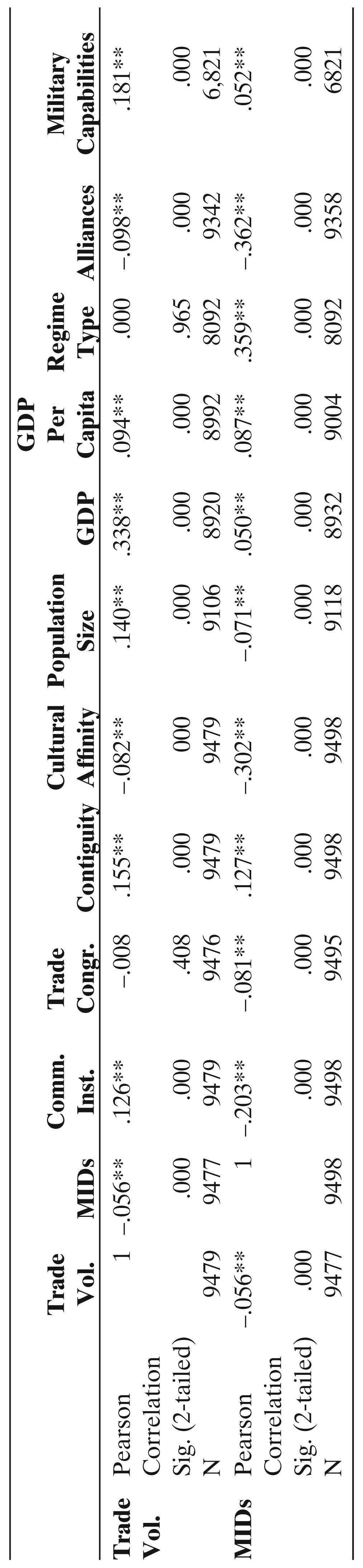
The results of the correlation test are clear and demonstrate a number of relationships between different variables; however, there are variations in the significance factor of these correlations (Table 1). The most important finding is that there is a direct and positive correlation between the level of commercial institutional membership and trade volume at the dyad level in the MENA for 1990–2014. According to the analysis of the data collected, where a commercial institutional relationship exists, total trade between member states will be higher than if no commercial institution exists. At the same time, however, the correlation value of 0.126 (significant at the 0.01 level) suggests that the correlation between commercial institutional membership and trade volume, while positive, is somewhat limited. Trade volume, for example, has a stronger direct positive correlation with a number of other variables, including contiguity (0.155 significant at the 0.01 level), population size (0.140 significant at the 0.01 level), and GDP (0.338 significant at the 0.01 level). In terms of positive correlation with trade volume, the test finds that commercial institutions only rank forth out of nine variables. The rank order from the most significant positive correlation to most significant negative correlation is as follows: (a) GDP; (b) military capabilities; (c) contiguity; (d) population size; (e) commercial institutional membership; (f) GDP per capita; (g) MIDs (negative); (h) cultural affinity (negative); and (h) alliances (negative). Regime type and trade congruence do not have a recordable correlation to trade volume.
The relationship between alliances and trade volume is surprising in so far as it has a negative correlation. It is possible that states with a more developed alliance are aware of the economic interdependence between them resulting from high trade volume, and thus would solidify their peaceful relationship in the form of an alliance. This does not seem to have happened in the MENA. However, for most of the MENA states considered in this study, their alliance status long predates any relevant economic interactions (especially for Arab League member states). It is not possible to conclude here whether or not alliance status has an effect on trade volume, and this needs further investigation—as mentioned earlier, MENA governments can be heavily involved in market interactions as the lines between state and big business are often blurred. The fact that trade congruence does not have a recordable correlation with trade volume is surprising. It is widely accepted that the more well suited two markets are, the more likely trade between them will flourish. The experience in the MENA does not correspond to this prediction; however, and the reasons why are unclear. The ranking of cultural affinity is also noteworthy and this finding suggests that further study on the relationship between culture and trade is needed. It was expected that cultural affinity would facilitate trade; however, the results of this study confirm that the opposite is true. This is likely, however, to be influenced by other (political) factors. Population size, GDP, and GDP per capita all represent market size and so it is also not surprising that they demonstrate a positive correlation with trade volume (a larger market will have a greater demand for imports and more productive capacity for exports). However, it is significant to note that population size and GDP have more significant positive correlations with trade volume than commercial institutional membership. This suggests that commercial institutions do not possess the potential to direct (perhaps even divert) trade away from larger markets to smaller ones, thus explaining some of the trade patterns witnessed.
The data analysis conducted here also shows that there is a direct negative correlation between trade volume and MIDs, confirming that trade does have a pacifying effect in the MENA. However, at –0.056 (significant at the 0.01 level) this impact is very limited and not particularly encouraging. The rank order of the variables and MIDs from most significant negative correlation to most significant positive correlation is as follows: (a) alliances; (b) cultural affinity; (c) commercial institutional membership; (d) trade congruence; (e) population size; (f) trade volume; (g) GDP (positive); (h) military capabilities (positive); (i) GDP per capita (positive); (j) contiguity; and (k) regime type. Commercial institutional membership ranks third out of 11 variables, but trade volume only ranks seventh and has the lowest score for a negative correlation. Increasing economic integration/interaction through trade, therefore, while reducing the occurrence of MIDs does not offer a very compelling policy approach to promoting peace in the region. As with the impact of commercial institutions on trade volume, the test finds that the prevention of MIDs has a more significant correlation with a number of other variables. Cultural affinity (–0.302 significant at the 0.01 level) and alliances (–0.362 significant at the 0.01 level) both have a much larger impact on preventing MIDs than trade volume. Importantly, however, while trade volume does not have a great impact on reducing MIDs, CIP theory is still relevant in terms of informing policy in the MENA. This is because the data analysis shows that engaging in commercial institutions has a clear impact on MIDs: having a direct negative correlation (–0.203 significant at the 0.01 level) regardless of the level of trade volume.
These findings mean that promoting domestic economic welfare in MENA states can be supported by commercial institutions if we assume that increased trade volume leads to gains such as increased production, job creation, lower consumer costs and so on. However, governments should not rest all of their hopes on reducing barriers and promoting market integration as commercial institutions do not seem to have increased trade volume significantly so far. Let us now consider what these findings mean for the second policy goal being considered: promoting interstate cooperation and regional peace. Here, again, contrary to the findings of much of the CIP literature that considers other regions or the global system as a whole (as discussed earlier), this study finds that MENA governments are not likely to be able to significantly promote peace through encouraging economic integration. The reasons for this are not clear and further investigation is needed into the causes of peace/its absence in the region. This study demonstrates that where economic integration takes place the occurrence of MIDs is only slightly reduced compared to conditions of greater economic disintegration between states. It is possible, however, that as many of the commercial institutions in the MENA are relatively young and are still in the process of being implemented, their effect on trade levels may not yet have had sufficient time to materialize. Furthermore, in order for economic integration to cause peace, decision-makers need to realize and appreciate the benefits of economic interdependence for the pursuit of their interests. This may also need more time to materialize and, therefore, it is possible that in the future, MENA-specific commercial institutions will have a greater positive effect on increasing trade volume, and governments may become more sensitive to the change in economic conditions.
At the same time, if governments do wish to pursue peace and stability in their bilateral and regional relations, the creation of commercial institutions is helpful regardless of the effect on economic interactions. This may be because of the political opportunities that commercial institutions provide to decision makers. As discussed earlier, the findings made by Bearce and Omori (2005) that commercial institutions build trust by regularly bringing high-level state leaders and decision-makers together is supported to an extent by this study. The analysis presented here suggests that for the MENA, CIP is not necessarily about economic integration, but rather it is about governmental interactions.
Conclusions
Commercial institutions in the MENA have promoted trade between member states since 1990; however, the correlation between commercial institutions and trade volume is not very significant. Population and GDP size (market size), and the distance between markets have more significant effects on trade volume. Yet at the same time, economic integration/interaction through trade does have a pacifying effect and reduces the likelihood of MIDs, albeit to a limited extent. This study has found that the fundamental assumption posited by CIP theory (that peace can be promoted between states through engagement with commercial institutions) is correct in the case of the MENA. Commercial institutions formed by states in the region do have a pacifying effect, reducing the likelihood of MIDs and thus promoting peace in the region. This effect arises not only from commercial institutions promoting trade, but also through the engagement with commercial institutions themselves—perhaps through a functional spillover effect. However, the data analyzed in this study are not sufficient to form conclusions on any possible spillover effect, and further study is needed on this issue.
In conclusion, the first hypothesis tested in this study (that commercial institutions in the MENA promote trade within the region) has been proven to be correct, but with the caveat that this impact is limited. The second hypothesis tested (that higher levels of bilateral trade promote peace by deterring aggression) has also been proven to be correct, but again the effect is limited. While this study demonstrates that there are policy implications for promoting peace in the MENA through reducing MIDs by promoting commercial institutions and economic integration, it also raises some questions that should be pursued in future research. Commercial institutional membership seems to have a more significant impact on promoting peace than levels of economic interaction, yet, we still do not fully understand why this is the case. It could be useful, for example, to investigate if the nature of trade (in terms of the goods and services being traded), and the balance of trade (symmetry/asymmetry) have an impact on the pacifying effect of trade in the region, and what commercial institutions do to state leaders’ perceptions of each other.
Declaration of Conflicting Interests
The authors declared no potential conflicts of interest with respect to the research, authorship, and/or publication of this article.
Funding
The authors received no financial support for the research, authorship, and/or publication of this article.