




Abstract
Climate change discourse permeates political and popular consciousness, challenging the ecological sustainability of our economic system and the business models that underpin it. Not surprisingly climate change has become an increasingly divisive and partisan political issue. While a growing literature has sought to address how business organizations are responding to climate change, the subjective perceptions of managers on this issue have received less attention. In this article we contribute to an understanding of the dynamic interaction between identities and organizations, by showing how sustainability managers and consultants balance tensions and contradictions between their own sense of self and the various work and non-work contexts in which they find themselves. Based on a qualitative, social constructivist method, we examine how these individuals develop different identities in negotiating between conflicting discourses and their sense of self. We explore how these different identities arise, interact and inform responses to climate change in different settings, and then demonstrate how individuals seek to overcome conflicts between identities in constructing a coherent narrative of themselves and their careers. In doing so, the article highlights how identity work is central to the micro-political enactment of business responses to climate change, and how, for some, the climate crisis provides an impetus for personal reinvention as a moral agent of change.
Keywords
Introduction
Climate change has rapidly emerged as the major social, political and economic challenge of this century (Stern, 2007). Indeed, the escalation of this issue within political debate has cast climate change as a critical threat to our society and, more broadly, our future as a species (Hansen, 2009). The implications of climate change for business organizations are profound. Our economic system is based upon the growing use of fossil fuels and the ever increasing production of greenhouse gases. The impact of climate change is driving not only new forms of regulation, but also technological disruption, competitive discontinuity and, very likely, fundamental social upheaval (Urry, 2010). It can thus be seen as an influential ‘macro’ or ‘Grand’ discourse; one by which particular knowledge and meaning is brought to bear in order to validate truth claims about the phenomenon and legitimate action that should be taken in response to it (Alvesson & Karreman, 2000; Grant & Hardy, 2004). Climate change discourse therefore challenges not only established assumptions of social and economic activity, but also our understanding of ourselves as individuals, our social roles and our identities.
Businesses have demonstrated a variety of responses to the discourse of climate change. Some companies have actively lobbied and campaigned against the regulation of greenhouse gas emissions, promoting counter-discourses of climate change denial (Dunlap & McCright, 2011). By contrast, others have sought to accommodate themselves within a changing regulatory and economic context by reassessing their strategies, investing in new technologies, and branding themselves as ‘green’ organizations (Hoffman, 2007; Kolk & Pinkse, 2005; Levy & Egan, 2003; Orsato, 2009). The emergence of climate change and aligned discourses of ‘corporate sustainability’ (Dyllick & Hockerts, 2002) has also led to the formation of new roles within corporations, such as sustainability managers and consultants, who are charged with making their corporations ‘sustainable’ and ‘good corporate citizens’. However, while climate change has made these articulations and positions acceptable and legitimate within business settings, engaging with climate change also challenges dominant and privileged discourses of shareholder value and economic growth. This situates many sustainability specialists in a contradictory space, in which their position within organizations is produced by, and consists of, conflicting discourses, which they need to negotiate in managing themselves and others (Kuhn, 2006; Sveningsson & Alvesson, 2003).
These tensions highlight the importance of ‘identity work’, the interpretive activity of constructing a coherent sense of self amid multiple social interactions and conflicting demands (Alvesson & Willmott, 2002). While much of the literature on managerial identity has stressed the way in which identity is regulated by the defined subject positions available in prevailing organizational discourses (e.g. Brown & Lewis, 2011; Thornborrow & Brown, 2009), identity formation with competing discourses, or against dominant discourses, can also act as a resource for identity work that challenges established norms and promotes change (Holmer-Nadesan, 1996; Maguire & Hardy, 2005). This generative feature of identity work is particularly important for those leading organizational changes, in terms of giving meaning to, and providing narratives of, these events for themselves and others. Beyond identification with conventional discourses of profit maximization and shareholder value, managers’ personal narratives in making sense of competing discourses (such as social and gender equality, or environmental sustainability) may also play a key role in such identity work.
In this article we explore how managers’ identity work involves constructing narratives that influence self-interpretations as well as organizational outcomes. We focus on a specific group of individuals: specialist sustainability managers and consultants employed within large corporations. These individuals are responsible for identifying and evaluating business threats and opportunities that may eventuate from climate change, and enacting strategies and practices of response. We argue that the location of these individuals as frontline business specialists on climate change makes them particularly relevant in exploring the processes through which identities are discursively constructed and organizational policies and practices are influenced (Maguire & Hardy, 2005). In particular, we highlight how different identities, or ‘characters’ (Watson, 2009; Wetherell & Potter, 1989), are enacted in seeking to bridge contradictions between personal stories and competing organizational discourses. These identities are political in that they influence local discourses and encourage others to change as well. Our study also contributes to theorizing the limits to identity plasticity (Alvesson & Willmott, 2002), that is, the work of crystallizing fragmented identities into the experience of a coherent self, a narrative identity (Ricœur, 1991). Finally, our study provides empirical insight into the reciprocal relationship between climate change and identity work. Climate change threatens not just our economic and social way of life, but our very sense of who we are as individuals. How we respond to the emerging climate crisis is therefore critically shaped by identity politics (Crompton & Kasser, 2009; Hulme, 2009).
The article is structured as follows. First we review the literature on managerial identity in relation to the dialectics of self and others within dominant, as well as emerging business discourses, such as corporate environmentalism. We then set out three research questions that provide the focus of our study. Second, we explain the research design, the data collection process, and the key stages of our data analysis. In the third section we describe the identities or ‘characters’ enacted by our respondents and explore how these identities contributed to the political work of sustainability specialists. Recognizing that individuals display multiple identities, in the following section we explore how narrative genres provided a process within which a coherent sense of self could be created. We then discuss our results and evaluate the study’s contributions in terms of managerial identity work and the role of identity as a resource for promoting organizational change. While much attention is paid to the economic, political and technological changes that underlie humanity’s response to the climate crisis, we suggest a more critical, although largely ignored, dimension is how we incorporate climate change discourse within our sense of self.
Managers, Identity Work and the Environment
Within organization studies, a tranche of research has focused on the conduct of identity work by paying considerable attention to discourse (Ainsworth & Hardy, 2004), and in particular the role of narrative (Clarke, Brown, & Hope-Hailey, 2009; Maclean, Harvey, & Chia, 2012; Sveningsson & Alvesson, 2003). Several of these studies have suggested that an actor can, through narrative, invoke a range of identities as a process of manoeuvring discursive regimes and social relations (Sveningsson & Alvesson, 2003). Indeed, in undertaking such identity work there is the potential for alternative, organizationally external discourses to intensify individuals’ ‘change-mindedness’ towards mainstream discourses and power in organizations (Meyerson & Scully, 1995). However, as ‘outsiders within’, these actors face the danger of isolation and marginalization on the one hand if their ideas are sufficiently disruptive, or co-option on the other, whereby they subjugate these identities to better fit organizational agendas. This raises an acute problem for these individuals in that they must find ways to cope with multiple and conflicting discourses that construct their identities. Indeed, some suggest that the current consumption-oriented and media-driven world based upon technological and (dis)connected relationships undermines the possibility to experience and present a coherent identity (Bauman, 2001; Gergen, 1991; Holstein & Gubrium, 2000).
Beyond presently available discourses, identity work also implies temporal complexity. There is then an interplay between the embedded (or spatial) and temporal aspects of identity construction. While the enactment of different identities is often shaped by the subject positions of prevailing local discourses and social relations, the temporal dimension of identity work allows for ‘emplotment’ (Ricœur, 1980, 1991), which potentially limits narrative ‘crisis’ (McNay, 1999), ‘multiphrenia’ (Gergen, 1991), or ‘fraction’ (Haraway, 1991) implicit in identity fragmentation. Here, the continuing and changing process of a temporal narrative structure distils the interpretations, incidents, situations and relations that underlie individual experience. The narrative structure therefore involves the construction of a coherent story, a ‘narrative identity’ (Ricœur, 1991, 1994), of the multiple and often conflicting identities that individuals articulate over time (see also McAdams, 1996). Indeed, narrative identity is seen as central to individuals in career and life changes by providing a sense of continuity ‘between who they have been and who they are becoming’ (Ibarra & Barbulascu, 2010, p. 136). While acknowledging that such self-narratives may still contain ‘unresolved antagonisms’ (Clarke et al., 2009), narrative identity provides a sense of unity, coherence and purpose by bringing together ‘the events of lived experience in the plot of the story a person tells about his or her life’ (Ezzy, 1998, p. 239). Further, such an identity has the capacity to ‘link the past with the future by giving a sense of continuity to an ever-changing story of the self’ (Rasmussen, 1996, p. 164).
This temporal aspect of identity work further limits the subjugation of individual self-narratives to local discourses, since it transcends immediate pressures through reflections on the past and anticipations of the future (McNay, 1999). For example, Hoffman (2010) highlights how environmentally conscious managers unite past experiences and identity work from educational and religious institutions, with the understanding of the self as a manager in a corporation. Rather than subjugating their identities in favour of corporate discourses (see Fineman, 1997), Hoffman locates these managers as change agents that draw upon past experiences in reforming their organizations into more environmentally sustainable entities:
In the pursuit of a spiritual element to their work, environmentalists in the workplace are challenging these dominant beliefs, attempting to reconcile them with their own personal value systems. They see their attempts to bring environmental sustainability into the core values of the organization as a spiritual cause and purpose both for maintaining their personal identity and for positively impacting society. (Hoffman, 2010, pp. 157–8)
Indeed, organizational experiences provide only partial aspects of our identity work, with past and present activities outside work strongly influencing our sense of self (Watson, 2009). Similarly, we can see how socially prevalent discourses, such as climate change, can provide anticipations of self-actualization. This temporal aspect of identity then allows for more substantive agency or ‘space of action’ than the limited forms of agency implicit within anti- or dis-identification with dominant discourses (Holmer-Nadesan, 1996).
Beyond creating a sense of a coherent self, narrative identities are also ‘cultural objects’ and ‘political projects’ which inform discourses and influence political ends (Callero, 1994; Somers, 1994). As others have noted, identity work is political in that identity involves collective struggle, not just individual claims; ‘power partially determines outcomes and power relations are changed by the struggles’ (Calhoun, 1994, p. 21). Identity-politics then suggests that ‘“I act because of who I am”, not because of a rational interest or set of learned values’ (Somers, 1994, p. 608). The dialectics between the self and others then provides a space for creativity or imagination. In situations of discordance, identities are enacted to create unity towards oneself and recognition of this self by others. For example, Meyerson and Scully (1995) highlight the explicitly political nature of identity work in their depiction of ‘tempered radicals’: individuals that are both committed to organizational and professional discourses (e.g. capitalism, profitability, individualism), but also identify with potentially conflicting discourses (e.g. feminism, racial equality and social justice). While such ‘dual subjectivities’ are seen as difficult to maintain, they provide concordance between the self and others. Here, identity work extends beyond the internal crafting of the self, to a potentially political role in which individuals come to personify particular change agendas by enacting identities (Creed, DeJordy, & Lok, 2010; Watson, 2008). Indeed, the tension between ‘the horizon of expectations and the space of experience’ implicit in identity work highlights the potential for such political work (McNay, 1999, p. 330). This more agential view of identity work highlights how, in narrating the self, there is also the potential to alter, challenge, as well as reproduce existing discourses.
The engagement of sustainability managers and consultants with climate change provides an ideal context within which to explore the interaction of identity and broader social and organizational discourses. At one level, the discourse of climate change can appear to be accommodated within prevailing business discourses of profitability and shareholder value, particularly where responses can be framed within the language of the market (Orsato, 2009). However, climate change also challenges established social and economic discourses, particularly in terms of highlighting limits to carbon emissions and continued economic growth. For professionals engaged in dealing with these conflicting discourses we would expect to find a variety of different identities reflecting the dialectics between self-interpretations (Taylor, 1989) and recognition by others (Ricœur, 2005). The possibility of multiple identities, leads to our first research question: What are the different identities that sustainability specialists enact in their engagement with climate change?
Going beyond this, we suggest that identity work can also have significant political implications, particularly for those in change-oriented activities like sustainability specialists. Here, we suggest identity work and the construction of particular identities, or ‘characters’, is central to the way in which sustainability professionals manage themselves and others. The identities in these instances not only present a vision of the individual which can be self-affirming and motivating, but can also come to ‘personify’ change and influence others (Creed et al., 2010; Maguire & Hardy, 2005). The possibility to politically influence the organization is then dependent on how identities overcome conflicting discourses. This possible political work leads to our second research question: How do the different identities that sustainability specialists enact in relation to climate change influence the political work of corporate environmentalism?
However, as other theorists have noted, identity is not completely open ended, because ‘[a] sense of identity … counteracts or closes the possibility of responding to contingencies with limitless plasticity’ (Alvesson & Willmott, 2002, p. 624). For instance, individual identification with a particular discourse, such as environmentalism or climate change, often involves more personally dominant narratives shaping identities and can lead to doubt, conflicts and uncertainty in a context, such as a business organization, where other goals and loyalties act as competing discourses. Identity work then involves dealing with ‘who I am’ and creating a sense of coherence among possibly ‘fractured’ identities. The narrative structure, or plot, is the logic or syntax of identities, crystallizing ourselves to something beyond particular occasions or situations (Ricœur, 1980, 1991; Tracy & Trethewey, 2005). Emplotment configures the identities to a story of the self, a narrative identity. This issue leads to our third research question: What are the key narrative genres that sustainability specialists use to create a sense of coherence among a plurality of identities?
Research Process
The study focuses on specialist managers and consultants addressing businesses responses to climate change. We conducted semi-structured interviews with 36 individuals who were either in designated positions in major Australian and global corporations as sustainability managers, or were working as external consultants advising about environmental sustainability (see Table 1). Respondents were recruited by targeting organizations identified in the media as having made public statements about climate change. This resulted in a sample of respondents from a range of industries and sectors which, while generally ‘progressive’ on the issue of climate change (i.e. acceptance of climate science and the need for action in reducing carbon emissions), were nevertheless varied in their interpretations about what role business should play in relation to this issue.
Details of Interview Respondents
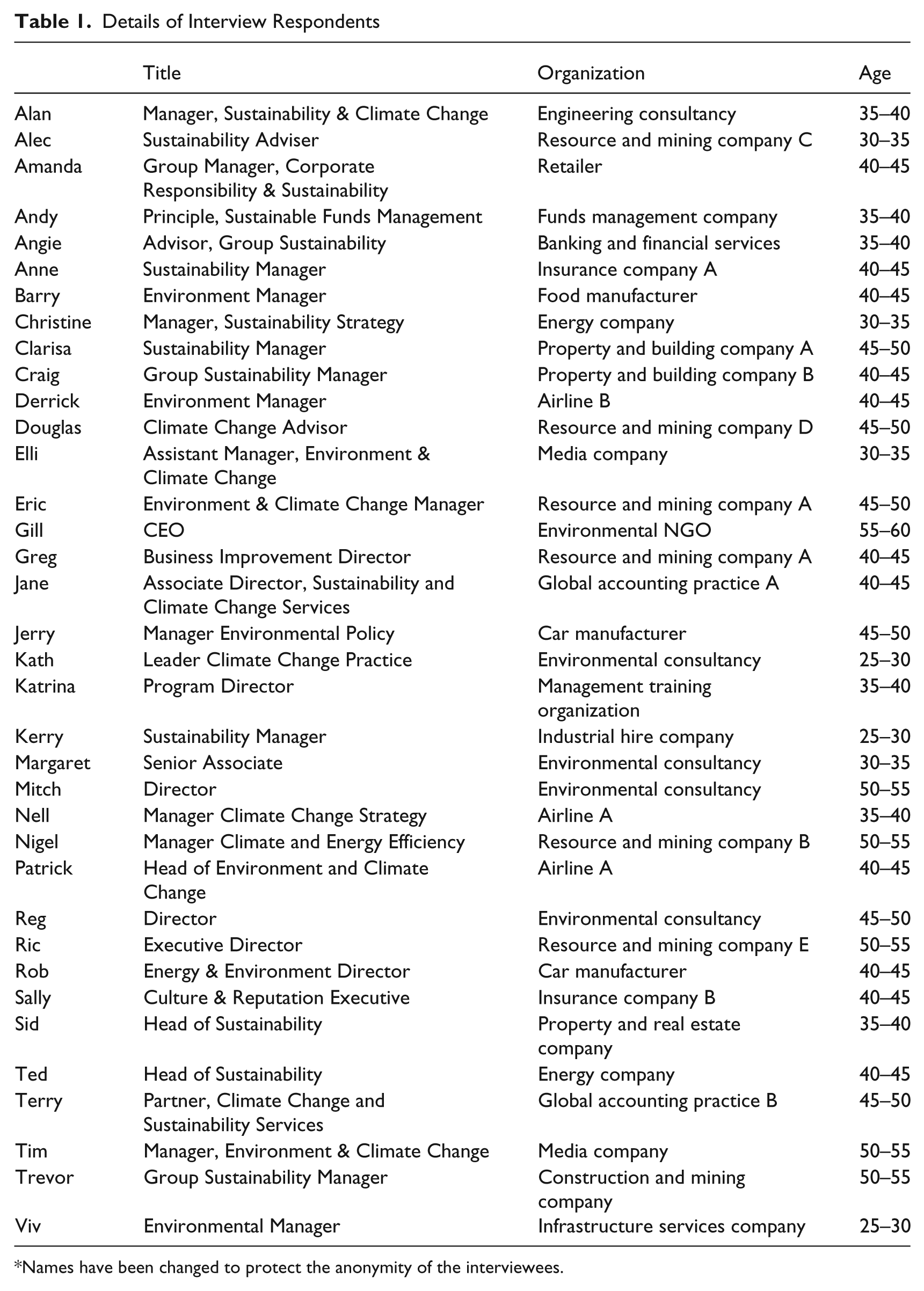
Names have been changed to protect the anonymity of the interviewees.
Data collection
In gathering data about the role and activities of sustainability specialists we asked each individual questions about their work and career history. We also asked them to reflect on their personal attitudes to the environment and climate change, and to provide examples of how their personal views had developed, as well as activities which illustrated their beliefs. We concluded each interview by asking respondents about the challenges they faced in their jobs and how they dealt with contradictions between their beliefs and work activities. Each interview lasted between 50 and 120 minutes and was recorded and fully transcribed. This provided a rich source of qualitative data (amounting to over 1000 pages of transcript), with most respondents highly reflexive in considering their work activities and personal attitudes towards climate change. Interview transcripts were supplemented with documentation from the respondents’ organizations, including sustainability strategy documents, internal communications, submissions to government inquiries, press releases and media coverage. These texts allowed us to gain a more detailed understanding of the broader organizational context and the dominant discourses with which respondents interacted.
Data analysis
In responding to our questions, the interviewees provided stories about their careers, how they had come to their current roles, and how the issue of climate change impacted in non-work settings such as at home, as well as leisure and social activities. These stories highlighted competing discourses and differing organizational and social demands, as well as varying personal values and attitudes. While the interview situation can be seen as an interaction between the interviewee and interviewer in producing the text to be analysed (Holstein & Gubrium, 2000), there are still limited available discourses and personal experiences for the interviewee to draw upon in producing narratives of their identities. In speaking we make sense of, and construct, or narrate our lives (Cunliffe, Luhman, & Boje, 2004). From the many discourse analytic strategies which have been applied within organization studies (for an overview see Grant, Putnam, & Hardy, 2011), we chose an interpretive approach in which we focused on ‘the constructed and constructive nature of language and on the function and consequences of language use’ (Wetherell & Potter, 1989, p. 206). Our interest then was not only in what our respondents said about climate change, but also in how they presented themselves within different situations and attempted to create a coherent narrative out of their experiences and available discourses.
Data analysis comprised three stages. The first stage involved a detailed reading of the textual material (interview transcripts and documents). Using the qualitative data analysis software QSR NVivo, we openly coded relevant ‘nodal points’ around which stories, narratives and discourses in the text were identified. This resulted in the classification of over 115 ‘nodes’, each of which illustrated the relationship between climate change, local discourses and the organization or individual. These nodes were central to managers’ identity work and the stories they told about their education and careers, their work activities and their personal and home life.
Given our interest in managers’ identity work in the context of climate change, in a second stage of data analysis we re-analysed our initial coding and sought to organize these nodes around key themes and categories (Miles & Huberman, 1994; Strauss & Corbin, 1998). Through this process we identified three key identities which respondents drew upon in different contexts and situations (see Table 2). Rather than an individual being characterized by a single identity, we found most of our interviewees enacted multiple identities dependent on the context they described (e.g. at work with like-minded colleagues, presenting to senior managers, or at home with their families). These identities then provided a particular image of the individual for others in accordance with their own ‘sense of self’ (see also Brown, 2001; Gergen, 1994). Moreover, and as we will show, such identities were an important resource and motivation in their work as organizational, and in some cases, broader social change agents.
Identities of Sustainability Specialists and Coding Concepts

In a third stage of data analysis, we then explored how individuals’ characterizations of their lives and careers encapsulated these different identities and how they sought to overcome tensions and contradictions between these through depictions of a broader narrative of their lives. Here we developed the ideas of ‘genres’ or themes that underlay individuals’ life stories and provided a plot through which they could construct a coherent sense of self (McAdams, 1996; Ricœur, 1991; Watson, 2009). Drawing on the work of Gabriel (2000) and others (Maclean et al., 2012), we noted that, while the stories our respondents provided about their work and home life included comic, tragic and romantic forms, by far the dominant mode fitted within a broader ‘heroic’ or ‘epic’ tradition, in which the respondents characterized themselves as moral agents ‘doing good’, often in the face of rejection and criticism (Clarke et al., 2009). Delving more deeply into these narratives, we discerned and coded for five key themes which encapsulated our respondents’ depictions of their lives and careers, which we titled ‘achievement’, ‘transformation’, ‘epiphany’, ‘sacrifice’ and ‘adversity’.
In the sections that follow we outline each of the three key identities, their role in not only depicting the individual but acting as a resource to influence others, before going on to explore how individuals sought to overcome conflicts between these identities through the five different narrative plots or genres.
The Identities of Sustainability Specialists
In describing their work activities and broader engagement with climate change, our respondents presented themselves in different ways. From our analysis of the data we discerned three principal identities which we termed the ‘green change agent’, the ‘rational manager’ and the ‘committed activist’. Importantly, these identities pertained not so much to fixed positions for individuals, but rather roles or characters (Watson, 2009; Wetherell & Potter, 1989) that were adopted in particular circumstances and for particular audiences dependent on the ‘distance’ between their self-understanding and situationally dominant discourses (see Table 2).
The green change agent
One of the key identities presented by our interviewees was that of the ‘green change agent’, an individual who sought to promote environmental sustainability both within their organization and outside of work through professional networks, as well as in their family life and at home. Here, individuals stressed how their passion for the environment and concern about climate change led them to challenge existing assumptions and seek to transform practices and beliefs. As Jane, a sustainability consultant in a major accounting practice, outlined, ‘I have a huge passion around climate change, around the change side of how do you move this change through organizations?’
Underpinning the identity of the ‘green change agent’, interviewees provided descriptions of the activities they undertook as sustainability managers and consultants. In particular, local discourses of ‘corporate sustainability’ provided a legitimate context for the enactment of this identity where they sought to change employee perceptions and behaviour on environmental issues. For example, Tim, the climate change manager in a major media organization, described how he and his team had implemented a major cultural change initiative which promoted ways for employees to reduce their carbon footprints at work and home. The programme involved a dedicated website which featured employee stories and a competition with an environmentally friendly hybrid car as a prize. The success of this programme kick-started a pervasive ‘green’ office culture throughout the organization, from which Tim derived particular satisfaction. Nor was this an isolated example, with other managers enthusiastically describing how their work had resulted in employees becoming passionate advocates of ‘green’ organizational initiatives such as improved energy efficiency, reductions in company air travel, and recycling campaigns. As Anne noted:
That’s really what you’re trying to do in this whole field is get people to go, ‘Oh okay, there’s another agenda, there’s something else bigger than just me and my job.’
Stressing their role as ‘change agents’, interviewees emphasized how their personal commitment to environmental sustainability provided new insights to organizational problems (e.g. changing consumer expectations, physical threats to raw materials or supply chains), as well as innovations in processes and products (e.g. opportunities for new efficiencies and new consumer markets). For instance, Sid, a sustainability manager in a commercial property firm, described how he had developed a marketing strategy which highlighted changes in environmental building certification and a ‘green’ real estate guide which he argued contributed not only to a more sustainable society, but also differentiated his organization from its competitors. Similarly Barry, who worked as an environment manager for a multinational food company, talked about how he liaised with senior managers about climate-induced changes in food production and how this affected the location of production facilities. In relating these stories of their work, individuals presented a positive image of themselves as both agents of change in creating a more environmentally responsible organization, as well as loyal employees helping to achieve the core business objectives of their companies. Indeed, this was an identity that respondents appeared to gain significant satisfaction from in the sense of providing a sense of mission and a higher purpose at work. As Barry outlined in respect to his personal work philosophy:
I get out of bed because I save people and I save the planet and that is what I do. That’s what I tell my kids and that’s what they tell their friends, ‘My Daddy saves the planet.’ It is all I want to do.
However, this was also an identity that could be difficult to maintain. While several of our interviewees enjoyed the support and patronage of executives who provided official sanction for their activities, others operated in a more uncertain status where the commitment to the discourse of sustainability was unclear. Indeed, developing an identity which emphasizes difference, distinctiveness and ‘otherness’ also carries the burden of choosing to stand outside existing organizational norms (Bartel & Dutton, 2001). In some organizations, promoting an identity as a green advocate would attract jibes about individuals’ environmental opinions and status. Hence, Jane spoke about how her accountancy firm colleagues labelled her as one of the ‘hippies on the third floor’, hinting not only at the perception of her ‘alternative’ environmental views, but also her limited status within the organizational hierarchy. She was seen as a tolerated eccentric.
The rational manager
While respondents’ enactment of the identity of ‘green change agency’ was significant both in frequency and the implied level of personal engagement, this was balanced by other competing identities. In particular, another strong and pervasive identity within our data was what we termed the ‘rational manager’. This identity linked to traditional business concerns and stereotypes of the loyal corporate functionary, an individual who operates in the best interests of his or her organization, and which was often related to discourses of efficiency, profitability and shareholder value.
For some of our respondents, the ‘rational manager’ appeared prevalent in their self-presentation. Hence Amanda, a sustainability manager in a large retail chain, downplayed any perceptions of environmentalism and emphasized her role very much in terms of business strategy and corporate interests: ‘I’m not a particular crusader, greeny, tree hugger, none of those things. When you do engineering they beat that out of you!’ In a different context, Margaret, a young sustainability consultant, explained how her move into consulting was driven by her interest in business change and efficiency: ‘I wouldn’t say I’m the greenest person. I think I’m quite business focused.’ Here issues of climate change and environmental sustainability were viewed in a more circumspect manner as potentially important in their jobs as sustainability specialists, but needing to be balanced against competing demands such as economic growth and business profitability. This was particularly the case for some of the consultants we interviewed, who in advising their clients stressed the discourse of ‘professionalism’.
The identity of the rational manager was articulated using the language of mainstream management. In particular the discourse of the ‘business case’ was a recurring theme in the interviews. Often this amounted to a rationalization that addressing climate change needed to be justified first and foremost from a business rationale of improved shareholder value. For example, as Trevor, the group sustainability manager in a major resources and construction company, noted, his business had a strong commercial focus which fitted with his own view of his role:
I think that what they want to see is results. If we put up a case for pursuing a particular renewable energy initiative, the management team aren’t going to support it if it’s a bucketload of money and there’s no return. They’re looking for return out of everything – which is great.
This view was reiterated by Mitch, a senior consultant, who reflected on the evolution of his firm’s philosophy that to have ‘impact’ they needed to focus on the core business strategy of their clients and then build sustainability initiatives that supported these objectives: ‘What we were doing was more the strategic consulting, so we leveraged more off the strategic management frameworks and introduced the sustainability concepts into that.’
The identity of the ‘rational manager’ therefore represented a preferred and self-affirming work identity for several of our respondents, who sought to play down any personal pretence to being ‘green’ and stressed a more ‘mainstream’ business career. For others, the identity of the ‘rational manager’ was a necessary device to bridge the distance between their desire for pro-environmental change and antipathetic local discourses. Some interviewees, for instance, noted how engaging with climate change in corporate settings often required the framing of initiatives around conventional business thinking (see also Andersson & Bateman, 2000). Indeed, an emotional appeal to reduce carbon emissions or a perception of appearing overly zealous was often presented as a reason why sustainability managers failed in their efforts to change corporate behaviour. As Mitch noted, being labelled ‘green’ could prove fatal to organizational legitimacy:
‘Oh they’re just the tree huggers, they’re not commercial, they don’t understand’ … So definitely there’s an association. If you’re ‘green’ then you have an ideological bent – ‘you’re part of the movement, you’re not objective, you’re not commercial, therefore we can put you in that box. We can’t trust you.’
However, proposing a ‘business case’ for environmental sustainability was not without its contradictions. For instance, even those individuals who promoted the idea of sustainability as ‘simply good business’ acknowledged their concerns for the future of the planet. As Patrick, the head of environment in a major airline, explained, ‘I want to be able to leave a legacy … so that maybe not my kids but my kids’ kids can still see the sun, can still see birds flying.’ Here, deeper concerns of climate change as a potentially apocalyptic scenario challenged the comfortable certainties of conventional business discourse. For some this provided justification for their activities in building a more ‘sustainable’ business and that the market and business would provide the answers. For others, the identity of the ‘rational manager’ provided a retreat from such uncomfortable thoughts.
The committed activist
As we have noted, the tensions between environmental beliefs and organizational commitment can be significant, particularly in an organizational setting which is hostile or sceptical towards environmental issues. In these circumstances the ability of individuals to balance the needs of business and the environment was sometimes seen as coming at too high a cost both in material and psychological terms, posing challenges that went to the heart of their environmental values and sense of self. In these situations, a third identity emerged, the ‘committed activist’, in which individuals forcefully expressed their environmental commitment, often in the face of organizational resistance. Here the personal became most clearly the political, and individuals in some senses put themselves on the line in challenging corporate decisions and practices. Barry, for example, outlined how in some situations he stepped outside of business convention and opposed proposals which involved environmental harm:
I guess we have to be the voice of the environment which can’t speak, that sends a signal that it can’t speak as well. So sometimes decisions are made and those considerations aren’t there and we’ve got to be the ones who stand up and say ‘No!’
More explicitly, the identity of the committed activist was evident where individuals’ environmental values led them to leave their organization or pass up work from companies which undertook activities they felt were incompatible with their environmental beliefs. Hence, Mitch outlined how the takeover of one consultancy he was working for by a multinational energy company meant he had to resign; ‘Seventy per cent of their revenue comes from hydrocarbons, and I just can’t do it.’ A more dramatic example of the ‘committed activist’ was presented by Greg, who had been a senior manager in a multinational resources company. Greg’s concerns about climate change led him to question his corporate role, resign from his job and sell his house to lead a more ‘sustainable life’ as a political and community activist. In relating this story, Greg highlighted the identity of committed activist in both expressing his personal environmental values as well as explaining his career choices: ‘I never had anybody who really came back to me and said “you’re crazy”. A lot of them really admired me for taking a stand on this.’
While some of the respondents who articulated this identity described how they went to work for other companies in which there was greater support for their environmental values, others chose to set up their own consultancies or become more engaged in community and political activism. For example, Greg’s post-corporate activism involved running for political office on the issue of climate change, and designing community campaigns to promote greater environmental awareness. This broader vision of environmental activism also extended to volunteer work. A number of our respondents had participated in Al Gore’s Climate Project and made presentations to companies, community groups and schools to spread awareness of climate change. Others undertook further education in environmental issues and sought to develop networks with like-minded sustainability professionals. Reflecting the significant personal engagement of many of those who worked in environmental sustainability, individuals stressed a multifaceted career or ‘journey’, moving in and out of corporate and consulting roles and intermingling their work, education and community activities. As Angie, the group sustainability adviser in a major bank, confided:
Most companies are a long way from being sustainable in the true sense and so therefore anything you get through is a win on that path. I think everyone is conscious that it is a long journey and there are kind of ebbs and flows in that.
Shifting between identities: Crafting a coherent sense of self
In describing their engagement with climate change at work and in their social and family lives, our respondents utilized different identities at different times and in different contexts. This identity work allowed individuals to negotiate between their self-understanding and dominant local discourses. Moreover, the process of shifting between identities highlighted the potential for identity work to provide political resources for individuals in their social interactions and in responding to criticism.
The contextual and situational salience of different identities was often noted by our respondents in describing how they presented themselves to others in varying work settings. For example, some individuals who expressed strong environmental values at home or among like-minded colleagues consciously played down these concerns where they encountered climate change scepticism at work. Here, local discourses of ‘professionalism’ or ‘productivity’ meant that the identity of the ‘rational manager’ was not only more appropriate, but also more politically effective in convincing others of the merits of pro-environmental action. For instance, Tim described how he often spoke with plant managers about issues of waste reduction, recycling and reduced costs. As he pointed out, not only did these managers seize upon these challenges, given their innate belief in the moral worthiness of improved efficiency, but these were also issues that were promoted by senior managers. Similarly, Anne related how she presented herself as a ‘rational manager’ in her efforts to embed climate change issues in a new training programme for insurance salespeople. As she explained, while many of the sales managers were ‘lovely guys’, they were also strongly sceptical about climate change and hostile to her advocacy on this issue. Her training programme was consciously framed around the goal of selling more insurance policies, but involved educating the salespeople on basic climate change science and the increased frequency of extreme weather events which they could use in their sales interactions with consumers. Not only did this allow Anne to diffuse the issue of climate change to an army of salespeople and the de facto education of consumers, but this was greeted in her organization as a ‘fantastic’ initiative, given the increased sales it generated. Presenting oneself as a rational manager was then justified as an effective political tactic, a necessary ‘work-around’ in this organization for the cause of environmental sustainability. As Jane rationalized:
If you can get business to change – and it is still delivering value for the community, it is not a greenwash but they are delivering measurable value in some way – then I don’t care why they do it.
In other situations, the identity of the ‘committed activist’ could also prove effective in challenging organizational practices, although this relied upon sufficient senior management support to ‘speak out’. As Eric, the senior climate change manager in a multinational resource company, noted: ‘I’m pretty passionate but I’ve learned how far I can push and sometimes it can be a little bit counterproductive.’ The identity of the committed activist then was one that was displayed only in specific contexts or where the issue was so important that risking one’s career was seen as worthwhile. Identity enactment then hinged upon the appropriate context, and while some organizations might tolerate ‘hippies on the third floor’, in others such identities were more difficult to maintain. For example, Kerry contrasted the greater space that was allowed for her to promote environmental sustainability within her current job in an industrial hire company, as opposed to her previous role in sustainability consulting:
I had to get quite hardline and professionalized about sustainability and only ever talk about facts and figures … I came into this job thinking, ‘Well, I’ve honed myself down to be just a machine now and I’ll come into this hardline fixed environment.’ But it’s actually a very family oriented, warm culture. Now they’re saying, ‘That’s fine, let’s engage people (on sustainability).’
Changes in identities were also evident in how respondents depicted the transition between their work and family lives. One response to the burnout and fatigue some individuals expressed in their ongoing climate change activism was to ‘switch off’ at home. For example, Craig described how his earlier career in an environmental NGO had made him especially conscious of the urgency of climate change, from which he needed to distance himself in his home life:
The thing is when you do it for a living all day you kind of switch off … you look at the horror of it all, the actual factual information, the melting, the death, the species loss, and you have to get over that.
This disengagement was also evident for many in the contradictions of trying to ‘live sustainably’ in a society based upon over-consumption. Hence, while many of our respondents commented on their lifestyle choices with regard to paying a premium for ‘green’ power, using public transport or downsizing their housing, they also often acknowledged the limits of the ‘committed activist’ identity. As Reg commented:
We joke here, I call myself ‘Mr Sustainable’ as a bit of a joke but the house is quite big and the pool is quite nice and so everyone goes, ‘You liar!’ And that’s true. I don’t know, I’m maybe more than a token green but the way I look at it is I’m trying to challenge those bigger fundamental issues about the systemic change and you try and do your own little bit as well.
The Heroic Self: Narrative Genres of Identity Work
Individuals then moved between identities in negotiating between their self-interpretations and the demands of different contexts. However, identity is not infinitely malleable and the potential to adopt different identities is likely to be constrained by one’s sense of self and commitment to particular values. Hence, identity work reflects not only the subject positions offered by local discourses, but also the temporal dimension of individuals’ experiences and beliefs. Indeed, a striking feature of our respondents’ depictions of their work and careers was the way in which they maintained a relatively coherent sense of self which accommodated conflict and incongruity between different identities (see Clarke et al., 2009). Here, the creation of a broader narrative identity was evident. As several researchers have argued, a common theme in managerial and professional identity work is to recast the self within the ‘heroic’ (Gabriel, 2000; McAdams, 1996; Watson, 2009) or ‘aspirational’ (Thornborrow & Brown, 2009) frame, in which the individual as a moral agent battles against adversity for a noble cause or the greater good (see also McAdams, 2006). In considering how our respondents outlined their engagement with climate change, we identified a number of genres which aligned within this broader heroic rubric (see Table 3).
Narrative Identity Genres of Sustainability Specialists

One common genre was that of achievement, in which individuals stressed a personal narrative of career success and progress based upon the skills and knowledge they had developed over time. For example, Nell described how during her career she had developed expertise in implementing new technologies which fitted with her current job deploying environmentally friendly technologies in an airline: ‘It is very personally satisfying to be involved in something so future facing … That is where my bias is, technology delivering a better world.’ Similarly, Sally, the culture and reputation manager in an insurance company, highlighted how her background as a political adviser (and her personal interest in social equity) had proven invaluable in advocating to senior managers the need to develop a strategic business response to climate change. The theme of achievement then provided space for individuals to explain changes in identity as part of their career progression, such that the ‘rational manager’ could now harness her skills as a ‘green change agent’, or those with a commitment to social and environmental equity (‘committed activists’) could engage as ‘rational managers’ and ‘green change agents’ in the business world.
The issue of personal change was even more pronounced in the genre of transformation, in which individuals described how their attitudes towards climate change had evolved over time as they were exposed to new information, the influence of mentors, and new activities and tasks. Often this idea of transformation was linked to themes of ‘maturation’, in which individuals stressed how their knowledge and character had developed over time (e.g. a gaining of wisdom). In a more classical sense they might characterize their engagement with environmental issues as a ‘journey’ or ‘quest’, in which they were engaged in a search for meaning. A good example of this was Greg’s characterization of his reinvention from the corporate globe-trotter and climate change sceptic in a mining company, to climate change activist and campaigner. In describing this transformation, he highlighted his realization of the importance of climate change while reading a Time magazine article in a doctor’s surgery:
That changed my world because really the information I saw in that I just found completely compelling. As a result of that I guess, I’ve now made it a bit of a mission of mine to try and understand climate change in more detail just because I wanted to understand how I could have been so wrong for so long.
The narrative of personal transformation could also be presented in other ways. So Craig talked about his decision to leave the NGO sector, in which he had spent many years fighting for environmental issues, in part because of a belief that he could effect greater change from within the business world. Here the ‘committed activist’ explained the adoption of the alternative identities of ‘green change agent’ and even the ‘rational manager’:
I think I have just formed a view that if I can make [this Company] better then that’s my piece. My mission is to make [this Company] a greener company and having [this Company] being greener will have a big influence in the world because they are pretty big.
Implicit in many individuals’ accounts of their engagement with climate change was a related narrative genre: epiphany. Hence, several interviewees noted how their concerns about sustainability and climate change followed critical events, major life changes or upheavals that led them to reconsider their job or career and discover a higher purpose. For example, Reg reflected back on a mid-life career transition from marketing into sustainability which followed the breakdown of his marriage: ‘I thought I could convince people to buy my cheese more than someone else’s cheese, or my chocolate bar more than someone else’s chocolate bar, and I struggled to find meaning in that!’ Similarly, Jane noted how a personal tragedy had led her to reassess her life and devote herself to a job that made a difference:
I started to realize how all-encompassing climate change was and it took me one to two years to actually go ‘Wow, this is everything.’ This is sort of so huge – it makes a lot of the other issues that we’re dealing with on a day-to-day basis look really minor.
In these depictions of career and life changes, the genre of sacrifice was also pronounced. Here, individuals described how they had given up highly paid corporate careers as part of their commitment to leave the world a better place. Indicative of this theme was Andy, who having become disillusioned with his well-paid job in global finance, decided to establish his own sustainable funds management business promoting renewable energy start-ups. While acknowledging his family’s increased financial vulnerability, he nevertheless stressed the satisfaction he gained from the realization that he could use his skills for a more socially worthy outcome. Sacrifice also related to status and organizational legitimacy. Hence, a related theme among those who stressed the identities of ‘green change agent’ and ‘committed activist’ was that of adversity: toiling against hardship and criticism. In these instances respondents spoke about the challenges they faced in seeking to establish themselves as sustainability specialists, the rebuffs and rejection they faced. So, as Anne observed, even when managers found merit in her initiatives, they would make sure they emphasized to her their rejection of her environmental concerns:
He said, ‘This is fantastic, this is great!’ And then he turns around and says to me, ‘You know I don’t believe in it (climate change). You know I haven’t changed my mind. I think it’s all still crap.’ He literally looked me in the eye, and I went ‘Yeah Keith I do. That’s fine. I don’t care.’
While this theme also hinted at the potential for the underdog to triumph in influencing change through political skill, such ‘face-work’ involved significant emotional labour as individuals juggled the corporate performance with an issue of significant personal concern. As Sid reflected on his own situation and that of his colleagues:
A lot of it is they’re becoming exhausted because the consequence of being very reactive to sustainability is you’re always going against the tide … It’s only sustainable for a limited time. People burn out.
Narrative genres therefore provided a syntax within which sustainability managers and consultants could explain different activities, incidents, experiences and roles, and give their life story a coherent and positive aura. These various plots connected the temporal and situational aspects of identity within a narrative time, stressing an edited past, a preferred present, as well as a desired future. In some cases these genres explicitly acknowledged and celebrated changes in identity in a temporal sense. Hence genres of ‘transformation’, ‘epiphany’ and ‘sacrifice’ highlighted how the individual had developed as a character over time within a favourable and heroic narrative arc. In other genres, movement between identities was accommodated in terms of the superior skills of the micro-political agent. So for example, the genres of ‘achievement’ and ‘adversity’ stressed the need to be astute in the use of influence and the assumption of different identities related to changed contextual dynamics. The development of narrative identity therefore provided a mechanism through which individuals could explain the conflicting identities they enacted in seeking to promote environmental sustainability in their organizations and, in some cases, their families, communities and society.
Discussion
In this article we have focused on a group of managers and professionals for whom climate change is a key issue in their daily work – corporate sustainability specialists. In focusing on this group we have explored the different identities these individuals developed in work and non-work contexts, and how these identities provided a resource for the individual in understanding themselves and also relating to others. For many of these managers, climate change as an omnipresent and boundary-breaking discourse posed both a challenge as well as an impetus to their identity work in seeking to create a coherent self-narrative of their organizational and personal experiences; one that enabled them to legitimize their work roles and activities with their personal views. Through our analysis of the interview and documentary data, we identified three key identities (the ‘green change agent’, the ‘rational manager’ and the ‘committed activist’) that our respondents enacted in bridging tensions between their sense of self and divergent circumstances and audiences. Accordingly, identity work involved both a spatial dimension in terms of the subject positions accorded to individuals by prevailing discourses, as well as a temporal dimension (the individual’s life experiences and their vision of their past, present and future self).
Rather than individuals’ identities being governed by prevailing discourses, our analysis suggested some agency in the way in which they negotiated their identities at work and in their private life. Here we noted how broader social discourses such as ‘climate change’ had come to influence these managers, as well as how these interrelated with other competing organizational discourses of ‘profitability’ and ‘shareholder value’. Moreover, these identities were central to the political work of sustainability specialists in providing a resource to influence others and seek change in organizational practices and behaviour. We sought to understand how, in dealing with conflicting discourses, these individuals created a coherent sense of self. We suggested the process of ‘narrative identity’ provided particular insight. In the final empirical section, we identified and explained how different narrative genres provided both coherence and an often appealing heroic self-characterization.
Our study makes a contribution at three levels. First, in terms of identity work, we have examined how sustainability specialists present different identities in diverse work situations, as well as in their social and family lives. We have demonstrated how dominant local discourses within business organizations (such as ‘profitability’, ‘professionalism’, ‘the business case’) often impose subject positions upon individuals (e.g. the ‘rational manager’). At the same time, we have shown how these individuals also draw on other discourses (such as ‘climate change’ and ‘sustainability’) in constructing other identities (e.g. the ‘green change agent’ and the ‘committed activist’). We found that sustainability specialists engaged in identity work in negotiating these conflicting discourses. That is, identities as social discursive constructions are dialogical and situational (McNay, 2008). Identities are dialogical in that they are constructed through interaction with others; it is through others that one comes to know oneself. Interaction facilitates reflection, not only in regard to ‘who I am’, but also in terms of ‘who I’m not’, as well as positioning oneself in response to these different identities without losing a sense of self. Sustainability specialists could, for example, enact being a rational manager and a green change agent, while not viewing themself as an activist. However, these identities are also situational, since they are dependent on available discourses pertaining to specific cultural and social contexts in order to form an understanding of the self (Kuhn, 2006). Hence, rather than multiple identities being free-floating or disconnected, we suggest identity enactment involves constraints both in terms of the limited number of available discourses that can be used to understand oneself (Alvesson & Willmott, 2002) and the need for some conformity in identity display. In enacting an identity there is a promise to both one’s self and others that one will be consistent over time (Ricœur, 1994). What is more, we have suggested that, rather than any core or essential self, multiple identities are made coherent through narratives: ‘The narrative view of the self seems to bypass the antinomy of essentialism versus fragmentation by suggesting that the self has unity, but is a dynamic unity which integrates permanence in time with its contrary’ (McNay, 2008, p. 105).
Our study’s second contribution explores the role of narrative identity in the achievement of a coherent sense of self (McAdams, 1996; Ricœur, 1991; Watson, 2009). Here, divergent experiences, relationships and self-representations can be accommodated through a life story involving an edited past, a preferred present and a desired future. These narrative genres help to explain changes in identity and apparent disjuncture between beliefs and actions, by providing a consistent storyline to these individuals’ lives and careers. As summarized in Table 3, while we have noted an overarching heroic theme within many of our respondents’ narratives, these genres also held the potential for more nuanced explanations of behaviour. For example, the genre of transformation, evident in the storyline of individuals who described their reinvention from corporate executive to environmental activist, might also be used to explain how the ‘committed activist’ had opted to work within a corporate setting to make change from within (see also Meyerson & Scully, 1995). Similarly, the genre of sacrifice could include not only the material costs of becoming an environmental advocate, but also discounting one’s principles in the short term in order to make a longer-term environmental gain. Sacrifice also related to living somewhat unsustainably in order to make larger systemic changes, essentially a ‘work-around’ for the cause. While the ‘heroic’ or ‘aspirational’ theme of narrative identity in managerial work has been noted by others (Thornborrow & Brown, 2009; Watson, 2009), we believe the more specific narrative genres we have identified are more broadly applicable, particularly as the issue of social and environmental responsibility becomes a more generic feature of professional life (Tams & Marshall, 2011). As our study demonstrates, in accommodating conflicting identities these narrative genres help to provide individuals with a more coherent depiction of themselves, and highlight a key feature of the process of ‘identity reconciliation’ (Creed et al., 2010). The process of resolving identity fragmentation through emplotment should, however, not be confused with an essentialist idea of the self. It is therefore important to note that there are limits to imposing a narrative structure on identities, and that this may result in disjunction between experiences of the self (Ricœur, 1994).
Third and finally, our research provides a better understanding of how identity work contributes to political agency within business organizations. Beyond making sense of ‘who I am’, identities are also important political resources in bolstering one’s own legitimacy in promoting particular change agendas. Here, enactment of identities not only challenges established thinking, but also demonstrates alternative possibilities (Creed et al., 2010; Meyerson & Scully, 1995). In contrast to earlier research on ‘corporate greening’ which found many managers unconcerned about the environment (Fineman, 1997), our interviewees exhibited a high level of environmental awareness. In describing their work, our respondents provided numerous examples of how their identities were linked to the political activity of spreading knowledge about climate change and influencing others. The politics of identity work was most obvious in the case of the ‘green change agent’ where a core theme centred on encouraging organizational change. However, the politics of identity work was also evident in the enactment of seemingly discordant identities such as the ‘rational manager’ negotiating environmental wins by promoting cost or efficiency improvements, or when, as the ‘committed activist’ individuals said ‘no’ to environmentally damaging proposals, risking their career for the greater good. Importantly, the discourse of climate change provides an increasingly fractious setting for such identity work, given the ideological and partisan interpretations that this issue now attracts.
Conclusion
Climate change presents an unparalleled challenge to humanity’s future and established discourses of limitless economic growth and human progress. Within the rapidly developing political debate around climate change, much attention has been paid to reducing greenhouse gas emissions and adapting our way of life to an altered climate. However, often missing from this analysis are the cognitive and behavioural barriers that prevent humanity from meaningfully responding to this threat (Hulme, 2009; Leiserowitz, 2006). How we respond to the emerging climate crisis is critically shaped by our own identities (Crompton & Kasser, 2009). Indeed, understanding how we as individuals create narratives of ourselves and our behaviour is central to theorizing how humanity can engage with an issue as critical as climate change.
This article has highlighted how climate change has become a touchstone issue for many managers and professionals. More specifically, it shows that while much of this attention can be explained by traditional business discourses of risk and opportunity, there is also significant personal concern about the world our children will inherit. Our study provides empirical insight into the reciprocal and politicized relationship between climate change and identity work. As an existential threat not only to our economic, social and physical well-being, but to our identities, climate change challenges our understanding of ourselves as individuals and as a species within a broader ecosystem. While this can be acknowledged as a positive sign, until the identity work of enough people is linked to this issue we are unlikely to see the emergence of a broader social movement agitating for the fundamental social and economic changes required. Similar to the civil rights movement in the United States, anticolonial nationalist movements in the Third World, the women’s movement and the gay movement, which all sought instrumental goals as well as the affirmation of excluded identities (Calhoun, 1994, p. 4), acting to limit climate change needs be linked with the broader identification of action as a public good.
Paradoxically, in highlighting our own mortality and the limitations of our species, climate change as a discourse encourages greater narrative reflection about the purpose and meaning of our lives. For some this will lead to the adoption of identities based upon social and political change. However, as we are now seeing in the increasingly partisan political battles over carbon regulation, it is also likely that the threat climate change poses to our future may be so profound that many will defer to a state of denial, re-emphasizing established identities as employees, managers, consumers and citizens (Norgaard, 2006). As scientific projections of the climate crisis worsen, issues of identity will inform our individual and collective decisions to engage with or retreat from this issue, shaped by competing discourses at work and society.
Footnotes
Acknowledgements
The authors would like to thank the editors and the three anonymous reviewers for their constructive and helpful comments in revising this article for publication.
Funding
Research for this article was funded by Australian Research Council Discovery Grant DP110104066.