



Abstract
In this article, we explore some of the forms of institutional work that organizations perform as they participate externally in the processes that drive change in the institutional logic that characterizes their field, and as they respond internally to the shift as it occurs. More specifically, we present the results of an in-depth case study of Intel Corporation, a firm that was implicated in a fundamental shift in the institutional logic of its field in the late 1980s and 1990s as the field moved from a traditional supply chain logic dominated by computer assemblers to a new platform logic following very different organizing principles. Through the qualitative analysis of 72 interviews with Intel employees, complemented by extensive archival data from 1980 to 2000, we identify two forms of institutional work that Intel performed externally – external practice work and legitimacy work – and two forms of work that they carried out internally – internal practice work and identity work – as the organization worked to simultaneously influence the shift in logic that was occurring and to deal with the ramifications of the shift.
Keywords
Institutional work – ‘the purposive action of individuals and organizations aimed at creating, maintaining or disrupting institutions’ (Lawrence & Suddaby, 2006, p. 215) – has rapidly become an important area of investigation in new institutional theory. One reason for the enthusiasm for this new concept is that it allows a deeper investigation of ‘how institutions and strategic action affect each other’ (Rojas, 2010, p. 1266). As a result, it allows scholars to inject agency into what has been a rather static view of institutions and to begin to shed light on the enduring paradox of embedded agency – ‘How can actors envision and enact changes in institutions if their actions, intentions, and rationality are all conditioned by the very institutions they wish to change?’ (Holm, 1995, p. 398).
The addition of agency is particularly relevant for researchers interested in the role of actors in institutional change, given that ‘in highly institutionalized systems, endogenous change seems almost to contradict the meaning of institution’ (Scott, 1981, p. 187). In their influential chapter, Lawrence and Suddaby (2006) present a typology of forms of institutional work that occur when actors purposefully attempt to create, sustain or disrupt institutions and, in doing so, provide one answer to the question of where endogenous change might come from even in highly institutionalized systems.
Another important and relatively recent stream of literature in new institutional theory has highlighted the nature and role of institutional logics – ‘the socially constructed historical patterns of material practices, assumptions, values, beliefs and rules by which individuals produce and reproduce their material subsistence, and provide meaning to their social reality’ (Thornton & Ocasio, 1999, p. 804). Early work on institutional logics focused on the importance of the broad organizing principles that characterize modern societies, such as the family, the state and the market, to institutional processes (Friedland & Alford, 1991). More recently, work has increasingly centred on how these abstract principles are drawn on and elaborated at the field level and, in particular, how logics change and evolve and the effect this has on the field and its members (e.g. Lounsbury, 2007; Ocasio, 1997; Thornton, 2002).
Some of the most interesting recent research in this area has examined how shifts in institutional logics shape the evolution of fields over time (e.g. Glynn & Lounsbury, 2005; Green, Babb & Alpaslan, 2008; Marquis & Lounsbury, 2007; Thornton, 2004; Thornton & Ocasio, 1999). This research has shown that the combination of the institutional pressures associated with shifting logics and their strategic use by institutional actors results in complex patterns of change in fields and in the organizations that populate them. How this process takes place, and the factors that influence it, have been the focus of substantial attention as institutional theorists have grappled with the problem of understanding change in organizational fields.
Interestingly, despite the attention on how logics change and the parallel interest in institutional work as a source of institutional change, little work has been done applying insights from the literature on institutional work to improve our understanding of how logics change. Yet, change in institutional logics depends on the institutional work carried out by actors in the field; institutions are fundamentally dependent on human action (Lawrence & Suddaby, 2006). Furthermore, as logics shift, agents must respond, and institutional work also provides a useful frame for considering these activities.
In this article, we begin to address this fertile area by exploring some of the forms of institutional work that organizations perform as they participate externally in the processes that drive change in institutional logics, and as they respond internally to logic shifts as they occur. As such, our work combines the concept of institutional work with an interest in institutional logics and contributes novel insights to our understanding of this important area of research.
More specifically, we present the results of an in-depth case study of Intel Corporation, a firm that experienced a dramatic shift in the institutional logic of the organizational field of which it was a part in the late 1980s and 1990s. During that time, the computer industry underwent a dramatic shift from a traditional supply chain logic dominated by computer assemblers to a new platform 1 logic following very different organizing principles. Through a qualitative analysis of 72 interviews with Intel employees, combined with extensive archival data from 1980 to 2000, we explore how Intel performed various forms of institutional work in its attempts to influence the shift in logics and in its response to the change in logics that took place.
We found that Intel performed four kinds of institutional work. At the field level, we found that Intel performed external practice work and legitimacy work in order to influence the process of logic change and in order to ensure that they were accepted in the role of platform leader. Within the organization, we found that the firm performed internal practice work and identity work in order to respond to the shifting logic. These different forms of institutional work did not occur in a sequential manner, but rather were simultaneous and mutually reinforcing.
In identifying these forms of institutional work and describing their effects, our study makes three important contributions. First, we provide some initial insight into the forms of institutional work that organizations perform as they seek to influence processes of logic change. While not all organizations have sufficient skills and resources to influence these processes in a significant way, some organizations have the potential to do so and we begin to describe how this may happen and what characteristics make it more likely that an organization will succeed in influencing the process.
Second, we show how organizations experience internal tensions as a result of a logic shift. The logic change does not simply affect the institutional field, but has important effects within the organization and we explore the nature of these tensions and the kinds of work that are required to manage them. We also show how the external and internal institutional work are interrelated and can be mutually reinforcing. The institutional work that occurs around logic shifts is therefore not limited to the efforts to change the logic, but includes work within organizations to manage the internal tensions that appear.
Finally, we highlight the importance of technology as a field structuring mechanism. In our case, the institutional logic was instantiated in the technology that formed the material foundation of the field’s commercial success. The nature of the technology was shaped through design processes that reflected the new logic and the resulting technology went on to structure the interactions and collaborations of the members of the field. This role for technology as an instantiation of an institutional logic has received little attention in institutional theory to date but is, at least in some cases, an important institutional mechanism.
Literature Review
The link between institutional logics and institutional work remains relatively unexplored despite a potentially promising theoretical connection. In this section, we begin by discussing the growing literature on institutional logics in some detail, review the concept of institutional work, and then connect these streams of literature and present the research question that motivated this study.
Institutional logics
Institutional logics have become one of the central concepts in institutional theory. They are the ‘socially constructed, historical patterns of cultural symbols and material practices, including assumptions, values, and beliefs, by which individuals and organizations provide meaning to their daily activity, organize time and space, and reproduce their lives and experiences’ (Thornton, Ocasio & Lounsbury, 2012, p. 2). Furthermore, these sets of ‘material practices and symbolic constructions’ exist at the societal level and are ‘available to organizations and individuals to elaborate’ within fields (Friedland & Alford, 1991, p. 248). From this perspective, society is a system consisting of institutional orders and their associated logics.
One of the reasons logics have received so much attention from institutional theorists is that they are so central to many institutional phenomena; the boundaries of fields, the identities of field members, their values and interests, and the nature of their interactions are all defined by one or more shared institutional logics (Greenwood & Suddaby, 2006; Thornton et al., 2012). Logics guide the behaviour of actors within a field and render their actions ‘comprehensible and predictable’ (Lounsbury, 2002, p. 255) to others by providing context-specific practices and symbolic systems that explain how culture ‘is anchored in a set of elemental building blocks, not just … “floating out there in thin air”’ (Thornton, 2004, p. 42).
In particular, logics provide rules of action that help actors to cope with ambiguity and cognitive limitations by highlighting particular issues and problems, determining which of these are salient and demand managerial attention, and framing possible solutions (Thornton, 2002). These rules are enforced through symbolic and material rewards and sanctions, and comprise a set of assumptions and values about how actors should interpret organizational reality, about what represents appropriate behaviour, and about what constitutes success (Thornton & Ocasio, 1999). In other words, institutional logics ‘link internal mental cognitions to external rituals and stimuli’ (Thornton, 2004, p. 41) and therefore connect meaning with action.
Many existing studies have focused on the role of institutional logics in shaping organizational action and outcomes (see Greenwood, Raynard, Kodeih, Micelotta & Lounsbury, 2011; Thornton & Ocasio, 2008; Thornton et al., 2012, for reviews) and on the effect of a change from one ‘dominant logic’ to another. These studies have examined the role of logics and the effect of logic change in a variety of empirical contexts including the Californian thrift industry (Haveman & Rao, 1997), health care (Nigam & Ocasio, 2010), publishing (Thornton & Ocasio, 1999) and professional services (Suddaby & Greenwood, 2005). Combined, this stream of literature provides a broad and nuanced understanding of how logics function and change.
Although much of this literature highlights the role that a dominant institutional logic plays in promoting conformity within fields, or on the effect of a shift in the dominant logic, researchers have begun to explore how competing logics can provide the impetus for institutional change and transformation. For example, Reay and Hinings (2005) conceptualize the radical transformation of the Alberta health care system as rooted in the conflict between the logic of medical professionalism and the logic of businesslike health care. In another interesting contribution, Lounsbury (2007) examines how conflict between a performance logic and a trustee logic led to variations in the practices adopted by mutual funds in Boston and New York. Marquis and Lounsbury (2007) extend these ideas further and show how competing logics in the US banking industry were used by actors as a basis for resistance. More broadly, the notion that contradictions and differences in institutional logics can drive institutional change has become a prominent perspective in institutional theory (e.g. Rao & Giorgi, 2006; Seo & Creed, 2002).
One area of increasing interest is the examination of how individuals draw on multiple societal logics to initiate change. Scholars agree that one basis for individual actions grows out of the contradictions among institutions (Friedland & Alford, 1991; Thornton & Ocasio, 2008). Individuals can mobilize different institutional logics to initiate change and the ‘ambiguities and contradictions between logics within a field provide increased scope for change as these mitigate certainty and make alternatives more easily available’ (Brown, Ainsworth & Grant, 2012, p. 299). Hence, a key task of institutional analysis is to understand the link between logics and institutional change and, conversely, to understand how and when logics shift.
Institutional work
The concept of institutional work grows out of the observation that institutions are the product of human action (Jepperson, 1991). It points away from the preponderance of studies concerning the effects of institutions and instead refocuses attention on the role of human action in the creation, maintenance and transformation of institutions. The growing literature on institutional work functions as an ‘umbrella construct’ (Hirsch & Levin, 1999) drawing together a number of themes in institutional theory such as deinstitutionalization and institutional entrepreneurship that are concerned with agentic action.
In bringing these previously disparate themes together, the concept has allowed more rapid theoretical development around the question of how human action produces institutions (Hwang & Colyvas, 2011). It also ‘represents an exciting direction for institutional studies of organizations, not because it represents a “new” idea, but because it connects a set of previously disparate ideas, and in doing so points to new questions and opens up space for new conversations’ (Lawrence, Suddaby & Leca, 2009, p. 1).
Lawrence, Suddaby and Leca (2011, p. 52) define institutional work concisely as ‘the practices of individuals and collective actors aimed at creating, maintaining, and disrupting institutions’. In explaining the nature of institutional work, Lawrence and Suddaby (2006) explicitly identify nine types of work aimed at creating institutions including vesting, defining, advocacy, constructing identities, changing norms, constructing normative networks, mimicry, theorizing and educating. Vesting, defining and advocacy are overtly political work through which actors reconstruct the rules, property rights and boundaries that determine access to material resources. Constructing identities, changing norms and constructing networks are seen as actions in which actors’ belief systems are reconfigured. Mimicry, theorizing and educating involve actions designed to change the abstract categorizations upon which meaning systems depend. Combined, this typology provides a useful framework for examining the link between purposeful human action and institutions.
Building on these initial theoretical insights, a number of researchers have carried out empirical studies of institutional work. Rojas (2010), in a study of the 1968 Third World Strike at San Francisco State College, explores the forms of institutional work that actors perform in order to increase their power by ‘creating, supporting, or modifying institutions’ (Rojas, 2010, p. 1263). Zietsma & Lawrence (2010, p. 189) study the ‘role of institutional work in the transformation of organizational fields’ through a fascinating study of the recursive interplay of boundary work and practice work in the coastal forestry industry in British Columbia, Canada. In a related study of the relation between institutional work and institutional change, Ritvala and Kleymann (2012) examine innovation and cluster emergence, which they frame as a problem of embedded agency and ask how is it that clusters emerge in highly institutionalized contexts? Their answer is that scientists act as ‘midwives’ and perform critical institutional work that allows the fundamental institutional change that is required.
These studies point to the usefulness of the concept of institutional work in explaining complex processes of institutional change. The growing literature on institutional work clearly shows how agents act purposefully to engage in and change their institutional context in various ways and with various intentions. This literature therefore provides an increasingly well-developed framework for studying various forms of institutional change, and particularly in understanding the role of actors in these processes.
Research question
Despite the centrality of institutional work and institutional logics in recent work in institutional theory, little has been done to explore the interplay between these important concepts. As a result, we have a limited understanding of the kinds of institutional work that organizations with sufficient resources and skills may engage in to influence processes of logic change, and know equally little about the sorts of institutional work organizations perform in response to shifts in logics in their field. This study therefore aims to contribute to our understanding of the link between institutional logics and institutional work by answering the following research question:
What kinds of institutional work do organizations perform as they attempt to influence the institutional logic that characterizes their field; and what kinds of institutional work do organizations perform in response to the resulting logic shift?
Method
In order to answer our research question, we conducted a detailed, qualitative investigation of a single case study. We chose this research design as the links between institutional work and institutional logics are not well understood (Marshall & Rossman, 1995); because we are interested in the worldviews of organizational members (Lee, 1999); and because our study is exploratory and aimed at theory building (e.g. Eisenhardt, 1989; Yin, 2003).
Empirical context
More specifically, we conducted a study of the computer industry between 1980 and 2000, focusing particularly on the actions of Intel Corporation. This empirical setting is well suited to our research question as, during this period, the computer industry underwent a profound transformation underpinned by a shift in institutional logics. Like all organizations in the industry, Intel Corporation had to adapt to this changing logic; in addition, Intel was an influential actor that played a central role in the changes that occurred in the industry (Jackson 1997; Moore, 1996; Yu, 1998). This case therefore offers a unique opportunity to examine the institutional work performed by an organization within a field as the field undergoes a shift in institutional logic.
The shifting institutional logic in the computer industry
The computer industry underwent a fundamental shift in its organizing principles during the period of our study (Baldwin & Clark, 2000; Bresnahan & Greenstein, 1999; Malerba, Nelson, Orsenigo & Winter, 1999). This shift began in the early 1980s with the emergence of the personal computer (Malerba et al., 1999) and was followed in the late 1980s by the emergence of technological platforms such as the WinTel 2 platform, the Apple Macintosh platform and the open-source Linux platform (Bresnahan & Greenstein, 1999). Not only did these developments profoundly affect computing technology and the role of computers in everyday life, but also they fundamentally altered the economics of the computer industry, allowing inexpensive yet powerful computers to be brought to a mass market.
This process began with the introduction of the IBM PC in 1981. At that time, IBM was the undisputed leader of the computer industry, where it dominated the mainframe computer business. In a break from tradition, IBM developed the first PC using the commercially available Intel 8088 microprocessor and Microsoft’s DOS operating system. IBM’s decision to use commercially available components would have huge and unforeseen impacts on the industry.
Soon after the introduction of the resulting IBM PC, the IBM PC-compatible business emerged. IBM had failed to make exclusive agreements to control the core hardware and software components and both Intel and Microsoft were able to sell their products to other firms that wanted to produce computers compatible with the IBM PC. The open architecture of the IBM PC, combined with the availability of these components, allowed other companies to build cheap compatible PCs. In addition to many hardware start-ups, many software companies were launched to offer a rapidly growing set of software application for this fast-growing market. The PC software and hardware developers were the basis of a new ‘open’ computer industry despite IBM’s best efforts to maintain its position as leader (Yu, 1998).
This shift fundamentally altered the organizing principles of the industry: it changed how competition happened, as well as how innovation happened. The industrial organization of the supply chain shifted away from competition between vertically integrated firms that offered closed systems, to competition between coalitions of firms specializing in compatible components (Farrell, Monroe & Saloner, 1998) built around technological platforms (Bresnahan & Greenstein, 1999). As a result, the organization of the industry evolved into a platform-based industry ecosystem (Moore, 1996).
The locus of competition also changed, as much innovation became focused on components and around the definition of ‘open standards’. One of the distinguishing features of the IBM PC was that it had a modular technological architecture 3 (Baldwin & Clark, 2000; Langlois, 1990): as a technological system, it was composed of a number of distinct components (such as the operating system, the microprocessor, memory chips, the hard drive, a variety of software applications, etc.), which were functionally and materially interconnected through technological interfaces that became gradually more and more ‘open’ during the period of study (i.e. their specifications became accessible to all rather than being proprietary information belonging to one company).
In parallel, the structure of the industry also became fragmented or ‘modularized’ (Baldwin & Clark, 2000), and the computer interfaces took on a particularly significant role as the demarcation lines between increasingly numerous firms that aimed to develop components to fit the PC architecture. The internal and external interfaces of the microcomputer therefore became focal points of competition and struggle, and highly significant technical areas towards which innovators focused their attention as their compatibility with interface standards became paramount. The specification of these interfaces codified the information needed by developers to build hardware or software components that would connect with these interfaces. These modular interfaces partitioned the scope of economic activity and provided a structure that both constrained and enabled the behaviour of field members, affecting the loci of competition and innovation (Jacobides, Knudsen & Augier, 2006; Langlois, 2002).
In parallel to these changes in roles, relationships and behaviours, new values emerged. For example, a discourse around ‘open’ versus ‘closed’ technologies developed in trade journals and keynote speeches at industry events. What constituted value also changed, as stimulating innovation around open standards became a socially legitimate goal and acquired the potential to inspire motivation and dedication. Advocacy around the concept of open innovation developed, with ‘proprietary approaches’ developing negative associations (Raymond, 2001). Activities aimed at facilitating innovation by making technology ‘more open’ became more and more valued (Chesbrough, 2003).
What it meant to be an industry leader changed as well (Bresnahan & Greenstein, 1999; Garud & Kumaraswamy, 1995; Gawer & Cusumano, 2002). In the new leadership role, ‘platform leaders’ drove the coordination of ecosystem members to innovate in directions that were mutually reinforcing and compatible with the platform they sponsored. These platform leaders adopted new practices such as sharing intellectual property on some technologies for little or no fee, as well as adopting the role of a neutral industry broker and benevolent orchestrator of industry innovation (Gawer & Cusumano 2002; Nambisan & Sawhney, 2011).
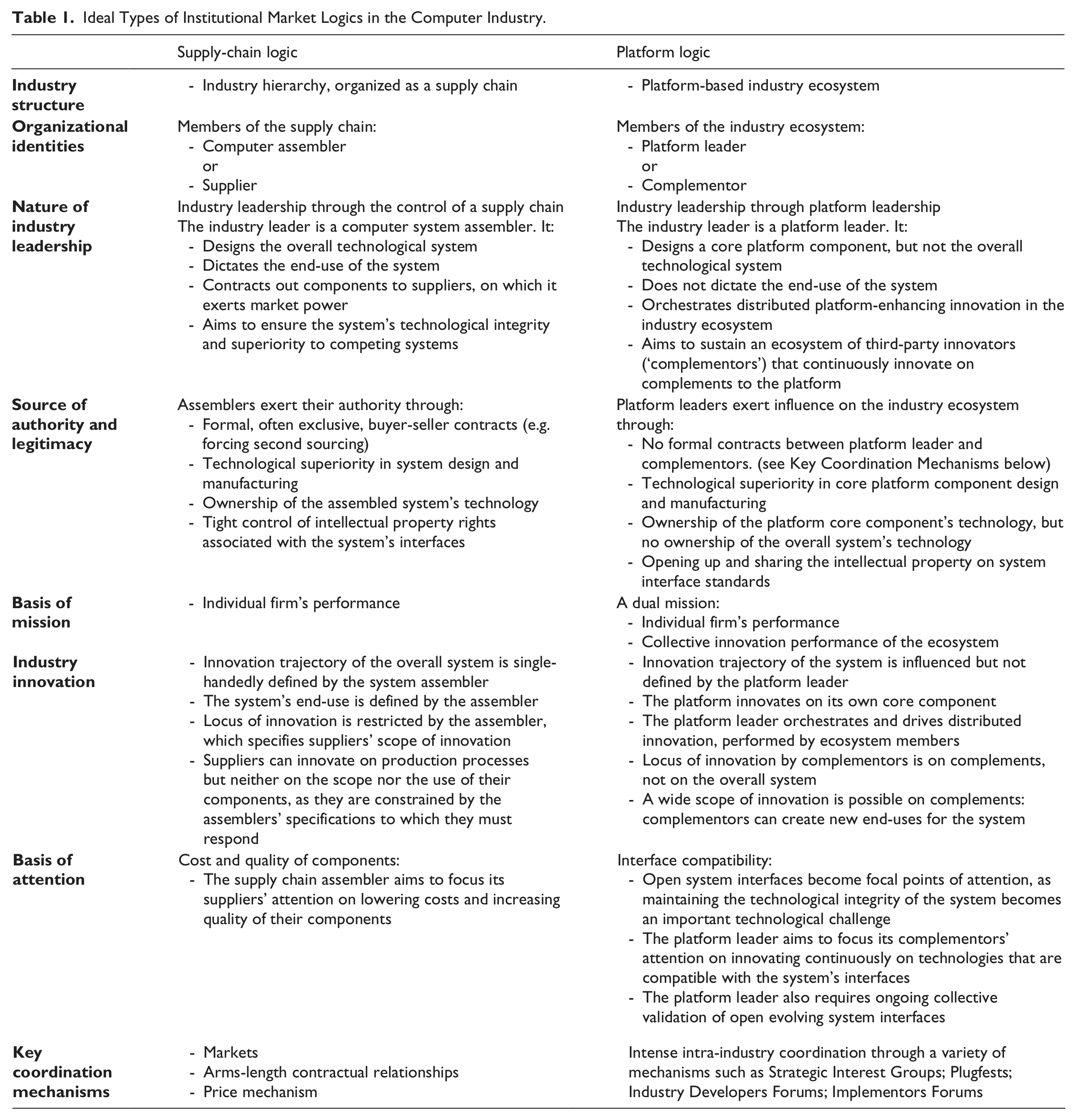
We suggest that, taken together, these changes in the computer industry between 1980 and 2000 can be usefully framed as a shift in institutional logics from a supply chain logic to a platform logic. Both of these logics are forms of market logic, but they are different in important ways in terms of the structure of the field, the nature of the relationships between firms, the practices that characterize the activities of field members, what constitutes value, and the nature of leadership. (See Table 1 for a summary of the ideal types of market logics in the computer industry.)
Ideal Types of Institutional Market Logics in the Computer Industry.
The focal organization: Intel Corporation
The changes described above profoundly affected Intel Corporation. Intel’s business model following their exit from the memory market was simple: develop faster and faster microprocessors that functioned as the central processing unit (CPU) for personal computers (Burgelman, 1994). In simple terms, a microprocessor’s function is to process data that is fed to the microprocessor through an internal data bus (a ‘data pipe’) and, once the processing of the data is complete, to pass the processed data to the other elements of the computer through the bus again. Intel’s success was predicated on its ability to sell a series of ever-faster microprocessors (the 286, the 386, the 486, the Pentium, etc.) which they were uniquely capable of producing. However, these microprocessors, if they were to function at their full capacity, required transferring data at higher speeds than the legacy interfaces and buses could manage.
This problem was potentially fatal to Intel, and highly problematic for many members of the industry. It was also difficult to resolve due to its systemic and interdependent nature: by the late 1980s, a large number of companies had a stake in the PC design and everyone in the ecosystem had their own agenda regarding changes to the architecture. As a result, no single firm or consortium of firms had, by the late 1980s, succeeded in increasing the speed of the PC bus in a way that was not proprietary. No single supplier was able to act as the leader to move the overall system forward.
This perceived lack of an industry leader led Intel to take the initiative and both to propose an updated PC architecture and open interface standards, and to work to build industry consensus around its proposals. It successfully achieved this and developed new industry standards such as the peripheral component interconnect (PCI), an important internal interface, and the universal serial bus (USB) which connects PCs to peripherals such as printers, keyboards and cameras. As Intel-sponsored standards and cross-industry initiatives gathered consensus, Intel became one of the platform leaders in the new computer industry.
In summary, the empirical setting of the computer industry provided an opportune setting for an in-depth study of the kinds of institutional work organizations perform as logics shift. Intel as platform leader played a central role in the development of the new logic, while Intel as an organization had to deal with significant internal issues as the logic of its field shifted. It therefore offers a ‘transparent example’ (Eisenhardt, 1989) of the way an organization can be both active in bringing about, and simultaneously affected by, a change in institutional logics.
Data collection
Our data covers the period from the late 1980s to 2000, a period that starts before and ends after the logics shift in the computer industry. The empirical analysis draws on a sequence of 72 in-depth interviews conducted with 42 managers at Intel between 1997 and 2002, as well as on primary and secondary literature. In addition, we were given access to extensive archival data, including annual reports for all the years of the study, organization charts, company brochures, internal presentations and project planning documents.
Our interview data included 72 interviews of 42 Intel employees including the CEO, a senior vice president, five vice presidents, 19 directors, 12 middle managers and four technical staff. The interviewees were chosen from a range of ranks and across business units in order to provide a broad and balanced view of the organization. All the interviews were recorded and later transcribed. The first 65 interviews were conducted during three visits to Intel sites in California and Oregon between November 1997 and April 2000. The final 7 interviews were follow-up interviews conducted over the phone or by videoconference to clarify important points and update the case.
We explained to our respondents that we were doing a study of the ways in which Intel had attempted to influence third-party complementary innovation; that is, influence firms whose products’ supply could have a demand-enhancing effect on Intel’s main product, the microprocessor. The interviews were semi-structured and respondents were provided with a list of interview questions beforehand, but were not held to them as the interview progressed. Most interviews lasted about an hour, with some lasting up to two hours. The initial interviews covered a broad range of topics, including company history and structure, industry innovation and competition, and the relationships between Intel and other firms, be they customers, suppliers, rivals, or complementors. 4 Later interviews focused on the wide range of activities that Intel engaged in while attempting to exert an influence on its external environment, and in particular the managerial processes through which Intel deliberately aimed to stimulate third-party innovation. The interviews also focused on the internal company dynamics that either supported or proved challenging in the effort to stimulate third-party innovation, as well as how the interviewees saw Intel and its changing role within the computer industry.
We used a ‘snowball technique’ (Lincoln & Guba, 1985) to identify informants who were knowledgeable and had participated in the processes we were trying to understand. One set of interviewees were approached through initial contacts with the managers of the Intel Architecture Lab (IAL). Another set of interviewees came from an initial contact with a member of the board of directors of Intel, who arranged for interviews with Intel’s top management team. The final set of interviewees was derived from recommendations from the first two. The gradual accretion of interviewees allowed the reach of the interviews to move well beyond the initial group of IAL personnel and top managers. Interviews were conducted in eleven different functional groups and at five different sites.
During the course of our research, we took a number of measures to ensure that we were, as far as possible, obtaining reliable data to inform our research question. In an attempt both to avoid problems of retrospective bias and also i to avoid being given official propaganda, we interviewed organizational members at several different levels of seniority and from different parts of the company. We also tried, where possible, to check the accounts we were given using the extensive archival data available on Intel. However, the accounts provided by interviewees remain retrospective accounts and our conclusions are therefore tentative and require further research to confirm.
Data analysis
Following common practice in qualitative data analysis, we used open coding to identify relevant concepts in the data and group them into categories, seeking evidence of what could constitute institutional work performed externally in an attempt to influence the shifting logic or internally in response to institutional logics shift. We started by identifying first-order codes, or terms and language adequate at the level of meaning of the informants (Van Maanen, 1979). Examples of the first-order codes we used include ‘driving open industry standards’, ‘stimulating innovation on complementary products’, ‘sensing and acknowledging the recurrence of external tensions’ and ‘influencing external perception of trustworthiness’.
Next, we performed axial coding (Strauss & Corbin, 1998) to identify relationships between and among these first-order codes, and to assemble them into higher-order themes. We sharpened these themes by connecting them with the literatures on institutional work and institutional logics. In addition, as themes started to emerge, we drew on the literatures on organizational identity (Glynn, 2008), collective identities (Wry, Lounsbury & Glynn, 2011), practices (Ansari, Fiss & Zajac, 2010; Lounsbury & Crumley, 2007) and legitimacy (Suchman, 1995). Examples of second-order themes that emerged from this process include ‘innovating new practices externally’, ‘managing external tensions caused by engaging in the new practices’ and ‘influencing shared understanding of collective identities’.
We allowed categories, themes and relationships to emerge until we developed a clear sense of the relationships among the categories and their related themes in order to develop our model. We continued this process until additional analyses did not provide further insight into the relationships between these categories. We only kept and recorded as findings those relationships that were corroborated by multiple informants and that were consistent with archival data. In Figure 1, we present our data structure, highlighting the categories and themes from which we developed our model.
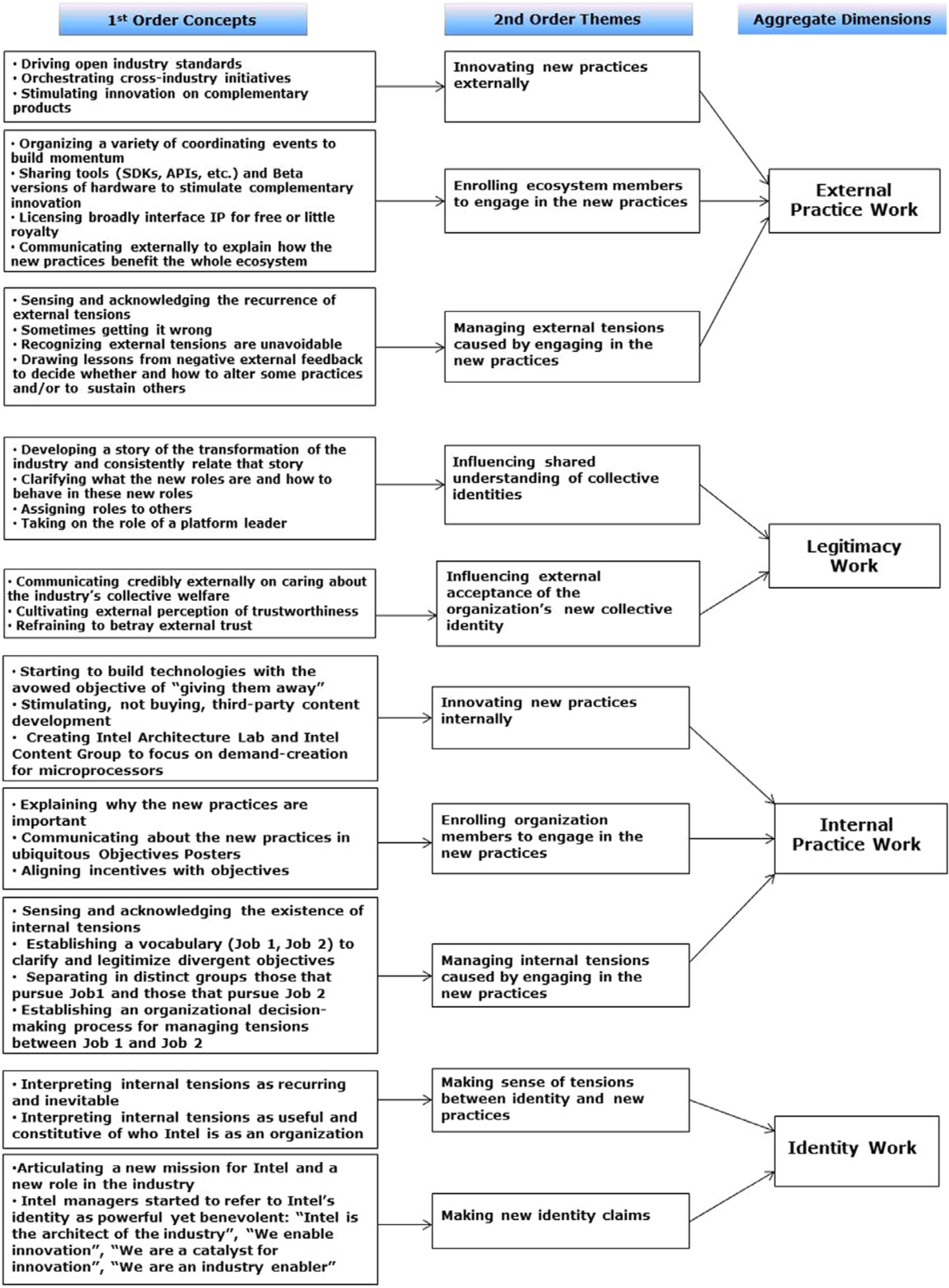
Data Structure.
Following recent recommendations for data reporting in qualitative research (Pratt, 2009), we provide additional selected quotations supporting our interpretations in the Appendix.
Findings
Our research question asked what kinds of institutional work organizations perform as they attempt to influence the institutional logic that characterizes their field, and what kinds of institutional work do they perform in response to the resulting shift? We found that two kinds of external work were central to the process: work done by the organization developing and legitimizing new practices in the field (which we call external practice work) and work performed by the organization aimed at influencing other field members’ perceptions of Intel’s collective identity (which we call legitimacy work). We also found two kinds of work were carried out inside the organization: work performed by organizational members developing and legitimizing new practices within the organization (which we call internal practice work) and work performed by Intel’s managers internally on organizational members’ perceptions of Intel’s organizational identity (which we call internal identity work). These forms of work were carried out over time, and were mutually reinforcing and overlapping. The forms of work and their relationship are illustrated in Figure 2.
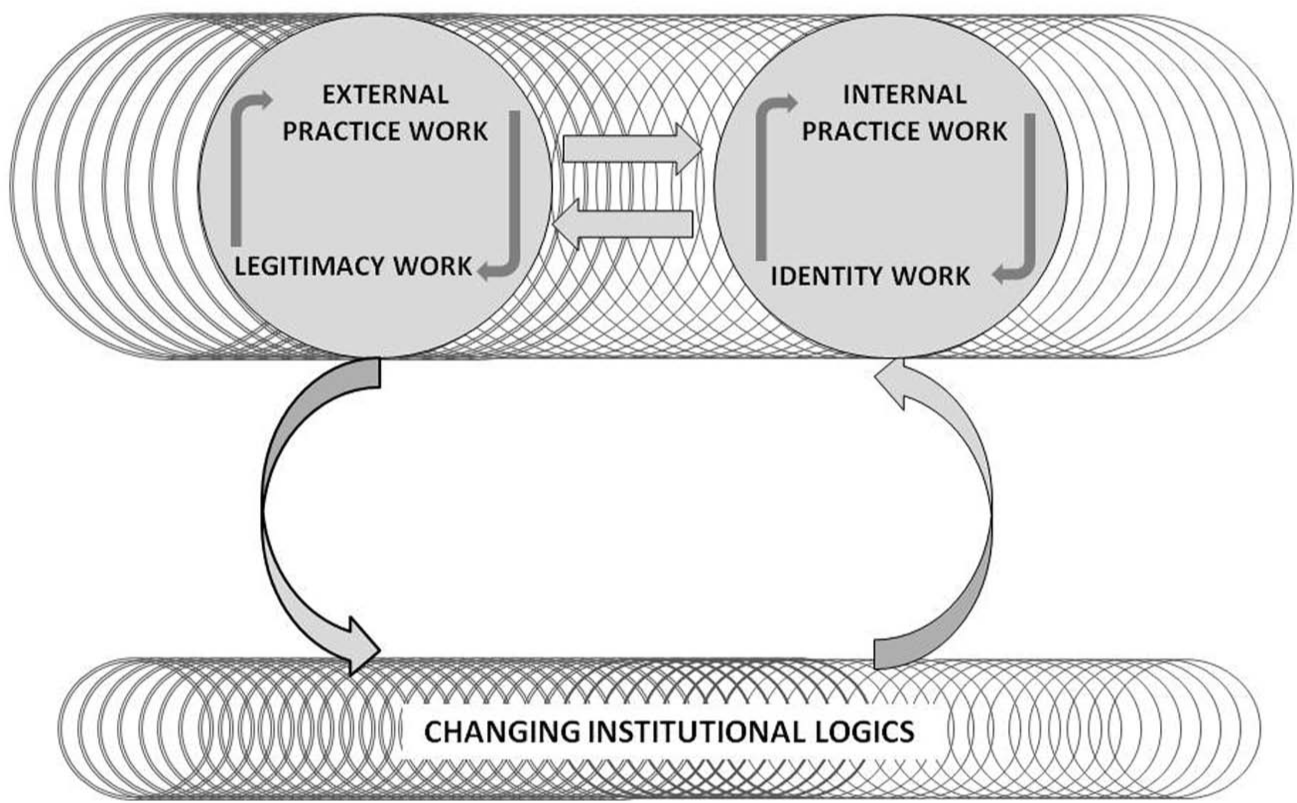
A Model of Institutional Work as Logics Shift.
External practice work
External practice work refers to a form of institutional work through which the focal organization creates and disseminates new practices to other organizations in the field with the intention of influencing the institutional logic. As Intel aimed not only to adapt to external changes, but also to play an industry leadership role and significantly shape behaviours and interactions in the field to its advantage, it attempted to engage in new practices that required the active participation of members of the ecosystem. Three themes emerged from our data analysis: (1) innovating new practices externally; (2) enrolling industry members in the new practices; and (3) managing external tensions caused by engaging in the new external practices.
Innovating new practices externally
Innovating new practices externally refers to institutional work through which the focal organization creates new practices that are carried out outside the organization and are intended to engage with other field members and to reconfigure the field. In our case, the overarching objective of this kind of work was to drive ecosystem innovation in directions that would be complementary to Intel’s plans. We can group the kinds of actions that Intel engaged in into three categories: (1) driving open industry standards; (2) orchestrating cross-industry initiatives; and (3) facilitating complementors’ innovations.
These all involved the active participation of other industry members. As a director of technology marketing explained: ‘For computers to have a greater benefit, advancing the microprocessor is necessary but not sufficient. The rest of the computing solution needs to advance as well, in appropriate ways and in coordinated fashions.’ The activities that made up this form of work consisted in various activities including defining rules of connectivity that would later become norms of compatibility (once they had garnered enough industry support); educating external developers and hardware manufacturers; tools sharing; technology sharing; and establishing monitoring networks through communities and events geared toward compliance checking.
The director of the Architecture Lab explained the structuring role that Intel played in the PC ecosystem by defining PC interfaces: We want to define how these companies will hook their pipe to the PC and how application writers can take advantage of that pipe that we control … Coordination here now creates a common connector. Now they all have to compete. … Because we said there’s one way to hook to a PC and we’re going to make it happen, they all now have to compete to deliver to that socket.
As this quote indicates, our informants offered a sophisticated articulation of how the definition of interface technologies constrained yet enabled the behaviours of industry players at large. We will return to this point in the discussion.
As Intel’s objectives were to stimulate complementary innovation to its microprocessors, examples of how Intel innovated new practices included: sharing beta versions of hardware among industry participants to stimulate ecosystem innovation; creating and sharing development tools such as application programming interfaces (APIs) and software developer’s kits (SDKs) to facilitate complementary innovation; and sharing other technological ‘building blocks’.
These practices were mutually reinforcing, as freely giving away intellectual property on selected interface technologies broadly increased incentives for a large number of developers to develop products that would be complementary to this interface. And a large number of complements to a particular interface rendered this interface more likely to become a de facto standard in the industry. In turn, the broad sharing of beta versions of hardware as well as development tools was intended to influence and stimulate the development of complementary products. This systematized programme of tools sharing guided external technological development in specific directions that would be favourable to Intel.
Intel also drove so-called ‘industry initiatives’ which were coordinated efforts to solve technical problems that ‘affected the whole ecosystem’, in other words, technical problems that a former PC assembler would have been able to solve alone in the old logic – problems that would now, in the new logic, require the concerted efforts of developers of various sub-parts of the PC. The industry initiatives had names such as the Multimedia PC, Manageability and Videoconferencing. They all tackled a systemic technical problem (at the PC system level) and each required a high degree of industry coordination.
Enrolling ecosystem members to engage with the new practices
The second form of external practice work refers to the focal organization’s attempts to engage other members of the field in the new practices and hence the new logic. In our case, as Intel gradually understood the nature and the extent of its interdependencies with other firms, as well as its capacity to influence its environment, increasing amounts of organizational effort went into enrolling more and more industry members.
The process of enrolling was all about ‘building momentum’, and had a self-sustaining quality once it had established ‘solid foundations’. The process began with the first PCI in the early 1990s. Intel started to organize and sponsor a regular series of coordinating events, which were regular working meetings of various sizes, held at different stages of the interface standardization process. Intel worked to enrol a large number of other firms to adopt these standards as they were in the process of being specified. Encouraging such adoption required stimulating the active engagement and risk-taking of potential complementors so that they would develop new products that would be designed to be compatible with the new interface or technology.
These meetings, called PlugFests (for compliance workshops involving hardware peripherals and components), Implementors Forums (for hardware developers of chipsets or motherboards or other hardware products embedding the interface specifications) and Developers Forums (for software developers of applications that would be specially optimized to work best with new generations of microprocessors), were planned encounters where an increasingly large number of industry actors met to share information, work on interface specifications, test the interoperability of their prototypes, teach and be trained in the latest software implementation of connecting standards – as well as, importantly, building a sense of collective identity (Wry et al., 2011).
The work of defining connectivity rules and compliance testing was important, structuring and ongoing: from early interface specification to practical implementation (along with the necessary provision of interface-compatible complements) it would often take 2 to 3 years of coordinated industry effort. Over time, Intel developed a process by which it would systematically involve external organizations in the development of interface standards, gradually first in the small groups that they called Special Interest Groups, later to spin off the governance and the steering of these standards in autonomous groups outside Intel, to be governed by coalitions of organizations.
Our informants insisted on the importance for this process to start in a low-key fashion and to increase in size gradually. It started by involving ‘small numbers’ of key players in the beginning. As our informants described, ‘we started with a Special Interest Group of seven companies’ and ‘it’s a really delicate time in the beginning’. In later stages, the organizers expanded to more organizations: ‘then, we allowed many companies to come and join the effort’. In the words of the director of platform initiatives: ‘at some point [after these efforts], you can just sit back and see the industry coalescing round a certain idea, and then most people want to jump on at that point’.
Managing the external tensions caused by engaging in the new practices
The last form of external practice work refers to the focal organization’s attempts to manage the tensions that arise between itself and other organizations in the field as the focal organization engages in the new practices. In our case, Intel (1) sensed recurring external tensions with external organizations; (2) recognized these tensions as unavoidable; and (3) drew lessons from external feedback on which practice to keep, which to alter and which to sustain.
Our informants recalled recurrent external tensions. Tensions started as soon as Intel attempted to define their first PC interface. In the words of one executive: ‘So here we are suggesting: “Hey you guys who build computers, you aren’t building the right bus and we’re going to help you do it right”.’ The CEO of Intel recalled: ‘But the notion that a silicon producer could define a computer bus-architecture was a very strange thing.’ Another manager observed: So we started, and the environment then was that here we are thinking to provide a specification for the whole industry to use, which may have been by some people’s estimation rather presumptuous on Intel’s part, it was a new thing. (manager, Media Architecture Lab)
Our informants also recalled cases where the external tensions were so strong that they resulted in notable failures. Our informants attributed these failures to enrol as a failure to take properly into account the incentives of other members of the ecosystem as well as, in some cases, ‘underestimating the strength of the incumbents’.
In the case of videoconferencing, for example, Intel pushed its practice of freely giving away technology too far, and ended up undermining the viability of the videoconferencing solutions that used to be sold at a premium by incumbent firms in that market. The IAL director recalled: We introduced a videoconferencing product in the market at $999, and PictureTel was pricing systems that cost in the $20,000 range. … It doesn’t surprise me that they didn’t want to join the standards around that, because it could have rewritten the rules of their business as they knew it.
Our informants recalled that, while attempting to push the videoconferencing market forward, and after having invested ‘in excess of $100 million over a period of a few years’, Intel had crossed the line from being a market enabler to become a market competitor, driving everyone else’s margins down to a point of unacceptability. This triggered a strong backlash against them in that market and they failed to rally others around the technology that they wished to sponsor.
These tensions or negative reactions led Intel to reflect on their practices and alter some of them, and even renouncing others. For example, a lesson Intel managers learnt was not to either give away too much intellectual property for no royalty at all, or make competing products and price them too low, as this would have the opposite effect of what they, as platform leader, wanted. A director reflected on the ‘lesson’ Intel learned about the fiasco of its engagement in videoconferencing: You have to be careful not to come in so hard that you undermine the conditions in the market you enter. You have to be careful, because you can undermine the whole market segment and not end up fostering innovation. Some people claim we did just that. (director of media and interconnect technologies, IAL)
Legitimacy work
Legitimacy work refers to a form of institutional work through which a focal organization attempts to influence the collective identities legitimately associated with a new logic, as well as influence external acceptance of its legitimate membership in one of the new collective identities. Legitimacy work therefore focuses on creating and maintaining the legitimacy – ‘a condition reflecting cultural alignment, normative support, or consonance with relevant rules or laws’ (Scott 1995, p. 45) – of particular collective identities at the field level.
Intel’s reaction to the perceived external tensions as it attempted to influence the shifting logic was to work to build legitimacy in its new role. In the case, the new categories of collective identities that were associated with the new logic included the identity of platform leader and complementor. Intel engaged in two complementary kinds of work: (1) work to influence a shared understanding of collective identities where, as members of a collective ecosystem, one was either a platform leader or a complementor; and (2) working to influence external acceptance of Intel’s new collective identity as a platform leader.
Influencing shared understandings of collective identities
Intel worked in a number of ways to influence shared understandings of the new logic characterizing the field and of the new collective identities embedded in the new logic. In a variety of external communications, Intel consistently attempted to explain the principles operating in the ‘new computer industry’, the fact that everyone was now a member of this new platform-based industry, and the new types of actors involved.
For example, in a series of annual reports it stated repeatedly that ‘open standards’ and ‘industry cooperation’ were positive developments and helped to create value for the whole industry. We also found in our interviews that many informants articulated a similar view of the benefits for the collective that would arise from industry cooperation. This was a clear change in the meaning of being an industry member.
This can be seen in the way several of the Intel managers we interviewed expressed their belief that it was important that ‘everyone makes money’. In the words of a technology marketing director: There needs to be profit at every stage of the value chain. If every stage of the value chain is not making profit or finding differentiation or doing something positive with your business in a significant way, [the business] is not going to happen. The weak link will break the chain.
Hand-in-hand with this explanation of the new operating principles of the industry, our informants consistently portrayed themselves as caring for the whole industry, not just caring for their own organization, going so far as to express a sense of responsibility for ‘small companies’ who were trying to act as complementors, and implicitly suggesting that a concern for the collective was now important for everyone. In the words of the director of IAL: The young companies could win big if they bet their whole company, but if they lose, it’s a very big deal. That puts responsibility on us: we’re not interested in putting companies out of business.
In addition, in the context of the already mentioned coordinating forums which Intel organized and sponsored (the Developers Forums, Implementors Forums and PlugFests), the company explicitly attempted to educate others to adopt similar behaviours and understandings. The coordinating forums were not only meeting places for industry actors to share information and build a sense of the collective, they were also important events where monitoring of the new rules was collectively performed. The roles that actors were expected to play in these events became scripted, with a gradually more broadly shared set of assumptions about how to behave and what roles were expected to be played.
In contrast with the previous set of roles in the old logic where one was either an assembler or a component maker who acted as a supplier to the assembler, in this new logic one can identify two distinct roles: the platform leader and the complementor. In the new logic, the contenders for the first category were organizations such as Intel (or Sun when it attempted to sponsor Java) who acted as orchestrators or platform leaders, and therefore who were trying to enrol a large number of others to develop products that would be designed especially to be compatible with the new technology. The characteristic of these platform leaders is that they aimed to rally others around what they portrayed as ‘open standards’.
In the second category of collective identity were complementors, whose role was to develop products (hardware or software) that would complement the core element (and be compatible with the focal interface under construction). They were expected to come to PlugFests with things to plug in (prototypes), to come to the Developers Forums with software in the process of being developed (so that it would be compatible with the new software and hardware interface), and to attend the Implementors Forums with specifications to implement. As these recurring, gradually larger, coordinating events became institutionalized, so did the collective identities of the actors who participated in them. By organizing these events and orchestrating these interactions, Intel and other platform leaders significantly shaped the creation and maintenance of the new logic.
Influencing external acceptance of the organization’s new collective identity
The last form of legitimacy work refers to the focal organization’s attempt to influence the external acceptance by field members of its new collective identity as platform leader. In our case, once industry members were convinced that industry coordination was needed, and that the collective identities of platform leader and complementor made sense, Intel still needed to convince the industry that it, as an organization, could fulfil the role of platform leader.
Intel informants often professed their belief in the importance of ‘building trust’ and ‘maintaining trust’ in order to assume the role of platform leader.
The market segment gets hurt if third parties think: ‘Intel, the big guys, are there, so I don’t want to be there. They’re going to crush me.’ (engineering manager, Intel Architecture Lab)
In the context of the new logic, Intel managers found that neutrality was very important to their acceptance as platform leader. Informants reported that they took the issue of building trust seriously, and that they worked hard to convince others that they were a neutral broker. This required a significant shift from how they were perceived prior to the shift in logics. Intel managers saw being perceived as neutral or fair as a strategic imperative, justified by the interdependence of actors in the new industry ecosystem: ‘It’s important that your complementors trust you because you need them, they need you, and you cannot just trample all over everybody’s business willy-nilly’ (director of corporate business development).
Our informants reported being quite aware of how difficult it was for Intel to appear as trustworthy, as they were starting to ‘run into’ being seen as ‘big bad Intel’: At the time, it felt as if the prevailing mood in the industry was ‘Don’t trust Intel’. Big bad Intel: obviously, they’re hiding something here. They’re going to get everybody excited about this bus, and then they’re going to come back and say: ‘And, by the way, we own some patents and you have to pay us royalties on it.’ We were starting to run into that. We really had no choice but to take a proactive stance. We said: ‘You know the IP [intellectual property] around this socket? Well, we will provide reciprocity for the industry.’ (program manager, worldwide sales and marketing)
Intel managers also learned to preserve their reputation by being careful about not implicating other companies in making ‘bets’ that ‘didn’t materialize’.
The main challenge is that if we commit to something and it doesn’t happen, we have an impact on a lot of small companies. We’ve asked them to bet their company on this technology, but if it doesn’t materialize, it’s not just a case of us feeling bad about it; it is a very damaging reputation to have. Maintaining trust is the real challenge. (director, platform planning, architecture business group)
Our informants also mentioned another factor that played a crucial role in Intel’s ability to cultivate trust in the industry: the ‘Chinese wall’ that was created between IAL and other groups and that ensured IAL members did not betray external trust by sharing externally entrusted confidential information internally (i.e. across the Chinese wall).
By creating this Chinese wall, Intel signified both internally and externally that it was not going to sacrifice its emerging legitimacy and industry-enabling activities for the sake of short-term gain in a product market. By refraining from betraying external trust by refusing to share externally entrusted confidential information across the Chinese wall, Intel acted repeatedly and visibly as a neutral broker – which helped it gain what it perceived to be the deserved trust of the industry, and which also reinforced the internal perception that Intel genuinely cared about what it claimed it cared about.
Internal practice work
Internal practice work refers to institutional work where the organization innovates new practices – meaningful activities that are informed by wider cultural beliefs (Engeström 1999; Jarzabkowski, 2004) – internally in response to the new institutional logic. As some of Intel’s members started to respond to logic change, they developed new practices that the organization gradually came to adopt and interpret as useful and appropriate.
Three specific themes relating to the internal practice work characterized our informants’ efforts: (1) innovating new practices internally, (2) enrolling organization members to engage in the new practices, and (3) managing the internal tensions caused by engaging in the new practices.
Innovating new practices internally
Innovating new practices internally refers to a form of institutional work where the focal organization creates new practices that reflect the new logic. Our informants gave us several examples of new internal practices that Intel engaged in, associated with Intel’s attempts to respond to the logics change. In fact, Intel created several groups in the early 1990s, including the Intel Architecture Lab (IAL) and the Content Group, whose sole purpose was to engage in new practices. IAL focused on creating demand for microprocessors, rather than focusing on supplying microprocessors, as had been the case for Intel previously. The Content Group focused on stimulating, not buying, third-party software development. In the past, the practice at Intel had been to pay external parties to create software. These new practices, for which we provide more detail below, were all consistent with the new logic, as they all reinforced the principle of an open computer industry organized as an ecosystem.
IAL’s mission was to facilitate and stimulate innovation performed by other firms, innovation that would be complementary and demand-enhancing for microprocessors. Contrary to other computer labs with more traditional innovation practices, the set of new practices therefore involved creating new technologies that Intel did not intend to commercialize itself – rather, it would aim to give them away to complementors so that they could innovate further, utilizing these technologies as a foundation for further innovation.
This meant that IAL’s focus was connected to, yet outside, the scope of Intel’s traditional products. IAL members saw their job as ‘demand-creation’ (marketing manager, IAL). The set of new practices developed at IAL consisted therefore in developing technologies that Intel was planning neither to sell nor to make direct profit on. These new practices made sense in the new logic, as they were intended to ensure continued demand for evolving series of microprocessors, which required the provision of necessary complements to Intel’s microprocessors. By giving away foundational technologies, Intel was influencing third-party behaviour in order to encourage them to innovate along particular lines.
At first, Intel developed and sponsored PC ‘buses’ (PCI, AGP), and later a set of connectors between the PC and other devices (FireWire, USB).
5
Intel’s CEO Andy Grove recalled in our interview: The change in our recognition was sometime between 1989 and 1991. This is coincident with IBM proving either lack of interest or ineptitude in moving the PC platform forward. The major thing we undertook was the definition of a new bus structure, PCI. It didn’t seem that big a deal then, but the PC bus structure for the previous decade had come from IBM.
Another practice we referred to above is that Intel acted in a new and unusual way to stimulate the development of, as opposed to paying for, third-party innovation. The Content Group, created in 1993, was established when Intel was getting ready to launch the Pentium chip. For the launch, Intel needed software applications that would promote the use of the Pentium chip as a multimedia tool. Intel decided therefore to encourage external software developers to create multimedia applications for PCs. The Content Group was given the goal of ‘trying to get that technology out there and really create compelling value for PCs through content’ (director, business developers relations group, Content Group).
To achieve this objective, members of the Content Group did not rely on traditional practices (which were the norm in the old logic) of treating external software developers as suppliers. In the new logic, Intel was not an assembler, and therefore its managers did not want software companies simply to be paid by Intel for development work. Paying developers was a practice associated with the old logic, and one that IBM engaged in with little success. By contrast, and this constituted the basis for new practices, Intel managers wanted external software companies to invest in their own new products and have a complementary business model to Intel’s, not a supplier relationship. As the director of the developers relations group in the Content Group explained: The one thing I have consistently refused to do is to pay people to do a job. Look at the history of IBM and OS/2 [the failed, proprietary operating system that IBM tried to commercialize]. Rumor has it that IBM spent a billion dollars on applications for OS/2, but they bought people. They’d say: ‘Here, do this for me.’ When the company was done, IBM asked: ‘Aren’t you going to sell it? Market it?’ The companies said: ‘No, our deal was to develop it. You’ve got it now. Good luck.’ … It comes right back to the ecosystem. I want them to be successful with their own business model.
New internal practices aimed at encouraging external developers included developing key software components and libraries and application programming interfaces (APIs), compilers and debuggers with the express intention of sharing them with external developers.
In the examples given above, there are some aspects of these new activities where Intel developed internal practices, and other aspects that required Intel’s engagement with external organizations. It is important, however, to draw a distinction between internal practice work and external practice work as they are empirically and analytically distinct (albeit complementary) types of practice work. Furthermore, the two kinds of practice work impacted each other: without the new internal practices of building foundation technologies to be given away, the external practices would not have been successful.
Enrolling organization members to engage in the new practices
A second form of internal practice work occurs when lead members of the focal organization work to enrol other organization members in the new practices associated with the new logic. Innovating new practices that reflect the logic change is not enough. Organization members must be convinced that the new practices are appropriate and that they should engage in them enthusiastically.
For Intel, attempting to enrol organization members in new practices was difficult and time consuming for those who acted as the evangelists of the new logic. While practices such as giving away intellectual property eventually came to be accepted within Intel, they were, at the outset, neither common industry practices nor had they previously been company practice. In other words, they ran directly against the usual way of doing things.
Instances of how Intel attempted to enrol organization members to engage in the new practices included: senior managers explaining to the rest of the organization why the new practices were important; top management communicating with all Intel members how these new practices corresponded to important objectives; and aligning individual and group incentives with corporate objectives.
First, Intel managers spent a lot of time and effort internally explaining why it made sense for Intel to act in these strange new ways. The new practices were consistently justified by two rationales. On the one hand, managers communicated a sense of urgency and danger: ‘This really is a desperate situation for us’ (engineering manager, IAL). On the other hand, managers provided an interpretation of how the new logic worked in a more cooperative and symbiotic way. As one informant explained, ‘there needs to be profit at every stage of the value chain’ (technology marketing director, IAL). These explanations, reported to us repeatedly by our informants, tell a consistent story.
Second, the effort to clarify how the practices fit with the new objectives was spelled out very explicitly in visual reminders, for example, by means of the ubiquitous and very detailed Intel Objectives Poster (a new one every year, the outcome of the internal strategy-setting processes), which clarified and communicated internally how groups’ and individuals’ objectives fit with the new practices and corporate objectives. As the Content Group vice president indicated: The whole company knows what we’re trying to accomplish. … You can see that on the wall (pointing to the Intel Objectives Poster) … Anybody from the top on down to the bottom or the other way around can know exactly what we’re doing. This is what we are supposed to be accomplishing, and so you know what you’re here for.
Third, Intel’s attempt to enrol organization members included setting up performance indicators and compensation practices that aligned members’ incentives with their mission: as a division, IAL was not expected to generate profits, contrary to traditional product groups whose performance was measured by the revenue and profit they generated. IAL was not treated as a profit centre but rather as a cost centre. This clarified that IAL members were not expected to sell the technologies they developed, nor to transform them into finished products. The performance of IAL engineers was measured by other factors, such as the number of ‘design wins’ (a ‘design win’ meant that a new external firm had accepted to alter their product design specifically to be compatible with Intel’s sponsored technologies). These tailored incentives systems ensured that individual and group objectives were aligned with the corporate objective, of developing and sponsoring open interface standards as well as giving away technologies to external organizations.
Managing internal tensions caused by engaging in the new practices
The final form of internal practice work refers to the focal organization’s attempts to manage the internal tensions caused by engaging in the new practices associated with the new logic. In the case of Intel, the new practice of attempting to influence the PC architecture and the practice of sharing intellectual property raised internal alarms and sometimes led to vocal internal opposition. Intel therefore started to do a specific kind of work to manage these tensions. This work consisted of: (1) sensing and acknowledging the existence of internal tensions; (2) establishing a vocabulary (‘job 1’ and ‘job 2’, which we shall define below) to clarify and legitimize divergent objectives; and (3) establishing an organizational decision-making process for managing these tensions in a way that was practice sustaining.
Alongside the groups engaging in new practices, there remained within Intel many product groups that continued doing business in a traditional way: by developing new technology, protecting the resulting intellectual property, and competing in the product market with rivals. The coexistence of these different kinds of practices, some from the old logic and others from the new logic, created internal tensions. For example, the Computing Enhancement Group continued trying to make a profit selling chipsets and motherboards that embedded hardware implementations of the same interface standards IAL was proselytizing to the industry, sharing intellectual property with competitors to Intel’s product group. Its director reported the internal discontent within his group: ‘My guys say “Wait a minute, I don’t want you putting me at a competitive disadvantage”.’
Intel’s managers’ sensing and acknowledgement of the existence of these tensions led them to reflect on their practices, and to try to find ways to sustain the practices in the face of these recurring tensions. In particular, in an effort to make sense of these internal tensions and manage them, Intel managers came to define an organizational vocabulary to identify and interpret the different (and sometimes seemingly opposing) approaches within Intel. They named them ‘job 1’ and ‘job 2’.
The terms job 1 and job 2 became widely used inside Intel. For example, they were used throughout internal official communications and we also heard them repeatedly in our interviews. Job 1 related to all activities aimed at growing the microprocessor business (whether by classic supply efforts, or demand-stimulation efforts). Consequently, microprocessor development groups were obviously part of job 1, but so were IAL and other Intel groups whose efforts resulted in growing demand for the microprocessor business. By contrast, job 2 was generally used to describe all activities aiming to make other products than microprocessors and sell them at a profit. In other words, job 2 groups aimed to enter and win in new markets by adopting classic competitive behaviours. The naming of ‘job 1’ and ‘job 2’, along with their pervasive use, stabilized and legitimized both the new practices – they were, after all, part of job 1 and ‘it’s called job 1 for a reason,’ as the director of IAL remarked – and the more traditional practices, while specifying which one should trump the other in case of conflict.
Another example of how Intel managed internal tensions caused by the new practices was to create separate groups within Intel that had diverging missions and opposing views: those in favour of giving away intellectual property, and those who were keen to compete in the product markets with new technologies. The director of the sales and marketing organization recalls one of the instances where this separation happened and why: The issue that Intel corporate faced was: How do we balance telling the other vendors about this technology and, at the same time, making sure that we weren’t seriously damaging [the product group]’s business. [This product group’s director] was very outspoken and he wouldn’t have let it happen. So the question was, how did the Intel politics internally decide between enabling our competitors and making our own business grow?’ … So we broke this apart and we said, we are going to do all the industry enabling, and then we’ll let the product group compete on equal footing so to speak.
Our last example of the work that Intel performed managing internal tensions in order to sustain the new practices consisted in the organizational practice of tolerating and even stimulating very direct discussions between the different internal points of view before letting top management decide which way to go. The theme of recurring arguments referred to by the Intel CEO – ‘we argue about it. It happens all the time’ – was reinforced in our informants’ description of a decision-making process that involved twice-yearly strategic long-range planning meetings (internally known as SLRPs) : this process was unanimously described by our informants as ‘confrontational’ and ‘fairly intense’, yet very positive as it allowed top management to make informed decisions having heard both sides in a ‘judicial process’. In the words of a senior executive: At the SLRPs there’s a lot of argument and discussion. In general, they’re pretty contentious, because we are talking about fundamental assumptions and strategies, and we’re saying what we should do. There are a lot of opinions.
The practice of arguing was sustained by an internal organizational culture that tolerated and even thrived on confrontation. In the words of the director of the Computing Enhancement Group, ‘we have this tenet of Intel culture called constructive confrontation’. The practice of arguing did not devolve into dysfunctional or endless conflicts, however. In the words of a senior executive: We usually come to consensus. But Grove and Barrett are very hands-on. They have very firm opinions and, in the end, they summarize what we’re going to do and what the ultimate decision is. They have to be tie-breakers if there is still dissension. They have to be the ones who say: ‘I’ve listened, and this is what we’re going to do’ – and get on with it.
Identity work
Identity work (Svenningsson & Alvesson, 2003) refers to a form of institutional work through which the focal organization attempts to reduce the tensions internally between its organizational identity and the new practices associated with the new logic. In our case, engaging in the new practices described in the previous section created an internal sense of uncertainty as to whether engaging with these new practices was coherent with Intel members’ perception of Intel’s identity. This led to a specialized form of identity work driven by the change in logic: (1) attempting to make sense of the tensions between its identity and the new practices; and (2) making new identity claims that aligned with the new practices.
Making sense of tensions between identity and new practices
This form of identity work refers to Intel’s attempts to make sense of the tensions that emerged between its members’ perception of the fit between the organizational identity of Intel and the new practices associated with the new logic. In our case, engaging in these new and unusual practices not only created the practical issues discussed in the previous section, but also led some organizational members to question whether, given their understanding of the organizational identity, it was appropriate for them to engage in the new practices at all.
Informants recalled the initial hesitation of many organizational members to support the new practices because of who Intel was (i.e. because of its identity as a microprocessor company): they recalled hearing colleagues say things like ‘let’s be careful here’, ‘this is a processor company’, ‘this is a company that builds chips’. In the words of one manager in the Intel Architecture Development Lab who was frequently referred to as a crucial individual in the early days of the pioneering PCI initiative: Intel never could really decide whether we wanted to do PCI or not. This was the whole issue of Intel. This is a processor company, this is a company that builds chips. Compaq takes those chips and builds whole computers out of them, and for the first time we’re going out and saying, ‘Here is an industry standard that will impact everybody, that doesn’t have anything to do with our processor, it has to do with the way you build the box. And we’re writing it, and here it is.’ That was the first time we’d done that.
Many of our informants came to see these tensions as ‘inevitable’ in Intel’s new role of platform leader. The perceptions of organizational identity shifted to include an irreconcilable and irreducible, and in many ways unproblematic, schism between job 1 and job 2.
In the words of one of our informants: ‘These tensions exist, but they are definitely not a war.’ As Intel members made sense of these tensions and tried to align Intel’s identity with its practices, Intel began to develop a new organizational identity that was tolerant of the internal tensions. Not only the tensions (and the polarizing forces) were acknowledged, but the groups whose objectives were clarified as either job 1 or job 2 were legitimized. The tension between job 1 and job 2 became a constitutive element of Intel’s organizational identity. Once the tensions were recognized, the associated underlying divergent objectives clarified and named, job 1 and job 2 became a way for Intel managers to identify themselves and others within the organization. The tensions became not only tolerated and expected, they became defining and constitutive.
Our informants presented a view of Intel as an organization that values its ability to tolerate these internal tensions. It became expected that product groups would react negatively to IAL’s ‘industry enabling’ efforts, and furthermore, it became clear to many managers that this was the right way for Intel to act. The director of platform initiatives explained: The one thing we have – and I think that is really key to our success – [is that] we have good management understanding that we do a lot of industry enabling. … And if the company was confused about whether we are doing USB for the sake of products or for the sake of advancing the industry, then I could see that this would be a real mess.
A director of media relations remarked that Intel is a company ‘that rewards tolerance for ambiguity’. Going further, some of Intel’s top executives interpreted internal tensions as useful. The Intel CEO explained: I don’t think tension is bad. Tension focuses strategic thinking. It focuses people to figure out what’s important and what’s not so important. It’s a bit like the judicial process in that it uses advocacy method to get at the truth. Here, the advocacy method and the arguments get the best results of strategy.
From surprising to inevitable, from problematic to useful, from divisive to constitutive, Intel managers’ conceptualization of the internal tensions became an integral part of the process of organizational identity redefinition as they made sense of their organization’s role in the new logic.
Making new identity claims
The second form of identity work refers to the focal organization’s attempts to make new identity claims that are aligned with the new practices associated with the new institutional logic. In our case, over time, as the logic shifted, Intel made new identity claims where it articulated a strong account of the benevolent nature of its power and it named the essence of its new identity (‘catalyst’, ‘architect of the industry’) using various symbolic references.
First, early successes allowed Intel to gain confidence in its ability to ‘move the industry’, in other words, to become convinced of the reality and the potency of its leadership capacity: Two interesting things happened. Number one, Intel realized through the PCI experience that hey, when we set out to do it, we can move the industry in some useful direction. We don’t have to be timid about it, we know we can do it. And learning number two, the rest of the industry learned it. (manager, interconnect architecture, Intel Architecture Lab)
Intel during those years started to describe itself as the ‘architect of the microcomputer revolution’. Intel managers articulated a strong account of Intel’s identity as an organization that helps promote competition among ‘complementors’, stimulate innovation and reduce ‘confusion’ in the industry by promoting open standards.
We said, ‘Wait a minute. We’re Intel. We care about the PC. If you all want to save some money, the best way to hook to a PC is this way. Here’s the hardware way; here’s the software way.’ … Coordination here creates a common connector. Now they all have to compete. … Because we said there’s one way to hook to a PC and we’re going to make that happen, they all now have to compete to deliver to that socket. … We resolve all of that confusion. And everybody invests in a common direction more quickly. … We are breaking down the cost to innovate. (director, Intel Architecture Lab)
Using a variety of evocative terms (‘catalyst’, ‘industry enabler’, ‘breaking down the cost to innovate’), Intel managers consistently portrayed Intel as a powerful yet benevolent actor in the new industry logic, one that played a structuring role in shaping the interactions of other actors in the ecosystem, that had the technological capability to solve technical problems that affect the whole industry, and the long-term vision of looking out for the welfare of the collective ecosystem. Its identity had changed to that of a platform leader. In the words of a senior manager: We want to be a catalyst that just got it started early, that made things happen sooner, that made investments occur – or we may want to make a complementary investment so that the innovators don’t have to do all the work. [Other firms] can focus on a layer of the application where there’s lots of innovation and value that they can add, and we take care of the glue and the lower-level infrastructure. That can be a success story.
It is important to note that the new identity claims were carefully expressed in a way that made sense to organizational members. In particular, the evocative metaphors describing Intel’s new identity claims (‘industry architect’ and ‘catalyst for the industry’) were constructed using a vocabulary that would make sense to Intel’s members as they borrowed from the vocabulary of chemistry, engineering and design – all foundational capabilities of Intel’s technological identity.
Discussion
In this section, we will discuss three areas where our study has particularly significant ramifications for institutional theory. First, we will discuss what our study means for our understanding of the relationship between forms of institutional work and institutional logics. Second, we will explore some aspects of the relationship between institutional logics and organizational identity. Finally, we will discuss the ramifications of our work for how technology and materiality are conceptualized in institutional theory.
Forms of institutional work and institutional logics
Based on our case study, we can make a number of novel observations about institutional work and processes of logics change. First, institutional work can be an important source of pressure for logic change. In many ways, this is not surprising, given the definition of institutional work as ‘the purposive action of individuals and organizations aimed at creating, maintaining or disrupting institutions’ (Lawrence & Suddaby, 2006, p. 215). But while not surprising, the case we have presented underscores the role of purposeful action by agents in change. Intel perceived a problem and set out to change the organization of its field in order to solve it. The problem of innovation in the PC bus was critical for them and they were able to use their resources and position to engineer a change in the logic that allowed innovation to restart.
Equally importantly, we have identified four kinds of institutional work that have to be performed simultaneously for an organization to be able to successfully influence the logic it wants to change. It is not enough to foment change at the field level; organizations must respond effectively to the changes in logic as they occur. Organizations involved in trying to change the logic that characterizes their field will therefore need sufficient resources and skills to manage both internal and external institutional work simultaneously.
A better understanding of the conditions under which organizations are more likely to successfully carry out these different forms of work will help specify the conditions under which organizations can more likely influence their institutional context. This is a subtle yet important point that our study has revealed. While the institutional work that Intel did in the organizational field was more obvious in its effect, the internal work supported and made possible the external work.
In this regard, it is useful to compare our study to Garud, Jain and Kumaraswamy’s (2002) study of institutional entrepreneurship – a concept which has now become subsumed in the wider category of institutional work – based on their study of Sun Microsystems’ attempt to drive the sponsorship of the common computing technological standard with Java. That study offers a useful point of comparison with ours because of the similarity in settings (the computer industry from the mid-1980s to the late 1990s), similarity of the actions and intentions of the two firms, and the dramatic variance in the outcomes.
Despite a promising beginning and strong initial industry support, formal legitimacy eluded Sun in its attempt to sponsor Java. Garud et al. (2002) argue that Sun carried out a subset of the actions Intel carried out when Sun attempted to ‘mobilize the bandwagon’ through its sponsorship of its Java technology. Garud et al. (2002) suggest that there were two main reasons why Java failed to rally the industry. First, they identify the problem of what they call a ‘legitimacy trap’. They highlight that the standard sponsorship process creates legitimacy challenges, as technology sponsors tend to attempt to play two roles: rule designer and rule enforcer. In the case of Sun, this resulted in a loss of credibility for the sponsor, who ‘wanted to play the referee, but … wanted to play in the game too’ (Garud et al., 2002, p. 208).
This is consistent with our findings on the importance of legitimacy work, which Intel, as opposed to Sun, performed successfully, with Intel ending up being mostly perceived as a neutral broker while Sun appeared as a self-interested manipulator. We therefore argue that successfully performing legitimacy work is critical to success in influencing shifts in logics.
But Garud et al. (2002) also highlight another cause of Sun’s failure: the fact that Sun neglected to deliver on its promise of technological superiority and on its pledge to maintain the standard as unified and non-fragmented. According to Garud et al. (2002, p. 203), ‘taking advantage of Sun’s inability to deliver on its vision and commitment to improve Java’s functionality, Microsoft began adding proprietary extensions to Java to improve how it worked with the Windows operating system’. Over time, this led to the fragmentation of Java and a loss of technological leadership. This too validates our finding that predictably delivering on promises was a critical part of Intel’s ability to gain legitimacy. So both reasons identified by Garud et al. (2002) point to the hypothesis that Sun would have failed because they failed at performing legitimacy work successfully, a hypothesis that is consistent with our model.
Institutional logics and organizational identity
Our study, by directing attention toward the relationship between organizational identity and practice, points to a subtler and more endogenous source of institutional change than that typically offered in institutional theory. This link between various sorts of identities and practices is, of course, a familiar one in institutional theory, particularly in the more cultural streams of institutionalism. As Glynn (2008, p. 413) comments: ‘institutional approaches that focus on the cognitive-normative contexts of organizations have emphasized the importance of social identities’. More recent research on institutional logics has also recognized organizational identity as an essential constituent of institutional logics (Greenwood, Díaz, Li & Lorente, 2010; Thornton & Ocasio, 2008; Tracey, Phillips & Jarvis, 2011).
Our findings extend this thinking and suggest that, while organizations may attempt to change practices in response to institutional changes in logics, it is through the prism of their identity that organizational members make sense of these practices. And, most importantly, organizational identities shape understandings of who can legitimately perform what practices. Therefore, the adoption of new practices may encounter significant resistance when organizational members believe there is a conflict between a new practice and the organization’s identity. Successful adoption may thus require a significant change in the organization’s identity. For example, in our study Intel only became accepted as a platform leader after it demonstrated consistently to the industry that it deserved the industry’s trust by tolerating internal tensions around job 1 and job 2 – this change in practices, in turn, required a significant change in the organizational identity of Intel.
Another related area that has received attention in the literature is the role of collective identities in processes of institutional change. For example, Fligstein (1997), in his essay on institutional entrepreneurship as a form of ‘skilled social action’, identified the importance of the link between collective identity and institutional entrepreneurship and argued that an organization’s ability to influence others revolves around ‘finding and maintaining a collective identity of a set of social groups and the effort to shape and meet the interests of those groups’ (Fligstein 1997, p. 398). More recently, Wry, Lounsbury and Glynn (2011) examined the processes by which collective nascent identities become legitimized through the articulation of defining collective identity stories. They suggest that collective identities are more likely to be legitimized when members agree upon and consistently repeat stories that coherently define the collective identity’s core purpose and practices, and invite established actors to pursue the group’s purpose.
Our study contributes to this discussion by highlighting some of the ways in which an organization can work to shape the collective identities that characterize a field. Interestingly, Intel did so not only through identity and legitimacy work, but also through practice work. They introduced new practices into the field that supported a broader attempt to create and institutionalize new collective identities such as complementor and platform leader. Our study therefore complements and extends this line of research on the processes through which collective identity categories themselves become legitimized. It is also consistent with recent research on practice creation that directs attention away from the actions of a small number of actors seen as muscular and heroic (as seen in the institutional entrepreneurship literature) and redirects attention toward the multiplicity of actors that interactively produce change (Lounsbury & Crumley, 2007).
Technology as a material instantiation of institutions
Our study also supports the various authors who argue that institutional theory needs to develop a richer and more sophisticated understanding of technology. As Leonardi and Barley (2008) suggest, this does not imply a return to technological determinism but, rather, that ‘the social and the material are constitutively entangled, and inextricably related’ (Orlikowski, 2007, p. 1437). This is, of course, completely in agreement with the definition of an institutional logic as being both symbolic and material.
In our case, the computer technologies that the members of the field produced were both material objects and a central part of the institutional logic of the field. They were shaped by the symbolic and cognitive aspects of the evolving logic of the field, yet their material nature and the limits of the material world also limited and shaped the evolving logic. Therefore, to understand the logic shift that occurred requires a deep understanding of the technological and material, as well as the symbolic and cognitive context of change. This is a significant challenge to existing institutional theory with its current focus on the non-material aspects of logics, but is necessary if we are to really understand the dynamics of logics, especially in technology-based fields.
In our study, for example, the PCI and USB interfaces, by virtue of being ‘open’, and through the collaborative industry-wide process by which they became defined and accepted, became physical instantiations of the new institutional logic. An open standard for an interface further supported the institutionalization of an open institutional logic and the new logic was inscribed in the material devices that were designed and manufactured. The design characteristics of interfaces explicitly reflected the shifting institutional logic and characterized the socio-materiality of a technology that then invited and facilitated cooperative interaction among field members.
Various researchers have repeatedly pointed out that technology and materiality do not receive adequate treatment in organization studies. Orlikowski (2007, p. 1436) puts it succinctly when she argues that, despite the ‘considerable amount of materiality entailed in every aspect of organizing …, materiality has been largely ignored by organizational theory, which appears to assume (often implicitly) that it does not matter or does not matter very much in everyday organizing’. Along similar lines, Pinch (2008, p. 461) asserts that sociology generally has not dealt effectively with materiality, which he defines as ‘the world of objects and things’, and goes on to argue that traditional studies ‘carve up the world … such that sociologists deal only with social things [while the] world of objects, machines, and materials are left unanalyzed or considered the territory of others, perhaps scientists and engineers’. For Orlikowski and Scott (2008), artifacts are ‘missing in action’ in the study of organizations.
In addition, an explicit institutional work approach would potentially enable a fruitful discussion between institutional theorists and organization scholars that study socio-material practices (such as Orlikowski, 2007). In our study, the process of interface design and adoption was a socio-material practice. The technological design of an interface allowed the conversation between social actors to happen, and during this process (characterized by a continuum of stages including recursive instances of design, testing, implementation and stimulation of complementary innovation), collective identities were specified and reinforced. The interface acted not only as a physical connector between material artifacts, it embodied a demarcation and articulated specified modes of interaction between different categories of social actors At its most basic, on one side of the interface was the platform leader while on the other were the complementors. The building of the interfaces constituted a material and a social construction, which we have showed to be inextricably linked.
Conclusions
This in-depth case study has allowed us to begin to bring together two important streams in institutional theory which, to date, have existed in isolation despite their important potential connections: institutional work and institutional logics. Our case study of Intel provides an opportunity to explore how an industry-level change in institutional logics occurred and provides an account of Intel’s actions – its institutional work – in working to influence this change. It also provides an opportunity to observe the sorts of institutional work that Intel performed as it adapted to the changing field-level logic. Intel was, like any member of this field, influenced by the logics shift at play in the computer industry. But in contrast to many other actors, it also played a pivotal role in bringing about the logics change.
This study therefore constitutes a rare and important example of the way an organization was both affected by, and active in bringing about, an institutional change at the field level. This study is thus in line with current calls (Thornton et al., 2012) to turn more attention to the micro-dynamics behind macro-level processes, as well as a significant contribution to the current stream of literature on institutional work.
The results of our study are, however, limited by the fact that it is a single case study. Much more research needs to be done at the intersection of logics and institutional work to build a theory of how actors work to influence shifts in the logics of their fields and also how they are affected by those shifts. This is a promising research area that deserves much more attention.
Footnotes
Appendix
Selected Evidence.
|
|
|
|
| Intel began to engage in a number of new practices externally in order to coordinate innovation with other ecosystem members.
• The PlugFests are something fairly unique in that every one of the companies that is making USB products is a competitor of the other companies. Typically, you would think that these companies wouldn’t want their unannounced product prototype, hardware or software to be seen in a public forum. On the other hand, they realize if they have a product that goes out there and doesn’t operate or can’t operate with other products, it’s bad for them because the end-user will be unhappy and return the product – and then there’s no market. (department manager, Intel Architecture Lab) • Back in1989, the PCI initiative set the tone for the other initiatives. We had to do a lot of pioneering in that one. We were pretty much turning new leaves legally – in terms of intellectual property ownership, licensing agreements, technical control of specifications – at the time we were building the actual content of that thing at the same time. And most of other platform initiatives kind of all took some learning from that first experiment. (manager, Architecture Development Lab) |
|
|
| Intel spent a considerable amount of time and effort to enrol ecosystem members in coordinating activities aimed at stimulating and harmonizing distributed platform-enhancing innovation.
• If we want to create a new PC capability, like a better PC power management system, we have to teach all these firms to do things differently. Because this is a horizontal industry, in the following way: if you look at a PC you might see it’s made by Dell; you’ll see it runs an Intel microprocessor; it runs a Microsoft operating system; it has graphics from ATI; is has a network card from 3Com; and it has a PCI bus, and it has a BIOS from Phoenix. So if we want to change something like power management, it involves all of these things. So all these people have to do something different from what they are doing today if this thing is to work … You can see the scope of something like this and we have to influence all these people and bring them along and convince them and then orchestrate the whole thing. (director, Platform Architecture Lab) • Part of that broad enabling and momentum-building has to be done in such a way that at the same time we train multiple designers in the industry. To back them up, we needed to have the tools, the white papers, the collateral required to explain to and enable the designers to actually go do that. And we have SDKs (software developers’ kits) and actual optimization tools like the IPEA [Intel Performance Evaluation and Analysis] kit, which is basically a set of tools we hand out to designers so they can optimize their graphics circuit, optimize their power management, optimize their input/output circuitry, optimize their drivers – that sort of thing. I call all this the platform industry enabling team. (program manager, worldwide sales and marketing) • We run these things several times a year, roughly every two months. We charge $2500 a year for a company to join, which is a small bill for a company to pay. And that’s a benefit that you get for joining the Implementor Forum. And the PlugFest we don’t charge for. (director of platform initiatives, Desktop Product Group) |
|
|
| When Intel first stepped in to take on an industry leadership role, their actions created tensions among some organizations in the computer industry. Intel managers recognized these tensions and attempted to manage them.
• So here we are suggesting: ‘Hey you guys who build computers, you aren’t building the right bus and we’re going to help you do it right.’ (director, Intel Architecture Lab) • The notion that a silicon producer could define a computer bus architecture … it was a pretty controversial move. (Intel CEO) • Our involvement in videoconferencing was … an unmitigated failure. We first tried a proprietary approach to videoconferencing, sort of dictating a standard with a product. We tried to build Intel products and create a conferencing standard and say, ‘This is it. We’re going to do it. Everybody signs up. It’s not open, and there is no participation.’ This was pretty much an unmitigated failure. That’s a bad memory for people so lots of people have blanked it out. But we do remember the lesson from it: the model that works is industry collaboration and working together productively, where everybody is participating in what’s going on and able to innovate their products. (director of platform marketing, Intel Architecture Lab) |
|
|
|
|
| Intel started to change its role and encouraged others to assume unfamiliar roles in the new logic, which were associated with new collective identities. It explained consistently the new roles and associated collective identities in the new logic.
• We want to be a catalyst that just got it started early, that made things happen sooner, that made investments occur – or we may want to make a complementary investment so that the innovators don’t have to do all the work. [Other firms] can focus on a layer of the application where there’s lots of innovation and value that they can add, and we take care of the glue and the lower-level infrastructure. That can be a success story. (engineering manager, Intel Architecture Lab) • So Dr Grove (Intel CEO) concluded that we needed to do something about it. We needed to provide leadership to the industry to cause the platform to evolve more quickly, to get new applications and new uses for the platform. (director, Intel Architecture Lab) |
|
|
| Intel managers realized the importance of earning the trust of ecosystem members if Intel was to become a legitimate platform leader. Intel managers exerted efforts to earn this trust.
• We had to go out and earn the industry’s trust. It took us probably three years, and we had to demonstrate, time after time, that specifications that were open did not have hooks in them, and that we weren’t going to get people some other way. (director, Intel Architecture Lab) • We have to be very careful [when we define interfaces] that we do it in such a way that people will have confidence in the openness of the specification. We have to be meticulously fair. … It is very important for us to play fairly – and largely we have, so there has been very little pushback. (Intel CEO) • In order for Intel to be able to move the industry, Intel cannot appear as extremely self-serving. Because people will want to start to look inside of what we’re proposing as to where the gotcha is, that promotes us and puts other people at disadvantages. That is not how Intel does standards. Intel builds in an extremely open way to create a level playing field. … If we are too visible then people are basically gonna see that Intel’s controlling this forum for Intel’s business purposes very directly. (marketing manager, Intel Architecture Lab) • It’s important that your complementors trust you because you need them, they need you, and you cannot just trample all over everybody’s business willy-nilly. (director, corporate business development) |
|
|
|
|
| Intel developed new internal practices as a response to the logics change. They included: establishing the Intel Architecture Lab, designing new PC architecture, and building technological tools or “foundations” to be given away to ecosystem members.
• The computer industry used to be very vertical, with large, integrated companies that did everything. … The PC started the phenomenon of broad, large, open computer industry. … IBM did not recognize the difference in this paradigm versus what they were used to. The leaders weren’t there. So Dr Grove (Intel CEO) concluded that we needed to do something about it. … We needed to provide leadership to the industry to cause the platform to evolve more quickly, to get new applications and new uses for the platform. And he fostered this thing called the Intel Architecture labs and I was asked to form it, lead it and to figure out what to do. (director, Intel Architecture Lab) • We build foundations in the sense that we try to do what we call ‘heavy lifting’ – that is, solve a hard problem that other people can build on top of … For example, if we solve some hard technical problem and issue an API [Application Programming Interface] or a SDK [Software Development Kit] to developers, that would be a ‘foundation’. (director of Media and Interconnect Technology Lab, IAL) |
|
|
| Intel managers set out to enrol many other organizational members to engage in the new practices through communication and changing incentives.
• We had to convince our own chipset group, which was about to go out of business, to invest in the new PCI technology. They had tried to bet with IBM on their bus, and they had tried to bet with Compaq on their bus, and the market went with the old bus. The group said they didn’t know what to do, and they weren’t going to change but instead stay with the old bus. And we asked the chipset group; ‘Why not do a PCI chipset?’ But it wasn’t a slam dunk. It was very difficult for Intel to decide to invest in the PCI chipset. There was no market yet for PCI chipsets. The OEMs [original equipment manufacturers] weren’t asking for it. We were inventing this thing. There was no business case for it. (director, IAL) • The Objectives posters are in every conference room and in every office. And we post it on every bloody wall in the place. (director, Content Group) • We [a product group] are a Profit & Loss Group. IAL is a cost center. (director, Computing Enhancement Group) |
|
|
| Intel managers started to sense and acknowledge the existence of internal tensions.
• There is some tension with IAL because their mission is to go out and drive general technologies and standards – ‘general goodness’ for PCs. Sometimes there is a fine line between what is an open industry capability and what is proprietary … My guys say: ‘Wait a minute. I don’t want you putting me at a competitive disadvantage.’ (director, Computing Enhancement Group [a product group that pursues Job 2]) • There are issues: We are out enabling competitors to one of our internal divisions. Enabling means working with the industry to get them to build this stuff. (director of platform marketing, Desktop Products Group) • How did the internal Intel politics decide between enabling our competitors and making our own business grow? We separated the two different groups. (strategic marketing director, Platform Group) • Our SLRP [Strategic Long Range Planning] meetings … get pretty hot because that’s the purpose. You want the best possible knowledge on the table … If you all agree with each other, then you get nothing done. (director, developers relations) |
|
|
|
|
| Intel managers started to interpret the tensions as recurring, and inevitable. They became normal, and an integral part of Intel’s new organizational identity.
• Tensions between Job 1 and Job 2 happen all the time. (general product manager, desktop products group) • What is really key at Intel, and so challenging, is that we have to balance two kinds of activities at any given time. On the one hand, what we are trying to do is ‘move the platform forward’ – add new technology that provides new capabilities for the platform. But we have to balance that with any given product group’s strategy. (director of platform marketing, Desktop Products Group) • We don’t yet have a really good way of dealing with tensions between Job 1 and Job 2, but at least we accept it and we’re trying to come up with a clear way of dealing with it. For example, one thing we know we want to do is make a given activity clear. Is it Job 1 or not? Is its primary purpose to support a microprocessor ramp and the growth of those technologies? If not, then it’s really got to be a business that stands on its own. It has to behave like a profit center. A lot of times, if you’re not clear up-front with whether a given project is part of Job 1, people get confused. They’re trying to make their profit center, but the microprocessor guys are telling them that by doing so they’re not cooperating with the rest of the company … But if you are taking all your intellectual property and enabling the industry broadly it is hard to have a successful business on your own. (vice president and general manager, Desktop Product Group) |
|
|
| Intel managers started to make new identity claims, which were associated with a new role within the ecosystem.
• We are an industry enabler. (director, technology marketing, Intel Architecture Lab) • Intel’s mission is to supply the building blocks that allow this ‘new computer industry’ to grow. (Intel Annual Report 1989) |
| • That was at a time, back in ‘89, when Intel was first becoming aware that we might have some ability to influence the platform and it might be to our advantage to try to influence the platform.(manager, Architecture Development Lab) • Intel realized through the PCI experience that hey, when we set out to do it, we can move the industry in some useful direction. We don’t have to be timid about it, we know we can do it. (manager, interconnect architecture, Intel Architecture Lab) |
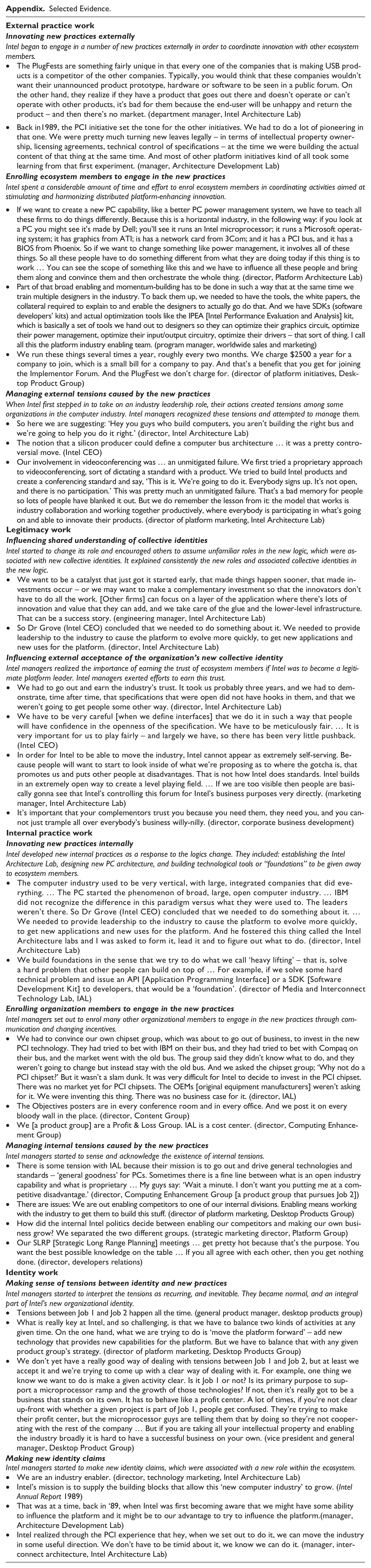
Acknowledgements
The authors would like to thank Tammar Zilber for all her help, guidance and enthusiasm during the review process. We would also like to thank Michael Lounsbury, Kevin Corley, the members of OTREG, and the three anonymous reviewers whose many suggestions led to a much improved paper.
Funding
This research received no specific grant from any funding agency in the public, commercial, or not-for-profit sectors.