




Abstract
How organizations cope with multiple and sometimes conflicting institutional demands is an increasingly familiar yet little understood question. This paper examines how four French business schools responded to demands that they internationalize their management education whilst retaining their traditional identities. We trace the role played by field-level actors in pushing and articulating competing logics and the importance of institutional and organizational identity in how organizations respond. By highlighting the role of identity aspirations we show that what matters is not how an organization sees itself—i.e., what it is—but how it wants to see itself—i.e., what it wishes to become. Finally, we unpack and explain why status differences across organizations affect the nature of the opportunities that are perceived and the scale and format of the responses that are implemented.
Introduction
There is a resurgence of scholarly interest in examining how organizations contend with multiple logics (Kraatz & Block, 2008; Greenwood, Raynard, Kodeih, Micelotta, & Lounsbury, 2011). It is now recognized that organizations often, perhaps even typically, are compelled to simultaneously abide by different “rules of the game”, each prescribing a different, and at times contradictory, set of normative orders (Kraatz & Block, 2008, p. 243; Reay & Hinings, 2009). Under these circumstances, the ability to conform to institutional prescriptions is complicated because “the adoption of a policy or practice that sends a favourable message to one audience may simultaneously send an offensive message to another” (Heimer, 1999, p. 18). Yet to date, the notion of institutional complexity has received limited empirical attention (although see: Dunn & Jones, 2010; Pache & Santos, 2010; Purdy & Gray, 2009). Kraatz and Block (2008, p. 246) refer to it as a “major void in our collective understanding of the relationship between organizations and institutions”. As a consequence, there have been calls for further examination of how organizations respond to “constellations” of logics (Goodrick & Reay, 2011).
We respond to these calls by building upon an emerging stream of research that suggests the potentially important role of identity (Glynn, 2008; Kraatz & Block, 2008; Thornton, Ocasio, & Lounsbury, 2012). This idea, that identity affects how an organization interprets and responds to institutional forces, is not, of course, new. Identity—both “organizational” (e.g., Dutton & Dukerich, 1991; Gioia & Thomas, 1996; Kellogg, 2011; Milliken, 1990); and, more recently, “institutional” (Glynn, 2008; Kraatz & Block, 2008; Selznick, 1957)—has long been used as a basis for determining appropriate organizational behaviour. Emphasis to date, however, has been primarily upon how an organization responds to a logic that is displacing another. Moreover, identity has been selectively treated; that is, studies typically focus upon organizational identity to the neglect of institutional identity. Our study, in contrast, explores the role of both forms of identity upon how organizations navigate and assimilate an emerging with an established logic.
We compare four French business schools (French Grandes Ecoles of commerce, or FGEC) which until the mid-1990s operated in a familiar and monolithic national context where the prevailing and long-standing institutional logic was manifested in widely-shared and taken-for-granted organizational practices and purposes. The rise of global standards for management education, however, confronted FGEC with new institutional demands. Given that “identities become most prominent under conditions of high uncertainty and ambiguity” (Navis & Glynn, 2011, p. 480) and that how organizations make sense of institutional complexity is more apparent when that complexity is unfolding rather than settled (Smets, Morris, & Greenwood, 2012), the French business schools context provides an excellent setting for analysing the unfolding responses of organizations to multiple logics.
We extend understanding of institutional complexity in three ways. We highlight the role played by field-level actors in signalling an institutional identity, which frames the experience of complexity and the discretion of organizational responses. Second, by highlighting the role of identity aspirations we show that what matters is not how an organization sees itself—i.e., what it is—but how it wants to see itself—i.e., what it wishes to become. Finally, we unpack and explain why status differences across organizations affect the nature of the opportunities that are perceived and the scale and format of the responses that are implemented.
The remainder of the paper is divided into four sections. The following section elaborates the theoretical context. Subsequent sections describe the empirical setting and then our research design and methodological procedures. The final section presents the findings and concludes with a discussion of the contributions and limitations of the study, and offers suggestions for future avenues of research.
Theoretical Context
The occurrence of multiple logics confronting organizations has long been established. Meyer and Rowan’s (1977) description of “decoupling” behaviours explicitly recognized that the schools they studied were coping with two logics. D’Aunno, Sutton, and Price (1991) explored how social work agencies coped with competing professional logics. Similarly, Scott (1991, p. 167) reminded us that “there is not one but many institutional environments and … some would-be sources of rationalized myths may be in competition if not in conflict”. Nevertheless, for the most part institutional theorizing and research moved away from this line of inquiry, turning instead to the responses of organizations to one logic, and to the issue of institutional entrepreneurship and change.
Recently, however, studies have returned to the problems posed by the coexistence of multiple logics. Reay and Hinings (2009) highlighted that plural logics continue to coexist in the Alberta health care field, such that neither one can be considered dominant. Purdy and Gray (2009) examined the conditions that enable the diffusion and the sustainable coexistence of the judicial and bureaucratic logics in the emerging field of Alternative Dispute Resolution. Dunn and Jones (2010) investigated the factors influencing the maintenance of the science and care logics within the medical profession and their relative balance. Each of these studies runs counter to the prevailing imagery of fields structured around a dominant logic (for reviews, see Thornton & Ocasio, 2008; Cloutier & Langley, 2013). Instead, they imply that within an organizational field there are several ways by which multiple logics can interact. As Meyer and Höllerer (2010, p. 1251) point out: “Logics may peacefully coexist, compete with one another, supersede each other, provide an opportunity for blending or hybridization or result in a compromise or temporary truce.”
Despite this shift in attention, most empirical studies that recognize the multiplicity of logics are typically situated at the level of the field and have focused on the conditions that promote the diffusion and persistence of logics at that level. In contrast, very few empirical studies have explored how organizations actually cope with the continuing presence and demands of multiple logics. One exception is Battilana and Dorado (2010), who identify the hybridization of hiring and socialization policies as key ways of achieving balance between the commercial and the development logics in the microfinance field. Pache and Santos (2010), also operating at the level of the organization, offer a different approach, hypothesizing that the responses of organizations to multiple logics depend upon the extent to which logics are “represented” inside an organization and upon the balance of power between the representatives. Heimer (1999) implies that representation per se (or “presence”, as she prefers) is insufficient—and suggests that regularity of participation in decisions is also significant because it provides cumulative authority. Yu (2013) probes more deeply into the political processes by which groups within organizations negotiate conflict arising from multiple institutional demands.
Nevertheless, there remains a relative paucity of empirical research and incomplete theorization of how organizations cope with the complexity posed by multiple logics making disparate institutional demands. As Cloutier and Langley (2013, p. 3) conclude, “few studies have dug deep … to open the ‘black box’ of institutional processes under conditions of multiplicity”. There is an emerging appreciation, however, of the potential importance of identity because it “functions as a filter for interpreting and responding to strategic issues and environmental changes” (Glynn, 2008, p. 418; see also Kraatz & Block, 2008; Yu, 2013).
Identity
This foregrounding of identity as a vehicle whereby organizations process institutional complexity is not surprising, given that it has received increasing attention and been implicated as a “subliminal guide” (Gioia, Price, Hamilton, & Thomas, 2010, p. 1) in a widening array of organizational phenomena—including strategic decision-making and issue interpretation (Dutton & Dukerich, 1991; Elsbach & Kramer, 1996; Gioia & Thomas, 1996; Glynn, 2000), the challenges of organizational change (Chreim, 2005; Corley & Gioia, 2004; Fox-Wolfgramm, Boal, & Hunt, 1998; Reger, Gustafson, DeMarie, & Mullane, 1994) and an organization’s relationships with its stakeholders (Brickson, 2005; Scott & Lane, 2000). In all these instances: “Organizational identity provides a guide for what an organization’s members should do” (Gioia, Patvardhan, Hamilton, & Corley, 2013).
Nevertheless, to date, identity studies have not typically focused on its relationship with institutional complexity per se but suggestions have been made as to how identity might influence the responses of organizations to institutional demands. Dutton and Dukerich (1991), Elsbach and Kramer (1996), Gioia and Thomas (1996), Fox-Wolfgramm et al. (1998) and Milliken (1990) all show that identity plays a critical role in the way organizations address environmental pressures and expectations of change. In particular, if an organization’s identity is inconsistent with institutional prescriptions, the organization will resist and/or reverse those demands. A complementary literature—the Scandinavian translation school—also indicates how identity shapes the organizational adoption of institutional expectations (Czarniawska & Sevon, 1996; Hedmo, Sahlin-Andersson, & Wedlin, 2007; for a review, see Sahlin & Wedlin, 2008). Standards and practices diffusing across populations of organizations are “edited” to fit the local organizational context (Sahlin-Andersson, 1996). Studies of “organizational” identity, in other words, portray organizations as acting according to a logic of appropriateness (March, 1981), such that they ask themselves who they are before following a course of action.
A particularly significant aspect of organizational identity (for our purpose) is the claim of status or prestige relative to other category members (Elsbach & Kramer, 1996; Navis & Glynn, 2010, 2011). Status matters because it can be a driver of institutional choice. Durand and Szostak (2010), for example, evoke prestige as providing actors with freedom to change what is expected and desirable in a field, and prestigious actors are likely to be imitated by peers. Moreover, high status organizations are expected to have better access to a field’s more valuable resources (Goodrick, 2002). Given the importance of status as a component of organizational identity, it is reasonable to anticipate that it will influence how organizations interpret and address institutional demands (Jensen & Roy, 2008). In particular, it is likely to affect organizational responses to institutional complexity if its component logics have different implications for the retention of privileges and resource access.
A more recent approach points to the potential role of “institutional” (or “collective”) identity (Glynn, 2008). This approach conceptualizes “identity” as involving claims of similarity and difference in that organizations have both an institutional identity as a member of a social category “such as a Top 20 school, a Fortune 500 firm, or a hospital (and not a bank)” (Glynn, 2008, p. 418); and an organizational identity comprised of central and distinctive claims of how the organization sees itself relative to others in that social category (Albert & Whetten, 1985; Glynn, 2008). Institutional identity consists of “identity elements” that together “create understandings of … how such organizations are meant to behave” (King, Clemens, & Fry, 2011, p. 554). Particular attention has been given to the mechanisms by which these identities are invoked and pushed by authoritative field-level intermediaries, such as the media (e.g., Jonsson & Buhr, 2011), critics (e.g., Kim & Jensen, 2011), the professions (e.g., Lockett, Currie, Finn, Martin, & Waring, 2012), and analysts (e.g., Zuckerman, 1999, 2000; Lamin & Zaheer, 2012). The inference is that organizations that deviate from institutional expectations about their category membership are socially sanctioned and pushed to adjust their behaviour. As Kennedy (2008, p. 270) puts it: “life outside the mainstream is harsh.”
Two consistent and complementary conclusions of studies of identity—whether organizational or institutional—are, first, that logics perceived as poorly aligned with an identity are resisted or adapted (Gioia et al., 2013); and second, that the extent to which the ascendance of a new logic is seen as misaligned is partly a function of whether its implications are perceived as opportunities or threats. However, studies confirming the role of identity in the processing of institutional demands do not explain how an organization will cope with more than one set of demands at the same time. Instead, the insights offered remain overly general—that identity matters and that institutional demands are filtered to align with it. Nor are institutional and organizational identities considered together. As Glynn (2008, p. 414) laments, “the link between institutional theorizing and organizational identity remains relatively unexplored”. Yet, in situations of institutional complexity the interactions between these identities may be important because different logics may provide alternative institutional identities and may be more or less accommodating of particular organizational identities.
Our starting assumption, therefore, is that organizational experiences of, and responses to, institutional complexity are influenced by their institutional and organizational identities, and our purpose is to explore the nature of these relationships.
Research Setting
France has historically developed its own model of business education (Kipping, Usdiken, & Puig, 2004; Takagi & de Carlo, 2003) based upon the Grandes Ecoles de Commerce introduced in the 19th century. Created outside the national university system and often closely supported by local chambers of commerce, the initial purpose of business education was to train the children of business owners in accounting and law. Throughout the 20th century, engineering schools (Ecoles d’Ingénieurs) served as the model for the Grande Ecole approach. Hence, in addition to the vocational emphasis, students were (and still are) admitted on the basis of a nation-wide examination (concours) taken after two years of intensive preparatory classes (classes préparatoires) within the curricula of secondary schools (lycées). This highly competitive process was (and is) intended to prove the intellectual capability of those admitted to the Grande Ecole (Kumar & Usunier, 2001). In this sense, the logic of the Grande Ecole is an “ascriptive-oriented meritocracy” (Kumar & Usunier, 2001) because once accepted graduation is “almost a done deal” (Mottis, 2008, p. 94). This contrasts with the “achievement-oriented meritocracy” of the Anglo-Saxon approach in which students struggle constantly to successfully graduate (Kumar & Usunier, 2001). This unified and national selection method remains a defining cornerstone of the Grande Ecole system and has allowed these institutions to develop an elitist character, whose alumni frequently become prominent business leaders or entrepreneurs (Dameron & Durand, 2008).
The French Grande Ecole system is underpinned by several authoritative actors, notably the French Ministry of Education, which plays an important role in monitoring and accrediting the Grandes Ecoles, and the Conférence des Grandes Ecoles (CGE), which in 1973 was formed by the Grandes Ecoles to define, encourage and monitor the Grande Ecole system and its underpinning logic, both nationally and internationally (Dameron & Durand, 2008). The CGE is a prestigious and selective private assessment body that consists of all Grandes Ecoles and includes a specific chapter that gathers 38 business schools (CGE annual report, 2011).
Business education remained primarily vocational until the 1960s (Dameron & Durand, 2008; Locke, 1989) when an initial awareness emerged of a different approach to business and management (Takagi & de Carlo, 2003). Highly influential was The American Challenge (Servan-Schreiber, 1967), which emphasized the “managerial gap” between the US and Europe and proposed that business education might be better underpinned by an academic rather than an exclusively vocational emphasis. In response, the French Ministry of Education financed 288 doctoral students to study in the United States between 1969 and 1973. This exposure to American business schools introduced new ideas and practices to the French system: In the 1960s, we looked up to the US and considered it to be the Mecca of management education thanks to the proliferation of MBA programs and the existence of highly prestigious business schools such as Harvard and Stanford. Backed by the … French government, professors were sent to the US in the 1960s and 1970s to be trained with the intention of forming a permanent faculty. We were young and returned to France to develop new programs similar to those we had seen in America, all the while attempting to maintain our relationship with the US. (ESSEC interviewee)
The US model inspired efforts to modernize the traditional approach to business education. It led to the diversification of the program portfolios of French business schools in the 1980s and to the creation of international programs and partnerships with foreign institutions (De Fournas, 2007; Takagi & de Carlo, 2003). Despite these initiatives, French business schools remained predominantly concerned with their standing within the Grande Ecole system: “there were a number of international initiatives, such as professors attending international conferences and students going abroad and so on, but obviously we were still operating in the familiar field of FGEC” (ESCP Europe interviewee). This focus on the Grande Ecole was reinforced by media rankings that highlighted metrics such as the difficulty of a school’s competitive examination (i.e., the concours), the percentage of students recruited through preparatory classes and the evaluations of national employers and professors who teach in preparatory classes. That is, the dominant institutional identity, in other words, remained that of a Grande Ecole.
Self-reflection continued, however, and it was invigorated in the 1990s by the concurrent influence of several factors. One factor was the expansion and growing popularity of accreditations in Europe from the AACSB (Association to Advance Collegiate Schools of Business), which accredited the first French School in 1997 (ESSEC), and EQUIS (European Quality Improvement System)—its European equivalent established in 1998 (Hedmo et al., 2007; European Foundation for Management Development [EFMD], 1998), which accredited the first French schools in 1998 (HEC and ESCP Europe). These agencies promoted and diffused global standards (Takagi & de Carlo, 2003; Hedmo et al., 2007), notably the role of research as an indicator of faculty quality and a school’s international status (Thietart, 2009). The Bologna process, initially signed by 29 countries including France in 1999, (and later by 47 countries), harmonized the previously fragmented European approaches into three levels of education—a Bachelor’s degree, a Master program and a PhD (Mottis, 2008; Thietart, 2009). In doing so, it furthered the process of reflection over the connection between French education and the wider international context. Widely discussed media rankings further legitimated research—and especially publishing in an elite group of (usually) North American journals—as an appropriate basis for comparison (Hedmo, Sahlin-Andersson, & Wedlin, 2006, 2007; Sahlin-Andersson & Engwall, 2002).
In effect, from the late 1990s onwards, French business schools were faced with a resonant new and increasingly complex set of institutional pressures. Two logics of business education, each containing distinct institutional identities and holding different implications for practice, were now in play—that of the traditional French Grande Ecole and the International Business School (IBS). As a consequence, French business schools faced a particular form of institutional complexity (summarized in Table 1). They were expected to develop and enhance their international profiles in accordance with standards that did not match their historical identity, whilst at the same time retaining their historical identity (De Fournas, 2007): In an academic institution (university), priority is given to research but not to teaching; in a practical vocational institution, priority is given to business and practical skills that serve companies. In France, Grandes Ecoles are today half-way between academic and practical vocational; they give knowledge and they create knowledge … they carry out research mostly for accreditations and rankings. (Grenoble EM interviewee)
Institutional logics in the French business schools field.
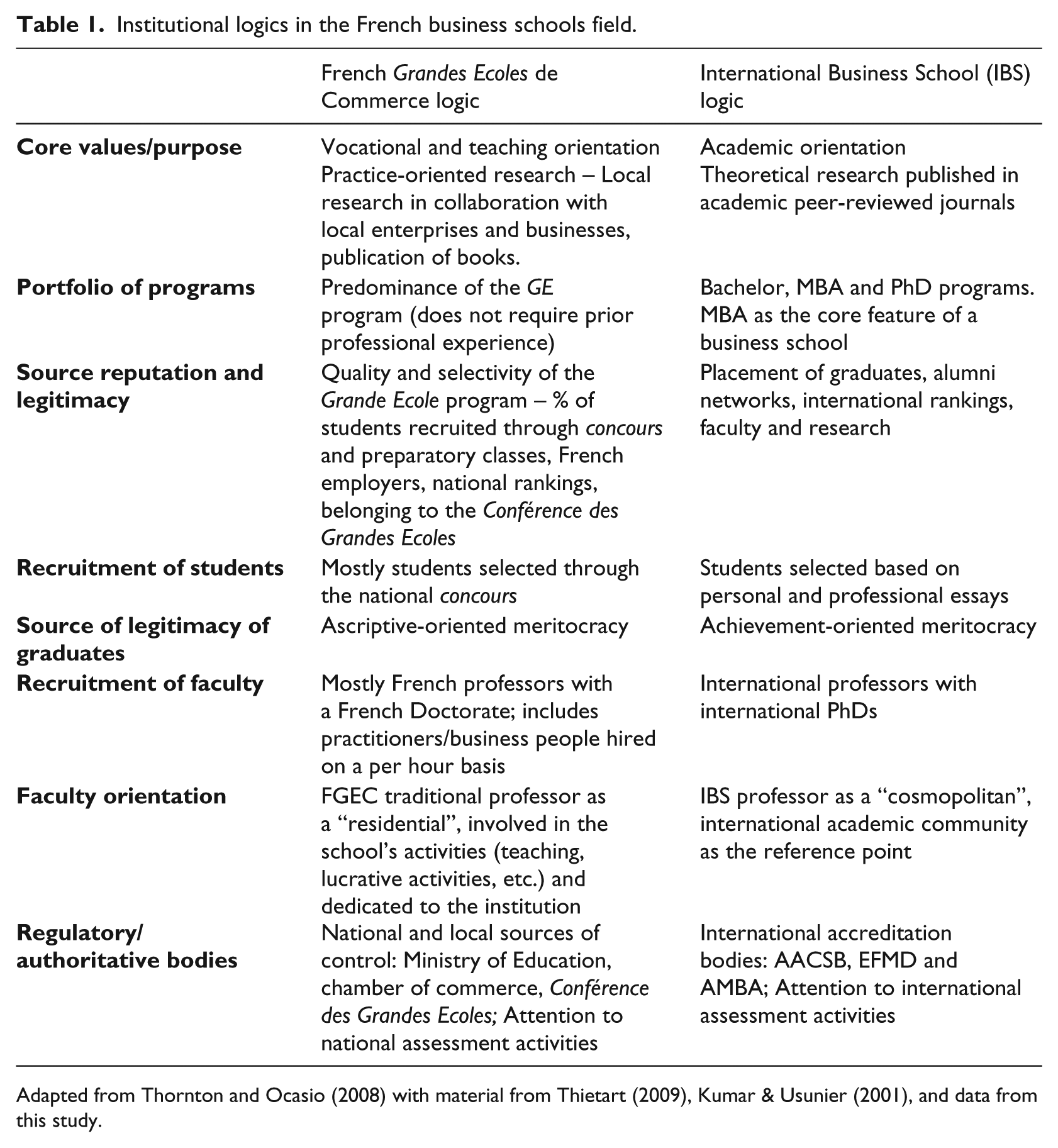
Adapted from Thornton and Ocasio (2008) with material from Thietart (2009), Kumar & Usunier (2001), and data from this study.
Differences between the institutional identities embedded in the two logics are particularly evident in their implications for student and faculty recruitment. To recruit the best and brightest French students and continue to receive financial and symbolic support from domestic constituencies, French business schools needed to demonstrate their commitment to the Grande Ecole logic through retention of the concours system of student selection. But this practice is signally unsuitable for the recruitment of overseas students and constrains the internationalization of the student body (De Fournas, 2007; Kumar & Usunier, 2001).
The implications for faculty hiring were (and are) also problematical. On the one hand, traditional Grande Ecole activities (e.g., coordinating programs and tutoring students) required the customary cadre of permanent professors committed to the vocational approach (Thietart, 2009). On the other hand, the international logic implied the need for faculty with a strong focus on academic research and the ability to publish in non-French academic journals. For this logic, research was a significant—if not the most important—part of a faculty member’s activity. As Courpasson & Guedri noted: Doing little or no research inevitably leads them to see themselves as teachers. In other words, everything happens as if it is research that represents the job: doing or not doing research is decisive in giving yourself an identity, even before discovering whether what you are doing is any good or not. This point is a very important one, since it presupposes that the identity of French teacher–researchers in management is largely based on how they relate to research activity more than on how they relate to their teaching activity as such. (2007, p. 185)
Research Design and Methods
According to Thornton et al. (2012), a useful way to study the interrelatedness of institutional logics and the dynamics of organizational identity is to focus on variation across material practices associated with each logic. Our paper is structured around comparative and longitudinal case studies because this method allows the observation of how variation occurs in a particular context (Eisenhardt, 1989; Eisenhardt & Graebner, 2007; Lee, 1999; Yin, 2003).
We chose to study the response of French business schools (FGEC) for several reasons: the theoretical issues of interest to us were readily apparent; there was clear prima facie evidence that schools were facing institutional complexity; and the institutional complexity confronting French business schools was of relatively recent origin, which meant that data were probably available. Further, it was likely that several data sources would be obtainable, enabling their triangulation.
Field work was conducted in two phases. The initial phase in 2008 provided an overview of the field of business education in France and confirmed that the Grandes Ecoles were experiencing institutional complexity—our central theoretical interest. It also suggested that organizational identity (a term not used by respondents, but implied by their frequent referencing of their school’s “past”, “history”, “legacy”, “prestige” and “status”) was affecting how the complexity was being handled.
In this exploratory phase, two data sources were used: archival materials supplemented by interviews. The first author studied 25 websites and press articles (primarily l’Etudiant, Les Echos and The Financial Times), and reports from the Ministry of Higher Education, the National Commission for the evaluation of training and qualifications in management and the Conférence des Grandes Ecoles; in all, a total of approximately 950 pages. Fifteen interviews in 10 schools were conducted to learn of their understanding of internationalization in the context of business schools in general and their particular institution. The interviews lasted 1 hr 15 min on average, were all tape-recorded and then transcribed verbatim.
The exploratory phase led to the selection of four cases for more detailed analysis and comparison. The basis of the sample selection was twofold. First, all four schools indicated that they were experiencing institutional complexity. Second, two cases (ESSEC and ESCP Europe) had long held elite status, whereas for the other two (Grenoble EM and Euromed Management) national rankings placed them below the elite and their relative status (as indicated by the annual rankings) was less stable (Figure 1 provides rankings from 2000 to 2012).
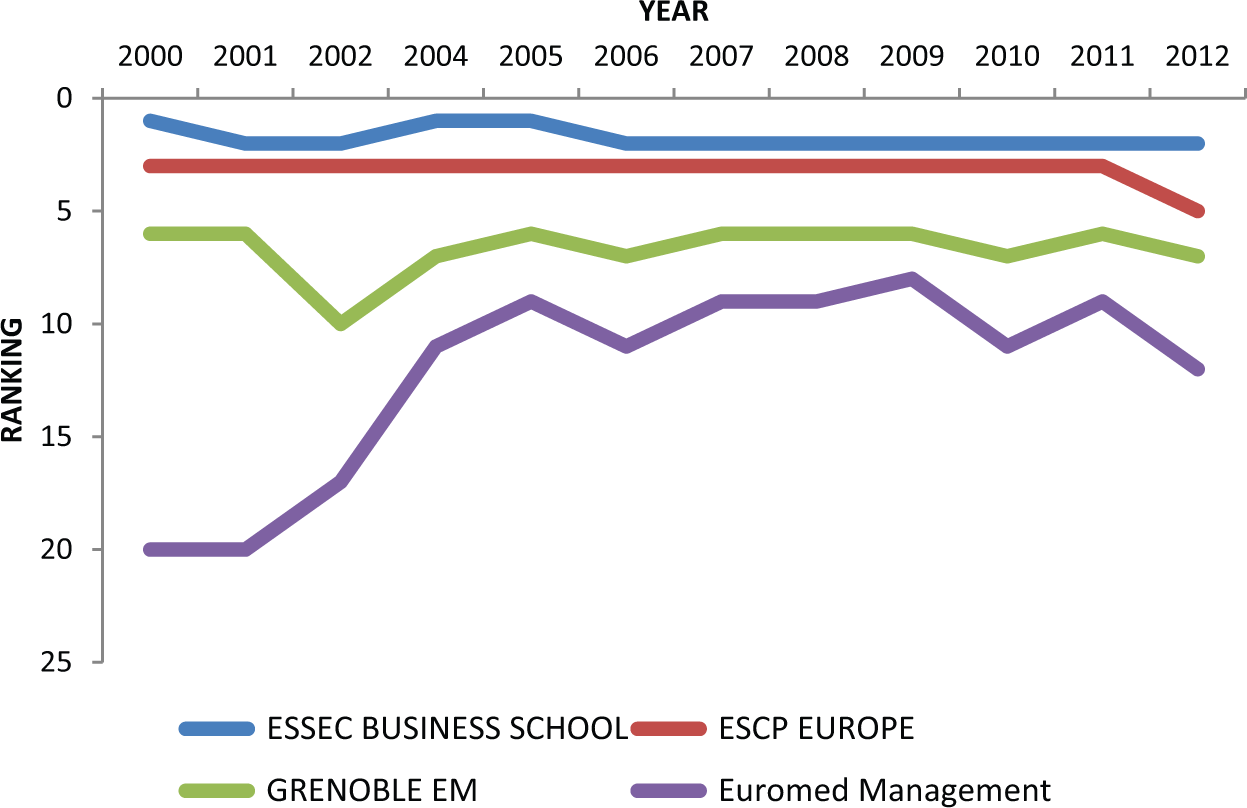
Evolution of the national rankings of schools.
Data sources
Data relating to each school were collected for the period 1990 to 2010. Again, two sources of data were used—archival materials and interviews—in order to minimize the risk of retrospective rationalization (Eisenhardt, 1989; Golden, 1997). In addition, the use of two data sources combined with two years “in the field” provided further confidence in the reliability of the data set (Lincoln & Guba, 1985). Archival materials included communications intended for organizational members (e.g., executive memos) that related to strategic, operational and cultural aspects of the organization (Corley & Gioia, 2004) and external communication, including the schools’ websites, press releases, newsletters, brochures, recruitment announcements, organizational histories and other archival material (Ravasi & Schultz, 2006). We also consulted the French press (primarily l’Etudiant and l’Express) and the international press (The Financial Times); in all, a total of approximately 450 pages. These archival materials allowed us to reconstruct the activities of the four cases from 1990 to 2010.
Archival materials were supplemented with 41 semi-structured interviews (in addition to the earlier 15): 11 interviews were conducted at ESSEC, 10 at ESCP Europe, 10 at Euromed Management and 10 at Grenoble EM. Respondents were key senior informants, initially identified during the exploratory phase of fieldwork, and subsequently through the use of snowball sampling. Our interview sample was guided by the approach that looks at “the overt claims made in articulating the features of organizational identity” (Gioia et al., 2013), especially the claims of “organizational leaders in particular” (Ravasi & Phillips, 2011, p. 106). Therefore, the sample focused upon professors, senior administrators, deans and associate deans. Where possible, interviews in each school were conducted with organizational members employed in the focal business school at least since 1990, and care was taken to include proponents of both logics, in order to capture the full range of opinions (Guba, 1981). Interviews averaged one hour, were open-ended and followed a protocol that was adapted to each school and to the interviewee’s institutional role. General questions included in the interview outline covered the major critical events over the past 15 years, mostly in terms of international initiatives and how these impacted the daily activities of the school. All interviews were tape-recorded, transcribed verbatim and coded according to themes identified through iterations with relevant literature. Certain informants were interviewed more than once in order to revise interpretations, seek clarifications and pose follow-up questions. Informants were allowed to use their own terminology and address issues they felt best represented their understanding of the situation.
Data analysis
We approached our analysis through an in-depth comparative analysis of the differences and similarities between the cases (Eisenhardt, 1989; Eisenhardt & Graebner, 2007). To do so, for each school we started by drawing a chronology of the changes to its core practices that were made during the research period. We focused on two key dimensions—the school’s approach to its core Grande Ecole program, and the extent and nature of its research activities. As noted earlier, the practices of each logic are different—the GE’s traditional emphasis is on the Grande Ecole program, and the IBS’s emphasis is on theory-driven research and publication in non-French outlets. Once we had reconstructed the narrative chronological accounts, we confirmed their accuracy by reporting them to a small number of informants. We then directly applied our two theoretical questions to the accounts. We asked of the data: how did this school experience institutional complexity, and how did it respond?
For this purpose, we relied on “focused coding”, by adopting frequently reappearing initial words and phrases, or codes, to sort and synthesize the data (Charmaz, 2002, p. 321). This initial appraisal of the data sought to identify emerging issues and themes using the words of the respondents. We then shifted our focus to a dialogue between theory and data as is common in this form of research (Chiles, Meyer, & Hench, 2004; Eisenhardt, 1989; Langley, 1999; Ragin, 1994; Wodak, 2004). Our analysis of the interviews and written material revealed that both institutional and organizational identity (and mainly perceived status and core attributes) played a crucial role in framing the experience and responses to complexity in all four schools. These observations resonated with an emergent stream of research that foregrounds identity as a key filter for processing institutional complexity.
This step of the data analysis allowed us to collapse our initial codes into categories and identify relationships among them (Strauss & Corbin, 1998). Then, insights from each case were compared in order to identify how identity played out in their accommodation process. In particular, we compared the two high status schools with the less prestigious ones to generate a set of themes that we subsequently interpreted to differentiate between schools’ interpretations of nascent institutional complexity. For example, respondents in the non-elite status schools referred to their ambition to “compete with high status schools on an international scale” as falling short of their aspiration to do so on a national scale—which we labelled opportunities for status reconfiguration; whereas respondents in high status schools referred to their desire to “sustain” their current status and “extend” it to the international arena—which we labelled: opportunities for status extension. The final stage of analysis abstracted the categories into two aggregate theoretical constructs: signalling, and identity aspirations. Our analysis focused on the early years of the implementation strategy.
The abstraction of our thematic codes and the relationship between them (Miles & Huberman, 1994) led to a framework anchored both in our data and in the literature, encompassing the role of identity (both organizational and institutional) in organizational coping with institutional complexity. Figure 2 summarizes the data structure, showing the data sources that underpin the categories and aggregate constructs. Table 2 provides illustrative data for each of the categories, which are clustered under the two aggregate constructs.
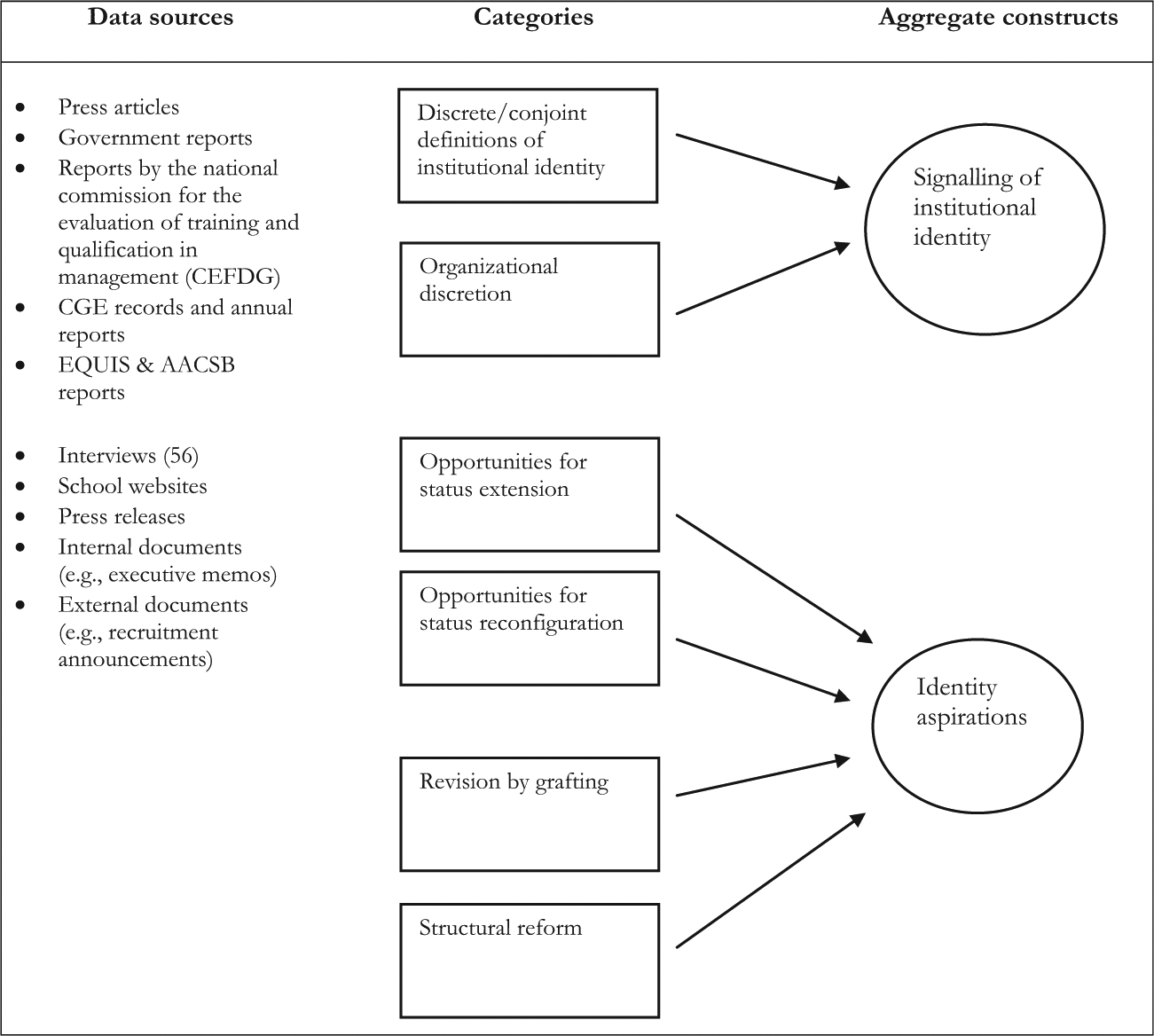
Data structure.
First-order codes, categories, aggregate constructs and illustrative data.

A final step of our analysis of the evidence was to confirm our preliminary findings by conducting two supplementary interviews in each school. These served to assure that we were not introducing analytical biases. Further, throughout the various stages of data analysis we sought to increase its “trustworthiness” and our analysis by using several of the methods recommended by Lincoln and Guba (1985): we triangulated sources of data and used “member checks”, presenting our chronological accounts and preliminary insights to representatives of each of the four cases. Furthermore, we checked the reliability of the coding framework and our coding by using a co-analyst. Following the practice of other qualitative studies (Dutton, Ashford, O’Neill, & Lawrence, 2001; Jarzabkowski, 2008), we gave another researcher the field-level and four case chronologies (enabling her to contextualize the data analysis), as well as samples of the raw data. A comparison of our coding and that of the co-analyst reached the acceptable reliability rating of 90%.
Findings
The role of institutional identity
It was clear from our interviews that even after importation of the IBS logic, not one of the four schools contemplated compromising its status as an accredited FGEC. As one senior professor put it: It would be suicidal not to call ourselves a Grande Ecole in France … the brand is so strong here that it would be a shame to abandon it. The reputation of the school is based on this program; the social, intellectual and historical capital as well. (ESCP Europe Interviewee)
Further, as the Conférence des Grandes Ecoles, summarizing the responses of the FGEC, reported in 2006: “While diversifying recruitment, FGEC want to preserve the specificities of their model, mainly, the originality of the preparatory classes and the GE program” (CGE White Paper, 2006).
Despite this, deans and administrators within the four schools each emphasized their international ambitions: Up until now, our school has enjoyed a good positioning in the French market—the challenge now is to properly position it in the European market to achieve our international objective. (Previous Dean of ESCP Europe, in Servan-Schreiber, 1994, p. 149) FGEC embarked on multiple international initiatives from the 1970s onwards. But since the 1990s, internationalization has become the cornerstone of schools’ strategies. (CGE White Paper, 2006)
Given that two of the four schools were not as privileged by the GE logic as the elite status schools, we were somewhat surprised by this shared view that the GE program should be protected and by the shared response towards the incursion of the IBS logic into the French arena. Why did all four business schools proactively and willingly work to retain aspects of the GE logic and introduce aspects of the IBS logic?
One reason was that important agencies at the field level valued the Grande Ecole logic and put pressure on all four schools to preserve it. Such pressure mainly stemmed from the Conférence des Grandes Ecoles (which includes representatives of all schools), alumni associations, employers, the media, chambers of commerce and the Ministry of Education (which exerts a regulatory role). Each of these field-level intermediaries expected the Grande Ecole model not only to endure, but to be actively nurtured.
Employers are very willing to accept GE students and are satisfied with this model. I don’t think they’ll encourage any particular changes to the model because the GE identity is not enough to take up the globalization challenge. I think we’re making our way and that you won’t see any radical change. (ESSEC interviewee)
Because they were well connected to these field-level actors all four business schools were recipients of the same pressures and institutional demands. Moreover, all of them valued and benefited from the endorsement that they received as providers of the GE program—i.e., as members of the FGEC category: We don’t want the fact that we’re a French school to stop us developing internationally, but on the other hand, we don’t want to forget our roots. We’re still very important in France and most students still come from the French market. The Grande Ecole is the flagship; a lot of students come from preparatory classes, so we can’t risk no longer being recognized in France just because we want to be “international”. It’s just not worth it. (ESSEC interviewee)
In other words, the decisions and practices of the schools had to conform to the traditional institutional identity or risk losing endorsement and support: as one ESSEC faculty member put it, “we spend a significant amount of time wondering how to ensure that our decisions don’t harm the renewal of the accreditation of our GE program by the French Ministry of Education”.
Yet, French business schools could not ignore the IBS logic. That, too, was not an option. Neither they nor the field-level actors were immune to the growing normative influence of international accreditation agencies such as EQUIS and AACSB, or from the scrutiny and influence of international media rankings. All players in the French system were being made increasingly aware of practices outside France, not only in North America, but also throughout continental Europe. Moreover, agencies underpinning and pushing the GE logic often acted as conduits and proponents for ideas within the IBS logic. For example, the Conférence des Grandes Ecoles redefined what an FGEC stood for: FGEC are not a French exception as widely understood. The way that they are organized and function conforms to that of the dominant international business school model: American, English, Canadian, Spanish or Indian. (CGE White Paper, 2006)
Similarly, starting in the mid-1990s, national rankings within France gradually increased the amount of attention given to international criteria and began to emphasize the international profile and research activity of business schools in addition to their traditional focus on “selectivity” and more particularly the percentage of students recruited from the concours. An important indication of this shift in attention towards research was the inclusion of international journals in the list compiled by the influential National Center for Scientific Research, the largest governmental research organization in France: The influence of this ranking seems very important, at least for the Grandes Ecoles, because traditional rankings now base part of their ranking on [the number of publications in journals established by this ranking]. The ranking […] involves a large majority of English language journals in Economics or Management […]. They significantly underestimate national journals, particularly in the field of Social Sciences. (Charreaux & Gervais, 2007, p. 5)
These field-level agencies—although guardians and protectors of the GE logic—saw no reason why French business schools could not assimilate international practices and successfully compete with elite non-French schools. In fact, at times there was an expectation that French business schools should assume their appropriate place in the international order, as reflected in the following statement by the National Commission for the evaluation of training and qualifications in management: This internationalization is not a passing fashion; it is a logical consequence of the need to contribute to the growth of competitiveness in France and in Europe. Management training must indeed be considered as an “industry” which can be “exported,” which in this case means attracting students of other nationalities. French assessment systems (CEFDG) and international accreditation organizations (EQUIS, AACSB) play a normative role in this area and, in the long term, no school will be able to escape from these processes as they become more and more widespread. (National Commission, 2006)
In other words, the message being provided to French business schools was that they should be proud of their tradition but also engage the international dimension of the IBS logic.
The role of organizational identity: Status and core attributes
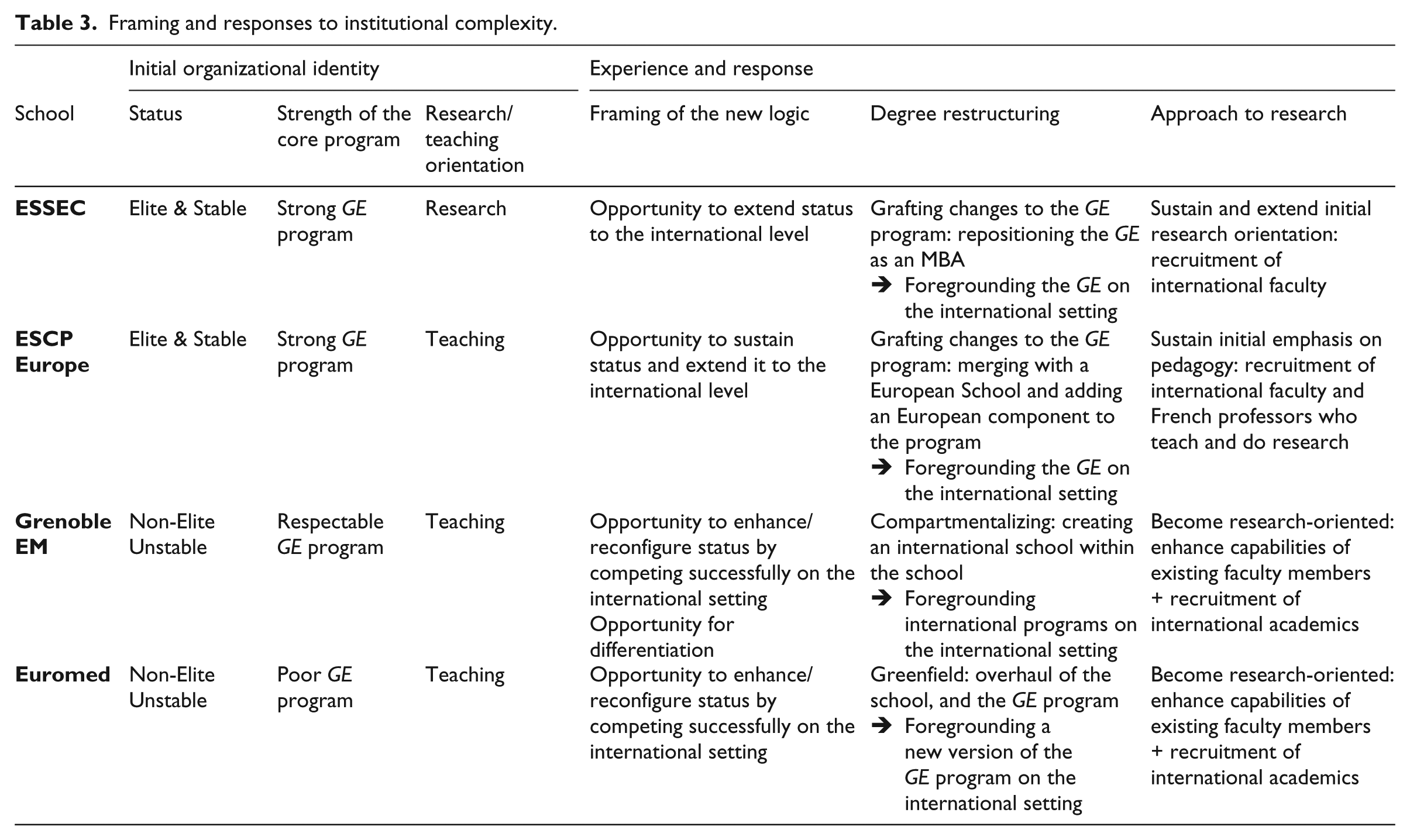
In response, and contrary to our expectations, each school retained their GE program, remodelled it, diversified their students’ recruitments, introduced new programs and/or developed existing ones, put more emphasis on research activity and recruited research-oriented faculty members. Yet, despite this overall similarity in framing the new logic as an opportunity, and the broad similarity in their responses to it, there were important differences between the schools. These responses are summarized in Table 3.
Framing and responses to institutional complexity.
Framing
The two elite schools basically saw the new logic as a means of extending their existing prestige into the international arena. Given that the IBS logic was now part of their organizational field and could not be ignored, becoming members of the elite category of international business schools was consistent with their identification of themselves as having high status.
ESSEC illustrates this response. It believed that embracing the IBS logic and gaining greater international prominence was consistent with its existing trajectory of accomplishment, and that international visibility would confirm and extend its elite status. Its domestic status position, in other words, would be applied to a wider arena. Hence, in 1997 its rationale for applying for AACSB accreditation was that it would: Enhance the notoriety and prestige of our programs. It will allow us to confirm our innovative character in France … On an international level, the accreditation confers to its member schools a notoriety and credibility that none of the European business schools have. (ESSEC records, 1997)
In contrast, non-elite schools perceived adoption of the IBS logic as a means of working towards their goal of being recognized as elite schools, which they knew was highly unlikely to happen within the domestic arena under existing arrangements. They recognized the cycle of disadvantage to them built into the GE system (especially for the lower status), because the national rankings traditionally emphasized the selectivity of the GE program (by measuring the percentage of students coming from preparatory classes) as a standard of its excellence. High status schools came to attract the brightest students from preparatory classes, and ultimately more resources, which in turn served to elevate their status and prestige level, and eventually to sustain the national status hierarchy. For non-elite schools, achieving success by relying solely on the national criteria of excellence was, therefore, virtually difficult. Instead, it sustained their non-elite classification in the national rankings.
All this cultural weight means that we don’t really have any control over the rules of the game, because the preparatory classes are themselves ranked according to the number of students they get into the best ranked schools, so it’s a vicious circle if you’re trying to convince the different players. (Euromed interviewee)
Euromed’s behaviour is particularly revealing. Dissatisfied with its modest domestic status, it saw the IBS logic as a way of identifying with a different comparison group, which if it could be successfully accomplished, would precipitate a reassessment of the school’s domestic status. For Euromed, in other words, the new logic offered a method of disrupting the domestic status quo and of stabilizing and even enhancing their domestic status ranking. Looking back, one senior professor admitted that: We were particularly stigmatized—other schools and the press used to call us “ESC Calanques”, the “beach school”—the school where students don’t do much work.
Therefore, he/she continued: Back in 2002, the idea was to rely on international standards to reinvent the school and refine its reputation and position in France. We aimed to become a Top 10 school in France by conforming to international standards, and ultimately, to become a recognized and specific school in Europe.
Euromed, thus, successfully used its growing status in the international arena as a means to reconstruct its domestic status: The EQUIS [accreditation] gave us both international and national recognition: the accreditation process pulled us up. MBAs were a part of it—by introducing the accreditation process, we gave ourselves something that GE at this stage couldn’t. This let us skip a few steps. I think this was a very wise strategy, because after seven years (everything was instigated in 2005–2006), the result has definitely been worth it. In fact, international accreditation has given us national visibility and enabled us to work the French ranking system.” (Euromed interviewee; emphasis added)
Although similar to Euromed in its framing of the new logic as an opportunity for status reconfiguration, Grenoble EM offers a slightly nuanced picture. Grenoble EM was rather satisfied with its status ranking in the late 1990s, given its short history. This status was built on the GE program, which quite quickly became attractive. Yet, Grenoble EM saw itself as a “fragile” school that lacked resources (relative to ESSEC and other members of the elite French schools) and recognized that achieving an elite status nationally was virtually impossible. Therefore, they believed that the new logic (i.e., accreditations and rankings) could offer them the possibility to differentiate themselves, to “benchmark against other schools and standards… and be sure that we were on the right track”, as highlighted by a senior administrator.
In other words, Euromed and Grenoble EM believed that they could compete with elite schools on the international circuit; and, that doing so would help consolidate and stabilize their domestic status ranking. Therefore, they interpreted the new logic as a way to challenge the established elite schools in a different context—the international environment—where different standards were to be found: We see ourselves as a school that pushes really hard and that has achieved much, since the beginning. Our counterparts recognize us for that rapid change. But, we are aware that we are right below the top-tier schools, and that we will never cross this boundary nationally. I think there will always be a world between the first schools and us; but we are at the top of the second-tier schools, and we can challenge the first-tier schools on the international level. (Grenoble EM interviewee) We entered The Financial Times Master in Management ranking two years ago and were immediately in the twenty second position. For us, this was much more important than gaining one position in the ranking of l’Etudiant. I don’t believe we will ever do better on a national level, but we can always challenge our competitors on an international scale. (Euromed interviewee)
Comparing the four schools, therefore, reveals how their respective status led to variations in interpretations of how they should incorporate the IBS logic. The elite schools saw the opportunity to extend their current status to a new arena whereas the less prestigious schools saw the opportunity to reconfigure their status. In this sense, status mediated the relationship between institutional complexity and its interpretation.
Status not only shaped how opportunities were framed, it also affected how complexity was translated into practices. This effect is particularly shown in how the four schools approached the design of their core degree program and their approach to research and teaching—i.e., two of the core practices that distinguished the two logics. Interestingly, the elite schools—in their respective ways—were more conservative in the changes that they introduced, essentially building on their existing core practices that were associated with their high status; whereas the non-elite schools were motivated by their aspirations to improve their current practices and/or foreground new practices on the international arena—rather than by existing attributes. These schools were, in this sense, less conservative in the changes that they adopted. Table 3 summarizes the responses of the four schools.
Implementation
In all four schools, the centrality of the GE program—and its characteristics in terms of the recruitment of students via concours—remained salient. Yet, because of their different interpretations of the opportunities generated by the addition of the IBS logic, they redefined their core GE program in different ways. ESSEC’s response was to build directly on to its Grande Ecole program. In 1999, it chose to revise the curriculum of the Grande Ecole program, reinforce the international and professional experience for its students and recruit a contingent of international students, and declare it to be an MBA of “a different kind”. It built on what it believed to be its traditional core strengths, highlighting the value of the GE program and in doing so expected to “internationalize the school without downgrading the ESSEC GE program”, and “not suffer from cognitive dissonance between the flagship program of French Business Schools—the GE program—and that of any other university in the world—the MBA program” as highlighted by the dean. After all, it was this program that had provided the historical basis for the domestic media rankings. As a senior administrator put it: “In France, ESSEC is very well recognized. When you say ‘ESSEC’, the reference is the GE program’s quality and selectivity.”
Ultimately, ESSEC’s approach did not succeed because it was unable to have its revised GE program included in the Financial Times rankings of MBA programs. The school abandoned its efforts—in 2010 the Grande Ecole program was retitled as a Master in Management and a separate fully-fledged international MBA was introduced for submission to the Financial Times.
ESCP Europe also sought to foreground its core GE program. In the late 1990s, ESCP Europe was a recognized elite school but was in the shadow of its Parisian counterparts (mainly HEC, the very highest status school, to which they were compared unfavourably by their common governors). In 1999 it merged with a French European Grande Ecole that had a significant contingent of international students, professors and campuses in Europe. Through this merger, the school sought to “capitalize on ESCP’s history, while adding a European dimension” (ESCP Europe interviewee). The merger resulted in a GE program with two tracks—the “ESCP track” (i.e., the traditional GE track) and the “EAP track”, in which students spent three years in three different countries—thereby retaining many elements of the original programs. But, as for ESSEC, the strengths of ESCP Europe’s core GE program remained paramount: Other programs have developed, but on the periphery, and even today when we meet to discuss the school’s evolution and program portfolio, issues around the GE program are the main focus, while other questions are left out. (ESCP Europe interviewee)
Both elite schools, in other words, endeavoured to highlight the GE program in their internationalization strategy and essentially grafted changes onto it, rather than undertake fundamental reform, or highlight their existing set of international programs. Other programs were developed, but for each school the fundamental centre of gravity remained the GE.
The two non-elite schools did different things. Created in 1984, Grenoble EM had long sought to be recognized as an FGEC of consequence. But in the late 1990s, as the new IBS logic emerged, members of the school, who perceived its status as “respectable” (given the school’s brief history) but as “fragile”, were more open to alternative possibilities. Grenoble was thus less dogmatically committed to its GE program. On the contrary, in response to the IBS logic it decided to build an international reputation based on international programs that incorporated international standards. While the GE program was rendered more international by including residence in foreign universities and overseas internships for its French students, greater emphasis was placed upon international programs that formed the basis of an international school (Grenoble Graduate School of Business [GGSB]). While initially poor in terms of quality, these programs “became more selective with the accreditations” as highlighted by the dean, and the school sought to build on them to compete on the international setting: it was these international programs, not the GE program, that were submitted to the Financial Times. Grenoble EM’s response then consisted in “compartmentalizing” (Kraatz & Block, 2008) national and international constituencies: The GE program is anchored in the French tradition of Grandes Ecoles; it is ranked in national rankings … It has a fair amount of internationality. [Our international programs] adhere to global traditions and standards, so these programs appear in international rankings. Sometimes we are told that our GE program is not international enough because there aren’t enough overseas students in it. This is paradoxical, since we have more than 1000 foreign students in our international programs next door. (Grenoble EM interviewee)
The second non-elite school, Euromed Management was of longer standing—it was established in 1872—and approached the opportunity to reinvent the school by redesigning its current practices and reconstructing its core GE program. In this respect, it resembled ESSEC and ESCP Europe, even though Euromed’s GE program was performing less well in the national rankings—but Euromed recognized the necessity to reconstruct this program to become a “respectable” FGEC: We started implementing changes in the Grande Ecole program because this is the flagship of FGEC. This program was way behind other GE programs in France, so this was where we had to start. (Euromed interviewee)
Further, Euromed radically redefined its core GE program (that was responsible for the school’s poor performance in national rankings in the mid to late 1990s); it also designed fresh new international programs—thereby adopting a “greenfield” implementation strategy; and, by drawing explicitly on the principles promoted by the IBS logic, sought to develop a very different identity for itself: Being an FGEC, there are many local rules we need to abide by. We need to keep recruiting students from preparatory classes, pay attention to national rankings and deliver a degree that is recognized by the Conférence des Grandes Ecoles and the Ministry of Education. But, we have developed an international identity that minimizes the impact of these commitments. That’s why, today, we consider ourselves an international school that happens to be in Marseille, and not the other way around. (Euromed interviewee)
The motivation for these more dramatic changes was that Euromed saw in the IBS logic an opportunity to break from national demands that offered little hope of status improvement.
Research
A critical distinguishing feature of the IBS logic was its emphasis upon the publication of research in international journals. In order to accommodate that logic, a commitment to research through appropriate hiring practices and the use of appropriate internal performance criteria, would be necessary. Again, the two elite schools differed from the non-elite schools in how they responded to this research imperative; and, also again, it was the non-elite schools that were the less conservative by acting upon their aspirations to become more research-oriented.
ESSEC already saw itself as a research-oriented business school and for members of the faculty research distinguished them from the majority of other French business schools. Thus, the rise of the IBS logic was perceived as consistent with the school’s identity and reinforced the existing recruitment of international faculty. However, the new logic prompted the introduction of a performance appraisal system more explicitly based on publications in peer-reviewed international journals: Newly-recruited professors at ESSEC are expected to publish heavily, as they were recruited for their potential to publish in the first place and ESSEC provides them with the means to conduct high-level research and publish in top journals. As a result, their relationship with ESSEC is very individualistic. (ESSEC interviewee)
In comparison, the high status of ESCP Europe was less underpinned by the practice of theoretically-oriented research than by its commitment to its pedagogical mission. Hence, even though the accreditation process directed the school’s attention to its weak academic performance—“the result of (the accreditation) process was that they thought … we didn’t produce enough research” (ESCP Europe interviewee)—the school’s response was to recruit professors from overseas whilst still emphasizing “French professors capable of delivering on an international level”. The school’s recruitment practice, in other words, reflected and maintained the school’s commitment to “teaching values”, which reflected the school’s identity: I think people would be extremely reluctant if the school started adopting such a drastic research-oriented discourse. So, we make sure to tell candidates for positions here, that although we expect them to be very good at research, we also expect them to be good professors. Dedication to research and publishing should not undermine the pedagogical role. (ESCP Europe interviewee)
In contrast, both of the non-elite schools began redirecting their hiring efforts in order to become more “research-oriented” and thus meet the standards of the IBS logic. They recognized that success on the international front would involve a major effort to improve their academic profile and in particular their capacity to conduct theoretical research: In 1999, we decided that accreditations would help us improve and the criteria they proposed appealed to us. We really did ourselves some harm … The first time the accreditation body told us, “it’s not that bad, but you don’t do enough research” … It was like blaming a student and telling him that he can do better … But we were small, recent and fragile, and the only way to exist was to accept the rules, no matter what they were. (Grenoble EM interviewee) The faculty was not that competent; there were only two people who held an habilitation qualification to supervise research, and those holding French doctorates were mainly external speakers. (Euromed interviewee)
However, both schools suspected that attracting research-oriented faculty would be difficult, and in the early 2000s sought to enhance the capabilities of existing faculty members: Our plan was to help our body of professors become better researchers. We trusted them and contributed massively to their doctoral studies. Every professor who decided to earn a PhD was able to do so and now we can start recruiting very competent researchers. The gap is acceptable. In fact, one of our new rules is to recruit only senior competent researchers. (Grenoble EM interviewee)
Nevertheless, both schools supplemented this approach (in recent years) by hiring international and more academically-oriented professors as suggested in the above quote and below: We can’t fire people who don’t publish in English or in international journals. But we can emphasize the recruitment of people who are able to do so. Recruitment is key for accreditation; for everything, in fact! (Euromed interviewee) In 2005, we started paying a lot of attention to peer-reviewed academic journals, referenced by evaluation bodies, like the CNRS, and the Financial Times. Between 2007 and 2008, we published 83 articles in peer-reviewed journals, including the International Journal of Research in Marketing, Marketing Letters, Organization, Research Policy and the Strategic Management Journal. This effort can only grow because it is at the heart of our mission. (Grenoble EM, Dean of faculty, the school’s website)
In both schools, the widening gap between professors initially affiliated with the schools and new recruits resulted in the creation of two “profiles” for faculty members—the “teaching” professors and the “researchers”. However, the senior leadership of these schools recognized that recruiting research-oriented faculty members had to be done if the school was to realize its status aspirations.
Hence, in their degree re-structuring and research prioritization strategies, both high status schools grafted changes onto their existing arrangements whereas non-elite schools adopted practices further way from their initial position and/or restructured their practices more significantly.
Discussion
These findings suggest how identity influences the experience of institutional complexity and the nature of organizational responses. In particular, they prompt three observations, each of which is elaborated below and summarized in Figure 3.
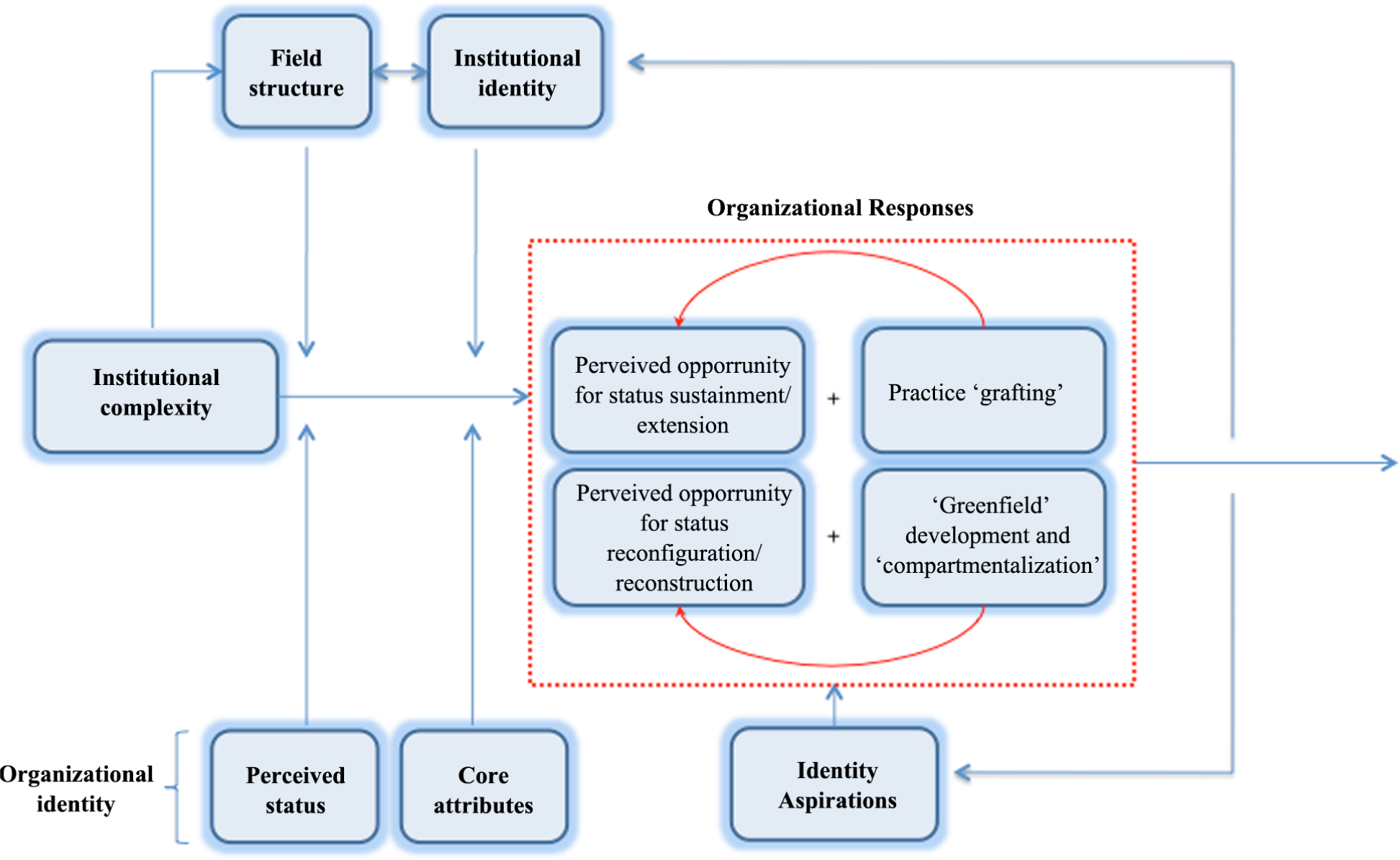
Identity-mediated responses to institutional complexity.
Field-level actors and the signalling of institutional identity
To date, studies have misleadingly tended to assume contestation as the normal scenario when several logics are in play. Further, the typical stance is that each logic is articulated and promoted by different field-level actors (e.g., Reay & Hinings, 2009; Goodrick & Reay, 2011; for a review, see Greenwood et al., 2011). Organizations, in this sense, are portrayed as recipients of discrete signals concerning their institutional identity. That is, audiences are shown as promoting a logic and as advancing an institutional identity. Under such a scenario, field-level tension and contestation would be a reasonable expectation, as organizations struggle to navigate these conflicting institutional demands, and theoretical attention inevitably turns to the internal processes of organizations, such as the extent to which a logic is “represented”, and/or to the strength of ties between organizations and proponents of each logic, as important determinants of organizational responses (e.g., Pache & Santos, 2012). Key assumptions of this approach are that conflict and political negotiation are essential mechanisms for resolving the contestation within organizations (Yu, 2013) and that there will be considerable variation in their responses.
That imagery and theorizing, however, is incomplete because it misses the possibility that logics may be signalled differently. Institutional complexity may not be projected as a contest between an incoming logic supplanting an existing logic. In our case, several field-level audiences and intermediaries were providing signals on the appropriate institutional identity for a French business school, including accreditation agencies, domestic and international media, professional associations, alumni, and governments. Some intermediaries solely articulated the IBS logic—such as the AACSB and the international media. But no intermediaries exclusively defended the traditional identity of the Grande Ecole logic. Even the Ministry of Education, and the Conférence des Grande Ecoles—upon whom business schools were particularly dependent for accreditation under the Grande Ecole logic—were themselves proponents of both logics and defined the appropriate institutional identity of French business schools as embracing both logics, even though responsibility for how that assimilation might be achieved was devolved to the organization. These agencies, the guardians and protectors of the GE logic, saw no reason why French business schools could not assimilate international practices and successfully compete with elite non-French schools. The consequence was that each of the four schools perceived that ideas arising from the IBS logic had to be translated and incorporated without severing their initial identities.
It is thus inappropriate to assume that institutional complexity and their implicated institutional identities is a contested struggle between logics invoked and championed by different audiences. On the contrary, signalling can take several forms. In particular, it might be a conjoint process with logics represented by the same referent audiences as being of equal importance.
Hence, to understand how organizations experience institutional complexity (in particular, whether that experience is one of conflict and political negotiation) it is necessary to take account of how that institutional identity is signalled by field-level actors—in particular, whether the signals are discrete—i.e., with each field-level audience signalling an exclusive concern with a particular logic; or conjoint—i.e., with audiences signalling support for both logics. In the former situation, the typical circumstance of previous studies, the organizational experience of complexity will be one of contestation and the pattern of organizational responses will exhibit high variability; whereas in the latter situation, the organizational experience of complexity will be one of logic compatibility, and organizational responses will exhibit low variability.
The organizational experience of complexity, however, is not only determined by whether signalling is discrete or conjoint. In our case the signalling also lacked specificity in how the two logics should be accommodated. Although the field-level intermediaries shared agreement on the importance of the IBS logic, responsibility for translating the IBS logic into structures and programs, and providing the details of the new identity was devolved to the organization—much in the way observed in Edelman’s studies of affirmative action in the US, where legislation was “filled in” by local professionals (Edelman, 1990, 1992; see also Edelman & Suchman, 1997; Dobbin, 1992). In Pache and Santos’ (2010) terms, there was field-level agreement on broad goals but a lack of signals over means. Organizations lacked guidance on how to accommodate both logics and thus had significant discretion to move according to local preferences. In these situations of discretion, the likelihood that the experience of complexity will be one of contestation is especially low. In short, the structure of the signalling process matters.
It would be misleading, however, to portray the process as exclusively top down, i.e., to assume that an institutional identity comes “from” the field “to” its constituent organizations. The process, we suggest, is not sequential but more reciprocal, engaging both organizations and field-level actors. Field-level actors’ signalling of institutional complexity and an organization’s experience of it are concomitant. To wit, in our context, while field-level actors acted as proponents of both logics, the actual accommodation of both logics by field-level actors enriched the definition of institutional identity as inclusive and not narrowly or exclusively drawn around a particular logic. The field structure combined with organizations’ social construction of the logics as compatible contributed to the perception of the new logic as an opportunity, and reinforced and “filled in” the re-framing of institutional identity. That is, logics per se are not intrinsically incompatible; on the contrary, they are socially framed as such.
Identity aspirations and organizational responses
Movement towards the new institutional identity in our study was shaped by organizational identity but not in the way that would be anticipated by existing works. We found no evidence that the newly introduced IBS logic was perceived as constituting a threat (although advocates of the traditional, vocational logic feared that their role within the school would be diminished). This shared optimism runs counter to previous work in which central and prestigious organizations are portrayed as typically resistant to institutional change because it is assumed that an incoming logic will disturb the benefits that they derive from existing arrangements. Following Leblebici, Salancik, Copay, and King (1991) studies of institutional entrepreneurship and change have confirmed that change is more likely to be initiated from lower status organizations at the periphery of organizational fields because organizations in those locations are less advantaged by prevailing arrangements (Hardy & Maguire, 2008; Wooten & Hoffman, 2008). Centrally-located organizations, in contrast, that enjoy high status and its associated benefits, are much less likely to initiate or embrace change (although, see Greenwood & Suddaby, 2006; Durand & Szostak, 2010; Goodrick, 2002). Given that two of our cases had well-established elite status, this apparent lack of resistance to change was puzzling.
Partly, this response no doubt followed from the projections of the field-level actors that the two logics are compatible. But acceptance of the need for change is not the same as embracing change as an opportunity. Hence, the idea that high status organizations will resist change because it will be seen as threatening benefits that flow from their current identity can only be part of the story, and in need of further consideration. Our interpretation is that existing theory misleadingly assumes that it is only current status and prestige that matters and that drives an organization’s response. Our context, however, suggests that organizations may be motivated less by their current identity and status than by their identity aspirations —i.e., by whom they would like to be rather than who they currently are. What matters is not how an organization sees itself—i.e., what it is—but how it wants to see itself—i.e., what it wishes to become. Institutional complexity, in this sense, can be experienced as providing opportunities for accomplishing an aspired identity. Organizational responses to complexity, therefore, will depend upon the nature of those aspirations—of which status plays an important role and one that leads organizations to respond differently to institutional complexity.
Status mediates the relationship between institutional complexity and organizational action by affecting perceptions of what is possible and the scale of changes needed. Organizations already enjoying the benefits of elite status are less likely to perceive the need for dramatic change and, in so far that they do see such a need, they will be less motivated to undertake such change for fear of risking existing benefits (Greenwood & Suddaby, 2006; Hardy & Maguire, 2008). Consequently, for elite organizations it makes sense to make adjustments to existing practices rather than to undertake fundamental change. For high status organizations, responding to complexity implies a process similar to Nag, Corley, and Gioia’s (2007) concept of grafting of revised practices onto traditional core strengths. Moreover, the purpose of change is to gain status extension—i.e., the movement of their existing status into the field or fields opened up by the incoming logic. Hence, in our study the two schools with elite status responded to the evolving institutional complexity through adjustments that built upon existing arrangements—notably the Grande Ecole degree, and their respective initial emphasis on research or teaching.
One could argue that this response mechanism, revision by grafting, is a measure of hubris —i.e., there is no perceived need for dramatic change (e.g., Milliken, 1990). Indeed, the response of both elite schools in our study reflected their perception of themselves as already prestigious and thus the changes that they introduced were extrapolations of existing practices. In fact, one of the cases illustrates the temptation for a higher status school to attempt to enforce existing practices onto the new logic—by going as far as to put forward its GE program as a genuine MBA. Yet, in both schools, change was considered necessary and their strategy eventually switched through the years, as they directed their attention to existing and new international programs, and recognized that their international reputation could not only depend on their existing GE program.
In contrast, organizations whose status is below their aspirations are more likely to interpret institutional complexity as providing opportunities for status reconfiguration and reconstruction. For them, the “identity gap” (Ravasi & Phillips, 2011) is more pronounced and acts to motivate them to set goals that are not necessarily closely aligned with their current identity. Moreover, they are more open to structural reform, rather than revision by grafting, because they do not associate existing practices as serving their interests. Similar observations—of low performance triggering more fundamental change—have been reached by other theoretical perspectives, notably organizational learning theory (see Greve, 2003) and the behavioural theory of the firm (Gavetti, Greve, Levinthal, & Ocasio, 2012), although in those studies emphasis is placed exclusively upon “performance aspirations”. Our findings nuance this theme by emphasizing the role of status aspirations.
The key point is that status filters the experience of complexity by framing the nature of the opportunities that will be perceived. Organizations with established and secure elite status will interpret it as means for status extension, that can be achieved by grafting changes “onto” existing arrangements; whereas organizations with lower and less secure status will see it as a vehicle of confirmation and enhancement that can more readily be achieved by structural reform. Status, in this sense, mediates the organizational interpretation of institutional complexity and produces variation in their responses.
Our study indicates that there is an important mechanism at play in this process. Institutional complexity that arises from the assimilation of a new logic brings with it an extended institutional infrastructure of field-level intermediaries to whom organizations can connect. This expansion of the network of social referents does two things. First, it brings about potential new inter-organizational structures and relationships, and the opportunity to constantly benchmark the features and “best practices” (Gioia et al., 2013) of a wider group of organizations (such as, in our case, non-French business schools accredited by the same agency and that are ranked in the same international rankings). In other words, the rise of a new logic expands the social referent groups of organizations and makes current institutionalized arrangements less pertinent and thus less constraining. In effect, the new logic opens the possibility of reflexivity and thus the adoption of novel practices (Battilana, Leca, & Boxenbaum, 2009). Second, organizations are able to legitimate their aspirations and efforts by appealing to the “authority” of the new, wider group of referent audiences who may be more receptive to an organization’s status aspirations than is provided by referents in the existing institutional context. Institutional complexity, in this way, provides influential and normative cues regarding acceptable and desirable practices, and provides alternative sources of legitimacy (Thornton et al., 2012).
Conclusion
The motivation for this study was to better understand how organizations respond to institutional complexity by exploring the role of identity. Our first contribution has been to show that the experience of institutional complexity is shaped by the structure of field-level signalling, which establishes whether the institutional identities implied by different logics are to be treated as conflicting or should be assimilated. Contrary to the prevailing imagery of complexity as “institutional warfare” (Hoffman, 1999, p. 352), all four cases embraced both the new and the traditional logic. To explain this finding we spotlighted the role of field-level actors in defining the parameters of institutional identity and suggested that how logics—and their implications for institutional identity—are signalled affects the experience of complexity and thus how far organizational responses will vary. A second contribution is that, although there was resistance within the organization, complexity was seen by the leadership of all schools as an opportunity not as a threat. This suggests that, again in contrast to existing theory, organizational responses are shaped not by current identity but by identity aspirations. Our third finding is that an organization’s status affects the scale and format of the changes made. Taken together, these observations clarify and inform the role of institutional and organizational identity in our theorizing about institutional complexity.
Future research possibilities
Inevitably, our study of four cases has traded descriptive richness for generalizability. Examinations of other contexts where nascent institutional complexity occurs will help provide confirmation and nuancing of the observations that we have offered. In particular, studies outside the education sector would be particularly informative. It would also be interesting to extend coverage to low status organizations in order to ascertain whether their patterns of behaviour are distinctive. Do they, for example, exhibit even less conservative responses than the non-elites that we have examined? Are they more prepared to move towards an incoming logic and jettison the prevailing logic that serves them poorly? These are interesting questions that deserve consideration.
A rather different area of future research might turn attention to more explicitly capturing the unfolding processes of institutional complexity. Although we have focused upon identity as a key filter through which organizations understand and respond to institutional complexity, what we have not done is assess the extent to which organizational identities evolve and possibly change over time, as the new practices are adopted and affect interpretations and understandings. Lok (2010), in a rare discussion of the relationship between logics, practices and identity, suggests that actors can publicly adopt the practices derived from new logics, all the while subtly contesting identities associated with one or another logic. Further longitudinal research could tease out the relationships between logics, practices and discursive identity work. Similarly, Yu (2013) has shown how organizations can develop and negotiate an identity as they cope with multiple logics. In this sense, Yu takes a different stance to that adopted here, in that she treats identity as constructed in response to complexity—whereas we have treated identity as a filter of complexity. It would be interesting in future work to combine these approaches, both zooming in on politics within the organization whilst, at the same time, recognizing that any settlement reflects more enduring status aspirations and accomplishments.
Our paper has concentrated upon the responses of the four schools as “presented” to the external world. That is, we have not emphasized the internal tensions and struggles that occurred prior to the decision, for example, to submit a particular program for accreditation, or to the Financial Times. Similarly, we have not probed the details of how decisions to hire overseas scholars—whose main activity is to conduct theoretical research and publish it in international academic journals—unfolded. Instead, our purpose has been to focus upon the organization as a whole—not its subparts—and to examine how that unit of analysis formally responds to institutional complexity. By excluding attention to internal tensions and contradictions and to how those tensions are resolved (which is, for example, the focus of researchers such as Pache & Santos, 2010, 2012; and Courpasson, Dany, & Clegg, 2012) our story is inevitably incomplete. Consequently, further work could usefully turn to this line of inquiry because these issues are important parts of the fuller picture.
Footnotes
Funding
This research received no specific grant from any funding agency in the public, commercial, or not-for-profit sectors.