



Abstract
Although institutional work has recently attracted considerable attention from organization research, there is a surprising neglect of inter-organizational negotiations as a form of institutional work. This neglect is astonishing, since negotiations provide a unique opportunity both to study institutional change in settings characterized by diverging institutional logics and to illustrate how institutional constraints and strategic agency are linked in interaction processes. Based on a combination of the literature on institutional work and the theory of strategic negotiations, we examine in detail three illuminating negotiation processes taking place around International Framework Agreements on global labour standards. This examination reveals three types of (proto-)institutional outcomes produced by these processes: institutional creation, modification and stagnation. Whereas institutional creation and modification, albeit differing in quality, show how integrative negotiation practices of global unions might engage management in a joint endeavor for institutional change, institutional stagnation illuminates some of the pitfalls of negotiation work.
Keywords
Introduction
International labour relations have been the scene of repeated failures to establish a core of industrial human rights as the minimum labour standards for (business) organizations. This core is laid down in conventions of the International Labour Organization (ILO): prohibition of forced and child labour (ILO co. 29, 105, 138, 182), non-discrimination and equal pay (ILO co. 100, 111) and freedom of association and collective bargaining (ILO co. 87, 98). In many parts of the world these conventions are not only far from being fully institutionalized but are still extensively violated. In today’s cross-border production networks, coverage of employees by these standards still seems to decline with every step away from the core multinational corporations’ (MNCs) headquarters (HQs); the more peripheral an organization is, the less regulated labour relations are, in particular at the level of suppliers and subcontractors (Frenkel & Kim, 2004; Palpacuer, 2008). Therefore, it is no surprise that the shape of labour relations throughout global production networks, including subsidiaries, suppliers and subcontractors at the local level, is a highly controversial issue between MNCs and global union federations (GUFs), i.e. the international federations of manufacturing and service unions.
The Sisyphean experience with the dissemination of industrial rights is above all a fundamental social problem, negatively affecting the daily lives of millions of people around the globe. However, the non-proliferation of core labour standards also poses serious challenges for theorizing institutional change in an inter-organizational context, here between MNCs and GUFs. In what follows, our intention is to tackle one aspect of this challenge by introducing and exploring inter-organizational negotiations as a form of ‘institutional work’ (Lawrence & Suddaby, 2006), i.e. negotiation work. Conceptually, we go beyond contestation and struggle as institutional work (Lawrence, 2008; Suddaby & Greenwood, 2005) by highlighting joint and interactive efforts to transform conflict over rules and their application into new agreements (McKersie et al., 2008). Thereby, we contribute to the recent conceptual renewal of neo-institutional theory in regard to the interaction of agency and institutions (Lawrence, Suddaby, & Leca, 2011; Thornton, Ocasio, & Lounsbury, 2012; Zietsma & Lawrence, 2010), using a dialectical perspective, in which conflicts between opposing forces are synthesized in a (new) outcome – here, through negotiating – in order to become subject to subsequent rounds of change (Barley & Tolbert, 1997; Hargrave & Van de Ven, 2006; Seo & Creed, 2002).
We begin with a literature review to illustrate why we think that negotiations, despite early recognition as a ‘social skill’ (Fligstein, 1997), represent an important gap in the research on institutional work. To fill this gap, we build our framework of ‘negotiation work’ by adding practices borrowed from the strategic negotiations approach (Walton & McKersie, 1991; Walton, Cutcher-Gershenfeld, & McKersie, 2000) to the forms of institutional work. Most notably, strategic negotiation theory provides us with the idea of integrative bargaining, which allows for an alteration of institutions by making the meta-rules of negotiations an issue for bargaining themselves (Cutcher-Gershenfeld, 1994; McKersie et al., 2008; Walton et al., 2000). Next, we examine in detail three negotiations between MNCs and GUFs over International Framework Agreements (IFAs) in more detail. IFAs are jointly negotiated and agreed on between MNCs and GUFs, containing both substantive and procedural provisions for global labour relations, intended to hold for individual MNCs, their subsidiaries, and in many cases also for their suppliers (Fichter, Helfen, & Sydow, 2011; Hammer, 2005). Interpreting negotiations on IFAs as pioneering new (proto-)institutions (Lawrence, Hardy, & Phillips, 2002), we illuminate the link between negotiation work and its institutional outcome. In so doing, we identify three types of (proto-)institutional outcomes, i.e. institutional creation, modification and stagnation, of which only the first two imply institutional change. We conclude by summarizing the results and highlighting the insights of our study for the debate on institutional work and global labour relations.
Negotiations in Theories of Institutional Work
Bringing non-isomorphic institutional dynamics into (neo-)institutional reasoning, the theory of institutional work focuses on how actors can bring about institutional change by creating, maintaining or disrupting institutions (Lawrence, 2008; Lawrence & Suddaby, 2006; Suddaby & Greenwood, 2005; Zietsma & Lawrence, 2010). In other words, institutional work comprises those individual and collective practices by which actors consciously evoke institutional change, which is defined by Hargrave and Van de Ven (2006, p. 866) ‘as a difference in form, quality, or state over time in an institution’. Institutional change can affect various aspects of institutions, as they consist of ‘formal and informal rules, monitoring and enforcement mechanisms, and systems of meaning that define the context within which individuals, corporations, labour unions, nation-states, and other organizations operate and interact with each other’ (Campbell, 2004, p. 1). Going beyond a rather passive stance on institutionalization, as expressed in early versions of the organizational isomorphism thesis (DiMaggio & Powell, 1983; Strang & Meyer, 1993), institutional change, then, is more an outcome of interest-guided activities, although still taking place within the confines of existing institutions and logics (DiMaggio, 1988; Greenwood & Hinings, 1996; Greenwood, Suddaby, & Hinings, 2002; Lawrence & Suddaby, 2006;Thornton et al., 2012). As such, a focus on institutional work takes the political and interactive dimension of institutions seriously, as they result from ‘struggle and bargaining’ (Campbell, 2004, p. 1).
From these considerations, one would expect that processes and practices of negotiations are a recurrent topic in accounts of institutional work, as negotiating bears the potential to bring about institutional creation, i.e. ‘a novel or unprecedented departure from the past’ (Hargrave & Van de Ven, 2006, p. 866). Even more so, if one follows Walton and McKersie (1991, p. 3) and defines negotiations as ‘the deliberate interaction of two or more complex social units which are attempting to define or redefine the terms of their interdependence’. 1 However, the literature on institutional work has so far by and large neglected negotiations between opposing parties, thereby leaving the capacity of negotiations for institutional change unconsidered (see Helms, Oliver, & Webb, 2012, and Slager, Gond, & Moon, 2012, for two recent exceptions). As such, inter-organizational negotiations make only a partial appearance in theoretical and empirical contributions to the literature on institutional work, although the politics of collective action and social movements (e.g. Hargrave & van de Ven, 2006; Rao, Morrill, & Zald, 2000; Schneiberg & Lounsbury, 2008;) as well as institutional entrepreneurship (e.g. Maguire & Hardy, 2006; Phillips, Lawrence, & Hardy, 2004; Suddaby & Greenwood, 2005) 2 figure prominently as core generating mechanisms of institutional change.
In the social movement approach, using terms like ‘institutional war’ (Hoffman, 1999, p. 367) or ‘war of positions’ (Levy & Egan, 2003, p. 812), conflicts are made central in situations in which challengers of an institutional status quo mobilize for an initiative by strategic positioning, rhetorical framing, and taking advantage of opportunity structures (Schneiberg & Lounsbury, 2008). In these accounts, negotiations among opposing parties either appear as a black-box mechanism for alluding to dynamic policy processes in institutional change (e.g. Hoffman, 1999) or as a tactic to curb change initiatives through accommodation (e.g. Levy & Egan, 2003). Djelic and Quack (2003) are among the few who at least distinguish a negotiation mode of (transnational) institution building where change is ‘the result of confrontation, debate and bargaining between actors coming from different national rule systems’ (Djelic & Quack, 2003, p. 30). Although reflecting on negotiations as a coordination mechanism in policy fields characterized by inter-organizational networks (Mayntz, 1993), Djelic and Quack do not lay out the details of inter-organizational negotiations.
In the institutional entrepreneurship approach, discursive practices of change agents are made productive for understanding institutional change. Using a discourse perspective, the symbolic realm of social action is explored by illuminating how institutional entrepreneurs preserve, create and change the meaning of institutions (Levy & Scully, 2007) by various communicative acts such as ‘text production’ (Phillips et al., 2004), ‘discursive strategies’ (Maguire & Hardy, 2006), or ‘rhetorics’ (Suddaby & Greenwood, 2005). However, again, surprisingly little is said in this literature about direct negotiations between opposing parties. For example, Phillips, Lawrence and Hardy (2004) build heavily on Berger and Luckmann (1966) in their theoretical contribution on the role of discourse for institutional construction. But negotiations in which actors act upon their text productions in direct encounters with each other are left out of the picture. Suddaby and Greenwood (2005) use rhetorical strategies to explain the amalgamation of corporate law services and accounting in North America. They provide a detailed analysis of how change agents persuade through language by using a diverging institutional vocabulary, i.e. drawing a linguistic demarcation line between themselves and opponents, and connect this vocabulary with rhetorical justification strategies, i.e. broader, archetypical frames of legitimation. As such, rhetorical strategies are regarded as the ‘key tools of institutional entrepreneurs’ (Suddaby & Greenwood, 2005, p. 61) for evoking change through legitimizing/de-legitimizing institutional logics, i.e. the ways an institution is made sense of by encoding, constructing and sustaining criteria for legitimacy (for a similar conclusion, see also Erkama & Vaara, 2010; Tracey, Phillips, & Jaris, 2011). However, negotiations, as immediate confrontations bearing the potential for joint institutional change initiatives, are not discussed.
Negotiation Work
Although the literature on institutional work fails to engage with negotiations explicitly, it provides us with solid building blocks for our framework of negotiation work (see Figure 1). We draw on a dialectical perspective that highlights collaborative aspects of institutional work along with conflict and competition between collective and corporate actors (e.g. Hargrave & Van de Ven, 2006, 2009; Lawrence et al., 2002; Reay & Hinings, 2009). In a dialectical perspective, conflicts between opposing forces are synthesized in a (new) outcome in order to become the subject of subsequent rounds of change (Hargrave & Van de Ven, 2006). As such, negotiating institutions goes beyond the imposition of rules as ‘normatively connoted procedures of praxis’ (Ortmann, 2010, p. 205) in that ongoing negotiation allows actors to perceive institutionalization as a process open to agency (Giddens, 1984; see also Strauss, 1982). But, although negotiations bear the potential for institutional work, the institutional outcomes of negotiating, i.e. creating, modifying or preserving institutions, depend on whether an institution can be made subject to negotiation and on the practices used in negotiations to mediate competing institutional logics (Hargrave & Van de Ven, 2009; Reay & Hinings, 2009; Thornton et al., 2012). In a nutshell, acknowledging inter-organizational negotiating as a form of institutional work raises the fundamental question of how actors who compete in a battle on institutional change (Lawrence, 2008; Suddaby & Greenwood, 2005; Tracey et al., 2011) can enter a joint, more or less collaborative process, initiating and conducting negotiations. To answer this question, we borrow the systematization of negotiation practices from strategic negotiation theory.
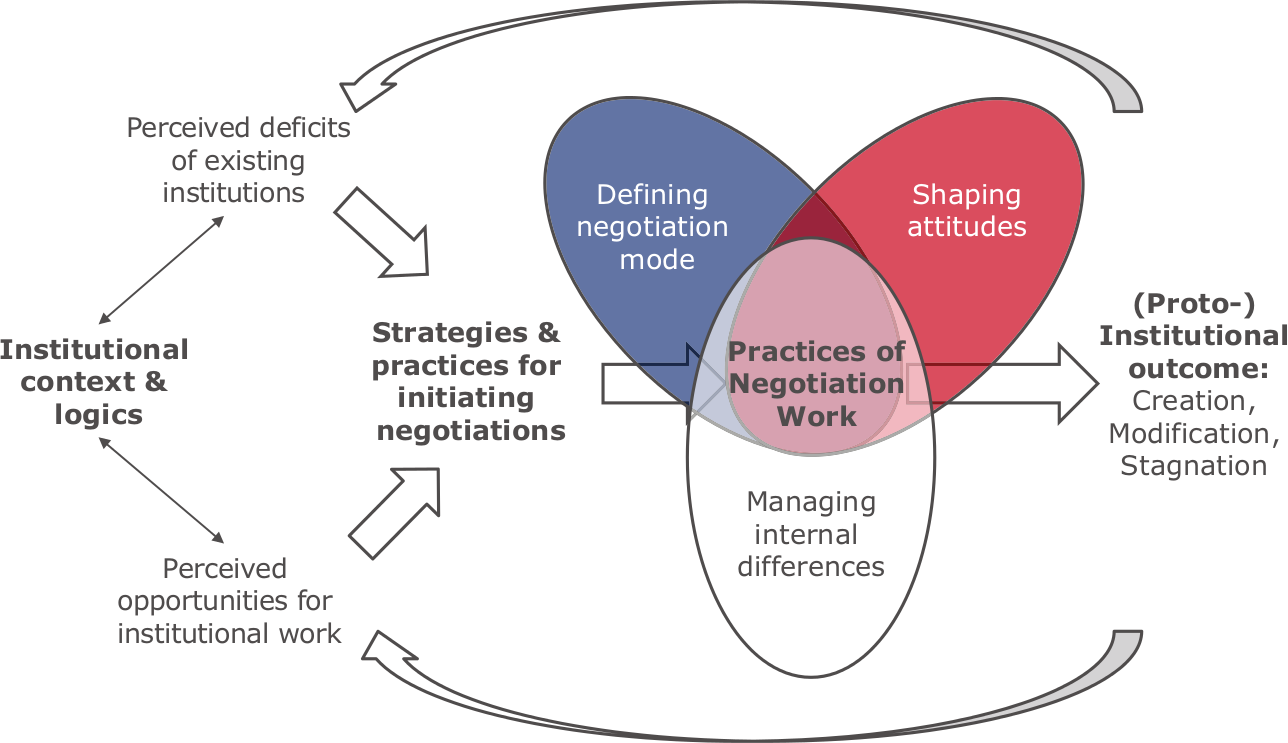
Negotiation Work.
Institutional context and logics
Negotiation work, like other forms of institutional work, does not take place in an institutional vacuum. In particular, the strategies and practices for initiating negotiations are influenced by institutional contexts and logics that shape actors’ goals, interests and attentional focus in general, and their perception of the necessity and the opportunity for institutional work in particular (Helms et al., 2012). Institutional contexts and logics thus constrain as well as enable the initial choice of some strategies or practices over others. Dialectical tensions between institutional logics allow for the partial autonomy of agents from social structure required for agency to be effective in change attempts (Greenwood & Hinings, 1996; Thornton et al., 2012; Walton et al., 2000; see also Giddens, 1984). Both sides enter the negotiation with conflicting perceptions of institutional deficits, diverging needs to build new institutions (or preserve the present ones), and different assessments of the opportunities for institutional work. For our case of cross-border labour–management negotiations, ‘competing institutional logics’ (Suddaby & Greenwood, 2005) and ‘institutional thickness’ (Selznick, 1996, p. 274) are highly relevant contextual conditions.
Competing institutional logics allow actors to perceive institutional deficits in the first place, contributing to what Greenwood and Hinings (1996, p. 1034) call ‘precipitating dynamics’ or what Walton et al. (2000, p. 54) call the ‘desirability of change’. Apart from the obvious management-labour opposition, in cross-border negotiations competing institutional logics are more likely to be observed, because globally dispersed production and supply networks bridge distances between heterogeneous local contexts (Levy, 2008; Palpacuer, 2008; Purdy & Gray, 2009).
In addition, institutional thickness has an impact on the extent to which actors see opportunities for negotiation work. By institutional thickness we mean not only the number and reach of institutions but also their complementarity (Sydow & Staber, 2002; see also Amin & Thrift, 1994). Apart from regulatory institutions, institutional thickness might also include enshrined habits, past experiences and other contexts that go beyond the single episode of negotiating. However, institutional thickness is a double-edged sword in a cross-border setting like the IFA negotiations we examine. On the one hand, the rather thick regulatory environment of European labour relations provides for access to the bargaining table (Egels-Zandén, 2009). On the other hand, these regulations may restrict the range of solutions negotiators can think of, leading to negotiation outcomes that are difficult to translate and enact for local actors constrained by different institutions.
Practices of negotiation work
During negotiations institutionalized expectations are confronted with direct responses from the other party; and both parties need to take these into account reciprocally by selecting negotiating practices that allow the negotiations to continue and result in an agreement. To capture these negotiation practices, we make use of behavioural or strategic bargaining theory, which has derived three major interrelated practices of negotiating, i.e. defining the negotiation mode, shaping of attitudes, and managing internal differences (Walton & McKersie, 1991; Walton et al., 2000).
Defining the negotiation mode means that negotiators decide whether they practise distributive bargaining, integrative bargaining or a mixture of these two modes. Distributive bargaining practices are used in negotiations in which interest conflicts about fixed-sum, pure-conflict issues are resolved within predetermined rules of the negotiation game. Typical examples are overstating one’s initial claims to get the most out of the bargain for one’s own camp, creating artificial boundaries for the issues at hand, or using pressure such as strike action to reaffirm one’s position. In contrast, integrative bargaining bears the greater potential for institutional change, since it is concerned with finding unforeseen solutions to new problems, and also includes the meta-rules of negotiations themselves (Cutcher-Gershenfeld, 1994; Walton et al., 2000). Examples of integrative practices comprise emphasizing shared motives and goals or restricting one’s initial claims in order to provide room for joint problem-solving. However, ongoing tensions between conflicting parties lead to the so-called ‘fixed pie fallacy’ (Bazerman, Curhan, Moore, & Valley, 2000, p. 288), i.e. the precipitate assumption that one party’s gains are the other party’s losses. This fallacy makes a purely integrative negotiation mode almost impossible and a mixed negotiation mode more likely (Bacon & Blyton, 2007; Lewicki, Weiss, & Lewin, 1992).
Shaping of attitudes consists of the practices by which both sides define their relationship towards each other. In labour relations, the most prominent distinction is between an adversarial, arm’s-length relationship versus a collaborative relationship (McKersie et al., 2008). A typical practice for adversarial negotiation relations is storytelling about the other party’s motives; a typical practice for collaborative relations is stock-taking of the other party’s views to increase joint understanding. However, the industrial relations literature also recognizes what Müller-Jentsch (2008) has termed ‘conflict partnership’. Here, the relationship is characterized by adversarial and collaborative practices at the same time, since it is stabilized through regulatory safeguards such as labour law and collective actors.
Managing internal differences consists of the way in which negotiators handle the interest conflict among the participants of their own party and may use such divergence on the opponent’s side (Walton et al., 2000). The insight that the outcome of a negotiation depends on who participates in the process is well-established in the fields of industrial relations and organization theory (March & Simon, 1958; Walton & McKersie, 1991). With respect to managing differences in one’s own camp, practices such as strictly tolerating only one negotiator to ensure internal coherence, or a more participative approach allowing for additional voices, can be distinguished. Interference in the other party’s negotiating team might be attempted through demands to exclude single actors from negotiations or by playing different sub-parties of the other side against each other.
Practices in these three categories can be separated only for analytical purposes because they happen to occur simultaneously in negotiations (see overlapping ellipses in Figure 1). Hence, strategic bargaining theory argues that negotiation practices can be expected to occur in more or less coherent patterns. For example, distributive bargaining goes along with a rather adversarial attitude on both sides and an exclusion of deviant voices in negotiations, whereas integrative bargaining flourishes in a collaborative and participative atmosphere (Cutcher-Gershenfeld, 1994; Walton et al., 2000). However, it is an empirical question whether negotiating practices actually fit into such coherent patterns.
Institutional outcomes
Actors’ practices of negotiation work are inspired and directed towards certain outcomes. Following Lawrence et al. (2002, p. 283) we define the institutional outcomes of negotiation work as proto-institutions, i.e. not (yet) widely diffused rules with the potential to become institutionalized. In our case, new procedural rules regarding information and conflict resolution over work-related issues classify as (proto-)institutions. A concentration on these procedural institutions allows us to put more emphasis on the dynamic nature of negotiation work’s impact. 3 According to our dialectical perspective negotiation work is not settled once and for all, but enters into next round (re-)negotiations over how procedural rules are properly enforced, triggering re-evaluation of institutional deficits and opportunities for additional institutional work (see feedback loop in Figure 1).
Furthermore, we apply Thelen’s (2009) idea of distinguishing in the outcomes of institutional work between institutional creation, modification and stagnation, the latter implying the lack of any substantial change at all. Our major criterion for qualifying the observed outcomes is context-specific, i.e. the reliability of the joint agreement on conflict resolution procedures. If these procedures are reliable, negotiating contributes to institutional change. However, outcomes of institutional change are different in quality: whereas institutional creation bears the potential to produce an entirely new (proto-)institution, institutional modification is confined to incremental changes of and within existing institutions. If outcomes neither produce something new nor modify existing procedures, the outcome of negotiation work may be a hollow institution, in that it produces a formal document, but leads to institutional stagnation rather than change.
IFA Negotiations as a Field of Study
IFA negotiations are an ideal field for studying negotiation work as institutional work because they classify as an exemplary case of inter-organizational negotiations in which GUFs strategically attempt to influence MNCs’ labour relations. Formal annual meetings between the GUFs and the management of various MNCs started as early as 1987, but the Convention on Trade Union Rights signed in 1994 between Groupe Danone (then BSN) and the International Union of Food Workers’ Associations (IUF) might well be said to be the first IFA (Hammer, 2005). After almost two decades of a slow but continuous process of negotiating additional IFAs, the early pioneers of the IUF have passed on their leading role to the larger GUFs in the manufacturing and service sector, which account for the bulk of agreements signed since then. At the end of 2012, there were 88 IFAs (see Figure 2) covering a variety of MNCs, predominantly with a European origin. Large global players have signed IFAs as well as some medium-sized companies with rather small international networks (see Papadakis, 2011).
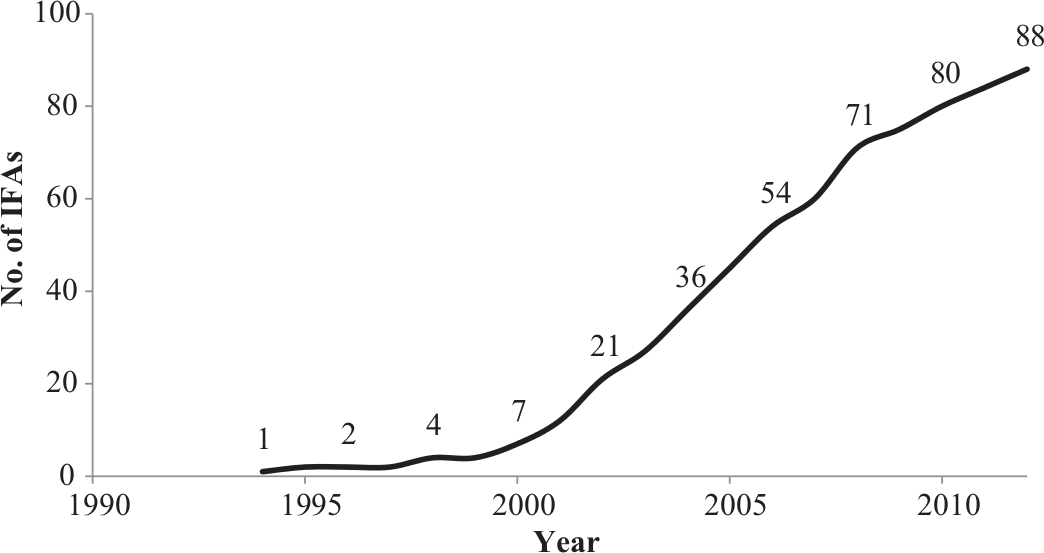
The Total Number of International Framework Agreements (1994–2012).
Given the procedural character of IFAs’ outcome, i.e. ‘meta’-rules on ‘how to bargain’ over local violations of labour standards, one might expect that IFA negotiations have been conducted within an integrative mode allowing for jointly finding new solutions (Cutcher-Gershenfeld, 1994). At the same time, however, negotiators are driven by competing logics, i.e. MNCs as representing globally mobile capital and GUFs as representing global workforces; moreover, these institutional logics vary by country. GUFs have almost always initiated the negotiation process (for details see Croucher & Cotton, 2009; Platzer & Müller, 2011). They regard the conclusion of an IFA, the projected outcome of negotiations, as being instrumental in raising the bar for labour standards. This occurs by way of establishing GUFs as legitimate negotiating partners accepted by MNCs, very often for the first time. Hence, IFAs provide an opportunity for institutional work to influence global labour relations in bilateral negotiations with MNCs as long as they contribute to the extension of the scope of union rights and union organizing, and increase GUFs’ overall standing (see also Croucher & Cotton, 2009; Fichter et al., 2011; Hammer, 2005; Papadakis, 2011; Stevis & Boswell, 2007). For MNCs, it is fair to say that management almost always enters passively into negotiating, either because it does not perceive deficits in global labour relations as an urgent issue, or because it is satisfied with a unilateral corporate social responsibility (CSR) approach, or it is not convinced that IFAs provide a reliable solution. However, management might also regard an IFA as a way to lend additional credibility to the company’s CSR policies or might feel obliged by HQ labour relations to give in to unions’ initiative (Egels-Zandén, 2009).
Most prominently, these competing logics across types of organizations as well as across regions are revealed by the most contentious issues in IFA negotiations: extension of the agreements to the periphery of global production networks, i.e. whether joint ventures’ and suppliers’ compliance with labour standards is to be included into the agreement’s clauses, and the precise meaning of union recognition in local contexts where labour law puts firm restrictions on unions organizing freely (Fichter et al., 2011). Whereas GUFs aim for the inclusion of the periphery of global production networks and demand universal application of their right to organize, MNCs usually want to place restrictions on both of these aspects. However, in IFA negotiations these conflicting institutional logics can be reconciled with each other through the creation of new (proto-)institutions. This reconciliation may be facilitated by the rather thick institutional environment at MNCs’ (European) HQs, where labour law, collective bargaining agreements, co-determination practices and industry and corporate traditions all interplay and (re-)enforce each other (Egels-Zandén, 2009; Fichter et al., 2011).
Empirical Approach, Data Collection and Analysis
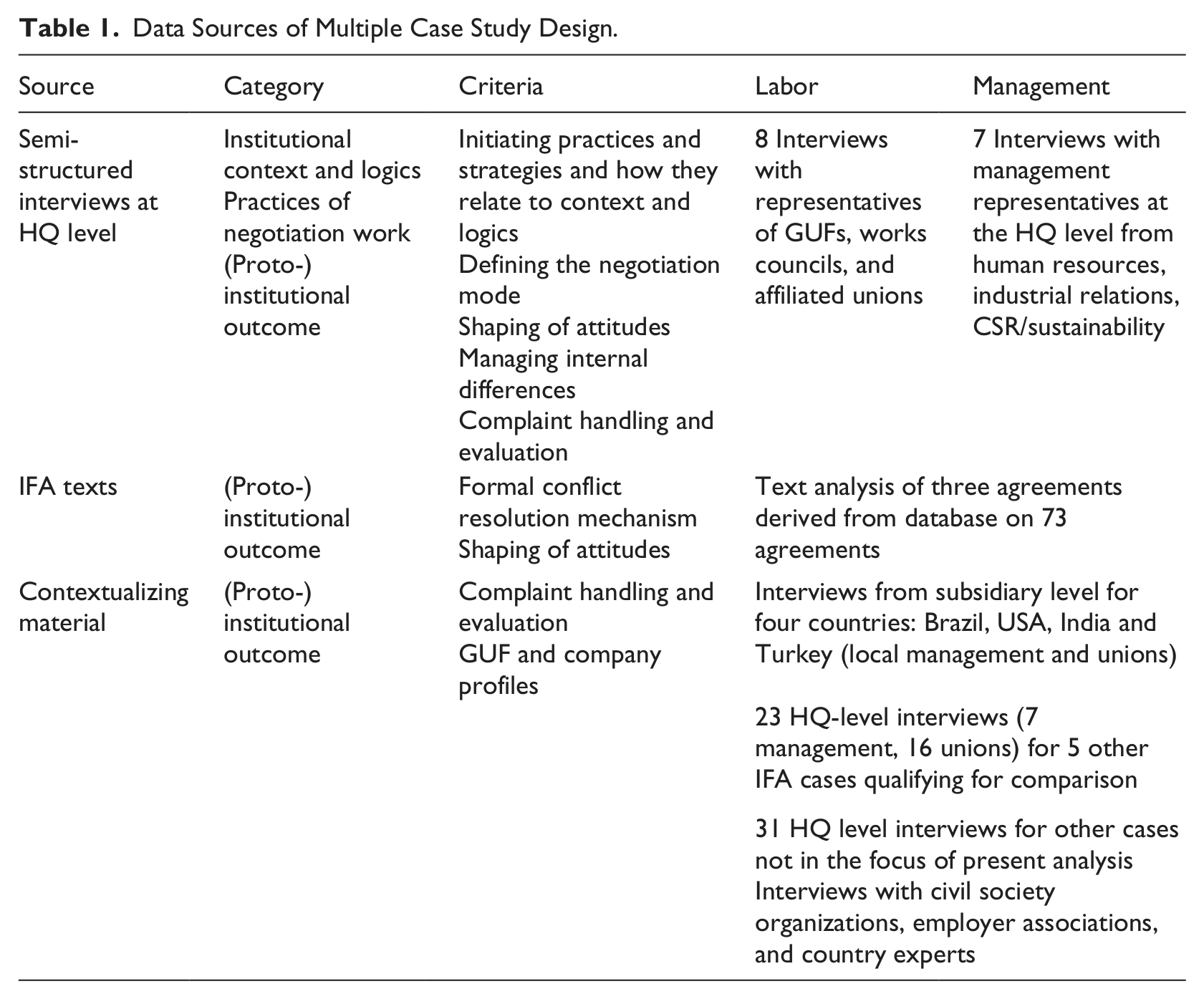
In order to examine empirically these general expectations about IFA negotiations and their impact on institutional outcomes, we analyse three negotiations around IFAs in more detail by using our framework of negotiation work. Such an examination of IFA negotiations requires a qualitative approach (Eisenhardt & Graebner, 2007; Schneiberg & Clemens, 2006) accounting for the local peculiarities of an inter-organizational negotiation setting. In particular, we need to use a variety of sources to reduce any distortion of results by biased informants driven by an institutional logic in a particular context. Hence, we collected and analysed a variety of data around single negotiation processes within a multiple case study design (Yin, 2009; see Table 1 for an overview):
Our core source for the present analysis is interviews for eight IFA negotiations, three of which we have selected for presentation and closer discussion here: (i) the International Metalworkers’ Federation (IMF) negotiations with MetalCorp (automotive industry); (ii) the Building and Wood Workers’ International (BWI) negotiations – joined by the International Federation of Chemical, Energy, Mine and General Workers’ Unions (ICEM) – with ResourceCorp (resource extraction and building materials); and (iii) the ICEM negotiations with ChemCorp (chemical industry). For each of these IFA negotiations, we have conducted between four and six interviews – at least one each for management and labour – making a total of 15 interviews with an average length of about 45 minutes. With one exception, all the interviews were audio-taped and transcribed.
These three negotiations were selected from a broader set of case studies we conducted between November 2008 and March 2011. In total, we have interviews on 22 MNCs with an IFA, yielding 69 semi-structured interviews. To select our case studies from this group we used the following criteria: (a) given the bilateral nature of negotiations, we select only those cases where we had at least one interview for each side, i.e. management (HR managers, industrial relations and CSR officers) and labour (GUFs, home country trade unions, works councils); (b) the MNC has signed an agreement with one of the four major GUFs, because these GUFs account for 90 percent of all IFAs in the last 15 years; (c) the MNC is headquartered within Europe, where 85 percent of all MNCs with an IFA come from, and which is indicative of European-style labour relations at the HQ level. This procedure yielded eight negotiating pairings on which we could carry out our analysis. However, we single out three cases for more detailed discussion that are highly characteristic and representative of one pattern of negotiation work and institutional outcome: ChemCorp, MetalCorp and ResourceCorp. As such, we exclude two pairings since they took place in the global service industry with its different conditions in terms of global labour relations (see Dolvik & Waddington, 2005), restricting our present analysis to the manufacturing sector. Furthermore, we exclude another three cases for pragmatic reasons, in terms of space considerations, since these cases basically confirm the conclusion we derive from the three focus cases. Nevertheless, we pick up these additional cases in the concluding section in order to illuminate important deviations from, but also commonalities with, the focus cases, allowing us to record some limitations of our findings.
In addition to the interviews, we analysed 73 agreements with regard to their agreed conflict resolution mechanisms, identifying some 120 characteristics (i.e. actors, substantive and procedural rules). For the present analysis, we concentrate on those criteria that characterize the formality of the conflict resolution mechanism, and statements that characterize the relationship between the signing parties in our eight cases.
Apart from the overall number of interviews at the HQ level and the excluded cases, we occasionally draw on additional interviews with several other sources – secondary to the present analysis – in order to place our selected cases within the larger field of IFA negotiations. We held some two dozen background interviews with actors in the field of international labour relations (including representatives from civil society organizations, employer associations and country experts), a similar number of interviews with local unions and local managers at the subsidiary level of our selected IFA-MNCs, and a small number of interviews with control cases in which negotiations failed completely. Additionally, we participated in five workshops (two for the GUFs, one for the MNCs, and four for local actors in India, Turkey, the USA and Brazil) in which participants in IFA negotiations debated relevant issues.
Data Sources of Multiple Case Study Design.
Insights into Negotiating IFAs as Institutional Work
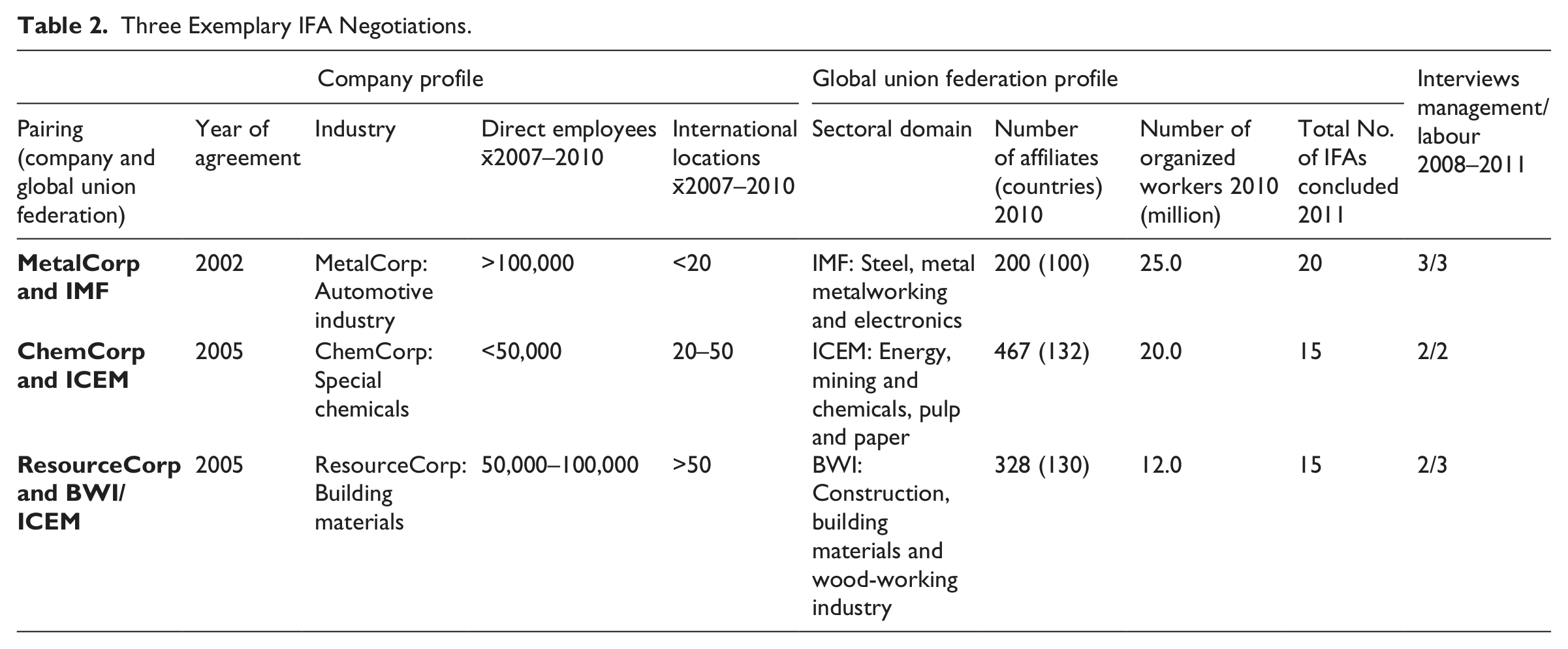
Table 2 provides an overview of the basic characteristics of our three negotiation pairings such as year of signature, and GUF and MNC profiles. All of the MNCs are examples of highly complex networks of subsidiaries, suppliers, joint ventures and subcontractors spanning many institutionally and culturally diverse settings. However, the MNCs differ in industry, overall size and number of international locations. MetalCorp is a very large MNC measured in terms of employment figures, whereas ResourceCorp is medium-sized and ChemCorp is a rather small MNC. All of the GUFs are transnational organizations themselves, formally representing millions of union members through their affiliates in countries on every continent. Despite limited financial resources and small staffs, each needs to engage with MNCs in several manufacturing sectors.
Three Exemplary IFA Negotiations.
For each of the cases, we examine important aspects of the institutional contexts and logics and how the agents refer to them, in particular when initiating negotiations. Furthermore, we investigate the practices of negotiation work, i.e. the practices deployed for defining the negotiation mode, shaping of attitudes and managing internal differences. Finally, we consider the quality of the (proto-)institutional outcome and identify empirical patterns among these variables.
Negotiations leading to institutional creation: The example of ChemCorp
ChemCorp is highly illustrative of IFA negotiations having the potential for institutional creation. The decisive reason for us to regard ChemCorp–ICEM negotiations as creating new institutions is that it contains innovative properties of global labour relations which did not exist prior to negotiation; in fact, prior to negotiations nothing existed that came close to a ‘functional equivalent’ to what both actors had agreed on after negotiations. At ChemCorp, HQ-level actors not only established a new, direct negotiation relationship between the GUF and HQ management, but they also defined joint initiatives to negotiate implementation with local actors, such as joint site visits and a reporting procedure in which local actors from both sides, i.e. subsidiary management and local labour representatives, are directly involved. An illustrative piece of evidence for this innovative – and among all IFAs’ texts to date: rare – exceptionalism in selecting a joint management-labour approach is the following quote from the agreement’s text: [The parties] shall cooperate to ensure the best possible understanding of this agreement by employee representatives on its sites. ChemCorp will facilitate participation of delegates in meetings that may be organized locally by the [GUF] … [The parties] will continuously monitor the application of the agreement and in this respect they will carry out [joint] assessment missions … Any problems encountered with the application of this agreement will be described in a report that will also discuss the solutions developed. If the difficulties are observed locally this report will be written jointly by management and [local] employee representatives. (ChemCorp IFA text)
However, ChemCorp is also a peculiar case in that HQ-level actors seek active dissemination of the IFA clauses into practice, for example, by actually holding local meetings jointly, conducting joint assessment missions (already done for China, Brazil and the USA) and bringing in local actors’ views through reporting on complaint handling. As the ICEM representative confirms: We have a [joint] monitoring committee … So each year we discuss what happened. And also every three years an external body makes an audit for the global agreement. So, it is an ongoing process. And if any problem is reported from any country, we immediately enter into communications with the company. (ICEM rep)
This holds true even for local situations in which IFA implementation might be expected to be a rather complicated affair, for example, in Asian countries or the USA with their different traditions and institutions for labour relations. One exemplary quote on this comes from the central HR manager’s account about local case handling in an Asian country: So we said [to an Asian supplier’s management]: ‘Listen, every employee is covered by our safety policy, whether he works for us or [for] a supplier. … And, we have an agreement with [GUF] which comprises a clause on our suppliers.’ I can tell you that our approach caused surprise on the part of the supplier. (ChemCorp management rep)
Similarly, the union negotiator confirms the management’s approach in the USA which is characterized by a strong commitment to management neutrality, i.e. management refrains from countervailing actions in a case when unionization drives and bargains without attacking the counterparts fundamentally, a position towards the unions not easy to cope with for US managers: If you are familiar with US labor relations, this neutrality is very important. And we managed to include a special provision for neutrality for any organizing drive which is very important particularly for the US case. (ChemCorp ICEM rep)
This outcome of institutional creation is the result of a highly integrative pattern of negotiation work: the parties not only entered easily into direct negotiations; negotiations also followed an ideal-typical pattern of integrative bargaining practices on each side and for all three components of our framework (i.e. defining the negotiation mode, shaping attitudes and managing internal difference). Arriving at an outcome of institutional creation was already eased during the initiation stage of getting negotiations started. Notably, ChemCorp is the only case in our sample in which management responded to an inquiry by the ICEM with its own initiative for IFA negotiations. Two aspects are of importance in this regard: (1) both parties managed to escape a hold-up through the strongly institutionalized, but fragmented and adversarial labour–management relations in the country of corporate HQs; and (2) a position change of a former union representative to become the leading negotiator on behalf of management. At ChemCorp’s HQ, unions demanded to be included directly in the negotiations; however, they were frustrated in that demand by both sides, the ICEM and HQ management; this was based on the consensually shared argument that these negotiations require an international mandate: The demand has been made by the national unions organized at my company: … They wanted to negotiate the agreement directly. But I refused, because it is supposed to be a global agreement. (ChemCorp rep)
In fact, this sort of exclusion of unions organizing at the HQ from negotiations has proven to be highly problematic for other IFA negotiations. However, at ChemCorp a hold-up through conflicts among these unions was avoided by the credibility of the management negotiator and the approach of ICEM to integrate affiliates at the same time. On the union side, ICEM was in charge of the global-level negotiations while managing internal differences by ensuring feedback from all of the affiliates with a major stake in ChemCorp, including but not privileging the home country unions: First, we communicate over this with our unions. We … get their opinions. First, there was a special resolution for that [at our congress] … [in which] we demanded improvements in the agreement, and then we started to negotiate with the company. And after the negotiations, we consulted with our affiliates [again]. (ICEM rep)
On the management side, negotiations were facilitated by the role change of a former high-ranking union official who had become a top manager capable of integrating employee rights into the company’s policies on sustainability: The involvement of [a former union leader as ChemCorp management rep] is an advantage for us, particularly for facilitating communication. But ChemCorp’s decisions are made by their board and the chief executive officer. (ICEM rep)
Moreover, lifting negotiations to the global level assisted negotiators in avoiding the restrictions of another institution at the HQ location, i.e. the employee representation body, like the European works council, also dominated by unions from the HQ location. As a result, both negotiating parties were freed from the restrictions of typical labour–management negotiations at the HQ, yet could still indirectly build on the thick institutional environment of labour relations to enter into an integrative negotiation mode in which both parties could openly contribute their views. In this way, both parties, GUF as well as HQ management, did not follow the path of ChemCorp’s home country institutions, but rather bypassed it by direct negotiation between top management and GUF leaders.
In addition, a reciprocally held collaborative attitude towards labour–management relations supported this approach: In general ChemCorp has this kind of social responsibility and sensibility … But not just for employees but also for other stakeholders, so that’s why I tend to define the company as highly socially responsible. (ICEM rep) [One] pillar is social dialogue. This company that I represent is not anti-union. It has developed a high level of dialogue in the various countries in which it is operating. (ChemCorp rep)
All this does not mean that there were no conflicts in negotiations, but at ChemCorp these were handled in an integrating way, resulting in a reliable joint labour–management conflict resolution mechanism that was non-existent before negotiations. In 2011, the process of institutionalizing this creative proto-institution was reaffirmed by the successful re-negotiation of the agreement, to be extended to a health and safety programme. Following our model, we interpret this second-round negotiating work as a positive feedback loop, increasing the chances of institutionalizing the newly defined approach to global labour relations at ChemCorp.
Negotiations leading to institutional modification: The example of MetalCorp
MetalCorp is an exemplary case of negotiations that build on already existing institutions to modify them into a more global direction. However, during the negotiation process, and also regarding the outcome in terms of subsequent complaints handling, the negotiated solution follows the path of those procedures already established at the corporate HQ. The negotiating pattern is strongly influenced by the thick and highly institutionalized environment of MetalCorp’s home country. First and foremost, the HQ institutions influence the overall approach of the labour side to negotiating the IFA. This holds for how negotiations were initiated, i.e. by using the established procedures for labour–management dialogue via the employee council, and also extends to the way internal differences on the labour side were effectively managed, for example by choosing the council chairman as the lead negotiator for the labour side. Additionally, we observe that the complaints handling procedure is also embedded into the regular proceedings of the employee council.
In comparison with ChemCorp, the definition of the negotiation mode in MetalCorp negotiations is heavily imprinted by the established labour–management bargaining relationships at corporate HQ. In fact, an already existing body for global employee representation, i.e. a world works council, dominated by a strong HQ location’s union, negotiated the IFA on behalf of the International Metalworkers’ Federation (IMF). The relationships between the employee council and management are characterized best as an institutionalized form of the mixed negotiation mode, i.e. ‘conflict partnership’ (Müller-Jentsch, 2008), in which both sides follow their logics and use distributive and integrative practices in negotiations about a single issue while at the same time avoid jeopardizing their basic relationship. Compared to a purely integrative mode, in this mode conflictive attitudes are tolerated on both sides without endangering the goal of achieving a collaborative outcome. For example, management holds the following opinion on its relationship with workers’ representatives: The works council, labour representatives in general, are seen as social partners and issues are managed in a partnership-like way. (MetalCorp rep1)
At the same time, management is very clear on the distributive limits for the outcome of IFA negotiations, which it is absolutely unwilling to cross in negotiations with the unions: We do not want to be forced by employee representatives to select this or that supplier. The same holds also for our sales partners. (MetalCorp rep1)
Labour representatives, for their part, initiated negotiations through the already institutionalized channels for negotiating with MetalCorp’s HQ management, in order to overcome MetalCorp’s initial reluctance: In the beginning, one felt like the management side was complaining about everything: ‘Do we really need an IFA?’ After the two first rounds of negotiation, I really had the impression that we would never get an agreement. (IMF rep)
In this stage, labour negotiators were capable of using their ties to the unions at a MetalCorp’s competitor to convince management of the urgency of taking action on the IFA issue: What helped us a lot was that [another OEM] had initiated parallel negotiations. … That was surely also a signal for the management. (IMF rep)
Apart from such external pressurizing, fostering a distributive rather than an integrative practice, the labour side also explicitly expresses respect for unilateral management initiatives such as introducing supplier audits autonomously: For example, these sustainability guidelines [containing supplier audits] have been a voluntary management initiative, without any pressure from us. We have to admit that this was their initiative; and we see it as a clear signal that they want to push things in a positive direction. (Council rep)
Due to a strong reliance on extant institutions at the HQ level, labour’s lead negotiator came from the employee council at the HQ, not from the GUF. To be sure, he was a multi-function employee representative (head of works council, an active representative of a union affiliated to the IMF, and a supervisory board member) backed by a strong union presence at the HQ level, but he was not a formally appointed official representative for the IMF. This distinguishes the MetalCorp negotiations considerably from the negotiations at ChemCorp, in that not the GUF but the company-related employee representative body led the negotiations.
As a result, in these negotiations managing internal differences meant involving the GUF in the background, which was facilitated by the fact that the more influential affiliates of the IMF have representation in the employee council: In the process, there was some discomfort with the fact that the [GUF] did not sit directly at the bargaining table. … But we thought [the IFA] is a delicate issue and it would be best to use the established negotiation structures at the [headquarters]. (Council rep)
In sum, the entire IFA negotiations took place within the confines of the highly institutionalized labour–management relationship at MetalCorp’s HQ, as a peculiar combination of learnt practices in defining the negotiation mode as well as the shaping of the parties’ attitudes towards each other and the handling of internal differences. This pattern of negotiation practices spills over into the complaints handling procedure defined in the agreement. At MetalCorp, a local problem is typically communicated from the local union to the GUF, and from there to the employee representatives at the HQ, who raise the issue with HQ management. After negotiation about the nature of the complaint, HQ management may decide to act upon it by intervening at local management level. Although two-thirds of about 20 complaints have been finally resolved to the satisfaction of both sides, this procedure is more reactive and involves the GUF less than the mechanisms referred to at ChemCorp, as the following description by management reveals: Complaints are processed this way: … if a violation is reported to us, … sourcing checks whether the supplier is registered in our supply chain, and if he is, then we send him a little letter asking for an explanation. (MetalCorp rep1)
As such, we conclude that the outcome is best characterized as an extension of the scope of an already existing institution, in that the employee council opens the agenda of the regular meetings for the international issues of the IFA.
Negotiations leading to institutional stagnation: The example of ResourceCorp
In the ResourceCorp negotiations no reliable conflict handling procedure was defined. Hence, we classify the outcome of negotiation work in this case as institutional stagnation. Negotiations in ResourceCorp followed a distributive pattern continuing into complaint handling and resulting in repeated dead-end situations when it came to finding adequate solutions accepted by both parties.
The negotiation process at ResourceCorp is a striking example of producing institutional stagnation, in that the agreement concluded with BWI only contains a weakly formalized conflict resolution clause, i.e. specifying joint meetings at the HQ level for debate; and in that there are many unresolved cases reported from several countries, fuelling doubts about the true intention of management to start negotiating in the first place: There is no such thing as an assessment, organized through the agreement, but we have our annual sustainability report for which we send out a questionnaire to our business units … For us, the whole idea for having the agreement was not to create a procedure. (ResourceCorp rep2)
At least two aspects are remarkable about the pattern of practices in these negotiations: first, in the ResourceCorp–BWI negotiations, distributive bargaining tactics prevailed on the management side – even in the face of integrative concessions from the principal negotiator on the unions’ side; second, management intervened directly into the selection process of labour’s negotiation team. To come to an agreement, the leading union negotiator clearly signalled a considerable commitment to integrative bargaining by indicating his willingness to substitute a company ‘promise’ to comply with labour standards for a more binding commitment: Right away we said: ‘Send the lawyers home. They’ll just confuse you and they’ll confuse us.’ Because all our discussions are based on a certain spirit, which is not legally binding. But we also want a clear promise from your side that you will honour the agreements we reach. (BWI rep)
For its part, management did not reciprocate this offer, but used distributive bargaining practices, above all by emphasizing that the IFA endangers opportunities to exploit cost advantages obtained through local subcontractors and joint ventures: It is not our responsibility to operate our subcontractors. We are not to interfere with the business management of our subcontractors. (ResourceCorp rep1) When we don’t own the majority of a joint venture company, there is obviously a different management. (ResourceCorp rep2)
Most significantly, management directly intervened in the composition of the unions’ negotiation team by demanding the exclusion of national unions at their HQ because of the expectation of HQ-centric policy priorities: The unions at HQ have no responsibility for these international questions, and are too much concerned with their own priorities. (ResourceCorp rep1)
In this case, given the distributive tone set by management, this exclusion could not be handled as easily on the labour side as in the ChemCorp case, triggering additional efforts of the main negotiator to keep national unions at the HQ informed about the proceedings of the negotiations.
In other [IFAs] we involved the unions at the HQ, but this was not the case with ResourceCorp because there are several … confederations. So both ResourceCorp and ICEM agreed to exclude them. That was a mistake, I think. (ICEM rep2)
In addition, ResourceCorp’s management complicated negotiations by having a representative of a North American subsidiary on the negotiation team, who argued against the conclusion of an agreement applicable to the US: There was heavy resistance from the US management … They feared that there might be a neutrality clause interfering with their national affairs and local conflicts. (BWI rep). The major stumbling block was application in the United States. The agreement would have been reached at least 12 months earlier if it hadn’t been for the United States. (ICEM rep1)
Only after the US manager had withdrawn from the management’s negotiation team did a breakthrough occur. The managing of internal difference has been further complicated by the fact that two GUFs, i.e. the BWI and ICEM, had to coordinate negotiations. Although the GUF representatives assure us that they defined a functioning division of labour in principle, their relationship has been complicated through ResourceCorp’s subcontracting policy, which happened to affect the local affiliates of the GUFs disproportionately: At ResourceCorp, whenever we bring local issues from India, or Malaysia or America, they say: ‘All authority concerning local operations is with local CEOs or local HR managers. The HQ has nothing to do with it.’ (ICEM rep2)
However, there are some recent signs that this situation might change in that ResourceCorp is becoming more responsive to the special concerns of the unions organizing at their East Asian subsidiaries. In particular, the re-employment of a group of workers at an Indonesian subsidiary – after the GUF’s intervention – could be interpreted as a first sign of change.
Discussion and Conclusion
Our major empirical finding for the three IFA negotiations we have discussed here in detail is that there is a strong link between practices of inter-organizational negotiations and the divergence in (proto-)institutional outcomes (see Table 3 for a summary). We conclude that negotiating classifies as a distinct type of institutional work because its outcome may elicit different institutional trajectories, ranging from stagnation through modification all the way to the creation of what have been called proto-institutions (Lawrence et al., 2002, p. 283), i.e. new rules and practices with the potential to become institutionalized. Another reason why negotiating represents a distinct type of institutional work is more process- than outcome-related. That is, agents actively and, as it seems, for the most part intentionally combined the three inter-organizational negotiation practices highlighted by our model of negotiation work against the background of specific institutional contexts and logics.
Practices of Negotiation Work.
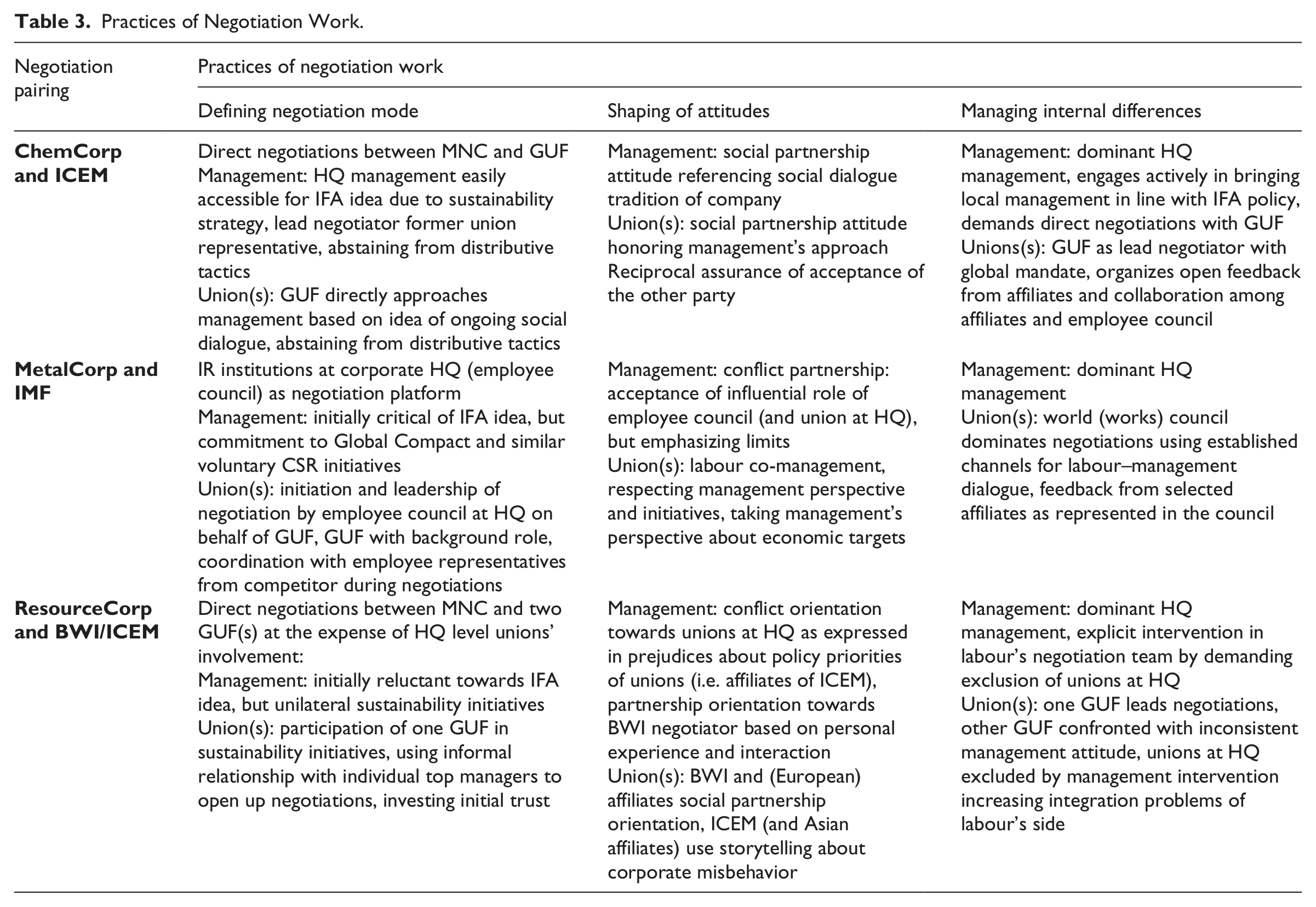
Acknowledging negotiation work across organizational boundaries adds to the current debate on institutional work by taking the double face of institutional change processes into account, i.e. contestation and joint problem-solving (Hargrave & van de Ven, 2009). Above all, the creation of a new institution – in our case International Framework Agreements (IFAs) as a new social contract for regulating global management–union relations, aiming at securing global labour standards – is more likely if negotiations allow for continuous joint problem-solving. In this way, our results confirm the expectation that integrative bargaining is more conducive to defining new meta-rules of labour–management relations (Cutcher-Gershenfeld, 1994), thereby contributing to institutional creation as the outcome of negotiation work. In more detail, institutional creation through negotiating is contingent upon three key practices of negotiation work: not only on choosing and defining an integrative bargaining mode, but also on avoiding or reducing adversarial orientations on each side, and on respecting the composition of each side’s negotiation team. Additionally, a reliable feedback loop affords a minimum of formalization of conflict resolution to ensure that violations can be communicated from the bottom up. Given the differences in institutional contexts and competing institutional logics in the field of industrial relations, these conditions are difficult to meet, making the negotiation of global labour relations a challenging endeavour. However, we interpret our findings on the ChemCorp–ICEM negotiations as confirming that the fulfilment of these conditions for institutional creation is not entirely impossible.
Institutional modification, by contrast, is the likely outcome when the practices IFA negotiators choose are predominantly shaped by rather thick institutional environments at HQ locations. In these cases – exemplified here in a proto-typical fashion by the MetalCorp–IMF negotiations – the rather dense network of industrial relations institutions at corporate HQ restricts not only the choice of negotiation practices but also the range of possible solutions, as negotiators do not dare to leave the common ground laid down by strong institutional safeguards. As revealed by the MetalCorp case, ‘conflict partnership’-type institutions play a crucial role in this regard, as they give unions at the HQ level and employee representatives a more dominant role in negotiations. In these cases, a negotiation mode can be observed in which integrative as well as distributive practices are deployed simultaneously, triggering occasional criticism from either camp about a too-concessionary or too-aggressive bargaining style; but all in all, the institutional safeguards keep the process on the road. As a result, where actors’ preference for negotiating practices is shaped by the institutional context, more incremental types of change show up, i.e. amending and supplementing already existing institutions such as an employee council at the HQ level, rather than going beyond that by experimenting with a new solution for global labour relations.
The decisive commonality of the negotiations creating as well as those modifying institutions is that at least some move is made towards globalizing labour relations. Where institutional stagnation is the outcome, institutional work fails to alter global labour relations, although an agreement has been signed. ResourceCorp (see Table 3) is our exemplary case of what happens if negotiators cannot go beyond distributive bargaining, entertain inconsistent or adversarial attitudes towards each other, and intervene in various ways in the composition of the opponent’s negotiation team.
Doing justice to the other five cases which we also scrutinized thoroughly but, because of space limitations, were not able to report about in any detail here, we wish to point out some basic commonalities and differences between these cases and the ones we have summarized so far. In doing so, we also put some qualification and limitation on the conclusions we have drawn so far, since these five cases do not always fit neatly into our explanative scheme. First of all, one case from the global service industry shows a pattern of institutional creation like the negotiation at ChemCorp, but simultaneously reveals that not all of the integrative practices mentioned need to be present from the start of negotiations and throughout the entire negotiating process. As negotiators in this case were capable of repairing their bargaining relationship in the process through mediation and collaboration on joint arbitration procedures and problem-solving, they were able to offset a rather aggressive initiation on the part of the global union federation involved. Another case, fitting well with the results for MetalCorp, lends additional confidence in the robustness of our conclusion regarding the pattern of negotiation practices leading to institutional modification as being driven by strong institutional imprints from the HQ labour relations. This case reveals that the same outcome can be obtained even if some details are different in quality, i.e. in this case a stronger involvement of the union at the HQ (instead of the works council) and a management more inclined to use a distributive bargaining style. As for the outcome of institutional stagnation, we found another case that also fits roughly into the pattern we have observed at ResourceCorp, but differs in some details, as in this case it was the HQ-level works council that was excluded from negotiations, provoking several major stumbling blocks in actually applying the agreement at the subsidiary level later on.
In addition, we have encountered two cases which do not fit into our conclusions about the strong link between negotiation practices and observed outcomes. In these two cases, an outcome of institutional stagnation was obtained, although negotiations originally started out with integrative practices and collaborative labour relations at the HQ level. But both agreements remain a hollow institution, since they are not used effectively for handling complaints. Apart from applying our own framework more intensively to the issue of ongoing negotiations between HQ-level and local actors during implementation, we see two major explanations for this contradictory finding: first, an integrative negotiating mode at the HQ level can only be successful in terms of institutional change when it is constructively coupled with conflict resolution for the distributive issues arising during implementation at the local level, pointing to a necessity to study the implementation process in its own right (see, with regard to the US context, Fichter, Stevis, & Helfen, 2012). Second, in these cases negotiating the IFA might have been used by management as a tactic to accommodate stakeholder demands (Levy & Egan, 2003). As such, this also requires a linking back of negotiation work to other forms of institutional work and social skills that reveal something about the actors’ broader repertoire for strategizing beyond negotiation work.
Going beyond the empirical findings regarding IFAs, we relate our study to recent calls to intensify the study of institutional work by examining the dialectical interaction between agency and institutions and by taking into account the fact that institutional work is not always a success story (Lawrence et al., 2011). Negotiations represent a rare opportunity to study interaction as ‘embedded agency’ (Emirbayer & Mische, 1998) and in its capacity to change institutions. Negotiations are a decisive point where diverging institutional logics meet, enmeshed in institutional structures with differing degrees of thickness and diverging opinions and positions; and in these situations, actors need (and are able) to work out how to evoke institutional change. Other forms of institutional work might also be conducive to that end, e.g. campaigning, legislative action, or creating influential rhetoric frames. But, as our cases show, it is negotiations that allow for the continuous practising of institutional work, mediating dialectically between existing institutional structures and strategic ambitions to bring about institutional change. In addition to this, negotiations provide for an alternative view on change processes accounting for the fact that institutional change is very often not a positional ‘either/or’ struggle, but proceeds within a complex dialectical process of constituting social order in inter-organizational encounters (Cutcher-Gershenfeld, 1994; Strauss, 1982).
Indeed, GUFs as much as the management of MNCs are capable of acting as a ‘collective institutional entrepreneur’, as they act upon their institutional environment to change it in negotiations with each other (Schneiberg & Lounsbury, 2008). Nevertheless, the pitfalls of achieving the institutional change of global labour relations through negotiations are numerous, as those cases of our small sample reveal that brought about hollow institutions. In this context, IFA negotiations raise three more general questions not only for research on institutional entrepreneurship (e.g. Maguire, Hardy, & Lawrence, 2004) but also for that on social movements (e.g. Schneiberg & Lounsbury, 2008).
The first concerns the obvious differences in reacting towards and enacting of institutionalized repertoires for action in the context of negotiations. As the comparison between ChemCorp and MetalCorp clearly reveals, negotiating actors are partially free in their decisions about how to relate precisely to the institutions in which they are embedded. They do have a choice: either following the paths set out by established institutions or distancing themselves from them in order to reach new solutions. As such, this reveals a considerable scope of agency but also raises the question of why and under what circumstances actors choose one of these courses of action. Our analysis of IFA negotiations points to two important aspects in this regard: the expectation of the other side’s willingness to go beyond institutionalized expectations, and the capacity of a negotiator to bring his own camp to accept a departure from institutionalized expectations with an uncertain outcome.
Building on this general observation of agentic leeway in enacting institutions in a negotiation setting, the second – and related – question is: how can we account for incumbents’ reactions after they have been forced into negotiating on institutional change? In our case, GUFs need to walk a tightrope between representing their own demands and keeping the negotiations alive. Management, after having been pushed by GUFs into negotiations, answered typically with distributive bargaining tactics in the first rounds of negotiations. For unions, in order to avoid a breakdown of negotiations and to actually reach an agreement, one of the major challenges has been to define an integrative mode of negotiation that takes the distributive tactics of management into account in order to make the underlying conflicts productive. In IFA negotiations, above all, GUFs have avoided introducing issues that could have endangered the successful conclusion of the negotiations. Most notably, unions abstained from including substantive issues such as global differentials in wages or physical working conditions in more than a very general way, since – although important for explaining unions’ motivation to negotiate IFAs in the first place – these issues would have jeopardized the negotiations. At the same time, framing the IFA as an issue compatible with the MNCs’ international strategies in order to accommodate employers’ demands and keep management in negotiations risks losing support among the GUFs’ own constituency.
The third more general observation is the salience of managing internal differences in processes of institutional work. In particular, GUFs had to move cautiously between excluding affiliates opposed to IFAs in order to come to a joint solution, and integrating critical voices to provide for the legitimacy of the final solution found. As the negotiations with stagnant outcomes reveal, this trade-off is complicated even further if management is able (and allowed) to intervene in determining labour’s negotiation teams. As a result of these interventions, it is not always the GUFs that have the leading role in IFA negotiations, although the GUF is formally responsible for coordinating the labour coalition behind an attempt to negotiate an IFA. For GUFs, this means that they are faced with a dilemma: on the one hand, they need to rely on labour representatives close to corporate HQs – above all, on influential national unions or works councils or a combination of both – to get access to management in the first place (see Fichter et al., 2011; Hammer, 2005). On the other hand, within a cross-border context, they need to obtain consent from their various local affiliates in order to alter local practice with the help of further negotiations; in particular in situations where HQ contexts diverge radically from local ones. For example, strategies of subsidiaries may contradict HQ-level intentions, or local unions’ strategies may be more adversarial than those of HQ-level unions.
Our analysis represents just a starting point for examining further negotiation work across organizational boundaries. Avenues for further research might be a closer look at the mediating role of power relationships between negotiators, personal traits of the negotiators, and other conditions influencing negotiation work and its capacity for institutional change. Similarly, industry cultures and economic conditions might also contribute to an explanation of why diverging institutional logics are either reproduced or altered during negotiations; with our concept of institutional thickness we have been able to address these conditions only in a very general way. Obviously, negotiations are not the only process of institutional work capable of producing change; however, they are very relevant for organization-related institutional work. As a consequence, more work is needed to differentiate institutional contexts and clarify the relationship between negotiations and other forms of institutional work, and on the interplay of organizational and institutional change.
Relating back to the Sisyphean experience with globalizing industrial rights, we think of IFAs as bearing the potential to change global labour relations, and thereby contribute to a proliferation of core labour standards, despite the difficulties our analysis has revealed. And perhaps – given the global weakness of labour-related regulatory institutions and agencies – IFAs are more instrumental in achieving an improvement of working conditions and labour relations in global production networks than either unilateral CSR policies or NGOs’ global campaigns, because negotiating IFAs brings the parties of the employment contract to act jointly.
Footnotes
Acknowledgements
We are grateful to Michael Fichter, Martin Behrens and Christopher Wright as well as to the Guest Editors of this Special Issue and to three anonymous reviewers for their insightful comments on earlier versions of this paper. Earlier versions of this paper were presented at the 2010 European Group for Organization Studies (EGOS) Colloquium, Lisbon, and at the 2011 Meeting of the Academy of Management in San Antonio, Texas. We thank the participants for their helpful suggestions and comments.
Funding
We thank the Hans Böckler Foundation for its generous financial support of the empirical research on which this paper is based (HBS Grant 2008-141-2), and the Friedrich Ebert Foundation for a substantial grant that allowed us to organize seminars with representatives from our cases in four countries (Brazil, India, Turkey and the US).