



Abstract
We contribute to research on institutional complexity by acknowledging that institutional logics are not reified cognitive structures, but rather are open to interpretation. In doing so, we highlight the need to understand how actors engage with institutional logics and the creativity that such engagement implies. Using an inductive case study of the Ontario wine industry, we rely on the notion of scripts to explicate how actors engage with the aesthetic and the market logics that are entrenched in their field. Our findings reveal two scripts that are used to adhere to the aesthetic logic (farmer and artist) and one that is used to adhere to the market logic (business professional). We find that not only can actors enact two different scripts to adhere to an institutional logic, but also that flexible script enactment takes place within interactions with specific audiences. Thus, we found no unique match between particular logics and specific audiences, but rather that the aesthetic and the market logics, and their underlying scripts, are relevant in the interactions with each of the audience groups, albeit to varying degrees. These findings have important implications for research on institutional complexity.
Keywords
Scholars increasingly recognize that institutional complexity, or the presence of multiple and often conflicting institutional pressures, is a part of many organizations’ daily functioning (Greenwood et al., 2011) rather than a passing phase in a field’s evolution from one dominant logic to another. Accordingly, scholars have become interested in the strategies (Pache and Santos, 2010) and mechanisms (Reay and Hinings, 2009) through which actors navigate institutional complexity on an ongoing basis. This research has helped to enhance our understanding of agency and micro-foundations of institutions (Thornton et al., 2012).
It is important to acknowledge, though, that not only might actors be exposed to multiple – and conflicting – institutional pressures, as a function of the presence of multiple logics in the field (Pache and Santos, 2010), but that these pressures may not be episodic and thus be ongoing and fluid, with different situations being potentially governed by different logics, requiring actors to be flexible in responding to these pressures. Adherence to a logic or multiple logics is not automatic, but creative and effortful, as actors attempt to determine which logic is relevant to a particular situation and how to best adhere to it. Thus, we need a better understanding of how actors engage with institutional complexity, acknowledging that such engagement may require ongoing creativity and improvisation (Emirbayer and Mische, 1998; Lok and De Rond, forthcoming, 2012; Rouleau, 2010).
To address this issue, we build on the work on scripts (Barley, 1986; Barley and Tolbert, 1997) to examine in a situated manner how actors and audiences engage with the logics entrenched in their field. Thus, we contribute to the literature on institutional complexity by investigating the meso-link between macro-level logics and micro-level individual behavior. Furthermore, we underscore that logics might provide multiple rather than singular cues that actors use for making sense of their reality and determining what actions are appropriate, thereby emphasizing flexibility in how they adhere to logics. Actors must be selective not only in which logic to adhere to, but also, possibly, in how to adhere to a particular logic. In so doing, we offer a more ‘comprehensive’ agentic view of institutional complexity, whereby agency is not limited to the free spaces resulting from institutional contradictions (Willmott, 2011), but rather encompasses actors engaging with institutional logics in an artful and creative manner (Emirbayer and Mische, 1998; Lok, 2007; Lok and De Rond, forthcoming).
Engagement with institutional complexity
According to Greenwood et al. (2011: 318), ‘organizations face institutional complexity whenever they confront incompatible prescriptions from multiple institutional logics,’ the overarching principles that ‘provide guidelines on how to interpret and function in social situations.’ Traditionally, scholars conceived of institutional complexity as a temporary state, because it can prompt contestation (Hensmans, 2003) and trigger institutional and organizational change (Rao et al., 2003; Thornton, 2002). Recent research, however, has acknowledged that institutional complexity can be a durable state in many fields, as a settlement between logics is reached (Helms et al., 2012; Rao and Kenney, 2008), that establishes a hierarchy or a compartmentalization of logics in a manner that allows them to co-exist. For example, Thornton et al. (2005) observed the ongoing presence of both aesthetic and efficiency logics in architecture, while Reay and Hinings (2005) found that although the Alberta healthcare system shifted from a dominant medical professionalism logic to a dominant business-like healthcare logic, the previously dominant medical professionalism logic was still strongly embedded in some sectors of the field and still guided the actions of a significant portion of the actors. Elsewhere, Glynn and Lounsbury (2005) observed a blending of the aesthetic and the market logic in a symphony orchestra.
As a result of these and other findings, scholars have acknowledged that the inherence of multiple logics in a field not only imposes plural, and sometimes conflicting, demands on actors (Kraatz and Block, 2008; Pache and Santos, 2010), but also increases their repertoire of strategies (Battilana and Dorado, 2010; Chan, 2009; Mars and Lounsbury, 2009) and identities (Glynn, 2008; Meyer and Hammerschmid, 2006; Thornton et al., 2012). In other words, institutional complexity can be seen as a resource and source of opportunities (Greenwood et al., 2011; Helms et al., 2012; Jones and Livne-Tarandach, 2008), rather than purely as a problem to overcome.
It is not entirely clear, however, how actors engage with institutional logics that are entrenched in their field, given that the tensions stemming from institutional complexity might not be episodic but ongoing. It is conceivable, for example, that in the course of meeting one’s day-to-day objectives, an actor might encounter situations that are governed primarily by different logics. For example, an entrepreneur might routinely need to deal with both investors and environmental groups, and in each of these interactions a different logic might be more salient (De Clercq and Voronov, 2011). In another example, a micro-finance institution might need to embed both banking and development logics into its human resource practices (Battilana and Dorado, 2010). Thus, in addition to fields developing mechanisms that allow conflicting logics to coexist (Reay and Hinings, 2009), individual actors themselves might need to be fluent at responding to the demands imposed by conflicting logics.
Thornton et al.’s (2012) landmark volume synthesizes extant research on the micro-foundations of institutional logics, and its guiding framework assigns particular schemas, goals and identities to particular institutional logics, whereby it is explained how certain logic-specific schemas, goals and identities are activated by situational cues. However, this fundamentally social psychological framework casts actors as cognitive misers (Voronov and Vince, 2012), whereby schemas, goals and identities are fully formed and ‘waiting’ to be activated in the right situations (Lok and De Rond, 2012). A significant drawback of this approach, therefore, is that it may not sufficiently acknowledge the inherent ambiguity of logics (Greenwood et al., 2011; Zilber, 2002) and hence the possibility of ‘slippage . . . between the institutional template and the exigencies of daily life’ (Barley, 1986: 80).
Although by their very nature, logics are broad and general and therefore open to multiple interpretations (Zilber, 2002), the leeway that actors have to engage with logics might increase further due to a variety of factors, such as a lack of field centralization, youthfulness of the field, or a field undergoing a significant transformation (Pache and Santos, 2010; Weber et al., 2008; Wry et al., 2011). Alternatively, a logic (e.g. a community) might mitigate the effects of and constrain another (e.g. a market) logic (Chung and Luo, 2008). Relatedly, mechanisms for ensuring adherence to a particular logic might be temporarily absent, facilitating loose coupling between a logic and organizational practices (Hallett, 2010).
In addition, the issue of embedded agency has been a challenging one for organization theory in general (Emirbayer and Mische, 1998), and it has been an ongoing preoccupation among institutional scholars in particular (Battilana and D’Aunno, 2009; Seo and Creed, 2002; Thornton et al., 2012). Although advances have been made, the conceptualization of agency as resulting primarily as a response to institutional contradictions (e.g. Seo and Creed, 2002) arguably ‘sidesteps’ rather than resolves the embedded agency problem (Willmott, 2011), because it in effect gives more agency to institutions than to actors and does not acknowledge the different ways for actors to engage with institutions (Lok, 2007; Lok and De Rond, forthcoming; Voronov et al., forthcoming).
Scripts and institutional complexity
To examine how actors engage with institutional complexity in the course of pursuing their day-to-day objectives, we draw on the notion of scripts, or the ‘observable, recurrent activities and patterns of interaction characteristic of a particular setting’ (Barley and Tolbert, 1997: 98) that ‘link the institutional realm to the realm of action’ (Barley, 1986: 83). Scripts involve a variety of routinized interactions (Lawrence, 2004) among actors that are accomplished through behaviors, speech (Rouleau, 2010) and other actions that in essence constitute the grammar of particular interactions (Barley, 1986). The factors that influence the dynamics of script enactment involve both particular actors’ preferences and audience expectations (Fine, 2010; Fine and Fields, 2008; Jarzabkowski et al., 2010; Sillince and Brown, 2009). Thus, script enactment is accomplished by ‘performers’ and audiences collectively (Barley, 1986; Hallett, 2010), whose actions are facilitated and constrained – but not predetermined – by logics.
A script, in essence, can be seen as a meso-level construct that links macro-level institutional logics to the micro-level day-to-day practices of individual actors. It encompasses: (1) projecting particular kinds of identities, which refers to the intricate interplay ‘between who members say they are as an organization (identity claims) and who they believe they are (identity understandings)’ (Ravasi and Schultz, 2006: 436), (2) performing certain material practices and (3) communicating in a manner that renders the particular interaction episodes authentic to both actors and their audiences (Alexander, 2004). We posit that the notion of scripts is ideal for examining how actors engage with the complexity of institutional logics, because script enactment is sensitive to both adherence to, and deviations from, logics (Barley, 1986). Most fundamentally, it resonates with our central premise that researchers should move away from the conceptualization of logics as reified social structures, with the associated categories, schemas and identities existing in a largely pre-formed state ready for activation. Instead, a focus on flexible script enactment allows researchers to investigate ‘how institutional logics are understood and influence’ actors (Suddaby, 2010: 17) − and thus offers a more inhabited view (Hallett and Ventresca, 2006) of institutional complexity − as well as how actors leverage adherence to these logics to their own advantage (Chan, 2009; Goodrick and Reay, 2011).
In the remainder of this article, we present an inductive case study in which we use the notion of scripts to examine how actors navigate institutional complexity resulting from the strong embeddedness of both aesthetic and market logics in their field.
Methods
Research setting
We conducted a qualitative case study of the Ontario fine wine industry. Wine industries offer an excellent setting to investigate institutional complexity because of the inherent and salient presence of aesthetic and market logics (Beverland, 2005; Colman, 2008; Peterson, 2005; Ulin, 1995, 1996), which is similar to other industries that produce experiential goods, such as classical music (Glynn and Lounsbury, 2005), fine dining (Rao et al., 2003), art (DiMaggio, 1987) and so on.
The aesthetic logic is the centrepiece of fine winemaking (Voronov et al., forthcoming), and it is enshrined and maintained in the wine industry through a variety of mechanisms. There are formal laws and regulations (that vary to some extent from region to region) that specify what grapes are allowed in wine (Johnson and Robinson, 2007), how wine should be produced and labeled (Zhao, 2005), and there are a number of bodies overseeing, and in some cases enforcing, these laws and regulations (Colman, 2008). There are also formal and informal norms and standards that, despite some variation from region to region, establish proper winemaking and quality of wine (Robinson, 2006). Finally, there are taken-for-granted assumptions about what makes some wines better than others (Beverland, 2005; Kramer, 2004; Voronov et al., forthcoming), and critics are important in shaping these perceptions (Colman, 2008; McCoy, 2005).
As one Ontario critic wrote poignantly: At its most basic, wine is simply fermented grape juice. But if you love wine like we do it’s really so much more. That’s why it matters how your bottle was made and aged. That’s why it’s important to know the story of the precise little corner the grapes were grown in that vintage. That’s why the personalities crafting the wine are the secret ingredient determining how it smells, tastes and feels. The common thread to all those things is passion.
At the same time, the wine industry is also intensely competitive in the purely economic sense (Colman, 2008), with many wine regions being characterized by strong domestic and international competition (Robinson, 2006). Thus, a market logic is also very salient in the wine industry. Both aesthetic and market logics are an inevitable condition of the wine industry, resulting in institutional complexity.
Of the approximately 140 wineries operating in Ontario currently, the largest concentration is located in the Niagara Peninsula. Although winemaking in Ontario dates back to the early 1800s (Phillips, 2004), many attribute the birth of fine winemaking in Ontario to the founding of Inniskillin Winery in 1975 (Frank, 2008), because that was the first winery to commit itself fully to adopting European winemaking practices and norms. Nowadays, the earlier history is widely seen as illegitimate (Phillips, 2004; Schreiner, 2005).
The most pivotal period in the industry’s history is believed to be the 1988 Free Trade Agreement with the USA. This agreement exposed Ontario wineries to increased foreign competition that threatened to destroy the Ontario wine industry (Aspler, 2006; Schreiner, 2005), and is also credited with prompting the industry to institutionalize fine winemaking in accordance with global institutional norms. This was done by uprooting the illegitimate labrusca grapes, such as Concord, that are not traditionally used in winemaking in Europe, but that had dominated the Ontario wine industry because of their cold hardiness and resistance to disease, and instead replacing them with vinifera grapes, such as Riesling, Chardonnay and Pinot Noir, which are seen as appropriate for fine winemaking in accordance with global standards (Aspler, 2006).
Since then, the industry has focused on producing what is understood internationally as high-quality fine wine. Many Ontario wineries have earned major international awards and garnered critical acclaim from the noted British critic Jancis Robinson and the prestigious US-based Wine Spectator magazine, among others, and the region’s profile and prestige has been increasing (Aspler, 2006; Frank, 2008). As of March 2011, the industry’s annual production reached 15,567,070 liters of VQA wine, with a retail value of $287,791,117 (VQA Ontario, 2011). The main export destinations for Ontario wine include the USA, China, South Korea and the UK, among others.
Data collection
We draw on a five-year qualitative field-level study that encompasses 81 semi-structured interviews, 300 hours of observations and the examination of over 4000 pages of documents. Given our interest in scripts used to navigate institutional complexity, an inductive methodology was deemed appropriate (Barley, 1986).
Sampling procedure
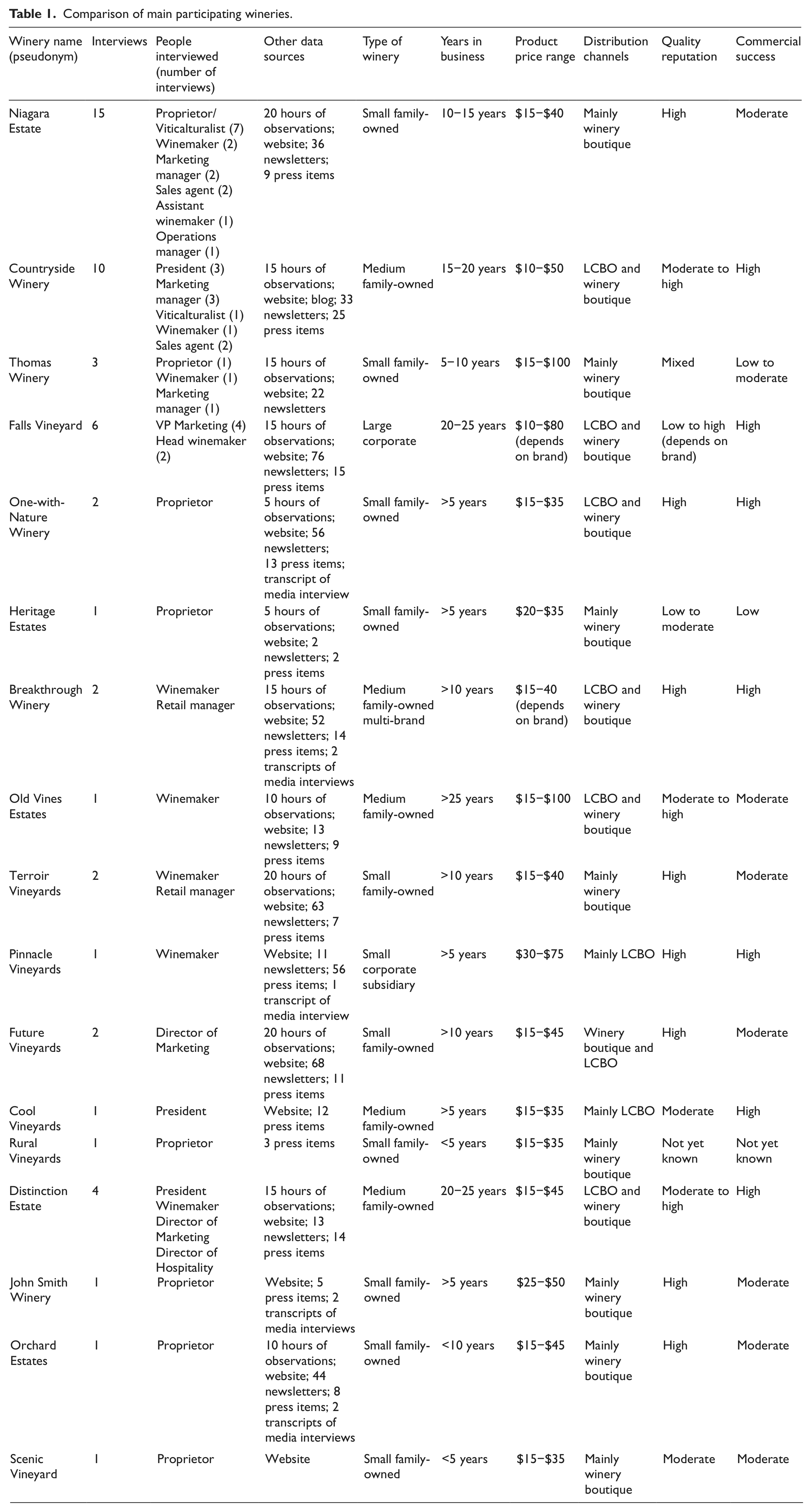
Our primary sample consisted of 16 Ontario wineries. Table 1 provides more information about the wineries and the type of data obtained. We started with three wineries (a small, a medium and a large). Following that, we used our respondents’ recommendations to add to our sample. The sampling was meant to ensure that the wineries varied on important characteristics including age, size, ownership type, level of commercial success (an indicator of adherence to the market logic) and quality reputation (an indicator of adherence to the aesthetic logic), because each of those factors could potentially play roles in how a winery and its employees seek to navigate institutional complexity. Because our interest was in theory building, we sought out as much variance as possible.
Comparison of main participating wineries.
Interviews
We conducted semi-structured interviews with a total of 34 winery representatives. Each interview averaged about 1.25 hours and was tape recorded and transcribed. A total of 54 such interviews were conducted, with several respondents being interviewed on multiple occasions, due to the changes happening at some of the wineries and within the industry.
Formal interviews were supplemented with informal conversations with the interviewees and other winery employees on multiple occasions throughout our fieldwork. These conversations often occurred while the interviewees performed their routine work, which gave them the opportunity to reflect on their situated activities (Schon, 1983).
Because critics play crucial roles in the wine industry (Colman, 2008; McCoy, 2005), we conducted one-hour semi-structured tape-recorded interviews with eight wine critics; 12 such interviews were conducted. In addition, because our early interviews and reading about the wine industry highlighted the importance of prestigious restaurants in the wine industry, we conducted semi-structured, tape-recorded interviews with seven, and informal conversations with 10, high-profile restaurateurs and sommeliers.
We complemented the insights gained from these three key actors (wineries, wine critics and restaurants) with interviews with other relevant actors. We interviewed a representative of the Wine Council of Ontario, a trade group that represents most of Ontario’s wineries, and two representatives of the Grape Growers of Ontario, the trade organization that represents the interests of the grape growers who supply Ontario wineries. In addition, we interviewed one senior representative of the Ontario Wine Society, a non-profit club that offers social and educational events aimed at promoting Ontario wines. The last set of interviews consisted of one-hour semi-structured interviews with four Liquor Control Board of Ontario (LCBO) executives. The LCBO oversees liquor sales and distribution in Ontario, and it is also the main alcohol distribution channel in Ontario.
Observations
A thorough understanding of scripts requires attending to both language and actions performed by actors on a day-to-day basis (Barley, 1986, 2008). Accordingly, we observed a variety of staff meetings, planning sessions, staff training sessions, winery open houses, grape harvesting, winemaking and other activities at several wineries. We also shadowed one of the wineries’ sales representatives as he visited client restaurants to observe how the winery manages its client relationships and convinces restaurateurs to add wines to their wine lists. In addition, we regularly observed the retail and other staff members as they conducted their routine work in the wineries’ retail stores. Finally, we attended and observed industry group meetings, workshops and presentations. These observations amounted to about 300 hours. In all cases, we took extensive notes during, or immediately after, the observations.
Documents
In order to grasp how wineries communicate to their customers, we compiled the email newsletters of 31 wineries. Of the 16 wineries in our main sample, 12 maintained email newsletter lists, which we included in our sampling of newsletters; we included 15 other wineries of various age, size and ownership structure in order to facilitate more comparisons and contrasts. Further, we routinely monitored the 31 wineries’ websites (all of them had websites). These electronic modes of communication were a crucial data source. Newsletters represent an important way for wineries to stay in contact with their customers, while websites enable wineries to communicate with both consumers and other audiences. Thus, these sources offer great insights into how wineries enact scripts.
We also compiled critics’ articles in newspapers and on web blogs, and examined various historical writings on, and historical accounts of, the Ontario wine industry (e.g. Aspler, 2006; Bramble, 2009; Ejbich, 2005; Phillips, 2004; Rowe, 1970). In addition, we compiled general news coverage of the industry and of individual wineries from local, national and international newspapers and web blogs, as well as various reports released by various groups.
Data analyses
The first phase of the study involved getting familiar with the routine functioning of the wine industry. It is noteworthy that whereas one of the authors was somewhat familiar with the functioning of the wine industry at the outset of the study, two other authors were novices to wine business and its institutional norms. This made it necessary for them to conduct extensive readings about the wine business, its history, norms and conventions, and immerse themselves in the ‘wine culture.’
This vicarious learning through reading and direct learning through participant observation activities played a key role in the shaping of the study’s focus; as the authors observed, actors collectively navigate the demands of the aesthetic and market logics. The authors’ relative inexperience with the wine culture facilitated critical sensitivity and defamiliarization (Alvesson and Deetz, 2000), whereby the authors were able to question why particular activities were accepted and taken for granted.
The next phase involved identifying a variety of different recurring activities and interactions, such as boutique tasting activities, email newsletters and vineyard tours, with an eye on both common and distinctive features (Barley, 1986; Lok and De Rond, forthcoming) within and across the different classes of activities and interactions (e.g. what are common and different features of winery tours, and how do they differ from boutique tasting interactions?). We also sought to examine the roles of audiences in these activities and interactions.
During the next phase, we sought to aggregate these different types of activities and interactions into more general categories of recurring patterned behaviors (i.e. the scripts) with a special focus on identifying their internal logic or rules. We noted the identities that were being projected (Barley, 1986), the associated material practices (Zilber, 2002) and the communication strategies (Lounsbury and Glynn, 2001) through which the identities were being projected. It is at this point that we mapped these scripts onto either aesthetic or market logics and, to do so, we relied on prior research that has outlined the properties of those logics (e.g. Glynn and Lounsbury, 2005; Thornton, 2002; Thornton and Ocasio, 2008). Thus, as we discuss below, we found three scripts – two (farmer and artist) that facilitated adherence to the aesthetic logic and one (business professional) that facilitated adherence to the market logic.
We ensured the trustworthiness of the data in several ways. First, all data were carefully managed using NVivo qualitative data management software. Second, we continually triangulated the multiple sources of data (Tilcsik, 2010), comparing and contrasting data across the different sources to validate that a particular practice could be ascertained either through multiple forms of evidence (e.g. interviews and observations) or through multiple instances of the same form of evidence (e.g. multiple interviews). When disagreements emerged either among the sources or between the authors with respect to the assignment of data to particular categories, we re-examined the data to understand the reasons for the differences until a consensus was reached. In addition, we periodically presented preliminary findings to various actors to test the accuracy of our understanding of field dynamics (Lincoln and Guba, 1985). We explored disagreements through additional data collection to assess whether the emerging theory needed to be modified (Alvesson and Kärreman, 2007).
Findings
Three scripts for navigating institutional complexity
We found that wineries and audiences enacted three scripts in the course of their day-to-day navigation of institutional complexity. Whereas the scripts of farmer and artist were enacted to adhere to the aesthetic logic, the enactment of the business professional script adhered to the market logic. Thus, while there is general consensus about how the market logic is to be followed, the aesthetic logic is more fluid and includes two distinct underlying scripts. Following the components of scripts we outlined above (projected identities, associated practices and communication strategies), we describe these features for each of the three scripts below and provide illustrations in Table 2.
Farmer, artist and business professional scripts.

The farmer
The farmer script conveys the aesthetic enjoyment to the audiences not through intrinsic aspects of the wines themselves, but rather through evoking the romantic imagery of old-fashioned and pre-modern toiling in the fields that putatively have characterized winemaking of the older days (Hills et al., forthcoming; Robinson, 2006; Ulin, 1996, 2002; Voronov et al., forthcoming). It constructs a wine producer’s relationship with nature as mainly reactive. It involves attempts to demonstrate a winery’s intrinsic connection to, and the supremacy of, land and ‘terroir,’ emphasizing the labor required to produce high quality wine, while also acknowledging the limited control that wine producers are able to exercise over wine production. The term ‘terroir’ refers to ‘the relationship between the characteristics of an agricultural product (quality, taste, style) and its geographic origin, which might influence these characteristics’ (Van Leeuwen and Seguin, 2006: 1). The focus is on demonstrating authenticity resulting from wine being essentially an agrarian product tied to the land, with nature dictating what can and cannot be done. This script is consistent with the traditional European conceptualization of winemaking that defocalizes the winemaker and emphasizes the grower (Ulin, 2002). As noted by Robinson (2006: 769), ‘there is no obvious synonym for the word winemaker in any of the major European languages, perhaps because historically wine was thought to make itself.’
The identity projected through the farmer script is one of devotion to the soil, and the love of farming and toiling in the fields. Humility is a key trait, and wine producers portray themselves as being at the mercy of nature and having fairly limited control over it. The following interview excerpt by James, the proprietor of Niagara Estate, illustrates this emphasis: ‘We think that this little plot of land will have flavors that no other plot will − and we will make it without any manipulation of the wine . . . what comes from the soil will be what the consumer will . . . experience when they come to Niagara Estate . . . we try to convey the flavors that come from the soil.’
The practices associated with this script involve hands-on and laborious farming practices. Technology is treated with skepticism, as some wineries conclude that it cannot deliver what hands-on work can do, as the following quote from a newsletter of Terroir Estate illustrates: When we first planted to vinifera grapes we knew that no mechanical harvesters could pick these sensitive grapes and harvest would have to be manual. Then, during our first harvest in 1985 new harvesting machines from Europe came to Niagara and mechanical harvesting of even vinifera varieties became the norm. Over the years we’ve done both, and find the quality from manual harvests is far superior to mechanical harvesting. Today all our grapes are harvested by hand.
Stewardship of the land is also an important component of this script, and a great deal of emphasis is placed on that aspect of winemaking. As one winery explains in an electronic newsletter: Biodynamic agriculture is a very natural, holistic means of growing crops, and focuses on enhancing the life processes of nature . . . the soil is treated as a living organism in its own right and nurtured as such without the use of harmful sprays or chemical fertilizers . . . Animals also play a fundamental role in helping us achieve both the bio-diversity and self-sustainability of our vineyards.
With respect to the communication of this script to audiences, it is done mostly through experiential events that offer visitors opportunities to get their hands dirty by working in the field side-by-side the winery team (e.g. day-long grape picking events), acquiring a more bodily appreciation for how difficult such work is. For example, when touring the otherwise refined and sophisticated gravity powered winemaking facilities of Future Vineyard during the harvest time, a visitor encounters crushed grapes on the floor, and notices fruit flies not only in the processing area but even in the tasting room. The winery is visibly busy, with many employees rushing around (de-stemming grape bunches, putting them into the press and so on). The Director of Marketing explained that ‘this is not a sterile environment.’ In addition to showcasing the laborious farming practices that convey hands-in-the-dirt authenticity, there are attempts to conceal and obscure practices that endanger the wineries’ abilities to convey such images. For instance, Tony, the winemaker at Falls Vineyards, explains that he is comfortable telling customers about farming practices and innovations used in grape growing, but not about the techniques of winemaking, because the latter likely conveys images of manipulation and tinkering with the grapes, which would clash with the customers’ ‘romantic notions of winemaking.’ This belief is also illustrated by Countryside Winery, which tries to avoid allowing customers to see the inside of the production facility, which the proprietor suspects ‘looks quite industrial.’ Websites and newsletters are also used to explain in detail the specific laborious and hands-on techniques used in order to ensure terroir expression.
The artist
Demonstrating the superior aesthetic merits of a wine itself is the most central feature of the artist script. Such superiority is accomplished by emphasizing a commitment to uncompromising and superior winemaking. Although this script also implies commitment to expressing the terroir, it conveys less resignation to the rule of nature and instead emphasizes the winery’s mastery over it and an ability to deliver superior quality, even if that means ‘enhancing the terroir.’ The image is grounded less in the pre-modern mythology of Europe, like that of the farmer script, and more in that of New World winemaking regions like California and Australia (Robinson, 2006; Voronov et al., forthcoming). Consistent with the imagery of high art, the imagery is the production of wine for those who are ‘in the know’, rather than for the general population, as the following quote from the website of Johnson Estate illustrates: There are two types of wine. An accepted wine: It is enjoyed by the masses, expected, and very popular. An acclaimed wine: It is spoken and written about. It is enjoyed by those who understand wine and appreciate the enormous effort that goes into producing a wine that is a cut above. Johnson wines strive to be acclaimed. The quote, aimed at connoisseur consumers, highlights the exclusive and small-scale aspects of the winery’s products and contrasts them with those offered by wineries seeking mass appeal and a large volume of sales.
The identity projected through this script is one of uncompromising commitment to producing wines of outstanding quality, as illustrated by the following quote from the winemaker of Terroir Estate: And sometimes I say to myself, if I’m not trying who’s going to do it. And who’s going to do it for me? And nobody for sure. So if I want to continue to be excited a little bit thinking that there is something possible, something that we can craft some great bottles, I have to do it, I have to try it.
Disavowal of the profit motive is an important component of this identity, as well; as wine producers often emphasize that they do what they do not to make money, but to pursue a personal passion. As the proprietor of One-with-Nature Winery, explained: It goes back to sharing my passion, right. I can’t share my passion with somebody if I charge $50 for a bottle of wine. I’ll guarantee you some of my wines are better than a lot of $50 − average $50 wine that’s out there in the marketplace. I know that. I know we are doing − we have a great vineyard, we’re doing all the right things in the winery. We’re doing all those things. I know there’s $50 wines out there that aren’t as good as mine. But I can’t share my passion with people if I charge $50 a bottle.
The practices associated with this script involve not only laborious techniques in the field that are traditional, but also greater experimentation in the field and in the winery, often requiring expensive equipment and processes. Nature does not dictate what wines are produced, and winemakers can attempt to mitigate and enhance what nature delivers – balancing between the dictates of the terroir and their desire to produce outstanding wine. For example, several wineries have attempted to overcome the challenges presented by Ontario’s cooler climate (i.e. terroir limitations) that makes it more difficult to produce full bodied red wines, by adopting the Italian appassimento method of drying the grapes after harvest to produce more concentrated wine. This method is at times questioned by proponents of terroir purity, as it produces wines that might be less characteristic of the particular locale.
The artist script is communicated primarily through the displays and highlighting of acclaim, such as critics’ reviews and awards, as well as showcasing the wines at restaurants with particularly respected wine lists. For example, Old Vines Estates displays laminated sheets that highlight high scores and review excerpts from Wine Spectator on its tasting table. Thus, wineries enter competitions, attempt to place their wines on prestigious restaurants’ wine lists, bring the wines to the attention of other wine producers, all in an attempt to earn artistic acclaim. It is also common to include wine critics’ assessments in emails to customers, such as: ‘Canadian wine writer David Lawrason (Toronto Life) who commented, “Fine tannin and excellent flavour focus. Score-96.”’
The business professional
The business professional script involves demonstrating requisite responsiveness to economic imperatives. The high investment stakes involved in starting a winery and the fact that many family members are often tied up with their fortunes in the wineries dictate that profitability is an important goal. However, it remains difficult to earn a profit in the wine industry. A proverb often rehearsed posits, ‘How do you make a small fortune in the wine industry?’ and responds with, ‘Start with a big one.’ Wineries also emphasize the competitive distinctiveness of local wine, as compared to imported ones, and the greater economic benefits that can result from it.
The identity projected through this script evokes a commitment to operating a profitable business. This is illustrated by the following quote from the Director of Marketing at Countryside Winery: We don’t do anything we can’t do profitably, put it that way. What’s a healthy margin is maybe a subject of the day but we know what it costs us to run this and be profitable. And if we can’t do something profitably, we’ll get out of the business.
The associated practices involve attempts to increase market share and profitability through judicious pricing, responding to market demand and finding business efficiencies wherever possible. The vineyard manager at Countryside Winery summarizes these challenges as follows: One of the reasons why a lot of the wineries don’t end up succeeding is I think because they come into it with all passion, and that’s good, but they forget the fact that they’re making a package good product that you have to ultimately sell, right? So you have to somehow harness your passion into creating added value to what is ultimately a package good. It’s a package good that is at its rawest form; you have to take out all the romanticism and all the – you’re fermenting juice, sticking it in a bottle, you got to get it on the shelf and have someone buy it.
The business professional script is communicated through catchy labels, sales and promotions, and partnerships with other business parties, all meant to increase sales. Branding, in particular, is very important to wineries, and many different approaches are used by wineries. For example, there are several celebrity winery brands accomplished through partnerships between an established winery facility and a celebrity, such as a sports celebrity (e.g. a golfer, a hockey player) or a TV or film personality. Other examples of branding involve tapping into family stories and cultural background, whereby references are made to winemaking expertise (e.g. one family’s five generations of winemaking in France) or local folklore. Some wineries’ different brands are highly differentiated and aimed at different psychographic segments, while other wineries’ brands cluster around a common theme. For example, Countryside Winery has launched several brands – all around the theme of family. Relatedly, wineries also make efforts to understand consumer buying patterns, and these efforts range from relatively informal observations of people’s reactions to particular wines, their packaging and pricing to more formal consumer surveys, conducted by advertising agencies.
Script and audiences
It has been acknowledged in prior research that actors seek to adhere to the logic preferred by particular audiences, and this sometimes creates challenges, as actors may be pulled in different directions by the divergent expectations of the audiences (Kraatz and Block, 2008; Pache and Santos, 2010). In our study we found that although some audiences aligned more closely with either the aesthetic or market logic, and thus with the enactment of their constitutive scripts, this alignment often was not exclusive in that the expectations of particular audiences were not monolith or uniform (e.g. different consumers might have different expectations from a winery). Below we discuss how scripts were used to adhere to the demands of the aesthetic logic, market logic or both in interactions with different actors in the field.
Consumers
Interactions with consumers, especially those who purchase premium and ultra-premium wines, are governed primarily by the aesthetic logic. As Shawn, the proprietor of Falls Vineyards, observed: The consumer who is buying a $30 wine, their involvement level’s probably quite a bit higher. So, we have to talk to them in ways that are interesting to them like, ‘What’s so special about this wine? Where did it come from? How did we make it? Who made it? How much did we make?’ They love scarcity. They love to know there’s only a tiny bit. They love to know that a wine writer gave it a high score. They love to know that it was the best white wine at the wine competition.
In other words, adherence to the aesthetic logic is crucial for effective relationship management with such consumers, and wineries enact either the artist or the farmer script in interactions with them. We found that audience cues were not the only determinants with respect to which of the two scripts were chosen, and wineries’ own preferences or winemaking philosophies were important in determining whether the farmer or the artist script would be enacted. In general, wineries with higher product price points were more likely to enact the artist script, as they sought to convey an uncompromising commitment to producing the finest wines year-after-year, regardless of the favorability of the vintage conditions. One winery, for example, describes its vineyard manager as someone who ‘knows the land and the sky above it like no one else in the region. His work is magnificent in every way, and he delivers a harvest of exceptional quality. Year after year.’
Over the course of this research several such wineries opened, garnering a great deal of critical acclaim and awards, and buzz among restaurateurs. These wineries tended to be owned by wealthy entrepreneurs who arrived in the industry after accumulating wealth in another field (e.g. law, business, etc.), who tended to be skilled at gaining media attention and critics’ reviews. They then tended to strongly emphasise the positive reviews they received to the consumers by posting excerpts in tasting rooms or including them in the email newsletters and on winery websites. But the artist script was certainly not exclusive to such wineries. Falls Vineyards, a corporate winery, also tended to enact this script. This seemed to be because its large boutique staff of mostly part time and seasonal employees, many of whom were students, combined with a high number of visitors to its boutique, required that the staff be trained to deliver consistent and concise messages about the winery and its winemaking. It was more feasible to train the staff to emphasize the exceptional quality of the wine than to talk about the old fashioned farming techniques that might be too abstract for many employees, who would have difficulty enacting the farmer script authentically. Thus, the staff training sessions that we observed revolved around developing employees’ abilities to enact this script.
In contrast, the farmer script was most likely to be enacted by wineries that were owned by people who entered the industry as grape growers and eventually decided to forward integrate to become a winery (e.g. Niagara Estate). Wineries that received less media buzz and fewer critical accolades also tended to be more likely to enact the farmer script with consumers.
Wineries’ reliance on either the farmer or artist scripts in their interactions with consumers may also change over time. For example, during the course of our research project Terroir Vineyards − which had been owned by four partners who owned some of the most regarded vineyards in the Niagara Peninsula and treated the winery as more of a ‘hobby,’ aiming merely to earn enough to continue sustaining it − was acquired by two wealthy entrepreneurs who sought to grow and professionalize the winery. They invested in a more elaborate building and hired an acclaimed winemaker and more professional staff. Some of the prices were raised, as well. Whereas prior to the change in ownership the winery enacted primarily the farmer script, after the change in ownership, it started enacting primarily the artist script. For example, whereas the winery tended to shun awards under the old ownership (some of its newsletters even denigrated the proliferation of awards in the wine industry), under the new ownership, the winery started emphasizing awards a great deal more in both newsletters and in boutique interactions with consumers. It also started emphasizing critics’ reviews a great deal more. In general wineries, even those that habitually enacted the farmer script, tended to enact the artist script more often, if they received some positive critical coverage or won awards.
It is noteworthy that even though some wineries were more likely to enact one of the two scripts than the other, both scripts were utilized by all wineries to a greater or lesser extent. For example, at harvest time or during the winter months, winery newsletters would be more likely to contain evidence of the farmer script, as wineries sought to update dedicated clientele on how hard they were working to nurture and care for their vineyards and grapes in a laborious and hands-on manner. The exception was Falls Vineyards, a corporate winery, which hardly utilized the farmer script in its newsletters.
It is also noteworthy that with respect to boutique experiences, it was not uncommon for boutique staff to switch between the farmer and the artist scripts, depending on the cues from a particular client. Older and more experienced boutique staff seemed especially capable of enacting such scripts fluidly and believably, compared to younger staff with less experience in the industry. The main factor that seemed to influence this ability to switch between scripts was the extent of these employees’ exposure to the variety of winery functions, often (but not always) resulting from working at a smaller winery. As the marketing manager at Thomas Winery explained: . . .in a small winery situation you are wearing many, many hats. And I believe that is better because the more hats you wear, like the dirtier your hands get, the more you understand. I mean, for instance, the best way to learn about wine is to get your hands dirty.
Although interactions with consumers are governed mostly by the aesthetic logic, a market logic also is present, and there is evidence of the business professional script being regularly deployed. Although many consumers are turned off by perceptions of obvious commercialism, and many are willing to pay for what they consider to be outstanding wines, they still want to feel that they are getting good value for money. Thus Ontario wineries are preoccupied with demonstrating to consumers that they are offering good value for money. For example, they routinely highlight reviews in which critics identify certain wines that seem to deliver particularly good quality for the price. Many wineries, even those committed to producing wines of the highest caliber (and with high price), sometimes offer incentives and sales to attract more customers. For example, about twice a year Orchard Estates highlights some discounts at the bottom of its newsletters, even if the winery mostly enacts the farmer (and occasionally artist) scripts. Its newsletter from October 2012 highlights the winery’s recent awards at an international competition (artist script), before listing its ‘winter warm-up promotion’ at the bottom that lists four wines as ‘limited time holiday specials’ on a $5 to $7 discount. In fact, as we discuss below, wineries are aware of the fact that successful enactment of the artist script is greatly beneficial for advancing wine sales.
In addition, over the past two years, a number of wineries have changed the labels on their wine bottles to make them more eye-catching. For example, when asked why Future Vineyards changed its label, the Director of Marketing explained that ‘we were getting constant complaints from the retailers: “we like your wines; they are really good. But we have to hand-sell them.” So we wanted them to stand out more.’ In fact, one Liquor Control Board of Ontario (LCBO) executive observed during a 2009 interview that Ontario wineries’ labels were ‘the most boring’ in the world, and it appears that wineries have been attempting to change their labels to be more aggressive in marketing their wines.
Equally important is the fact that many consumers are not highly involved with wine at all, and look for more affordable wines, regardless of its artistic merits. These consumers are a particular challenge for most Ontario wineries. Given the small size of the vast majority of the wineries and the less predictable climate, Ontario wineries have tremendous difficulty successfully producing inexpensive wines. Interactions with these consumers involve primarily the business professional script, accomplished through simple and memorable communication promoting affordable wines. Only a few large wineries are able to successfully serve this consumer segment. This issue is seen as a ‘problem’ by a number of small wineries that are located along the busier touristy roads that bring tourists who may all too often taste a number of wines without making any purchases. Some small wineries try to offer at least one or two lower priced wines that can be sold to such consumers, and over the course of the study we noticed wineries increasingly introducing a tasting fee (ranging from $1.50 per sample to $10 per three samples) for consumers who do not make purchases after tasting.
Wine critics
Wineries’ interactions with critics are governed primarily by the aesthetic logic because critics are mostly interested in the various factors that determine the quality of a wine, such as where the grapes are grown, what winemaking techniques are used, and, most importantly, the extent to which the wine reflects the local terroir. They are the ultimate guardians of the aesthetic logic in the wine industry and, arguably, possess more power than any other group of actors in legitimizing (or not) a winery’s efforts. Critics tend to believe in the primacy and superiority of terroir and proper grape growing in determining wine quality. As noted American wine critic Matt Kramer (2004) observes, with respect to ‘somewhereness,’ his Anglicization of terroir: ‘You can't fake somewhereness. You can't manufacture it. Indeed, you can't even figure out its source. But when you taste a wine that has it, you know. This is what wine lovers have understood since the ancient Romans’ (p. 10).
Thus, wineries’ interactions with critics usually involve the farmer script. During the interactions, wineries seek to explain to the critics how the particular vintage conditions and particular grape growing and winemaking techniques have contributed to the wines acquiring particular traits and characteristics. This point is further illustrated by the Falls Vineyards’ decision that only the winemaker, and not the marketing personnel, should communicate with the critics, thereby lessening the risk that the interaction between the winery and the critics might be contaminated by a market logic.
But critics are also essential in enabling wineries to enact the artist script. In fact, whereas wineries might often enact the farmer script in their interactions with the critics, critics might translate wineries’ activities into the artist script. Consumers often rely on critics to help them assess the artistic quality of wine, because as an experiential good, wine can be difficult to assess (Colman, 2008). As one critic we interviewed observed, ‘I think the role of the writer [critic] is really to explain and to interpret the wines for people.’
These interpretations are influential in determining wines’ commercial prospects (Colman, 2008; McCoy, 2005), such that positive reviews can result in substantial increases in sales and justify price premiums. As we noted above, in order to successfully enact the artist script, producers tend to seek out critics’ reviews and use them in marketing and promoting wines, as illustrated by the following quote from Shawn, the proprietor of Falls Vineyard: You only have to influence one wine writer with your story and, if he writes about it, that’ll affect, I don’t know, The Globe and Mail will affect, you know, a hundred thousand readers a day, maybe or two hundred thousand.
Thus, as the above quote alludes, and as we found throughout the interviews with various industry insiders, critics are not opponents of, and are not unconcerned with, market logic. They are aware of the commercial implications of their reviews, which is one of the reasons why some critics have the policy of either writing good reviews or not writing any reviews for wines they do not like. A number of critics also work as sommeliers or consultants for restaurants, and this makes them more attentive to the commercial prospects of particular wines. We actually found that all the critics we interviewed were personally curious about the business aspects of the wine industry. They wanted to see the producers they liked to make a profit, and they expressed concerns for wineries they believed struggled financially. For example, in 2010 a critic who writes for a leading national newspaper wrote a column that expressed concerns about the number of wineries struggling financially. Thus, although the interactions between wineries and critics enacted mainly the farmer script, critics were keenly aware that their ability to help wineries to translate the farmer script into the artist script might also help wineries enact the business professional script, to the extent that the wineries use their reviews to market the wine.
Elite restaurateurs
Both the aesthetic and market logics are salient in the relationships between wineries and elite restaurants. Not only do such restaurants account for a significant portion of a winery’s sales, but when high status restaurateurs select a winery’s products for inclusion on their wine list, it legitimizes the wine’s quality reputation. As John, Countryside Winery’s sales representative notes, for some restaurateurs or sommeliers, the ‘wine list really is their artistic expression.’ Thus, such restaurateurs play roles that are akin to museum curators (Alexander, 1996), enabling wineries to enact the artist script. For example, boutique staff at Terroir Vineyards often inform visitors that one of the winery’s wines is on the wine list at the UK’s Fat Duck Restaurant, listed among top restaurants in the world.
It is not just the international restaurants that are important. Toronto, one hour from the wine region, has many famous restaurants with distinguished wine lists. However, no ‘home field’ advantage exists for Ontario wineries, because many restaurant-goers are unfamiliar with Ontario wines. Thus, attaining a listing on the wine list of a prestigious restaurant, alongside a famous Burgundy, Bordeaux or California offering, is a daunting challenge. As one wine critic observed, ‘basically they [wineries] have to convince the Toronto businessman that Ontario wines are worth drinking instead of wines from France and Italy.’
Similar to consumers and wine critics, restaurateurs must be educated about a winery’s efforts to ensure high quality and to preserve the integrity of a particular wine. The artist script is enacted primarily by emphasizing the awards, reviews and other accolades received by a winery. The farmer script is enacted by some wineries as well, as they bring restaurant staff (often at winery expense) to the wineries and educate them and let them experience how arduous the farm work is. This is especially important for restaurants that adopt a farm-to-table philosophy with a similar emphasis on old-fashioned non-interventionist farming that is the characteristic of the farmer script. When that is not feasible, or with restaurants that have ongoing partnerships with particular wineries, winery representatives might attempt to evoke the farmer script in other ways, such as by discussing the specific farming activities and challenges that are happening at that particular point in time. Some restaurateurs subscribe to wineries’ email newsletters, and might be exposed to the farmer script through these, along with consumers. Sometimes the representatives even consciously attempt to downplay the business side of winemaking in order to project the farming image more effectively. For example, the Director of Marketing at Countryside Winery explains: I used to be a suit-and-tie guy and tried to present a very professional sort of button-day, Bay-Street-type image when I was visiting my customers, in Toronto especially because we wanted − I needed to communicate to them that we were a professional, organized serious business. That we’re not fly-by-nighters . . . But we’re not corp − now I don’t want them to think we’re corporate . . . So I dress down . . . The odd time I wear my cowboy hat. You know what I mean? I don’t wash the car because I want them to see that’s a dirty car that was in the vineyard. Because it’s true.
Nonetheless, fine dining establishments are profit-oriented, and, thus, as a number of respondents pointed out, the ultimate question that preoccupies restaurateurs when choosing wines to add to their wine lists is whether those wines are likely to sell or help the restaurant differentiate itself from competitors. For example, Simon, the operator of a prestigious Toronto restaurant, observed that having added Ontario wines to his wine list helped generate ‘buzz’ for the restaurant, which increased his sales figures significantly. Thus, the business professional script is important in these relationships, too. Wineries need to provide restaurateurs with easy to tell stories about themselves and particular wines that would be easy for the wait staff to remember. The wine pricing for restaurants is usually lower than for consumers, and wineries also try to cater their offerings to meet particular restaurants’ needs, such as by bringing particular wines or particular styles of wines to certain restaurants, based on the owners’ preferences and/or the type of food served. Some loyal restaurants might even get special offerings in the form of exclusive wines, bottled especially for those restaurants or some rare wines not available to the general public. For example, we observed that when visiting a particularly loyal restaurant client, the Countryside Winery’s sales representative brought several bottles of an older vintage Cabernet-Merlot that was no longer available to the general public.
Liquor Control Board of Ontario (LCBO)
Relationships with the LCBO, responsible for the distribution of wine in Ontario, are governed primarily by a market logic. The LCBO is less concerned with a winery’s use of specific farming techniques or artistic recognition than its ability to fulfill its obligations to deliver the requisite number of cases of wine and provide the necessary marketing support for that wine. In contrast to the relationships with consumers, critics and restaurateurs, the relationship between a winery and the LCBO requires pre-empting suspicions that a winery is too aesthetics-focused and not sufficiently business-oriented. In other words, this relationship requires enacting the business professional script, which is a tough order for many wineries. Both LCBO executives and representatives of large wineries (who do a great deal of business with the LCBO) lament the lack of business acumen within the Ontario wine industry. Wineries have to sell wine to the LCBO at a price considerably lower than the retail pricing, and they may be asked to deliver volumes that are difficult to attain. They need to also provide various marketing support materials, such as ‘shelf talkers’ or tags that describe concisely what is special about a particular wine.
Nonetheless, the LCBO still values wines of distinction to some extent, in that those wines tend to be more marketable and cast a positive glow over other Ontario wines. Thus, in contrast to the more typical practice of Ontario wineries approaching the LCBO in hopes to place their wines there, the LCBO proactively approaches some of the more acclaimed or buzz-worthy wineries with invitations to distribute their wines. This indicates that the aesthetic logic, though not dominant, is present in wineries’ relationships with the LCBO as well, whereby the LCBO utilizes critics’ reviews of the aesthetic qualities of certain wines to promote the wines.
Summary
The Ontario wine industry is characterized by the strong salience of both aesthetic and market logics. Actors engage with institutional complexity by utilizing three scripts: the farmer and the artist scripts are enacted to adhere to the aesthetic logic, and the business professional script is enacted to adhere to the market logic. We found that the choice of scripts was driven not only by audience cues, but also by certain winery characteristics, such as history, owners’ preferences and price points – especially when it comes to the choice between the farmer and the artist scripts. Furthermore, these preferences were somewhat fluid, such that most wineries we studied were able to enact all three scripts, and adhering to the aesthetic logic involved occasional switching between the artist and the farmer scripts.
The audiences did not impose totalizing expectations on the wineries. Thus, although we found closer alignments between some audiences and either the aesthetic (e.g. consumers) or the market (e.g. the LCBO) logics, all of the audiences were mindful of, and at least somewhat amenable to, the less salient (for them) or less preferred logic.
Discussion
Our objective was to advance a better understanding of how actors engage with institutional complexity. Mindful of the fact that logics may not provide fully formed schemas and identities that are situationally activated (Lok and De Rond, 2012), we sought to better apprehend how actors engage with them in a semi-automatic manner on a day-to-day basis, using them as the raw materials through which meaning is formed and negotiated (Barley, 1986). In our research context − which investigated how Ontario wineries sought to adhere to the aesthetic and market logics in the course of their day-to-day functioning − we revealed two scripts that were used to adhere to the aesthetic logic (farmer and artist) and one that was used to adhere to the market logic (business professional).
Our findings suggest that institutional complexity involves more than responding to pressures resulting from different and possibly conflicting logics. Whereas prior research on institutional complexity has focused primarily on more discrete and episodic responses to conflicting institutional pressures (Greenwood et al., 2011; Pache and Santos, 2010), our findings suggest that institutional complexity may form a more mundane backdrop for actors’ day-to-day functioning, priming, editing and triggering (Weber and Glynn, 2006) their meaningmaking, rather than dictating courses of action. Adherence to logics appears to be both effortful and creative, as actors choose not only which logic is appropriate to adhere to in a particular situation, but also which script might be needed to adhere to the particular logic. In doing so, actors were mindful of audience cues, as well as their own preferences and strategic objectives. For example, in choosing between the farmer and the artist scripts, such factors as owners’ preferences and backgrounds, as well as pricing strategies, might influence the choice of a script.
In terms of the role of audiences, actors tended to switch among scripts in response to their diverse expectations of what they should do or not do (Kraatz and Block, 2008; Lamertz and Heugens, 2009; Pache and Santos, 2010). However, it is noteworthy that in our study, and contrary to what is typically assumed, there was no unique alignment between particular logics and specific audience groups, but rather the aesthetic and market logics, and their underlying scripts, were salient in the communication with each of audience groups, albeit to varying degrees. Thus, audiences such as consumers, wine critics and restaurants continuously co-produced, with the wineries, the definition of what ‘appropriate’ winemaking was or should be about, whereby wineries sought to achieve equilibrium between the demands of multiple audiences and their own objectives.
Such accommodation encompassed emphasizing or highlighting practices that are consistent with the aesthetic and markets logics through the flexible enactment of the artist, farmer, or business professional scripts. Further, we noticed not only ‘settlement’ (Rao and Kenney, 2008) between the conflicting logics of aesthetics and market, but even a ‘synergy’ resulting from the wineries’ adherence to the conflicting logics. For example, actors used their adherence to artistic aspects to enhance their commercial prospects in their interactions with audiences (Beverland, 2005). Audiences that were primarily aligned with the aesthetic logic (e.g. critics) seemed to embrace the market logic as an essential component of the field functioning too, perhaps realizing that wineries’ pursuit of aesthetic excellence is conditional upon their financial viability. In this regard, this study also provides nuance to the acclaimed role of decoupling (Meyer and Rowan, 1977) as a route to gain legitimacy. Whereas traditionally research on decoupling has focused on how organizations separate technical activities that might not be palatable to audiences from socially desirable formal arrangements (e.g. Elsbach and Sutton, 1992), this study highlights how actors may blend different audience expectations in a balanced way in their response to institutional complexity. As noted above, all audiences in our study, regardless of their personal preferences for one logic over another, were keenly aware of the inevitability of both logics in the field. This salience then made it less necessary for wineries to decouple technical activities from formal arrangements, as long as they could demonstrate to each audience that they adhered to the audience-preferred logic. Thus, in the presence of institutional complexity, such selective matching of specific practices with audience-preferred logic is a possible alternative to decoupling.
Interestingly, the study’s findings also indicated that successful engagement with a particular logic in the eyes of audiences (e.g. being perceived as an authentic producer of high-quality wine) may be facilitated by the very presence of the other logic (e.g. the commercial side of winemaking). Thus, in the face of institutional complexity, the successful demonstration of one’s adherence to a particular logic might be enhanced by the acknowledged salience of another, seemingly rival logic. For example, in our study, it appears that the keen awareness among some wineries, and audiences, of the strong market forces that entrench the wine industry made it somewhat easier for other wineries to demonstrate credible adherence to the aesthetic logic, through their enactment of either the farmer or artist scripts, because these both involved demonstrating that wineries were not simply trying to produce a cash commodity.
Our findings also shed more light onto the notion of scripts itself. It is apparent that the enactment of different scripts is interlinked. For example, in our study, winemakers tended to enact the farmer script in relation to wine critics, and wine critics were instrumental in helping them translate the farmer script into the artist script when dealing with connoisseur consumers, or into the business professional script when dealing with the LCBO. Restaurateurs played a similar role as well, by facilitating the enactment of either the artist or the business professional script. Scripts then may offer further insight not only into how individual actors adhere to a particular logic, but also how they collectively blend or compartmentalize logics (see Battilana and Dorado, 2010). Conversely, through the flexible enactment of scripts, it is possible for logics to co-exist not only at a field level, but also to be integrated into actors’ routine practices. Thus, even if certain logics themselves might be in conflict with each other and place opposing expectations on actors (Pache and Santos, 2010), the notion of scripts helps to explain how actors are able to manage these conflicting expectations and cues fluidly, and on an ongoing basis. Taken together, by turning our attention to actors’ lived experiences of institutional complexity (Hallett and Ventresca, 2006), this study directed attention away from the question of which logics actors should adhere to, to how they engage with multiple logics in their daily work.
Limitations and future research
We acknowledge that our research has some limitations, and these offer avenues for future research. For example, it is important to acknowledge the potential eccentricity of this study’s empirical setting, in that like other industries producing experiential goods (e.g. music, theater, fashion, haute cuisine, etc.), the wine industry is inevitably characterized by the simultaneous presence of aesthetic and market logics (Colman, 2008). Thus, future research should examine other industries, where certain logics, over time, might be abandoned or transformed into something else.
Further, by utilizing the notion of scripts we were able to bridge the macro-level of institutional logics and micro-level of individual actor behavior, and provide a more nuanced view of embedded agency. In particular, agency is not confined to addressing gaps and empty spaces resulting from institutional contradictions (Willmott, 2011), but captures the active use of institutional logics as resources for actors’ ongoing sensemaking and action-taking. However, our data did not allow us to distinguish clearly between actors’ interpretations of logics and their enactment of scripts that adhere to the logics, and we focused primarily on script enactment. Future research, then, would benefit from a closer examination of how actors interpret a particular logic (or logics) and the roles of routines and habits versus intentionality (Emirbayer and Mische, 1998) in choosing which scripts should be enacted. Further, it would be interesting to explain variations among individual actors in terms of how much incompatibility they see in seemingly opposing logics, and what factors might explain these variations.
Future research could also investigate the process of script switching longitudinally. In particular, it could examine the enablers and inhibitors − both internally (e.g. skills) and externally (e.g. field maturity) − of such script switching, the tensions that actors might experience during script switching, as well as how some actors, over time, may gravitate toward a single dominant script that is consistent with their identity. Related questions in this regard are what events provoke a shift from one script to another or the gravitation to a specific script, as well as what the legitimacy consequences of such script switching are, and how these consequences may vary across audiences.
Yet another limitation of this study is that while we were able to identify the scripts that were enacted by actors in their navigation of multiple logics embedded in their field, we did not investigate the effects of such script enactment on the field itself. Given that institutional change may sometimes result from the actions of actors who do not aim to bring about such change (Lounsbury and Crumley, 2007), future research could investigate how flexible script enactment – though not aimed at field transformation – might, over time, bring about a restructuring of the field (Smets et al., 2012).
Finally, future research could also investigate how the selective adherence with particular logics may position some actors in dominant and others in dominated positions (Bourdieu and Wacquant, 1992). To this end, there may be benefit in using a Bourdieusian (or other critical) analysis of how actors selectively adhere to particular logics. The scripts that different actors use to navigate the space within and between logics are likely to be influenced by their access to capital in various forms and linked to the system of domination between and across fields (Bourdieu and Wacquant, 1992; Hensmans, 2003). Thus, research could explicate the role of power for creating a better understanding of how actors deal with institutional complexity.
Footnotes
Acknowledgements
We are grateful to the Associate Editor, Nick Turner, and three anonymous reviewers for their thoughtful guidance throughout the review process.
Funding
This research was funded, in part, by a grant from the Social Sciences and Humanities Research Council of Canada (grant number 410-2009-0485).