



Abstract
How do relatively low-power, role-constrained actors break through their constraints in a highly institutionalized environment? Examining the experience of Japanese middle-class housewives involved in a social enterprise, we developed a model of emergent identity work which outlines how actors who enacted their role values in new domains triggered a process of learning and sensemaking which led to spiralling cycles of role boundary expansion. In this process, facilitated by an enabling collective, actors not only changed their own self-concept (internal identity work) but also, through external identity work, changed others’ conceptions of their institutionally prescribed roles.
Introduction
The exercise of power is determined by thousands of interactions between the world of the powerful and that of the powerless, all the more so because these worlds are never divided by a sharp line: everyone has a small part of himself in both. – Vaclav Havel
Though marginalized actors may not be completely powerless, their roles may be confined within a very specific and narrow domain, limiting their influence in other domains and in society. Unleashing the power of marginalized groups in society can be a significant resource for social reform. Yet marginalized actors embedded in a highly institutionalized environment may not consciously seek change as the power over them may be systemic, and difficult to see, leaving them content in their prescribed roles (Lawrence, Winn & Jennings, 2001). How do relatively low-power, role-conforming actors break through their social constraints in a highly institutionalized environment, especially when they may not be consciously aware of such constraints?
To address this research question, we build on and extend the concept of identity work as institutional work (Creed, DeJordy & Lok, 2010; Lok, 2010; Watson, 2008) through an inductive case study of a social enterprise created by middle-class housewives belonging to the Seikatsu Club (also referred to as the Seikatsu Club Consumers’ Cooperative, or SCCC). When the club was founded in 1965, the influence of middle-class housewives in Japan was virtually confined to home and children through a prescribed and taken-for-granted role-identity of ‘ryosai-kenbo’, or ‘dutiful wife and nurturing mother’. While the institutionalized gender role has been viewed as a constraining factor preventing Japanese women from being taken seriously in the public domains of business and politics, the Seikatsu Club case demonstrates how this very institution became a resource for women to break through their role constraints through what we conceptualize as emergent identity work.
Current research on identity work focuses mostly on an internal ‘process of continuously forming, repairing, maintaining, strengthening or revising self-constructions’ (Alvesson & Willmott, 2002, p. 626; see also studies by Creed et al., 2010; Lok, 2010; Snow & Anderson, 1987; Watson, 2008) within a specific institutional environment. The paths from individual level identity work to structural change have rarely been illuminated (Creed et al., 2010). Research on identity work at the collective level, meanwhile, has focused on how members of a marginalized group struggle to resist social stigma or to enhance the social value of an existing identity (Schwalbe & Mason-Schrock, 1996; Taylor & Whittier, 1992), or on how institutional entrepreneurs create collective identities to rally support for a political agenda (Hunt & Benford, 1994; Maguire & Hardy, 2009). The interactions between internal identity work shaping the ‘internal aspects of personal identity’, and external identity work influencing ‘how others see us’ (Watson, 2008, p. 121) have rarely been examined. Most of the extant studies, moreover, share an assumption that individuals or groups conduct identity work when discontented with their institutionalized role-identity. How relatively content role-conforming actors may engage in identity work has not been explored.
By capturing the process through which Japanese middle-class housewives broke through the constraints of their institutionalized role-identity and changed that very institution, we conceptualize emergent identity work as an intra-person and collective process that involves multiple cycles of interactions between external and internal identity work through action, learning, sensemaking and role boundary expansion. Our conceptualization is consistent with the prior view of identity work as ‘an ongoing cycle’ of ‘an active and critical process of making sense of and for our “selves”’ (Musson & Duberley, 2007, p. 147), but goes beyond the definition of identity work as a purely intra-person and internal process. It also highlights the link between identity work and structural change through action taken in expanded role domains. Our study adds new insights to the literature of identity work and institutional change in several ways. First, we offer a conceptual model that captures how role-conforming actors engaging in everyday activities can draw power from their institutionally prescribed role-identity through emergent identity work. The Japanese middle-class housewives, though marginalized in public domains in postwar Japan, did not set out to change their role-identity. They were not even aware of the need for change. The commitment to their salient role-identity and the desire to improve their role performance, however, motivated those actors to take actions in ever-expanding domains while remaining consistent with their role values. Through these actions, they enlarged their role-identity without necessarily engaging in highly conflictual processes, internally or externally. In the process, they also became much more aware of the constraints imposed on them through their institutionally prescribed role-identity. It was at that juncture that their identity work turned from unintentional to intentional. Second, our case study captures the iterative cycles of interactions between external identity and internal identity work, paving the way for structural change. The identity work process of the Seikatsu women was triggered by responses to ‘problematic social situations’ (Alvesson, Ashcraft & Thomas, 2008, p. 15) that hindered the performance of their traditional roles as ryosai-kenbo. By taking action to address those problematic social situations, the housewives enacted their role values in ever-expanding domains through multiple cycles of action, learning and sensemaking. During the process, they reflected on, and realigned, their self-image with their new roles, resulting in a change in their institutionalized role-identity that incorporated both their updated self-image and others’ acceptance of their new roles. Last but not least, our findings highlight the role of an enabling collective as the platform for the emergent identity work of marginalized actors. The Seikatsu Club provided the ‘free spaces’ for Japanese middle-class housewives to interact with similar others as well as external stakeholders without drawing institutional sanction, to build up self and collective efficacy through activities of the club, and to acquire new knowledge that enabled them to take action in new domains. Isolated from the direct control of the dominant structure, the Seikatsu women were able to conduct identity work that was legitimized by their role values and yet gradually change their own self-conceptions and the institutionalized role expectations constraining them.
Theoretical Background
Role-identity as resource
Roles are ‘bundles of norms and expectations’ (Baker & Faulkner, 1991, p. 280) – ‘the building blocks of social systems and the summation of the requirements with which systems confront their members as individuals’ (Katz & Kahn, 1978, pp. 219–20). Roles thus encompass the institutional directives that guide and constrain incumbents’ view of self and their behavior. The term ‘role-identity’ implies duality: role is external, linked to social positions within the social structure; and identity is internal, ‘consisting of internalized meanings and expectations associated with a role’ (Stryker & Burke, 2000, p. 289). Thus, a role is a social prescription for behavior, while identity is self-understanding (Sveningsson & Alvesson, 2003). When a role becomes internalized and adopted as a component of the self, an ‘identity’ or ‘role-identity’ is said to have been established (McCall & Simmons, 1978; Piliavin, Grube & Callero, 2002).
Identity theorists have come to recognize the dual nature of structure and agency in role-identity – that society consists of both powerful, determining structures and actors that possess a degree of efficacy, freedom and creative independence (Callero, 1994). The structural interactionism perspective of identity theory suggests that social structures affect self and self affects social behaviors (Stryker, 1980; Stryker & Burke, 2000). Further, based on structuration arguments (Giddens, 1984), there should be a feedback loop through which social behaviors change social structures. How this can happen, however, has not been elaborated in identity theory, though the ‘role as a resource’ argument put forward by a group of scholars over the last two decades (Baker & Faulkner, 1991; Callero, 1994; Piliavin et al., 2002) provides a starting point for us to consider how action legitimized by role expectations can lead to structural change.
Baker and Faulkner (1991) studied how filmmakers used their prescribed roles to transform the Hollywood film industry, and those authors advanced the concept of ‘role as resource’ for the agency of role incumbents in affecting role structures. They suggest that a role can be a resource in two senses. First, a role defines and signals a person’s social identity and enables others to classify, understand and anticipate a person. It therefore can be used as a resource to claim legitimate membership in a social community, with attendant rights and obligations. Second, a role ‘grants access to social, cultural and material capital that incumbents and claimants can exploit in order to pursue their interests’ (Baker & Faulker, 1991, p. 279), as demonstrated by how roles were reconfigured into different positions by Hollywood filmmakers to enhance the power of the position holders in the post-blockbuster era. In another study, Piliavin et al. (2002) illustrated how commitment to the values of a salient role-identity may enable role players to overcome other restrictions associated with their role. These authors found that when the professional nurse role was salient for nurses, with its associated values of safeguarding the client and the public, the nurses could break out of their historical subservience to doctors to become ‘principled organizational dissidents’ in reporting healthcare errors (Piliavin et al., 2002, p. 473). Thus, roles are resources that enable different types of agency for role players (Callero, 1994), including exploitation of the role within existing structures and the creation of new ones.
While the aforementioned studies show that role-identities can be resources for agency, they do not show how individuals, especially marginalized actors who may not be conscious of the power vested in their prescribed roles, wake up to that potential and utilize their role-identity as a resource. What are the processes and mechanisms that enable change to established role structures? The identity work literature we review in the next section sheds light on the question.
Identity work and institutional change
Studies of institutional work have examined the micro processes through which actors affect institutions (Lawrence, Suddaby & Leca, 2009; Powell & Colyvas, 2008; Zietsma & Lawrence, 2010). Identity work scholars have argued that, as institutions can be affected through constructing and performing particular identities, hence identity work can be seen as an important form of institutional work (Creed et al., 2010; Glynn, 2008).
Identities can be constructed and subtly transformed through the everyday discourse and actions of ordinary actors. Snow and Anderson (1987) elaborated how homeless people constructed personal identities by engaging in ‘identity talk’ in which they used distancing, embracing, or fictive storytelling strategies to establish a sense of self-respect and dignity. Identities can be maintained through persistence of values, ideas and practices, even when formal structures change. Lok (2010) illustrated how managers’ everyday process of ‘sedimentation’ (p. 1329) enabled them to resist the pressure to change their identity when a new institutional logic was imposed by institutional entrepreneurs. Identity contradiction and its reconciliation can also be a potential force for change. Creed et al. (2010) documented the struggles of gay/lesbian /bisexual/transsexual (GLBT) ministers with identity contradictions between their sexual orientation and institutionalized heterosexism within the Church. The ministers’ identity work included internalization of institutional contradiction, identity reconciliation, role claiming and role use. As a result of this process, the ministers were able to see themselves as change agents within their institutional environment.
So far, identity work has been portrayed mostly as an internal process (Creed et al., 2010) or mental activity (Alvesson et al., 2008) an individual undertakes in ‘forming, repairing, maintaining, strengthening or revising self-constructions’ (Alvesson & Willmott, 2002, p. 626). Alvesson and colleagues, however, also argued that identity work is ‘grounded in at least a minimum amount of self doubt and self openness typically contingent upon a mix of psychological existential angst and complex or problematic social situations’ (Alvesson et al., 2008, p. 15). For identity work to be considered as a type of institutional work, a link needs to be established between the endogenous process of self-constructions and the external process of changing, or maintaining, institutions. While identity work scholars have argued for, and hinted at, the potential of the actor’s ability to claim power through identity work (Creed et al., 2010; Simpson & Carroll, 2008), the question of whether and how such micro processes lead to institutional change remains unanswered (Creed et al., 2010).
Furthermore, extant studies on how individuals construct and maintain identities, or resolve identity contradictions (Creed et al., 2010; Lok, 2010; Snow & Anderson, 1987; Watson, 2008) often reveal conflicts between internal personal ‘self-identities’ and external discursive ‘social identities’ (Creed et al., 2010; Watson, 2008). Such conflicts lead to the need to construct/reconstruct and manage a self-identity that retains a certain level of individual autonomy and dignity, with internal and external consistency, resulting in a ‘good self for a good society’ (Creed et al., 2010, p. 1360), or a good self for a good organization (Lok, 2010; Watson, 2008). What has not been examined is how actors conforming to, and reasonably content with, their roles may engage in a process of identity work which can lead to a simultaneous change of personal-identities and social structure in the form of role expectations. The current study of Japanese middle-class housewives engaging in the activities of the Seikatsu Club provides us with an opportunity to examine such a process.
Method
Empirical context
An overview of the Seikatsu Club
The Seikatsu Club in Japan is ‘a unique organization of its kind, combining formidable business and professional skills with strict social and ecological principles and a vision of a community- and people-centered economy’ (Right Livelihood Award website, http://www.rightlivelihood.org/). ‘Seikatsu’ means ‘life’. Founded in 1965 as a women’s voluntary association to address issues affecting their day-to-day lives, the Seikatsu Club has evolved into a social enterprise anchored in women’s initiatives and values to improve the quality of life, build a better community, and change unhealthy social trends. From a community-based, voluntary group of 200 Tokyo housewives aiming at buying better-quality milk at lower prices, the Seikatsu Club has grown into one of the most successful social enterprises in Japan, with 30 consumers’ cooperatives, over 300,000 members (99.9 percent of whom are women), and sales of approximately US$1 billion in 2008. Seikatsu Club members also formed the Seikatsusha Network, a grassroots political group addressing social and environmental issues which has placed close to 150 representatives, all women, in local assemblies. The Seikatsu Club group movement also gave birth to workers’ collectives, ‘an alternative form of work’ challenging the masculine work structure and culture in mainstream Japan Inc. By 2007, over 600 workers’ collectives with 17,000 workers (95 percent female) had annual sales of $150 million. In recognition of its contribution to social transformation, in 1989 the Seikatsu Club was presented with the Right Livelihood Award, often referred to as ‘the alternative Nobel Prize’, and won one of 50 community awards in honor of the 50th anniversary of the United Nations in 1995. 1
In this study we focused on the first two and a half decades of Seikatsu Club’s history, as those years represented the crucial stages of the club’s rise to become an internationally acclaimed social enterprise, as signified by the Right Livelihood Award. While the Seikatsu Club movement has contributed to changes in political, social and economic structures, launched new organizational forms and brought about changes to the food and household products used in Japan, the focus of this study is on its contribution to the change in the role-identity of middle-class Japanese women, from a restricted, private role as family caretaker to a more active public role in Japanese society, with political, economic and social facets.
Gender role segregation and the ryosai-kenbo role-identity in post-war Japan
After the initial years of democratization under American supervision following the Second World War, Japan focused on economic recovery through massive industrialization, leading to a prolonged period of rapid economic growth beginning in the 1960s. Accompanying this growth was structural change in employment and urbanization as workers moved from primary sectors such as agriculture and fishing to manufacturing and service sectors in cities. The middle-class ideal created under the Meiji modernization process was personified in ‘salarymen’ (the gender was specific) working virtually all their waking hours in large corporations, contributing to the national quest for productivity and efficiency. To support the corporations, a social structure represented by the motto otoko wa shigoto, ona wa katei – ‘men for work, women for family’ – was designed which left the private domain of family affairs completely in the hands of salarymen’s wives. Women’s devotion to the family in performing the idealized role of the ‘professional housewife’ was considered an indispensable enabler of the economic miracle (Sievers, 1983, p. 57).
Women in post-war Japan had internalized the institutionally prescribed ideal of womanhood embodied in the identity of ryosai-kenbo, or ‘dutiful wife and nurturing mother’, and identified strongly with their roles as manager and protector of the family. Due to their limited domain, Japanese middle-class housewives might easily be dismissed as powerless, especially as agents for social change. However, these housewives were uniquely positioned to create a better life for Japanese families because their role clearly charged them with taking care of family well-being, and they had the time and inclination to become involved in issues such as the price and quality of food and household products, and in improving their local environment. More importantly, as the manager of family finances and consumption, professional housewives had a reservoir of practical knowledge which could be drawn upon as a resource in improving the political and economic system (Sato, 1988).
The Seikatsu Club was founded against this societal context in 1965. Initially focused on collective buying of consumer products at lower prices and better quality, the club’s manifesto stated a social intent to form an ‘autonomous, democratic entity’ utilizing women’s power as gatekeepers for the well-being of their families, to ‘right the wrongs of the society’ (see Manifesto and Principles of the Setagaya Seikatsu Club, Appendix 1).
Data on the Seikatsu Club
Sources of data
We conducted an historical analysis of the reflections and activities of Seikatsu Club members from 1965 to 1989. The bulk of the data analyzed was collected from the archives of the Policy Research Institute for the Civil Sector, a research agency of the Seikatsu Club. These data include newsletters of the Seikatsu Club during its formative years, reflections written by members on their Seikatsu Club experience, journals and notes kept by the hans (the neighborhood units for collective buying) and anniversary reports of the Seikatsu Club, all in Japanese. The first author of this paper also conducted interviews in Japanese with a dozen Seikatsu Club officers/veterans, each lasting 90 to 120 minutes, in 2009. The first author and a native Japanese research assistant then translated and back-translated the archival documents. Information and insight generated from the interviews facilitated the collection and comprehension of archival data, but were not used as primary data for our analysis. Secondary sources also provided rich data on the early years of the club and its evolution, as they featured member reflections, quotations from interviews and summaries of survey data on the Seikatsu Club. These included a memoir written by one of the founders (Iwane, 1979), and a collection of essays written about the club (Nishikito, 2008; Sato, 1988, 1996). Academic articles and a dissertation, illustrating female participation in politics (Gelb & Estevez-Abe, 1998), social services (Oka, 2000), business (Kutsuzawa, 1998) and sustainable development (Dyck, 1994; Takitane, Da Silva & Pedrozo, 2005), were also studied for insights.
Scope of data
As in studies of many collective movements, we were aware that our theorizing might be applicable only to a minority group of active participants in Seikatsu Club events. According to a large-scale survey conducted in 1984, 13.2 percent of Seikatsu Club members were identified as active participants based on the number of activities in which they took part, whereas 54 percent participated in only a few activities and 32.8 percent only took part in collective purchase (Yamasaki & Wada, 1988, in Sato, 1988, pp. 254–5). Active participants tended to be older than the member average – in their 40s instead of the average range of 30 to 39 – and were emerging out of their intensive child-rearing years as the youngest child entered school; they had relatively higher household income and few held full-time jobs; they tended to have lived in the neighborhood for a relatively long time, and thus were deeply rooted in local networks (Sato, 1988, p. 256). The identity work and role boundary expansion process that we describe, however, may be applicable, though in varying degrees, to more than just the active participants, as close to 40 percent of the members in the survey indicated that becoming a Seikatsu Club member had broadened their social horizon (Sato, 1988, p. 227).
The key source of data we draw on in this study consists of individual member recollections of their Seikatsu Club experience collected through a wide range of sources, both primary (in the form of the club’s own collections and publications) and secondary (in the form of a memoir of one of the founders and prior research done on the club). The data is inherently messy with self-reflections/recollection at the individual level and yet relating mostly to the collective experience of housewives operating within the space of the Seikatsu Club. Hence our conceptualization of the emergent identity work process is inseparable from the interactions within the collective space. The data we collected was also biased towards active participants of the Seikatsu Club, and distilled to reflect the key themes we identified from the initial round of examination of the overall data. Despite their messiness and biases, the multiple sources of data, and insights generated from prior research and our interviews with Seikatsu Club officers/veterans, provided a rich basis for us to understand the process and develop our theory. We do not argue that all club members experienced the processes we infer, but only that enough club members described such processes to make the findings theoretically and practically meaningful.
Analytic process
As the focus of this study is to capture change processes, we followed Langley’s approach (1999), conducting our data analysis in multiple stages, and moving iteratively between the data, the emerging themes and existing theories to generate new theoretical insights.
Stage 1: Organization of data
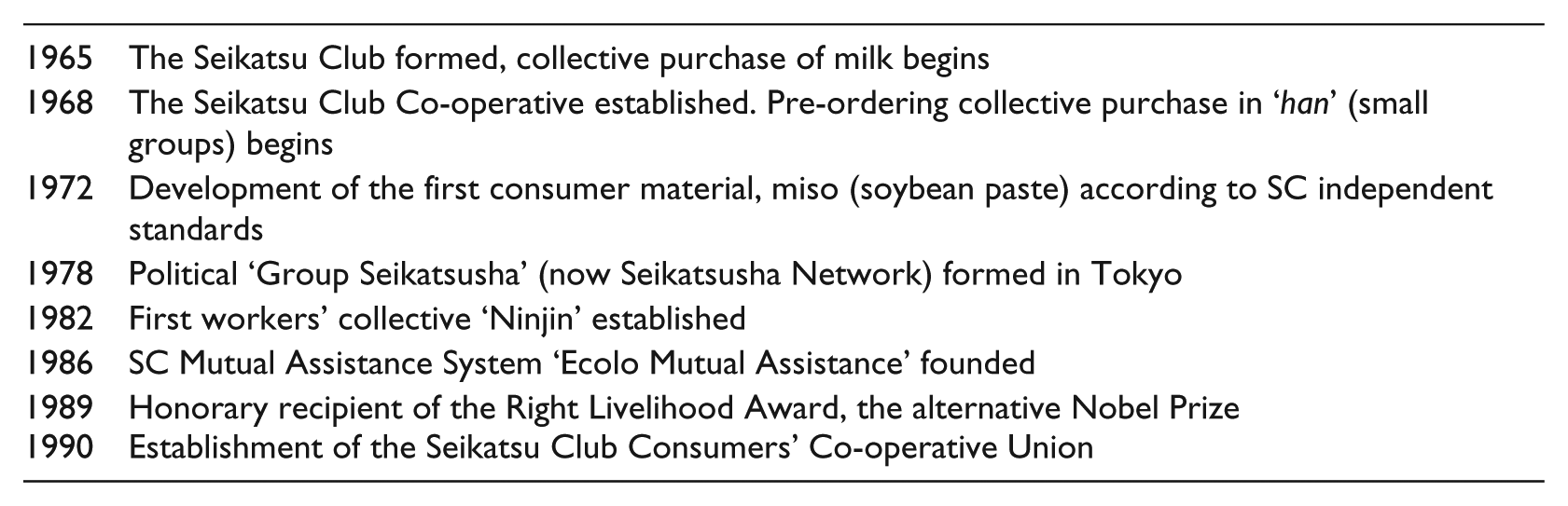
We first constructed chronological lists of key milestones and public campaigns of the Seikatsu Club group movement, such as the milk campaign and the soap movement, based on archival documents of the Seikatsu Club 2 (Appendices 2 and 3). We used these activities to document the domain of action of the Seikatsu housewives over time.
Stage 2: Mapping of data
In the second stage we identified emergent themes in the micro-narratives of individual club members as they described their motives for membership, club activities and reflections over time. In total, we have examined around 500 pages of the recollections/reflections of Seikatsu Club members from those multiple sources, and ‘stories’ such as the ‘milk crisis’, ‘why or how I joined the Club’, ‘why and how we needed to expand membership’, ‘what we learned from study trips’, ‘how we developed new consumption materials’, ‘the soap campaign’, ‘political involvement’, ‘why and how I joined the workers’ collectives’, ‘others’ reaction to my involvement in Seikatsu Club activities’ came from multiple sources. We distilled first-level themes from these stories.
Key first-level themes we identified included performing the ryosai-kenbo role, connecting with similar others through action, realizing own ignorance and capacity to learn, acquiring new knowledge through club activities, reflecting on self and collective, recognizing power of self and collective, rationalizing for role expansion, and action in new domains. In comparing the first-level themes with existing theories, we concluded that they represented the emergent process by which the Seikatsu women engaged in identity work. We then moved on to a higher level of abstraction, travelling back and forth between data, literature and emerging theory (Langley, 1999; Locke, 2001) to identify second-level constructs. Table 1 presents the first- and second-order themes and constructs with data exemplars.
Data Exemplars for First-Order Themes Linking to Second-Order Constructs.
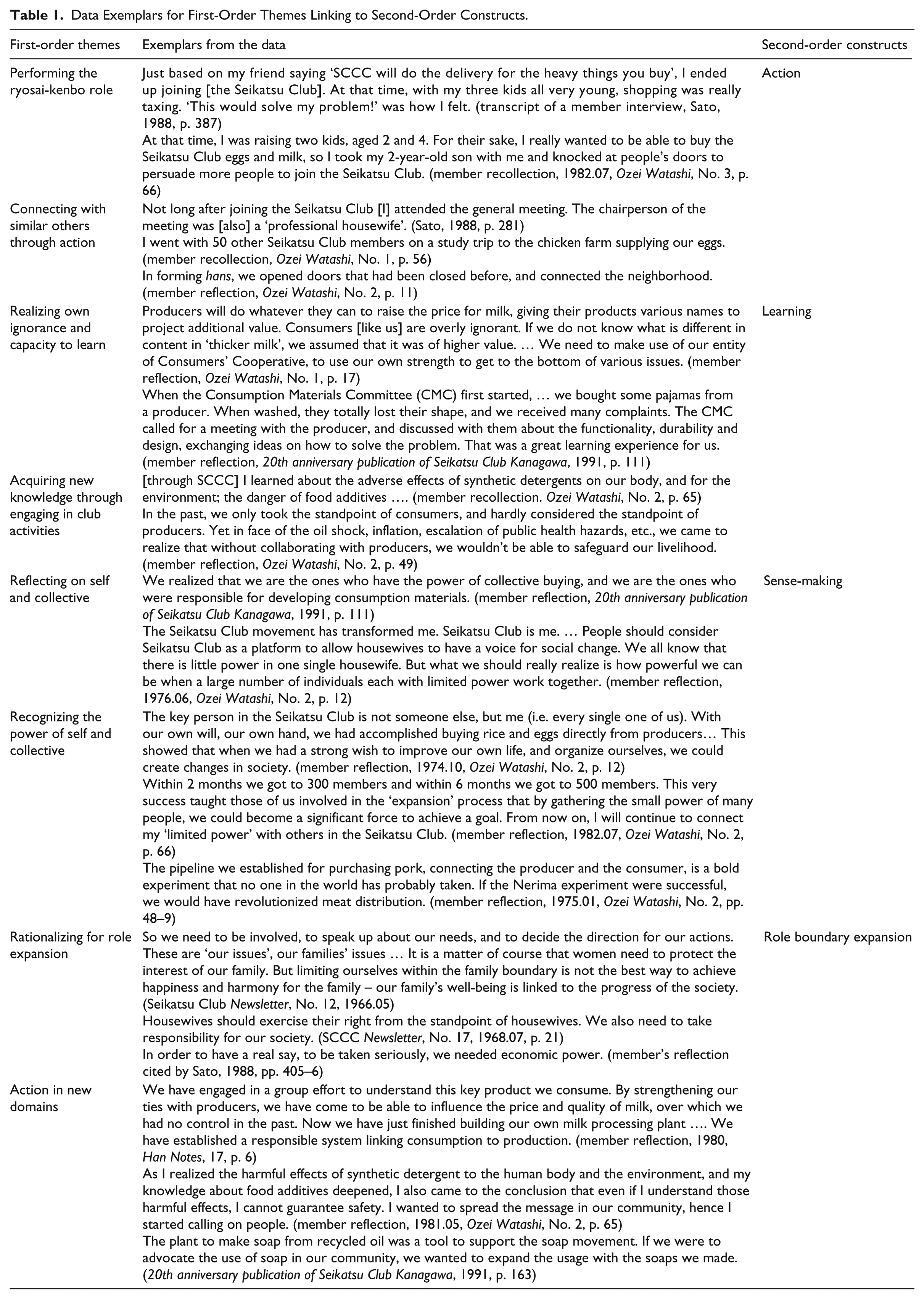
The first second-order construct we identified was action: individuals performing the ryosai-kenbo role by connecting with similar others in organized activities. Callero (1985) argued that role-identities imply action: ‘It is through action that role-identities are realized and validated’ (p. 205). As the starting point of the multi-cycle process of identity work of the Seikatsu women, action began with enactment of the institutionally prescribed role by housewives within the han, the collective buying group of 6 to 10 members living in the same area. As the cycles progressed, action happened in expanded domains of politics and business. Action was followed by learning, the process through which individuals realized their own ignorance and acquired new knowledge and skills while engaging in club activities. Learning presupposes a better understanding of own and others’ experiences and problems (Daft & Weick, 1984). The Japanese housewives, through engaging in club activities, came to realize how little they knew about the products they consumed and how they were produced and distributed. This triggered a learning process that involved sharing of experience and discussion of issues among themselves, and interacting with producers for understanding and fact-finding. After learning (and sometimes simultaneously) came sensemaking, a process in which individuals reflected on themselves and the collective and gave meaning to their new experience, recognizing their own power and that of the collective. According to Weick, Sutcliffe and Obstfeld (2005, p. 409), ‘sensemaking involves the ongoing retrospective development of plausible images that rationalize what people are doing’. As they reflected on what they could do outside of the isolation in their homes, the Japanese middle-class housewives redefined ‘who they are’ based on ‘what they have done’ (Weick, 1995). Weick and colleagues (2005) suggest that once people figure out ‘what’s the story’, they will move on to the question ‘what should I do [next]’, enabling them ‘to act into the future, continue to act, and to have the sense that they remain in touch with the continuing flow of experience’ (Weick et al., 2005, p. 410). The new images the Japanese housewives constructed of themselves were a ‘springboard’ (Taylor & Van Every, 2000, p. 275) to further action in new domains, restarting the iterative process of identity work.
Stage 3 – Interpretation of data
Abstracting across multiple micro-process narratives based on repeating sequences, we developed a model of emergent identity work (see Figure 1) illustrating a multi-cycle, spiralling process of action, learning, sensemaking and further (domain-expanded) action conducted in a collective setting. Table 2 provides two complete illustrative examples of how the transformation process took place. In the next section we elaborate the model with supporting data.

Model of Emergent Identity Work.
Illustrative Examples of the Spiralling Process of Action, Learning, Sensemaking and Identity Expansion.
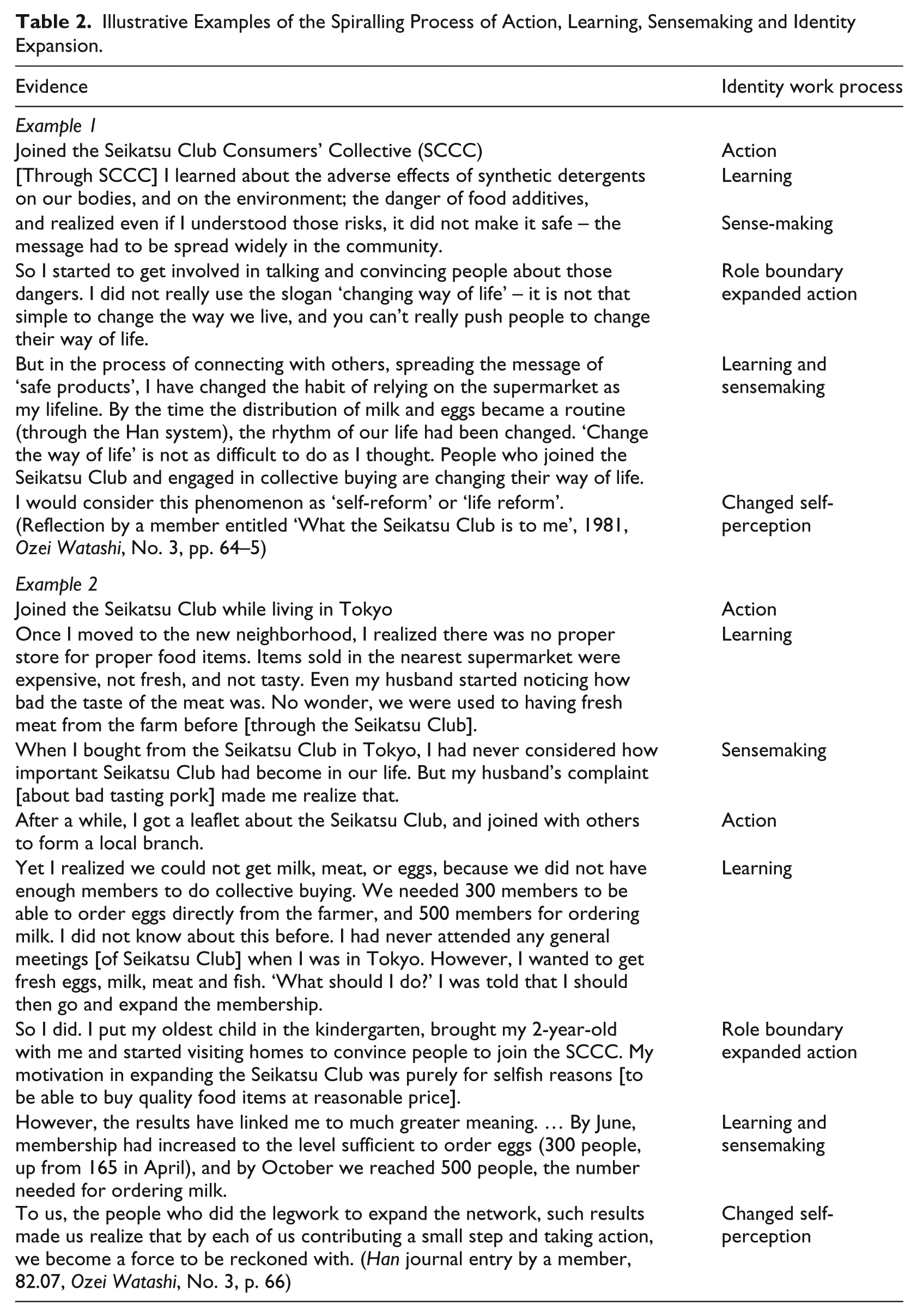
Spiralling Cycles of Identity Work in a Collective Setting
The Seikatsu Club was founded by a young socialist couple named Shizuko and Kuniyo Iwane who intended to unleash the power vested in the role of middle-class housewives, ‘to utilize women’s strength to reform our way of life’ (Manifesto and Principles of the Setagaya Seikatsu Club, 1965, see Appendix I). The typical Seikatsu Club member was a woman living in a middle- or upper-middle-class neighbourhood, raising young children or approaching the conclusion of that life stage, with a ‘white collar salaryman’ husband (Sato, 1988, p. 246). While most members joined the club solely to address private concerns (Sato, 1988), a significant number, as reported above, went through a transformative process as a result of participating in Seikatsu Club activities. Over time, those women became leaders and activists for the social causes of the Seikatsu Club, and it is their identity work that is the focus of this study.
It is important to note the divergence between the aspirations of the founders and the goals of the women who became members of the Seikatsu Club in its early days. While there was a clear intention from the founders at the starting point of the Seikatsu Club to bring about social change by unleashing the power vested in the institutionalized role-identity of the housewives, most members joined the club in order to purchase better-quality products at lower prices. At least initially, the women were not seeking to challenge the traditional boundary of their roles. ‘They were content with their roles as caretakers, which they viewed as the most important aspect of a woman’s life’ (Kutsuzawa, 1998, p. 167). As the middle-class housewives took part in the various activities of the Seikatsu Club, however, they engaged in an identity work process within an enabling collective. Their initial action of engaging in collective buying activities, and subsequently in a consumer cooperative, started the spiralling cycles of action, learning and sensemaking. Such a process allowed housewives to break away from their isolation at home and connect with similar others to take action in new domains. Progressively, they came to realize the social constraints imposed on them, which confined their influence to the private sphere of the family. With that the housewives started to feel discontent towards the social system and, to a certain extent, towards themselves. Hence the intention to expand their role boundary became more apparent, and the identity work at that stage became much more intentional. Their identity work cycle consisted of taking action to better perform prescribed roles, engaging in learning, making sense of the effects of their actions, and using their emerging identity conceptions to act in expanded domains, restarting the cycle. We elaborate this emergent identity work process below.
Taking action to better perform the ryosai-kenbo roles
Most women were motivated to join the Seikatsu Club mainly to improve the quality of life for their family through ‘safer, fresher food … assured raw materials/origins of the products … lower price … [and] convenience in getting the products delivered’ (Sato, 1988, p. 226). The Seikatsu Club began with the collective purchase of milk: ‘It was about being able to drink milk at a lower cost; it linked directly to the daily “kitchen” matters of housewives’ (Iwane, 1979, p. 15). In post-war Japan, milk was considered an essential item for a healthy family diet, yet milk producers frequently increased the price and some sold milk contaminated by harmful chemicals. Hence, being able to buy safe, quality milk at a lower cost enabled middle-class housewives to improve their role performance. The housewives’ involvement in the Seikatsu Club activities arose from a desire to perform their institutionally prescribed roles, not challenge them.
I was approached by my neighbor in the same apartment: ‘Do you want to join the Seikatsu Club? You can buy milk cheaper if you join.’ However, I found it very difficult to quit buying from the milk shop I had been buying milk from for a long time. On the other hand, my kids drank 3 to 4 bottles of milk a day, and if we [parents] want to drink milk too, the expenses would be too much for us to manage …I was not sure what I should do. Then I heard from the news that if you drank milk every day you wouldn’t get cancer so easily.… So I made up my mind and took the courage to turn my back on the milk shop and joined the Seikatsu Club Consumer’s Cooperative. (member reflection in SCCC Newsletter, No 60, 1970.09, p. 15)
The collective buying activity of Seikatsu members differed from the individualized housewife buying practices they were accustomed to, yet the ryosai-kenbo role-identity legitimized club members’ individual actions to join the club on the one hand, and on the other hand created a common bond to connect them with similar others through the han,
3
which became the collective platform for their identity work. The lady cited below, like many others, was initially unaware of the social agenda of the club: While I thought SCCC helps us to buy safe products, I was surprised to find out that it was a social movement to change the way we live. I did not want to have anything to do with a ‘movement’ – and I did not think about a cooperative as a ‘movement’, even in my dreams! … Really for a long time I thought the slogan ‘to change the way of life’ was overly arrogant – how could we say only Seikatsu Club members were living a proper life? (interview transcript, a Seikatsu Club member, Sato, 1988, p. 387)
Yet as many Seikatsu women got involved in collective buying activities, they embarked on a journey of learning along with other housewives, and together they came to realize what influence they could exert through their actions.
Questioning role restrictions as a result of collective learning and sensemaking
The association with the Seikatsu Club Consumer Cooperatives set the women within a new context, with its own norms derived from cooperative principles (International Co-operative Alliance, 2007). This context allowed them to learn and connect their actions to larger issues and new domains. Club members were expected to engage in a broad range of activities, such as the investigation of the production and distribution of consumer materials, the development of new product sources, the administration of the club and the recruitment of more members if they wanted to add more new items. 4 These activities did not attract institutional sanctions because they were legitimized by the housewife role: members’ actions supported the housewives’ institutionalized role values of protecting their families’ interests.
The housewives’ learning and sensemaking began when they perceived their own ignorance: When we received the first delivery of our collective purchase, I came to the realization that as the purchaser for the family, we housewives knew too little about the products. Retailers just took what the wholesalers said [about the products] and passed that on to us, and we consumers just believed in whatever the shop people told us when buying the products. (member reflection, SCCC Newsletter, No. 8, 1968.05, p. 12)
Desiring to learn more, club members investigated their products’ supply chains, learning that ‘the milk they had been drinking was not necessarily real milk’, and ‘the detergents they used could be harmful to themselves, their children, and their children’s children through their harmful effects on the environment’ (Sato, 1988, p. 219). They shared their new knowledge through the club newsletter.
Realizing that their private domain was not as safe as they thought motivated them to develop their own ‘consumption materials’
5
from trusted suppliers. They began to connect with suppliers for essential household food items, such as rice, meat, eggs, etc. A housewife described her experience on a trip to the egg farm: The first thing I learned at the egg farm was that eggs were made by people as much as by the hens who laid them … The nice-looking eggs in the supermarket were not due to better feed, but due to the use of chemical to wash the eggs after they were gathered. The egg yolk color could be artificially manipulated by putting additives in the feed… We divide eggs into large, medium and small (paying different prices), but that has nothing to do with their quality. (member reflection, 1971, Ozei Watashi, No. 1, p. 56)
Through such pursuits, members achieved their first level of learning and moved on to sensemaking, the next dimension of their identity work. The same member went on to say: ‘Seeing how our egg farmer raised the chickens made us realize what constituted “good quality eggs”, what environment, feed and management practices were needed to produce such eggs.’
They also began to realize that there was greater meaning behind the buying and consumption of products. In order for them to perform well in their roles as ‘dutiful wives and nurturing mothers’, they had to extend their influence to ‘right the wrongs’ in society, so that they could protect their family’s welfare in the present and future.
Facing the reality of rising prices, increasing occurrence of harmful food products, distribution systems that favor manufacturers, and a society that neglects consumers, if we want to fight against it by ourselves, we feel totally powerless.… one person’s effort does not go very far, and no matter how good something is, to proceed with one person is not going anywhere. Through the han we are not only buying products cheaper, it is important that we talk about various things in the han. Through participating in those han meetings, we can safeguard our interests in a lopsided society, and make the first step to change that society. (member reflection, 1968, Ozei Watashi, No. 1, pp. 39–40)
Their sensemaking was thus facilitated by the hans, which not only enabled collective purchase, but also served as ‘networks in which communities were formed, conversations were made, and discussions deepened’ (Iwane, 1980, pp. 12–13, cited in Sato, 1988, p. 20). Together, Seikatsu housewives began to question the role boundary they took for granted, and think and act differently about how they, as the protectors of their family’s welfare, could improve their lives. This marked the shift from unintended identity work to intended identity work.
Expanding the role boundary through new rounds of action, learning and sensemaking
With the realization of their own capacity to pursue change, the housewives moved on to the next phase of their identity work, enacting their housewifely role values in new domains. As principal caretakers of the family, the housewives’ expertise in the life domain gave them the legitimacy to claim the role of change agents in the ‘way to live’. As Shizuko put it: Inflation is affecting us, women in charge of the kitchen, the most. The Seikatsu Club was created to address those life concerns with our own actions. … So we need to be involved, to speak up about our needs, and to decide the direction for our actions. These are our issues, our families’ issues… It is a matter of course that women need to protect the interests of our family. But limiting ourselves within the family boundary is not the best way to achieve happiness and harmony for the family – our family’s well-being is linked to the progress of society… The Seikatsu Club is a vehicle for women to influence society. (Seikatsu Club Newsletter, No. 12, 1966.05)
Becoming involved in managing the supply chain of essential daily consumption items became the first boundary-expanded action of the housewives, a natural extension of their role as the manager of family finances and purchases, demonstrating a more intentional element of their identity work. The campaign to purchase better-quality milk at a lower cost at the start of the Seikatsu Club, for example, had expanded until housewives were involved in the whole supply chain for milk, working with farmer cooperatives, raising cows in urban neighborhoods, setting up and running processing facilities close to dairy farms to ensure freshness, distributing milk in the most efficient packaging through the neighborhood networks, and encouraging ‘all natural’ milk consumption in the family (member reflections, 1969, Ozei Watashi, No. 1, pp. 47–8; member reflections, 1978, Ozei Watashi, No. 2, pp. 45–6). Such a process converted the housewives from mere consumers to economic agents to promoters of social well-being through the practice of ‘local supply, local consumption’.
The Seikatsu women did not stop at addressing the supply chain. Deeper questions were asked, which led to further learning and sensemaking, and continued action in expanded domains:
How do the various issues SCCC members face in their day-to-day life, and the issue of product prices, link to the issues in the society? What are our responsibilities in solving those issues? (member reflection, 1974, Ozei Watashi, No. 2, p. 12)
Complaints of hand eczema caused by synthetic detergents sold by the club triggered the housewives to learn about the harmful effects of toxic chemicals in the detergent on their families’ health, and on the environment and the health of future generations. When their supplier dismissed their concerns, SCCC not only stopped carrying synthetic detergents altogether within the cooperative, but also launched a public campaign to ban the production and sale of synthetic detergents in Tokyo and Yokohama, where the Seikatsu Club operated at the time (1970s). When their appeals were rejected, the Seikatsu women realized they needed to gain political influence. They formed the Seikatsusha Networks, a new form of grassroots politics (Takabatake, 1993, p. 207) in 1978 to run for representation in local governments. By 1987, Seikatsu Club members had won 33 seats (Sato, 1988, p. 252). Though only a small percentage of Seikatsu women were elected to public office, the movement to achieve representation connected many club members to the public domain of politics, expanding their role-identity to include active citizenship.
The success of the political campaign also allowed the club to enter the economic domain. In the mid-1980s, the Seikatsusha Network representative in Kawazaki City proposed that a soap plant be built in the city to address concerns about detergents. She gained the mayor’s support, and a plant using recycled oil to make soap was built with capital from Seikatsu families in the city (1000 yen per family), on land granted by the city and with Seikatsu women running it.
Tension with the dominant structure did exist, yet rather than deterring the Seikatsu housewives, it pushed them to extend their role boundary further to pursue their cause. A club member reflected: When I was collecting signatures in support of the ‘Soap Movement’ to make a direct appeal (to the government), a man said to me: ‘Who do you think is feeding you?’ Also, I had to mind what my husband would think when I put in precious time and money pursuing the social movement. In order to have a real say [in society], to be taken seriously, we needed economic power [independence]. (Sato, 1988, pp. 405–6)
One way to gain economic independence is through paid work. However, the Seikatsu Club housewives were critical of the mainstream way of work, i.e., how their husbands worked, which demanded total devotion to corporations at the expense of involvement in the life domain. To pursue economic independence without giving up their traditional ryosai-kenbo role-identity, Seikatsu Club women created workers’ collectives – ‘cooperatives created by workers living in a community, which recognize the products and services needed by people living in that community. Workers work not as employees but [as equal share owners who] possess equal rights and equal responsibility in their work’ (Seikatsu Club Consumers’ Cooperative brochure). Through workers’ collectives, the housewives achieved autonomy economically, socially and as human beings (Amano Masako, 1988, in Sato, 1988), as they worked toward improving quality of life for families and society. As a SCCC member who started a workers’ collective providing lunch boxes put it: We cannot contribute to society by just eating safe products ourselves. As we have participated in the Seikatsu Club movement, we want people in the community to consume safe food as well. Therefore, we make lunches [using safe ingredients]. (member recollection of worker collective experience, Kanagawa Workers’ Collective Union 10 year anniversary publication, 2000, p. 52)
An Enlarged Role-Identity for Middle-Class Housewives as the Outcome of Identity Work
Changed perception of self
The Seikatsu women did not set out to challenge their role. However, through interacting with other housewives within the han, and through taking action and learning in new domains, the Seikatsu women reflected on their role, and the club’s, in improving their ‘way of life’. Even though they were proud of their ryosai-kenbo role-identity, the Seikatsu Club housewives started to see that they could play a larger role in society. Our data suggest that in taking action in new domains, members loosened the role boundary that constrained them and saw themselves not just as family caretakers, but as active citizens and economic agents. The change in self-identity started with the questioning of the existing order: Participating in the Seikatsu Club allowed us the opportunity to express our ‘self identity’. What we did was being recognized. Inside the house, whatever we did was considered ‘a matter of course’, not recognized even a little bit. … On the table where my husband read his front-page news, wasn’t I the one who fought for the economic issues through meat and vegetables? Does my husband really understand anything about politics or economics deep down? … There is a difference between people who say ‘I am a housewife’ and draw the line and people who want to go beyond that line… Since I had the chance to be involved in the Seikatsu Club, I wanted to ride on it to achieve something… to have a light inside me to guide my path. (member’s interview transcript, Sato, 1988, pp. 387–92)
Through the action, learning and sensemaking process, this member went from passively accepting her institutionally prescribed role-identity to realizing what she could accomplish by applying her ‘housewifely knowledge and skills’, leading to a change in self-concept. The same member described her experience starting a workers’ collective for prepared food: We are doing everything, from cooking to delivery to accounting. I was very surprised to find that I could actually handle accounting quite well without external help, even though I had only handled the very cumbersome family finances up to now. I discovered a new facet within me. Working in the workers’ collective was an interesting experience. Seeing myself changed was another interesting experience. … I will not escape back to the safety net of being a housewife with everything provided for. It is a matter of pride. (member’s interview transcript, Sato, 1988, pp. 390–2)
Another member described her experience: ‘Working at the collective gave me a good feeling that I could make a contribution and have a place in society, not as a mother or a wife of so-and-so, but as myself. …We create our own work and we are in charge’ (Kutsuzawa, 1998, p. 100). Through such experiences, the housewives realized what they could achieve beyond the private domain of family, and their identity work became ever more intentional over time. 6
Changing their self-perception, however, did not mean abandoning their traditional role-identity, but instead, reinforced it. An elected representative in the local government elaborated how she saw her role: I am not only a representative of the Seikatsu Club, but a representative of all ‘Seikatsusha’ [housewives]. I wanted to let people know the reality that the day-to-day life of housewives was being controlled by politics, and I wanted to change that reality from the standpoint of a housewife. (Sato, 1988, p. 253)
In expanding their role boundary from the private to the public domain, the Seikatsu Club women proudly held onto their ryosai-kenbo role-identity, and the social campaigns they pursued as a collective were entirely consistent with, and legitimized by, that role-identity. They received feedback from society as they extended their boundaries. Their new roles shaped their self-understanding, or role-identity.
Gaining acceptance for the enlarged role-identity
In a highly institutionalized environment, the reconstruction of one’s role-identity involves not just updating one’s own self-portrait, but also having the new roles accepted by others. The domain-expanded actions undertaken by Seikatsu Club housewives had created some tension within the family, as some housewives recalled their family members’ reactions to their involvement in Seikatsu Club activities. Objections, however, soon turned to resignation, and progressed to recognition and acceptance. A Seikatsu Club officer talked about her experience: When I came home late at four or five [in the afternoon], my husband was not so happy … he objected to me becoming a branch officer. Yet when I became the chair of the Consumption Materials Committee, he was no longer objecting … Even though he said ‘do it without affecting the family [responsibilities]’, he once in a while would tell my son ‘your mother is doing something worthwhile’. (member’s interview transcript, Sato, 1988, p. 278)
When another housewife told her husband about her anger over the mishandling of catering in school, her husband reacted by saying ‘if you are so upset about it then you should speak up’. When she decided to take up an officer position in a Seikatsu Club branch, however, her husband objected because she was not home all the time. Determined to stay involved, she talked to her husband repeatedly about the meaning of her work: ‘My husband still hates the fact that I am not home all the time. … However, as I move forward in pursuing various activities, my husband also seems to be gradually moving forward with his thinking.’ When she was asked to represent her branch on the SCCC board, she was surprised at her husband’s consent; he even suggested installing a telephone answering machine as a gesture of support. Her son in primary 6 also spoke of his support: ‘Mother, it is great that you’ve gotten Father’s support. What you are doing needed to be done [is really meaningful], and the meaning will be lost if you cannot continue to pursue it’ (member’s interview transcript, Sato, 1988, p. 286). Again, the ready acceptance by family members of the housewives’ extended roles might have to do with the consistency of such activities with the traditional role values of ryosai-kenbo.
Beyond the family unit, it was the collective efforts of club members, especially through the structures they created through the Seikatsu Club, which succeeded in expanding the roles of women in society, formalizing at least some economic and political roles for women beyond that of passive consumers. Though the women’s attempts to expand their role-identity were sometimes criticized or rejected, as the detergent supplier’s dismissal, the politicians’ rejection of the soap campaign appeal and the comment from the man who said ‘Who do you think is feeding you?’ suggested, they did not lead to structural sanctions. The women’s success in running for seats in local government through the Seikatsusha Network, the willingness of suppliers to adapt their production methods to meet the club’s needs, and the popularity of the workers’ collectives started by members in local communities attested to their eventual success in gaining acceptance for their expanded role. Thus, the Japanese housewives we studied began an emergent process of identity work by enacting their role-identity, and learning and making sense of their actions, in ever-expanding domains. In doing so, they changed the way they saw themselves and the way others saw them.
Discussion
Studies of identity work as institutional work have tended to focus on either how individual actors struggle with, and, within limits, try to influence the institutionalized image and expectations associated with their role-identity (Creed et al., 2010; Snow & Anderson, 1987; Watson, 2008), or how institutional entrepreneurs engineer the construction of new collective identities through social movements, to frame the need for change and legitimate new logics (Lounsbury, 2001; Rao, Monin & Durand, 2003; Thornton & Ocasio, 2008). Few studies have linked the internal process of identity work with outward-facing identity work (Watson, 2008), and through it, to an external process of institutional change. More importantly, research has not looked into how relatively role-contented actors can become change agents due to their strong commitment to their role-identity and role values. Our case study of middle-class housewives of the Seikatsu Club in Japan provides a rich story that addresses those gaps, illuminating the mechanisms and processes by which agency, reflexivity and intentionality were awakened in relatively content, role-conforming actors embedded in a highly institutionalized environment. We have examined the process by which highly embedded, marginalized actors expanded their institutionally prescribed role-identity by enacting it in new domains. Our model of emergent identity work (Figure 1) outlines how actors who take action consistent with their role values in expanded domains trigger a process of learning and sensemaking that leads to spiralling cycles of role boundary expansion. In this process, actors not only changed their own self-concept, but also others’ expectations of their institutionally prescribed roles. Our research findings contribute significantly to the literatures on identity work and institutional change.
A conceptual model of emergent identity work by role-conforming actors
Unlike the GLBT ministers struggling with contradicting values between their internal and external identities (Creed et al., 2010), or the managers experiencing internal conflicts between their personal and organizational identities, the identity work of the Seikatsu housewives was evoked around one salient role-identity to which they were highly committed. As a result, the Seikatsu women did not go through a painful process of identity reconciliation before they could use and claim new roles through action. Instead, the women were enacting their role values and seeking to perform their roles better through Seikatsu Club activities. The housewives’ identity work was thus stimulated not by perceived discontentment with their role prescriptions, but instead by new actions that enhanced their role performance, but which differed from what they had done before, and which achieved different results.
Though the identity work process of the Seikatsu housewives was not intentional at first, it became more so as they enacted their role-identity in expanded domains, became exposed to new learning and made sense of the effects of their action on their world. This process opened further possibilities for agency – having once stepped beyond the purely private family sphere and joined the club to take collective action, the housewives could see possibilities for expanding their roles further. They started to become involved in managing the supply chain of the products they consumed. They initiated social campaigns to protect their family, community and environment from harmful substances in those products. They voiced the need for social change politically. They launched businesses to provide resources for their social actions and to design more family-friendly work arrangements, consistent with their role values. At each step, the housewives acted and engaged in learning processes, then developed plausible images of themselves as actors capable of agency (and indeed, duty-bound to act) in economic, political and social domains, while keeping the ryosai-kenbo role-identity salient and operational.
Our findings also illustrate that the women were able to ignore some aspects of their role prescriptions as long as they were enacting their role values. Their buying and association practices changed, and their domain of action changed, which allowed them to go beyond the traditional role boundary. These findings echo those of Piliavin et al. (2002), who found that nurses could ignore their typical subservience to physicians if they were enacting professional values associated with their nurse roles. Can one use more durable, and perhaps more constraining, institutional elements, such as role values in this case, as resources for changing other institutional elements? It seems likely that this is the case, but future research is required.
Interactions between external and internal identity work leading to structural change
Watson (2008, p. 127) suggested that ‘whenever identity work is done there is an element of working on the “external” social-identity of the person, alongside the shaping of the “internal” aspects of personal identity’. Most studies on identity work, however, focus on an internal process of individuals ‘forming, repairing, maintaining and strengthening or revising self-construction’ (Alvesson & Willmott, 2002, p. 626), or ‘resolving identity contradictions’ (Creed et al., 2010). Though Creed and colleagues hinted at the possibility that the internal identity work of GLBT ministers would turn them into change agents within the larger social structure (church denominations), little has been done to examine the interactions between internal and external identity work, and how they lead to institutional change (Creed et al., 2010; Watson, 2008).
The emergent identity work we observed among the Seikatsu women linked external identity work that redefined the role-identity of ryosai-kenbo with the internal identity work that changed their perception of themselves. It emerged from their responses to problems they encountered (Alvesson et al., 2008) that became salient through the club, rather than internal identity conflicts or struggles. The problems of dominant manufacturers controlling prices and supply chains and putting harmful chemicals in their products threatened the housewives’ ability to perform their role as the guardians of family health and well-being. By acting on these concerns, the housewives performed external identity work, affecting the social conception of the appropriate realm of action of housewives. When they did so, they made sense of the results of their actions (internal identity work), together with other members of the club. Their emerging sense of themselves as efficacious actors in new domains then stimulated further action in more domains. Thus, we illustrate how external identity work can stimulate internal identity work, which can in turn stimulate further external identity work in an iterative cycle.
Our observation of how interactions between external and internal identity work lead to structural change is consistent with the central argument of structural interactionism in that individuals are motivated to plan and act in ways that reinforce, support and confirm their identities, and that the process is a two-way street: ‘the self operates in choosing behaviours and the behaviours reinforce and support the self’ (Burke & Reitzes, 1981, p. 84). It was that two-way street that made the spiralling cycles of role-expanding identity work possible. People learned using the outcome of action (feedback) to revise their belief systems (Weick, 1979). The inter-related, ever domain-expanded actions had profound consequences on what the Seikatsu women believed they were capable of and what they believed was appropriate for them to do. As such, our study explores both ‘how individuals construct evolving understandings of themselves amid social situations’ (Alvesson et al., 2008, p. 16), and how that emergent identity work changes others’ (and their own) perceptions of the boundaries of their socially prescribed role.
The collective as the enabling platform for emergent identity work
Research on identity work at a collective level has focused on how members of a marginalized group struggle to resist social stigma, as in the gay and lesbian movement (Taylor & Whittier, 1992); or on how groups with an identity crisis made conscious effort to enhance the social value of an existing identity, as in the men’s (Schwalbe, 1996) or women’s movement (Ferree & Mueller, 2004). While ‘identity politics’ (Sampson, 1993) has become an important element in those new social movements, little has been done to explore the micro processes individuals go through within these collective settings (Snow & McAdam, 2000). Specifically, how an enabling collective may allow individuals to conduct identity work has rarely been examined.
The Seikatsu Club case illustrates how individual identity work was enabled by a collective whose legitimacy was grounded in the very institutionalized role-identity that members ended up changing. The Seikatsu women faced a relatively low level of external sanction or domestic conflict because they were legitimately doing their duty by participating in Seikatsu activities. The role justified their boundary-expanded action both to the housewives themselves and to others. Yet alone, the housewives could not have unleashed the power vested in their role-identity. Together within the Seikatsu Club Consumer Cooperative, however, they pursued issues concerning day-to-day life (Seikatsu) and devised collective solutions, advancing their role values in new domains. Members’ active participation in the organizing and operation of the SCCC allowed them to break away from the ‘private’ domain of the family to engage in the ‘public’ domains of business and politics, and expanded their role-identity accordingly.
Scholars have used the notion of ‘free spaces’ in the social movement literature to explain how marginalized groups generate the capacity to challenge the dominant structure through interactions with like-minded others while isolated from defenders of the status quo (Fantasia & Hirsh, 1995; Gamson, 1996; Polletta, 1999). Free spaces are ‘particular sorts of public places in the community’ that become ‘settings between private lives and large-scale institutions where ordinary citizens can act with dignity, independence and vision’ (Evans & Boyte, 1986, p. 17). We consider the SCCC, with its han structure, as the free space that allowed the Seikatsu women to act, learn and make sense with similar others and connect with multiple stakeholders (Kellogg, 2009). With the growth of the Seikatsu Club, the hans, the neighborhood purchasing units, and the regional meetings and events, became the free spaces for interactions within the community. The isolation of such free spaces from the direct control of dominant groups allowed the middle-class housewives some autonomous space where they started to question their role constraints, took collective action and connected with external stakeholders.
Our findings highlight that a change of scenery (a new social space) can trigger learning, sensemaking and a new capacity for action even when traditional role values are enacted. Connecting with many similar others to address issues of common concern, the middle-class housewives were empowered by what they could achieve together. Seeking new ways to enact their institutionally prescribed roles, their collective wisdom enabled the women to identify new domains and act together within them. The congruence between the personal and collective identities of the Seikatsu Club women, based on institutionally endorsed role values, served as the enabling platform for individuals to carry out role boundary expansion work without either attracting sanctions externally or experiencing identity conflicts internally.
Conclusions
As a single case study of members involved in a successful social enterprise in Japan, our study may have limited empirical generalizability. Yet, the insights it offers hold theoretical and practical promise for our understanding of how relatively low-power, role-conforming actors become conscious of their role constraints and develop the capacity to change them.
A number of studies at the intersection of gender and social movements have suggested that many women’s movements have pursued a distinctive, low-conflict form of grassroots activism that mobilizes through family, church and community ties (Blee, 1991) to create evolutionary social change and expand women’s roles. For example, the vaso de leche programme that emerged in Lima, Peru, in the 1980s had a transforming effect on the role of women in urban and rural communities in that country (Peredo, 1995). Similarly, the work of Shiva (1997) in promoting a form of micro-credit with seeds led to an enlarged role for rural women in advancing biodiversity. Mello e Souza (2008) has described the ways in which women’s traditional roles, especially as mothers, were revised as a result of their involvement in activist networks. Does the Seikatsu Club illustrate a Gilligan-esque ‘different voice’ of institutional change (Gilligan, 1982) based in feminine values of nurturance and low conflict? Future research is needed to explore the link between gender and institutional change processes and, more generally, to develop an understanding of the contingencies that condition institutional change processes.
It is worth noting that even though the Seikatsu Club emerged during a historical period when women’s movements were becoming active in many nations around the world, the gender-based division of labour in Japan, which focused on the ‘diligent worker-husband and equally devoted housewife’, was promoted in the 1950s and 1960s, ‘infiltrated in mass scale’ in the 1960s and 1970s (Kutsuzawa, 1998, p. 152), and persisted into the 1980s (the entire period of this study). The Equal Employment Act for women came into effect in 1985, but it was minimally enforced until it was amended in 1995, and thus what the Seikatsu Club women did in changing role expectations for women in Japanese society could be considered pioneer work (Kutsuzawa, 1998). While Seikatsu Club members, as a small proportion of the total Japanese population, cannot be credited with breaking the bonds of gender role segregation, as a collective, they did contribute substantially to enlarging the contribution of women to the political and economic spheres in Japan, and they ‘broadened the life-choices for women in society’ (Kutsuzawa, 1998, p. 60).
Our study highlights that by taking small initial steps in new domains, marginalized actors may trigger a reflexive identity work process and, at the same time, gradually build resources to enable them to expand their roles further. The emergent identity work process we have identified essentially bootstraps power and autonomy development, and it may be more successful than more punctuated and externally driven changes. The housewives we studied increasingly saw their potential to contribute to society in fuller ways, and acted on that potential, enabled by their collective as a site for collective learning and sensemaking. Because they continued to enact institutionalized role values, the housewives’ role-identity was a resource that enabled them to justify their role expansion to themselves and to others. The successful ‘quiet’ revolution of middle-class housewives in Japan sheds new light on the possibility of non-conflictual change which can be of reference for future research and practice on social change.
Footnotes
Appendix I: Manifesto and Principles of the Setagaya Seikatsu Club,1965
Setagaya Seikatsu Club was started as an autonomous and democratic organization for women living in the community of Setagaya ward near the Odakyu train line in June 1965.
The main purpose of this organization, as expressed in a separate document of principles, and in our newsletters and pamphlets, is to utilize women’s strength to reform our way of life, to become actively involved in activities for the progress of our society.
Since the establishment of this organization, we have issued a monthly newsletter Seikatsu (current circulation 3,000). However, the monthly newsletter has become an inadequate publication to cover all our activities. Therefore, we are to start issuing a monthly newspaper, Seikatsu Shinpo (two pages of newspaper size, printing 10,000 copies).
This is a newspaper that is organized and edited by ourselves (club members), to provide a democratic platform for residents of Setagaya-ward to express their standpoint.
If you appreciate our intention, you are more than welcome to not only be a member of the Setagaya Seikatsu Club, but also to subscribe to Seikatsu Shinpo. For those who want to subscribe to Seikatsu Shinpo, we will ask you to write an article once or twice a year, and contribute an annual fee of 1,000 JPY.
October 1966
Appendix II: Major Milestones of the Seikatsu Club Group Movement up to 1990
| 1965 | The Seikatsu Club formed, collective purchase of milk begins |
| 1968 | The Seikatsu Club Co-operative established. Pre-ordering collective purchase in ‘han’ (small groups) begins |
| 1972 | Development of the first consumer material, miso (soybean paste) according to SC independent standards |
| 1978 | Political ‘Group Seikatsusha’ (now Seikatsusha Network) formed in Tokyo |
| 1982 | First workers’ collective ‘Ninjin’ established |
| 1986 | SC Mutual Assistance System ‘Ecolo Mutual Assistance’ founded |
| 1989 | Honorary recipient of the Right Livelihood Award, the alternative Nobel Prize |
| 1990 | Establishment of the Seikatsu Club Consumers’ Co-operative Union |
Appendix III: Major Campaigns Pursued by Seikatsu Club Group Movement up to 1990
Soap movement (1974)* Recycling movement (1976) Anti-nuclear, peace movement (1977) Network movement for political representation in the local assemblies (1982) Workers’ collectives movement (1982) Food safety movement (1989)
*The year in brackets indicates the starting year only, as most of these campaigns were ongoing.
Acknowledgements
The authors thank the Civil Policy Research Institute (Japan), Japan Foundation, and the Centre for Asia Pacific Initiatives at the University of Victoria for their support during the research process. We also thank Peter Groenewegen, Patrick Vermeulen, Tom Lawrence, Jakomijn van Wijk and Paul Hirsch, and participants of the 2nd International Conference on Institutional Work who provided comments on earlier drafts and Yoko Oka for her help in processing research data written in Japanese. David Courpasson and the two anonymous reviewers provided invaluable feedback in bringing the paper to its final form.
Funding
This research is partially funded by the Social Sciences and Humanities Research Council of Canada (grant number 410-2011-0449).