



Abstract
In this article, we aim to revitalize the concept of role for advancing theory on identity work in organizations. Our article makes three contributions. First, we offer a critical review of how roles have been conceptualized in studies on identities, and develop a theoretical frame for understanding how people in organizations engage in transitions within and between roles that emerge and evolve in relational interaction and mediate their identity work. Second, we operationalize this frame in a longitudinal study of an organizational change initiative focusing on strategic rebranding in an industrial firm. We elucidate how roles and identities co-evolve over time and how roles and role transitions figure in the organization-based identity work of individuals. Third, we consider the implications of viewing roles as mediators in identity work. We highlight identity-related trade-offs made by individuals when they become associated with particular roles and show how they become disillusioned as organizational change agents.
Introduction
Identity and role share a rich conceptual history and their relationship has been depicted in various ways over the years. This has often implied a duality where identity is considered to represent internalized expectations and the meanings associated with particular roles, while role is considered to be external to the individual and linked to specific positions within a social structure (Stryker & Burke, 2000). It has been argued, however, that the concept of role has been neglected to the extent that it has “dropped off the lexicon” of theory on identities in organizations (Alvesson, Ashcraft, & Thomas, 2008, p. 22). More specifically, while understandings of identity work in complex and volatile organizational contexts have been developed (Alvesson & Willmott, 2002; Brown, 2015; Brown & Toyoki, 2013; Sveningsson & Alvesson, 2003; Watson, 2008), the concept of role has not received similar research attention. While understandings of identities as temporary and evolving constructions worked on by people to establish a sense of coherence and distinctiveness in the face of ambiguity and uncertainty continue to hold sway, roles are not explicitly articulated and detailed. This is unfortunate as multiple roles, transitions within and between roles, and juggling with roles and role transitions are characteristic of individual experience in organizations today (Ashforth, 2001; Ashforth, Kreiner, & Fugate, 2000). Hence it has been argued that there is an urgent need to develop our understanding of how roles figure in identity construction (Simpson & Carroll, 2008) and of how roles and identities co-evolve in organizational life (Brown, 2015).
In this article, we aim to revitalize the concept of role for advancing theory on identity work in organizations. Our article makes three contributions. First, we offer a critical review of how roles have been conceptualized in studies on identities, and develop a theoretical frame for understanding how people in organizations engage in transitions within and between roles that emerge and evolve in relational interaction and mediate their identity work. Second, we operationalize this frame in a longitudinal study of an organizational change initiative focusing on strategic rebranding in an industrial firm. We elucidate how roles and identities co-evolve over time and how roles and role transitions figure in organization-based identity work of individuals. Third, we consider the implications of viewing roles as mediators in identity work. We highlight the identity-related trade-offs made by individuals when they become associated with particular roles and show how they become disillusioned as organizational change agents.
This article is structured as follows. We first present an outline of how role has been conceptualized in studies of identities in organizations. Next, we develop a theoretical frame based on role transitions (Ashforth, 2001; Ashforth et al., 2000) and roles as intermediary translation devices (Simpson & Carroll, 2008), and argue for its usefulness in studying the organization-based identity work of individuals. We then introduce our longitudinal study of a strategic rebranding project in an industrial company, report its findings, and go on to discuss the contributions and limitations of our analysis.
Theory
The ambiguous legacy of role theory
Role theory was first based on a theatrical metaphor to explain the predictability of human behavior in relation to particular “scripts” and “parts.” Biddle (1986) identifies five distinct perspectives on role: functional, organizational, symbolic interactionist, structural, and cognitive. The most influential perspectives in studying roles have been the functional and organizational, which in organization and management studies date back to the seminal work of Gross, Mason, and McEachern (1958) and Kahn, Wolfe, Quinn, Snoek, and Rosenthal (1964). The functional perspective is concerned with the characteristic behaviors of individuals who occupy particular positions within social systems, while the organizational perspective focuses on the manner in which individuals accept and enact an array of roles in task-oriented and hierarchical systems that are formal organizations. Assumptions about the relative stability and predictability of social systems and positions-cum-roles underlie both perspectives (Biddle, 1986). In addition, scholars have drawn on symbolic interactionism and the seminal work of Mead (1934) and Blumer (1969) to elaborate an understanding of role as an ongoing process of social construction that depends upon the interplay between the creative actions and meaning-making of actors and a social system.
However, role-based understandings of organizational life have been criticized. It has been argued that role theory in its various forms fails to provide an authentic account of human agency and that it ignores the creativity with which individuals adapt to their situations. It has also been argued that role theory falsely reifies ideologies into concrete realities and assigns them roles, ignoring resistive efforts by those who seek to change established practices and systems (Connell, 1983, 1987; Jackson, 1998). Biddle (1986) argues that role theory has diverse roots and that this diversity has led to fragmented theoretical development and ambiguity, 1 which is arguably reflected in the study of identities in organizations where scholars have mainly drawn on functional and symbolic interactionist perspectives. Typically for identity theory, Stryker and Burke (2000, p. 289) imply a duality: “role is external; it is linked to social positions within the social structure. Identity is internal, consisting of internalized meanings and expectations associated with a role.” The assumption is that roles (such as teacher and student) remain relatively stable over time even when identities of role-holders may be in flux. 2 Roles also apparently determine the identities of their holders even if positions-cum-roles can be enacted in different ways (Sluss & Ashforth, 2007, p. 12).
Critical social constructionist studies of identities in organizations, in contrast, have ignored the value of role as an analytical concept (Alvesson et al., 2008). 3 In theorizing identities as temporary and evolving constructions (Alvesson, 2010; Alvesson et al., 2008; Coupland & Brown, 2012; Ybema, Keenoy, Oswick, Beverungen, Ellis, & Sabelis, 2009) that are fragile (Thomas & Linstead, 2002) and insecure (Collinson, 2003; Knights & Clarke, 2014) rather than a fixed and abiding essence (of an individual, group, or organization), only passing references to “organizational role” (Ybema et al., 2009, p. 313), “formal-role” (Watson, 2008, p. 131), and “traditional role” (Thomas & Linstead, 2002, p. 72) are made, suggesting that the concept is consciously or unconsciously associated with a pre-defined organizational position.
In the following, we highlight two approaches that help revitalize the role concept for critical inquiry of identities in organizations. The first is concerned with the dynamism apparent in multiple roles and transitions between them (Ashforth, 2001; Ashforth et al., 2000), while the second centers around rethinking roles as intermediaries in relational interactions (Simpson & Carroll, 2008). We go on to discuss how the two approaches complement each other for the purpose of studying roles and identity work in organizations.
Role identities and transitions
Focusing on identities of individuals in organizations, scholars have drawn inspiration from both functionalist and symbolic interactionist conceptions of role, allegedly staking a “middle range position” (Ashforth, 2001, p. 4). Research interest has shifted to the variety of roles enacted by individuals in organizational contexts, to the boundaries between various roles (their interfaces with the environment), and to the (dis)identification of individuals with their roles. Such dynamism in the enactment of multiple roles is captured in the concept of role transition, which denotes movement between roles – both routinely in everyday life as well as in more infrequent life changes – with implications for the concerns of individuals about who they are (Ashforth, 2001).
These considerations are grounded in the assumption that the number of formal and informal organization-based roles is increasing while the rate at which organizations change is accelerating. Ashforth (2001) maintains that each role carries with it an identity that contains specific values, goals, beliefs, norms, interaction styles, and time horizons. These role identities are “socially constructed definitions of self-in-role” (Ashforth et al., 2000, p. 475) and each one represents “a persona that one may enact” (Ashforth, 2001, p. 6). Role identification, then, is said to occur “when a role occupant defines himself or herself at least partly in terms of the role and its identity,” while role dis-identification takes place when a given role identity is rejected (Ashforth et al., 2000, p. 483). However, roles are constantly taken on and abandoned, conditioned by situational and cultural circumstances (Ashforth, 2001). From the point of view of individuals, (dis)identification is driven by motives for locating the self in context, for enacting valued identities, for maintaining a sense of consistency in different situations and across time, and for attaining a sense of uniqueness while engaging with various groups and communities (Ashforth, 2001). Enactment of specific role identities helps individuals in their search for meaningfulness and belonging as well as for control and influence over their lives.
This conceptualization draws our attention to the boundaries and interfaces between roles. Ashforth et al. (2000, p. 474) define role boundary as “whatever delimits the perimeter – and thereby the scope – of a role.” While conformity and conflict are fundamental questions in role theory (Biddle, 1986), the concept of role transition first highlights how individuals move between various roles in sequences of transitions and second elucidates how this movement impacts their sense of self. By macro role transitions, Ashforth (2001, p. 4) refers to “psychological and, if relevant, physical movement between jobs, occupations, committee appointments, and other positions.” These are infrequent and relatively permanent changes in an individual’s life; passages between sequentially held roles (Ibarra & Barbulescu, 2010). Micro role transitions, in turn, are “frequent and usually occurring transitions such as commute between home and work” (Ashforth et al., 2000, p. 472) wherein role exits and entries are temporary and recurrent (Ashforth, 2001). Researchers also distinguish between intra- and inter-role transitions: intrarole transitions refer to changes in an individual’s orientation toward a role already held, and interrole transitions occur when an individual moves from one role to another (Louis, 1980). It has been argued that different kinds of transitions (micro/macro; intra/inter) relate to identities of individuals in different ways (Ashforth, 2001).
However, this strand of research is burdened by the assumption that roles remain relatively stable and fixed even when the circumstances for role transitions change. Also, while embracing the complexity related to roles today, Ashforth et al.’s (2000, p. 487) frame makes only passing references to what they call “quasi-micro transitions,” “ephemeral roles,” and “role extensions.” These include short-term assignments and infrequent roles that are characterized by temporal ambiguity and, we would assume, are increasingly frequent in contemporary organizations. It is against the backdrop of the negligence of roles in constructionist studies of identities, on the one hand, and the shortcomings of theorizing on role transitions, on the other, that the contribution of Simpson and Carroll (2008) stands out.
Roles as intermediaries in interaction
Critiquing the ways in which roles have been represented in the literature on identities in organizations, Simpson and Carroll (2008, p. 43) argue that role may be seen as a “vehicle that mediates and negotiates the meanings constructed in relational interactions, while itself being subject to ongoing reconstruction in these relational processes.” Their insight is to locate role in-between actors, where it facilitates the emergence of identities. Roles, then, are not inherently related to positions in the social system as functionalism assumes, but neither are they containers to be filled with meaning by actors enacting them as symbolic interactionists would suggest.
Simpson and Carroll (2008) contend instead that roles are emerging boundary objects. Star and Griesemer (1989, p. 393) define boundary objects as objects that “inhabit several intersecting social worlds … and satisfy the informational requirements of each of them.” They are “both plastic enough to adapt to local needs and the constraints of the several parties employing them, yet robust enough to maintain a common identity across sites” (p. 393). Simpson and Carroll (2008) conceive boundary objects as epistemic objects that acquire their intermediary status by virtue of being positioned simultaneously within several “different worlds or domains of knowledge.” They suggest that roles offer anchors within knowledge domains and bridges to translate meanings between them. 4
Simpson and Carroll’s (2008) theorization of roles as intermediary translation devices (which take the form of boundary objects) is in line with the conceptualization of critical theory according to which the organization-based identities of individuals are evolving constructions that are worked on to establish (a temporary) sense of coherence and distinctiveness. However, Simpson and Carroll (2008, p. 37) base their argument on analyzing texts produced in interviews and specifically on interviewees’ accounts of various roles, without offering empirical insights into the intersubjective negotiation of meanings in organizations or into how roles may function as boundary objects in social interactions. They assume that it is the “robustness and elasticity” of roles “across different locations that constitute identity” (p. 41), but they do not study these different locations.
Hence we suggest that the idea of roles as evolving intermediaries would benefit from Ashforth et al.’s (2000) role transition concept and their elaboration of how role transitions pertain to identities that are subject to change over time. While Ashforth et al. (2000) do not share Simpson and Carroll’s (2008) assumption of the inherent instability of roles, we contend that by looking at moves from one role to another (interrole transition) as well as changes in an individual’s orientation toward a given role (intrarole transition) enables us to better understand the dynamics between emergent and evolving roles and the social construction of identity. 5 We argue that these concerns are crucial for studying identity work in organizations. 6
Roles and identity work: Entangled over time
Alvesson and Willmott (2002, p. 626) put forth the argument that “people are continuously engaged in forming, repairing, maintaining, strengthening or revising the constructions that are productive of [their] precarious sense of coherence and distinctiveness.” They referred to this as identity work, which was elaborated by Sveningsson and Alvesson (2003), who showed its value in making sense of managerial identities in contemporary workplaces. 7 Alvesson and Willmott’s (2002) definition has served as a foundation for many subsequent studies (e.g. Beech, 2008; Brown & Lewis, 2011; McInnes & Corlett, 2012; Musson & Duberley, 2007; Thornborrow & Brown, 2009). However, while seminal contributions on identity work included some reflections on roles (Alvesson & Willmott, 2002; Sveningsson & Alvesson, 2003), the subsequent discussion seems to have lost touch with the role concept (Alvesson et al., 2008; Brown, 2015; Simpson & Carroll, 2008).
On the one hand, the concept of identity work assumes agency as individuals are seen to have the capacity to shape their personal and social identities in organizations. On the other, it implies that individuals are disciplined and regulated as they work on their identities in and through the discursive and other resources available to them. Nevertheless, extant research incorporates somewhat different emphases in understanding identity work. 8 Alvesson et al. (2008, p. 15) suggest that it “describes the ongoing mental activity that an individual undertakes in constructing an understanding of self that is coherent, distinct and positively valued.” Watson (2008), in turn, argues that identity work includes an element of working on the “external” identity of the person as well as the shaping of the “internal” aspects of personal identity; identity work thus bridges self-identities and wider discourses.
The bulk of the research assumes that identity work takes place in movement between different, and often contradictory and conflicting, identity constructions. Beech (2011) uses the notion of liminality to make sense of this. While Carroll and Levy (2008) suggest that identity work involves some form of default identity (a relatively securely held baseline identity) that enables more emergent identity constructions, Kreiner, Hollensbe, and Sheep (2006) maintain that identity work often involves tailoring one’s identity to a prototypic role identity, and Thornborrow and Brown (2009) argue that it involves a desired or aspirational identity that disciplines individuals to construe their identity in particular ways. At the same time, identity work is generally considered to be an interactional (as well as a discursive, narrative, or conversational) activity. 9 Clarke et al. (2009) define identity work to be about (re-)authoring the self in a continuing quest in conditions characterized by contrasting positions or “antagonisms.” While Sillince and Simpson (2010, p. 112) theorize on identity work as something retrospective – a “reformulation of meanings ascribed to past events” – emphasizing how it is accomplished in conversations, Down and Reveley (2009) focus on face-to-face encounters as well as self-narration in identity work, suggesting that it is active and ongoing.
Different views and emphases notwithstanding, identity work as a subject of inquiry bridges levels of analysis from individuals to groups to organizations and beyond (Brown, 2015). An intriguing recent example – considering the role concept in particular – is offered by Leung, Zietsma, and Peredo (2014), who cover a period of 25 years to show how the collective identity work of actors can gradually change institutional arrangements in society. The authors highlight how Japanese middle-class housewives over time “broke through the constraints of their institutionalized role-identity and changed that very institution.” Following Baker and Faulkner (1991), Leung et al. (2014, p. 425) define roles as resources that are “bundles of norms and expectations” 10 and demonstrate how collective identity work served to gradually expand the boundaries of the collective’s role in society. This suggests a co-evolving relationship between roles and identities that is subject to alteration over time. While “the primary function of identity work” may be “compliance with role requirements” (Ibarra & Petriglieri, 2010, p. 14), Leung et al.’s (2014) study shows that challenging and changing established roles is possible.
Taking stock of the extant literature, Brown (2015) outlines directions for future research on identity work. He calls for studies that focus on how particular organizational contexts affect individuals’ identity work, suggesting that different contexts may “vary in the scope, resources and encouragement they offer people as they fashion their identities” (p. 31). Brown (2015, p. 31) further argues that more fine-grained research is needed to address “nuances in how, why and with what implications identity work is engaged in.” This is closely related to time and temporality: “people work on different identities at different times, but the temporal relationships between these processes of identity work, and the trade-offs … that may accompany these choices are virtually unexplored” (p. 31). Brown (2015, p. 32) suggests that future research focus on “what happens when individuals’ subjective identity work clashes with others’ ascriptions of identities to them.” 11
We aim to contribute to the literature with a focus on roles as mediators of identity work. We build on Ashforth (2001) and Ashforth et al.’s (2000) research on role transitions and Simpson and Carroll’s (2008) insights on roles as vehicles that mediate and negotiate meanings between actors while being subject to reconstruction in processes that mediate the identity work of individuals. Next, we introduce our longitudinal analysis of individuals engaged in identity work in an organizational context where they were faced with emerging and evolving roles and role transitions and where they were subject to contradictory role-related expectations over time.
Research Design and Process
Our empirical research is on a corporate rebranding project in the industrial company Alpha (a pseudonym) between 2002 and 2006. Alpha is a multinational corporation that operates in the business-to-business field as a raw materials processor and manufacturer of products for further refinement. Its ownership is distributed across national boundaries and it has production units and sales offices in some 20 countries. On the back of a period of growth and an extensive product branding exercise, the top management decided to undertake a corporate rebranding project. Our study focuses on an organizational taskforce that was given responsibility for implementing this project. Taskforce members were to become “change agents” whose main task was to coordinate interaction between organizational members (top management, middle managers, and employees) and external experts (consultants). The first author, who at the time worked as a marketing executive in Alpha, together with a communication executive suggested the project to the top management, and the two executives became the core members of the taskforce. Another two members were appointed to the taskforce, but they left some two years later after the new brand had been defined and visual modernization accomplished. Hence, by “taskforce” or “taskforce members” (the focal actors in our study) we refer to the two executives, based at the corporate headquarters, who developed a close working relationship during the five-year span of the project. For three of those years (2003–2005), a brand steering group consisting of Alpha’s top managers and the taskforce members, chaired by the COO, was responsible for monitoring the work of the taskforce and for making strategic decisions about the project.
The project was carried out in intensive interaction between organizational members and consultants. The taskforce mediated interaction at the intersection between two knowledge domains that attached specific, and often different, meanings to branding in general and to the project in particular (Simpson & Carroll, 2008). On the one hand, an engineering orientation was deeply engrained in Alpha’s organization. Its knowledge domain was characterized by a continuous search for improvements in technology, production efficiency, and logistics through meticulous planning and execution. Organizational members openly talked about its “male, conservative, middle-aged, and engineer-driven corporate culture” (internal workshop material, 2001). On the other hand, the consultancies involved in the project thrived on the latest concepts in strategic marketing, branding, and organizational behavior. Their knowledge domain was characterized by confidence in a bold approach targeted at changing Alpha’s ways of working to better meet customer demands. “You don’t have a vision! Giving me a long list of strengths only shows that you don’t have a clue about positioning yourself,” was a brand consultant’s comment on Alpha at the outset of the project (sales pitch to first author, 2001). In addition to their executive jobs at Alpha, then, the taskforce members straddled the organization and the consultants in trying to “make the new brand come alive,” as one top manager put it in 2002.
Empirical materials
The first author became interested in corporate branding during her Executive MBA studies (2002–2003) and viewed it as a tool to engage organizational members towards a common goal that would become visible to all Alpha stakeholders. In 2004, she realized that the rebranding project was an opportunity to pursue her dream of writing a PhD, and asked for consent to carry out research on it. In 2002−2006, the first author was personally engaged in the project. She collected documents related to it and reflected on brand-related activities in a diary. The taskforce members communicated intensively throughout the project, in person and by email, and prepared all brand-related events and brand steering group meetings together. They developed the habit of discussing their experiences of these events over a drink or cup of coffee. In addition, interviews with organizational members and stakeholders such as clients and suppliers were carried out by both the consultants and the first author, and surveys were administered in the organization at several points in time.
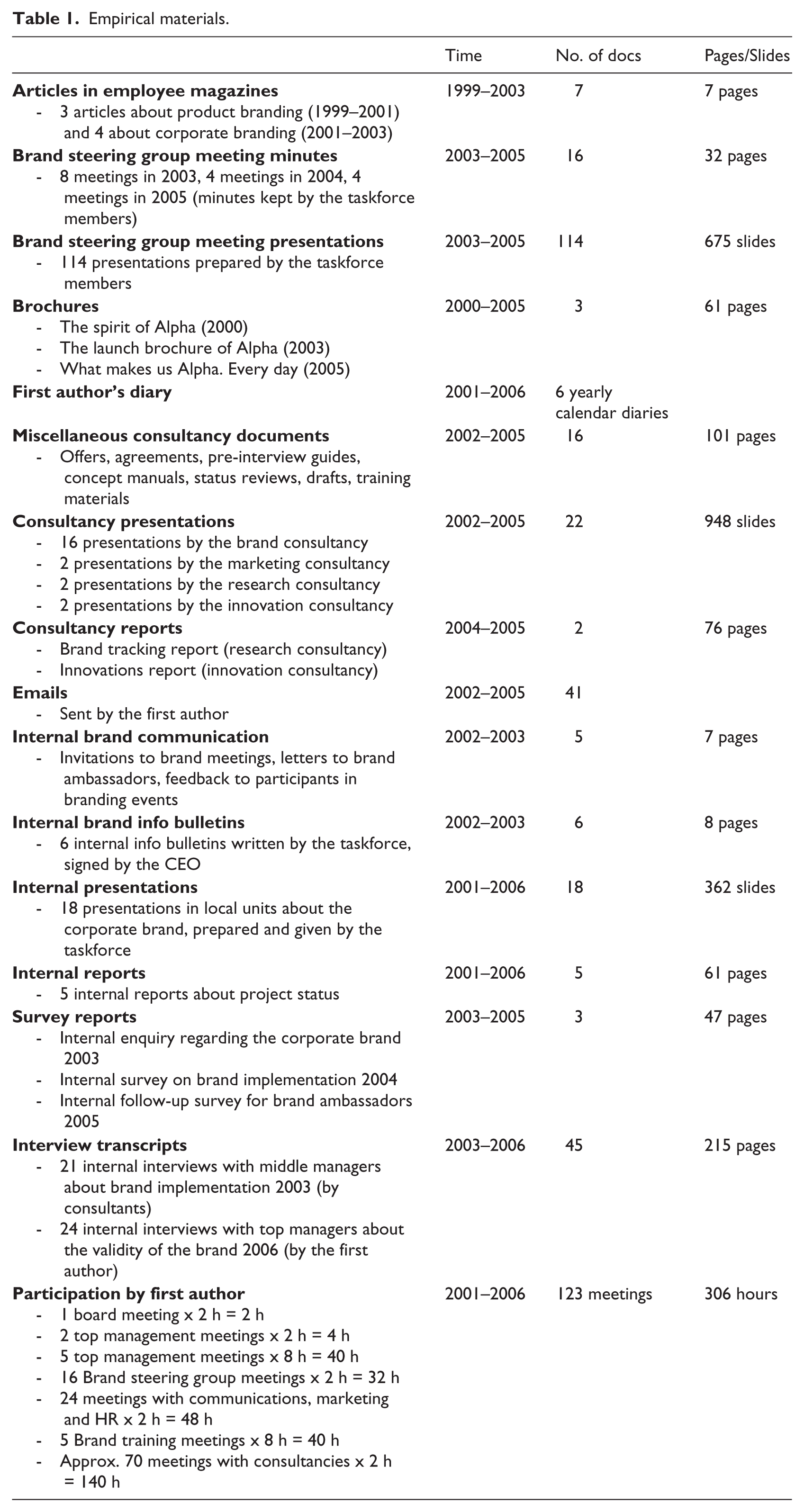
Our empirical materials are summarized in Table 1. The materials complement each other: while the documents depict what was (intended to be) done, the first author’s participant observation (noted in the diary), email correspondence (within the taskforce and with consultants and organizational members) as well as interviews and surveys help shed light on lived experiences, offering us access to what passed unnoticed in the documents. While the position of the first author enabled us to view the project “from within” (Bartunek & Louis, 1996), the second author joined the research after the field work was completed. While the first author had unique contextual information about the interaction she had lived through, the second author could view the interaction depicted in the materials from a distance. This approach gave us an opportunity to discuss different interpretations and various perspectives for analyzing the materials (Cunliffe, 2003).
Empirical materials.
Analysis
Our analysis of the empirical materials proceeded iteratively through three main stages: temporal bracketing, identifying interactions and roles, and specifying role transitions and identity work. At the outset our data seemed overwhelmingly abundant. In order to make sense of the various materials we first relied on temporal bracketing, which involves the generation of comparative units of analysis in the form of distinct time periods (Langley, 1999). We organized the materials chronologically and by document type, and identified repetitive patterns among events and activities corresponding to distinct consultancy assignments (sub-projects). There seemed to be continuity in interaction between organizational members and consultants within each sub-project and discontinuity between sub-projects. Temporal bracketing resulted in a condensed description of five sub-projects.
The first sub-project focused on defining the corporate brand, and a strategic brand consultancy was used for this purpose. Second, a learning consultancy specializing in change implementation was employed in brand training. Third, a marketing consultancy with a focus on visual modernization, graphic design, advertising, and public relations was hired. Fourth, a consultancy operating in the area of market research and business intelligence was used to carry out a brand-tracking inquiry. Fifth, a consultancy with close links to academia was employed, with the specific task of supporting Alpha’s brand-building from the perspective of innovativeness. The nature and duration of the five sub-projects varied, and Alpha relied on a different consultancy for each sub-project.
In the second stage of the analysis, we focused on the interaction between organizational members and consultants during the course of each sub-project, and then compared them. Despite their varying scope and duration, the sub-projects proceeded through a similar process. In a study of how consultants produce their services in interaction with the client, Nikolova, Reihlen, and Schlapfner (2009) argue that this consists of specific phases. “Acquiring” the assignment constitutes the first phase. This is followed by “consulting activities,” while “communicating results” wrap up the assignment. Nikolova et al. (2009) maintain that all phases are characterized by consultants’ efforts to coordinate the client’s expectations about the process and its outcomes. Studying client-consultant interaction from the viewpoint of the client (with Alpha’s taskforce as the focal point), we identified similar phases in the five sub-projects that consisted of specific interactions. We also noted, however, that the consultants’ “client” cannot be treated as a monolithic entity. Rather, it incorporates multiple, contradictory, and conflicting expectations (Alvesson, Kärreman, Sturdy, & Handley, 2009).
Based on a comparative analysis of the five sub-projects we identified the pattern of interaction between organizational members (taskforce, top management, middle management, and employees) and consultants as follows. During the first phase (acquiring), the interaction consisted of (i) opening up discussion about a consultancy assignment, (ii) negotiating a tailored solution, (iii) agreeing on the scope of the assignment, and (iv) agreeing on its duration. During the second phase (consulting), the interaction consisted of (i) creating internal awareness of the project and (ii) encouraging participation in it. The interactions continued by (iii) engaging organizational members and consultants in co-creation of solutions and (iv) providing feedback on the actions taken. During the third phase (communicating), the interactions concentrated on developing internal support and “buy-in” by (i) communicating the outcomes of the consultancy assignments, (ii) substantiating tangible changes, (iii) convincing organizational members of synergies between the sub-projects, and (iv) stressing the need for future commitment.
These interactions reflect the top-down hierarchical “culture” at Alpha where top management always had to be consulted before decisions on continuing the project could be made. The interactions seemed to form “inter-subjective knowledge processes” (Simpson & Carroll, 2008) between organizational members and consultants as they made actors from different knowledge domains come together to articulate and discuss what they mean by branding, how it ought to be carried out, and with what goals in mind. Bundles of these interactions in each phase of the sub-projects seemed to constitute roles that “sat on the boundary” of the domains (Simpson & Carroll, 2008). In our comparative analysis, we noticed that these roles were not pre-determined in an organizational position (such as top management or the taskforce), but emerged and evolved in and across the sub-projects as they were continuously reproduced in the interactions. They also embodied different expectations.
During the first phase of each sub-project (acquiring), the mediation of interaction between Alpha and the consultancies consisted of sharing information about new corporate brand building activities. Here, bundles of interactions refer to, for example, meetings and correspondence involving consultants and the taskforce as well as the top management and the taskforce (only in exceptional cases did top management meet consultants without the taskforce being present), brand steering group meetings, the taskforce commenting on consultancy materials to the consultants, and the taskforce preparing presentations to top management (sometimes with the help of consultants). In this way, at the outset of each sub-project, negotiating a suitable approach, scope, and duration for an assignment constituted the role of what we call “intrapreneur,” which involved bringing Alpha top managers and consultants together to discuss their expectations for the assignment and to facilitate reconciliation of the various views. In the second phase (consulting), differences in what brand building meant and what was expected from Alpha’s employees became increasingly evident. Negotiating and translating meanings about brand building activities in order to involve and engage Alpha’s middle managers and employees in the activities facilitated by the consultants constructed the role of “cultural translator.” Finally, towards the end of each sub-project (communicating) the mediation of interaction focused on finding a way to communicate results so that organizational members (top management, middle management, and employees) were willing to continue building the new Alpha brand, constructing the role of “internal salesperson.” The three roles came to be associated with the taskforce, who assumed responsibility for coordinating interactions in and across the sub-projects and knowledge domains. No other roles related to interaction between the two knowledge domains in the rebranding project could be detected.
The third stage in our analysis constituted the final iteration. We studied how the taskforce members moved between the roles of intrapreneur, cultural translator, and internal salesperson in and across the sub-projects, and how they worked on their identities while doing so. We identified different forms of role transitions (Ashforth, 2001) and sought to discern how roles and identities co-evolved over time (Brown, 2015). First, during each sub-project the taskforce moved from one role to another, and an interrole transition took place. Each sub-project offered a unique setting for this transition as the negotiation of meanings between Alpha and a different consultancy were started anew. Moving from one role to the next acquired specific meanings as the focus of interaction changed from getting the sub-project started to mediating the actual consultancy work to communicating its results. Second, over the entire research period, the taskforce’s orientation towards each role gradually changed, and an intrarole transition took place. Returning to a given role in yet another sub-project was characterized by a changing orientation towards that role. Overall, while the roles helped to negotiate the meanings of the project in the interaction between Alpha and the consultancies, they were subject to ongoing reconstruction both within each sub-project (interrole transitions) and over the entire rebranding project (intrarole transitions).
At the same time, roles and role transitions seemed to affect how taskforce members saw themselves and how they belonged in the Alpha organization. Whilst the roles were subject to ongoing reconstruction in the relational interaction between Alpha and the consultancies, the meanings conveyed by the evolving role-specific interaction conditioned how the taskforce made sense of their identities as taskforce members, what they were supposed to do, and where their allegiances lie. To further explore this, we returned to the key characteristics of the phase-specific interaction within each sub-project as well as across them, and discerned how inter- and intrarole transitions played into the identity work of the taskforce. We found that roles and role transitions gave rise to the development of two contrasting organization-based identities, those of expert and outsider. While the two identity constructions oscillated in each sub-project (in interrole transitions), the identity construction of expert dominated at the outset of the rebranding project while that of outsider became more prominent as the project evolved (in intrarole transitions). In the end, the taskforce members increasingly identified with the domain of consultants.
Our analysis suggests that this shift between the two identity constructions was conditioned by a change in Alpha’s operating environment whereby the rebranding project evolved from an ambitious organizational change initiative to a relatively traditional marketing and promotional exercise. As the market for Alpha’s products deteriorated and top management focused on cost-cutting, their interest in brand-related activities all but disappeared. For example, while during the first sub-projects the “intrapraneur” role was characterized by leeway and freedom to make suggestions of new brand building activities and to get them accepted, towards the end of the project this role was characterized by inability to craft new initiatives and to continue the rebranding project. A similar shift could be detected in the “cultural translator” and “internal salesperson” roles.
Our analytical process is summarized in Figure 1. We realize that our reading of the Alpha rebranding project over the course of five years cannot be exclusive and exhaustive. We have decided what data to analyze and how to ascribe meanings to it (Suddaby, 2006). Other readings of roles and identities based on different empirical emphases and theoretical framings are possible. However, we have attempted to be systematic and transparent in our research as well as in reporting our research process and findings so that the reader is able to follow our line of argumentation. In the following, we first specify and illustrate how the mediation of interaction between Alpha and the consultants constituted the roles of intrapreneur, cultural translator, and internal salesperson, and describe recurrent interrole transitions between the roles. Second, we focus on the intrarole transitions and highlight the changing nature of the role-specific interactions as well as the changing orientation of the taskforce towards the roles. Third, we elucidate how the roles and role transitions mediated the identity work of the taskforce.
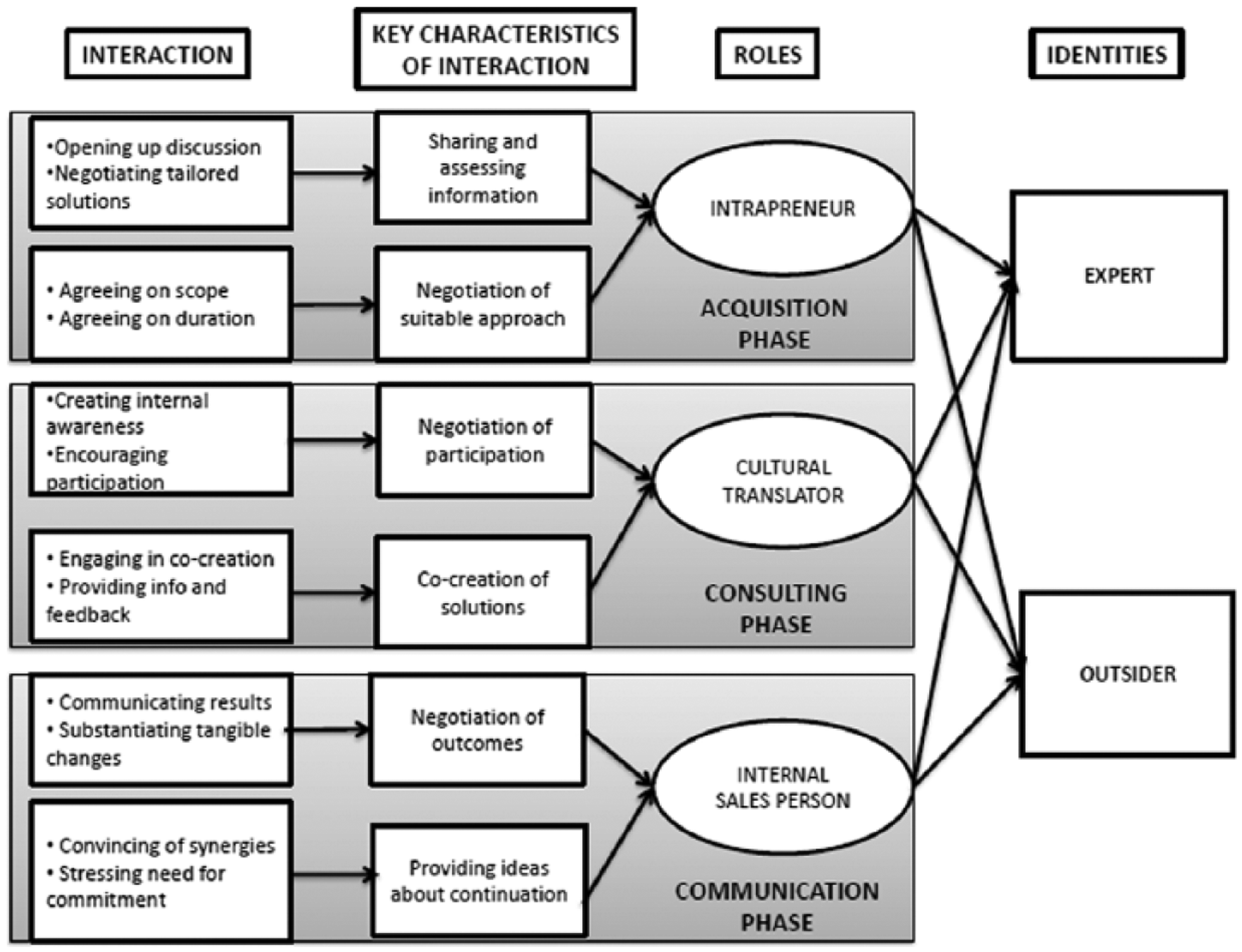
Analytical process.
Findings
Interrole transitions
Interrole transitions are examples of what Ashforth et al. (2000) call micro role transitions; both entries to roles and exits from them are temporary and recurrent. In such transitions, individuals move with relative ease from one role to another (Louis, 1980). In Alpha’s strategic rebranding project, no roles were established as organizational positions. Instead, it was the mediation of interaction between Alpha and the consultants that constituted the roles we call intrapreneur, cultural translator, and internal salesperson. In taking up these roles, the taskforce made several interrole transitions; these refer here to movement from intrapreneur to cultural translator to internal salesperson in the course of each sub-project.
At the outset, the marketing and communications executives who formed the taskforce had developed up-to-date knowledge about the variety of branding-related service providers and services on offer. They approached top management to open discussion on whether there was a need to rebrand Alpha. Their key message was as follows: “All our products have exact specifications, yet the company and what it stands for remains unspecified” (presentation to top management, August 2001). The idea was favorably received and the two executives were offered a mandate to find a consultancy firm to assist in defining a new brand for Alpha. It was agreed that the new brand would not be based on Alpha’s products but on its ways of operating. However, no concrete long-term plan or clear process description was developed for the project. This meant that rebranding would mean different things for different actors as the project unfolded. While for the taskforce it entailed a quest for change in Alpha’s culture, top management saw it as an opportunity to highlight Alpha’s qualities for stakeholders. Middle managers and employees in Alpha’s local units failed to embrace cultural change, and remained indifferent to the new brand.
Emergence of the intrapreneur role
Several brand consultancies contacted the taskforce to offer their services. One consultancy stood out in its bold and comprehensive approach, its references from the field of B-to-B, and the outspokenness of its consultants in challenging their clients. The consultants declared the following in their presentation to the taskforce: “Marketing is like running the hurdles. All hurdles must be cleared without fault to get the optimal results from the effort invested.” The taskforce was convinced of the consultancy’s ability to support brand building and cultural change at Alpha. However, in the ensuing discussion with top management it became clear that the scope of the project had to be reduced from an extensive “hurdles race” to a more modest initiative that focused on defining Alpha’s new brand. Reaching a shared understanding called for mediation, and an agreement was negotiated between Alpha’s top management and the consultancy.
The intrapreneur role emerged in this interaction (Nikolova et al., 2009). The emergent role at the boundary of the organization and the consultancy fell to the taskforce as they were eager to get started and take responsibility for rebranding Alpha. The taskforce worked to tone down the bold rhetoric of the consultants and filtered their high ambitions to create the preconditions for what they thought was a realistic change initiative. They developed a habit of guiding consultants to present their ideas in “digestable pieces” to Alpha top management (and later middle managers), as the first author noted in her diary in March 2002. After several meetings, the response among the top management was positive. The CEO opened the kick-off workshop in April 2002 with the following words: “We have a good product image, now let’s take care of the corporate brand!” The emergence of the intrapreneur role is depicted in Figure 2 below.
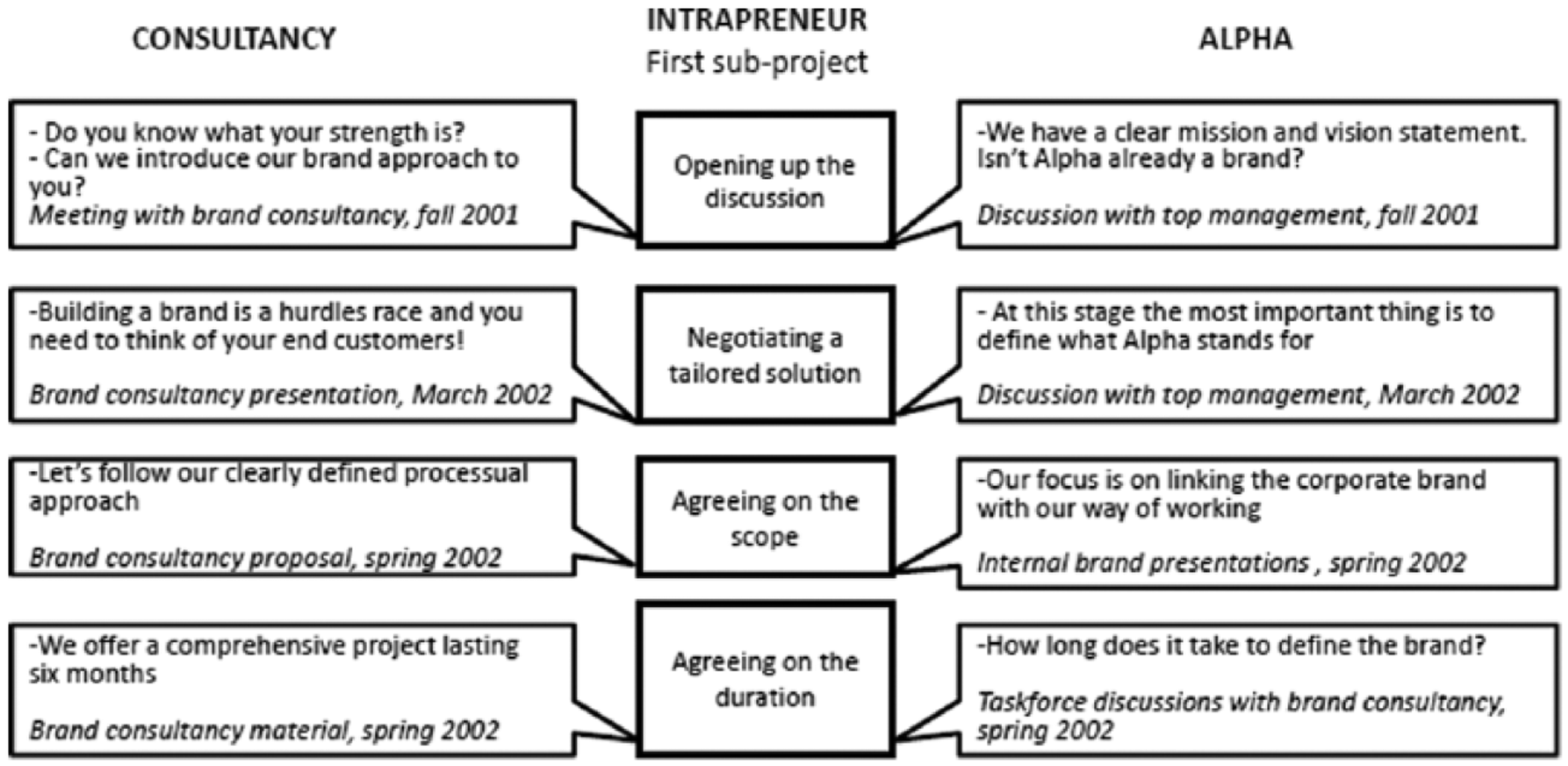
Emerging intrapreneur role.
Emergence of the cultural translator role
When the brand definition proceeded from negotiations to consulting activities (Nikolova et al., 2009), a new role came into being. In creating wider awareness of the need for rebranding Alpha, and in encouraging middle managers and employees in local units to participate, the cultural translator role emerged on the boundary between the organization and the consultants. Again, the initial mediating work fell to the taskforce, who were faced with a transition to a role that was only taking shape. This is depicted in Figure 3 below.
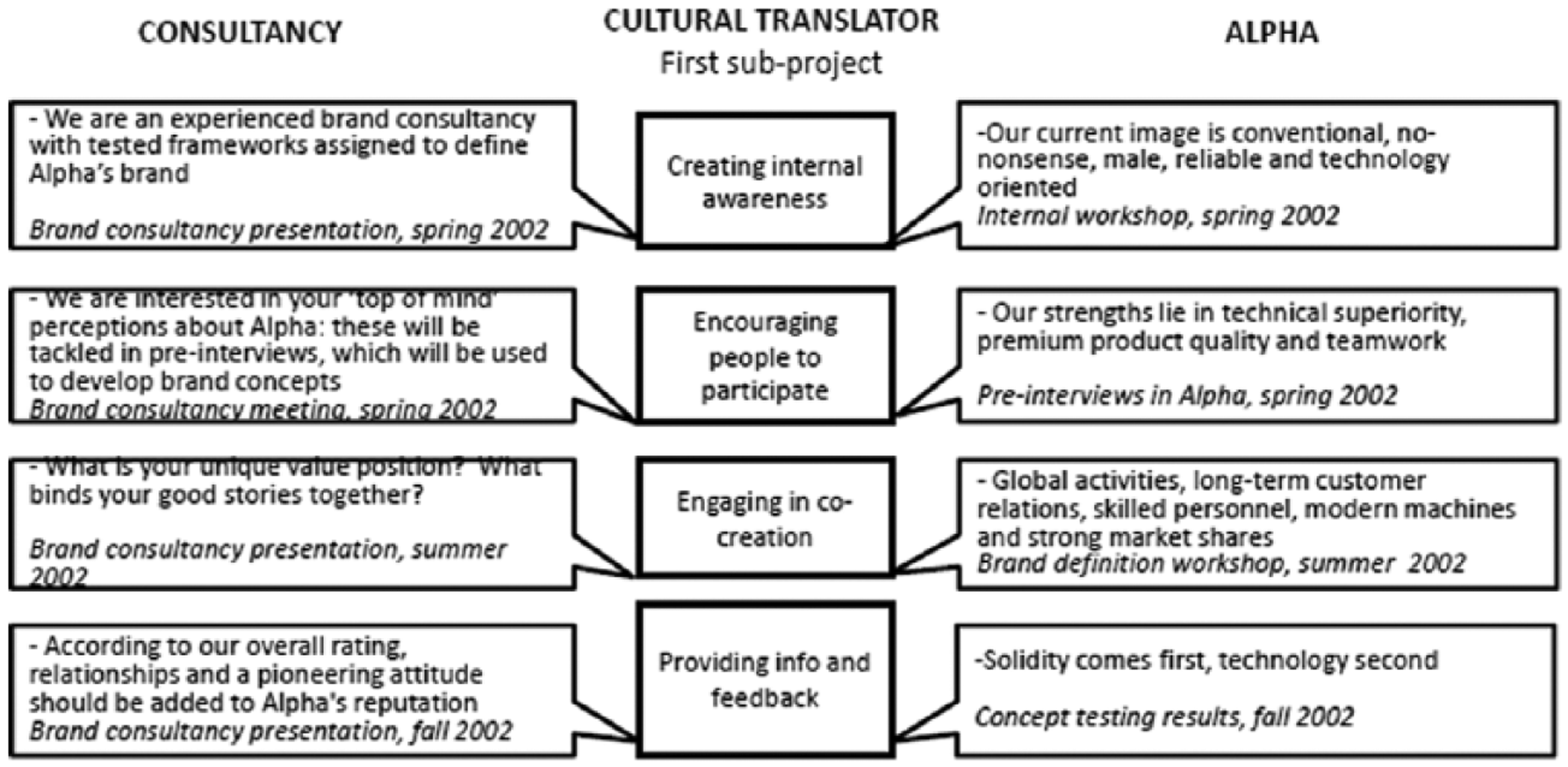
Emerging cultural translator role.
However, the consultants increasingly took over the role of cultural translator. The taskforce retreated, limiting their efforts to support of the activities facilitated by the consultants. In effect, the taskforce rendered control over the assignment to the consultants, who had a ready framework for brand definition, including templates for “pre-interviews,” concept development, and workshops. The taskforce helped the consultants in finding volunteers for pre-interviews (where perceptions in the local units and among Alpha’s stakeholders were studied) and assisted them in organizing workshops where different concepts (drawn from the interviews) were worked on by select middle managers and other key people. One enthusiastic middle manager said that redefining the Alpha brand would “put a new star in the sky for all our employees. It will also take us to a new level in the eyes of our stakeholders.”
However, only a fraction of the middle managers and employees were directly involved in the brand definition and thus the task of local “change agents” was crucial in continuing the work in the units. While the brand definition assignment met with some enthusiasm, there was mistrust towards the consultants and their ideas among middle managers and employees. The taskforce were treated like the consultants: as “in-house staff” carrying abstract conceptual knowledge rather than practical hands-on advice. The reactions of middle managers reinforced the view that only line management could understand “real life” in the local units: “It is important that the training is led by line management. Just having outside consultants or in-house staff is not enough. Line management has to be involved … to show that this is what we are going to implement in real life, too!” (Response to open question in survey, 2003)
Emergence of the internal salesperson role
When the first consultancy assignment proceeded to communicating its results – the final phase (Nikolova et al., 2009) – yet another role came into being. It was about persuading all organizational members to look forward to the next steps in making the new brand a reality. Hence the taskforce made an interrole transition to the emerging role of internal salesperson. This last phase of the sub-project was crucial for ensuring continuation of the initiative. The taskforce rallied behind a comprehensive approach to building a new brand for Alpha. They wrote the following in Alpha’s employee magazine (August 2002):
A strong corporate brand positions the company in relation to its competitors. It also communicates its values to stakeholders. The brand crystallizes the philosophy that steers our operations and it is an invaluable tool for leadership that is engaging. A total of 120 representatives of different stakeholders were interviewed. We received valuable information on which to base our brand definition. Crucial decisions will be made this coming autumn. The end of this particular project is the beginning of a new one – we must all stand behind our brand promise and make it real!
The outcome of the first sub-project was that Alpha’s brand was defined on the basis of continuous improvement and learning. The taskforce worked together with the consultants to ensure that this message was effectively communicated to top management and other organizational members. However, the final phase in the first sub-project also involved terminating cooperation with the consultants; the taskforce regained control of the change initiative. This is depicted in Figure 4 below.
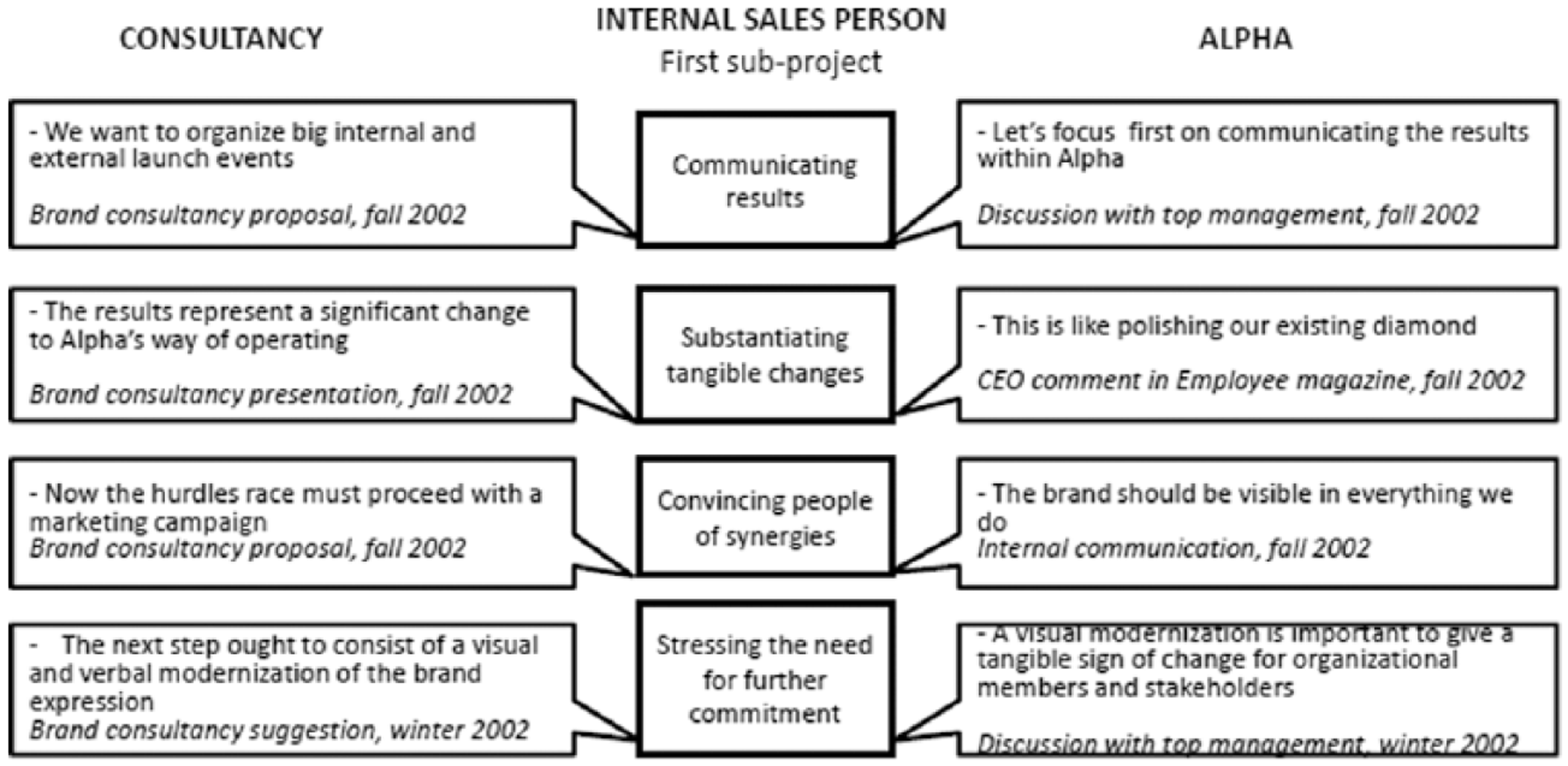
Emerging internal salesperson role.
Summary of interrole transitions
In what eventually amounted to five sub-projects, mediation of interaction between the knowledge domains of Alpha and the consultants entailed (1) negotiating new branding activities with top management, (2) establishing some form of co-creation between consultants and organizational members, and (3) securing continuation of the rebranding initiative. Within each sub-project, the roles of intrapreneur, cultural translator, and internal salesperson were closely connected and the boundaries between them were often blurred. The roles were “integrated,” as Ashforth et al. (2000, p. 479) put it. They were tightly connected and not tied to specific locations or times. They also allowed cross-role interruptions, i.e. going back and forth between roles. However, it is noteworthy that with each new sub-project the interrole transitions from intrapreneur to cultural translator to internal salesperson faced by the taskforce became increasingly unwieldy. This shift over time is even more apparent when intrarole transitions are considered.
Intrarole transitions
Intrarole transitions are about individuals’ orientation toward a role already held (Ashforth et al., 2000; Louis, 1980). In Alpha’s rebranding project, the taskforce returned to the roles of intrapreneur, cultural translator, and internal salesperson in each new sub-project. The nature of the interactions underlying the roles changed and the taskforce’s orientation towards them was also subject to change.
Intrarole transitions in flux
The first intrarole transition took place when the second sub-project was negotiated and a need arose for aligning the views of Alpha top management with the ideas and approach of a new consultancy firm. As a follow-up to defining the new brand the taskforce returned to the intrapreneur role. This time the role was about acquiring external assistance for planning and carrying out brand training sessions that aimed at “crystallizing” what it meant that the Alpha brand would be defined on the basis of continuous improvement and learning. A learning consultancy was hired for the job. Activities involving the learning consultants were to be organized together with Alpha’s human resources (HR) department.
Next, the taskforce returned to the cultural translator role, sharing it with in-house HR-specialists who assisted in setting up the training sessions. “You are welcome to step into the world of Alpha’s corporate brand! The journey starts with attending one of our training sessions,” the taskforce wrote in an invitation letter to potential change agents in the local units (August 2003): As a start it is essential that people get an opportunity to understand why branding and brand values are relevant to everybody. Only then will people be motivated and receptive to learn about the Alpha brand platform and what it means to them. (Learning consultancy email to taskforce members, September 2003)
Local change agents were called brand ambassadors and 179 of them were eventually appointed, mostly from middle management ranks. The brand ambassadors were invited to training sessions where exercises – developed by the learning consultants in collaboration with the taskforce – formed the core activities. “We incorporate relevant hands-on activities in an environment that simulates your own operating conditions so people learn by their own experiences,” the consultants promised. Expectations were high, as the following responses by brand ambassadors to an open question in a survey (August 2003) indicate:
I hope people understand that we are not talking about icing on the cake, but our real behavior and ways of operating.
The new brand ought to create instant positive reactions among all our stakeholders by capturing who we are and what we stand for.
Returning to the internal salesperson role, in turn, was characterized by new communication challenges. A brand brochure was delivered to the home address of every Alpha employee with the aim of capturing the essence of the new brand and describing the cultural change that it entailed:
We are a company driven by continuous improvement. The world around us is changing constantly – and so are we! To improve we have to balance between extremes. Alpha is a company that is simultaneously solid, but flexible; reliable but experimental; technically superior but willing to learn. We thrive on these apparent contradictions, constantly questioning our conventions and striving to improve.
In all subsequent sub-projects the taskforce returned to the roles of intrapreneur, cultural translator, and internal salesperson. However, the roles did not remain stable but evolved in the following ways.
Transitions to the intrapreneur role
The role of intrapreneur evolved from initiative to inaction during the course of the five sub-projects, and the transition to this role became increasingly complicated for the taskforce. While the first two sub-projects were characterized by enthusiasm (as described above), the third sub-project was a tipping point, and the fourth and fifth sub-projects were marked by contradictions. This shift was conditioned by a change in Alpha’s operating environment, which affected its performance: The business climate has changed quickly, and the measures introduced to improve profitability are not yet sufficient. … Reversing the trend in profits requires a new way of thinking from our employees and management actions that will allow us to use our capacity more profitably. (Annual report 2005)
Declining demand and falling prices in the largest customer markets combined with overcapacity in the industry overall led to poorer prospects for Alpha. Cost effectiveness occupied top management’s agenda. This led to change in the taskforce’s orientation to the intrapreneur role. While they continued to emphasize the need for cultural change and proposed new branding activities to support it, most ideas were now turned down by the top management. For example, in late autumn 2004, the taskforce held an impromptu one-day workshop with a brand consultancy. The first author noted in her diary that “we reached a state of flow” with the consultants. The outcome of the workshop was a detailed visualization of how brand-led cultural change could be accomplished at Alpha. It was eventually presented to top management who were not impressed. They ridiculed the visualization by saying that it was a “real Star Wars thing.” Collaboration with the consultancy was cut short.
Overall, omission of brand-related items from the agenda of top management meetings, belated decision-making, and denied requests for more resources changed the meaning of the intrapreneur role. Extracts from minutes of brand steering group meetings (2005) illustrate this: The general opinion was that there needs to be a brand development system; details on how this will be arranged will be discussed in the next meeting. (April 2004) The different brand pillars should be kept in mind when communicating issues across the company. This will be discussed in more detail in the next meeting. (October 2004)
In May 2005, the taskforce proposed to top management that the brand ambassadors’ network be invigorated. Brand ambassadors were to be re-engaged as local change agents in brand building. In an email to the ambassadors, the taskforce wrote the following: Alpha has an extensive network of corporate brand builders or ambassadors. … In the surveys carried out earlier, you have indicated that the most difficult area to influence is behavior. … The surveys were a step in exchanging experiences and opinions. The next step will be face-to-face sessions organized later this year.
Top management asked the taskforce to update the list of brand ambassadors and fine-tune their proposal. Together with an advertising agency the taskforce prepared a layout for a new brand brochure – “Living the Brand” – that was to support the activities. However, decisions regarding the proposal were postponed several times. An extract from the minutes of a brand steering group meeting in September 2005 illustrates the inaction:
The proposal was discussed and commented on. It was agreed that all top managers comment on the new ‘Living the Brand’ brochure, so that the preparations can proceed. However, it was decided that the project would be postponed until further notice.
The brand steering group was discontinued soon afterwards. No face-to-face sessions were ever held with the brand ambassadors and no brochure was distributed. A top manager asserted the following in a subsequent interview with the first author (April 2006): “The brand should not become larger than life. The brand alone does not matter; what matters is our performance and products.”
Transitions to the cultural translator role
Over the course of the five sub-projects the role of cultural translator evolved from advocator of cultural change to coordinator of marketing and promotional exercises. At the outset, facilitating the participation of Alpha middle managers and employees was characterized by enthusiasm (as described above). The taskforce worked on alternative concepts with the consultants and helped them organize activities where internal and external stakeholders of Alpha were able to express their opinions and make suggestions for the future direction of the company: Establishing a strong corporate brand is a very big challenge and we all have only ONE chance to implement it properly! With clear and open information, guidelines and communication EVERYWHERE … we can do it!!! (Brand ambassador reply to taskforce letter, March 2004)
However, there were already signs of a lapse in enthusiasm in the second sub-project. The exercises that the learning consultants put together with the taskforce were not appreciated. They were considered “childish” as they “underestimated the intelligence of the participants,” as one middle manager put it. Afterwards, the momentum was lost as the plans of the brand ambassadors for incorporating the new brand in their daily activities were notably cautious. The first author noted in her diary in December 2003 that “the plans are pretty mechanistic” and that there was typically no reflection on what was to be changed and why. At the same time, the taskforce was slow in getting back to the ambassadors. The tone in their subsequent communication with the brand ambassadors was apologetic: It is already five months from our brand training sessions. After the trainings you have made your plans on how to introduce the Alpha brand to your own people. The plans as well as the schedules differ from unit to unit, which is only natural. … In some areas we have certainly progressed towards the desired behaviour. (Taskforce letter to brand ambassadors, March 2004)
Eventually, the cultural translation activities turned into a mere marketing and promotional exercise. For example, the taskforce worked on proposals for advertising concepts, sponsoring, and VIP-events for key clients. In the fourth and fifth sub-projects, the taskforce sought to re-engage organizational members in more ambitious cultural translation activities. For example, in the fourth sub-project they worked on the results of the brand tracking survey. “Alpha’s first ever corporate brand tracking survey is based on an index-model developed specifically for you,” the consultants had promised. The idea was to obtain information on how the Alpha brand was performing on key dimensions identified in the new brand definition. The taskforce had provided the consultants with hands-on information about Alpha’s needs to ensure a truly tailored approach, and the survey was conducted in Alpha’s five largest markets with respondents representing clients and suppliers. The taskforce had high hopes that brand tracking would help keep momentum in the project as it would highlight where Alpha’s brand values differed from the perceptions of its stakeholders. However, this turned out to be a huge disappointment for the taskforce. The survey results failed to mobilize brand-related activities locally. The reactions of organizational members indicated that the new brand was not having an impact on the functioning of their units – and that they were basically indifferent to the project. The taskforce wrote the following in the Alpha employee magazine (May 2004):
Developing our operations so that we keep our promise to take on the challenges of our clients and to invest in people entails a lot of work on our part. But there is still a distinct opportunity for differentiating Alpha from its competitors.
By now, the momentum in the cultural change sought by the taskforce seemed to have vanished. “The message is accepted but it is difficult to see its relevance for business,” a brand ambassador noted in a response to an open question in a survey (2005). “Change in behavior is always difficult. There is not enough willingness to change.” The top management introduced cost cutting schemes, taking attention away from the brand in strategic planning and corporate communications. A top manager put it as follows in an interview (2006): “We have improved the appearance of our company quite significantly and we have been able to create the image of a modern and dynamic company.” It was clear that he saw branding purely as a marketing device.
Transitions to the internal salesperson role
Finally, the role of internal salesperson evolved from selling ideas to selling consultancy assignments. In communicating the achievements in the first sub-project – when spirits were still high – the taskforce wrote an info bulletin to all members of the Alpha organization (December 2002): The corporate brand definition project started in April and it was concluded in November. … Its results and the formulation of the corporate brand capture our strengths as well as our ambitions. At the same time, however, it represents an organizational challenge and a stretch for all individuals. Strong brands in the B-to-B environment are built in the minds of customers, shareholders, and opinion leaders – and in the minds of all of us.
However, by the time the achievements in the second sub-project were to be communicated, the brand steering group had stated that “we should talk about development instead of massive change” (meeting minutes, August 2003). As follow-up activities were frequently delayed, direct connections between the various sub-projects – and progress in the project overall – were difficult to show. The fact that Alpha had no long-term commitment to rebranding became increasingly apparent. The need for every new consultancy assignment had to be “sold” separately. By the fifth sub-project, with the brand steering group discontinued, the taskforce had no-one to sell them to.
The innovation-related consultancy assignment, which proved to be the last in the chain of sub-projects, illustrates the frustration. The aim was to disentangle key points that either supported or prevented innovativeness, continuous learning, and customer orientation in Alpha’s sales offices. The taskforce worked in close cooperation with the consultancy that carried out two focus group discussions in each of Alpha’s five largest sales offices. Those who took part in the discussions commended them for being open and thought-provoking, and the consultants’ report highlighted many issues that were in need of improvement. The first author presented the findings in a meeting organized by Alpha’s marketing department – and noticed that she had become a messenger of news that was not appreciated. Her presentation met with silence. Overall, the rebranding project had fallen off the radar of key organizational members. The comments of top managers in the interviews carried out by the first author in March 2006 illuminate this:
Maybe our new brand concept was better than the actual reality. We have created good concepts, but we have been unable to implement them.
The brand and the brand pillars are still good. Good work has been carried out. But let’s keep it in the drawer.
Summary of intrarole transitions
Intrarole transitions evolved throughout Alpha’s rebranding project: returning to each of the three roles in each new sub-project was a different experience. It is noteworthy how the domains of knowledge between which mediation took place did not remain stable (cf. Simpson & Carroll, 2008). On the one hand, the knowledge domain of the organization changed as Alpha retreated to a focus on cost-consciousness as the operating environment turned for the worse. On the other hand, the knowledge domain of consultants changed as a different consultancy was used for each assignment. As a consequence, the meaning of the interactions underlying the roles and the taskforce’s orientation towards them changed, and this mediated the evolving identity work of the taskforce members.
Identity work
The taskforce members attached different, contradictory, and even conflicting meanings to themselves and to where they belonged during the course of Alpha’s rebranding project. Their organization-based identities co-evolved with the roles and role transitions depicted above.
Identity work in interrole transitions
In interrole transitions that were about moving from one role to another within a given sub-project, the taskforce was initially able to work on their identity as members of the Alpha organization with unique and strategically relevant expertise: I want to get the top managers inspired and engaged in the idea of building a corporate brand for Alpha. The workshops must be developed as professionally as possible. I received a very positive email from [head of division] who had attended our workshop. This proves that we are on our way to success. (First author’s diary, September 2001)
However, over time the taskforce also began to work on a sense of becoming an outsider to the organization. From their point of view, each sub-project became a “rollercoaster ride” characterized by “small victories and setbacks,” as the first author noted in her diary. Initiating a new consultancy assignment was always exciting, and the transition from internal salesperson (in the final phase of the previous sub-project) to intrapreneur (in the first phase of the following one) was significant as it enabled the taskforce to work on their apparently unique expertise in mediating interaction between Alpha top management and consultants. Time and again, a sense of control, of being able to tone down the consultants’ bold rhetoric and adapt it to Alpha’s culture, boosted their self-confidence: I was surprised by the invitation to have lunch with the CEO to discuss alternatives for a consultancy firm to carry out the corporate brand definition work. The rebranding initiative seems to be really high on their agenda! (First author’s diary, March 2002)
In all sub-projects, the transition from the role of intrapreneur to cultural translator proved to be more challenging. Changing established ways of working in local units across Alpha was significantly more difficult than pitching new ideas. This was anticipated at the outset of the project: I want to maintain an ambitious attitude towards the branding project. It should help us in creating a new leadership culture through clear direction. This clarity can only be achieved if the “story” holds – no matter which direction the doubts come from. (First author’s email to the brand consultancy, April 2002)
While collaboration with the consultants reinforced the taskforce members’ sense of expertise, in the eyes of Alpha middle managers and employees they remained bureaucrats from headquarters. They were associated with the external consultants, who lacked an understanding of life in the local units. The fact that not only middle managers but also top management seemed to sustain this view undermined the taskforce members’ sense of belonging to the organization.
In the first two sub-projects, the transition to cultural translator was still relatively smooth. Subsequently it became increasingly apparent that Alpha’s organizational members and the consultants spoke a different language. Persistent problems in facilitating cultural change at Alpha triggered self-doubt: taskforce members pondered whether there had been real momentum in the project in the first place – or whether they had misunderstood its potential altogether. “A big ship takes time to turn,” the first author lamented in her diary (December 2003), but she was still baffled by the inertia.
The final phase in each sub-project was always the hardest from the point of view of the taskforce. The role of internal salesperson was crucial in securing continuation of the rebranding initiative. However, convincing top management was increasingly difficult. Persuading them to see the value of rebranding Alpha took a lot of energy at the best of times, let alone when their attention turned to cost-cutting. The transition from the role of cultural translator to internal sales person was characterized by mounting loneliness and frustration: The brand definition is over and the consultants have done their tricks. However, many issues remain to be tackled. The biggest issues are likely to be attitudinal – how effective a tool the brand should become and how much time and money do we want to allocate to it. In my opinion – naturally – corporate branding is an awesome tool, but to sell the continuation of the project requires a very good proposal – let’s talk more on Thursday! (First author’s email to taskforce members, 2002)
Overall, within each sub-project the taskforce members’ sense of who they were and where they belonged oscillated between the identity constructions of expert and outsider. Mediating interaction in getting a new consultancy assignment off the ground tended to sustain their expert identity, while engaging organizational members and securing the next steps in the project were about both – and increasingly about working on the outsider identity. This becomes even more apparent when intrarole transitions are considered.
Identity work in intrarole transitions
In intrarole transitions that are about returning to a role already held, the taskforce worked on their identities during the course of the five sub-projects. Each of the three roles evolved over time, and sustained a general shift from the expert identity construction to that of an outsider in the Alpha organization.
In the first sub-project, the intrapreneur role was characterized by leeway and freedom in getting the work on Alpha’s new brand definition started. Returning to the intrapreneur role in the second (brand training) and third (visual modernization) sub-projects was a similar experience, but when the time for embracing cultural change came the momentum was lost. In the fourth (brand tracking) and fifth (innovativeness), the role was burdened by contradictory and even conflicting meanings. Returning to the intrapreneur role became a source of self-doubt for the taskforce in terms of their allegiance to the Alpha organization. After a disappointing meeting or rejection of an idea, taskforce members found themselves pondering what it would be like to set up a business together and become self-employed. This never materialized, but in 2004 the first author decided to apply for the PhD program of a business school and to write a doctoral thesis on corporate branding from a practice perspective. The positive response from the academic community sustained her sense of becoming an outsider at Alpha.
A general sense of alienation also characterized the evolving cultural translator role. At the outset, it sustained a sense of expertise and the taskforce members considered themselves a great team, “combining high flying ideas and meticulous execution,” as the first author noted in her diary in December 2002. In the first sub-project, the taskforce let consultants as external experts take control over the activities, but had a strong conviction that this was their own choice; an integral part of their vision of cultural change. The taskforce members were invited to internal meetings, workshops, and away days hosted by Alpha’s different local units to present how the consultants’ work was proceeding and to discuss the rebranding project and its implications. The interest, invitations, and warm welcome on behalf of colleagues contributed to the construction of expert identity: A colleague said: it would be a good idea to elect a “brand person of the year” who embodies the brand. She said that I would make a great choice. (First author’s diary, 2003)
These kinds of encouraging events and interactions characterized the taskforce members’ experience until the third sub-project. In one case, the first author had taken her two sons along to a meeting in a local production unit. The other core member of the taskforce came along, too. The first author noted in her diary that on the train back from the event: “We got such a laugh … [her oldest son] looked at us and said: the two of you are like sisters! He’d been listening to us chatting away enthusiastically about the brand.” However, the taskforce members also began to sense that the expertise they had accumulated (perhaps paradoxically) turned them into outsiders at Alpha. After a frustrating brand steering group meeting (in October 2004) the first author recorded the following thought in her diary: “We didn’t discuss how to implement and live the brand; we discussed details of the damned company Christmas card!”
Experiences of this kind increased in number and led the taskforce to identify more with the consultants. This apparently showed as the following example of a consultant praising the first author illustrates: [The consultant] said in front of everyone: “I have seldom heard the need to carry out a customer satisfaction survey argued so well! If you for some reason want to leave Alpha, you can come and work for us.” I was glad to hear this, but wondered what my colleagues thought. (First author’s diary, June 2005)
Around the same time, the first author received an email from a baffled colleague:
As funny as it may sound, looking at the corporate brand in the grassroots level, the visual uplift and the fancy tagline are the only tangible things. They are the only things about the corporate brand that I can recall. I know that these only make up the visual part, so what happened to the Alpha brand? Where are we today? Even more importantly, what’s going to happen next?
This email and others like it frustrated the first author a great deal. As rebranding was increasingly treated by top managers as a marketing and promotional exercise, she felt that the only concrete achievement in the project was the visual modernization of Alpha’s image in glossy brochures. It became increasingly clear to the taskforce that the project was unable to create a common mode of operating and to facilitate a transformation from an engineering-driven technology company to a continuously improving, customer-driven one. This was apparent also in relation to the evolving internal salesperson role.
Eventually the taskforce felt disappointed with the entire project because it seemed to have lost all support in the organization. The feeling of disappointment was further strengthened by the comments made by Alpha’s top managers during an interview round carried out by the first author in spring 2006. “Even at the headquarters there are many people who are not on board.… I don’t know whether it’s a question of not accepting the corporate brand or whether it’s about living in the past,” one top manager remarked. Another noted: “Our style is modest. We can’t change all of a sudden and become something different. We are professionals, expressionless, maybe even slightly boring.” The round of interviews confirmed what the taskforce had already sensed: the project was no longer a priority in terms of top management attention and resource allocation. After five years it had faded away.
Epilogue
For the first author, disillusionment and outsider identity at Alpha had significant consequences. While continuing to write brand-related articles in Alpha’s stakeholder newsletter, she took a leave of absence from the organization to concentrate on her PhD studies. She pursued her view of branding as a way of working in research and teaching at the business school. She felt that this expertise was not appreciated at Alpha, and eventually decided not to return to the organization. The other core member of the taskforce, in turn, used the expertise developed in the rebranding project to refocus her career in another function at Alpha.
Discussion and Conclusion
Our aim in this article has been to revitalize the concept of role for advancing theory on identity work in organizations. We have developed a novel theoretical frame and illustrated its usefulness with an empirical study. First, in our review of how the concept of role is used in studies on identities in organizations we found that most research is based on a functionalist assumption of predetermined roles associated with positions in a given social structure, although symbolic interactionism focusing on how individuals enact and give meaning to roles is drawn on to complement the functionalist understandings (Ashforth, 2001). We have argued that while identities are understood to be in flux, the implicit assumption that roles are contained in (expectations related to) positions that remain fixed and stable is problematic because it hinders theorizing on how roles and identities co-evolve in organizational life (Brown, 2015). We have suggested that this is a particularly acute challenge for research on identity work, where the discussion has stopped short of analyzing how roles emerge and gain (and lose) meanings and in part constitute and sustain how people work on their organization-based identities. To this end we have built on Ashforth et al.’s (2000) and Ashforth’s (2001) research on intra- and interrole transitions as well as Simpson and Carroll’s (2008) understanding of roles as boundary objects. We have argued for conceptualizing roles as mediators in identity work, and suggested that this approach paves the way for enhanced understanding of the dynamism in the processes by which organization-based identities evolve, in particular with regard to identity work that accompanies roles and role transitions.
Second, we have demonstrated how conceptualizing roles as mediators can be operationalized in empirical research by engaging in a longitudinal empirical study of a change initiative in an industrial firm. The recurring interactions that we found to constitute the emerging and evolving roles in the initiative provided the foundation for the focal actors’ identity work. These roles were not determined as a priori “parts” and there was no “script” from which they could be derived as the change initiative unfolded (cf. Biddle, 1986). Instead, our analysis has elucidated how roles and identities co-evolve over time. Our findings are in general agreement with research indicating that identities are worked on in interaction where self-identities are bridged with available social identities (Watson, 2008); where meanings are (re)formulated in face-to-face encounters (Down & Reveley, 2009) as well as in actors’ retrospective reflections of their experiences (Sillince & Simpson, 2010); and where identity work is conditioned by particular situational and cultural circumstances (Alvesson & Willmott, 2002; Brown & Toyoki, 2013; Musson & Duberley, 2007). However, our study has taken the research further by showing how identity work is enabled and constrained by social interaction in an organization operating in a changing environment and, in particular, by elucidating how emerging and evolving roles may in part constitute the identity work of organizational members. Hence we have shed light on some of the “nuances” in how, why, and with what implications people in organizations engage in identity work (Brown, 2015).
We have also extended the work of Ashforth et al. (2000) and Ashforth (2001) by showing that meanings related to roles do not remain stable and fixed when they co-evolve with identities and mediate identity work (see also Leung et al., 2014). We have demonstrated not only that a given role can carry different meanings in different conditions, but also that roles can carry multiple identities – here, expert and outsider – rather than “single personas” for people to enact (cf. Ashforth, 2001). Also, the identity work involved in role transitions is affected not only by situational and cultural circumstances but also by economic ones. While we have not done full justice to Ashforth et al.’s (2000) and Ashforth’s (2001) comprehensive framework detailing the psychological dynamics of various types of role transitions, we have arguably shed new light on “quasi-micro transitions” that have passed unnoticed in earlier research. We have shown how the distinction between roles may become blurred and how inter- and intrarole transitions function separately and together in mediating individuals’ identity work. In so doing we have focused on mediation in interactions between a company and external consultants. Other examples include middle management, which straddles the often conflicting expectations of top management, employees, and clients in contemporary organizations (Thomas & Linstead, 2002). We suggest that their identity constructions could be understood better by exploring the emerging and evolving roles that they encounter in their daily work as well as the various role transitions that they are engaged in.
Further, we have elaborated Simpson and Carroll’s (2008) approach to identities and roles. While these authors ground their theorizing on roles as boundary objects on analysis of episodes in interviews, our longitudinal study has built on insights into social interaction and inter-subjective negotiation of meanings over time and space. Our analysis has elucidated how roles are subject to ongoing reconstruction in continuously evolving relational processes and shown how they give stimuli to identity work over time. We have also demonstrated how the “knowledge domains” (Simpson & Carroll, 2008) between which roles operate as intermediaries did not remain stable. They changed and this change impacted the identity work of organizational members located on the boundary between the domains. Within a given consultancy-specific assignment role transitions were relatively fluid and their input to identity work was more volatile, but across assignments a more dramatic shift was evident in the focal actors’ orientation to roles and in their identity construction.
Overall, we have developed in this article an understanding of organization-based identity work as the constitutive process whereby individuals reflexively attach sometimes contradictory meanings to themselves and to where they belong as they struggle to come to terms with the various roles and role transitions produced and reproduced in social interaction in the organization. At the same time, we have demonstrated how studying identities and roles in organizations is informed by the time frame applied. Capturing the complex oscillation and shift in individuals’ identity work entails a sufficiently long time frame for research (see also e.g. Michel, 2011). If we had been content with one or two years of field work we would most likely have highlighted the process of becoming an expert, without due attention to working on an outsider identity, which only became visible later on.
We argue that conceptualizing roles as mediators in identity work has implications for individuals and organizations. While identity construction may provide people with a temporary sense of coherence in organizational life (Alvesson, 2010), our study has illustrated how relationships between processes of identity work are characterized by “trade-offs” (Brown, 2015, p. 31) that are related to the inherent instability and malleability of roles as well as transitions that may shift from stimulating to distressing, or vice versa. We have shown how trade-offs emerge over time when individuals’ identity work starts to clash with others’ ascriptions of identities to them. We have illustrated this with role-related trade-offs encountered by the focal actors in our study: they invested in constructing a given expert identity, nurtured it enthusiastically, but found that it began to undermine their credibility in the organization and cast them as outsiders. Becoming an expert offered a sense of accomplishment and temporary ontological security. The outsider identity, however, prompted insecurity as the sense of becoming an expert was undermined. This insecurity could be seen as both a “condition and consequence” (Knights & Clarke, 2014, p. 336) of the actors’ aspirations to live up to what they thought was expected from them in implementing the change initiative. Different, even markedly contrasting identities developed side by side (Thomas & Linstead, 2002) and the shifting meanings of roles and role transitions led to what appears to be a new sense of self.
Further, our study has implications for organizations. We studied a long-lasting change initiative that was given different meanings by actors and whose importance diminished over time. It became increasingly clear that established work practices in the organization did not yield to the process of co-creation advocated by the focal actors. The operating environment turned for the worse and this shift had an adverse effect on the change initiative as organizational members (including top management) retreated to their established ways of working. The resultant shift in the meaning of the intermediary roles between knowledge domains impacted the identity work of the focal actors who eventually became disillusioned as “change agents.” Hence we have shown how the distinction between organizational insiders and outsiders may become blurred in and through identity work that is mediated by roles and role transitions in change initiatives. Initially, the focal actors studied were insiders (most visibly, in their executive positions in the organization), but in carrying out the rebranding project they gradually came to dis-identify with the organization and to be alienated from it (Costas & Fleming, 2009).
We have shown how the unfolding of an organizational change initiative not only gives rise to new roles, but also provides new meanings for roles; people may become unwitting carriers of evolving roles that sometimes lead them to work on their identities in unexpected ways. The concept of “role conflict,” which is typically defined as the “concurrent appearance of two or more incompatible expectations for the behavior of a person” (Biddle, 1986, p. 82), does not capture this dynamic because it rests on a functionalist assumption of fixed and stable roles. Neither does “role identity conflict,” or the discrepancy between different role-based identities of an individual (Ashforth et al., 2008; Brown, 2015). Our findings suggest instead that an understanding of roles as evolving mediators of identity work may be useful for furthering the “organizational becoming” perspective where organizations are understood as unfolding enactments and where change and stability are seen as an ongoing negotiation of meanings (Thomas, Sargent, & Hardy, 2011; Tsoukas & Chia, 2002). This understanding of roles and identity work helps us to see how the notion of “change agent” is more complicated than is often assumed.
To summarize, we have made some progress in conceptualizing roles and identity work in a novel way. Many questions remain unaddressed, however. We have not viewed identity work as a locus and target of organizational control (Alvesson & Willmott, 2002) and we have not elaborated in any explicit way on power relations and resistance in the co-evolution of roles and identities, although we have highlighted difference, negotiation, and conflict rather than agreement and harmony in our study. Simpson and Carroll (2008, p. 42) suggest that roles as boundary objects act as sites where power is negotiated between different stakeholders, but how exactly this happens over longer periods of time in organizations remains to be explored.
How emotions play into the way roles mediate identity work suggests itself as another important area for future research. Our study shows how enthusiasm turning into frustration played into how the focal actors constructed their identities. While identity theory that is underpinned by a functionalist understanding of role has discussed emotions to some extent (Stets, 2005; Stryker, 2004), and the notion of emotional work has been addressed in the light of social identity theory (Ashforth & Humphrey, 1993), the more critical constructionist literature in organization and management studies has yet to deal with emotions in understanding how roles and identities co-evolve in organizational life. It would seem that this calls for viewing emotion as a relational concept that develops in and through interaction. Finally, considerations of power, resistance, and emotions could be combined with an elaborate focus on gender relations. Although we have not highlighted gender in the ways roles and role transitions mediate identity work, references in our materials to a “male culture” indicate that roles and identities in the organization are grounded in assumptions about a gendered hierarchy where men and the masculine are routinely favored over women and the feminine (Calás & Smircich, 2006). How gender relations are (re)constructed in and through evolving roles and role transitions in such a setting, and how this affects the identity work of men and women in the organization, remains a timely topic for critical inquiry.
Footnotes
Funding
This research received no specific grant from any funding agency in the public, commercial, or not-for-profit sectors.