




Abstract
Research highlights how coexisting institutional logics can sometimes offer opportunities for agency to enterprising actors in organizational fields. But macro- and micro-level studies using this framework diverge in their approach to understanding the consequences of institutional complexity for actor autonomy, and correspondingly in the opportunities they identify for agents to resist, reinterpret or make judicious use of institutional prescriptions. This paper seeks to bridge this gap, through a longitudinal, comparative case study of the trajectories of four ostensibly similar change initiatives in the same complex organizational field. It studies the influence of three dominant institutional logics (professional, market and corporate) in these divergent trajectories, elucidating the role of mediating influences, operating below the level of the field but above that of the actor, that worked to constrain or facilitate agency. The consequence for actors was a divergent realization of the relationship between the three logics, with very different consequences for their ability to advance their interests. Our findings offer an improved understanding of when and how institutional complexity facilitates autonomy, and suggests mediating influences at the level of the organization and the relationship it instantiates between carriers of logics, neglected by macro- and micro-level studies, that merit further attention.
Keywords
Introduction
Academic understanding of conformity, differentiation and change in organizational fields has been advanced in recent years by a burgeoning literature drawing on the concept of institutional logics. From its foundations in neo-institutionalism, the institutional logics perspective has rapidly advanced to theorize how diverse institutional forces not only compete for dominance, but also frequently interact and coexist, and how this affects organizational and individual behaviour. It offers a rich explanatory framework that accounts for heterogeneity as well as conformity, and which better allows for the potential of agency as well as structure in enacting, contesting and transforming institutions.
Within this approach, a particularly vibrant thread of research has focused on the consequences of institutional complexity – that is, the presence of multiple logics with conflicting, or at least diverging, prescriptions for behaviour. At the macro level, theoretical and empirical studies have, as a rule, found that institutional complexity adds further constraints to organizations’ and individuals’ behaviour, since it poses expectations from additional audiences, all of whom must be satisfied for legitimacy (Kraatz & Block, 2008; Pache & Santos, 2010). Yet such predictions have not always been borne out in micro-level studies of individual behaviour under conditions of complexity, which often find that actors ‘on the ground’ exercise a remarkable degree of autonomy in their day-to-day practice (e.g. Hallett, 2010). The objective of this study, therefore, is to attempt to bridge this gap, through a longitudinal comparative case study of the consequences of a period of intensifying institutional complexity for actor autonomy, in the English National Health Service (NHS). Existing theory predicts that this period of change, which saw the increasing centralization and formalization of institutional expectations (Greenwood, Raynard, Kodeih, Micelotta, & Lounsbury, 2011; Pache & Santos, 2010; Thornton, 2002), would impose more exacting expectations on individual-level behaviour. But we found a mixed picture, with two cases remaining recalcitrant to changing institutional prescriptions, while in two others actors’ behaviour was more conforming. We seek to add to an emerging literature on organizational-level factors in the constitution of institutional logics (e.g. Besharov & Smith, 2014) by elucidating this meso-level influence on the degree of latitude enjoyed by actors in the face of apparently determinative institutional prescriptions. In so doing, we outline alternative forms of organizational influence on the experience of logics ‘on the ground’, and begin to identify the building blocks for a bridge between macro-level and micro-level work on institutional logics that has to date been missing. We respond to calls for research that takes seriously the partial and contingent nature of agency in institutional fields (Greenwood, Diaz, Li, & Cespedes-Lorente, 2010; Thornton, Ocasio, & Lounsbury, 2012; Waldorff, Reay, & Goodrick, 2013), and accounts for institutional complexity more adequately by considering more than two logics (Greenwood et al., 2010, 2011; Goodrick & Reay, 2011).
We begin by reviewing the institutional logics literature, including its propositions on how logics coexist, and how actors respond to this. We highlight the disconnection between macro- and micro-level studies, and argue that, while micro-level studies have gone some way to fulfilling their promise of returning neo-institutionalism to its ‘microfoundations’ (Powell & Colyvas, 2008), the methodological approaches predominant in this literature mean that in aggregate it risks overstating the ‘avenues for partial autonomy’ (Thornton et al., 2012, p. 7) available to individual actors. Then we briefly describe our empirical setting, a particularly complex institutional field in terms of the dimensions set out by Greenwood et al. (2011). After accounting for our methods, we explore the dynamics of institutional change and the divergent consequences for our four cases through time. We then discuss our findings and their implications for theory and future research.
Institutional Logics: Coexistence and its Consequences
Over the last 15 to 20 years, the institutional logics approach has offered an increasingly sophisticated means of accounting for change and stability in organizational fields. Institutional logics are ‘the socially constructed, historical pattern of material practices, assumptions, values, beliefs, and rules by which individuals produce and reproduce their material subsistence, organize time and space, and provide meaning to their social reality’ (Thornton & Ocasio, 1998, p. 804). In other words, institutional logics are the key means by which social reality is reproduced and changed. Distinctive domains of social practice – organizational fields – have their own sets of institutional logics, derived from societal-level logics, from the logics of neighbouring fields, and from the endogenous action of the individuals who populate them (Thornton et al., 2012).
Formative research within the institutional logics approach focused primarily on the dominance of given logics: how this was created, maintained and challenged (e.g. Scott, Ruef, Mendel, & Caronna, 2000). Increasingly, however, research has found that many fields are characterized by the coexistence of a plurality of logics, often with no single logic dominant in determining actors’ disposition and behaviour. Rather than representing a temporary, transitional phase between epochs of dominance by a single logic, ‘some fields are better portrayed as leaning towards the “relative incoherence” of enduring, competing logics’ (Greenwood et al., 2011, p. 323). Greenwood et al. (2011, p. 332) note that research on institutional complexity has tended to assume that coexisting logics are ‘inherently incompatible’, but more recent studies have challenged this assumption. Several have found that contradictory logics may coexist in an organizational field, often in a kind of ‘creative tension’ which means that their influences affect actors simultaneously (e.g. Goodrick & Reay, 2011; Greenwood et al., 2010; Lounsbury, 2007; Martin, Armstrong, Averling, Herbert, & Dixon-Woods, 2015; Reay & Hinings, 2005, 2009; ). The plurality of institutional prescriptions available means that a diversity of actor behaviours is often in evidence: for example, Lounsbury (2007) finds that different fund managers operate according to ‘trustee’ and ‘performance’ logics concurrently, depending on their geographical location.
The presence of divergent behaviours, however, should not automatically be interpreted as signalling greater actor autonomy. The influence of logics, studies have found, is often ‘segmented’, such that different groups of actors are affected differentially by logics’ prescriptions (Goodrick & Reay, 2011; Pache & Santos, 2010; Reay & Hinings, 2009). Reay and Hinings (2009, p. 646), for example, find that the rivalry between an incumbent logic of medical professionalism and an increasingly powerful logic of business-like healthcare is managed by collaboration between physicians and administrators, with each group maintaining its independence but engaging ‘in collaborations that result in mutually desirable outcomes and thus sustain the co-existing logics’. Often, therefore, studies of sustained institutional complexity find that carriers of different logics (for example, professional and managerial groups) remain bound to their ‘home’ logics and referent audiences, and are able to continue to act in accordance with their expectations. Alternatively, the same group of actors may have to satisfy the expectations of more than one audience for legitimacy, such that different aspects of their practice are governed by different logics (e.g. Smets, Jarzabkowski, Burke, & Spee, 2015).
To observe that multiple logics are available within a field, therefore, is not to imply that individuals are able to pick and choose freely from their prescriptions. Due to their prior socialization, the expectations of their referent audiences, and other structural determinants, actors continue to face the constraints presented by the need for legitimacy, as identified by the earliest exponents of neo-institutionalism. The most recent developments in our understanding of the consequences of institutionally complex fields for actor autonomy arguably retain this structural focus. A promising recent line of inquiry is the consequences of the specific configuration of logics in a field: the ‘constellation’ in which they are formed (Goodrick & Reay 2011; Reay & Hinings 2009; Waldorff et al. 2013). The same logics may be configured differently in different fields, with important consequences for actor behaviour, as Waldorff et al. (2013) demonstrate with a comparison of Danish and Canadian healthcare. A similar set of logics existed in each setting, but they were arranged in rather different constellations, so that a complementary relationship between market and professional logics in Canada led to changes in behaviour that did not arise in Denmark, where the relationship was more antagonistic. Waldorff et al. (2013, p. 125) claim that ‘the concept of constellation of logics [offers] a new way of understanding agency. We see that it is the arrangement and relationship among logics that helps to explain how action can be both constrained and enabled’. Yet their analysis remains at the level of the field: the constellation of logics is a product of field-level dynamics (most notably, in this example, incentive structures and regulatory regimes), and these determine the repertoires available to different actors. There is less sense in such analyses of the way, as Smets and Jarzabkowski (2013, p. 1301) have it, ‘constellations are constructed rather than given, and which dimensions of agency drive their construction’.
Partly in response to the shortcomings of the macro-level focus of much of the work on institutional logics, another, largely separate, body of literature considers the micro-level enactment of logics by individuals at the ‘coalface’ (Barley, 2008) of everyday work – that is, the unremarkable, day-to-day interactions of actors in institutionalized fields, far removed from the battles between institutions and high-level institutional entrepreneurs. Scholars in this line argue that much neo-institutional research neglects ‘interpretation and subjectivity, which … offers considerable degrees of agency and freedom to reinterpret and even change institutional templates’ (Bévort & Suddaby, 2015). Where institutionalists have considered agency, they have focused disproportionately on what Smets, Morris and Greenwood (2012, p. 878) call ‘“hypermuscular” institutional entrepreneurship’: the work of ‘heroic actors’ (Powell & Colyvas, 2008, p. 277) with unusual levels of individual or collective clout, who feed back into the constitution of institutional logics themselves (e.g. Greenwood, Hinings, & Suddaby, 2002; Murray, 2010). What this neglects, critics argue, is the everyday work of lower-profile actors who nevertheless are active in their interpretation and application of institutional logics.
Accordingly, work on ‘inhabited institutions’ (Hallett & Ventresca, 2006) has examined the lived experience of actors in institutionalized fields, and the practices they pursue, consciously or unconsciously, that reproduce or challenge institutional expectations. Often deploying ethnomethodological approaches, these studies highlight the interpretive, non-deterministic processes that translate situations of institutional complexity into day-to-day reality (e.g. Binder, 2007; Everitt, 2013; Hallett, 2010; Heimer, 1999; McPherson & Sauder, 2013; Smets & Jarzabkowski, 2013; Smets et al., 2015). They vividly demonstrate Powell and Colyvas’s (2008, p. 277) assertion that a division between ‘heroic actors and cultural dopes [is] a poor representation of the gamut of human behavior’. For example, Binder (2007) shows how professionals in different parts of the same organization meld together institutional demands, personal beliefs and localized meaning systems in the way they enact their organization’s mission. Everitt (2013) looks at the professional socialization of teachers as agentic and active, combining institutional prescriptions with social influences and personal preferences. Such work focuses above all on the everyday work of actors who are not in the business of ‘intentionally pursuing a clear institutional “vision”’ (Smets & Jarzabkowski, 2013, p. 1300): they are not seeking to transform the rules of the game in an institutional field, but to forge a legitimate path through complex organizational settings characterized by a profusion of prescriptions, power relationships and personal interests (Smets et al., 2015).
Taken together, these studies provide an important corrective to neo-institutionalism’s focus on the power of institutional logics. Yet their key methodological advantage – detailed examination of practice as it takes place in real-life environments – also creates a limitation. With few exceptions, these papers offer in-depth understanding of single organizations or even single organizational sub-units, rather than cross-sectional comparisons. This means that they are unlikely to reveal organizational-level contingencies in the way that, for example, a comparative case-study approach might. They also tend to ascribe a remarkable degree of autonomy to individual actors, perhaps in consequence of case selection, or of a desire to challenge the structuralist predictions of macro-level studies, or of the preferences of journals for studies that indicate new or unexpected findings. In aggregate, these studies suggest that actors enjoy a great deal of latitude, in contradiction to the findings of the macro-level institutionalist literature. If a macro-level focus fetishizes structure, then a risk of a micro-level focus is fetishizing agency. Thus, echoing Hardy and Maguire’s (2008, p. 199) critique of the institutional entrepreneurship literature, we need to ‘ensure that the efforts of institutional theorists to incorporate agency – in order to move beyond an over-emphasis on the constraining effects of institutions – do not swing too far in the opposite direction’.
What has been less prominent in the literature is examination of the circumstances in which such agency is possible. With this in mind, our study considers the consequences of institutional complexity and rapid institutional change in four organizations in the same field, which exhibited divergent outcomes in terms of the room for manoeuvre achieved by the central actors, each of whom sought to maintain a novel service intervention that became misaligned with the prescriptions of the dominant logic within the field. We sacrifice the ethnomethodological depth of the ‘inhabited institutions’ tradition for comparative breadth, but nevertheless offer a detailed, qualitative, longitudinal study covering seven years of change. Our approach is not without precedent: the work of Reay and Hinings (2005, 2009) similarly combines field-level analysis with qualitative interviews with key actors, but whereas their focus is the consequences for the composition of the field, ours is the consequences for the autonomy of everyday actors (not muscular institutional entrepreneurs) at the coalface. Whereas the success of institutional entrepreneurs is often attributed to the power deriving from their social position or to exceptional creative vision (Hardy & Maguire, 2008), we address the question of what enables or constrains these ‘coalface’ actors, who cannot rely on such attributes, in acting autonomously. We ask: what are the conditions that precipitate and inhibit actors’ ability to defy changing institutional prescriptions in defence of their own beliefs and interests?
Institutional Logics in English Healthcare, 2005–2011
The field of healthcare is quintessentially institutionally complex. It has offered a fertile ground for the development of institutional theory, with key contributions arising from analysis of healthcare systems globally (e.g. Reay & Hinings, 2005; Scott et al., 2000). As Pache and Santos (2010) note, healthcare is a fragmented field where stakeholders from a wide range of logics coexist, but is also dependent on a small number of resource providers (in England’s case, the state). ‘The most complex fields for organizations to navigate,’ argue Pache and Santos (2010, p. 458), ‘are moderately centralized fields’ of this kind, ‘characterized by the competing influence of multiple and misaligned players whose influence is not dominant yet is potent enough to be imposed on organizations.’ Besharov and Smith (2014) conceptualize such fields as combining ‘high centrality’ (with multiple logics central to organizational functioning) with ‘low compatibility’ (because the logics’ prescriptions are contradictory), and suggest that such fields produce ‘contested’ organizations characterized by extensive conflict.
In common with healthcare systems worldwide (e.g. Scott et al., 2000), the NHS is the site of long-term conflict among logics. Of particular note is the influence of the professional, corporate and market logics. The professional logic in healthcare can be characterized as the dominance of professionals over not just clinical but organizational decision-making, and deference among others (managers, patients and lower-status clinicians) to (medical) professional knowledge (Reay & Hinings, 2009). The market and corporate logics are sometimes conflated (e.g. Currie & Spyridonidis, 2016), but we follow Thornton (2002) in distinguishing between them as two potentially complementary, but conceptually separate, institutional logics. The corporate logic is realized through managerial techniques for controlling professionals’ activity, for example performance management regimes, standardization of clinical care, and development of capacity for surveillance and audit. The market logic represents a shift towards use of competition among providers and market signals to induce improvement and contain costs. Traditionally dominated by medical professionalism, the English system was subject to increasing managerial and market influences from the 1980s onward, as the state sought to challenge professional jurisdictions and provider monopolies as part of wider ‘new public management’-style reforms (Ferlie, 1996). Within this longer-term shift in the balance of logics, the period of our study, 2005–2011, can be seen as a particularly turbulent period of change, marking as it did the end of an unprecedented increase in healthcare spending in England, followed by a rapid retrenchment into austerity. Government funding for healthcare rose rapidly in the early 2000s (at a real-terms rate of 7% per annum) before plateauing and finally declining slightly relative to GDP (OECD, 2014). The exogenous jolt of the global financial crisis from 2008 was partly responsible for this transition, but by this point the government had already begun to shift its focus from increasing capacity to increasing productivity (Secretary of State for Health, 2008). In 2006 the government required that the NHS’s £520-million deficit be transformed into a £250-million surplus by 2008 (Day, 2006), and as the financial situation became straitened, in 2009 the NHS chief executive called for efficiency savings of 20% within five years (Nicholson, 2009).
This turnaround in the financial environment translated into pronounced shifts in the organizational field, with the government seeking to increase the influence of market and corporate logics. First, in line with the corporate logic, there was an increased emphasis on more managerial approaches to improving quality (e.g. care pathways, skill-mix reconfiguration) (Secretary of State for Health, 2008). Second, again following the corporate logic, the government introduced a more intensive regime of performance management of NHS provider organizations, including a pledge to reduce waiting lists to 18 weeks, backed by the ability to invoke draconian sanctions against ‘failing’ organizations (Lewis & Appleby, 2006). Third, following the market logic, the government took renewed steps to increase competition in the NHS. Although an internal market for acute healthcare services had existed since the early 1990s, further steps were taken from 2006 to extend the scope of the market by increasing service provision outside traditional hospitals (Secretary of State for Health, 2006), increasing the power of ‘commissioners’ (holders of healthcare budgets for a locality, responsible for paying for the healthcare needs of the local population) over providers (Ham, 2008), and removing all responsibility for providing care from commissioning organizations, known as primary care trusts (PCTs), so that services were tendered competitively rather than offered ‘in house’. Thus there was a sustained effort to ensure that the logic of the market pervaded the entire healthcare system, including areas that had previously been immune to its influence.
This period, then, was characterized by particularly intensive change, as government sought to adapt to the end of a period of sustained increases in funding by introducing ever more extensive market and managerial policies into the NHS system. Of course, changes in policy do not instantaneously give rise to a shift in the logics governing actors’ behaviour; nevertheless we can detect in these policies an attempt to strengthen the market and corporate logics, and correspondingly weaken the professional logic. At the start of the period, the NHS was enjoying unprecedented real-terms increases in funding; by the end, it was facing unprecedented levels of efficiency savings. A system of performance management that was emerging at the start had grown into a fully-fledged set of central government prescriptions by the end, accompanied by the ability to ‘punish’ non-compliant or ineffective organizations with sanctions or wholesale replacement of management. At the beginning, only secondary care services provided by hospitals were subject to a competitive system of resource allocation, but by the end all community-based services, previously provided in-house by PCTs, were exposed to the same expectation. The period was thus characterized by great institutional turbulence, with increasing centralization and formalization (Greenwood et al., 2011; Pache & Santos, 2010) of the market and corporate logics.
Setting and Methods
Our paper follows the trajectory of four new service developments over this period, through a longitudinal understanding over the period 2005–2011 of how those responsible for leading the development of these services – the ‘focal actors’ – and other stakeholders responded to the changing institutional environment. The four services in question had their roots in a national government initiative in 2004 which aimed to encourage the ‘mainstreaming’ of clinical genetics knowledge across the English NHS. This initiative (Secretary of State for Health, 2003) provided pump-priming funding to 27 pilot services, each of which sought to introduce a new approach to delivering genetics services in its locality (for example, by changing the way risk assessment or counselling was provided) but maintaining professional control over this. Our team evaluated the initiative, studying the changes attempted in a theoretical sample of 11 of the services. The initiative ran on the basis that successful services would be sustained using local monies, and host organizations committed to this as a condition of funding. However, in the event, when pilot funding ended in 2007, only a minority of services were sustained, including just four of the 11 we studied (see Table 1). The challenges inherent in sustaining organizational innovations are an area of significant policy interest in the UK (e.g. Buchanan, Fitzgerald, & Ketley, 2007), and we therefore developed, and succeeded in obtaining external funding for, a follow-up study that revisited the four sustained services post-pilot, to examine in more detail what had made a difference in their successful continuation. This paper derives from both the original evaluation and the follow-up study, offering a longitudinal analysis of the work of actors involved in the four services covering the seven-year period 2005–2011. While we lack the data from the seven discontinued services to consider them in detail in this paper, Table 1 shows how they resemble and differ from our sample of four according to key variables, and briefly summarizes the reasons for their termination.
Overview of the 11 pilots included in the original evaluation.
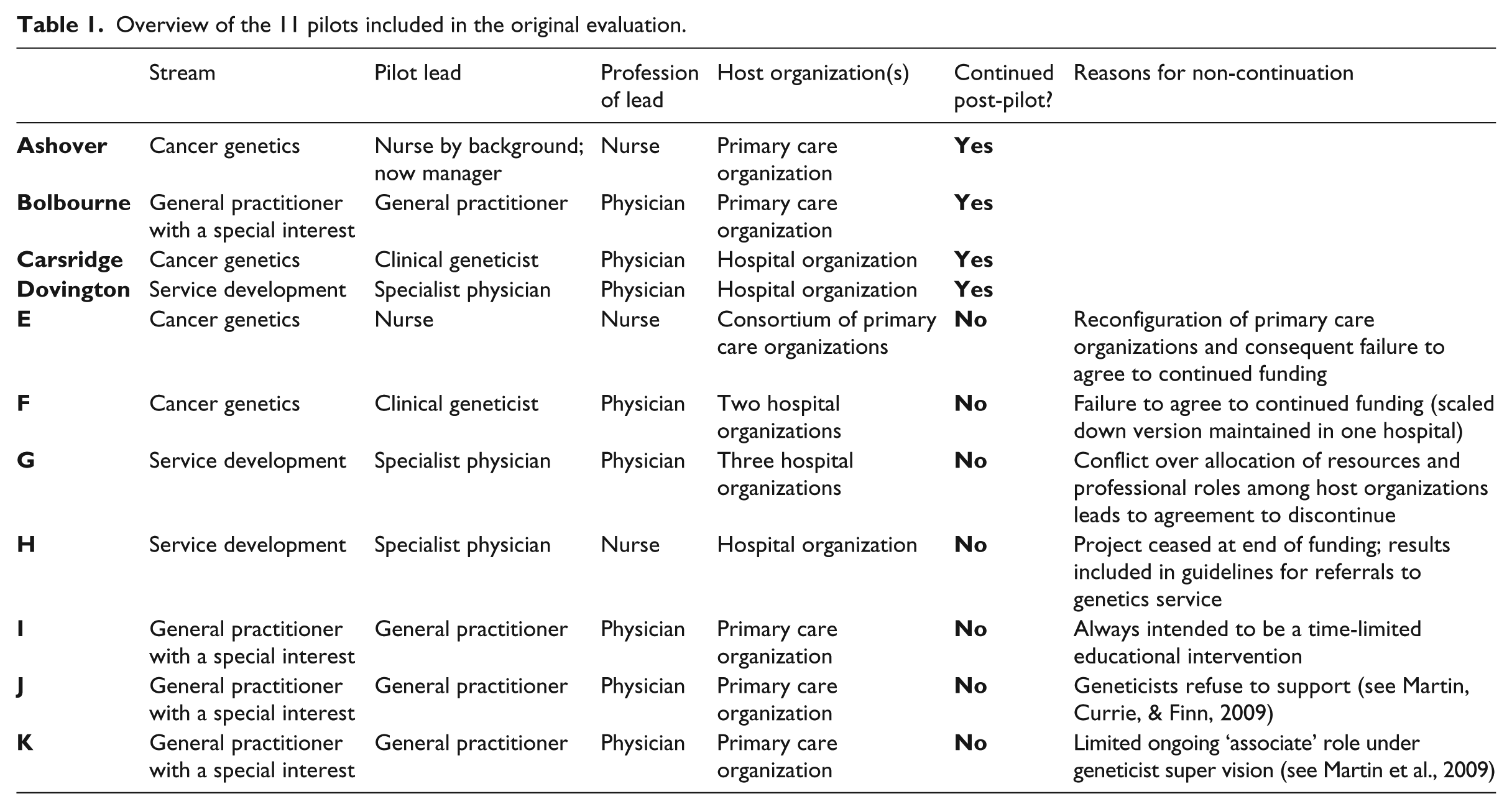
For our original evaluation, our sample was driven by a theoretical approach to obtain variation in key variables of interest, inter alia host organization (e.g. hospitals versus primary care organization), professional affiliation of focal actor (e.g. doctors, nurses), and disciplinary affiliation (e.g. specialist geneticists, other specialist clinicians, generalists). These variables are highlighted as pertinent in the existing literature (e.g. Battilana, 2011); they were supplemented in our sampling strategy by other variables raised as of potential significance in discussions with our funder, such as clinical focus of the service and amount of funding allocated. Cases exhibiting various combinations of these variables were sampled to facilitate cross-case comparison. Our follow-up study included all sites from this original sample that were sustained with further funding beyond the pilot period (4 of 11). While they differ in detail, all four embodied a professionally led approach to improving genetics provision by breaking down organizational boundaries (e.g. between specialisms or between primary and secondary care) that gave rise to disjointed provision. Given that the focal actors in each case were successful in obtaining post-pilot funding where their peers in the other seven services failed, they could be seen as exceptional; but as our findings demonstrate, they did not have significant power over local decision-making. In one site (Bolbourne), ongoing funding ceased after six months; in the other three, it continues today.
Table 2 summarizes the four cases. Of particular note in the composition of our sample are the similarities and differences in two dimensions: professional allegiance of focal actor; and organizational host. Whereas Ashover’s focal actor was a nurse by training who had more recently become involved in a managerial capacity in her organization, the other three cases were led by physicians of varying backgrounds. The focal actor in Bolbourne was a general practitioner (family physician), while Carsridge was led by a clinical geneticist and Dovington by a specialist physician in the ‘mainstream’ clinical area into which genetics provision was being incorporated (we leave this unspecified to protect participant anonymity). Nurses are of lower status than doctors in English healthcare, as worldwide (Battilana, 2011); the intraprofessional hierarchy within medicine tends to place specialists above generalists, although the changes afoot in the English system explicitly sought to raise the standing of general practitioners and increase their influence on resource allocation (Secretary of State for Health, 2006). The host organizations in Ashover and Bolbourne were both primary care organizations: PCTs responsible for budget-holding and resource allocation, but which also at the start of the period provided some services in-house, including these genetics services. Carsridge and Dovington’s services were hosted by acute hospital trusts: large hospital organizations providing services to the populations covered by several PCTs.
Summary of the four cases.
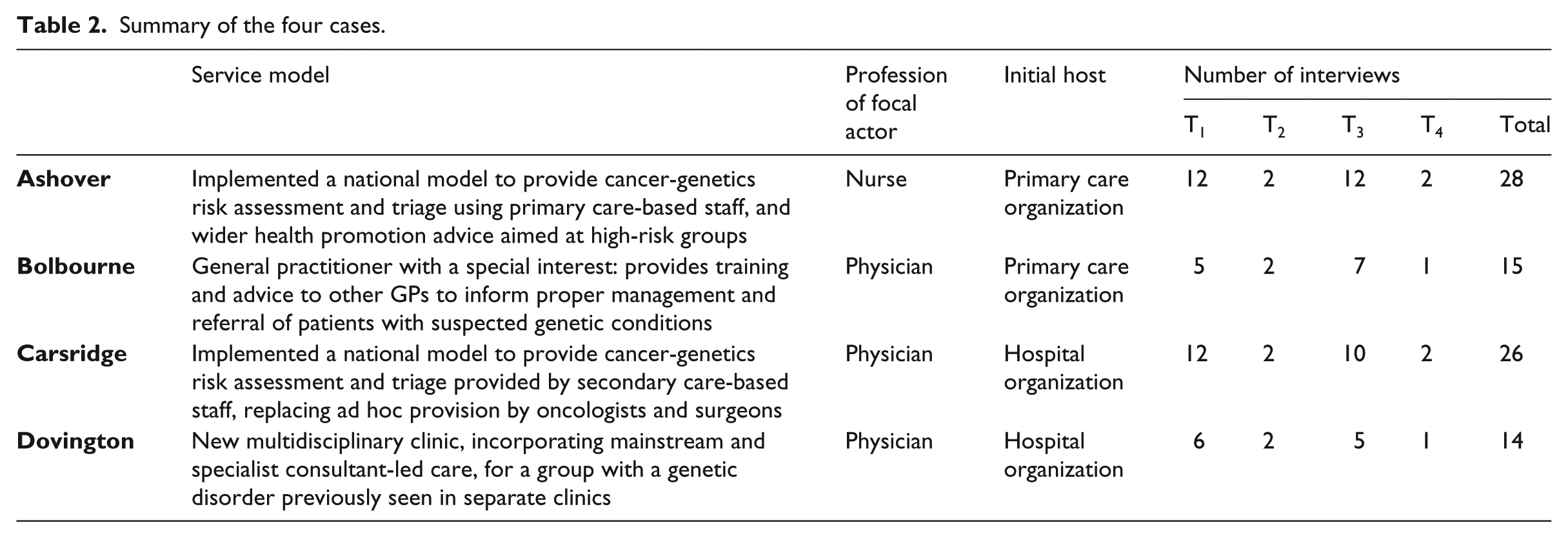
Both studies used a combination of qualitative methods, drawing primarily on in-depth interviews with key actors (e.g. focal actors, others involved in service delivery, those in key decision-making and budget-holding roles beyond the services), supplemented by observational data and document collection and analysis. In total, across the two studies, we undertook 83 interviews over four time points, broken down as shown in Table 2. For the original evaluation, we undertook the majority of interviews in 2005–6 (hereafter referred to as T1), with follow-up interviews in 2008 (T2). For the second study, we undertook further interviews in 2010 (T3) and 2011 (T4). Thus our data offer a longitudinal perspective on the trajectories of the four cases spanning seven years, albeit with data collection unevenly distributed across the period. Interviews ranged from approximately 30 to 130 minutes, with an average length of around one hour. Our topic guide in the original evaluation covered a wide range of issues, most notably for this paper the rationale for the service, how it related to and modified existing provision, relationships with key stakeholders and organizations, plans for the future, and (at T2) progress towards maintaining provision post-pilot. In the follow-up study our topic guide focused more specifically on the trials and tribulations of sustaining these small service innovations in a changing environment, the degree to which they had evolved in their service models, and the organizational, financial and relational work that had been done and was anticipated to maintain their existence.
All interviews were transcribed in full. They were analysed using an approach informed by the constant-comparative method (Charmaz, 2007), with specific attention directed towards certain ‘sensitizing concepts’ – ideas that had informed our thinking in developing the study, derived from prior conversations, analysis of policy documents, and the existing literature on healthcare and organizational change – covering the social, professional, organizational and policy influences on service innovation and sustainability. We thus developed themes both inductively and deductively, to cover issues derived from existing conceptual frameworks, and also issues that emerged from close, repeated readings of the data sources. GPM and SW both read the source materials several times over, and GPM then led coding and analysis using NVivo software. This involved an initial ‘broad-brush’ coding of all documents to identify portions that offered potential insights for the purpose of this paper (since a substantial proportion of the material from the original evaluation was not relevant), informed by our existing knowledge. In discussion with the other authors, GPM then undertook several rounds of more refined, inductive coding, first coding items in terms of the actions described by interviewees in relation to the development and sustaining of the services (Charmaz, 2007), and then a further round of more theoretically oriented coding that sought to identify the influence and enactment of different logics in the activities interviewees described and the way they justified them. He then developed case histories describing the trajectories of the four cases over the period studied, which he discussed with co-authors before returning for a final round of coding, merging some existing codes and disaggregating others.
Findings
We present our findings over three sections. First, we examine the way the services were set up, and the impact of the rapid shift in the policy landscape for the continued legitimacy of services premised on a professional logic. Next, we consider the focal actors’ response to this challenge, which was differentially successful across the four cases, with very different outcomes in terms of the logics that were most evident in actors’ behaviour. Finally, we explore the reasons for this. By examining the data from across the cases in more detail, we suggest that the answer lies neither in the constellation of logics present in the field, nor solely in the creative capacity of the focal actors to make instrumental use of these logics, but in a confluence of micro- and macro-level circumstances, mediated at the meso (organizational) level, that meant that institutional repertoires that were accessible and held legitimacy in some cases were beyond the reach of focal actors in others.
Professionally led services and shifting institutional logics
When originally designed and initiated in 2004 through central government funding, all four services embraced a model premised on professional ownership and accountability. The White Paper that announced the initiative had emphasized the role of clinical professionals in devising new genetics services (Secretary of State for Health, 2003), and accordingly, all the projects funded were led by clinicians, not managers – primarily clinical geneticists, but also other physicians, and nurses. Focal actors emphasized the centrality of a professional ethic in their approaches to delivering the new services, though in slightly different ways. In Carsridge and Dovington, they stressed the importance of ensuring that genetic knowledge was mainstreamed in a way that maintained or enhanced specialist involvement, rather than reducing it to a protocolized approach that might be more in line with the corporate logic. In the two primary care cases, Ashover and Bolbourne, the emphasis was on integrating genetics into a generalist model of care, emphasizing holism and the wider public health: We were aware right from the early stages that patients really didn’t get a terribly good deal in terms of any kind of comprehensive service. There was very little continuity and I thought we could do a better job. (Focal actor (mainstream physician), Dovington, T1) Anybody who’s concerned that they’ve got a family history of cancer and are at risk can be referred into our service. … We also do a lot of health promotion so we don’t actually just talk about cancer, we also talk about things related to cancer like diet, like giving up smoking, sunbathing, those types of things. (Focal actor (nurse-manager), Ashover, T1)
Each focal actor thus enacted the professional logic in the way they set up their service, albeit with variations on the theme reflecting their professional affiliation: it was presented in terms of esoteric expertise by the specialist physicians in Carsridge and Dovington, but in terms of holistic, generalist care by the nurse and family physician in Ashover and Bolbourne.
Each focal actor had obtained agreement in principle from their host organization to continue to fund the service following the pilot period. The shift in the policy landscape from 2005, however, threw such plans into disarray. An increased emphasis on markets and targets, and the organizational changes that accompanied it, had a marked effect on genetics service developments, and meant that commitments made years earlier counted for little: We’ve gone from a position of completely unprecedented investment in the health service, where it was attractive to invest money in bits of the service which had not previously had large amounts of money invested in them. [… But now] we’re in a position where it’s not clear how we’re going to continue to provide what everybody would regard as core NHS services, [so] slightly unusual developments are much less easy to make. (Director, genetics service, Bolbourne, T3)
There was a tangible shift in the language of those in decision-making positions in all four cases, towards an acknowledgement of the need for parsimony and demonstrable value. Professionally led services, in the view of these stakeholders, needed to address changing expectations around, for example, consumer-responsiveness in a competitive environment that mirrored the market logic: The mistake I’ve seen a lot of services make is that they try really, really hard to establish because they think there’s a need to convince people, there’s a need to get funded, and they start seeing stakeholders, but then it stops. … Products don’t survive in the market very long unless they inhabit the environment they’re in, learn from it and modify based on their clients’ continuously changing needs. And that’s what differentiates successful products from not-successful products. (Director of Commissioning, Ashover, T3)
As they reached the end of their pilot funding and considered how to maintain their services, therefore, focal actors found themselves in an environment that had changed markedly. The rise of the market and corporate logics in policy demanded evidence of cost savings or cost-effectiveness, and this posed a threat to services founded on a different logic. But as we see next, the ultimate outcome of this shift in logics at the field level for the four services was very different.
The outcomes: domination; resistance; transformation
Focal actors in all four cases worked hard to defend the services they had built, and secure continued funding for them in this changing environment, while ensuring they remained true to the professional logic on which the services had been founded. As noted above, all four succeeded initially in obtaining ongoing funding, in contrast to their peers. But beyond this, their success varied.
At one extreme, in Bolbourne, despite the focal actor’s extensive efforts, local budget-holders decided six months later to terminate their funding for the service. The focal actor, a family physician, made robust arguments for the continued importance of her service and the holistic understanding of the place of genetics in wider primary care that it promoted. Alongside a costed business case, her efforts included compiling evidence of impact in the form of ‘e-mails, comments from other GPs saying, “This is great, the website’s fantastic, really good about having the advice line”,’ ‘pictures in the [local] newspapers saying what a wonderful thing’, and lobbying commissioners and genetics specialists: ‘I think we covered most avenues really.’ But as she bluntly reflected in her final (T4) interview: From an outside perspective perhaps it seemed a bit woolly what I was doing, but I think it was actually much more worthwhile to focus my attentions in that way. It wasn’t as sexy and didn’t look quite as good; I wasn’t seeing all these patients.
Essentially, she found that arguments premised on a logic of professionalism failed to hold sway in an environment now dominated by concerns around efficiency and throughput (‘seeing all these patients’). Her view was confirmed by the decision-makers themselves. The director of the genetics service felt that the focal actor was ‘selling something which … commissioners didn’t want to buy’ (T3). Another decision-maker was even franker: It isn’t going to release huge savings, … so when commissioners are prioritizing, it will not tick all the boxes I’m afraid. It’s undeniable that well-informed GP specialists able to support their GP colleagues can have an impact both on improving resources but more importantly making sure that patients get the right service at the right time, but I think in the current economic situation it’s going to be difficult to see many primary care genetics services being established. (Primary care commissioning lead, T3)
Further work undertaken by the focal actor to resurrect her service following termination of funding was unsuccessful, and by the end of the study period she was resigned to the fact that ‘it’s just gone back to how it was. The website is the only lasting legacy’ (T4).
At the other extreme, in Carsridge and Dovington, focal actors were much more successful in defending the professional logic in the changing field, such that their services remained in place, largely unaffected by the wider environment and the rise of the market logic for the duration of the period studied. As the focal actor in Dovington put it, with some surprise, ‘actually to move us into the whole commissioning process and to make it sustainable was a far more fraught process potentially than it actually was’ (T3). The model of service delivery continued to follow a professional logic, with patient-centredness taking precedence over throughput or efficiency savings: Patient satisfaction is high, clinic sizes are relatively small although efficient, and time spent with medical staff and nursing staff is higher and so we get a much better patient experience and outcome with all of that. We’re always going to be able to be criticized on the basis that we’re providing a luxury service as opposed to an economy service, but they’re a very vulnerable group of patients.’ (Clinical geneticist, T4)
Similarly, in Carsridge, ongoing funding was secured and the service remained faithful to the original design, without any challenge to the professionally determined service model: ‘I don’t think there was ever any major problems: it just seemed to happen’ (Genetic counsellor, T3). Only minor changes were instigated, such as adjustment of the skill mix to enhance the professional responsibilities of the clinical staff: ‘The function of the team is exactly the same, but we have up-skilled one of the administrators to take some of the more mundane activities from [the clinicians]. And I suppose that’s the biggest change actually’ (Focal actor (clinical geneticist), T3). Whereas in Bolbourne, adherence to the professional logic meant that the service was seen as anachronistic by budget-holders (‘selling something which … commissioners didn’t want to buy’), the services in Carsridge and Dovington retained legitimacy with key decision-makers despite their avowedly professionally driven ethos: To me it’s actually really pretty streamlined, a very efficient service. … What they’ve done in terms of bringing things up into the twenty-first century is of value to the population, so I think they provide a valuable service.’ (Clinical director, Carsridge, T3)
Between the contrasting experiences of Bolbourne, and Carsridge and Dovington, lay Ashover’s. Here, funding was sustained throughout the period, but achieving this required fundamental changes to the ethos and delivery model of the service. At the behest of local decision-makers, the original holistic, public health focus of the service gave way to something much narrower in remit, and better aligned with corporate and market expectations around efficiency and performance against specific measures. The focal actor was expected to agree to a ‘service specification’ with ‘specific key performance indicators’ developed with managers, ‘which I disagreed with but had to put them forward anyway’ (T4). The service was incorporated into a managed care pathway, with a much more tightly defined service-level agreement that focused on triaging patients at possible risk of inherited cancer. Alongside this, more forensic examination of the service’s activities was introduced: ‘We have now a scoring of interventions, sort of whether it’s a low intervention or a high intervention, … and they’re now reviewing that data collection as well, so there’ll be a whole new system coming out’ (Focal actor (nurse-manager), T4). The positioning of the service within a managed pathway, along with this extra scrutiny and oversight for managers and commissioners, gave the service legitimacy with key decision-makers. It was now aligned with normative conceptualizations of how to deliver efficient and well managed healthcare, as part of a defined pathway that offered a cheaper alternative to hospital-based care: Community services we know are darn site cheaper than secondary and tertiary care services. … It’s a community-led service, you know, and necessarily, it’s broken down the boundaries between primary care and secondary care. So it’s a pathway-driven service from the community which ticks all the boxes at the moment of things being community-driven, closer to home. (Associate medical director, T3)
Besides more focused performance management, this also brought a much stricter set of eligibility criteria for patients. For example, the service took fewer self-referrals from worried patients who had not been screened by their family physician, and was contemplating stopping self-referrals altogether since budget-holders were unlikely to see this is as appropriate expenditure: When we first started in the pilot phase, it was very much self-referrals that outweighed any professional referrals. Whereas now I would say that’s reversed and self-referrals probably come at the bottom of the referral rate and it’s secondary care and GP referrals that probably top. … I don’t know how GPs will feel about patients referring themselves in, because they’re not going to have control of that budget. (Focal actor (nurse-manager), T4)
This process of adaptation to the new realities of the market continued through time. Between T3 and T4, as part of its continued funding, the service was incorporated into a different organization with much greater managerial capacity than its original host, and with a strong market orientation: [New host organization] have an operating model which they would apply to all of their products. So … they’ll have to change certain aspects of the way they just run the service to fit in with their corporate model. … If they can’t robustly describe the value this service would have on the whole of cancer care, then the more likely the risk that this service won’t be commissioned. (Commissioner, T3)
The future for the service looked more secure – it had reinvented itself as part of an integrated care pathway with a tightly defined remit and expectations around efficient resource use – but this had meant fundamental changes to its service-delivery model. From her original affiliation with the professional logic, the focal actor had been forced to fundamentally realign herself to the corporate and market logics, in terms of both the discursive justification and the service provided.
Making sense of the contrasting outcomes
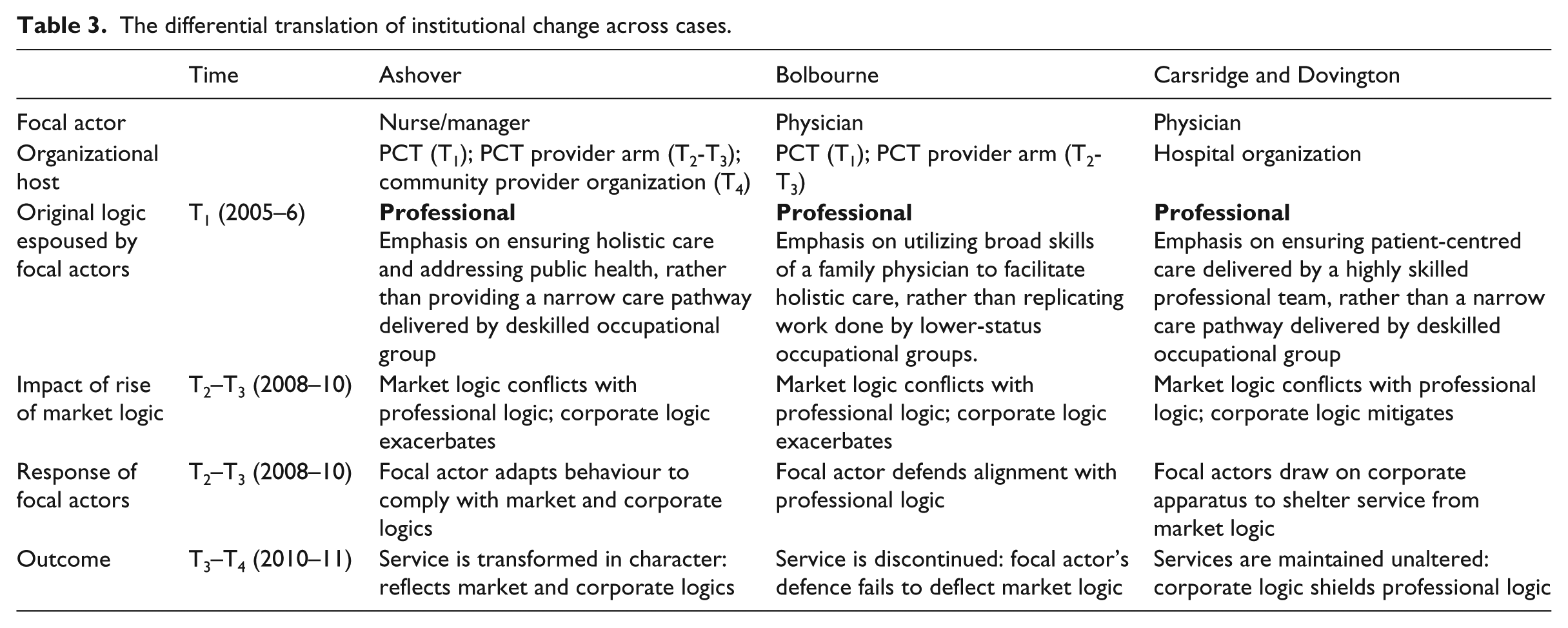
From similar starting positions, then, the four cases exhibited divergent trajectories. While the focal actors in Carsridge and Dovington continued to espouse the professional logic, and maintained services formed in a professional image despite the changing environment, in Bolbourne the focal actor’s fidelity to the professional logic saw her service terminated, while in Ashover the focal actor had to embrace alternative logics to secure her service’s future (see also Table 3). How might these divergent outcomes be explained?
The differential translation of institutional change across cases.
In all four cases, hard evidence about the efficiency or effectiveness of the services was in short supply (see Martin, Weaver, Currie, Finn, & McDonald, 2012). Evidence of this nature was difficult for focal actors to generate, partly because they had never devised their services with such a crudely economic calculus in mind, but also because generating such evidence was difficult in genetics with its long-term, not short-term, outcomes: ‘It’s difficult to demonstrate their value or the amount of money they’re saving,’ as a manager in Carsridge acknowledged (T3). Explanations for the divergent outcomes premised on a rationalistic understanding of organizational decision-making can therefore be discounted.
Yet while the services in Ashover, Carsridge and Dovington may have been no more cost-effective than that in Bolbourne, we have seen that as far as key decision-makers were concerned, they were more in keeping with how a service of this nature should look. Although all services lacked a clear economic rationale that would offer a firm alignment with the expectations of the market logic, this was more problematic for some than others. From our data, a number of explanations for this might be invoked, with differing degrees of support.
First, it might be argued that the divergent outcomes were down to the differential skill of the focal actors in making the case for their services. Other micro-level studies have noted the importance of actors who are ‘highly reflexive and somewhat creative in interpreting the pressures for institutional change’ (Bévort & Suddaby, 2015; Currie & Spyridonidis, 2016; cf. Smets & Jarzabkowski, 2013), and going against the ‘institutional grain’ clearly requires capacity for lateral thinking and persuasive ability. There was some support for this notion in our data. One decision-maker in Bolbourne intimated that the focal actor did not have ‘the right personality to go out there and engage people and get people stirred up’ (T3). However, it was clearly not the case that any of the focal actors was naïve about the changing environment they were facing: over the course of our four interviews with each of them, they demonstrated an astute, reflexive understanding of the changing healthcare system and the risks this posed to their services. And of course, unlike the seven other services sampled in our original evaluation, these focal actors had at least obtained initial local funding beyond the pilot monies provided by central government.
A second plausible explanation is that the status and power enjoyed by the focal actors affected their ability to defy the vagaries of the shifting institutional prescriptions. Certainly the position of nurses in terms of professional status, authority and autonomy is weaker than that of physicians, in England and elsewhere (see, e.g., Battilana, 2011). Socio-demographic characteristics such as gender may also contribute to this positional power. But while Ashover’s focal actor was a (white, female) nurse, there was little to differentiate the status of those in Bolbourne, Carsridge and Dovington, all of whom were doctors (white and female in Bolbourne and Dovington, white and male in Carsridge), albeit from different subspecialities. Indeed, if anything, the changes afoot over the study period – which saw more powers given to family physicians in terms of funding allocation, and encouragement of community-based over hospital-based care (Secretary of State for Health, 2006) – should have raised the power of Bolbourne’s focal actor vis-a-vis that of Carsridge and Dovington’s.
A more convincing and comprehensive explanation is possible if we focus on neither actors’ social position nor their creative capacity per se, but on the consequences for these of the wider changes taking place in the field at the time. While the rise of the market logic over the period of the study applied equally across the English healthcare field, its effects at an organizational level were unequal. For the primary care organizations that hosted the services in Ashover and Bolbourne, the rise of the market was unprecedented, and brought significant structural changes. As commissioning organizations (budget holders for the healthcare needs of the local population), they were required to relinquish their responsibility for service provision to enable competition for services that had been provided in-house. The services that had been a part of these organizations, including Ashover’s and Bolbourne’s genetics services, had to be reconstituted as financially independent standalone bodies, or incorporated into existing provider organizations. Consequently, the focal actors in Ashover and Bolbourne found themselves in the midst of a complicated process of organizational disengagement, and were cut adrift from their organizational sponsors. The focal actor in Ashover found that her new managers ‘didn’t have as much insight into the service and were less committed to seeing it expand’ (T3), while in Bolbourne, the service’s manager had ‘less direct involvement’ in the service, ‘although because there was not really anyone else to do it I did carry on to an extent’ (T3). Further, and more critically, the focal actors were exposed to a range of expectations associated with the market logic that were foreign to them – and lacked the managerial support necessary to coherently argue their case in response.
On the face of it, this challenge also applied to Carsridge and Dovington. However, here the services were hosted by hospitals with long experience of participating in a competitive market, and this equipped them much better to deal with the changing expectations of the new regime. The primary care organizations in which Ashover’s and Bolbourne’s focal actors worked had only ever encountered the competitive market as budget holders, choosing between competing bids: making a business case as a potential contractor was not something they had experienced before. As hospitals, the organizations in Carsridge and Dovington had long experience of a competitive market for secondary care that stretched back to the 1990s. Thus, while the market-oriented shifts were just as dazzling to the focal actors themselves, they were surrounded by an established managerial infrastructure that was adept at managing such demands, and did not have to contend with rapid organizational change. They could rely instead on extensive managerial support – an instantiation of the corporate logic with its focus on the monitoring, audit and justification of professional activity – to deal with such shifts.
The consequences for the ability of the focal actors to defend their services were profound. In Ashover and Bolbourne they found themselves with little support and little idea of how to make a case for themselves: Just after the pilot finished once we’d secured ongoing funding there was the commissioner–provider split, so the service went into mainstream services in the provider arm. … I don’t mean to sound derogatory, but I suppose the senior managers within the provider arm didn’t have as much insight into the service and were less committed to seeing it expand. (Focal actor, Ashover, T3) My final line manager, essentially he and I put together a business plan very much on our own, and we met with the medical director and the deputy medical director and we put our case. (Focal actor, Bolbourne, T3)
In Carsridge and Dovington, focal actors enjoyed the full support of their organizations’ corporate apparatus: The key relationship going forward … is the relationship between our service, the business planning directorate, and their relationship with whatever commissioner organization exists after that, because we as a clinical service can’t keep up with changes in commissioning. But the business planning section do. And it’s that relationship that’s really important. (Focal actor, Carsridge, T2) We have had no direct dealings with commissioners at any stage, because we are part of [a wider funding] envelope, from the point of view of the service that’s provided, it’s completely embedded in [the wider service]. (Focal actor, Dovington, T4)
Intriguingly, then, in Carsridge and Dovington, the presence of a well-established corporate logic, manifest in the activities of the hospitals’ dedicated business planning staff, shielded the focal actors from the full force of the market logic, and enabled them to continue to enact the professional logic in the way they ran their services. Focal actors here could rely on others around them, carriers of the corporate logic but also well versed in the language of the market logic and the expectations of financial decision-makers, to frame their projects accordingly and deflect challenges: What we’ve been doing is pulling together our experience and our outcomes in a brief report that we can send to the business planning department of this hospital, so that they can use that in their negotiations. (Focal actor, Carsridge, T3)
In the absence of such support, Ashover and Bolbourne faced greater challenges. Bolbourne’s focal actor floundered, but in Ashover the focal actor was able to draw on her experience as a manager – her dual embeddedness in the professional and corporate logics (Pache & Santos, 2013) – to reframe her service. As we have seen, though, this came at the cost of transforming the service model itself, so that it was premised not on a professional logic but on notions of efficiency and throughput. For all four focal actors, however, the ability and opportunity to invoke and make advantageous use of logics was heavily shaped (one might even say structured) by influences beyond their capacity and social position as individual agents, but below the level of the field as a whole. Organizational context and the nature of their relationship with other agents, themselves affiliated with other logic, were crucial mediators of the relationship between field-level configuration of logics and individual-level autonomy.
Discussion
Our paper seeks to bridge macro-level and micro-level work on responses to institutional complexity by using comparative, longitudinal analysis to examine the conditions under which actors are able to defy changing institutional prescriptions. In particular, we show that a common ‘constellation’ of institutional logics (Goodrick & Reay, 2011; Waldorff et al., 2013) could give rise to divergent outcomes at the level of practice. Constellations are thus not just ‘celestial’ features of the field-level ‘sky’: the relationship between logics was also realized through the work of actors on the ‘ground’. Most notably, whereas the corporate logic aligned, as the literature predicts (Martin et al., 2015; Thornton, 2002), with the market logic in some cases, in others it proved a remarkably robust defence for the professional logic against the market logic. But none of the actors had free rein to pick and choose from the plurality of logics present in this complex field. Rather, influences above the level of the actor but below that of the field were important mediators and shapers of autonomy.
As noted above, much of the micro-level work on the enactment of institutional logics ‘at the coalface’ has focused on the ‘hypermuscular’ work of institutional entrepreneurs with unusual degrees of power, deriving from their social position, their ‘reflexivity or insight’ and ‘their superior political and social skills’ (Hardy & Maguire, 2008, p. 211). But even where studies have looked at the day-to-day work of lower-profile actors, they have often found a high level of autonomy, and attributed this to the creative capacity or social position of the individuals studied. For example, Bévort and Suddaby (2015) suggest that liberation from institutional prescriptions ‘appears to rest in the differential ability of some individuals in a common field to interpret the phenomenological fragility of logics and to be somewhat immune to their “totalizing” cognitive influence’. Greenwood et al. (2011, p. 349), summarizing the state of the field, submit that the ability to advance the prescriptions of one logic over others is in part ‘a function of how logics are given voice within the organization; but the ability of a voice to be heard is linked to the influence of that logic’s field-level proponents over resources’. One way or another, these studies suggest that the ability to selectively enact logics derives primarily from some combination of status and creativity. But as Hallett (2010, p. 67) acknowledges, this ability is produced (and denied) at a ‘supra-individual’, social level. And a key level at which this process takes place, we argue, is the organizational level, and particularly the way in which logics are configured and represented in organizational processes and personnel.
Others have shown how organizations can act as ‘filters’, whereby different organizational units are subject to different institutional logics. Binder (2007, p. 562), for example, finds that actors in different sections of the community organization she studied enact different logics, since different constellations of logics predominate: those in the housing department follow a more corporate logic since ‘there are no countervailing institutional logics that staff in this department draw on’. This reflects the findings of others about how, in some fields, institutional complexity is ‘segmented’: some prescriptions apply to one group of actors; others to another (e.g. Pache & Santos, 2010). In other settings, collaboration across logics may be a prerequisite for organizational functioning (e.g. McPherson & Sauder, 2013; Smets et al., 2015). What we witness in this study, however, is a combination of what Besharov and Smith (2014) call high centrality and low compatibility: a field characterized by multiple institutional logics which must all be adhered to, and yet are mutually conflicting. This results in what they term ‘conflicted’ organizations, and they recount many examples from the literature of where this has led to organizational dysfunction or even disintegration. Yet, as Besharov and Smith (2014) argue, centrality and compatibility are not determined only at the field level: they are also a function of organizational form. Since ‘structurally differentiated hybrids’ – in which the influences of different logics sit side by side, in different units in the same organization (Greenwood et al., 2011) – are especially vulnerable to dysfunction (e.g. Battilana & Dorado, 2010; Greenwood et al., 2011), Besharov and Smith suggest two organizational interventions to mitigate this: recruiting personnel without prior institutional affiliations (to move from a structurally differentiated hybrid towards a blended hybrid, thereby reducing logic incompatibility), or reducing resource dependency by shifting strategic focus (to diminish the number of logics that must be accounted for, thereby reducing logic centrality). But these are not options for all organizations, particularly in the public services, where structural differentiation is itself necessary for legitimacy (and so blending is difficult to achieve) (see Greenwood et al., 2011, p. 355), and organizational objectives are externally dictated (and so shifting strategic focus is not tenable). Logics’ influence cannot always be reduced in this way.
What our findings suggest is how the tension between logics can be managed even where structural differentiation, so prone to disintegration, is necessary. What appears crucial is the internal configuration of structurally differentiated units. Thus in Carsridge and Dovington, the presence of carriers of the corporate logic in a separate unit (who could intervene actively to moderate its influence on their professional colleagues) paradoxically helped to secure latitude for the focal actors; the lack of such a buffering influence in Ashover and Bolbourne resulted in constraint. 1 We suggest, therefore, that at least in public service organizations, efforts to hire or socialize ‘non-affiliated’ staff to create blended hybrids that increase compatibility, or realign mission to reduce logic centrality, are likely to be forlorn or even counterproductive: attention might be more appropriately addressed to developing a cordial, interdependent and mutually beneficial relationship between carriers of logics in structurally differentiated units. Indeed, in Ashover the focal actor’s socialization (or dual embeddedness) within both the professional and the corporate logic proved a mixed blessing, enabling the service to continue but only through transformation in its character. Boxenbaum and Battilana (2005, p. 359) echo Besharov and Smith’s (2014) contention that staff with multiple institutional affiliations can help to reduce incompatibility and increase autonomy: ‘The more contexts individuals are embedded in, the more options they have available for transposing practices.’ But while this helped Ashover’s focal actor avoid the termination of the service that occurred in Bolbourne, it offered her substantially less discretion than that enjoyed by the focal actors in Carsridge and Dovington. Dual embeddedness may then improve actors’ access to different logics, but it does not necessarily give them freedom of choice in enacting them. The configuration of organizations and the carriers of logics within them, not just their composition, matters, and such structurally differentiated hybrid arrangements have the potential, at least, to reconcile conflicting logics as effectively as blended hybrids.
Understood this way, the findings of other micro-level studies that have emphasized the ingenuity of individual actors might be seen in a slightly different light. For example, Murray (2010, p. 379) sees the response of scientists to unfamiliar commercial pressures arising from the patenting of the genetic modification of ‘OncoMouse’ as the ‘sophisticated [production] of new hybrids’, in which the ‘expertise that allows [key actors] to transpose elements from each logic’ to protect the autonomy of science was crucial. Yet it is also evident from her study that the privileged access to a wider, supportive, infrastructure – including ‘lawyers, TTO professionals, university counsel, and corporate executives’ – was also critical to this endeavour: it was not expertise or status alone that enabled autonomy. McPherson and Sauder (2013, p. 186) show that actors in a drugs court draw relatively freely upon a ‘shared toolkit’ of logics in pursuit of their interests, but some actors are better placed than others to do so: the relational position of probation officers means they occupy a position of ‘brokerage’ that allows them privileged access to the ‘home’ logics of others, even though they lack the status of other professional groups in the court. 2 Heimer (1999, p. 61) argues that in disputes about the care of neonates in intensive care, doctors’ arguments tend to overpower those of other actors because they are on their home turf, with greater knowledge of ‘how to get problems onto the agenda, how to propose their solutions in a persuasive way’ and so on. She thus concludes that ‘the ranking of various professions [will shape] outcomes’ of such disputes; ‘laws that are useful to high status professionals like physicians are more likely to be incorporated into NICU routines than laws that might be useful to lower status staff’ (Heimer 1999, p. 62). But our findings show that it is more than simple professional hierarchy that is important here: in itself, it is no guarantee of greater legitimacy, as the contrasting experiences of Ashover’s nurse and Bolbourne’s physician indicate. It was perhaps not then physicians’ position as ‘high status professionals’ per se that was important in Heimer’s study, but the privileged access to wider resources and networks that this afforded.
We suggest, then, that organizations – and specifically the way organizations instantiate relationships between multiple logics – thus contribute crucially not just to the availability of logics at individual level, but also to the manner in which they become available: the degree to which the appearance of a logic constrains or enables autonomy. Broadly, we propose three overarching alternative ways organizations might mediate the influence of logics, deploying a physics-based metaphor that we hope helps to convey the means by which different organizational forms may intervene in the transmission of logics. First, organizations may deflect logics, protecting those within them from the need to align with logical prescriptions. We did not see this in our study, but other studies (Binder, 2007; Jones, 1999; Pache & Santos, 2010), where organizations have the power to defy institutional expectations or buffer their members from the influence of competing logics, might be conceptualized in this way. Second, they may simply transmit logics, so that prescriptions are largely unmediated and it is left to individual-level actors to resolve (or fail to resolve) the contradictions between competing logics. We see this in Ashover and Bolbourne, where the professional actors were left exposed to the vagaries of new prescriptions from the market logic in the absence of an effective corporate buffer. Third, they may refract logics, altering or refocusing their influence and thereby offering some shield to individuals and opportunity for autonomy. We see this in Carsridge and Dovington, where a functional relationship between carriers of the corporate and professional logics saw the former shield the latter from some aspects of new institutional prescriptions, such that they retained autonomy. The notion of refraction has some similarities with one of the oldest concepts in the institutionalist repertoire, that of decoupling (Meyer & Rowan, 1977). However, as our choice of metaphor indicates, we consider this to be more than a simple matter of one organizational unit providing legitimacy in the terms of the corporate logic, while another, decoupled unit continues its own work untainted. Rather, by refraction we mean that the institutional logic, like white light passing through a prism, is slowed, bent or even dispersed into its component parts. Thus, in the cases of Carsridge and Dovington, staff in business planning units were able to translate the requirements of the market and corporate logics into terms comprehensible to the services’ professional leads, and then reframe the professional leads’ cases back into terms that would satisfy the expectations of the corporate and market logics. This was not so much a decoupling, then, as a conscious, selective coupling. Though carriers of the corporate logic, the relationship between these business planning units and professional clinicians was organized in a way that encouraged co-operation, enabling this refraction to take place, in stark contrast to the situation in Ashover and Bolbourne. The notions of deflection, transmission and refraction represent a tentative typology requiring validation and further development, but might serve as an initial touchstone for further investigation of the organizational-level mediation of institutional logics.
For all four focal actors, then, creative capacity, professional status and embeddedness in the rules and norms of different logics were only as good as the organizational setting and social relationships they enjoyed. Autonomy was constrained where these were lacking and enabled when these were favourable. Over the period studied, institutional prescriptions were consolidated, with greater centralization of logics and the ascendency of market and corporate logics that seemed incompatible with the professional logic. Both of these changes should work to constrain actors’ autonomy. Nevertheless, meso-level features of organizations within the field made a significant difference to the consequences for actors, maintaining latitude for some while others faced constraint (cf. Besharov & Smith, 2014). We contend that attending to these features could go a long way towards explaining the disjuncture between macro- and micro-level findings about the partial autonomy afforded to professionals at the coalface.
Our analysis offers several suggestions for future research. In particular, we suggest that more attention to the meso-level mediators of agency, perhaps building on the typology we outline above, would help to understand how the prescriptions and openings for discretion at the field level do or do not translate into opportunities at the individual level. Further work that combines a detailed, phenomenological understanding of micro-level activity with comparison of similar or divergent contexts would be helpful. Relatedly, further conceptual development of Thornton et al.’s (2012, p. 7) notion of ‘avenues for partial autonomy’ would be helpful in reconciling macro- and micro-level work in the field of neo-institutionalism. As noted above, while many macro-level studies claim to show how institutional complexity affords opportunities for autonomy, they often remain steadfastly structuralist in the way they describe these (e.g. Waldorff et al., 2013). Finally, we strongly endorse Greenwood et al.’s (2011) call for research that embraces the impact of the coexistence of more than two logics, and Thornton and Ocasio’s (2008) point that what constitutes a logic needs to be carefully considered by those seeking to study their effects. The market and corporate logics appear, on the face of it, to present a concerted threat to the professional logic in rapidly changing fields such as healthcare. Indeed, others have analysed their impact collectively: for example, Reay and Hinings’ (2005, p. 358) logic of ‘business-like healthcare’ combines elements of both. But we show that the experience of the two logics can diverge in different contexts, and that they do not necessarily operate synergistically in practice. We therefore recommend careful disaggregation of logics (and perhaps their constituent elements) in future studies.
Conclusion
Through comparative study of the trajectories of four change initiatives in a complex organizational field, we have sought in this paper to contribute to the institutional logics literature by examining the divergent consequences of a common constellation of logics for actors in different organizational contexts. Actor autonomy, so often valorized in micro-level studies of institutional logics in action, depended greatly on mediating factors at the meso level: opportunities for autonomy were determined neither at the field level nor in the status and creativity of individual actors. Rather, organizations – not just as containers of carriers of logics (Besharov & Smith, 2014) but, more importantly, as configurations of relationships between those carriers – constituted a prism which could act to transmit field-level institutional prescriptions into micro-level constraints, or refract them into something more pliable and productive. Further research taking a ‘nested’ case-study approach (studying multiple cases across two or more fields where logics are arranged in different constellations) may be fruitful in adding further nuance to our understanding of how logics facilitate or obstruct discretion, and with what consequences for day-to-day practice and indeed reproduction and change in organizational fields.
Footnotes
Acknowledgements
We would like to thank three anonymous referees, and senior editor Charlene Zietsma, for their critical engagement with earlier drafts of our paper.
Authors’ Note
The views expressed in this publication are those of the authors and not necessarily those of the National Health Service, the NIHR, or the Department of Health.
Funding
This research was funded by the Department of Health, and by the National Institute for Health Research, Health Service and Delivery Research (NIHR HS&DR) programme (project number 09/1001/40). Visit the HS&DR website for more information. Professor Martin’s contribution to the writing up of this paper was also supported by the NIHR Collaboration for Leadership in Applied Health Research and Care East Midlands (CLAHRC EM).