




Abstract
High-status members are incentivized to contribute to a group’s collective endeavors by the deference and influence they receive. But what incentives do groups offer low-status members for their continued participation and deference to high-status others? We develop and test a theoretical account of how the implicit cultural rules for status hierarchies create a modest incentive system for deference to those deemed more valuable to the collective effort. Such deference endorses the group’s shared expectations for what is perceived to be validly better. The group responds by granting the deferrer a modicum of respect: the dignity of being seen as reasonable. This respect reaction acts as an incentive system that tempts the low-status person to stay involved in the group’s endeavor despite being less valued. Three experiments confirm that low-status members anticipate receiving and higher-status members offer such reactions of respect and reasonableness for low-status deference, and these reactions increase low-status members’ commitment to the group. A fourth study with a nationally representative sample supports the robustness of these findings.
Status hierarchies, understood as interpersonal rankings of esteem and influence, are ubiquitous in daily life (Anderson and Willer 2014; Berger et al. 1977; Berger and Webster 2006). Recent research has viewed them as an organizational solution to the collective action problem posed by a fundamental human circumstance—people’s need to work together to achieve shared goals or tasks (e.g., Halevy, Chou, and Galinsky 2011; Simpson, Willer, and Ridgeway 2012; Willer 2009). When faced with a shared task, people must find a way to motivate each group member to contribute to the group task effort and a way to coordinate these contributions into a collective group action or decision.
How do the implicit social rules by which interpersonal status hierarchies operate address this collective action problem? A great deal of evidence shows that status hierarchies grant esteem and influence to group members on the basis of the perceived value of each’s contributions to the group’s task efforts, compared to the other members (Anderson and Willer 2014; Correll and Ridgeway 2003). By giving those expected to make more valuable contributions greater esteem and influence, the implicit rules of status hierarchies effectively create an incentive system that encourages group members to contribute to the group effort and to do so to the best of their ability (Goode 1978; Willer 2009). And by granting influence over group decisions in proportion to the perceived value of members’ contributions, the operating rules of status hierarchies also coordinate the weighing and combining of members’ contributions into a collective line of action.
As useful as this account is, it is incomplete in an important way. It focuses on incentives for contributions to the group that are primarily available to high-status members. Status hierarchies cannot function without the efforts of low-status members as well who accept the influence of high-status members and support the group activity. Thus, motivating the commitment of low-status members is as much a part of the collective action problem created by a shared task as is rewarding those who end up with high status and influence.
We argue that interpersonal status hierarchies provide, as a result of the implicit normative processes or “rules” by which their structure is enacted, a system of positive rewards that offer a modest incentive for the deference of low-status members and their continuing efforts in a low-status role. In this article, we define low-status deference as acceding to the judgments of higher-status members in regard to group decisions even when those judgments disagree with the low-status member’s own, an action that grants higher-status members influence and standing in the group.
We argue below that when a lower-status member defers as expected to a higher-status member, the group reacts by viewing the low-status member as reasonable and worthy of a modicum of baseline respect. The dignity of being deemed reasonable, we argue, acts as a modest but meaningful incentive that tempts the low-status member to stay involved in the group endeavor despite being less valued. This incentive system means, however, that for low-status members, the price of being seen as reasonable is often deference. We develop a theoretical account of how this incentive system for low-status deference develops from the implicit normative processes of status hierarchies. Our approach builds on expectation states theory’s well-documented account of status hierarchies (Berger and Webster 2006). But it adds complementary arguments about implicit normative processes within such hierarchies that, we argue, help maintain the hierarchy. As scope conditions, we focus, like expectation states theory, on cooperative, goal-oriented groups. We describe four studies that empirically test and support predictions derived from our account.
Theory
The Problem of Low-status Members
Research suggests that group members who end up with low status in interpersonal hierarchies value the respect and esteem of their fellow members as much as others (Anderson et al. 2012). Yet as expectation states research has shown, the development of shared expectations in the group, called performance expectations, that rank these members lower than others in the perceived value of their contributions, results in their having to defer to the judgments of those others and accept relatively lower social esteem (Berger and Webster 2006). Accepting a low-status position also makes these members subject to more negative and self-blaming emotions like sadness or guilt while high-status members feel more positive emotions like pride (Lovaglia and Houser 1996; Ridgeway and Johnson 1990; Tiedens, Ellsworth, and Mesquita 2000). Thus low status has costs. Yet if people do not defer when others have firmly held low expectations for them, they risk criticism and rejection (Anderson et al. 2006).
If low-status members are less esteemed and threatened with sanctions, why do they continue to participate in the group’s activities as they must if it is to continue to function? As expectation states theory argues, low-status members, like others, are likely motivated to help the group succeed at its task (Berger et al. 1977). And for low-status members, like others, group membership may satisfy the basic need to belong (Baumeister and Leary 1995) or offer other benefits. Yet even if they are very task oriented and value group benefits, they are being asked to pay a price in esteem that others are not to attain these outcomes. Low-status members may sometimes defer in the interests of task success or other outcomes without much thought of this personal price but other times become more aware of it.
By examining how the underlying normative processes of status hierarchies provide modest, partially compensating rewards for deference, we can better understand the basic, structural processes that sustain deference both when it comes willingly and when the low-status member feels the cost. To the extent that this normative provision of incentives for deference occurs, it will act as a general facilitating force for maintaining the participation of low-status members in groups, even groups that lack exceptional task success or prestige. To see how the implicit rules of status produce a positive incentive system for the deference of low-status members, we need to understand the nature of the implicit consensus about each group member’s perceived value to the group that creates the status hierarchy and coordinates group task efforts.
Consensus about What Others Can Be Expected to Expect
How, then, do collective, roughly consensual status hierarchies so regularly emerge among goal-interdependent people? While individuals have an enlightened self-interest in deferring to others on the basis of their apparent ability and willingness to contribute to the task effort, these same individuals also have a more egoistic self-interest in gaining as much status and influence as they can, regardless. How is this resolved and coordination achieved? The key is recognizing that whatever individuals want for themselves, they want others in the group to defer to those expected to best contribute to the collective effort since this will maximize task success and theshared benefits that flow from that(Ridgeway and Diekema 1989). As a result, group members are likely to form implicit coalitions to pressure others in the group to defer on the basis of performance expectations. By the same token, they are likely to be faced by an implicit coalition of other group members who pressure them to defer on that basis. Horne (2004) has shown that such an interdependence of exchange interests gives rise to group norms that members enforce. Here it creates implicit norms for deference on the basis of performance expectations that carry sanctions for violation (Anderson et al. 2006; Ridgeway and Diekema 1989). These are the core implicit rules of status that are likely taken-for-granted cultural knowledge for most people. These implicit norms undergird and enforce the status processes documented by expectation states theory.
To act in implicit coalitions to pressure each other to defer on the basis of expected performance (i.e., to enact the rules of status), group members need to spontaneously form roughly consensual expectations for others’ likely contributions to the group (if not for their own). Research suggests that members do this by collectively drawing on the same widely known and shared cultural beliefs about the status and competence associated with each other’s social characteristics (e.g., gender, race, education), their apparent skills, and their behavior (Berger and Webster 2006; Fiske et al. 2002; Webster and Rashotte 2010). By drawing on shared status beliefs, group members implicitly anticipate the expectations others will have for the status of a given member and coordinate that with their own expectations for that member (Correll et al. 2017). The result is an implicit consensus about the expected status of others that allows members to pressure each other to defer on the basis of expected performance.
In forming shared expectations about the status of others, group members anticipate how they, too, will be consensually judged in the group, since such judgments will follow these same cultural status beliefs. These anticipations are second-order performance expectations about how others in the group see them, given the public information others have about them and the shared status beliefs that information evokes (Webster and Whitmeyer 1999). As Anderson et al. (2006) show, people accurately estimate others’ views of their standing. Research indicates that people’s second-order performance expectations are the most powerful determinants of their status claims and deference to others (Anderson et al. 2012; Kalkhoff, Younts, and Troyer 2011; Troyer and Younts 1997).
In this way, a rough consensus emerges, not necessarily in what each member wants for himself or herself, but in what each member expects that others expect for himself or herself and others in the group. Importantly, this “working consensus” can shape deference and coordinate behavior without members’ necessarily fully buying into it as what each “really deserves,” as studies of the spread of status beliefs have shown (Ridgeway and Correll 2006). In fact, consensus and the coordination that follows from it in everyday status hierarchies are probably only possible because they do not require consensus at the egoistic level of “what I deserve.” How do this consensus and the status rules it encodes create a positive reward system (not just threaten sanctions) for those who defer to it by accepting low status in the group?
Endorsing the Consensus as Being “Reasonable”
When a social comparison process among people leads to a consensually shared definition of a situation, that definition takes on a quality of validity or reality for the participants (Hardin and Higgins 1996). In this case, the emergent definition of the situation is a shared perspective on who and what is better and more valued in the group. To the extent that this perspective draws on common-knowledge cultural status beliefs to decide who is “better,” the presumption is that “most others” outside the group, if they were group members themselves, would share in this perspective, which deepens its apparent validity (Ridgeway and Correll 2006).
These processes make the group status consensus seem to members to be a socially valid, legitimate, and objectively “reasonable” assessment of who is “better” at what the group values (Johnson, Dowd, and Ridgeway 2006). When, according to this consensus, one member is expected to be not as good as a second member, the first member is expected to defer to the presumably superior judgment of the second. When the low-status member does defer, that behavior appears to endorse the consensual, apparently valid assessment of what is better. It makes the low-status member appear as if he or she is also reasonable and smart enough to recognize what is legitimately better or worse. This appearance of reasonableness is likely to be especially strong if the low-status member appears to defer willingly rather than reluctantly. The low-status member’s deference to the group’s consensual assessment, we argue, is likely to cause the other members to view the deferrer with a measure of respect and approval.
The baseline respect earned by deference is less than the esteem offered to high-status members. It is respect for knowing one’s place because it views the deferrer as at least understanding what is validly better for achieving the group’s goals even if he or she is not personally better. Yet it is still a type of worthiness. It is an acceptance of the low-status member not as an object of scorn but as a worthy member who understands and affirms the group’s standards of value, standards the group takes to be valid and reasonable.
Since, by deferring, the low-status member endorses the consensual assessment of what constitutes “better,” deference earns respect and approval not just from the direct recipient of the deference but from all group members. This is key and distinguishes our normative account from others that focus on dyadic exchanges in which high-status members reward low-status members for direct deference (e.g., Blau 1964; Lovaglia and Houser 1996). The reaction of respect and approval theorized here is collective. As such, it acts as a positive incentive system for expected deference that is a structural consequence of the shared performance expectations and normative pressures that maintain the status hierarchy (i.e., the implicit rules of status). And since this incentive system results from a consensus about expected status that the low-status member understands as well, the low-status member can anticipate that deference, despite its personal costs, will at least provide the partial compensation of collective approval and respect.
We argue, then, that our implicit cultural rules for enacting status hierarchies not only incentivize contributions to the collective goal. They create a general, if modest, incentive to defer to those for whom the group has higher performance expectations—an incentive we characterize as the dignity of being deemed reasonable.
In any given situation, the power of this modest incentive to actually induce deference depends on the low-status actor’s access to an alternative course of action. One alternative is to simply leave the group. Structural constraints in the workplace and elsewhere may sometimes make this alternative impractical (i.e., very costly), but not in all situations. The point here, however, is that to the extent that deference earns a positive reward of respect and approval, leaving the group becomes a less attractive alternative than it otherwise would be. And when leaving is not a viable option, rewards for deference encourage the low-status member to stay committed to the group effort.
The other alternative would be for the low-status actor to remain in the group but try to alter the group’s low performance expectations and improve his or her status position. This alternative, however, is high risk–high reward for the actor. Given the group’s low expectations, self-assertions of greater competence will encounter skepticism and could potentially fail (Cohen and Roper 1972; Ridgeway 1982). The greater the apparent social validity and certainty of the low performance expectations that the group holds for an actor, the less appealing this riskier alternative is likely to seem in comparison to the dignity of “reasonably” deferring (Johnson, Ford, and Kaufman 2000). In many situations, then, especially when it seems that the status information others have about them is clearly against them, people defer and take the modest rewards that it elicits.
Hypotheses
The account we have developed above leads us to three testable hypotheses.
Hypothesis 1: A group member who expects that others expect him or her to perform less well than others will anticipate that he or she has a positive likelihood of being viewed by the group with respect and as reasonable if he or she defers to those others rather than resists deferring.
Hypothesis 2: (a) When one group member is expected to perform less well than another, other group members will have a positive likelihood of viewing the first member with respect and as reasonable when he or she defers, rather than resists deferring, to the other member. (b) This reaction of respect will come not just from the group member who is deferred to but from other group members.
Hypothesis 3: If a group member who expects that others expect him or her to perform less well than others receives a reaction of respect and perceived reasonableness when he or she defers to those others, he or she will be more committed to the group effort and less willing to leave the group than if group members do not react with respect and perceived reasonableness.
We conducted three online experiments with diverse, nonstudent samples of adult participants to test Hypothesis 1 (study 1), Hypotheses 2a and 2b (study 2), and Hypothesis 3 (study 3). A fourth study employed a nationally representative sample to demonstrate the robustness of the findings across the population.
Study 1
To test Hypothesis 1, an online experiment created a situation that cast the participant into the low-status position in a task group based on a pretest of task ability. Expectation states research has shown that manipulations of task expertise, called specific status characteristics, have particularly powerful effects on performance expectations and status (Wagner and Berger 1982), allowing for an unambiguous test of the hypothesis. While providing the clearest initial test, creating status with a specific status characteristic means that an examination of our hypotheses in groups where status is based on diffuse status characteristics like race or gender must be explored in future research.
A sample of 188 (82 male, 106 female) U.S. adults was recruited from Amazon Mechanical Turk (MTurk), an online crowdsourcing platform for individuals who work for pay. Studies show MTurk samples are reasonably representative of, although slightly more educated than, the general American population (Buhrmester, Kwang, and Gosling 2011). Experimental data collected with MTurk are as valid and reliable as those collected with traditional methods (Buhrmester et al. 2011; Mason and Suri 2012).
Method
Study 1 participants were told that they would work as part of a three-person online team on a “meaning insight” task. After entering their first name and gender, they were linked with two (fictional) teammates who were of the same sex as the participant (Adam and Mike or Sarah and Allison). The participant and, supposedly, the other team members, then took a ten-item test of meaning insight ability that asked them to decide which among three words from an early language has the same meaning as a given English word. 1 Test results presented to the whole team revealed that the participant had scored 3 of 10, described as a performance no better than guessing, while theteammates had scored 6 and 7, described, respectively, as moderately and extremely good compared to the general population. 2
To see if these task ability scores caused participants to form second-order expectations about their teammates’ views of them, each participant completed a six-item measure from Anderson et al. (2012). The items asked how much participants thought other members wanted them to have status and influence in the upcoming task, wanted them to exert control over group activities, wanted them to act as group leaders, viewed them as highly valued members, wanted them to achieve leadership, and wanted them to lead the group task activities; responses were on seven-point scales from not at all = 1 to a great deal = 7 ( alpha = .93). These items were summed and averaged to provide our measure of participants’ second-order expectations of how their teammates viewed them in terms of meriting status and influence.
Next, participants learned they would work together on the meaning insight task as a team, resolving disagreements in a chat room to select a team choice on each item. There would be a pay bonus for superior team performance. These instructions were designed to frame the decision context as a collective, task-oriented one, consistent with our theoretical scope conditions. We then asked participants to consider some situations before proceeding to the group task: “During the task you find you have a different opinion than [Adam/Mike or Sarah/Allison—the name of either the high or mid scorer on the team]. There are different strategies by which you could react. Please rate how your teammates would view you if you used one strategy compared to the other.” The strategies were presented in counterbalanced order. They were, “You react by explaining your choice but agree to go with [Adam’s/Mike’s or Sarah’s/Allison’s] choice for the group decision” or “You react by explaining your choice and sticking to it rather than agreeing to go with [Adam’s/Mike’s or Sarah’s/Allison’s].” We refer to the strategy of agreeing to go with the higher scorer as defer and the strategy of sticking to one’s own opinion as resist.
For each strategy, participants rated on seven-point scales from very unlikely = 1 to very likely = 7 the likelihood that the group would view them in terms of seven items that we grouped and averaged into three scales: Respect (respect, approval; alpha = .86), Reasonable (reasonable, useful; alpha = .79), and Cooperative (cooperative, helpful, likeable; alpha = .91). Participants answered these seven items for disagreements with the mid-scoring and the high-scoring teammate (order counterbalanced). Finally, we asked participants which strategy they were likely to use in the upcoming group task, giving them a choice of the two strategies they had just rated or “other—please specify.” At this point, the study concluded so that participants did not actually enter a chat room with their (fictional) teammates.
Results and Discussion
Our procedures clearly caused participants to expect that others in their group expected them to have low status and influence. On our measure of how much other group members valued them and wanted them to have a high-status position, participants placed themselves at 2.22 (SD = 1.31) on the 1 to 7 scale, which was significantly (t = −18.7, p < .001) less than the midpoint of 4. Thus, participants clearly understood themselves to be in a low-status position when they evaluated how the group would view them if they deferred or resisted deferring in a disagreement with a higher-scoring member.
Participants’ ratings of how they would be viewed on the Respect, Reasonable, and Cooperative scales were analyzed with three-way mixed-model ANOVAs with gender as a between-subjects factor and within-subject factors for strategy (defer/resist) and the group member’s disagreeing with mid scorer or high scorer. Of the 12 tests for gender main or interaction effects in these analyses, only one modest two-way gender interaction emerged, and this did not substantially condition the main effect of deference and resistance on participants’ ratings. For substantive clarity, therefore, although we discuss the gender interaction below, the mean Respect, Reasonable, and Cooperative ratings presented in Figure 1 for deference or resistance in a disagreement with the high-scoring member and the mid-scoring member are pooled across gender.
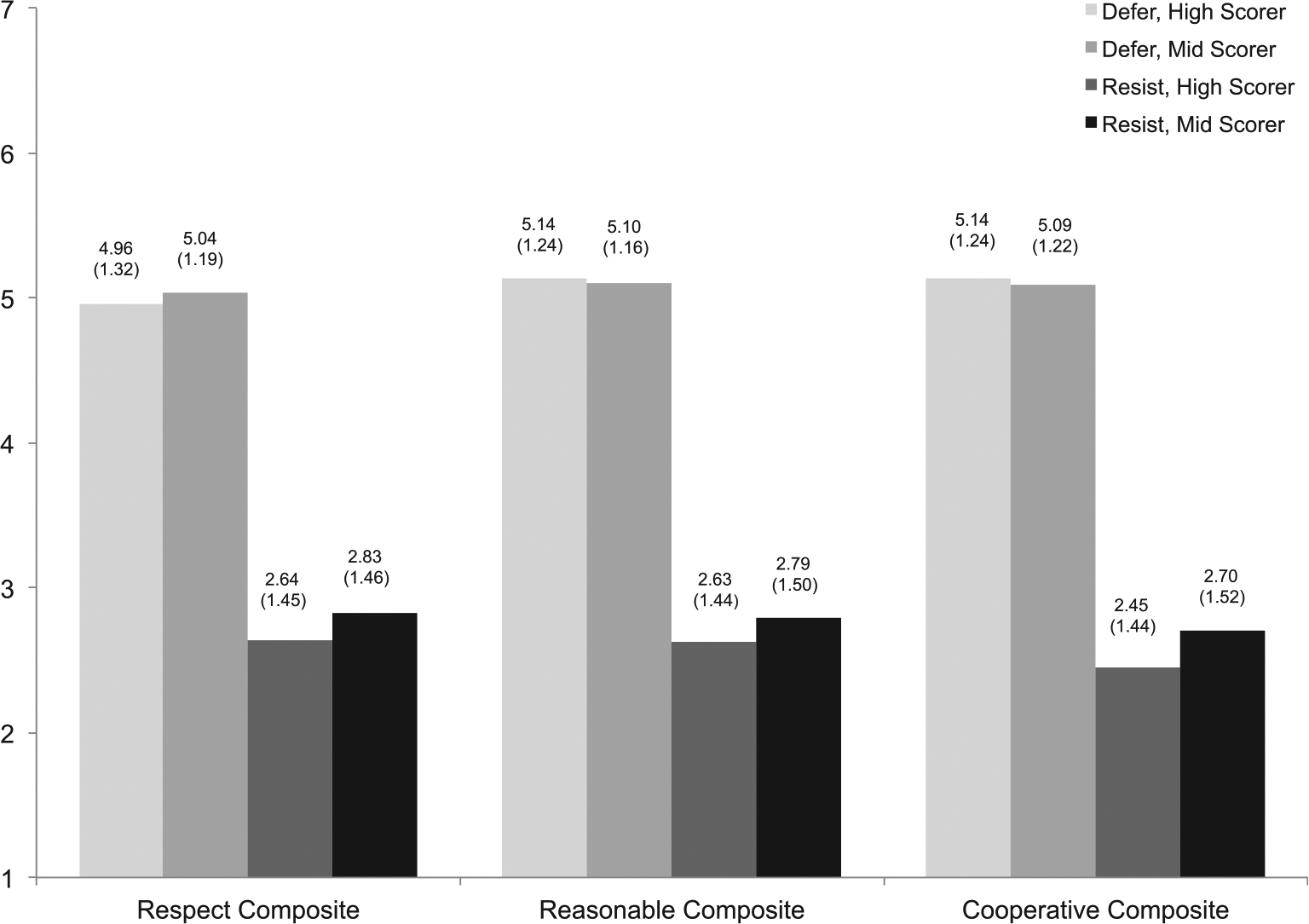
Means and Standard Deviations (in Parentheses) for Conflict with Other Member for Study 1
The three-way ANOVAs confirmed what an inspection of Figure 1 suggests. Participants thought they were dramatically more likely to be viewed with respect (F = 321.49, p < .001) and seen as reasonable (F = 334.08, p < .001) and cooperative (F = 357.85, p < .001) if they deferred rather than stuck to their own opinion in a disagreement with a higher-scoring group member. In support of our normative argument that deference to any member expected to perform better than one’s self is rewarded, it made only modest differences if the disagreement was with the high- or mid-scoring member. In the models forReasonable and Cooperative ratings a High/Mid × Defer/Resist interaction (F= 4.05, p < .05 for Reasonable; F = 9.23, p < .01 for Cooperative) showed that participants felt they were similarly likely to be viewed as reasonable and cooperative when they deferred to a high-scoring (M = 5.14 and 5.14, respectively) and to a mid-scoring (5.10 and 5.09) member but thought it less likely that they would be seen as reasonable and cooperative when they resisted the high-scoring (2.63 and 2.45) versus mid-scoring (2.79 and 2.70) member. For Respect ratings, a modest main effect (F = 4.84, p < .05) showed that participants thought respect reactions were more likely in disagreements with mid scorers than high scorers, regardless of deference or resistance. A Gender × Deference/Resistance interaction (F = 4.73, p < .05) also revealed that men anticipated more differentiated respect reactions to their deference or resistance (5.12 vs. 2.54) than did women (4.91 vs. 2.89).
It is notable that the means in Figure 1 for the anticipated likelihood of respect (4.96, 5.04), reasonable (5.14, 5.10), and cooperative (5.14, 5.09) reactions to deference are well into the positive range of the seven-point scale, suggesting that participants clearly perceive these respect reactions as available positive incentives for deference. They are seen as highly likely and predictable reactions from others in the situation. Note also that the mean rated likelihoods of positive reactions for resisting deference are all less than 3.00, putting them well into the unlikely range of the scales.
When asked which strategy they would actually use during the upcoming group task, 69.7 percent of participants chose the defer strategy, 14.4 percent the resist strategy, and 16.0 percent an “other” strategy. T-tests showed no gender differences in the strategies participants chose. An examination of the strategies participants specified when they chose “other” revealed most to be efforts to engage and persuade the other group members. These are, in effect, efforts to alter the others’ low performance expectations for the participant by successfully reasoning with them. We argued that attempting to engage and alter other members’ low expectations for one’s self is a risky option in a context of relatively certain low performance expectations, and this may account for the low rate at which participants chose this option.
It seems, then, that when placed in a situation in which they expect that others expect low performance from them, people do anticipate that deference to those the group deems better will earn them a modicum of respect and the dignity of being deemed reasonable, clearly confirming Hypothesis 1. Presumably for this reason, people see deference as a relatively attractive option in the circumstances.
The results of study 1 suggest that people understand the cultural rules of status as providing a modest system of positive incentives, not merely punishments, for the assumption of low status. But to be certain, we also need to see that other members grant these rewards to the deferrer, as suggested by Hypothesis 2a. And to ascertain whether the granting of such rewards is a normative effect, not just a personal reward for direct deference, we need to see if such rewards are granted not only by the person deferred to but by other group members witnessing deference (Hypothesis 2b). Study 2 examined these questions.
Study 2
Overview and Design
Study 2 was an online MTurk experiment with the three-person group decision-making context and procedures of study 1, but it changed the position of the participant to be either the mid scorer (n = 94, 42 men and 52 women) or the high scorer (n = 87, 42 men and 55 women). Instead of being the low scorer who deferred or resisted, the participant observed the low scorer’s behavior. To test Hypothesis 2a and Hypothesis 2b, the participant was asked how he or she would view the low scorer if, in an opinion disagreement, the low scorer either deferred to or resisted deferring to first the other team member and then the participant him- or herself. The participant evaluated deference or resistance to the other member first to provide a clear test of Hypothesis 2b that would not be contaminated by any possible carryover effects of the more ego-concerned situation of deference or resistance to self. Thus, the resulting experimental design crossed two between-subject factors (Mid/High Scorer × Gender) with two within-subject factors (Defer/Resist × Other/Self Target).
Method
As in study 1, participants were introduced to the three-person decision-making group, linked to two (simulated) same sex teammates, and completed a ten-item test of their ability at the meaning insight task that they would work on as a team. Participants were randomly assigned to be mid scorers or high scorers so that test results presented to the whole team showed a 6 for the mid-scoring member (participant or Adam/Sarah), a 7 for the high-scoring member (participant or Adam/Sarah), and a 3 for the low-scoring team member (Mike/Allison). To examine whether participants formed second-order expectations for their performance on the group task based on these test scores, they completed the 6-item measure from study 1 on whether the group wanted them to have high status and influence (alpha = .93).
As in study 1, we told participants that they would now work together on meaning insight as a team, resolving disagreements in a chat room, and there would be a bonus for superior team performance. We asked them to consider some situations before proceeding to the group task: “During the task, [Mike or Allison] finds that [he or she] has a different opinion than [Adam or Sarah] on how a question should be answered. There are different strategies by which [Mike or Allison] could react in this situation. Please rate how you will view [Mike or Allison] if [he or she] uses one of these strategies compared to the other.” The strategies (order counterbalanced) were, “[Mike or Allison] reacts by explaining [his or her] choice but then agrees to go with [Adam’s or Sarah’s] choice for the group decision” (defer) and “[Mike or Allison] reacts by explaining [his or her] choice and sticking to it rather than agreeing to go with [Adam’s or Sarah’s] choice for the group decision” (resist).
After rating the low scorer’s (Mike’s/Allison’s) deference or resistance in a disagreement with the other team member (Adam/Sarah), participants rated the low scorer in a disagreement with themselves. Again, they rated how they would view the low scorer if he or she reacted to the disagreement with the participant by deferring or resisting, with these strategies in counterbalanced order.
For each strategy in a disagreement with the other team member and with self, the participants rated how they would view the low scorer on the same seven-point items described for study 1 and two additional items: competent and trustworthy. As before, we grouped and averaged these nine items into three scales. Respect (respect, approval; alpha = .86) and Cooperative (cooperative, helpful, likeable; alpha = .90) were the same as in study 1. Factor analysis supported grouping competent and trustworthy with the Reasonable items from study 1 to form a Reasonable/Competent scale (reasonable, competent, useful, trustworthy; alpha = .91). We have argued that “competence” in this context is competence at knowing what is “better,” a type of social competence rather than specific task expertise, and this is supported by the fact that competence loaded on the Reasonable factor. For comparability with study 1, we conducted all analyses on both the four-item Reasonable/Competent scale and the two-item Reasonable scale (reasonable, useful; alpha = .83). As we report below, they were substantively identical.
Finally, to measure the participants’ performance expectations for the low scorer, we asked them to rate how much influence Mike/Allison should have on the group task from none = 1 to a great deal = 7 and whether they expected Mike/Allison to be a highly valued team member from no, not at all = 1 to yes, definitely = 7. Participants also rated the other group member on these same items. We averaged the items together to produce a composite measure of participants’ (first-order) performance expectations for the low scorer, the mid scorer (rated by high-scoring participants), and the high scorer (rated by mid-scoring participants). We also asked which strategy Mike/Allison would be most likely to use in the upcoming group task, with the options being the defer or the resist strategies described earlier or “other—please specify.” Again, the study concluded at this point so that participants did not actually enter a chat room.
Results and Discussion
We had no theoretical reason to anticipate gender differences in our results, but to be certain, we ran four-way mixed-model ANOVAs on our three major dependent measures. Of the resulting 15 tests for gender effects, 1, a two-way interaction on Respect, was significant at p < .05. There were no gender effects on any other dependent measures. Therefore, for ease of interpretation and substantive clarity, data are pooled across gender in all figures below and analyses other than Respect. For Respect, we also report results of the four-way model that includes gender.
The feedback participants received on their own test scores compared to their teammates created clear second-order expectations about the status and influence they thought others wanted them to have on the team. Reflecting the test score feedback, mid scorers estimated themselves on average at 3.70 (SD = 1.20) on the seven-point scale, but high scorers put themselves significantly higher at 4.62 (SD = 1.45; t = 4.66, p < .001).
When asked about their teammates, participants clearly expected the low scorer to have less influence and value (a two-item composite measure) than the relatively higher-scoring other team member. We analyzed this measure with a Participant (Mid Scorer/High Scorer) × Teammate Evaluated (Low Scorer/ Other Member) mixed model ANOVA. A strong main effect (F = 200.46, p < .001) of teammate evaluated confirmed that the low scorer was rated significantly less than the other, higher-scoring member (M = 3.45 for low scorer vs. 5.73 for high scorer; M = 3.73 for low scorer vs. 5.37 for mid scorer). This main effect was conditioned by a modest interaction effect (F= 5.49, p < .05) reflecting the fact that mid-scoring participants made sharper distinctions between the expected influence and value of the low scorer compared to the other teammate. 3 Because our two-item measure of participants’ (first-order) performance expectations for their teammates is not comparable to our six-item measure of participants’ second-order performance expectations for themselves, we cannot directly compare the participants’ ratings for self versus teammates.
These measures indicate that, by the rules of status documented in previous research (Anderson and Willer 2014; Berger and Webster 2006), participants should have expected the low scorer to defer to the other teammate and to themselves in a disagreement. If these implicit rules effectively create incentives for appropriate deference, then participants should react to deference with respect and perceptions of reasonableness (Hypothesis 2a) not only when the deference is to self but also when it is to the other teammate (Hypothesis 2b). Figure 2 shows the participants’ evaluations of the low scorer’s deference and resistance in a disagreement with the other teammate on the Respect, Reasonable/Competent, and Cooperative scales and also gives means for the two-item Reasonable scale. Figure 3 shows these results for low-scorer disagreements with self. To test Hypotheses 2a and 2b, we analyzed evaluations of the low scorer using three-way mixed-model ANOVAs with participants’ position (mid scorer/high scorer) as a between-subjects factor and within-subject factors for strategy evaluated (defer/resist) and target of the disagreement (self/other teammate).
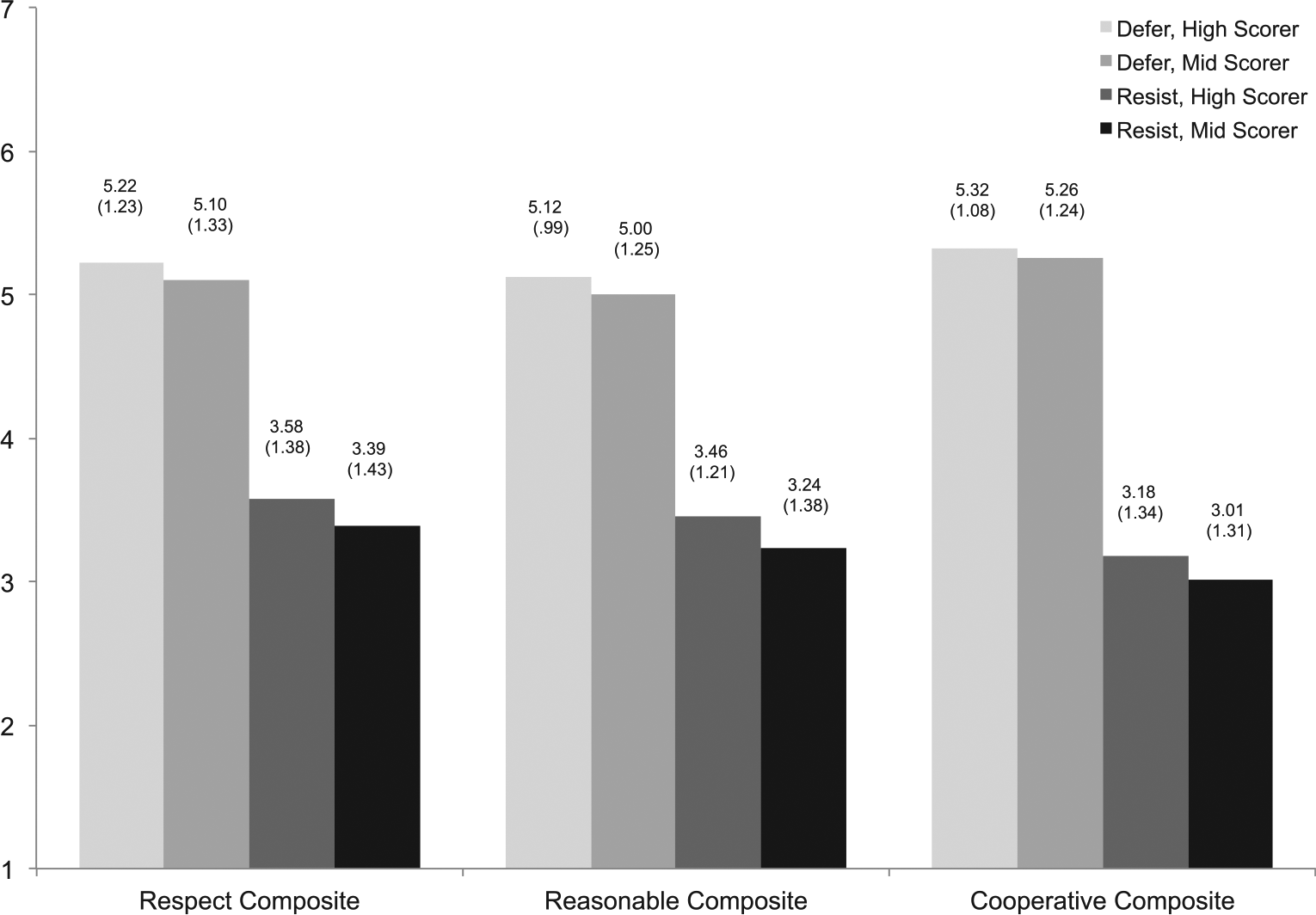
Means and Standard Deviations (in Parentheses) for Conflict with Other Member by Condition and Strategy from Study 2
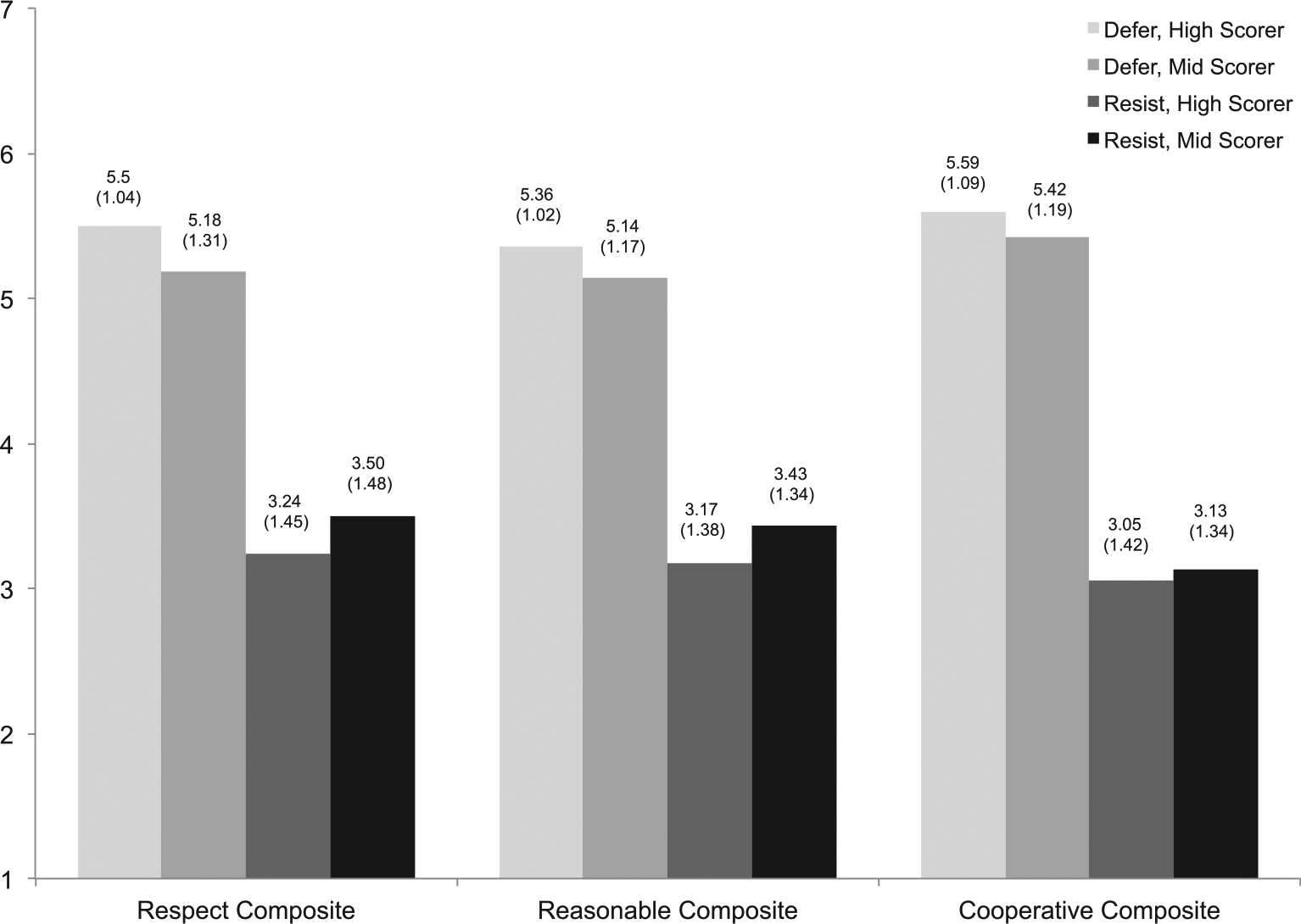
Means and Standard Deviations (in Parentheses) for Conflict with Self by Condition and Strategy from Study 2
Results from statistical models confirmed what Figures 2 and 3 clearly show. Participants were dramatically more likely to view the low scorer with respect (F = 180.82, p < .001) and see the low scorer as reasonable/competent (F = 207.08, p < .001; two-item Reasonable, F = 236.86, p < .001) and cooperative (F = 309.79, p < .001) when he or she deferred rather than resisted deferring in disagreements with higher-scoring members, whether the participant or the other teammate. For Respect ratings, the powerful main effect of deference versus resistance was conditioned by a modest three-way interaction effect (F = 4.13, p < .05), showing that high-scoring participants had more extreme reactions to deference versus resistance to self than other. In four-way models of Respect that included gender, the main effect of deference/resistance (F = 176.77, p < .001) was conditioned by the same three-way term (F = 3.90, p = .05) and also by a modest Gender × Self/Other interaction (F = 4.05, p < .05), indicating that men had slightly stronger Respect reactions in disagreements with self rather than other (4.40 vs. 4.25) while women showed the opposite pattern (4.31 vs. 4.39).
Evaluations of the low scorer on the Reasonable/Competence scale followed a related (but ungendered) pattern with two modest interactions in addition to the powerful defer/resist main effect: Mid/High × Other/Self (F = 3.93, p < .05) and the three-way term (F = 4.88, p< .05; for two-item Reasonable, only the three-way term appeared, F = 4.36, p < .05). These effects were largely driven by high-scoring participants’ being particularly unlikely to see low scorers as reasonable/competent when resistance was to self. For Cooperative ratings, responses did not vary by whether the disagreement was with self or other or by participant position (mid scorer/high scorer).
It is clear, then, that despite some modest effects for more ego-involved situations involving disagreements with self and for high-scoring (vs. mid-scoring) participants, none of these fundamentally changed the overwhelming pattern of reporting a positive likelihood of viewing low scorers with respect and as reasonable and cooperative when they defer rather than resist higher-scoring members. The substantial similarity between views participants reported when the low scorer deferred to the other team member (see Figure 2) and for deference to self (see Figure 3) offers telling support for our normative argument. Furthermore, note again that the likelihood of positive, respect reactions to deference are not simply greater than those for resistance but are, in absolute terms, highly likely, typically about 5.0 on 7-point scales, suggesting a systematic granting of positive rewards for deference both to the other teammate and to self. Together, these results clearly confirm Hypothesis 2a and Hypothesis 2b. They suggest that these highly likely and, therefore, predictable reactions of respect and perceptions of reasonableness and competence for appropriate deference reflect shared status rules and not just the personal interests of participants receiving deference.
Finally, also reflecting the presumption that the rules of status are shared and, therefore, that low scorers would know they were expected to defer, 76 percent of participants named deference as the strategy the low scorer was most likely to use in the upcoming group task. This did not differ by whether the participant was the mid scorer or the high scorer.
Studies 1 and 2 put participants directly into a group situation where they must anticipate the group’s reactions to a low-status member’s deference in a disagreement with a member who is expected to perform better. Furthermore, they examined reactions from the perspective of both the low-status member and the higher-status members and demonstrated the comparability of their expectations that deference would be rewarded with a response of respect and perceived reasonableness. This is as we would expect if the widely understood cultural rules of status provide positive incentives for deference and the assumption of low status in the group.
A final question remains, however. Does this positive incentive of respect and the dignity of being deemed reasonable matter to low-status recipients? Hypothesis 3 predicts that when a lower-status member receives such reactions to his or her deference to a member for whom the group has higher performance expectations, he or she will be more committed and less willing to leave than when others do not react with respect and approval to his or her deference. Study 3 examines this prediction.
Study 3
Method
Study 3 used an online MTurk experiment with 199 participants (123 men, 76women). First, participants read a vignette in which they are about to do an unfamiliar task with two same-sex group members (with rewards for group performance). Before starting, they all take a test of task ability, and results are shown to the group as follows: participant scored 3 of 10, described as poor performance, while the other teammates scored 6 and 7, described as performing moderately and extremely well.
Afterwards, participants completed the six-item scale from studies 1 and 2 evaluating how much they thought other group members would want them to have status and influence in this situation (alpha = .96). The mean for this scale was significantly less than the scale midpoint of 4 (M = 2.05, SD = 1.33, t = −20.70, p < .001), confirming that participants perceived themselves as having low status in the group. 4 There were no gender differences in these results.
Participants then read, “As you begin the task, you find you have a difference of opinion with [Jessica/Bill], the high scorer on the test. There are two options for how you could react in this situation. You could explain your choice and stick to it for the group decision. Or you could explain your choice but agree to go with [Jessica’s/Bill’s] choice for the group decision.” The order of the two options was counterbalanced. Next they read, “In the end, you decide to agree to go with [Jessica’s/Bill’s] choice for the group decision.” Thus, the participant is described as deferring to the high-scoring teammate. This is a necessary precondition for testing Hypothesis 3, which predicts the effects on commitment for different reactions to the low-status participant’s deference.
After this, half the participants were randomly assigned to read, “You sense your teammates see your choice as reasonable and respect your behavior.” This constitutes our Respect condition. The remaining participants in the Not Respect condition read, “You sense your teammates do not see your choice as reasonable or respect your behavior.” 5 Both vignettes ended with, “The group discussion moves on to the next question.” Participants then completed a three-item commitment scale, with 1 to 7 ratings of willingness to continue working with the group, commitment, and willingness to help the group do well (alpha = .91). They also rated how likely they would be to leave the group if they could, from 1 = very unlikely to 7 = very likely.
Results and Discussion
Study 3 had a 2 (Respect/Not Respect) × 2 (Gender) between-subjects design. We analyzed the results with a corresponding 2 × 2 between-subjects ANOVA. Because there were no main or interaction effects of gender, we report only means and effects pooled across gender.
When deference elicited perceptions of reasonableness and respect, participants anticipated being quite committed to the group and willing to work for it despite being low status (M = 5.52, SD = 0.94, significantly greater than the scale midpoint of 4, p < .001). In contrast, when participants did not receive respect for deference, mean commitment was just less than the scale midpoint of 4 (M = 3.92, SD = 1.51, n.s.), yielding a highly significant main effect for Respect condition (F = 83.42, p< .001). Similarly, when deference brought respect and perceptions of reasonableness, participants estimated a relatively low likelihood of leaving (M = 3.13, SD = 1.42, less than the midpoint of 4, p< .001). But when deference was not respected, they leaned towards leaving if they could (M = 4.55, SD = 1.68, greater than the midpoint, p < .01), resulting in a strong main effect for Respect condition (F = 41.32; p < .001). These results clearly confirm Hypothesis 3.
It seems, then, that participants in low-status positions thought deference to higher-status members would cause them to be seen as reasonable and respected as study 1 showed; in addition, these responses acted as a positive incentive that increased willingness to continue working in the group despite their low status, as study 3 demonstrates. This is as we would expect if the widely understood cultural rules of status provide positive incentives for deference and the assumption of low status in groups. Studies 1 through 3 employed diverse samples but not fully representative ones. If the reward of respect for appropriate deference is indeed part of widely understood cultural rules for status, it should also be apparent with a nationally representative sample.
Study 4
Method
Study 4 presented respondents with vignettes as part of a 20-minute omnibus survey of a representative sample of 1,000 U.S. adults, administered by theInternet polling company YouGov. 6 Approximately half of the sample (n = 488) was randomly assigned to this study rather than other studies, and 52 of these respondents were dropped via listwise deletion because of missing data on one or more demographic variables used in analyses, yielding a final analytic sample of N = 436.
Respondents evaluated a vignette describing a three-person team: “In the group, all three people have to work together on an unfamiliar task. The better they all do on the task as a team, the more the team will benefit. Also, the better the team does, the more each teammate will benefit.” Members of the team, the vignette continued, all take a test of task ability, and results, shown to all, reveal one low scorer (12/20), a mid scorer (14/20), and a high scorer (17/20). During the task discussion, the low scorer has an opinion different than the top scorer’s.
Respondents were then randomly assigned to rate how other team members would view the low-scoring member under either the deference strategy (n = 225, 95 men, 130 women) of reacting to the disagreement or the resistance strategy described in studies 1 through 3 (n = 211, 98 men, 113 women). Respondents evaluated the team as observers and rated on seven-point scales the likelihood that the low scorer would be viewed by the group as competent, reasonable, helpful, and likeable. Respondents also reported how likely they personally would be to use this strategy in such a situation (seven-point scale).
Results and Discussion
We analyzed ratings of the four items and the probability that respondents would use the strategy with a series of ordinary least squares regression models. These models included population weights and demographic controls for gender (male = 1, female = 0), age (in years), income (in thousands of dollars), education level (college degree = 1, less than college degree = 0), and race (white, black, Latino, other), as well as our main independent variable, the defer/resist experimental condition (1= defer, 0 = resist).
As Table 1 shows, respondents thought the low scorer would be viewed as significantly (p < .001) more competent, reasonable, helpful, and likeable when he or she deferred. Respondents also said they personally would be most likely to use the deference strategy (p < .01). Note that these results held up despite appropriate sample weights and controls for race, age, education, gender, and income. Thus, this final study suggests that the positive reward for deference that we have called the “dignity of appearing reasonable” is indeed a broadly understood and widely shared part of our implicit cultural rules for enacting status hierarchies.
Unstandardized Coefficients from Ordinary Least Squares Regressions—Study 4.
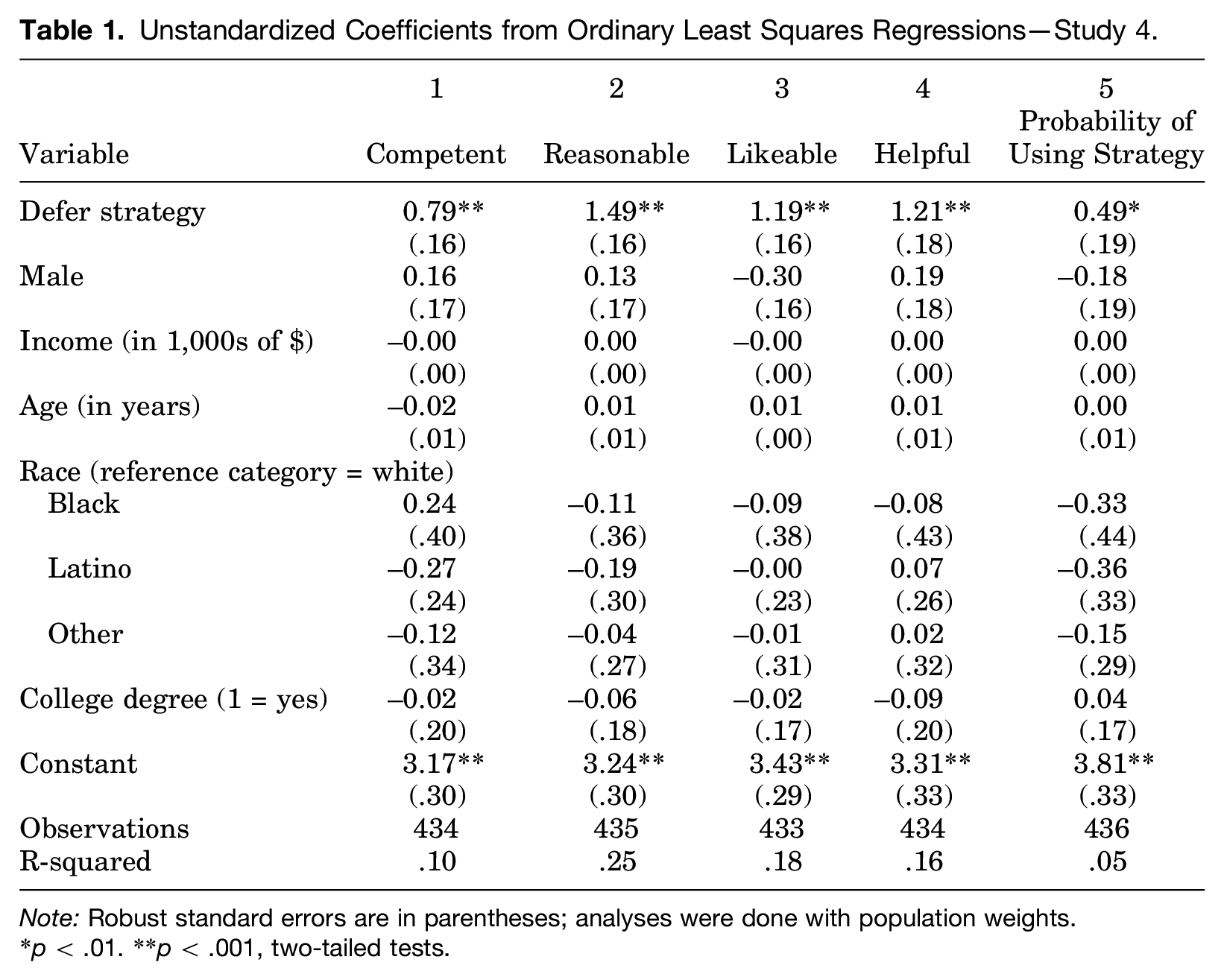
Note: Robust standard errors are in parentheses; analyses were done with population weights.
p < .01. **p < .001, two-tailed tests.
General Discussion and Conclusion
Current accounts of how status hierarchies help people solve the collective action problem they face when they work on a shared goal focus primarily on incentives of esteem and influence offered to high-status members (Anderson and Willer 2014; Berger and Webster 2006). Less is said about the equally important problem of incentivizing the deference and continued efforts of members who end up with low status in the group. With four studies, including one with a nationally representative sample, we have shown how status hierarchies also provide, through their implicit normative processes, a general, modest, but meaningful positive incentive for low-status deference—the dignity of being respected in the group as reasonable. Our studies found that low-status members anticipated this respected-as-reasonable reaction when they deferred as expected, that higher-status members did indeed offer that reaction to their deference, and that when low-status members received this reaction, they were more committed to the group and less willing to leave it even if they could.
Our theoretical account builds on expectation states theory’s well-documented analysis of status hierarchies in cooperative, goal-oriented groups (Berger and Webster 2006). Drawing on analyses and evidence from Ridgeway and Diekema (1989), Horne (2004), and Anderson et al. (2006), our account adds further, complementary arguments about how the circumstances of such groups also create implicit normative processes that undergird and enforce the basic status processes described by expectation states theory. More generally, our theoretical argument and empirical studies open the question of the role of norms in maintaining status hierarchies and demonstrate one way in which they contribute.
The distinctive argument we test here is that the underlying norms or implicit rules by which status hierarchies are enacted, which are likely taken-for-granted cultural knowledge for most people, also create a systematic incentive for low-status deference: the dignity of being seen as reasonable. Since the basis of this respected-as-reasonable reaction for low-status deference is normative, it comes from all group members, as our studies confirmed, and not just from a given high-status member who directly receives deference. The normative provision of this modest but meaningful incentive for deference in status hierarchies acts as structural force that helps sustain the participation of low-status members both when their deference comes willingly and when it does not. As a normative incentive system, it acts as a general process that facilitates deference in addition to factors such as interest in task success described by expectation states theory (Berger and Webster 2006).
Exchange theory research has shown that working together on shared tasks can bind members to the group, but inequality among the members undermines the effect (Lawler 2001; Lawler, Thye, and Yoon 2009). Here we have demonstrated an additional process that acts to pull low-status members into the group even when a clearly differentiated status hierarchy exists among members.
A strong test of our theoretical predictions required distinct differences in the expected value of members’ contributions to the group so that the low-ranking member would be clearly expected to defer and accept low status in the group. For this reason, we manipulated status in our studies by direct feedback on task expertise, a specific status characteristic. Having done so allows us to conclude with greater certainty that when performance expectations are clearly differentiated, low-status deference elicits basic respect and perceptions of reasonableness. A large body of expectation states research, however, has shown that a variety of diffuse status characteristics, including gender, race, education, and occupation, not just specific expertise, often also produce clearly differentiated performance expectations, although they do not do so as strongly and reliably in every situation as does task expertise (Berger and Webster 2006). By our account here, in groups in which such diffuse status characteristics do form the basis of clear differences in the expected value of members’ contributions, the low-status members (e.g., women, people of color, the less educated) should be similarly offered the rewards of approval and the designation of being reasonable if they defer, a respect and social dignity that they forfeit if they resist. An important next step for research is to test this proposition.
In addition to not having tested the applicability of our arguments in groups differentiated by diffuse status characteristics such as race or education, the present research has other limitations. In order to construct clear tests of our three hypothesized processes (low-status anticipation of rewards for deference, high-status granting of such rewards, and the positive effects of rewards received on low-status commitment to the group) in contexts in which the measurement of one dependent variable did not contaminate the measurement of others, we disaggregated the tests into separate, controlled online experiments. With supportive evidence from these controlled studies, it is now important to examine the argument’s applicability in settings that more closely approximate open-interaction groups in which all three processes go on together. Such studies would also allow investigation of how perceived reasonableness is signaled in open interaction.
The approval offered for deference represents a devil’s bargain for the low-status member. It provides a positive temptation to defer despite the social and personal costs of doing so. Whether this temptation is sufficient to actually induce deference may depend on the low-status member’s access to an alternative course of action. If the alternative of leaving the group is not practical, the low-status member could, by resisting, try to convince the group that he or she really has more of value to offer and deserves higher status and influence. The more status information the group has about the member that is clearly against him or her, however, the riskier this alternative action is. And the group’s bargain for deference at least offers a modicum of dignity and approval that at the same time allows the member to continue to share in the group’s goals and benefits. In this situation, many take these rewards and defer.
Interpersonal status hierarchies play a significant part in the broader structure of inequality in society by mediating people’s access to resources and positions of power (a hiring decision, a promotion). They also distribute a commodity people strive for—respect in the eyes of others (Ridgeway 2014). Better understanding of how they pull in and motivate not only their high-status members but also their low-status members gives us deeper insight into not only how status hierarchies work but also how they persist by drawing people into their collective assessments of who is better. In making deference by low-status members the price of being seen as reasonable in the eyes of the group, they legitimate inequality.
Footnotes
Acknowledgements
We would like to thank the Stanford Social Psychology Workshop for comments on various stages of this research and Shelley Correll and Morris Zelditch for comments on earlier drafts of this article.
1

2
Although the scores of 6 and 7 are close together, we chose them to ensure that both teammates’ scores were clearly better than that of the low-scoring member while at the same time avoiding an implausibly high score for the highest-scoring teammate. We described for participants scores of 3 or less as no better than guessing (chance levels), 4 to 6 as “performed moderately well (above chance levels),” and 7 to 9 as “performed extremely well (difficult to accomplish)” compared to the general population.
3
This was likely due to the fact that the “other” teammate evaluated by the mid scorer was the highest-scoring member while for the high scorer the “other” was the mid scorer.
4
Because Hypothesis 3 and our theory about the positive effect of perceived reasonableness on low-status commitment/disengagement makes no claims about the relative value of perceived reasonableness to high- versus low-status members, there is no high-status contrast condition. Hypothesis 3 is independent of such a contrast.
5
Note this does not say your teammates “disrespect your choice” but rather that they do not respect it, a slightly more neutral phrasing. We did not include a “your teammates do not react to your choice” condition because this implies to the participants that their deference is ignored by the group, which potentially introduces additional, confounding factors. Since respect/not respect was a between-subjects factor, participants evaluated respect or its lack in absolute terms rather than comparatively.
6
YouGov draws its samples by recruiting a subset of respondents from its larger U.S. panel of more than 1.2 million members. Panel members’ complete surveys in exchange for points that are redeemable for gift cards and other rewards. YouGov creates a representative sample by matching respondent characteristics to those of the U.S. adult population at large based on the 2007 American Communities Survey.