



Abstract
Identity verification occurs when individuals’ situational identity meanings match the meanings in their identity standard. When a person verifies an identity, they feel understood, and they feel good. When an identity is not verified, people feel misunderstood, and they feel bad. Two identity characteristics that may moderate people’s negative reactions to identity nonverification are identity prominence or importance and identity salience or time spent in the identity. We study these moderating effects on a national sample of adults who had problems verifying their identities during the COVID-19 pandemic. The identities included worker, friend, romantic partner, and family member. The results show, as hypothesized, that identity prominence increases the negative responses to nonverification, while identity salience decreases the negative responses to identity nonverification. We discuss how these countervailing effects advance our understanding of identity prominence and salience.
An identity is a set of meanings that characterize people as belonging to a social category, such as their race or gender (categorical identity); as group members, such as participants of their family or local clubs (group identity); in their roles, such as a student or worker (role identity); or as individual persons, such as being dominant or moral (person identity; Burke and Stets 2023). In identity theory, people act to maintain perceived meanings of how they are coming across in a situation to match the defining identity meanings held as the standard for their identity (the identity standard).
For example, in the student identity, persons may have an identity standard that contains meanings of a strong academic orientation or a strong social orientation (Reitzes and Burke 1980). In either case, they will act in ways that convey their meanings both to themselves and to others. Students with meanings of a strong academic orientation may take good notes in class, do their homework, and work hard to do well on exams. Those having self-meanings of a strong social orientation may focus on involvement in social activities, such as clubs, other extracurricular pursuits, and spending time with friends. When students are able to maintain a perception that the meanings as to who they are in the situation (self-in-situation meanings) match their identity standard meanings, their identities are being verified (Burke and Stets 2023).
When individuals experience a disturbance to their meanings in a situation, perhaps due to others changing meanings in the situation to verify their own identities, individuals’ perceived self-in-situation meanings may no longer match the meanings in their identity standard. This is identity nonverification. Central to identity theory is the idea that identity nonverification, or the lack of congruence between perceived self-in-situation meanings and identity standard meanings, has negative consequences for individuals. Perceptions that self-in-situation meanings do not match identity standard meanings may emerge from different sources, such as people’s own internal assessment (self-appraisals) or from individuals thinking that others do not see them as they see themselves (reflected appraisals; Burke and Stets 2023). The discrepancy arising from either source may result in anxiety, depression, and other negative feelings (Burke and Harrod 2005; Burke and Stets 1999; Stets and Burke 2014; Stets and Carter 2012; Stets and Trettevik 2016). People will then act to reduce the discrepancy and restore the identity-relevant situational meanings to match the meanings in their identity standard.
Two characteristics of identities that may affect the negative consequences of nonverification are identity prominence, or the subjective importance of an identity, and identity salience, or the likelihood an identity is in an activated state (Brenner, Serpe, and Stryker 2014; Burke and Stets 2023; Stets et al. 2020; Stryker and Serpe 1994). Because people work harder to verify more prominent identities, they may feel more upset when they encounter verification problems (Burke and Stets 2023). As a result, nonverification of more important identities may strengthen the negative feelings associated with nonverification. The opposite may occur for more salient identities. With greater time spent in more salient identities, individuals may adapt to the problems that emerge in their identities and learn how to deal with them, thereby weakening the negative feelings related to nonverification. If these theoretical expectations are confirmed, they will strengthen and add to the theoretical development of identity theory.
We test these expectations with data on a national sample of individuals surveyed in spring 2021. During this time, respondents had been experiencing the COVID-19 pandemic for at least a year. The original intent of the survey was to examine how individuals were responding to the pandemic. Since identities are at the core of who one is, we were interested in the difficulties people were experiencing in enacting their identities and the negative consequences that this might produce, including mental health challenges, such as anxiety and depression, and negative feelings, such as anger or shame. In this article, we examine how the identity characteristics of prominence and salience may moderate respondents’ mental health and emotional outcomes when respondents experience identity nonverification. We find that, in general, prominence increases the effect of nonverification on poor mental health and negative emotions, while salience reduces those effects. This advances identity theory as it tests relationships that previously have been hypothesized.
Identity Prominence
A prominent identity has typically been characterized as an identity that is important to a person. Some have labeled it “centrality” (Rosenberg 1979; Stryker and Serpe 1994). The consequence of identity prominence is that it serves as a motivator for individuals in that the higher the identity prominence, the more people will work to perceptually control meanings in a situation as to who they are to match the meanings in their identity standard (Burke and Stets 2023). Thus, the more prominent an identity, the harder people work to verify their identity. This is consistent with other writings that maintain that higher identity prominence increases the level of role performance tied to a role identity (Stryker and Serpe 1994) or that higher identity prominence increases the probability of enacting behavior consistent with the identity (Brenner et al. 2014).
Recently, it has been argued that another way to think about identity prominence is in terms of the number of other identities that share meanings with the focal identity (Burke 2023; Burke and Stets 2023). The more other identities that share meanings with an identity, the more prominent is the identity. For example, if in the parent identity, the meaning of dominance is shared with the worker identity, the parent and worker identities are more prominent than identities that do not share meanings. Alternatively, if the parent identity also has meanings of honesty, care, and loyalty, and these meanings are shared not only with the worker identity but also with the friend identity, the parent identity is still more prominent than if shared meanings were only with one other identity. Thus, the more identities that share meanings, the more prominent are those identities.
If prominent identities have meanings that are shared with other identities, prominence has implications for identity verification because when one identity is verified, so are the other identities that share meanings, and when an identity is not verified, neither are the other identities whose meanings it shares (Burke and Stets 2023). Thus, when a very prominent identity is verified, other identities that share meanings with it also are verified, and individuals will feel especially good. However, when a very prominent identity is not verified, other identities that share meanings with it also are not verified, and individuals will be particularly upset. In this way, the consequences of verification or nonverification are much greater for prominent identities than for identities that are not prominent.
The idea that those with more prominent identities experience more negative feelings when those identities are not verified is consistent with earlier theorizing that negative emotions would be more likely to emerge when more prominent identities are threatened (McCall and Simmons [1966] 1978). Evidence supports this. For example, researchers found that women whose mother identity was more prominent were more likely to report feelings of jealousy when nurturant activity was linked to father-child interactions (Ellestad and Stets 1998). Such interactions signaled a threat to the mother-child bond and the maintenance of the mother identity.
Given these findings and building on identity theory, we expect identity nonverification to be positively associated with poor mental health and negative feelings. Thus, we might predict a main effect of identity nonverification on these negative outcomes. However, because the magnitude of the effect of identity nonverification is conditioned on the level of prominence of the identity, with the negative effects of nonverification stronger when the identity is more prominent, we do not offer a main effect of identity nonverification. Empirically, such a main effect would be the average level of prominence. Instead, we focus on testing the contingency of the effect across levels of prominence and thus offer the following hypotheses on the moderating effects of prominence: Hypothesis 1a: The effects of nonverification on poor mental health will be stronger for identities higher in prominence. Hypothesis 1b: The effects of nonverification on negative emotions will be stronger for identities higher in prominence.
Identity Salience
Identity salience is the probability that an identity is activated or invoked in a situation (Burke and Stets 2023; Stets et al. 2020; Stryker 1968). One factor that increases the likelihood that an identity is activated is the presence of meanings in the situation that also are held in the identity standard. As a probability, the characteristic of salience is strictly descriptive, describing only what happens, not why it happens. It does not have motivational implications as does prominence (Burke 2023; Burke and Stets 2023). 1
Identity theory makes clear that identity salience is the relative amount of time an identity is activated (Brenner, Serpe, and Reed 2023; Burke 2023; Burke and Stets 2023). Thus, it would be the probability or proportion of time spent performing behaviors of an activated identity (Brenner and DeLamater 2016). To understand the effects of salience, we need to think of the consequences of being in an identity for greater or lesser amounts of time. High salience would mean frequently being in the identity; low salience would mean seldom being in the identity.
During the time an identity is activated in a situation, individuals are controlling all the meanings that maintain an identity. All the counteridentities of others in the situation, that is, the identities with which the target identity interacts, also are activated, and they are controlling the same meanings. Through the mutual verification process in which the identities of persons in the situation verify each other by verifying themselves, relationships among these people are formed, developed, and maintained (Burke and Stets 1999, 2023). Feelings and emotions are being generated. Groups and organizations are being formed and maintained. Skills and knowledge are being developed. A more salient identity does more because it is activated for a longer time. With more time performing the identity, the person also becomes practiced and efficient.
With a greater amount of time an identity is activated, we expect that people will be more experienced and adept in maintaining an identity that is more salient. With more practice and skill, problems with identity verification should be more easily managed. Rather than nonverification eliciting a strong negative emotional response, it might elicit a weaker negative emotional reaction because individuals know how to quickly modify meanings in the situation so that self-in-situation meanings and identity standard meanings are better aligned. It is also possible that, with practice, dealing with verification problems becomes more automatic and less deliberative, leading people to not being fully aware of any nonverification. Essentially, being in an identity for a longer time is beneficial because individuals will have learned the adjustments that need to be made cognitively, behaviorally, or emotionally to respond to identity nonverification (Brenner 2011; Burke and Stets 2023).
Given these parameters, since the main effect of identity nonverification on mental health and emotions are conditioned on the salience of one’s identity, we do not offer a main effect for identity nonverification. Instead, we offer the following hypotheses on the moderating effects of salience: Hypothesis 2a: The effects of nonverification on poor mental health will be weaker for identities higher in salience. Hypothesis 2b: The effects of nonverification on negative emotions will be weaker for identities higher in salience.
To date, we know of only one study that has examined the moderating effects of prominence and salience on the identity verification process (Markowski and Serpe 2018). A negative impact of nonverification on self-esteem was found, but neither prominence nor salience moderated the effect of nonverification. While we can compare our results with those found in the Markowski and Serpe (2018) study, we are cautious with this comparison because our measures of both salience and nonverification are different from those that they used.
We also are examining this moderation effect not under normal life circumstances but during a pandemic that severely interrupted daily living. People may have had frequent trouble playing out their identities given disruptions at work, at home, with friends, and in intimate relationships brought about by the disease. Nevertheless, it is important to test these relationships not only for theory development but also so that individuals might understand what enhances or diminishes their well-being when they experience nonverification, even under extreme circumstances.
Data and Method
Sample
Qualtrics conducted a national survey using their panels to obtain a quota sample of 854 respondents during the spring of 2021 when the COVID-19 pandemic was happening. To test the applicability of identity processes during COVID-19 across different groups of people, the sampling strategy attempted to obtain roughly equal numbers of respondents within the gender, race (Asian, Black, Hispanic, White), income, and age categories. At the time of the survey, respondents had been in the pandemic for at least a year.
Because we are not trying to generalize our results to some population but, rather, seeking to understand relationships across representative social categories, a nonprobability quota sample is more useful than a random sample of some population. For this analysis, our sample is (1) 49 percent men and 51 percent women; (2) 35 percent non-Hispanic White, 22 percent Black, 24 percent Hispanic, and 19 percent Asian; (3) 41 percent low income (<$50,000), 33 percent middle income ($50,000–$100,000), and 26 percent high income (>$100,000); and (4) 35 percent ages 18 to 34, 40 percent ages 35 to 54, and 25 percent ages 55 and older.
Since we were interested in people’s experiences in their identities, respondents were given a list of the different ways in which people might see themselves, and they were asked to select one that they had the most difficulty playing out, on average, over the past year. 2 The list of identities included respondents seeing themselves in terms of work (including being a student), friendship, romantic relationship, political party, family, gender, race-ethnicity, nationality, and religion.
Four identities were most frequently selected by 73 percent of the respondents as the identities they had the most troubling enacting. These were the worker (n = 156), friend (n = 197), romantic (n = 125), and family (n = 142) identities. Each of the remaining identities had too few respondents to analyze. We confine our analysis to these four identities. Thus, we had a total of 620 respondents who had complete data on the constructs we examine in this article.
Measures
To measure poor mental health, we examined the depression and anxiety symptoms of respondents. Depression was captured with eight items in response to the question, “Over the last two weeks, on how many days have you been bothered by any of the following problems?” The items included, for example, little interest or pleasure in doing things, feeling down, and feeling tired (Kroenke, Spitzer, and Williams 2001). Response categories were not at all, several days, more than half the days, and nearly every day (coded 1–4). Anxiety was captured with seven items with the same stem as for depression but with different problems that tapped into anxiety, for example, feeling nervous, worrying too much, and becoming easily irritated (Spitzer etal. 2006). As shown in Appendix Table 1A, a principal component factor analysis revealed that the combined depression and anxiety items formed a single underlying dimension with a high omega reliability (Ω = .98). The items were averaged, with a high score reflecting poor mental health.
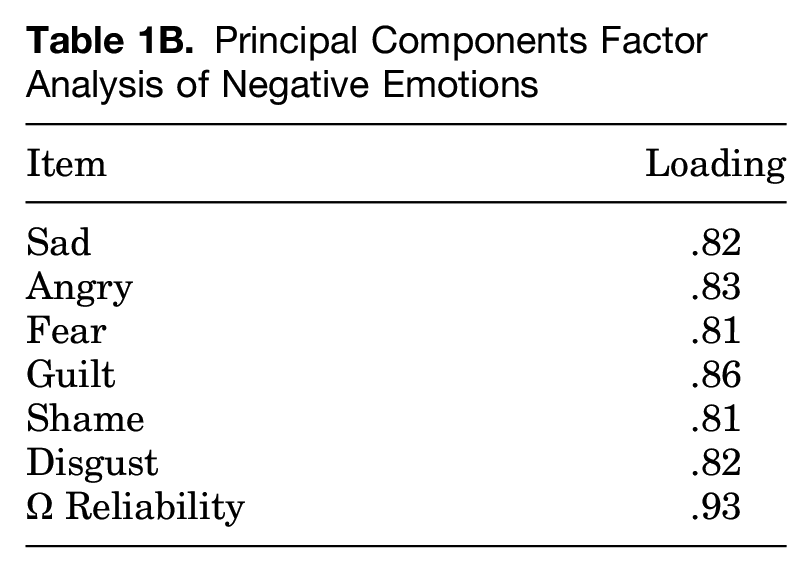
Negative emotions were measured by asking respondents to indicate the degree to which they felt a series of negative emotions over the past two weeks, with 0 being not at all and 6 being intensely. The emotions included the primary emotions of sadness, anger, fear, and disgust and the secondary emotions of guilt and shame (Turner and Stets 2005). In Appendix Table 1B, the principal component factor analysis shows that these negative emotions formed a single underlying dimension with high reliability (Ω = .93). 3 The items were averaged, with a high score representing a high level of negative emotions.
The measure of identity nonverification is based on self-appraisals, or individuals’ own views as to how well they were doing in meeting the identity standard they set for themselves (Burke and Stets 2023). This is one of three forms of appraisal that people use in the perceptual control process. Others include reflected appraisals (how individuals think others see them) and actual appraisals (what others say or do to inform individuals as to how they see them from their own viewpoint). As Burke and Stets (2023) argue, all appraisals are going on, and each has its own independent effect on the verification process. Given the theoretical expansion of these different sources of nonverification, there is a call for more research on each of them. We do that in this study, adding to the limited research on self-appraisals (Burke 2006; Riley and Burke 1995).
To obtain this measure, following the selection of the identity with which respondents had the most difficulty playing out over the past year, respondents were asked to identify the level of difficulty in playing out the identity. Responses ranged from not at all difficult to extremely difficult (coded 0–10). Higher scores reflected greater levels of identity nonverification. This measure of nonverification has been used in other research (Burke and Harrod 2021; Grindal, Kushida, and Nieri 2021).
Because we wish to see the effect of nonverification during the pandemic, we need to measure and control the nonverification that happened prior to the pandemic. By putting both measures in the model, we can separate out the current and prior effects of nonverification. Therefore, respondents also were asked whether the identity with which they had difficulty during the pandemic also was an identity they had difficulty with prior to the pandemic. Response categories were no and yes (coded 0 and 1). This was our measure of prior identity nonverification. 4 This was a truncated measure of nonverification. That is, rather than capturing the full range of difficulty (from 0 to 10), the measure simply identified the presence or absence of difficulty with an identity prior to the pandemic.
Identity prominence was measured with three questions (Brenner et al. 2014; Markowski and Serpe 2018, 2021). Respondents were to think about the identity they had the most trouble playing out during the pandemic and then answer the following: (1) “How much is being [selected identity] an important part of how you see yourself?” (2) “How much is being [selected identity] an important reflection of who you are?” (3) “How much do you think of yourself in terms of being [selected identity]?” The responses for the three questions ranged from not at all to completely (coded 0–10). The three-item scale had a high omega reliability (Ω = .92). The items were averaged, with high scores reflecting greater prominence or importance of the identity they had the most difficulty enacting during the pandemic.
Identity salience, or the amount of time a person is in the identity, was measured by again having respondents think about the identity they had the most difficulty playing out during COVID-19 and then answer the following: “How many hours during an average day is being [selected identity] relevant to what you are doing? Please select the number of hours during an average day.” Responses ranged from 0 to 24 in whole numbers. More time in the identity represented greater salience. 5 This is a direct measure of identity salience that tells the proportion of time an identity was activated over 24 hours. It is the proportion of a day during which a person is maintaining self-in-situation meanings to be consistent with identity standard meanings.
To control for potential spuriousness in the relationship between nonverification and mental health, we included four background factors: gender, race, age, and income. Prior research has shown a relationship between these factors and mental health during the pandemic, specifically, being female (Lee etal. 2020; Vindegaard and Benros 2020; Xiong etal. 2020); of a particular racial-ethnic group, particularly, Black or Hispanic (Alcendor 2020; Mude etal. 2021; Purtle 2020); young (Lee etal. 2020; Xiong etal. 2020); and of a low income (Xiong etal. 2020).
Female was a self-selection binary variable, with 1 being female and 0 being male. Because of the sample design, we have only Asian, Black, Hispanic, and White racial-ethnic groups in the analysis. These were coded as three binary variables: Asian (0/1), Black (0/1), and Hispanic (0/1). White respondents were the omitted category. Age was measured in years. Income was based on respondents’ total annual family income before taxes. Values ranged in 16 categories from <$5,000 to ≥$150,000. Income values were coded to the midpoint of each category in thousands of dollars.
Analysis
To test our hypotheses, we estimated a structural equation groups model (SEM) using our four identities (worker, friend, romantic, and family) as groups. This allowed us to test the invariance of the results across the different identities. The model estimates were constrained to be equal for all groups that did not show significant variation. Estimates were left free to vary where there were significant differences across groups. The error terms on our two outcome variables, poor mental health and negative emotions, were allowed to be correlated. The predictors for our SEM included nonverification, prior nonverification (that is, prior to COVID-19), identity prominence, identity salience, and the interactions of identity prominence and salience with the nonverification variables (current and prior). Controls included gender, race-ethnicity (Asian, Black, Hispanic, and White), age, and income. We used the method of maximum-likelihood missing values so that no cases would be dropped because of any missing values. Overall, less than 1 percent of the values was missing.
Results
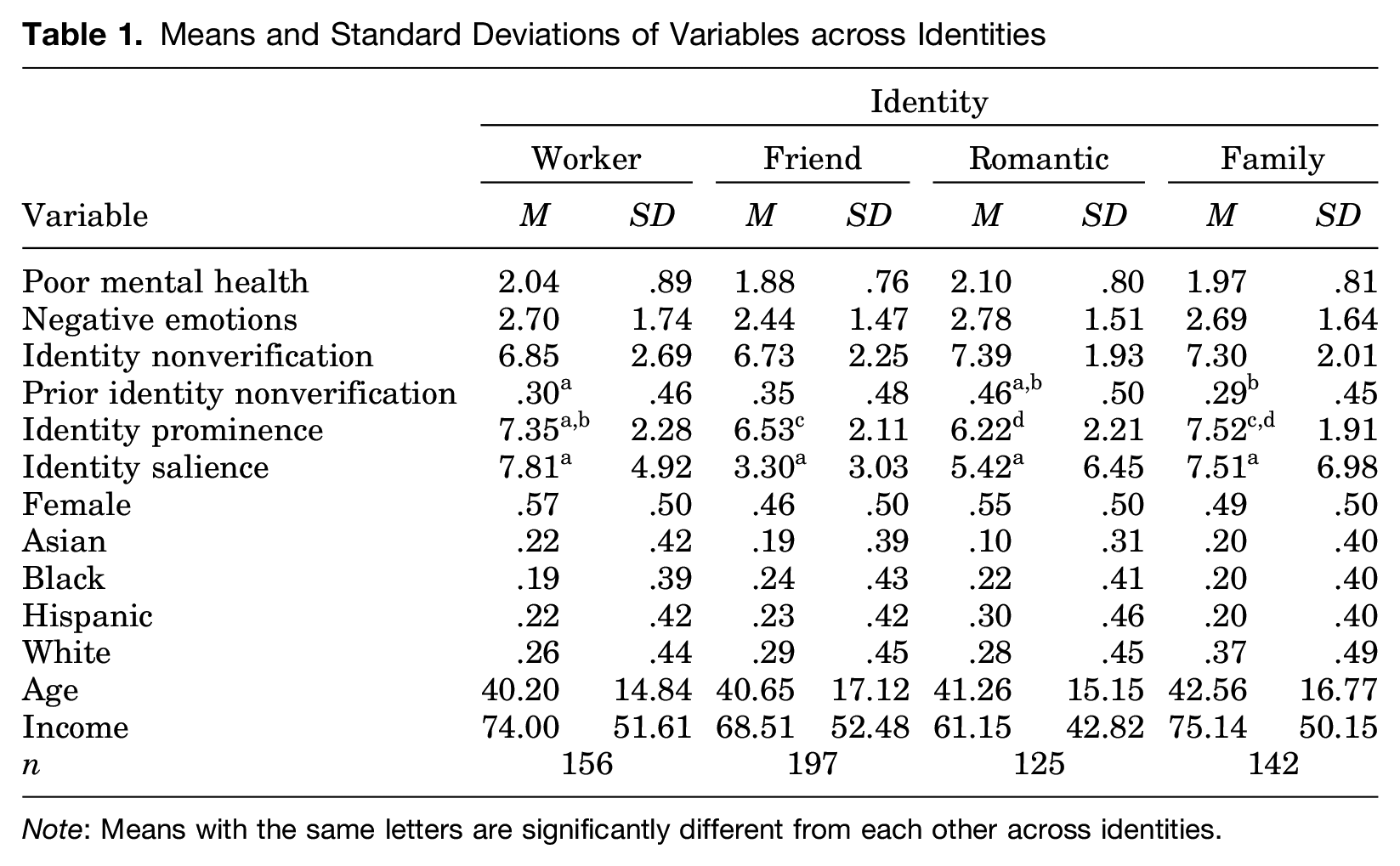
The means for our variables across the worker, friend, romantic, and family identities are in Table 1. Respondents report average levels of mental health problems and negative feelings across the four identities. The level of difficulty across the four identities is high (about 7 on a scale from 0 to 10), indicating that individuals did experience a good deal of nonverification in these identities during the pandemic. Experience of nonverification prior to COVID-19 is more likely to be reported for the romantic identity compared with the worker and family identities. In this way, the romantic identity seems to be a persistent problem for those who report high levels of nonverification; nonverification is not unique to the pandemic time frame.
Means and Standard Deviations of Variables across Identities
Note: Means with the same letters are significantly different from each other across identities.
Across all the identities, respondents indicate that the identity they are having difficulty with is prominent. The family and worker identities are both higher in prominence than the romantic and friend identities. Not surprisingly, the identity that is activated the longest in a 24-hour period is the worker identity. It is salient 46 percent of respondents’ waking hours. 6 The next most activated identity is the family identity (salient about 45 percent of waking hours), followed by the romantic identity and the friend identity (salient about 20 percent of waking hours). 7 The identities generally are equally distributed across the genders. The mean age is about 41. The average income of respondents is approximately $70,000.
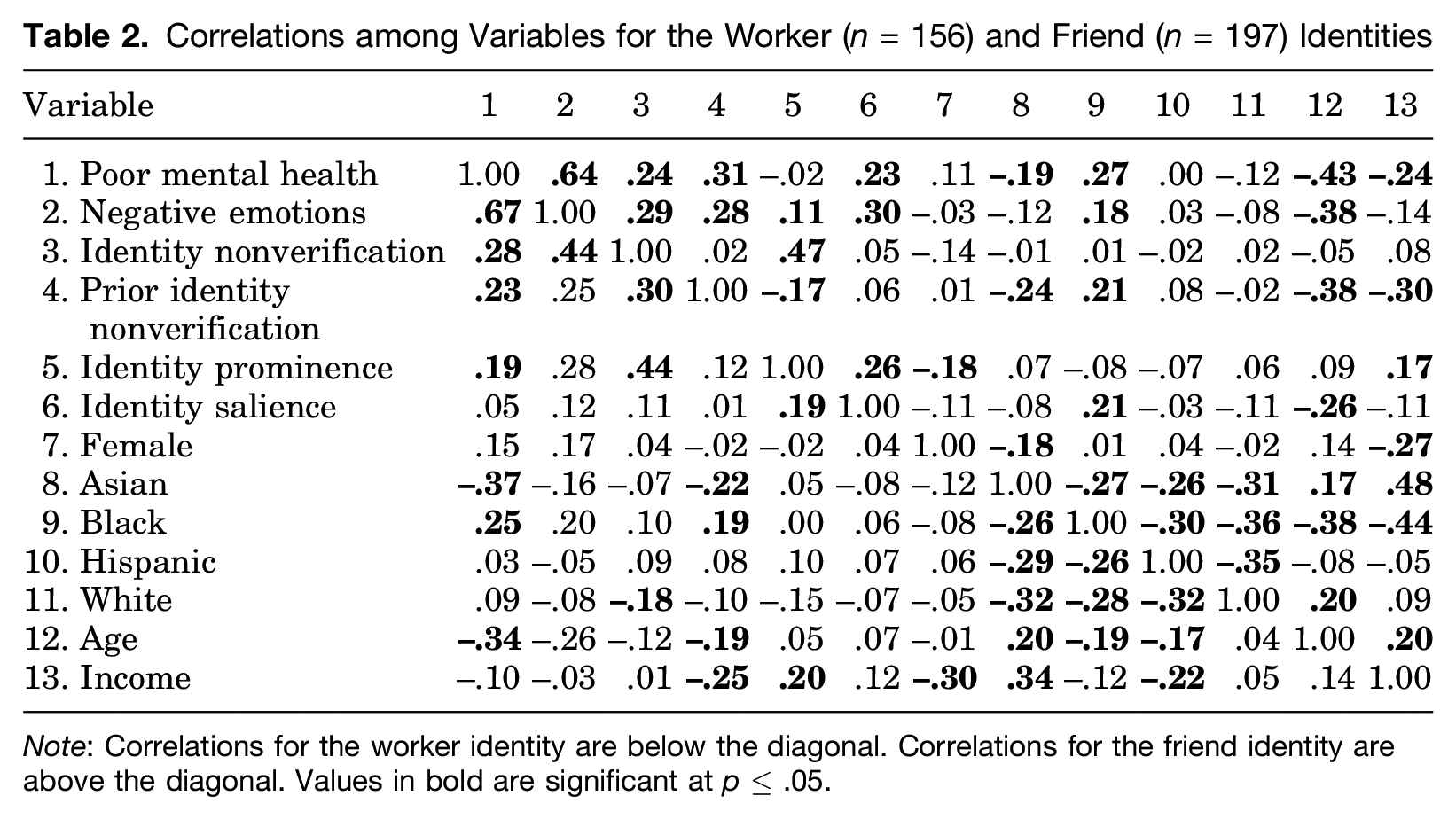
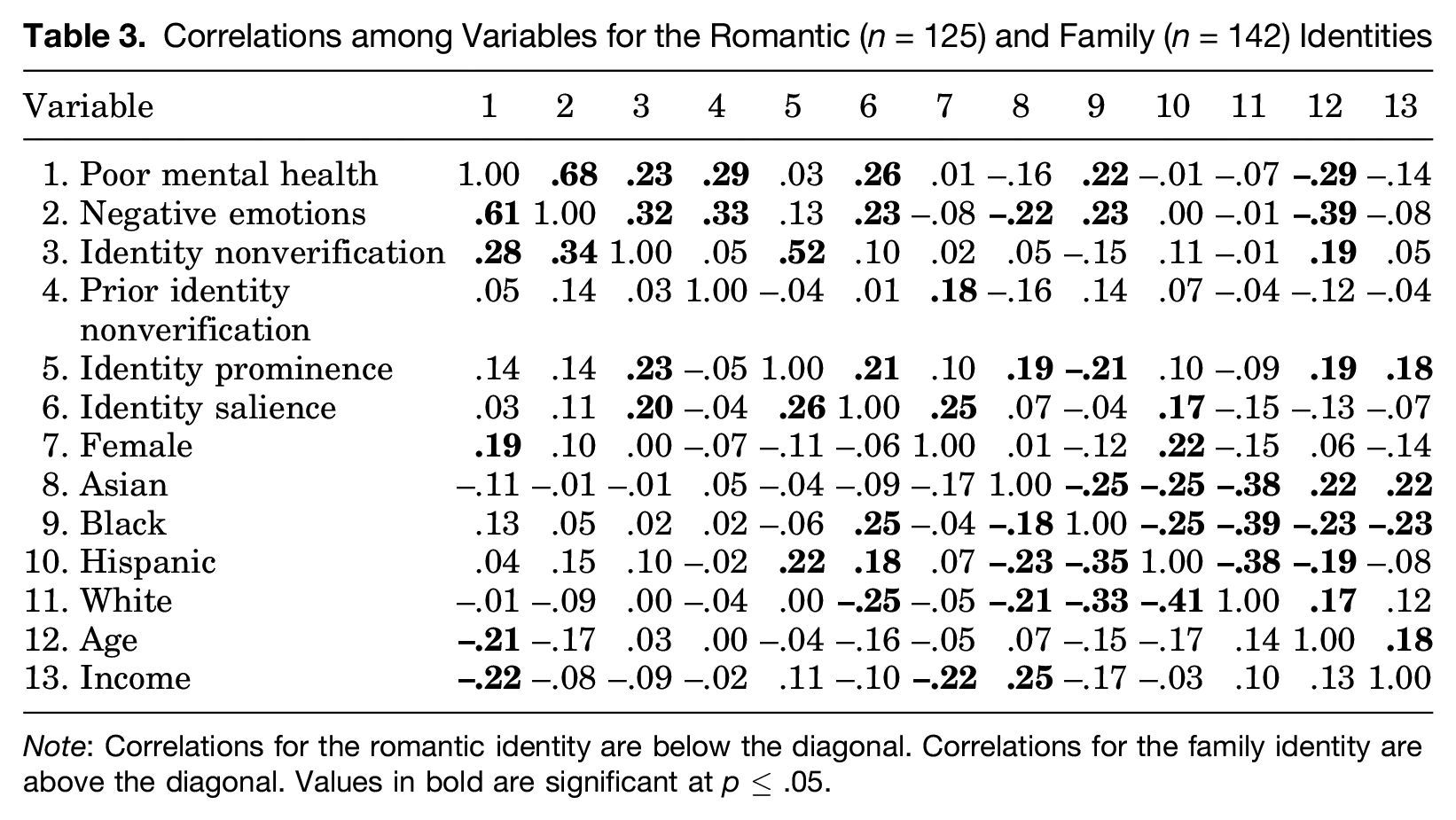
The correlations among the variables across the worker, friend, romantic, and family identities are in Tables 2 and 3. Not surprisingly, there is a strong positive association between poor mental health and negative emotions across the four identities. For identity nonverification, there also is a positive relationship with poor mental health and negative emotions across the four identities. Prior identity nonverification is positively associated with mental health problems and negative feelings for all the identities but the romantic identity.
Correlations among Variables for the Worker (n = 156) and Friend (n = 197) Identities
Note: Correlations for the worker identity are below the diagonal. Correlations for the friend identity are above the diagonal. Values in bold are significant at p ≤ .05.
Correlations among Variables for the Romantic (n = 125) and Family (n = 142) Identities
Note: Correlations for the romantic identity are below the diagonal. Correlations for the family identity are above the diagonal. Values in bold are significant at p ≤ .05.
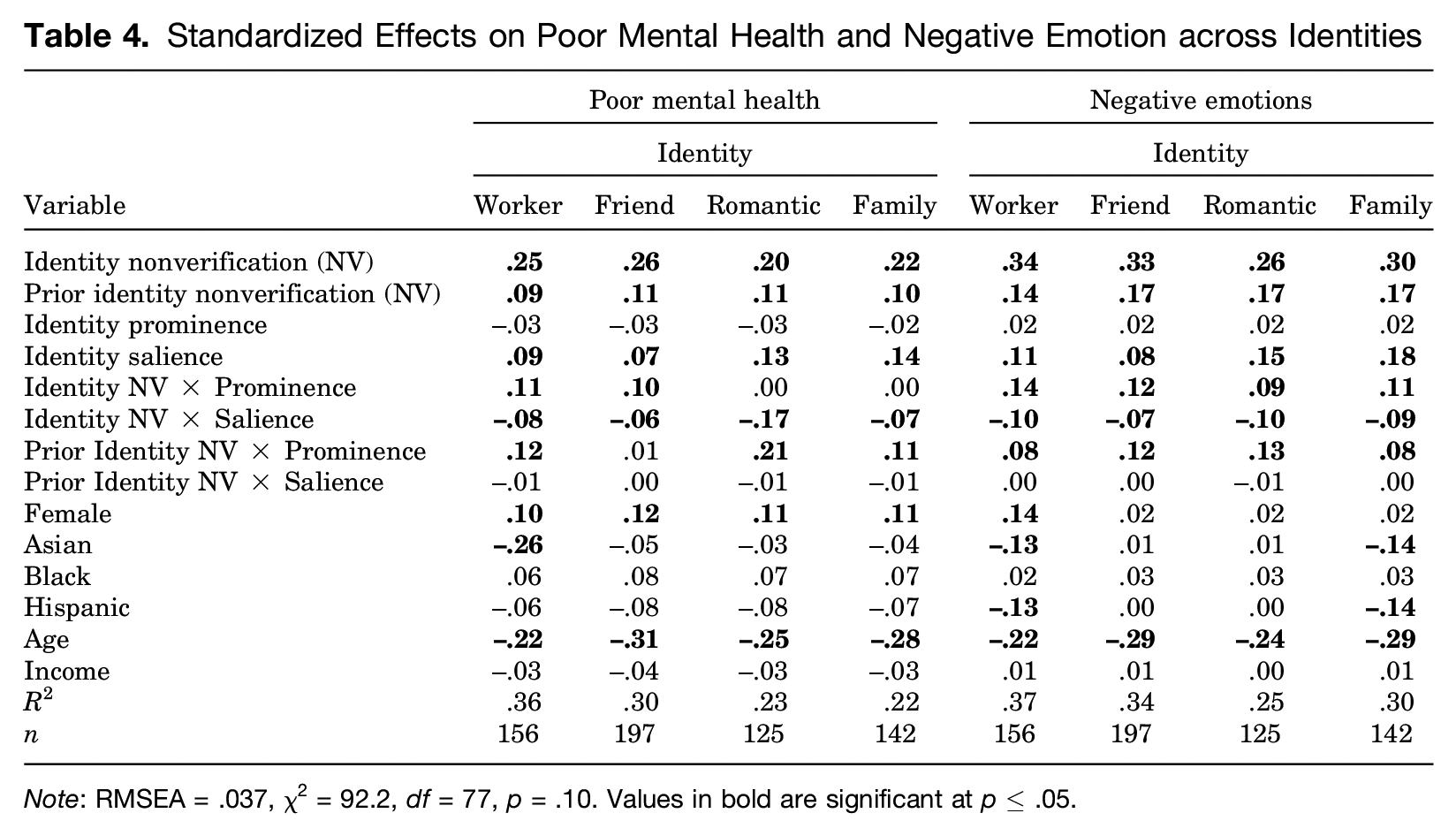
A test for invariance across the four identities in the structural equation model showed that most of the coefficients were not significantly different across the identities, and these coefficients were constrained to be equal. The four effects that did vary by identity will be discussed. The results of our SEM are presented in Table 4. The constrained model fits the data very well (root mean square error of approximation = .036, χ2 76 = 92.9, p = .09). These results reveal significant positive main effects for current and prior experiences of identity nonverification across the four identities even with the interactions in the model. Given the interactions, these main effects of current and prior identity nonverification are the expected effects for those persons with average levels of prominence and salience. These average effects of current and prior identity nonverification increase poor mental health and negative feelings across the identities.
Standardized Effects on Poor Mental Health and Negative Emotion across Identities
Note: RMSEA = .037, χ2 = 92.2, df = 77, p = .10. Values in bold are significant at p ≤ .05.
Interestingly, there is a main effect of salience on mental health and negative emotions across the four identities even when controlling for the interaction effects. For people who have average levels of difficulty playing out the identity, the more time in an identity, the more they experience poor mental health and negative feelings. Thus, a salient identity has an especially troubling effect on respondents’ well-being. Prominence by itself does not have this effect.
Hypotheses 1a and 1b concern the moderating effects of identity prominence on the consequences of nonverification for poor mental health and negative emotions. The expectation is that higher identity prominence would exacerbate the effects of nonverification on poor mental health and negative feelings. A consequence of higher identity prominence is that individuals will work harder at verification such that failure at verification will generate stronger negative outcomes. Additionally, if higher prominence means sharing meanings with other identities, nonverification of one identity also will negatively affect other identities to which it is related, producing even greater negative consequences. In Table 4, we find that the effect of the interaction of prominence and identity nonverification on poor mental health is positive and significant for worker and friend identities but not for romantic and family identities. For negative emotions, the interaction term is positive and significant for all the identities. Thus, for six out of the eight effects, Hypotheses 1a and 1b are supported.
To interpret these effects, we use the worker identity as an example. The average effect of nonverification on poor mental health (β = .25) increases by .11 to a level of .36 for persons one standard deviation higher than average prominence and is decreased by .11 to a level of .14 for persons one standard deviation less than average prominence. The average effects of nonverification on negative emotions are altered by plus or minus .14 for one standard deviation above or below the mean level of prominence. These results are presented graphically in Figures 1 and 2 for mental health and negative emotions.
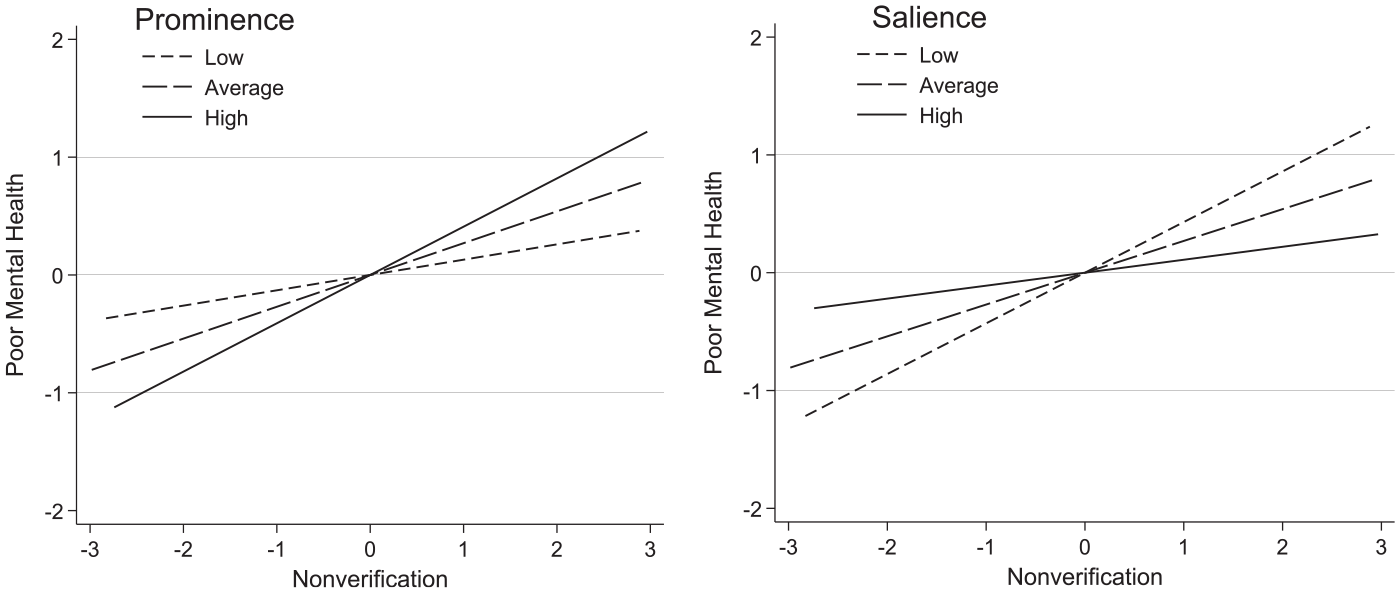
Effects of Nonverification on Poor Mental Health for the Worker Identity, Moderated by Identity Prominence and Salience
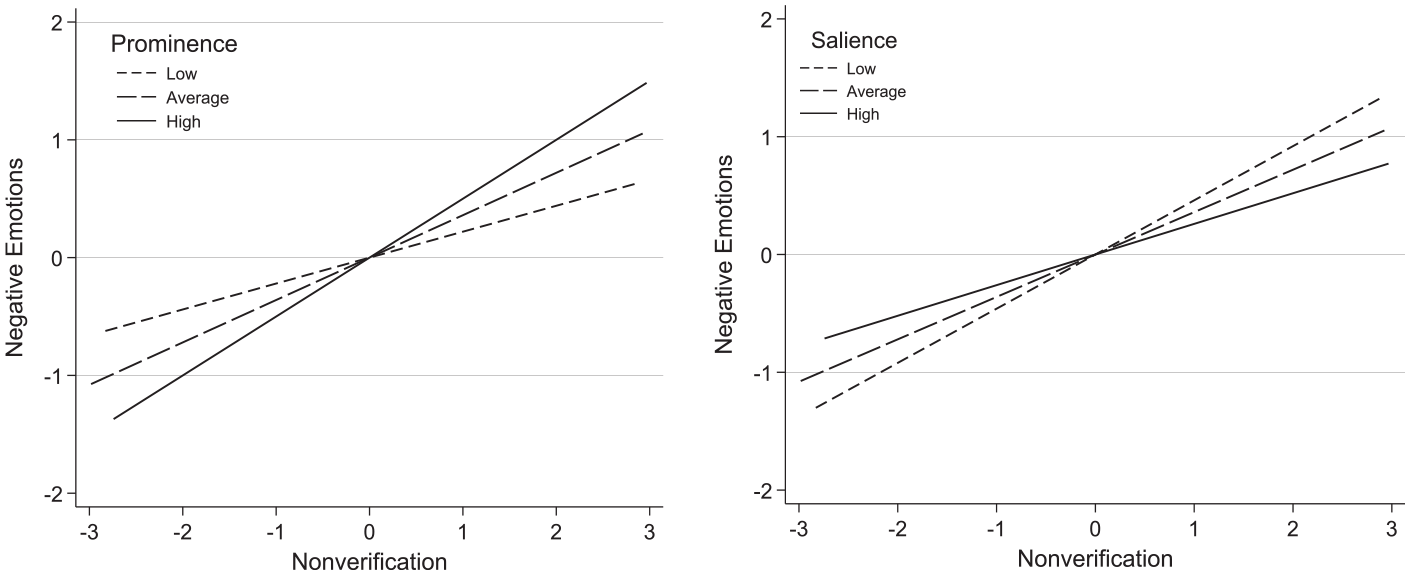
Effects of Nonverification on Negative Emotions for the Worker Identity, Moderated by Identity Prominence and Salience
For the interaction of prominence and identity nonverification prior to the onset of the pandemic, we find similar results. The interaction is positive and significant for poor mental health for all but the friend identity. For negative emotions, the interaction is significant for all the identities. Again, taking the worker identity as an example, the average effect of prior nonverification on poor mental health is increased by .12 to .37 for those with one standard deviation above the mean level of prominence, and it is decreased by the same amount, to a level of .13 for people one standard deviation below the mean level on prominence. The average effects of prior nonverification on negative feelings change by plus or minus .08 for persons one standard deviation above or below the mean level of prominence. In general, we again find support for Hypotheses 1a and 1b with respect to nonverification that occurred prior to the pandemic.
Hypotheses 2a and 2b involve the identity characteristic of salience and its moderating effects on identity nonverification. We anticipate that the more time spent in an identity, the greater the development of skills to manage nonverification, which should have the effect of tempering the negative results that nonverification produces. Table 4 shows a significant, negative interaction for identity nonverification and salience on poor mental health for all identities. For negative emotions, the interaction term also reveals a significant, negative interaction for all the identities. Thus, all eight effects support Hypotheses 2a and 2b.
Once again, we use the worker identity as an example to interpret the effects. The average effect of nonverification on poor mental health (β = .25) decreases by .08 to .17 for persons one standard deviation above the mean on salience, and it is increased by .08 to a level of .33 for people one standard deviation below the mean on salience. The average effect of nonverification on negative feelings are altered by minus or plus .10 for individuals one standard deviation above or below the mean level of salience. These results are presented graphically in Figures 1 and 2. The interaction of identity nonverification and salience prior to the pandemic on mental health and negative emotions is not significant. Thus, we find support for Hypotheses 2a and 2b but only for identities that individuals had trouble playing out during the pandemic. The effects of prior problems with identity verification are not influenced by the level of salience of the identity.
Regarding our background factors, women are more likely than men to experience poor mental health across all four identities. Women also are more likely than men to report negative feelings in the worker identity. In general, compared with White respondents, Hispanic respondents report fewer negative feelings for the worker and family identities but no differences in levels of mental health. Additionally, compared with younger persons, older individuals report better mental health and fewer negative emotions across all the identities.
More generally, our results confirm our expectations regarding the moderating effects of prominence and salience on identity nonverification. Prominence strengthens the negative effects that nonverification produces, while salience weakens those negative consequences. The moderating effects of salience apply to the identities during the pandemic but not prior to it.
Discussion
When people verify their identities, they feel good. When identities are not verified, people feel bad. These consequences are well documented (Burke and Harrod 2005; Burke and Stets 1999; Stets and Burke 2014; Stets and Carter 2012; Stets and Trettevik 2016). What is less well documented are the effects of identity prominence and salience, two characteristics of identities, on this process. Identity theory suggests that prominence or importance of the identity should increase the effects of nonverification, while salience or time in the identity should decrease these effects (Burke and Stets 2023). In the current research, we use a measure of nonverification based on self-appraisals or individuals’ own evaluations of themselves in an identity along with measures of identity prominence and identity salience.
A consequence of higher prominence in any identity is that an individual will be motivated to work harder to verify that identity. If the person finds that nonverification still occurs, the emotional response will be more negative than if the person was not as motivated to work hard in a less prominent identity. We also put forth the idea that prominence can involve shared meanings across identities such that when the meaning in one identity is not verified, that meaning is not verified in identities that share that meaning, thereby generating a stronger negative impact when nonverification occurs. Future research needs to formally test whether higher prominence is equated with an increase in shared meanings across identities, but our findings are consistent with what we would expect if it was occurring. In general, we found that prominence did intensify the negative consequences of nonverification, increasing levels of depression, anxiety, and negative emotions.
The exception to the moderating effect of prominence was that during the pandemic, prominence had no moderating effect on mental health for the romantic and family identities, and prior to the pandemic, there was no moderating effect on mental health for the friend identity. Romantic and family identities are both identities that are forged with an intimate other who may be the source of the nonverification. The means in Table 1 revealed that the family identity had higher prominence compared with the other identities, and the romantic identity had the lowest prominence of all the other identities. Thus, these two identities did not share the same level of prominence. That the prominence of these identities did not have moderating effects on nonverification during the pandemic, but they did have moderating effects prior to the pandemic, suggests that there is something about the pandemic that tempered these effects on anxiety and depression.
In these intimate relationships, individuals already may have been highly motivated to work hard to verify who they were. There were problems that the pandemic posed, including lockdowns that created the inability to easily interact with others, such as romantic partners, and the shift of work to the same space or place as the home, making it difficult to simultaneously fulfill meanings associated with the family identity, such as the spouse identity and parent identity. If people already were motivated to verify their identities, the prominence of their identity appeared to not add anything of significant import to their mental health, even under the additional difficult circumstances of the pandemic. However, this was not the case for the negative emotions associated with nonverification because the prominence of their identity did matter in strengthening their negative emotions.
For the moderating effects of salience, new to this research is the use of a different, more direct measure of salience, operationalized as the amount of time an identity is active in a 24-hour period. While a 24-hour period is arbitrary, we thought that using an average day would be easier for respondents to consider and thus would allow them to give a more accurate judgment about how long they were performing an identity.
We hypothesized that identity salience would weaken the effects of nonverification rather than strengthen them, as in the case for identity prominence. When people are in an identity for extended periods of time (high salience), they become more experienced and adept in the identity verification process and they are better able to deal with problems that arise. High salience, as a result, should reduce the negative impact of nonverification as people are better able to deal with the situation. The results of our analysis confirmed these hypotheses across most of the identities but only during the period of the pandemic. There were no moderating effects of salience prior to the pandemic.
Like the moderating effects of prominence on mental health, we found that the moderating effects of salience did not hold for the romantic and family identities. As discussed with respect to the effects of prominence, the means in Table 1 indicated that when respondents reported difficulty playing out the family identity, it was significantly higher in salience than the salience of the romantic identity. Thus, like the prominence of these two identities, they did not share the same level of salience. Again, the context of the pandemic may provide some insight on the unique effects for romantic and family identities.
Individuals already could have been working hard to verify who they were amid a crisis in society where a disease uprooted people’s daily routine, caused severe illness and sometimes death to loved ones, and generated severe stress as individuals did more with fewer resources. Those in the romantic and family identities may have been working in “overdrive” to find ways to respond to nonverifying experiences such that, like the prominence of these identities, their salience did not significantly add to their mental health outcomes. However, like the effects of prominence, this was not the case for the negative emotions associated with nonverification because the salience of their identity did matter in strengthening their negative emotions.
The fact that salience moderates the negative effects of nonverification during the pandemic and not prior to the pandemic suggests that longer time in an identity during a persistent and taxing situation like a pandemic may result in individuals becoming quite effective in responding to nonverifying experiences over time such that the negative consequences diminish. An effective response may involve changing behavior to modify situational meanings or changing an understanding of meanings in the situation. If nothing else occurs, the identity standard meanings will change toward the situational meanings. Each of these would lead to reducing the discrepancy between the meanings as to who people are in situations and their identity standard meanings. Reducing this discrepancy would temper the poor mental health and negative feelings associated with it.
An alternative explanation regarding the conditions under which salience moderates the effects of nonverification has to do with measurement. Our hypotheses generally were supported for the measure of current nonverification in which the full range of difficulty (from 0 to 10) was indicated. The greater the salience, the less effect nonverification had on mental health and negative emotions. The hypotheses were not supported using the truncated measure where respondents indicated the presence or absence of difficulty with the identity prior to the pandemic. It is possible that without measuring the full range of problems people had playing out an identity prior to the pandemic, there was less effect to be moderated, though that was not a problem for the moderating effects of prominence. Future research will have to explore this.
In general, the countervailing effects that prominence and salience produce as moderators can be understood in the following way. Prominence serves as a motivator to engage in an identity and, when activated, to work hard to verify the identity. When verification does not emerge in more prominent identities, the negative consequences of nonverification will be more strongly felt. The longer an identity is activated (salience), that is, the more time individuals spend performing an identity, the more practiced and successful they become in verifying an identity, and the more they should experience good mental health and positive feelings.
These findings generally apply to all the identities we examined. We can think of these identities as forged in networks, however small or large, that run from the less intimate (the worker identity) to the more intimate (the friend identity) to the most intimate (romantic and family identities). Thus, the moderating effects of prominence and salience apply to identities that vary along the dimension of intimacy. However, these identities are normative, and whether these moderating effects occur for counternormative identities is not answered (Markowski and Serpe 2018). When individuals deviate from social norms, they have more nonverifying experiences in the same way that a pandemic produces an excess of nonverifying experiences. In this way, we may find the current results are also applicable to counternormative identities.
Practically speaking, prominent identities create a double-edged sword. Compared with less prominent identities, the verification of more prominent identities generates more positive feelings, but when they are not verified, they produce more negative feelings. Thus, individuals are much better off if they experience nonverification in less prominent than more prominent identities. This leaves people who have many prominent identities vulnerable to its deleterious effects. Since those with more prominent identities get off track more easily or are more easily threatened by nonverification, they may be more attentive, focused, or oriented to matching self-in-situation meanings with identity standard meanings when nonverification occurs. However, this may be particularly challenging when they are simultaneously experiencing negative feelings, which may hijack clear thinking.
Once an identity is activated, individuals can reap the benefits of staying in the identity longer, or maintain identities that are higher in salience, because when nonverification emerges, they are better equipped, through learning, to respond to it, thereby tempering the negative consequences. This suggests resilience to the effects of nonverification. We think that the greater skill that accumulates over time given more time in an identity facilitates quicker recovery from nonverification, getting individuals back on track in matching situational meanings with identity standard meanings. Nonverification is an inescapable reality of life. Depending upon where the level of prominence and salience is set will make it more (or less) difficult to return the individuals to a verifying state.
Supplemental Material
sj-pptx-1-spq-10.1177_01902725231202255 – Supplemental material for Prominence and Salience Effects on Identity Nonverification
Supplemental material, sj-pptx-1-spq-10.1177_01902725231202255 for Prominence and Salience Effects on Identity Nonverification by Peter J. Burke and Jan E. Stets in Social Psychology Quarterly
Footnotes
Appendix
Principal Components Factor Analysis of Negative Emotions
| Item | Loading |
|---|---|
| Sad | .82 |
| Angry | .83 |
| Fear | .81 |
| Guilt | .86 |
| Shame | .81 |
| Disgust | .82 |
| Ω Reliability | .93 |
Supplemental Material
Supplemental material for this article is available online.
1
Early researchers who studied identities often have used the term salience to mean “importance,” thus producing a confusion between salience and prominence (Morris 2013; Serpe 1987; Serpe and Stryker 1987; Stryker and Serpe 1982,  ).
).
2
Since properly playing out the identity is what verification means, having trouble playing out the identity means some degree of nonverification; hence this framing will tend to select identities that experienced nonverification, which is the focus of the current article. Nevertheless, the amount of difficulty reported by respondents ranged across the whole scale (see ).
3
Happiness, pride, and hope also were asked, but they did not factor into the scale.
4
5
Some prior indicators of salience use the likelihood of mentioning the identity when first meeting someone (Brenner et al. 2014; Merolla etal. 2012; Stryker and Serpe 1994). This procedure has been criticized because the person may not mention an identity if they know or assume that others in the situation already have this information or the identity may not be relevant in the situation (Brenner et al. 2023; ).
6
We assumed waking hours to be 17 hours (24 – 7 hours of sleep).
7
Percentages do not add to 100 because they are based on different individuals selecting different identities.
Bios
References
Supplementary Material
Please find the following supplemental material available below.
For Open Access articles published under a Creative Commons License, all supplemental material carries the same license as the article it is associated with.
For non-Open Access articles published, all supplemental material carries a non-exclusive license, and permission requests for re-use of supplemental material or any part of supplemental material shall be sent directly to the copyright owner as specified in the copyright notice associated with the article.
