



Abstract
Next to their well-documented authoritarian cultural agenda, new-rightist populist parties have developed specific views on the welfare state: welfare chauvinism and welfare populism. This article studies the electoral relevance of these views for Dutch new-rightist populist parties by means of survey data representative of the Dutch population (N = 1972). The electorate of those parties shows high levels of both welfare chauvinism and welfare populism. However, only welfare populism underlies support for new-rightist populist parties in addition to well-known cultural motives. Based on these findings, ideological and electoral competition between political parties is discussed, and suggestions for further research are provided.
Introduction
New-rightist populist parties have been electorally successful all over Europe since the 1980s (Elchardus, 1996; Ignazi, 2003). Well-known and politically influential examples are the Freedom Party of Austria (Freiheitliche Partei Österreichs), the Danish People’s Party (Dansk Folkeparti) in Denmark, Flemish Interest (Vlaams Belang) in Flanders, and Geert Wilders’ Party for Freedom (Partij Voor de Vrijheid or PVV) in the Netherlands. Research has convincingly shown that electoral support for such parties is to a large extent rooted in discontents about immigration and ethnic diversity (Ivarsflaten, 2008; Rydgren, 2008; Van der Brug, 2003). As such, it is not surprising that they have been frequently labeled as ‘anti-immigration parties’ (see, for example, Rink et al., 2009; Van der Brug et al., 2000, 2005) and ‘movements of exclusion’ (Rydgren, 2005). In addition, it has been observed that the electorate of these parties is driven not only by xenophobia and skepticism about immigration, but also by feelings of political discontent (Rydgren, 2007).
However, politics obviously involves much more than just conflicts about immigration and articulations of discontent. Traditionally, economic issues and issues pertaining to the welfare state have been the focal point of western politics, and these issues continue to be important (Achterberg, 2006; Stonecash, 2000). Therefore, it does not come as a surprise that new-rightist populist parties have developed economic agendas about the welfare state next to their cultural ones (see, for example, Banting, 2010: 798; Rydgren, 2004: 486). Although scholars generally place these parties at the far-right end of the political spectrum, new-rightist parties do not necessarily adopt typical rightist stances when it comes to issues of economic redistribution and the state. These parties are not by definition opposed to high levels of economic redistribution from the rich to the poor, economic interference by the state, and an extensive welfare state. As new-rightist populist parties typically cater to the needs of the native ‘common man’ (Derks, 2006), which are believed to be of primary importance (compare Fennema, 2005: 10–11), adopting an economic agenda that serves these needs can be advantageous to new-rightist populist parties. Since the economic interests of the potential electorate of these parties are not in line with traditional right-wing stances on economic redistribution and the welfare state (compare Van der Waal et al., 2007), the economic agenda of new-rightist populist parties is often markedly different from that of traditional right-wing parties.
In short, new-rightist populist parties not only have cultural agendas, but may also distinguish themselves by means of a newly developed welfare agenda emphasizing the interests of the native ‘common man.’ Whereas the cultural motives for voting for these parties pertaining to ethnocentrism and discontent have been well documented, the question is still open as to what extent distinctive new-rightist populist welfare agendas are also important in electoral terms. In answering this question we focus on the Netherlands, where various new-rightist populist parties have rapidly gained electoral success since the rise of the late Pim Fortuyn in 2002. More specifically, we analyze the extent to which the electorate of new-rightist populist parties is characterized by populist views on the welfare state and to what extent this drives its voting behavior. In short, in this article we investigate the degree to which populist stances vis-a-vis the welfare state are relevant for support for new-rightist parties, in addition to well-documented stances toward cultural issues.
New-rightist populism and the welfare state
Positioning new-rightist populist parties in political space
Inglehart has argued that ‘postmaterialist’ values such as individual liberty and self-attainment occupy center stage in western countries. This idea has spawned a vast literature on the emergence of a so-called ‘new political culture’, which has increasingly overshadowed an ‘old political culture’ focusing on the distribution of scarce resources between social classes. 1 This new political culture was politically articulated by the emergence of left-libertarian parties such as Les Verts in France, Die Grünen in Germany, and GroenLinks in the Netherlands (Inglehart, 1990: 281–3). As a result, the idea that ‘there are now two Lefts’ (Lipset, 1981: 510) has been a mainstay in both political sociology and political science from the 1970s onward (compare Weakliem, 1991). Whereas the old left is still, primarily, defined by its progressive stance on economic issues, the new left is primarily defined by a progressive stance on cultural issues.
Inglehart’s influential theory has, however, been contested. Critics have argued that it is unwarranted to exclude the possibility of ‘rightist-authoritarian postmaterialism’ by definitional fiat (Flanagan, 1979, 1987; Middendorp, 1991: 262). Because of the emergence of new-rightist populist parties in recent decades, mockingly referred to as a ‘silent counter-revolution’ (Ignazi, 2003; Van der Waal and Achterberg, 2006), there are not only ‘two lefts’, but also ‘two rights’: the old right is still primarily defined by its anti-egalitarian stance on economic issues, while the new right is primarily defined by an authoritarian stance on cultural issues. This idea that political space is organized along two dimensions, yielding two lefts and two rights, is relatively new. Scholars such as Kriesi et al. (2008), Kitschelt (1995), and Houtman and Achterberg (2010a) have successfully used these dimensions to describe the political landscape at the party level. 2
On the level of the public at large, evidence of a bi-dimensional structure in ideological beliefs mirroring the one at the level of political parties is abundant. 3 The first dimension is ‘socioeconomic’, revolving around the question of how equal society should be. Issues on this socioeconomic dimension pertain to differences in wealth and income, pitting leftist egalitarians against rightist anti-egalitarians. The second dimension addresses the ‘cultural’ domain, pitting leftist libertarians against rightist authoritarians. The former celebrate individual freedom and cultural diversity, while the latter desire a rigid moral and cultural order. 4
The question is how the political agendas of new-rightist populist parties fit into this bi-dimensional political space. Whereas these parties share an egalitarian economic agenda with leftist ones (Derks, 2006), they can be placed on the rightist authoritarian extreme when it comes to their cultural agenda. New-rightist populist parties are the fiercest proponents of a radical restoration of the moral and cultural order that has, in their view, most notably been violated by the influx of immigrants in recent decades (Ignazi, 2003). While these leftist economic and rightist cultural agendas can be easily positioned on the two ideological dimensions found among the public at large (compare Green-Pedersen and Van Kersbergen, 2002: 510), it is complicated to do so when it comes to their welfare agenda. This agenda does not neatly fit in either one of these dimensions: because it relates to issues of economic redistribution, it is not well covered by the cultural dimension, while the populist welfare agenda entails more than redistribution alone. Instead, it critically addresses economic redistribution through the institution of the welfare state, which redistributes to immigrants and is believed to cater to people undeserving of its services. Below, we will delve more deeply into this welfare agenda, and we will assess whether supporters of new-rightist populist parties differ in this respect from supporters of other Dutch political parties. This will shed light on the question of whether the new right’s welfare agenda appeals to its constituency at all, in addition to their well-documented authoritarian cultural motives.
Welfare chauvinism and welfare populism
The first reason why new-rightist populist parties developed a welfare agenda is that the question of immigration also relates to the welfare state. This part of their argument does not entail a critique of the welfare state in itself, but rather addresses its intrinsic universal nature in western democracies. In European countries, entitlements to welfare services are for the most part irrespective of one’s origins. This has been fiercely criticized by new-rightist parties, which would like to restrict welfare entitlements to the native population (Banting, 2010: 798) – and in some countries (for example, Denmark) the new right has succeeded in changing social policies by introducing the ‘length-of-stay’ principle for welfare eligibility, which to a certain degree excludes foreign-born immigrants from welfare entitlements. The new-rightist critique of the welfare state should, however, not be interpreted as a rejection of economic redistribution as such – after all, most new-rightist populist parties have a quite ‘progressive’ or ‘leftist’ profile when it comes to the redistribution of scarce economic resources (Derks, 2006). Consequently, many new-rightist populist parties stand out not only because of their well-known rightist cultural agenda, but also because they combine economic egalitarianism with the stance that entitlement to welfare arrangements should be restricted to the native population. As such, they add an ethnically exclusionist dimension to the welfare state, which is commonly deemed a socioeconomic issue par excellence (Svallfors, 1997).
Similar sentiments can be found among the public. The native population in many European countries consider immigrants less entitled to welfare services than needy natives, such as the elderly, the handicapped, and the unemployed (Bay and Pedersen, 2006; Van Oorschot, 2006). A combination of strong support for economic redistribution with resistance toward distributing welfare services to immigrants has become known as ‘welfare chauvinism’ (Van der Waal et al., 2010). This term was introduced by Andersen and Bjørklund (1990), 5 who aptly summarized the underlying sentiment as the idea that ‘welfare services should be restricted to our own’ (1990: 212). Welfare chauvinists, in short, do not oppose economic redistribution in itself (on the contrary, they are egalitarian), but want this redistribution to be restricted to the native population. Welfare chauvinism, thus, is the specific combination of egalitarian views on the one hand and restrictive views pertaining to the deservingness of immigrants on the other hand (Van der Waal et al., 2010). 6
The finding that welfare chauvinism can be found among the public suggests that the welfare agenda of new-rightist populist parties appeals to parts of the electorate. If so, the welfare agenda of new-rightist populist parties might be right on the mark: it appeals to a share of the electorate in a way that the stance of no other party does (Van der Waal et al., 2007). Consequently, welfare chauvinism might be an additional reason (that is, besides authoritarian cultural motives) for supporting such parties.
In line with the anti-establishment attitudes and the ‘anti-institutional mood’ (Zijderveld, 2000) characteristic of populism (Elchardus, 2002), new-rightist populist parties also criticize the institution of the welfare state itself, despite their economic egalitarianism. The second part of their welfare agenda is their claim that the welfare state is not adequately aimed at helping poor common people who are ‘really’ in need and hence deserving of assistance. New-rightist parties argue that the welfare state, instead, provides well-paid and comfortable jobs for self-interested civil servants who cater to a class of ‘welfare scroungers’ that freeload on the hard work of the ‘common man’ (Andersen, 1992). Not unlike socialism in the past, then, new-rightist populist parties make a bid for the status of the only true advocates of economic egalitarianism and the interests of the ‘common man’ (compare Betz, 1994; Mény and Surel, 2000). In effect, even though these parties do not reject economic egalitarianism, they offer a harsh critique of the welfare state. This ideological profile strikingly contradicts the notion that economic egalitarianism and support for the welfare state are basically two of a kind. In what follows, we will label this profile (that is, the specific combination of egalitarianism and a critical view pertaining to the welfare state) as ‘welfare populism.’ 7
Traces of such welfare populism can also be found among the public. Recent research has shown that while the lower educated and people in lower social classes tend to display aversion to the welfare state, they do not combine their critiques on the welfare state with the traditional rightist rejection of the quest for economic equality (Houtman et al., 2008). On the contrary, just like new-rightist populist parties, they combine their critiques on the welfare state with economic egalitarianism (Achterberg et al., 2011). That this combination can be found among substantial parts of the electorate suggests that the welfare populism of new-rightist populist parties might appeal to them. Just like their welfare chauvinism, the welfare populism of parts of the electorate might therefore underlie support for new-rightist populist parties, in addition to their cultural motives.
In sum, the welfare agenda of new-rightist populist parties is characterized by both welfare chauvinism and welfare populism. Next to their authoritarian cultural agenda, they aim at restricting welfare services to the native population. In addition, new-rightist populist parties aim to ‘reclaim’ those services from the ‘bureaucrats’ and ‘welfare scroungers’ that ‘abuse them’ at the cost of their ‘rightful owners’: the common man who is falling on hard times. Since welfare chauvinism and welfare populism can also be found among the public, it might be that the welfare agenda of the new-rightist populist parties strikes a chord among parts of the electorate. The question therefore is to what extent support for new-rightist populist parties is driven by welfare chauvinism and welfare populism among the electorate, in addition to the cultural motives that are commonly assumed to underlie the new-rightist populist vote. Put differently, to what degree do new-rightist populist parties rely on their specific welfare agenda, in addition to their cultural one, in order to appeal to the electorate?
To answer this question we test five hypotheses. First, in order to be able to distinguish between welfare chauvinism (a combination of egalitarianism with a low level of support for redistribution to immigrants) and welfare populism (a combination of egalitarianism with critical views of the welfare state), one should be able to distinguish three ideological domains: egalitarianism, support for redistribution to immigrants, and a critical view pertaining to the welfare state (hypothesis 1). Furthermore, we expect that voters for new-rightist populist parties are welfare chauvinists, that is, they are expected to combine egalitarianism with low levels of support for redistribution to immigrants (hypothesis 2). In addition, we expect that voters for these parties are welfare populists, that is, we expect these voters to combine egalitarianism with a critical view toward the welfare state (hypothesis 3). While the corroboration of these hypotheses would show that both welfare chauvinism and welfare populism can be found among the electorate of new-rightist populist parties, it would not in itself indicate whether these two ideological profiles actually have electoral consequences in addition to the well-known authoritarian cultural values of new-rightist populist parties’ constituencies. That is why we will also test two further hypotheses: people cast their vote for new-rightists populist parties instead of for others on the basis of welfare chauvinism (hypothesis 4) and on the basis of welfare populism (hypothesis 5), in addition to their cultural motives. In technical terms, this means that in explaining voting behavior we expect significant interaction terms for egalitarianism with, on the one hand, support for redistribution to immigrants (hypothesis 4), and with critical views pertaining to the welfare state (hypothesis 5) on the other hand.
Data and measures
We use a survey of a representative sample of the Dutch public in 2006, which was designed to monitor stances vis-a-vis the welfare state. It offers a comprehensive set of internationally validated scales and items, enabling us robustly to test our hypotheses. In all 2682 individuals were contacted, 1972 of whom actually completed the questionnaire, yielding a response rate of 73 percent. A comparison with official statistics from Statistics Netherlands showed that older people, higher income categories, and higher educational categories were somewhat overrepresented, which we corrected by weighting the data. 8
As discussed above, welfare chauvinism and welfare populism are specific combinations of egalitarianism with low support for redistribution to immigrants and a critical view pertaining to the welfare state, respectively. Of course, in order to study the existence of such welfare populism and welfare chauvinism, and their electoral consequences, we need to measure these three ideological views separately. We measured egalitarianism using the following five items previously used by Houtman (2003).
Ega1: The state should raise social benefits.
Ega2: There is no longer any real poverty in the Netherlands.
Ega3: Large income differences are unfair because everyone is essentially equal.
Ega4: The state should intervene to reduce income differences.
Ega5: Companies should be obliged to allow their employees to share in the profits.
To measure support for redistribution to immigrants, we used the following four items previously used by Van der Waal et al. (2010).
RedIm1: In the future, non-western immigrants should have fewer entitlements to social assistance than Dutch natives.
RedIm2: In the future, western immigrants should have fewer entitlements to social assistance than Dutch natives.
RedIm3: In the future, economic refugees should have fewer entitlements to social assistance than Dutch natives.
RedIm4: In the future, political refugees should have fewer entitlements to social assistance than Dutch natives.
We measured a critical view pertaining to the welfare state with seven items that voice negative and critical opinions about the welfare state. These were previously used by Achterberg et al. (2011) and are as follows.
Crit1: The welfare state makes people lazy.
Crit2: The welfare state worsens the position of the Netherlands in relation to other countries.
Crit3: Because of the welfare state, people no longer take care of themselves.
Crit4: Because of the welfare state, labor costs are becoming too high.
Crit5: Because of the welfare state, people do not take care of each other anymore.
Crit6: The welfare state causes economic recession.
Crit7: Because of the welfare state, unemployment rates are rising.
For all these items, we used response categories ranging from ‘totally agree’ (1) to ‘totally disagree’ (5) and treated ‘don’t know’ answers as missing. Where needed, items were recoded in such a way that higher scores stand for more progressive opinions on the items for egalitarianism and support for redistribution to immigrants. The items for a critical view pertaining to the welfare state were recoded in such a way that higher scores stand for a more critical view.
For the measurement of attitudes on cultural issues we used a seven-item selection from the well-known F-scale for authoritarianism by Adorno et al. (1950), which is internationally validated and widely used in political-sociological studies (see, for example, Achterberg and Houtman, 2009; De Koster and Van der Waal, 2007; Middendorp, 1989, 1991). This scale proves to be closely connected to the political distrust characteristic of populism (Elchardus, 1996: 52–3), and the comparative research of Meloen et al. (1996) demonstrates that it is as good an indicator of ethnic intolerance as the scale developed by Altemeyer (1988). Respondents were asked to indicate whether they agreed (answers ranging from 1 for ‘totally agree’ to 5 for ‘totally disagree’) with the following statements.
Young people often revolt against social situations that they find unjust; however, when they get older they ought to become resigned to reality.
What we need are fewer laws and institutions and more courageous, tireless, and devoted leaders whom people can trust.
Because of rapid changes it is hard to distinguish good from bad.
There are two sorts of people: the strong and the weak.
Most of our social problems would be solved if we could somehow get rid of immoral, crooked, and feebleminded people.
If people would talk less and work harder everything would be better.
Because of the many opinions on good and bad, it is not clear what is what.
Again, the ‘don’t know’ answers were coded as missing. A factor analysis of the responses to these seven items showed that there was a first factor with an eigenvalue of 2.89 explaining 41 percent of the variance. After standardizing the items, we constructed a reliable scale (Cronbach’s α = 0.80) by calculating mean scores – higher scores on this scale stand for higher levels of authoritarianism. 9
Voting behavior was measured by asking which party respondents would vote for if elections were to be held tomorrow. Apart from distinguishing new-rightist populist parties from, respectively, the old right, the old left, and the new left (compare Houtman and Achterberg, 2010a), we include a separate category for Christian parties because these take a distinctive position in Dutch politics, with its history of ‘pillarization’ (De Koster and Van der Waal, 2007; Lijphart, 1975; Van Kersbergen, 1994). Those indicating a vote for Geert Wilders’ PVV or One Netherlands (EénNL) were coded as new right-wing populist partisans (3.9 percent). 10 Respondents voting for the Conservatives (VVD) were coded as old rightist (9.4 percent). Those voting for Labor (PvdA) or the Socialists (SP) were coded as old left-wing partisans (30.6 percent) and those voting for the Greens (GroenLinks) or Democrats’66 (D66) were coded as new leftist (6.9 percent). Finally, respondents indicating a vote for the Christian Democrats (CDA) or either one of the two small Christian parties (the Christian Union or CU and the Reformed Political Party or SGP) were coded into one ‘Christian’ category (22.8 percent). Those indicating that they would not vote, would not know whom to vote for, did not want to disclose this information, or would cast a blank vote (25.3 percent) were excluded from the analysis, as were those respondents who indicated a vote for the Party for the Animals (1.0 percent) or ‘other’ parties (0.01 percent).
We measured the control variable education as the number of years needed to attain one’s highest level of education, ranging from primary education (8 years) through to a university degree (18 years). To measure the control variable net household income, respondents were asked into which of the following four categories their monthly net household income fell: (1) €1150 or less, (2) €1151–€1800, (3) €1801–€2600, and (4) €2601 or more.
In order to control for welfare dependency, we asked respondents whether they were dependent on a number of social security benefits (unemployment benefits, early retirement pensions, incapacity benefits, illness benefits, or the only means-tested benefit, social assistance) at the time of the survey. Respondents answering affirmatively to one of these questions were assigned a 1, while all others were assigned a 0. Since women are, on the one hand, more supportive of the welfare state and economically egalitarian policies (Edlund, 1999; Svallfors, 1997) and, on the other hand, less attracted to new-rightist populist parties (Norris, 2005: 145), we also add gender (assigning 1 to males and 2 to females) as a control variable in our analyses.
Results
First, we assess whether there are three largely independent ideological domains, as predicted by our first hypothesis. In Figures 1 and 2, the results of confirmatory factor analyses are shown, in which it is tested whether these three indicators can be conceived as stemming from one dimension of generalized support for the welfare state (Figure 1) or as separate scales tapping three different ideological dimensions (Figure 2). The strong decrease in chi-square and Consistent Akaike Information Criterion (CAIC), while using merely three degrees of freedom, and the better fit statistics for Incremental Fix Index (IFI) and the root mean square error of approximation (RMSEA) all demonstrate that each cluster of indicators measures a specific dimension. Hence, three separate scales were construed, by standardizing the items and then calculating mean scores. 11 Higher scores on these scales stand for more egalitarianism, more support for redistribution to immigrants, and a more critical view pertaining to the welfare state.
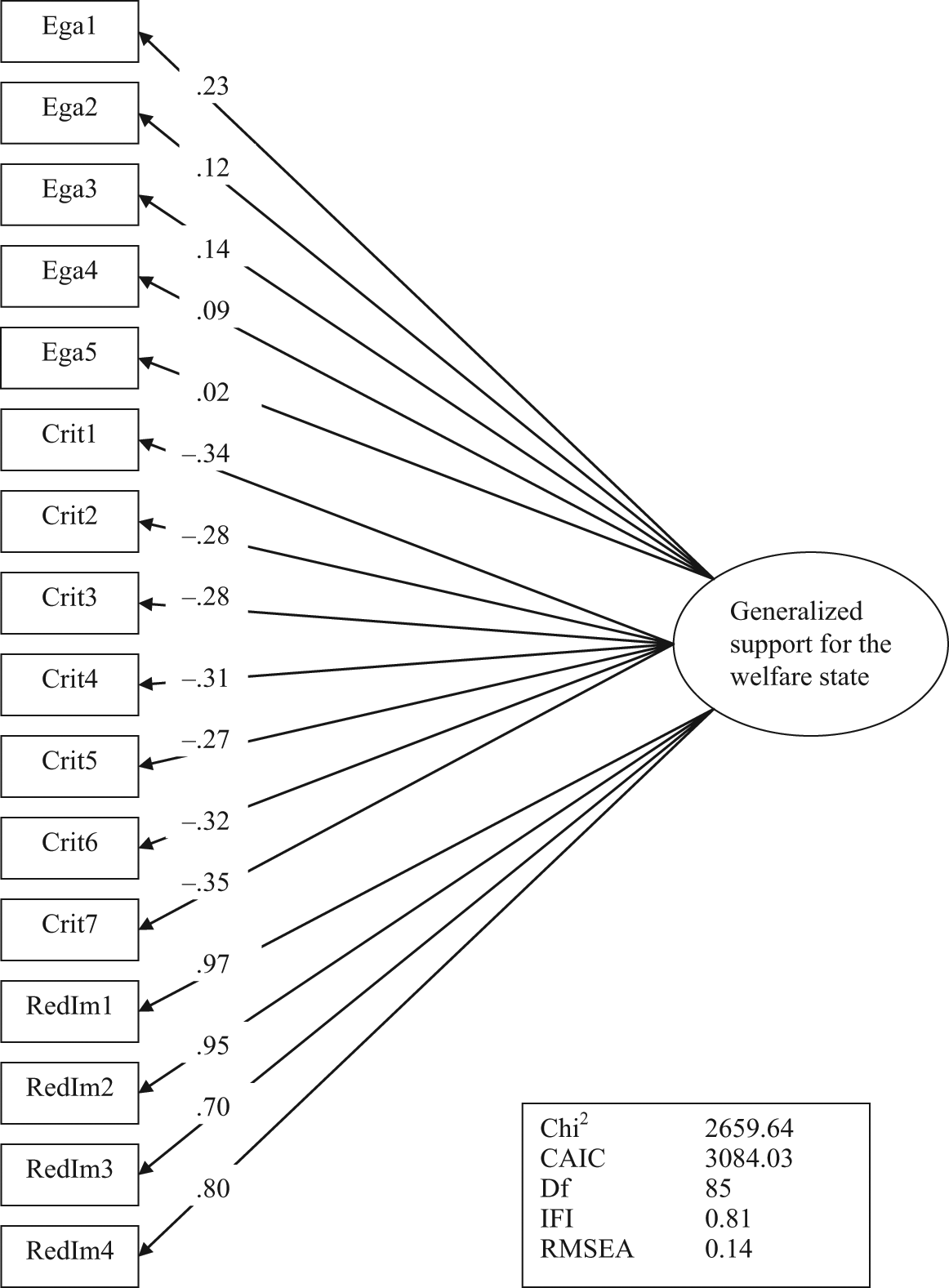
One-dimensionality of Welfare State Support?
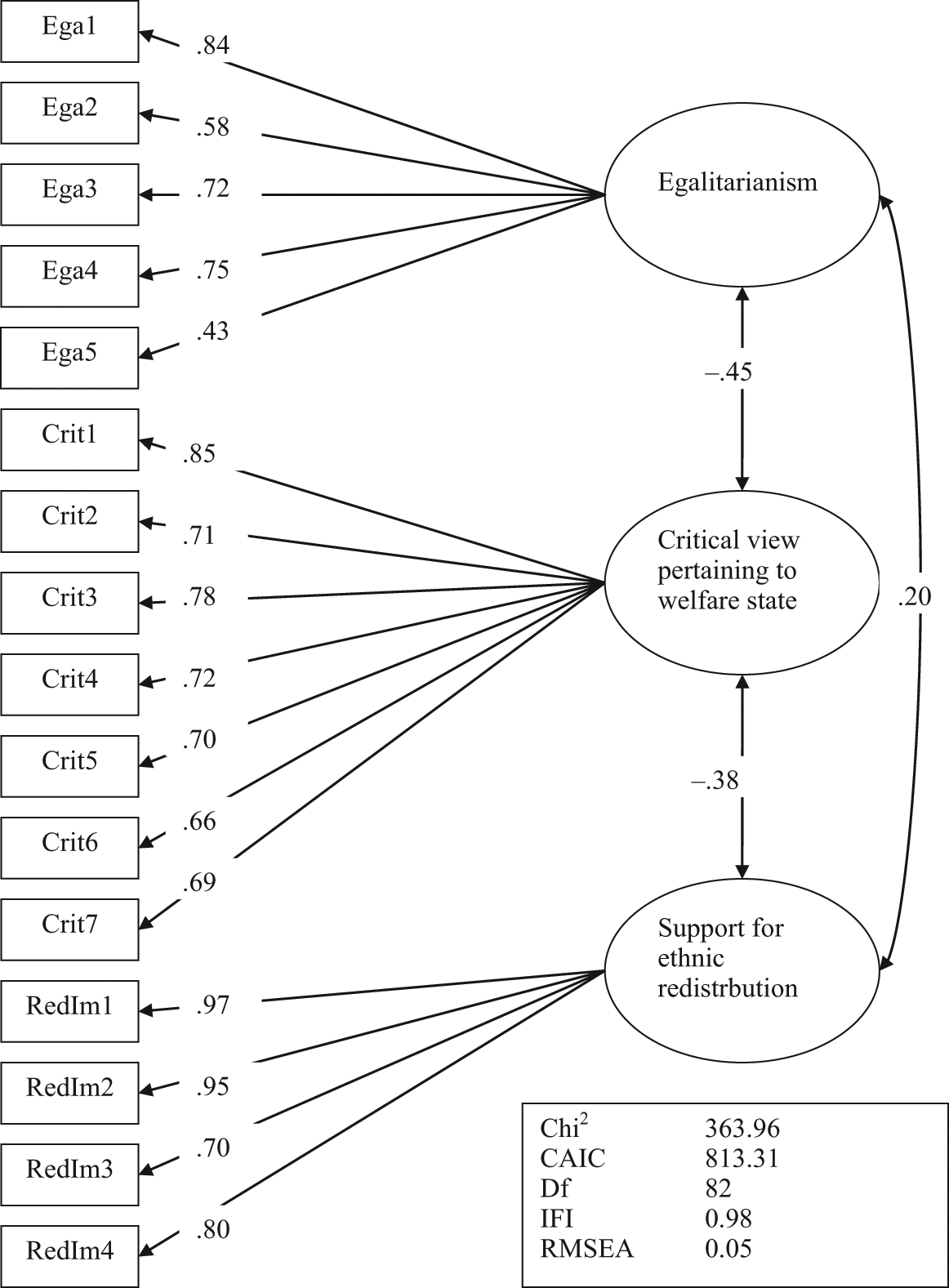
Three-dimensionality of Welfare State Support?
Before assessing whether welfare chauvinism and welfare populism underlie voting for new-rightist populist parties, we investigate whether these phenomena characterize the new-rightist populist constituency. This means that we analyze whether voters for new-rightist parties stand out, by combining an egalitarian ideology with little support for redistribution to immigrants and with a critical view of the welfare state, respectively. Table 1 displays the mean scores of the parties’ constituencies on egalitarianism and support for redistribution to immigrants. The first four columns more or less speak for themselves, but the last column requires some explanation. These residuals are derived from an ordinary least square (OLS) linear regression analysis in which the mean scores on support for redistribution to immigrants are explained by egalitarianism: they represent the deviation from the regression line and were calculated as the support for redistribution to immigrants that remains when controlled for the mean level of egalitarianism.
Means of Electorates of Political Parties on Scales for Egalitarianism and Support for Redistribution to Immigrants
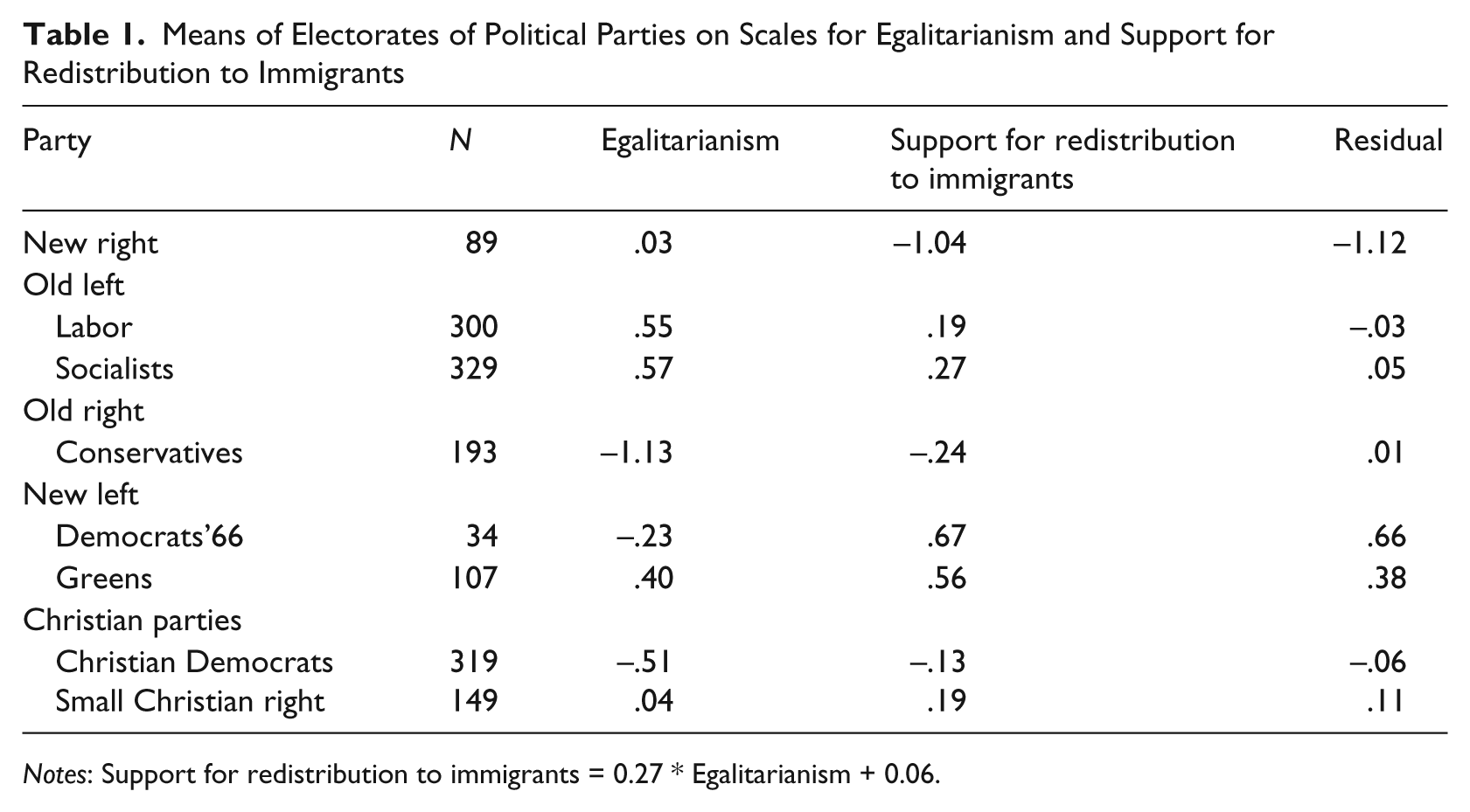
Notes: Support for redistribution to immigrants = 0.27 * Egalitarianism + 0.06.
The low residuals of the electorates of most parties indicate that most constituencies combine egalitarianism and support for redistribution to immigrants in a predictable way – higher scores on egalitarianism go together with higher levels of support for redistribution to immigrants. Old-leftist constituencies are characterized by high levels of both egalitarianism and support for redistribution to immigrants. Old-rightist parties’ constituencies, on the contrary, tend to combine anti-egalitarianism with a rejection of redistribution to immigrants, and supporters of Christian parties take an intermediate position on both dimensions. The electorates of the new left and of new-rightist populist parties, however, strongly deviate from the regression line. Given their levels of egalitarianism, they are exceptionally supportive and unsupportive of redistribution to immigrants, respectively. Put differently, supporters of new-rightist populist parties are remarkably egalitarian in the light of their unsupportive views toward redistribution to immigrants. This confirms our second hypothesis: new-rightist parties’ constituencies are indeed characterized by welfare chauvinism.
In order to find out whether the new-rightist constituencies are also characterized by welfare populism, as predicted by our third hypothesis, we followed the same procedure. The results of this are depicted in Table 2.
Means of Electorates of Political Parties on Scales for Egalitarianism and a Critical View Pertaining to the Welfare State

Notes: Critical view pertaining to the welfare state = −0.59 * Egalitarianism – 0.07.
Again, the constituencies of most parties display low residuals, indicating that they combine egalitarianism with views pertaining to the welfare state in a predictable way: a higher level of egalitarianism goes hand in hand with a less critical view of the welfare state. Unsurprisingly, old-leftist constituencies are characterized by high levels of egalitarianism and strong support for the welfare state. Old-rightist parties’ constituencies, on the contrary, tend to combine their anti-egalitarianism with critical views of the welfare state, and again supporters of Christian parties hold an intermediate position on both dimensions. Strikingly, the electorates of new-leftist and new-rightist parties both display large residuals: new-leftist parties’ constituencies tend to be more supportive of the welfare state than one would expect on the basis of their egalitarian stances, whereas new-rightist parties’ constituencies tend to be surprisingly critical of the welfare state given their egalitarian views. Put differently, voters for new-rightist parties are exceptionally egalitarian in the light of their critical views pertaining to the welfare state. This confirms hypothesis 3: new-rightist parties’ constituencies are characterized by welfare populism.
Having established that new-rightist constituencies combine egalitarian views with low levels of support for redistribution to immigrants as well as with a critical view of the welfare state, we now turn to the question of whether welfare chauvinism and welfare populism actually underlie the new-rightist populist vote. This means we have to control for other factors, such as cultural attitudes, that could explain a preference for the new right. Therefore, we performed a multinomial logistic regression analysis in which authoritarianism and various relevant control variables were included simultaneously (see Table 3).
Voting Behavior Explained

Notes: Multinomial logistic regression analysis. Method: enter, log-odds ratios presented. Reference category: voting for new-rightist populist parties.
p < 0.05; **p < 0.01.
Table 3 presents estimations of the log odds of voting for four categories of parties (that is, the old left, the old right, the new left, and the Christian parties) versus new-rightist populist parties. As indicated by the parameter estimates for authoritarianism, voters for new-rightist populist parties are, rather unsurprisingly, considerably more authoritarian than voters for old-leftist and new-leftist parties. However, they do not (significantly) differ in their authoritarianism from voters for Christian and old-rightist parties.
Having established this, we test our fourth hypothesis, which holds that people vote for new-rightist populist parties instead of other parties on the basis of welfare chauvinism. Whereas voters for new-rightist populist parties have a lower level of support for redistribution to immigrants than those who vote for other parties, the combination of this sentiment with egalitarianism (modeled by means of the first interaction term in the model) does not have a significant effect. 12 Therefore, our fourth hypothesis is rejected. Contrary to our expectations, it is not a specific combination of egalitarianism and a low level of support for redistribution to immigrants that explains a preference for new-rightist parties – voters for new-rightist populist parties merely stand out in this respect because they are averse to redistribution to immigrants itself.
Things are different when it comes to welfare populism. The combination of egalitarianism and a critical view pertaining to the welfare state proves relevant for explaining voting for new-rightist populist parties. The significant interaction term indicates that welfare populists (people who combine egalitarianism with a critical view of the welfare state) tend to vote for new-rightist parties instead of new-leftist or old-rightist ones. In addition, these results indicate that welfare populists may also vote for old-leftist parties and Christian parties. This means that hypothesis 5 is partially confirmed: when taking authoritarianism and various control variables into account, welfare populism proves to underlie voting for new-rightist populist parties vis-a-vis the old right and the new left, but not vis-a-vis old-left and Christian parties.
Remarkably, in these multivariate models the electorates of new-rightist and old-leftist parties display no significant differences when it comes to the relevance of the welfare agendas addressed here: decisions to vote for the new right instead of the old left prove not to be inspired by differences in welfare chauvinism or welfare populism. At a more general level, the results presented above inspire a twofold observation: whereas the constituencies of new-rightist populist parties are characterized by welfare chauvinism and welfare populism alike, only welfare populism proves to be actually relevant for their voting behavior in addition to their well-documented authoritarian cultural motives. Below, we discuss the implications of these findings.
Conclusion and discussion
New-rightist populist parties not only stand out because of their well-known and extensively researched cultural agenda. As self-proclaimed defenders of the interests of the common man, these new-rightist parties also find common ground in their critiques of the welfare state. In order to assess the electoral relevance of these critiques the central questions addressed in this article are to what extent the electorates of new-rightist populist parties are characterized by populist views on the welfare state and to what extent this underlies their voting behavior.
In answering these questions, we have distinguished between welfare chauvinism and welfare populism. Both entail a remarkable combination of egalitarianism with a negative evaluation of the welfare state. In contrast to other egalitarian political parties, new-rightist populist parties let their preference for economic redistribution go hand in hand with a negative evaluation of the welfare state for two reasons. In the case of welfare chauvinism, they have a more particularistic conception of economic redistribution than other parties with an egalitarian agenda. In contrast to the latter, new-rightist populist parties would like to restrict entitlement to welfare services to the native population. In the case of welfare populism, it is argued that the welfare state does not do what it is supposed to do, that is, supporting the ‘common man’ in need of social assistance. Instead, the welfare state is perceived as an instrument for catering to self-serving bureaucrats and those undeserving of assistance.
Our findings on the electoral relevance of these critiques of the welfare state demonstrate that the constituency of Dutch new-rightist populist parties stands out because of high levels of both welfare chauvinism and welfare populism. However, contrary to what was expected, their welfare chauvinism does not drive their vote. While supporters of new-rightist populist parties are more averse to redistribution to immigrants than the electorate of other parties, it is not the specific combination of this sentiment with egalitarianism that inspires their vote. This does not mean that the new-rightist populist critique of the welfare state is electorally irrelevant: welfare populism does lead voters to new-rightist populist parties instead of to old-rightist and new-leftist ones.
Our results inspire some more general remarks. The first of these pertains to the distinction between electoral and ideological competition. If parties compete electorally, they want voters with basically the same characteristics to vote for them instead of for another party. If parties compete ideologically, they do not so much aim to appeal to the voters of electorally competing parties, but to reaffirm their ideological position in opposition to other parties (Houtman and Achterberg, 2010b).
Our analysis indicates that ideological competition between new-rightist and new-leftist parties is more encompassing than commonly assumed. Time and again scholars have argued that the new political cleavage between the new right and the new left is based on a conflict over the evaluation of cultural issues defined in a narrow sense (Achterberg, 2006; De Koster et al., 2008; Elchardus, 1996; Stubager, 2009). While our analysis, rather unsurprisingly, corroborates this suggestion by showing that authoritarianism clearly differentiates between the new right and the new left, it also indicates that the new cleavage is broader than that. After all, welfare populism also sets the new right apart from the new left. Of course, there are indications that welfare populism as well as welfare chauvinism are rooted in a similar cultural ideology (Achterberg et al., 2011; Van der Waal et al., 2010). Therefore, these new-rightist welfare ideologies can still be interpreted as part of the much-discussed ‘authoritarian/libertarian’ value conflict. Yet, this would still mean that this ‘new’ cultural political cleavage is more encompassing than is accounted for in the scholarly literature, as it also entails evaluations of societal institutions, even one that is commonly considered to be of a socioeconomic nature par excellence.
While the ideological competition between the new right and the new left is fierce and covers various domains, the electoral competition between them is low: the odds that potential voters for new-rightist parties will consider voting for new-leftist parties are rather small. Electoral competition is, however, high between new-rightist and old-leftist parties. When it comes to welfare issues, the electorates of these parties display almost no differences: support for redistribution to immigrants is higher among the old-leftist electorate, but our analysis indicates that decisions to vote for the new right instead of the old left are not inspired by differences in welfare chauvinism or welfare populism. This means that if issues pertaining to the welfare state are politically salient during elections, people who are welfare chauvinist or welfare populist are, as indicated by our results, as likely to vote for the new right as for the old left. If the elections revolve around cultural issues instead, then the electoral competition between the new right and the old left will be less intense.
Another point for discussion is the possibility that the electoral relevance of welfare chauvinism and welfare populism is currently higher than our analysis suggests. Our data were collected in 2006, and back then the new-rightist agenda on welfare was relatively underdeveloped. Thus even without much active political mobilization on these issues by new-rightist populist parties in the Netherlands, people voted for new-rightist parties on the basis of welfare populism. Since then we have witnessed a strong growth in the electoral success of Wilders’ Party for Freedom, strikingly matched by a decline in the electoral popularity of old-leftist parties in the Netherlands. This possibly signals that there has been successful, increased mobilization around these issues. This leads us to believe that the electoral relevance of welfare populism may have grown since 2006. Back then, Wilders’ party, as well as other new-rightist alternatives, were still predominantly active in the debate revolving around anti-immigrant sentiments, without giving much attention to issues around the welfare state (Lucardie, 2007). In the period preceding the Dutch elections of 2010, though, there was a growing effort by new-rightist parties to underscore their anti-establishment agenda through combining egalitarian policies with rhetoric critical of the welfare state. Further research is needed to find out whether the electoral impact of welfare populism has indeed increased due to the increased mobilization on these issues by new-rightist parties. The same goes for emerging issues such as European integration (compare Halikiopoulou et al., 2012): since fierce critique of the European Union (EU) is a way for new-rightist populist parties to distinguish themselves from their old-rightist electoral competitors, future studies should strive to find out whether issues concerning the EU have also increased in electoral relevance due to stronger mobilization.
In addition, future research should be aimed at assessing how far our findings travel beyond the Dutch case. As suggested by the fact that Scandinavian new-rightist populist parties originated as anti-tax parties (Andersen, 1992), but evolved into new-rightist populist parties much like the Dutch ones analyzed in this article, our results for the Netherlands may be found elsewhere in Europe, too. Do welfare chauvinism and welfare populism also lead to support for new-rightist parties in other countries, and if so, how does this relate to other politically salient issues? Two country characteristics that might affect the salience of welfare chauvinism and welfare populism for voting behavior come to mind. First, various European countries do not have a viable new-rightist populist party, and it would therefore be interesting to find out if and how welfare chauvinism and welfare populism are politically articulated in those countries. Second, different welfare states vary substantially in generosity, and this might also affect the political articulation of welfare chauvinism and welfare populism. According to various authors, 13 generous welfare states breed high levels of widespread solidarity toward ‘others,’ such as welfare recipients and immigrants. This suggests that sentiments of welfare chauvinism and welfare populism are probably less widespread and less politically relevant in generous welfare states. On the other hand, as the recent example of Denmark suggests, a generous welfare state can go hand in hand with the political articulation of populism, and exclusionism toward welfare recipients. How welfare institutions affect those sentiments and their relevance for voting behavior, hence, is a key question for future research.
Footnotes
Appendix
The interaction terms shown in Table 3 can be displayed differently, conveying the effects of support for ethnic redistribution and a critical view pertaining to the welfare state on the dependent variable (that is, voting behavior) for different levels of egalitarianism. Following Brambor et al. (2006: 74) we have created a dichotomous variable for egalitarianism, allowing us to present uncomplicatedly the effects and the corresponding standard errors of the independent variables for people who score low (lower than the mean) on egalitarianism and the marginal effects and their standard errors of the independent variables for respondents scoring high (higher than the mean) on egalitarianism. Table A1 depicts these figures. All control variables were included in both models, but we do not display their effects here for reasons of brevity.