



Abstract
This article investigates the interactive effects of ruling party stability and veto players on economic performance. We show that ruling party duration has an inverted U-shaped relationship with growth when the number of veto players is low, while it has a regular U-shaped relationship when there are more veto players. We find support for these contentions using time-series cross-section data on the economic growth of a sample of 66 democracies between 1975 and 2007.
Introduction
How does political stability affect economic performance? Among research that conceptualizes stability in terms of the absence of political violence, there is a broad consensus that stability is indeed conducive to growth (Barro, 1991; Feng, 2003; Feng and Chen, 1996; Gupta, 1990; Levine and Renelt, 1992; Londregan and Poole, 1990; Sala-i-Martin et al., 2004; Sturm and De Haan, 2005). However, among research on the impact of transfers of power that occur within a state’s constitutional framework (Alesina and Roubini, 1992; Brunk and Minehart, 1984; Bunce, 1980; Feng, 2003; Huber, 1998; Robertson and Cutcomb, 1987; Slantchev, 2005), the findings do not converge. Feng (2003) observes that both major regular government changes (i.e. changes in party control) and minor regular government changes (i.e. cabinet changes where party control is unchanged) increase economic performance. Conversely, Alesina et al. (1996) find that increased probabilities of change of parties in power or coalitions decrease per capita Gross Domestic Product (GDP) growth. Finally, Slantchev (2005) finds that the tenure of the executive in formerly communist democratic countries has no effect on economic performance.
In this article, we develop a theoretical approach to resolve these seemingly disparate results. Conceptualizing political stability as the duration of ruling parties in power, we theorize that the timing of two competing effects of political stability gives rise to a non-monotonic relationship between ruling party duration and economic performance. 1 Because the public needs clear policy expectations to make economic decisions (Hibbs, 1977), we posit that ruling party duration initially improves economic performance as these expectations are formed; we refer to this as the policy expectations effect. However, long-lived governments turn to rent-seeking activities and ignore broad constituencies in the economy, reducing performance (Hellman, 1998; Olson, 1982, 1983); we refer to this as the institutional sclerosis effect. Because the policy expectations and institutional sclerosis effects are ordered in time, we contend that the impact of government stability on performance depends on timing.
Prior work on government changes that occur within the constitutional framework does not use an event history approach. Instead, in order to account for reverse causality between growth and stability, a multi-stage approach is employed, with the probability of some change in government (executive party, cabinet composition, etc.) estimated in the first stage and then used as an exogenous variable in a growth model. While this is a sensible econometric solution, it imposes an important theoretical constraint on the relationship: the effect of a given size change in stability (i.e. the difference in probability of government change) on growth is constant over time. We use duration analysis to test hypotheses about when during a ruling party’s tenure continued time in office promotes or impedes economic growth. 2
We hypothesize that the effect of ruling party duration on growth is initially positive and subsequently negative, producing an inverted U-shaped relationship. We also hypothesize that increasing the number and ideological distance of veto players flattens this U-shaped relationship. Combining two-stage estimation with duration modeling, we find support for our hypotheses in a sample of 66 democracies between 1975 and 2007. 3
Ruling party duration and economic performance
Duration and economic growth
Economic growth requires the investment of savings in capital and technology to improve future production possibilities. Yet, political risk – the potential of capricious actions by the state – undermines investors’ incentives and saps performance (North and Thomas, 1973). New ruling parties may have substantially different policy agendas from their predecessors; indeed, changes in ruling parties have been found to be associated with large shifts in macroeconomic policy (Alesina and Rosenthal, 1995; Bunce, 1980; Cameron, 1978; Castles, 1982; Cowart, 1978; Hibbs, 1977; Lewis-Beck and Rice, 1985; Mosley, 1984; Schmidt, 1982). Absent information concerning particular governments’ policy preferences, investors face uncertainty and are unable to assess these risks effectively. Heightened uncertainty has a chilling effect on investment as it precludes the accurate comparison of risk-adjusted returns; policy uncertainty rewards waiting and hence dampens investment incentives (Dixit, 1989).
Candidate party platforms give policy cues but cannot completely eliminate the uncertainty associated with a new ruling party. Parties create reputations for certain economic policies over time such that some may be more welcomed by investors than others (Petrocik, 1996). However, skepticism cannot be eliminated altogether because a party’s ability as currently constituted to enact an economic program is uncertain, particularly if the party has not been a part of the government in the past. Even when parties have experience in prior governments, current party members may not have served in the government and, moreover, macroeconomic circumstances may have changed. This especially applies to newer democracies since they often have little or no track record in economic policy (Keefer and Vlaicu, 2008).
Even fully rational and forward-looking actors may lack information about a government’s policy preference or competence (Cukierman and Meltzer, 1986; Persson and Tabellini, 1990; Rogoff, 1990; Rogoff and Sibert, 1988). Empirically, economic actors are wary of predicting the policy behavior of ruling parties with short track records (Backus and Driffill, 1985). In the US, such simple partisan mappings of behavior would not have predicted Clinton’s retrenching of welfare, Reagan’s base-broadening tax measures, or Nixon’s wage and price controls and devaluation.
Observation of government policy behavior does alleviate this uncertainty. Governments’ difficulty in making credible commitments makes assessing a new ruling party’s policy preference on the basis of platforms difficult. Observed behavior, however, gives a clear indication of policy preferences. Even ruling parties that are initially perceived as potentially more hostile to business will see improved performance with duration, as investors become better able to calculate political risks. As the largest gains in the reduction of uncertainty come with the initial observation of behavior, economic performance should improve most in the initial phases of party tenure.
However, extended duration in power of ruling parties leads to institutional sclerosis and deteriorating economic performance. As the marginal returns from the stabilization of policy expectations diminish, ruling parties come under increasing special interest pressure to redistribute resources, hindering growth in four important ways. First, market intervention to create rents for narrow interests distorts incentives, drawing resources from efficient uses (Becker, 1983, 1985). Second, the widespread prevalence of redistributive policies incentivizes rent-seeking, diverting real resources from productive activity to lobbying (North, 1990). Third, vested interests lobby for government policies that hamper innovations (Krusell and Rios-Rull, 1996). Fourth, incumbent parties use the public budget for partisan purposes instead of acting as effective gatekeepers (Geddes, 1994; Shefter, 1994).
Ruling party duration should be associated with decreasing economic performance as rent-seeking draws resources away from productive activity. Responsiveness to rent-seeking suggests that narrow interests have achieved political victory over broad interests who benefit from the growth of the economy as a whole. Olson (1982, 1983) suggests that rent-seeking interest groups accumulate over time during periods of stability. Similarly, in Hellman’s (1998) partial reform equilibrium model, ruling party stability allows the winning constituency to lock in reforms that provide them with private benefits at a cost to greater economic efficiency. Extended government duration also increases the likelihood that vested interests maintain political connections with the ruling party and use them to stymie new, innovative competition.
The Liberal Democratic Party (LDP) in Japan provides a quintessential example of a sustained tenure contributing to institutional sclerosis. Ruling continuously from 1955 to 1993, the LDP subsidized public construction works, supporting 560,000 construction companies with 6.7 million employees. Although this lavish infrastructure spending initially stabilized the economy and contributed to the Japanese miracle, it was increasingly criticized over time as expensive and inefficient. However, this spending became entrenched due to an iron triangle among LDP politicians belonging to the construction “tribe,” bureaucratic agencies, and construction companies. The construction companies colluded and submitted artificially high bids, while the LDP politicians received kickbacks and election contributions (Broadbent, 2002). Such activities were implicated in the collapse of the bubble economy in the 1990s.
The policy expectations and institutional sclerosis effects of ruling party duration run in opposite directions, causing potential uncertainty about the total impact of duration on economic performance. However, the timing of these effects within a particular ruling party’s tenure in office allows us to make predictions about which effect will dominate. We expect the largest improvements in economic performance to come early in the ruling party’s tenure. Investors’ observation of government policy choices yields the largest improvements in stabilizing policy expectations with initial behavior, producing diminished marginal returns over time. By contrast, the institutional sclerosis effect of duration operates over longer durations, as rent-seeking activities accumulate. As a result, we expect: Hypothesis 1: There is an inverted U-shaped relationship between ruling parties’ tenures and economic growth.
The timing of hypothesized effects in models of comparative political economy is often under-theorized and treated as an empirical matter. We face the same difficulty in predicting when the turning point suggested in Hypothesis 1 will arrive. Essentially, this requires us to posit the rate at which policy expectations stabilize for investors and compare it with the rate at which the institutional sclerosis accumulates.
For investors, reduction of uncertainty comes from the observation of ruling party behavior in fiscal, monetary, and regulatory policy. While fiscal behavior can be observed quickly given budget cycles, regulatory policy may play out over a longer period of time and monetary policy requires observation after a second election (to assess time inconsistency). This suggests that the benefits of duration associated with the reduction of uncertainty may even extend for a number of years past the first term.
New ruling parties may quickly seek to reward narrow constituencies with public resources. However, concern over losing the subsequent election due to pandering to special interests might restrain this until a second term or later, when the party has consolidated its position. Olson (1982, 1983) suggests that the damage occurs over time as the drag of rent-seeking impedes dynamism and actors increasingly shift real resources away from investment and toward seeking government benefits. Taken together with the discussion of the policy expectations effect, this suggests that the turning point on economic performance might not arrive until a ruling party’s second or third term in office, a period ranging from five to 12 years.
Veto player interactions
Extensive research has focused on the role played by political institutions in shaping the prospects for economic growth. Ruling parties do not make economic policy in isolation, but operate within an institutional framework that constrains their agendas. If political institutions moderate the two duration effects – policy expectations and institutional sclerosis – we should observe different relationships between growth and duration across institutional contexts. These relationships should change in predictable ways given prior work on the effects of institutions on policy outcomes.
We consider how veto players moderate the impact of two duration factors. Tsebelis (1995, 2002) develops the concept of veto players to assess governments’ ability to produce policy change. Veto points are institutional features that allow individual or collective actors within the political system to veto changes in policy. The combination of a large number of institutional veto points and their control by actors with divergent preferences makes policy unlikely to change.
Although there are other institutional variables, we choose to utilize the presence of veto players for two reasons. First, choosing veto players allows us to make comparisons across a broad range of countries, including presidential, semi-presidential, and parliamentary systems with a multitude of institutional variations (MacIntyre, 2001). To those interested in a detailed accounting of the interplay between these institutional features (e.g. coalition government versus single party government, legislative rules and committees, etc.) and duration, collapsing them into a single dimension will seem unsatisfying. However, this is an analytically tractable way to estimate the effects of duration given the econometric minefield we describe later. Second, extant literature on veto players generates clear hypotheses about how their presence alters the duration effects we specify.
Economic growth requires seemingly conflicting characteristics in governments (MacIntyre, 2001). On the one hand, governments must provide stable policy environments with predictable behavior from political executives. On the other hand, governments must be able to respond to exogenous shocks to the economy as well as to reverse prior policy mistakes. Haggard and McCubbins (2001) contend that these two important characteristics, which they label decisiveness and resoluteness, necessarily trade off in institutional design.
We utilize this insight to predict how the numbers of veto players and the ideological distance among them moderate the effects of ruling party duration on growth. The foregoing theoretical discussion assumes that the ruling party is relatively less constrained (i.e. it faces relatively fewer effective veto players). As Tsebelis (1995) argues, the absence of effective veto players increases the likelihood of large policy departures from the status quo. This policy flexibility creates uncertainty among investors, impeding economic performance. With time, the growing track record of the ruling party builds investor confidence in the market. However, the economic returns for building reputation diminish over time, while pressures to increase rents for narrow constituencies mount.
On the other hand, the presence of many veto players and of greater ideological distance among them stabilizes policy outcomes, altering the relationship between duration and performance. As the dominating characteristic of the government is resoluteness, checks on the policy discretion of the ruling party can help alleviate the chilling effect of unstable policy expectations on investor confidence in several ways. First, constraints on the executive can enhance the credibility of policy reforms undertaken as retrenching such measures will face greater opposition (Henisz, 2000; MacIntyre, 2001; Tsebelis, 2002). Second, veto players can diminish the likelihood of large deviations from the status quo policy environment (Tsebelis, 1995). Indeed, Alesina and Rosenthal (1995) suggest that in the US, rational voters will choose divided governments precisely for the purpose of managing this kind of risk. Third, Keefer and Stasavage (2002, 2003) find that veto players enhance the credibility of monetary policy choices, tamping down inflationary pressures. Finally, veto players have a general effect of enhancing the protection of property rights and the rule of law (Andrews and Montinola, 2004).
New ruling parties constrained by veto players will enjoy an initial advantage in credibility relative to their unconstrained counterparts that should improve economic performance by stabilizing investor confidence. However, this initial advantage decays as time passes and changing economic conditions require effective policy responses. Governments with numerous veto players are less nimble amid economic shocks as “high levels of commitment” mean “inability for political response” (Tsebelis, 2002: 204). Facing more effective veto players complicates the task of ruling parties of coordinating policy responses to these events by decreasing the win-set of policy choices. Poterba (1994) and Alt and Lowry (1994) argue that US states with divided governments respond more slowly to fiscal shocks. Under such circumstances, the government loses the capacity to create investment opportunities, contributing to economic downturn.
Some episodes from the Asian financial crisis of the late 1990s can also illustrate these points. According to MacIntyre (2001), Thailand’s fragmented party system represented a typical case of resoluteness with multiple veto players. Its coalition governments involved six or more incoherent parties whose members could vote differently from their party leaders. When Chavalit’s government attempted to reduce government spending to ameliorate the current account and to help loosen monetary policy to encourage growth, it faced strong opposition by a coalition member who feared the loss of pork-barrel construction projects. Policy rigidity created by veto players hampered an effective response to the financial crisis.
However, the declining performance of ruling parties facing many veto players may improve with further duration for two reasons. First, constrained ruling parties can overcome the policy gridlock created by multiple veto players. With a cross-national analysis, Scartascini et al. (2010) demonstrate that large numbers of veto players can achieve productive policy cooperation over time, defeating the dilemma predicted by Haggard and McCubbins.
Second, veto players can forestall rent-seeking activity by ruling parties, thwarting the institutional sclerosis in later phases of duration predicted by Olson. Evidence suggests that veto players insulate governments from special interests in the areas of state infrastructure investment (Henisz and Zelner, 2006; Keefer and Knack, 2007) and protectionist policies (Henisz and Mansfield, 2006). In the absence of effective veto players, parties become more clientelistic, creating rents for narrow constituencies at the expense of the economy as a whole (e.g. the LDP in Japan). Given the potential for policy cooperation and the prevention of institutional sclerosis, we expect: Hypothesis 2: In the presence of numerous veto players, the inverted U-shape relationship between duration and growth is flattened and bent into a regular U-shape.
It is possible that numerous veto players could create log-rolling dynamics, leading to bloated fiscal deficits. Empirically, veto players (Perotti and Kontopoulos, 2002) and coalition or divided governments (Roubini and Sachs, 1989) tend to be associated with larger budget deficits as they increase the number of constituent groups that must be satisfied. This could be detrimental through either the crowding out of private investment or rising inflation. However, accommodating special interest pressure through executive intervention in the regulatory apparatus could create even greater distortions. In cases such as Japan’s LDP and Italy’s Christian Democrats, the abuse by a single dominant party without political constraints appears to be more damaging to the economy. This seems particularly true when these unconstrained ruling parties stay in power for an extended period of time. Budget outlays limit the distortion of incentives to the recipient, rather than rearranging them for all actors economy-wide. Moreover, they face an explicit budget constraint, whereas predatory regulations can be extended without large fiscal outlays. If veto players prevent regulatory rent-seeking and instead channel it into competition over budget resources, the net effect on economic performance may be positive.
Methods
We face three methodological challenges in assessing the impact of ruling party duration on economic growth. First, economic growth and ruling party duration are expected to be endogenous. As the use of a single equation model causes bias in the results, we adopt a simultaneous equations approach to achieve our objective. We estimate two equations: one with economic growth per capita as the outcome and the other with ruling party duration as the outcome.
The second challenge we face stems from our use of duration of ruling parties as an outcome variable. Because the use of a traditional linear model is problematic, we must use event history analysis. The most serious problem with using traditional models is that they lack a mechanism to deal with censored and truncated data where full event history is not observed.
Third, the data in our analysis are time-series cross-section (TSCS) data. Analysis of this data is often vulnerable to two problems. Heteroskedasticity can occur as units have different error variances. Also, there may be serial correlation among the residuals.
In the face of these problems, the combination of a simultaneous equation approach with duration and panel models is necessary to test our hypotheses. We use a two-stage approach to estimate the equations. 4 In the first stage, d is regressed on Xd, X, and Xy to obtain d̂, the predicted values of d (where d = duration of ruling party, X consists of exogenous variables common to both growth and duration, Xd consists of instruments for duration, and Xy consists of instruments for economic growth). The variable y – the monthly growth rate of real GDP per capita – is also regressed on Xd, X, and Xy to obtain ŷ, the predicted values of y:


In the second stage, the duration and growth equations are estimated with ŷ and d̂:


Commonly used in duration analyses, the Cox model cannot generate predicted durations; it yields predicted hazard rates. Instead, we use the log-logistic model with an accelerated failure time (AFT) parameterization to estimate the duration equations and generate predicted duration. 5 The model allows the baseline hazard to increase and decrease over time, making it more flexible than the Weibull model, where hazard rates either rise or decline monotonically. We note, however, that our results are substantively unchanged when the Weibull model is employed in the two stages.
We use panel models to estimate the growth equations as we have TSCS data. 6 Fixed effects and random effects estimators are widely used, but not without problems. 7 The fixed effects estimator consumes many degrees of freedom when the number of units is large and cannot estimate coefficients for time-invariant characteristics. Random effect models can include time-invariant characteristics, but only under a strong assumption: that unobserved unit-level effects are uncorrelated with included variables. To demonstrate robustness, we test our hypotheses using both the fixed effects and random effects models.
Data and measurement
Typical of duration analysis, each case in our data set is a country-month, creating two potential problems. First, many of the variables are measured yearly, as is common in government duration models, even when cases are months. For variables with this interpolation problem, we apply the annual value to each month within the year. Though not ideal, when collapsing the models from monthly to annual analyses, we find that each of our main theoretical findings remains significant and the coefficients are correctly signed. Second, unlike much of the work on the determinants of growth, we do not utilize 10-year averages of growth rates. While this might make our findings more susceptible to business cycle effects, we see no alternative in assessing the effects of ruling party duration. Further, we note that our findings from the following growth models nonetheless correspond to those of the endogenous growth literature.
Each case in the data set represents a month for a country that has been classified as a democracy (i.e. POLITY score of six or better), including presidential and semi-presidential systems and parliamentary systems. The POLITY data are used since they cover a large number of countries, and the information is updated regularly. Table A1 in the Appendix (accessible online) shows the list of countries and years covered in the analysis. 8
Endogenous variables
The duration of ruling parties, d, is the number of months that a member of the same party holds the presidential or prime ministerial office. For semi-presidential systems, we follow the Database of Political Institutions (DPI) data set to determine whether or not these cases should be considered as presidential or parliamentary. 9 The variable, derived from Woldendorp et al. (2000) and Doring and Manow (2011), is not reset when new chief executives serve the same party. The second outcome variable is economic growth, y. Because monthly data on economic growth rates are unavailable, we must proxy them with another measurement. We utilize the World Development Indicators (WDI) to determine the rate of GDP per capita growth and convert it into a monthly rate for each month of the year of measurement. 10
Exogenous variables Xd
Few studies examine ruling party stability (as opposed to cabinet stability); we adopt control variables primarily from Maeda and Nishikawa (2006) as this study covers both presidential and parliamentary systems. We include four of these variables as exogenous regressors in the duration model. First, we include a measure of ethnic heterogeneity developed by Fearon (2003). Ethnic heterogeneity is expected to reduce ruling parties’ tenures. This variable does not vary over time, but it captures important differences across countries and reduces noise in our models. Second, we control for constitutional inter-election periods: a greater length of terms between elections is expected to increase duration. The tenure of chief executive is usually fixed as four or five years. Third, the presence of an investiture rule is expected to make ruling parties more stable. The investiture variable is a dummy variable derived from Woldendorp et al. (2000). 11 Fourth, the presence of limits on the number of terms an executive can serve is expected to shorten duration. The variable ‘term limits’ is drawn from the DPI developed by Beck et al. (2001).
In addition to the institutional controls suggested by Maeda and Nishikawa (2006), we also add two variables that capture the partisan political context. First, governments that are divided are expected to have shorter durations. The government fractionalization variable measures the probability that any two deputies in the government are from different parties. 12 Second, greater margins of majority of the executive in the legislature are expected to lengthen duration. These variables are drawn from the DPI.
Exogenous variables Xy
The selection of control variables for our growth models is complicated by two factors. First, the endogenous growth literature ranges far and wide, with different combinations of well over 50 variables regularly appearing in various authors’ models. Sala-i-Martin et al. (2004) and Sturm and De Haan (2005) conduct robustness analyses of these variables; we select controls from the variables identified in common by these studies as robustly affecting growth. Second, given that many growth studies use 10-year averages, the regressors are time-invariant and would drop out of fixed effect models when using TSCS data. To remedy this problem, we utilize yearly data when possible.
Eight exogenous variables appear only in the growth models. First, we include a measure of trade openness (imports plus exports as a percentage of GDP). Countries that are more integrated within the international economy can specialize and utilize resources more efficiently (data source: WDI). Second, we control for the level of government consumption as a percentage of GDP. Higher government usage of resources is expected to lower growth rates. 13 Third, we include a dummy variable for African countries, which are expected to experience slower growth. Fourth, we include mineral and ore exports as a percentage of GDP; reliance on mining exports is expected to be detrimental to performance (data source: WDI). Fifth, we include a commonly used measure of human capital stock, the level of primary school attainment in 1975 (Barro and Lee, 2001). Sixth, we expect slower growth among post-communist states and include a dummy variable for them. Seventh, a dummy variable for EU countries is also added since EU membership is expected to influence performance. Finally, a lagged growth rate variable is also included in this category in order to account for serial correlation.
Exogenous variables X
There are five variables (X) common to both equations. First, we include GDP per capita (source: WDI). For the growth equation, according to the convergence theory, economic development lowers economic growth rates. For the duration equation, economic development is expected to be positively associated with ruling party durability since economic development may be associated with the stability of socio-political systems. Second, higher levels of democracy are expected to be associated with lower levels of economic growth. We also expect that increased levels of democracy are associated with longer duration for ruling parties. POLITY IV data are used to represent levels of democracy (Marshall and Jaggers, 2002). Third, the election year variable from the DPI data set is added. Because the independent variables in the growth equation are lagged, we expect the election year variable to be associated with decreased economic growth as this would represent a post-election downswing in the political business cycle. It is expected to produce shorter tenures for ruling parties in the duration equation. Fourth, a democratic duration variable is added. For the growth equation, mature democracies are expected to be associated with slower economic growth. For the duration equation, mature democracies are likely to produce longer tenures among ruling parties. This variable is derived from the POLITY IV data set. Finally, veto players are expected to reduce growth rates as well as ruling party duration. We use the DPI variable ‘checks’ to capture the number and ideological dispersion of veto players in the executive and legislature; this measure is logged and standardized. Although the POLCON data set includes a variable that also measures judicial veto points, the coverage is very limited and would eliminate two-thirds of our cases. 14
Interaction terms
We include two sets of interactions to model the relationship between duration, veto players, and growth. First, we include the square of duration in order to model the shifting marginal effect of duration over its range. The variable is mean-centered in order to mitigate collinearity. Second, we include interactions between veto players, duration, and duration squared.
Results and discussion
Broadly, the estimations of the growth models support our hypotheses about the relationship between ruling party duration and growth and the moderating effects of veto players. The effects of control variables are consistent with prior findings. Table 1 (accessible online) presents the coefficients estimated for the growth models estimated with random effects. 15
Model 1 shows a simple specification without a squared duration variable. The effect of duration is negative and significant; that is, longer ruling party duration is associated with slower growth. In Model 2, the coefficient of the squared duration term is negative and significant, yielding the inverted U-shape predicted for growth in Hypothesis 1. Figure 1 displays the predicted monthly growth rates as a function of duration for a state with mean values on each of the other independent variables. In this figure, growth rates increase with duration, reach a peak, and then decline.

Predicted monthly growth rates, model 2 estimates.
Because the effect of duration on growth is contingent on its level, the standard errors for the main effect and squared term presented in Table 1 are not especially helpful in determining the significance of the relationship. In Figure 2, the marginal effect of each month of duration on growth for Model 2 is shown with a 95% confidence interval. These effects are significant when the confidence intervals do not include zero. The values of the marginal effects are initially positive but decline with duration, becoming negative, consistent with Hypothesis 1.

Marginal effect of duration on growth, model 2 estimates (95% confidence interval shown).
The turning point at which the impact of duration becomes negative is estimated in Model 2 to be 95 months. Consistent with our expectations, returns to reduced uncertainty may decline quickly, but several election cycles are required for rent-seeking to reduce macroeconomic performance. Many governments in our data set do not reach this turning point as the average duration in power is around six years. Voters may be successfully anticipating sclerosis and voting these governments out of power. Yet, we do have confidence in our estimation of the latter end effects of duration as there are a number of governments of much longer tenure than the average. Of the 313 unique ruling parties in the sample, 78 have durations that extend beyond the estimated turning point at which the marginal effect of continued duration on growth becomes negative. In these cases, it appears that ruling parties maintain power well beyond their economic usefulness. Figure 3 shows, as an example, the observed growth rates for the Philippines under the Lakas- Christian Muslim Democrats (CMD) presidency of Fidel Ramos from 1992 to 1998. As the trend line demonstrates, the growth pattern follows an inverted U-shape.
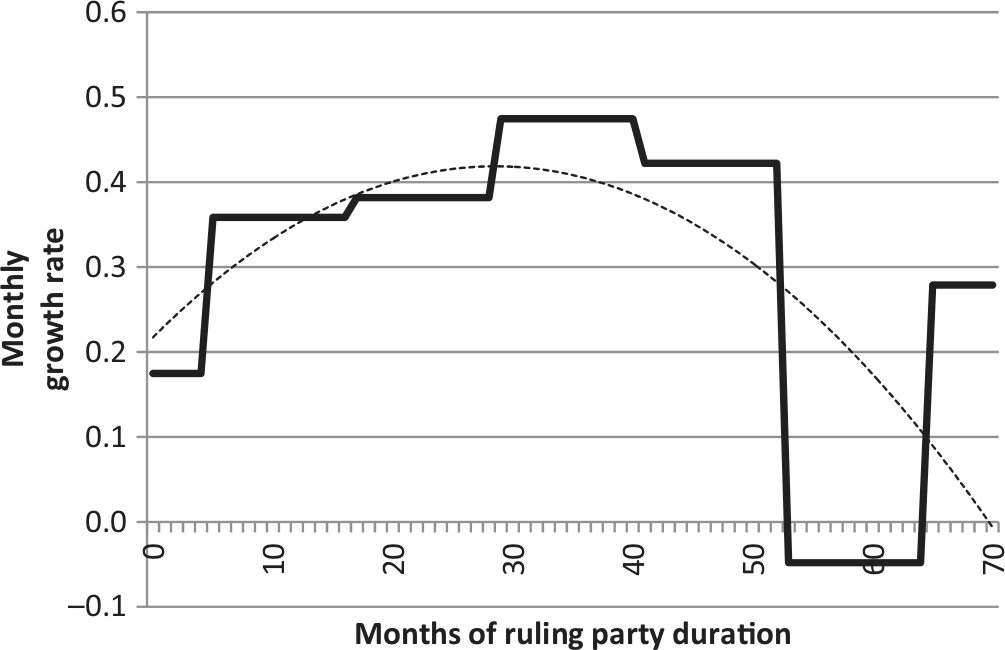
Actual growth rate for the Philippines under the Lakas-Christian Muslim Democrats, 1992–1998.
In Model 3, we include interactions between veto players and the two duration variables. The results with these terms included are consistent with our hypotheses. Figure 4 shows the predicted growth rate curves for ruling party duration generated by Model 3 for five different levels of veto players: the mean as well as one and two standard deviations above and below the mean. The curves showing growth for parties with low numbers of veto players support Hypothesis 1. For ruling parties facing mean or below-mean levels of veto players, the predicted growth curves have an inverted U-shape. As shown in Figures 5a, 5b, and 5c, the marginal effects of duration estimated in Model 3 are initially positive, significant, and declining.

Predicted monthly growth rates conditional on level of veto players, model 3 estimates.

Marginal effect of duration on monthly growth rate conditional on veto players (95% confidence interval shown).
Model 3 yields findings that provide mixed support for Hypothesis 2. 16 The addition of veto players does alter the inverted U-shaped relationship between duration and growth. Figures 5d and 5e display the marginal effects of duration for ruling parties facing many and very many veto players, respectively. Neither of the two groups shows any initial positive effect of duration on growth, unlike the curves under the presence of few veto players; instead, the effect of duration is initially statistically indistinguishable from zero. This absence of any initial positive effect of duration on growth is consistent with the interpretation that these parties enjoy no initial economic performance benefits from establishing a policy reputation.
While this finding is consistent with Hypothesis 2, there is no evidence of a positive effect on growth at later durations. 17 Instead, it appears that the gridlock and rigidity of numerous veto players eventually leads to reduced performance as ruling parties cannot respond effectively to changing economic conditions. As performance is not predicted to improve, we do not find evidence of either a learning effect creating cooperation between ruling parties and veto players or of long-term benefits associated with a reduction of rent-seeking. The more rapid deterioration of performance for high veto-player governments is consistent with the observation that ruling parties in these situations have very short durations. Figure 6 shows, as an example, the observed growth rates for Denmark under the Conservative People’s Party from 1982 to 1993. This government faced on average six-and-a-half veto players during its tenure. Growth rates were initially high and then fell and did not substantially recover.

Actual growth for Denmark under the Conservative People’s Party, 1982–1993.
The average observed durations of the governments in the data also fit with the effects expected in Hypothesis 2. Governments facing higher than mean numbers of veto players averaged a length in office of 63 months, while those facing fewer than mean numbers of veto players maintained power for 81 months on average. Since low veto-player governments can expect initially improving economic performance with duration, their longer average makes sense as voters would reward them with greater time in office. Facing initial declining performance with duration, high veto-player governments more quickly invoke voter disapprobation. On average, these governments do not survive to durations that Model 3 predicts would be associated with economic contraction.
We present results for the ruling party survival model in Table 2 (accessible online). The relationship between growth and ruling party duration is indeed endogenous as the coefficient for the growth variable is significant: greater economic growth extends ruling party duration. According to the fitted survival function from this model, about 30% of the ruling parties are replaced within 50 months when the annual growth rate is two standard deviations above the mean, whereas almost 55% of the ruling parties are replaced when it is two standard deviations below the mean. We adapt Hausman tests for the endogeneity of duration and reject the null hypothesis for each specification, concluding that ruling party duration is not exogenous. 18 This accords with our strong theoretical priors that economic growth and duration have a reciprocal relationship.
Conclusions
Previous studies have yielded mixed findings about the relationship between stability within governments and economic performance. We resolve this puzzle by theorizing that two competing effects of political stability – policy expectations and institutional sclerosis – are ordered in time, creating a non-monotonic relationship between ruling party duration and economic growth. Initially, through the development of clear policy expectations among the public, ruling party duration yields increasing economic performance. At longer durations, however, performance begins to decrease as special interests dominate policymaking. Our findings support the hypothesized inverted U-shaped relationship between duration and growth.
In addition to this theoretical contribution, our findings speak to other literatures as well. The burgeoning literature on institutional design suggests that veto players play an important role in shaping governments’ macroeconomic performance. Yet, the effect of veto players is complex and contingent: large numbers of veto players within the political system flatten the inverted U-shape relationship between duration and growth. Initial economic performance benefits from the policy stability associated with a constrained executive. However, lack of flexibility leads to declining results. Although it is possible that coordination could be built among veto players over time, ruling parties with many veto players are in fact replaced relatively quickly. Finally, our findings offer an important insight for research on ruling party duration. We show growth and ruling party tenure to be endogenous.
Footnotes
Funding
This research received no specific grant from any funding agency in the public, commercial or not-for-profit sectors.
Notes
Author biographies
References
Supplementary Material
Please find the following supplemental material available below.
For Open Access articles published under a Creative Commons License, all supplemental material carries the same license as the article it is associated with.
For non-Open Access articles published, all supplemental material carries a non-exclusive license, and permission requests for re-use of supplemental material or any part of supplemental material shall be sent directly to the copyright owner as specified in the copyright notice associated with the article.
