




Abstract
Based on data from a survey conducted in Saint Petersburg in 2013, this article sheds new light on attitudes towards fatherhood in contemporary Russia. We explore what norms are held concerning fatherhood, how these attitudes are related to age, sex, education and income as well as to ideal–typical models established in previous research on fatherhood from Western Europe and the US. Thus, the article also discusses what explanatory value established theoretical models have for the Russian context. Norms of the role of the father in the family are related to general norms of masculinity and, hence, are an important part of the study of politics and the political climate in a society. The results show that there are several fatherhood ideals present in contemporary Northwestern Russia: a traditional breadwinner model, an active fatherhood model as well as what we refer to as a marginalized fatherhood model. The latter has not been substantially identified in previous research, and may tentatively be identified as a legacy of the Soviet era.
Introduction
Research on fathering, male role models, masculinity and fatherhood has expanded significantly in the US and Western Europe since the 1970s, prompted by profound societal changes, the development of gender equality across the globe, and the proliferation of what has been referred to as postmodern values. Norms of the role of the father in the family are related to general norms of masculinity and, hence, are an important part of the study of politics and the political climate in a society. Also, academic interest in fatherhood is related to public health issues. A number of studies have demonstrated that active fatherhood is associated with reduced substance abuse, less inclination towards domestic violence and stronger social ties for the fathers (Kimmel, 2008; Rossi, 1984).
In Russia, by contrast, there has been relatively little research on fatherhood, especially studies based on larger samples of individuals, despite the fact that demographic issues and population policies have been high on the political agenda in recent years, because of a decreasing population (Rodin and Åberg, 2013; Utrata, 2015; Utrata et al., 2013). Our knowledge about what attitudes Russians in general have towards fatherhood and in what way age, gender, and socioeconomic status (SES) correlate with fatherhood norms is thus limited.
Drawing on a unique data collection – the Saint Petersburg Fatherhood Survey (SPFS), conducted in 2013 – this article contributes to existing research by testing previously elaborated ideal-type fatherhood models against the Russian case, to find the extent to which such theoretical frameworks may be seen as universal. More specifically, this article answers three questions.
What fatherhood norms are prevalent among citizens in contemporary Saint Petersburg?
How do age, gender and SES (income and educational attainment) correlate with different fatherhood norms?
To what extent can established theoretical frameworks on fatherhood be utilized to explain norm patterns in a Russian context?
The article unfolds as follows: in the next section, we review the literature on fatherhood and fatherhood norms, highlighting different theoretical models or ideal-types suggested in Western research. The overview also covers findings from the modest research on fatherhood norms in a post-Soviet and Russian context. There is a small but growing literature on these issues in a Russian setting (e.g. Ashwin and Lytkin, 2004; Utrata, 2011, 2015; Utrata et al., 2013). Subsequently, there is a section on data and measures, followed by the empirical analysis. In a concluding section, the findings of the present study are discussed in relation to previous research on fatherhood norms.
Fatherhood and fatherhood models in previous research
At a first glance, fatherhood seems to be quite easily defined. It concerns the relations between a male parent and his biological offspring and/or stepchildren. Previous research typically distinguishes between ‘fatherhood’ and ‘fathering’. Fatherhood refers to norms and values attributed to the role of the father, whereas fathering concerns the actual behavior and practices of fathers (Hobson and Morgan, 2002). In this article, we focus exclusively on fatherhood, that is, what norms and attitudes about how a father should be are articulated and fit dominant fatherhood models identified in previous research (cf. Kimmel, 2008).
At the same time, it is important to note that fatherhood also has implications for and is affected by many different actors and processes, both in the private realms and public realms of life. In the wider context of research on men and masculinities, for instance, fatherhood is discussed from the perspective of how this part of a man’s identity relates to other norms of masculinity (Pringle et al., 2006; Whitehead, 2002). In the private sphere, fatherhood not only concerns the father himself but also has implications for the mother of the child/children since it concerns the role of the father in the family. Fatherhood not only speaks in relation to a man’s children but can also influence how a soon-to-be father acts during pregnancy, to what extent he is present and supportive before and during the delivery of the child and, of course, how much he participates in child-rearing tasks once the child/children are born (i.e. fathering).
However, norms about fatherhood are not solely constructed within the family or at home but in a constant interaction with the surrounding society, that is, conceptions of what is ‘good’ and ‘bad’ fatherhood are influenced by the specific sociopolitical and historical context (Doherty et al., 1998; LaRossa, 1998). This also means that the applicability of Western theoretical models – developed from research on for instance Sweden or the US – on the Russian case is far from certain; rather, it is something that calls for empirical testing.
Models of fatherhood
In this article we will initially focus on three established models of fatherhood that have been important in research based on Western Europe and the US: the breadwinner model; the sex role model; and the father as nurturer.
From the mid-19th century until World War II, the so-called breadwinner model was the most common fatherhood model in Western Europe and the US. During that time, industrialization brought about major societal transformations. For families such processes meant that more and more men worked further away from home, thus leading to the father being increasingly absent from home, family and child-rearing. Thus, societal transformations pushed the father out of the private sphere since his primary connection was to the public sphere due to his role as a breadwinner, a role that implies that the father’s main task in relation to his family is to see to the material needs of wife and children (Kimmel, 2008; Lamb, 2000).
From the mid-1940s until roughly the 1960s, the breadwinner model gave way to the sex role model in many countries. The father was still perceived as the main provider but also took on a more active role in the family by involving himself in the raising of the children. This involvement mainly took a governing and controlling form where the father took on the task of making sure that everyone in the family lived according to the roles expected by society and by being a male role model, which also connects it to issues of masculinity (Kimmel, 2006). In comparison to the breadwinner model, fatherhood now was more of a bridge between the public and private.
In the 1960s, a new model emerged where the father was understood as a ‘nurturer’. According to this model, the father is a much more active parent than in the previous models and he is supposed to take on a much wider range of tasks. Meeting the material needs of the family and children is not the sole focus but the father is in general more attentive to the private sphere, aiming to meet physical as well as emotional needs of the children. Thus, here the father takes part in the caring for, as well as in the rearing of, children (Doherty et al., 1998; Kimmel, 2006, 2008; Lamb, 2000; LaRossa, 1998). Equality between man and woman is key factor for the father as nurturer since the parents share equal responsibility for the children (Williams, 2008). This fatherhood model has also been referred to as ‘new’, ‘responsible’ or ‘active’ fatherhood. Henceforth in this text we will use the term ‘new fatherhood’ to designate this model.
Fatherhood in a post-Soviet context
In Russia, according to the small amount of research on fatherhood that does exist, it seems that the role of the father has been different from the historical development discussed above. First we have to notice that the room for plurality in family life was more limited during Soviet times than in Western Europe or in Russia today, since the private sphere of the family was to a large extent controlled by the state, which has led to researchers referring to the Soviet gender contract as ‘etat-cratic’ (Zdravomyslova and Temkina, 2007). The state made the private political and public.
Russia, like many other countries, has traditionally had a patriarchal family model. During Soviet times, this social institution was replaced by a hegemonic state. In the Soviet gender contract, the ‘working mother’ was one of the pillars, although mothers also retained more or less full responsibility for the household and the family, in essence creating a double burden for women. Thus, families in Russia were to a great extent matrifocally organized (Utrata, 2015). Even though the state took over much of the responsibility for things like childcare and child-rearing, for instance by increasing the number of public childcare institutions (Ashwin, 2000; cf. Utrata, 2015), it was not sufficient to solve all the needs of the families. Mothers and grandmothers filled the gaps left by the state whereas men were not encouraged to take an active role in the family, hence marginalizing them as fathers (Aivazova, 1998). This was further strengthened by the fact that private property which traditionally granted the man power over the woman, was abolished, making it more difficult for the father to be the primary breadwinner. This marginalization of the father also meant that it was more difficult for him to function as a sex role model or a nurturer, even if he wanted to (Pascall and Manning, 2000). Thus, what the father’s role was, if anything, was a question left unanswered (Ashwin, 2000: 12).
Since the breakdown of communism and the introduction of a market economy, political and economic reforms have had great implications for the family and parenthood in Russia. It is possible to observe a re-privatization of family life, which has led to more diverse sets of norms, attitudes and behavior concerning parental roles and family life (cf. Rodin and Åberg, 2013). This has also meant that there is no clear uniform image of what ideal fatherhood may be.
The Russian state was unable to continue playing the part of the primary breadwinner for the family, while at the same time private property was reinstated and this provided both the possibilities and the need for fathers to return to the role as the primary family provider.
Simultaneously, the breakdown of the Soviet Union also meant that the previous gender contract, where female participation in the labor market was one ideological pillar, faded away. Instead, calls were made for women to take on their ‘natural’ role as the caregivers of family and children – a discourse that can be linked to the state’s concern about Russia’s population decline and to the increased influence of the Russian Orthodox Church, which has been active in promoting traditional family life (Ashwin, 2000; Rybalko, 2006). This discourse is part of a general neo-conservative trend evident in today’s Russia, exemplified by how state policies and public attitudes concerning for instance abortion, divorce, and family relations have become increasingly traditional (Zdravomyslova and Temkina, 2007).
The role of the father in Russian public discourse is often that of a traditional breadwinner, whereas child-rearing tasks and managing children and household are female tasks (Ashwin and Lytkina, 2004; Utrata, 2011). However, while such trends may be manifested in state policies our data set does not show a uniform trend in public attitudes regarding these matters. Moreover, most families still rely on two incomes. In reality men and women therefore have to combine work and family life, although public discourse dictates otherwise.
Data and measures
To analyze citizens’ orientations towards fatherhood in contemporary Russia, we use data from the SPFS. The survey was conducted in Saint Petersburg in the spring of 2013 by the Centre for Independent Social Research, on behalf of an ongoing research project on fatherhood norms in contemporary Russia. The SPFS includes face-to-face interviews with 1200 respondents of both sexes, 18 years and above covering questions about fatherhood as a social institution and as social practice. Initially, the opinion institute we collaborated with contacted 3169 households, of which 1969 would not or could not take part in the survey. The response rate was thus 38 percent.
In the SPFS data collection, five out of Saint Petersburg’s 18 city districts (raions) were chosen for random route sampling, each representing a certain type of city district: one central district in the historical center of the city, with mainly older three to five story buildings (Admiraliteiskii raion); one industrial district with both pre- and post-war buildings (Nevskii raion); one district in the outskirt of the city where you also find separate houses (Pushkinskii raion); one suburban district with Soviet and modern housing (Krasnoselskii raion); and finally one mixed district with business areas and a mixture of dwellings (Vyborgskii raion). All in all, 86 routes were designated to the five districts.
An initial problem was that no comprehensive or updated sampling frame existed for Saint Petersburg. This is in fact a problem frequently encountered by researchers, not only in Russia, but in a number of countries in Eastern Europe (cf. Vågerö et al., 2008). Thus, we knew from the very outset that the collected data could not be weighted so that the sample would resemble the total population in Saint Petersburg. Instead, we aimed for a strategic sample, where each district would be ‘typical’ of the kind of districts you find in Saint Petersburg. It should also be noted that there is no direct link between place of residence and SES in these five districts. For example, one may find discontinuous pockets of the highest socioeconomic strata throughout the central city of Saint Petersburg that do not correspond to the actual city districts (Bater, 2006).
As it turned out, the collected data came pretty close to the Saint Petersburg population in terms of age (Table 1). As for the sex of the respondents, official census data (Petrostat 2012 Yearbook, 2013) reported 44.9 percent men and 55.1 percent women. In our sample, the corresponding figures were 43.1 percent male respondents and 56.9 percent female respondents.
Saint Petersburg Fatherhood Survey (SPFS) 2013 and Saint Petersburg 2012 census data (Petrostat Yearbook 2012, 2013).
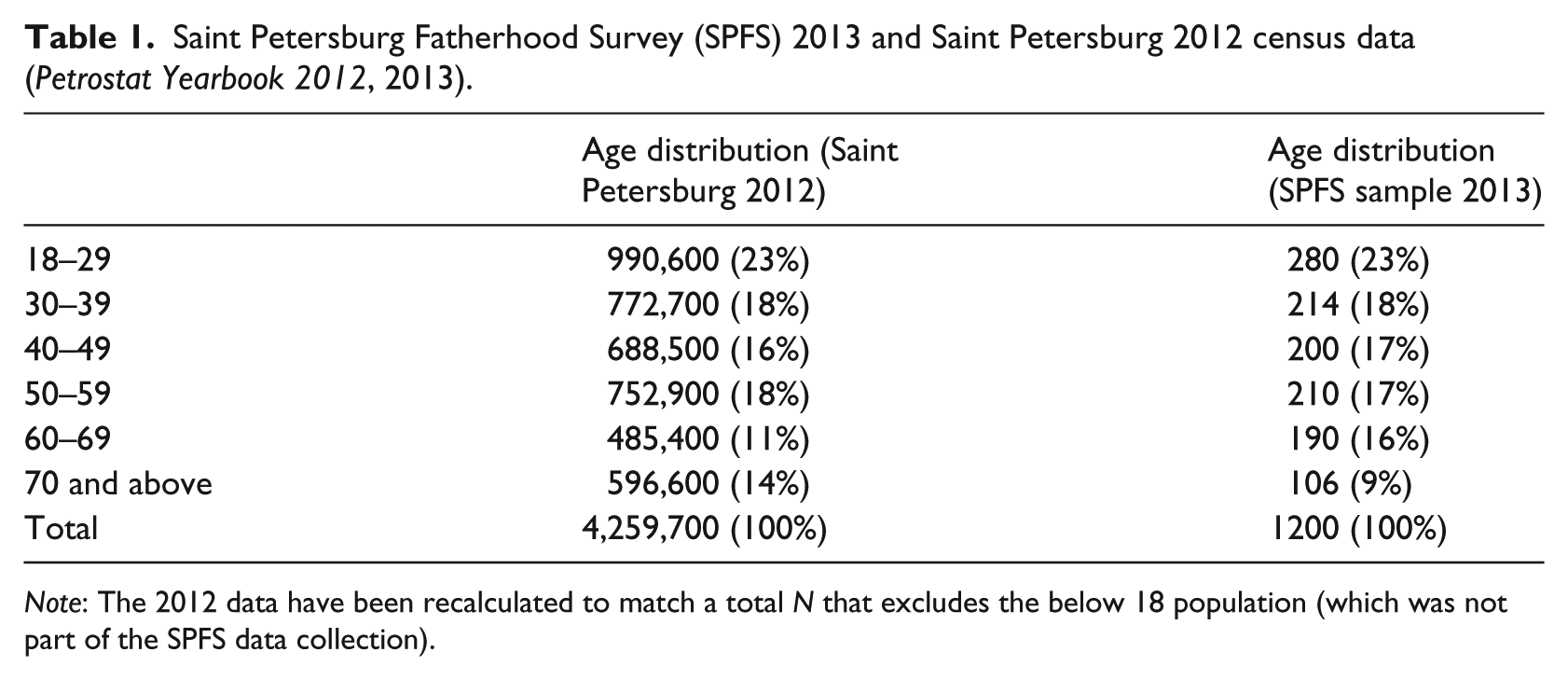
Note: The 2012 data have been recalculated to match a total N that excludes the below 18 population (which was not part of the SPFS data collection).
Measures
Based on evidence from previous research (see above), we expect the following background factors to be of particular importance when it comes to explaining attitudes towards fatherhood among Russians: SES; gender; and generation. Middle-class men appear to be most likely to adopt progressive gender norms that influence their perceptions of fatherhood as well as their actual behavior, which also means that it is more likely to find support for the new fatherhood model in this group (Doherty et al., 1998; LaRossa, 1998). Unemployment and poverty, on the other hand, are not conducive to progressive fatherhood ideals among Russian men in general (cf. Rodin and Åberg, 2013).
To recapitulate, a number of individual background variables have been included: gender (male/female); generation; and SES. Generation in this context refers to the age of the respondent. As a measure of SES, we use two specific items: education level; and household income.
As already noted, previous research has suggested a few ideal–typical models of fatherhood: the breadwinner model; the sex role model; and the new fatherhood model. In order to assess the three models, we use a battery of statements designed to tap the respondents’ norms and values associated with fatherhood, gender roles and household/child-rearing tasks. All in all, we have 35 items. For each statement, the response categories are: strongly disagree; disagree; neither agree nor disagree; and agree or strongly agree. See the Appendix (available online at http://ips.sagepub.com)
The specific items used to operationalize each fatherhood model will be explained in the running analysis (below). The logic of the initial analysis is to explore what norm patterns that seem to exist, based on established theoretical models. To illustrate, respondents holding attitudes in line with the breadwinner model would typically support statements that identify the father as the main provider of the household’s income, and at the same time support statements that suggest that the mother has the primary responsibility for all child-caring and child-rearing tasks (Kimmel, 2008; Lamb, 2000). As for respondents close to the sex role model, we expect them to agree with statements describing the father as a disciplining force vis-à-vis the children, but still retain a view that the mother has the main responsibility for child-caring tasks (cf. Kimmel, 2006). Respondents supporting the new fatherhood model would emphasize the equal responsibilities of mothers and fathers, for instance when it comes to who should stay at home to care for a sick child or who should take the child to the pre-school/school. Advocates of the new fatherhood model would supposedly also stress the importance of a father who is continuously present, physically and emotionally (Williams, 2008).
Norms about fatherhood in contemporary Saint Petersburg
Turning next to the actual empirical analysis, what norms do people in Saint Petersburg hold concerning fatherhood? How do they believe a father should behave and to what extent should he be part of child-rearing and family affairs? In the present data collection, a number of items dealt with norms and attitudes concerning fatherhood. Figure 1 shows the outcome on those items.
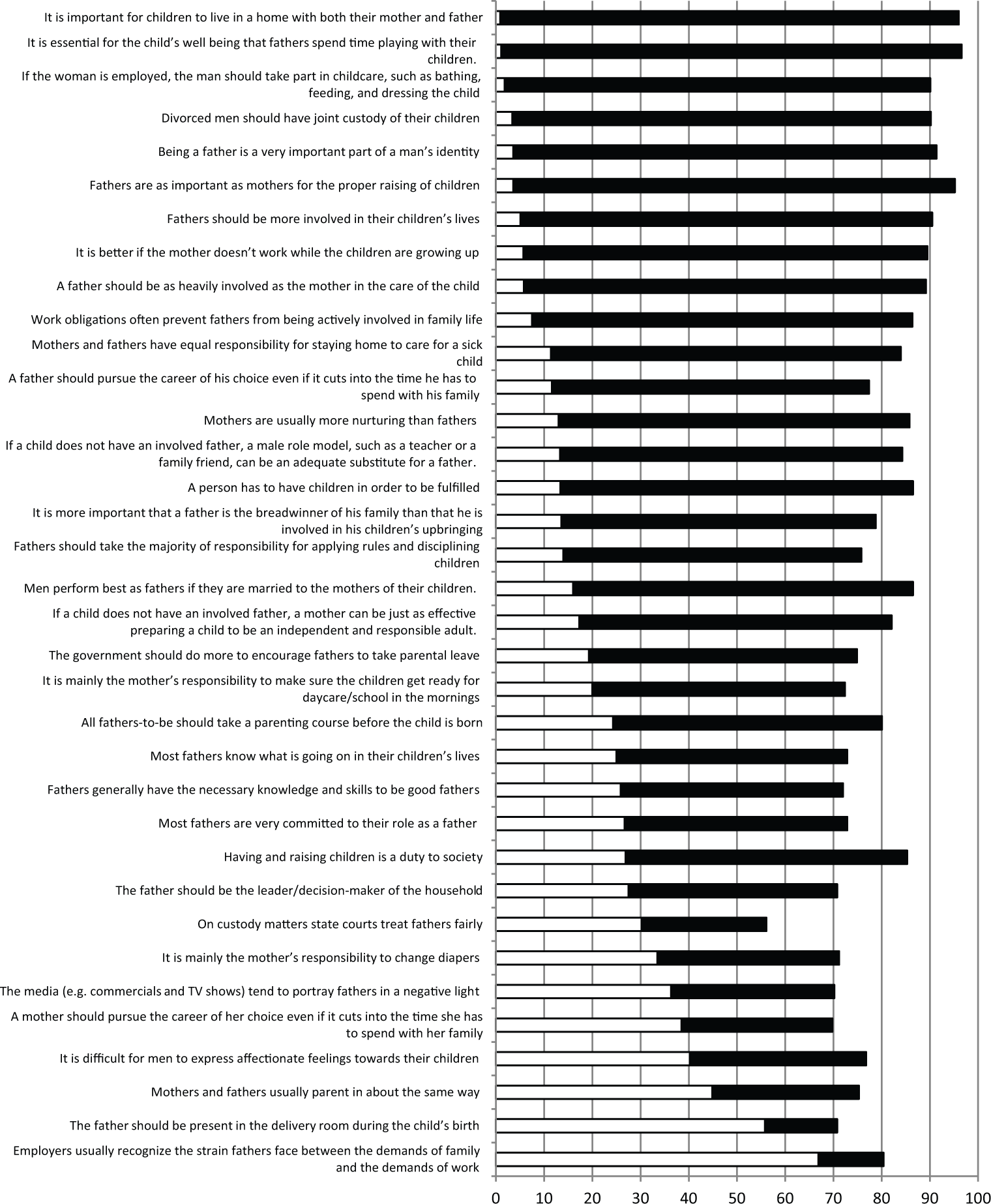
Questions about fatherhood.
Figure 1 admittedly does not lend itself to straightforward interpretations. Still, there are a few detectable patterns. Looking at statements that distinctly many of the respondents agreed with (the black staples in Figure 1) several emphasize the importance of the father being present and constituting an active part in the life of the family and the children. These items are: ‘Mothers and fathers have equal responsibility for staying home to care for a sick child’; ‘Divorced men should have joint custody of their children’; ‘If the woman is employed, the man should take part in childcare such as bathing, feeding and dressing the child’; ‘It is important for children to live in a home with both their mother and father’; ‘It is essential for the child’s well-being that fathers spend time playing with their children’; ‘Fathers should be more involved in their children’s lives’; ‘A father should be as heavily involved as the mother in the care of the child’; and ‘Fathers are as important as mothers for the proper raising of children’.
At the same time, there is also quite a lot of agreement with statements that rather speak to a more traditional or conservative view of the family and of gender roles, resembling what we referred to above as the ‘breadwinner’ model of fatherhood. For example, an overwhelming majority of the respondents agree with the statement: ‘A father should pursue the career of his choice even if it cuts into the time he has to spend with his family’. Distinctly fewer respondents agree that mothers should pursue the career of her choice. Also, quite a few agree that it is more important that a father is the breadwinner of his family than that he is involved in his children’s upbringing, which is in tune with previous research that demonstrates the centrality of the breadwinner norm in contemporary Russia (Ashwin and Lytkina, 2004; Utrata et al., 2013).
Thus, the norm patterns that may be detected in Figure 1 are not entirely consistent. Respondents seem to lend support for both a traditional breadwinner ideal and to statements that are closer to a ‘new fatherhood’ model. To makes things even more complicated, Figure 1 also suggests strong agreement with statements that do not really fit the ‘breadwinner’ model or the ‘new fatherhood’ model: ‘If a child does not have an involved father, a male role model, such as a teacher or a family friend, can be an adequate substitute for a father’; and ‘If a child does not have an involved father, a mother can be just as effective preparing a child to be an independent and responsible adult’. Both these statements suggest that the father is in fact replaceable.
Making sense of the norm patterns
In order to shed further light on the respondents’ norm patterns, we have performed an exploratory factor analysis. The idea with such an analysis is to detect underlying dimensions in the data by looking at variables that correlate highly with a distinct set of other variables, and at the same time do not correlate with variables outside that group (Field, 2000: 424). The variables – or items – with high intercorrelations supposedly measure one distinct ‘factor’, that is, an underlying dimension. The factor scores and components are reported in Table 2.
Factor analysis of fatherhood norms.
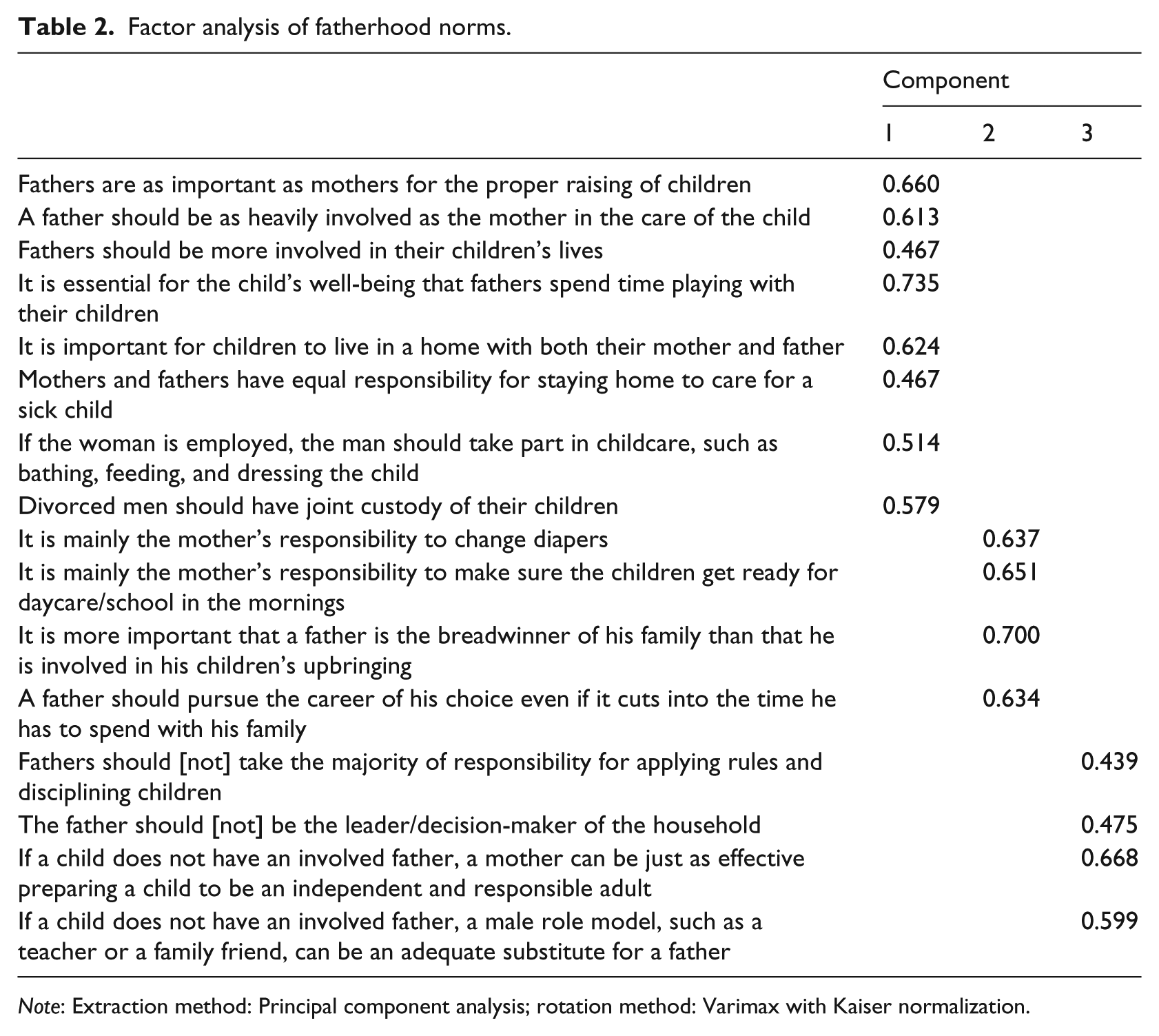
Note: Extraction method: Principal component analysis; rotation method: Varimax with Kaiser normalization.
A number of the original 35 items (see Figure 1) were discarded due to low degree of shared variance or complex loadings across multiple factors. The remaining 16 items were reduced to three varimax rotated factors, explaining just above 40 percent of the variance in the set. The important thing with this kind of exploratory analysis is that the pattern reported in Table 2 allows us to say something about the respondents’ norm patterns. Here, the first two extracted factors do in fact resemble two of the established theoretical models of fatherhood described above.
The first factor in Table 2 (the first component) is made up of eight statements that emphasize the importance of a present and engaged father. Thus, this factor seems related to the ‘new fatherhood model’. The second factor in Table 2 includes four items that reflect traditional gender stereotypes, suggesting that it is mainly the responsibility of the mother to take care of home and family, while the man should provide for his family (i.e. being the ‘breadwinner’). The third component in Table 2, however, does not reflect the third ideal-type developed in previous research (the sex role model, see above). The third component is instead made up of two items that challenge the notion of the father as the leader of the family, making decisions and disciplining the children. This is combined with two items that suggest that the father could be replaced, substituted by a mother or another male role model. Thus, the third component describes an ideal-type where the father is marginalized and should not be too involved in the family. We will tentatively refer to this orientation as the ‘marginalized fatherhood’ model.
Previous research has, of course, covered absent fathers (e.g. Ancona, 1998; Kimmel, 2008). However, the marginalized fatherhood model we encounter here does not necessarily imply that the father is not present in the family but rather that the father’s role in the family is limited, and that he is not considered essential for the functioning of the household. In fact, this relates to the situation for many fathers in the former Soviet Union (cf. Rodin and Åberg, 2013; Utrata et al., 2013). Also in Russia of today, the father’s role in family and household is frequently found to be limited. There are many nonresident fathers where, after a divorce, fathers give up or lose touch with their children. Even fathers still living with their children and partners are presented as having a very limited role (Utrata, 2015).
On top of this, one should consider a Soviet reality where many fathers were made to leave their families for long periods of time, because of political purges, deportations, World War II, and later on, because of the need to travel far to find work. Another important factor in this context is binge drinking and alcoholism that was a severe problem particularly among men in Soviet times and continues to be a problem in contemporary Russia (Jukkala et al., 2008; McKee, 1999; Utrata, 2015). Hence, historical, political and social structures have created poor conditions for present and engaged fathers.
In short, throughout the Soviet era, families had to learn to function largely without the father. For single mother families the solution often rested with securing help from the child’s grandmother (babushka). A situation where the mother and grandmother take care of family and household as well as putting food on the table is also argued to be quite common in today’s Russia (Utrata, 2015). This is partly due to the harsh labor market situation, which has left many men unemployed (Ashwin and Lytkina, 2004; Utrata, 2011). Given the breadwinner norm, the labor market situation, and the historical legacies of family structures it is not hard to see that a man without a job may be at a loss, having no role in professional life and no role in the home. Previous research has argued that it is difficult for Russian men who lose their role as breadwinner to take on a different role in the household (Ashwin and Lytkina, 2004). Table 2 suggests that this historical reality has forged a distinct notion of the father as someone with only a limited role in the private sphere. Many men also seem to embrace, or at least accept, the marginalization of their role in family life and agree with women both that the father’s role is less important than the mother’s role and that expectations on fathers’ contributions should be kept low (Utrata, 2008, 2015).
To summarize, based on our statistical analysis of the SPFS data, we may identify three notions of fatherhood in contemporary Saint Petersburg: the ‘new fatherhood’ model; the ‘breadwinner’ model; and the ‘marginalized fatherhood’ model. The three models are summarized in Table 3.
Fatherhood models in contemporary Saint Petersburg.
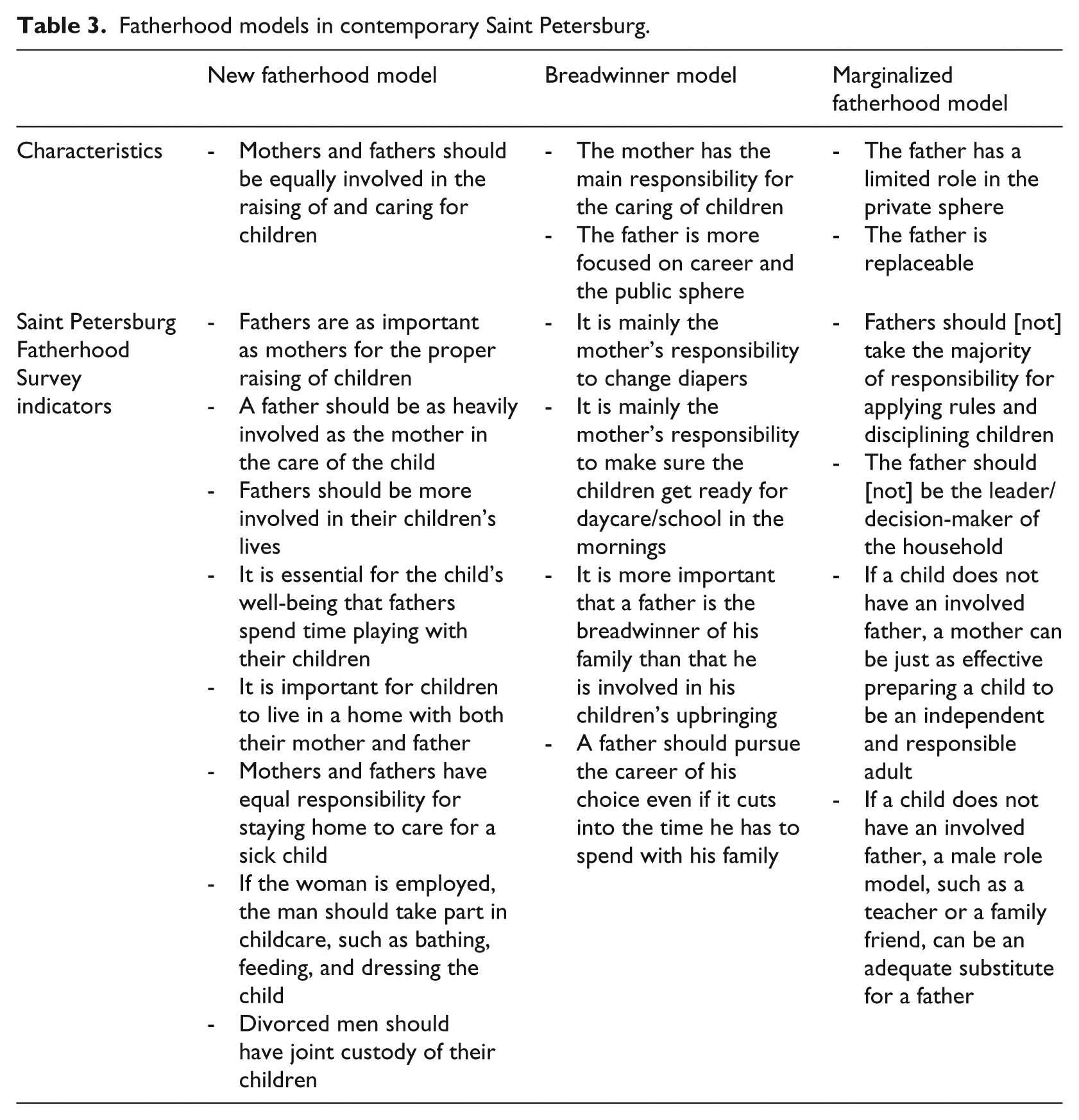
Thus, there is obviously not just one fatherhood model present in the minds of the citizens of Saint Petersburg. This is not surprising; one would expect to find attitudinal differences in any context. Still, it is interesting to note the strong support for both the breadwinner model and the new fatherhood model. This indicates that there are competing fatherhood discourses in contemporary Saint Petersburg despite the strength of neo-conservative and neo-familial public discourse. It is also interesting to see that marginalized fatherhood continues to be a prevalent feature. This has been discussed in some research (Utrata, 2008, 2015), but to the best of our knowledge this is the first time the prevalence of this phenomenon has been mapped out, based on a larger sample of individuals.
The marginalized fatherhood model resembles the breadwinner model, with a limited role for fathers in the private sphere. However, the marginalized fatherhood model implies an even more limited role since the father is not expected to provide for the family either. The role of the father is, to put it a bit pointedly, not essentially important for the functioning of the family; and this constitutes a difference to the breadwinner model where the father is needed as the provider.
It may of course be that this marginalized fatherhood model that shows up in our data is influenced by practical realities in today’s Russian society, leaving the man/father unable to fill the role of the breadwinner due to unemployment, social dysfunction and/or health problems due to drinking. This may in turn result in views of fathers as generally less capable, less suitable or even unfit to take care of a child. While it is likely that this plays a role in fathers’ marginalization, it cannot be directly deduced from the data at hand, although it does resonate with previous qualitative studies where both mothers and fathers express the view that fathers are replaceable and mostly superfluous (Utrata, 2015).
Who holds what norms?
Next, we turn to an analysis of the correlates of the different fatherhood models, controlling for standard background variables such as age, gender, and SES (Table 4). Who are the respondents that support each model, and what differences may be observed?
Fatherhood norms and background variables.
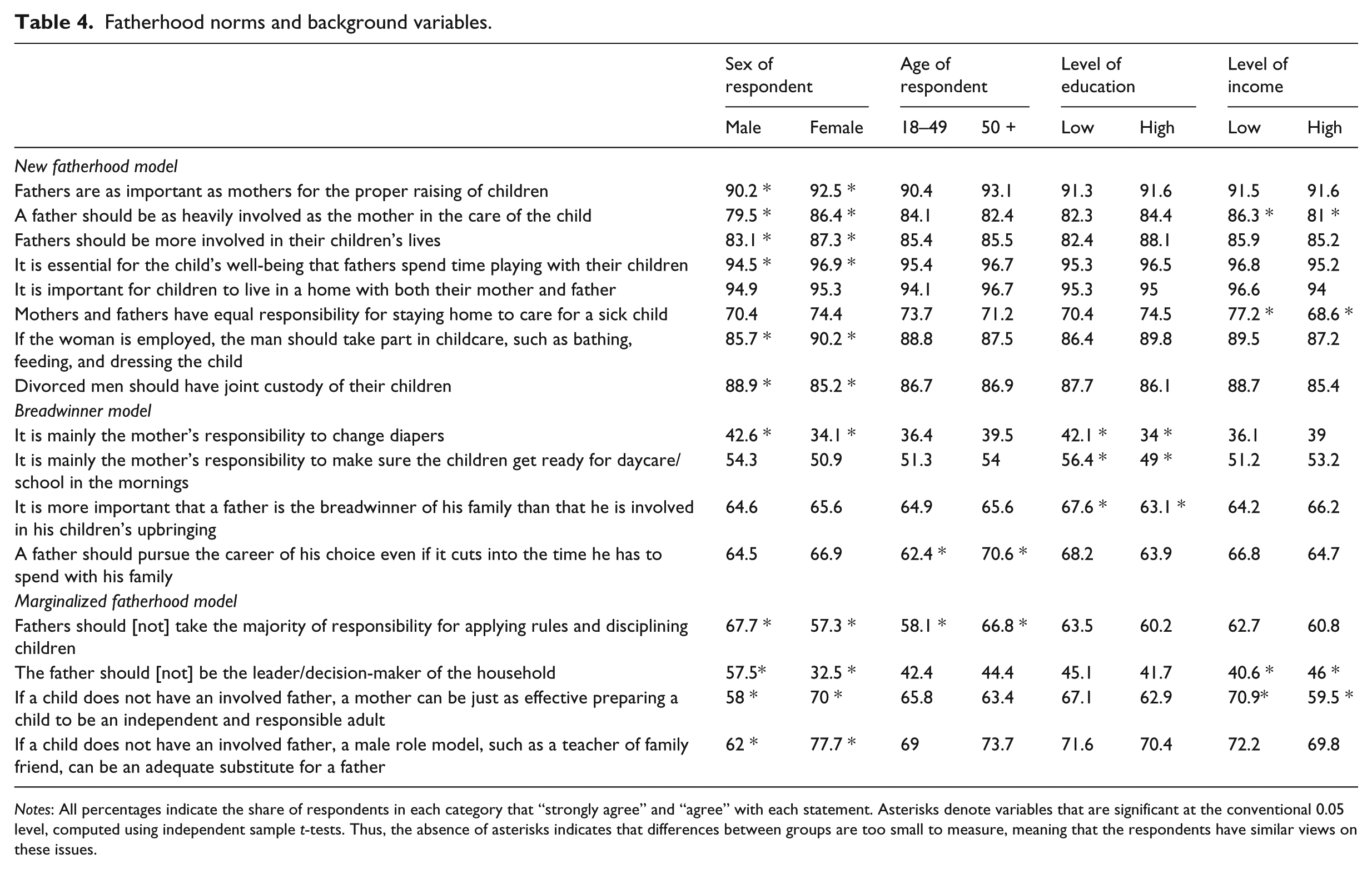
Notes: All percentages indicate the share of respondents in each category that “strongly agree” and “agree” with each statement. Asterisks denote variables that are significant at the conventional 0.05 level, computed using independent sample t-tests. Thus, the absence of asterisks indicates that differences between groups are too small to measure, meaning that the respondents have similar views on these issues.
In Table 4 we have cross-tabulated gender, age, level of education, and level of income with the norm questions that make up the three different fatherhood models (see Table 3). Thus, the first eight items in Table 4 correspond to the ‘new fatherhood’ model; the next four to the ‘breadwinner’ model; and the final four items to the ‘marginalized fatherhood’ model.
Gender
Concerning the items that make up the first model, we find that gender matters. In six out of eight items, significant differences between men and women are found. Differences are not pronounced, but women are overall more in favor of the ‘new fatherhood’ model than are men. Only when it comes to one item – ‘Divorced men should have joint custody of their children’ – the pattern is reversed (Table 4).
Looking at the items that constitute the second model, there are no clear-cut gender differences. In fact, only one of the four items that make up the ‘breadwinner’ model displays a statistically significant difference between men and women (Table 4).
It is interesting to note that the third model in our analysis – the marginalized fatherhood model – elicits the most distinct differences between men and women. All differences are pronounced – above 5 percentage units – and statistically significant: women are thus distinctly more in favor of this model than men are; rejecting the role of the father as the leader of the family and at the same time agreeing that the father can be replaced (Table 4). This could possibly be explained, again, with reference to the Soviet legacy and the notion of a marginalized father figure, although recent studies show that many men in Russia also agree with the notion of a marginalized role for the father in the family (cf. Utrata, 2008, 2015). Moreover, in contemporary Russia, the gender contract bears many similarities with the Soviet one: the private sphere remains an isolated arena where women hold power positions. For sure, this would not be unique to the Russian context, but the normative and attitudinal differences in this respect suggest the presence of female ‘gate-keepers’, upholding the limited role of fathers in the private sphere (cf. Allen and Hawkins, 1999; Ashwin and Lytkina, 2004; Doherty et al., 1998). This maternal gate-keeping does most likely not only reflect general norms and attitudes towards fatherhood, but also to a certain extent that drinking and other related social problems like domestic violence among Russian men severely reduce mothers’ trust in men’s fathering skills and trustworthiness, as mentioned above.
Age
A bit surprisingly, age (or generation) turned out to be a poor predictor of fatherhood norms in the present analysis. Only for two items out of 16 we find statistically significant differences between age groups. It should be noted that we also tested the relationship using more fine-grained age groups than the young (18–49) versus old (50+) dichotomy displayed in Table 4, but with the same result: respondents in all age groups seem to hold similar views on these issues. While we cannot entirely rule out the possibility of an effect of how the age categories were constructed in the original questionnaire (i.e. an ordinal scale with 10-year categories rather than an actual birth year scale), the lack of clear-cut generational differences could also mean that all three models of fatherhood are, at least to some extent, institutionalized in the Russian context.
This may seem like a contradiction, since the three models (Table 3) are in fact not compatible. It should however be kept in mind that the three models of fatherhood developed in West European and American research did not always follow a clear-cut sequential development, going from a total dominance of the breadwinner model, via the sex role model, to the new fatherhood model. Rather, all three models have existed side by side in different countries, at different points in time. One could thus expect a similar situation in Russia, where the ‘new fatherhood’ model could exist side by side with both the ‘breadwinner’ model and the notion of a ‘marginalized father’.
Education and income
Turning next to SES, Table 4 does not reveal much additional information. As for level of education, there are only three instances of significant differences between respondents with high and low education, but these cannot really tell us anything about how educational levels correlate with preferences for the three fatherhood models. As above concerning age/generation, we have also tested the statistical relationship using more fine-grained education categories, but with the same result. Again, attitudinal differences seem to be too small.
We have also controlled for income levels, but again, the findings are inconclusive. The few instances of significant differences between people with low and high income levels do not follow any clear-cut patterns in relation to the three models of fatherhood (Table 3). Still, it may be noted that significant differences are actually found for two of the four items that make up the ‘marginalized fatherhood’ model. People with low income are more likely to support the notion of fathers being replaceable (Table 4).
All in all, gender seems to matter more than age and SES when explaining the respondents’ support for the different fatherhood models.
Concluding remarks
What may we conclude about fatherhood norms in contemporary Russia, on the basis of the present Saint Petersburg case study? To begin with, there is not just one dominant model to be found.
Through the analysis of the SPFS, we have identified three fatherhood models. Two of them, the breadwinner model and the new fatherhood model also relate clearly to what previous research on fatherhood in Western Europe and the US has shown. Thus, there are clear similarities regarding fatherhood norms between the Russian and the Western context, as manifested in the breadwinner model and the new fatherhood model. However, the third model, marginalized fatherhood, seems to be a distinct (albeit perhaps not unique) Russian feature of fatherhood. It does not fit the third model identified in previous research in other contexts, that is, the sex role model. Marginalized fatherhood in the Russian context has been discussed in previous research but here we can see its actual prevalence and relation to other models of fatherhood.
Admittedly, our investigation of the Russian context is not a historical study, aiming at discovering developments over time. However, as is certainly the case in most contexts, it is not a matter of one fatherhood model replacing another, but rather a matter of which model is more dominant at a certain period of time. Thus, the existence of several norm patterns, constituting different fatherhood models simultaneously is to be expected. Still, the marginalized fatherhood model, here derived from the Russian context, may be seen as a useful contribution to the literature on fatherhood.
A significant amount of research in the West has discussed social problems believed to be caused by ‘absent fathers’. However, few if any scholars have departed from the notion of ‘relative absence’ as part of a distinct fatherhood model. Rather, the assumption has conventionally been that ‘absence’ has to do with a situation when a father is not part of the family or household. However, the marginalized fatherhood model found in the present study does not necessarily imply that the father is absent from the family; but rather that he is not believed to have any major part in family affairs. Thus, the marginalized father is more in line with the situation fathers found themselves in during Soviet times where the state and the mother took on the tasks of the private sphere of the family, leaving the father without any clear role.
As for the different background variables used in the present analysis, only gender seems to be a distinct predictor for which norm pattern that is supported. Even if differences are not pronounced, women are more likely to agree with the new fatherhood model than men. The same pattern is even clearer when it comes to the marginalized fatherhood model. At the same time, age and SES appear to be poor predictors in the present data collection. Looking at support for the breadwinner model, we find hardly any differences when controlling for all of the background variables. This could possibly be explained by this model being more institutionalized in contemporary Russian society than the other two models.
A recurring pattern in our analysis is that the standard SES background variables do not explain much of the variance. This is not consistent with previous research on fatherhood norms. For example, according to previous research we should expect stronger support for the new fatherhood model among respondents exhibiting middle-class attributes. These results did not show up. Further studies are needed to uncover this particular phenomenon, which may be ascribed to the specific Russian context.
All in all, the analysis of the SPFS demonstrates that several fatherhood ideals are present in Saint Petersburg today. The new fatherhood model seems to have taken root but the breadwinner model also has strong support. Finally, a third model, the marginalized fatherhood model is also evident. This model does not match any of the models outlined in previous fatherhood studies based on larger samples of individuals, but it is discussed in previous qualitative studies of fatherhood in Russia. The existence of such an ideal may be explained with reference to the Soviet legacy and, thus, begs the question of to what extent it is a more general post-communist phenomenon. However, one should be careful with what claims are made. One obvious limitation of this study has to do with the sample, that is, the data collected in Saint Petersburg. We cannot claim that the marginalized fatherhood model is a distinct post-Soviet/contemporary Russian phenomenon. Here, the more modest ambition has been to move beyond qualitative case studies and test what attitudes people have towards fatherhood in a larger population. Ideally, a similar test on a representative sample of the entire Russian population could be carried out in future research. Another interesting task for future research would be to compare across post-communist societies, looking for similar orientations outside of Russia.
Footnotes
Acknowledgements
We wish to thank the anonymous reviewers as well as the editors for their valuable input and for their assistance in improving our text.
Funding
This work was supported by the Foundation for Baltic and East European Studies.
Author biographies
References
Supplementary Material
Please find the following supplemental material available below.
For Open Access articles published under a Creative Commons License, all supplemental material carries the same license as the article it is associated with.
For non-Open Access articles published, all supplemental material carries a non-exclusive license, and permission requests for re-use of supplemental material or any part of supplemental material shall be sent directly to the copyright owner as specified in the copyright notice associated with the article.
