




Abstract
Despite the widespread use of disappearances as a central tool of terror in recent decades, little is known about the emergence of the phenomenon or its underlying rationale. We argue that growing international accountability norms, coupled with the improved quality of reporting human rights abuses, paradoxically reshaped the repressive strategies of certain regimes and pushed them to deploy more clandestine and extrajudicial forms of repression, predominantly disappearances. We also explore the timing of disappearances: when a state decides to deploy a particular instrument of terror can greatly benefit our understanding of why it was used. We show that repressive regimes tend to use disappearances in the first period after a coup, taking advantage of the general confusion and opacity to secure strategic benefits and protect the regime from external scrutiny and future accountability. Our findings contribute to the growing literature on human rights and political repression by highlighting an ‘unintended consequence’ of international accountability norms: repressive regimes turn to clandestine crimes.
Keywords
Introduction
By abducting, secretly executing, and hiding the remains of their victims, perpetrators of enforced dissappearances have three main aims. First, and most obviously, they want to eliminate real or perceived enemies. Second, they seek to spread a unique form of terror, trapping the affected families in a state of ‘ambiguous loss’ and paralyzing the broader society (Boss, 2006). Third, by hiding the body and concealing the crime, they hope to deny its commission and avoid the consequent criminal charges. According to a recent report of the UN Working Group on Enforced or Involuntary Disappearances, 91 states face the problem of enforced disappearances (United Nations, 2017).
In what follows, we highlight the gaps in the relevant literature and articulate our contribution. We then explore the historical, ideational and normative causes of disappearances. We show how the ‘justice cascade’ (Sikkink, 2011) of the late 20th century, coupled with the improved quality of reporting human rights abuses, paradoxically reshaped the repressive strategies of certain states, pushing them to deploy more clandestine forms of repression, such as disappearances. Next, we shed light on the rationale behind the timing of disappearances by drawing on the comparative experience of Greece and two of the most prominent cases in Latin America, Chile and Argentina, as ‘crucial cases’ (Eckstein, 2000). Finally, we conclude by discussing the unforeseen impact of post-WWII international accountability norms on shaping the repertoire of political repression. We show how concerns over future accountability ‘pushed’ authoritarian leaders to deploy novel extrajudicial and clandestine forms of repression, like disappearances.
Theoretical and empirical gaps in the literature on political violence and state repression
A number of accounts engage explicitly with the problem of enforced disappearances and provide detailed analyses of various aspects of the crime, including the enduring trauma of the relatives (Sant Cassia, 2005), or the mobilization of the relatives, including the well-known case of the Mothers and Grandmothers in Argentina (Arditti, 1999). Others offer a systematic analysis of the historical, social and political conditions (Brysk, 1994; Robben, 2005). However, most are based on ethnographic research into a single or a couple of countries, making no attempt to identify the historical and ideational factors that enabled the crime to be diffused more widely.
Legal scholars have paid particular attention to the crime of enforced disappearances (Kyriakou, 2012; Scovazzi and Citroni, 2007). However, most legal analyses fall into two categories: either they simply describe the evolution of the legal framework, or they assess the effectiveness of states in prosecuting perpetrators. Commencing from a deontological standpoint, most focus on the duty to punish, failing to explore the other side of the equation, namely how legal and normative boundaries affect the repertoire of violence deployed by repressive regimes. In essence, many legal accounts, by perceiving violence as the exception to an otherwise peaceful society, fail to appreciate the political rationale of repression and the strategic considerations behind the choice of a specific tool. Consequently, little emphasis has been placed on the impact of international law on the various repertoires of violence.
Political scientists have taken significant steps towards providing robust theoretical explanations of the ‘logic of violence’, accounting for the presence or absence of selective versus indiscriminate violence, the duration of conflict, and/or the relevance of institutions in times of conflict (Kalyvas, 2006). However, the objective of this fertile line of research is to offer a holistic theory of violence in civil wars. It does not focus on separate practices, in particular disappearances. To be sure, systematic attention has been given to which conditions cause contending groups to use specific forms of violence against civilians (Balcells and Kalyvas, 2014; Downes, 2007), but without explaining the use of disappearances and politically motivated abductions as the preferred instrument of violence.
Even more importantly, this rationalist line of thought is based on the assumption that ‘causal structures are uniform through time’ (Sewell, 1996: 263) and pays scant heed to variations in state repression across time. Determining why specific crimes gain prominence in specific historical periods and wane in others is analytically significant, but existing research on political violence has failed to provide a convincing explanation of why the crime of disappearances began to be used in a systematic way at a particular historical juncture (1960s and 1970s). With some exceptions (Fariss and Schnakenberg, 2014; Ron, 1997), few have asked how external influences may shape domestic repertoires of political violence.
In line with other authors, we argue that states choose among different methods of repression after calculating the costs and benefits of each. The rationale behind the choice of one or several of these tools by different countries and at different moments in time has, however, only recently sparked critical interest. Some analysts say repressive policy tools are not independent; they ‘provide overlapping benefits to leaders’ and ‘affect the costs of other repressive policies’ (Fariss and Schnakenberg, 2014: 1004). Others emphasize the ‘tactical adjustments’ made by states when they face ‘naming and shaming’ denunciations by international actors (Hafner-Burton, 2008). Notably, ‘when a country is shamed for torture by the United Nations in a given year, the level of disappearances increases in the following year’ (DeMeritt, Conrad and Fariss, 2014: 20–22). This finding is not particularly surprising, because ‘disappearing individuals after they have been tortured can make it more difficult to prove that the torture occurred’ (DeMeritt, Conrad and Fariss, 2014: 9). By emphasizing the unintended consequences of international advocacy campaigns, such argumentation goes in the same direction as ours. However, while it helps explain why authoritarian regimes shift their repressive strategies and use disappearances at different stages during their rule, it fails to account for the historical context within which the crime of disappearances occurs, and does not explain the timing of certain repressive strategies.
Historical, ideational and normative origins of disappearances
A combination of ‘push’ and ‘pull’ factors made disappearances particularly appealing from the 1970s onwards. Normative and international shifts pushed perpetrators away from more visible crimes (e.g. executions, torture) and pulled them towards extrajudicial and clandestine forms of repression. Of course, disappearances were not new in the 1970s. They have always offered a strategic advantage. For example, by disappearing a handful of persons from one’s own community, one party could prevent collaboration with the ‘other’ (Kalyvas, 2006); it serves as a message to the ‘in-group’. Despite the strategic benefits, it was only with the broader international normative shift occurring after World War II that disappearances began to be used in a systematic manner. 1
More specifically, after World War II, the winning powers signed the Agreement for the Prosecution and Punishment of Major War Criminals of the European Axis (London Charter). The International Military Tribunal at Nuremberg was established in 1945 and the International Military Tribunal for the Far East in 1946. As a result of these trials and the gradual development of international human rights law, the bar of legal accountability was raised. Certain actions that had never previously been punished were now subject to criminal prosecution. 2 Table 1 traces the main developments before Pinochet’s coup in 1973 – a watershed event in the use of enforced disappearances as a political tool.
Selected landmarks in human rights before the 1970s.
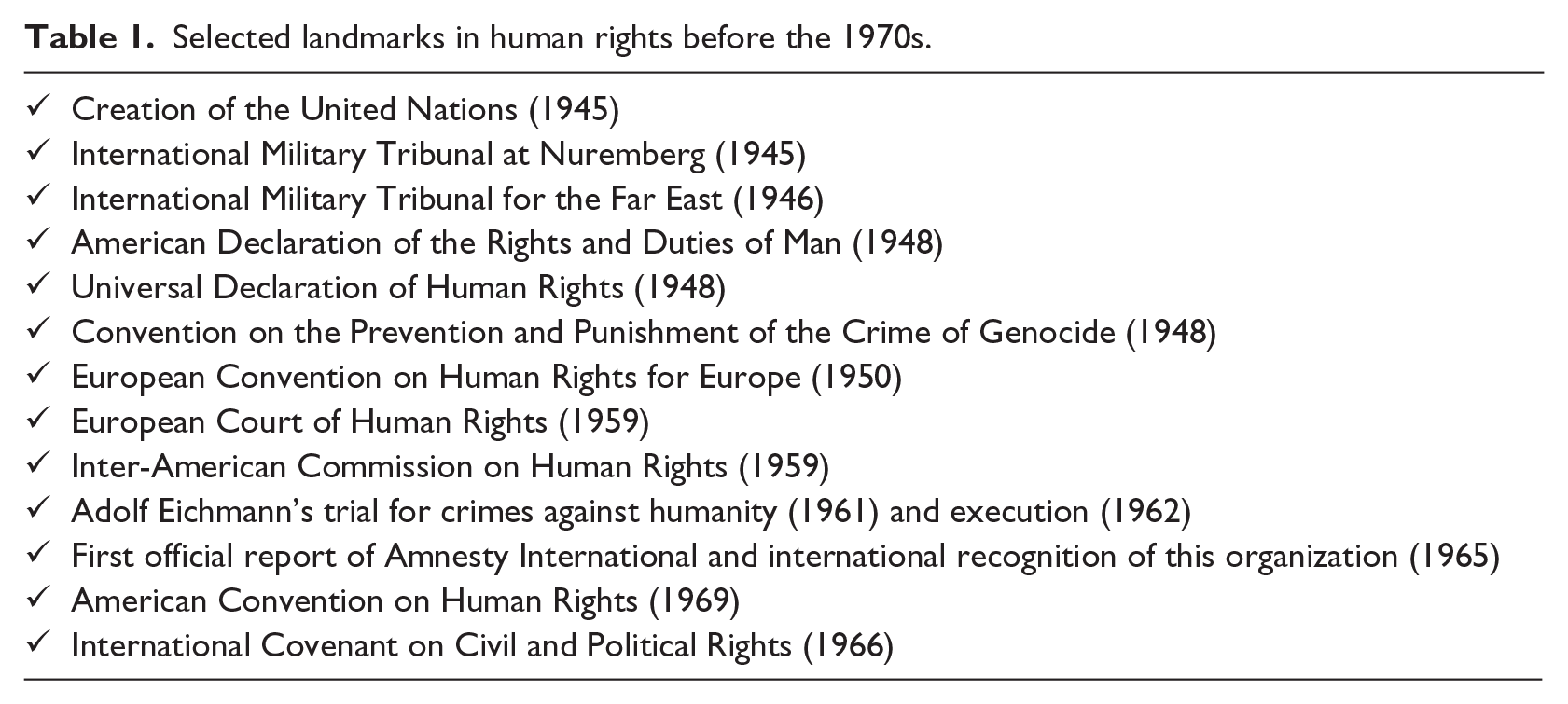
In sum, after 1945 an international human rights regime began to emerge. As Schmitz and Sikkink note, certain rights ‘underwent a process of progressive “international legalization”’, while at the same time, ‘global efforts to strengthen individual criminal responsibility through the use of domestic, foreign, and international courts gained growing support’ (Schmitz and Sikkink, 2012: 832). This constrained the capacity of states and paramilitary groups to use overt violence, necessarily reshaping their preferred means of repression. As Sadat points out, ‘since World War II new variants of atrocity crimes have ravaged populations on different continents at different times’, including the ‘widespread or systematic disappearances in Latin America’ (Sadat, 2013: 375).
In an interview, Stefanie Grant, head of research at Amnesty International in the 1970s, explains how unprepared they were for this new variant of atrocity: ‘“this person was taken” or “we don’t know where this person is” and that was the end of the trail; the government said this has nothing to do with us, he or she is a missing person’. 3 This seems to be a textbook case of unintended and/or unanticipated consequences (Merton, 1936). 4 By increasing the cost of visible forms of repression, a more attentive and demanding international community unwittingly gave dictators the incentive to deploy clandestine forms. A gradual shift from inter-state to individual criminal liability, together with innovations in formulations of human rights norms (Watkin, 2004), raised the bar of accountability and the potential (criminal, political, legitimacy) costs of violence, pushing those seeking power to find covert means to rid themselves of their enemies.
As noted above, recourse to illegal detention/kidnapping is not novel. Those disappearing their enemies in the 1970s did not invent a new crime. However, some authors consider it only began to be used in a planned and systematic way in the French operations in the Indochina and Algeria Wars (Riegler, 2008; Robin, 2005). Leading members of the French army were convinced their mission was not limited to safeguarding the colonies for France; rather, they were fighting an ideological war to save Europe and Christianity from communism and anti-colonial movements. Traditional counterinsurgency manuals could not address the new types of warfare; instead of clear lines of battle, the dividing line between civilians and ‘terrorists’ was unclear. Accordingly, the French military designed a novel counterinsurgency doctrine (guerre revolutionnaire) aiming to cut off popular support for guerrilla forces. Within this revised background, interrogations, torture, and psychological terror became central, not only in extracting information about potential collaborators but also in deterring the broader population from assisting rebels. One crucial element of the new doctrine was making interrogations extrajudicial; another was taking the counterinsurgency out of the realm of the law to deter potential collaborators.
Roger Trinquier, a French military officer, theorized the French counterinsurgency practices in Guerre Revolutionaire. 5 One of his concerns was the possible consequences of a public backlash: ‘A violent press campaign was unleashed, both in France and abroad, demanding that peacetime laws be strictly adhered to in the course of police operations’ (Trinquier, 1961: 48). Such a backlash, he said, could have political consequences: ‘Certain harsh activities can easily pass for brutalities in the eyes of a sensitive public …. Our enemies will not fail to exploit the situation for their propaganda needs’ (Trinquier, 1961: 57). In other words, there was a need to conceal political repression – but not to halt it. An estimated 3000 persons disappeared during the Battle of Algiers (Riegler, 2008: 57). According to informed observers, dead bodies were thrown from aircraft into the sea, a shocking prequel to the practices of the Argentine military 15 years later (Armony, 2005).
The clandestine repression exerted by an external force can easily be replicated by like-minded military regimes fighting domestic opposition. The strategy simply requires an efficient bureaucratic organization with abundant personnel, weapons, means of transport, and places to hold and torture enemies. So, on the one hand, the US army practised the guerre revolutionnaire doctrine in Vietnam while, on the other hand, Latin American dictatorships adapted it to fight domestic dissidents.
The diffusion of disappearances to the South American continent has been widely documented. It is not a coincidence that the crime moved from the (former) French colonies to Latin America, where it became a systematic tool of state terror in the 1970s (Ryan, 2005: 296). It was ideologically linked to the ‘national security doctrine’ and intrinsically related to state repression. In addition, members of the French military who had applied the doctrine in Algeria taught the manual (Guerre Revolutionnaire) at the School of Americas, the training ground for hundreds of military personnel in Latin America (Armony, 2005:311-312; Robin, 2005). 6 In effect, the counterinsurgency doctrine designed by the French military set the stage for the ideological justification of contemporary disappearances. The notorious Operación Cóndor, which carried out thousands of disappearances in the region, clearly reflected the lessons of the French instructors.
The above considerations should be put in the context of the emergence of new transnational human rights watchdogs and the rapid increase in the speed of media reporting, making certain crimes more easily detected. Since the 1970s, and especially after the 1980s, the global media have increasingly used human rights discourse in their reporting (Ron, 1997). However, instead of deterring violence, the vigilance of mass media and International Non-Governmental Organizations (INGOs) has pushed perpetrators to commit more clandestine crimes – the ‘push’ factor we mentioned above. Legitimacy, prestige and reputation in the international system are important assets. Having a poor human rights record could have an adverse effect on international trade, economic aid, and investment. In preceding decades, there was little reason to ‘disappear’ an enemy; the long time lag in reporting, the absence of human rights international trials, and the lack of external oversight enabled totalitarian regimes to use massive and overt forms of violence, a good example of which is the Stalinist repression. A sign of the changing times was the decision of the Argentine military to use disappearances as its primary form of repression. The Argentine military undoubtedly took note of the harm to the international reputation of Pinochet following public executions in Chile (Robben, 2005).
We do not suggest that all authoritarian regimes are influenced to the same extent by external normative influences. In fact, we argue that under certain conditions the tool of disappearances becomes more appealing than other available instruments. First, the threat of future accountability and/or international scrutiny is likely to be a key concern of the regime’s leaders. Totalitarian leaders and/or leaders whose power does not depend on external (financial or military) support will not have the same incentive to conceal their crimes, because their power is mainly founded on their ability to exert physical violence as a tool of coercion. In contrast, clandestine violence and disappearances reflect the need to conceal or deny the crime in order to avoid domestic unrest and to confound international scrutiny.
There is a second, overlapping caveat: the military leaders of a regime should not have absolute control over the state and its population. A totalitarian regime that has reached a high level of control of social and political life usually deploys institutional forms of castigation or control rather than clandestine violence, such as disappearances. For example, Gulags, mass deportations, or executions proved to be effective institutional tools of repression to terrorize opposition and consolidate Stalinism. The institutional violence needs to be visible and have clear ‘ownership’ of coercion to maximize its legitimizing role. In contrast, disappearances are based on the effort to deny the crime.
Research design
To explore the logic (and timing) of disappearances, we draw on the comparative experiences of Greece, Chile and Argentina as ‘crucial cases’ (Eckstein, 2000). First, we take a close look at the actions of the Greek military junta (1967–1974). Despite sharing similar ideological, political and strategic convictions with their Latin American counterparts, the Greek colonels used torture as their main tool of repression. We suspect that the time frame and the normative framework determined the selection of the repertoire of repression in each case. On the one hand, the Greek dictators did not expect rigorous international scrutiny and thus adopted crimes that in retrospect proved relatively easy to detect. Chile and Argentina, on the other hand, could be considered the ‘big bang’ of disappearances, not least because the growing awareness of international monitoring of human rights violations gave them a strong incentive to hide their crimes.
The Greek junta: the litmus test of international accountability
Much like several Latin American juntas, the ostensible rationale of the military coup in Greece was to bolster stability in the country and to maintain the ‘Christian values’ which, in their view, were threatened by communism. In addition, within the context of the Cold War Greece was positioned in a strategic location in the global balance of power, so the USA supported the regime, albeit covertly. This echoes the justification of the support of the USA for the Latin American juntas, largely stemming from security concerns regarding a potential rise of communist-supported regimes in its backyard. Unlike the Latin American leaders, however, the Greek colonels used more ‘traditional’ and easier to document forms of repression, predominantly torture: there are no known cases of disappearances.
To explain this outcome, we need to understand the international historical and normative context. As mentioned above, after the end of World War II, there was a cascade of international treaties and legal instruments. These became politically salient only in the mid-1960s, when international organizations and transnational NGOs started to monitor human rights violations systematically (Moyn, 2012; Sikkink, 2011). A growing number of studies show that the documentation of violations carried out by the Greek junta was a notable ‘turning point’ in the process (Keys, 2012).
To be precise, international accountability was not a concern when the Greek colonels were designing their repressive tools. For example, a few days after the coup, one of the military masterminds, Stylianos Pattakos, stressed that the Council of Europe ‘bothered Greece no more than a mosquito on the horns of an ox’ (cited in Soriano, 2017: 357). We argue that there are two key reasons for this lack of concern about international accountability or future domestic criminal proceedings. First, the realities of the Cold War in the mid-1960s made powerful states and international organizations more reluctant to openly confront useful military actors (notably the USA) that could secure regional stability and security, even if that meant turning a blind eye to human rights violations. The Greek military could look at the dictators in the Mediterranean (e.g. Spain, Portugal) who were largely off the hook on human rights issues. Hence, they assumed their dictatorship would be business as usual.
But things changed in the Greek case. By the second year of the junta’s rule, Amnesty International sent a team to Greece to investigate and document cases of torture. Records of the time reveal that the dictators were so shocked to be investigated by the international community that they naively allowed Amnesty International to be present (Keys, 2012; Pedaliu, 2016) and, given previous history, they were genuinely convinced that the Western community would offer its unconditional support. However, as a result of the reports published by Amnesty International, and their ensuing inter-state cases, the Human Rights Commission of the Council of Europe condemned the Greek military for gross violations of human rights. Faced with the very real prospect of being expelled from the Council of Europe, the colonels decided to withdraw the country from the Council in 1969 (Keys, 2012; Soriano, 2017).
Most importantly, this international documentation of abuses was crucial in the trials held in the aftermath of the collapse of the regime in 1974, when more than a dozen officers involved in torture were prosecuted and convicted. The entrenched belief that accountability was off the table had led the colonels to opt for an easily detectable crime (i.e. torture) as their preferred tool of repression. This belief paved the way for their eventual criminal conviction.
The Greek experience is useful because it took place at a critical juncture (mid-1960s) when international organizations and transnational NGOs started to monitor human rights violations, particularly cases of torture. The international outcry not only shocked the Greek dictators when it bore fruit, but also it pushed other dictators to use less visible crimes, such as disappearances, and demonstrated the need to conceal the corpus delicti. It is not an entirely implausible counterfactual hypothesis to claim that if the Greek colonels had carried out their coup a few years later, they would probably have substituted torture with another clandestine crime, much like the Latin American military did with disappearances. In this, timing is everything.
The logic and timing of disappearances
As the Greek case suggests, when a repressive state decides to deploy a particular instrument of terror may help explain why it was employed in the first place. As Charles Tilly argues, ‘When things happen within a sequence affects how they happen’ (Tilly, 1984: 14; emphasis in original). Placing state repression in time – that is, ‘systematically situating particular moments in a temporal sequence of events and processes’ (Pierson, 2004: 78-79) – can benefit our grasp of complex processes.
Although we point out that the tool of disappearances gained widespread acceptance after the lesson learned from the fate of the Greek colonels, we also argue that there are time restrictions on its usage. Timing goes beyond simply the decade or era, to include the time span of a regime. Disappearances are most useful, from the repressor’s perspective, when deployed in the early stages of an authoritarian regime, to stabilize the power of the military, uproot any sources of resistance, and protect the masterminds from future prosecutions and external scrutiny. The repressors take advantage of the uncertainty and lack of transparency of the moment. Once they have undisputed control of the state, they are interested in consolidating their power; they try to legitimize and institutionalize their rule, sometimes even by co-opting the enemy (though this is more frequent in semi-competitive autocracies than in military ones, which tend to invest more in power-sharing strategies with the ruling elite). In any event, continued recourse to clandestine violence tends to be of minimal use at this stabilizing stage.
To explore this kind of timing, we draw on the comparative experiences of Chile and Argentina, two countries where disappearances were deployed on a massive scale at a time when the international normative framework concerning the crime was absent. Before we begin, a caveat is in order. The clandestine nature of the crime of disappearances makes it particularly difficult either to document its mechanics or to get access to reliable data. However, Chile and Argentina have set up truth recovery mechanisms to document patterns of abuses, making it easier to study the element of timing in their particular cases.
Figure 1 illustrates the temporal spread of disappearances in the two countries. The data are based on the final reports of the Truth Commissions. Most reports have underestimated the total number of disappearances; in fact, the figures indicate a wider trend of violence. To illuminate this point, the lines illustrate the distribution (in percentages) of the total number of recorded disappearances per year in each country. T is the year of the coup in the two countries, T+1, the first year after the coup, etc. As the graph shows, in both countries, disappearances were intensively used in the first two or three years after the military coups; after this, their use declined or even ceased.
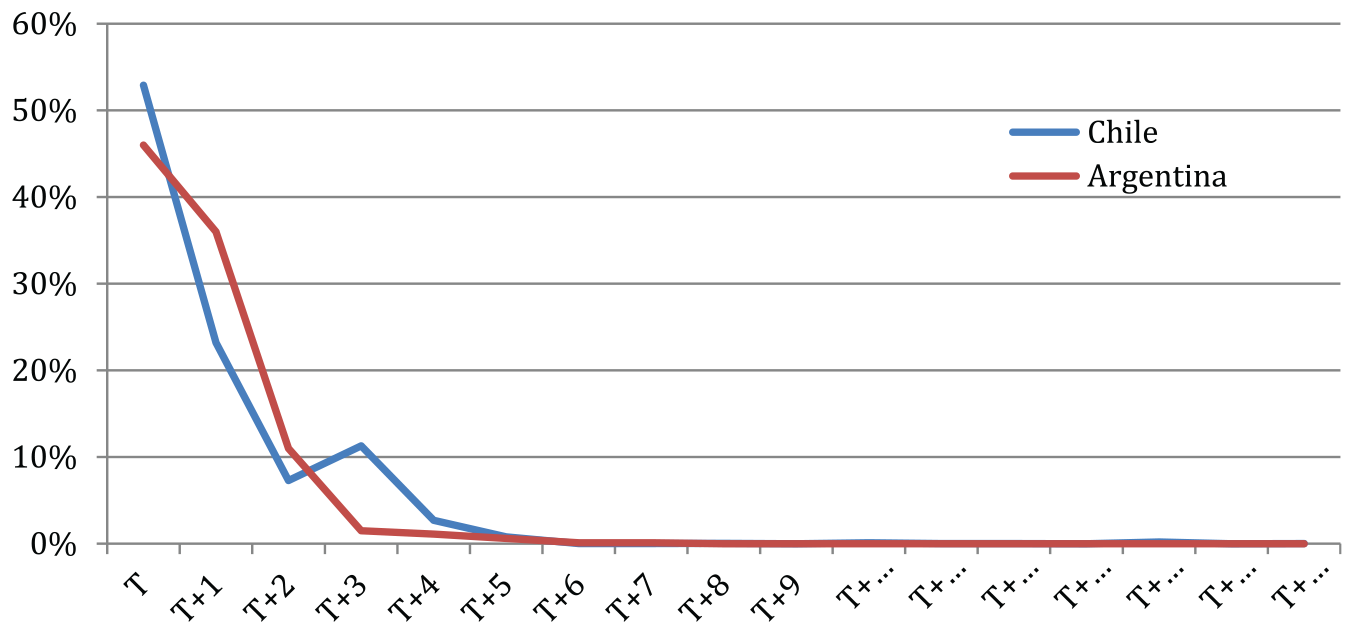
Timing of disappearances in Chile and Argentina.
The Pinochet regime disappeared more than a thousand of its citizens. Despite the setting up of a number of official bodies tasked to provide an authoritative account of the disappeared, the precise figure is still unknown. For example, the final report of the truth commission published in the early 1990s indicated 2396 cases, 979 of which referred to disappearances; but a follow-up commission focusing on the disappeared added another 123 cases originally excluded (United Nations, 2013: paragraph 7). In ensuing truth recovery processes in 2009 (Valech Commission, II), another eight cases were included, raising the number of the disappeared to 1110 persons (United Nations, 2013). Approximately 3000 people were executed but they remain unaccounted for; therefore, in legal terms, they are still missing. The ‘politics of measurement’ of sensitive human rights questions is a pivotal but thorny issue (Brysk, 1994: 676).
The chronological distribution of disappearances is crucial to a grasp of the repertoire of repression in Chile. Most disappearances (95%) occurred between 1973 and 1976. Broadly defined, there were two periods of disappearances. The first wave took place in the immediate aftermath of the coup in September 1973 and lasted until late 1974. In this period, the secret police (DINA) targeted militants of the Revolutionary Left Movement (MIR) in an effort to eradicate the leftist resistance. It is estimated that in the first three months following the coup 631 persons disappeared, accounting for more than half of the total missing (Padía Ballesteros, 1995: 48). The majority of disappeared of the period were MIR militants: they were executed and their bodies ditched to hide incriminatory evidence. In the second period of repression, from 1975 to 1978, disappearances became a more sophisticated tool of terror: the selection of victims was based on intelligence gathered by DINA, and the extraction of information was facilitated by clandestine detention centers. During this period, repression was directed at a broader circle of students, workers, and communist and socialist sympathizers. 7
Argentina’s temporal distribution of disappearances is a mirror image of that in Chile. The majority of the disappearances took place in the first couple of years after the 1976 coup. Most victims were members of, or sympathizers with, leftist or Peronist militant groups, or members of labor, trade or student unions. Interestingly, disappearances in Argentina were already taking place before the military coup 8 ; but, after 1976, they were carried out on a massive scale, quickly becoming the central tool of repression (Robben, 2005). As part of a ‘national security doctrine’, the ideological foundation for the ‘Dirty War’ in the region, disappearances became the most effective counterinsurgency mechanism (Armony, 2005; McSherry, 2002).
After 1978, the number of disappearances dropped. In fact, a common thread linking the two countries’ experiences is that disappearances were used on a large scale only in the first period of repression. From the standpoint of the military dictatorships in Chile and Argentina, there were several strategic advantages to the use of disappearances immediately after the coup. For one thing, the immediate objective of any coup is to establish a firm grip on state and society, and disappearances can be a useful way to achieve this goal. As the comparative experience of Argentina and Chile shows, disappearances can eliminate (or at least radically diminish) potential resistance. As opposed to other indiscriminate tools of terror, which could turn even sympathizers against a regime, this selective form of violence can be used against specific individuals or groups. Tellingly, the majority of the victims in Chile and Argentina were young, educated members of trade/labor unions or student associations. As part of the bid to remove resistance, disappearances were used to extract intelligence. A Chilean general later confessed, ‘There was a lot of people who wanted us to kill all the Marxists, but DINA’s task wasn’t to kill them….It was intelligence, to check all the information and then go look for the bandits’ (Payne, 2007: 113). Of course, execution followed the acquisition of intelligence on potential threats to the regime.
In addition, disappearances have a unique psychological impact on the broader society. By disappearing the dead bodies of the victims and making it impossible, or at the very least extremely difficult, to prove that a crime was committed, the Chilean regime could instill terror not merely in potential ‘subversives’ but in society at large. The terror accompanying the widespread disappearances essentially demobilized society, making it easier to control people in the turbulent period after the coups.
On the one hand, disappearances have strategic value in the early stages of authoritarian rule. On the other hand, a policy of disappearances requires a high level of coordination among different branches of the state, infrastructures, trained agents, and intelligence. A policy of systematic disappearances is a time and resource consuming enterprise, arguably requiring years of state control. This explains why disappearances as a form of state violence are more likely to be used by the military, an institution with a nationally-based infrastructure, and with the capacity and training to carry out such demanding and large-scale operations in a short period. Chile and Argentina are cases in point. To some extent, therefore, apart from the external factors, discussed above, there is also a domestic dimension in selecting disappearances as a tool of repression. According to the Report of the Chilean National Commission on Truth and Reconciliation, the ‘deniability’ of disappearances made the crime more appealing to the military, because they hoped to avoid strong objections from other sectors of the state or even the army itself. 9
Despite their efficacy, disappearances were used for a relatively short time in Chile and Argentina – only in the early years after the respective coups. Even the military leaders made concrete efforts to put an end to this period. DINA, the central organization carrying out disappearances in Chile, was shut down in 1977 and was replaced by CNI (Central Nacional de Informaciones). Similarly, the Argentine military leaders, in an effort to draw a clear line between the present (stable) situation and past practices, passed a ‘law on disappearances’ in 1979, institutionalizing the presumption of death. 10 In other words, what we see in Chile and Argentina is that as time passed and authoritarian leaders were more effectively controlling state and society, their priorities shifted towards consolidating their power. They began to emphasize the creation of institutions to legitimize their authoritarian rule, not to continue violence (Gandhi and Przeworski, 2007).
While strategic benefits explain the timing of the Chilean and Argentinian disappearances, other factors may have ‘pushed’ the dictators in this direction; for example, as mentioned previously, the fear of future (legal) accountability or international scrutiny may have been a factor (Hafner-Burton, 2008; Ramos et al., 2007). One of the most important, yet least explored, considerations of military leaders in the design of their repertoires of repression is accountability (DeMeritt et al., 2014). Although the clandestine nature of the crime of disappearance inhibits our efforts to substantiate this argument with rich empirical evidence, it seems that prospective accountability, particularly punitive, was a key consideration in the region. As Antonius Robben points out: The disappearance of the corpses was motivated by a strategic concern about the political future of the armed forces. Eventually the military would have to hand power to a democratic government and they knew that without a corpus delicti future criminal prosecutions would be impossible. (Robben, 2000: 94)
As opposed to other available types of repression, which leave incriminatory evidence, the military could simply deny the commission of the crime. Chilean Osvaldo Romo, a DINA civilian agent, one of the masterminds of disappearances, admitted: ‘When you don’t have [bodies in] cemeteries, you don’t have anything, you just have to throw them into the sea’ (Payne, 2007: 111). He also mentioned disguising the identity of the dead bodies by snapping off their fingers and toes with bolt cutters to remove any incriminatory evidence (Payne, 2007). By disappearing their enemies, perpetrators could distance themselves from the crime, because there was no corpus delicti/body of evidence. In an influential report, Amnesty International explains why disappearances represent the ‘prefect crime’: ‘If there is no prisoner, no body, no victim, then presumably no one can be accused of having done anything’ (Amnesty International, 1981: 91)
Moreover, the practice of disappearances removes the individual from the realm of law. General Contreras, the main organizer of tortures in Chile, reinforced this point when he said: I have never acknowledged that there were human rights violations during the military government, not in my case, nor by my people. We acted under the law. (Payne, 2007: 147)
As Ron rightly argues, and as Contreras’ comment demonstrates, ‘Repressive states cloak their activities in a mantle of pseudolegality that channels their techniques of repression into ways that appear, at least to the outside observer, to follow legitimate patterns of violence’ (Ron, 1997: 298).
The military cannot be certain a coup will be successful and will lead to their consolidation, nor can they predict how long their reign will last. Given the uncertainty, prospective accountability becomes a concern, making disappearances an attractive option, largely because of their deniability, should prosecutions occur at some point in the future. As noted above, one of the ‘unintended consequences’ of the growing international media and policy attention to human rights violations (DeMeritt et al., 2014) was that it could push dictators to deploy clandestine tools of repression, such as disappearances, something particularly important for regimes whose survival depends on international support or tolerance, such as Argentina. Also noted above, the international reaction to the public executions in the first weeks after the coup in Chile could well have been a push factor in Argentina’s preference for clandestine violence. However, the (eventual) international visibility for their crimes led both military dictatorships to pass amnesty laws before ceding power to civilians. Their concern about the prospect of future accountability was obvious.
Although it was initially difficult for human rights watchdogs or international diplomatic missions to identify acts of disappearances in Latin America, as time passed they established screening mechanisms that enabled them to document patterns of crimes. Stefanie Grant remembers how the deniability of the crime inhibited their efforts: Amnesty had to decide whether disappearances was a category the organization should take up, and if so, who were the disappeared, and what could be done. At the simplest level it was a question how you fitted this situation of absence into an organization whose work had been framed by individuals held in a named prison, or being tortured in a particular place. It is methodologically straightforward where a person is in this prison or detention center, you know where they are, and your job is to get them out. But where the person is defined not by their presence in a prison camp or in a torture center but by their absence, the task is much harder.
11
Despite the difficulties, their efforts bore fruit, and after the first two years, the practice abated in both countries.
In the end, although disappearances were seen as the perfect crime, they came back to haunt the perpetrators. In the decades since the transitions in Chile and Argentina, many military leaders have been indicted or convicted on charges related to abductions and disappearances. In addition, the mobilization of the relatives of victims in both countries remains a point of reference for the contemporary human rights movement (Kovras, 2017).
The most recent developments in international accountability norms have contributed to a decrease in the incidence of this crime worldwide by explicitly legislating against it. As Table 2 shows, there have been crucial advances in the criminalization of forced disappearances.
Main landmarks in the criminalization of forced disappearances.

The improvement of the international scrutiny of authoritarian regimes is another factor driving this trend. Both tendencies seem to draw on a narrow definition of disappearances in war scenarios, much more difficult to scrutinize and less affected by international norms.
Conclusion
This paper provides an explanation of the emergence and timing of systematic disappearances as a deliberate repressive strategy in the hands of certain regimes. To do so, it takes a closer look at Greece, Chile and Argentina. It builds on the important work of Berman and Clark (1982) and Clark (2001).
What happened in Greece taught later repressive regimes that the type of crimes they perpetrated might eventually matter. Therefore, after their respective coups, both Chile and Argentina chose the strategy of disappearances over other available tools. 12 In a way, the improved legal framework that caught the Greek colonels flat-footed made disappearances the ideal tool of subsequent state terror. The clandestine and extrajudicial nature made it extremely difficult to trace the crime’s commission. Without a body, there was no incriminatory evidence, thereby minimizing (but not eliminating) the possibility of future criminal prosecution and international scrutiny; and it inspired fear among the general populace. That being said, its utility ended in both countries in a few years’ time, once state institutions were set in place and international watchdogs began to close in.
The discussion sheds light on the dialectical relationship between the ‘logic of violence’ and the ‘logic of the law’, something important for the study of international (accountability) norms. A number of studies have enumerated the growing human rights prosecutions in post-conflict and post-authoritarian settings, a phenomenon known as the ‘justice cascade’ (Sikkink, 2011), but the lion’s share of academic attention has been reserved for the long-term positive impact of accountability norms on the post-transitional trajectory of individual countries, including respect for human rights. While we find this research convincing, we point to the short and medium-term unintended consequences of post-WWII normative developments, which have occasionally ‘pushed’ authoritarian leaders – particularly military ones, as in the case of Chile and Argentina – to deploy extrajudicial and clandestine forms of repression. At the same time, we invite scholars to pay more attention to the unintended and/or unforeseen consequences of socio-political actions, something largely overlooked in the literature on the development of the international human rights regime.
Admittedly, the whole issue of disappearances requires further research. With growing democratization, the improved international scrutiny of authoritarian regimes by human rights associations and organizations, and the gradual development of a robust and specific legal framework, disappearances have declined over the past 20 years, at least in peace settings. An increasingly assertive global civil society has contributed to improve the standards of accountability and real improvements in human rights outcomes have taken place over time (Fariss, 2014). In the past, it was difficult to monitor state abuses in real time; however, disappearances are harder to conceal now, not only because of the existing international legal framework, but also because a robust and interconnected civil society is permanently watching.
That being said, the logic of violence recently found a legal loophole and took this dialectical relationship a step further. The emergence of a novel form of disappearances, ‘extraordinary rendition’ (Kyriakou, 2012), is reflected in the evolution of the International Criminal Court’s (ICC) definition of disappearances and the disappeared, whereby the ‘Perpetrator intended to remove such person or persons from the protection of the law for a prolonged period of time’ (see International Criminal Court Statute, article 7, 2(i); Silva, 2008: 329). 1 Because ‘prolonged period’ is vague, it gives states the opportunity to interrogate or torture suspected terrorists in an extrajudicial fashion. The implicit struggle between the ‘logic of consequences’ and the ‘logic of appropriateness’ is an important consideration in international politics and should be examined in greater depth. The crime of ‘extraordinary rendition’ is an alarming reminder that not only autocracies, but also democracies, engage in repressive strategies to conceal their crimes and avoid international scrutiny.
Following from the above, we wish to highlight a broader disciplinary flaw in the study of political repression and human rights. On the one hand, political scientists, guided by a ‘logic of consequences’, focus on the structural, rational, or cultural factors shaping the repertoire of repression. On the other hand, most legal scholars, following the ‘logic of appropriateness’, focus on the application of the law irrespective of the political conditions, paying only limited attention to the prevalence of violence in times of repression. The ‘logic of appropriateness’ sees legal responses to violence as the only appropriate response, thereby limiting introspection or critical reflection on the unintended consequences of legal developments. Because normative (‘push’) factors could be important influences on the repertoire of violent repression by precluding certain tools, more interdisciplinary research is most certainly required.
Supplemental Material
IPS764410_French_and_Spanish_abstracts – Supplemental material for Explaining disappearances as a tool of political terror
Supplemental material, IPS764410_French_and_Spanish_abstracts for Explaining disappearances as a tool of political terror by Toby S James, Holly Ann Garnett, Leontine Loeber, Carolien van Ham, Paloma Aguilar and Iosif Kovras in International Political Science Review
Footnotes
Acknowledgements
We would like to thank the three anonymous reviewers for their pertinent and constructive suggestions, as well as Stefanie Grant, Eirini Karamouzi and Boris Hau for their useful feedback to earlier versions of the paper.
Funding
This research received no specific grant from any funding agency in the public, commercial, or not-for-profit sectors.
Notes
Author biographies
References
Supplementary Material
Please find the following supplemental material available below.
For Open Access articles published under a Creative Commons License, all supplemental material carries the same license as the article it is associated with.
For non-Open Access articles published, all supplemental material carries a non-exclusive license, and permission requests for re-use of supplemental material or any part of supplemental material shall be sent directly to the copyright owner as specified in the copyright notice associated with the article.
