




Abstract
Dynastic rule in republics is a global trend. Using a qualitative life-story-and-family-history method to compare two republican dynasties – the Assads of Syria and Kims of North Korea – this article examines how ruthless kin groups establish themselves in power, practice nepotism and corrupt republican institutions of government with dynastic succession. Focusing on sibling rivalry, a potentially destructive threat to dynasties, it contributes to an emerging political science literature on republican political families by exploring five factors that shape sibling conflict and cooperation.
Dynastic succession in republics
Until modern times authoritarian regimes were a norm. Most were hereditary monarchies following a traditional form of inherited personal rule restrained by traditional customs and institutions. But the idea that personal rule over a state and its people could be inherited like private property, like a family estate, lost its nimbus once republican systems had taken hold. After democratic regimes had become a norm, in both monarchies and republics, the category of authoritarian regime turned into something of a residual one that threw all non-democratic systems in together (Brooker, 2014: 97). Apart from the fact that they are not democracies, these regimes appear to have little in common: theocracies; warlords; absolute monarchies; military regimes; single-party regimes; populist presidential monarchies; and the subject of this essay ‘dynastic republics’ – authoritarian republics (non-monarchies) where government is controlled by a ruling family.
Throughout the world ruthless families have captured power in authoritarian republics.
The trademark style of dynastic rule is how it turns family matters into public affairs, and public matters into family affairs. In these nepotistic offshoots of authoritarianism, the ruling dynasty ostentatiously disguises succession of its heir, be it a son, daughter, brother, sister, cousin, husband, or wife, with un-free single-party plebiscites and/or unfair rigged ballots. Differenciated from hereditary monarchies by the fig leaf of elections, and from democratic republics by the corrupt way elections have been rigged, dynastic succession in authoritarian republics is proliferating, raising concerns about their potential for democratization, fighting corruption and good governance. In the Caucuses, the Aliyevs rule Azerbaijan. In East Asia, the Kims rule North Korea. In the Middle East, the Assads rule Syria. In the Americas, the Castros rule Cuba. In Africa, the Nguemas rule Equatorial Guinea (Yates, 2017), the Bongos rule Gabon (Yates, 2019), and the Gnassingbés rule Togo. Their widespread practice of nepotism, qua governance, violates the classical ideal of the republic as being res publica: ‘the public thing’ (Cicero, 2000: 64).
Political scientists of dynastic rule tend to focus on ‘democratic political families’ (Chandra, 2016; Chhibber, 2013; Cruz et al., 2017; Dal Bó et al., 2009; Jalalzi and Rincker, 2018; Smith, 2018) defined broadly as several family members related by blood or marriage, including children, siblings, spouses, in-laws, and cousins, over one or more generations, consistently or sequentially winning elective office. Their distinguishing feature is a competition in genuinely fair and free democratic elections. One post-hoc test is whether or not they ultimately accept defeat and yield power through the same elections by which they came to power. Famous examples include the Kennedys and the Bushes of the United States (Hess, 2016) and the Nehru–Gandhis of India. ‘Belonging to a political family is an advantage to entering national executive positions’ (Jalalzi and Rincker, 2018: 54) an ‘inherited advantage that members of dynasties reap throughout their political careers—from candidate selection, to election, to promotion into cabinet’ (Smith, 2018).
One debate within this literature is why some families succeed in founding dynasties. Using data from Unites States political dynasties, Dal Bó et al. argue that a longer period in power increases chances that a politician may start a political dynasty: ‘political power is self-perpetuating in that a positive exogenous shock to a person’s political power has persistent effects through posterior dynastic attainment’ (Dal Bó et al., 2009: 115). Such dynastic success/ion may reflect the differences in ability or political vocation across families. Cruz et al. found that in the Philippines ‘family networks exercise an effect independent of wealth, historical elite status, or previous electoral success’ (Cruz et al., 2017: 3006). Other political scientists have hypothesized that dynastic politics is a systematic product of modern democratic institutions of state and party (Chandra, 2016), blaming the ‘absence of a party organization, independent civil society associations that mobilize support for the party, and centralized financing of elections’ for dynastic scions around the Asian sub-continent (Chhibber, 2013: 277).
Political scientists studying authoritarian regimes, however, have quite a different focus; no pretense of free and fair democratic elections to consider, only plebiscites staged by rulers to legitimize their rule rather than offering their subjects a genuine choice. Here the question instead is why other non-family elites in the ‘selectorate’ might support the ruling family, rather than how it can win elections. Bueno de Mesquita and Smith have argued that: ‘By designating heirs who might keep the existing winning coalition largely intact, these leaders sought to prevent the incumbency advantage from disappearing [. . .] For essential supporters have a much greater chance of retaining their privileged position when power passes within a family from father to son, from king to prince, than when power passes to an outsider’ (Bueno de Mesquita and Smith, 2011: 29, 32). This idea is ripe. Gordon Tullock (1987) had already hypothesized that dynastic succession appeals to non-familial elites who are wary of a leadership struggle. Brownlee has tested this hypothesis on a dataset of 258 non-monarchical (republican) autocrats and found that ‘in the absence of prior experience selecting a ruler through a party, regime elites accepted filial heirs apparent when the incumbent had arisen from a party and his successor predominantly emerged from that organization’ (Brownlee, 2007: 595). Entrenchment of father-to-son transfer of power in the Middle East is just a means for peaceful succession (McMillan, 2013). In Asian post-communist regimes says Monday this has now become the norm, ‘the selectorate of socialist societies is gradually transforming into a ruling caste’ (Monday, 2011: 812).
The problem of sibling rivalry
Dynastic scholars have so far focused on succession, favoring lineage, the descent ‘down’ from parents to children, from ancestors to descendants. Yet tracing down these family lines may overlook lateral, ‘sideways’ sibling relations. Brothers and sisters are among the most important relations an individual will ever have, people with whom one grows up, one’s longest-lasting relations, made before friends, spouses and children, sharing genetic traits, class origins, cohort generation and an historical period, and generally outliving parents (Hemphill, 2011: 3). Siblings are part of one’s inner psychic world, internalized archetypes of one’s individual psychology, distant impressions or repressed childhood memories, which continue to shape one’s adult desires as psychic motives of ambition and frustration (Adler, 1992: 126–132).
In some dynastic republics, siblings collaborate. Cuba’s Castro brothers, Fidel and Raúl, for instance, came to power together in revolutionary struggle then presided successively over their island. Yet in other dynastic republics, violent sibling conflict has occurred. In Togo, for example, Kpatcha Gnassingbé challenged his half-brother Faure Ganssingbé before the president arrested him. In North Korea, Kim Jong-un poisoned half-brother Kim Jong-nam to prevent such a challenge. In Syria, Rifaat staged a coup against his brother Hafez al-Assad before the president forced him into exile. So siblings will – for the sake of power – sacrifice brotherly love. The question here is why they sometimes do, and why sometimes they do not?
Sibling rivalry, a universal feature of human nature, has been the subject of psychology since the discipline was founded; but Freud only looked at early childhood as part of the ‘Oedipal complex,’ with older children competing for the love of the mother with their younger siblings. Alfred Adler was the first to coin the expression ‘sibling rivalry’ to describe inherent jealously, fighting, and competition between siblings that continued into adulthood. Adler felt that children’s place in the family – ‘birth order’ – was a key determinant in both the development of character and the nature of any sibling rivalry that would emerge. He saw children (firstborn, middle, and last born) involved in a constant struggle for power, with the eldest child fighting to protect his/her superior position against usurping younger siblings (Adler, 1992: 126–132). Frank Sulloway (1997) found that birth order is the single best predictor of siblings’ personality traits: firstborn children tend to become neurotic, latter-born children are ‘born to rebel.’ Valerie Hudsen (1992) examined the birth order of 46 world leaders. She found that firstborns are over-represented, lastborns underrepresented, and middle children proportionally represented to their share of the population. Why? Dynastic rulers’ eldest heirs are traditionally groomed for succession, often to the detriment of their younger siblings, forced to assume that inferior role – so well-known to celebrity royals – of ‘spares’ (Conradi, 2012: 268).
This suggests the root of sibling rivalry may be psychologically related to (1) birth order. Alternatively, it may be due to: (b) family size – larger families promote sibling cooperation and have less sibling conflict as elder members assume ‘kin work’ for the younger members (Bossard and Boll, 1956); (c) sibling gender, as women assume more responsibility over most ‘kin keeping’ and ‘kin work’ (Leonardo, 1987) with sister–sister ties the strongest, brother–brother ties the weakest, and sister–brother ties inbetween (Dunn, 1984); (d) ageing, because sibling rivalries tend to mellow in adulthood as siblings leave home to get involved in their own families and careers (Cicirelli, 1995); and (e) inheritance disputes (Hemphill, 2011: 215). This last factor may take on critical importance for political scientists studying dynastic succession. Perhaps this accounts for the violent sibling rivalry found in dynastic republics? For a republic codifies no rules of legitimate dynastic succession.
Research design: Comparative life story and family history
Birth order, kin work, sibling gender, ageing, and inheritance disputes are therefore five plausible factors explaining when siblings will conflict or cooperate. The method used here to explore this is ‘life story and family history,’ a qualitative approach to social science championed by Robert Lee Miller (2005) particularly well-suited to the study of dynasty, an intergenerational institution that transmits patrimony within a family over time. Those who have wanted to move away from present-oriented journalistic ‘portraits’ of rulers in power (one point in time) use whole-life ‘biographes’ and ‘family histories’ (longitudinal time series analysis) to trace entire families across several generations (e.g. Bertaux, 1981). Biography breaks out of disciplinary constraints preventing researchers from understanding one another’s concepts and terminology. A life is something everyone can understand.
Selection of these two cases was, firstly, to see sibling rivalry emerge within the dynastic pattern of nepotistic quasi-hereditary succession independent of geographical, cultural, and economic contexts. Despite Syria’s location in the Middle East and North Korea’s in East Asia (difference of geography), Syria being an Islamic society and North Korea atheistic (difference of religion), Syria having an Arab culture and North Korea neo-Confucianist (difference of culture), Syria having a private capitalist system and North Korea a state-run communist one (difference of economy), dynastic sibling rivalry is observed independent of ‘Asian family values’ or ‘Islamic civilization.’ In sum, controlling for external contextual factors, our attention can be focused on five internal family factors.
Secondly, these two dynasties were chosen because they represent extreme tyrannies. Both have highly undemocratic systems of government, ranked at the lowest level of ‘not free’ (Syria’s political rights are scored by Freedom House as 3/40, North Korea’s as 0/40) and both are ruled by cruel scions who rose to supreme power through ‘dynastic succession.’ Siblings in such tyrannies compete for absolute power, and can use violence in ways that are illegal in democratic systems under rule of law. In tyrannies we can observe more clearly the manifestations of sibling rivalry’s most violent impulses.
Within two similar case studies of dynastic republics, the outcomes of sibling conflict and cooperation manifest in function of five factors. In republican constitutions a lack of formal inheritance rules for dynastic succession, combined with dissatisfaction of younger siblings due to birth order are key factors of violent sibling conflict. Heirs to dynastic authoritarian regimes, lacking clear institutional rules of legitimate hereditary succession as developed by traditional monarchies, will arrest, imprison, exile, and even assassinate their sibling rivals. This then leaves the question of why siblings in tyrannies will sometimes cooperate instead. Outcomes varied at different points in time within these same dynasties due to internal family factors conducive to sibling cooperation: ageing; gender difference’ and kin work. Conflict may change to cooperation, and vice versa, over a lifespan, in function of these.
Data in this article come from a variety of sources. First are book-length biographies (Breen, 2004; Lesch, 2005; Seale, 1988; Zisser, 2001, 2006) and regime portraits (Dagher, 2019; Lesch, 2012; Martin, 2006; Oh, 1988). Next are works of national historiography (Cummings 2005; Ismail, 2018; Van Dam, 2011) which place individuals and familes in their larger historical context. Next come the eight-volume authorized Kim Il-sung autobiography (Kim, 1992) and five-volume memoir by Assad regime defector (Tlass, 2006). Classified United States State Department memos were consulted through Wikileaks. Lastly were monographs by country experts from humanities and social sciences (Naaman, 2017; Rey, 2018).
Case number 1: Assad’s Syria
The Assad dynasty has been in power for more than half a century, during which time this clan has effectively captured Syria’s national identity (see Figure 1). Syria has become Souriya al-Assad, ‘Assad’s Syria.’ Its founder Hafez al-Assad (1930–2000) was the ninth of eleven children, born in the Alawite mountains of Syria, at Qurdaha, a peasant village which consisted of a hundred mud-and-stone houses. In 1927, his father Ali Sulayman had changed the family name to Assad (Arabic for ‘lion’) after making the transition from simple peasant to Alawite notable during the French mandate. All members of the extended Assad dynasty stem from Ali Sulayman and his second wife Naissa.
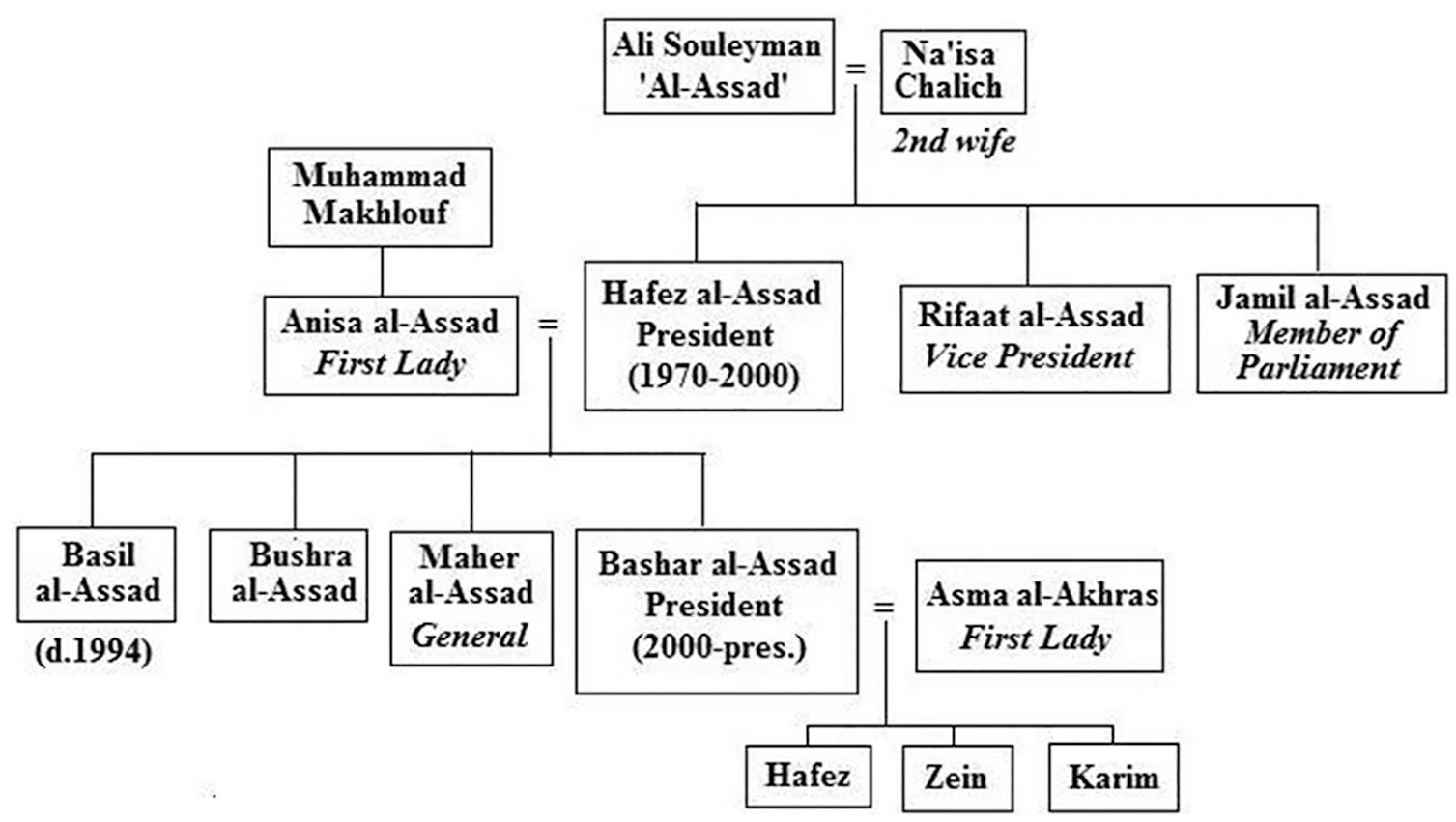
The Assad dynasty.
Who are the ‘selectorate?’ Assad built his power base upon his Alawite community. Official documents from the French mandate show that Ali Sulayman was a ‘chef alaouite’ and a later British surveys show his family as head of a minor clan of one of the tribes (Seale, 1988: 496). Alawites were a visible religious minority in Syria treated with hostility by the Sunni majority (Naaman, 2017: 118–131). For 800 years the repeated efforts to stamp out their heresy, kill their men and women, destroy their villages, and enslave them as captives, led to a strong tribal persecution complex. Ali Sulayman, Hafez’s father, asked France not to place Alawites in a Sunni Syria. They were given their own autonomous region, L’État de Lattakié, which lasted from 1922 to 1946 (Naaman, 2017: 104–105). France, following a strategy of divide and rule, favored this Alawite minority, recruiting them into the auxiliary forces to the French army. Alawites made up to one-third of this 10,000-man force which later formed the basis of the Syrian army: the second base of Assad’s power. He was an air force pilot who participated in the officer’s coup of 1963. His third base of power was the Ba’ath Party. A Ba’ath student activist, elected president of its student union, he rose up the party ranks. Later he used it as his main political organization for presidential plebiscites and passing laws.
How did Assad rise to power? In 1960, he and fellow Syrian officers in Egypt founded the Military Committee, a secretive clique modeled on Nasser’s Free Officers. He and his co-conspirators built up a network of several dozen Syrian officers, most hailing from rural backgrounds like themselves, many from religious minorities (Seale, 1988: 60–71). Upon their return to Damascus, they overthrew the provisional government, recruited junior officers, reconstituted their clandestine organization, and during a cycle of army coups and counter-coups that brought Syria’s faction-ridden officer corps into complete disarray, staged a successful coup in 1963. Decisions were now taken jointly, in secret, by military officers. The Military Committee became a veritable ‘junta within a junta.’ Rifaat al-Assad (b. 1937) became deputy commander of Ba’ath security forces. Rifaat helped his brother stage another coup in 1969 (Seale, 1988: 151) which allowed Assad to eliminate all of his rivals: first the Nasserites, then the Muslim Brothers, then the Druze militia, and finally his original fellow coup conspirators.
Were seeds of sibling conflict sowed in Assad’s household? From a modest dwelling in a residential area just north of the old city of Damascus where Hafez lived like an ordinary government bureaucrat with his wife Anissa and their five children on the third floor of a three-story condominium (Lesch, 2005: 9), Assad’s children Bushra (b. 1960), Basil (1962–1994), Bashar (b. 1964), and Maher (b. 1967) traveled to school together by bus. The lifestyle imposed by Hafez on his children was austere. Bashar was reportedly ‘ignored by his father and oppressed by his older siblings,’ writes Dagher, who conducted extensive interviews with intimate lifetime family acquaintances. One childhood friend, Manaf Tlass (later a general in the regime) said Bashar’s older sister and brothers Bushra and Basil were the favorites in the Assad household. ‘Whereas Basil was the natural leader and the one everyone deferred to, Bashar was an introvert and a loner. Bashar was living in the shadow of his brother, in fact they were all living in Basil’s shadow’ (Dagher, 2019: 43–44). Older sister Bushra, said Tlass, ‘openly mocked Bashar within family circles’ (Dagher, 2019: 85).
Was widespread nepotism practiced? Assad’s extended family, like his brother-in-law Muhammad Makhluf, made immense fortunes. Countless extended kin from his Alawite community also occupied key government posts, strategic functions in the security apparatus, and leadership positions in the party: an ‘Alawite intelligentsia’ (Naaman, 2017: 257–326). Lucrative government contracts for big public projects gave rise to a new, highly visible class of Alawite millionaires. Partnerships between businessmen, military officers and Ba’ath political party barons gave rise to corrupt networks of patronage and cronyism. Rifaat al-Assad created a profitable defense firm to serve as his brother’s ‘Praetorian Guard.’
Sibling rivalry, attempted coup
When did sibling conflict first manifest? On 12 November 1983, in a moment of exhaustion, Assad suddenly collapsed and was rushed to the hospital. He started having heart difficulties. Fourteen-hour workdays had clearly taken their toll. Rumors started circulating. The power structure Assad had built to be wholly dependent upon him personally was now in danger of breaking down. He spent two weeks in hospital (Seale,1988: 423). Three sleepless nights in the hospital took their toll on Rifaat, whose relationship with his older brother was complex. Living a grand lifestyle, Rifaat had married four wives and had fathered 17 children. He had originally paved the way for Assad to seize power in 1967, helped crush Islamic insurgents in 1982, and built up a private defense company of 55,000 troops with tanks, armored personnel carriers, and helicopters. Until then, the brothers had cooperated. But now that their positions were secure, Assad no longer trusted Rifaat, and disliked his brother’s high living, taste for hunting, and womanizing (Seale, 1988: 426).
Rifaat longed for Hafez to recognize his importance, something that he felt his brother had denied him ever since their childhood. He wanted his brother now to accept him as his equal. While Hafez was convalescing in hospital, top generals had called upon Rifaat at his home and invited him to join their ad hoc regional command. This was when Rifaat revealed to them that he was interested in taking power. But then Hafez recovered. The generals quickly abandoned Rifaat, whose security chief was relieved of his command (Seale, 1988: 430). Hafez placed his brother under surveillance, and demoted him to a ceremonial vice-presidential role without real powers. Rifaat asked his younger brother Jamil to intercede on his behalf, but to no avail. ‘I am your elder brother,’ Hafez scolded them, ‘to whom you owe obedience. Don’t forget that I am the one who made you all’ (Seale, 1988: 430).
Was sibling rivalry managed by female ‘kin work?’ On 30 March 1984, Rifaat ordered his troops to enter Damascus to seize power. But the previous day Hafez had arranged for their mother Naissa, then in her eighties, to be flown into town to stay at Rifaat’s home. Assad knew that their mother still exercised compelling influence over his younger brother. He drove across Damascus with his son Basil to speak personally with his brother. Their aged mother Naissa was there in Rifaat’s house. Hafez played martyr while she convinced Rifaat to keep family peace. Rifaat ‘could not bring himself to declare open war on a brother whom he admired and respected and whose approval he yearned for, however deeply he resented him’ (Seale, 1988: 433). Rifaat went to live in exile in Paris. It is reported that Bushra convinced her father that jailing her uncle would only disgrace their family.
Quasi-hereditary dynastic succession
How was dynastic succession organized? In the early 1990s, as his health was failing, Hafez groomed his eldest son Basil for succession. But Basil was reckless and unexpectedly died in an automobile accident in 1994. So Assad’s second son Bashar, living in London at that time completing an internship in ophthalmology, was called back to replace his brother. The first thing Hafez did was send Bashar to military academy, where the family ‘spare’ spent six years in officer’s training, part of a dynastic plan to build a bastion of loyalty for him in the army as a new ‘heir apparent.’ Questioned about this matter on television, Hafez said: ‘I am not preparing my son to take my place, nor have I ever heard him speak of this matter. As for the issue of succession, there is no clause whatsoever in our constitution that gives the right of succession to family members’ (Zisser, 2001: 162–163). Yet Bashar moved up the ranks from captain (1994) to lieutenant-colonel (1997) to colonel (1999) and, by his father’s death (2000), to general.
Why did the ‘selectorate’ support dynastic succession? Top generals in the military-security apparatus gathered to discuss the transition in 2000. They had worked long and hard to obtain their positions of power and influence in Syria. Most were Alawite. They were not going to give up their privileges easily. ‘Assad’ was their regime’s brand name. They saw in Bashar ‘al-Assad’ the best chance of maintaining their political and economic status, the status quo. ‘This, above all other reasons, is why Bashar became president’ (Lesch, 2012: 3).
What sibling rivalry manifested? All around Syria were large bronze statues of Hafez and new buildings named after Basil. Assessing Bashar, the ‘spare,’ with his oversized father and dominating brother was inevitable. ‘For Bashar, the larger-than-life personas of his father, Hafez, and late brother, Basil, were monsters he had to slay in order to prove himself. He was consumed by this inner struggle. ‘I want the world to forget Basil and my dad – I can do it,’ he once confided to Manaf’ (Dagher, 2019: 85). Fortunately for him, his brother was dead. But older sister Bushra was enraged by references to his wife Asma as ‘Syria’s First Lady.’ For Bushra, Asma was simply her brother’s wife. ‘Bushra’s thinking was that if her mother the founder’s wife, was never called first lady, then certainly the privilege should not now be accorded to Asma, seen by some in the family as an interloper’ (Dagher, 2019: 133). One day Bushra insulted and then slapped Asma in the palace, prompting Bashar’s wife to leave Syria and return to her parents’ home in London for a while (Dagher, 2019: 136).
Was widespread nepotism practiced? His brother-in-law Assef Shawkat supported Bashar in the face of his sibling detractors. Bashar’s in-laws – the Makhlouf’s – also did everything they could to protect their fortune and privileges. Perceiving intense spousal intimacy between Bahsar and Asma, they forged an alliance with her in the dynastic palace politics. ‘Asma loved money, and they [the Makhlouffs] showered her with expensive gifts,’ said General Manaf Tlass (son of General Mustafa Tlass): ‘having Rami and the Makhloufs on her side strengthened her position in the family after the acrimonious clash with Bashar’s sister’ (Dagher, 2019: 158). Her husband Assef Shawkay went out of his way to win Bashar, oversaw Bashar’s dealings with Saddam Hussein around the 2003 invasion of Iraq, and was named head of military intelligence in 2005, the most powerful position in the security system, a public function acquired through nepotistic private family politics.
Was there any sibling cooperation? The Arab Spring began in January 2011 when protests broke out in Tunisia then spread throughout the whole Arab world against dictators in Egypt, Yemen, Bahrain, Algeria, Morocco, and Syria. Bashar’s younger brother Maher, implicated in the assassination of Lebanon’s Rafiq Hariri, cultivated a public image as his brother’s enforcer. His mafia-like acts of violent loyalty were vital to his brother’s survival (Ismail, 2018). Ten years earlier, in 1999, when Bashar was introduced to French President Chirac in Paris, he had ordered brother-in-law Assef Shawkat to raid his uncle Rifaat’s properties in and around Latakia and arrest dozens of his partisans. ‘Maher ordered Assef to stay out of the dispute with his uncle, but Assef insisted he was part of the family. [. . .] The argument between Assef and Maher degenerated into shouting and insults and ended with Maher shooting Assef in the stomach’ (Dagher, 2019: 94). Bashar demoted Assef to deputy defense minister in 2008. Disgraced, Assef and Bushra moved to the United Arab Emirates. In 2012, he was assassinated. Both brothers, Bashar and Maher, skipped his funeral (Dagher, 2019: 310–311).
There is a third generation now. Bashar’s wife has given him two sons, Hafez (b. 2001) and Karim (b. 2004), and a daughter Zein (b. 2003). The oldest son and namesake of the dynasty’s founder has reached the age of 18. He is reported to be the Assad dynasty’s new heir apparent (Le Monde, 31 July 2020). Arab culture has a long tradition favoring the eldest male child. But the absence of codified lines of succession in a republic means that younger siblings have a personal choice of whether or not to cooperate with their elder siblings, who are only ‘heirs apparent.’
Case number 2: Kim’s North Korea
Kim Jong-un (b. 1984) is a third-generation dynast now ruling North Korea. Son of Kim Jong-il (1942–2011), grandson of Kim Il-sung (1912–1994), he ascended to his family throne after his father’s state funeral in 2011. Before then, his eldest half-brother, Kim Jong-nam (1971–2017) had been the heir presumptive. Sent to Swiss boarding schools, this elder sibling used to wear a four-star generals’ uniform, brag he would rule North Korea, drink heavily, carry around a loaded gun, shoot up hotel lobbies, was an embarrassment to the ‘selectorate.’ In 2001, secretly traveling to Tokyo Disneyland, Japanese police arrested him at the airport. Kim Jong-un – the ‘spare apparent’ – soon replaced him in the line of succession (see Figure 2).

The Kims of North Korea.
Kim Il-sung (born Kim Song-ju.), founder of the Kim dynasty, came from Chilgol, an impoverished Korean village under Japanese colonial rule. In his eight-volume memoirs he recalled his poverty. ‘Such things as fruit and meat were beyond our means’ (Kim, 1992: 7). During Japanese occupation, his father Kim Hyong-jik (1893–1925) had moved to Manchuria in search of work. But his son went back for schooling financed by his maternal grandparents. ‘They provided me with a separate room, furnished with a kerosene lamp and fine floor mats’ (Kim, 1992: 86). At 13, he returned to Manchuria. His father, in poor health, died. His mother Kang Pan-sok (1892–1932) now widowed could barely provide for her children. So, he went to another Manchurian town, and enrolled in a Korean nationalist military academy. Radicalized by nationalists, he founded a communist youth group, got arrested and was briefly imprisoned in 1929.
Who are the ‘selectorate’? Like Assad, Kim Il-sung built his power on military foundations. In the 1930s, he joined the Chinese Communist Party and became a guerilla fighter in the mountains of Manchuria, staging hit-and-run ambushes on Japanese troops. His education in Manchuria provided him fluency in Mandarin, which helped translate Chinese orders for his Korean unit. Comrades began calling him Kim Il-sung (‘become the sun’). As with anti-colonial communist guerilla leader – Korea’s Ho Chi Minh – his family paid a heavy price in the war. One uncle was arrested for killing a Japanese policeman and died in prison. His elder brother Kim Chol-ju was killed in combat, leaving his youngest brother Yong-ju (b. 1920) orphaned and homeless.
How did Kim rise to power? He joined the Chinese People’s Liberation Army in 1937, fighting in Manchuria and Korea. A violent Japanese counterinsurgency campaign pushed him across the border in 1940. Seeking refuge in Russia, he soon found himself wearing a captain’s uniform in a brigade created by the Soviets to establish communist regimes in China and Korea after the collapse of the Japanese empire. In 1945, Moscow sent him back to Korea in command of a mixed Sino-Korean force that marched on Pyongyang and began what was supposed to be a transitional Russian occupation to found a satellite regime on their border. In 1946, Russians named ‘General Kim’ chairman of the local communist party, effectively making him leader of North Korea.
How did Kim establish his regime? A core of armed loyalists, 25 guerrillas who had been with him in Manchuria during his early days in the Chinese communist army, followed him into Russia, marched with him into North Korea, and set up a communist police state with him in Pyongyang (Martin, 2006: 94). His younger brother Kim Yong-ju (b. 1920) one of those loyalists, ran internal security; classified all citizens as either ‘friendly, neutral,’ or ‘hostile,’ and then, in 1959, coldly executed thousands (Breen, 2004: 128). Kim’s regime was described by Bruce Cummings as a hierarchy of concentric circles: ‘At the center is Kim. The next circle is his family, the next the guerillas who fought with him, then come the party elite. This group forms the core circle, and it controls everything at the commanding heights of the regime’ (Cummings, 2005: 419).
Sibling rivalry, dynastic succession
Was widespread nepotism practiced? Kim established his personal rule over the country. He changed the constitution into a presidential system in 1972, and became a patriarch who ran the state like a family enterprise, nepotistically promoting his family and clan members. He named one cousin of his maternal grandfather vice-president. Then he named his son-in-law as the next vice-president. Of three vice-presidents, in fact, only one was not his relative. Another cousin was vice-chair of the Korean General Occupational Federation, and another editor of the Administration Council newspaper. Her husband was both the vice-premier and foreign minister. Another cousin became deputy director of the Academy of Social Sciences; and her husband became a member of the Politburo and chairman of the Supreme People’s Assembly. Another first cousin was vice-premier; his brother became chairman of the Profession League Central Committee, one of his sons the State Security Department officer responsible for rooting out disloyalty to personal rule, while yet another was a colonel in the People’s Army. ‘In the final analysis,’ said one high-level regime defector, ‘the topmost officials have to be relatives’ (Martin, 2006: 189).
Were seeds of sibling rivalry sowed in the Kim household(s)? Watching de-Stalinization of the Soviet Union, and later observing the abortive revolt by Mao Zedong’s designated successor in China, Kim became determined to name his own flesh-and-blood as successor (Oh, 1988). His first three legitimate children – Kim Jong-il, Kim Man-il, and Kyong-hui – came from his official marriage to Kim Jong-suk (1917–1949). Her eldest child was Kim Jong-il (1941–2011) (Martin, 2006: 206). After their mother’s death in 1949, their stepmother Kim Song-ae (b. 1928), the new First Lady, gave birth to a rival step-brother Kim Pyong-il (b.1954), one of the many heirs presumptive, who looked more like his father Kim Il-sung, spent more time with him, developed a closer relationship with him, and was, in short, preferred by their father (Martin, 2006: 210).
How did sibling rivalry manifest? His younger brother Kim Man-il (1944–1948) died drowning at the age of four. Playing outside in the garden, the story goes, he was trying to climb out of a pond when his older brother pushed him back (Martin, 2006: 206). Official regime biographies make no mention of his stepmother, stepbrother, nor of his brother’s drowning, treating Jong-il as Kim’s ‘only son.’ But Jong-il had to struggle hard to attain his status as ‘heir apparent.’ He promoted his father’s cult of personality to defeat his siblings, published his father’s Selected Works, enforced their systematic, daily reading in the schools, and promoted unthinking devotion to ‘Kimilsungism.’ In reward, his portrait started to appear alongside that of his father in public places by 1975. According to one high-ranking regime defector, ‘even the most insignificant report could not reach Kim Il-sung without going through Kim Jong-il first’ (Martin, 2006: 270).
Yet Kim Il-sung’s surviving younger brother, Kim Yong-ju, was also a full member of the Politburo in 1970, and number six in the regime. Many viewed Yong-ju as his brother’s most likely successor. First Lady Song-ae, for example, favored Yong-ju to improve her own son’s Pyong-il’s chances (Martin, 2006: 278). But to ruin his step-brother’s chances, Kim Jong-il cleverly disgraced Pyong-il in 1978, then got his step-mother demoted in 1980, so becoming heir apparent. ‘Kim Jong-il was always waiting for a chance to get his stepbrother in trouble,’ observed another regime defector (Martin, 2006: 281).
How was dynastic succession organized? In an era when the ruling party was focusing ideologically on Kim Il-sung’s Juche ideology, Kim Jong-il actively stood for this process. Kim Yong-ju, having studied in Russia, supported a more classical view of Marxism and was not fond of the extensive personality cult built around his brother. This played to Kim Jong-il’s advantage: Kim Yong-ju became increasingly marginalized. After a Central Committee plenum in February 1974, Kim Jong-il became heir apparent and Kim Yong-ju was demoted to vice-premier. In 1988, Kim Il-sung informed the army, ‘As you have been following me in participating in a revolution, from now on follow the orders of Kim Jong-il’ (Martin, 2006: 483–484). In 1991 he named his son Army Supreme Commander, then, in 1992, his second highest military officer, then in 1993 Chairman of the Worker Party’s Military Commission, the most powerful state organ. When the ‘Great Leader’ finally died in 1994, Kim Jong-il was sufficiently elevated in rank to replace the regime’s founding father.
Why did the ‘selectorate’ support dynastic succession? Party leaders reportedly acquiesced to his succession because anyone who opposed it was labeled ‘factionalist’ and sent to prison or concentration camp. Everyone who seemed to be a threat to the Kim dynasty was purged. From 1967 for a decade or so, new groupings opposed to Kim Jong-il’s succession appeared. Followers who helped Kim Il-sung establish his own one-man rule, said one regime defector, sometimes dissented: When Kim Jong-il appeared on the scene in 1967 or so, they were angry: ‘How dare that young boy take the second position in power?’ Then someone would report them, and they would be purged. . . . They and their families were sent to concentration camps, where they were expected to die within two or three years. That was the procedure for higher-ranking people; ordinary people would be sent to the mines. By the late 1970s, all opposition to Kim Jong-il was removed. (Martin, 2006: 293–294)
How were seeds of sibling conflict and cooperation sowed? Kim Jong-il married a dancer Kim Young-sook who bore him a daughter Kim Sul-song. Second wife Song Hye-rim (1937–2002) bore his eldest legitimate son, Kim Jong-nam (b. 1971) – the one disinherited travelling on a false passport to visit Disneyland Tokyo. Third wife Ko Yong-hui (1953–2004) bore him another son named Kim Jong-chul (b. 1981), reported to be too effeminate for his father to designate him successor, and a daughter Kim Yo-jong (whose gender prevented her from succeeding) and the youngest scion, current ruler, Kim Jong-un (b. 1984). Their mother Ko Yong-hee (1952–2004) came from expatriates from Japan, a low status group in North Korea. But being a loving mother, she took her children in 1991 to live with her in Switzerland, far from the deadly palace intrigues, where she raised them in a close family circle that cultivated affective relations between siblings.
How was dynastic succession organized? After his graduation in 2000, not long after his half-brother Kim Jong-nam was arrested in Japan, Kim Jong-un returned to Korea in 2001. The next two years he studied at the Institute for the History of the Korean Workers’ Party. He spent three years in officer training, and two more years in artillery training at the Kim Il-Sung Military Academy. Party and military were two main pillars of the regime. He began to appear in the North Korean press attending military inspections with his father and older brother. Kim Jong-un’s rapid ascension up the ladder of the Korean Workers’ Party and the army would be hard to explain were he not Kim Jong-il’s favorite son.
Why did the ‘selectorate’ support another dynastic succession? After his father’s stroke in 2008, the old man decided he was going to make Kim Jong-un his successor. But having numerous wives and numerous children complicated his succession because Kim Jong-il’s brother-in-law General Jang Song-thaek (who was married to Kim’s sister Kim Kyung-hui) had been a supporter of Kim’s older half-brother Kim Jong-nam (then living overseas in disgrace but fully prepared to return). In 2009, Kim Jong-un’s name appeared on the ballot for elections to the Supreme People’s Assembly, General Jang became afraid for his position and threw his support behind the ‘spare apparent.’ He struck a deal with Kim Jong-un that enabled him to appoint men to key army positions in exchange for his support. Vice-Chairman of the ruling party’s Central Military Commission (in 2010) then acting Chairman (in 2011) and Supreme Commander of the People’s Army (in 2011), within two years Kim Jong-un had accumulated all of the most powerful positions in the regime. He became ‘Supreme Leader’ of North Korea after his father’s state funeral in December 2011.
Was sibling rivalry conflictual? Kim Jong-un’s older half-brother gave a speech at those 2011 memorial services flattering his younger step-brother’s succession: ‘Respected Comrade Kim Jong-un is our party, military and country’s Supreme Leader who inherits great comrade Kim Jong-il’s ideology, leadership, character, virtues, grit and courage.’ But lavish praise was not enough. In 2013, their uncle Jang was accused of being counter-revolutionary, stripped of his posts, expelled from the Workers’ Party, and executed. In 2017 Kim Jong-nam was poisoned at Kuala Lumpur airport, Malaysia. The trial revealed palace intrigue of poisoning.
In summary, birth order and inheritance disputes have resulted in bloody sibling rivalry. But what about sibling cooperation? Gender difference and kin work may offer a solution to problems of violent male sibling conflict in a dynasty. Younger sister, Kim Yo-jong (b. 1989) the First Vice-Director of the United Front Department, his full-blood sibling, spent most of her early childhood with him at their mother’s residence in Pyongyang, growing up alongside her brothers. From 1996 to 2000 she studied with Kim Jong-un at Liebefeld-Steinhölzli public school there where she reportedly developed a very close relationship with her older brother. At the state funeral of December 2011, Yo-jong appeared alongside him and all senior party officials bowed down to her father’s casket. In 2014, she assumed state duties for her ailing brother while he underwent medical treatment. Now she is reportedly the driving force behind her brother’s cult of personality. A member of the Politburo since 2017, there is no evidence that she is her brother’s rival – not yet.
Conclusion: Uncodified lines of succession
In republics, which do not enshrine rules of hereditary succession, inheritance disputes may degenerate into sibling conflict. While there is a tradition favoring the eldest male child in both Arab and Korean cultures, absence of codified legitimate lines of succession means that younger siblings have a personal choice of whether or not to cooperate with ‘heirs apparent.’ Lacking codified lines of succession, ‘spares’ have no guarantee, if their elder siblings die or are otherwise deposed, that they will have any assured place in the future regime.
Birth order appears to have been a critical factor in violent succession crises in both Syria and North Korea. There is evidence that younger siblings were often unhappy with their status as ‘spares,’ and succession crises were critical to violent conflicts of sibling rivalry. Unwritten rules of primogeniture are difficult to enforce, especially where rulers have married many different women and sired many different children. Kim Jong-il’s rivalry with his elder half-brother Kim Pyong-il over the uncertain succession to their father was compounded by their having different mothers, and thus not sharing the same birth order as full-blood siblings from one and the same mother. Kim Jong-il’s ‘accidental’ drowning of his younger brother reflects a deep psychology of sibling rivalry. Kim Jong-un’s assassination of his older brother was more a political act to remove a rival. Rifaat al-Assad felt his brother did not appreciate him and suffered from status frustration. Bashar’s younger brother Maher remains loyal, so far, but may become a force to be reckoned with unless something is done to assuage the deep psychological needs linked to birth order.
Sibling cooperation between Kim Jong-un and his younger sister Kim Yo-jong may be attributable to their gender differences and life patterns formed in their mother’s household which set an early pattern of love and cooperation that appears to have persisted in later life. Sibling cooperation in the first generation of the Kim dynasty between Kim Il-sung and his younger brother Kim Yong-ju was also instrumental in the dynastic succession of Kim Jong-il later being accepted by this uncle. So too the conflict between Hafez and his brother Rifaat in the first generation of the Assad dynasty was resolved by decisive intervention of their mother as well as the intervention by sister Bushra on behalf of her uncle to preserve family honor. Still, as bitter relations between Bashar and Bushra Assad in the second generation suggest, neither gender difference nor kin work alone are sufficient to guarantee cooperation.
Having a large number of siblings does provide dynasties with ‘spares’ for succession. (Note how both current rulers of the Kim and Assad dynasties are violent younger brothers.) The hypothesis that such large families tend to experience less sibling rivalry is not proven out by either of these dynasties. But ‘kin work’ in secretive ruling clans is hard to document. Still, marrying into a ruling family is a royal road to power, and large-N cases of government roles distributed nepotistically to in-laws and other family members provide circumstantial evidence of spousal and maternal help to large networks of their extended kin.
The process of ageing does not seem to have played its critical role. If in North Korea the rivalry between Kim Il-sung and Kim Yong-ju did mellow over time so that the succession of Kim Jong-il was accepted by Yong-ju (now 100 years of age), and if Kim Man-il’s drowning by Kim Jong-il occurred when both were boys, and if Kim Jong-nam’s poisoning by Kim Jong-un occurred when both were young men, nevertheless Rifaat al-Assad’s failed coup d’état against his brother occurred when both men were mature, not when they were younger, and purportedly more hot-blooded. Ageing alone is therefore not sufficient, but works in combination with other internal factors to play its moderating role on conflict. Sibling rivalry does not occur in isolation. It is enmeshed within a larger web of family relations.
Footnotes
Funding
The author received no financial support for the research, authorship, and/or publication of this article.
