




Abstract
This study investigates emotions conveyed in US presidential speeches and media coverage regarding the Iraq War and the Iran nuclear deal during 2003 and 2015. The researchers gathered and examined news stories about the two policies, all official speeches delivered by George W Bush and Barack Obama, and opinion polls conducted during the respective six-month period in those two years. Nine discrete emotions were coded to capture the valence and volume in the speeches and news media content. The study finds that emotions appear more frequently in the Iraq discourse than in the Iran counterpart. President Bush used more negative emotions while President Obama employed more positive emotions. Emotion in the media coverage is constant and stable across the two policy periods; yet negative emotions are more prevalent than positive counterparts in the media despite distinct foreign policies. The study also examines public opinion trends toward the two policies for inferring potential linkage. This article contributes to the conceptual nexus among emotional persuasion, journalism pattern, and foreign policy-making process.
Introduction
Foreign policy decision-making hinges greatly on public sentiment. To persuade reluctant Americans to support participation in World War II, the United States (US) government collaborated with media industries to produce propaganda to bolster patriotism and uplift emotions (Fyne, 1997). Emotion arguably plays a critical role in all wars (Scheff, 1994) and deserves to be examined in its relationship with foreign policy-making processes. In the past two decades, the US has introduced two major foreign policies pertaining to the Middle East, and public sentiment appears to be a crucial factor in forming a president’s persuasion strategy. This prompted us to investigate the relationship between uttered emotions in presidential speeches and the mediated sphere around critical foreign policies.
The 2003 war in Iraq and the 2014 Iran nuclear deal were two significant foreign policies pursued by the US. Not only did the proposed resolutions diverge, but their respective communication characteristics elicited opposite reactions. At first glance, support for the Iraq War in 2003 reached 80%, while public support for the Iran deal hovered around 25% for most of 2015 (Pew Research Center, 2016). The statistics show that the majority of Americans accepted war as a viable option to international crises in 2003 but disapproved of the peaceful resolution with Iran in 2015. The large gap in public support between these two foreign policies is notable.
The foreign policy toward Iraq resulted in a US military invasion in 2003. In President Bush’s speeches, emotions are frequently incorporated. For example, on 16 March 2003, he said:
The dictator of Iraq and his weapons of mass destruction are a threat to the security of free nations. He is a danger to his neighbors. He’s a sponsor of terrorism. He’s an obstacle to progress in the Middle East. For decades, he has been the cruel, cruel oppressor of the Iraq people.
This type of emotional appeal recurs throughout Bush’s speeches to convince the audience that military intervention was the only solution. Subsequently, his emotionally loaded rhetoric might have been willingly adopted by the media, and therefore swayed the American public.
President Obama took a drastically different, forthright approach, focusing on facts with much less emotion. In a speech delivered on 21 July 2015, for example, Obama said:
We also see the strength of American diplomacy in our comprehensive nuclear deal with Iran . . . And we’re now engaged in an important debate, which is a good thing . . . So even as I make the case of why this is a critical deal to prevent Iran from getting a nuclear weapon, we’re going to make sure the people know the facts.
These distinct approaches to persuasion—with or without emotion—merit an investigation to see if they are related to differed news coverage and public supports. The relationship between varied emotional appeals in political speeches and public opinion trends seems promising (Kuhne et al., 2011), but an empirical inspection of the landmark cases is needed.
At the center of this study lies emotion in political persuasion and media coverage of international policy. Affect is an integral part of political communication that fuels how people feel about an issue or policy (Ng and Kidder, 2010). Therefore, emotion as an underlying component of political discourse may shed new light on responses to such policy initiatives as those toward Iran and Iraq. Given that presidential speeches are highly newsworthy, and political elites tend to opine and set policy discourse through the media, examining the relationship between presidential speeches and media coverage is essential to better understand opinion formation. It is also important to investigate whether public opinion toward foreign policy is associated with emotion—either purposefully orchestrated or accentuated—in media coverage.
A survey of the existing literature on foreign policy indicates that emotion is seldom a focus. While past studies identified potential casualties (Eichenberg et al., 2006; Feaver et al., 2006) or assumption of eventual victory (Voeten and Brewer, 2006; Western, 2009) as determinants of public support for war, analyses of international relations scarcely examined emotions. It is encouraging that researchers (e.g. Erisen and Villalobos, 2014; Lerner et al., 1998) have recognized that emotion plays a crucial role for presidential discourse and political behavior. Nevertheless, the void in the existing scholarship on how, and to what extent, emotion might have played a role in forming foreign policy initiatives makes examining the relationship between presidential speeches and media coverage necessary.
This article investigates emotions conveyed in presidential speeches and media coverage and their relationship with public opinion on the US military intervention in Iraq in 2003 and the Joint Comprehensive Plan of Action (JCPOA) with Iran in 2015. The researchers chose these two foreign policies based on the following rationale: their comparable significance and salience; similar region of geopolitics; the president’s integral role in persuading the general public; the heightened media coverage and intense public reaction; and, most importantly, the opposite nature of the policies. Admittedly it is nearly impossible to find two perfect, real cases to compare—with all contextual factors held constant. In both cases, nonetheless, the presidents introduced the initiatives to the American people in the hope of receiving support and subsequent approval from Congress, and the media’s devotion to significant time/space covering these policies. Primarily, these two foreign policies stand out conspicuously for their distinct orientations: war and peace. The varied emotion embedded in the communicated content—vis-à-vis other comparable features—allows us to inspect its crucial role.
Literature review
Emotion
Emotion is an essential part of the human experience and can convey essential messages. Ekman (1992: 170) said that ‘separate, discrete, emotional states, such as fear, anger, and enjoyment can be identified and differentiated with one another, not only in expression but probably in other important aspects, such as appraisal, antecedent events, probably behavioral response, physiology, etc.’ Ekman identified six discrete emotions: anger, fear, sadness, enjoyment, disgust, and surprise, four of which are outright negative. There are disagreements on the number and dimensions of emotions, however. For example, Tomkins (1981) argued for 9 discrete emotions: interest, enjoyment, surprise, fear, anger, distress, shame, contempt, and disgust; while Izard et al. (1993) posited 10 by adding guilt to Tomkins’ list. Different emotions can be elicited and relevant under unique circumstances and contexts. Therefore, the international policy context in which this study is centered warrants examining the emotions that are truly relevant.
Emotion is rarely addressed in foreign policy scholarship, but its impact in various contexts, including political campaigns and voting decisions, has been empirically investigated in political communication (Coleman and Wu, 2015). Emotion can be immediately relatable and readily retrievable in policy discourse for both lay people and elite participants, yielding indistinct influence on decision-making. In other words, emotion can be critical to heuristic information processing (Chaiken, 1980) in a situation of foreign policy discourse that commands complex information. Furthermore, research has found that it is impossible to separate emotion from the reasoning process (LeDoux, 1996) and that emotion organizes human experience and forms cultural meaning (Ng and Kidder, 2010). Loseke (2009: 499) echoes the impact of emotion on cognitive ability, saying that ‘it is not possible to separate thinking and feeling because feelings give rise to thoughts and thoughts give rise to feelings.’ Furthermore, emotion may shape and alter realities for humans, producing enduring identities and relationships within society. The Israeli–Palestinian conflict, for example, cannot be understood without considering involved emotions (Halperin et al., 2008). Two peoples with diverse emotions—when the miracle of rebirth for one is the catastrophe of defeat and oppression for the other (Moisi, 2010)—have proved hard to reconcile.
Emotion drives how humans communicate during critical times, which encourages people to either relate or conflict with one another. For foreign policy elites, emotion is one of the effective diplomatic devices in international negotiations or political persuasion (Hall, 2015). Erisen and Villalobos (2014) say presidential speeches offer an opportunity to strike an emotional chord with the public and elevate citizens’ support. They found that, for presidents, connecting with the public emotionally allows them to create a sense of shared feelings, capitalize on it as a mandate, and leverage their political goals. To reach vast swaths of the public during critical times, emotion can present an effective shortcut (De Castella et al., 2009). Furthermore, Lerner et al. (1998) argue, intense emotion in mediated discourses entices the public to rely more heavily on heuristics rather than rational thoughts. While some citizens may be uninformed and lack appropriate knowledge to form sound opinion on a foreign policy initiative, they can resort to harboring sentiment to guide their reasoning and decision-making processes (Chaiken 1980). This type of emotion-led cognitive evaluation is worth exploring as to whether government-orchestrated emotions and media-relayed sentiments correspond and also whether either source, alone or together, might have influenced public opinion.
In terms of critical foreign policies, namely war or peace proposals, the existing literature on these two categories is lopsided—with far more scholarship devoted to studying wars. Loseke (2009), for example, argues that emotional discourse was at work to rally the American public to support the Iraq War. The most famous anecdote is that Churchill spoke to the British parliament and offered his ‘blood, toil, tears, and sweat,’ effectively moving Britons’ opinion toward World War II (Lukacs, 2009). More specifically, Nabi (1999) found that discrete emotions are associated with cognitive processing. In the same vein, affective intelligence theory (Marcus, et al. 2000) indicates that negative emotion can trigger further an individual’s cognitive interest and knowledge acquisition. Unfortunately, the existing literature has yet to take on examining positive emotions in relation to processing peace proposals. Therefore, there is a void in the literature; and it is worthwhile to investigate what types of emotions were employed by presidents to persuade the public under different circumstances. Our first set of research questions is as follows:
Framing war and peace with emotion
Framing is relevant to this study due to its tendency and capacity to convey emotions that promote a desired impression and subsequently shape public opinion (Entman, 2004). In other words, public office holders and the media have the power to influence the public’s views and interpretations of an issue through intentionally or unintentionally framed narratives about policy proposals. In studying this phenomenon, Entman (2004) found that when a news slant exists, the groups, causes, or individuals favored by the media become more prevalent or positive while other sides were brushed aside. It is most certain for any political leaders to purposively frame their advocated foreign policy in an instrumental way to galvanize public support (Mintz and Redd, 2003); less certain is the extent to which emotional frames employed in presidential speeches are picked up by the media, and the extent of autonomy news professionals exercise with emotional interpretation.
Emotion is a usual suspect among politicians’ framing devices. For example, Ahmed (2013) highlights emotion used in British far-right political narratives to frame critical issues in the United Kingdom. Emotion was found highly relevant when effects of wartime journalism were gauged. Aday (2010) studied the media’s tendency to use soldier profiles and battle stories to inspire pride in audiences and, along with another study (Gross and Brewer, 2007), found that hope and pride in the media coverage instilled a sense of public confidence in the government after the 11 September terrorist attacks on the US. Regarding negative emotions, Aday (2010: 459) found that the media’s use of anger and disgust in war reporting makes the message less persuasive and concluded that ‘news, perhaps through framing, can stimulate emotional responses and shape policy beliefs.’ Kang and Cappella (2008), however, found that using two other negative discrete emotions—fear and sadness—in media reporting is more likely to promote message persuasiveness during wartime. Peace proposals, on the other hand, have not been directly studied with emotion.
Another reason to study emotion in mediated discussions of foreign policy is that it can influence the public’s evaluation of the policy (Coleman and Wu, 2010). Examining the US intervention in Iraq in 2003, Eshbaugh-Soha and Linebarger (2014) argue that average citizens pay scarce attention to policy details and simply use cues to form their opinion and decisions. This point echoes other scholars’ views (e.g. Nelson et al., 1997), who similarly describe average people as cognitive misers who depend on salient frames to promptly process complex information. People can process emotions easily and swiftly and political leaders often invoke them during times of war. However, no prior empirical studies have demonstrated that effective campaigns can be orchestrated with emotions—particularly positive ones—in promoting peace deals with foreign countries. In recent history, positive emotions were found to be associated with the public’s willingness to compromise and reconcile in Israeli–Palestinian (Jarymowicz and Bar-Tal, 2006) and Northern Irish (Tam et al., 2008) situations. The US reached a peace treaty with Vietnam in 1973 and played a pivotal role in the short-lived peace agreement between Israel and Palestine in 1993. Nevertheless, emotion or public sentiment has not been a critical component in public communication to reach peace. Thus, the scarcity of relevant literature lends insufficient guidance for the present study. Given this, we ask the following questions:
Public opinion towards foreign policy
Presidents often use public speeches broadcast via the media to move and shape public opinion in their favor. For example. President Bush iterated the phrase ‘axis of evil’ and painted gruesome scenarios in his State of the Union address to convince Americans of the urgency for regime change in Iraq (Mral, 2006). Consistently fueling riveting language to the media that instilled fear and inferred an imminent threat allowed Bush to capitalize on emotion as a driver for public support (Foyle, 2004).
In contrast, Obama did not appear to focus as much on actively employing emotions and mustering public support for the Iran peace agreement. Following a trend throughout his presidency, he acted without catering to the public’s preference when making critical policy decisions, and the Iran nuclear agreement was no exception (Gilboa, 2016). He was described as disregarding public sentiment and refusing to let it constrain his decisions (Gilboa, 2016). When he saw public support declining, his communication strategy was to explain the deal in detail with enthusiasm and a hopeful outlook, stressing international cooperation and Iran’s commitment. Western (2009) argues that non-military intervention, like the military counterpart, is usually acceptable to the public when they perceive likely victory. However, it is unclear whether the American people perceived that the Iran peace deal would succeed.
Coe (2012) postulates that only looking at ‘real-world’ factors without acknowledging the media’s role in international conflicts is inadequate because it ultimately shapes the public’s support level for military intervention. The loss of the Vietnam War prompted military-friendly historians (e.g. Hammond, 1998) to conclude that, arguably, it was the media that lost the war, which subsequently led to the practice of embedded journalism during the Iraq War. Coe (2012) also argues that focusing exclusively on political elite consensus and dissent in traditional foreign policy literature misses the essential media factor.
Public opinion about war and peace proposals may also depend on the quantity of media coverage on the policy. The more coverage on a given policy, the more the public think about it (McCombs and Shaw, 1972). Escalating coverage of a foreign policy increases the perceived salience of that foreign policy while also affecting assessment of the president’s performance. Similarly, Althaus and Kim (2006: 960) acknowledge the importance of coverage frequency as well as the ‘cumulative exposure to relevant news discourse and changes in the evaluative tone of that discourse.’ Additionally, emotion as a crucial component in media agendas has been confirmed to transmit to audiences, affecting their judgment of issues (Coleman and Wu, 2015; Kuhne et al., 2011). In other words, the more prominently certain emotions are conveyed in media coverage, the more the audience associates those emotions with covered issues. Therefore, both volume and valence of emotions conveyed by the media matter.
To the best of our knowledge, public opinion for non-military intervention has not been examined except for two scenarios—immediately following a war or involving humanitarian purposes. Mor (1997: 197) argues that public support for non-military intervention is only attainable when there is a ‘shock-treatment to the system,’ meaning dramatic peace initiatives that enhance feelings of resistance among the public. Additionally, he found that a peace agreement such as the Oslo Accords between Israel and the Palestine Liberation Organization is only acceptable to the public after they are acclimated to the idea; deep emotions from both sides can very well get in the way of acceptance. Sabucedo et al. (2011) found that whenever anger is present in government speeches, the public are less likely to consider alternate solutions to conflict, preferring a military option over diplomacy and compromise. They found that only when leaders express enthusiasm will the public support negotiation.
Therefore, the president’s speeches and media coverage loaded with emotion that resonates with the proposal’s nature during critical times of foreign policy decisions have the potential to exacerbate the public’s attention and subsequently spur their support for the proposal. Based on this reasoning, we want to explore:
Methodology
To meet the goals of the present study, the researchers gathered all presidential speeches, news articles, and newscast transcripts centering on the two foreign policies during two six-month time frames. Trained coders identified discrete emotions with three categories:
1. The emotion is absent.
2. The emotion is present.
3. The emotion is the dominant emotion in the content.
With the Likert-scaled design in emotion coding for all content, the researchers used the interval-level data to conduct statistical analyses. Two types of statistical output were produced for our empirical investigation: the first is the number of times an emotion appears in the content (either presidential speech or news); the second is the average level of an emotion appearing in the content. In addition, the coders identified emotional valence in each unit of the content—that is the dimensional emotion. This study analyzes the frequency, average emotional content, and valence in presidential speeches and media coverage during the two study periods.
Knowing the different discrete emotions identified in the literature (Mauss and Robinson, 2009), the researchers conducted a pilot study of relevant content and included only those discrete emotions highly relevant and identifiable in foreign policy discourse in the study. As a result, five of Ekman’s (1992) six (anger, fear, sadness, enjoyment, and disgust) as well as four (shame, enthusiasm, hope, and pride) from Tomkins’ (1981) and Izard et al.’s (1993) lists are included in our list of nine discrete emotions. 1 It is worth noting that some of the emotions, such as surprise, interest, distress, and contempt, are not suitable for this study because they are physiologically based and cannot be gauged without looking at orators. The coders of this study based their judgments of emotions on text-based content per se.
For both Iraq and Iran policies, all speeches delivered by the two presidents (N = 161) as well as broadcast (CNN and FOX News) transcripts and newspaper (The New York Times and the Wall Street Journal) articles (N = 561) with the identical keywords were included and analyzed. These media include both print and broadcast outlets and represent distinct political perspectives in the US. The content of the two policy cases was chosen based on a six-month period—three months before the president officially announced his foreign policy proposal toward Iraq or Iran and three months after. This six-month time frame of the content was decided because it can capture sufficient political discourse in both presidential speeches and media content; also, it is long enough to incorporate the public’s potential change of opinion once a policy objective is announced, especially after media conjecture.
Transcripts of presidential speeches were provided by the American Presidency Project (APP), hosted at the University of California Santa Barbara. Any presidential speech that mentions ‘Iraq’ or ‘Iran’ in the text of that speech during the six-month time frames was chosen for analysis. Based on these criteria, the researchers analyzed 133 of President Bush’s speeches and 28 of President Obama’s speeches. The same time frame was applied for the retrieval of all media content. The researchers retrieved and collected media content from CNN, FOX News, and The New York Times via Nexis, a commercial database, using either the term ‘Iraq War’ or ‘Iran Nuclear Agreement’ in newscast transcript or story headlines; likewise, the researchers retrieved and collected the Wall Street Journal articles from the paper’s archive directly, using the identical search terms and time frame. The four media outlets were chosen based on their high readership or viewership, tendency to set news agendas, and different political views.
Two trained coders each coded 100 random units of the collected content to test intercoder reliability. The coders used the same codebook, which provided precise definitions and instructions for all coding items. Multiple discrete emotions (e.g. fear and anger in the same news story) as well as varied levels of discrete emotions could be noted within a single content. After several rounds of training, intercoder reliability test resulted in a satisfactory rate—α values for dimensional emotions and 7 of the 9 discrete emotions range from .873 to 1 with Krippendorff’s (2018) formula. Two discrete emotions, joy and enthusiasm, appeared too infrequently to be tested correctly, yet their agreement rates reach 100% and 97%, respectively.
Aside from coding of speech and media coverage, this study used a dataset of existing public opinion polls of nationwide samples conducted by news media, polling agencies, and non-profit organizations. These polls—derived from the Roper Center for Public Opinion Research at Cornell University—gauged American public support for either the Iraq War or the Iran nuclear deal. The time frame used to identify the polls is identical to the time frame during which presidential speeches and media coverage were gathered. It should be noted that polling results in roughly the last two months of the six-month study periods were missing.
Results
The first notable finding about the content of the two foreign policies produced during the two periods is their stark difference in volume. President Bush delivered far more speeches on Iraq (N = 133) than did Obama on the JCPOA (N = 28). The news media, on the contrary, rendered the opposite of the above pattern. There is far less coverage about Iraq (N = 178) than about Iran (N = 383). Emotion in the policy discourse (see Table 1), appears in 79% of Bush’s speeches versus 64% of Obama’s speeches. Similarly, emotion appears more frequently in media coverage of the Iraq War than the Iran peace deal, which provides the answer to RQ2. A much higher amount of negative emotion and also a slightly greater presence of positive emotion exist in the media coverage of the Iraq War declaration than in the coverage of the peace proposal with Iran—even though there is far more coverage about the latter. 2
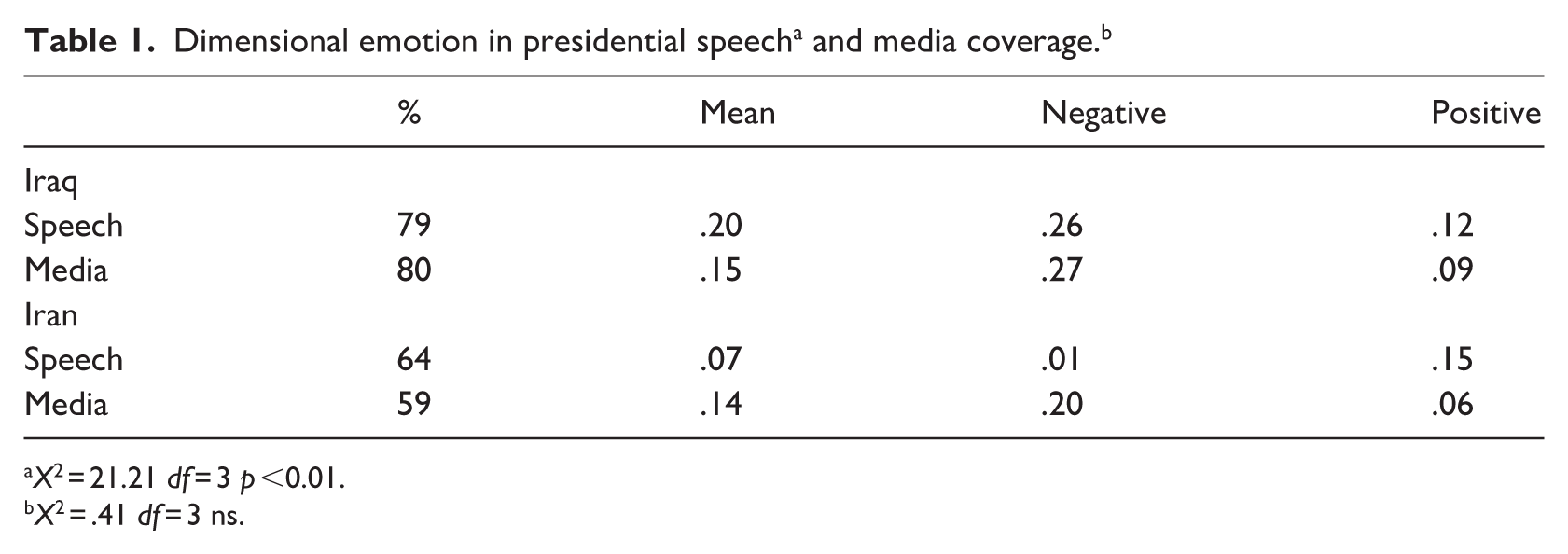
X2 = 21.21 df = 3 p <0.01.
X2 = .41 df = 3 ns.
Inspecting the nine discrete emotions across two sources, we found that the news corresponds well with Bush’s speeches (only enthusiasm produces a significant difference; see the t-test results presented in Table 2) but not with Obama’s speeches (three significant differences—fear, anger, and hope, plus overall discrete emotions). Based on these results, we can confidently deduce that the mediated discourse about the Iraq policy is more likely to resonate with Bush’s speeches and to convey emotions than the Iran counterpart.
Discrete emotion in presidential speech and media coverage.
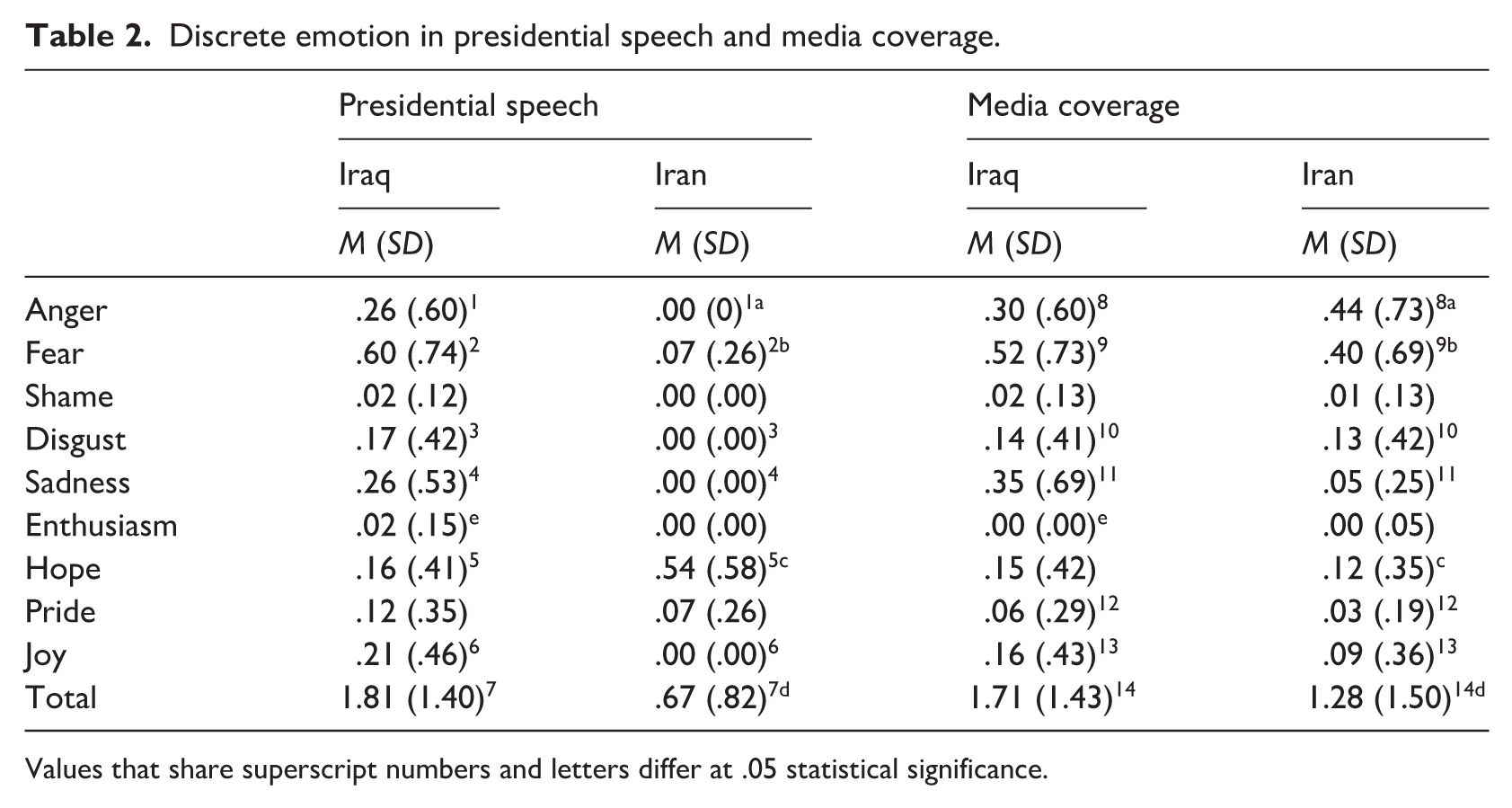
Values that share superscript numbers and letters differ at .05 statistical significance.
RQ1 aims at unveiling the discrete emotions in the discourse of the foreign policies, with both presidential speeches and media coverage analyzed. During the Iraq period, both positive and negative emotions are present in presidential speeches and media coverage. Specifically, as Table 2 indicates, fear, sadness, and disgust are rather prominent on the negative spectrum while hope, pride, and joy stand out on the positive spectrum. Both Bush’s speeches and the news coverage roughly correspond to each other regarding discrete emotions. During the Iran deal period, however, the discrete emotions existing in Obama’s speeches and media coverage differ greatly. The only significant emotion appearing in Obama’s speeches is hope, while the coverage of the Iran deal is teeming with anger, fear, and some disgust, and merely a modest amount of hope.
RQ3 focuses on the potential difference between the two presidents in their uses of emotion in speeches. Based on the measurement of discrete emotions that falls on the scale of 0 to 2, when all emotions are included, Bush’s average is .20 and Obama’s average is .07. Bush’s average negative emotion is .26, compared to Obama’s average of .01. Bush’s average positive emotion is .12, compared to Obama’s .15. As Table 2 indicates, the differences between Bush and Obama in their uses of discrete emotions are statistically significant, except for shame, enthusiasm, and pride. Not only did Bush use emotions more frequently than Obama, he used them in greater magnitude. Two distinct emotions truly differentiate the two presidents’ approaches that are worth highlighting here—Bush used much more fear in his messages to persuade the American public while Obama resorted to more hopeful narratives.
RQ4 centers on the existence of emotions in the media coverage. Discrete emotions appear in 80% of the media coverage during the Iraq War period and 59% of media coverage during the Iran nuclear agreement period. Interestingly, the average emotion conveyed in the media coverage remains strikingly constant across the two study periods, ranging from .15 to .14. As mentioned above, Bush’s speeches contain ample emotion, and the media seem to correspond to it to a considerable extent. There is only .05 difference in the average emotions between Bush’s speeches and media coverage during the Iraq War period.
During the Iran deal period, the average emotion in the media coverage is twice as much as that in Obama’s speeches—.14 versus .07. The average negative emotion in Obama’s speeches is extremely low (M = .01), but the media’s average negative emotion reaches .20. While positive emotion is notable in Obama’s speeches (M = .15), the media coverage average at .06 strays significantly from his lead. The divergence of emotion found between the speeches and the news media during the Iran period is in stark contrast with the convergence found during the Iraq period. The levels of average negative and positive emotions in the media and speeches during the Iraq War period resemble each other. Negative emotion in the media differs from that in the Bush speeches by merely .01 and positive content in the media only by .03. During the Iran period, negative emotion in the media is larger than in the Obama speeches by .19, while positive emotion is less by .09. Another notable aspect of the media coverage is emotion’s seemingly stable presence across the two periods.
The polling results obtained from the Roper Center archive 3 show that initial public support for the Iraq War before the official announcement hovers around 60%. The percentage of support dips below 50% briefly and then bounces back up higher, to reach almost 80%. Public support for the Iraq operation remains high in the second part of the study period, while the percentages of people who oppose the war go down from 40% to 20%. In contrast, the opinion trend for the Iran deal shifts quite differently. Support for the nuclear deal reaches 62% at the outset, moves up and down between 30% and 40%, and then settles below 30% in August 2015. Meanwhile, disapproval of the peace proposal rises from 25% to more than 55% in two months, ending at 60% in August 2015.
As in every significant foreign policy, compounding and interconnected factors may have resulted in different opinion trends towards the Iraq and Iran policies. The historical background of the US’s relationship with either nation, the nature of the proposed policies, and the emotions in the discourses could all play a role. For example, the high level of support for invading Iraq could stem from the ‘rally around the flag’ effect that was prevalent after the attacks on 11 September 2001 (Schubert et al., 2002). With limited and irregular polling points, we unfortunately cannot pursue rigorous statistical testing between public support and the emotional component in presidential speeches across the six-month period. Yet, based on 41 national polls conducted during the Iraq policy period and 15 counterparts during the Iran period, the average support for the Iraq policy (59%) is higher than the Iran counterpart (38%); and the average percentage opposing the Iraq policy (36%) is lower than the Iran counterpart (44%). With the above opinion indicators, combined with the salience of emotions (particularly negative discrete emotions) employed in Bush’s speeches during the Iraq policy period, compared with the lack of emotions in Obama’s speeches about the Iran deal (t = 4.167, df = 159, p < .01), there appears to be a positive association between emotion in presidential speeches and policy support. The markedly salient emotions of fear, anger, and sadness in Bush’s speeches versus hope in Obama’s speeches are indicative of the potential impact of negative emotions on policy support.
Likewise, the relationship between emotions conveyed in the media coverage and public support is examined. With the evidence of statistically significant differences of media coverage in average emotion (t = 3.125, df = 551, p < .01) and in six of the nine discrete emotions between the two foreign policies, it is reasonable to infer a potentially positive association between the mediated emotion and contrasting opinion trends during the two policy periods. Examining the nine discrete emotions further, we find that fear and sadness are notably highlighted in the Iraq coverage, while anxiety is emphasized more in the Iran coverage. Interestingly, there is also a higher amount of pride and joy in the Iraq coverage than in the Iran counterpart.
Discussion and conclusion
Based on the results yielded from two landmark foreign policies, we conclude that mediated political discourse with high frequency of emotional content—particularly negative emotion—is positively associated with public support, more than the counterpart with low or positive emotion. President Bush employed greater emotion throughout his speeches leading up to and immediately after his declaration to invade Iraq, which worked better than President Obama’s strategy of remaining matter-of-fact and positive for the JCPOA. President Bush’s frequent use of emotion also appears to resonate well with the media’s preference for emotional coverage, which simultaneously or subsequently led the public to concur. Alternatively, President Obama’s use of positive language did not register well with the media’s well-documented tendency to lean towards the negative (Arango-Kure et al., 2014). Therefore, news media tend to mirror the president more when he uses negative emotional language but ignore the cue when the president uses positive emotion. Therefore, based on these two examined cases, the public are more reliant on negative emotion in political discourses to shape their opinion towards foreign policy.
Our research result reveals the potentially important role emotion plays in presidential speeches and media coverage about crucial foreign policies. When used by a president in speeches, certain emotions appear to trickle down through the media more effectively than others. For example, the salient negative emotions delivered in the Bush speeches were echoed by the media, whereas the negligible negative emotions conveyed by Obama were ignored while his hopefulness was notably squashed in the news coverage. This pattern supports the known tendency of the media practice of covering more negative news—but a more consequential question for future researchers is whether negative emotions drive media coverage. Emotion in presidential speeches subsequently can be instrumental in shaping and moving public opinion, particularly when there exists a high level of negative emotions, such as anger and fear. President Bush’s regular use of highly negative emotion in his speeches, albeit with the help of the rally effect (Schubert, et al. 2002), presents an effective persuasion strategy in boosting public support. Alternatively, positive emotional language such as hope and joy appear to yield less of an effect in shaping news coverage or public opinion. Both media professionals’ and the public’s inclination for bad news appears to be consistent (Biswas, et al. 1994). President Obama’s infrequent use of emotions, particularly negative ones, in his speeches, and Americans’ lackluster support for his Iran peace treaty also provide a vivid case.
In today’s policy-making environment, the media are often the key mediator between the policy maker and the public. The level of salience of a foreign policy that registers with average citizens may hinge on the media’s treatment. Therefore, it is important to pay heed to the media’s inclination towards including emotion in their coverage, particularly negative emotions. Policy makers should be aware that the media’s persistent preference for negative, controversial coverage reflects their business interests, and that negativity has long been considered a type of conventional newsworthiness to journalists. It is still quite telling that when the media receive strong negative emotional cues from the president, reporting is more likely to align with his tone. Yet when weak, positive emotional cues from the president come along, media reporting is more likely to be defiant. Therefore, this pattern suggests that policy makers’ negative, highly emotional content can yield more similarly emoted mediated discourse than the counterpart.
The media often sway the public’s support with their coverage of military intervention early on, when political elites are typically in consensus and the press is presenting patriotic, casualty-free coverage (Aday 2010). Prior scholarship has not revealed the media’s coverage of peace proposals, let alone the associated emotions. This study suggests that one mechanism through which the interactive dynamic occurs is through the emotional discourse initiated by the president. Both Bush and Obama used varied emotional language in their respective speeches leading up to and after important foreign policy decisions. And the consequences of their distinct approaches, given the opposite opinion trends, cannot be more lucid.
The trickle-down effect of negative emotion may affect the public more than is commonly recognized by the mainstream media and the public. The collated data suggest that the public have relied more on negative, strongly emotional discourse to form their opinions. Polls show that the public respond swiftly to negative emotions, particularly when the president urges action in response to a clear and present danger. People tend not to rely on strong emotional discourse when it is predominantly positive and potentially promising; particularly because the president’s use of positive language does not allow for the creation and augmentation of an evil enemy dramatized and capitalized on by the media. The question we must turn to is whether peace is harder to sell than war. How political leaders, policy elites, and perhaps media consultants can effectively persuade citizens to accept peace resolutions is of great concern. Furthermore, what kind of emotional frame can policy makers utilize to resonate with the public and elevate the chance of peace?
This article highlights the role emotions play in the interaction between presidential speeches and news media coverage; and how they might be related to reaching sound and well-thought-out foreign policies via public engagement. Understanding the role of emotion in political communication processes illuminates how Americans made up their minds about two foreign policy initiatives. Acknowledging the power of emotion also illustrates how policy makers can effectively harness emotion to amass public support for responsible resolutions. To engage the public in a responsible way and induce sound policies, it is essential for all involved parties to understand the process more clearly. Understanding the underlying mechanism of emotion in shaping mediated discussion of critical foreign policy will enhance the quality of decision-making processes.
This study is particularly relevant to today’s political and media environment. The public are increasingly accessible via varied media platforms, and so are political leaders. Governments need to prepare for the public’s swift response to foreign policy, particularly when it is conveyed in 280 characters or fewer. The increasing use of social media by the public and public offices encourages emotion over detail or facts. Yet communicating a complex foreign policy decision via a short message is not easy, especially when it contains highly detailed information that can overwhelm even the most patient policy wonks. Using emotion to explain any policy is a luring shortcut at reaching the public and elicit strong attention. And political leaders around the world are keenly aware that as communication mechanisms evolve, the power of emotion looms larger.
This study investigated only two distinct international cases to better understand the influence of emotions in foreign policy on the American public. The involved US presidents, the unique media environments, and the specific political situations when the two foreign policies were introduced and deliberated differ—and these factors will also change in the future. Therefore, generalizability of our findings for other or future cases is not entirely established. Moreover, studies of mediated emotion in political discourse, especially on peace deals, are scarce. Future research should examine the influence of discrete emotions more closely in a longitudinal and systematic manner. Understanding the impact of each distinct emotion on communication can enhance our prediction about the media’s treatment as well as public opinion. Additionally, emotion in social media may prove to be particularly salient due to the increasing use of social media by political leaders and policy elites to reach their virtual circles.
One weakness of this study is that these two policies not only have different assumed outcomes, but also diverse contextual and historical factors. While Bush’s main objective was to go to war, Obama’s objective was to avoid war. People who might already have harbored existing attitudes toward either country or objective may respond differently to such situations and lean towards supporting either policy. Future research may examine a greater number of foreign policies with similar objectives and backgrounds to enhance external validity. This study hopes to draw more interest in including emotion as a factor in political communication and in investigating the impact of emotion on the foreign policy process.
Footnotes
Funding
The authors received no financial support for the research, authorship, and/or publication of this article.
