



Abstract
The “New Economy” features 24/7 employment, varied work schedules, job insecurity, and lower benefits and wages, which lead to disparities in experiences of security and sufficiency. This study investigates sufficiency concerns in the New Economy; who is having trouble making ends meet? Sufficiency concerns are subjective perceptions that work is insufficient to meet basic needs and that family and work cannot be coordinated in a stable way. This study uses the 2006 National Survey of Religion and Family Life (N = 1,621) to analyze Americans’ experiences in the New Economy and how these experiences are related to work–family conflict. Sufficiency concerns were experienced by a quarter to a third of our respondents and were shaped by gender and structural inequality, especially race and education. Moreover, sufficiency concerns strongly predict work–family conflict, even when other controls are included. This research furthers our understanding of work–family conflict and the winners and losers in the New Economy.
The “New Economy” has altered the way we work and live (Cappelli et al., 1997). Paid work is less stable and harder to coordinate with family life in an era of nonstandard work schedules, contingent and episodic work, and the extension of work into later life (Mosisa & Hipple, 2006). Household incomes are down because of lower wages and investment returns (Bucks, Kennickell, & Moore, 2006). The gap between the rich and the poor has grown (Johnson, 2007) despite the rise in married dual earner households and the steady growth in wives’ contributions to earnings (U.S. Department of Labor, 2007). And the employer-sponsored benefits that earlier generations relied on have become less generous and harder to obtain. Many Americans do not have health insurance or are underinsured (Stanton, 2004), and risky individual retirement accounts have largely replaced pensions (Barney, 2007).
Although some workers may be able to negotiate the pitfalls of the New Economy well, others, especially lower class families (Farber, 1998; Schor, 1991), may fall short and encounter difficulties achieving economic sufficiency and stability. Cooper (2008) refers to these problems as the new “inequality of security” (cf. Bauman, 1998; Beck, 2000; Hacker, 2006; Schor, 1991; Sennett, 2004; Smith, 1997). Two back-to-back recessions have exacerbated this trend. 1 In this article, we investigate two questions: (a) What are Americans’ experiences with insufficiency between 2001 and 2006? Did they have trouble finding and keeping a job with adequate pay and benefits or repeated problems coordinating work and family life? (b) How do these experiences relate to assessments of recently experienced work–family conflict? 2
There is a great deal of research using objective measures of insufficiency, including underemployment, poverty statistics, and access to health care (DeNavas-Walt, Proctor, & Smith, 2009; Rowland, Hoffman, & McGinn-Shapiro, 2009). We focus on American’s subjective perceptions of the insecurity that Hacker (2006) and others have identified; do Americans feel they have been able to “make ends meet” and, if not, what are the consequences? Questions about one’s perceived ability to make ends meet have often been approached through small-scale studies that make it difficult to make comparisons across subgroups or to generalize findings to the population as a whole (Edin & Lein, 1997; Hays, 2003). And studies of work–family conflict often focus only on middle-class or professional Whites (see Allen, Herst, Bruck, & Sutton, 2000; for an exception see Ciabattari, 2007) and use individual characteristics or statuses as predictors (e.g., occupation, income), without considering individuals’ assessments of these statuses or characteristics (Voydanoff, 2004).
We take advantage of a national data set with oversamples of African American and Hispanic respondents, which has measures of experiences with specific features of the new economic insecurity—we use the term insufficiency to denote these subjective experiences of difficulty in making ends meet. We investigate how structural location (race, social class, and gender), religious involvement, family characteristics, and job characteristics shape insufficiency and, in turn, how perceptions of insufficiency are related to work–family conflict.
Work–Family Conflict
Work and family can intersect and influence one another in both positive and negative ways. They are said to “conflict” when managing the demands of both is “too much,” causing missed work, missed time with family, or subjective stress and strain in the short term. Directionality matters; work-to-family conflict and family-to-work conflict each have different predictors and outcomes associated with them (Frone, Russell, & Cooper, 1992). Work and family can also enhance one another (Barnett & Hyde, 2001; Greenhaus & Powell, 2006; Voydanoff, 2004); positive experiences in one arena can help individuals perform other roles more effectively. Whether conflictual or enhancing, the work–family relationship has important influences on mental and physical health (Frone, 2000; Frone et al., 1992) and on organizational outcomes such as burnout, turnover, and job satisfaction (for a review, see Allen et al., 2000; or Kelly et al., 2008). Since New Economy characteristics are likely to have a detrimental rather than an ameliorative effect, our research focuses on work-to-family and family-to-work conflict, not enhancement.
When investigating work–family conflict, researchers typically start with a consideration of the structural constraints that shape work–family management and then proceed to consider factors that either buffer the worker from the effects of structural constraints or make the worker more vulnerable. What is often missing from this approach is the subjective: How do individuals interpret the resources or demands at their disposal, and how do these perceptions, in turn, shape other outcomes of interest? For example, researchers will investigate how one’s hours spent at work affect work–family conflict but do not include variables that assess perceptions of working “too little” or “too much” (Grzywacz, Almeida, & McDonald, 2002; Voydanoff, 2004). Scholars have theorized the necessity of including subjective assessments (Greenhaus & Powell, 2006) or discuss them as implicit part of the cognitive appraisal process that individuals use when thinking about the intersection of work and family (Voydanoff, 2004), but such assessments are often conspicuously missing in analyses. 3 If perceptions of the work environment shape work–family conflict, so might perceptions of the availability and stability of work and the adequacy of compensation and benefits, all of which have changed with the advent of the New Economy.
The New Economy: Increased Coordination Costs and Reduced Resources
As organizations in the New Economy seek to reduce costs and respond to the demands of a 24/7 global economy, workers are more vulnerable and organizations more unstable; the 1950s model of lifetime employment has all but vanished (Cappelli et al., 1997). Job insecurity is normative; organizations merge and downsize, and workers often switch employers several times before eventually retiring (Knoke, 2001). Contingent work, nonstandard work schedules (e.g., schedules other than Monday through Friday from 9 a.m. to 5 p.m.), and involuntary part-time work (Kalleberg, 2000; Tilly, 1991; U.S. Department of Labor, 2009b) 4 have all become more common. Work schedules vary among multiple workers in a family, change on short notice, and no longer neatly coincide with the schedules of other institutions (children’s schools or community organizations; Moen, 2003). The erosion of security between employers and employees, coupled with reduced wages and benefits, means that cost of supporting and coordinating work and family life is increasingly born by individuals and their families.
At the same time, wages and benefits have become less generous. Most adults younger than 65 years rely on employer-based benefits, such as health care, paid time off, and retirement funds. Because of its daily relevance and the financial costs associated with injury, illness, and routine preventative care, health care benefits are especially important to workers. But variable eligibility requirements mean that not all workers have coverage through their employers (Gabel, Pickreign, Whitmore, & Schoen, 2001). In 2009, only 71% of private industry workers and 88% of state and local government workers had access to employer-based health benefits, with full-time and higher wage workers most likely to be covered (Bureau of Labor Statistics, 2009b). Those with coverage have faced increased premiums and deductibles, larger employee contributions, 5 and/or reduced coverage, as employers have had to reconsider the health care benefits they offer workers (Bruno, 2008). These trends have sparked widespread concern, in part because of the lack of viable alternatives to employer-based health insurance. 6
Income inequality, as assessed by the Gini Index, has been rising steadily since 1970 (DeNavas-Walt et al., 2009). Although median earnings have grown over the past 25 years for those who have at least a bachelor’s degree, earnings have remained flat or declined for those with less education (U.S. Department of Labor, 2007). As a result, the labor force is growing increasingly bifurcated between those with “good” jobs and those who can work full time all year and still experience poverty (DeNavas-Walt et al., 2009). The decline in manufacturing and growth of the service sector in the New Economy (Cappelli et al., 1997; U.S. Department of Labor, 2007) has been especially detrimental to those with less human capital. The replacement of salaried with hourly based positions across many occupations, including professionals and managers, also contributes to wage depression (Hamermesh, 2002). Most Americans either feel overworked or underworked; only a fifth of workers report that they are working the number of hours that they need or would prefer (Golden & Gebreselassie, 2007; Jacobs & Gerson, 2004; Schor, 1991). And unemployment is, of course, a serious problem facing many.
Stressors and Buffers: Gender, Family, and Job Characteristics
Despite gains in gender equality, gender is still likely to shape one’s objective experiences with the New Economy, one’s subjective assessment of making ends meet, and perceptions of work–family conflict. The percentages of dual-earner, single-mother, and single-father households have grown since the 1970s (Bureau of Labor Statistics, 2005; Kreider & Elliott, 2009). At the same time, declines in male earnings and improved job prospects for women have eroded, for many, the desirability and practicality of the breadwinner/homemaker model (Milkie, 1991).Although men are gradually doing more household labor and devoting more time to their children (Sayer, Bianchi, & Robinson, 2004), women continue to shoulder the majority of routine child care and domestic tasks (Bianchi, Milkie, Sayer, & Robinson, 2000) and confront intensive parenting ideologies (Hays, 1998). This often leaves working moms torn between being a good worker and being a good mother (Blair-Loy, 2003; Williams, 2000).
Scholars have consistently found that certain characteristics lead households to experience more difficulty, whereas others have more ameliorative effects. Marital and parental statuses are consistently linked to perceptions of work–family conflict (Frone et al., 1992; Voydanoff, 1988). Parents with children younger than 18 years report significantly more conflict balancing their work and family life compared with men and women who do not have these caregiving responsibilities (Bond, Galinsky, & Swanberg, 1998). And single-parent households experience more work–family imbalance than married couples (Tausig & Fenwick, 2001).
Job characteristics also shape work–family conflict, and work in the New Economy is increasingly unbounded and at odds with family responsibilities. Although “flexible” hours (such as part-time, rotating schedules, weekend shifts, etc.) may be beneficial to employers as they negotiate the needs of a 24/7 economy, nonstandard work schedules make it challenging to reconcile work with family obligations (Presser, 2003). Lack of job autonomy and control over scheduling add to the problem; workers may struggle to attend to routine or unexpected family situations, such as tending to a sick child that needs to be picked up early from day care, or dropping off a car for routine maintenance (Heymann, 2000), and they experience more work–family imbalance as a result (Tausig & Fenwick, 2001). Changing communication technology means some workers feel pressured to stay connected and responsive to an ever-changing set of work-related duties: Work can easily spill over and invade personal and family time (Chesley, 2005) or lead to feelings of burnout and stress (Bond et al., 1998).
Structural Location and Inequality
In the New Economy, insufficiency concerns and work–family conflict may affect all workers, but they may be particularly problematic for individuals and families who are structurally disadvantaged across multiple dimensions, particularly along the intersections of race/ethnicity and social class, and for younger workers who are building careers and starting families. Marginalized racial/ethnic groups, such as Hispanics and African Americans, are disproportionately in lower wage jobs and are more likely to be unemployed (U.S. Department of Labor, 2007). Between 2006 and 2008, almost a third of Hispanics lacked health care coverage compared with 11% of Whites and roughly 20% of African Americans (DeNavas-Walt et al., 2009). Racial and ethnic minorities also report more problems paying for health care and/or health care coverage as a result of the recent economic downturn (Berndt & James, 2009). Because of their lower earnings, African Americans are more likely than Whites to desire additional work hours (Golden & Gebreselassie, 2007) and more likely than other racial minority groups to work two or more jobs (Bureau of Labor Statistics, 2009a). Family structures also differ along race and class lines, with percentages of single-parent households with children younger than 18 years higher among African American and Hispanic than among White households and among single mothers and fathers with less education (Kreider & Elliott, 2009).
Similarly, younger workers are less likely to have employer-based health care coverage than older workers (Holahan & Cook, 2009), and they are more likely to have wages that place them below the poverty line than older groups of workers (U.S. Department of Labor, 2009a). Since the young adult years are often the window when many Americans begin raising children and juggling work and family schedules, it is not surprising that work–family balance improves as workers age (Tausig & Fenwick, 2001).
Religion
When it comes to shoring up individual’s work–family lives, research has generally focused on the ability to secure additional financial resources and social support (e.g., Gibson-Davis, Edin, & McLanahan, 2005; Harris, 1996). Religious involvement is a form of social capital that may shape access to both resources and social support (Beyerlein & Hipp, 2006; Smidt, 2003). Across subpopulations, religious involvement is consistently linked to emotional support and psychological well-being (Krause, 2006; Krause, Ellison, Shaw, Marcum, & Boardman, 2001). For non-White populations, religious involvement is linked to specific kinds of social support that may provide a buffer against work–family dilemmas. Involvement in a religious community may offer help with household tasks and caretaking (Ellison & George, 1994; Sherkat & Ellison, 1999) as well as provide “bridging” social capital (Beyerlein & Hipp, 2006) that generates information about employment opportunities and support in times of crisis (Ellison & George, 1994; Krause, 2006, Krause et al., 2001). The expansion of faith-based social services (White House Faith-Based and Community Initiatives, 2007) suggests that religious communities may also be a source of practical help and resources for families struggling to make ends meet (Black, Koopman, & Ryden, 2004; Steiner, 2005; Wineburg, 2007).
Ammons and Edgell (2007) find that the effects of religious involvement on behavior work–family trade-offs is slight (such as cutting back the number of hours worked per week to spend time with family), but argue that religion may be a factor shaping subjective assessments of the work–life interface. Religious communities may be a source of the moral and cultural frameworks that people draw on in making sense of the work–family interface as it relates to their own lives (Gerson, 1985), shaping assessments of “the good family,” a good career, appropriate parenting styles, or gender roles in the family (Edgell, 2005). However, in the work–family literature, the effects of religious involvement has only been considered in studies of behavioral work–family trade-offs for White, middle-class Americans (Ammons & Edgell, 2007) and in small-scale studies focused on a short time span (Edin & Lein, 1997). We know little about how religion affects perceptions of work–family conflict or insufficiency concerns.
Perceptions of Insufficiency in the New Economy and Ties to Work–Family Conflict
Research on the New Economy has outlined the major features of the recent economic transition and identified factors that make people more or less vulnerable to having lower wages, poor benefits, and high costs in coordinating work and family. But although we know there is a new inequality of security (Bauman, 1998; Beck, 2000; Cooper, 2008; cf. Hacker, 2006; Schor, 1991; Sennett, 2004), we know less about who is likely to perceive this insecurity as insufficiency—a consistent or recurring problem in making ends meet. And although there is a large, interdisciplinary literature on the work–family interface, we do not know how perceived insufficiency stemming from the New Economy affects work–family conflict.
We analyze perceptions of insufficiency and how such perceptions relate to work–family conflict using a national data set with oversamples of African American and Hispanic respondents and good measures of insufficiency, work–family conflict, family structure, job characteristics, and religion.
Method
Our data come from the National Survey of Religion and Family Life (NSRFL), a 2006 telephone survey of U.S. working-age adults aged from 18 to 79 years. The NSRFL asks respondents about Americans’ family relationships, work–family management, and information about respondents’ religious identities, affiliation, and family-oriented programs and services in which people participate through local congregations. SRBI, headquartered in New York, conducted the survey. Households were selected to participate in the survey using random digit dialing (RDD) and one adult respondent was chosen at random within each household. African Americans and Hispanics were oversampled by dialing within telephone area codes with 10% or more concentrations for each ethnicity. If respondents desired, the survey was conducted in Spanish.
The cooperation rate for the survey (the proportion of all cases interviewed of all eligible units ever contacted) was 54%, with higher cooperation rates in the racial oversamples. The response rate for the NSRFL (the number of complete interviews with reporting units divided by the number of eligible reporting units in the sample) was 36%.The response rate for the African American oversample was 41% and for the Hispanic oversample, it was 34%. Although the overall response rate is low by traditional standards, it compares favorably with national RDD surveys (Council on Market and Opinion Research, 2003). 7 In addition, research suggests that there are few differences between high response rate government surveys, such as the CPS or the U.S. Census and RDD surveys with lower response rates (Keeter, Miller, Kohut, Groves, & Presser, 2000; Pew Research Center for People and the Press, 2004).
The sample size for NSRFL is 2,386 (1,518 women and 868 men). But, the effective sample size for this study is 1,659 since we limit our analysis to respondents who were employed part-time or full-time. The sample size is further reduced to 1,556 (913 women and 643 men) in the regression models because of missing data for the dependent variables and some of the independent variables.
Dependent Variables
We use two scales to assess work-to-family and family-to-work conflict. The work-to-family scale asks employed respondents how often the following had been true in the past 3 months: (a) my work kept me from spending enough time with my family, (b) my work made me feel very tired or exhausted, (c) my work made me feel anxious or depressed, or (d) my work kept me from spending enough time on myself (Cronbach’s α = .796). The family-to-work stress scale asks employed respondents how often the following had been true in the past 3 months: (a) my family kept me from spending enough time on my work, (b) my family made me feel very tired or exhausted, (c) my family made me feel anxious or depressed, or (d) my family kept me from spending enough time on myself (Cronbach’s α = .750).
Independent Variables
Insufficiency
We measure work–family insufficiency using three dependent variables that come from questions we created for the NSRFL. We designed them to measure experiences of typical problems associated with core features of the New Economy. The first question that asks, “In the past 5 years, have you had trouble finding a steady job that pays enough to support your family?” The second asks respondents, “In the past 5 years, have you had trouble finding a job with adequate health benefits?” The third question asks, “In the past 5 years, have family commitments made it hard for you to hold down a job?” Response categories for each question are measured using a Likert-type scale and range from 0 (never) to 4 (always).
Demographic variables
We include a number of demographic variables as controls in our analyses. Age is a common characteristic used in work–family studies. We measure age as a continuous variable. Although household income was originally an ordinal variable in the survey, in our analyses we treat it as continuous. Each response category is mutually exclusive and includes a range of household income, one of which was selected by respondents to represent their household income. We substituted the midpoint value of the income range selected for household income and used Pareto’s curve (Parker & Fenwick, 1983) to set the last category midpoint to $180,000. As mentioned above, one of the advantages of the NSRFL survey is it contains an oversample of Blacks and Hispanics. Whites, Blacks, and Hispanics each comprise one third of respondents in the sample. These response categories were presented to respondents as mutually exclusive. Black and Hispanic are included in the models as dichotomous variables with White being the reference group. We measure high school education with a dichotomous variable indicating whether the respondent has a high school degree or less.
Family characteristics
We measure family characteristics with two variables: (a) marital/cohabitation status and (b) whether the youngest child is younger than 18 years. Married/cohabiting is a binary variable where 1 is married or cohabiting. Child younger than 18 years is measured as 1 if the youngest child living in the household is younger than 18 years.
Employment characteristics
It seems likely that respondents who participate in nontraditional employment arrangements experience higher levels of insufficiency and work–family conflict. Full-time employment is measured 1 if the respondent is employed 35 or more hours per week, otherwise 0. Nonstandard work schedule is a dichotomous variable and is coded 1 if the respondent’s employment includes any evening or night work, weekend work, rotating shifts, or regular overnight travel.
Religion
We assess religious activity with two variables that address affiliation and participation. Our models include a dummy variable indicating identification as Conservative Protestant. We also include a variable for church attendance as an indicator of religious practice. Response categories range from 1 (never) to 6 (more than once a week).
Analytic Strategy
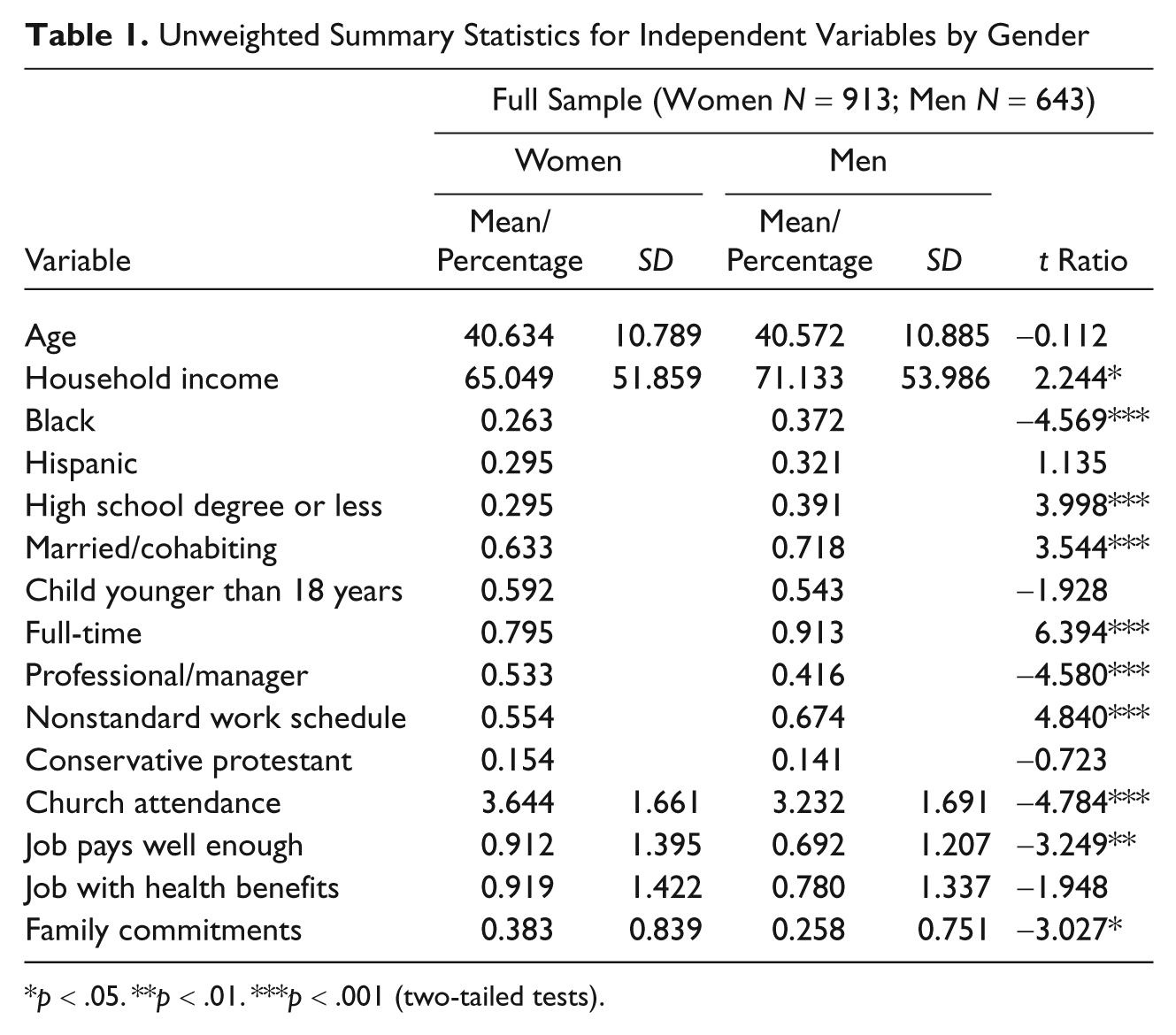
Table 1 provides summary statistics for the independent variables. In the subsequent table, we explored who experiences sufficiency concerns using descriptive statistics (chi-square and analysis of variance). To assess how sufficiency concerns are related to our work–family conflict scales, we used bivariate correlations and ran ordinary least squares (OLS) regression models, which were estimated separately for men and women. OLS regression is the appropriate estimation procedure since our dependent variable is continuous and the observations are independent. The regression models proceed as follows: Model 1 includes only the sufficiency variables and assesses how well these concerns predict work–family conflict. In Model 2, we add demographic, family, employment, and religious characteristics and analyze whether these subjective concerns cease to be as important once relevant control variables are included in the analysis.
Unweighted Summary Statistics for Independent Variables by Gender
p < .05. **p < .01. ***p < .001 (two-tailed tests).
Results
Descriptive and Bivariate Statistics
Summary and descriptive statistics come from unweighted data for our sample (see Table 1 for summary statistics; for bivariate statistics on sufficiency concerns see Table 2). In Table 1, we provide unweighted summary statistics for our independent variables by gender. The summary statistics and the subsequent analyses are separated by gender because the work–family interface is often experienced differently by men and women. Although there are important race and class variations, women (especially White middle-class women) have historically been charged with maintaining the family domain more than men, and thus work–family researchers often find gender differences in the predictors and prevalence of work-to-family and family-to-work conflict (Duxbury & Higgins, 1991; Grzywacz et al., 2002). Table 1 shows significant gender differences for several demographic characteristics, family characteristics, employment characteristics, and religion. The women in our sample are less likely to be married, more likely to be a manager or professional, work a regular work schedule, and work part-time than the men in our sample. On average, women also have more education, less income, attend church more regularly, report more difficulty finding a job that pays well enough to support their families, and more often agree that family commitments make it hard for them to hold down a job.
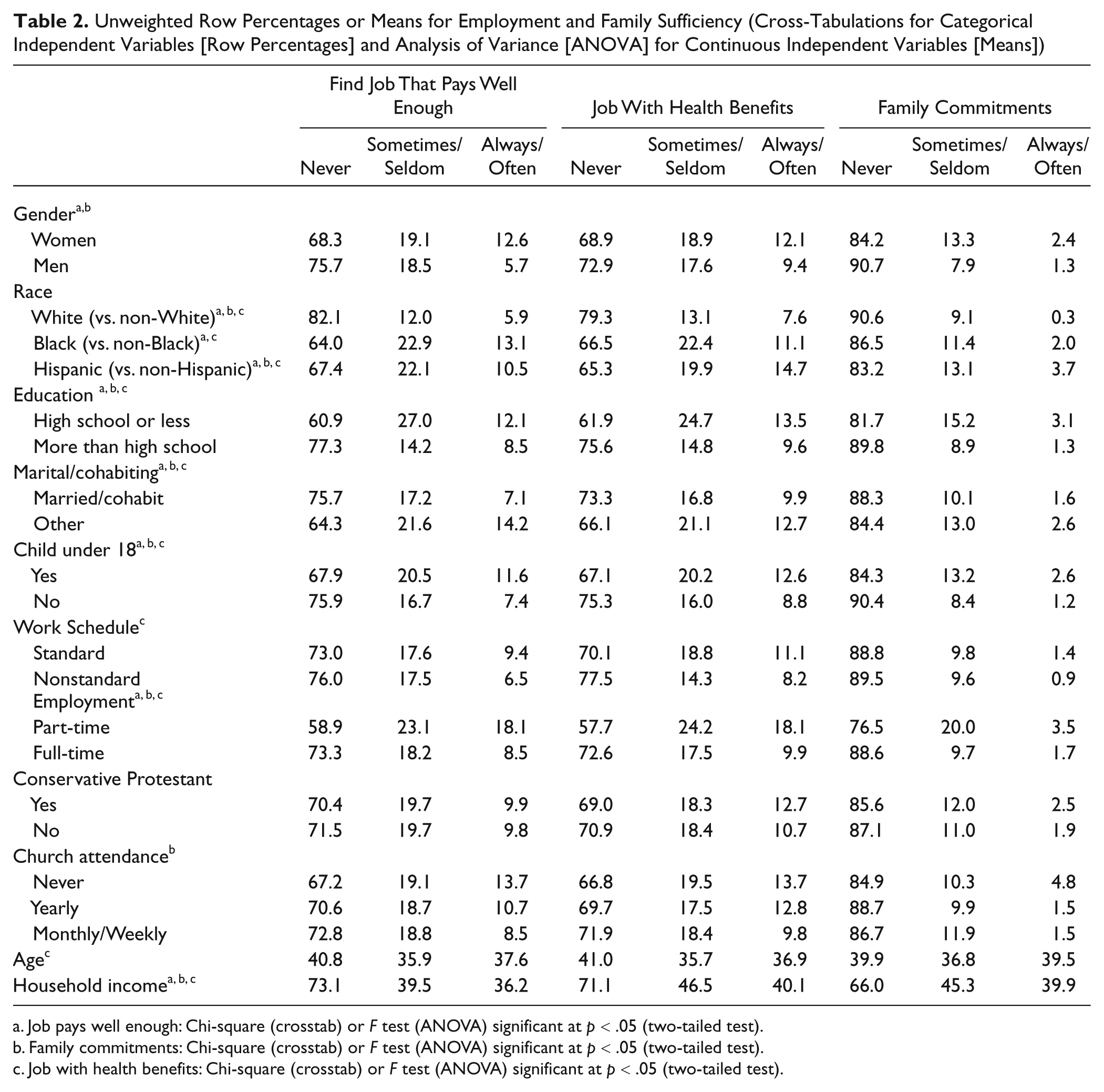
Unweighted Row Percentages or Means for Employment and Family Sufficiency (Cross-Tabulations for Categorical Independent Variables [Row Percentages] and Analysis of Variance [ANOVA] for Continuous Independent Variables [Means])
Job pays well enough: Chi-square (crosstab) or F test (ANOVA) significant at p < .05 (two-tailed test).
Family commitments: Chi-square (crosstab) or F test (ANOVA) significant at p < .05 (two-tailed test).
Job with health benefits: Chi-square (crosstab) or F test (ANOVA) significant at p < .05 (two-tailed test).
Table 2 reports unweighted bivariate statistics for those who are most likely to experience insufficiency “always or often,” “sometimes or seldom,” and “never.” These statistics show that women are more likely than men to report that they “always or often” experience each type of insufficiency. Thus, gender is an important moderator that, absent control variables included in regression models, exacerbates two of the three types of sufficiency in our analysis. The bivariate relationships between race and insufficiency are statistically significant. Black respondents report the highest levels (“always or often”) of having trouble finding a job that pays well enough (13%). Hispanics report the highest percentages of having trouble finding a job with health benefits (15%) and family commitments interfering with employment (4%). Family characteristics are also associated with insufficiency. Married and cohabiting respondents are less likely to report experiencing each type of insufficiency whereas respondents with children have higher levels of insufficiency across each measure. Finally, resources and human capital are important buffers from perceptions of insufficiency. Respondents with more education and full-time employment perceived that it was easier to “make ends meet”; this suggests that self-reports of employment sufficiency and the ability to stably coordinate work and family are reflective of a divergence between winners and losers in the New Economy.
Work–Family Conflict
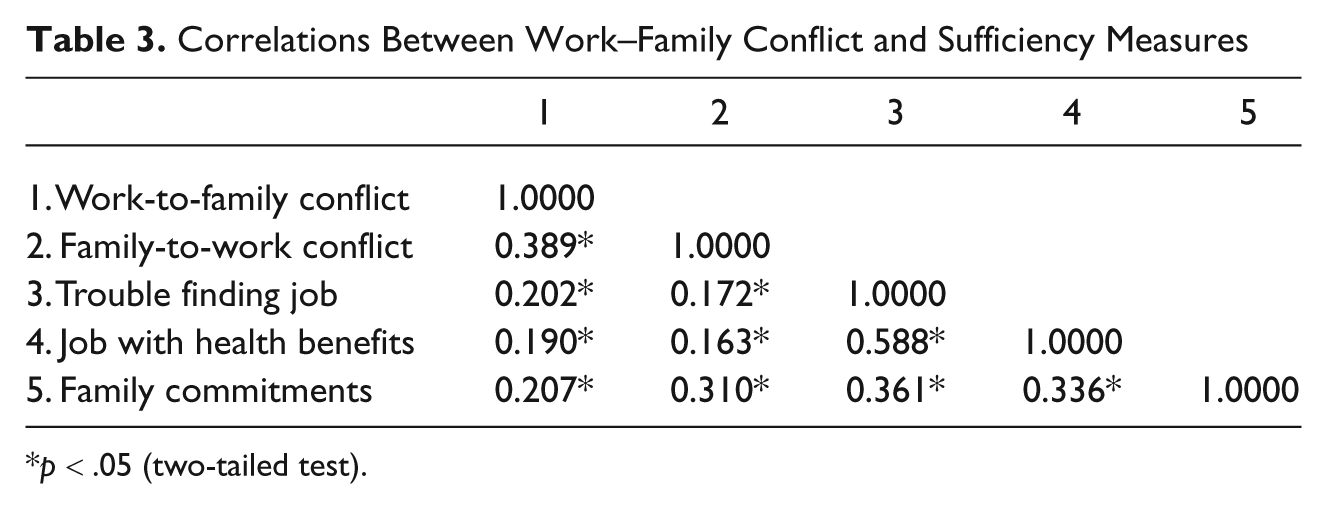
To assess the relationship between our work–family conflict scales and sufficiency measures, we ran correlations (see Table 3). There is a moderately strong correlation between work-to-family conflict and our family-to-work conflict scales and either strong or moderately strong correlations among our insufficiency measures. Unsurprisingly, trouble finding a job with adequate health benefits is closely related to difficulties finding a job that pays well. Low-paying jobs often either lack health care benefits, provide coverage that is too expensive for employees to afford, or provide coverage that is not adequate for employees’ needs.
Correlations Between Work–Family Conflict and Sufficiency Measures
p < .05 (two-tailed test).
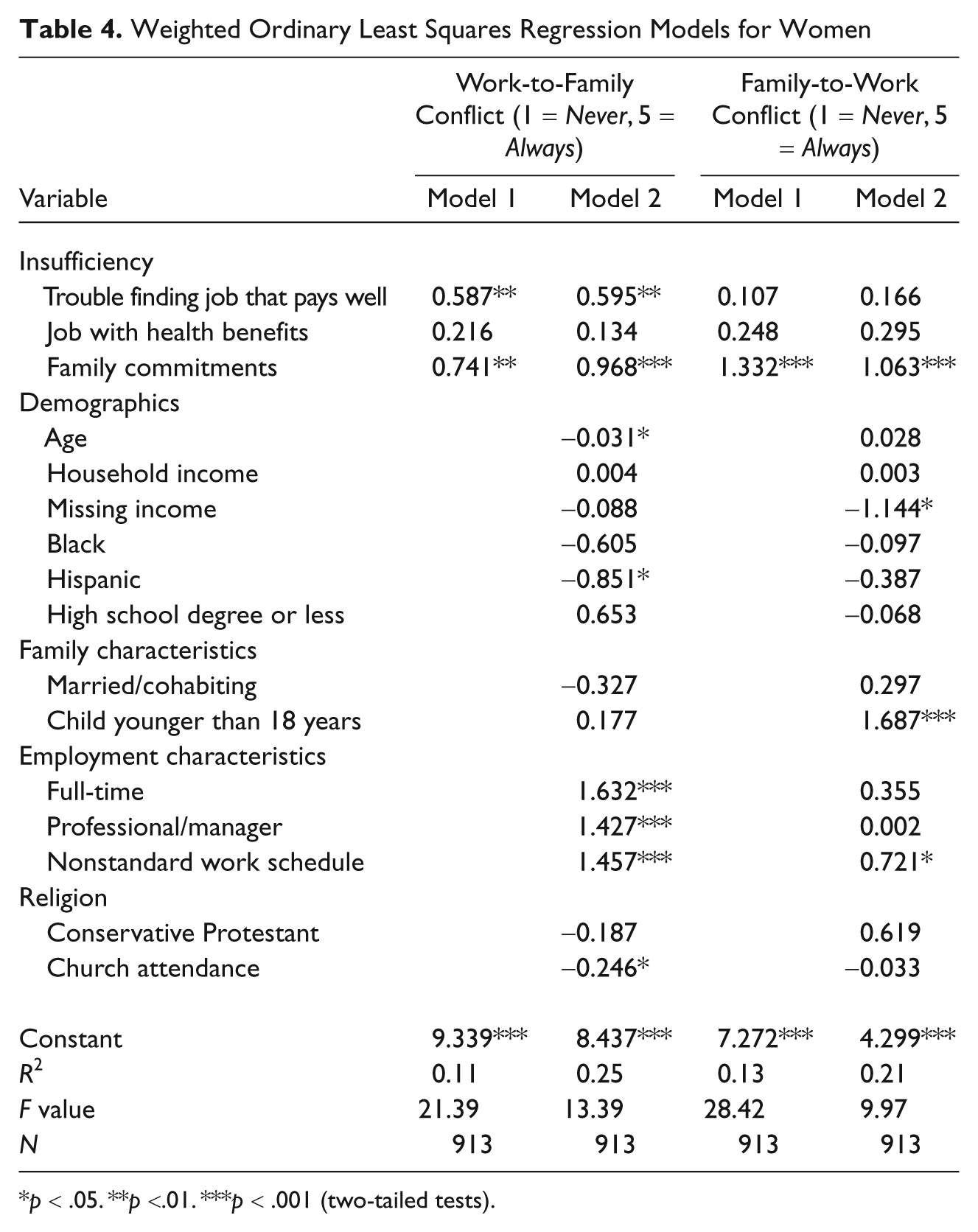
We use weighted data in multivariate models to estimate the effects of family demands, social class, race, insufficiency concerns, and religious characteristics on work–family conflict for both women (Table 4) and men (Table 5). Since we examine the extent to which work–family conflict is experienced by a more diverse population than is commonly examined in work–family scholarship, we use weighted data that reflect the national proportion for each racial group.
Weighted Ordinary Least Squares Regression Models for Women
p < .05. **p <.01. ***p < .001 (two-tailed tests).
Weighted Ordinary Least Squares Regression Models for Men
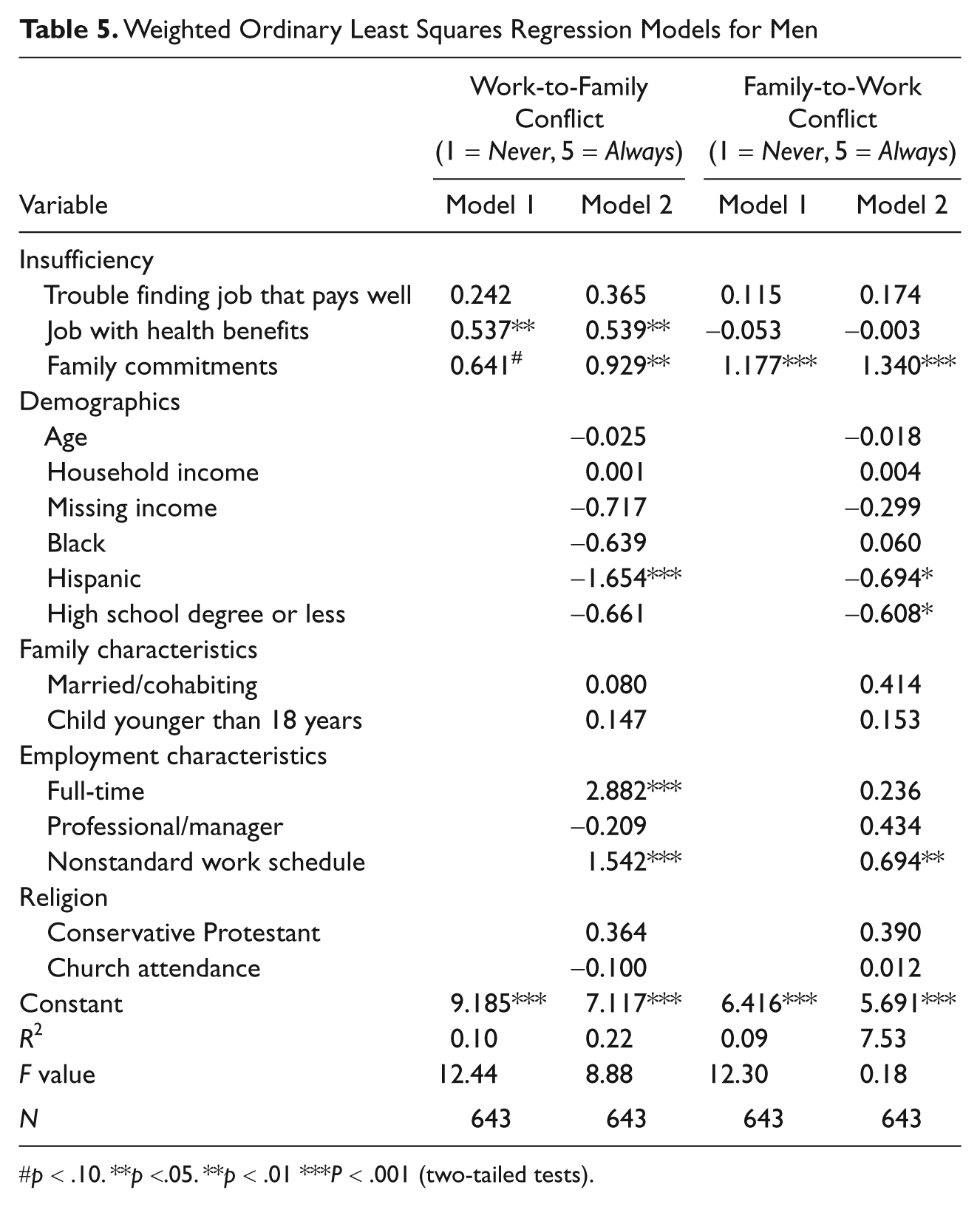
p < .10. **p <.05. **p < .01 ***P < .001 (two-tailed tests).
Women
Insufficiency concerns significantly predict work-to-family conflict and family-to-work conflict for women, and as Model 2 shows, these findings are robust when controls are present. Women who have trouble finding a job that pays well or have family commitments hinder their ability to hold down a job report more work-to-family conflict than women who do not have as much difficulty with these sufficiency concerns. Likewise, family commitments are strong predictors of family-to-work conflict: If women perceived that their family commitments got in the way of them holding down a job, they also thought these commitments spilled over and negatively affected their ability to carry out their work role.
When controls are folded into analysis, employment characteristics, religion, race, and family characteristics all significantly predict whether the women in our sample experience work–family conflict. However, sufficiency concerns remain highly significant. Women who have trouble finding a job that pays well continue to experience more work-to-family conflict, and those with family commitments that interfere with their ability to hold down a job report more work-to-family and family-to-work conflict. Thus, control variables add to our understanding of work–family conflict, but they do not take away the explanatory power of subjective insufficiency concerns.
As Table 4 shows, demographic variables and family characteristics—marital status and parental status—have limited effects for work-to-family or family-to-work conflict. Hispanic women report less work-to-family conflict than White women, and younger women report more work-to-family conflict than older women. Married or cohabiting women do not experience more work–family conflict than women who are not living with a spouse or partner, but women who have children younger than 18 years do report higher family-to-work conflict than nonparents and those with grown children. Work characteristics show a similar pattern for family-to-work conflict, but they are strong predictors of work-to-family conflict. Women who work full-time, or are managers or professionals report more work-to-family conflict. And, those who work a nonstandard schedule report more family-to-work and work-to-family conflict than women who regularly work Monday through Friday from 8 a.m. to 5 p.m.
Only one of our religion variables, church attendance, was a statistically significant predictor of work–family conflict. Women who attend church more frequently have lower work-to-family conflict than those who attend less often. Interestingly, our models also indicate that there is collinearity between church attendance and two of our measures of insufficiency: When church attendance is included in the analysis, our insufficiency variables become more significant. Women who attend church more frequently are exposed to, and may agree with, a discourse that emphasizes the importance of being family centered, which may ease work-to-family conflict through reducing subjective investment in paid work. But women who attend church more may be doing so to seek support: They could be in situations where insufficiency is creating problems and leading them to experience work–family conflict.
Men
Similar to women, insufficiency concerns significantly predict work–family conflict. Work-to-family conflict is more prevalent among men who have had trouble finding a job with adequate health benefits than among men who did not experience this insufficiency concern as much. Family commitments that hindered men’s ability to hold down a stable job were marginally associated with work-to-family conflict and significantly associated with family-to-work conflict. And, these relationships grew more significant when controls were included.
When assessing the factors other than insufficiency concerns that influence work–family conflict for men, we found that, unlike women, objective family characteristics and religion do not significantly predict either form of work–family conflict. Instead, education, race, and employment characteristics best explain who experiences conflict. Men who work a nonstandard work schedule have higher levels of both forms of work–family conflict. Likewise, those who work full-time experience more work-to-family conflict than those who work part-time. Those with a high school degree or less have lower family-to-work conflict than those with more education, and Hispanic men report less work–family conflict, in both directions, than White men. In fact, the inclusion of race/ethnicity into the model, specifically Hispanic versus White men, actually strengthens the effect of the family commitment sufficiency measure.
Discussion
We set out to investigate the prevalence of subjective experiences of insufficiency in the New Economy. Who experiences persistent problems in making ends meet, and how do these concerns relate to work–family conflict? Using a nationally representative sample with an oversampling of Blacks and Hispanics, we found that difficulties coordinating work and family in a stable way plague many Americans but are differentially experienced by people of color and women. These sufficiency difficulties are strong predictors of work–family conflict, and they remain significant with the inclusion of demographic variables, religion, and objective measures of work and family characteristics. This suggests that subjective assessments of resources are vital to understanding the work–family interface.
First, we find that gender does matter, both in the overall amount of insufficiency one experiences and in the factors that shape experiences of work–family conflict. For women, insufficiency concerns over the past 5 years were more pronounced than among men: Women were significantly more likely to report that they had problems finding a job that pays well, finding a job with adequate health benefits, and that their family commitments made it hard for them to hold down a job. Similarly, their family characteristics influenced how much family-to-work conflict they experienced. Women with children younger than 18 years reported higher levels of family interfering with work than women either without children or women with grown children; having dependent children was not a significant predictor for men. When assessing how insufficiency and conflict were related, men and women diverge again. Difficulties finding a job with adequate health benefits predicts work-family conflict for men, but trouble finding a job that pays well predicts work-to-family conflict for women.
This echoes other scholarship on the gendered nature of work and family roles. Although men and women are increasingly involved in both domains, women continue to shoulder most of the burden for caregiving and household labor (Bianchi et al., 2000). Thus, it is not surprising that family responsibilities predict family-to-work conflict for women, but not men. Likewise, if men feel cultural pressure to act in hegemonic ways that reinforce their “breadwinner” or “good provider” status within the family (Townsend, 2002), it makes sense that concerns over having a job with good health benefits would affect men more than women, and that problems finding a job that pays well would plague women more than men. Although women’s incomes are essential for maintaining the household and many women remain in the labor force when they become mothers (Cohany & Sok, 2007), men’s jobs are often viewed as primary and foundational while women’s jobs are seen as supplemental. However, since more women than men report problems in making ends meet, this suggests that women do feel increased pressure to provide economically for their families, just as men do.
The second pattern illustrates that although gender explains part of the story, structural location is also important, especially structural inequality. All men do not suffer from feelings of work–family conflict or insufficiency to the same degree; nor do all women. Although there is an established literature that shows racial minority groups, especially those with less human capitol, earn lower wages than Whites (see Grodsky & Pager, 2001; Huffman & Cohen, 2004), our findings reveal a gap in subjective perceptions of sufficiency as well. Non-whites face more insufficiency problems across the board than Whites, but their higher likelihood of these problems does not necessarily make the more prone to work–family conflict. Among Hispanic men, concerns about family commitments were more prevalent than among non-Hispanics, but the inclusion of this insufficiency variable as a predictor of work–family conflict was associated with a decrease in work–family conflict. Hispanic men, and those with less education may have more traditional gender role beliefs, which lead them to be concerned about providing for their families, but these traditional beliefs also make them more likely to be insulated at work from family-related stress; their spouse or partner is likely to be the one primarily responsible for the daily care of children and household upkeep.
Previous research (Ammons & Edgell, 2007) has suggested that religion may be particularly important in predicting subjective experiences of work–family conflict, and of the work–family interface more generally. Our descriptive analysis shows that those who attend church are less likely to report that family commitments make it hard to hold down a job, which mirrors standard accounts emphasizing the relationship between social class and religious involvement. We also find that for women, a conservative Protestant identity is associated with less work-to-family conflict (but the result is not statistically significant), and women who attend church regularly are significantly less likely to experience work-to-family conflict.
Last, our findings indicate that insufficiency is a distinctive but closely related construct to work–family conflict and that long-term perceptions of inadequacy are detrimental and hard for individuals to shake. Reports of insufficiency appear where we would expect to find them, among those with less human capital, who work nonstandard or contingent work arrangements, and/or have dependent children living at home. However, when these characteristics are controlled for, the relationship between insufficiency and work–family conflict remains strongly significant. If long-term measures of insufficiency are closely tied to more recent assessments of work–family conflict, this suggests chronic instability: Individuals cannot break free from their perceptions of resource inadequacy, and may have a chronic sense of unrest such that even short-term problems in work–family management take on an air of crisis.
Conclusion
The erosion of employment stability, the reduction in wages and benefits, and changes in the timing and scheduling of work have radically transformed the employment experience of Americans over the past several decades. Scholars have speculated that these changes have brought about an inequality in security (Bauman, 1998; Beck, 2000; Cooper, 2008; cf. Hacker, 2006; Schor, 1991; Sennett, 2004), but little is known about whether individuals perceive this insecurity, or lack of adequate resources, to be a consistent or reoccurring problem. Using a nationally representative sample, we set out to analyze who experiences problems making ends meet given the realities of the New Economy and how these perceptions relate to more recent assessments of work–family conflict. We relied on measures that capture the perceived unmet needs and desires of workers; concerns that are often masked by standard objective measures in the work–family field (like the federal poverty line).
We found that there is indeed an inequality of security in America, and that it has a tenacious hold on individuals’ work and family lives. At the most basic descriptive level, we find that a quarter of women and almost a third of men have experienced insufficiency either “seldom,” “sometimes,” “often,” or “always” in the 5 years leading up to 2006. This is a substantial portion that may well be higher in 2011, given the latest recession and its high sustained unemployment rate. And, this percentage may increase over the next decade as the new employer–employee relationship continues to unfold. However, recent pushes to reform health care may abate one insufficiency worry in the near future, especially among those in vulnerable populations. Alarmingly, perceptions of insufficiency are experienced disproportionately among groups with less power, women and non-Whites, making it especially difficult for them to overcome their concerns. Given the large body of literature documenting the negative consequences of work–family conflict on physical and mental health (see Allen et al., 2000; Frone, 2000), it is disconcerting that feelings of insufficiency are highly predictive of work–family conflict. Our article shows that work–family conflict is not just a problem of the fortunate (i.e., managers, professionals, and those who choose to work long hours by choice), but is more widespread and indicative of a fundamental economic transformation. This suggests that work–family scholars should take a closer look at “average” workers.
We recommend that future scholars continue to investigate subjective assessments of work–family sufficiency and whether feelings of inadequacy are here to stay or will align with the ups and downs of the U.S. economy. We believe it is important to develop better measures of workers’ perceptions of employment sufficiency, to identify the factors that foster the stable long-term coordination of work and family life, and to investigate how perceptions of insufficiency relate to objective measures of health and subjective well-being.
Footnotes
Acknowledgements
We thank the Odum Center and the Sociology Department at University of North Carolina–Chapel Hill for an opportunity to present this work in progress, and we are grateful for feedback on earlier drafts from members of the University of Nebraska at Omaha Sociology Research Triangle and from Rachelle Hill, Carolyn Liebler, Ross Macmillan, Phyllis Moen, Lisa Pearce, and Teresa Swartz.
Declaration of Conflicting Interests
The author(s) declared no potential conflicts of interest with respect to the research, authorship, and/or publication of this article.
Funding
The author(s) disclosed receipt of the following financial support for the research, authorship, and/or publication of this article: Data are from the National Survey of Religion and Family Life (Penny Edgell, Christopher Ellison, W. Bradford Wilcox, co-Principal Investigators), funded by the Lily Endowment (Grant No. 2002 2301-000).