



Abstract
Cultural models are shared frameworks that people use to make sense of the world. The cultural model of father involvement (a) specifies ideal roles fathers should play, (b) provides evaluations of involvement, and (c) describes the benefits of fathers’ interactions with offspring for family members. Discourse about benefits of father involvement remains underexamined empirically but is vital to study because it may motivate and/or justify fathering actions. We perform content analysis on the 575 Parents’ Magazine articles on fathering (1926-2006) to describe articulated benefits of father involvement. About half of articles state rewards for fathers, with a shift from enjoyment to fulfillment. Fifty-eight percent of articles state benefits to children, with a dramatic decline from 79% in the 1920s to 30% in the 2000s, and a relative shift in focus from character development to achievement. Nineteen percent of articles mention benefits to mothers; these discussions are sometimes cautious or conditional.
Cultural models, also referred to as cultural schemas, are frameworks that people use to interpret and make sense of the world (Blair-Loy, 2003; Correll, 2001). They can be thought of as containing “cultural equipment” (Swidler, 1986, p. 277) or “cultural vocabulary” (Ridgeway, 2006, p. 7), which people selectively use to devise their own “strategies of action” or to justify behavior in the face of inconsistency or conflict (Swidler, 1986, p. 280; Vaisey, 2009). Cultural models are considered powerful and influential because of their prominence and ubiquity (Blair-Loy, 2003; Correll, 2001; Milkie, 1999; Smith, 1990). Yet their interconnectedness with the people of the culture and their place in morally defining institutions of work and family (Blair-Loy, 2010) renders them temporally sensitive. Dominant models change as portions get discarded or renegotiated by people, groups, and institutions over time.
Cultural models are also interconnected with media and cultural texts. Media play a central part in the expression of cultural models in that they reflect powerful voices and codify these in a more or less permanent record of the era. The pervasiveness of the media is also critical such that the messages conveyed are viewed by people of that era, even if not fitting with their own beliefs, as a “uniform point of reference” regardless of individual social location (Smith, 1990, p. 176); they are seen as reflective of what “other people” think or deem important (Hamer, 2001; Hays, 1996; Milkie, 1999) and thus act as powerful mandates (Blair-Loy, 2010).
In this article, we examine the dominant cultural model of father involvement as conveyed through media. We delineate three categories of the cultural model of father involvement as follows; the schema (a) specifies ideal roles fathers should play such as nurturer, friend, or disciplinarian, (b) provides evaluations of the performance of those roles, and (c) describes rewards or benefits of fathers’ interactions with offspring. 1 Research to date has largely focused on the first two facets of this cultural model. A good deal of historical and social scientific research describes fathering roles, and changes therein over time, as portrayed within a diverse array of media (Atkinson & Blackwelder, 1993; Lamb, 2000; Pleck, 1987). Researchers have also examined cultural evaluations of “good fathering,” noting change but also some remarkable consistencies over the past century (Coltrane & Allan, 1994; LaRossa, 1997).
Descriptions of the rewards or benefits that allegedly accrue from fathers’ engagement with children are a central but underexamined part of the cultural model of father involvement. Benefits specified in cultural texts are powerful because they are part of the language used both as motivations for men to become more involved with children, and as justifications for fathers who are involved for reasons that may be less freely chosen, such as a mother’s unavailability due to employment. By explicating this culturally articulated “benefits” discourse, we can achieve a more comprehensive understanding of the contours and contents of the culture’s changing model of father involvement more generally.
We simultaneously refer to this three-category cultural model as a “moral schema” of father involvement because of its emphasis on expectations and standards—ideal roles fathers should be enacting and/or ways of fathering in which men should or should not be engaged. The benefits discourse is a central dimension in the moral schema of father involvement because it carries with it not only the message that families benefit from increased father involvement with children but also the counter implication that if fathers are not as involved as they should be, they are doing their families a disservice by depriving them of these benefits. According to Blair-Loy (2003), cultural models or schemas are “moral and emotional maps [that] evoke intense moral and emotional commitments” (p. 5) and help define institutions of work and family (Blair-Loy, 2010). The moral schema of father involvement is important to examine because, as part of the broader “tool kit” of culture (Swidler, 1986), it can shape desires and identities (Blair-Loy, 2003), and be selectively drawn on to devise action strategies or to justify behavior in the face of inconsistency or conflict (Swidler, 1986; Vaisey, 2009). Moreover, a powerful discourse clearly articulating a breadth of benefits may be required to pull men into mundane involvement with children, because this may be costly to employers, and to fathers’ breadwinning success and leisure time.
It is important to clarify the term father involvement. By involvement, we refer to its most common usage of direct interaction with or care for children, congruent with Lamb, Pleck, Charnov, and Levine’s (1985) classic definition of father involvement as interaction with, accessibility to, and responsibility for children. Although some (e.g., England & Folbre, 2002) consider breadwinning a form of involvement with children, we view breadwinning as a parenting “investment” and direct time with and care for children as “involvement” (Backett, 1987). Although researchers tend to focus on and measure involvement as direct engagement with or care for children, it is a complex phenomenon to operationalize (Palkovitz, 2002b).
In this study, we perform quantitative and qualitative content analyses on the 575 Parents’ Magazine (PM) articles focused on father involvement published between 1926, the inception of the periodical, through 2006, to identify patterns in the cultural messages about what benefits arise from fathers’ involvement with their children and to whom these rewards accrue. Below we discuss prior research on the first two aspects of the cultural schema of father involvement examined through content, textual, and discourse analyses on an array of media and other cultural texts. Following this, we articulate the importance of examining this third aspect of the model, benefits thought to accrue to different family members from father involvement and how these change over time.
Fathering Roles and Evaluations of Involvement
A central aspect of the cultural model of father involvement is the specification of ideal roles. Historians and social scientists have traced fluctuations in dominant conceptualizations of fathering roles through content and textual analyses of cultural texts (Atkinson & Blackwelder, 1993; Demos, 1982; Lamb, 2000; Pleck, 1987). The salience of a nurturant father, or one directly engaged with children, versus a breadwinner has been a main subject of research. Atkinson and Blackwelder’s (1993) content analysis of popular magazine articles tracks how cultural definitions of ideal fathering oscillated between provider and nurturer between 1900 and 1989. They find that fathers’ role as provider was discussed more often through the 1930s, but in the 1940s, 1970s, and 1980s, fathers were two to three times as likely to be portrayed as nurturers; the shift in emphasis toward fathers’ nurturance in the later decades of the 20th century was perhaps linked to macro-social changes such as the women’s movement and the dramatic rise of mothers in the labor force (LaRossa, 1988; Pleck, 1987).
Though the nurturant father rhetoric ballooned in the latter part of the 20th century, scholars have argued that the “new father” generating press at this time was not as new as he may have seemed (Griswold, 1993; LaRossa, 1997; LaRossa & Reitzes, 1993). Historical analyses of writings from family experts of the 1920s and 1930s indicate that men’s affective responsibilities within the home were being emphasized in an effort to stabilize the “drifting” institution of the family, which was feared to be weakening due to growing urbanism, materialism, and individualism (Griswold, 1993, p. 91). According to Griswold’s (1993) examination of the expert opinions of the day, “love and involvement, not discipline and authority, were the hallmarks of the modern father” (p. 101). Similarly, Quinn’s (2006) analysis of the culture of motherhood and fatherhood in Caldecott award winning children’s books from 1938 through 2002 finds that mothers and fathers were shown to be engaged in proportionately equal amounts of nurturing behaviors across the decades overall. The type of involvement differed however, with mothers engaging more in physical affection, whereas fathers are shown teaching, playing, and providing verbal affection in slightly more books than mothers.
Though many researchers focus on the poles of breadwinner versus nurturer, scholars point to change in other roles and types of nurturance that fathers have been expected to enact, such as moral guide, sex-role model, and pal (Lamb, 2000; LaRossa, 1997; Pleck, 1987). Lamb (2000) notes that in the 1930s and 1940s popular literature and films directly and indirectly called attention to the need for more effective sex-role socialization by fathers, especially for sons. He points to movies such as Rebel Without a Cause as contemporaneous examples of cultural texts communicating messages about expectations for fathers’ effective “sex-role modeling.” LaRossa’s (1997) analysis of articles from a range of household and family-oriented magazines (e.g., Good Housekeeping, PM, Ladies Home Journal) shows that the role of pal or playmate to children was emphasized for fathers in the early- to mid-20th century.
A second, related component of the father involvement schema is an evaluative dimension, addressing how well fathers are performing in their roles through assessing questions such as, Are fathers competent? Is fathering compromising masculinity? Research tracks dominant conceptualizations of men’s fathering performance through content analyses of cultural texts such as comic strips, movies, or sitcoms (Day & Mackey, 1986; Hamer, 2001; LaRossa, Jaret, Gadgil, & Wynn, 2000; LaRossa, Gordon, Wilson, Bairan, & Jaret, 1991; Unger, 2010). A prominent theme across these studies is the consistent portrayal of fathers’ incompetence as caregivers. LaRossa et al. (2000) find in their content analysis of 500 comic strips published in the Atlanta Journal and Constitution between 1940 and 1999 that father characters were portrayed incompetently twice as often as mother characters. Though fathers were valorized more than mothers in comic strips in the period immediately following World War II (1945-1949), by the early 1960s, the pattern had reversed and fathers were portrayed as incompetent more often than mothers through the 1980s. Previous studies assessing parental incompetence in Saturday Evening Post cartoons offer comparable results, finding that fathers were significantly more likely than mothers to be portrayed as incompetent when engaged with children, especially before the 1970s (Day & Mackey, 1986; LaRossa et al., 1991).
Also examined within the evaluative dimension of the schema is the crisis of masculinity when men “mother” (Doucet, 2006). In a qualitative textual analysis, Wall and Arnold (2007) examined a year-long Canadian newspaper series on family issues. They find fathers were underrepresented and more often portrayed as the “sidekick” parent, and that a major theme was the conflict between fathering and masculinity. Articles that discussed involved fathers often also affirmed the masculinity of these men in some way, typically in relation to or in conjunction with their dedicated breadwinning. Fathers’ involvement and nurturance were also framed differently than mothers’; even in articles featuring highly involved and stay-at-home dads, only mothers’ nurturance was talked about in terms of “attachment, bonding, and meeting emotional or developmental needs” (Wall & Arnold, 2007, p. 521).
Examinations of fathering roles and evaluations of fathering performances in cultural texts provide important insights into the content of the cultural model of father involvement, with much of the emphasis placed on specifying contours of fathers’ nurturance and caregiving over time. The model is complicated and contradictory in that although the nurturant father has been on the cultural radar for nearly a century, with spikes in the 1940s and 1970s and 1980s, portrayals of fathers’ involvement with children are frequently mocked and masculinity questioned in cultural texts. 2 Below, we argue that knowing more about the complexities of a central, powerful aspect of the cultural schema of father involvement, the articulated benefits or rewards of fathers’ involvement for family members, is important for a more comprehensive picture.
Benefits of Father Involvement in Cultural Texts
We know little about the “benefits” aspect of the cultural model of father involvement as it is portrayed in cultural texts, and how these ideas have changed over time. With strongly gendered work–family devotion schemas, in which men’s ultimate responsibility to families is breadwinning and devotion to work (Blair-Loy, 2003; Townsend, 2002), pulling men into family commitments through mundane interaction with children, perhaps at a cost to employers, breadwinning success, and to their leisure time, requires a powerful discourse clearly articulating the breadth of benefits for them doing so. The push for men to be present and engaged with children at all, or at a higher level than they are at that time, has to be upheld with specific reasons for pulling men away from the traditional masculine “work devotion” schema for fathers.
Even if dominant schemas are only partially drawn on, knowing the specific discourses about benefits that parents have at their disposal is critical to understanding the cultural model of father involvement and how it changes. In this way, cultural schemas can be thought to be central to people’s lives at any given historical moment as parts of “cultural equipment” or a “tool kit” (Swidler, 1986, p. 277) that people can use in specific ways to think and talk about actions such as those taken on by fathers (Martin, Hutson, Kazyak, & Scherrer, 2010). Martin et al. (2010) examine the contradictory cultural discourses present in 29 advice books to parents of gay and/or lesbian children, identifying prominent strategies that parents may draw on in dealing with their child’s sexual identity disclosure. They argue that a necessary preliminary step before examining how people use the cultural discourses at their disposal, is to have a more nuanced understanding of what that “equipment” looks like. We argue that examining benefits is crucial given the potential power of such discourse to act as both motivations for men to become or stay involved with children, and/or as justifications for fathers to validate involvement for which they may be constrained into or reluctantly participating in.
The Case: Parents’ Magazine as Authoritative Advice on Father Involvement
To examine this third aspect of the moral schema of father involvement, we analyze a long-running popular child-rearing periodical, Parents’ Magazine. 3 Though PM, like other mass media products, is reflective of larger societal concerns, values, and trends, this periodical had an important place as a legitimator and champion of father involvement. The title of this periodical was novel in the 1920s in that it addressed, at least philosophically, both mothers and fathers. Other periodicals that gave advice on child rearing at the time of PM’s inception, such as Ladies’ Home Journal explicitly addressed women only. General interest periodicals of the time, such as Saturday Evening Post occasionally discussed fathering, but it was hardly the organizing principle of that literature. Though PM was unique in that it was ostensibly for both parents, the content of the magazine was implicitly directed toward women (Strathman, 1984). PM was, overall, sensitive to the father–child relationship; its use is validated by other scholars (LaRossa, 1997; Rutherford, 2011; Young, 1990), and it has great historical reach, making it an appropriate text for analysis. 4
The magazine’s goal of disseminating scientific knowledge of all types concerning children’s development and family life in general, proved to be very popular. The magazine was the only U.S. periodical whose circulation rose during the Great Depression, and during the 1930s and 1940s, it was proclaimed as the most popular advice periodical in the world (Schlossman, 1985). By 1971, PM claimed in its pages to have counseled mothers and fathers in the “rearing of more than 100 million children,” attesting to its prominence. The magazine took its responsibility very seriously as noted from the motto on the editorial page in the early years:
As children grow older, they constantly present new problems. You will want to inform yourself in advance in order to meet them successfully. A single article may give you ideas which have a lasting influence on the health, happiness, and character of your children.
Data and Method
LaRossa et al. (2000) argue that “multiwave studies are more sensitive to the complexities of cultural history” (p. 386). Conducting analyses “in binary”—that is, between two time points or eras—tends to lead to more dramatic assertions about the degree of discontinuity and change (Furstenberg, 1988). Thus, we examine 80 years of data between 1926, when PM debuted, and 2006. Articles were collected in two chronological phases. During the first phase of sample collection, the first author compiled articles from 1926 to 1995 by searching the Readers’ Guide to Periodical Literature using the following search terms: “Fathers,” “Daughters,” “Sons,” “Parents,” and “Parent–Child Relationship.” Examination of the tables of contents of selected issues for each year confirmed the quality of the sampling. The second phase of article collection was conducted by the first and second authors and involved examining the tables of contents of each issue of PM published between 1996 and 2006. In each phase, all articles concerned in any way with fathers and fathering were collected. A very small number of articles were damaged or illegible. Together, the two rounds of article collection yielded a total of 692 articles referencing some dimension of fathers and/or fathering. Of these 692, we excluded 117 articles. The majority (n = 92) were rejected because they did not discuss fathers’ involvement with children or the father–child relationship, but rather the mother–father relationship, fathers’ fashions, fathers’ financial investments, tips for Father’s Day gifts, and so on. A minority (n = 25) were rejected because they were written about or directed at parents in general and made no substantive distinction between maternal and paternal involvement. 5 In some ways, these 25 articles (4% of all fathering articles) could be seen as an indicator of a fathering equivalent to mothering and a special type of push for involved fathering, however, they were extremely infrequent and were scattered through the 80-year time period. After excluding the 117, 575 articles constitute the analytic sample. Table 1 shows the distribution of articles by decade.
Distribution of Articles in Quantitative Sample by Decade (N = 575).

We first conducted a quantitative analysis by reading and coding all 575 articles for any mention of benefits accruing to family members from fathers’ involvement with children. The benefits were coded as being for the child, the father, or the mother. An article was coded as containing “no benefit” if neither coder had identified any type of benefit. In the few instances where one of the authors was undecided as to whether the article contained a benefit, both authors came together to discuss the article and arrive at a consensus. Some articles mentioned specific benefits to two individuals, or less often, to all three (child, father, and mother); some mentioned two or more different types of benefits for the same family member. The articles that mentioned benefits to more than one family member were counted in each respective category. Of the 575 articles, more than three quarters, or 440 articles, mentioned benefits of father involvement to at least one family member. Twenty-three percent, or 135 of the 575 articles were coded as not mentioning benefits to anyone. Three hundred thirty-one (58%) had at least one benefit for children, 304 (53%) mentioned at least one benefit to fathers, and 111 (or 19%) mentioned at least one benefit to mothers. Percentages add to more than 100 because some articles described benefits to more than one family member.
We performed qualitative analysis on the 440 articles that mentioned any benefit of father involvement. We coded articles for the following 10 major themes involving benefits to fathers for their involvement: (a) fun and enjoyment in leisure, (b) companionship, (c) enjoyment of routine care, (d) father–child closeness, (e) knowing and being proud of children, (f) generativity (e.g., contributing to growth of children), (g) joy and happiness, (h) fulfillment and deep meaning, (i) personal growth, both internal (e.g., maturity) and external (e.g., trying new things), and (j) a sense of mattering. For benefits to children, we coded for the following themes: (a) internal development in childhood (e.g., psychological, moral, and character development and self-concept formation), (b) external development in childhood (e.g., academic performance and behavioral adjustment), (c) healthy infant development, (d) healthy development in adulthood (e.g., future occupational success), (e) gender/sex role development, (f) warmth and love, (g) fun and enjoyment, and (h) friendship. For benefits to mothers of fathers’ involvement with children, we coded for (a) more equitable division of labor, (b) freedom to work outside the home, (c) greater leisure/rest time, (d) health, (e) fun, (f) happiness, (g) stronger fellowship with husband, (h) husbands’ appreciation of the maternal role, (i) enjoyment in observing husband–child relationship, and (j) being supported during childbirth.
The qualitative coding scheme above was based both on knowledge of the extant literature and patterns that emerged during initial coding phases. For instance, previous research has shown that being a pal to children has been considered an important role for fathers (LaRossa, 1997), priming us to look for mentions of “fun” as a benefit to father involvement. Following independent open coding of a considerable number of articles through the entire range of years, the authors convened to discuss the types of benefits identified for children, fathers, and mothers and establish a set of theme codes per family member. Once the types of benefits were established, each author coded more than half of the full sample of articles with an intercoder reliability rate of .94. 6 Because of the established level of concurrence in coding between the authors, the remaining articles were coded by the second author only. Throughout the entire qualitative coding process, when either author was unsure of which code, if any, to apply or when the rare discrepancy in coding arose, the authors would discuss the article in detail and arrive at a consensus.
Table 2 shows the percentage of articles that identified the aforementioned benefit themes for fathers, children, and mothers, in order of prominence. We list only those themes that were identified in more than 5% of the articles for that particular family member.
Percentage of Articles by Benefits Theme for Fathers, Children, and Mothers.

Note: Column percentages based on total number of benefits articles per family member: fathers = 304, children = 331, mothers = 111. Percentages do not add to 100 percent because many articles articulating benefits to that family member stated multiple benefits.
Results
Who Benefits: Quantitative Findings
Figure 1 presents the percentage of articles that discussed benefits for each family member over time. Benefits thought to accrue to fathers from their own participation with children are discussed in 53% of all fathering articles. The pattern is somewhat sinusoidal with the 1930s, 1960s, and 2000s seeing dips in the percentage of articles mentioning benefits to fathers. In the 1980s, the percentage of articles mentioning benefits to fathers surpassed the percentage mentioning benefits to children. Fifty-eight percent of the articles articulated at least one benefit for children, but this average masks a dramatic decline over the century, from an average of 79 % from the 1920s to 30% of articles in the 2000s. Finally, mothers are marginal in cultural stories about involved fathering: Only 19% of father involvement articles mentioned any benefit accruing to mothers. In the 1920s and 1930s, articles mentioning benefits to mothers were rare. The percentage of articles with stated benefits to mothers remained steady (about 20% to 25%) through mid-century and then peaked through the 1980s, with 31% of articles across that decade mentioning “mom benefits,” nearly twice as many as the decades following it.
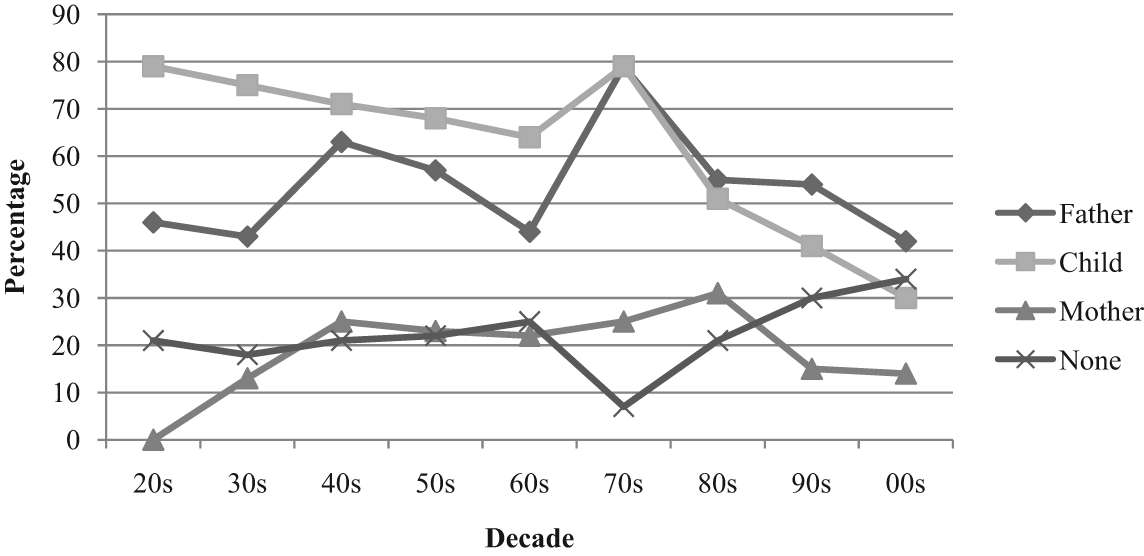
Trends in percentage of articles mentioning benefits to fathers, children, mothers, or no one.
How Fathers, Children, and Mothers Benefit When Fathers Nurture: Qualitative Findings
We conducted qualitative analyses of the 440 articles that were coded as containing references to benefits of father involvement during the quantitative analysis phase. This allowed for a more nuanced description of how fathers, children, and mothers are considered to benefit from fathers being involved with children. Although these analyses provided a wealth of textured qualitative data on the specific types of benefits and their patterns over time, in this section we discuss the nature and timing of only the most prominent benefits mentioned for fathers, children, and mothers.
Benefits to Fathers
Of the half of fathering articles that laid out benefits to fathers for being involved with their children, the most common theme was that fathers should get more involved with children because it could be fun and enjoyable. But by the second half of the 20th century and into the 21st, the emphasis shifted to a personal fulfillment narrative. The main benefit to fathering was no longer that it could be fun (and not terribly onerous) but that through involved fathering, men could be fulfilled. Importantly, the theme of enjoyment continued through the century, but by the latter decades of the century, particularly in the 1990s, fathers were more frequently portrayed enjoying the routine care of children, as well as in leisure with them.
Involved fathering is fun
Throughout the early to mid-century decades (1920s-1950s), fathering was portrayed as primarily an enjoyable and fun experience. Fathers were shown to derive enjoyment out of fathering through playing with children and participating in hobbies and leisure activities such as woodworking and outdoor recreation. Many articles from this period were written with an incentivizing tone, that is one trying to convince fathers that being involved with their children did not have to be the arduous and unappealing activity that it appeared to be; in short, it did not have to be mothering. As Griswold (1993) pointed out, “For those [fathers] willing to be disturbed, the rewards were indeed great” (p. 102). A 1937 father talked about the time costs of young children, lamenting that “baby was monopolizing all of his leisure hours at home, with obvious detriment to both baby and father” (“For Fathers Only: The author, who found his small son monopolizing all his leisure moments, tells how he managed to get his fathering onto a part-time basis,” 1937). Not an uncommon sentiment during the era, a frequent suggestion for increasing time with children without significantly inconveniencing fathers was to incorporate children into men’s leisure time. One woman writing in the early 1950s discussed her husband’s dilemma:
“I NEVER seem to do anything with the boys in winter,” my husband used to complain. “When I come home it’s too dark to go out and have a catch, I’m too tired for anything energetic and too busy for those long-drawn-out games they like. I wish there was something we liked to do together that wouldn’t take up too much time or energy.” [italics added] (“A Hobby to Share with Dad: The men of the family can really have fun together with a stamp collection. They may even let mother share in it,” 1951)
In this family, the solution was to start a stamp collection together. For other families, children accompanied their fathers on fishing trips, hiking excursions, or assisted them with their woodworking. In the following 1936 quote, a father talks about the surprising benefits he discovered from being involved in his daughter’s Girl Scout troop, though note that his enjoyment was not experienced because of his involvement but rather in spite of it:
There is no doubt that through this organization, the fathers are a decided help to their daughters. Now what does all this do for the fathers? The Girl Scout program includes so many activities that a participating father is suddenly apt to find out that he has developed a hobby of his own. Knot-tying, star study, map making and signaling are a few of the projects that fathers enjoy. (“Good Fathers Get Together,” 1936)
In all, throughout the first half of the 20th century, although other incentives to fathering were present, the most popular way of framing the benefits of involved fathering was in terms of a fun, enjoyable experience during leisure time.
Fatherhood is fulfilling
Discussion of benefits to fathers from their involvement transitioned to those of a less tangible nature, namely fulfillment and meaningfulness. Figure 2 shows the percentage of articles per decade mentioning fun versus fulfillment benefits for fathers over time. In the 1950s, half of the articles that state benefits to fathers mentioned the benefit of fun for fathers whereas only 14% of those mentioned the benefit of fulfillment that decade; in the 1980s, the fulfillment benefit outpaced the fun benefit by a considerable margin, and by the 2000s, 63% of articles stating benefits to fathers mentioned a fulfillment benefit compared with 20% of articles mentioning a benefit of fun. Take the following quote from a 1950s father cautioning against expecting fulfillment from child care as a means of comparison for the very strong fulfillment messages to come later in the century:
Not that there is anything wrong in a father’s giving the baby a bottle. Far from it. He should certainly do so whenever the situation requires it or he enjoys it. What is wrong is to think that this adds to his parenthood. . . . When he tries to find greater fulfillment of his fatherhood by doing more for the child along the lines only mothers used to follow, the result is that he finds less rather than more fulfillment, not only for his fatherhood, but also for his manhood. (“Fathers Shouldn’t Try to Be Mothers,” 1956)

Percentage of father benefits articles mentioning fun versus fulfillment.
By the 1980s, nurturant fathering was portrayed as highly fulfilling. One father described the deeply meaningful experience of sleeping for a few weeks with only his son while the mother was on the couch, in an effort to decrease the baby’s frequent nighttime nursing:
I found I loved sleeping [alone] with my son. As I slipped quietly next to him, moving his tiny feet away from my side of the bed, the band of fatherhood coiled tightly around my heart. (“Bunkmates: Why one dad embraces the family bed,” 1998)
The message of fulfillment has only intensified into the 21st century. In 2004, a single father who shared custody with his daughter’s mother explained in a letter to the magazine how deeply fulfilling it felt to be a father: “She’s the best and most important thing in my life. . . . I can’t imagine life without my beautiful little girl” (“Daddy Diaries,” 2004).
These findings align with Palkovitz’s (2002a) interview study that was used to inform our coding scheme. His interviews with 40 resident fathers revealed that men discussed their fathering as a deep and meaningful experience central to their own adult development. We find that the benefits of involved fathering in the late 20th and early 21st centuries were portrayed in terms deeper than in previous decades—more than a source of diversion, fathering was purported to be a meaningful and influential experience in and of itself.
Not only did fathering begin to be portrayed as deeply fulfilling, the type of time that fathers were said to enjoy changed, as well. Routine care time was often mentioned by experts and fathers themselves as an enjoyable and sought-after time with their children, particularly infant children. One veteran father speaking to a class of expectant dads in 2000 encouraged fathers to bond through routine care: “Changing diapers, feeding, burping, and bathing are surefire ways to bond” (“School for Dads,” 2000). Below is a testimonial from a father who enjoyed caring for his infant:
“I’d get up in time to be at work by 4:30 in the morning and be home by 8:30, when my wife had to leave for work,” says Shawn Maguire, a production worker at Tom’s of Maine, in Kennebunk. “That way, I stretched my one-month paid paternity leave over two months, and I got to spend the day with my daughter doing all the good stuff [italics added]—feeding her, burping her, really getting to know her.” (“The Truth about Paternity Leave,” 1995)
Messages about fathers participating in and even enjoying the routine care of children in the earlier decades were rare but did exist. What sets the latter decades apart, however, is the intensity with which these messages were communicated, as well as the lack of countervailing “anti-fulfillment” messages (such as the one from 1956, above) that existed in earlier decades.
Benefits to Children
One of the most important findings about benefits to children in the model of involved fathering is their dramatic decline over the time period studied. Nearly 80% of fathering articles mention benefits to children in the early part of the 20th century, a percentage that declined precipitously to a level in 2006 (30%) which was far below that for described benefits to fathers (see Figure 1). In order of frequency, children were thought to benefit in terms of their internal (i.e., character) development, gender role development, warmth and love received from their father, enjoyment of father–child activities, external development (academic achievement and peer relations), future adjustment (e.g., careers), and in the friendship they share with their father (see Table 2). Benefits to children were differently emphasized over the decades. In the first half of the 20th century, children were shown to benefit from fathering in much the same way fathers were said to benefit from it—in terms of fun and enjoyment. Many articles in this era discussed the mutuality of benefits in the father–child relationship, particularly the father–son relationship. The following quote is illustrative:
Every father is perfectly free to choose his own hobby. Why not find out what appeals to your boy and then invite him to ride the “hobby horse” with you? Such an effort to “grow up” with your boy frequently leads to much pleasure and benefit to both father and son and may, indirectly, benefit the community in which they live (“For Fathers Only: Every father should have a hobby, preferably one he can share with his children. Here is the story of one who took up astronomy,” 1937).
Though enjoyment continued to be emphasized as a benefit to children through the 2000s, the proportion articulating this benefit was greatest—at 33%—in the 1940s (data not shown).
Another theme was the benefit of the love and warmth communicated to children through father involvement. Giving children love was not always seen as mutually beneficial for father and child, especially pre-1970s as evidenced below:
Giving love is troublesome. It takes effort. It means you have to stop whatever you’re doing and do something else less interesting. You have to listen to long-winded, pointless children’s stories, exclaim over scribbles and terrible drawings. Only at the price of your own convenience can you give your child what he needs. (“What Children Need from Dad,” 1953)
Children’s “sex role” development (a term used by experts in earlier eras) was identified as a considerable benefit to both boys and girls, particularly in the 1960s, perhaps when heightened fears about sexuality in the culture had come to fruition (Adams, 1997). Nearly half (48%) of the articles stating benefits to children during this decade mentioned the benefit of gender development, compared with 20% in most of the decades prior to and following the 1960s, with the exception of the past two decades of the analysis period when its mention as a benefit became much less common (only 5% of articles in the 2000s; data not shown). For boys, although some articles discussed the benefits of father involvement for boys’ own future paternal roles, the majority of articles in the 1960s concentrated on boys’ healthy masculine personality development. A wife whose husband was frequently away on business trips worried about her young son’s lack of exposure to a masculine role model, especially given, in her words, “all the skirts that circle a small boy’s life” (“Needed: A Stand-In for Dad,” 1961). From her perspective, the benefit of father involvement for boys was that it provided the means for boys to develop certain masculine aptitudes:
I abandoned my efforts and began to worry. Who was going to teach our boy the manly arts of repairs, carpentry, nature lore and fishing? Where would he learn about batteries and motors, ergs and amps? (“Needed: A Stand-In for Dad,” 1961)
For girls the emphasis was on future relational success. That is, girls benefitted from father involvement by learning how to interact with men on their way to becoming wives:
From their father, children learn what it is like to be a man. They gain understanding of how a man acts and feels, of how he gets along in the world. A son finds a pattern for his life; a daughter learns what men are like and establishes a basis for choosing a husband. (“Fathers Without Children: Divorce doesn’t lessen the importance of keeping father-child relationships alive,” 1965)
Finally, perhaps most important, fathers have always been portrayed as having a considerable influence on children’s adjustment. The benefit of character development dominated the articles written in the first half of the 20th century:
Too much cannot be said in favor of encouragement and praise for small successes. A boy can be made to feel capable of doing great things, and inspired to try, simply because his father has let him feel his confidence in him. . . . This is particularly true of boys who feel that their convictions are really shared by their fathers. It gives a stability and sturdiness to certain phases of a youth’s character that in those years of rapid changes can otherwise be acquired only with difficulty, if at all. (“What I’ve Found Out About Fathers and Sons,” 1933)
Also notable is that the benefits of fathers’ involvement were seen as distinct from, yet complementary to the benefits of mothers’ involvement. In the following excerpt, the author encourages mothers not to stand in the way of the sturdy character development that only fathers are able to cultivate in children:
Your child is not going to pull a fine character out of thin air. Along with much love and consideration for him, he needs some wise guidance and discipline too. A father should stand for these things in his life. Mothers should not discourage a man from playing his proper role in protecting his children from behaving badly or not coming up a scratch. (“Father’s Changing Role,” 1951)
By the end of the 20th century, articles discussing more social and human capital–oriented (external) development, critical to adult success in the 21st century, were far more frequent than those discussing the benefit of character development. Figure 3 shows the diverging trends in how often these two benefit types were mentioned; though mentions of both character development and social capital declined through the first half of the century, the percentage of child benefit articles mentioning social capital–type benefits steadily increased following the 1960s, whereas mentions of character development became almost non-existent.
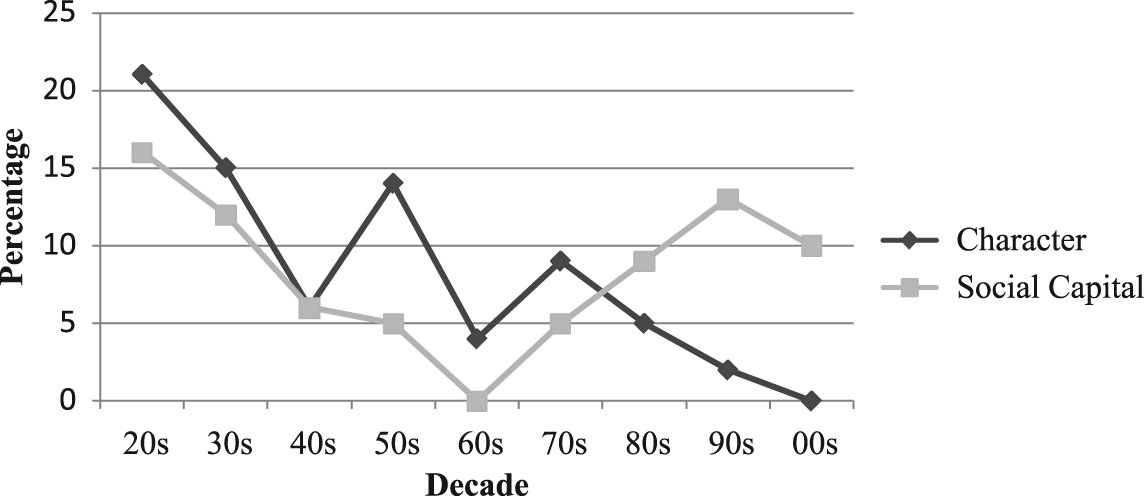
Percentage of child benefits articles mentioning character development versus social capital.
In terms of social capital, father involvement was shown to benefit children’s development of academic and intellectual, as well as interpersonal skills (subtypes of external development—data not shown). Below, two articles from the 1990s discussed the benefits of father’s style of play—as distinct from mother’s style—for children’s development of teamwork skills:
The way a mother plays with her child helps that child feel more important, better able to manipulate the world; the way a father plays provides the child with a sense of belonging to a team, as well as with the feeling of competence and shared goals that goes along with successful teamwork. (“Letting Dads be Dads,” 1994) And preschoolers appear to learn important social skills by playing a lot with Daddy, gaining greater empathy and other skills with playmates. Studies have shown that preschoolers who have warm relationships with their fathers are more likely to share. That means they tend to get along better with their peers. (“Daddy Love: 9 ways dads make a crucial difference,” 1998)
In sum, during the first half of the 20th century, articles identified fun and enjoyment, as well as proper character development as advantages for children, particularly boys, of greater father involvement. By the 1960s, articulated benefits to children took a decided turn toward the theme of healthy gender development, with sufficient father involvement yielding successful masculine growth in boys and the development of a wifely personality in girls. This benefit aligns with Lamb’s (2000) findings about the cultural call for greater participation from fathers in their children’s gender socialization, though we find this benefit emphasized most often not in the 1930s and 1940s as Lamb suggested but in the very traditional but culturally turbulent 1960s. Finally, through the second half of the past century and into the current, children’s social and human capital skills, most notably their interpersonal skills and academic achievement, were increasingly portrayed as benefitting from father involvement.
The decreasing emphasis on children’s gender development and the increasing emphasis on social and human capital benefits can be interpreted in different ways. One might argue that it indicates a cultural turn in the conceptualization of fathering from a more traditional to a more progressive understanding. It could also be argued, however, that although the specifics of the articulated benefits to children have changed, the underlying nature of these benefits may be more similar than they seem—both could be seen as consistent with a traditional instrumentality characteristic of stereotypical masculinity. The articles in the latter decades take on a definitively different tone from those in the early-to-mid decades with the image of “traditional” fatherhood giving way to one much more nurturant and gentle. However, the enduring message that the benefits children accrue from their fathers’ involvement are unique and not replaceable by mothers, may be an indication that fatherhood remains characterized by a masculinity that is traditional in that it is distinguished from motherhood and femininity.
Benefits to Mothers?
Two aspects of the articles that mention benefits to mothers are noteworthy. First, a small percentage of articles mention benefits to mother at all, and these are in a relatively limited number of spheres. Notably, the benefits themes fluctuate in prominence over the decades, with no clear linear patterns. Second, there is a somewhat demeaning and cautious way of discussing how mothers might benefit, underscoring fathers’ power in the family. Despite this, a few articles celebrate the bonding and connection that mothers and fathers could have through shared parenting.
First, mothers are marginal. Through the 80-year period, only 19% of articles discussing fathers’ involvement focused on how mothers would benefit from their doing so. Although the feminist scholarly literature consistently shows how fathers’ domestic work benefits mothers, popular discourse on fathers in PM is notable for the relative absence of such discussions. The most common benefit articulated for mothers was that they would experience a more equitable division of labor within the home, with fathers’ involvement with the children “lightening the load” for mothers (see Table 2). Mothers were also said to benefit in terms of greater leisure time for themselves. Following sharing the workload and enjoying more leisure time, “fellowship” benefits for mothers were the next most frequently articulated, in terms of both a closer parenting fellowship between her and her husband, and also the joy of seeing fellowship between her child and spouse. Finally, about 10% of the “mother benefits” articles discussed fathers’ involvement during the labor of childbirth, a very precise, but important time to help mothers through this painful rite of passage.
A key second finding was that even when mothers were mentioned as benefitting from fathers’ increased involvement, there was a demeaning quality, and a cautionary tone to this discourse. For example, nearly one fifth of these articles showed that mothering might improve through fathers becoming more involved. Fathers, because of their absence most of the day, were portrayed as having a more objective perspective on their families and were better equipped to identify inadvertent weaknesses in their wives’ mothering. The following article written in 1941, which mentioned a more fair division of labor when fathers become involved, mainly extolled the benefits of fathers as “detached observers” of their families:
Here we have an excellent example of an observant father. Just as father is usually a stronger disciplinarian than mother because the children see so little of him that they have not learned where the weak spots in the paternal armor are, so, mother is so close in her daily contacts with her children she is often unaware of the many things she does for them that they ought to do for themselves. There is a good deal of discussion these days about the relation of a father to his children. Here is a job for father that is most important in the bringing up of children. He can be the cool and somewhat detached observer. He wants the children to develop fine character and personality just as their mother does. But mother-love is a powerful thing and it sometimes tends to blind even the best of mothers to unfortunate attitudes which their children develop and to see that unselfish devotion on their own part may be bad for youngsters. (“Father Knows Best,” 1941)
Thus, by father stepping in, mother might be able to do less for her children. Note that the article’s author aims to show a benefit to mother from his being involved, but that in the process, mothers are arguably demeaned by a “father knows best” attitude.
In several articles mentioning benefits to mothers, there are cautions to mothers about not benefitting too much—a “father comes first” message. This finding is consistent with Griswold’s (1993) understanding of how father involvement was interpreted in the earlier parts of the 20th century—as a gift and not an obligation: “. . . men’s involvement in the home was important, but it was a ‘gift’ men granted to women and children and not part of a restructured conception of masculinity and parenthood” (p. 91). Sometimes women were explicitly cautioned not to make too many demands on their husband’s time if they wanted to reap any of the benefits of his involvement. A 1948 article described how keeping a “fifty-fifty” baby on a later schedule to facilitate greater father involvement was a very satisfying arrangement for the mother but also offered the following warning:
We believe it would be worthwhile for more parents to evolve a similar plan. It is a wonderful way to enjoy your youngsters together. A word of caution to mothers however. Do not leave too many of the little jobs for your husband to do in the evening as he has to work all day too. Help him enjoy the children without feeling their care is an extra burden. (“Fifty-Fifty Baby,” 1948)
In addition to warning mothers of the counterproductive effects of overburdening their husbands, mothers were also encouraged not to be too critical of their husbands. These articles encouraged mothers to praise and positively reinforce their husbands’ parenting efforts so as not to deter them from involvement completely.
7
The following excerpt from an article written in 1982, titled, “How to get your Husband to Help,” stressed that bolstering a man’s self-confidence was key to obtaining and maintaining his involvement:
“The more you talk to your husband and explain, rather than teaching per se, the more he’ll have confidence to do child care without feeling insulted by you,” says Edie Delaniaide. The most lethal insult to husbands, both mothers and fathers warn, is criticism. Criticizing a father’s attempts to diaper, dress, or hold the baby discourages rather than encourages the development of a partnership in child care. If you must comment and correct because something is potentially dangerous, that’s another matter. But do it in an easygoing and helpful tone. (“How to Get your Husband to Help,” 1982)
Nevertheless, despite the sparse and sometimes demeaning and cautionary benefits discussed for mothers of more father involvement, a few of the articles celebrated how when fathers become more involved, there would be more of a fellowship for mothers in the joint acts of parenting. In part, this was because fathers really came to see and appreciate the great work of mothering. For example, a 1937 father wrote of stepping into full-time parenting, albeit very temporarily, during his wife’s minor illness:
I understand [my wife’s] problem so much better than if I had just casually helped out once in a while. It seems terribly unfair that a mother should have to drudge all day and give up many outside contacts. I am promising myself that I will share the responsibility with her mother, give all I can to my child, and for myself get the greatest possible satisfaction and enjoyment out of being a father. (“For Fathers Only: A brand new father discovers from four hectic days of firsthand experience that caring for a baby is not all fun,” 1937)
Improved marital fellowship was discussed as a reward to mothers and was noted in a 1981 article in which an academic was cited saying:
“When the husbands participate in child care, their wives are able to rest or grab some time for themselves and the marital relationship reaps the rewards,” explains Dr. Block. (“Fathers Who Deliver,” 1981)
In addition to the notion of improved marital fellowship, this excerpt also aptly conveys the theme of conditionality in benefits to mothers. Very often throughout the century benefits to mothers were stated in conjunction with or as dependent on benefits to fathers or children. In the above quote, the benefit of mothers getting rest is important not primarily for mothers’ individual mental or emotional health but because these ancillary benefits are said to lead to a happier marriage—a benefit indirectly shared by husbands. It was more the exception than the rule for articles to state benefits to mothers exclusively and without exception or contingency: only 2% (n = 10) of the 440 benefits articles mentioned the mother as the sole beneficiary of father involvement, compared with 16% for fathers and 25% for children. In other words, only the very rare article mentions benefits to the mother without also referencing those for her husband and/or her children, and as discussed above, there are many qualifiers to mothers benefitting from father involvement, cementing the idea that cultural models of father involvement have edges of contradiction and are not constructed in purely positive terms.
Discussion
Cultural models of father involvement are complex and changing. We argue that the cultural model of father involvement is a moral schema about why fathers should be more directly and more frequently involved with their children. We articulate this model, and examine the third facet of it, showing how the “benefits” discourse that is part of this schema is far reaching. PM enumerates a wealth of benefits from father involvement accruing to fathers, children, and mothers, though the nature of the alleged rewards themselves depends in part on the era in which they are articulated. Among the three facets of the cultural model, the benefits discourse described therein is geared toward outlining for parents just how important and rewarding fathers’ interaction with children can be.
Clear patterns about the benefits that may accrue when fathers become more involved with children emerge. For fathers themselves, the discourse indicates a shift from arguably a more superficial “fun” gained from involvement with children to a deeper meaning of fulfillment that fathering is shown as providing by the 1970s and beyond. At the same time, articulated benefits to children dramatically diminish, in favor of more discussion of benefits to fathers and to a much less extent, mothers (particularly in the 1980s). We can only speculate on why there was such a dramatic decline in stated benefits to children from fathers’ involvement. One possibility is that children’s gains from father involvement became more “taken for granted” in the culture and there was less of a need for articulating the enjoyment or instruction children obtain from fathering. Another is that as fathers’ involvement in family life became more normative as mothers’ labor force participation rose (Bianchi, Robinson, & Milkie, 2006), it became necessary to emphasize (deeper) rewards to fathers relatively more often to keep them in this unglamorous position of child care at the potential cost to their breadwinning or leisure time. In all, paternal nurturing of children a century ago was framed as light, fun, and limited for both fathers and offspring, but is now portrayed as having deeper purpose for fathers and increasingly more serious outcomes for children’s academic and social futures.
Mothers stand out as sidebars to fathering in that they are not nearly as central a focus of the discourse, and even that is quite complicated. A brief push of articulated benefits to mothers in the 1980s dropped off dramatically in the subsequent years, even as U.S. mothers’ labor force participation continued to rise. In the relatively few articles that talk about benefits to mothers, the most frequently mentioned across decades are greater maternal leisure and equality and to some extent the fellowship she would share with the father in the work of raising children when he became more involved. But there was a dark side: Nearly one fifth of these articles undermine mothering abilities through suggesting that father involvement would make mothering better. Moreover, other patterns underscore an extremely fine line for mothers: They should not benefit unless others too benefit; they should back off from pushing fathers to be involved, and yet they may be to blame when fathers are not involved enough through lack of encouragement and even deliberate gatekeeping tactics.
Interestingly, the issue of why fathers might continually have to be pushed or enticed to be more involved with children was ignored. Although there were and are strong cultural incentives for involvement, it was rarely, if ever, noted that if fathers were to be ideal workers for capitalist America, then their involvement would of course have to stay limited. 8 Reasons offered in the culture for why fathers’ involvement is perennially less than that of mothers’, is an interesting question for future research.
How and to what extent the cultural model of father involvement, as articulated through cultural texts, influences fathers’ actual level of engagement is unanswerable with these data. Scholars have theorized extensively on the linkages between culture and action (Blair-Loy, 2003; Connell, 2000; Correll, 2001; LaRossa, 2012; Milkie, 1999; Ridgeway, 2006; Swidler, 1986, Vaisey, 2009). Though terminology may differ somewhat (Swidler’s “cultural equipment” or “tool kit”; Ridgeway’s “cultural vocabulary”), the basic insight from this scholarship is that rather than passively being influenced by it, people use culture in important ways to frame and understand their lives. The relationship of influence between culture and action is thus not unidirectional but rather people and culture, as expressed through texts, interactions, and institutions, are fundamentally interconnected; as individuals, groups and institutions contest and renegotiate cultural models, the models themselves change as a result.
Important to consider here is how people likely draw simultaneously from a host of cultural models to devise their “strategies of action” (Swidler, 1986). In other words, cultural models are themselves interconnected, and when people use “cultural vocabulary” to devise, motivate, and/or justify actions, that vocabulary is derived from interacting models rather than from any one schema in isolation. We have brought into sharper relief the contours of the cultural model of father involvement, but there are undoubtedly other cultural models, such as work devotion schemas, that men simultaneously draw from to motivate and justify their behavior. Levels of father involvement based on cultural beliefs are due not only to how men draw from the father involvement schema but this schema interacts with other “ordering schemas” (e.g., gender) to yield individual patterns of behavior (Ridgeway, 2006).
To be sure, structural realities are an essential part of the discussion on the linkages between culture and action. In the context of the current study, structural resources and constraints such as fathers’ class position, their employers’ work–family policies, and their spouses’ employment status and schedule are likely to be very strongly related to how involved fathers become, and how they understand benefits of their involvement (Fox, 2009). Economic contexts may push fathers (and mothers) into demanding and stressful work contexts, pulling them away from home and time with children. Factors such as these are some of the important structural considerations that influence the extent and nature of involvement (LaRossa, 2012).
This study brings up important issues about the type of cultural text under investigation and its primary audience. The text examined here, PM, is biased in that it emphasizes middle-class values, since these are the people who disproportionately constitute the creators and readership of such material. This de-emphasizes the culture of working-class parents (Pollock, 1983) and that of particular ethnic groups, who may have different conceptions of fatherhood. Still, though one may not see themselves explicitly represented in the messages being conveyed, they are likely still being exposed to and affected by them nonetheless (Hamer, 2001; Hays, 1996; Milkie, 1999). Hamer (2001) notes that even though dominant Western norms of fatherhood do not take the fathering paradigms of Black nonresidential fathers into consideration, these men are still aware of and compared against the Western standard.
Overall, this analysis of a popular parenting magazine provides a more nuanced picture of the changes in the cultural model of father involvement through the 20th and into the 21st century. We have described one dimension of what we refer to as the moral schema of father involvement, a model concerned with how and why fathers should be involved in the lives of their children. Moreover, we have shown that the contents of this model change over time as the nature of articulated benefits vary with cultural era, reinforcing the notion that culture is neither static nor stagnant but changes as structural conditions change, other schemas shift, and people engage with and contest that which cultural models communicate. By tracking discourse on benefits of father involvement over time, we have a deeper understanding of how the cultural model of father involvement continues to change and the possibilities for how people might “use” cultural ideals to motivate and justify father involvement.
Footnotes
Acknowledgements
We thank Shyon Baumann, Bonnie Fox, Ralph LaRossa, and the anonymous reviewers for insightful comments. We also thank Tallese Johnson and Tetyana Pudrovska for research assistance on earlier phases of this project.
Declaration of Conflicting Interests
The authors declared no potential conflicts of interest with respect to the research, authorship, and/or publication of this article.
Funding
The authors disclosed receipt of the following financial support for the research, authorship, and/or publication of this article: The research was supported by a grant from the University of Maryland’s General Research Board (GRB).