



Abstract
Many parents feel uncertain about the actions and experiences their teenage children have on the Internet, thus causing worry and concern. The aim of the study was to examine parents’ worries and concerns in relation to their teenagers’ use of the Internet. The participants were 798 Swedish parents (307 fathers, 491 mothers) and their teenage children (aged between 13 and 15 years). The results indicate that parents’ worries and concerns vary, in certain aspects, according to age and gender of the child. Furthermore, parents’ own Internet skills, experience of using the Internet, and attitudes toward the Internet are related to the type and nature of their worries and concerns. Parents’ beliefs about their teenager’s skills in using the Internet and the teenagers’ Internet use and experiences are related to the parents’ concerns. Parents with an accurate understanding of their children’s negative Internet experiences are those who are the most worried.
In their teens, individuals strive to achieve greater independence from their parents. Eccles et al. (1993) claim that when individuals in their early teens increasingly try to find different peer groups and spend increasing time in places other than their homes, it can cause parents worry. But what is it like when the teenager does not explore the world by leaving the home physically, but chooses to carry out such exploration using the Internet? Do the parents feel calm as long as their teenager is still in the home, or do they worry about what the teenager comes into contact with while using the Internet? Although TV and newspapers often describe parents as harboring great worries (e.g., Cho & Cheon, 2005), there is currently little research. In an American study (Rosen, Cheever, & Carrier, 2008), more than 80% of the parents reported being either somewhat or very concerned about their teenager’s Internet use, with regard to getting in contact with sexual material, making new friends who they also meet offline, as well as revealing personal information. Furthermore, an equal number of parents reported concerns about the teenager becoming/getting isolated and addicted to the Internet and eschewing physical activity.
There is, however, a lack of systematic knowledge concerning what influences parents’ worries and concerns and the extent to which such worry is related to the teenagers’ experiences with pornographic, violent, and/or hate-inciting material on the Internet. The present study aims to investigate what parents worry about as well as the connection between worry and the parents’ characteristics and attitudes, the teenagers’ Internet usage, and the parents’ trust in their teenagers’ offline and online activities.
Studies from, for example, Sweden, the United States, Canada, the United Kingdom, and Australia show that almost 90% of young people aged 12 to 15 years use the Internet and that more than half (in some cases close to 80%) of those who use the Internet in this age group are out on the Internet every day, for shorter or longer periods of time, in some cases for several hours per day (Ferguson, 2000; Findahl, 2009; Fleming, Greentree, Cocotti-Muller, & Elias, 2006; Gross, 2004; Livingstone & Bober, 2005; Stahl & Fritz, 2002). In other words, the Internet is an everyday arena frequented by most young people in the Western world. There are no significant differences concerning how much girls and boys of the same ages as those in the present study, that is, 12 to 15 years, use the Internet. However, in the 16 to 25 years age group, it is possible to discern major differences regarding how young men and women use the Internet. At this age, men use the Internet significantly more and the difference above all consists of them spending more time playing games, sharing files, nurturing their interests, watching video clips and pornography, as well as instant messaging (IM) with their friends (Findahl, 2009).
Even though the Internet offers obvious opportunities for acquiring knowledge, engaging in social interaction, and creating an identity, a worry remains concerning the more dubious aspects of Internet use and content. Pernemalm and Lindgren (2009) demonstrate how many adults are concerned about how, for example, sexual activities online can affect their children’s development and health. Parents’ self-reported worry over their teenagers coming into contact with sexual material when using the Internet varies between studies conducted in different countries. About one third of Swedish parents and more than 70% of U.S. parents (Turow & Nir, 2000) expressed worries about their teenagers coming into contact with pornographic material. It might be that, compared with their U.S. counterparts, parents in Sweden have different attitudes toward sexuality—and not to Internet—as half of the American parents believed that the Internet was a safe place for their children to be.
Irrespective of the national setting, it is common that young people, advertently or inadvertently, come across web pages with, for example, pornographic, violent, or hateful content. Almost 60% of all teenagers have either come into contact with pornographic pages either deliberately or by chance (Livingstone & Bober, 2005; Swedish Media Council, 2005). There are, however, studies that point to a much higher number for boys, nearly 85% to 90% (Fleming et al., 2006). In an Australian study, Fleming et al. (2006) found a similar discrepancy between boys and girls when it came to contact with violent and/or gory material (55% of the girls and 75% of the boys), but not with regard to contact with distressing material (46% of the girls and 51% of the boys).
About a fifth of the young people who use the Internet state that they have at some point come into contact with material that they have considered to be threatening, degrading, or distressing (Swedish Media Council, 2005). In an international study, the participating teenagers reported that when they came into contact with information/incidents they themselves regarded as unpleasant, the majority simply choose to remove the contact (close the page down 80%, block the sender 44%). Only 8% of the teenagers reported disclosing the incident to a parent (Fleming et al., 2006). A similar pattern can be seen in an American study concerning cyber bullying, where only 10% of those who have experienced the bullying reported having told an adult about their experiences (Juvonen & Gross, 2008). Research, in both Sweden and the United States, indicates that between 50% and 70% of teenagers aged 12 to 17 years have experienced bullying and threats on the Internet, and almost one out of every five teenagers in the same age group reported experiences of repeated bullying in the previous year (Juvonen & Gross, 2008; Pernemalm & Lindgren, 2009). Even though boys generally experience more bullying and attacks on the Internet, girls are often considerably more affected by attacks of a sexual character (Pernemalm & Lindgren, 2009). Bullying on the Internet occurs outside adults’ fields of vision, and peers who could have been potential spectators of the situation are often not willing to talk to anyone about it. In one study, a third of the young people reported that they were afraid of their parents introducing various restrictions if they knew what was happening on some Internet sites (Livingstone & Bober, 2005). In an American study, two thirds of the parents, and two thirds of the teenagers aged 12 to 17 years, say that teenagers do things on the Internet that they do not want the parents to know about (Lenhart, 2005). The result is supported in an European study, where 65% of the young people surveyed aged between 12 and 19 years reported that they had in some way tried to conceal their Internet activities from their parents (Livingstone & Bober, 2005). This finding accords well with information provided by Swedish parents, where more than 80% report that they never have discussed situations on the Internet that have distressed the teenagers (Swedish Media Council, 2005).
Parents of teenagers are, of course, also regular users of the Internet. Swedish studies show that more than half of all fathers, and a third of the mothers, use the Internet every day or almost every day (Swedish Media Council, 2005). Despite this, parents in previous studies have expressed the opinion that it is difficult to discuss, be involved with, set up rules and restrictions when their teenagers know so much more about the Internet and how to use it than they do themselves (Wang, Bianchi, & Raley, 2005). Teenagers’ Internet use is increasingly becoming a private activity, and more than one third of European teenagers and nearly half of Swedish teenagers use their mobile devices (mobile phones, tablets, handhelds, etc.) to go online (Livingstone, Haddon, Görzig, & Ólafsson, 2011). The monitoring strategies that parents were using only a couple of years ago, that is, shared Internet experiences, having the computer in a common room, checking the browser, and in some cases installing monitoring software, can be problematic in this new setting. Having the computer situated elsewhere than the bedroom has been associated with less than half the time spent on the Internet (Eastin, Greenberg, & Hofschire, 2006). Shared Internet experiences and dropping in on the teenager when she or he is using the Internet have been recommended as strategies for decreasing teenagers’ experiences with unwanted content and situations (Cho & Cheon, 2005). Installing software, although widely discussed, has not been supported as a way of decreasing undesirable Internet experiences (Fleming et al., 2006). As teenagers’ Internet use is becoming more personalized and more flexible in location, it is likely that parents will have to resort to other monitoring strategies as a means of gaining insight into teenagers’ Internet use and for providing opportunities to support them. This might be truer for older teenagers than younger ones who do not have access to mobile Internet devices to the same degree. Monitoring strategies that include dual communication between parents and their teenagers have been shown to be successful for gaining parental insight (Rosen et al., 2008). For example Stattin and Kerr (2000) stress that the teenagers’ willingness to disclose information about their everyday life is the strongest source for parents to get insight. A teenager’s willingness to disclose increases if the teenager has good experiences of talking things over with the parent, as well as if the parent is viewed as someone to trust. For some parents it might be that the way to gain knowledge, and hopefully reduce their worries and concerns, especially regarding their children’s Internet use in this new setting.
In Sweden, there is a widely held desire to strive to achieve a more equal society with respect to children’s and youths rights and to see children as full human beings (Durrant, 2003). Parents in Sweden tend to view child development not as something that has to be formed or shaped and instead express the opinion that children are individuals, not to direct, but to support (Hallden, 1991). Parents’ attitudes, beliefs, and knowledge about children and child development influence how they choose to bring up their children and are important in determining the parents’ choices of action (for an overview, see Goodnow & Collins, 1990). In an international study, Swedish parents, more so than parents in other countries, more frequently emphasized their children’s rights in the family and in family life (Harkness et al., 2001). Very few parents in Sweden (about 10%) use software to monitor their teenagers’ Internet use, and this might be a result of a generally held belief that children should be supported and supervised in the form of dialogues instead of unidirectional monitoring and control.
Furthermore, research has indicated that parents modify their actions to fit their child’s maturity (Dunn, Plomin, & Daniels, 1986). It is most likely that parents expect teenagers in different ages to take different levels of responsibility for their behavior. In a Swedish study (Janson, Långberg, & Svensson, 2007), it has been shown that parents gradually increase their demands as the child’s capability grows and decrease their demands as the child becomes a more independent adolescent. Likewise, parents can have different goals for their boys and girls, meaning that they also have different expectations about their behavior (Okagaki & Johnson Divecha, 1993). Generally speaking, it would thus be reasonable to assume that parents’ worries also vary depending on the gender and the age of the teenager.
The aim of the study was to examine parents’ worries and concerns in relation to their teenagers’ use of the Internet as well as any connections there may be between parents’ concerns and different parental and child characteristics and Internet attitudes and practices.
To what extent do parents worry about their teenagers’ Internet usage?
What connection is there between the parents’ worry and concerns and the parents’ own Internet usage, Internet knowledge, views on advantages and disadvantages of the Internet, and its importance for their child’s development and life?
To what extent do the teenagers’ age, gender, and frequency of use affect the parents’ worry and concerns?
What connection is there between the worry and concerns experienced by the parents and the trust generally the parents have in the teenager, as well as specifically concerning their Internet usage and knowledge about the Internet?
To what extent is the parents’ worry and concerns related to the type of material they assume their teenagers come into contact with on the Internet?
Does the parents’ actual knowledge concerning the teenagers’ Internet usage contribute to the worry and concerns they experience?
Method
Participants
A total of 798 parents (491 mothers, 307 fathers) participated in the study together with their teenage children (361 girls, 467 boys). The mothers’ ages varied from 29 to 59 years (M = 43.06, SD = 4.84), and the fathers’ age ranged from 33 to 64 years (M = 45.66, SD = 5.47). Of the parents in the study, 8.6% had completed 9-year compulsory education (mothers 6.6%, fathers 11.8%), 55.2% had upper secondary education (mothers 53.6%, fathers 57.7%), and 36.2% had university education (mothers 39.8%, fathers 30.5%). This is equivalent to the level of education of individuals of the age group in question in Sweden as a whole when taking the total number into consideration. The majority of the parents (520) were couples (260 couples), and the remaining parents (278) were either from single-headed households or from families where only one of the parents had chosen to take part in the study. The number of individual teenagers in the study amounted to 538 (242 girls, 296 boys). All the teenagers had the opportunity to express themselves separately about their mothers and fathers, and as a result, the teenage material that can be linked to the 798 parents is unique. The teenagers were enrolled in school Grades 7 (33.8%), 8 (32.3%), and 9 (33.8%), which means that on average they were 13, 14, and 15 years old (M = 14.00, SD = 0.86), with a few being younger than 13 years of age and a few being older than 15 years of age.
Procedure
Contact was established with two schools in western Sweden who provided the names, addresses, and telephone numbers of pupils in Grades 7 to 9. One of the schools was the only one in that town, meaning that all the parents in that town with children in Grades 7 to 9 were invited to participate. The other school, although not the only one in town, was nevertheless the main school. The parents were first contacted by letter in which they were informed about the study as a whole, their own and their children’s personal involvement, their right to refrain from or subsequently withdraw from participation, and also how the material was to be used. Questionnaires were sent out in connection with the information letter. About 20% of the 798 participating parents returned their completed questionnaire in connection with receiving the information letter. The remaining parents returned their questionnaires after having been contacted on the telephone.
The teenagers completed their questionnaires during lessons. The data collection was administrated either by someone from the research project or a teacher in accordance with a set of written instructions. Additionally, a person from the research project was also present at the school during the administration to answer any questions that might arise. In all cases written consent from the parent, as well as oral consent from the teenager them self, was obtained. The data from the parents and the teenagers were coded into the same data file using the same identification number for each parents–child dyad.
Measurements
Both the parents and the teenagers participated in the study by completing individual questionnaires where the focus was on experiences and attitudes toward Internet use. The measurement instruments presented below address the parent. For the teenagers, in addition to these questions, a part of the questionnaire also asked about the teenagers’ gender and age as well as the parents’ gender, age, and level of education. In those cases, when the number of missing values together exceeded 5% for the variables that were planned to be joined in a scale, they were replaced using a series mean. The missing value was thus replaced with the mean of all values in that variable. This was done after confirming that the values were missing completely at random, using Little’s MCAR test. Only in the cases when Little’s MCAR test showed nonsignificant values were the replacing missing values used.
Parental concerns
The parents’ worries and concerns concerning their children’s Internet use was measured using nine questions, the answers to which were measured on a five-point scale ranging from 1 = no fears to 5 = great fear. Five of the questions were regarding concern about the teenager coming into contact with material such as pornography, violence, hatred, distressing material, and erroneous information. Three of the questions concerned worries and concerns of a relational character including coming into contact with dangerous people, being bullied, and losing friends. One question measured concern about the teenager becoming passive or inactive. Together the nine questions generated a reliability α of .93. The nine questions are based on previous research measuring parents’ worries (Rosen et al., 2008) as well as risks that appear in relation to the Internet. The missing values totaled 119 (randomly distributed across the nine questions and the 798 informants) and were replaced according to the process described above.
Parents’ own Internet use
The response options for the general question “how often do you use the Internet?” were never/almost never, once or a few times a month, a few times a week, every day less than 3 hours or every day more than 3 hours. A higher number indicates more frequent use.
Assumptions regarding the teenagers’ Internet use
A similarly general question, like the one above posed to the parent, was asked of the parents concerning their assumptions about their teenagers’ Internet use. Additional questions regarding specific activities such as school, hobbies, surfing for fun, playing games, using e-mail, chatting on open sites, chatting via IM, downloading, and purchasing were estimated on the same five-point scale as the general question.
Opinions on the importance of the Internet
The importance the parent considered the Internet to have for the teenagers’ development and way of life was measured by seven questions, which concerned school work, contact with friends, entertainment, hobbies, computer knowledge, taking part in society, and chances of expressing one’s opinions. All questions were measured on a five-point scale ranging from 1 = not important to 5 = very important. Together the seven questions generated a reliability α of .84. The missing values totaled 54 (randomly distributed over the seven questions and the 798 informants) and were replaced according to the process described above. In addition to these seven questions, a separate question was asked of the parents: “To what extent do you consider the Internet to have disadvantages and advantages?” The answer was given on a continuous scale from 0 to 100, where a higher number indicated a more positive attitude toward the Internet (0 = only disadvantages, 50 = neither nor, 100 = only advantages).
Skill in using the Internet
To measure how the parents perceived their own skill in using the Internet, an instrument that has been designed and used previously by Novak, Hoffman, and Yung (2000) was used. The original instrument was modified in that one question was removed (a reverse question that was misapprehended by several informants) and one question was added (regarding the ability to chat). On a five-point scale, from 1 = not true to 5 = very true, the individuals estimated their ability to use the Internet in general (e.g., “I am extremely good at using the Internet”) and more specifically to search for information and chat (e.g., “I know how to find what I am looking for on the Internet”). In addition to this, the individuals estimated their ability to use the Internet in relation to other individuals and other activities (e.g., “Compared to other things I do in my spare time, I am very good at using the Internet”). Together the six questions generated a reliability α of .84. Themissing values totaled 102 (randomly distributed over the six questions and the 798 informants) and were replaced according to the process described above.
Assumptions regarding the teenagers’ skills of using the Internet
To measure the parents’ confidence in the teenagers’ skills in using the Internet, the same instrument was used as described above (Novak et al., 2000) and included the same modifications to the original instrument as described above. Instead of asking the parents about their own ability, they were asked about the teenagers’ ability (e.g., “I think he/she is extremely good at using the Internet”). Together the six questions generated a reliability α of 0.85. The missing values totaled 35 (randomly distributed over the six questions and the 798 informants) and were replaced according to the process described above.
Confidence in the teenagers’ Internet use
The parents’ confidence in the teenagers’ use of the Internet was measured by asking five questions about the trust in the teenager and that he/she does not expose himself/herself to danger, does not go to inappropriate sites, does not sit too long at the computer, handles the Internet in an appropriate way, and uses the Internet in the way which it is agreed on. The parents indicated on a five-point scale, from 1 = absolutely not to 5 = totally and fully, the extent to which they trusted the teenager. Together the five questions generated a reliability α of .85. The 76 missing values were not replaced since Little’s MCAR test could not confirm that the hosts were randomly distributed.
Trust in the teenager in general
To measure the parents’ trust in the teenager in general, an instrument constructed and previously used by Stattin and Kerr (2000) was used. On a five-point scale, from 1 = absolutely not to 5 = totally and fully, the parents indicated to what extent they trusted that the teenager: does not end up in bad company, is careful with his/her money, does his/her best in school, does not get in trouble in his/her spare time, tells the truth about what he/she is doing at night, and that the parent trusts his/her child completely. Together the six questions generated a reliability α of .76. The missing values totaled 44 (randomly distributed over the six questions and the 798 informants) and were replaced according to the process described above.
Assumptions regarding the teenagers’ experiences
The parents were asked if they thought that the teenager had, on the Internet, “come into contact with pornography, violence, or hatred”; “come into contact with distressing material”; or “via e-mail or chat felt threatened, humiliated, or bullied.” The parents answered the question on a five-point scale, ranging from 1 = has never happened to 5 = has happened very often. Because of few variations in the parents’ answers, three separate dichotomous variables were constructed, which indicated whether the parent thought that the teenager had experienced (a) pornography, violence, and hatred; (b) distressing material; or (c) had felt threatened, humiliated, or bullied.
Actual knowledge of the teenagers’ experiences on the Internet
Just like the parent, the teenager was asked to indicate on a five-point scale whether he/she on the Internet had “come into contact with pornography, violence, or hatred”; “come into contact with distressing material”; or “via e-mail or chat felt threatened, humiliated, or bullied.” Just as for the parents, three dichotomous variables were constructed. The teenagers’ and the parents’ answers were thereafter compared to create three variables which were to be used in the analysis, and which measured the concordance between what the parent and the teenager had indicated. The four levels of each variable were the following: 1 = both the parent and the teenager have stated that the teenager via the Internet has had these experiences; 2 = the teenager, but not the parent, has stated that the teenager has had these experiences; 3 = the parent, but not the teenager, has stated that the teenager has had these experiences; and 4 = both the parent and the teenager have stated that the teenager has not had these experiences.
Results
The parents in the study were asked to what extent they were afraid that, when using the Internet, the teenager would come in contact with dangerous people, be bullied, become passive/inactive, lose friends, encounter erroneous information, and come into contact with pornography, violent/gory images, hatred or distressing material. In all the cases, there was a high correlation between the various apprehensions (p < .01), something that indicates that those parents who are afraid of some of the dangers are probably afraid of the others too (see Table 1). Examination of the mean values (see Table 1) for the different variables (min 1, max 5) reveals that most variables have a mean value of about 2.5. A value of about 2.5 (2 = some fear, 3 = a certain fear) indicates that the parents generally experience at least some concern about their teenage children’s Internet use, but a variation can be seen when looking at the standard deviations. These variations are analyzed more closely in the following sections.
Mean Value (M), Standard Deviation (SD), and Correlation Value for All Issues Concerning the Parents’ Fears (n = 789).
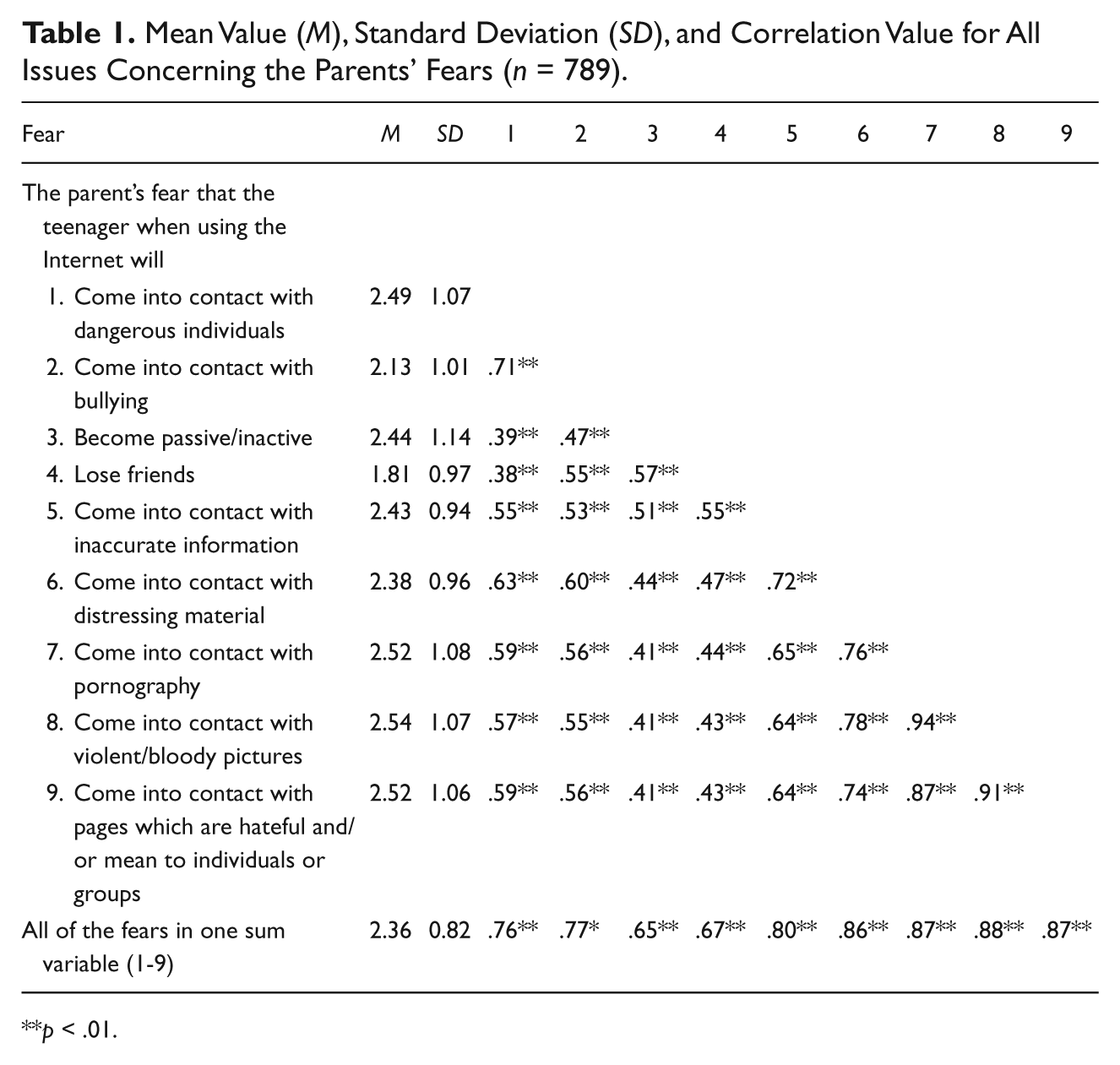
p < .01.
The question measuring the fear of the teenager losing his/her friends stands out with a mean value of just above 1.8. This points to parents not being as afraid of the teenager losing his/her friends as, for example, of the teenager coming into contact with dangerous people, pornography, violence, hatred, erroneous or unpleasant information. It is interesting to note that when comparing mothers and fathers, it is only the question concerning losing their friends that shows a significant difference, t(796) = −2.17, p < .05, as fathers show greater worry. In a comparison between the sum variable and the other separate questions, no significant results were found in relation to the parent’s gender.
Parents’ Perception of Advantages and Disadvantages of the Internet and Its Importance to the Teenager
If the parents are divided into three groups, (a) those who consider the advantages of the Internet to outweigh the disadvantages, (b) those who consider there to be as many advantages as there are disadvantages, or (c) those who consider the disadvantages of the Internet to outweigh the advantages, the most worried group of parents is those who consider the advantages to outweigh the disadvantages, F(774, 2) = 7.24, p < .001. Furthermore, the more important the parents considered the Internet to be for the teenagers’ development and way of life, the more worried they were, r(798) = .12, p < .001.
The Parents’ Own Internet Use and Knowledge
Parents who use the Internet more often than other parents consider themselves to be more knowledgeable in how to use the Internet, r(794) = .51, p < .01. The more knowledge the parents consider themselves to possess, r(798) = −.09, p < .01, and the more the parents use the Internet themselves, r(794) = −.10, p < .01, the less concerned they are in general (the total sum variable) about their teenagers having negative experiences while using the Internet.
The Teenagers’ Age, Gender, and Frequency of Use
Parents’ worries over what the teenagers will come into contact with while using the Internet is in some aspects linked to age, although not generally (see Table 2). Compared with parents of older children, parents of younger children are more worried that their teenager will come into contact with dangerous people, r(798) = −.08, p < .05, pages with violent/gory images, r(798) = −.08, p < .05, as well as pages with content that make her/him distressed or uncomfortable, r(798) = −.10, p < .01.
Mean Value (Standard Deviation) of the Parent’s Fear Divided According to Gender, and Correlation Values in Relation to the Teenagers’ Age and the Parents’ Assumption of the Young Person’s Frequency of Use.
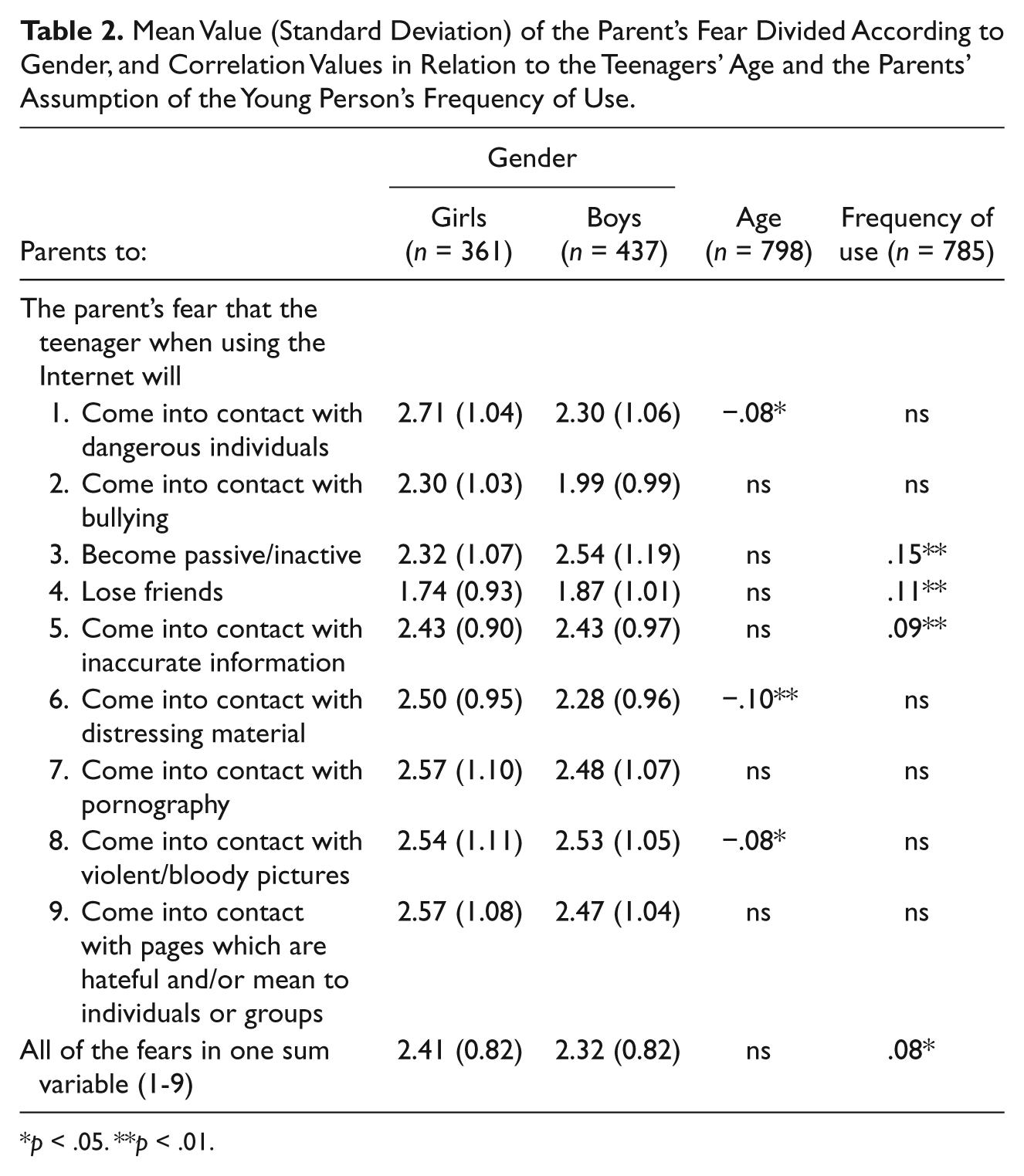
p < .05. **p < .01.
When analyzing the sum variable for worry, no differences between the parents’ worry over girls or boys appear. However, the results reveal that parents partly worry about different things when it comes to their sons’ and daughters’ Internet use. They are more worried that the girls, rather than the boys, will come into contact with dangerous people via the Internet, t(796) = 5.56, p < .001, be bullied, t(756) = 4.24, p < .01, or come into contact with pages the content of which distresses her/him or makes her/him uncomfortable, t(796) = 3.25, p < .001. On the other hand, the parents are more afraid that the boys, compared with the girls, will become passive and inactive while using the Internet, t(790) = −2.86, p < .01.
The frequency of use is a measurement of how much time the parent thinks that the teenager spends on the Internet, both in general and divided into a number of activities. The more time parents think their children spend on the Internet, the more, generally speaking, they worry, r(798) = .08, p < .05, particularly about the teenager becoming passive/inactive, r(798) = .15, p < .01, losing friends, r(798) = .11, p < .01, or encountering erroneous information, r(798) = .09, p < .01.
If we take a closer look at the frequency of use, namely, how much time the parents think that the teenagers spend on activities on the Internet and the connection to worry (total sum variable), we can see that the more parents think that their children spend their time surfing aimlessly for fun, r(798) = .12, p < .01, and chat in fora open to everybody, r(798) = .12, p < .001, the more worried they are.
Trust in the Teenager, His/Her Internet Knowledge and Use
The results indicate that parents who consider their teenagers to be skillful users of the Internet are, in general, more worried about the teenagers’ Internet use, r(798) = .12, p < .001. The less the parents trust that their teenagers use the Internet in a prudent way, the more they worry about something happening to the teenagers while online, r(768) = −.25, p < .001. A two-tailed analysis of variance could not establish any covariance between the parents’ trust and assumptions regarding the teenagers’ skill. It is worth noting that parents who trust their teenagers’ way of using the Internet also trust the teenager in general to take responsibility for his/her spare time and school, r(768) = .64, p < .001.
Assumptions Regarding the Teenagers’ Internet Experiences
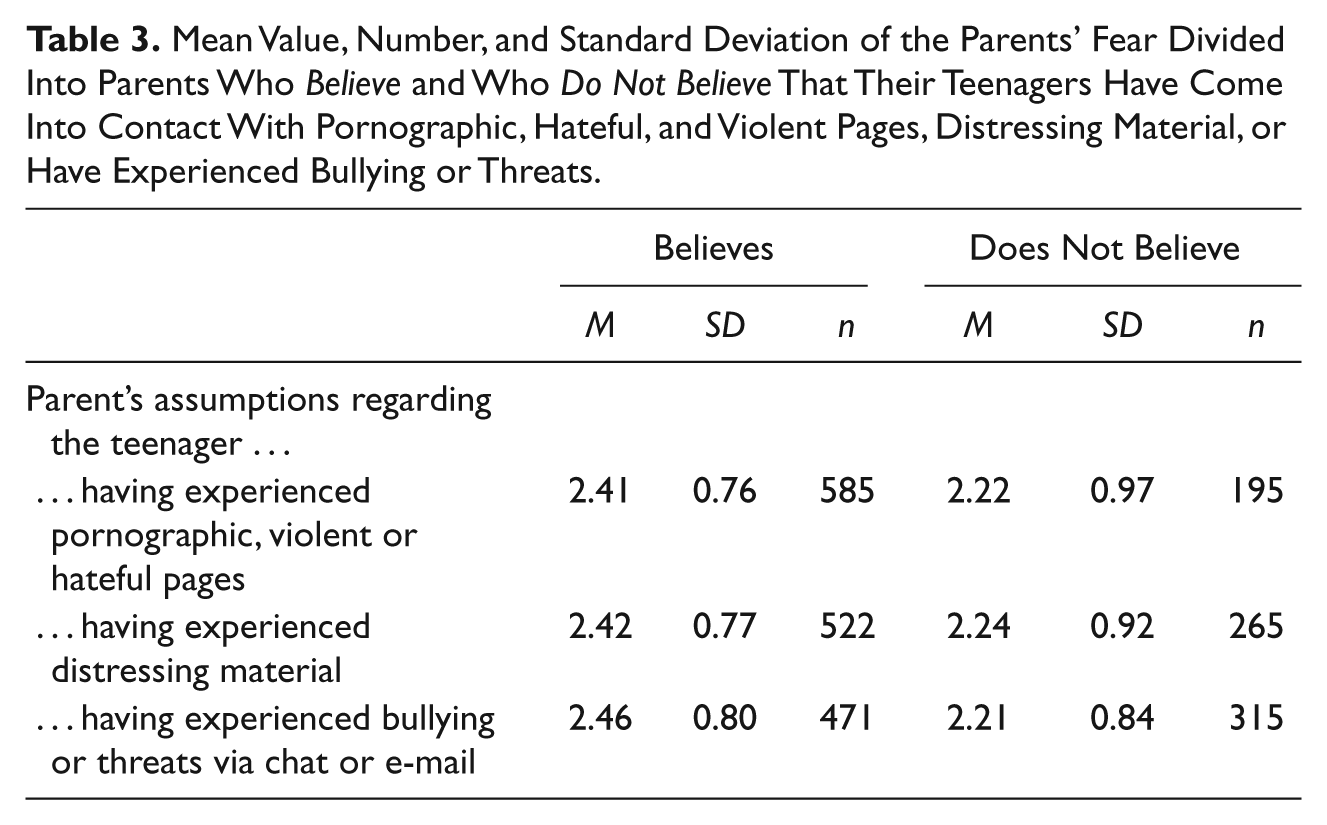
Most parents think that, when online, their teenagers have come into contact with pornographic, hateful, or violent home pages (see Table 3). The analysis shows that it is those parents who do not think that their teenagers have come into contact with any of the above who worry the least about the teenagers’ Internet use, t(778) = −2.70, p < .01. The pattern endures when we turn to look at the parents’ assumptions regarding the teenagers’ other experiences. In those cases where the parents think that their teenager has experienced distressing material, t(785) = −2.90, p < .01, or has experienced bullying or threats, t(784) = −4.20, p < .001, the parents are more worried than if they think that the teenager has not experienced these things.
Mean Value, Number, and Standard Deviation of the Parents’ Fear Divided Into Parents Who Believe and Who Do Not Believe That Their Teenagers Have Come Into Contact With Pornographic, Hateful, and Violent Pages, Distressing Material, or Have Experienced Bullying or Threats.
Actual Knowledge of the Teenagers’ Internet Experiences
When taking a closer look at the parents’ assumptions regarding the teenagers’ negative Internet experiences in relation to the young people’s own reported experiences, an interesting result emerges. The analysis (see Table 4) shows that those parents who are correct in their assumptions that their teenagers have had negative experiences on the Internet are also those who worry the most, whereas those who worry the least are those who are correct in their assumptions that the teenagers have not had any negative experiences on the Internet. In between, the parents who are incorrect in their assumptions can also be found. The pattern is the same concerning experiences of pornographic, hateful, and violent pictures, F(774, 3) = 3.35, p < .05, and experiences of threats or bullying, F(775, 3) = 7.73, p < .001. However, the responses to the question regarding experiences of distressing material, F(779, 3) = 3.18, p < .05, stand out. The parents who are correct in their assumptions of the teenager not having had any experiences of distressing material still show the least worry. It is, on the other hand, the group of parents who think that the teenagers have had these experiences—when they in reality they have not—who worry the most.
Mean Value, Number, and Standard Deviation (in Parenthesis) of the Parent’s Fear Divided According to Concordance Between the Parents’ and the Teenagers’ Reports.

Discussion
The results reveal that parents’ worry and concerns over their teenager’s Internet is over average. Such worries and concerns vary quite considerably between different parents and depend on a number of different factors. Looking at the parents’ attitudes and their own Internet use, the results indicate that the parents who worry the most are those who consider that the advantages of the Internet outweigh its disadvantages, that the Internet is important for the teenagers’ way of life and development, that they consider themselves as not being skilled Internet users, and that they do not use the Internet as frequently as others. A combination of insecurity, lack of knowledge about the Internet, and the attitude that the Internet is important seems to cause greater worry. Probably these are parents who consider the Internet to be an important agent of socialization, but who do not feel that they are in control of the situation. The results showing that parents who consider the advantages of the Internet outweigh its disadvantages are a little bit surprising in that they indicate that these are parents who, although they think the Internet involves many things that are positive, they also worry about their teenagers’ online contacts. Interestingly, this is the opposite of what might have been expected.
Parents are generally not more concerned about their daughters than their sons, and they do not worry more about the younger children compared with the older ones either. However, the parents harbor different fears depending on the child’s age and gender. The parents of girls worry more about their daughters being subjected to bullying and coming into contact with dangerous people and distressing material. Several studies show that, more so than boys, girls are exposed to sexual harassments on the Internet. Boys, however, have more experiences of bullying and threats that are more general in nature (Findahl, 2009; Wolak, Finkelhor, Mitchell, & Ybarra, 2008). Parents of boys, on the other hand, are more worried about their sons becoming passive and inactive. At the age in question, the boys’ and girls’ frequency of use does not differ considerably. However, in general, parents have different perceptions of boys’ and girls’ activities and what is suitable, which might make the parent think and act differently depending on the child’s gender (Okagaki & Johnson Divecha, 1993).
The results indicate that a higher frequency of teenagers’ Internet use is generally linked to greater levels of worry on the part of the parent and, specifically, worrying about the teenager encountering erroneous information, losing friends, and becoming passive and inactive. Part of the explanation can be that high-frequency users are more often boys than girls. However, this is probably not the entire explanation since previous studies that have controlled for gender have revealed links between high-frequency use and more experiences of sexual and/or violent material (Fleming et al., 2006). Parents of younger teenagers are more worried about their children coming into contact with dangerous people and material containing violent/gory images and/or distressing content. This is probably linked to the parents’ general picture of the child’s maturity and ability to cope with this type of experience. Younger children are not exposed to these types of experiences as often as older children, but they more often become distressed (Livingstone & Bober, 2005).
The more skilful in using the Internet the parent considers the teenager to be, the more the parent worries about his/her Internet use. In contrast to this reasoning, Yan (2008) states that increased Internet knowledge in children and young people in fact contributes to safer usage and reduced vulnerability. Furthermore, the results indicate that the parents who do not have confidence in their teenager’s responsible use of the Internet are more worried than those parents who do trust the teenager. The results show that parents’ confidence in the teenager using the Internet in a safe manner and the parents’ trust in their daughter/son in general, that is, on other everyday arenas such as in school and spare time, covary. The parents who trust their teenagers in general also do so when it comes to Internet use. This connection points to there being more behind the feelings of worry and concern than simply that the child belongs to a risk group of some kind (e.g., girls being more at risk for sexual attacks). Indeed, it is possible to come up with at least two explanations for this connection. The first is based on the parent possessing awareness and the second on the parent not possessing awareness. The first explanation can be that the parents are worried because they are aware that the teenager often ends up in situations that, for one reason or the other, can be considered problematic. For example, studies show that 85% of those who are victims of cyber bullying have also experienced bullying outside the Internet (Juvonen & Gross, 2008). The other explanation is that the parents are not very knowledgeable in general about the teenagers’ spare time activities and that the realization that they are not aware contributes to feelings of worry and concern. This is a discussion that will be returned to in the next paragraph where the focus is on knowledge versus ignorance.
When analyzing both the parents’ assumptions regarding the teenagers’ experiences on the Internet and the accuracy of such assumptions (based on the teenagers’ own reports), it became clear that the parents who think that teenagers have experienced dubious material or situations and those who make correct assumptions (meaning that it is correct that the teenager has had such experiences) are the ones who worry the most. The least worried are the parents who do not think that the teenager has experienced dubious material or situations, and those who, again, make correct assumptions, meaning that it is correct that the teenagers have not had such experiences. In between we find those parents who have not made correct assumptions. The experiences have been analyzed on the basis of three types of cause for concern: (a) exposure to pornography, violence, and threats; (b) encountering distressing material; and (c) bullying and threats. The same pattern was discerned in the analysis of all units, with the exception of experiences of distressing material, as the parents who assumed that their teenagers had experienced such material, even when it was incorrect, worried more. These results indicate that parents’ worry in part is based on what they experience at home and their awareness about the teenagers’ Internet activities. However, the results also indicate that worry is not always necessarily based on an awareness of the reality; the parents’ perception of the situation is also important.
In contrast to several previous studies, in the current study parents and children from the same family participated. This is a strength and advantage when wishing to comment on parents’ insights into teenagers’ Internet use. The two schools that took part in the study were both representative for the towns where they were located. There are no private schools in either of the two towns, so there were no selection effects as a result of the school system. The towns are average size towns. However, a recent study (Swedish Media Council, 2010) has revealed that teenagers’ Internet experiences do not vary significantly between urban and rural areas. Furthermore, there is no significant difference between teenagers living in different parts of the country. However, this does not mean that parents in different places (urban or rural areas for example) could differ. One critique of the material in the study can be that, apart from the young people’s own reports of activities and experiences on the Internet, it primarily comes from parents, which means that the result could have been different if the young people’s reports of, for example, their parents’ confidence had been in focus. One of the results showed that parents of girls had greater concerns about bullying than parents of sons. To interpret this result in a better manner, the question could have been split into two parts, one with a focus on bullying and threats from a more general perspective and the other on bullying from a sexual perspective, as research has shown that girls and boys differ in their contact with bullying depending on its characteristics.
It is positive for a young person’s development that, during the teenage years, a more balanced power relationship is developed with parents (Eccles et al., 1993). However, Eccles and her colleagues found that when the parent worries about the autonomy that the child strives for during the teenage years, this can generate feelings that the teenager is in greater need of control and that he/she is not yet ready for a more independent life and increased personal responsibility. In turn, this can obstruct the development of a balanced power relationship between parent and child. Seen from this line of reasoning, there can be a possibility that parents, if they do not feel comfortable about the Internet, instead of engaging in discussions, resort to different forms of control strategies. Stattin and Kerr (2000) argue that control and surveillance strategies function in a way that can prevent parents from gaining meaningful insights into and supporting the teenager’s development. An open climate between parents and children, characterized by trust and not suspicion and control, can instead be facilitative for the teenager choosing to talk about his/her everyday life, something that Stattin and Kerr claim is of very great importance when it comes to mutual discussions and gaining insights into the teenager’s life. Currently, when teenagers’ use of the Internet is steadily increasing, particularly in terms of access via their mobile Internet devices, dual understanding and communication are becoming increasingly important tools. Authoritative parenting, which is a combination of warmth and boundaries, has been shown to be associated with teenagers having fewer negative experiences on the Internet (Rosen et al., 2008). Parents need to be strengthened in their parenting behavior and supported in the sense that what many parents already know about communication and rule setting is also applicable in relation to the Internet. As indicated by the results obtained here, greater insight will result in reduced concern and a more open climate, which, according to Stattin and Kerr (2000), will in turn increase teenagers’ disclosures, thus contributing to further insights and opportunities to support the teenager. Knowledge about how various factors affect the parents’ concerns can provide valuable information of how worries can be met, both for preventive purposes and when it is already being experienced. An important issue for the future is thus to study whether parents’ concerns and parents’ strategies for handling their children’s Internet use correlate, and to what extent these strategies can be influenced by, for example, the parent’s knowledge development.
Footnotes
Declaration of Conflicting Interests
The author(s) declared no potential conflicts of interest with respect to the research, authorship, and/or publication of this article.
Funding
The author(s) disclosed receipt of the following financial support for the research, authorship, and/or publication of this article: This research has been funded by the Swedish Council for Working Life and Social Research as well as University West.