




Abstract
This study reviews the relationship between social policy and the division of domestic chores in the family by providing a new theoretical framework for housework reallocation. We argue that if presented as a dual process composed of modern values formation and behavioral compliance with such values, the reallocation of unpaid labor can be affected by a wide set of welfare state policies. In particular, education or labor market policies contribute to the emergence of modern values, while child care provision or poverty alleviation practices facilitate behavioral compliance with them. We suggest that the level of symmetry in the distribution of domestic chores in families is a function of whether or not policies promoting both stages of the reallocation are introduced. In addition, we demonstrate what may result if only one of them becomes a key target of welfare state activities. This theoretical framework is tested on data from the European Social Survey (2004) for 25 countries, using a variety of statistical techniques.
Men’s contribution to unpaid labor is recognized as moving from the stalled revolution to a lagged adaptation mode, suggesting that men gradually engage in more housework (Hook, 2006; Sayer, 2005). The pace of this change, however, varies considerably across countries, which makes the claim that the country-level context is consequential for the reallocation of domestic chores nonequivocal. Despite the fact that social policy is recognized as part of such contexts, the way in which it intervenes in establishing gender symmetry in families remains largely unexplained.
The article’s main objective is to provide a new theoretical framework that sheds light on the rationale behind the housework reallocation process while including social policies as one of its determinants. The latter objective is achieved by disaggregating the reallocation process into two stages: (a) the formation of modern values and (b) compliance with such values. We argue that the final result in the level of family symmetry regarding domestic chores distribution is a function of whether or not policies help to promote both stages. In addition, we demonstrate what may result if only one stage (the first or the second) becomes a key target of welfare state activities. The proposed theoretical framework further broadens the conventional understanding about the links between the welfare state and housework allocation and allows us to include a wider set of social policies in the analysis.
Literature Overview
Scholars generally agree that the division of domestic household labor is a function of several overlapping determinants. The utmost importance is usually ascribed to a set of individual characteristics, which assume that an individual’s (irrespective of gender) contribution to housework depends on their disposable free time (Geist, 2005; Gershuny, Bittman, & Brice, 2005), partners’ relative resources (Bloemen & Stancanelli, 2008; Evertsson & Nermo, 2007), or the kind of ideologies each partner holds regarding the role of women, in general (Alvarez & Miles, 2003; Fuwa, 2004). Recent research, however, emphasizes that one also needs to take account of characteristics of the context in which individuals act, thereby drawing welfare states into the discussion.
In doing so, scholars mainly use two ways of integrating welfare state policies into the analysis. The first is limited to relying on typologies and presupposes that different welfare states encourage and enable women’s employment to a different extent, which might partly explain cross-country variations in the progress of promoting the egalitarian equilibrium. Batalova and Cohen (2002), for instance, argue that regimes with more macro-level gender equality also have more equal division of domestic travails in the family. In agreeing with them, Geist (2005) points out that there are significant regime differences in the effects of an individual’s characteristics on the sharing of domestic chores. By not directly referring to welfare state effects, Esping-Andersen, Boertien, Bonke, and Gracia (2009) demonstrate that three countries (Denmark, Spain, and Britain) with different welfare regimes have different levels of gender symmetry regarding housework allocation, which may result in various types of equilibrium in the family.
The second approach contests the plausibility of such an analysis by asserting that relying on typologies may conflate disparate national characteristics and policies, which obscures those contextual aspects that matter most (Hook, 2006). Many studies thus attempt to disaggregate welfare regimes into specific policies, and gauge their separate effects on the allocation of domestic chores in households. The focus is limited to two main aspects of welfare state functioning: labor market regulations and child-related provisions (Fuwa & Cohen, 2007; Hook, 2006; Pettit & Hook, 2005). The former largely includes antidiscrimination laws and regulations of working hours for men and women. The latter mainly refers to the provision of parental leave and the availability of publicly funded child care facilities. Both, however, were found to correlate with men’s level of involvement in unpaid labor in the family. Fuwa and Cohen (2007), for instance, demonstrate that countries without prohibitions against certain types of employment for women and those with longer parental leave policies exhibit a more gender egalitarian division of housework. Similarly, the provision of publicly funded child care was found to promote a more symmetrical division of domestic travails (Pettit & Hook, 2005).
Therefore, research suggests that an association exists between welfare state arrangements and patterns of housework allocation. One can find, however, two main drawbacks in the vast majority of studies. The first is their narrow vision of welfare state activities that relate to the promotion of gender symmetry in the family. Previous studies are based on a fragmented coverage of social policies and fail to embrace all forms of welfare state intervention, which may go far beyond woman-friendly policies. The fact that housework division takes place in the family and not in the labor market suggests that welfare state effects on the process of its reallocation goes beyond employment-related policies.
The second drawback concerns the lack of understanding of the process of enforcing changes in housework allocation as such. In particular, it is not clear what triggers the change and what the exact mechanism is that results in sharing housework. Women’s employment is commonly assumed to be the main driver of change, which is oversimplified and contradicts recent findings showing that when women move from inactivity to employment, this is not necessarily accompanied by a sufficient increase in men’s share of domestic travails (Cooke, 2008; Fuwa & Cohen, 2007). Moreover, one could argue that our poor understanding of how housework is reallocated may essentially account for the fragmented or narrow vision of the role that welfare states play in fostering gender symmetry in the family. A new theoretical framework is hence needed to explain housework reallocation.
Theoretical Model
Our theoretical model is based on the conventional assumption derived from family policy analysis that women’s employment usually triggers a move toward more symmetrical housework sharing (Sanchez, 1993; Shelton & John, 1996). The theoretical framework itself draws from psychological and philosophical theories of human behavior, according to which an individual’s behavior is seen as a dual process (DeScioli & Kurzban, 2009; Strack & Deutsch, 2004). The first aspect includes forming values and norms reflecting an individual’s understanding of right and wrong. The second aspect presupposes that an individual must act in accord with such values. Behavioral compliance with values, in turn, is often perceived as a function of environmental (contextual) characteristics within which an individual operates. These may vary depending on whether or not sufficient motivation and opportunity for compliance are present (Broom, 2006) or if enforcement mechanisms are developed (DeScioli & Kurzban, 2009).
This theoretical framework projects that a redistribution of domestic chores between spouses/partners includes, on one hand, the formation of modern ideologies emphasizing the importance of lifelong employment for women (the ideological component of change). On the other hand, there must be consistency between her values and her activity (the behavioral component of change) in the labor market, meaning that a woman actually exits the household and finds a job. In addition, compliance should exist in the household, and she must therefore share responsibility for housework with her spouse/partner. We argue that both stages of housework reallocation can be associated with welfare state features. First, welfare state policies may encourage the formation of modern ideologies by providing motivation and hence forming an incentive structure for women to work outside the family. In addition, social policies may increase conformity with such ideologies by instituting policies and practices that create opportunities for women which enable them to exit their household or marriage.
This assertion may seem to contradict the conventional assumption that welfare state policies are “embedded in the societal context of the welfare culture” (Pfau-Effinger, 2004) and are hence antedated by the formation of values rather than vice versa. We assume that this observation is valid for the initial formation of the welfare state when basic forms of welfare state structures appear, but that does not exclude the possibility of a reverse effect once the welfare regime is in place. A clear-cut example is a crowding-out effect, which the welfare state is believed to have caused in terms of the value of civic engagement and trust (Hackl, Halla, & Pruckner, 2009; Van Oorschot & Arts, 2005). Similarly, public education policy is believed to have led to a substantial reconsideration of the role of women in the labor market and in the family (Pfau-Effinger, 2011), thereby altering family values. Therefore, the welfare state which has first emerged within the boundaries of existing values may potentially change these values or an individual’s behavior in the course of its later functioning.
The key is to understand which welfare state policies affect the ideology component and which affect the behavioral component in the change process. Common sense suggests that any welfare state activity may affect both in direct or indirect ways. However, some welfare state policies alter values/ideologies before they affect behavior, and for other policies, this order is reversed. Keeping this assumption in mind, we propose a simplified and basic model to describe the straightforward relationship between welfare state policies and housework reallocation and which can be easily expanded to incorporate later or indirect impacts. We also recognize that the relationship might not be unidirectional: Though values may change behavior, behavior may change values.
In choosing a set of welfare state policies, we reject the existing typologies from welfare regimes (Esping-Andersen, 1990) or family policies (Gornick & Meyers, 2003; Pfau-Effinger, 2011), since they do not incorporate all stages of housework reallocation. Instead, we use Pfau-Effinger’s (2006) classification of welfare state dimensions to construct an expanded typology. By using the position of the “active” citizen in different fields of action to which welfare state policies refer as the criterion, she distinguishes between five key fields: social services, labor market, family responsibility, social security system, and civil society. We narrow the scope of this approach by reducing the notion of “active” citizen to the “active” female. In this respect, the understanding of the fields/dimensions of the welfare state is reinterpreted so that they include the kinds of policies that may strengthen the role of women as autonomous, self-sufficient and “active” citizens. Based on these fields, we tease out four mechanisms through which the welfare state can help women be more empowered and hence promote more symmetry in the division of family domestic chores. We omit the fifth, civil society, field from our analysis since we perceive it as an alternative means of support, which often acts independently from state provisions and is usually crowded out by welfare states.
The education-related mechanism is derived from the social services dimension by limiting social services to the provision of publicly funded education. It reflects the extent to which education is organized by the state and represents a public good in society. The labor market–related mechanism is derived from the labor market dimension by selecting welfare state activities that aim to equalize economic rights between men and women in the labor market, as a result of new laws passed by the state, such as equal pay and antidiscrimination legislation. The child-related mechanism is derived from the family responsibility dimension and considers whether the welfare state supports child care outside the family by providing publicly funded day care facilities or ensuring that affordable private care exists. The poverty-related mechanism is derived from the social security dimension and describes the extent of welfare state efforts to reduce the risk of experiencing poverty in a given country and suppress income/social inequalities between men and women created by the market.
We argue that these welfare state mechanisms are related to housework reallocation in a certain way. More specifically, education-related and labor market–related policies may modify women’s incentive structure, leading to the emergence of egalitarian norms or modern values. Child-related and poverty-related mechanisms may mold the opportunity structure for women and ensure behavioral compliance with the modern values/ideologies in the labor market and in the family. The logic of this process is depicted in Figure 1.
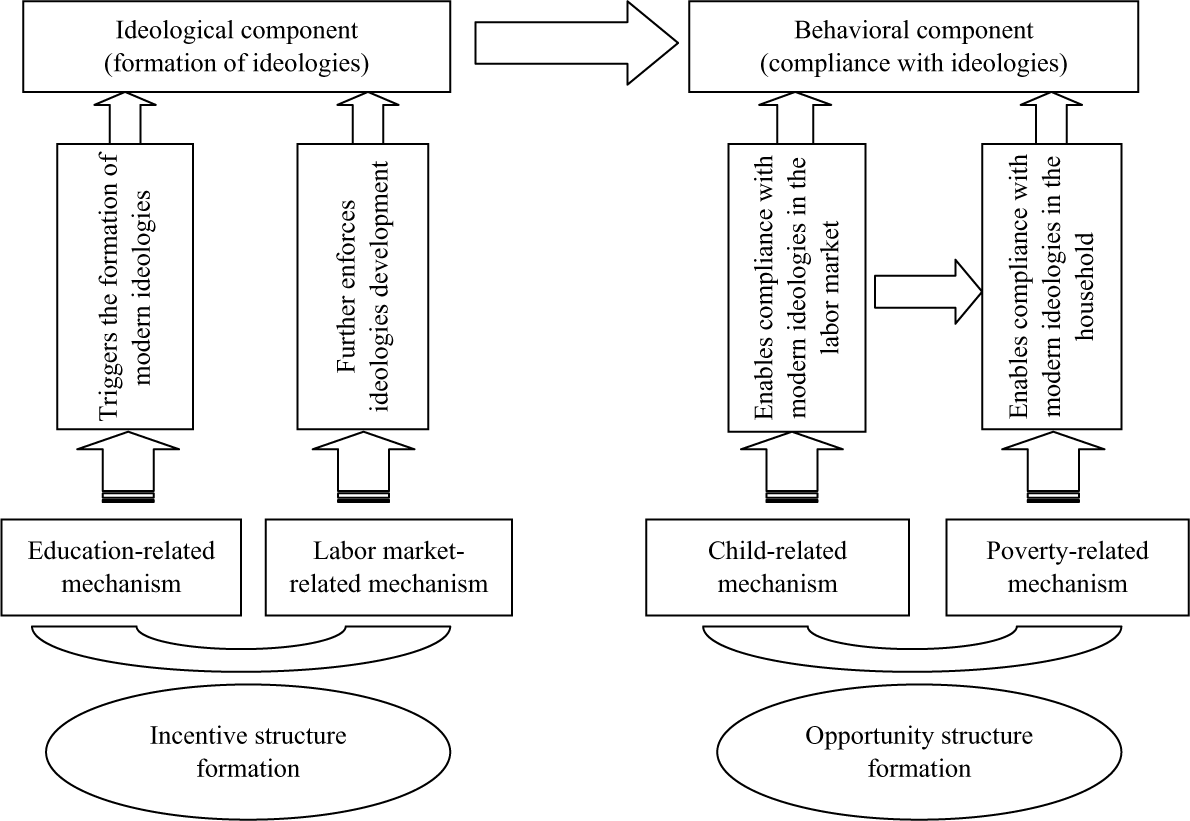
The logic of the welfare state’s impact on an individual’s decision making regarding housework reallocation.
We perceive education as the starting point for a change in values. The welfare state may help trigger change in an individual’s expectations of the proper role of men and women in society and in the family by providing affordable education and encouraging women’s participation in it. Education is believed to spur new expectations and aspirations among women, undermining traditional views of their main vocation in life and increasing the opportunity costs of traditional gender specialization (Sjöberg, 2004). It is well established in the literature that the extension of places at universities in the early 70s accelerated the change in the male breadwinner model by giving rise to new visions of women in the labor market and society and the formation of feminist movements (Pfau-Effinger, 2004). In line with these findings, research usually suggests that educational attainment is associated with more egalitarian attitudes among both men and women (Bergen, 1991; Sjöberg, 2004).
Being educated is, however, not enough to internalize modern attitudes and encourage women to invest in their employability and enter labor markets. The process of modern ideology formation triggered by education can be further encouraged by, or suppressed by, the context created by labor market institutions. If a woman perceives that the labor market prioritizes men over women, it is unlikely that she will remain firm in her modern beliefs, regardless of the level of her education (Hook, 2006; Iversen & Rosenbluth, 2006). In contrast, forbidding discriminating against women and treating them in a way that equalizes their chances for, and rewards from, employment, may further strengthen women’s adherence to modern norms about their main vocation in life (Fuwa & Cohen, 2007).
The emergence of modern values, however, does not necessarily mean that a woman will act accordingly (Alvarez & Miles, 2003). Education and policies on equality of labor market access may enhance women’s sense of entitlement as workers, but they may have a limited effect since they presume that there are no obstacles to behavioral compliance with such ideologies, which is often not the case (Fuwa & Cohen, 2007). What may lead to a contradiction between ideologies and practices is having a child who needs care (Fuwa & Cohen, 2007). Mothers will start working only if they can outsource child care during the day, and if the cost of this service does not exceed the reward brought by employment (Daly, 2000; Sainsbury, 1996). Outsourcing of care is often regarded as a prerequisite for the integration of women in gainful employment (Pfau-Effinger, 2011). The existence of publicly funded (or affordable private) child care facilities may hence predefine whether actual behavior complies with modern ideologies in the labor market.
Many studies, nevertheless, argue that women’s employment alone does not help substantially shift the burden of domestic duties from women to men (Diefenbach, 2002), since men tend to minimize their contribution to monotonous and boring household tasks (Robinson & Milkie, 1998; Starrels, 1994). This may happen because there is always an element of path dependency in any transformation process (Pfau-Effinger, 2004), and hence an individual may be influenced by older structures and models, regardless of the level of actual change. As the shift to a new path at the macro level is based on conflicts, negotiations and compromises (Pfau-Effinger, 2004), the adaptation to a new model of family-level relations similarly requires that women engage in active strategies aimed at forcing men to take over a certain share of domestic duties (Gershuny et al., 2005). Initiating negotiations and discussion between actors in relation to an unequal distribution of housework may therefore allow a break to a new modern pattern. The frequency of such negotiations can be a function of a woman’s fear of losing her relationship (and breadwinner) and experiencing a loss of income with related poverty (Cooke, 2006). But, if exiting the marriage does not entail poverty due to generous welfare state support to single women, this fear can be suppressed and resistance to the unequal division will be enough to compel men to take on an adequate share of housework. A developed poverty alleviation mechanism may hence promote behavioral compliance in the household.
Therefore, the final outcome regarding housework allocation may be shaped by which policies within the proposed mechanisms (those promoting modern ideologies or those enabling compliance with them) are more or less developed. More emphasis on ideology promoting policies without trying to ensure the enactment of behavior following from such ideologies may lead to unrealized intentions and stymie the potential for establishing family gender symmetry. In contrast, more emphasis on compliance-enabling policies without any attempt to change ideologies may cause a disequilibrium in which men try to take over a greater share than their beliefs allow them, but this reallocation will never be enough to achieve perfect gender symmetry. Only when all four mechanisms are fully developed by the welfare state, will gender equality in the household be reached. Our expectation can thus be formulated in the following way:
Hypothesis 1: A greater level of state intervention measured through the four specified mechanisms is associated with a more equal division of domestic travails in the family.
Hypothesis 2: Countries with more developed education-related and labor market–related mechanisms are characterized by more modern ideologies concerning the role of women in the labor market and household among their populations.
Hypothesis 3: Countries with more developed child-related and poverty-related mechanisms are characterized by higher levels of women’s involvement in the labor market.
Hypothesis 4: A symmetric division of domestic chores in the family can be achieved only when welfare state policies target both components of the housework reallocation model: modern values formation and behavioral compliance.
Data and Method
For testing our hypothesis, we use the European Social Survey (ESS) conducted in 2004. This database allows one to measure the level of men’s participation in unpaid labor in relative terms. The sample includes countries belonging to different stages in the unfolding revolution of women’s role and different welfare regimes: Austria, Belgium, Czech Republic, Denmark, Estonia, Finland, France, Germany, Greece, Hungary, Iceland, Ireland, Luxembourg, the Netherlands, Norway, Poland, Portugal, Slovenia, Slovakia, Spain, Sweden, Switzerland, Turkey, Ukraine, and the United Kingdom. We restrict our sample to couples where both adults are between 16 and 65 years of age. In addition, we excluded the cases where either the respondent or the partner is disabled from the analysis. Based on the pooled sample, we formed two subsamples: one for women and one for men, to compare the ideological and behavioral effects of the welfare state mechanisms between the two sexes. The subsamples of respondents include 5,963 males and 7,802 females. Despite the fact that our argument assumes a dynamic process, we conduct a cross-sectional analysis because relevant longitudinal data are not available. We use the following set of variables for testing our hypotheses empirically.
Operationalization of Dependent Variables
For assessing the respondent’s involvement in domestic travails, we use her or his share of housework since it more accurately reflects the process of housework allocation. Reduction in the number of hours of women’s housework may not be accompanied by an adequate increase in the number of hours of men’s work, leading to a decrease of total time spent on housework in the family. The variable is operationalized through the question in which the respondent self-estimates his or her share of housework, not including child care and leisure time activities. The values of the variable range from 1 to 6: with the value of 1 being almost none, and with each further point being associated with a 20% increase in the respondent’s share. Hence the respondents rely on their own definitions of what range of tasks might constitute domestic travails, which may create a source of over- or underestimations. In addition, the respondent does not use a diary approach but only provides self-reported information regarding his or her share in housework, which again, may cause biased estimation (Coltrane, 2000). These imperfections can be offset by the fact that men and women tend to overestimate or underestimate their contribution to housework to the same extent (Voicu, Voicu, & Strapcova, 2009), and hence there is no gender bias in misestimating their share of domestic chores.
Operationalization of Independent Variables
The education-related mechanism is measured through expenditures on education, women’s participation in education, and lifelong learning. Expenditures on education are defined as total public expenditure on education, expressed as a percentage of gross domestic product. Women’s participation in education is measured as a percentage of women among all students in tertiary education irrespective of the field of study. The lifelong learning variable is operationalized as the percentage of women aged 25 to 64 years who reported receiving education or training in the 4 weeks preceding the survey out of the total female population of the same age group. All three indicators are taken from the Eurostat website.
The labor market–related mechanism includes a tax shift, the presence of antidiscrimination legislation, and the extent of horizontal segregation in labor markets. The tax shift variable expresses a percentage increase in the income tax rate when the family moves from a one-earner model to a two-earner model and calculated as follows: (Tax rate for a two-earner married couple, both at 100% of average wage [AW], with two children – Tax rate for a one-earner married couple, at 100% of AW, with two children)/Tax rate for a one-earner married couple, at 100% of AW, with two children. The main source for relevant data is the Eurostat website. The antidiscrimination legislation variable is a dummy which takes the value of 1 when all such treaties are present and 0 when none of them or only some of them are present (reference category). We use Fuwa and Cohen (2007) as the source for relevant information. The horizontal segregation variable is operationalized as the percentage of women in the total population employed in technical jobs. The indicator is taken for the year 2006 from the OECD website (Gender, Institutions and Development Database 2009, Political and economic status of women).
The child-related mechanism is expressed through the extent of public day care services for the youngest children (0-3 years old), the availability of affordable paid care, and of free care. The first variable measures the share of children less than 3 years old for whom public child care services provide formal child care as a percentage of all children in the same age group. The main data source is the Eurostat website. The availability of affordable paid care is operationalized through an ESS question “care of youngest child in household, other than yourself/partner.” The variable has 10 values, out of which we use Answer 5—paid care at own or carer’s home and Answer 7—paid nursery/care other than home. We count the percentage of respondents who picked up these two options in the total number of respondents with children. The free care variable is operationalized through an ESS question “Can you count on unpaid house/care help from anyone outside household” by counting the percentage of respondents in each country who answered positively (the value 1) on this question.
Finally, the poverty-related mechanism is operationalized through income inequality levels, risk of poverty, and gender difference in risk of poverty. The first indicator represents the ratio of total income received by the 20% of the population with the highest income (top quintile) to that received by the 20% of the population with the lowest income (lowest quintile). Risk of poverty represents the share of persons with an equivalized disposable income below the risk-of-poverty threshold, which is set at 60% of the national median equivalized disposable income (after social transfers). The gender difference in risk of poverty variable is calculated by subtracting the “at risk of poverty” rate (after social transfers) among women from the “at risk of poverty” rate (after social transfers) among men. The main source for all three indicators is the Eurostat website.
Where possible, the relevant indexes are averaged out for the period 1997-2007 to avoid any cyclical fluctuation in their levels. In some cases, the indexes are not available for all 25 countries. The relevant data are often missing for Turkey and Ukraine. The analysis is then conducted on the sample of 23 countries. In addition, the analysis of tax shift effects excludes Iceland, Luxembourg, and Slovakia, since these countries clearly represent an outlier case in the whole sample. Mean values for all the indexes averaged for each welfare regime are presented in Table 1.
A Juxtaposition of Welfare State Mechanisms in the Four Welfare Regimes.
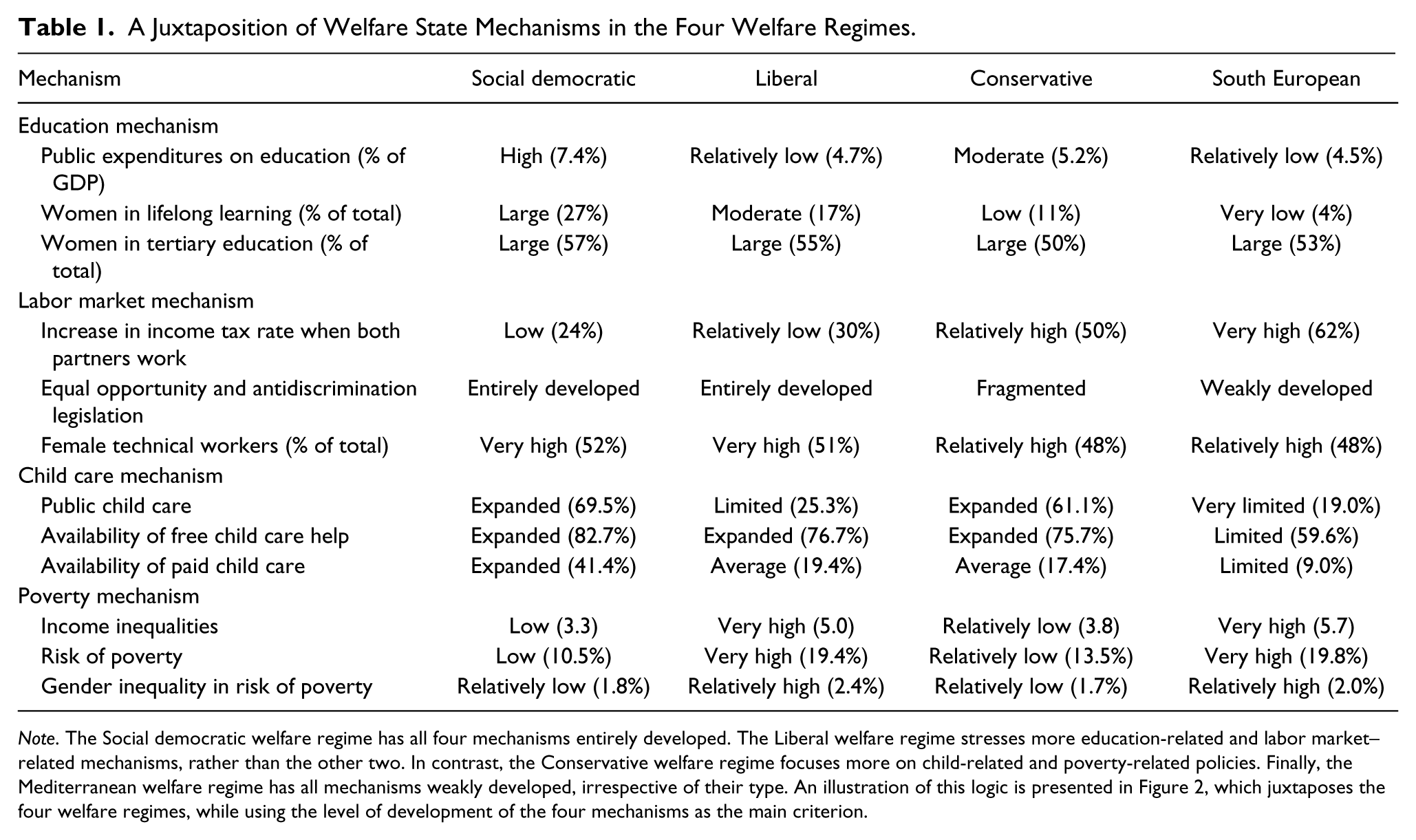
Note. The Social democratic welfare regime has all four mechanisms entirely developed. The Liberal welfare regime stresses more education-related and labor market–related mechanisms, rather than the other two. In contrast, the Conservative welfare regime focuses more on child-related and poverty-related policies. Finally, the Mediterranean welfare regime has all mechanisms weakly developed, irrespective of their type. An illustration of this logic is presented in Figure 2, which juxtaposes the four welfare regimes, while using the level of development of the four mechanisms as the main criterion.
Operationalization of Control and Instrumental Variables
The set of control variables includes the respondent’s ideology, involvement in the labor market, and share in the household income. The ideology index is constructed by summing up the responses to the following three statements: (a) Women should be prepared to cut down on paid work for the sake of the family, (b) Men should take as much responsibility as women for the home and children, (c) Men should have more right to a job than women when jobs are scarce. Each item has values ranging from 1 to 5, so that the values of the final construct vary from 1 to 15, with higher values indicating more modern attitudes. The extent of involvement in paid employment is measured by the respondent’s work hours operationalized through the question about “total hours normally worked per week overtime included.” In addition, we control for the number of hours worked per week in gainful employment by the respondent’s spouse/partner. The income ratio is operationalized through relative resources of the respondent which is measured by a question in which he or she should specify the proportion of income they provide. The responses vary from 1 = none to 7 = all. In addition, we control for individuals’ educational level, age, and religious denomination. The respondent’s education level is operationalized by the question about the total number of years completed in full-time education. Spouse’s/partner’s education is measured based on the question about spouse’s/partner’s highest education attained, based on which we construct two dummies, with the first including all those having first or second stage of tertiary education. The second combines those having upper secondary or postsecondary but not tertiary. The values no primary, primary, and lower secondary are combined together and used as a reference category. The religious denomination of the respondent is described by four dummies. The Protestant dummy takes the value of 1 when the respondent adheres to a Protestant denomination. The Orthodox dummy takes the value of one when the respondent is Orthodox. The Catholic dummy takes the value of 1 when the respondent is Catholic. The dummy “others” takes the value of 1 when the respondent adheres to any other religion not mentioned above. We use atheists as a reference category.
Our analytical strategy includes three steps.
Step 1: We check for associations between the four welfare state mechanisms and housework allocation (Hypothesis 1).
To do so, we run a multilevel analysis which allows us to explain variations in domestic chores done by men and women with both upper and lower level factors. In this respect, the upper level represents features of the proposed welfare state mechanisms. Accounting for such a hierarchical structure of our data is necessary to prevent the unmodeled country information from ending up all being pooled into the single individual error term or recognize the fact that the regression coefficients on individual-level variables may not apply equally to all countries (Luke, 2004). The empirical model takes the following form:

Here, Welfare_statej consists of relevant measures of the four defined mechanisms that will sequentially (one by one) be included in the model, Xij is a set of individual-level control variables, moj is variance at the country level, ϵ ij is variance at the individual level. We use STATA command GLLAMM for calculating the parameters of the model.
Step 2: We explore the channels through which the associations between the welfare state mechanisms and housework share emerge (Hypotheses 2 and 3).
To disentangle the mechanisms’ direct impact from their indirect effects, we use a simultaneous equation model which can run several regressions simultaneously assuming a certain cross-equation correlation. The basic econometric specification consists of a series of three structural relationships describing the behavior of the endogenous variables. More specifically, the model includes a cross-country housework equation and two channel equations, one for the respondent’s hours of work per week, and the other for his or her ideology. The measures of welfare state mechanisms are included in all three equations. The housework equation also contains three main determinants of the division of housework in the family (the respondent’s hours of employment, income ratio, and ideologies) commonly accepted in the cross-country housework literature. Since two of these variables appear endogenous in the system as channels, we consider it necessary to use instrumental variables estimation to ensure that our structural parameters are identified. The choice of the instruments is done based on their strong correlation with the correspondent variables (ideology or hours of paid work), while ensuring that they are theoretically or statistically unrelated to the main dependent variable (the respondent’s share of unpaid labor). In addition, we include other control variables in the channel equations. The number of inclusions is sufficient for the order condition for identification to be satisfied. We estimate the full set of equations jointly using three-stage least square. The estimation is conducted by applying STATA command reg3 to aggregated data-sets for men and women obtained by calculating countries’ mean values for the aforementioned variables. The model can hence be described in the following way:



Housework is a respondent’s self-estimated share in housework, and Res_hr_job stands for the number of hours the respondent works in gainful employment per week. Res_Income_ratio measures the respondent’s relative resources. The Values variable describes ideologies the respondent holds regarding the role of women in the family and labor markets. Spouse_hr_job operationalizes the spouse’s extent of involvement in paid employment and Child is a dummy specifying whether or not the respondent has children. The employment variable is instrumented through the quality of economic regulation (Ec_regulat) in a country. Educat reflects the respondent’s level of education and Spouse_ed is a dummy specifying whether the respondent’s spouse or partner has higher education. The Values variable is instrumented through an individual’s attitude toward homosexuals (Modern) and the degree of ethnic fractionalization in society (Ethnic_fract).
The set of instruments includes the economic regulation, modernity level, and ethnic fractionalization variables. The quality of government’s regulation of different aspects of the economic system is taken from the Economic Freedom of the World: 2002 Annual Report (Gwartney & Lawson, 2002). It has values ranging from 1 to 10, with higher values indicating a better set of government regulation mechanisms. The modernity variable reflects how modern an individual’s attitudes are in general and is based on responses to the ESS question about the respondent’s opinion whether gays and lesbians should be free to live as they wish. The responses vary on a 5-point scale from agree strongly to disagree strongly. The fractionalization level is operationalized through the ethnic fractionalization index (Retrieved from http://www.nsd.uib.no/macrodataguide/set.html?id=16&sub=1), which measures the degree of ethnic heterogeneity in various countries. The responses vary between 0 and 1, with higher values reflecting the existence of more ethnic fragmentation in a country.
Step 3: We demonstrate that the integrity of welfare state arrangements is necessary to achieve gender equality in housework allocation (Hypothesis 4).
For this purpose, we carry out a prediction exercise that simulates men’s share of housework given their current ideologies and assuming that there is full compliance between ideologies and behavior. STATA gllasim option (for more details, see Rabe-Hesketh & Skrondal, 2008) is used for this purpose. The procedure presupposes first conducting a multilevel analysis of men’s share in housework and then calculating predictions. One should note that when used repeatedly, gllasim always produces a different answer, suggesting that the latter may be sampling from a distribution of the parameter estimates. To minimize this effect, we generate predictions that are repeated 100 times and are averaged out in the end, which makes the process akin to a Monte Carlo simulation. We calculate a mean value of such predictions for each country and report it as compared with the actual value of men’s involvement in domestic chores.
Results
Regarding the individual-level effects (see Table 2), our results confirm previous, established findings, which also suggests that our basic model is correctly specified. In addition, we introduce random coefficients, allowing the individual-level slopes to vary across countries. Measures of fit show a significantly improved fit when including random effects, which suggests that impacts of the individual-level variables are not the same across countries (not shown in the table). One should also note that permitting a random slope most improves model fit for the ideology variable, which indicates that compliance with the respondent’s attitudes may differ according to national context.
Individual-Level Determinants of Housework Allocation in the Family.
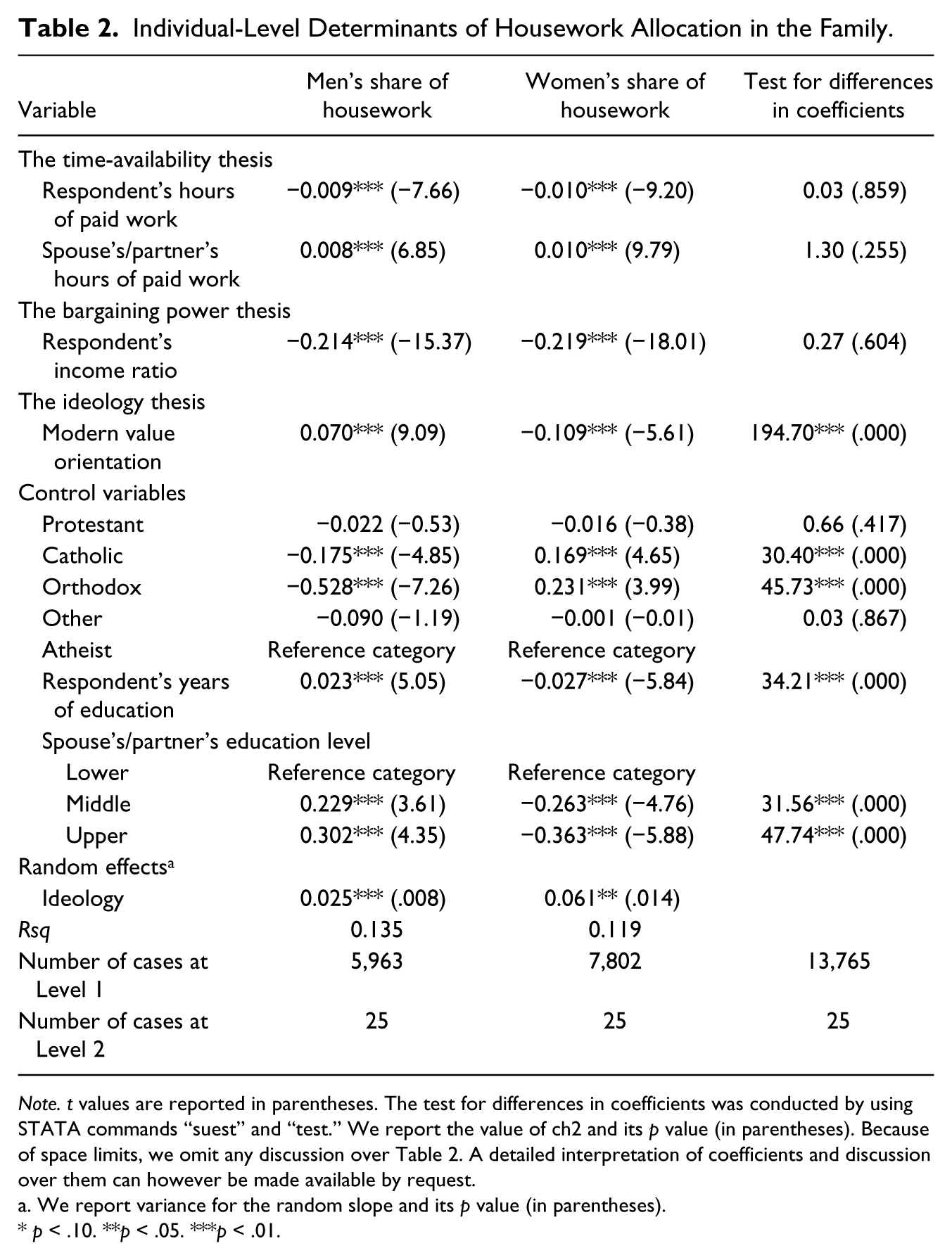
Note. t values are reported in parentheses. The test for differences in coefficients was conducted by using STATA commands “suest” and “test.” We report the value of ch2 and its p value (in parentheses). Because of space limits, we omit any discussion over Table 2. A detailed interpretation of coefficients and discussion over them can however be made available by request.
We report variance for the random slope and its p value (in parentheses).
p < .10. **p < .05. ***p < .01.
Turning to the national context (see Table 3), one finds results which are largely consistent with our expectations. In particular, public funding of education, lifelong learning, or the degree of women’s involvement in tertiary education are all positively correlated with men’s involvement in housework. Similarly, the labor market–related mechanism indicates that various incentives for women to enter the labor market are associated with more egalitarian gender relations in the family. In the context, in which taxation of family income only slightly increases when the second partner enters the labor market, the less traditional specialization in the household usually prevails. Moreover, women respond to the decrease in horizontal segregation by reducing their share of housework. Finally, the introduction of antidiscrimination regulations is usually positively associated with men’s involvement in domestic chores.
Macro-Level Determinants of Housework Allocation in the Family.
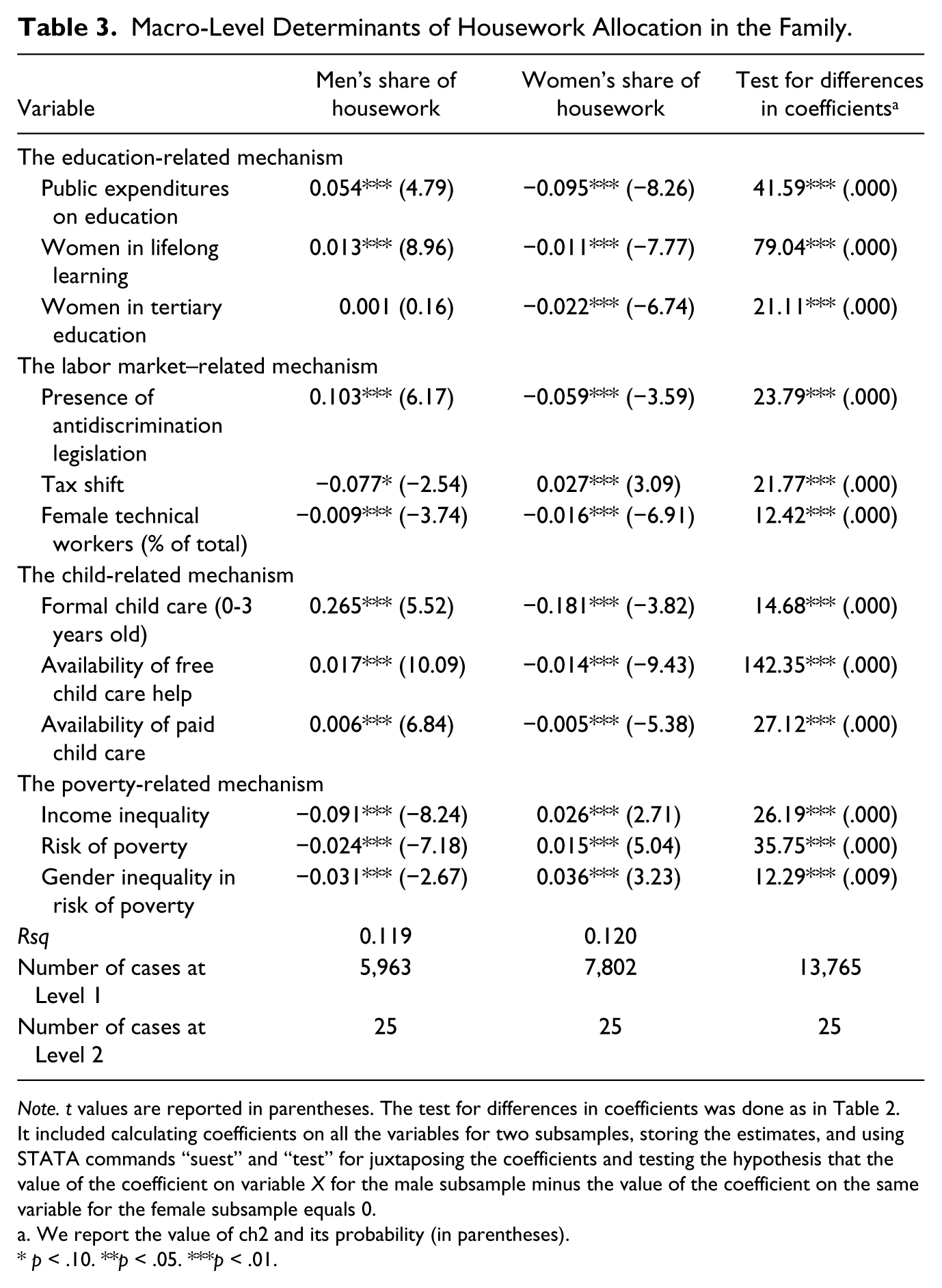
Note. t values are reported in parentheses. The test for differences in coefficients was done as in Table 2. It included calculating coefficients on all the variables for two subsamples, storing the estimates, and using STATA commands “suest” and “test” for juxtaposing the coefficients and testing the hypothesis that the value of the coefficient on variable X for the male subsample minus the value of the coefficient on the same variable for the female subsample equals 0.
We report the value of ch2 and its probability (in parentheses).
p < .10. **p < .05. ***p < .01.
The child-related mechanism is also related to men’s and women’s share of domestic travails. In the countries where families are assisted with child care regardless of whether it is provided by the state (publicly funded child care facilities), family (free care from family), or the private sector (affordable paid child care facilities), the couples adopt more egalitarian gender relations in the family. In addition, poverty issues may matter for symmetry in the domestic sphere. In particular, men do more housework in more equal societies. Similarly, countries in which the welfare state manages to reduce the risk of poverty and does so irrespective of beneficiaries’ gender have a more equal division of unpaid labor in the family.
Therefore, the four specified mechanisms are associated with housework allocation in the expected way. However, it is not explicit through which channels this relationship plays out. To explore this, we use a simultaneous equation model (Table 4). The data reveal some interesting nuances which are largely commensurate with our expectations. In particular, countries investing in education (general and lifelong learning) and promoting women’s participation in this education usually have more modern ideologies, and as a result, more participation by men in domestic chores. Similarly, countries that introduce antidiscrimination regulations and minimize the tax shift exhibit more modern values. Surprisingly, we did not find any relation between ideologies and the level of horizontal segregation. The results suggest that they directly relate to housework division bypassing the two selected channels.
Coefficient Estimates on Macro-Level Determinants in the Simultaneous Equation Model.
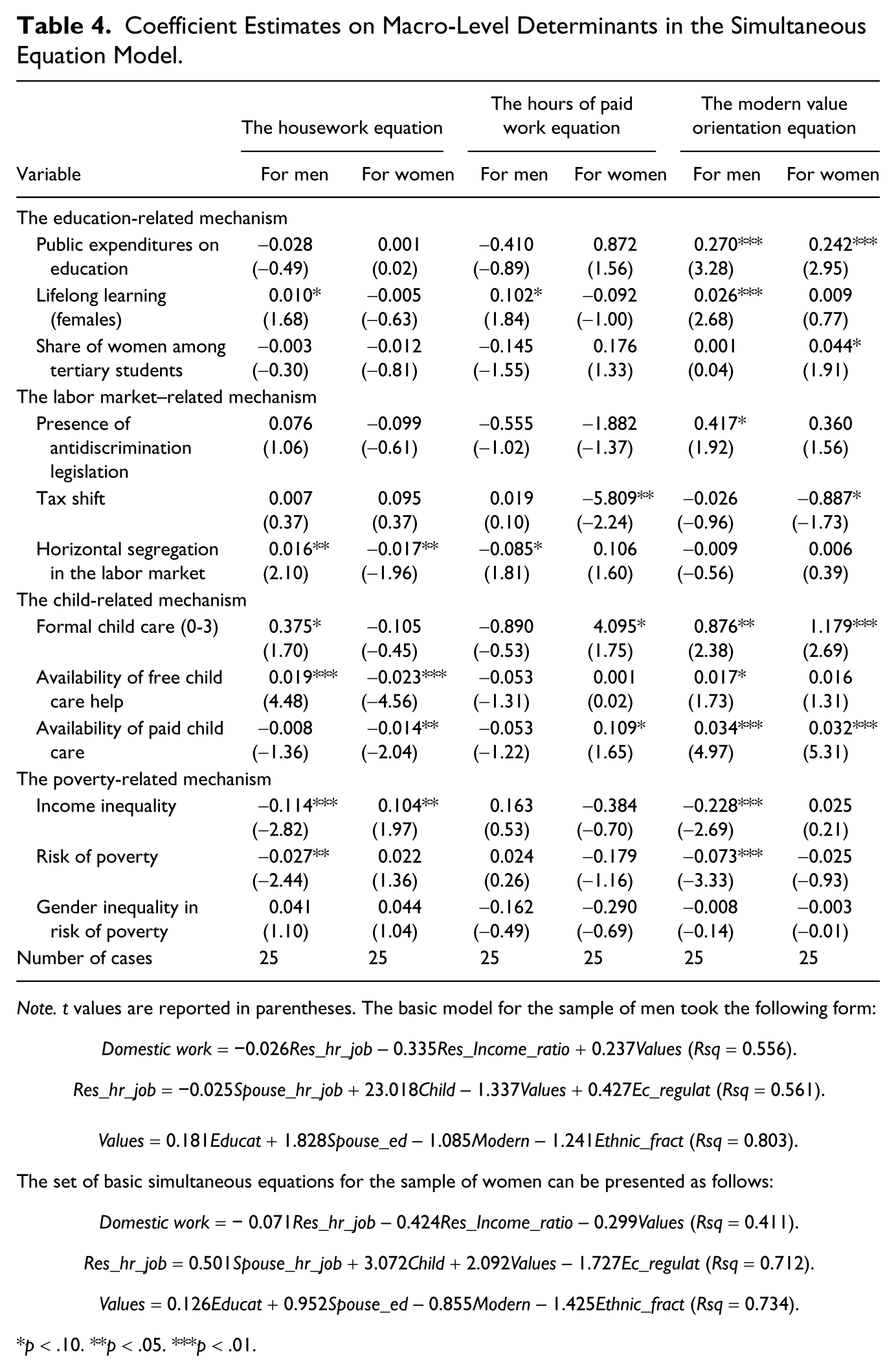
Note. t values are reported in parentheses. The basic model for the sample of men took the following form:
Domestic work = −0.026Res_hr_job – 0.335Res_Income_ratio + 0.237Values (Rsq = 0.556).
Res_hr_job = −0.025Spouse_hr_job + 23.018Child – 1.337Values + 0.427Ec_regulat (Rsq = 0.561).
Values = 0.181Educat + 1.828Spouse_ed – 1.085Modern – 1.241Ethnic_fract (Rsq = 0.803).
The set of basic simultaneous equations for the sample of women can be presented as follows:
Domestic work = − 0.071Res_hr_job – 0.424Res_Income_ratio – 0.299Values (Rsq = 0.411).
Res_hr_job = 0.501Spouse_hr_job + 3.072Child + 2.092Values – 1.727Ec_regulat (Rsq = 0.712).
Values = 0.126Educat + 0.952Spouse_ed – 0.855Modern – 1.425Ethnic_fract (Rsq = 0.734).
p < .10. **p < .05. ***p < .01.
Components of the child-related mechanism relate to housework allocation in a different way. Out of the three indicators, the one measuring the extent of publicly funded child care is found to be most important. Countries organizing child care usually have women who work longer in paid employment and men who work more in the household. It is worth noting, however, that more formal child care is also associated with more modern ideologies among both men and women. In contrast, the availability of free care from relatives may help to reduce women’s involvement in housework without changing women’s participation in labor markets. The availability of paid care does not entrain a substantial change in women’s participation in gainful employment, but it may change their ideology and the ideology of their spouse/partner.
The poverty-related mechanism is also found to be related to the allocation of domestic tasks. More income inequalities and a higher risk of poverty are associated with less involvement of men in housework. In addition, unequal societies with a high risk of poverty have more conservative men who adhere to more traditional specialization in the household. Therefore, education-related and labor market–related policies are closely associated with the emergence of modern attitudes. Similarly, child-related and poverty-related mechanisms may have a relationship with promoting more modern attitudes, but they also strongly correlate to compliance with these ideologies, either in the labor market or in the household. The question about the joint importance of all the four mechanisms still remains open.
Table 5 suggests that allowing an individual to behave according to her or his ideology may increase gender symmetry in the family regarding the sharing of domestic chores. But if ideologies are not yet modern enough, the actual shift in men’s involvement in housework will never suffice to change the unequal division of unpaid labor to the full extent. The calculated predictions indicate that Scandinavian countries which have the most modern ideologies also have the greatest predicted share of housework done by men. A similar case is found for liberal countries, where relatively modern ideologies dominate and, if allowed to be complied with, ensure symmetric participation of men in housework. Permitting full behavioral compliance with prevalent ideologies does not allow countries of the Continental and Mediterranean welfare regimes to reach perfect equality in the family, since their ideologies are still relatively conservative.
A Comparison of the Actual and Predicted Participation of Men in Domestic Chores by Welfare Regime Type.
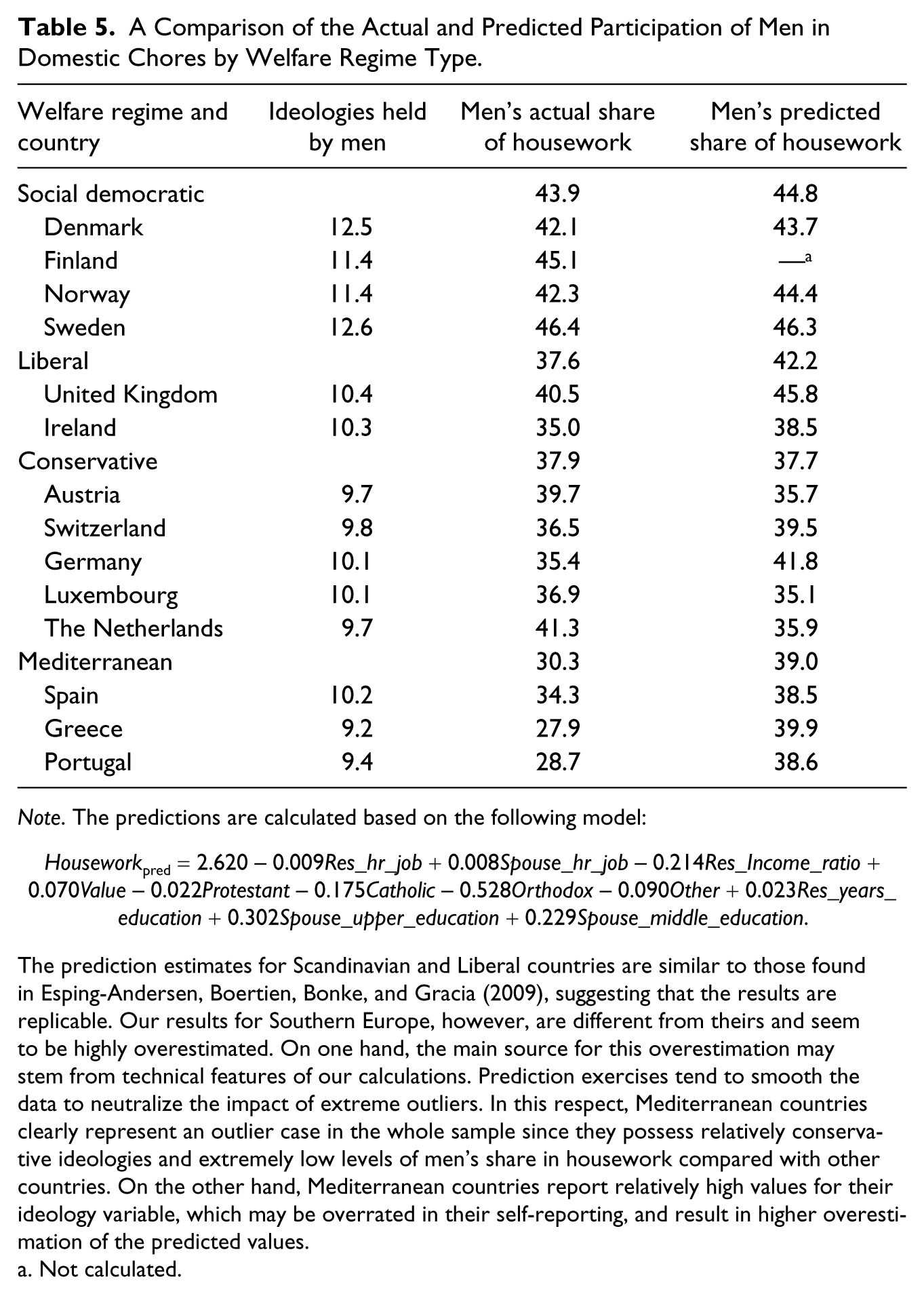
Note. The predictions are calculated based on the following model:
Houseworkpred = 2.620 – 0.009Res_hr_job + 0.008Spouse_hr_job – 0.214Res_Income_ratio + 0.070Value – 0.022Protestant – 0.175Catholic – 0.528Orthodox – 0.090Other + 0.023Res_years_education + 0.302Spouse_upper_education + 0.229Spouse_middle_education.
The prediction estimates for Scandinavian and Liberal countries are similar to those found in Esping-Andersen, Boertien, Bonke, and Gracia (2009), suggesting that the results are replicable. Our results for Southern Europe, however, are different from theirs and seem to be highly overestimated. On one hand, the main source for this overestimation may stem from technical features of our calculations. Prediction exercises tend to smooth the data to neutralize the impact of extreme outliers. In this respect, Mediterranean countries clearly represent an outlier case in the whole sample since they possess relatively conservative ideologies and extremely low levels of men’s share in housework compared with other countries. On the other hand, Mediterranean countries report relatively high values for their ideology variable, which may be overrated in their self-reporting, and result in higher overestimation of the predicted values.
Not calculated.
Linking the level of men’s actual and predicted involvement in domestic chores to the level of development of each of the mechanisms (Figure 2) allows us to postulate explanations for why these patterns have been found in the four welfare regimes.
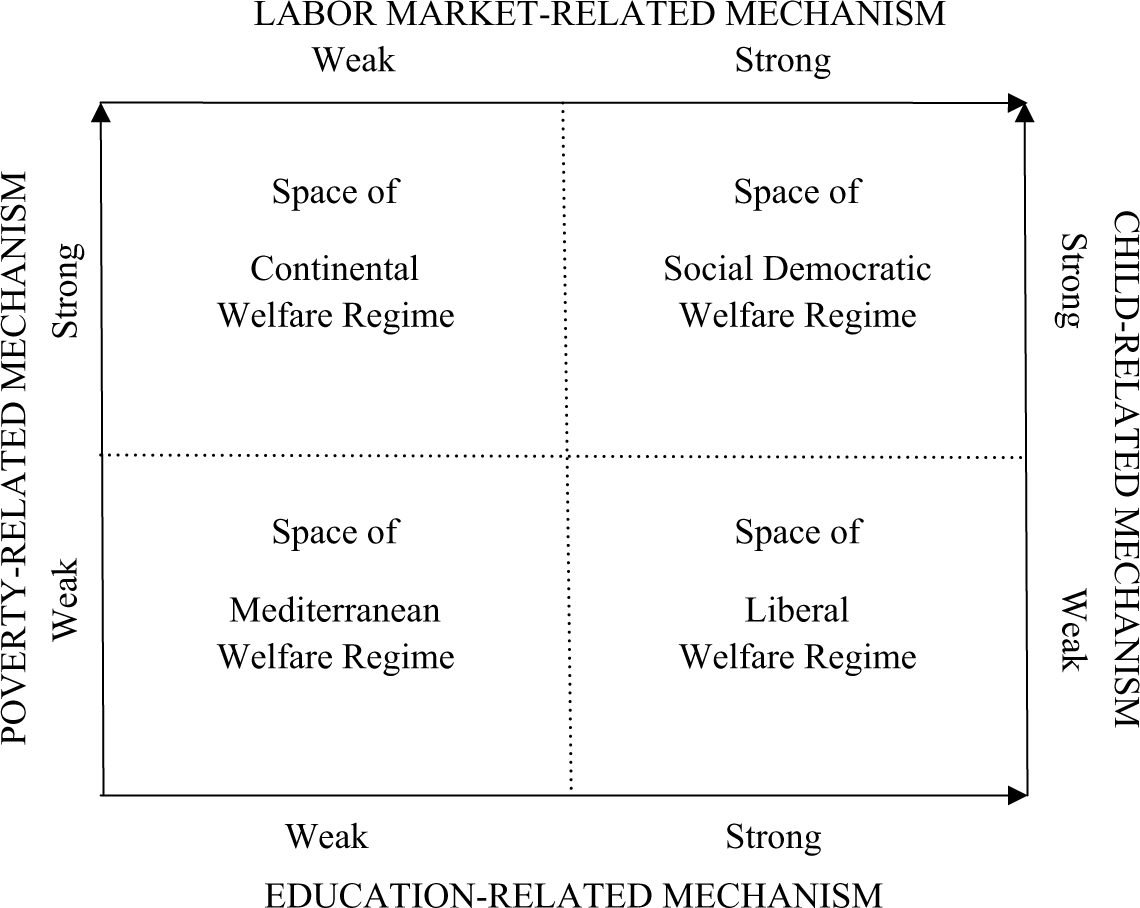
A four-dimensional visualization of welfare regimes according to their level of development of the four mechanisms.
Scandinavian countries managed to reach almost perfect gender symmetry in the family since all the four mechanisms are in full force and support the formation of modern values and behavioral compliance with them. Mediterranean countries have relatively conservative values and conservative conduct among their population since none of the four mechanisms is fully developed. Liberal countries invest mostly in the development of education and labor market mechanisms and as a result possess quite advanced ideological values. However, enacting these ideologies is blocked because of relatively weak inequality reduction and child care mechanisms. In contrast, Continental countries emphasize only the poverty alleviation and child care provision, thereby “supporting women’s employment in a male breadwinner context” (Pfau-Effinger, 2011). Therefore, welfare state policies promoting alterations in ideologies and opportunities to match actual behavior with these ideologies are both necessary to achieve the greatest possible change.
Conclusions and Discussion
The analysis, therefore, supports the theoretical framework of housework reallocation, which regards this process as composed of modern values formation, on one hand, and compliance of an individual’s behavior with such values, on the other. Both stages of reallocation prove to be connected to a wide set of welfare state policies, with education and labor market policies correlating more to the ideological component and child care or poverty alleviation practices relating more to behavioral compliance. Both components should, however, be targeted by the welfare state if the egalitarian equilibrium is to be established in families.
The proposed theoretical framework may also help postulate which policies are needed for establishing family gender equilibrium in the four welfare regimes. We suggest that variations in the extent to which each welfare regime addresses modern values formation and behavioral compliance components can be one of the main sources for cross-country variations in men’s share of housework. Hence, symmetric housework division can emerge in the liberal welfare regime if policies enabling women to enact their modern ideologies are introduced. In contrast, the continental welfare regime needs to formulate policies which promote the formation of such ideologies. Mediterranean countries are more likely to foster gender symmetry in families if their welfare state invests more in developing each of the four mechanisms.
The process of establishing the “egalitarian equilibrium” is hence connected to the level of welfare state development. This relationship, nevertheless, needs further research aimed at exploring two main issues. The first is the direction of causality in the relationship between the welfare state and housework allocation. The second refers to the methodological approach and requires that research take the form of a longitudinal study to check the dynamic nature of the rationale behind our theoretical model.
Footnotes
Acknowledgements
We would like to thank Prof. G. Esping-Andersen for his constructive suggestions, guidelines, and criticism on an earlier draft of this article written as a part of the IMPALLA program.
Declaration of Conflicting Interests
The author(s) declared no potential conflicts of interest with respect to the research, authorship, and/or publication of this article.
Funding
The authors are grateful to the CEPS/INSTEAD for funding Natalya Tamilina’s stay, granting access to the data, and providing her with academic and technical support.