




Abstract
Young adults increasingly express a desire to create egalitarian romantic partnerships, yet numerous studies have shown that women generally continue to assume the lion’s share of housework. Building on previous work on threshold levels of tolerance for dirt and disorder, on housework allocation, and on perceived fairness, the current longitudinal study documented the pathway by which threshold levels for housework lead to feelings of frustration with the partner over a period of six months. Data from 176 cohabiting emerging adult couples were analyzed using path analysis. Results confirmed the proposed model of feelings of frustration with the partner. More precisely, romantic partners’ threshold levels were associated with their and their partners’ feelings of frustration through the division of housework and perceptions of fairness. Gender differences, empirical and practical implications, and future research directions are further discussed.
Keywords
Emerging Adult Couples and Housework
Transitioning from dating to living together is an important stage in a relationship and holds potential implications for emotional and relational health during emerging adulthood (Guzzo, 2014; Rhoades et al., 2012). Cohabitation exposes individuals to new romantic settings, changes in roles, and new sources of conflict (Rhoades et al., 2012). A common potential source of disagreement during cohabitation concerns the allocation of household labor. Women generally continue to be responsible for nearly two-thirds of domestic work, even when both partners are employed (Carriero, 2011; Claffey & Mickelson, 2009). Although many scholars have examined the gendered division of household labor over the past decades (Bianchi et al., 2000; Davis & Wills, 2014; Lachance-Grzela & Bouchard, 2010; Sullivan et al., 2018), the dominant theories on this phenomenon in the literature only partially predict housework allocation (Alberts et al., 2011).
According to Alberts and colleagues (2011), one of the reasons researchers have not yet been able to fully explain how housework tasks are distributed is that they too often disregard the fact that individuals possess different tolerance levels for dirt and disorder in the home. Their integrative theory of the division of housework suggests that a partner’s larger share of household tasks would be explained by lower threshold levels of tolerance for uncompleted tasks relative to the other partner. Accordingly, one partner would be less involved in housework when the other has lower threshold levels. Alberts and colleagues also suggest that these tolerance levels are at the root of relational conflicts concerning the division of housework. Yet, research on the subject is sparse. It is of particular interest to address this gap in the literature to help couples improve relationship functioning and outcomes. Taking a dyadic approach, the aim of the current study is to investigate the interdependence of preferences, perceptions, and behaviors between romantic partners in the pathway from housework threshold levels to frustration with the partner. More precisely, in the current longitudinal study, we proposed and verified a dyadic model examining the mediating roles of the division of housework and perceived fairness in the relation between partners’ threshold levels and feelings of frustration over a six-month period among emerging adult couples.
This study makes an important contribution to the existing literature by analyzing data on married and unmarried emerging adults living with a romantic partner. Prior studies exploring the uneven division of housework and its impact on relational outcomes have focused mostly on the experience of well-established adults. Yet, in the last decades, cohabitation has become a common practice during emerging adulthood (Rhoades et al., 2012; Stanley et al., 2011), a developmental period from the late teens through the twenties (Arnett, 2000). Emerging adulthood is a dynamic time of life in which individuals explore identity issues and a variety of life possibilities. In the area of love, relationships become more intimate and serious, and often include cohabitation, regardless of marital status and marriage intentions. Researchers indicate that emerging adults choose to live with a romantic partner for different reasons: to test a relationship before marriage, to spend more time together, or for convenience reasons, such as sharing financial obligations and expenses (Stanley et al., 2011). As a result, expectations and behaviors in the home, as well as their relational outcomes may vary between emerging adult couples and well-established couples (Keith & Schafer, 1986). Previous research has shown that the division of labor changes across life stages according to life experience, life-course transitions and time demands for paid and unpaid work (Baxter et al., 2008; Leopold et al., 2018). For instance, Leopold and colleagues’ (2018) results revealed that women’s time spent on housework tend to increase throughout young-adult life and decrease in midlife, whereas men’s housework time tend to remain stable into midlife. Emerging adults may also share responsibilities for unpaid and paid work more equally than well-established adults, as the division of housework tends to become more gendered after the transition to parenthood (Baxter et al., 2008). Finally, it is important to investigate emerging adults’ experience with housework as they tend to express greater preferences for egalitarian unions, as compared to previous generations (Gerson, 2010) and because emerging adulthood is a period during which relational behavioral patterns are established (Arnett, 2007).
Threshold Levels and Housework Arrangement
Given that women’s employment has significantly increased over the last decades, many individuals now feel that romantic partners’ participation in housework should be balanced (Gerson, 2010; Miller & Carlson, 2016). Despite these egalitarian ideals and some signs of gender convergence in unpaid work (Sullivan et al., 2018), women continue to be disadvantaged by the housework arrangement in most cohabiting and married couples (Lachance-Grzela & Bouchard, 2010; Miller & Carlson, 2016). According to Alberts and colleagues (2011), the organization of household tasks remains highly gendered because of women’s and men’s differing tolerance levels for dirt and disorder in the home. Although there is a remarkable degree of consensus in the public media that women are generally more sensitive to household cleanliness than men (Chalt, 2013; Johnson, 2014), there is a paucity of scientific research in this area. The researchers who have studied sensitivity to household cleanliness have found that men and women tend to justify the unequal division of household tasks by women’s lower tolerance for dirt and disorder (Beagan et al., 2008; Ogletree & Worthen, 2008; Poortman & Van Der Lippe, 2009; Van Hooff, 2011). Comments by the respondents of qualitative studies illustrate the rationalization of inequality using tolerance levels: I (male) do not expect her (partner) to do it, but for me to be bothered to do something, it has to be really filthy, and she would never let it get that bad. (Van Hooff, 2011, p. 23) I (female) do everything, [. . .] but it is because he (partner) does not realize something needs doing. (Van Hooff, 2011, p. 21)
Alberts and colleagues’ (2011) integrative theory of the division of housework takes these results into account. It stipulates that, due to biological differences and social experiences, women often shoulder the brunt of housework because they are generally more sensitive to household cleanliness than men are. Based on the assumption that housework allocation is related to each partner’s tolerance for dirt and disorder, the theory suggests that individuals with a lower threshold level are disturbed by uncompleted tasks before individuals with a higher threshold level and, consequently, tend to be the ones performing the tasks. The few researchers who have examined this explanation of the persistence of the gender gap in the domestic sphere found differences between men’s and women’s tolerance for uncompleted household tasks in samples of individuals in well-established relationships (Ogletree & Worthen, 2008; Poortman & Van Der Lippe, 2009). For instance, Poortman and Van Der Lippe (2009) found that, in couples, women have lower threshold levels for cooking, cleaning, and childcare than men do. Findings also suggest that one’s tolerance for uncompleted tasks relative to the romantic partner’s tolerance is associated with housework allocation. More precisely, the interaction between partners’ threshold levels is associated with the division of household labor in lesbian couples (Wong, 2012) and married heterosexual couples (Hawkins et al., 1995): The person with the lower threshold level is the one who generally performs more housework.
Housework Arrangement, Perceived Fairness, and Negative Outcomes
Household responsibilities are one of the three leading sources of conflict—along with money and work–family balance—between romantic partners (Chethik, 2006). According to Claffey and Manning (2010), the key to understanding the relationship between housework allocation and partners’ personal and relational well-being is their perception of fairness of the housework arrangement. More precisely, the research suggests that perceived fairness may be the mechanism by which an uneven division of housework influences personal and relational outcomes (Claffey & Mickelson, 2009): The division of housework would directly affect the perception of fairness, which, in turn, would influence changes in personal and relational well-being. Several studies have supported the mediating role played by perceived fairness in the link between the division of housework and possible outcomes like marital satisfaction (Claffey & Mickelson, 2009), and marital and personal distress (Wilkie et al., 1998). Wilkie and colleagues (1998) found that the division of housework only affected husbands and wives’ marital satisfaction indirectly, via perceived fairness. Accordingly, the more inequality is present in the division of housework, the lower the perception of fairness in the division of housework (Braun et al., 2008). In turn, perceived fairness rather than the actual division of housework is a more powerful predictor of relationship quality and stability (Claffey & Mickelson, 2009; Frisco & Williams, 2003). If women perceive the division as unfair, they are more likely to report lower well-being (Claffey & Mickelson, 2009), lower marital happiness (Frisco & Williams, 2003), and more mental health problems (Lee et al., 2018). Similarly, they tend to report experiencing more relational conflicts (Newkirk et al., 2017) than women who consider the division to be fair. Research also suggests that men’s perceptions of fairness are related to relational outcomes (Frisco & Williams, 2003; Newkirk et al., 2017), such as relationship happiness and changes in conflict.
The equity theory provides a useful framework for understanding the links between the division of housework, perceived fairness, and negative outcomes (Hatfield & Rapson, 2012; Hatfield et al., 2011; Walster & Walster, 1975). According to equity theory, people tend to seek a balance in their relationship exchanges, such that men and women are more satisfied with a romantic relationship in which there is equal give and take by both partners. This theory also proposes that perceptions of inequity are based on what each partner puts in their relationship (input) and what they get out of it (output). Partners who perceive an imbalance in the input/output ratio, whether the perceived injustice is to themselves or their romantic partner, are likely to experience distress. On the one hand, the theory posits that people who feel under-benefited—they perceive that their partner is getting a better deal than they are—are likely to experience anger and resentment. On the other hand, people who feel over-benefited—they perceive that they are getting a better deal than their partner—are likely to experience guilt and shame. Although under-benefiting inequity is predicted to be more distressing than over-benefiting equity, the theory states that both types of imbalance in the partners’ input/output ratio are likely to create distress that can affect the overall relationship satisfaction and stability.
The Current Study: The Pathway from Threshold Levels to Feelings of Frustration
The current study mainly draws on Alberts and colleagues’ (2011) integrative theory of the division of housework to provide insights into the pathway from threshold levels to feelings of frustration with the partner over a six-month period. More precisely, the integrative theory of the division of housework predicts that differing threshold levels not only influence the allocation of housework, but also increase relational conflicts. In this study, relational conflicts were operationalized as frustration with the partner. Frustration tends to be a less studied outcome in the housework literature than other personal and relational variables, such as relationship satisfaction, relational conflicts, and personal well-being. Yet, researchers indicate that frustration is a common “emotional reaction to obstacles that impede one’s pursuit of personal or relationship goals” (Carr et al., 2016, p. S5), such as relationship equity. We believe that perceptions of unfairness to self may exacerbate feelings of frustration, which can lead to vicious cycles of conflicts, undermining relationship quality and stability over time (Vanhee et al., 2018). Vanhee and colleagues (2018) also underline the importance of studying frustration in couples to provide new insights into ways that can help reduce relationship conflict and dissatisfaction. Building on Vanhee and colleagues’ (2018) recommendation, the current study investigates the influences of threshold levels, the division of housework and perceived fairness on feelings of frustration with the partner. Given that threshold levels are associated with the division of housework and that several studies have documented that perceived fairness plays a mediating role in the relationship between an unequal division of housework and negative outcomes, the present study examines the mediating roles of housework allocation and perceived fairness in the relationship between threshold levels and feelings of frustration.
Expanding this line of inquiry, the pathway linking threshold levels to feelings of frustration will be explored using a dyadic approach. Although it is impossible to fully understand the functioning of romantic relationships, their challenges, and their consequences for relational outcomes, without considering the mutual influence partners exert on each other (Ackerman et al., 2011), much of the current literature fails to collect data from both partners. As a result of this methodology, the research on housework often overlooks issues of interdependence within interpersonal relationships. Finkel et al. (2017) recently stated that it is crucial to analyze dyads rather than individuals when studying romantic relationships, as relational outcomes tend to depend not only on the individual partner’s qualities, preferences, and behaviors but also on the patterns that emerge when those of both partners intersect. In line with this recommendation, the intrapersonal, interpersonal, and meditational relationships illustrated in the proposed longitudinal model (Figure 1) were analyzed using dyadic data.

Illustration of the path model of feelings of frustration with partner.
All associations in the pathway from threshold levels to feelings of frustration with the partner were tested in a single model leading to four research objectives and six hypotheses. First, we investigated the associations between partners’ threshold levels and the division of housework. The division of housework was operationalized as the proportion of household labor performed by women. On the basis of Alberts and colleagues’ (2011) integrative theory of the division of housework and prior work on threshold levels and housework allocation, we expected women’s lower threshold levels and men’s higher threshold levels to be associated with a larger proportion of housework for women (Hypothesis 1).
Second, we examined the links between the division of housework and perceived fairness. To improve our understanding of the long-term influences of housework allocation on perceptions of fairness and relational outcomes, perceived fairness with regard to the division of housework was measured at two-time points. It was first measured, together with the division of housework, during the first wave of data collection, and then again six months later. Consequently, using a short-term longitudinal design, we examined the links between housework allocation and each partner’s initial perception of fairness and each partner’s change in their perception of fairness over the six-month period. On the basis of previous research and the equity theory, we postulated that women’s share of housework would be negatively associated with women’s perceptions of fairness at Time 1 and positively associated with men’s perceptions of fairness at Time 1 (Hypothesis 2). Similarly, we expected women’s share of housework to be negatively associated with changes in women’s perceptions of fairness at the six-month follow-up and positively associated with changes in men’s perceptions of fairness (Hypothesis 3).
Third, we examined actor and partner effects of perceived fairness, measured at Time 2, on feelings of frustration with the partner (in the same wave of data collection). On the basis of previous research and the equity theory’s principle that under-benefiting inequity breeds negative emotions similar to frustration (e.g., anger and resentment), we hypothesized an actor effect: Men’s and women’s perceptions of fairness at Time 2 will be negatively associated with their own feelings of frustration (Hypothesis 4). We also postulated a partner effect due to the mutual influence romantic partners often exert upon each other’s perceptions, feelings, and behaviors (Ackerman et al., 2011). More precisely, research reveals that individuals in relationships characterized by high levels of mutual care, attention, and physical proximity, such as romantic relationships, often rely on each other to regulate their emotions (Sels et al., 2017). Studies also suggest that individuals tend to use their partners’ cognitions, perceptions, and behaviors as a source to guide their own behaviors, feelings, and cognitions. Considering the interdependent process of influence between romantic partners, we postulated the following partner effect: men’s and women’s perceptions of fairness at Time 2 will be negatively associated with their partners’ feelings of frustration (Hypothesis 5).
Finally, we investigated the mediating roles of housework allocation and perceived fairness in the pathway from threshold levels to feelings of frustration with the partner, and the nature of these mediating effects (i.e., partial versus complete). Although, to best of our knowledge, we are the first study to examine the interdependent pathway of influence between these variables, we believe that the effect of the partners’ threshold levels on their own and their partners’ feelings of frustration will be indirect only, thereby suggesting complete mediation (Hypothesis 6).
Method
Participants
The sample is comprised of 176 cohabiting Canadian couples, from the original sample of 207 couples. Of the 31 excluded couples, 22 failed to complete Part 2, and 9 couples broke up after the first wave of data collection. Statistical tests comparing the included and excluded couples were conducted to assess differences in key psychological variables measured at Time 1. Results revealed no significant differences between the two groups on threshold levels, division of housework, and perceived fairness, F(3, 201) = 0.84, p = 0.47 for men, and F(3, 203) = 0.78, p = 0.50 for women.
Inclusion criteria were the following: being between 18 and 30 years of age (men’s mean age = 24.78 years, SD = 2.81; women’s mean age = 23.32 years, SD = 2.74); having been in the current heterosexual relationship for at least two months (mean = 40.96, SD = 25.98); and cohabiting with their partner for fewer than five years (mean = 1.71, SD = 1.33). In the first wave of data collection, most participants occupied a full-time job (69% of men, 43% of women) or were students (26% of men, 42% of women). The average level of education was 15.86 years for men (SD = 2.45) and 16.51 years for women (SD = 2.38). Men and women had a median annual income ranging from $30,000 to $39,000 and from $20,000 to $29,000, respectively. Fourteen couples were married (mean years of marriage = 1.95, SD = 1.03) but most were unmarried and cohabiting. Twenty couples reported having children.
Procedure
The institutional research board from the university at which the research was done approved the research proposal prior to the study. Couples were recruited with the use of advertisements in locations frequented by young adults (e.g., libraries, coffee shops; n = 19 couples; 11%), through various groups on social media targeting young adults (e.g., university groups; n = 141 couples; 80%), and in psychology classes offering course credits for participation in experiments (n = 16 couples; 9%). They were informed that the goal of the study was to gain a better understanding of the way interactions are established and maintained among romantic partners living in cohabitation and that the task consisted of answering questions regarding their current personal and relational functioning at two-points within a six-month period, without consulting their partner. Participants who were recruited in psychology classes received one-course credit for their participation. No compensation was provided to the other participants.
Respondents had the choice of answering the questionnaires in either official language of Canada (i.e., French or English); 64% of men and 73% of women answered the questionnaires in French. The remaining participants completed the questionnaires in English. To translate the questionnaires into French, two bilingual research assistants whose mother tongue is French completed forward translations of the instruments. A bilingual panel including the research assistants and the research supervisor examined the discrepancies between the original versions and the forward translations and agreed on final translated versions of the questionnaires.
For the first part of the study, interested couples were invited to the laboratory. Couples who lived too far away completed the task from home (N = 66, 38%). A research assistant described the study and explained the procedure (in person or by phone). Participants consented, and then completed a questionnaire. They first reported on multiple demographic variables, and then completed assessments of threshold levels, division of housework, and perceived fairness. Couples who participated from home were told to complete the online survey without consulting their partner, whereas couples who came into the laboratory completed the online survey in separate rooms. All participants were invited to communicate with the researchers if they had any questions. Statistical tests comparing the remote and laboratory groups revealed no significant differences between the two groups on threshold levels, division of housework, perceived fairness at Time 1 and 2, and frustration with the partner, F(5,170) = 0.94, p = 0.46 for men, and F(5, 170) = 0.56, p = 0.73 for women.
At the six-month follow-up, an e-mail containing a link to the online survey and the instructions on the procedure was sent to each participant. Participants were reminded to complete the procedure individually. At this time, they first completed the Frustration with Partners Scale, and then the Perceived Fairness Scale for a second time.
Measures
Socio-demographic questionnaire
The socio-demographic questionnaire was used to collect personal information, such as the participants’ age, gender, and principal occupation.
Threshold levels
Threshold levels were assessed with items inspired by and partly adapted from the Cleanliness Subscale (Ogletree et al., 2006) and items previously used by Carriero (2011). Each of the nine items presented an attitude about a situation relating to household labor, such as “I ca not stand it if the bathroom is cleaned less than once a week”; “It is important to me that the counter is cleaned after every meal”; and “I do not mind having a messy house or apartment.” Participants rated each item using a 5-point scale ranging from 1 (strongly agree) to 5 (strongly disagree). Appropriate items were reversed before averaging the items so that a lower score indicated lower threshold levels. Reliability analyses indicated an alpha of 0.70 for men and 0.73 for women.
Division of housework
Participants were presented with nine household tasks (cooking, cleaning up after meals, laundry, cleaning the house, taking out the garbage, car maintenance and repairs, outdoor and household maintenance, managing finances, and running errands) and were then asked to indicate how much time per week they and their partner normally spend on household tasks in general (Knudsen & Wærness, 2008). As participants’ estimation of their own contribution is frequently higher than the estimation made by their partner (Kamo, 2000; Lachance-Grzela & Bouchard, 2010; Mikula et al., 1997), averaged scores for each participant were calculated using the estimations made by both members of the couple (see Mikula et al., 1997, for a similar procedure). The proportion of housework was then calculated by dividing women’s mean time by the total time spent on housework by both partners (women’s average time + men’s average time). Higher proportional scores indicate that women are responsible for more housework, whereas lower proportional scores indicate that men complete a greater share of the housework. A score of 0.50 indicates an equal division of housework between partners.
Perceived fairness
Participants were asked to indicate to what extent they perceived the sharing of the nine household tasks presented in the Division of Housework questionnaire as fair to them and their partner (cooking, cleaning up after meals, laundry, cleaning the house, taking out the garbage, car maintenance and repairs, outdoor and household maintenance, managing finances, and running errands; adapted from Claffey & Mickelson, 2009). The nine items were rated on a 5-point scale ranging from 1 (very unfair to me) to 5 (very unfair to my partner). Lower mean scores correspond to greater perceived unfairness that disadvantage the self (unfairness to self), whereas higher mean scores correspond to greater perceived unfairness that benefits the self (unfairness to the partner). A score of 3 indicates that the respondent considers the division of household work to be fair to him or herself and to the partner.
Frustration with partner
The Frustration with Partners Scale, created by Brennan and Shaver (1995), was used to assess participants’ feelings of frustration with their partner. For the purposes of this study, references in the scale to one’s “partners” were changed to “partner.” The scale consists of 10 items (e.g. “I have not received enough appreciation from my romantic partner” and “My romantic partner has often been inconsiderate”) answered using a 5-point scale ranging from 1 (strongly agree) to 5 (strongly disagree). Two items were reversed before calculating the mean score. Higher scores reflect stronger feelings of frustration. Alphas for men and women were 0.89 and 0.90, respectively.
Control variables
To increase confidence in the findings of the proposed model of feelings of frustration with the partner, several factors that have previously been associated with the variables of interest were considered as potential control variables: time availability (Arrighi & Maume, 2000; Cunningham, 2001), economic power (Bianchi et al., 2000), marital and parenthood statuses (Baxter et al., 2008), and length of relationship and cohabitation (Alberts et al., 2011; Riforgiate & Boren, 2015). To assess time availability, participants were asked to report the amount of time they dedicated to paid work or studies per week. Their levels of personal annual income were used to assess economic power. Relative scores of time availability and economic power were then calculated by subtracting the woman’s scores from her partner’s score. A lower relative score of time availability indicates that the woman has more time availability than her partner, whereas a lower relative score of economic power indicates that the man has a higher annual income than his partner. Participants also reported their marital (married or not) and parenthood (parents or not) statuses, and the length of their relationship and cohabitation.
Results
Preliminary Analyses
Descriptive statistics and Pearson bivariate correlations for key variables are presented in Table 1. Five dependent t-tests were also conducted to examine differences between men and women with regard to the key variables. A Bonferroni-adjusted α level of 0.01 was used for alpha inflation. Results indicate that women report having lower threshold levels than do men, t(175) = −4.53, p < 0.001. Women also tend to dedicate more time to housework than their partners, t(175) = 4.90, p < 0.001. More precisely, for every hour women spent on housework, their partner worked approximately 47 minutes, suggesting that women in the current sample performed 56% of household labor. Perceived fairness measured at Time 1 and Time 2, and feelings of frustration with the partner at Time 2 did not differ by gender, t(175) = 0.12, p = 0.91, t(175) = 0.66, p = 0.51, and t(175) = −0.52, p = 0.61, respectively. Overall, respondents tend to consider the division of housework to be fair to both partners, and to report low feelings of frustration with the partner.
Correlations and Descriptive Statistics of Key Variables for Men and Women.
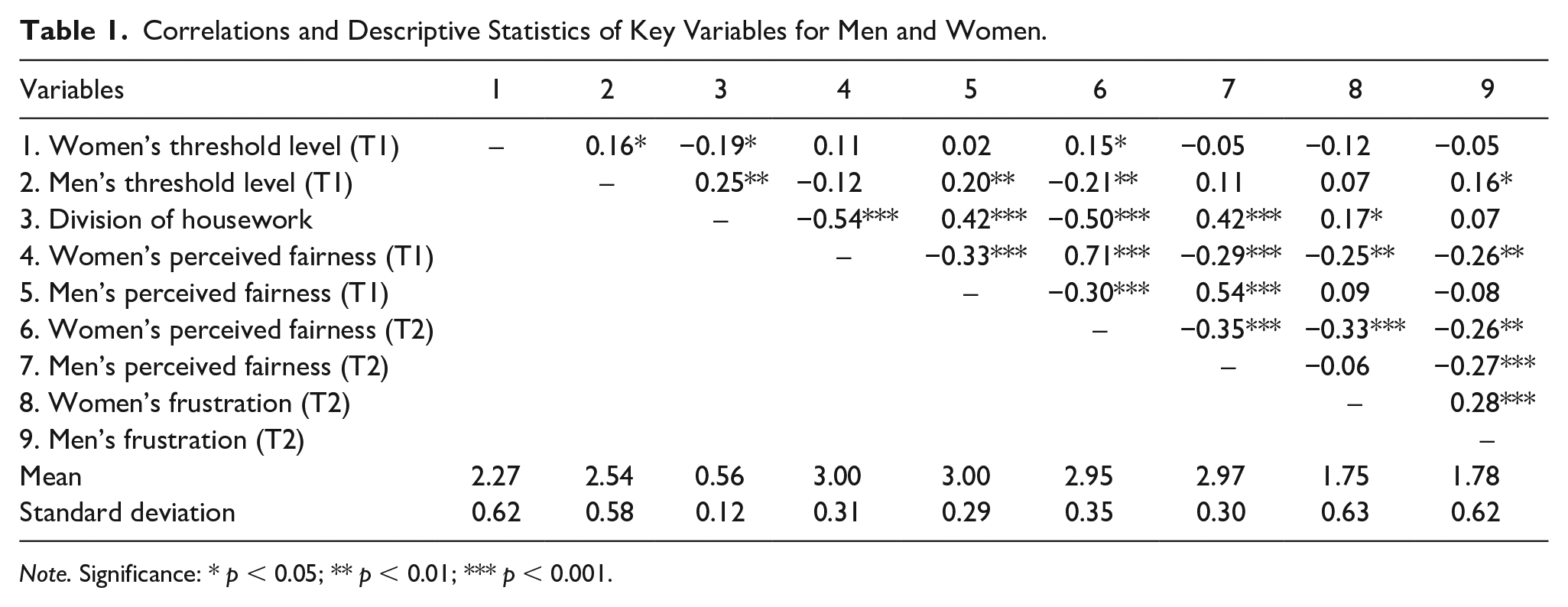
Note. Significance: * p < 0.05; ** p < 0.01; *** p < 0.001.
Finally, correlations between predicted variables and potential covariates were analyzed (not shown in Table 1). Only the presence of children was related to the proportion of housework performed by each partner (r = 0.18, p < 0.05), indicating that women complete a greater share of the housework when they have children at home, whereas men’s share tends to be smaller. Time availability, economic power, marital status, and length of relationship and cohabitation were not significantly associated with the key variables. For the sake of parsimony (Tabachnick & Fidell, 2013), analyses were conducted only with the inclusion of the presence of children as a covariate for the division of housework.
Model Testing
Path analysis in EQS 6.3 was used to investigate the dyadic pathway by which partners’ threshold levels for housework influence feelings of frustration with partners among couples. In doing so, the proposed longitudinal model was tested using the dyads, rather than individuals, as the units of analysis (Cook & Kenny, 2005). Partners’ threshold levels (pair of predictor variables) were allowed to correlate since the scores of dyad members were non-independent (Kenny et al., 2006; Ledermann et al., 2011). Similarly, covariances between the error terms of predicted variable pairs (perceived fairness at Time 1, perceived fairness at Time 2, and frustration with partner at Time 2) were permitted due to unmeasured common causes. Model fit was evaluated using local fit estimators and global fit indices. An acceptable global fit is indicated by a non-significant χ2 value, a goodness of fit index (GFI) and a comparative fit index (CFI) superior to 0.90, a standardized root mean square residual (SRMR) smaller than 0.08, and a root mean square error of approximation (RMSEA) smaller than 0.07 (Hooper et al., 2008).
The proposed meditational model linking partners’ housework threshold levels to frustration with the partner was tested. Based on the correlations between predicted variables and potential control variables, the presence of children was entered as a covariate for the division of housework. All paths were significant, with the exception of the path between men’s perceptions of fairness at Time 2 and their partner’s feelings of frustration, as well as the covariance between the error terms of dyad members’ perceptions of fairness at Time 1. Moreover, the model provided a good fit for the data for all global fit indices: χ2(28) = 23.09, p = 0.73, CFI = 1.00, GFI = 0.98, SRMR = 0.04, RMSEA = 0.00, [0.00, 0.04]. The model accounted for 13% of variance in division of housework; 17% and 29% of variance in men’s and women’s perceptions of fairness at Time 1, respectively; 33% and 52% of variance in men’s and women’s perceptions of fairness at Time 2, respectively; and 22% and 12% of variance in men’s and women’s frustration with the partner, respectively.
To evaluate the nature of the mediation effects, our model was compared with a more saturated model that estimated and tested all possible direct paths between threshold levels and feelings of frustration (Ledermann et al., 2011). The influence of threshold levels on feelings of frustration can either be completely mediated or partially mediated by housework allocation and perceived fairness. To support the hypothesis of complete mediation, the direct effects between our predictor and outcome variables in the more saturated model must be non-significant. It is also important, when evaluating the nature of the mediation effects, to compare the fits of the proposed model and the more saturated model using a chi-square difference test. Partial mediation is suggested by a significant chi-square difference test, whereas it is impossible to reject the hypothesis of complete mediation when the test is non-significant. The results of the current study seem to suggest complete mediation between threshold levels and feelings of frustration. More precisely, the more saturated model reveals non-significant direct effects between our predictor and outcome variables, and the chi-square difference test between the proposed and the more saturated models was non-significant, Δχ2(4) = 4.63, p > 0.05. These results suggest that the relationship between romantic partners’ threshold levels and their feelings of frustration could be fully mediated by the division of housework and perceptions of fairness.
Discussion
This study makes several important contributions to the literature by examining the intrapersonal, interpersonal, and mediating relationships underlying frustration with the partner relative to housework allocation. First, our results provide a better understanding of the link proposed by Alberts and colleagues (2011) between threshold levels and relational outcomes. More precisely, this study shows that threshold levels lead to feelings of frustration with the partner over a period of six months, through an unbalanced division of housework and perceptions of unfairness to self. The current dyadic design also allowed us to explore the presence of interdependence between partners in the pathway of influence from threshold levels to feelings of frustration with the partner. In this regard, our results suggest that each partner’s threshold level for housework is associated with the division of housework, which in turn, influences each partner’s actual perceptions of fairness regarding the housework arrangement and changes in their perceptions of fairness over a six-month period. Our dyadic analysis also indicates that romantic partners mutually influence each other’s feelings of frustration through their perceptions of fairness regarding the division of housework. These findings are further discussed below.
Although men’s and women’s roles in the professional and domestic spheres have greatly evolved over the past decades, women generally continue to spend more time on housework than do their partners. Alberts and colleagues (2011) suggest that the gender gap in the domestic sphere remains because women tend to be more bothered than men when tasks are not completed. Accordingly, the first goal of this study was to examine whether threshold levels are associated with the division of housework. Our preliminary analyses reveal that women generally have lower threshold levels and tend to dedicate more time to housework than do their partners. Results also support Hypothesis 1: Women’s lower threshold levels and men’s higher threshold levels are linked with women’s larger share of housework. More precisely, the amount of time women spend on household tasks is greater when their tolerance level for dirt and disorder is lower and when their partner’s tolerance is higher. In line with previous research, these results provide support that romantic partners with a lower tolerance for uncompleted tasks tend to take on a greater share of housework (Hawkins et al., 1995; Wong, 2012).
The second goal of this study was to investigate the associations between the division of housework and romantic partners’ perceptions of fairness over time. As predicted by Hypotheses 2 and 3, we found links between the division of housework and each partner’s perception of fairness at the first wave of data collection and each partner’s change in perception of fairness over the six-month period. In line with the findings of previous studies demonstrating that the allocation of tasks between partners is an important determinant of perceived fairness of household chores (Braun et al., 2008; Hawkins et al., 1995), these results reveal that the more housework one shoulders, the less fairness to self is perceived. As perceived inequity in romantic relationships often leads to negative emotions and reduction in satisfaction (Lively et al., 2010; Sprecher, 2018), our results underscore the fact that the division of housework remains an important issue to investigate.
The third goal of this study was to assess the consequences of perceived unfairness regarding the housework arrangement, by examining the intrapersonal and interpersonal relationships between perceptions of fairness and feelings of frustration with the partner. Our analyses reveal the presence of actor effects, thereby confirming Hypothesis 4. More precisely, our results indicate that men and women who perceive the housework arrangement as unfair to them report stronger feelings of frustration with their partner. This relates to Claffey and Manning’s (2010) argument that perceived fairness plays a key role in understanding the negative outcomes for an individual of an unbalanced division of housework. Our findings suggest that individuals who perceive being disadvantaged by the housework arrangement tend to feel exploited and less appreciated by their partners; they feel that their partners are inconsiderate and resent them for not taking their concerns seriously and not understanding their needs. In order to gain a better understanding of the mutual influence that romantic partners exert on each other, the current study extended prior work on housework allocation by also examining the partner effects of perceived fairness on feelings of frustration. Women’s results, but not men’s, are consistent with Hypothesis 5. Partner effects indicate that men reported stronger feelings of frustration when their partner perceived the housework arrangement as unfair to them. However, men’s perceptions of fairness are not linked to their partner’s feelings of frustration.
We believe that this gender difference may be due to the tendency for men and women to demand changes over the division of housework. More precisely, the equity theory postulates that partners who feel a relationship is unfair to them are likely to experience negative emotions such as anger and resentment (Hatfield et al., 2011; Walster & Walster, 1975). This theory also suggests that romantic partners in inequitable relationships often attempt to restore equity in order to reduce their negative emotional experiences. Accordingly, individuals who are discontented with their share of housework may try to restore balance in the home by persuading their partner to perform more tasks. Prior studies found that women tend to demand more changes than men over the division of housework because they are often the ones shouldering the brunt of the housework (Eldridge et al., 2007). Kluwer et al. (1997) results also suggest that men often resist changes requested by their partners, as they tend to be advantaged by the housework arrangement and they want to maintain the status quo. Interactions in which one partner is feeling pressured to change yet chooses to resist these changes have been linked to relational conflicts and marital dissatisfaction (Charbonneau et al., 2019; Gottman & Levenson, 2000; Kluwer et al., 1997). Thus, we believe that women’s attempts to restore balance in housework allocation by demanding and pressuring can become a source of frustration for their partners. On the other hand, men’s perceptions of fairness may not be linked to their partner’s feelings of frustration because they tend to be advantaged by the division of housework, and therefore, make fewer attempts to convince their partner to increase their involvement in housework.
The final goal of our study was to investigate the pathway between threshold levels and relational outcomes proposed by Alberts and colleagues (2011). Consistent with Hypothesis 6, our study supports that an unbalanced division of housework and perceptions of unfairness to self mediate the effect of partners’ threshold levels on their own and their partner’s feelings of frustration. These results extend the premises of Alberts and colleagues’ (2011) integrative theory of the division of housework. Their theory postulates that partners who differ in terms of their tolerance levels for dirt and disorder would experience more relational conflict. Adding to their theory, this study documents the mediating roles of housework allocation and perceptions of fairness in the pathway between threshold levels and negative outcomes. Such knowledge is important in understanding the process of relationship inequalities.
Implications
Knowledge about the salience of threshold levels in the division of housework adds to an important line of inquiry in the housework literature and may be useful in building a more complete theoretical model of gender inequalities in the homes of the younger generations. Indeed, expectations for romantic relationships have changed over the last decades (Gerson, 2010), and researchers have been suggesting that the three main theoretical perspectives that account for imbalances in the division of household labor among well-established couples (time availability, relative resources, and gender ideology; Davis & Wills, 2014) may not reflect gender relations among new generations (Geist & Ruppanner, 2018). In line with Alberts and colleagues’ (2011) integrative theory of the division of housework, our results suggest that tolerance levels for dirt and disorder may help researchers gain a better understanding of the dynamics of contemporary romantic relationships. Data reported in this study also add to Alberts and colleagues’ (2011) theory by giving new insights into the process through which threshold levels influence relationship outcomes. Individuals may feel frustrated with their partner, not directly because of their differing threshold levels but rather because these levels of tolerance influence the division of housework and each partner’s perceived fairness of their romantic relationship. Moreover, our investigation of issues of interdependence with regard to perceived fairness highlights the importance for future research to adopt a dyadic approach when studying housework allocation. To better understand the challenges romantic partners face regarding the division of housework and to help them overcome these challenges, researchers must take into account that relationship interactions and their consequences on relational outcomes depend on both partners’ preferences and perceptions.
From a clinical point of view, our results suggest that it is important for educational programs about healthy romantic relationships to include information on the potential effects of romantic partners’ threshold levels on relationship behavioral dynamics and relational well-being. Bianchi and colleagues (2000) posited that women may be more concerned about the cleanliness of their home, as they may feel it reflects on their own competence but not on their partner’s, due to gendered expectations and social norms about housework. In that respect, educators could invite romantic partners to explore the foundations of their cleanliness preferences and encourage them to share ideas and skills with the goal of achieving relationship equity. Romantic partners must also be aware that inequalities in the home are important sources of conflict in cohabiting emerging adult couples, and that such inequalities can negatively affect both partners’ relational well-being. Educational programs can serve as an opportunity to help couples understand how partners mutually influence each other and the benefits of achieving equality in the home. Educators could also teach romantic partners how to work together to negotiate an arrangement that satisfies both parties.
Limitations and Future Research
Some limitations should also be noted. First, the longitudinal nature of this study may be both a strength and a limitation. Changes not accounted for in the study may have occurred over the six-month period, such as job changes and new sources of stress (e.g. a move, planning a wedding). Similarly, our longitudinal model did not take into account the fact that threshold levels may vary over time. Alberts and colleagues’ (2011) theory suggests that the influence of threshold levels on housework allocation is greater when behaviors are being established among couples, as housework patterns often become routines over time. Yet, we acknowledge the possibility that changes in threshold levels could be linked to changes in housework allocation, perceptions of inequity, and feelings of frustration. Second, participants were all emerging adults living in Canada, which limits the generalizability of our results. Our findings may differ in other birth cohorts and cultures, as social, political, and cultural forces influence the way individuals behave and perceive inequalities in their home (Lachance-Grzela & Bouchard, 2010). It could also be interesting for subsequent longitudinal research to explore the pathway from threshold levels to relational outcomes, while considering who benefits from the tasks being performed. Indeed, some household tasks, such as running errands and managing finances, may, in some cohabiting emerging adult couples, primarily benefit one partner. The time partners dedicate to tasks that only they will benefit from may not be linked to perceptions of fairness and feelings of frustration. Furthermore, although our results provided support for the proposed model of feelings of frustration with the partner, an important proportion of the variance of feelings of frustration remained unexplained. Future research should expand upon our results by investigating whether the proposed model could better predict frustration about household allocation specifically, rather than general frustration with the partner. Finally, an important next step would be to investigate the gender differences revealed by the partner effects between perceived fairness and feelings of frustration. If the gender differences found in the current study can be explained by the patterns of demands and resistance among couples, it could be interesting to explore the optimal way for romantic partners to initiate the housework negotiation process when inequity is perceived.
Conclusion
Despite these limitations, the current study contributes to the further understandsing of the persistent gender gap in the home and of its consequences, by documenting the overlooked indirect effects of threshold levels on feelings of frustration among emerging adult couples. It is of interest to understand the factors that are associated with feelings of frustration with a romantic partner and the context in which these feelings occur, with the goal of increasing relationship quality. In this regard, the current study supports the mediating roles of housework allocation and perceived fairness in the pathway from threshold levels to relational outcomes, using dyadic data from romantic partners. These findings have relevant implications for academics (by giving new insights into the process through which cleanliness preferences influence relationship outcomes) and for professionals (who may integrate information about the influence of relationship perceptions on relationship functioning into couples counseling).
Footnotes
Acknowledgements
We would like to thank Meghan Beaudin, Josée Boudreau, Jolène Doucet, Colombe Mazerolle, Karine Roy, Manon Vautour, and Mylène Richard for their help with data collection.
Declaration of Conflicting Interests
The authors declared no potential conflicts of interest with respect to the research, authorship, and/or publication of this article.
Funding
The authors disclosed receipt of the following financial support for the research, authorship, and/or publication of this article: This research was supported by a Joseph-Armand Bombardier CGS Doctoral Scholarship.
