



Abstract
Nonresident fathers have been shown to have much higher psychological distress than married parents with rates similar to or higher than those of single mothers. This study explores how aspects of the father–child relationship influence nonresident fathers’ psychological distress using the 1997 Child Development Supplement of the Panel Study of Income Dynamics. Using a structural equation model, this study finds that, other than being married, only father–child relationship quality has a direct influence on nonresident fathers’ psychological distress. Conflict with the mother, talking to the child, and the salience of the fatherhood role all influence psychological distress indirectly through father–child relationship quality.
Keywords
Nearly half of White children and two-thirds of African American children will spend part of their childhood with at least one parent (usually the father) residing in a separate residence from them (Teachman, Tedron, & Crowder, 2000). Approximately 24% of African American fathers aged 15 to 44 have a nonresident minor child, and 8% of non-Hispanic White fathers aged 15 to 44 have a nonresident minor child (Stykes, 2012). Despite the prevalence of this role in society, little research has considered the factors that influence the well-being of nonresident fathers.
Previous research indicates that parents have higher psychological distress and mental health problems than nonparents (Evenson & Simon, 2005; McLanahan & Adams, 1987; Ross & Huber, 1985; Ross & Van Willigen, 1996; Umberson, Pudrovska, & Reczek, 2010). However, psychological distress and mental health problems are particularly high for nonresident fathers (Evenson & Simon, 2005; Hughes, 1989; Nomaguchi & Milkie, 2003; Umberson & Williams, 1993). Despite this consistent finding, little research has explored the processes behind nonresident fathers’ high levels of psychological distress. That is, which aspects of this role put nonresident fathers at risk for psychological distress? Additionally, what circumstances help alleviate this distress? This research will address these issues by exploring how the quality and characteristics of the father–child relationship with nonresident children influence nonresident fathers’ psychological distress. Key issues are how proximity, contact with nonresidential children, fatherhood role salience, conflict with resident mothers, and father–child relationship quality influence nonresident fathers’ psychological distress.
Explaining Nonresident Fathers’ Psychological Distress
The reasons behind nonresident fathers’ high levels of psychological distress are unclear. Determining the factors behind these high distress levels is critical for any attempt to improve the well-being of nonresident fathers who comprise an increasing percentage of fathers in the United States (Stykes, 2012). This study explores whether the factors of low proximity, low contact, relationship ties to a spouse or additional children, low fatherhood salience, and conflict with the biological mother are related to nonresident fathers’ psychological distress.
Nonresident fathers face the challenge of not living with their children, which may decrease their proximity to, and thereby their contact with, their nonresident children. Nonresident fathers who live closer tend to have greater contact with their nonresident children including phone or letter contact (Cooksey & Craig, 1998; Stewart, 1999) and in-person visits (Cooksey & Craig, 1998; Manning & Smock, 1999; Manning, Stewart, & Smock, 2003; Seltzer, 1991; Stewart, 1999). Nonresident fathers who live farther away are more likely to have low-stable, high-decreasing, or low-increasing contact rather than high-stable contact with their nonresident children (Cheadle, Amato, & King, 2010). Moreover, nonresident fathers who live closer to their nonresident children are more likely to participate in childrearing decisions (Seltzer, 1991). Furthermore, talking to the child is related to higher nonresident father–child relationship quality (Arditti & Keith, 1993; King, 2006). Thus, nonresident fathers who live farther away from their nonresident children are expected to spend fewer days and to talk less frequently with them, which in turn are associated with lower father–child relationship quality.
Nonresident fathers with additional relationship commitments, such as having a current spouse who is not the mother of the nonresident child, may have difficulty maintaining contact and involvement with their nonresident children, which may increase their psychological distress. Even though being married is generally associated with higher psychological well-being (Williams, 2003), single nonresident fathers who married had fewer significant gains in mental health (Meadows, 2009). Furthermore, married nonresident fathers tend to have lower visitation (Manning & Smock, 1999; Seltzer, 1991; Stewart, 1999) and decreased probabilities of participating in childrearing decisions (Seltzer, 1991). Fathers of nonmarital births who had new partners saw their nonresident children about two fewer days per month than fathers without new partners (Tach, Mincy, & Edin, 2010). Thus, it is expected that although marriage may be directly, inversely associated with nonresident fathers’ psychological distress (Williams, 2003), marriage will be associated with fewer days spent with their nonresident children.
Moreover, a new marriage may decrease nonresident father contact and involvement even more when the nonresident father has additional children, especially when a nonresident father has a new biological child (Manning & Smock, 1999). Indeed, nonresident fathers who have biological children in their home are less likely to see or talk often with their nonresident children (Cooksey & Craig, 1998). Thus, it is expected that married nonresident fathers will be more likely to have other children who do not live with their nonresident children, thereby decreasing how often fathers talk with their nonresident children. Marriage may also decrease fatherhood salience because of additional role commitments. This expectation seems to be supported by remarried or cohabiting nonresident fathers being more likely than single nonresident fathers to report that fatherhood is not as manageable for them (Seltzer & Brandreth, 1994).
Fatherhood role salience may be a determinant of nonresident fathers’ involvement with their nonresident children. On the one hand, the fatherhood role should be quite salient because nonresident fathers have biological ties to their nonresident children, resulting in them having a biological imperative to be involved in order to further their genetic line (Davis & Daly, 1997; Emlen, 1995). On the other hand, because they do not live with their children, nonresident fathers have more difficulty maintaining contact with their nonresident children, so nonresident fathers who do not value the fatherhood role may be particularly likely to lose contact with their nonresident children. Fatherhood salience has not been explored for nonresident fathers but has been explored for resident fathers. Resident biological fathers who have higher parental role salience are more likely to be vulnerable to parental role strains (Simon, 1992). Moreover, role ideologies, such as egalitarian role ideologies, are related to fatherhood involvement including having greater breath of involvement and spending more hours with their children (Bulanda, 2004). Additionally, nonresident father’s involvement with decision-making when the child was an adolescent is associated with higher contact when the child is a young adult (Aquilino, 2006). Thus, as research shows that fathers who value involvement tend to be more involved, it is expected that higher fatherhood salience will be associated with spending more days with nonresident children, talking more with nonresident children, and higher father–child relationship quality.
Some nonresident fathers experience high levels of conflict with resident mothers. A greater amount of contact with the nonresident child is positively correlated with higher conflict between parents (Amato & Rezac, 1994; Sobolewski & King, 2005). However, conflict over childrearing is positively related to coparenting, which is also positively related to father–child contact and relationship quality (Sobolewski & King, 2005). These associations could be due to increased contact with the biological mother and an increased interest in being actively involved with parenting decisions resulting in greater conflict between parents. Thus, both spending more days with the nonresident child and higher fatherhood salience are expected to be positively associated with conflict, which is expected to be associated with poorer father–child relationship quality.
Despite the many barriers to nonresidential fatherhood, some factors of nonresidential fatherhood may be beneficial for nonresident fathers’ well-being, such as having a high-quality relationship with their nonresident children. Nonresident fathers vary in the quality of relationships they have with their nonresident children. Higher frequency of contact with nonresident children is associated with higher quality relationships (Arditti & Keith, 1993; King, 2006). Higher quality parent–child relationships are beneficial for parents (Umberson, 1989), although this relationship needs to be explored specifically for nonresident fathers. Therefore, it is expected that spending more days and talking more with nonresident children will be associated with higher father–child relationship quality, which will in turn be associated with lower nonresident fathers’ psychological distress. Furthermore, it is important to consider whether only relationship quality matters or both quality and quantity, as indicated by contact with children, decrease nonresident fathers’ psychological distress.
Although in many cases African American and White nonresident fathers are very similar, some research finds differences between African American and White nonresident fathers’ involvement. For example, African American nonresident fathers have higher visitation (Manning & Smock, 1999; Seltzer, 1991; Thomas, Krampe, & Newton, 2007) and are more likely to participate in childrearing decisions (Seltzer, 1991). Other research, though not finding significant differences for contact, found that African American nonresident fathers had higher levels of closeness with their adolescent children, once socioeconomic status and demographic differences were controlled (King, Harris, & Heard, 2004). In addition, African American men are not only more likely to have a higher number of children than Whites but are also more likely to have them with multiple partners (Guzzo & Furstenberg, 2007; Manlove, Logan, Ikramullah, & Holcombe, 2008). Thus, it is expected that nonresident African American fathers would not only have greater contact and higher relationship quality but also would be more likely to have other children who did not live with the nonresident child.
Socioeconomic status of the nonresident father could influence father–child relationships. Higher socioeconomic status, as indicated by income and education, is associated with increased visitation frequency (Arditti & Keith, 1993). However, results considering income and education separately are somewhat mixed, especially regarding income. Some research shows that income is not a predictor of contact with the nonresident child (Cooksey & Craig, 1998; Stewart, 1999), but other research shows that income is associated with increased contact (Stephens, 1996) and visitation (Stewart, 2010). Results for education have been more consistent. Education has been shown to be positively associated with the breadth of father involvement among married biological fathers (Bulanda, 2004). Additionally, nonresident fathers’ education is also positively associated with contact with nonresident children (Amato & Rezac, 1994; Arditti & Keith, 1993; Cooksey & Craig, 1998; Stephens, 1996). These findings indicate that higher socioeconomic status should be associated with spending more days with nonresident children. However, higher socioeconomic status might also be associated with living farther away from nonresident children, because men gain more income from moving (Cooke, 2003). On the other hand, higher-income fathers may be more able to afford longer distance travel to see their children, although this will probably not fully overcome the disadvantages of low proximity. Men of higher socioeconomic statuses tend to have fewer children and are less likely to have them with multiple partners than men of lower socioeconomic statuses (Guzzo & Furstenberg, 2007). Last, socioeconomic status has a strong relationship with mental well-being (Eaton, Mutaner, & Sapag, 2010). Thus, nonresident fathers with higher socioeconomic statuses are expected to live farther away from their nonresident child, spend fewer days with the nonresident child, have more children who do not live with the nonresident child, and have lower psychological distress.
The full conceptual model is shown in Figure 1. Miles and other child(ren) are treated as endogenous independent variables, because they are expected to be influenced by other variables—socioeconomic status for miles and socioeconomic status, race, and married for other child(ren). They are also unique aspects of nonresidential fatherhood. Although all paths are expected to be recursive, nonrecursive paths will be explored to determine whether reverse causation is a factor. The data are cross-sectional, so reverse causation is still a potential limitation, even if the nonrecursive paths are not significant.

Conceptual model.
Method
Data Set
The data set used in this analysis is the 1997 Child Development Supplement of the Panel Study of Income Dynamics. The Panel Study of Income Dynamics has been administered since 1968 to a nationally representative sample of families and a sample of low-income families. In 1997, data were collected on randomly selected children ages 0 to 12 years. The surveys were administered to their primary caregiver and their other caregiver where applicable. Interviews were completed with 3,563 children 0 to 12 years old. The response rate was 88%. The 1997 Child Development Supplement is particularly appropriate to address this research issue, because it had a special survey that was administered specifically to nonresident fathers. Nonresident fathers were contacted based on information provided by the resident mother. Of those with correct and available contact information, 64% agreed to participate in the survey. The full sample size for nonresident fathers was 284, but some questions were not asked of fathers who did not maintain contact with the nonresident child, resulting in a sample size of 228. With adjustments for missing data, the total sample size for the current study is 206.
Dependent Variable
Psychological Distress
Nonresident father’s psychological distress is an index created from 10 items of depressive and anxiety symptoms. For example, these items indicated how often in the past 30 days, the respondent felt “nervous,” “so sad nothing could cheer you up,” and “that everything is an effort.” Responses range from 1 = None of the time to 5 = All of the time. Responses were averaged to create the index with a Cronbach’s α of .807.
Endogenous Independent Variables
Miles and Other Child
Two characteristics of the nonresident father that could influence the father–child relationship—miles and other child—are included. Miles is the number of miles the nonresident father lived away from the nonresident child. Other child is a dichotomous dummy variable indicating whether the nonresident father (1) does or (0) does not have other children who live separate from the nonresident child.
Contact
Two measures indicate how much contact the nonresident father has with the child—days of contact and talk with the child. The Days variable is indicated by a question asking, “In 1996 about how many days did (CHILD) actually spend with you?” Responses are in total number of days for the year. Talk to child is measured by an item that is indicated by the response to the question, “How often do you see or talk with (CHILD)?” Responses range from 1 = Never to 7 = Several times a week.
Salience of Fatherhood Role
The salience or importance of the fatherhood role is indicated by the following question: “Being a father and raising children is one of the most fulfilling experiences a man can have.” Responses range from 1 = Strongly disagree to 4 = Strongly agree.
Conflict With Mother
Conflict with the mother is measured by how often conflict occurs over how the child is raised. Responses range from 1 = Never to 4 = Often.
Father–Child Relationship Quality
Father–child relationship quality is indicated by one question asking the nonresident father to rate the quality of the child’s relationship with him. Responses range from 1 = Poor to 4 = Excellent.
Exogenous Control Variables
Several control variables are included to adjust for potential spurious effects including socioeconomic status (measured by two items, education and household income), race, and marital status. Education is indicated in years and household income in thousands of dollars (logged). Race (African American = 1; not African American = 0) and marital status (currently married = 1; not currently married = 0) are both coded as dummy variables.
Analytic Strategy
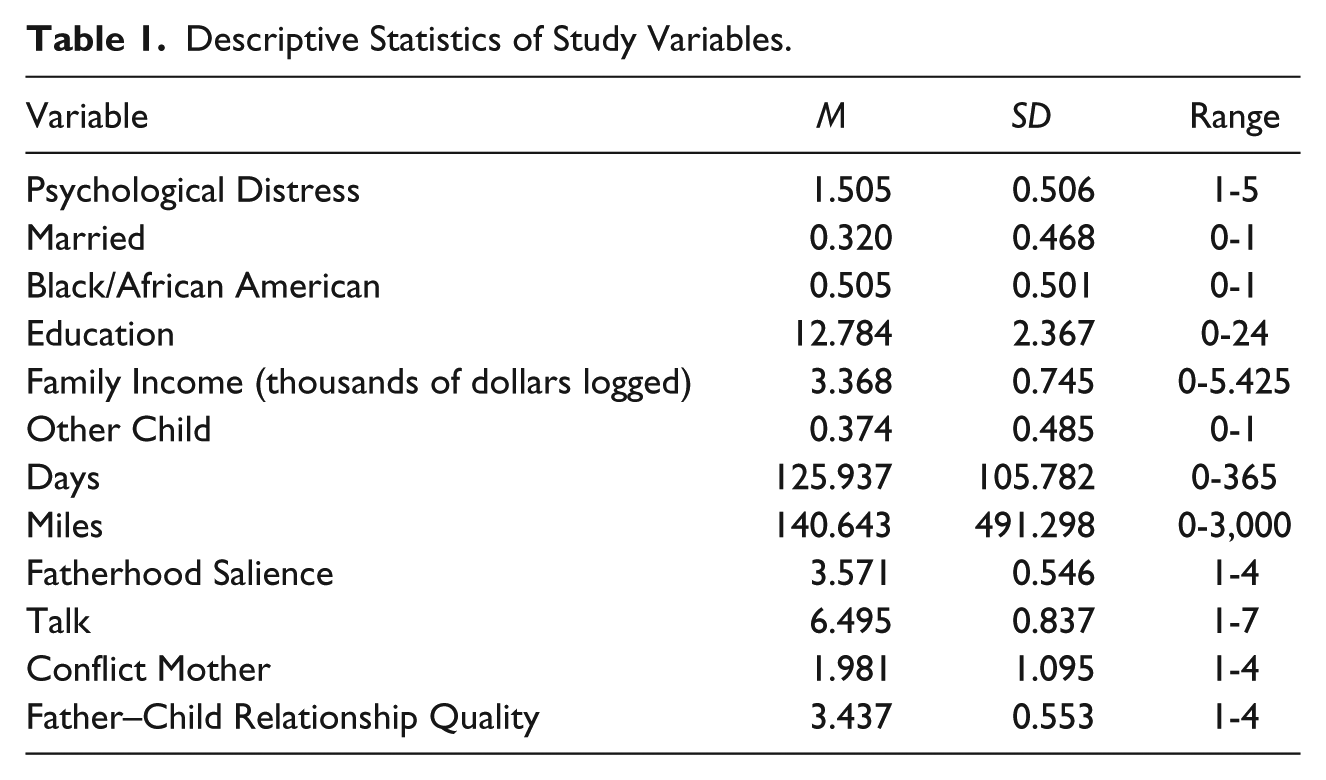
The analysis was conducted using AMOS to fit the structural equation model. Structural equation modeling is an appropriate technique for this study, because both direct and indirect pathways are explored, and many of these associations are expected to be indirect. All hypothesized relationships included in Figure 1 were explored. This initial model was not an adequate model, as indicated by the fit statistics. To improve model fit, paths that were not significant were eliminated. Model fit was still not ideal, so additional paths were explored. This resulted in one additional path being added to the model—the path from days to fatherhood salience. Thus, the final model includes only parameters that were significant at the .05 level. The descriptive statistics for the study variables are shown in Table 1.
Descriptive Statistics of Study Variables.
Results
Bivariate Correlations
Table 2 shows the bivariate correlations between the study variables. Bivariate correlations indicate that most of the variables in the study are not directly related to nonresident fathers’ psychological distress. Only being married is negatively correlated with nonresident fathers’ psychological distress. Furthermore, father–child relationship quality has a weak, inverse correlation with nonresident fathers’ psychological distress. None of the other father–child relationship variables are correlated with nonresident fathers’ psychological distress.
Bivariate Correlations of Study Variables.
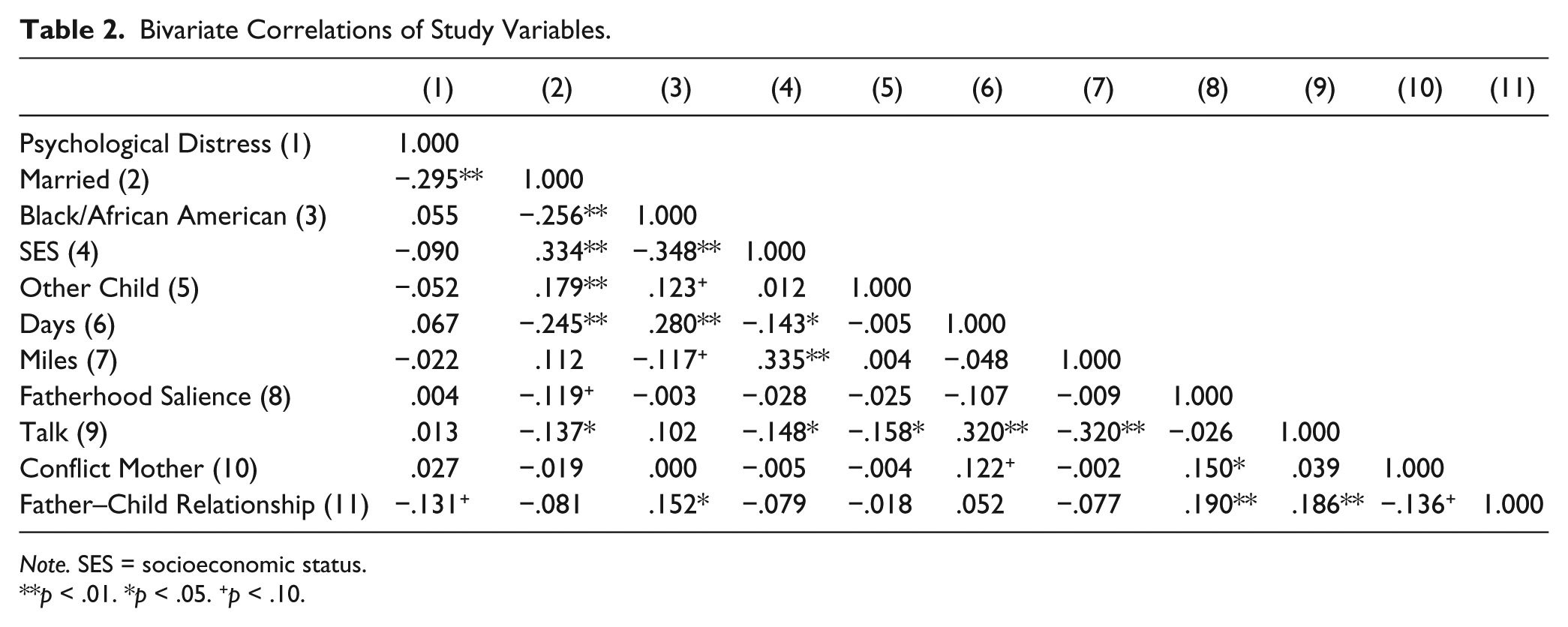
Note. SES = socioeconomic status.
p < .01. *p < .05. +p < .10.
However, several of the variables are correlated with father–child relationship quality. African American nonresident fathers report higher father–child relationship quality than other nonresident fathers. Fatherhood salience and the frequency of talking to their children are positively associated with father–child relationship quality, whereas conflict with mothers is negatively correlated with father–child relationship quality.
Structural Equation Model
Figure 2 shows the standardized effects for the final model. Figure 2 indicates that the exogenous control variables are correlated with each other. African American nonresident fathers are less likely to be married and to be of a higher socioeconomic status, and being married is positively correlated with socioeconomic status. These exogenous control variables are related to the endogenous variables. Higher socioeconomic status is positively associated with the number of miles that fathers live away from their nonresident children, but higher socioeconomic status fathers are less likely to have other children not living with their nonresident children. African American fathers report more days spent with their nonresident children and higher relationship quality. Married nonresident fathers are more likely to have other children not living with their nonresident children and report lower fatherhood salience and fewer days spent with their nonresident children. Finally, being married has a direct, negative association with nonresident fathers’ psychological distress.
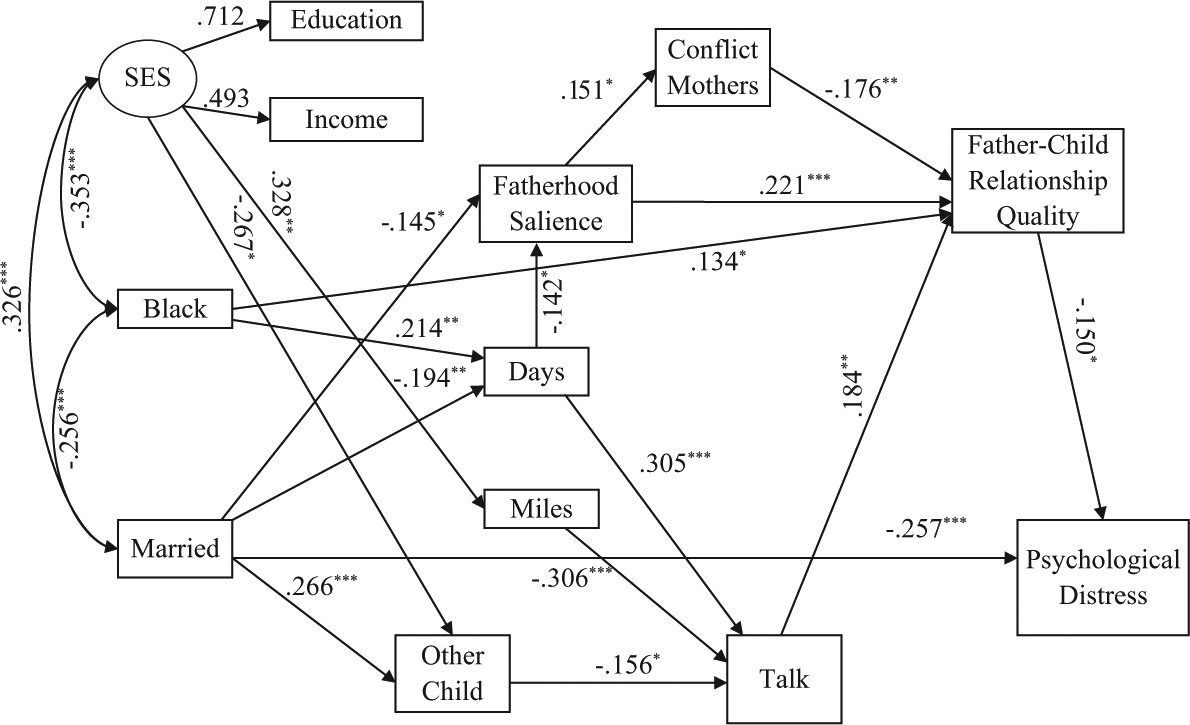
Structural equation model for the effect of father salience, conflict with mothers, father–child relationship quality on the psychological distress of nonresident fathers.
Both having other child(ren) and living more miles away from their nonresident children are inversely associated with talking with nonresident children. Fathers who spend more days with their nonresident children are more likely to talk often with their nonresident children. Contrary to expectations, spending more days with nonresident children is associated with lower fatherhood salience. As expected, higher fatherhood salience is positively associated with conflict with mothers. Talking more often with their nonresident children is positively associated with father–child relationship quality. Higher fatherhood salience also has a direct, positive association with father–child relationship quality, whereas experiencing conflict with resident mothers is negatively associated with father–child relationship quality. Therefore, fatherhood salience has a direct, positive relationship with father–child relationship quality, whereas it has an indirect, negative relationship with father–child relationship quality through conflict.
Higher quality father–child relationships are directly, inversely associated with nonresident fathers’ psychological distress. Other aspects of the father–child relationship are only indirectly related to psychological distress through the quality of the father–child relationship. For instance, talking more often with their nonresident children has an indirect, negative association with psychological distress through its positive association with father–child relationship quality. Furthermore, experiencing conflict with mothers has an indirect, positive association with nonresident fathers’ psychological distress through its negative association with father–child relationship quality. Some variables have both positive and negative associations with nonresident fathers’ psychological distress. For example, fatherhood salience is associated with higher nonresident fathers’ psychological distress by being positively associated with conflict, whereas fatherhood salience is associated with lower psychological distress by being positively associated with father–child relationship quality. Thus, it is important to consider both the direct and indirect associations of these variables with nonresident fathers’ psychological distress.
Direct, Indirect, and Total Effects on Relationship Quality and Psychological Distress
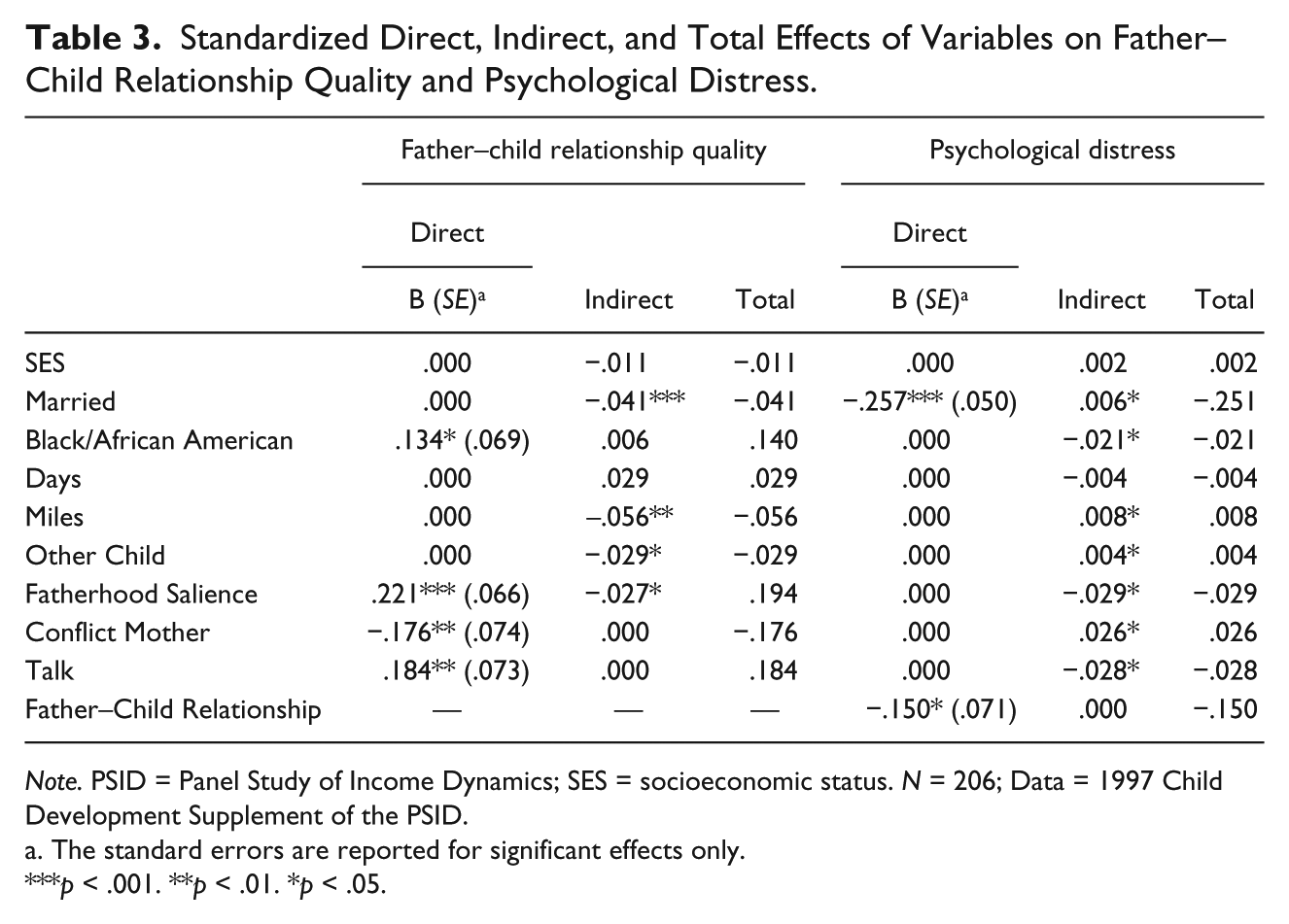
Table 3 shows the standardized direct, indirect, and total effects for the influence of the study variables on father–child relationship quality and nonresident fathers’ psychological distress. Nonresident fathers who are married, have other children, or live farther away from their nonresident child are more likely to have lower father–child relationship quality, although these associations are indirect and weak. Talking more often to their children and having conflict with mothers have more moderate, direct associations with father–child relationship quality, although the former is a positive association, and the latter is a negative association. Race has a significant direct association in which African American fathers report higher father–child relationship quality. Fatherhood salience has both direct and indirect associations with father–child relationship quality, although the indirect association is weak. Nonresident fathers with high fatherhood salience are more likely to have higher quality father–child relationships, although a weak, indirect, negative association partially counteracts the direct, positive association.
Standardized Direct, Indirect, and Total Effects of Variables on Father–Child Relationship Quality and Psychological Distress.
Note. PSID = Panel Study of Income Dynamics; SES = socioeconomic status. N = 206; Data = 1997 Child Development Supplement of the PSID.
The standard errors are reported for significant effects only.
p < .001. **p < .01. *p < .05.
Many of the variables have weak, indirect associations with nonresident fathers’ psychological distress including married, race (African American = 1), miles, other child, fatherhood salience, conflict with the mother, and talking with the child. All of these are positive associations except for race (African American = 1), fatherhood salience, and talking with the child, which are negatively associated with nonresident fathers’ psychological distress. The magnitude of the indirect associations for miles, other child, and married are so weak as to be inconsequential for nonresident fathers’ psychological distress. There are two relatively strong associations as well. First, father–child relationship quality has a direct, negative association with nonresident fathers’ psychological distress. Being married has a direct, negative association with nonresident fathers’ psychological distress and a negligible, positive, indirect association for a substantial, negative, total association.
Discussion
Although much research finds that nonresident fathers have high levels of psychological distress (e.g., Evenson & Simon, 2005; Hughes, 1989; Nomaguchi & Milkie, 2003; Umberson & Williams, 1993), little research has explored the reasons behind these high levels with the exception of Umberson and Williams (1993), which indicated that these differences occurred because nonresident fathers have higher levels of parental role strain. Nonresident fathers may have higher strain and psychological distress levels because of the unique challenges of the nonresident father role. This study determined how aspects of the father–child relationship influence nonresident fathers’ psychological distress.
Nonresident fathers do not live with their children, so low proximity is a potential barrier to nonresident father–child relationships. Indeed, this study finds that living farther away from their nonresident children has a weak, negative association with father–child relationship quality through its negative association with talking with their nonresident children. However, proximity only has an indirect and negligible association with nonresident fathers’ psychological distress. Thus, proximity may influence father–child relationship quality but does not influence nonresident fathers’ psychological distress.
Nonresident fathers who form new family relationships face additional challenges for maintaining their relationships with their nonresident children. Nonresident fathers who are married are more likely to have other children, tend to spend fewer days with their nonresident children, and have lower fatherhood salience. These factors result in the marriage having a small, indirect, positive association with nonresident fathers’ psychological distress. Alternatively, being married itself has a substantial, direct, inverse association with nonresident fathers’ psychological distress, which could be due to marriage acting as a stress buffer by being a substantial source of social support (Turner & Marino, 1994). Thus, on the whole, marriage is beneficial for nonresident fathers.
Fatherhood role salience has both positive and negative associations with nonresident fathers’ psychological distress, as it is associated with more conflict with mothers and higher father–child relationship quality. Fatherhood role salience likely increases conflict with mothers, because fathers who want to be involved with their children are more likely to argue with resident mothers regarding decisions about their nonresident children. Thus, because of increased conflict with mothers, fatherhood role salience is indirectly associated with higher nonresident fathers’ psychological distress, which offsets some of the benefits of fatherhood role salience for nonresident fathers’ well-being. In addition, a surprising finding is that spending more days with the nonresident child is associated with lower fatherhood salience. This result could occur because nonresident fathers who spend more time with their nonresident children may be less likely to idealize the fatherhood role and thus have a more realistic view of the difficulties and effort involved in maintaining high-quality father–child relationships.
Conflict with mothers is associated with decreased father–child relationship quality. Moreover, through decreased relationship quality, conflict with the mother has a weak, positive association with nonresident fathers’ psychological distress. Even though this association is found to be weak, this data has a limitation that may result in the current research study being a particularly stringent test of the association between conflict and psychological distress. Fathers who were not involved with their nonresident children are probably less likely to respond to the survey and be included in the data. It is also possible that fathers with particularly high conflict may be less likely to remain in contact with their nonresident children (Arendell, 1992). Thus, the associations between conflict, relationship quality, and nonresident fathers’ psychological distress need to be explored more in future research, as nonresident fathers with the highest amounts of conflict may be less likely to respond to the survey in the first place.
Father contact (as indicated by talking with the nonresident child) and father–child relationship quality are both negatively associated with nonresident fathers’ psychological distress, although the total association between contact and psychological distress is weak and indirect. Even though spending more days with nonresident children is not related to psychological distress, it is positively associated with talking often with nonresident children, which in turn has a negative association with nonresident fathers’ psychological distress. This result supports the contention that nonresident fathers’ involvement and relationship quality with their nonresident child is important for nonresident fathers’ well-being. These results also seem to indicate that quality matters more for well-being than quantity, as relationship quality has a larger influence on nonresident fathers’ psychological distress and even mediates the association between contact and nonresident fathers’ psychological distress. However, the data may be biased toward finding beneficial associations for greater involvement and higher relationship quality, because fathers who are not involved with their nonresident children may be less likely to respond to the survey. Thus, future research should explore this issue with longitudinal data to determine how much of this association is due to this potential selection effect.
Race influenced these relationships mostly in expected ways, but socioeconomic status did not have a significant impact on father–child relationship quality or nonresident fathers’ psychological distress. Moreover, African American fathers reported that they spent more days with their nonresident children and reported higher relationship quality. Although these differences could be perceptual, they match previous research on differences between African American and White nonresident fathers’ involvement (e.g., King et al., 2004; Manning & Smock, 1999; Seltzer, 1991; Thomas et al., 2007).
There are several limitations to this research. First, although the data is one of the few to target nonresident fathers, the sample size is still relatively small. The small sample size makes it more difficult to detect significant associations. A small sample size also makes it more difficult to determine whether there are racial and ethnic differences in these relationships, as there are a limited number of respondents in each racial or ethnic group. In particular, only distinctions for African Americans could be explored independently of other groups, but sample sizes were not sufficient to determine differences for Hispanics and Asian Americans. As was previously mentioned, sample selection could be influencing the associations, because nonresident fathers who have no contact and/or interest in their nonresident children were less likely to respond to this survey, potentially biasing the results toward supporting the predicted research model. Furthermore, many of the variables are measured by single-item measures, which may make the results less reliable and valid. Additionally, the data is cross-sectional, which leads to the potential problem of reverse causation. Although nonrecursive paths were tested and none were significant, reverse causation might not be detected, because all variables are measured concurrently. Future research should explore whether prior conflict with resident mothers and prior low father–child relationship quality decreases nonresident fathers’ current levels of involvement. In addition, future research should explore whether nonresident fathers who have prior high levels of psychological distress have low current involvement and report lower father–child relationship quality. Longitudinal data would be helpful in exploring the stability and change in these relationships over time.
In conclusion, this study indicates that father–child relationships have a significant impact on nonresident fathers’ psychological distress. In particular, having a high-quality relationship with their nonresident children is associated with lower psychological distress for nonresident fathers. Other aspects of the father–child relationship including talking with the child and fatherhood role salience also have weak, indirect, negative associations with nonresident fathers’ psychological distress. Although much research explores the influence of nonresident father involvement on the well-being of nonresident children (e.g., Amato & Gilbreth, 1999; Amato & Rezac, 1994; King, 2006; White & Gilbreth, 2001), this previous research misses a crucial part of the overall picture by not exploring the ramifications of the nonresident father–child relationship for the well-being of the nonresident fathers themselves.
Footnotes
Declaration of Conflicting Interests
The author(s) declared no potential conflicts of interest with respect to the research, authorship, and/or publication of this article.
Funding
The author(s) received no financial support for the research, authorship, and/or publication of this article.