



Abstract
Ethnic–racial identity (ERI) development is important for ethnic–racial minority youth because of its association with their positive adjustment. Guided by Garcia Coll’s ecocultural framework and using survey data from 729 Black college students, we examined the associations between relationships with parents (i.e., disrespect, psychological control, nurturance, and connection), ethnic–racial socialization (ERS), and ERI in hopes of understanding ways to promote ERI formation. Findings from two multiple group models suggested that, among men, nurturance from mothers and fathers was associated with ERI and these associations were mediated by ERS. For women, connection with mothers was associated with ERI through ERS and nurturance from fathers was indirectly and positively associated with ERI through ERS. Contrary to our hypothesis, disrespect from fathers was positively associated with ERI via ERS, but only for women. Findings suggest that both ERS and the parent–child relationship are important for ERI formation among Black emerging adults.
Keywords
Over the past few decades, there has been an increased focus on positive developmental and family processes among ethnic and racial minorities (Hughes et al., 2006). However, there is still much to understand in terms of how to promote positive outcomes, particularly among Black families. Despite being at increased risk for social and economic stressors (Evans et al., 2012), many Black families successfully foster positive development in their children. An important predictor of psychosocial adjustment among Black youth is ethnic–racial identity (ERI; Hughes, Hagelskamp, Way, & Foust, 2009). ERI is particularly important for emerging adults (ages 18-25; Arnett, 2000) because it is during this time when many people enter college, a “consciousness-raising environment,” in which they are prompted to think about ERI due to the increased diversity in culture and worldview in a new setting (Umaña-Taylor et al., 2014). Accordingly, it is essential for scholars to study factors that promote positive ERI. In this study, we examined familial and cultural processes in Black families that may positively affect ERI among emerging adults.
Typically, researchers differentiate between ERI, although recent scholarship has acknowledged the interrelations between race and ethnicity. Ethnic identity involves having positive views of one’s ethnic group, knowledge about the ethnic group’s history and traditions, feelings of belongingness, and participation in practices that reflect one’s ethnic group membership (Phinney, 1990). Ethnic identity development provides individuals with a positive framework through which to identify as a person of color (Stevenson & Arrington, 2009). Racial identity, on the other hand, is defined as identification with groups of people who are socialized as belonging to a group defined by a specific skin tone (Helms, 1993). Thus, although Blacks are considered a racial group, their shared historical context has led to a shared cultural experience in the United States; therefore, their racial and ethnic identity are intertwined. In fact, scholars have suggested that conceptualizing racial and ethnic identity as separate concepts may be outdated because new generations define their identities more globally (Umaña-Taylor et al., 2014). As such, the combined term ethnic–racial identity/ERI will be used throughout this article.
Erickson’s (1968) ego identity theory emphasizes that identity exploration and resolution is central to well-being. Research supports the positive influence of ERI in that a secure identity contributes to healthy psychological and emotional functioning and is associated with positive outcomes such as enhanced cultural values, self-esteem, and academic achievement (Bracey, Bámaca, & Umaña-Taylor, 2004; Hughes et al., 2009; Smith, Levine, Smith, Dumas, & Prinz, 2009). Thus, identifying precursors to ERI is important when considering how to encourage positive youth adjustment.
Among the processes known to contribute to ERI are emerging adults’ relationships with their parents and their parents’ ethnic–racial socialization (ERS) practices. In a review of the ERS literature, Hughes et al. (2006) called for research conceptualizing ERS within the broader context of parenting. Research has examined cultural practices such as ERS; however, few have examined how ERS is embedded within broader parenting practices, and, to our knowledge, none have examined how ERS and parenting practices (e.g., connection, nurturance, disrespect, and psychological control) are associated with ERI. Therefore, the goal of the current study was to examine how Black emerging adults’ relationships with their mothers and fathers were associated with ERI, and how ERS mediates those associations.
Parenting and Ethnic–Racial Socialization
According to Garcia Coll et al.’s (1996) ecocultural framework, in order to understand development among ethnic minority youth, universal developmental processes and experiences related to minority status (e.g., discrimination and segregation) must be considered. It follows that, to fully understand developmental processes such as ERI, the roles of cultural teachings and universal parenting practices must be examined together.
Research suggests that practices such as parental warmth, connection, consistent involvement, nurturance, and effective discipline have a positive impact on a range of youth outcomes (Murry, Brown, Brody, Cutrona, & Simons, 2001), including ERI development (Caldwell, Zimmerman, Bernat, Sellers, & Notaro, 2002; Swenson & Prelow, 2005). For example, more maternal social support has been associated with higher levels of ERI among African American adolescents (Caldwell et al., 2002; Swenson & Prelow, 2005) and positive parenting practices (i.e., nurturance, clear communication, and adaptive racial socialization) are associated with higher self-esteem, healthy sexual self-concepts, and stronger racial identity among African American children (Murry et al., 2001).
In addition to the clear implications for children and adolescents, the parent–child relationship continues to be important in the lives of emerging adults (Gitelson & McDermott, 2006; Holahan, Valentiner, & Moos, 1994; Thompson & Berenbaum, 2009). During emerging adulthood, parental acceptance, empathy, and support (i.e., positive parent–child relationships; Holahan et al., 1994) help individuals navigate significant life changes such as identity exploration, changes in roles and relationships, and the evolution of one’s worldview (Gitelson & McDermott, 2006). Emerging adults who do not have a positive parent–child relationship are at greater risk for psychological and adjustment problems when they enter college (Holahan et al., 1994).
Given the connection of positive parent–child relationships with well-being and identity development during emerging adulthood (Grotevant & Cooper, 1985; Holahan et al., 1994; Scabini & Manzi, 2011), parent–child relationships may also hold significance for ERI during emerging adulthood. ERI during emerging adulthood is a continuation of identity formation during adolescence, but involves greater integration with other identity domains such as gender, political, and national identity (Umaña-Taylor et al., 2014). In other words, as emerging adults enter a more complex adult world, they revisit ERI formation, which can lead to the development of a more integrative form of ERI than was formed in adolescence. For this reason, Arnett (2000) argued that more identity exploration may take place during emerging adulthood than during adolescence. Thus, it follows that the parent–child relationship may play a role in culturally relevant indices of psychosocial adjustment such as ERI during emerging adulthood, and that culturally relevant familial processes such as ERS may facilitate this association.
Along with fostering a positive parent–child relationship, Black families often incorporate cultural teachings into their parenting. One such process is ERS: behaviors and activities that families, including parents, engage in to expose youth to their ethnic group’s history and culture (Hughes et al., 2009; Umaña-Taylor, Zeiders, & Updegraff, 2013). We use the combined term of ERS because Black families are likely to socialize their children regarding both race and ethnicity. Similar to findings about parent–child relationships, research demonstrates that ERS strategies are used throughout childhood and adolescence and may fluctuate in type and frequency according to the child’s developmental stage and experiences (Hughes & Johnson, 2001; Umaña-Taylor & Fine, 2004). Furthermore, research indicates the continued importance of ERS during emerging adulthood, such that Black college students who experienced racial socialization had developed an internalized multicultural racial identity and had better academic and overall college adjustment (Anglin & Wade, 2007). Thus, it appears that Black parents have two tasks when promoting long-term positive development: developing a warm, caring relationship with their children and introducing them to their culture to help them develop and maintain their ERI. Therefore, the connection between ERS and a positive parent–child relationship may be critical for ERI among Black emerging adults. This notion is consistent with Garcia Coll et al.’s (1996) integrative theory that calls for the integration of mainstream developmental and cultural processes in research among racial and ethnic minority families.
Research indicates that African American parents who have positive relationships with their children exhibited more ERS practices (Frabutt, Walker, & MacKinnon-Lewis, 2002; McHale et al., 2006). In a study of African American mothers and their adolescent children, mothers who used a moderate level of ERS exhibited more positivity, which was characterized as high warmth and high communication (Frabutt et al., 2002). In another study, parental warmth was associated with two types of ERS messages: cultural socialization and preparation for bias for both mothers and fathers (McHale et al., 2006). This research suggests that a positive parent–child relationship is associated with ERS; therefore, with the current study, we sought to further examine this association.
Positive parent–child relationships are often linked with positive youth outcomes (Caldwell et al., 2002; Murry et al., 2001; Swenson & Prelow, 2005). However, in the case of ERI, it is likely that this association is mediated by ERS. Hughes et al. (2006) noted that many studies have found that parental use of ERS can increase young children’s knowledge about their ethnic or racial group and create favorable in-group identity. In a study by McHale et al. (2006), mother’s use of cultural socialization was related to youth’s ethnic identity. In studies among African American and Mexican American adolescents and emerging adults, ERS was associated with more ERI exploration, more ERI development, stronger sense of affirmation and belonging to one’s ethnic group, and more ethnic-specific behaviors, such as listening to music from one’s ethnic group and eating ethnic foods (Hughes et al., 2006; Hughes et al., 2009). Taken together, research supports a clear link between a positive parenting relationship and ERS and between ERS and ERI; however, the mediated relationship of these constructs has been underexplored. Thus, the current study examined the mediating role of ERS, particularly messages related to cultural pride, in the association between Black emerging adults’ relationships with their mothers and fathers and ERI. Much of the literature on African American families focuses on the multiple dimensions of ERS, particularly preparation for bias. However, our study seeks to highlight how an emphasis on cultural pride and heritage is uniquely important for youth outcomes, especially when considering other mainstream parenting strategies.
Differences in Relationships With Mothers and Fathers
Family systems perspective emphasizes the unique experiences of family members, as well as reciprocal relationships between family subsystems, such as mother–child or father–child relationships (Whitchurch & Constantine, 1993). Family systems can be used as a foundation for understanding differences in emerging adults’ relationships with their mothers and fathers because men and women may be raised differently based on the unique challenges they will face in their adult lives and the different expectations their parents have based on their child’s gender (McHale et al., 2006). For example, a review by Raley and Bianchi (2006) found that there are an array of reasons why parents may treat their sons and daughters differently. For instance, parents may develop more interests with their same-gender children/adolescents (Stanik, Riina, & McHale, 2013). Parents may assume that sons need fathers as role models, thus allowing this bond to take precedence over that with mothers. Parents may also expect more financial help from sons but caregiving help from daughters later in life, which may affect their socialization behavior (Raley & Bianchi, 2006). In addition, according to the reciprocal nature outlined in family systems perspectives, children may also elicit different responses from mothers and fathers. For example, sons may elicit less verbal interaction than daughters, which may explain the finding that mothers tend to use more supportive speech and spend more time talking with their daughters than their sons (Raley & Bianchi, 2006).
Research also suggests that there may be gender differences in the implications of relationships with mothers and fathers for youth adjustment. However, fewer studies have investigated gendered differential treatment among minority youth. Those studies that have looked at gender differences among Black families found that Black mothers of sons are more protective and involved in extensive caregiving, and that Black mothers and fathers tend to support confidence and self-reliance in daughters more than sons (Hill, 2001). Differences also exist in terms of ERS. Studies have found that Black mothers are the primary source of ERS (Brown, Linver, & Evans, 2010; McHale et al., 2006), which could reflect their higher level of communication and time spent with their children (Raley & Bianchi, 2006). Black mothers have also been found to spend more time socializing their daughters, compared with sons (Brown et al., 2010; Thomas & King, 2007), whereas Black fathers tend to participate in more masculine activities, and use more ERS practices, with their sons, compared with their daughters (Leavell, Tamis-LeMonda, Rubie, Zosuls, & Cabrera, 2012; McHale et al., 2006; Raley & Bianchi, 2006). These findings, consistent with systems theory, suggest that mothers’ and fathers’ socialization behaviors are embedded within other parent–child relationship characteristics such as quality time spent and communication levels, and thus may have a differential impact on sons versus daughters. In particular, relationships with fathers may be particularly important for sons, whereas relationships with mothers are important for sons and daughters.
Differences in associations between parenting processes, ERS, and ERI based on the gender constellation of a family system (e.g., mother–daughter vs. mother–son) are likely given the intersectionality of race and gender. Thomas and King (2007), in their study on African American mothers’ socialization behavior with their daughters, suggested that the term gendered-racial socialization be used to reflect the unique interaction between racism and sexism. Due to the intersectionality of gender and race in parent–child relationships, it is reasonable to assume that there are differences in the associations between parenting, ERS, and ERI. Thus, in this study, we investigated how our proposed model (see Figure 1) differed for mothers and fathers and varied as a function of youth gender. Importantly, in this study, we also examined the impact of the Black fathers on ERI, a process that is understudied.
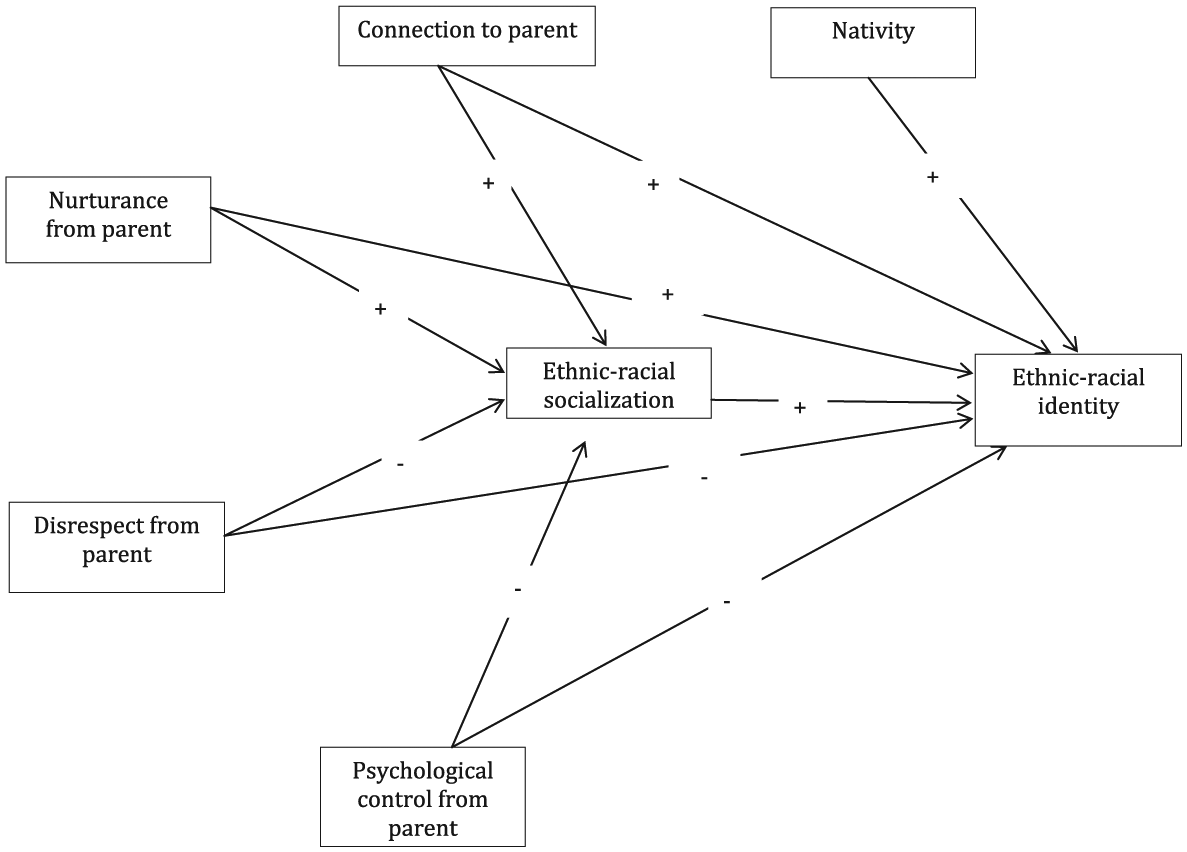
Conceptual model.
Current Study
Based on theory and previous research, we had two aims with the current study. First, we investigated the association among relationship quality with parents, ERS, and ERI among Black emerging adults. We expected that having a positive relationship with parents (nurturance and connection) would be positively associated with ERI, and a negative relationship with parents (psychological control and disrespect) would be negatively associated with ERI. In addition, we expected that these associations would be mediated by ERS (see Figure 1). Second, we explored gender differences and differences between relationships with mothers and fathers in these associations. We expected that mothers’ parenting and socialization behavior would affect both sons and daughters equally. On the other hand, we predicted that fathers’ parenting and socialization behavior would have a stronger effect on sons.
Method
Procedure
Data were taken from the Multi-Site University Study of Identity and Culture (MUSIC), a project focused on identity and cultural processes during emerging adulthood (Weisskirch et al., 2013). MUSIC includes data collected between 2008 and 2009 from 10,321 college students across 30 diverse colleges and universities in the United States. Participants were invited to complete an online survey by collaborators at each data collection site via printed, e-mailed, and in-class announcements. Recruitment sites were diverse with regard to type of institution (e.g., large state universities, private universities, and small liberal arts colleges), setting (e.g., urban/suburban vs. college town), geography (e.g., located in the Northeast, Southeast, Midwest, Southwest, and Western United States), and ethnic composition. Proportion of ethnic–racial minority students at each institution ranged from 8% to 83% (M = 41.62, SD = 20.39). Participants completed the survey on their own time in a private setting. The survey took approximately 1 to 2 hours to complete, and participants received either course credit or entry into a prize drawing as compensation for participating.
Participants
Given the goals of the current study, the sample was limited to participants between 18 and 25 years old (M = 19.94, SD = 1.65), who self-identified as “Black, African American, Afro-Caribbean, Black African, or other in this category” (n = 729). Participants specified their ethnicity in an open-ended question as follows: 42.1% Black, 24% African American, 15% Caribbean, 4.4% African, and 10.4% other (i.e., nonethnic–racial label). Four percent of participants did not report a specific ethnicity. The majority of the sample were women (76.8%) and born in the United States (84.8%). The most commonly reported family structure was biological, two-parent households (40.3%), followed by separated/divorced (24.4%), stepfamilies (12.3%), never married (6.4%), or other (1.2%). Participants were diverse in terms of socioeconomic status. Specifically, reported annual family income was as follows: 32.9% below $30,000, 29.9% $30,000 to $50,000, 24.7% $50,000 to $100,000, and 9.5% above $100,000. Twenty-two (3%) participants did not report their annual family income.
Measures
Participants responded to measures on a Likert-type scale from 1 (strongly disagree) to 5 (strongly agree) unless otherwise indicated.
Relationships With Parents
Participants reported on four dimensions of their relationships with their mothers and fathers, separately, using four scales: psychological control, connection, disrespect, and nurturance. Participants were asked to think about their relationship with their mothers and fathers when they were growing up. All measures were scored such that higher scores indicate higher levels of that construct.
Psychological control was assessed with an eight-item (e.g., “My father/mother was always trying to change how I felt or thought about things”) adapted version of the Psychological Control Scale–Youth Self-Report (Barber, 1996). This scale has demonstrated good reliability (α = .73-.76) among African Americans (Kincaid, Jones, Cuellar, & Gonzales, 2011). For the current sample, the alpha coefficients were .89 for reports of both fathers and mothers.
Connection was measured with a 10-item adaptation of the Parental Acceptance subscale from the Child Report of Parental Behavior Inventory (Schaefer, 1965). Participants responded to items such as “My father/mother made me feel better after talking over my worries with him or her.” The alpha coefficients were .96 for both father and mother connection, which is higher than other studies reported using this measure for African Americans (α = .57-.65; Gray, Carter, & Silverman, 2011).
Disrespect toward emerging adults’ individuality from mothers and fathers was measured with the eight-item (e.g., “My father/mother ridiculed me or put me down [e.g., saying I am stupid, useless, etc.]”) Parental Disrespect Scale (Barber, 2007). This measure has achieved good reliability among college students (Schwartz et al., 2009). The alpha coefficients for fathers’ and mothers’ disrespect in the current study were .89 and .91, respectively.
Nurturance was measured with the nine-item Nurturant Parenting Scale (Finley, Mira, & Schwartz, 2008; Finley & Schwartz, 2004). Participants responded to items (e.g., “When you needed your father’s/mother’s support, was he or she there for you”) on a Likert-type scale from 1 (poor, never, not at all, never, very poor, or never there) to 5 (outstanding, always, extremely, always, very well, or always there). The alpha coefficients in the current sample were .96 and .94 for fathers and mothers, respectively.
Ethnic–Racial Socialization
The Familial Ethnic Socialization Measure (Umaña-Taylor & Fine, 2004) is a 12-item (e.g., “My family teaches me about my ethnic/cultural background”) scale that gauged the extent to which participants’ families taught them about their ethnic culture. Participants reported the ERS they received from their families as a whole. The Familial Ethnic Socialization Measure has demonstrated strong reliability across ethnic and age groups (Brittian, Umaña-Taylor, & Derlan, 2013; Gonzales, Umaña-Taylor, & Bámaca, 2006) and achieved good reliability (α = .93) in the current sample.
Ethnic–Racial Identity
ERI was measured using the Multigroup Ethnic Identity Measure (MEIM; Roberts et al., 1999). Twelve items measured ethnic identity search (e.g., “I have spent time trying to find out more about my ethnic group, such as its history, traditions, and customs”) and affirmation/belonging (e.g., “I have a clear sense of my ethnic background and what it means for me”). A composite score (i.e., mean across items in the search and affirmation subscales) was used in the current study. Use of a composite score has been supported by previous work examining the psychometric properties of the MEIM (Roberts et al., 1999). The MEIM has achieved good internal consistency among ethnically diverse samples of adolescents and emerging adults (Brown et al., 2014; Gonzales et al., 2006). The alpha coefficient of the MEIM was .91 in the current study.
Results
Preliminary analyses were performed to examine the distribution and bivariate associations of study variables. All study variables were adequately normally distributed with a skew of <|2| and kurtosis <|7| (West, Finch, & Curran, 1995). Bivariate correlations were in the expected directions (see Table 1).
Correlations for Male and Female Reports of Parenting Variables.

Note. ERI = ethnic–racial identity; ERS = ethnic–racial socialization. Correlations for male are above the diagonal (n = 166) and for female are below the diagonal (n = 560).
p < .05. **p < .01.
Structural equation modeling was used to test our hypotheses. Analyses were performed in Mplus 7.0 (Muthén & Muthén, 1998-2012) and controlled for the association of participant nativity, ethnicity, age, family income, and family structure with ERS and ERI. Ethnicity was entered into the analytic model as dummy codes for the largest ethnic groups based on participants’ responses to the open-ended ethnicity question: Black, African American, Caribbean, and other. Black was the largest group and was thus used as the reference group. Family structure was dummy coded (i.e., 1 = both biological parents, 0 = other family forms). Separate mediation models were estimated in which ERS mediated the association between relationship with mothers/fathers (i.e., connection, nurturance, disrespect, and psychological control) and ERI (see Figure 1). All indices of relationships with parents were allowed to covary. Indirect effects were estimated using 5,000 bootstrap samples (Preacher & Hayes, 2008). To examine whether these associations differed for men and women, multiple group models were estimated and compared with models in which the groups (i.e., gender) were constrained to be equal using the chi-square difference test (Kline, 2011). Hypothesized associations were free to vary across gender, whereas covariates and correlations were constrained to be equal across gender. Model fit was evaluated using the following criteria: comparative fit index (CFI) ≥ .90 (Hu & Bentler, 1999), Tucker–Lewis index (TLI) ≥ .95 (Sharma, Mukherjee, Kumar, & Dillon, 2005), and root mean square error of approximation (RMSEA) ≤ .07 (Steiger, 2007). Missing data were handled using full information maximum likelihood estimation.
Relationships With Fathers
For analyses examining the association between relationship with fathers, ERS, and ERI (see Table 2), the multiple group models for fathers improved model fit compared with constrained models, χ2(9) = 17.25, p < .05, demonstrating that these associations differ for men and women. Overall, the model provided a good fit to the data, χ2(81) = 88.36, p = .27, CFI = .98, TLI = .99, RMSEA = .02. Among men, nurturance from fathers was positively associated with ERI, and ERS significantly mediated this association. As expected, higher levels of father nurturance were associated with more reported ERS, which, in turn, were associated with higher levels of ERI among men.
Unstandardized Coefficients and Confidence Intervals for Fathers’ Parenting on ERI and ERS by Gender.
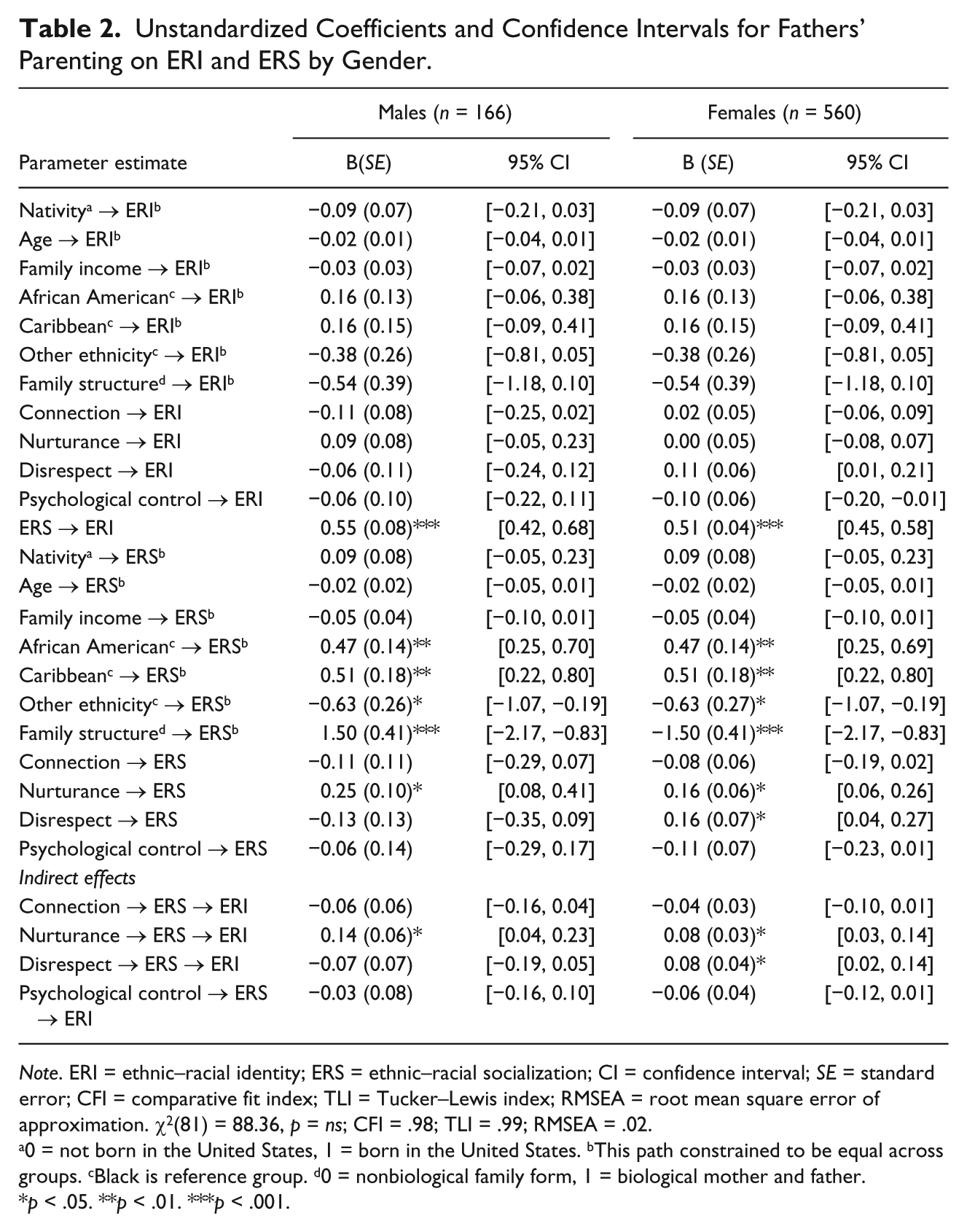
Note. ERI = ethnic–racial identity; ERS = ethnic–racial socialization; CI = confidence interval; SE = standard error; CFI = comparative fit index; TLI = Tucker–Lewis index; RMSEA = root mean square error of approximation. χ2(81) = 88.36, p = ns; CFI = .98; TLI = .99; RMSEA = .02.
0 = not born in the United States, 1 = born in the United States. bThis path constrained to be equal across groups. cBlack is reference group. d0 = nonbiological family form, 1 = biological mother and father.
p < .05. **p < .01. ***p < .001.
Among women, nurturance from fathers was associated with ERI, and ERS mediated these associations. As hypothesized, higher levels of nurturance from fathers were associated with higher levels of ERI and ERS significantly mediated this association. Specifically, higher levels of nurturance were associated with higher levels of ERS, which were associated with higher levels of ERI. Contrary to our expectations, this pattern also emerged with disrespect from fathers, such that more disrespect from fathers was also associated with higher levels of ERS and, in turn, higher levels of ERI. Connection to and psychological control from fathers were not significantly associated with ERS or ERI for either men or women.
Relationship With Mothers
For the analyses examining relationship with mothers, ERS, and ERI (see Table 3), the multiple group model was a better fit to the data, after allowing correlations between nurturance, disrespect, and psychological control to vary across gender as per the modification indices, χ2(12) = 27.146, p < .01. The improved fit for the unconstrained model suggests that the hypothesized associations are different for men and women. Furthermore, the multiple group model provided an adequate fit to the data, χ2(78) = 107.16, p < .05, CFI = .91, TLI = .95, RMSEA = .03. Among men, nurturance from mothers positively predicted ERS, such that men who reported high levels of nurturance from their mothers also reported high levels of ERS from their families. In turn, ERS positively predicted ERI such that higher levels of ERS were associated with higher levels of ERI. The indirect effect was significant, indicating that ERS significantly mediated the association between maternal nurturance and ERI for men. Connection to, disrespect from, and psychological control from mothers were not significantly associated with ERS or ERI among men.
Unstandardized Coefficients and Confidence Intervals for Mothers’ Parenting on ERI and ERS by Gender.
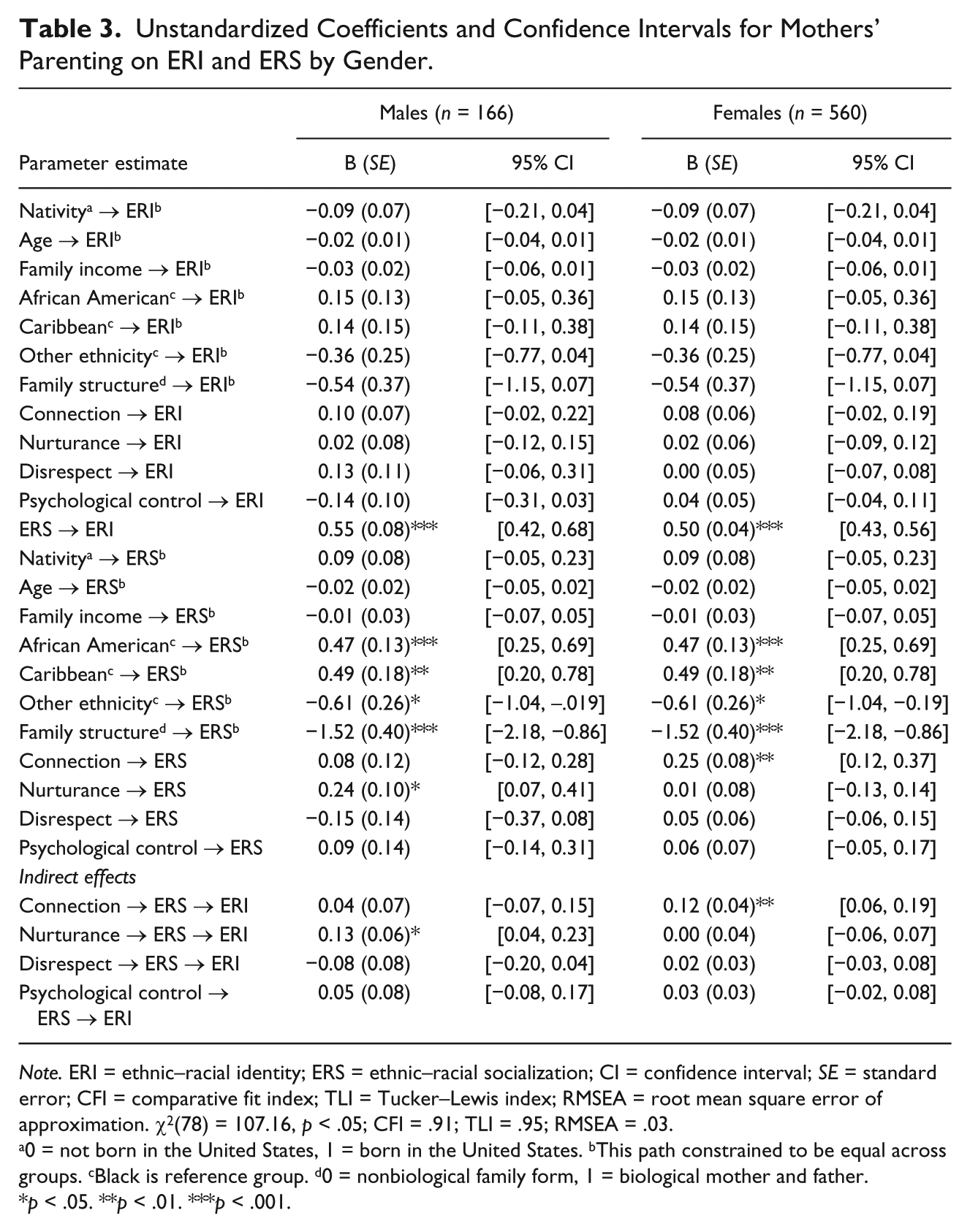
Note. ERI = ethnic–racial identity; ERS = ethnic–racial socialization; CI = confidence interval; SE = standard error; CFI = comparative fit index; TLI = Tucker–Lewis index; RMSEA = root mean square error of approximation. χ2(78) = 107.16, p < .05; CFI = .91; TLI = .95; RMSEA = .03.
0 = not born in the United States, 1 = born in the United States. bThis path constrained to be equal across groups. cBlack is reference group. d0 = nonbiological family form, 1 = biological mother and father.
p < .05. **p < .01. ***p < .001.
Among women, more reported connection to mothers was associated with higher levels of ERS, and, in turn, ERS was positively associated with ERI. The indirect effect of connection to mothers on ERI via ERS was also significant, indicating that ERS significantly mediated the association between maternal connection and ERI for women. Nurturance, disrespect, and psychological control from mothers were not significantly associated with ERS or ERI among women.
Discussion
In this study, we examined how ERS mediates the association between Black emerging adults’ relationships with parents and ERI. Our findings replicate previous work that demonstrated a positive relationship between ERS and ERI (Hughes et al., 2006; Hughes et al., 2009; Umaña-Taylor et al., 2013), and extend this work by providing insight into the role of the parenting relationship in ERI and ERS processes. Our findings also suggest gender differences in the associations between parenting, ERS, and ERI. In addition, the influence of mothers and fathers on Black emerging adults’ ERI appears to differ.
As predicted, the present findings indicate that ERS is positively associated with ERI. This supports previous literature (Hughes et al., 2006; Umaña-Taylor et al., 2013) suggesting that ERS is important for adolescents’ ERI, and demonstrates that ERS processes continue to hold importance for ERI during emerging adulthood. Investigating the role that ERS plays in ERI is integral in identifying the precursors of ERI, and such knowledge equips scholars and practitioners with a point of investigation and intervention to promote positive development in a culturally relevant way.
Although the association between ERS and ERI has been documented previously, the findings from this study also aid in understanding the role of the parenting relationship in this process. Based on previous literature (Frabutt et al., 2002; McHale et al., 2006), we expected that a positive parenting relationship would be positively associated with ERS, and that a negative parenting relationship would be negatively associated with ERS. In addition, we expected positive parenting to be positively associated with ERI (Caldwell et al., 2002; Murry et al., 2001; Swenson & Prelow, 2005) and that this relationship would be mediated by ERS (Hughes et al., 2006; Hughes et al., 2009; Umaña-Taylor et al., 2013). This hypothesis was partially supported. We found that ERS significantly mediated the association between reported nurturance from mothers and fathers and ERI for men, and connection with mothers, and nurturance from fathers for women. In other words, emerging adult men who reported having a nurturing relationship with their parents reported higher levels of ERS, and, in turn, higher levels of ERI and emerging adult women who reported a connected relationship with their mother and nurturing relationship with their father reported higher levels of ERS and, in turn, higher levels of ERI.
The mediated relationship between positive parenting, ERS, and ERI demonstrates the complexity of the processes that can affect positive development in Black youth. By solely studying ERS as a predictor of ERI, scholars may overlook the important role that other family dynamics, such as parenting relationships, have on ERI. This mediated relationship also demonstrates the necessity of studying both mainstream and culturally specific teachings in Black families, as Garcia Coll et al.’s (1996) ecocultural theory suggests. Although ERS serves as a direct link to ERI development, it appears that having a nurturing or connected parent–child relationship affects ERI development as well, and a positive parent–child relationship may serve as a precursor to effective ERS. Clinicians can use this information to provide already nurturing parents with useful ERS skills to promote positive ERI in their children.
Although we expected a positive parenting relationship to affect ERI through ERS, we found, with the exception of mother–daughter relationships, that a nurturing relationship has a stronger effect on ERS and ERI than does having a connected relationship with one’s parents. A possible explanation could be in the way nurturance and connection were conceptualized in this study. Nurturance was operationalized as a more general experience of support, emotional connection, availability, and an overall rating of the parent (Finley et al., 2008; Finley & Schwartz, 2004). On the other hand, connection was operationalized as more concrete behaviors that parents use (e.g., smile, praise) to make the emerging adult feel connected (Schaefer, 1965). Thus, it is possible that providing an overall nurturing presence would influence the household environment where ERS occurs. However, praising or giving attention, while important for healthy functioning, may not necessarily be an essential component in delivering ethnic teachings or creating an environment that fosters learning about one’s culture.
Contrary to our expectations, we found that the relationship of disrespect and psychological control to ERS was nonsignificant. This suggests that having a negative parenting relationship does not affect ERS or ERI, but that a positive parenting relationship is key. The absence of positive characteristics in the parenting relationship does not necessarily imply a negative relationship and vice versa. In other words, whereas positive parenting relationships may facilitate ERS, a negative parenting relationship could simply create an ERS neutral environment instead of decreasing the use of ERS as predicted.
Another goal of this study was to investigate differences in outcomes depending on child gender and on gendered parent–child pairs. Although findings have been mixed (Caughy, O’Campo, Randolph, & Nickerson, 2002; Crouter & Crowley, 1990; Frabutt et al., 2002; Hughes et al., 2006; Raley & Bianchi, 2006), our hypotheses align with the classic literature on parenting and gender in African American families that suggests mothers are more egalitarian than fathers in their parenting relationships with their children (Bartz & Levine, 1978). However, our expectation that the mother–child relationship would affect sons’ and daughters’ ERI equally, and that father–child relationships would have a stronger effect on sons than daughters was not fully supported.
We found that, among men, having a nurturing relationship with one’s mother was associated with reports of higher levels of ERS and ERI. This finding aligns with previous literature finding that adolescents viewed their mothers as empathic, supportive, warm, more involved, and communicative (Crouter & Crowley, 1990; McHale, Crouter, & Whiteman, 2003). This suggests that the nurturing presence of mothers allows ERS messages to be used and transmitted effectively to children and, in turn, a stronger ERI is formed. We also found that, for women, having a strong connection with their mother was associated with higher levels of ERS and ERI. These findings are consistent with previous literature, suggesting that a positive mothering relationship is necessary for ERI development during emerging adulthood for both men and women (Bartz & Levine, 1978; Holahan et al., 1994; Raley & Bianchi, 2006). For women, it appears that having a connection with their mother is more impactful than having a nurturing relationship, which is also consistent with previous literature that suggests mothers spend more time taking with their daughters and tend to use more language that is supportive (e.g., praise, approval) with their daughters than with their sons (Leaper, Anderson, & Sanders, 1998). Women value the emotional support received from their mothers and are better adjusted when they receive it (Holahan et al., 1994; Raley & Bianchi, 2006; Thompson & Berenbaum, 2009).
Regarding relationships with fathers, we found that nurturance was also associated with higher levels of ERS and, in turn, higher levels of ERI, among both emerging adult men and women. We expected a nurturing relationship to have a positive association with ERS and ERI; however, based on previous literature suggesting that fathers engage in more gender-differentiated socialization than mothers (Bartz & Levine, 1978; McHale et al., 2003; McHale et al., 2006), we expected a nurturing relationship with fathers to have a stronger impact on men than women. Although connection with fathers was not associated with ERS or ERI, our findings suggest that having a nurturing fathering relationship is important for both sons and daughters. In particular, nurturance from one’s father plays a pivotal role that should not be overlooked when investigating positive youth development. Although recent literature has attempted to widen the focus on parenting to include father involvement (e.g., Leavell et al., 2012; McLoyd, Cauce, Takeuchi, & Wilson, 2000; McHale et al., 2006; Raley & Bianchi, 2006), there is much to be understood, especially in the ERS literature which highlights mothers as the primary socializing agents (Brown et al., 2010; McHale et al., 2006). The fact that our findings were not consistent with McHale et al.’s (2006) finding that fathers were more likely to differentiate their racial socialization messages based on child gender could be a function of parent versus youth report and the different dimensions of ERS used. McHale et al. (2006) used parent report of their socialization practices and focused on both cultural socialization and preparation for bias, while this study focused on the emerging adult’s retrospective report solely of cultural socialization messages. Thus, it is important for future studies to continue to seek out fathers and investigate their involvement with both sons and daughters so as to address the mixed findings in the literature and to better understand father’s role within the parenting and ERS process and the unique effect on both sons and daughters.
Contrary to our hypothesis, findings suggest that women who reported more disrespect from their fathers had higher levels of ERS and, in turn, higher ERI. However, this was not true for psychological control, which was nonsignificant for both men and women. It is possible that, in Black families, this type of relationship, while labeled disrespectful, does not necessarily represent a bad parenting relationship but rather one that emphasizes respect and discipline. For example, Richman and Mandara (2013) found that African American parents who were more likely to use filial–cultural piety goals, which emphasized values such as respect for elders and ethnic pride, were more likely to use stricter parenting, conceptualized as putting restrictions on what their children are allowed to do, which coincides with some of the items in our disrespect scale (e.g., “My father violated my privacy” or “My father expected too much of me”). Indeed, as measured in the current study, disrespect from parents is operationalized as disrespect for individuality (Barber, Xia, Olsen, McNeely, & Bose, 2012). As such, disrespect for individuality may be a means of encouraging subservience, or stressing the importance of being a member of the family or ethnic–racial group. In addition, a study by Mason, Walker-Barnes, Tu, Simons, and Martinez-Arrue (2004) suggests that the interpretation of control behaviors used by parents may affect child outcomes. In other words, if a child attributes feeling safe and loved to their parents’ controlling behavior (in this case disrespect or cultural group focus from fathers), the emotional relationship with that parent would be viewed as positive. Thus, using a systemic lens, it is possible that if the disrespectful behavior from fathers aligns with ERS use, and it is perceived from the child as being loving, it would have a positive impact on ERS, and, in turn, the ERI of these emerging adult women.
Conversely, we found that disrespect from fathers did not affect ERS or ERI for emerging adult men. One possible explanation could be understood by the popular notion that Black parents “love” their sons but “raise” their daughters (Stanik et al., 2013). In other words, studies have suggested that Black parents tend to provide their daughters with more rules and discipline, and engage in more monitoring, while they provide their sons with warmth and permissiveness (Hill & Zimmerman, 1995; Mandara, Murray, & Joyner, 2005). Therefore, it is reasonable to assume that fathers would use greater monitoring behavior with their daughters than their sons and if perceived with love and care, it would positively affect ERS and ERI. However, because the literature on Black parents’ gendered differential treatment of their children is scarce, and findings are mixed, the results of this study highlight the need for more investigation into the differential relationships that men and women develop with their parents and how these relationships affect the socialization process and future adjustment. Our study also highlights the need for future studies to continue to focus on the unique cultural parenting processes within Black families that promote positive outcomes for minority youth and emerging adults.
The present findings should be interpreted in light of several limitations. First, data were retrospective, self-reported, and cross-sectional. This limited our ability to make inferences about causality, and our reliance on emerging adults’ perceptions of their relationships with their parents while they were growing up creates the potential for recall bias. Furthermore, it is possible that shared method variance associated with using emerging adults as the sole reporter might account for some of the significant findings.
Second, our sample consisted of college students, which limited our findings to the unique experience of emerging adults who are attending college. Our focus on emerging adults is beneficial in that it provides further research on the newly socially constructed developmental period, although it limits generalizability to other age groups or to those emerging adults who did not attend college.
Another limitation was the measurement of ERS. Emerging adults reported ERS from their family as a whole, rather than ERS from mothers and fathers specifically. Grounded in a family systems perspective, we can speculate that the parents play a role in creating a family environment that emphasizes ERS, but we cannot determine which specific family member(s) transmitted the ERS messages. Additionally, the emerging adults were not asked specifically what developmental period (e.g., childhood, adolescence) they were reflecting on when reporting ERS. Future studies should use longitudinal data and multiple reporters and obtain greater information about the differences between fathers’ and mothers’ uses of ERS to account for these limitations and unpack parenting and ERS processes.
In sum, the current study underscores the importance of incorporating mainstream parenting practices and ERS. Research on Black families tends to focus on multiple dimensions of ERS; however, by focusing on one dimension our study highlights that there is a differential impact of mothers and fathers in terms of cultural pride/heritage. Studies have consistently found that messages emphasizing cultural pride and heritage are a salient aspect of childrearing (e.g., Caughy et al., 2002; Hughes et al., 2006; Hughes & Johnson, 2001), and our study contributes to this conversation by suggesting that positive parenting practices are uniquely associated with cultural pride messages to produce positive outcomes in Black emerging adults. Promoting pride and cultural knowledge is an important proactive aspect of parenting ethnic minority children, whereas other dimensions of ERS tend to be reactive, particularly to experiences of racism and discrimination. These findings should be replicated and future studies should attempt to provide further insight into the formation of ERI. Given that ERI is an evolving process, it would be beneficial to understand how the parent–child relationship and ERS process affects each stage of ERI development. The results of this study underscore that this process is important during emerging adulthood.
Footnotes
Declaration of Conflicting Interests
The author(s) declared no potential conflicts of interest with respect to the research, authorship, and/or publication of this article.
Funding
The author(s) received no financial support for the research, authorship, and/or publication of this article.