




Abstract
Increasing support for same-sex marriage (SSM) is often explained as a consequence of rising tolerance of homosexuality across successive generations. This article argues that higher levels of SSM support among young people is also linked to their own emerging plans for couple and family formation. Panel data from 1,836 young Australians participating in the Social Futures and Life Pathways Project was used to analyze change in SSM attitudes between late adolescence (2008, aged 14/15 years) and early adulthood (2013, aged 19/20 years). During this period, the sample became less religious, more expectant of unmarried cohabitation, and more approving of SSM. Being male, living in outside a major city, not living with both biological parents, and being more religious were all associated with lower SSM support. Young people’s views on this issue developed in ways that were indicative of distinct (i.e., traditional vs. pragmatic) orientations toward intimate relationships formed earlier in adolescence.
Introduction
In Australia and other industrialized societies, younger generations are pursuing their educational and occupational aspirations and postponing marriage and family formation until later in life (Smock, 2005; Western & Baxter, 2001). Today’s young people are more flexible about aspects of marriage on which previous generations stood firm, such as its permanency, its necessity for cohabitation, sexual relations and child rearing, its gender roles and division of labor, and its superiority to other union types (Cherlin, 2004; Kefalas, Furstenberg, Carr, & Napolitano, 2011; Qu & Weston, 2008).
Nowhere is this more evident than in the case of same-sex relationships. In Australia and across the Western world, support for same-sex marriage (SSM) has risen dramatically over the past decade. Many theorists attribute such changes to processes of economic development and demographic change, which have encouraged secular, postmaterial values across successive post–World War II generations (Inglehart & Appel, 1989). However, recent increases in public acceptance of lesbians, gay, bisexual, and transgender (LGBT) rights, and homosexuality more generally, have outpaced cohort replacement (Becker, 2012). Contrary to the idea that attitudes rarely alter after early adulthood (Alwin & Krosnick, 1991), people of all ages are changing their minds about SSM. One possibility is that support for SSM among young people is linked to a more individualized and secularized orientation toward marriage, family, and intimate relationships (Brumbaugh, Sanchez, Nock, & Wright, 2008). This article examines changes in the SSM attitudes of a large cohort of Australian young people between late adolescence and early adulthood, and whether these are linked to their own expectations of unmarried cohabitation.
At the time of writing, Australia had not joined the 18 other countries to have legalized SSM (Pew Research Center, 2013). Three unsuccessful attempts to legalize SSM have been made in the Australian Parliament over the past decade. The most recent, in 2012, was defeated with 42 votes in favor and 98 votes against. While members of the then-governing Australian Labour Party (ALP) were granted a conscience vote on this issue, conservative Liberal/National Coalition MPs voted along party lines against the bill. After the Coalition’s victory at the 2013 Federal Election, legislation approving SSM is unlikely unless the conservative Prime Minister Tony Abbot grants Coalition MPs a conscience vote on this issue.
Nonetheless, the legal status of same-sex unions in Australia has strengthened in recent years. In five out of eight states/territories (Queensland, New South Wales, Victoria, Tasmania, and the Australian Capital Territory), gay and lesbian couples may enter a civil union with legal characteristics similar to those of marriage. Following a wide-ranging package of reforms enacted in 2009, same-sex couples and their families are no longer discriminated against when it comes to most government services and benefits. Yet there remain several areas, such as adoption law and access to reproductive services, where unequal treatment of same-sex and opposite-sex couples continues. Moreover, marriage equality advocates maintain that civil unions lack the social and cultural legitimacy of marriage. Where one third of the population supported this view a decade ago (Newspoll, 2004), more recent polling (Australian Broadcasting Corporation, 2013) shows majority support for SSM among the general population, and two thirds support among Australians aged 18 to 35 years. The current article examines how this trend relates to young people’s emerging expectations of intimate relationships in the context of their own lives.
Attitudes Toward Homosexuality and Same-Sex Couples
People who support SSM share a similar sociodemographic profile to those who tolerate homosexuality and espouse postmaterialist values more generally (Pearl & Galupo, 2007). In addition to being younger, research shows that they are more likely to be female, wealthier and more highly educated, less actively religious, and more politically progressive (Olsen, Cadge, & Harrison, 2006; Pew Research Center, 2014). Hooghe, Claes, Harell, Quintelier, and Dejaeghere (2010) found that such influences—most notably religion—were readily observable in Belgian and Canadian adolescents’ attitudes toward homosexuality—highlighting the importance of such factors for young people’s socialization in this area. This is consistent with the long-held notion of value change resulting from cohort succession: where older and more conservative generations are gradually replaced, through natural attrition, by younger generations whose more permissive views become the norm (Inglehart & Appel, 1989). Cohort succession theories link value change to the period-specific influences of socializing agents (e.g., family, school, class, and religion), and economic conditions, on each generation during its formative years (Alwin & Krosnick, 1991).
However, the rapid pace of change in attitudes toward LGBT civil rights, and in particular SSM, appears inconsistent with the model of gradual change across generations (Sherkat, Powell-Williams, Maddox, & de Vries, 2011). Commenting on the sharp decline in disapproval of same-sex relations between 1988 and 1998 in the United States, Treas (2002) instead attributes this to “both the incremental permissiveness of cohort succession and the rapid revision of public opinion evidenced within cohorts as they grew older” (p. 279). Several studies cite intracohort change—where individual attitudes within each cohort change over time—as responsible for increases SSM support in the United States (Baunach, 2012; Becker, 2012).
Some commentators argue that the HIV/AIDS epidemic of the 1980s, as well as media depictions and advocacy campaigns, have increased cultural exposure to homosexuality and widely softened opposition to LGBT civil rights within generations (Andersen & Fetner, 2008). On a similar note, having personal friends who are gay or lesbian has been shown to predict higher SSM support across all birth cohorts (Becker, 2012; Bramlett, 2012). Increasing contact with gays and lesbians, exposure to LGBT concerns, and SSM approval levels are without question closely related concepts and processes. However, this closeness makes it difficult to distinguish specific effects (i.e., accompanying instances of “exposure” and “contact”) from the normative changes which enable them to occur in the first place. For instance, individuals may be more willing to openly identify as homosexual if they share diverse social networks and environments with others who already find homosexuality acceptable. Contact effects are, in part, network effects—meaning that the positive association between contact and SSM approval will rise exponentially with the number of SSM approvers in a social network. One way of adding depth to this circular type of explanation is to explore links between SSM trends and normative changes that do not directly concern homosexuality—such as those relating to marriage, family, and intimate relationships.
Attitudes Toward Marriage, Family, and Intimate Relationships
For some time the consensus among family scholars has been that increasing rates of divorce and remarriage, as well as cohabitation and childbirth outside of marriage, can be attributed to changing views about marriage itself and its embedded notions of gender and sexuality (Cherlin, 2004). In the past century, marriage has gone from what was essentially a social and economic transaction, to a form of companionship emphasizing love and emotional satisfaction, and finally, to an “individualized” union in which the self-development of each partner is paramount (Coontz, 2004). Up until the 1960s, the “male breadwinner” model of marriage and family left little ambiguity as to men’s and women’s expected roles in paid employment, household labor, and childbearing. Increasing female workforce participation, and a more general demand for tertiary education, now requires that today’s couples negotiate around their competing educational, occupational, and reproductive aspirations (Cherlin, 2004). In the Transformation of Intimacy, Anthony Giddens (1992) attributed this new dynamic to what he calls the “pure” relationship, which he defines as follows: A social relation . . . entered into for its own sake, for what can be derived by each person from a sustained association with another; and which is continued only insofar as it is thought by both parties to deliver enough satisfactions for each individual to stay within it. (p. 58)
For Giddens, the impact of the pure relationship is most profound with respect to intimacy and marriage. The idea of romantic love—with its grounding in religious tradition, its emphasis on naturalness of heterosexuality and complementary gender roles, and its claim to permanency—has been a cornerstone of couple formation. In a less religious and more egalitarian society, Giddens suggests that intimate relationships are predicated on the ongoing compatibility of each partner’s values, needs, and aspirations.
Although marriage still features in most young people’s plans, the conditions under which couples marry have indeed changed. As they place greater emphasis on financial stability, career attainment, and relationship quality before deciding to marry, individuals delay marriage until later (Smock, 2005). Cohabitation tends to precede most marriages, enabling couples to “test” their relationship without cementing their commitment or jeopardizing their career plans (Bumpass, Sweet, & Cherlin, 1991). In their study of U.S. teenagers’ marriage and cohabitation plans, Manning, Longmore, and Giordarno (2007) found that adolescents who were dating, sexually active, less religious, and less certain about their educational and occupational pathways were the most likely to expect to cohabit. They concluded that young people planned to cohabit when they were uncertain about their life pathways and foresaw a need for the flexibility that such arrangement could afford them. Although young people’s religiosity levels in adolescence still influence their expectations and experiences of sex, intimate relationships, and family formation, there is also emerging evidence that such experiences can in turn modify preexisting attitudes and beliefs about such issues (Katz-Wise, Priess, & Hyde, 2010; Meier, 2003).
Several researchers have linked SSM support to more flexible, secular relationship norms. Giddens (1992) notes that pure relationships are less exclusively heterosexual in nature, since “a person’s sexuality [becomes just] one factor that has to be negotiated as part of the relationship” (p. 63). Gross and Simmons (2002) found that people in pure relationships hold more egalitarian political views on issues such as taxation and welfare provision, and similarly, Brumbaugh et al. (2008) reported higher SSM support among adults with cohabitation experience. In terms of religious beliefs, Duncan and Kemmelmeier (2012) found that essentialist beliefs about marriage (i.e., that marriage is a natural and unchanging form of relationship) more strongly predicted SSM opposition than essentialist beliefs about homosexuality (i.e., that homosexuality is an unnatural and morally wrong choice). In a large mixed-methods study of Americans’ attitudes to same-sex relationships, Powell, Bolzendahl, Geist, and Steelman (2010) found that respondents’ willingness to accept same-sex couples with children as “families” was shaped by religious and moral conservatism, on the one hand, and pragmatism, on the other, about the kinds of environments and relationships that are suitable for raising children. In sum, these findings suggest that young people’s SSM attitudes will be linked to their own relationship expectations and their value orientations toward intimate relationships more generally.
Hypotheses
This study investigates three hypotheses concerning the influences on young people’s SSM opinions during late adolescence and early adulthood. The first hypothesis tests whether SSM support is higher among young people who expect to cohabit, just as it is higher among adults who have cohabited (Brumbaugh et al., 2008):
The second hypothesis addresses intracohort attitudinal change by supposing there is a temporal dimension to this relationship. It examines whether young people’s SSM attitudes alter in accordance with major changes in their cohabitation plans during the transition to early adulthood:
The final hypothesis assumes that changes in young people’s SSM attitudes and cohabitation plans correspond with several aspects of their underlying value orientations.
These aspects of young people’s value orientations are regarded by Giddens (1992) and Gross and Simmons (2002) as closely aligning with a preference for pure relationships, and as such may be linked to young people’s SSM opinions.
Data and Method
The data for this study are from the Social Futures and Life Pathways (“Our Lives”) Project, which is a longitudinal study of young people in Queensland, Australia. Data were first collected in 2006 when participants were beginning secondary school (aged 12/13 years), then in 2008 during the middle of high school (aged 14/15 years), and in 2010 during their final year (aged 16/17 years). The fourth wave of data collection, when respondents were aged 19/20 years, was completed in late 2013. Although participants have been asked about their SSM attitudes from Wave 2 onwards, in Wave 3 many participants completed a shortened survey module that did not contain the SSM item. Thus, in order to maximize the size of the analytic sample and to ensure a sufficient time period for attitudinal changes to occur, the analysis for this article uses data from the second (2008) and fourth (2013) waves of data.
In Wave 1, respondents were first sampled using a two-stage cluster sampling approach (de Vaus, 1995). An attempt was made to sample all high schools in the state, and all Grade 8 students within those schools. There was a school-level response rate of 55% (n = 213 schools) and a within-school response rate of 34% (n = 7,031 students). In Waves 2 to 4, attempts were made to contact all original respondents. Among those with valid details at each time point, there were response rates of 58% in Wave 2 (n = 3,649), 58% (n = 3,139) in Wave 3, and 41% (n = 2,206) in Wave 4.
For Wave 2, the survey was administered using a multimodal approach combining hard copy, online, and telephone survey completion. Due to its high cost and relatively low uptake, the hard copy option was discontinued in Wave 4. After excluding those with missing data on key analytic variables, the final analytic sample consisted of 1,836 respondents from both waves. As in other studies of a similar cohort (e.g., Dwyer & Wyn, 2001), there was disproportionately higher participation among female students and those attending independent schools (typically higher socioeconomic status than State and Catholic schools). However, the gender and school sector distribution held steady across Waves 2 to 4. Weighting and other measures described later were used to ensure generalizability to the broader youth population in Queensland and nationally.
Dependent Variable
The dependent variable is a respondent’s SSM attitude, measured in both waves with the Likert-type question: “Same-sex couples should be allowed to legally marry” (1 = strongly disagree; 2 = disagree; 3 = neither agree nor disagree; 4 = agree; 5 = strongly agree).
Independent Variables
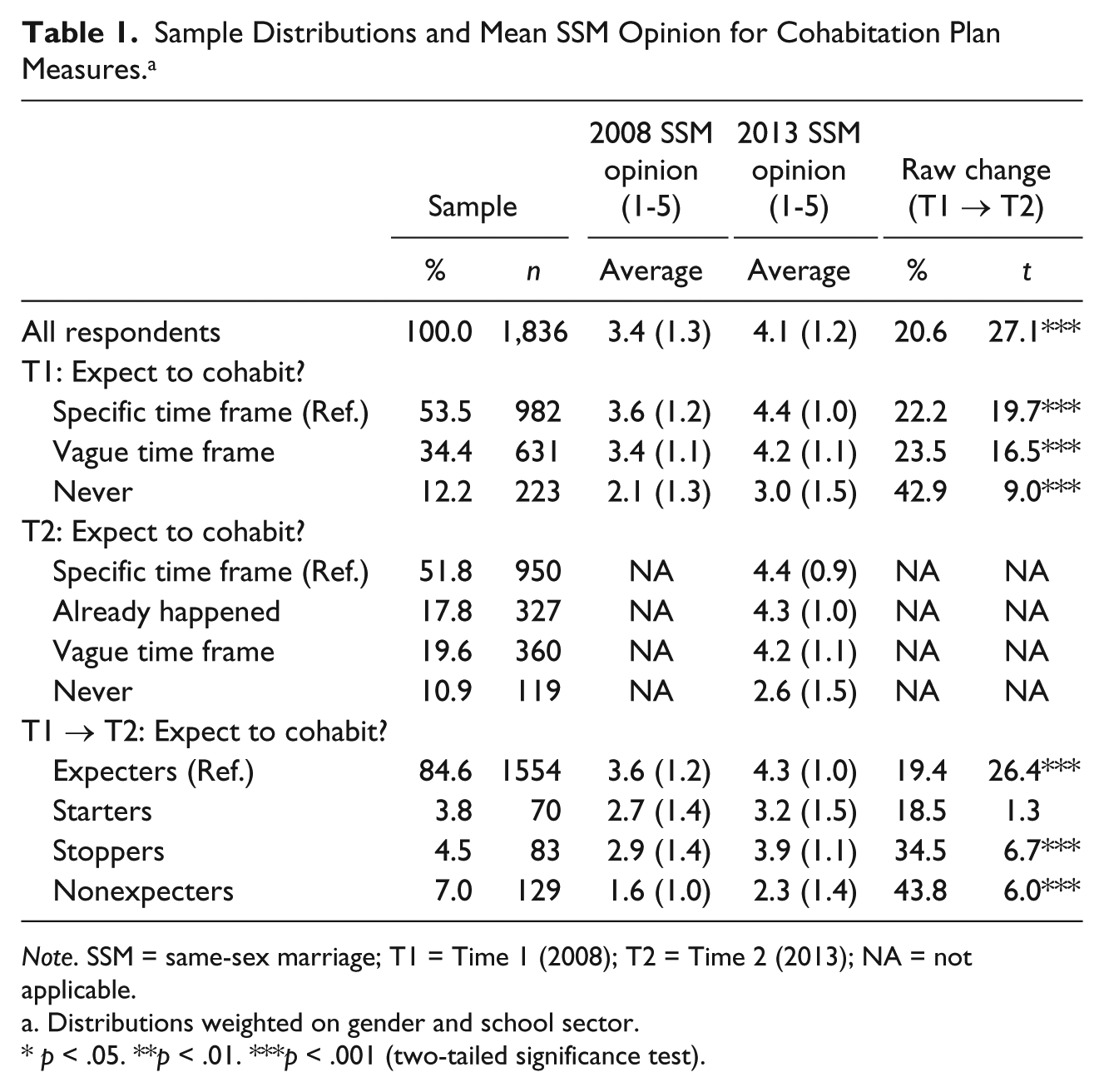
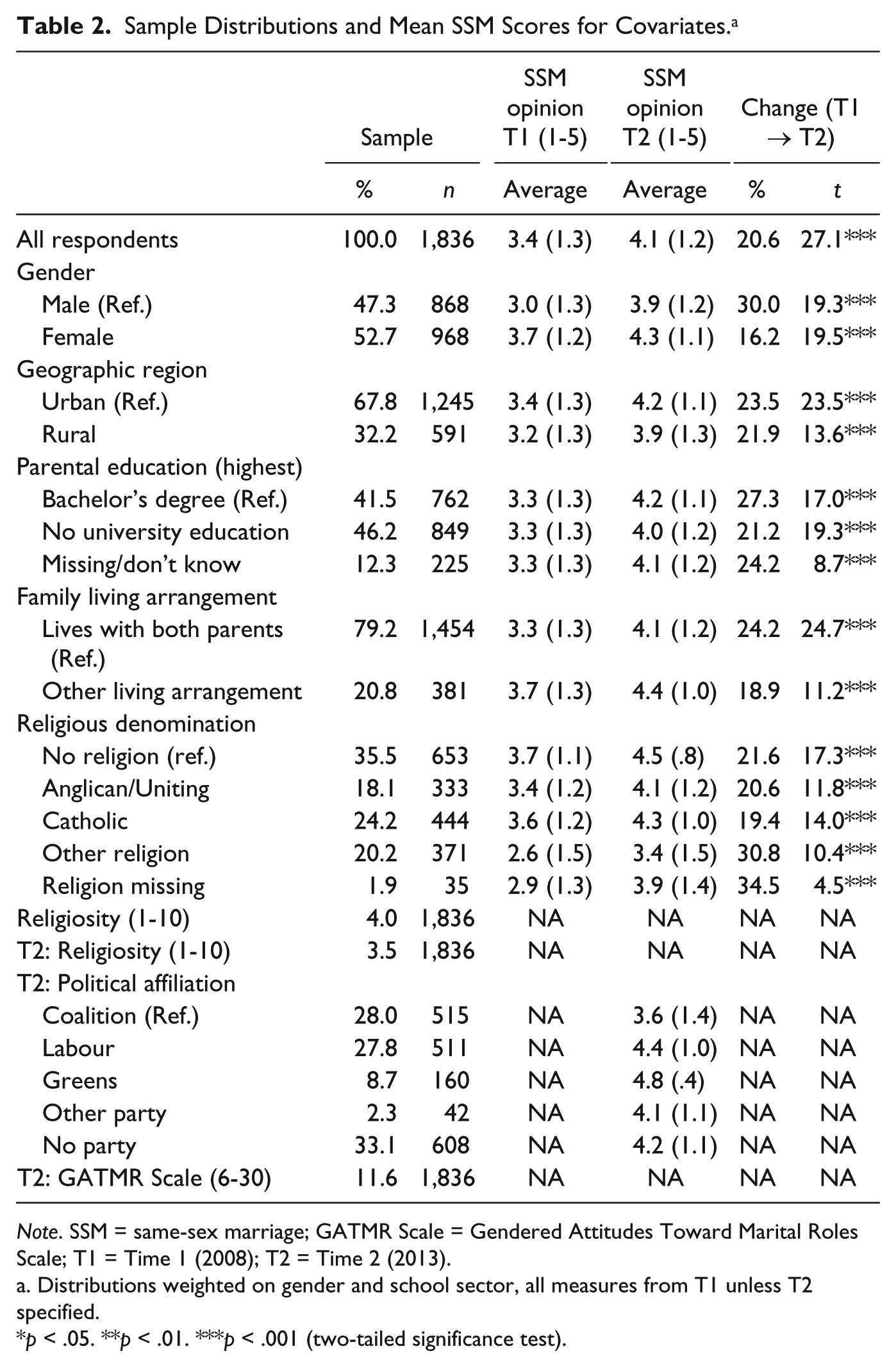
For each analytic variable, Tables 1 and 2 show the sample characteristics (columns 1 and 2) and average SSM scores (columns 3 and 4). Columns 5 and 6 show the percentage change in SSM score between T1 (2008) and T2 (2013) and whether this was statistically significant. While the latter measures of change indicate significant increases in SSM score for almost all groups, these figures should be interpreted with caution. The SSM measure has upper and lower constraints that tend to bias raw change scores toward their initial levels (known as “regression to the mean”). This issue is addressed in the analysis using a conditional change score method described in the next section.
Sample Distributions and Mean SSM Opinion for Cohabitation Plan Measures. a
Note. SSM = same-sex marriage; T1 = Time 1 (2008); T2 = Time 2 (2013); NA = not applicable.
Distributions weighted on gender and school sector.
p < .05. **p < .01. ***p < .001 (two-tailed significance test).
Sample Distributions and Mean SSM Scores for Covariates. a
Note. SSM = same-sex marriage; GATMR Scale = Gendered Attitudes Toward Marital Roles Scale; T1 = Time 1 (2008); T2 = Time 2 (2013).
Distributions weighted on gender and school sector, all measures from T1 unless T2 specified.
p < .05. **p < .01. ***p < .001 (two-tailed significance test).
The main variable of interest was respondents’ cohabitation plans (Table 1). As part of a question set asking “When, if ever, do you think these things might happen,” one item was “Live with someone without being married.” In Wave 2, five options were provided: 1 = Within 2 years of leaving school; 2 = Between 2 and 5 years of leaving school; 3 = More than 5 years after school; 4 = Sometime in the future but I don’t know when; 5 = Never. In Wave 4, another category (6 = Already happened) was included for those already cohabiting. For the initial analysis focusing on SSM opinion at T1, these categories were collapsed to distinguish between those whose expectations had a specific time frame (e.g., Categories 1-3), a vaguer time frame (Category 4), and those who expected never to cohabit (Category 5).
For later analyses focusing on change in SSM attitudes, dummy variables were used to indicate the effect of a reversal in cohabitation plans between T1 and T2. Four groups were created based on respondents’ plans at T1 and T2: (a) “Expecters,” who held either vague or specific plans to cohabit at T1 and still did so (or were cohabiting already) at T2; (b) “Starters,” who began expecting to cohabit between waves; (c) “Stoppers,” who ceased expecting to cohabit between waves; and (d) “Nonexpecters,” who never planned to cohabit at both waves.
Various sociodemographic factors associated with SSM opinion, shown in Table 2, were controlled for also. 1 In line with the notion that value formation is primarily shaped by social and economic conditions experienced during one’s adolescence, these control measures are from T1 unless otherwise specified. For categorical measures, dummy variables were used to show the effect of each category relative to a given reference category. Male adolescents tend to be more traditional in their expectations of marriage and family life (Skrbiš et al., 2011), and in their attitudes toward homosexuality (Hooghe et al., 2010). Gender is included in the analysis with a dummy variable (0 = Male, 1 = Female). Those living in major cities tend to be more cosmopolitan in their social attitudes than those living in regional and remote areas, and may have higher SSM support (Cheshire, Willing, & Skrbiš, 2013). Geographic region is included in the analysis by coding a respondent’s postal code using the Australian Standard Geographic Classification. Family living arrangement is controlled for with a measure of whether respondents lived with both parents, or in some alternate arrangement (e.g., with parent/stepparent, in a shared arrangement, with a single parent, or with other relatives). Since higher parental education predicts greater tolerance of homosexuality among adolescents (Hooghe et al., 2010), the highest education level of either parent has been controlled for (University educated, less than university educated, and don’t know/missing).
Mainstream religious denominations tend to be less opposed to SSM than smaller and more fundamentalist congregations (Sherkat, Powell-Williams, Maddox, & de Vries, 2011). The measure used here distinguishes between respondents with no religion, the major religious traditions in Australia (Anglican/Uniting and Catholic), and an “Other” category comprising smaller and mostly conservative Christian traditions. Religiosity has been shown to mediate denominational differences in SSM attitude (Olsen, Cadge, & Harrison, 2006). This was assessed with a continuous measure asking, “On a scale of 1 to 10, how important is religion in your life?” At the time of the Wave 4 survey, just prior to the 2013 Federal Election, the conservative Liberal/National Coalition supported the traditional definition of marriage, the center-left ALP had recently adopted SSM legalization into its policy platform, and the Australian Greens were strong proponents of marriage equality. The analysis examines how respondents’ political preferences (Coalition, ALP, Greens, Other party, or No party) at T2 predicted their SSM attitudes.
Finally, young people’s SSM opinions are likely to correspond with their ideas about gender roles within marriage. These were measured at T2 using Hoffman and Kloska’s (1995) Gendered Attitudes Toward Marital Roles (GATMR) Index. This index gauges agreement or disagreement with six statements about marital roles (e.g. “Men should make the really important decisions in the family”), where a lower score indicates a more egalitarian orientation. The index displayed a Cronbach’s alpha of .9162 indicating high reliability.
Analytic Strategy
The analysis consists of three stages. The first stage (Figures 1 and 2) involves descriptive analysis of SSM attitudes at T1 (in 2008, during the middle of high school) and T2 (in 2013, 3 years after high school), as well as change in attitudes between these time points. The second stage (Table 3) examines the relationship between SSM attitudes and cohabitation plans at T1, controlling for the independent variables described above. To assess the effects of attrition between Waves 2 and 4, this analysis is first conducted with the full Wave 2 sample and then replicated with the smaller longitudinal sample used for all subsequent analyses. Since the dependent variable measures SSM support in categories arranged in ascending order, ordinal logistic regression was used to estimate effects for the independent variables. This approach uses cumulative probabilities to determine what effect each covariate has on the likelihood of being in a higher response category rather than a lower one (Agresti & Finlay, 1997). 2
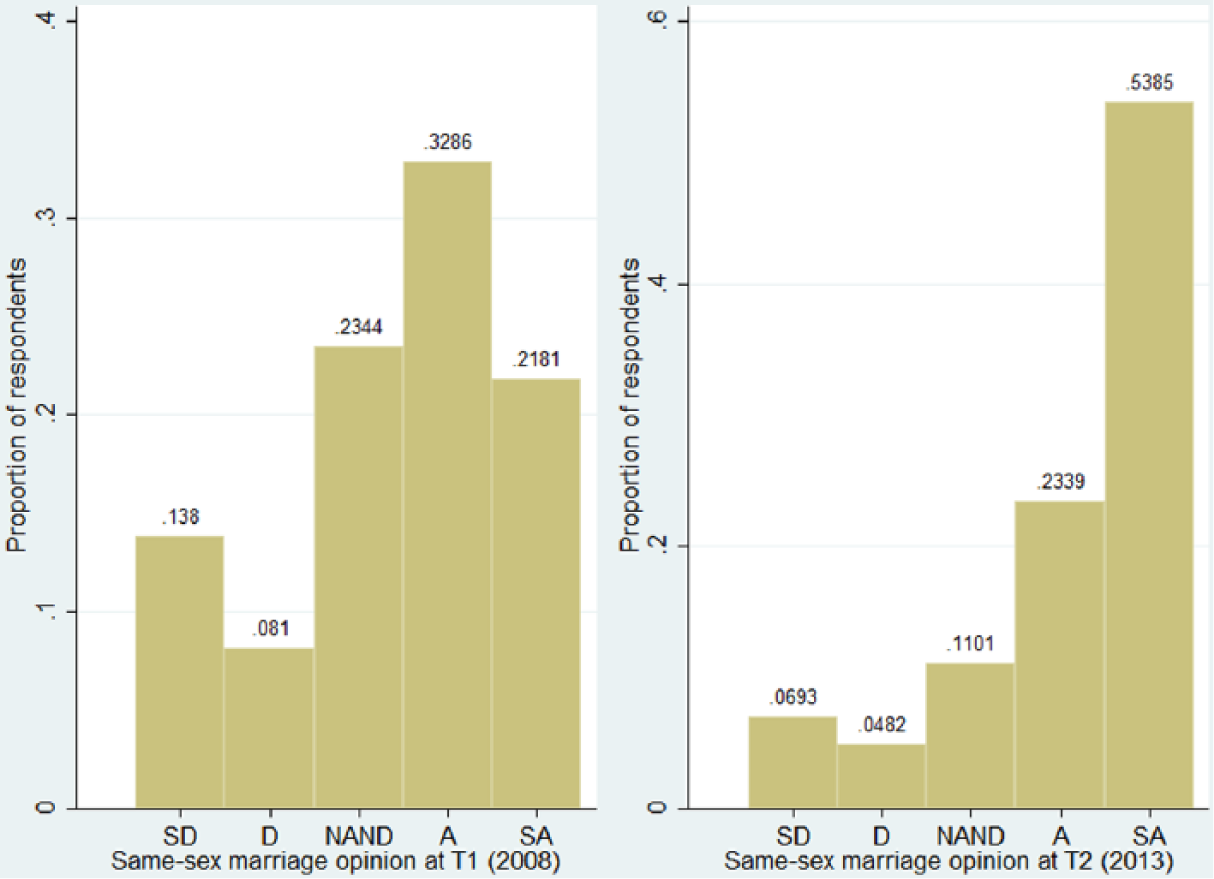
Same-sex marriage opinion at T1 and T2.

Change in same-sex marriage opinion (T2-T1).
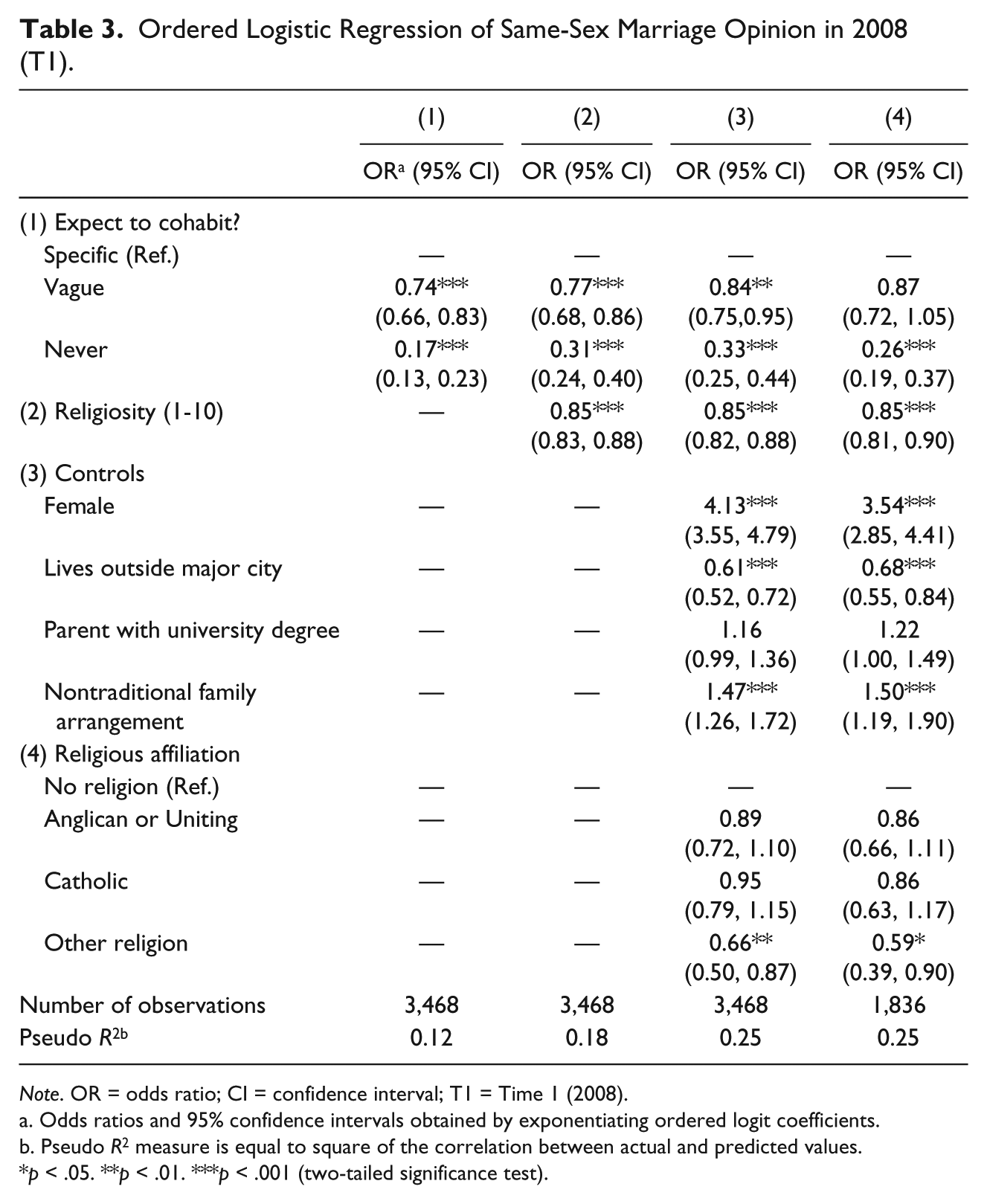
Ordered Logistic Regression of Same-Sex Marriage Opinion in 2008 (T1).
Note. OR = odds ratio; CI = confidence interval; T1 = Time 1 (2008).
Odds ratios and 95% confidence intervals obtained by exponentiating ordered logit coefficients.
Pseudo R2 measure is equal to square of the correlation between actual and predicted values.
p < .05. **p < .01. ***p < .001 (two-tailed significance test).
The final stage of the analysis (Table 4) investigates change in SSM attitudes between T1 and T2 using ordinal logistic regression of change scores. Change score models, which are useful for examining change between two points in time, take two main forms: “unconditional” models where the difference of the responses at T1 and T2 is regressed on the other covariates; and “conditional” models where the response at T2 is regressed on the other covariates and the response at T1 (Finkel, 1995). Unconditional models assume that the responses at both time points are uncorrelated, which is rarely the case for social attitudes (as these tend to be skewed toward their initial levels; Finkel, 1995). The conditional model was therefore used in this analysis. By including SSM attitude at T1 as a covariate this initial level is controlled for, and the effect of the other covariates on SSM attitude at T2 can be interpreted as the effect on change in attitude between the two points (see Hooghe & Meeusen, 2012, for a similar example). The final model also incorporates two variables not available at T1 (political affiliation and GATMR Index). All models accounted for within-school clustering when calculating standard errors, allowing for more robust significance tests. Poststratification weighting was used to correct the joint sample distribution for gender and schooling sector. Analyses were conducted in Stata 12 (StataCorp, 2011).
Ordered Logistic Regression of Change in Same-Sex Marriage Opinion (T2-T1).

Note. OR = odds ratio; CI = confidence interval; SSM = same-sex marriage; T1 = Time 1 (2008); T2 = Time 2 (2013); GATMR Scale = Gendered Attitudes Toward Marital Roles Scale.
Odds ratios and 95% confidence intervals obtained by exponentiating ordered logit coefficients.
Pseudo R2 measure is equal to square of the correlation between actual and predicted values.
p < .05. **p < .01. ***p < .001 (two-tailed significance test).
Results
Figure 1 displays the frequency distributions for the SSM question from both time points. Overall, most respondents at both points in time (55% at T1 and 77% at T2) agreed or strongly agreed that same-sex couples should be allowed to marry. In 2008, only one fifth of the sample had strongly agreed with this statement, but by 2013, over half of all respondents did so. Although part of the increase was an intensification of existing support (evidenced by a large displacement of respondents from agreed to strongly agreed), there were also clear attitudinal shifts among those who were previously neutral or opposed (indicated by declines of between 40% and 60% for these categories).
Shown in Figure 2, the SSM opinion change scores (i.e., the difference between SSM attitude at T1 and T2) confirm this interpretation. For around two thirds of the sample, there was some change (indicated by a score other than 0) in SSM support between waves. For the majority of respondents, this change took the form of a one- or two-level increase in support, whereas increases larger than this, or decreases of any kind, were relatively uncommon.
Initial SSM Opinion in the Middle of High School (T1: 2008)
Model 1 (Table 3, column 1) examines the association between SSM attitude and cohabitation plans for the full Wave 2 sample at T1 (Grade 10, aged 14/15 years). The pseudo R2 indicates that cohabitation plans account for 12% of the variation in SSM opinion. Compared with respondents who expected to cohabit within a specific time frame after leaving school, those who said they would never cohabit, or who held vaguer intentions of doing so (i.e., “sometime in the future, but I don’t know when”) were less approving of SSM. The odds ratio for the group with vague plans (.74, p < 0.001) indicates that a one-level increase in SSM support at T1 was 26% less likely for this group than it was for those with specific plans. For respondents who expected to never cohabit, the odds of a higher level of SSM support were much lower (by 83%) than they were for those with specific plans.
After accounting for religiosity in Model 2, the total variation explained increases to 18%. Net of the effect of cohabitation plans, higher religiosity predicted less SSM support: with every 1-point increment in their religiosity, respondents’ chances of increased SSM support dropped by 15%. Including religiosity in the model slightly reduced the size of the negative correlation between SSM support and vaguely or never planning to cohabit.
When the sociodemographic controls are added in Model 3, the total variance explained rose to 25%. Gender, family living arrangement, and geographic location were the main predictors of SSM opinion. Most strikingly, the chance of a one-level increase in support for SSM was 4 times higher for females than it was for males. Compared with their urban counterparts, the odds of an increase in SSM support were 39% lower for individuals living outside a major city area. Respondents in nontraditional family living arrangements (e.g., blended, shared, or single-parent families) were also 47% more likely than those living with both parents to display higher SSM support. No association was found between parental education and SSM support.
With religiosity already included in the model, the odds of SSM support were similar for nonreligious respondents and those in more mainstream religious denominations. If religiosity is excluded from the model, respondents with any religious affiliation were less likely to support SSM. For Anglican/Uniting and Catholic respondents, their religious denomination only mattered for their SSM opinion insofar as they felt religion was important in their daily lives. Belonging to a less mainstream religion (categorized as “Other”) was still negatively associated with the odds of SSM approval even after accounting for religiosity and all the other measures in Model 3. The stronger SSM opposition of this group is likely due to it being mostly composed smaller Christian denominations with more fundamentalist stances toward issues such as homosexuality. The sociodemographic controls did little to diminish the associations between cohabitation plans, religiosity, and SSM opinion.
To ascertain any effects of sample attrition, Model 4 replicates the previous model with the smaller longitudinal sample. It shows a decrease in the significance of the associations for holding vague cohabitation plans and belonging to an “Other” religious denomination. This suggests that the strength of these associations may be underrepresented as a result of sample attrition. Otherwise, the results did not vary much between samples, suggesting that attrition is unlikely to greatly influence the subsequent analyses using the longitudinal sample.
Change in SSM Opinion Between the Middle (2008) and the End of High School (2013)
The previous analyses highlighted key predictors of respondents’ initial SSM attitudes in 2008. The next phase of the analysis examines how these factors affect changes in SSM opinion between 2008 and 2013, when participants were aged 14/15 years and 19/20 years, respectively. A conditional change score approach was used to regress SSM opinion at T2 on covariate models that each account for baseline SSM opinion at T1. The odds ratios in Table 4 represent the change in odds of higher SSM support at T2 associated with a one unit change in the predictor, after accounting for prior levels of SSM support at T1. As expected, SSM support at T2 correlates strongly with SSM support at T1 (see column 1): with each increment in SSM support at T1, the odds of a one-level increase at T2 rose by 111%.
Model 1 examines whether a major change in respondents’ cohabitation plans is associated with changes in their SSM opinions. Compared with Expecters, who have always anticipated cohabitation, all other respondents were less likely to display an increase in SSM approval between waves, after holding constant their SSM opinion at T1. The size and significance of this negative association was lower for those who those who ceased expecting to cohabit (Stoppers) than it was for those who never expected to cohabit (Nonexpecters) or who began expecting to cohabit (Starters). For Starters and Stoppers, the reversal of their expectations only slightly moderated the effect of their original plans on their SSM opinion. This is consistent with the idea that, even when young people’s SSM attitudes and cohabitation plans change, such change occurs within the parameters of their relatively stable, preestablished orientations toward couple and family formation.
The results for Model 2, which accounts for respondents’ developing value orientations, lend further weight to this interpretation. Religiosity was an important predictor of initial SSM opinion in 2008. The sample as a whole became less religious between 2008 and 2013 as they grew older (see Table 1), and this may explain some of the change in SSM opinion. By including measures of religiosity from T1 and T2 in Model 2, the odds ratios for T1 can be interpreted as the effect of initial religiosity levels, and the odds ratios for T2 is interpreted as the effect of the average change in religiosity between T1 and T2. The results show each 1-point change in religiosity between waves predicted a 25% change in the odds of higher SSM support at T2. Much of the decrease in religiosity (and corresponding increase in SSM approval) is likely to have occurred among respondents who were not particularly religious (or opposed to SSM) to begin with, but whose initial religiosity was large enough (i.e., not 0) to permit a decrease. As such, after accounting for this change, each one-level increment in this initial level of religiosity was associated with an 8% increase in the likelihood of higher SSM support at T2.
Respondents’ political affiliation and GATMR score (both measured at T2) are also correlated with SSM support at T2. Net of all the other factors, supporters of no party were 1.72 times as likely as Coalition supporters to display higher SSM approval, whereas these odds rose to 2.18 for ALP supporters and 4.38 for Greens supporters. Egalitarian views about marital roles also predicted higher support: with each 1-point increase on the GATMR scale the odds of increased SSM approval rose by 14%. When these value orientation measures are added in Model 2, a clear division emerges between those who initially expected to cohabit and those who did not. Stoppers no longer differed from Expecters in their odds of increased SSM approval, while Starters and Nonexpecters were equally unlikely to display this increase.
Model 3 (column 2) includes all previous sociodemographic controls. After controlling for their initial SSM attitudes, the differences between males and females, and between those living with both parents and those in some alternate arrangement, remained stable over time. However, the existing gap between urban and nonurban respondents widened, and a new one emerged, as children of university-educated parents became more supportive than those of less educated parents.
Model 4 includes interaction terms which examine whether the relationship between changes in religiosity and SSM attitudes varies by cohabitation plan group. These indicate that the effects of a change in religiosity were less pronounced for respondents who had initially not expected to cohabit (i.e., Starters and Nonexpecters) than they were for those who did initially expect to cohabit (Expecters and Stoppers). To illustrate this, the MARGINS 3 and MARGINSPLOT commands in Stata were used to plot the predicted marginal probabilities of approval and disapproval resulting from this interaction (Figure 3). The differing slopes for each group indicates the varying effects of a change in religiosity on the conditional probability of SSM approval or disapproval at T2.
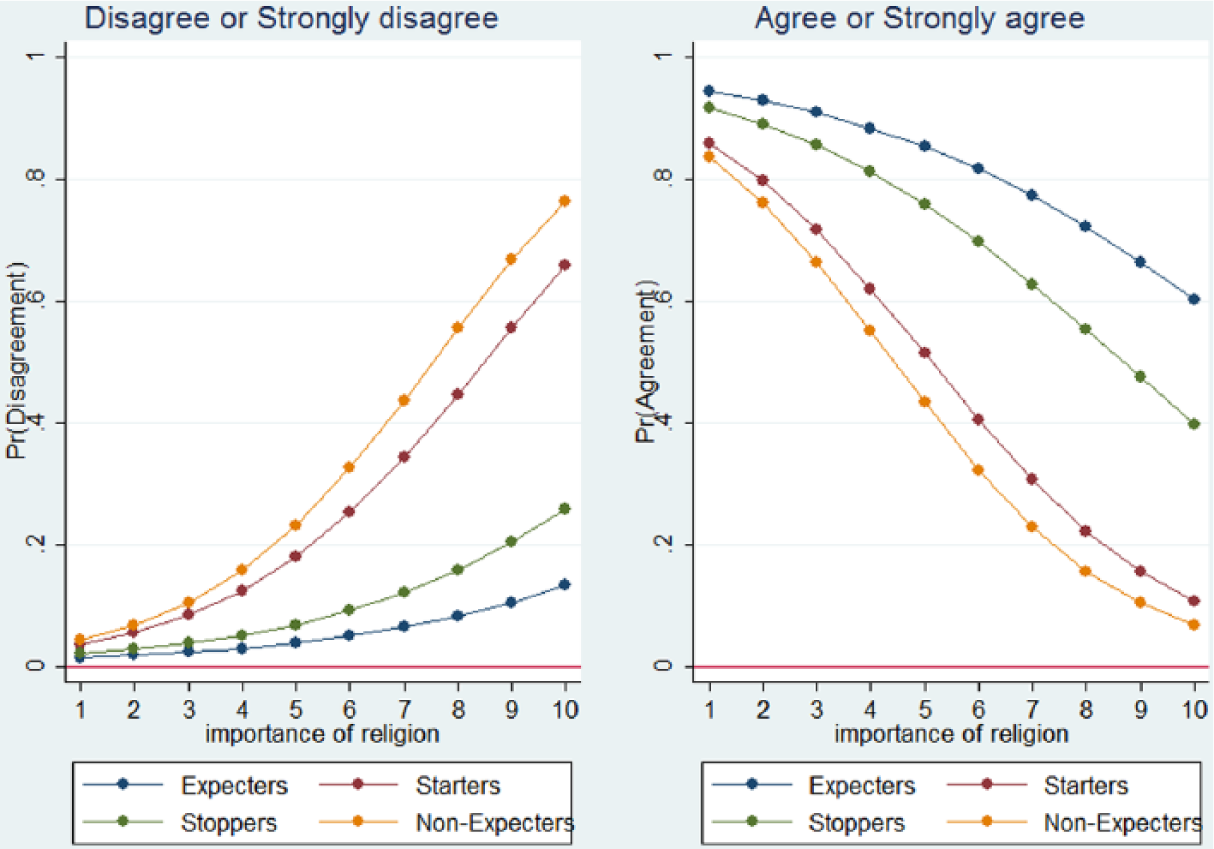
Predicted marginal probabilities for cohabitation plan group × T2 religiosity.
Although not displayed, the confidence intervals for Starters and Stoppers (which are large due to the small number of respondents in these groups) overlap with those of the nearest groups (i.e., Nonexpecters and Expecters, respectively). The persistent contrast between Starters/Nonexpecters, on the one hand, and Stoppers/Expecters on the other, is worth noting. It suggests that, even as respondents’ religious values, cohabitation plans, and SSM attitudes developed across this 5-year period, they did so in ways that appeared to be consistently determined by two distinct, contrasting value orientations toward intimate relationships.
Discussion
The current study has examined the idea that higher levels of SSM approval among younger generations are linked to changing social norms and expectations regarding marriage and family life. As one of the first studies to explore how SSM attitudes develop and change during late adolescence and early adulthood, several hypotheses relating to this were tested.
Consistent with Hypothesis 1, young people who expected unmarried cohabitation were more supportive of SSM, while the strongest opposition to SSM resided among those who expected to never cohabit without marrying. This finding complements earlier research with older cohorts showing higher SSM support among individuals with cohabitation experience (Brumbaugh et al., 2008). In line with cohort succession theories, a number of socializing influences had already shaped young Australians’ SSM attitudes in 2008, when they were 14/15 years old. However, accounting for effects of gender, family living arrangement, geographic region, and even religiosity, did little to explain lower SSM support among those who were unsure about when they would cohabit, and those said they would never cohabit at all. Respondents in the latter group opposed SSM with a traditionalism that ran deeper than any religious observance.
Additional hypotheses investigated intracohort change between late adolescence and early adulthood. While the majority of young people grew more supportive of SSM during this period, those who initially disapproved of SSM were still the least likely to approve. Respondents who reversed their cohabitation plans (i.e., Starters and Stoppers) were few, but as per Hypothesis 2, the SSM attitudes of these groups differed from those whose cohabitation plans were relatively consistent between 2008 and 2013. This finding adds a temporal dimension to the initial association between cohabitation plans and SSM attitudes: those who stopped expecting to cohabit ended up less approving of SSM than those who had always done so, whereas those who started expecting to cohabit were not as strong in their opposition to SSM as those who had always rejected cohabitation.
Hypothesis 3 tested whether respondents’ developing value orientations accounted for varied changes in SSM support among the different typology groups. The analysis included three indicators of a preference for “pure” relationships: that is, relationships which are more contingent individual needs, than on traditional ideals of romantic love and commitment (Giddens, 1992; Gross & Simmons, 2002). Once religiosity, political affiliations, and marital role attitudes were accounted for, each group’s initial cohabitation plans took precedence in determining how their SSM attitudes developed. As predicted in Hypothesis 3.1, respondents clustered into two main groups along mainly religious lines: (a) a less religious majority with cohabitation plans and higher SSM support and (b) a more religious minority with no cohabitation plans and lower SSM support. Over time, the former group became even less religious and increased the most in their SSM support, even if they stopped expecting to cohabit. The latter group remained highly religious and increased the least in their SSM support, even if they began expecting to cohabit.
Findings from other studies can help explain this relationship. Meier (2003) shows that, although adolescents’ religiosity predicts more conservative attitudes toward sex and lower likelihood of first intercourse, the experience of first intercourse leads to more permissive later attitudes toward sex. Manning et al. (2007) have found that adolescents who are sexually active and dating are also more likely to expect cohabitation. In the same way that social contact with gays and lesbians may decrease homosexual prejudice and opposition to SSM, dating and sex may broaden young people’s conception of intimacy and who should be allowed to marry. However, if their willingness to cohabit is any indication of this, those with stronger initial religious and moral convictions appear less likely to have such experiences, just as they are less likely to have contact with gays and lesbians. Alongside traditionalism about marriage and family, this conservative minority may display the increasing prejudice toward homosexuals observed by Hooghe and Meeusen (2012) in their study of Belgian youth over a similar period.
Having a liberal political orientation (Hypothesis 3.2) and egalitarian ideas about gendered marital roles (Hypothesis 3.3) also maps onto traditional and individualistic orientations on this issue. Respondents were less likely to approve of SSM if they supported the governing conservative Coalition party than if they supported Labour, the Greens, or no party whatsoever. The higher SSM approval among such a large segment of young people supporting “No Party” (33%) attests to disenfranchisement many young people feel with traditional “party politics.” These respondents did not affiliate themselves with the broader policies of parties which, had they been elected in the weeks following the survey, would have legalized SSM. Still, most respondents are committed to the traditional goals of marriage and family (Skrbiš et al., 2011) while displaying nontraditional ideas about gender roles within marriage, cohabitation before marriage, and the rights of same-sex couples to wed.
If cohabitation plans and SSM attitudes are indeed shaped by distinct value orientations toward marriage and intimate relationships, then adolescence is unlikely to be the only life stage in which these orientations are exposed to transformative events or experiences. As marital and family instabilities spread across the life course, such phenomena may explain why people of various ages change their views on social issues like SSM. This research did find that young people were less approving of SSM if they lived with both their biological parents than in an alternative arrangement (e.g., blended, shared, or single-parent families). Having in many cases experienced the dissolution of a relationship between their parents, these respondents may be more sensitive to the fragility of heterosexual marriage than most.
Several key limitations to this study should be noted. First, more advanced approaches to measuring SSM attitudes, such as the multidimensional scales developed by Pearl and Galupo (2007), were not included due to the length restrictions of the survey used here. Second, qualitative research would allow respondents greater scope to outline the rationales behind their SSM views. For this reason, a recent series of interviews conducted with Our Lives participants, focusing on their social/political attitudes, has included SSM as a key topic of interest. Finally, additional waves of data will enable the use of longitudinal methods, such as fixed effects analysis, which have numerous advantages over change scores. As such, future analyses will draw on data from Wave 5 (aged 21/22 years), and on qualitative interviews with Our Lives participants, to enrich and develop the initial account provided here.
Footnotes
Acknowledgements
I especially thank Prof. Bruce Tranter, Prof. Zlatko Skrbiš, and the anonymous reviewers for their useful advice and feedback on earlier versions of this article.
Declaration of Conflicting Interests
The author(s) declared no potential conflicts of interest with respect to the research, authorship, and/or publication of this article.
Funding
The author(s) disclosed receipt of the following financial support for the research, authorship, and/or publication of this article: I wish to acknowledge the generous support of the Australian Research Council in funding the Social Futures and Life Pathways Project (DP0878781 & DP130101490) from which the data for this study originate.