




Abstract
Sexual satisfaction is an important contributor to relationship functioning that is not well understood among first-time parents, at a time when relationship functioning is important for the well-being of parents as well as the child. The current study examined how several dimensions of individual and relationship functioning among first-time parents (coparenting, division of household and paid labor, parenting stress, and role overload) at 6 months postbirth predicted multiple domains of sexual satisfaction at 12 months postbirth, in a sample of heterosexual first-time parents. Role overload, work hours, and division of household labor each predicted at least one domain of sexual satisfaction for both mothers and fathers, whereas parenting stress was a unique predictor for mothers only. The implications of these results for first-time parents are discussed.
Although sexual satisfaction is a unique contributor to happiness in romantic relationships (Impett, Muise, & Peragine, 2013), it often goes unmeasured in studies examining first-time parents (Litzinger & Gordon, 2005). The lack of data regarding sexual satisfaction among new parents leaves an incomplete understanding of couple functioning at a time when sexual activity changes in terms of frequency and meaning (Ahlborg, Dahlöf, & Hallberg, 2005; Pacey, 2004) and at a time when relationship satisfaction is important not just for the couple but also for the child (Feinberg, Kan, & Goslin, 2009). Generally, greater sexual frequency and satisfaction are associated with relationship stability (Ade-Ridder, 1990; Yeh, Lorenz, Wickrama, Conger, & Elder, 2006), regulation of stress, and psychological well-being (Davison, Bell, LaChina, Holden, & Davis, 2009; Ein-Dor & Hirschberger, 2012). Therefore, understanding sexual satisfaction among first-time parents would provide more understanding of functioning after the birth of a child and further inform couple-based prevention efforts.
At the transition to parenthood, the focus of the couple relationship shifts as the coparenting aspect of the relationship emerges (McHale et al., 2002). Coparenting encompasses how partners work together in parenting their child but does not include the romantic aspects of the couple relationship (Feinberg, 2003). Although couples often experience great pleasure from their new baby, many also experience a decline in pleasure from their relationship (Pacey, 2004), as the baby takes precedence over couple-level issues (Cowan & Cowan, 1992). Couples may also experience an increase in conflict as they sort out a myriad of new tasks and responsibilities, balance new roles, and function with reduced sleep (Cowan & Cowan, 1992; McDaniel & Teti, 2012). Thus, the transition to parenthood brings a multitude of new stressors as well as a decline in relationship and sexual satisfaction (Ahlborg, Strandmark, & Dahlöf, 2000; Lawrence, Rothman, Cobb, Rothman, & Bradbury, 2008; Pacey, 2004). Yet less is known about how specific domains of the new parent role predict specific domains of sexual satisfaction.
Sexual satisfaction is shaped by the interplay of factors at three levels: the individual, the relationship, and the broader culture (Bancroft, Loftus, & Long, 2003; Carpenter, Nathanson, & Kim, 2009). Accordingly, the current study aims to identify predictors of sexual satisfaction after the transition to parenthood within the context of the individual’s experience of stress, the relational experience of coparenting and division of labor, and the sociocultural experience of gender. In addition, this study aims to explore nonintercourse aspects of the sexual relationship such as cuddling, romance, and passion as limited work has explored multiple domains of satisfaction with the sexual relationship after the transition to parenthood.
Stress and Sexual Satisfaction
Over the past 20 years, since Morokoff and Gillilland’s (1993) study of the link between stress and sexual frequency, the majority of research on sexuality within the context of marriage has focused on stress. However, findings have been inconsistent. Some research suggests sexual activity decreases at times of stress, whereas other studies indicate sexual activity increases (Bancroft et al., 2003; Morokoff & Gillilland, 1993). Additionally, daily stress predicts less sexual activity within the relationship for women who are dissatisfied with their marriage and more sexual activity within the relationship for men who are dissatisfied with their marriage (Bodenmann, Ledermann, & Bradbury, 2007). These findings highlight the nuanced nature of the relationship between gender, stress, and sexuality.
New stressors related to the transition to parenthood include sleep disruption, work and family balance demands, increases in role overload, and changes in identity (Cowan & Cowan, 1992; McDaniel & Teti, 2012). Daily hassles, especially related to parenting a temperamentally reactive or fussy child, can result in elevated parenting stress (e.g., Crnic & Low, 2002), which has been shown to negatively affect couple relationship quality (Lavee, Sharlin, & Katz, 1996).
Division of Labor, Satisfaction, and Sexuality
First-time parents are faced with determining how to divide responsibilities for paid and household labor. Time-diary data have shown that there has been a general decline in total time women spend on housework since 1965, as more women have entered the paid-labor force; yet for men, time spent doing housework has doubled (Bianchi, Milkie, Sayer, & Robinson, 2000). Despite these trends, many women feel overburdened as they work outside the home and still do the majority of the housework in what is known as the “second shift” (Hochschild, 1989).
Studies of the effects of juggling work and home life have typically been focused on mothers. Juggling both paid work and responsibilities at home has been viewed as potentially positive by those citing the “enhancement hypothesis.” The enhancement hypothesis (Marks, 1977) suggests that participating in multiple realms of life (e.g., work, family, social, spiritual) creates a feeling of balance and satisfaction. In this view, parents—especially mothers—who both work outside the home and inside the home may be better adjusted and enjoy their romantic relationship. However, more attention is needed to understand the role of hours spent on work outside the home, given the demand of full-time employment on new parents—especially mothers—who may still be breastfeeding or who want to spend more time bonding with their infants while still capitalizing on intellectually or socially stimulating processes at work outside the home.
In contrast, the “scarcity hypothesis” (Bielby & Bielby, 1989) suggests that strain from engagement in multiple areas leads to feelings of being overwhelmed. Several studies have investigated the association between the division of household labor and relationship satisfaction (Barstad, 2014). Mothers generally spend more time per week multitasking to complete household chores than fathers, and this time is associated with an increase in overall negative emotion and couple conflict (Barstad, 2014; Offer & Schneider, 2011). However, the relationship between balancing multiple roles and sexual satisfaction is unclear.
Some prior research has not shown a significant difference between women who work exclusively inside the home versus women who are employed full-time or part-time outside the home on measures of frequency of intercourse, sexual satisfaction, and decreased sexual desire (Hyde, DeLamater, & Hewitt, 1998). However, a study using the National Survey of Households and Families found that couples who have a more traditional division of household and paid labor have sex more frequently (Kornrich, Brines, & Leupp, 2013). Yet another study using the same data, found that dual-earner couples who “work hard” also “play hard,” meaning that couples who spent more time overall on household labor also had sex more frequently than couples who spent less time on household labor (Gager & Yabiku, 2010). Furthermore, qualitative work suggests that husbands and wives feel that sex is important for their marriage, but conflict arises when couples try to fit sex into busy schedules (Elliott & Umberson, 2008).
Missing in much of the research on workload and sexual satisfaction is a recognition of the importance of satisfaction with the division of labor, instead of simply the division of hours spent on labor. Satisfaction with the division of labor is also linked to perceptions of fairness in a couple’s division of household labor. For example, in a study of dual-income lawyers, men were more likely to perceive the distribution of tasks as unfair for their spouse when their spouse was doing the majority of the housework, whereas women were more likely to perceive the distribution of tasks as unfair for themselves, regardless of how much time was spent on the tasks relative to their spouse (Young, Wallace, & Polachek, 2013). In contrast, women are more likely to report fairness in the division of chores if their own or their husbands’ personal commitment is higher (Tang & Curran, 2013), which suggests that the division of labor is as much an emotional arrangement as it is a practical one. Therefore, the decline in marital satisfaction after the transition to motherhood can be partly attributed to perceptions of unfairness in the division of labor (Dew & Wilcox, 2011; Milkie, Bianchi, Mattingley, & Robinson, 2002; Wilkee, Ferree, & Radcliff, 1998). Moreover, wives’ perceptions of father involvement in child rearing are associated with both partners’ marital satisfaction (Galovan, Holmes, Schramm, & Lee, 2014). Therefore, the current study extends research in this area by examining how the number of hours spent on paid labor, satisfaction with the division of labor inside the home, and subjective feelings of role overload among first-time parents predict later sexual satisfaction.
Gender Differences in Sexual Satisfaction
Finally, integrating both biological and sociocultural perspectives on gender, an overarching goal of this study was to expand what is known about gender differences in sexual satisfaction. Changes in sexuality are drastic and variable after the transition to parenthood. For example, some couples resume sexual activity before the 6-week postbirth checkup, while others remain abstinent for many months (Dixon, Booth, & Powell, 2000).
In general, sexual functioning changes in numerous ways after childbirth for mothers and fathers. On a biological level, both mothers’ and fathers’ experiences of sleep deprivation and lack of “adult only” time are obstacles to sexual activity after the birth of a child (Woolett & Parr, 1997). For new mothers, there is a dramatic decrease in estrogen immediately after birth and a gradual decrease in estrogen and progesterone for the next 6 to 12 months depending on breastfeeding status (Bancroft, 1989). This drop in hormone levels is associated with decreased sexual desire (Bancroft, 1989). There is also a decrease in pleasure and orgasm due to physical complications from vaginal births such as tearing or complications with the incision from cesarean births that can last up to 6 months (Pacey, 2004). One study of 484 postbirth women found 80% of women experienced at least one sexual problem at 3 months postbirth and 67% were still experiencing sexual problems at 6 months postbirth (Barrett et al., 2000). Overall, the most commonly cited reason for a decrease in sexual activity among new mothers during the first 6 months after birth is a lack of sexual desire (De Judicibus & McCabe, 2002). Although little is known about fathers’ sexuality postbirth, a study of Scandinavian first-time fathers reported much greater sexual desire than mothers (Ahlborg et al., 2000).
On a sociocultural level, there is evidence that the context of the sexual relationship is crucial to women’s sexual response more so than men’s (Leiblum, 2002). Women’s sexual desire more often requires a coherent narrative that ties what is occurring sexually with the relational dynamics, while men tend to desire sex regardless of what is occurring in the relationship (Leiblum, 2002). Thus, being more satisfied with the overall relationship functioning is associated with higher sexual satisfaction in women (Witting et al., 2008) but not men. For women, intimacy tends to be a pathway to sexuality, but for most men, sexuality is a pathway to intimacy (Riessman, 1990). This is seen in men reporting the reason they feel disconnected from a partner is because they are not having frequent sex, while women more often report that the reason they are not having sex is because they do not feel intimate with their partner (Hatfield & Rapson, 1987). Based on these findings, we expected relational and contextual factors such as satisfaction with the division of labor and satisfaction with coparenting quality to be more salient predictors of sexual satisfaction for mothers than fathers.
The Current Study
In this study, we conceptualized and measured multiple domains of sexual satisfaction such as satisfaction with the overall sex life, frequency of sex, frequency of cuddling, amount of romance, and amount of passion. Given limited literature in subdomains of sexual satisfaction, we were also interested in determining which nonintercourse behaviors and qualities (e.g., cuddling, romance, passion) would be predicted by relational and contextual factors. Although couples do not substitute nonintercourse behaviors (e.g., cuddling) for intercourse per se, even as intercourse decreases (Ahlborg et al., 2005), cuddling is a means by which couples often continue to validate each other as romantic partners as they cope with a decrease in sexual intercourse after the transition to parenthood (Ahlborg & Strandmark, 2006). Research examining nonintercourse behaviors in adulthood is limited, despite the prevalence of these behaviors throughout adolescence and emerging adulthood (O’Sullivan, Cheng, Harris, & Brooks-Gunn, 2007). Even less research examines if couples are satisfied with nonintercourse behaviors and qualities of the sexual relationship or what predicts satisfaction with nonintercourse behaviors and qualities of the sexual relationship.
The overarching research question for our study was as follows: “How do relational and contextual factors of first-time parents such as coparenting, parenting stress, role overload, number of work hours, and satisfaction with the division of household labor predict later sexual satisfaction for mothers and fathers?” Well-validated measures (perceptions of coparenting, role overload, parenting stress, housework satisfaction, and child care satisfaction) at 6 months postbirth were used to predict overall sexual satisfaction and four subdomains of sexual satisfaction (satisfaction with the frequency of sex, romance, passion and excitement, and cuddling) at 12 months postbirth with data from a randomized coparenting intervention.
For mothers, we hypothesized that
These hypotheses for mothers are based on findings that the overall quality of the couple’s relationship is more highly linked with sexual satisfaction, and stressors are greater impediments for sexual functioning, among women compared with men (Bodenmann et al., 2007; Leiblum, 2002). In line with both the enhancement and scarcity hypotheses, we hypothesized
For fathers, it was hypothesized that
However, as men’s sexual desires and behaviors are less linked to feelings about the relationship and emotional intimacy compared with women (Leiblum, 2002), we hypothesized that
As fathers often participate less frequently than mothers in household labor tasks, and perhaps as a result have not been shown to be as sensitive to the division of labor as women (Dew & Wilcox, 2011), we hypothesized that
We also hypothesized that
Finally, differential hypotheses with regards to each specific subdomain of sexuality were withheld as prior research involving multidomain sexual satisfaction measures is limited.
Method
Participants
Participants (N = 169 heterosexual couples) in the present study were from a longitudinal study designed to test the intervention program Family Foundations, which is a coparenting intervention program for couples during the transition to parenthood (Feinberg & Kan, 2008). To be eligible for the study, first-time parents must have been at least 18 years of age, living together, and expecting their first child. Couples were mostly (81%) recruited from childbirth education programs at two hospitals located in the Northeast. All other couples were recruited from doctors’ offices (8%), newspapers ads or flyers (7%), by word of mouth (3%), or by unknown means (1%). Participants were not chosen based on higher risk factors for negative individual or couple functioning.
Data on the division of labor, parenting stress, role overload, and coparenting were collected when the couple’s infant was approximately 6 months old. Sexual satisfaction data were collected when the couple’s infant was approximately 12 months old. At the 12 month wave, all couples were still living together and 89% were married (M = 4.68, SD = 2.37 years). Ninety-three percent of fathers and 72% of mothers were employed full-time. Fathers on average were 30.21 (SD = 5.35) years old, and mothers on average were 28.68 (SD = 4.69) years old. The majority of mothers (93%) and fathers (91%) were non-Hispanic White, with a median household income of $63,968 (SD = $31, 515). Average level of education at the beginning of the study was 14.86 years (SD = 2.01) for fathers, and 15.31 years (SD = 1.71) for mothers.
Only those mothers and fathers who had complete data on all study variables were included in our analyses (N = 137 mothers, 132 fathers). We compared our analytic sample with participants who had missing data on the study measures or who dropped out of the study by 12 months on demographic variables utilizing a series of χ2 and t tests. There were no significant differences on ethnicity/race, income, or intervention group status. However, fathers in our analytic sample were significantly older, t(134) = −2.17, p < .05, more educated, χ2(8) = 23.50, p < .01, and more likely to be married, χ2(1) = 16.85, p < .01. Our analytic sample also had mothers who were significantly more educated, χ2(7) = 16.67, p < .05, and more likely to be married, χ2(1) = 18.28, p < .001.
Procedure
Informed consent was obtained and couples were paid for their participation. Pretest data were collected via home interviews when mothers were pregnant (average weeks of gestation = 22.9, SD = 5.3). Mothers and fathers worked separately on questionnaires. Following the pretest, couples were randomly assigned to an intervention (N = 89) or to a no-treatment control condition (N = 80). There were no significant differences between intervention and control group couples on marital status, mental health, education, age, income, or relationship quality at baseline. Further data (see Measures section) were collected 6 months after birth via mailed questionnaires and 12 months after birth via home interviews and paper-and-pencil questionnaires. Sexual satisfaction questions were only asked at 12 months after birth via paper-and-pencil questionnaires.
Measures
Sexual Satisfaction
Sexual satisfaction was assessed with a measure that was developed for this study and administered at 12 months postbirth. The measure consisted of four items that included satisfaction with the frequency of (a) sex, (b) cuddling and touching, (c) romance, and (d) passion and excitement. Participants responded on a 9-point scale ranging from 1 to 9 with 1 = not enough; 5 = just right; and 9 = too much. We recoded and reverse-scored item responses to be the absolute deviation from the midpoint, with 0 representing the most dissatisfied (with either too little or too much) and 4 representing the most satisfied (just right). All items were analyzed separately to examine parents’ satisfaction with various domains of their sexual relationship. These subdomains were exploratory for this study as multidomain sexual satisfaction measures are limited.
To measure satisfaction with the overall sex life, participants responded on a 9-point scale to the item, “Regarding your sex life with your partner, would you say that you are overall,” 1 = not at all satisfied to 9 = very satisfied.
Work Hours
Work hours were assessed at 6 months postbirth and were calculated as a sum of two items: “How many hours per week do you spend at work?” and “How many hours per week do you spend on work-related activities at home?”
Parenting Stress
Parenting stress was measured at 6 months postbirth and assessed with 27 items from the third edition of the Parenting Stress Index–Short Form (Abidin & Brunner, 1995). Six items from the Parent–Child Dysfunctional Interaction scale and three items from the Difficult Child scale because Abidin and Brunner (1995) found that they had lower factor loadings than the rest of the items. Items measured parental distress (e.g., “I find myself giving up more of my life to meet my children’s needs than I ever expected”), parent–child dysfunctional interaction (e.g., “My child smiles at me much less than I expected”), and parents’ reports of a difficult child (e.g., “My child turned out a to be a lot more of a problem than I had expected”) on a 5-point scale (1 = strongly disagree, 5 = strongly agree). Responses were averaged and the total scale score was used in the analyses. Cronbach’s alphas (α) were .89 for mothers and .85 for fathers.
Satisfaction With the Division of Household Labor
We measured satisfaction with the division of housework and child care at 6 months postbirth with Cowan and Cowan’s (1988) Who Does What Scales. Parents rated, on a 9-point scale ranging from 1 = I do it all to 9 = my partner does it all, how they feel the division is now and also how they would like it to be. They rated 13 items regarding housework (e.g., “planning and preparing meals”) and 15 items regarding the division of child care (e.g., “reading to our child”). A scale for satisfaction with housework (α = .72, fathers; α = .69, mothers) as well as a scale for satisfaction with child care (α = .81, fathers; α = .88, mothers) were produced by taking the absolute difference of a parent’s ratings between how it is divided now with how he or she would like it to be. Higher scores on each of these scales represent more satisfaction with the division in that area. These scales were correlated for both mothers (r = .62, p < .001) and fathers (r = .50, p < .001); thus to reduce multicollinearity in our final analyses, these two scales were standardized and averaged to produce an overall satisfaction with the division of household labor score for each parent.
Coparenting Quality
Parents responded to the Coparenting Relationship Scale (Feinberg, Brown, & Kan, 2012), which includes 35 items assessing their parenting relationship with their partner at 6 months postbirth. The measure taps various dimensions of the relationship, such as agreement, endorsement, closeness, support and cooperation, division of labor, competition and undermining, and child exposure to interparental conflict. Items (e.g., “My partner asks my opinion on issues related to parenting,” “My partner does not trust my abilities as a parent”) were rated on a 6-point scale with responses ranging from 0 = not true of us to 6 = very true of us. Negative items were reverse scored, and all items were totaled and averaged to produce an overall coparenting score for each parent. Higher scores indicate more positive perceptions of coparenting (α = .93, fathers; α = .94, mothers).
Role Overload
Role overload was assessed at 6 months postbirth. Parents rated the degree to which they felt strain from their daily roles using the 13-item Role Overload Scale (Reilly, 1982). Items (e.g., “I need more hours in the day to do all the things which are expected of me”) were rated on a 5-point scale, ranging from 1 = strongly agree to 5 = strongly disagree. Items were reverse scored and summed, such that higher scores reflected more role overload. This measure was found to be highly reliable (α = .92, fathers; α = .92, mothers).
Plan of Analysis
Due to the dearth of literature on gender differences in the associations between the division of household/paid labor and sexual satisfaction, we decided to first examine bivariate correlations between the predictors and outcomes for mothers and fathers. Then, due to the sheer number of gender interactions required to test gender differences in each of our predictors in our models and the resulting multicollinearity of these many interactions, the stark differences in the bivariate correlations for mothers and fathers (see Table 1), as well as biological differences in postpartum sexual function that can last for up to 12 months (Pacey, 2004), we elected to carry out analyses to evaluate our study hypotheses separated by gender. As the data come from a large-scale family intervention, intervention status was also entered as a control variable in our regression models. Other controls (parent education, family income, marital status, and age) were considered, but were not significantly correlated with any of our outcomes and were therefore not included in the final analyses.
Correlation of Study Variables Separated by Gender.
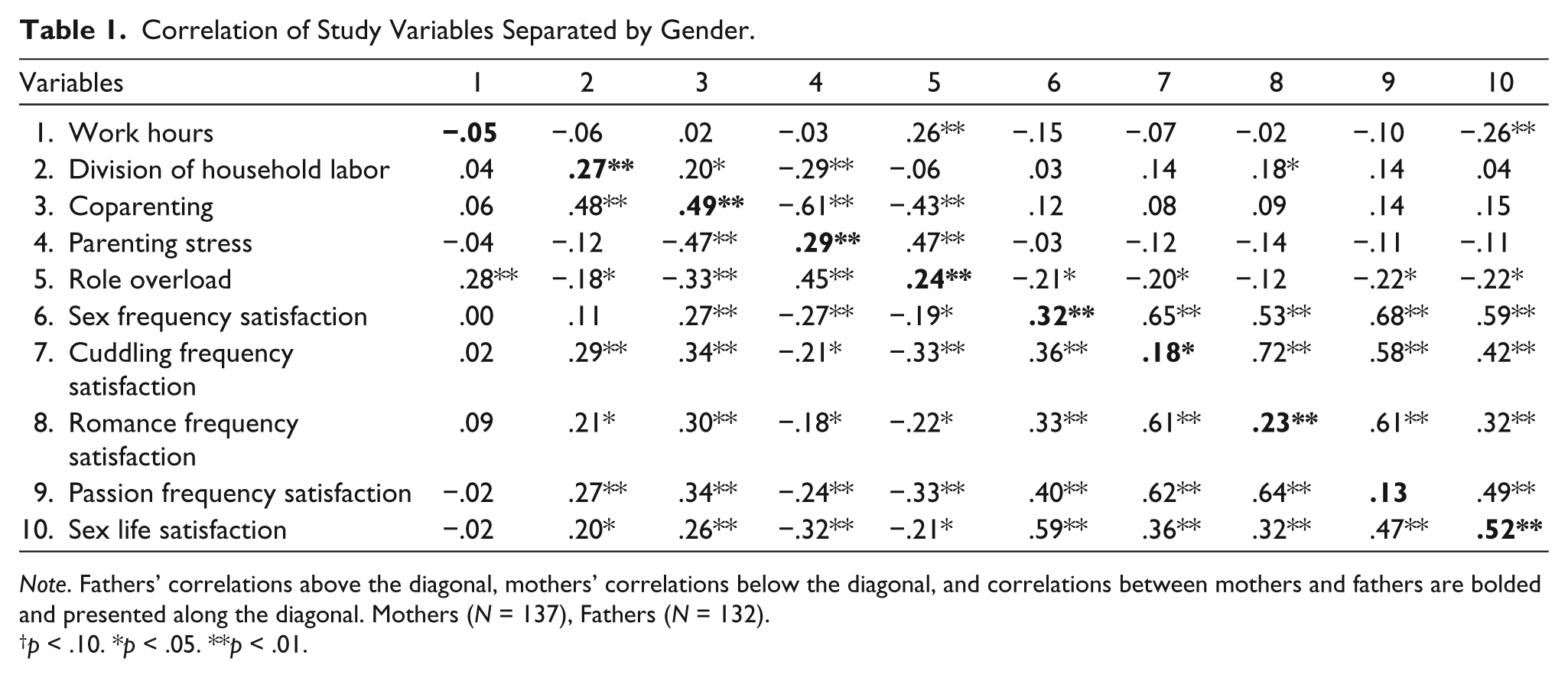
Note. Fathers’ correlations above the diagonal, mothers’ correlations below the diagonal, and correlations between mothers and fathers are bolded and presented along the diagonal. Mothers (N = 137), Fathers (N = 132).
p < .10. *p < .05. **p < .01.
Results
In Table 1, we present results for our bivariate correlations of study variables, which show large differences by gender. For example, parenting stress and coparenting are associated with all variables for subdomains of sexual satisfaction for mothers, but are not associated with any subdomains of sexual satisfaction for fathers. In contrast, number of work hours are associated with overall sexual satisfaction for fathers but not mothers. Also, mothers’ and fathers’ overall sexual satisfaction and satisfaction with the frequency of sex, romance, and cuddling were correlated with each other, but not satisfaction with the amount of passion. These correlations between mothers and fathers on the subdomains were small.
In Table 2, we present the means, standard deviations, and gender differences utilizing matched-pairs t tests for all study variables. On average, mothers and fathers were generally dissatisfied with their overall sex life and all four subdomains of sexual satisfaction at 12 months postbirth. Mothers were significantly more dissatisfied than fathers with the amount of romance, t(130) = −4.48, p < .001, and fathers were significantly more dissatisfied with the frequency of sex than mothers, t(130) = 2.70, p < .001. There were also significant differences within parents on satisfaction between the four subdomains for mothers, F(3, 134) = 17.33, p < .001, and fathers, F(3, 129) = 10.76, p < .001. In general, mothers were more satisfied with the frequency of sex and cuddling than they were with the amount of romance and passion (p < .01). Fathers were less satisfied with the frequency of sex and amount of passion than they were with the frequency of cuddling and amount of romance (p < .01).
Means, Standard Deviations, and Gender Differences in Study Variables.
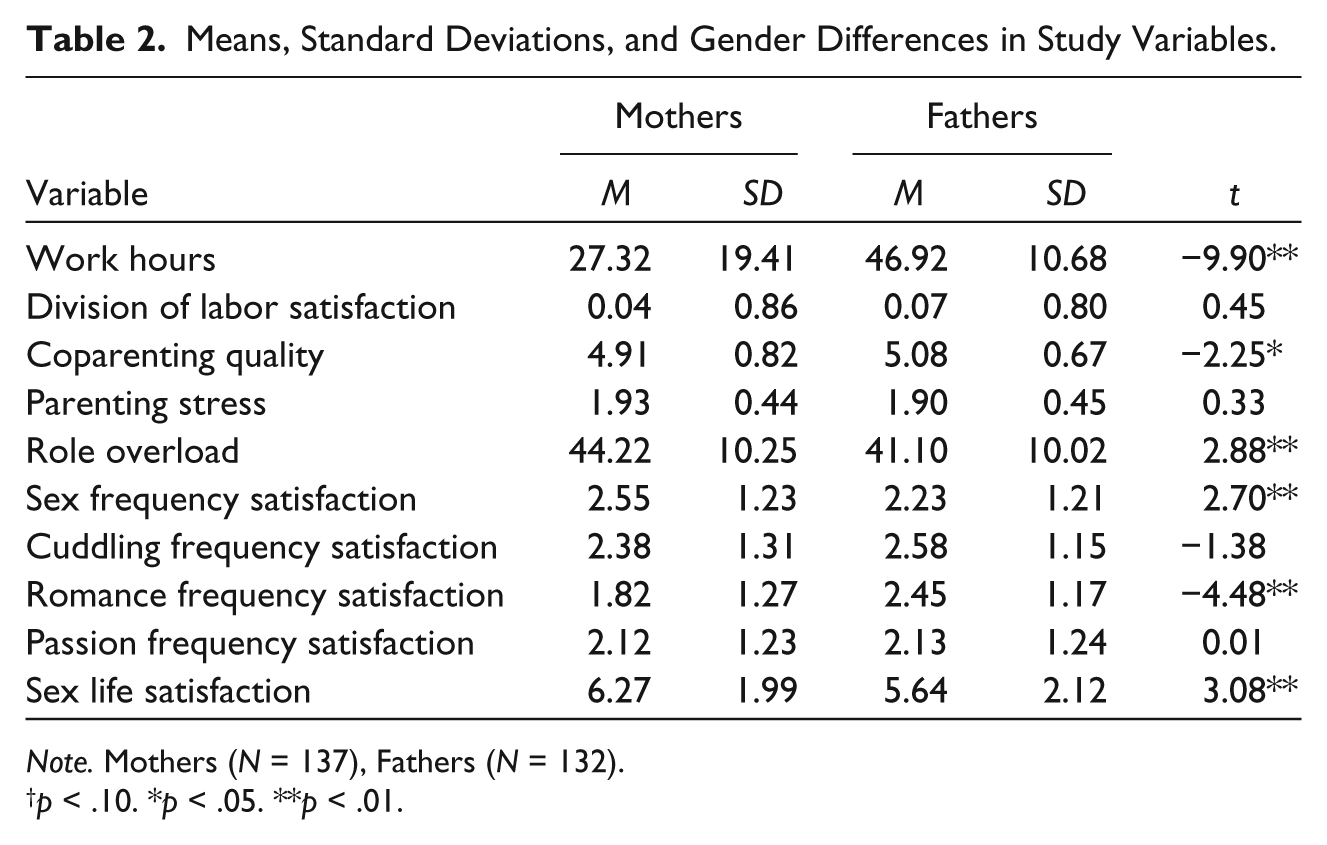
Note. Mothers (N = 137), Fathers (N = 132).
p < .10. *p < .05. **p < .01.
In Table 3, we present results from our multivariate regression models for mothers. The results represent five separate linear regression models each examining a different sexual domain. All of the study variables (coparenting, role overload, parenting stress, and satisfaction with the division of household labor) were significantly associated with the various sexual satisfaction domains (see Table 1) and thus were all entered in the regression models for mothers. In addition to correlated study variables, we also added a quadratic effect for work hours due to our Hypothesis 3 regarding maternal work hours.
Standardized Regression Coefficients Summary for Models Predicting Mothers and Fathers Sexual Satisfaction.
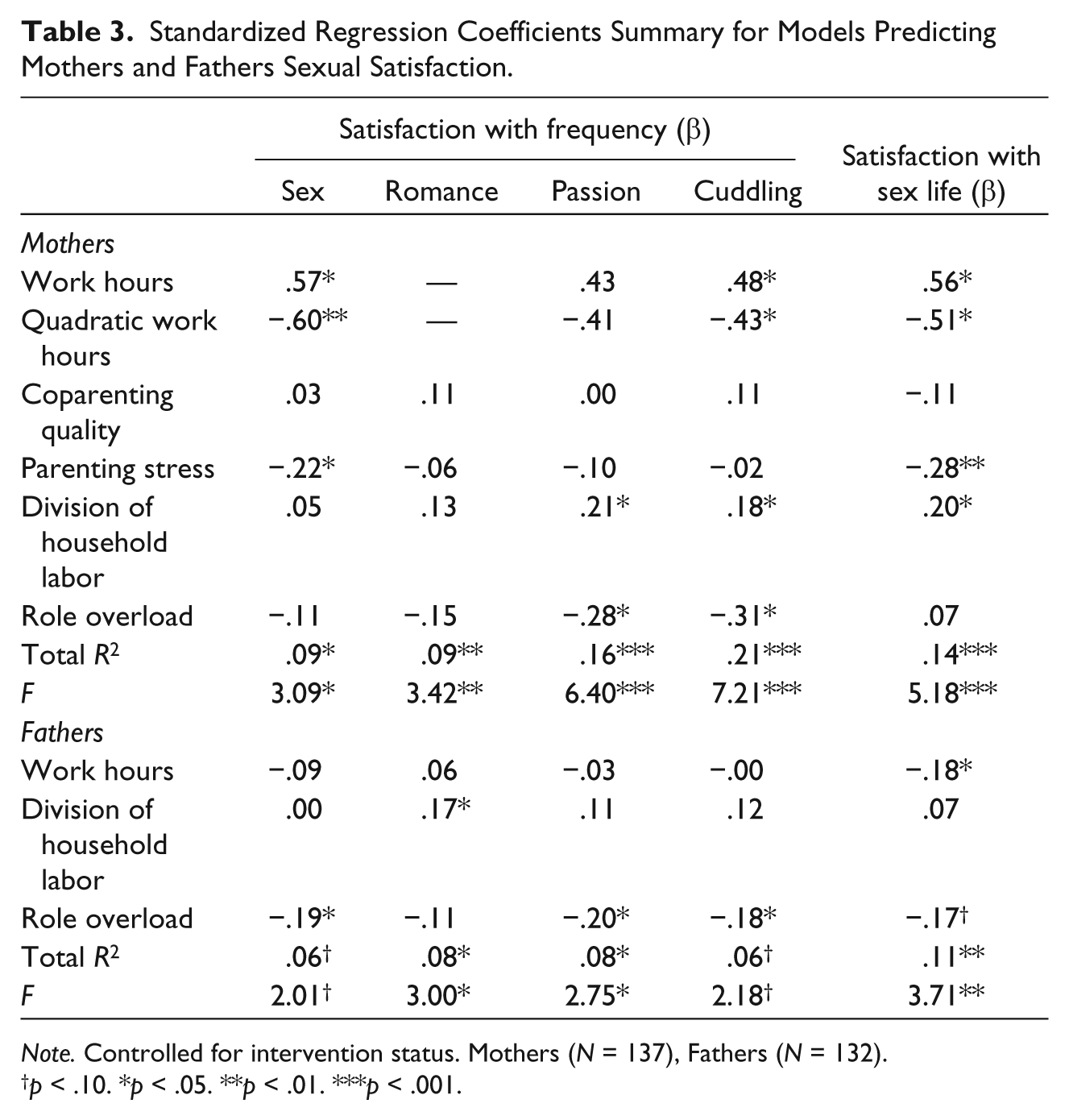
Note. Controlled for intervention status. Mothers (N = 137), Fathers (N = 132).
p < .10. *p < .05. **p < .01. ***p < .001.
Hypothesis 1: Mothers’ Satisfaction With Coparenting and the Division of Household Labor
It was hypothesized that being more satisfied with overall coparenting and the division of household labor would predict more sexual satisfaction for mothers (Hypothesis 1). This hypothesis was partially supported for mothers’ satisfaction with their overall sex life, amount of passion, and frequency of cuddling. Greater satisfaction with the division of household labor at 6 months postbirth predicted more satisfaction with sex life, amount of passion, and frequency of cuddling at 12 months postbirth although not frequency of sex or amount of romance (see Table 3). Surprisingly, in the presence of all of the other predictors in the models, mothers’ perceptions of coparenting quality at 6 months postbirth did not significantly predict any subdomains of sexual satisfaction.
Hypothesis 2: Mothers’ Parenting Stress and Role Overload
It was hypothesized that greater parenting stress and role overload would predict lower sexual satisfaction for mothers (Hypothesis 2). Hypothesis 2 was partially supported with greater parenting stress at 6 months postbirth predicting lower satisfaction with the frequency of sex and with overall sex life at 12 months; greater role overload at 6 months also predicted less satisfaction with the amount of passion and the frequency of cuddling at 12 months, but surprisingly did not predict satisfaction with overall sex life or with the frequency of sex (see Table 3).
Hypothesis 3: Mothers’ Paid Work Hours
In line with both the enhancement and scarcity hypotheses, we hypothesized a curvilinear association between paid work hours and sexual satisfaction for mothers (Hypothesis 3). Hypothesis 3 was supported, with the linear and quadratic terms for mothers’ work hours both significantly predicting satisfaction with overall sex life, as well as satisfaction with the frequency of sex and cuddling; this was also the case for satisfaction with the amount of passion at the p = .06 level (see Table 3). Results suggest that more time spent on paid labor predicted more sexual satisfaction to a point, and then after a certain point additional hours of paid labor predicted less sexual satisfaction for mothers (see Figure 1). This inflection point occurred around 25 to 30 hours for satisfaction with sex life, around 20 to 25 hours for satisfaction with frequency of sex, around 15 to 20 hours for satisfaction with frequency of cuddling, and around 25 to 35 hours for satisfaction with the amount of passion.

Mothers’ predicted sexual satisfaction values according to how many hours they work (N = 137 mothers).
Predictors of Fathers’ Sexual Satisfaction
In Table 3, we present results from our multivariate analyses for fathers. We hypothesized that stressors such as higher parenting stress or role overload would predict lower sexual satisfaction for fathers (Hypothesis 4), but that perceptions of coparenting quality (Hypothesis 5), satisfaction with the division of labor (Hypothesis 6), and number of work hours (Hypothesis 7) would not predict sexual satisfaction for fathers. Only work hours, role overload, and satisfaction with the division of labor were significantly predicted some dimensions of sexual satisfaction for fathers (see Table 1); thus, these were the only predictors used in the regression procedures for fathers. Surprisingly, parenting stress did not significantly predict any of the sexual satisfaction outcomes for fathers (Hypothesis 4). Feeling more role overload at 6 months postbirth was linked to less satisfaction with the frequency of sex, amount of passion, and frequency of cuddling at 12 months postbirth, providing partial support for Hypothesis 4 (that stress would affect fathers’ sexual satisfaction). Satisfaction with coparenting quality did not predict any of the sexual satisfaction outcomes for fathers, and in our regression models, the division of labor did not predict sexual satisfaction for the most part either, providing support for Hypotheses 5 and 6. However, satisfaction with the division of household labor at 6 months postbirth predicted more satisfaction with one subdomain at 12 months postbirth, romance. Finally, it was expected that fathers’ paid work hours would not predict sexual satisfaction (Hypothesis 7), and this was supported for the satisfaction with the subdomains. However, in the regression models, spending more time on paid labor at 6 months postbirth predicted lower satisfaction with overall sex life at 12 months postbirth for fathers, providing only partial support for Hypothesis 7.
Discussion
In general, our findings support a growing body of evidence that suggests first-time parents are generally dissatisfied with their sexual lives (Ahlborg et al., 2000; Ahlborg et al., 2005; Ahlborg & Strandmark, 2006; Pacey, 2004). Our findings also suggest that stress in the new role of parent and the division of tasks that go along with that role are differentially predictive of sexual satisfaction for mothers and fathers. More work hours are also predictive of less overall sexual satisfaction for both mothers and fathers, although for mothers little to no work hours also predicts less overall sexual satisfaction. In general, differences in predictors of romance, passion, and cuddling for mothers and fathers were more varied.
Satisfaction with the division of labor was important for both mothers’ and fathers’ sexual satisfaction—yet for different subdomains. In support of our hypothesis, satisfaction with the division of household labor predicted more satisfaction with overall sex life and frequency of cuddling and amount of passion for mothers. These findings are consistent with research highlighting the particular importance of satisfaction with the division of labor for mothers (Dew & Wilcox, 2011; Milkie et al., 2002; Wilkee et al., 1998). However, greater satisfaction with the division of labor predicted fathers’ but not mothers’ satisfaction in the amount of romance. This result was surprising because the majority of research finds women to be more oriented to relationship interactions and romance than men (Leiblum, 2002). These findings for satisfaction with the amount of romance suggest future research should include an examination of what men and women consider as “romantic” or what contributes to experienced romance. Furthermore, these findings suggest the need for future researchers to develop measures for satisfaction with nonintercourse behaviors and constructs (such as romance, cuddling, and passion), as our results suggest that sexual satisfaction is more nuanced and expands beyond satisfaction with sexual intercourse or sexual pleasure for first-time parents.
Although the negotiation of the division of labor can be considered a part of the coparenting relationship, we also examined the quality of the broader coparenting relationship in addition to the division of labor. In partial support of our hypothesis, satisfaction with coparenting quality was associated with more sexual satisfaction in all domains for mothers in our bivariate correlations. Yet coparenting did not predict any of the sexual satisfaction domains for mothers in the multivariate regression models. Fathers’ perceptions of coparenting quality were also not associated with fathers’ sexual satisfaction, which was in line with our hypothesis as men’s sexual satisfaction is less linked to other aspects of the couple relationship than it is for women (Leiblum, 2002). For mothers, it may be that overall coparenting quality was not linked to sexual satisfaction in the multivariate regression models because a more proximal and specific aspect of coparenting, the division of labor, was included in the model. In addition, given the influence of coparenting quality on parental stress (Cowan & Cowan, 1992; Crnic & Low, 2002), it may be that parental stress partially mediates the influence of coparenting on sexual satisfaction. A more sophisticated longitudinal design would be able to explore such indirect paths in future research.
In contrast to our hypothesis, parenting stress was not associated with any sexual satisfaction measure for fathers. However, in support of our hypothesis for mothers, parenting stress was associated with all sexual satisfaction domains for mothers in the bivariate correlations and in the presence of other predictors in our regression models, parenting stress continued to predict overall sexual satisfaction and satisfaction with the frequency of sex. Parenting stress predicting later sexual satisfaction for mothers may be due to women’s view of child rearing as an obligatory gender role, in contrast to men’s more optional participation in child rearing (Coltrane, 2000). In a qualitative study of the sexual experience among mothers, common themes for lack of sexual interest were the feeling that “her body belonged to her children,” and “not having energy to devote to her partner after giving all day to her children” (Trice-Black, 2010). Thus, the mothers in our sample who were stressed by the new role of parent may have felt less sexual desire or less sexually attractive, thus reducing sexual satisfaction. For fathers, however, parenting stress may have been unrelated to their sexual satisfaction because parenting may be less tied to the male gender role.
Our results corroborate previous findings that suggest stress plays an important role in the sexual function of couples. In general, both mothers and fathers felt overloaded. However, mothers reported greater role overload than fathers. Although mothers worked fewer hours on paid labor on average than fathers, they likely spent more time on household and child-related duties. In our bivariate correlations, both mothers and fathers who reported more role overload reported less sexual satisfaction in all domains. In the multivariate regression models, more role overload predicted less satisfaction with the frequency of cuddling and amount of passion for mothers and fathers, and less satisfaction with the frequency of sex for fathers. Our role overload findings provide support for the scarcity hypothesis (Bielby & Bielby, 1989), indicating that time and energy dedicated across multiple areas of life leaves one feeling overwhelmed and may take time and energy away from the sexual relationship.
Although both mothers’ and fathers’ satisfaction with the frequency of cuddling and amount of passion were predicted by role overload and both mothers’ and fathers’ work hours predicted satisfaction with the overall sex life, there are some gender differences that should be noted. Greater role overload for fathers and greater parenting stress for mothers predicted less satisfaction with the frequency of sex. Overall, stress experienced inside and outside the couple was demonstrated more in mothers, with less satisfaction with coparenting quality and more feelings of role overload predicting less sexual satisfaction. Although there has been a shift toward fathers becoming more involved in housework and child care, there continue to be more demands placed on mothers to balance multiple roles after the transition to parenthood. These greater demands would make mothers more easily distracted by child care and housework and therefore mothers would need more energy to boost desire for sexual activity (Levine, 1992). These findings for mothers are similar to a recent daily diary study, which found that the probability of having sexual intercourse following a relatively stressful day was higher for men than women (Ein-Dor & Hirschberger, 2012).
In partial support of the enhancement hypothesis for mothers, work hours had a curvilinear association in four out of the five domains of sexual satisfaction for mothers suggesting that some time spent on paid labor is beneficial to the well-being of new mothers. However, the scarcity hypothesis was supported by the findings that more work hours predicted diminished sexual satisfaction for mothers. In our sample, although paid work hours was not predictive of satisfaction with most of the sexual satisfaction domains, we found one significant linear trend for fathers: higher work hours was associated with decreased satisfaction with their overall sex life, providing some support for the scarcity hypothesis for fathers. Of course, fathers generally were working outside the home for more hours than mothers, and thus it is possible that the scarcity hypothesis only applies across a certain range of work hours for both men and women. Overall, these findings allude to the importance of measuring the number of work hours instead of dichotomizing working inside or outside the home as well as considering nonlinear associations when considering gender differences in work and family.
Limitations
Although this study adds to the literature on sexual satisfaction among first-time parents in a number of ways, there are certain limitations. First, the sample was not ethnically diverse and therefore these findings may not generalize across different ethnicities. Second, a portion of the sample participated in a coparenting intervention, and although intervention status was controlled for in our models, some participants’ experiences may not be normative of all first-time parents. Third, future research would benefit from exploring actual sexual behavior and frequency in addition to satisfaction. Fourth, our sample did not include same-sex couples or couples with an adopted child, and therefore these findings might not generalize across all first-time parents. Although the current study examined mothers and fathers separately in the analyses due to power issues, multicollinearity, and inherent biological differences in sexual function postbirth, the current study provides an initial exploration of the predictors of multiple sexual and romantic domains in first-time parents. We believe the current study will act as a springboard for future work to examine the complex interdependencies that may exist between mothers and fathers within couples in terms of sexual satisfaction.
Contributions
Despite these limitations, we highlight three key implications of these findings. First, the sexual aspect of the relationship in first-time parents is an integral part of the entire relationship. When sexual intimacy decreases there is a risk that the couple detaches emotionally and physically from each other (Foux, 2008) and the risk of infidelity increases (Cowan & Cowan, 1992). Accordingly, it is important to address sexuality in couple-based interventions. Our findings could be used in coparenting and premarital interventions in order to educate and inform new parents about sexual expectancies and realities of first-time parenthood as well as important gender differences to consider when facing the challenge of maintaining sexual intimacy after the transition to parenthood. For example, it would be beneficial to caution new parents that they may be dissatisfied with their sexual life, yet ensure them this is a normative experience and encourage them to communicate with their partner about their sexual feelings or concerns.
Second, our results—although exploratory—suggest that different parenthood factors (e.g., coparenting, parenting stress, role overload, and satisfaction with the division of household labor) predict different sexual satisfaction domains. These results suggest that sex, cuddling, passion, and romance are likely distinct aspects of the sexual relationship. Future research should explore whether nonintercourse sexual behaviors play a protective role for couples in maintaining intimacy in the absence of sexual intercourse.
Third, stress and sexual satisfaction are associated for first-time parents. However, sources and perceptions of stress vary between genders. It is important to consider the sources of stress for new parents (e.g., work hours, division of labor, parenting stress, and role overload) and how these relate to couple sexual satisfaction.
Conclusion
It is apparent to us that sexuality is deeply understudied in first-time parents, offering an opportunity for future investigation that uses a more complex analytic approach. Our findings indicate that sexuality is an integral part of other relationship dynamics in first-time parents, and therefore should be considered when examining difficulties faced in first-time parents. Therefore, couple-based prevention programs should address gender differences in sexual functioning and satisfaction among first-time parents by offering possible solutions for communicating and understanding those differences so that both genders in the dyad experience satisfaction with their sex life during the pivotal time for couples after the transition to parenthood.
Footnotes
Acknowledgements
We are grateful to Michelle Hostetler for her help with data collection and project management.
Declaration of Conflicting Interests
The author(s) declared no potential conflicts of interest with respect to the research, authorship, and/or publication of this article.
Funding
The author(s) disclosed receipt of the following financial support for the research, authorship, and/or publication of this article: This research was supported by grants from the National Institute of Child Health and Human Development (1 K23 HD042575) and the National Institute of Mental Health (R21 MH064125-01), to Mark E. Feinberg, principal investigator and the National Institute on Drug Abuse (T32 DA017629). The content is solely the responsibility of the authors and does not necessarily represent the official views of the National Institute on Drug Abuse or the National Institutes of Health.