



Abstract
Stay-at-home and employed mothers have been the subject of a wide range of both academic and popular discourse about roles, satisfaction, and meaning. However, no literature has examined time trends in relative satisfaction with being a stay-at-home versus a working mother. Here, we use pooled, yearly data from the General Social Survey to examine trends in how satisfied stay-at-home mothers are with their work relative to employed mothers. We find that stay-at-home mothers used to report less satisfaction with their work than employed mothers, but this gap became statistically nonsignificant around the same time trends in which societal attitudes toward gender roles began to shift. These changes are widespread across different socioeconomic and ideological groups, and do not appear to be attributable to sociodemographic composition changes.
Introduction
Stay-at-home mothers (SAHMs) and employed mothers have been the subject of a wide range of both academic and popular discourse examining questions of gender roles, satisfaction, and meaning. Although no longer a majority, SAHMs still constitute a sizeable minority of the female population, with 8.6% of females in the 2012 General Social Survey (GSS) indicating that they were full-time homemakers with children at home (roughly 13.7 million women). 1 This proportion has not changed significantly in the past decade (6.9% of females in the 2002 GSS), suggesting that stay-at-home mothering is likely to remain a feature of American society for the foreseeable future. This, in turn, underscores the importance of understanding the social and emotional consequences of stay-at-home mothering as its own substantively important phenomena. 2
In this study, we focus on women’s satisfaction with SAHM work relative to paid labor and examine whether this difference has changed over time. Despite much informal speculation, virtually no literature has empirically examined trends in SAHM satisfaction, a fact that is particularly striking given the dramatic sociocultural changes of the past decades surrounding work and gender roles.
Theories and Prediction
Along with satisfaction with family, health, and leisure, satisfaction with work represents one of the central domain-specific measures of subjective well-being (Diener, Scollon, & Lucas, 2003). There are a variety of mechanisms through which work-specific satisfaction could change over time for either working or SAHMs, in part because there are many sources of work satisfaction (e.g., job demands; Kohn & Schooler, 1973). For brevity, we consider just one, though we mention other possibilities in the discussion. We argue that how satisfied individuals are with the work that they do is affected at least in part by the messages they receive from society about how important their work is; that is, work satisfaction among SAHMs depends on the socially constructed schemas (Sewell, 1992) that impute meaning and purpose to the SAHM role.
We can gain insight into how satisfaction with being a SAHM might have changed by examining changes in perceptions of stay-at-home mothering. However, theoretical and empirical treatments of the subject conducted at different times have come to varying conclusions about the extent to which society values the SAHM role relative to the working mother role (e.g., Bernard, 1971; Brescoll & Uhlmann, 2005; Douglas & Michaels, 2005; Ferree, 1976; Friedan, 1964; Gove & Tudor, 1973; Okimoto & Heilman, 2012; Parsons, 1942; Weiss & Samelson, 1958). When taken in total, these studies are not consistent enough in their methods to be able to draw any conclusions about time trends one way or another. Fortunately, there are investigations of gender role attitudes more generally, and given the historically tight connection between conservative gender norms and stay-at-home mothering, these trends may give insight into satisfaction with stay-at-home mothering.
Recently, Donnelly et al. (2016) found that attitudes toward working mothers became more egalitarian from the 1970s to the 2010s, only interrupted by a small backlash in the 1990s. The 1990s backlash they found supports other studies that have found evidence for a stalling of the gender revolution around the mid-1990s (Cotter, Hermsen, & Vanneman 2011; England, 2010; Pedulla & Thébaud, 2015). However, it is not clear if this stalling really represents a state of stasis for gender attitudes, or whether it represents a more nuanced shift, continuing to be more egalitarian in some dimensions, while stalling in others. This distinction is important when trying to extrapolate trends from general gender attitudes to SAHM role valuation specifically, and there are a number of perspectives on the ideological causes of the stalling of the gender revolution that have implications for SAHM satisfaction.
For example, Charles and Grusky (2004) attribute the seeming stasis in gender role attitudes to a rise in an essentialist but equal framework as a backlash against the traditional egalitarian one of the previous two decades, where women and men were viewed as having distinct but equally valid roles in society. If this is the case, we would generally expect to see SAHMs become more satisfied with their work as the SAHM role came to be viewed as an equally worthy (or superior) alternative to employed labor. Similarly, Cotter et al. (2011) posit that the 1990s also saw a rise in a gender frame that shifted away from the assumption that the SAHM role was the natural outgrowth of patriarchal repression toward one that emphasized the validity of the mother’s choice. Consequently, we would expect differentials in satisfaction between SAHMs and employed mothers to narrow as this framework became more widespread and women disposed toward one role or the other felt freer to pursue the role that was a better fit for them. (Oakley [1975] suspects that fit plays a role in homemaker satisfaction, and a large literature suggests that personal fit with occupation has a positive effect on work-specific satisfaction [e.g., Morley, 2007].)
Other researchers have emphasized changes around the same time of the stalling of the changes in gender attitudes that may have changed the incentives for adopting a SAHM role. While Stone (2007) primarily attributes the decision to stay at home as stemming from employment-specific factors, both Hays (1996) and Stone (2007) point out that societal expectations emphasizing labor and emotionally intensive mothering follow women into the workplace, especially among middle- and upper-middle-class women who are likely to be heedful of the parenting philosophy industry that provides “expert advice” that encourages intensive mothering, and who also have the resources required to engage in such a parenting style (Stone, 2007).
Similarly, Lareau (2011) found that middle- and upper-middle-class parents engage in what she labeled a “concerted cultivation” approach that involves spending enormous amounts of energy, time, and resources on developing their children educationally and in other ways. With such a strong emphasis on intensive, hands-on parenting, it may be no surprise that some parents “opt out” of the employed workforce and decide to stay home as full-time parents; however, this emphasis on parenting is also likely to have altered the cultural meanings surrounding stay-at-home mothering work, making it seem more important and, hence, increasing its social valuation.
However, the assumption that the stay-at-home lifestyle is a luxury option only accessible to those in the middle and upper classes who can afford it has been criticized, most notably by Damaske (2011), who argues that working-class Hispanic and White women have ambivalent attitudes toward workforce participation in large part because the prospect of long-term, stable employment is more distant for them. This approach highlights the possibility that historical changes in SAHM satisfaction may also stem from the valuation of the alternative to stay-at-home parenting: employed labor. As opportunities for stable employment change, so too does the relative value of its alternative.
The aforementioned discussion implies that changing cultural norms could influence work satisfaction among SAHMs in at least two ways. First, mothers who are more likely to be satisfied with SAHM work relative to paid labor could choose to leave the paid workforce and stay home with their children. This “fit” hypothesis suggests that any increases in satisfaction among SAHMs are the product of self-selection that produces a better fit between mothers and their work. Presumably this would be evidenced by a change in SAHM demographics across time. Alternately, increased cultural valuation of the SAHM role could allow mothers to derive more satisfaction from SAHM work, perhaps because they receive positive reinforcement from peers, or because they personally come to value SAHM work more highly. Either scenario would increase reported satisfaction, but only the second is consistent with our claim that satisfaction with SAHM work has increased because cultural messages have increasingly imbued the SAHM role with greater value. We investigate both possibilities below.
Method
Data
We use data from each wave of the GSS from 1974 to 2012. The GSS collected data (almost) yearly from 1974 to 1994, and every 2 years after that. 3 Missing data were multiply imputed 60 times using a bootstrap EM algorithm (Honaker & King, 2010), but cases originally missing on the outcome were removed prior to analysis to increase efficiency and prevent possible biases (Von Hippel, 2007). The sample was restricted to working mothers and SAHMs; that is, women with at least one child at home who worked either part-time or full-time, or who reported that she “keep(s) house” (N = 9,926). Some analyses also use U.S. data taken from Waves 2 to 6 of the World Values Survey (WVS), described below. Measures are described below, with descriptive means given in the appendix.
Predictors
SAHM status is coded 1 for women with 1 or more children living at home who reported that past week they were “keeping house,” and 0 for all others (including women who might be at home for other reasons, such as unemployment, illness, or retirement). Year is an integer recording, the year in which data were collected relative to 1974 with endpoints 0 = 1974 and 38 = 2012.
Outcome
Respondents were asked: “On the whole, how satisfied are you with the work you do?” with response options of 1 = very dissatisfied or a little dissatisfied (combined due to small sample size), 2 = moderately satisfied, and 3 = very satisfied (after reverse coding). It is important to note that this measure taps satisfaction with “keeping house,” which likely includes—but is not limited to—parental work. Thus, it is more appropriately regarded as tapping satisfaction with the SAHM lifestyle. This wording, combined with the sample specifications used (women with a child at the home), strongly implies that “the work” in question involves both parenting and domestic housework, especially, since it was presented as a category that is mutually exclusive to employed labor. Additionally, parenting-related emotional labor and housework is often conflated in practice (e.g., preparing and executing family meals, planning a birthday party, etc.), and it is unlikely that respondents carefully differentiated between the two when asked in general about the work they do.
In some cases, the order in which questions were asked might have contaminated this measure with unwanted associations with past employment. SAHMs who reported ever having worked “for as long as 1 year” were asked a number of questions about their past work prior to receiving the work satisfaction question. A chi-square test of work satisfaction and having ever worked among SAHMs confirms that response patterns differ between these two groups (χ2 = 13.6, p = .001), with SAHMs who had once worked reporting slightly higher mean levels of satisfaction than SAHMs who had not (2.28 vs. 2.18). We cannot be sure if this is because these women were actually reporting satisfaction with their prior employment, or if the reminder of past work prompted a comparison that resulted in higher ratings for their current at-home situation. In either case, this suggests a need to replicate any findings in the subset of SAHMs who have not worked. This sensitivity check is reported below.
Cultural Valuation of Stay-At-Home Mothering
GSS data do not measure attitudes toward SAHMs; however, Waves 2 to 6 of the U.S. WVS ask respondents to rate their agreement with the statement “being a housewife is just as fulfilling as working for pay.” We operationalized cultural valuation of SAHM work as the overall percentage of U.S. respondents in each year who strongly agree with this statement. These data were available for 1990, 1995, 1999, 2006, and 2011. 4 We matched these to GSS data for the years 1990, 1994, 1998, 2006, and 2010, respectively.
Control Variables
Controls include variables that were found to predict selection into SAHM status, as described below. Variables considered include number of children younger than 6 years, total number of children at home (younger than 18 years), age (divided by 10), and dichotomous indicators for working part-time, being married, being divorced, living in the South, being racially Black, and being of another non-White racial category. Income was measured as total household income minus the respondent’s personal income (divided by 10,000 and in year-2000 dollars), as this is the amount respondents would likely consider in deciding whether to stay at home. Potential controls also include self-reported political liberalism and conservatism (1 = extremely liberal, 7 = extremely conservative) and indicators for having an associate’s degree or higher, and for belonging to a Conservative Protestant denomination, coded using the scheme outlined by Steensland et al. (2000). Feminist attitudes were measured using the scale developed by Cotter et al. (2011), with higher values indicating more support for women working outside the home. 5 While popular perceptions of SAHMs usually include a breadwinning spouse, this is not necessarily the case, as many SAHMs rely on cohabiting partners or ex-spouses for financial support. However, the GSS does not consistently measure cohabitation status, and the arrangements for providing financial care for children of nonpartnered SAHMs are likely complex enough that our basic measures here do not do descriptive justice to the phenomenon of the unmarried SAHM. We are unable to investigate how these fiscal dynamics interact with the results found here; ultimately this is a limitation of the study.
Analyses
All models assessing work satisfaction are proportional odds logistic regression models. Time trends in SAHM satisfaction relative to employed mothers are calculated by interacting SAHM by Year (preliminary analyses indicated that linear trends fit the data adequately). 6 We then move to testing potential explanations for the observed trends, examining first whether observed trends can be explained by the “fit” hypothesis—that is, that work satisfaction has increased because women who better fit the SAHM role are increasingly selecting into it. We then explore the role of changing norms surrounding SAHMs in two ways. First, we use WVS data to examine whether cultural valuation of SAHM work increases between 1990 and 2010 (the time of the stalling of the gender revolution) and determine whether trends in SAHM satisfaction depend on this cultural valuation as hypothesized. Because these analyses rely on only 5 years of data, we then test the role of norms indirectly using all years of GSS data. We reason that if social norms surrounding SAHMs are becoming more positive due to intensive mothering, concerted cultivation, and related cultural frameworks, we would expect to see the effects first in the middle- and upper-middle-class mothers among whom these ideas are most prevalent. We therefore use three-way interactions to determine if the trend in SAHM satisfaction relative to employed women is more pronounced for middle- and upper-class mothers. We operationalize class using total household income (divided by 10,000 and in year-2000 dollars) and a binary variable for having earned a college degree (associates or higher).
Interaction terms change the meaning of coefficients and their associated significance tests, making them difficult to interpret directly. For these reasons, we present key results graphically using predicted probabilities and average marginal effects (AMEs). 7 AMEs are attractive because they overcome many of the problems inherent in comparing coefficients across logit models (Mood, 2010) and have a simple interpretation: They are the average effect of a predictor on the outcome.
Results
Model 1 of Table 1 compares the work satisfaction of SAHMs with that of employed mothers, and allows this relationship to vary over time. These relationships are shown in Figure 1, which plots predicted probabilities of work satisfaction for both groups, along with confidence intervals that show where trend lines are statistically different from one another (Goldstein & Healy, 1995). There are several notable features. First, the majority of women in both groups are predicted to be very or moderately satisfied with their work throughout the period of study (predicted probability > .80), indicating that both paid employment and full-time mothering provide rewarding experiences. Second, despite high overall levels of work satisfaction, employed mothers have traditionally enjoyed an advantage, with higher predicted probabilities of being very satisfied and lower probabilities of being a little or very dissatisfied. However, trends for all levels of work satisfaction converge from 1974 to 2012, converging for those who are a little or very dissatisfied or who report moderate satisfaction by the mid-1990s, and for those who are very satisfied by 2000. For the remainder of the analyses, we restrict our attention to exploring trends in being very satisfied with work, as this both simplifies the presentation of results and highlights the level of satisfaction where initial differences between SAHMs and employed mothers are largest and persist the longest.
Ordered Logit Regressions of Work Satisfaction on SAHM Status and Time Trend.

Note. Est. = estimate; SE = standard error; SAHM = stay-at-home mother.
p < .05. **p < .01. ***p < .001.
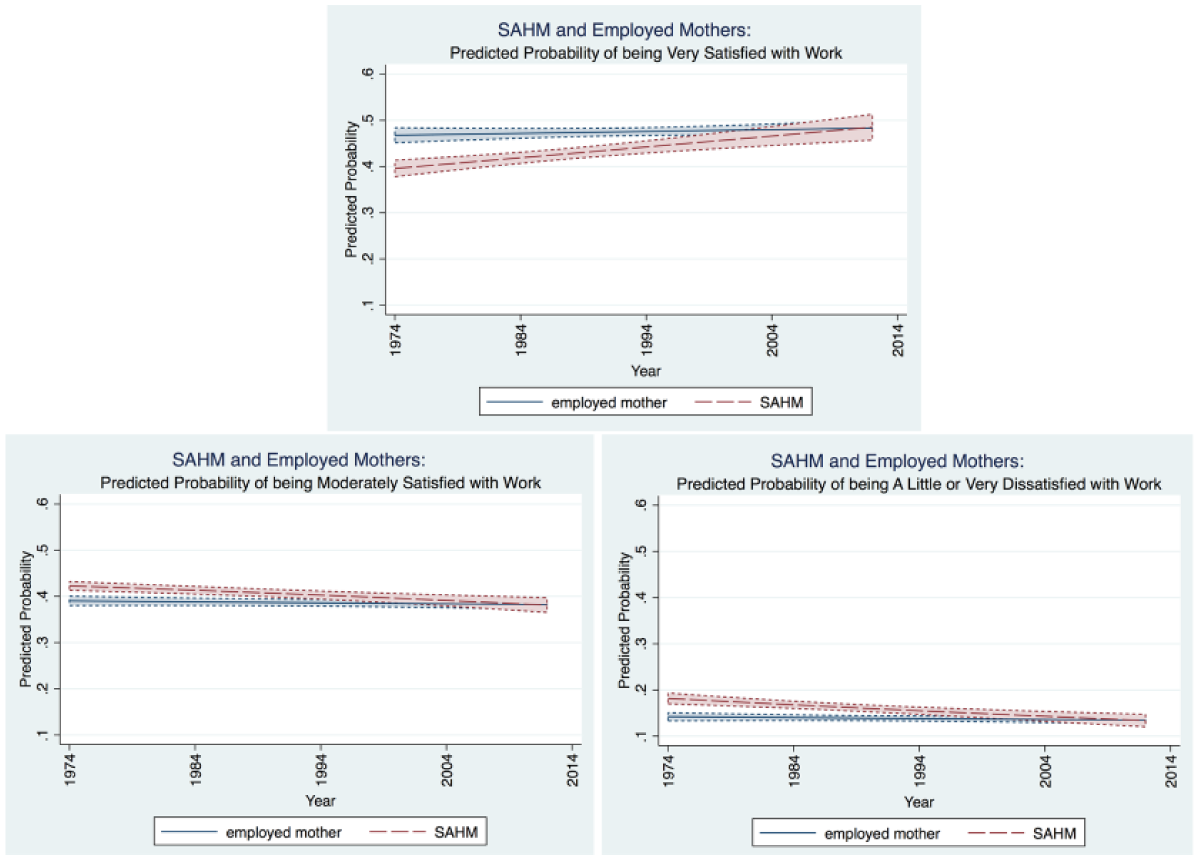
Predicted probability of satisfaction with work for SAHMs and employed mothers, unadjusted models.
Why do trends in satisfaction converge? One possibility is that the composition of women who make up SAHMs has changed over time as women increasingly self-select into the SAHM role. Table 2 presents a logit selection model that includes interactions that allow the effect of selection variables to change over time. Initially, women from households with higher incomes (net of their own earnings) were more likely to be SAHMs, and this tendency has strengthened over time. In contrast, feminist attitudes originally had a strong negative effect on selection into SAHM status, but this has diminished through the years.
Logit Regression on SAHM Status on Selection Variables.

Note. Est. = estimate; SE = standard error; SAHM = stay-at-home mother.
p < .05. **p < .01. ***p < .001.
To determine if these composition changes explain the SAHM satisfaction effect, we added all predictive selection controls to our original time-trend model. Results are shown in Model 2 of Table 1. Marginal effects from the model are shown in Figure 2, along with 95% confidence intervals. These represent the differences in the predicted probability of being very satisfied for SAHMs relative to employed mothers. Figure 2 makes it clear that changes in work satisfaction among SAHMs cannot be explained by selection—the pattern of results remains the same as in Model 1. In particular, in 1974, SAHMs have a −0.09 lower probability of being very satisfied with work, but this deficit decreases over time, becoming statistically indistinguishable from 0 by 1998 (2 years earlier than in the model without controls).

Marginal effects of SAHM status on being very satisfied with work.
Another possibility is that increasing work satisfaction among SAHMs is tied to an increased cultural valuation of mothering and the SAHM role. Figure 3 provides preliminary evidence using WVS data, showing that the percentage of U.S. respondents who strongly agree that being a housewife is just as fulfilling as paid work generally increased from 1990 to 2006.
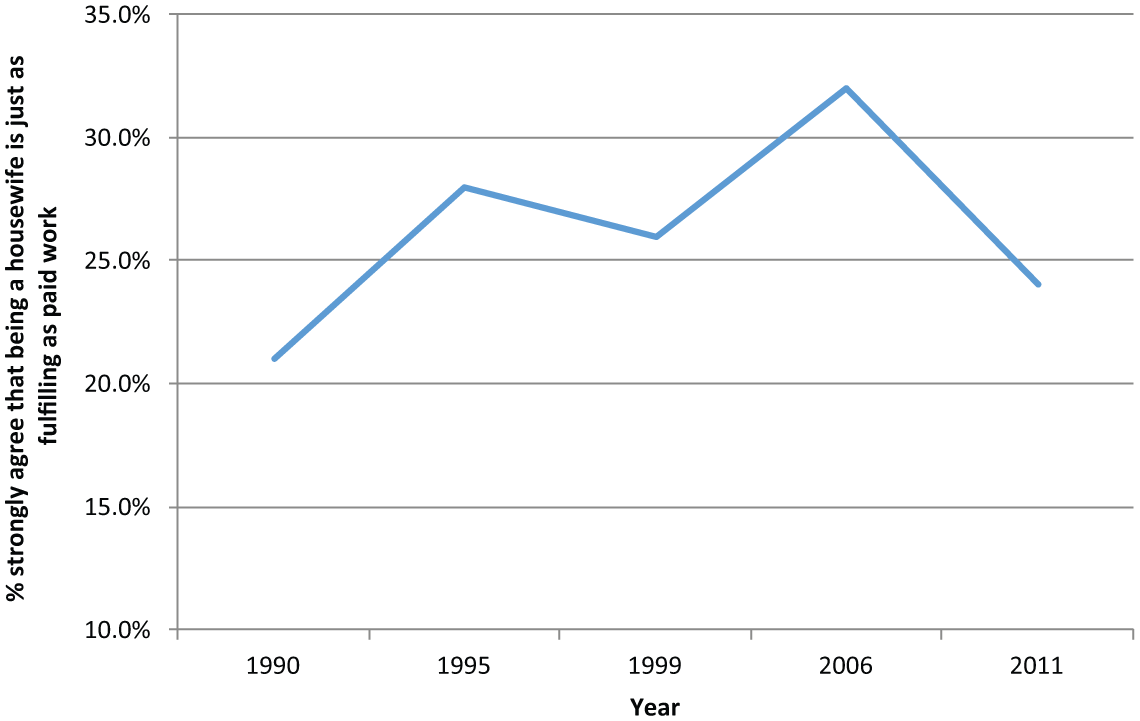
Cultural valuation of SAHM role in the United States by year.
The last wave, taken in 2011, did show a decline. Nonetheless, taken as a whole SAHM valuation showed a tentative increase across time. As there would presumably be a lag in changes in SAHM valuation and career and domestic decisions arising from those changing norms, it is difficult to derive year-specific predictable hypothesis from this one wave. The general finding, however, that SAHM valuation increased the same time the differential in satisfaction collapsed, still holds. Does this increased valuation of SAHM work spill over into work satisfaction? Table 3 tests this claim by interacting SAHM status with cultural valuation of SAHM work, using data from the 5 years for which cultural valuation measures are available (and including all selection controls).
Variation in SAHM Effect by Cultural Valuation of SAHM Role.

Note. N = 2,211. Est. = estimate; SE = standard error; SAHM = stay-at-home mother. Uses General Social Survey years 1990, 1994, 1998, 2006, and 2010.
p < .05. **p < .01. ***p < .001.
The interaction is positive and significant (β = .066, p = .018), consistent with the claim that SAHMs derive more satisfaction from their work when cultural norms value SAHM work. Translating this result into marginal effects makes the point even more clearly. When only 21% of the U.S. population strongly agrees that being a housewife is as fulfilling as paid work (the minimum value observed between 1990 and 2011), the predicted effect of being a SAHM on work satisfaction is negative (β = −.109, p = .019). However, when that proportion rises to 32% (the maximum value) the predicted effect becomes is in the positive direction, though it is not significantly different from 0 (β = .065, p = .116). These results support the claim that increased work satisfaction among SAHMs is attributable at least in part to increased valuation of the SAHM role.
We also test the link between cultural valuation and SAHM work satisfaction indirectly using all waves of GSS data. Because ideological changes toward intensive parenting have purportedly been most pronounced in the middle- and upper-middle classes (Hays, 1996; Lareau, 2011; Stone, 2007), we expect a stronger trend among middle- or upper-middle-class women. Model 3 in Table 1 tests this idea by interacting the SAHM × Year trend by total household income, and Model 4 does the same, but uses instead an indicator for having earned a college degree (2 year or above) as a proxy for middle- or upper-middle-class status. In both Models 3 and 4, the three-way interaction is positive and statistically significant, indicating that changes in work satisfaction are stronger for SAHMs with higher household incomes and for more highly educated SAHMs, as expected. Among SAHMs at first quartile of household income, the initial predicted probability of being very satisfied with work was −0.05, lower than for employed mothers, but this diminishes to essentially 0 by 2012 (−0.002, p = .936), a change of approximately 0.05. 8 Among SAHMs at the third quartile, however, the initial gap is −0.07 and the final difference is a positive 0.07 (p = .022), for a change of 0.14. The pattern is similar by education, with the marginal effect for SAHMs without a college degree increasing from −0.08 to 0.002 (p = .945)—a change of 0.08—while college educated SAHMs increase by 0.28, from −0.18 to 0.10 (p = .023). Thus middle- or upper-middle-class women experience the largest gains in satisfaction, and by 2012 have predicted levels of satisfaction that are higher than those of employed mothers.
Sensitivity Check
Findings to this point suggest that SAHMs have increased in work satisfaction over the past several decades, but it is possible that this is an artifact of question ordering in the GSS (see above discussion). To test this, we reestimated Models 2 to 4 from Table 1 after removing SAHMs whose answers might be contaminated by question ordering. Table 4 shows key coefficients for both sets of models. In almost all cases, coefficients for the original models and the subset models are in the same direction (the exception being the year main effect for Model 4).
Comparison of Key Results in Full and Subset Samples.

Note. N = 7,381. Est. = estimate; SE = standard error; SAHM = stay-at-home mother.
Patterns of statistical significance also remain the same except for the three-way interaction by college education, which is nonsignificant in the subset sample. We must be cautious not to read too much into this change; however, since this interaction spreads the data quite thin—removing SAHMs who have never worked leaves just 39 SAHMs with a college degree. Overall, the similarities across the full and subset samples indicates that whatever question ordering effects might exist in the full sample of SAHMs are unlikely to invalidate the substantive findings.
Discussion
Our results reveal two important points. First, by and large both SAHMs and employed mothers reported high levels of satisfaction throughout the period of the study, suggesting that both types of work provide fulfilling experiences. Second, this gap has closed over time, such that by 1996 the differences between SAHMs and employed mothers in the predicted probability of being very satisfied with their work became statistically nonsignificant, and remained so through 2012.
These results are consistent with an explanation based on shifting cultural norms (Cotter et al., 2011; England, 2010; Pedulla & Thébaud, 2015), and chronologically our results match up with the empirically observed trends in female workplace participation and other changes that occurred around the mid-1990s, suggesting that they are related to the nexus of changes associated with the “stalling” of the gender revolution. In particular, the rise of intensive mothering and related cultural frameworks seem to have increased the value placed on stay-at-home mothering, and the consequent gains in work satisfaction have been most pronounced among middle- and upper-middle-class women most likely to be exposed to these ideas. When Cotter et al. (2011) discussed why gender attitudes had changed in the 1990s, they made the point that if the reaction against the liberal feminism of the 1970s and 1980s was a more general cultural shift, then the particular micro-level characteristics of the individual’s family and work situations may be less important, and we should expect to see the attitudes changing broadly across the entire population.
We agree, and argue that a broad-based cultural change has occurred in U.S. society that has made SAHMs more satisfied with their work.
Our findings are also consistent with the claim that changing cultural norms have allowed women more freedom to choose the SAHM role, and we observed that high-income and feminist mothers have been increasingly likely to stay at home. However, these selection processes do not explain the increases in satisfaction observed among SAHMs, lending no support for the claim that “fit” with the SAHM lifestyle is important for SAHMs’ work satisfaction.
These results also inform the literature on historical changes in gender roles more generally. While not directly bearing on the “opt out” discussion in the literature about why middle-class women choose to leave work to adopt the SAHM role (Stone, 2007), our findings suggest that, while there may be push factors leading to that decision, there may be pull factors as well, as stay-at-home mothering is now seen as a more acceptable choice for women. Perhaps, more important, our results indicate that regardless of why mothers stay at home, those who “opt out” are not miserable in their role, and that among middle-class women, where the opt out phenomenon appears to be most relevant, there has been the greatest gains in SAHM satisfaction. However, there remains the uninvestigated possibility that shifts in employment valuation may also be playing a role.
However, while the results empirically comport with the aforementioned theoretical explanations, this brief study (and GSS and WVS data) are limited in their ability to more precisely explicate the causes behind these trends; however, the existence of these trends alone substantively informs our understanding of the gendered dynamics underlying work satisfaction. Further research could profitably address the limitations of this study and explore questions raised by our results. First, researchers should replicate the trend in work satisfaction among SAHMs using alternative sources of data. The GSS is an excellent resource for charting change over time, but other data might more directly measure stay-at-home mothering rather than housekeeping generally. Even if other data sources cannot match the time span covered by the GSS, replication of portions of the time trend using more precise measures would provide valuable confirmation of the present results. Second, researchers could look for variation in the broad trends uncovered here. For example, our results find little evidence that fit influences the satisfaction of SAHMs, but this might be less true for subsets of SAHMs that are difficult to capture using a large nationally representative survey. Future work could also examine other explanations for the increasing satisfaction among SAHMs. For instance, work satisfaction might improve if the demands of stay-at-home parenting have decreased over time, perhaps due to changes in family structure (e.g., size), increased sharing of child rearing responsibilities among parents, or increases in the social supports and resources available to SAHMs. Researchers should also examine whether satisfaction depends on the timing and duration of stay-at-home work—knowing that staying at home is an interruption rather than an end to paid employment might change its emotional impact. Finally, WVS data indicate that cultural valuation of SAHM work might have decreased in recent years (see Figure 3). Researchers should examine what effect this has on selection into the SAHM role and satisfaction with SAHM work.
These limitations notwithstanding, our study provides clear evidence that the SAHMs of today are not unfulfilled, desperate housewives, but rather are just as satisfied with their work as are employed mothers. Our results are consistent with the idea that many different sectors of American society are increasingly validating the legitimacy of the SAHM role. Perhaps, most important of all, this study directs much needed attention to SAHMs, who make up a significant portion of the population but who have largely been neglected in the social scientific literature. SAHMs do not appear to be going anywhere and deserve further study.
Footnotes
Appendix
Declaration of Conflicting Interests
The author(s) declared no potential conflicts of interest with respect to the research, authorship, and/or publication of this article.
Funding
The author(s) received no financial support for the research, authorship, and/or publication of this article.