




Abstract
Via analysis of online survey data of 262 people aged 18 to 70 in the United States who have been involved in a long-distance romantic relationship (LDR) since 2005, we investigate how paper, audio, visual, and digital communication formats may be used and viewed as differentially meaningful. While in most intimate relationships, digital formats such as e-mail, messaging, and texts are frequently used, LDR couples are more likely to use and find most meaningful video chat and audio platforms compared with paper or digital formats. The reason for each platform’s meaningfulness varies according to survey respondents’ subjective understandings. Audio and visual formats are seen as meaningful because they offer intimacy, paper formats offer thoughtfulness, and digital formats offer ease as well as thoughtfulness. This research contributes to understanding the subjectively constructed meaning of ever-changing communication platforms, as well as definitions of shared sociomental spaces, for couples who are geographically separated.
Keywords
People increasingly use digital formats to communicate with loved ones who are geographically distant, from video chats on cell phones to messages shared on social media platforms. More people are texting and using smartphones to communicate with each other than ever before (Fox & Rainie, 2014; Smith, 2015), and people are less likely to send paper letters than in the past (Harris, 2007). With each new information and communication technology (ICT) device or platform introduced in the marketplace, the options for ways to digitally communicate with loved ones who are geographically far away seem to be expanding exponentially. With this expansion have come changing assessments about the impacts of technology on intimate relationships, and changing views on the importance of paper letter writing.
At the same time, definitions about the meaning of shared space have been reshaped in the context of increasingly mobile lives and increasingly multilocal relationships. In particular, for romantically involved couples who are geographically separated, being physically together is less likely than in the past to be seen as necessary for a relationship to be defined as emotionally close, due in part to available technologies that allow for more frequent and accessible communication across geographic space than previous paper and audio formats could foster. ICT has thus played an important role in long-distance couples’ reconfiguration of what it means to share “space”—space that is increasingly defined not just in terms of physical location but in terms of mental or emotional closeness that can be facilitated using ICT (Kolozsvari, 2015). Myriad research has investigated relationship characteristics of long-distance romantic relationships (LDRs), and much of this research has delved into the role of technology in these relationships (e.g., Stafford, 2005). But the question remains as to what meanings couples in LDRs attach to different types of communication formats that are not face-to-face—including paper formats—given rapidly changing technology and given relationship scholars’ changing understandings of the significance of shared space.
In the case of romantic couples who are not in the same geographic location, and must therefore rely on non–face-to-face means of communication, does the meaning of the communication change depending on whether the communication format is webcam, telephone, digital text, or paper letters and cards? What meaning do LDR couples attach to certain communication format types, and how do these meanings add nuance to past research on the richness (Harwood, 2000) of communication formats that are not face-to-face, given changing conceptions of “shared space” (Kolozsvari, 2015) by couples? Via analysis of online survey data from 2013 of 262 people aged 18 to 70 years in the United States who have been involved in an LDR for at least a month since 2005, we aim to add to existing scholarship on technology-mediated communication in intimate relationships. Because the subjective meanings, etiquette, and norms surrounding ICT are in an ongoing and rapidly changing state of development and negotiation (Baym, 2010; Turkle, 2011) alongside the decline of paper communication (Harris, 2007), and because the definition of shared “space” within a relationship is socially constructed (Kolozsvari, 2015), we explore what formats of communication are used most frequently and deemed most meaningful during long-distance portions of contemporary romantic relationships, as well as what reasons are given for the assignment of meaningfulness to particular formats.
Background
When ICT Meets LDR: Changing Communication in Social Relations
Couples in LDRs, or who have portions of their relationships spent geographically apart, are increasingly common (Saadatian et al., 2014), especially among the growing number of people attending college, and given work and family patterns that require people to spend time in different geographic locations more than in the past. Having access to communication platforms that allow for more communication across geographic distance is also more common (Saadatian et al., 2014; Stafford, 2005).
How LDR couples communicate with each other has undergone rapid transformation. In the past decade, the world has seen the introduction of smartphones, the public availability of Facebook, an increase in use of Skype and other video calling technologies, the introduction of apps that one can use to meet up with people who are geographically nearby, and a marked increase in the overall use of ICT in interpersonal relationships in the United States across all age groups (Fox & Rainie, 2014; Smith, 2015). Since 2011, the number of Americans who own a smartphone has nearly doubled, from 35% in 2011 to 64% in 2015. The most common activity for which people of all ages, 18 years and older, use smartphones is text messaging, followed by Internet use, voice/video calls, and e-mail (Smith, 2015). Cell phone use for both calls and text-based communication generally has risen (from 53% in 2000 to 90% now), especially among young adults aged 18 to 29 years. With these increases has also come increased global access to wifi and cell phone coverage (Bergdall et al., 2012; Fox & Rainie, 2014; Schade, Sandberg, Bean, Busby, & Coyne, 2013).
Questions have emerged about whether the increased use of ICT in intimate relationships has positive or negative impacts (see Murray & Campbell, 2015, for an overview). Some scholars claim that digital communication has made relationships rely too much on non–face-to-face interaction, arguing that these new channels of communication can disallow the ability to read verbal and nonverbal cues, thereby creating more superficiality (Murray & Campbell, 2015) and less in-depth connectivity in a world with greater amounts of technological connectivity (e.g., Turkle, 2011, 2015). In addition, research on infidelity, pornographic consumption, overuse, distraction, and partner monitoring highlights some potential negative impacts (Murray & Campbell, 2015). For LDR couples in particular, communication during LDRs can cause tension because it may idealize the offline relationship when partners do not share the mundane activities of life that can provide an opportunity for role negotiation and conflict resolution (Beck & Beck-Gernsheim, 2014).
At the same time, most research on LDR couples suggests that ICT has a positive impact, claiming that communication formats such as webcam calls, messaging, and texting allow long-distance families and partners who are geographically separated to retain relationship closeness and share intimacy across a distance even though face-to-face connection may still be preferred (Beck & Beck-Gernsheim, 2014; Kolozsvari, 2015; Neustaedter & Greenberg, 2012). Technology not only can help form relationships (Murray & Campbell, 2015) it can help make people stay connected (Morey, Gentzler, Creasy, Oberhauser, & Westerman, 2013). Most Internet users across all demographic categories (67%) believe that online communication via e-mail, messaging, or social media has strengthened relationships with family members who may be far away (Fox & Rainie, 2014).
Research on communication between long-distance partners highlights the emphasis on ideal relationship qualities found in Western societies in particular: that face-to-face interaction and shared activities are “critical for relational quality and endurance” (Stafford, 2010, p. 286). But shared activities need not be face-to-face, and they can take many forms. LDR couples may even conclude that being apart adds a sense of appreciation of time together, rendering an LDR as preferable to a non-LDR (Kolozsvari, 2015). LDRs, despite their less frequent face-to-face interaction as compared with couples who are geographically close, may actually have higher levels of relationship trust, stability, and satisfaction than those couples who are geographically close (Kelmer, Rhoades, Stanley, & Markman, 2013; Kolozsvari, 2015; Stafford, 2010). Rooney (2014) notes that the communication and interactions within any kind of relationship, especially LDRs, help create and maintain the relationships themselves because they are part of recurring interactive practices. Video and phone calls, text-based digital messages, and paper letters, notes, and cards, can become salient as relationship maintenance tools (Masuda & Duck, 2002) for couples when they spend significant times apart. ICT therefore may create or perpetuate intimacy for LDR couples.
As usage rates of ICT and commentary about concomitant benefits and drawbacks relative to face-to-face communication have grown, commentators have lamented the decline of paper letter writing (Harris, 2007). In terms of perception of non–face-to-face romantic communication, people view the reliance on digital formats as lessening the thoughtfulness and artfulness that are more readily captured in handwritten paper letters (Janning & Christopherson, 2015). Furthermore, the paper greeting card industry has had to refigure its modus operandi in light of the fact that people send fewer cards through the mail than they used to (Franzen, 2013). To illustrate how ICT and paper correspondence have changed for people who wish to communicate across geographic distance in the past decade, the U.S. Postal Service (2015) reports a decline in both the volume of total mail sent since 2005, as well as an increase in the number of online customers and in online revenue. Thus, while ICT has not replaced paper correspondence, its use is growing and includes formats of communication that now a majority of Americans use. However, while it is the case that handwritten or paper communication in intimate relationships is dwindling, some people still use it to preserve relationship memories in physical form or because they are afraid that digital communication is detrimental to relationship closeness (Janning & Christopherson, 2015).
Despite these illuminating and sometimes conflicting findings about communication format use within LDRs, most research (especially that on ICT) has been limited to only college students (Maguire & Kinney, 2010; Yang, Brown, & Braun, 2014), military couples (Maguire, Heinemann, & Sahlstein, 2013), transnational families where couples’ relationships are not highlighted as much as other family relationships (Felton, 2014; Francisco, 2015), or international students (Yang et al., 2014). And most of these studies highlight only one or two communication formats (e.g., Skype and e-mail), rather than a more full array of formats (Yang et al., 2014). Our research adds to existing understandings of how communications are deemed meaningful in LDRs by incorporating multiple communication formats, including paper, among a wide age range of people. In addition, we explore respondents’ subjective understandings of what makes particular formats more or less meaningful and why, not to make a claim about whether certain formats are better or worse than others but to understand how people using them define their meaningfulness for their particular relationships.
The Subjective Meaning of Communication and Shared Space Within LDRs
Some people find ICT to be problematic because the formats deny the benefits of face-to-face closeness, while others find digital platforms to be exciting and useful. Both of these assessments are themselves founded on a set of constructed meanings. Whether and why people find specific communication formats more or less meaningful is worthy of investigation because relationship characteristics are subjectively defined, and because situations where face-to-face interaction is not possible are increasingly likely to be found across different types of social relationships (Kolozsvari, 2015). As technological innovation and ICT usage grow, researchers are increasingly likely to study the subjective assessment of communication formats within romantic relationships (e.g., Hertlein & Ancheta, 2014), as well as the effects of certain technologies on couples’ evaluation of their relationship quality (Saadatian et al., 2014; Yang et al., 2014).
As Stafford (2005) reflects in her discussion of how symbolic interaction can frame interpretations of patterns within long-distance relationships, it is through social interaction that subjective meaning is derived via interpretation of symbols in the form of verbal and nonverbal cues. Talk between partners, whether infrequent or routine, can seem trivial, but it is in these kinds of small mundane practices where the meaning of relationship definition emerges, because “humans act towards things based on the meanings those things have for them; meanings are created through social interaction; and meanings are understood and transformed through an interpretive process” (Kolozsvari, 2015, p. 103). Meaning making through communication is also part of relationship maintenance (Masuda & Duck, 2002), a practice made especially vivid for long-distance couples whose communication often occurs via non-face-to-face formats.
The attachment of meaning to communication formats for LDR couples can be related to how they subjectively define what “space” they share in their relationship, whether physical or mental (Kolozsvari, 2015). In doing this, it is possible to conclude that sharing physical space is better, or perhaps more meaningful, than being apart. But it is also possible to conclude that face-to-face interaction is not necessary in order to feel intimate or be considered more couple-like relative to people who are in geographically close partnerships (Stafford, 2005). Geographic proximity and distance are thus not necessarily opposites, because LDR couples can subjectively perceive the boundaries between them to be permeable, and because the perception of togetherness is defined not by being physically in each other’s presence but by reframing the relationship as “together” regardless of distance. Sociomental spaces, which reside in the imaginations of people occupying them together, can be viewed as “just as real as physical spaces” (Kolozsvari, 2015, p. 112). This reframing can be enhanced with tools such as communication devices that allow for the creative consideration of shared cyberspace as sufficient for intimacy and mental closeness even when there is geographic distance.
Media Richness Theory and Variation in Meaning Among Communication Formats
According to media richness theory (MRT) (Harwood, 2000), face-to-face, or “FtF communication” within an intimate relationship is the “richest communication” format (Stafford, 2005, p. 90) because it allows for feedback immediacy as well as audio and visual cues in both verbal and nonverbal forms, and because it feels most personal. But in the case when couples cannot communicate in person, MRT posits that formats that most closely mimic face-to-face communication during long-distance portions of relationships can be useful at providing lots of social cues and “social presence” (Harwood, 2000, p. 59), which is the ability of a communication format to allow partners to feel each other’s psychological and visual presence (Short, Williams, & Christie, 1976). The most likely candidates for richness along these lines are audio and visual formats, since they allow couples to have “instantaneous feedback and multiple channels to allow a wide range of [verbal and nonverbal] cues” (Stafford, 2005, p. 90). If equivocality (a “need for understanding that requires sense-making activities,” Harwood, 2000, p. 59) is desired, then rich formats are more appropriate. Such formats can provide couples a sense of security, a way of noticing in real time whether a partner is paying full attention, and opportunities to anticipate a partner’s needs and reactions directly. Accordingly, research on audio and visual communication during geographic separation for couples has shown that high levels of intimacy can be achieved even though the conversation is taking place on a screen or through a speaker (Kolozsvari, 2015; Parks & Floyd, 1996; Schmitz & Fulk, 1991; Walther & Burgoon, 1992). Importantly, though, Harwood (2000) notes that if a couple wants to avoid in-depth interaction or to exchange mundane information, low-richness formats may be suitable.
MRT thus suggests that certain communication formats offer more richness than others, but communication format preference can depend on its user’s assessment of what purpose the communication serves. For example, some couples may use low-richness formats even for communication about in-depth relationship issues, because they allow for reflecting and editing before communicating. Furthermore, there is no guarantee that face-to-face communication is necessarily rich, or somehow automatically more advantageous than communication that travels across geography. Despite its inability to offer audio or visual cues, there is also no guarantee that a “low-richness” format such as texting is necessarily less likely to feel personal, or less likely to allow for making sense of a partner’s sentiments. Given changing conceptions of the importance of shared physical presence for LDR couples, it is important not to make assumptions about what characteristics of the communication may be preferred to add meaning (Kolozsvari, 2015). In addition, the meaning of a particular communication format, whether it is a webcam, a telephone, a digital text, or a handwritten letter, may stem from benefits or drawbacks that people construct that may or may not include how “rich” the format seems. Richness may be meaningful for some, but not for others. Complicating earlier applications of MRT to LDR relationships is useful, since how social actors construct meanings of their LDR communication may depend on how the rapidly changing communication technology in the past decade plays out in their relationships.
In sum, past research and theorizing about the comparative classification of communication formats as more or less meaningful in LDRs helps us understand the importance of subjective construction of meaning of the communication process. By studying subjective classifications of communication formats as more or less meaningful by people involved in an LDR, with particular emphasis on reasons for their meaningfulness, this research aims to update past conceptualizations of media richness in terms of ever-changing technology, and add complexity to the various formats used. To extend past research, we ask what non–face-to-face formats of communication are used most frequently and deemed most meaningful during contemporary LDRs. We also investigate what reasons are given for the assignment of meaningfulness to particular formats, allowing respondents to define meaningfulness in whatever way makes sense to them.
Data and Method
We collected data using an online Qualtrics survey designed by the first and third authors via a link sent to a college student listserv and shared on the researchers’ social networking sites, as well as shared with members of the researchers’ social networks within underrepresented groups to yield a more diverse sample in terms of age, race, geography, and gender, thus making the sample purposive and nonrandom. The survey remained open for 2 weeks during July 2013. Respondents are from the United States and all are at least 18 years old. A total of 262 survey responses are used in this analysis.
For the survey questions besides those asking about demographics and current relationship status, and in order to isolate a subsample for this analysis, survey respondents were asked to refer to one romantic relationship that was salient in terms of romantic communication. To help respondents know whether their experience fit with our definition, we defined a romantic relationship as follows:
It’s hard to provide a definition of “Romantic Relationship.” For this survey, we define it to include physical intimacy, attraction, commitment, and development [deepening of attachment] over time. Since we are studying communication patterns, we are interested in relationships lasting at least three months.
This relationship could have been from the past or present. Respondents were then asked whether this relationship at any point was long-distance for at least 1 month, which, consistent with past LDR research (see Koloszvari, 2015, for an overview), meant it was difficult or not possible to see each other in person during that entire time. If they answered yes, and that the long-distance portion had occurred since 2005, their responses were included in the measures and analyses described below. This analysis is thus a portion of a larger study (N = 398) on communication patterns within romantic relationships more generally.
Sample Characteristics
The convenience sample included in this analysis is made up of 262 people, all of whom had been in at least one romantic relationship that involved a long-distance portion that lasted at least 1 month since 2005. The age range of respondents is 18 to 70 years, with the majority of respondents (64.5%) fitting into the 18- to 24-year-old category, due in part to the disproportionate number of college students who took the survey. The racial–ethnic composition of the sample is primarily White (76.7%), with the remaining respondents identifying as Asian American (5.0%), Hispanic or Latino (3.4%), American Indian or Alaska Native (1.3%), Black or African American (0.4%), Native Hawaiian or Pacific Islander (0.4%), and Other (1.9%; 11.0% did not answer this question). The sample is made up of 18.7% men and 63.7% women (and another 17.2% who chose not to answer). In terms of education, most respondents have some college (48.5%), followed by a bachelor’s degree (16.8%), a master’s degree (8.0%), a high school degree (4.6%), a doctorate degree (4.2%), an associate’s degree (.4%), and other or missing (17.6%). Household income from 2012 was measured using ranges, with 15.2% of the respondents in households with less than $50,000, 25.6% between $50,000 and $100,000, 32.8% with more than $100,000, and 26.3% who did not respond. In terms of current relationship status for those who reported having had at least one period of geographical separation since 2005, 31.3% are single, 57.6% are in a romantic dating relationship lasting at least 3 months, 11.5% are married, 1.5% are separated or divorced, 0.4% are remarried, and 3.1% are “something not listed here.” The range of years when the salient relationship (not necessarily the long-distance part, which had to have occurred since 2005) began was between 1976 and 2013, with most (73.3%) beginning since 2010, given the disproportionate number of respondents younger than 25 years.
Measures
Long-Distance Relationship Characteristics
Gerstel and Gross (1984) suggest that the time period of at least 1 month is appropriate for considering a relationship to be long-distance, although what can also matter is if the partners sense that the subjective time without seeing each other is too long (Jurkane-Hobein, 2015; Stafford, 2005). With both of these interpretations of the amount of time that needs to pass in order for a relationship to be considered long-distance in mind, respondents were asked, “Roughly how long was this long-distance period in the relationship?” The choices that were made available to respondents in a pull-down menu were collapsed during data analysis into broad temporal categories of less than 6 months, between 6 months and a year, and at least a year.
LDR Start Time
An important variable in this analysis was when the LDR started, given the changing availability and popularity of ICT. Respondents were asked, “In what time period was the long-distance period? (if you have had more than one long-distance period, choose the time period in which the long-distance period was the longest).” Participants were given the choices of start time ranges, based on the aforementioned trends in availability and use of ICT that have occurred since 2005. Only relationships with an LDR portion starting since 2005 are included in the analysis.
Frequencies of LDR and Regular Romantic Relationship (RR) Communication Formats
New technologies have increased the number and availability of varying communication formats when partners are geographically distant, and the rates of usage of these new ICT have been increasing (Fox & Rainie, 2014; Smith, 2015). To assess how frequently particular communication formats were used in LDRs, as well as their relative frequency compared with regular (RR) portions of their relationships (that consist of time periods that predate 2005), respondents were asked, “How often do you/did you use these methods of communication? Remember, we are interested in communication that is NOT JUST about logistics, scheduling, reminders, etc.” We paired that question with “How often do you/did you use these methods of communication during the long-distance period of the relationship?” For both questions, responses were marked in a matrix question that contained communication formats in the rows, and frequency categories in the columns ranging from every day or almost every day, most of the time (once or twice a week), sometimes (once or twice a month), rarely (a few times a year), and never contained in the columns. These frequency categories were collapsed during data analysis into at least once a week, once or twice a month, and a few times a year or less. The listed communication formats included in the survey were as follows: digital chats (Facebook chat/messaging, Skype chat, Gchat, IM, etc.); letters; phone call (just audio, no video); cards; texting; notes (including Post-its, memo boards, etc.); e-mails; and webcam video calls (Skype, Google+, Facebook video call; Facetime, etc.).
Most Meaningful Type of LDR Communication, and Reason for Meaningfulness
Past research notes that communication format can affect the subjective experience and quality of the interaction between long-distance romantic partners (e.g., Gershon, 2010), sometimes adding richness and “social presence” (Harwood, 2000, p. 59) and sometimes redefining togetherness not necessarily in terms of shared physical space but in terms of shared mental space that can be constructed differently depending on the goals of the relationship (Kolozsvari, 2015). In order to allow respondents to frame meaningfulness in terms of their subjective assessment, and in order to allow for a reframing of past research that assigns certain formats as more like face-to-face communication, respondents were asked, in an open-ended question following the LDR communication format frequency matrix, “Which of these communications is/was most meaningful to you? Why is/was it the most meaningful?” Responses included mention of the previous format types (e.g., texts, phone calls), and narrative about their meaningfulness, such as “[This format] was a way to feel closer,” or “[This format was] special, takes extra effort,” or “[This format was] the easiest.”
Data Analysis
Frequencies were calculated for the measure of most frequent type of communication format used during both the RR and during the LDR. The initial frequencies of individual format types were subsequently collapsed into broader categories of Digital, Audio, Visual, and Paper formats, for use in bivariate analyses.
The analysis of the open-ended question about meaningful communication formats (which format used during the LDR is/was most meaningful, and why is/was it the most meaningful) consisted of four rounds of inductive pen-and-paper coding of respondent-level narrative data into aggregate findings (Berg & Lune, 2011; Miles, Huberman, & Saldaña, 2013) by the first and second authors. The coding consisted of two rounds regarding which formats were/are meaningful, and two rounds on reasons why the formats listed were/are meaningful. The first coding round for format used consisted of coding the format type (e.g., e-mail) into one of four broad categories: digital, paper, audio, and visual. The first round of coding of the reason for meaningfulness consisted of noting single-word terms that captured the longer responses (e.g., “thoughtfulness” for “because it was more thoughtful to me”). The latter round for each analysis included double-checking the format classification for the listed formats deemed most meaningful, and constant comparison by both coders of codes developed in the first round of coding the reason for meaningfulness. This process yielded a recoding of words for the second half of the question into one of three categories: thoughtfulness, intimacy, and ease. Twenty respondents listed more than one meaningful format along with a reason for each, but these responses were likely to contain qualifier phrases about the formats listed after the first format listed, such as “besides” or “in addition,” or made note of the format only being used when the first format was not available. For this reason, we coded these responses by the first format listed, thus assigning one format and one reason for meaningfulness code for each respondent. Established codes were treated as nominal variables within SPSS. To examine the relationship between the coded meaningful format type and reason for meaningfulness, we performed a chi-square test of independence.
Limitations
It is important to note that this study’s nonprobabilistic sampling method means that generalizability is difficult to assume. Nonetheless, the sample does include respondents with a wide age range to yield some interesting results. Given the speed with which new ICT are introduced into the marketplace, there are communication formats that have emerged even since the data for this project were collected in 2013 that are not included in this analysis. The data analyzed in this study also does not account for variation in communication formats due to differential access (e.g., some digital formats are more difficult to access cross-nationally). Finally, the responses we analyze are based on people’s subjective memory, which can fade or incorrectly recall things, especially as far back as 2005. But since people were asked to think of a relationship that was salient to them in terms of communication, which likely could have helped jog the memory more than other instances of memory recall. And, as Gullestad (1996) has noted, it can be in people’s recollections of reality where we uncover nuanced explanation of past experiences’ impact on current and future practices and preferences, rather than just in the recounting of what actually transpired.
Findings
Relationship Characteristics
All LDR relationships lasted at least a month. Most of the relationships on which the 262 respondents’ answers were based had LDR periods that lasted less than 6 months (66.8%), followed by between 6 months and a year (16.4%), and then at least a year (14.1%; with 2.7% Missing). All of the LDRs had portions of the relationship when the couple was not separated by distance, which allowed for comparing LDR practices with those in the regular (RR) portion of the relationships. The primary causes of the LDR portion of these relationships include separation because of returning to (28.6%) or being on break from (26.3%) school, followed by separation from studying abroad (18.7%), employment (14.5%), and military service (1.5%; 10.3% listed something else or were missing). While these characteristics are most likely to be found in a sample of college-aged individuals, the broad age range and existence of varied reasons for geographic separation extend this analysis beyond an exclusively college-aged population.
LDR and RR Format Frequency of Use
Respondents were asked how frequently they used specific communication formats during the regular portion (RR) of their romantic relationship, as well as during the LDR. The responses are noted in Table 1, with each specific format labeled also as belonging to the larger digital, visual, audio, or paper categories.
Regular Romantic Relationship (RR) and Long-Distance Romantic Relationship (LDR) Communication Format Use Frequencies (% Within Specific Format; N = 262).
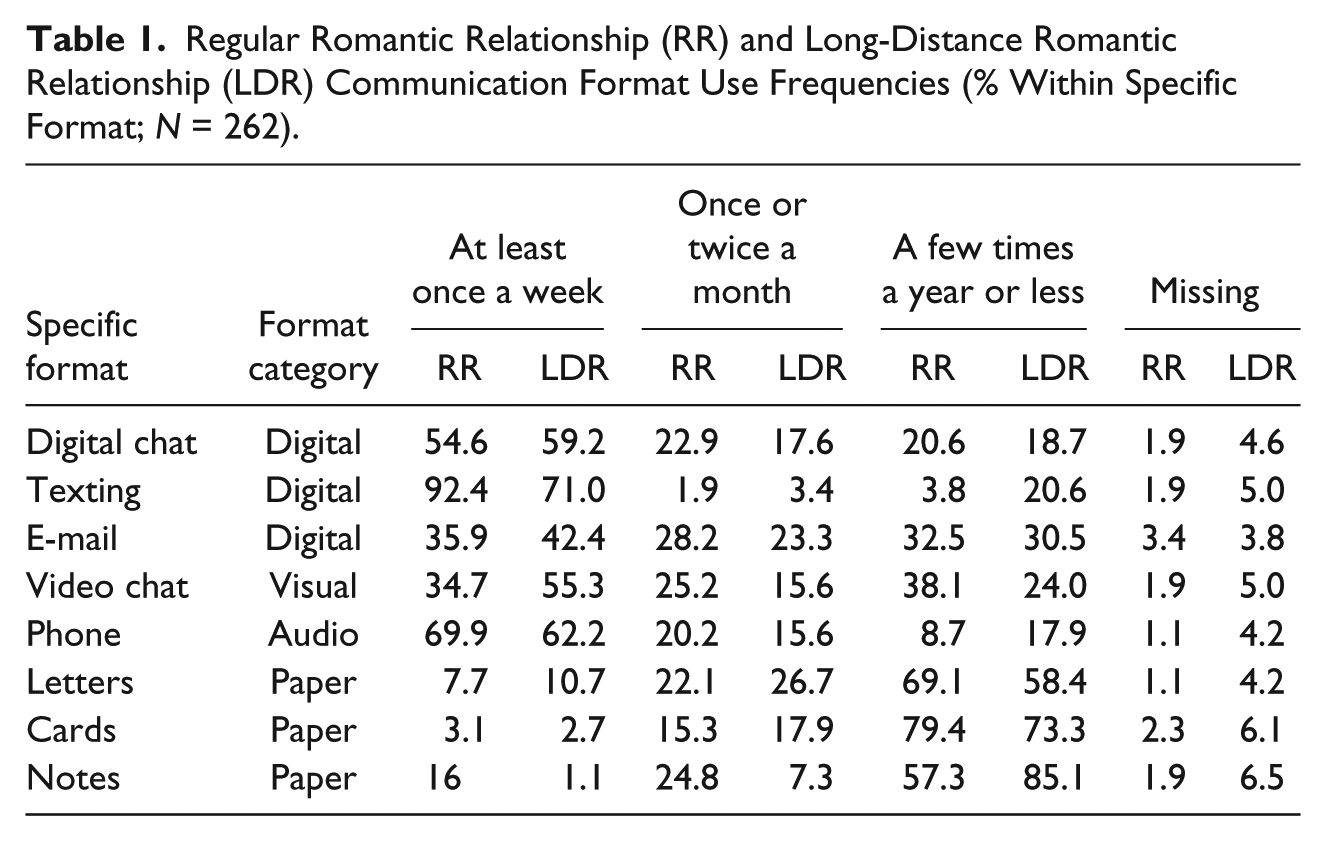
While frequency of use of specific formats fluctuates somewhat between the regular and long-distance portions of the relationship (e.g., paper notes and texting are used more often when partners are not separated by geographic distance, and visual chatting is used more frequently in the LDR portions), there are similarities between the regular and long-distance relationship portions in terms of the broad format categories. In both, paper formats are used infrequently, and digital, video, and audio formats are used frequently.
The Meaningfulness of Formats in LDRs
Among the 262 respondents who had had an LDR since 2005, 182 responded to both portions of an open-ended question that asked which format type was most meaningful to use during the LDR and why, allowing respondents to claim their own definition of meaningfulness. The first portion of these responses was coded into broad communication format types. The most meaningful format type used in LDRs is visual (54%), followed by audio (17%), digital (15%), and paper (14%).
We coded the portion of the responses about why they were meaningful into three primary categories. While these categories emerged from the data inductively, their classification was checked with existing conceptions presented by past researchers. The first category—thoughtfulness—included mention of focus, taking time, personal-ness, effort, and thoughtfulness. This category aligns with Janning and Christopherson’s (2015) notion of communication tasks that are time consuming as connoting more effort. The second category—intimacy—included mention of normalcy, ability to hear a partner’s voice or see a face, and intimacy. This category most closely resembled past researchers’ conception of “social presence” or richness (Harwood, 2000, p. 59). The third category—ease—included mention of speed, consistency, reliability, comfort, and ease—consistent with Harwood’s (2000) notion of feedback immediacy, but without necessarily including a “wide range of [verbal and nonverbal cues]” (Stafford, 2005, p. 90), and with the added element of accessibility and efficiency.
To examine the relationship between meaningful format type and reason for meaningfulness, we performed a chi-square test of independence. The relationship between these variables was significant, χ2(6, N = 182) = 168.284, p = .000. The formats chosen as most meaningful, once collapsed into broad format categories of paper, digital, audio, and visual, each disproportionately align with different reasons for their meaningfulness. The cross-tabulation of meaningful format and reason for meaningfulness is shown in Table 2.
Cross-Tabulation of Meaningful Format by Reason for Meaningfulness.

People who find digital formats most meaningful are most likely to find them meaningful because of their ease, but only slightly more than because of their thoughtfulness. Paper formats are seen as meaningful almost exclusively because of their thoughtfulness. Both audio and visual formats are seen as meaningful primarily because of their intimacy. Put another way, those who consider meaningfulness to be about thoughtfulness are likely to choose paper and digital formats as meaningful. Those who view intimacy as the reason for meaningfulness choose audio and visual formats. And ease as a criterion for meaningfulness falls disproportionately among those who find digital formats to be most meaningful. Finally, the most cited reason for any format to be defined as meaningful is intimacy, followed by thoughtfulness, and then ease.
Discussion
Our analysis finds that there are both similarities and differences in terms of the frequency of use of particular communication formats during regular and long-distance portions of romantic relationships. When couples are geographically close, they use paper more often (imagine a love note on the counter left for a partner to see). When partners are far apart, they can take advantage of technological advances such as video chat platforms, as long as they have an appropriate device and access to the Internet (imagine a laptop screen with a video chat image of a partner perched on a pillow to mimic the person’s actual presence in bed). Interestingly, in both geographically close and distant relationships, digital formats such as e-mail, messaging, and texts are frequently used. This makes sense given the growing ubiquity of handheld devices that can be used for messaging, texting, and e-mail over wifi networks or with data plans increasingly available across the globe.
The availability of format types can go a long way to explain the use patterns of these communication formats. However, people do not necessarily use things just because they can. While the reasons why these format types are used more or less frequently may have to do with their increased accessibility, it is only after asking people which format types are meaningful during an LDR and why that we can see how the construction of meaning surrounding a particular format for a particular couple may matter, too.
Why people use video chat or a paper greeting card is not necessarily just about which one is accessible. It is also about which one means something to the communicating couple and why. Different communication formats may offer different uses for people, which may be used in their assessment of a format as satisfying, worth using instead of previous formats, and meaningful. Our findings suggest that thoughtfulness, intimacy, and ease are the primary reasons that LDR communication formats are deemed to be meaningful, and that visual formats are most often (54% of respondents) defined as meaningful among people who have been in a LDR since 2005. Audio, digital, and paper formats are defined as meaningful, too, but at lower (and similar) rates (between 14% and 17%). Audio and visual formats are seen as meaningful because they offer intimacy, paper formats offer thoughtfulness, and digital formats offer ease as well as thoughtfulness.
Paper Formats
Given the cultural presence of a romanticized scenario where partners send paper love letters across geographic distances, seen in both historical and popular culture representations of romantic love (Illouz, 1997), it is perhaps not surprising that paper communication formats are deemed meaningful nearly exclusively because of their thoughtfulness. Despite lessening use of paper communications in general (Franzen, 2013; Harris, 2007), and despite views that paper love letter writing is dwindling in contemporary society (Janning & Christopherson, 2015), it is notable that, at least in LDRs, it is important for people to use communication formats that connote thoughtfulness. This thoughtfulness can be a proxy for the effort that would otherwise be present during the in-person everyday romantic relationship. Or it may be that people assign a particular romantic meaningfulness to paper communication formats precisely because they are dwindling in frequency of use. Their rarity may enhance their definition as sacred, special, and therefore more meaningful (Janning & Christopherson, 2015).
The other side of the interpretation about the meaningfulness of paper communication being due to its thoughtfulness and connoted effort lies in the understanding of message content and time between sending and receiving a message. Asynchronous (not in real-time, intermittent) interaction, which is what handwritten love letters require, allows users to carefully edit and deliberate on their messages before they are sent. Taking extra time is built into a process where it takes days to communicate. Furthermore, writers are allowed to be less inhibited in self-expression and more strategic in self-presentation (Walther, 1997) as they imagine the letter recipient reading the words at a later time. With paper writing, both writer and recipient participate in an exercise in patience, because the message needs to travel across geographic distance and takes time. Because the recipient of the letter is not present when its sentiments are being written, and because the writer is not present when the letter is read, both partners have limited ability to read facial or vocal cues. The content of the message can reflect a level of thoughtfulness that compensates for these missing cues. Certainly this can be true in digital communication (e.g., sending a text or e-mail does not guarantee an immediate reply because the sender does not know if the recipient is accessible; see Yang et al., 2014), but it is not true all of the time, as it is for paper communication. Thus, unless someone reads a love letter from her partner in that partner’s presence using a webcam, paper communication always requires delay and inefficiency, and always denies face-to-face cues about its reception. This delay and inefficiency does not lessen the meaningfulness of paper love letter writing; in fact, it may enhance its definition as meaningful because it requires thoughtfulness, patience, and time.
Digital Formats
When assessing whether communication format types disproportionately align with particular reasons for meaningfulness, our data show that people who find digital formats (e.g., e-mails and texts) most meaningful are most likely to find them meaningful because of their ease, but only slightly more than because of their thoughtfulness. Respondents who label digital platforms as most meaningful may do so because meaning, to them, is based on the ability to reach their partner quickly, easily, and without barriers to stand in the way of their ongoing relationship. For digital communicators, freedom to communicate without constraints may equal meaningfulness. Nothing except geographic distance stands in the way of their communication with an intimate partner. Because of this, digital responses, while they can take time to craft, may sometimes seem more spontaneous and less filtered, especially with texting and instant messaging.
For the most part, these findings are consistent with past research (Harwood, 2000), but they complicate things, too. The fact that digital communication formats are also defined as meaningful because they allow for thoughtfulness negates claims that it is primarily and exclusively paper formats which demonstrate thoughtfulness, or that thoughtfulness requires time, or that digital communication is always immediate. It may be that the reason for digital formats being defined as thoughtful is because of the ability of users to craft messages without the need for immediate response (hence offering the potential for more depth), or because digital communications are more likely to be seen as thoughtful than in the past, or when in comparison to other formats. It may be that a short quick text with an inside joke from an LDR partner can seem just as thoughtful as a lengthy handwritten letter that arrives 2 weeks after it is written.
Visual and Audio Formats
Visual and audio cues during communication are cited as important in order to allow partners to see and/or hear each other and create intimacy, a finding true in past research (Beck & Beck-Gernsheim, 2014), and in this analysis. During LDRs, and consistent with MRT, respondents most connect the audio and visual communication formats (webcam and telephone) with intimacy as the reason for their meaningfulness. These formats most closely mimic being physically present in a social interaction. Attachment in romantic relationships is easier with proximity because being physically close allows for “small connecting daily pieces of life” (Pistole, 2010, p. 116), which having the ability to read communication cues and respond immediately does. But when there is geographical distance, connections need to be maintained with language and looking only (Beck & Beck-Gernsheim, 2014). In this sense, distance may create less intimacy by virtue of physical absence between partners, but with communication that offers visual and auditory cues, the relationship can feel as intimate even with the physical absence of a partner, as Kolozsvari (2015) argues. So, when respondents talk about communication formats that enhance feelings of intimacy or closeness, they are most likely to reference the senses of sight and sound—to get as close as possible to actually being physically present in front of someone without actually being able to do so. For example, regarding the question asking why certain formats were most meaningful for LDR communication, responses such as “seeing her made me feel close to her” and “hearing his voice made it seem as if he were really here” are referenced among those who identify the audio and visual communication formats as most meaningful.
One of the reasons audio and visual communication formats can yield intimacy is because they are synchronous. While asynchronous formats such as letter writing (or preparing an e-mail or text to be sent later) may remove inhibitions and allow for time-consuming thoughtfulness, to be able to get immediate auditory or visual feedback in a conversation allows for complicated messages to be clarified. If a person can be seen or heard, she or he can participate in an interaction that has more richness, depth, and capacity to interpret and respond to linguistic and expressive cues because more information is presented in the interaction. Consistent with MRT, this makes it most similar to face-to-face interaction (Murray & Campbell, 2015), even in light of changing communication technology in the past decade. And consistent with the notion that socioemotional “space” can feel as intimate as shared physical space (Kolozsvari, 2015), it appears as if people involved in LDRs would be likely to view audio and visual communication tools as most likely to foster a feeling of shared space across geographic distance.
Conclusion
There is no one-to-one relationship between being physically apart and feeling emotionally apart for long-distance couples (Kolozsvari, 2015). ICTs create “presence-in-absence” (Saadatian et al., 2014, p. 737), or a “detached attachment” (Ben-Ze’ev, 2004, p. 53) for partners in LDRs because they facilitate communication that would otherwise be hindered by geographic distance. But they do not allow physical presence, and they vary in how much their format may affect facets of the relationship. More than a particular communication format being universally likely to connote a particular level or type of meaningfulness, as some have suggested (Sitkin, Sutcliffe, & Barrios-Choplin, 1992; Trevino, Daft, & Lengel, 1990), social actors subjectively interpret the formats and how they are used differently depending on many contextual factors (Gershon, 2010; Yang et al., 2014). There is not consensus among researchers on whether certain types of formats are automatically defined as more or less meaningful. This is in part due to the rapidly changing ICT options available that are too elusive for researchers to capture in a timely manner. It is also in part due to the fact that the people participating in communications differ in their subjective interpretation of the symbolic importance of the format. This subjectivity can vary by demographic factors such as age (Gershon, 2010; Yang et al., 2014), attitudes about privacy (Yang et al., 2014), and individual characteristics. In light of this inconclusiveness and importance for understanding subjective interpretations, analyzing open-ended responses asking how people view the symbolic meaningfulness of different formats of communication, including paper, is especially important, which is what this study does.
The findings in this study can lend support to the idea that people who are venturing into a long-distance portion of a romantic relationship may be well-served to think about their own communication format preferences, and then talk explicitly with their partner about these preferences and reasons for them. This can assist with logistical arrangements, but also with the alignment of expectations and reality, because limitations to, and preferences for, certain communication formats may be less likely than in the past to be caused by access problems and may be more likely, as this study suggests, to be caused by constructed meaning of the format as being more or less meaningful. Finally, romantic partners could take a step further by working to figure out how certain communication formats may be better for certain topics or functions of conversation, a task that is especially important in light of rapidly changing communication formats. This kind of awareness and ongoing intentional figuring can help frame conversations, add clarity, and reduce disappointment or conflict that emerges from having differing expectations for the purpose and meaning of any given communication format.
Footnotes
Acknowledgements
The authors wish to acknowledge the data collection and analysis assistance of Neal Christopherson.
Authors’ Note
Emma Snyder was affiliated with Impact Hub Boston, MA at the time of manuscript preparation. She is currently affiliated with Toast, Inc., Boston, MA, USA.
Declaration of Conflicting Interests
The author(s) declared no potential conflicts of interest with respect to the research, authorship, and/or publication of this article.
Funding
The author(s) disclosed receipt of the following financial support for the research, authorship and/or publication of this article: Research assistance was supported by the Whitman College Louis B. Perry Summer Research Endowment (2013) and the Whitman College Abshire Student Research Scholar Award (2016).