




Abstract
Research suggests violence in the family-of-origin is a consistent predictor of later intimate partner violence (IPV). However, prior empirical studies have also demonstrated that exposure to violence does not lead deterministically to violent behaviors in young adulthood. Given that family context entails more than simply the presence or absence of abuse, additional aspects of family life warrant examination. One such aspect is the quality of the parent–child relationship. Using five waves of data from the Toledo Adolescent Relationships Study (N = 950 respondents, 443 males and 507 females), the present study examined both main and interactive effects of parent–child physical aggression (PCPA) and parent–child relationship quality (PCRQ) in predicting adolescents’ and young adults’ IPV perpetration. Results indicated that both PCPA and PCRQ were key independent predictors of individuals’ IPV perpetration, but did not interact to produce cumulatively different risk. Important interactions between PCPA and gender, and PCRQ and age were also found.
Keywords
One of the most consistent predictors of intimate partner violence (IPV) experiences in adolescence and young adulthood is exposure to violence in the family of origin via child maltreatment and witnessing interparental violence and aggression (e.g., Cui, Ueno, Gordon, & Fincham, 2012; Renner & Whitney, 2012; Smith, Ireland, Park, Elwyn, & Thornberry, 2011; Swinford, DeMaris, Cernkovich, & Giordano, 2000). The strength of such an association can be understood through social learning theory (Bandura, 1977, 1986; Kalmuss, 1984), which states that because the family is one of the first and main socializing institutions for individuals, relationships between the parents and between parents and their children provide models for how individuals should behave in relationships with others. Through processes of observation, learning, and reinforcement, children exposed to violence are thought to internalize these experiences as both acceptable and normative. In turn, violence is seen as an appropriate way of interacting with others generally, and dealing with conflict more specifically, in future relationships. Prior research also indicates that children exposed to family-of-origin violence (FOOV) illustrate fear and mistrust when interacting with others, and may feel violence is necessary to maintain control and power in their lives (Grych & Kinsfogel, 2010; Parks, Kim, Day, Garza, & Larkby, 2011; Wolfe, Scott, Wekerle, & Pittman, 2001).
Yet prior empirical research driven by social learning theory has demonstrated that exposure to violence does not lead in a deterministic fashion to violent behaviors in young adulthood (e.g., Fang & Corso, 2008; Schafer, Caetano, & Cunradi, 2004; Smith, Ireland, Park, Elwyn, & Thornberry, 2011; Widom, 1989) or that such effects may only be contemporaneous (Wolfe, Wekerle, Scott, Straatman, & Grasley, 2004). Relatedly, some studies have demonstrated FOOV may be more predictive of women’s than men’s IPV experiences; while others indicate FOOV may become only a distal risk factor for adolescent dating violence once such mediating factors as anxiety, depression, and affect regulation are accounted for (Dankoski et al., 2006; Fang & Corso, 2008; Wolfe et al., 2004). These complex and occasionally inconsistent findings lead to the conclusion that a more complete understanding of familial effects on IPV perpetration may require inclusion of additional antecedents beyond FOOV. The present study sought to explore one of these potential antecedents with attention toward parent–child relationship quality (PCRQ).
Parent–Child Relationship Quality and IPV
Less extensively studied than childhood exposure to violence, especially in reference to IPV, is the overall relationship quality between the parent and the child. Given that the familial background entails more than simply the presence or absence of abuse, studies examining parental effects are missing imperative information when not taking PCRQ into account. As illustrated by prior research, PCRQ often encompasses the manner in which parents help and support their child (Hair, Moore, Garrett, Ling, & Cleveland, 2008), how caring, controlling or rejecting they are toward their child (Palazzolo, Roberto, & Babin, 2010), how much time the parent and child spend together (Miller, Gorman-Smith, Sullivan, Orpinas, & Simon, 2009), and how much the child feels respected, trusted, and accepted by his or her parents (Tajima, Herrenkohl, Moylan, & Derr, 2011).
From a social learning perspective, individuals may learn how to view and interact with others based on the quality of their relationships with parents, just as they learn how to view violence based on violence they experience via their parents. Such a notion is supported by attachment theory (Bowlby, 1982), which rests on the premise that individuals begin to form early cognitive models of relationships with others based on the interactions they have with their parents and other adult caregivers. These cognitive models often entail such notions of others as being predictable and trustworthy, of the self as being lovable and competent, and of relationships in general as being rewarding and worthwhile (Bowlby, 1982). As such, an insecure attachment style developed in response to dysfunctional parenting practices may inhibit the social skills necessary to initiate or maintain consensual intimate relationships, as well as lead to anger and hostility toward potential or actual partners (Dutton, 1994; Dutton, Starzomski, & Ryan, 1996). More specifically, it has been suggested that violence in adulthood may represent a parallel to the behavior exhibited by a child when separated from an attachment figure. Viewed in this light, IPV may be seen as an effort by the perpetrator to prevent the anticipated or perceived loss of their romantic partner (Dutton, Saunders, Starzomski, & Bartholomew, 1994; Henderson, Bartholomew, Trinke, & Kwong, 2005).
Prior research has also demonstrated that individuals who describe their families as unloving, unrewarding, or unsafe often come to view all relationships in this light. When such negative views are fashioned in, or continued into, adolescence, these individuals enter romantic relationships with little expectation of positive reinforcement, support or love. These lower expectations, in turn, often lead to relationships defined by more conflict and other problematic characteristics (Busby, Holman, & Walker, 2008; Wekerle et al., 2009).
Yet, much like research on FOOV, prior studies examining aspects of PCRQ with regard to IPV have garnered mixed support. For example, research has found that communication styles used by parents with their children are predictive of women’s, but not men’s, IPV perpetration and victimization experiences in young adulthood (Babin & Palazzolo, 2012); while parental verbal aggression has been found as a risk factor for both men’s and women’s IPV (Palazzolo et al., 2010). Meanwhile, some previous work has found that PCRQ is predictive of neither men nor women’s IPV when experiences of FOOV are also examined (Richards & Branch, 2012). These inconsistent findings may be due to differences in the measurement of PCRQ. They may also indicate that additional unmeasured antecedents are driving the relationship between PCRQ and IPV. Finally, there is the possibility that multiple familial factors may interact to produce cumulatively different results. Specifically, the effect of PCRQ on IPV perpetration may vary, depending on the existence of other experiences within the familial domain.
Cumulative Risk
A particularly intriguing hypothesis is that it is not just negative PCRQ that may lead to IPV in later life, but positive PCRQ may as well under certain circumstances (Simons, Simons, Lei, Hancock, & Fincham, 2012). Specifically, when combined with childhood exposure to violence, parental warmth may amplify the negative effects of FOOV. According to Straus and Gelles’ (1990) argument, parents foster IPV to the extent they teach their children that verbal and physical aggression are a normal and legitimate component of loving relationships. That the quality of the parent–child relationship may moderate the effect of parent–child physical aggression (PCPA) on IPV experiences is thus an extension of social learning theory. Specifically, a strict interpretation of the theory would suggest children are more likely to learn such lessons regarding loving relationships when parental hostility is interspersed with affection. This is, according to social learning theory, individuals are more likely to observe, learn from, and mimic the behaviors of those individuals who matter to them. Thus, PCPA occurring within the context of low PCRQ would provide little information about how children should treat those they love, as they themselves would not feel loved in such a context. However, if children feel their parents love them, thus indicating the perception of more positive relationship qualities, while at the same time being exposed to violence via their parents, they may come to see violence as a normal part of intimate relationships.
While the theoretical logic of positive PCRQ amplifying the negative effects of PCPA on IPV perpetration seems clear according to social learning theory, an alternative, competing hypothesis presents itself when viewed from the lens of attachment theory. As noted previously, insecure attachments to parents in childhood increases the risk for insecure attachments in adulthood, often evidenced by anger and aggression toward romantic partners (Dutton, 1994; Dutton et al., 1996). According to attachment theorists, PCPA would only serve to further weaken these attachments. For example, a descriptive analysis of 13 studies on the attachment quality between mothers and children found that maltreated children were less securely attached to their mothers than non-maltreated children. Perceived as a form of insensitive parenting, the authors proposed that maltreated children would thus form a representation of their caregivers as unresponsive, unavailable and rejecting. This representation, in turn, would increase the risk for the child’s violence perpetration in later life (Morton & Browne, 1998). In fact, it has been theorized that insecure attachments may serve as an alternative explanation for intergenerational continuities in violence. In other words, that instead of learning and normalizing violence via modeling behaviors, child maltreatment results in insecure attachment patterns, which manifest in anger, hostility and aggression toward others (Buchanan, 1996; Dutton et al., 1994). From this view then, PCPA, in itself a risk factor for IPV perpetration, would further amplify the effects of low PCRQ on IPV perpetration.
Individual-Level Risk Factors
Much of the prior research on IPV relies on retrospective and cross-sectional data, ignoring the possibility that violence experiences may vary in different periods of the life course and across time. Specifically, as individuals age and mature, they often learn from continuing relationships or form new ones, the latter of which may also be potentially affected by earlier romantic experiences (Bonomi et al., 2012; Franklin & Kercher, 2012; Halpern, Spriggs, Martin, & Kupper 2009; Shortt et al., 2012). This limitation is especially problematic when examining adolescent and young adult populations, given the highly fluid and complex nature of these life stages. Among these individuals, IPV may not only vary as a function of age and time but also as a result of changes in familial characteristics over time (Aquilino, 1997, 2006; Belsky, Jaffee, Hsieh, & Silva, 2001; Thornton, Orbuch, & Axinn, 1995). For example, as individuals become legal adults and leave the parental home, conflict over issues of parental monitoring and control substantially decline. The relationship between adult parent and minor child also becomes one of two mutually respecting adults, often leading to increased levels of trust, communication and understanding (Aquilino, 1997, 2006; Lefkowitz, 2005). Conversely, with the advent of adulthood also comes increased independence and autonomy to live life outside the confines of parental wishes and demands. This new-found freedom, in turn, may lead to disparate beliefs between parents and adult children in the young adult’s behavioral choices. Such disparities often result in declines of parental support and acceptance over time (Whiteman, McHale, & Crouter, 2012). Thus, as the parent–child relationship changes function and form throughout the life course, IPV experiences may also differ.
Realizing some individuals may have a predisposition toward violence regardless of familial background, some studies have included childhood and adolescent behavioral problems in their prediction of IPV (e.g., Hair et al., 2008; Swinford et al., 2000). However, many other factors could predispose individuals to IPV, or may serve as mediators between family background and IPV in later life, and such factors are often not accounted for in prior studies. For example, compared with individuals with no IPV experience, those who reported IPV were also more likely to exhibit low impulse control (Derefinko, DeWall, Metze, Walsh, & Lyman, 2011; Finkel, DeWall, Slotter, Oaten, & Foshee, 2009), and to display certain social psychological characteristics such as borderline, antisocial, narcissistic, avoidant, and dependent personality traits (Maneta, Cohen, Schulz, & Waldinger, 2013; Varley Thornton, Graham-Kevan, & Archer, 2010). Without taking into account all these, plus any additional unmeasured or unknown characteristics, studies aiming to predict IPV experiences may have resulted in upwardly biased estimates of the effects of familial background factors.
Gender and IPV
Prior research on IPV, especially among adolescents and young adults, also places emphasis on gender differences in violence experiences (Anderson, 2013; Cho, 2012; Fang & Corso, 2008; Miller et al., 2009). Previous studies have noted when analyzing IPV experiences in younger populations that women’s reports of perpetrating violence are often equivalent to or greater than men’s perpetration reports (Anderson, 2013; Cho, 2012; Gelles, Flannery, Vazsonyi, & Waldman, 2007; Straus, 2009).
Likewise, PCPA is associated with IPV perpetration for men and women (Smith et al., 2011; Swinford et al., 2000; Giordano, Johnson, Manning, & Longmore, 2014; Giordano, Kaufman, Manning, & Longmore, 2015), but the strength of familial background factors on the risk of experiencing IPV for men and women may differ. Specifically, past research has found the relationship between violence experienced as a child and aggression in adolescence and young adulthood is stronger for women than for men (Fang & Corso, 2008). One explanation in the literature for this differing effect is that women who engaged in violence are often responding to their own victimization. Conversely, male violence is often enacted for a wider array of reasons, including during the commission of a crime, peer pressure, as a reaction to other aggressive men, or to defend one’s reputation (Herrera & McCloskey, 2001). Relatedly, in examining the parent–child relationship, prior studies illustrated that the quality of this relationship may be more protective for women in deterring a variety of deleterious outcomes (Alarid, Burton, & Cullen, 2000; Kerpelman & Smith-Adcock, 2005). This appears to be especially true concerning aspects of parental warmth and attachment, the primary components of the measure of PCRQ utilized in the present study. Thus, while PCPA is thought to increase the risk for IPV perpetration and PCRQ thought to decrease such risk for both genders, these effects may be greater among women.
Current Investigation
To address the limitations of previous research, the current study utilized an integrated theoretical approach and thus contributed to the literature in several ways. With a central focus on social learning theory, the present research allowed for the importance of traditionally measured FOOV exposure, via our measure of PCPA (i.e., physical abuse), in influencing IPV perpetration. However, as previous work has demonstrated exposure to aggression via parents does not lead deterministically to later IPV reports, elements of attachment theory were also incorporated (Bowlby, 1982). Attachment theory provided the basis for PCRQ as a further determinant of individuals’ IPV reports. This theoretical framework also aligns well with notions of social learning theory and the transmission of attitudes, beliefs and behaviors from parents to children. We expected PCPA to be positively associated with and PCRQ to be negatively associated with perpetration of violence. Moreover, both the main and interactive effects of PCPA and PCRQ were examined to test whether the influence of familial background factors on IPV perpetration was cumulatively different based on these two domains. Yet, given the competing explanations derived from social learning and attachment theories, as well as limited past research in this regard, there was not enough evidence to pose a definitive hypothesis for this research question. Instead, potential interactive effects between PCPA and PCRQ were exploratory aims of the present study.
Given the extant literature on gender differences in IPV, we also evaluated whether PCPA and PCRQ had similar effects on perpetration among men and women. Consistent with Fang and Corso (2008), we expected PCPA to have a stronger effect on IPV perpetration for women. Likewise, and consistent with prior research (e.g., Kerpelman & Smith-Adcock, 2005), we also expected PCRQ to have a stronger effect on IPV perpetration for women.
To account for the possibility that IPV perpetration may vary as a result of age, time and changes in the parent–child relationship over time (e.g., Aquilino, 1997, 2006; Franklin & Kercher, 2012; Halpern et al., 2009; Whiteman et al., 2012), we utilized prospective longitudinal data collected from adolescence into adulthood. This is a key advantage over prior work that relies on retrospective and cross-sectional data. In particular, we analyzed PCPA, PCRQ and IPV perpetration reports at five points in time to assess whether and how the effects of PCPA and PCRQ on IPV perpetration varied at different stages of the life course and across time. As past research has been limited in this arena, there was not enough evidence to pose a definitive hypothesis with regard to this research question. Instead, whether and how the effects of PCPA and PCRQ on IPV experiences might vary across the life course was an exploratory aim of the present study.
To capture how changing life course experiences influenced IPV perpetration, we accounted for a number of correlates identified in past research as influencing violence perpetration and victimization in intimate relationships. These included age (Bonomi et al., 2012; Halpern et al., 2009), an age-appropriate measure of socioeconomic status, gainful activity (Alvira-Hammond, Longmore, Manning, & Giordano, 2014), delinquent and deviant behaviors (Hair et al., 2008; Swinford et al., 2000), relationship status (i.e., dating, cohabiting, married; Cui et al., 2012; Renner & Whitney, 2010), and relationship duration (Giordano, Soto, Manning, & Longmore, 2010). We also included a measure of residency status, specifically whether the individual resided in the parental home. Although residing in the parental home is not necessarily correlated with the presence or absence of IPV, given this study’s emphasis on familial background, its inclusion is imperative. Specifically, individuals who reside in the parental home have a greater likelihood of being exposed to PCPA and may be likely to exhibit different qualities in their parent–child relationships more generally.
Finally, prior work has also been limited in that it often does not account for unmeasured heterogeneity that may be selecting individuals into IPV perpetration experiences. Characteristics that may predispose individuals to violence include childhood and adolescent behavioral problems, low impulse control, antisocial or narcissistic personality traits (e.g., Derefinko et al., 2011; Swinford et al., 2000; Varley Thornton et al., 2010), among others. Our research addressed the possibility of unmeasured heterogeneity through the use of fixed effects regression, which controlled for all stable characteristics of respondents that may select individuals into IPV perpetration (Allison, 2005, 2009).
It is also important to note that data were available on IPV victimization as well as perpetration. However, due to the focus on social learning processes, we examined how familial background factors influenced variability in respondents’ own behavior (perpetration) within the romantic relationship. However, acknowledging that victimization experiences undoubtedly shaped a more complete understanding of violence occurring in intimate partnerships, models were also run with IPV victimization as the outcome of interest. Although not presented here, supplemental models relying on this alternative dependent variable produced a similar pattern of results.
Data
Five waves of data from the Toledo Adolescent Relationships Study (TARS) were used in the current investigation. The TARS study initially was based on a stratified random sample of 1,321 adolescents in the 7th, 9th, and 11th grades and their parents/guardians in Lucas County, Ohio. Devised by the National Opinion Research Center, the sampling frame was derived from public and private school enrollment records in Lucas County, Ohio; however, school attendance was not a requirement for inclusion in the study. The stratified random sample also included oversamples of Black and Hispanic adolescents; and the geographic area of Lucas County is similar to estimates of race and ethnicity, family incomes, and education to the national population based on 2010 U.S. Census data. Data were collected from adolescent and young adult respondents through structured in-home interviews using laptop computers. Parent data were collected via a short, self-administered questionnaire at the first wave.
Data were originally collected to investigate adolescents’ romantic and sexual behaviors, and to examine how these behaviors were influenced by their families, peers, and romantic partners. The first wave of data was collected in 2001, when respondents were, on average, 15 years of age. Wave II was collected in 2002, Wave III in 2004, Wave IV in 2006-2007, and Wave V in 2011-2012, when respondents were, on average, 16, 18, 20, and 25 years old, respectively. By Wave V, there were 1,021 respondents, with a retention rate of 77% from Wave I. Comparison analyses between study dropouts and completers revealed no statistically significant differences in IPV perpetration nor PCPA reports at the Wave I interview. Marginally significant differences (p = .052) were found for PCRQ, with dropouts reporting lower PCRQ at the Wave I interview than those respondents who remained in the study at the Wave V interview.
The analytic sample was restricted based on the requirements of the research questions. Focusing on the IPV experiences of adolescents and young adults, the sample consisted of only those individuals reporting on a romantic partner in at least one wave of data (N = 979). In particular, 987 respondents reported on a romantic relationship at Wave I, 774 at Wave II, 993 at Wave III, 1,006 at Wave IV, and 950 at Wave V. The sample was also further restricted due to missing data. In particular, list-wise deletion was used for individuals who were missing on time-stable single-item indicators or more than half the items in time-stable multiple-item measures. We used list-wise deletion because it is robust to violation of missing at random among the independent variables (Allison, 2002). Importantly, individuals remained in the sample if they were missing on time-varying covariates as long as they had at least one wave’s worth of data, whereby each wave of data was included as a separate case in multivariate analyses. These restrictions resulted in a final analytic sample of N = 950 (443 male and 507 female) respondents and, correspondingly, 4,750 person–period observations.
Measures
Dependent Variable
Four items were used to address the presence or absence of respondents’ IPV perpetration at each wave in the 1 to 2 years prior to data collection (1 year in Waves I and II, 2 years in Waves III-V when data collection points were two or more years apart), based on the revised Conflict Tactics Scale (Straus, Hamby, Boney-McCoy, & Sugarman, 1996). These items ask respondents: “During this relationship, how many times have you [how many times did you], ‘. . .throw something at (partner)?’ ‘. . . push, shove, or grab (partner)?’ ‘. . . slap (partner) in the face or head with an open hand?’ and ‘. . . hit (partner)?’” Response categories ranged from 1 (never) to 5 (very often). However, each measure was quite skewed in that the majority of respondents reported never perpetrating any of these acts. Hence, respondents were simply coded 1 if they reported having perpetrated any of these acts on a partner and 0 otherwise, resulting in a binary response variable for IPV perpetration.
Independent Variables
Parent–child physical aggression was a dichotomous variable at each wave measuring whether the respondents’ parents pushed, slapped or hit them during arguments and disagreements. Respondents exposed to PCPA were coded as 1, and 0 otherwise. PCRQ was assessed through seven items. Respondents were asked to report their level of agreement or disagreement with the following five statements: “My parents give me the right amount of affection,” “My parents trust me,” “My parents sometimes put me down in front of other people” (reverse coded), “My parents seem to wish I were a different type of person” (reverse coded), and “I feel close to my parents.” Two additional items assessed the frequency of verbal aggression between the respondent and their parents: “In general, how often do you and your parents yell or shout at each other because you are mad?” (reverse coded) and “ . . . call each other names or insult each other?” (reverse coded). Given the different response scales across these seven times, all items were standardized to provide equal weight in the measurement of PCRQ. These items were then combined, resulting in one continuous measure of PCRQ at each wave (Wave I α = .82, Wave II α = .82, Wave III α = .82, Wave IV α = .82, Wave V α = .83), with a higher score indicating a better parent–child relationship quality. Parents were defined as those individuals the respondent resided with most during the 12 months prior to data collection (for respondents under the age of 18), or those adult guardians they most recently lived with prior to residing on their own (asked of respondents age 18 years and older).
Seven items assessed respondent delinquency at each wave and asked respondents to report how often they have: “stolen (or tried to steal) things worth $5 or less,” “carried a hidden weapon other than a plain pocket knife,” “damaged or destroyed property on purpose,” “stolen (or tried to steal) something worth more than $50,” “attacked someone with the idea of seriously hurting him/her,” “sold drugs,” and “broken into a building or vehicle (or tried to break in) to steal something or just to look around” (Elliott & Ageton, 1980). Respondents reported on behavior occurring within the 12 to 24 months prior to data collection (12 months in Waves I and II, 24 months in Waves III-V when data collection points were two or more years apart). Responses ranged from 1 (never) to 9 (more than once a day). The average of these items formed a single-item indicator of respondents’ delinquent and deviant behaviors at each wave, with a possible range of 1 to 9 (Wave I α = .83, Wave II α = .79, Wave III α = .72, Wave IV α = .62, Wave V α = .59.
Three variables were used to assess basic characteristics of respondents’ intimate relationships. Relationship duration was measured continuously by one item, with responses ranging from 1 (less than a week) to 8 (a year or more). The inclusion of shorter duration relationships acknowledged that romantic partnerships are often characterized by a great degree of fluidity in earlier stages of adolescence. Moreover, relationship status assessed whether the respondent was in a dating, cohabiting or married relationship. It was measured by two dichotomous variables, “cohabiting” and “married,” with dating respondents serving as the comparison category. Whether the respondent is reporting on experiences in a current or most recent relationship was represented by one dichotomous variable, with a past or most recent relationship serving as the comparison category.
Four measures were used in multivariate analyses to indicate respondent’s gender, age, residency and socioeconomic status. Gender was a dichotomous variable, with male serving as the contrast category. Age was a continuous measure at all five waves. After analytic sample restrictions, respondents were, on average, 15, 16, 18, 20, and 25 years of age, respectively. Respondents’ residency status was measured at all five waves to assess whether respondents lived in the same home as their parent(s), and was measured by a dichotomous variable. Specifically, respondents living with one or both parents, as well as any other family members, were considered to be residing in the parental home and coded as 1, and 0 otherwise. Finally, given the varying ages of the sample at each wave, where respondents progress from adolescent minors to legal adults throughout the course of the study, an age-appropriate measure of respondents’ socioeconomic status was utilized, referred to as “gainful activity” (Alvira-Hammond et al., 2014). Specifically, three items were used to construct a dichotomous measure of individuals’ educational and employment status. Those respondents either currently attending school or employed full-time were considered gainfully active and coded 1, while others were considered not gainfully active and coded 0.
Analytic Strategy
The current study utilized fixed-effects logistic regression models to examine the independent and interactive effects of PCPA exposure and PCRQ, measured at five points in time, in the prediction of IPV perpetration. We also tested interactions between each of these two constructs with age and gender. These interactions allowed for the analysis of whether the IPV perpetration experiences of older or younger individuals and men or women were more greatly influenced by PCPA and PCRQ.
Fixed-effects analysis is the optimal method to address these questions, rather than traditional logistic regression models, because it controls for the influence of unmeasured heterogeneity (Allison, 2005, 2009). This refers to unmeasured selection characteristics associated with both family-background dysfunction and the tendency to form violent relationships with intimate partners. Thus, in the case of the current study, although familial and individual background factors (i.e., PCPA, PCRQ, delinquency, age, relationship status) were explicitly controlled for in multivariate analyses, fixed-effect models implicitly control for any fixed characteristics of the individual that do not change over time that also have stable (time-invariant) effects on the response. As detailed previously, unmeasured characteristics may include negative personality characteristics, such as avoidant or dependent traits (Derefinko et al., 2011; Maneta et al., 2013; O’Leary & Woodin, 2006), among others. In controlling for unmeasured characteristics that link observations for the same respondent across time periods, this technique also models the attendant serial correlation and heteroscedasticity that is typical of longitudinal data (Allison, 2005, 2009). Importantly, the use of fixed-effect models allows the researcher to model individuals’ family experiences as dynamic, not static, processes. Accordingly, the effects of familial processes on IPV perpetration are likely to vary at different periods in the life course and across time.
One disadvantage to the fixed-effects approach is the inability to estimate the effects of respondents’ time-stable characteristics on IPV, even those that are known, as all time-stable characteristics are eliminated in multivariate analyses. However, these measures are controlled in all analyses (Allison, 2005, 2009). Thus, factors that are omitted from models, but automatically controlled for, include sociodemographic characteristics including parental education and employment, respondent race, and respondent’s family structure at Wave I. Also controlled for are time-invariant factors found to be related to IPV through social learning and intergenerational literatures. From the parents’ report at the Wave I interview, these include parents’ own delinquency and criminality, respondent childhood behavioral problems, and the frequency of verbal conflict between the respondent parent and their spouse or partner. From the respondents’ report at the wave V interview, a measure of respondent childhood exposure to interparental verbal and physical conflict is included (Ferguson, 2011; Silberg, Maes, & Eaves, 2012; Thornberry, Freeman-Gallant, & Lovegrove, 2009; Wareham et al., 2009).
In using fixed-effects, it is also important to first test whether a fixed-effects or a random-effects model provides a better fit to the data. A random-effects model is similar to fixed-effects in that it adjusts for the within-person correlation of repeated measurements over time. However, random-effects models assume unmeasured characteristics are uncorrelated with all model regressors, thus only accounting for unmeasured heterogeneity that is uncorrelated with any model predictors. This is a restrictive assumption, which may lead to biased coefficients if it is violated, which is often the case. Fixed-effects models, on the other hand, make no assumption about the relationships between unmeasured and measured characteristics of respondents.
To determine which method was the most appropriate for the current data, both fixed-effects and random-effects models were run, as well as an equivalency test between the two. Results from Allison’s hybrid model (Allison, 2005, 2009) illustrated significant differences between the coefficients derived from the fixed- and random-effects approaches (χ2 = 49.26, p < .001). The differences in coefficients suggested that at least some unmeasured factors may be correlated with model regressors, and that fixed-effects was the appropriate method to employ.
Results
Descriptive Statistics
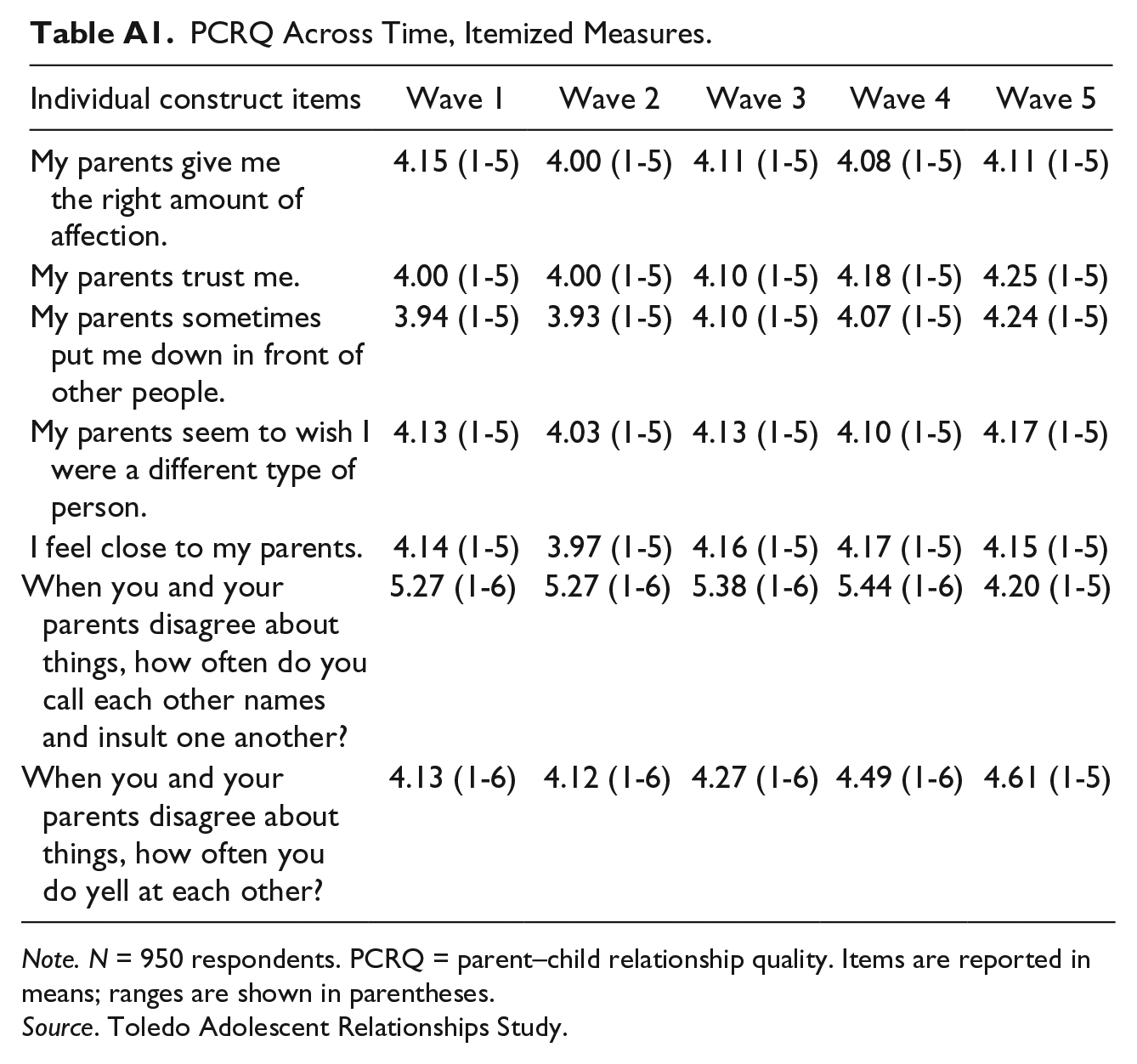
Table 1 presents descriptive statistics for IPV perpetration and both time-varying and time-stable characteristics of the current sample. IPV perpetration ranged from approximately 11% to 22%, with the largest number of reports occurring in Wave IV, when respondents were on average 20 years old. In examining familial background factors, between 11% and 22% of individuals reported experiencing parent-to-child physical aggression across time. As expected, respondents also reported less PCPA as they aged, most likely a result of leaving the parental home. Since PCRQ was a summed score of standardized items, mean scores were approximately zero and illustrated little variation across time. To gain a better understanding of the change in PCRQ across time, Table A1, found in the appendix, shows the mean scores of all seven items used to construct PCRQ before they were standardized. These scores demonstrated that, on average, PCRQ either remained stable or was slightly more positive over time.
Intimate Partner Violence and Time-Varying Correlates (N = 950).
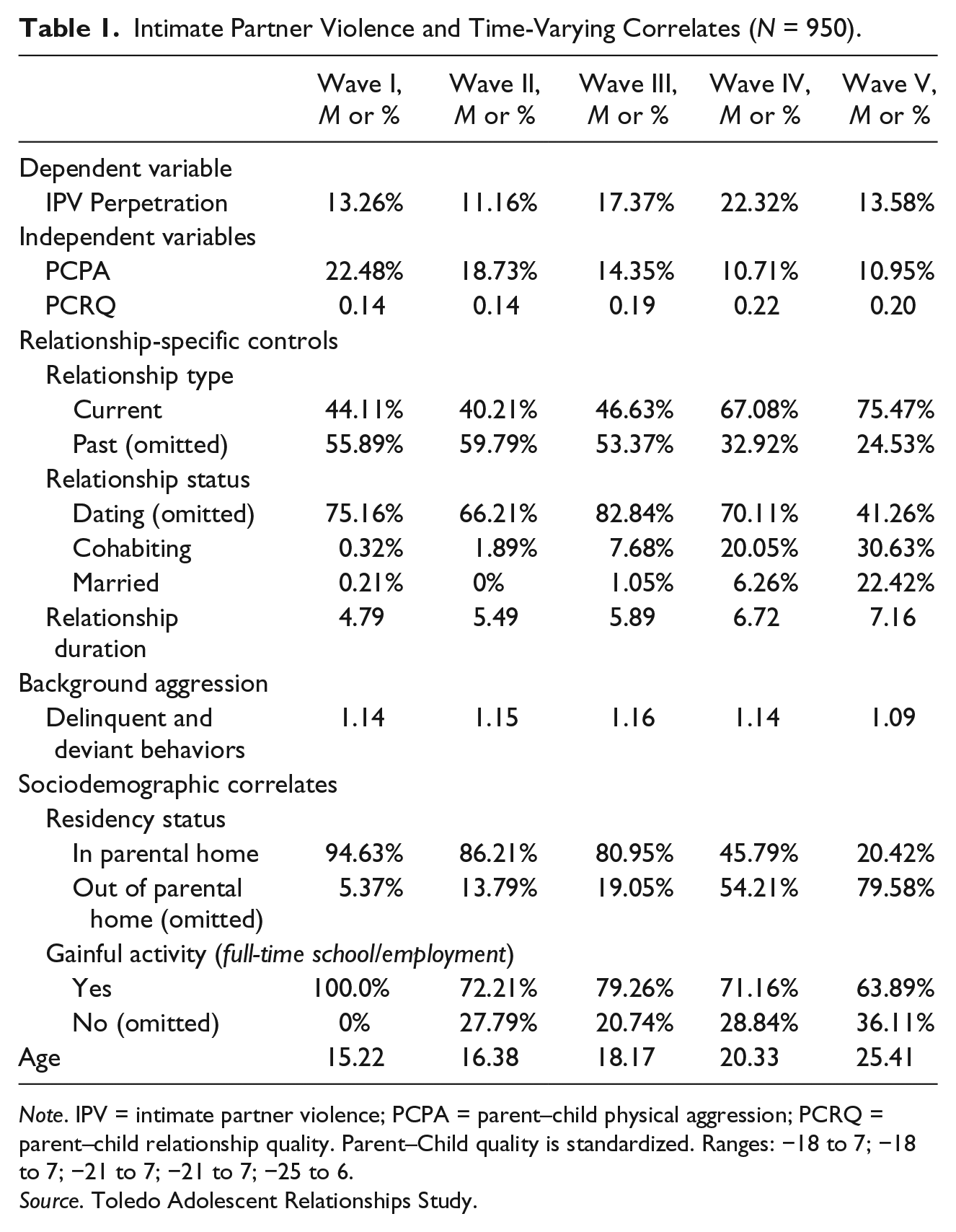
Note. IPV = intimate partner violence; PCPA = parent–child physical aggression; PCRQ = parent–child relationship quality. Parent–Child quality is standardized. Ranges: −18 to 7; −18 to 7; −21 to 7; −21 to 7; −25 to 6.
Source. Toledo Adolescent Relationships Study.
In terms of relationship-specific factors, relationship duration was, on average, between 2 and 5 months at Waves I and II, between 6 and 8 months at Wave III, and 9 months to a year at Waves IV and V. The results also showed that most individuals reported on a past relationship in earlier waves, but increasingly reported on a current relationship in later waves. This is consistent with the notion that individuals’ relationships are in greater flux at earlier ages when they are first becoming romantically involved. Similarly, most respondents reported on dating relationships at all five waves, although the percentage reporting on cohabiting and married relationships increased substantially in Waves IV and V when respondents were on average 20 and 25 years of age, respectively.
With regard to individual-level factors, which vary across time, the mean delinquency score was low and exhibited little variation across the five waves. As expected, most respondents lived with their parents at Wave I (95%), although the majority had moved out of the parental home by Wave V (80%). The majority of individuals were also gainfully active at all five waves, although this percentage decreased sequentially over time, as respondents finished school and navigated the world of employment. Finally, results showed that respondents were on average 15, 16, 18, 20, and 25 years of age across the five waves of data.
Although time-invariant correlates were not included in multivariate analyses, it is important to note a few characteristics of the current sample. A slight majority (53.4%) of respondents were female and were raised in a two-biological parent household (54.5%), compared with single parent, stepparent and other family-type households. The most common racial identification of the sample was White (65.9%), although there were significant portions of Black (20.8%) and Hispanic (10.8%) respondents. At the time of the Wave I interview, the majority of respondents’ parents were high school graduates (64.8%), employed (79.0%) and not receiving government assistance (88.9%).
Multivariate Results
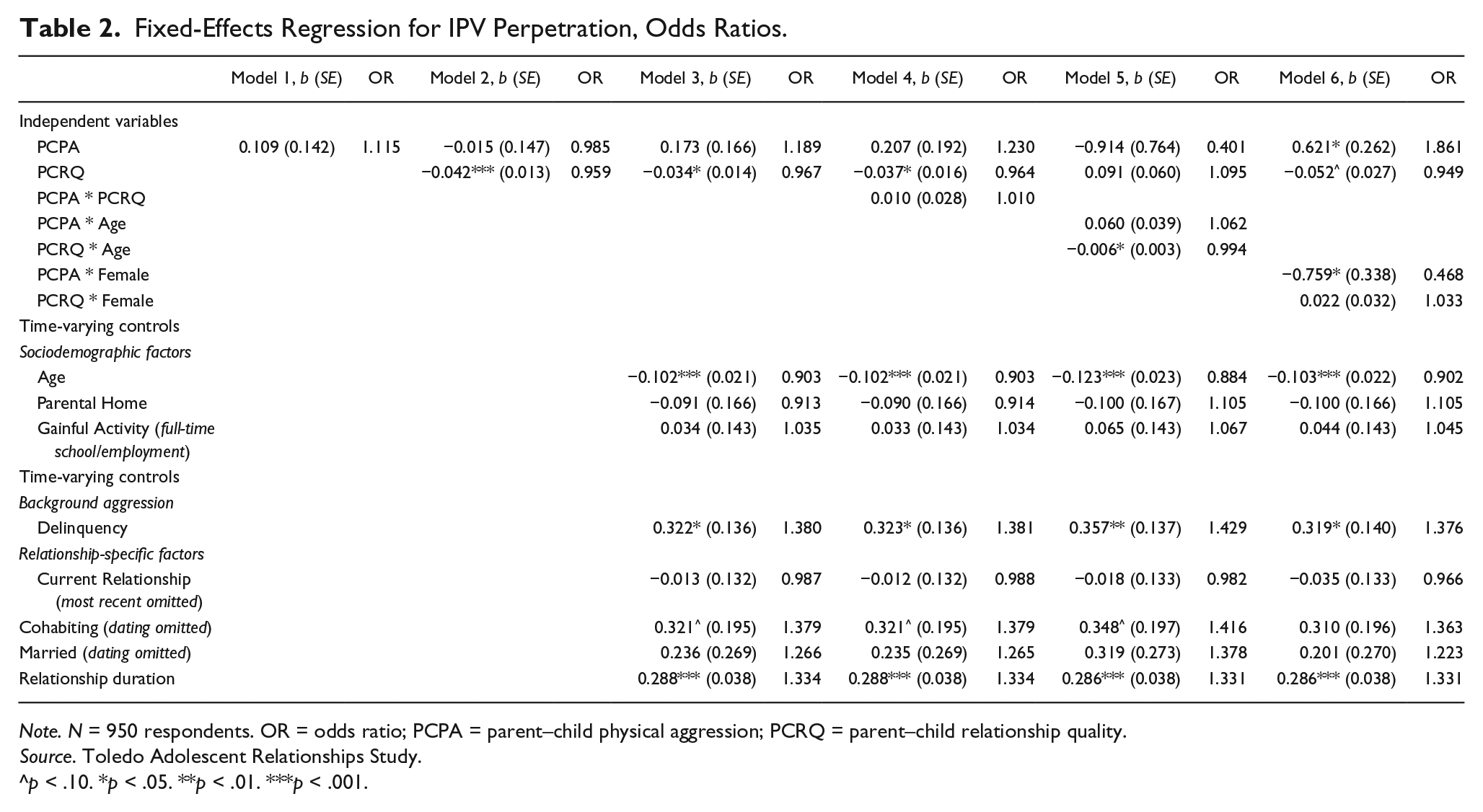
Table 2 presents nested models for the fixed-effects regression for IPV perpetration. To test the effects of the more traditionally measured FOOV variable, model 1 regressed IPV perpetration on PCPA only. Counter to previous research, as well as to our hypothesis for this study, PCPA was statistically nonsignificant in predicting individuals’ violent behavior in intimate relationships. Yet, consistent with prior research and our hypothesis, supplemental analyses utilizing traditional logistic regression models resulted in a positive and significant relationship between PCPA and IPV perpetration. The statistical nonsignificance of PCPA is thus likely due to the fixed-effects method utilized in the present study, where any correlates selecting individuals into either PCPA or IPV perpetration experiences were controlled for in the modeling strategy. Model 2 then added PCRQ to the regression to assess whether this additional familial characteristic explained any additional variation in respondents’ IPV reports. Results indicated that PCRQ was a highly significant negative predictor of respondents’ IPV perpetration. Specifically, each unit increase in PCRQ reduced individuals’ odds of perpetrating violence against an intimate partner by approximately 4%. Such a finding supported the notion that PCRQ may matter not only in addition to, but also independent of, FOOV in predicting IPV experiences.
Fixed-Effects Regression for IPV Perpetration, Odds Ratios.
Note. N = 950 respondents. OR = odds ratio; PCPA = parent–child physical aggression; PCRQ = parent–child relationship quality.
Source. Toledo Adolescent Relationships Study.
p < .10. *p < .05. **p < .01. ***p < .001.
Model 3 included time-varying sociodemographic, background aggression, and relationship-specific correlates expected to influence individuals’ risk of perpetrating violence against an intimate partner. These measures were included in Model 3 to assess whether they accounted for any of the effects of PCPA and PCRQ included in Models 1 and 2. Subsequently, with the inclusion of this block of time-varying correlates, PCRQ remained a significant negative predictor in the odds of IPV perpetration. Age was inversely related to IPV perpetration. For each year increase in age, the odds of perpetrating IPV decreased by approximately 10%. As would be expected, respondents’ delinquency was a positive predictor of IPV perpetration, whereby each unit increase in delinquency increased the odds of perpetrating IPV by approximately 38%. Turning to relationship-specific factors, duration was positively associated with respondents’ IPV perpetration reports, whereby each unit increase in relationship length increased the odds of IPV perpetration by approximately 33%.
Finally, Models 4 to 6 present the interaction between PCPA and PCRQ, as well as interactions between each of these constructs with both age and gender. Interaction terms were entered in a stepwise fashion to avoid the loss of statistical power which occurs when entering too many interactions in a single regression model. Results indicated no statistically significant interaction between PCPA and PCRQ in predicting the likelihood of respondents’ IPV experiences. In other words, the cumulative effects of PCPA and PCRQ did not produce any additional explained variation in IPV perpetration than when considered as independent measures. Based on the suggestion of a reviewer, supplemental analyses were also run with a dichotomized version of PCRQ included in the interaction between PCRQ and PCPA. In particular, following the work of Bartholomew and Horowitz (1991), it was noted that either low PCRQ or high PCRQ may amplify the positive effect of PCPA on IPV. More specifically, Bartholomew and Horowitz (1991) posit that insecurely attached individuals can show both fearful and dismissing patterns of attachment with others; and each of these attachment forms may lead to an increased risk of IPV. Fearful attachments may be more likely when children are exposed to a combination of parental aggression and warmth via PCPA and high PCRQ; while dismissing attachments may result when children are exposed to a combination of parental aggression and low warmth via PCPA and low PCRQ. Accordingly, two dichotomous variables were created from the original scale of PCRQ. Those individuals falling within the top 20% of PCRQ reports were categorized as evidencing very warm parenting, while those falling within the bottom 20% were categorized as evidencing very cold parenting. Each of these measures were then interacted with PCPA and entered into the model. Neither the interaction between low PCRQ and PCPA (b = 0.182; p = .527) nor high PCRQ and PCPA (b = −0.880, p = .398) produced significant results.
Conversely, findings from Model 5 indicated significant interactions between age and familial background. In particular, the effect of PCRQ on IPV perpetration appeared to be more negative for older than younger individuals, whereby the effect is 0.091−0.006 × Age. Thus, at 15 years of age, the effect of PCRQ was near zero, at β = .001. At 25 years of age, the effect of PCRQ was β = -−.059. The effect of PCPA, on the other hand, did not vary with age.
Findings from Model 6 provided support for the expectation that familial background factors may have different effects on IPV perpetration experiences for men compared with women. In particular, the interaction between PCPA and gender was statistically significant, although in the opposite direction from expectation. PCPA had a stronger effect on IPV for men. The effect of PCPA in Model 6 was 0.621 − 0.759 × Female. It was therefore positive and significant for men with a coefficient of 0.621. For women, the effect was 0.621 − 0.759 = −0.138. Further testing showed the effect to be nonsignificant for women. Specifically, while the effect of PCPA can be calculated to be −0.138 as just noted, this coefficient does not produce a corresponding test of significance. In order to examine whether this effect is significant among females, the model must be re-run with female serving as the reference category. As expected, this supplemental analysis (not shown) produced a coefficient of −.138 for PCPA. However, the corresponding p value was .653, a highly insignificant value. Thus, as measured here, PCPA appeared to elevate the risk of IPV perpetration for men only.
Finally, Model 6 also included an interaction between PCRQ and gender. This interaction was not significant, suggesting that there was no difference in the negative effect of PCRQ on IPV for men relative to women. The main effect of PCRQ remained marginally significant in this model. Although this main effect applied only to men due to the inclusion of an interaction term with gender in the full model (PCRQ * Female), the lack of a significant interaction with gender suggested that the effect applied equally to both men and women.
Based on the work of Johnson (2010), it was suggested by a reviewer that victimization data be incorporated in the present study to construct measures of mutual-violence perpetration versus respondent-only perpetration. Such constructs would further clarify the effects of exposure to violence as a child on adult IPV, given that such effects may vary based on the type of IPV experienced. These separate violence categories may also help to further explain any gender differences in results. While a potentially fruitful line of inquiry, such categorizations are not as appropriate with the present data. More specifically, as the TARS is a community-based sample, situational or common couple violence is the primary violence-type reported by respondents, which is considerably more likely to be bidirectional in nature. Given that respondents, on average, do not reach the age of legal adulthood until the third wave of data collection, instances of intimate terrorism are even more unlikely to occur. Finally, when respondent-only perpetration is assessed by gender, females are significantly more likely to be the perpetrators. These characteristics of the TARS data are in line with much prior research on IPV (e.g., Archer, 2000; Capaldi, Hyoun, & Shortt, 2007; Hamby, 2009).
Discussion
Despite the increasing empirical research on IPV over the past few decades, prior studies have often limited their examination of family predictors to exposure to violence in the family of origin. Yet, the family environment entails much more than simply the presence or absence of abuse. This study has sought to examine additional ways in which familial background experiences contributed to intimate partner violence during adolescence and young adulthood. In particular, PCRQ was posited as an additional characteristic of the family experience, which may teach individuals that violence is an acceptable and normative way of interacting with others generally, and dealing with conflict more specifically, in their future relationships.
As supported in the literature (e.g., Parks et al., 2011; Renner & Whitney, 2012; Smith et al., 2011), exposure to violence in the family-of-origin, as measured by PCPA, was a significant predictor of men’s adolescent and young adult experiences with IPV perpetration. Contributing to literature in this arena, the relationship was significant even after accounting for those factors that may have predisposed individuals to violence, or served as mediators between family background and IPV in later life. However, this relationship was not statistically significant for women’s IPV perpetration. This is counter to findings utilizing traditional logistic regression models, where PCPA was associated with IPV perpetration for both men and women (e.g., Giordano et al., 2014; Giordano et al., 2015; Smith et al., 2011; Swinford et al., 2000). This suggests that unmeasured characteristics may account for more of the association between PCPA and IPV for women than men. In other words, parent-to-child physical aggression appears to directly impact men’s perpetration of violence. Conversely, additional factors may need to present themselves in the lives of women to make violence appear as a viable or appropriate response in interacting with their romantic partners. Such factors may include specific dynamics within the romantic relationship (i.e., partner engaging in infidelity) or those that are internal to the respondent (i.e., feelings of insecurity, anxiety, poor impulse control, etc.). It is also noteworthy that while the gender findings here run counter to some past research, a recent meta-analytic review (Smith-Marek et al., 2015) also concluded that the relationship between experiencing FOOV and subsequent IPV perpetration in adulthood was significantly stronger for men than women.
Contributing to the literature on adolescent and young adult experiences with IPV, the findings presented here also demonstrated that PCRQ was an important negative predictor of violence in romantic relationships. As noted with regard to PCPA above, this finding was especially noteworthy given the use of fixed-effects analysis, which served to reduce the influence of any potential unmeasured heterogeneity among respondents by implicitly controlling for all time-stable characteristics. Thus, fixed-effects models provided greater confidence that the effects of familial background factors were not biased due to those respondent characteristics that were not directly included in the model. Although the effect size of PCRQ was relatively small in comparison to that of PCPA (5% vs. 62%) and reached only marginal significance in the full model, PCRQ was a consistent predictor of IPV perpetration. These results indicated, as hypothesized, that individuals who reported higher PCRQ were less likely to report IPV perpetration. This finding supported the notion that individuals learn how to view and interact with others based on the quality of their relationships with parents, just as they learn how to view violence based on the violence they experience via their parents (Bowlby, 1982). Moreover, although the significance of PCRQ in the present study ran counter to some past research examining PCPA and PCRQ simultaneously (e.g., Richards & Branch, 2012), some of this variation may be due to the difference in measurement of PCRQ (e.g., Hair et al. 2008; Miller et al., 2009), as well as the age of the sample under consideration. This potential conclusion is supported by other studies, which found significant effects of PCRQ-similar constructs on IPV (e.g., Dutton, 1994; Dutton et al., 1996; Palazzolo et al., 2010; Wekerle et al., 2009). It is important to note that the negative effect of PCRQ on IPV perpetration appeared to vary to some degree by age. In particular, PCRQ seemed to matter more for older than younger individuals. Such a finding is consistent with the notion that the quality of the parent–child relationship in young adulthood may signify more cumulatively positive or negative experiences throughout the life course. Likewise, as individuals age, reports of higher PCRQ may signify a plethora of additional parental supports more specific to the needs of young adults. These supports may take either emotional (i.e., seeking relationship and parenting advice) or tangible forms (i.e., monetary assistance or help with childcare), reducing potential stress in the young adult’s life and, correspondingly, decreasing their likelihood for perpetrating violence against an intimate partner. These findings, combined with the various ways in which PCRQ may be measured, indicate that more research is needed to explore the specific details of the relationship between PCRQ and IPV experiences.
Although PCRQ is important to account for on its own, it does not appear to interact with PCPA. Two potential hypotheses were previously put forth. One, according to social learning theory, that PCRQ would moderate the effect of PCPA, such that greater PCRQ would actually amplify the positive effect of PCPA on IPV perpetration (Simons et al., 2012; Straus & Gelles, 1990). Two, according to attachment theory, that PCPA would amplify the effect of low PCRQ on IPV perpetration (Bowlby, 1982; Dutton et al., 1994). With the lack of a significant interaction term between these domains, in both primary and supplemental analyses, the present study did not find support for either of these previously hypothesized relationships. Thus, although both PCRQ and PCPA are critical to our understanding of how individuals’ families affect their relationships with romantic others, these two mechanisms appeared to operate largely independent of one another. Similarly, results indicated no significant gender differences in the effect of PCRQ on IPV, failing to support the hypothesis that greater PCRQ would be more protective for women than men in deterring experiences of IPV perpetration.
Although the present findings advance our understanding of familial influences on relationship violence, there were several limitations in the present study. First, the TARS sample has characteristics similar to the national population; nevertheless it is a regional sample. As such, generalizability of the findings presented here should be made with caution. Future research efforts should replicate the findings presented here, with nationally representative data. Second, only respondent reports were used for the measurement of IPV perpetration. Although issues of under- or over-reporting are possible with any self-reported data, this may be especially the case here given the absence of partner reports in the current data set. The use of couple-level data is an important avenue for new advances. Third, while the fixed-effects approach utilized here does address the possibility of unmeasured heterogeneity between respondents, it does not allow for the estimation of time-stable effects. Of particular importance here, we were unable to assess the effects of indirect violence exposure in the family-of-origin (i.e., interparental verbal and physical aggression), an important variable to consider in predicting later IPV (e.g., Black et al., 2010). Fourth, although both PCPA and PCRQ were important predictors of IPV perpetration, the exact processes by which these associations unfold were not examined in the present analyses. For instance, although social learning theory presupposes that individuals exposed to PCPA are taught to see violence as an acceptable solution to conflict, or come to believe violence is a legitimate component of healthy, loving relationships, measures of respondents’ attitudes toward violence were not examined. Relatedly, future research may find it useful to expand measurements of PCPA and PCRQ. Only respondent reports were used in the measurement of PCPA. A stricter interpretation of this variable, as well as child maltreatment more generally, may also include official reports made by police and social service agencies. If variability in reports allows, future research may also find it useful to measure PCPA on a continuum rather than as a binary. Likewise, as mentioned previously, the measurement of PCRQ varies considerably within empirical research. Differences in these two measurements may produce a different pattern of results.
Establishing family profiles based on longitudinal experiences of PCPA and PCRQ may also prove to be a valuable line of inquiry. For example, individuals who report more frequent PCPA over time, as well as those who have consistently poor relationships with their parents, may exhibit markedly higher risk for violence with romantic partners. Finally, although the family is the first and primary agent of socialization, peer relationships are also central to individuals’ development, particularly in the adolescent and young adult years (Newman, Lohman, & Newman, 2007; Waldrip, Malcolm, & Jensen-Campbell, 2008). Thus, future studies may want to include violence occurring within the peer network, as well as more general qualities of individuals’ friendships overall.
Although continued research is needed to further explain variations in the risk of romantic relationship violence, the current study makes several strides to improve on past research efforts. Through the use of fixed-effects analyses, the results presented here indicate that familial background factors influence individuals’ propensity for violent offending in the context of romantic relationships, net of individuals’ own problematic, deviant, and delinquent characteristics. This finding is an important contribution to the literature, as it challenges the notion that IPV perpetration may be just one category in a constellation of negative behaviors for people otherwise predisposed to violence and other antisocial behaviors. Specifically, it has been argued that those who report IPV are also more likely to exhibit poor impulse control, antisocial and narcissistic personality traits, and other similar social psychological characteristics (e.g., Derefinko et al., 2011; Varley Thornton et al., 2010). Yet, in accounting for these characteristics and any similar constructs, which may be selecting individuals into violent experiences through the use of fixed-effect analyses, familial background factors still contributed significantly to IPV perpetration reports. Likewise, while consistently significant in the prediction of IPV perpetration, explicit controls for individuals’ delinquent and deviant behavior did not diminish the effects of either PCPA or PCRQ. These findings thus lend further support for both social learning and attachment theories, in that experiences with parents and other caregivers in early life may continue to have ramifications in romantic and other relationship types throughout the life course.
Footnotes
Appendix
PCRQ Across Time, Itemized Measures.
| Individual construct items | Wave 1 | Wave 2 | Wave 3 | Wave 4 | Wave 5 |
|---|---|---|---|---|---|
| My parents give me the right amount of affection. | 4.15 (1-5) | 4.00 (1-5) | 4.11 (1-5) | 4.08 (1-5) | 4.11 (1-5) |
| My parents trust me. | 4.00 (1-5) | 4.00 (1-5) | 4.10 (1-5) | 4.18 (1-5) | 4.25 (1-5) |
| My parents sometimes put me down in front of other people. | 3.94 (1-5) | 3.93 (1-5) | 4.10 (1-5) | 4.07 (1-5) | 4.24 (1-5) |
| My parents seem to wish I were a different type of person. | 4.13 (1-5) | 4.03 (1-5) | 4.13 (1-5) | 4.10 (1-5) | 4.17 (1-5) |
| I feel close to my parents. | 4.14 (1-5) | 3.97 (1-5) | 4.16 (1-5) | 4.17 (1-5) | 4.15 (1-5) |
| When you and your parents disagree about things, how often do you call each other names and insult one another? | 5.27 (1-6) | 5.27 (1-6) | 5.38 (1-6) | 5.44 (1-6) | 4.20 (1-5) |
| When you and your parents disagree about things, how often you do yell at each other? | 4.13 (1-6) | 4.12 (1-6) | 4.27 (1-6) | 4.49 (1-6) | 4.61 (1-5) |
Note. N = 950 respondents. PCRQ = parent–child relationship quality. Items are reported in means; ranges are shown in parentheses.
Source. Toledo Adolescent Relationships Study.
Authors’ Note
The opinions, findings, and conclusions or recommendations expressed in this article are those of the authors and do not necessarily reflect the official views of the National Institutes of Health, the funding agency.
Declaration of Conflicting Interests
The author(s) declared no potential conflicts of interest with respect to the research, authorship, and/or publication of this article.
Funding
The author(s) disclosed receipt of the following financial support for the research, authorship, and/or publication of this article: This research was supported by a grant from The Eunice Kennedy Shriver National Institute of Child Health and Human Development (HD036223) and by the Center for Family and Demographic Research, Bowling Green State University, which has core funding from The Eunice Kennedy Shriver National Institute of Child Health and Human Development (R24HD050959-01).