



Abstract
Using the baseline wave (2010) of the China Family Panel Studies, this study conducted an investigation of the associations between intergenerational relationships and the psychological well-being of elderly parents and adult children based on 2,401 coresiding parent–child dyads. Parents receiving support from children in three to four life areas were more likely to have higher life satisfaction than parents with no upward support. Downward support in more life areas was associated with poorer psychological well-being for adult children. Good quality parent–child relationships were positively associated only with parents’ life satisfaction. This association was stronger for elderly mothers than for elderly fathers. No significant differences were found between father–child and mother–child relationships with regard to their implications for children’s psychological outcomes. This study highlights the importance of considering cultural sensitivity and parental gender roles when applying attachment theory to aging families.
Keywords
Despite rapid changes in family demographics and society, having close relationships with family members remains essential for people to gain support and overcome diverse life challenges across the life course. Intergenerational parent–child relationships are one of the most important family relationships for individuals (M. Guo, Xu, Liu, Mao, & Chi, 2015). Due to extended life expectancy, parents and their children today will have decades of overlapping adult life spans. Whether parents and children have long-term good relationships with each other will inevitably influence the well-being of both generations throughout their lives. Later-life researchers have been most concerned with the parent–child relationship and its psychological outcomes for elderly parents (J. Chen & Jordan, 2016; M. Guo, Liu, Xu, Mao, & Chi, 2016; Schwarz et al., 2010; Silverstein, Cong, & Li, 2006), whereas little attention has been given to outcomes for adult children, despite some studies showing the care burden borne by adult child caregivers (Schwarz, Trommsdorff, Albert, & Mayer, 2005; Yee & Schulz, 2000).
Existing research has applied different theories to delve into intergenerational relationships, including, but not limited to, the intergenerational solidarity framework (Bengtson & Roberts, 1991), social exchange and equity theories (Walster, Walster, & Berscheid, 1978), and attachment theory (Merz, Schuengel, & Schulze, 2007). The former two focus on identifying multidimensional constructs of intergenerational solidarity and uncovering the processes and rules of various types of “support flow” between parents and adult children, respectively. An attachment perspective helps extend the focus to mental representations and outcomes related to the key concepts of attachment relationships between elderly parents and adult children. This perspective suggests enduring linkages between parent–child attachment relationships and the well-being of both children and parents, where such relationships are primarily characterized by seeking and offering comfort, support, and emotional security (Cassidy, 1999). Within attachment theory, there are three distinct and important concepts, namely, attachment bond, behavior, and relationship (Ainsworth, 1973). The current study refers to an attachment perspective mainly derived from Merz et al.’s (2007) approach, which focuses on attachment relationships and associated dimensions (i.e., direction, penetration, and relationship quality, discussed below) and can particularly be incorporated into the study of the dyadic relationships of intergenerational solidarity. An attachment relationship exists in the case of interactions, where one person provides support and protection to another person. There is evidence suggesting a primary role of late-life parent–child attachment relationships in affecting psychological conditions in intergenerational care contexts (Carpenter, 2001).
Researchers also call for culture-specific understandings of parent–child attachment relationships over the life span (Rothbaum, Weisz, Pott, Miyake, & Morelli, 2000). Different cultural contexts may lead to distinct family dynamics and implications for well-being. In addition, it is also important to consider gender differences. Gender not only reflects the organizing features of family relationships but is also connected with distinct family roles (e.g., father and mother, son and daughter) involving different expectations and responsibilities (Gilligan, Suitor, Kim, & Pillemer, 2013). Little attention has been paid to the characteristics of father–child and mother–child relationships in later life and the psychological outcomes for both generations. To address this research gap, the current study aimed to address two research questions specifically in the Chinese context:
Intergenerational Relationships From an Attachment Theoretical Perspective
Compared with attachment relationships in infancy and early childhood, relationships between elderly parents and adult children may become reciprocal or have a reversed direction of support while simultaneously maintaining longer standing underlying explanatory dimensions. Three basic dimensions can be used to describe variations among attachment relationships in later life: direction, penetration, and relationship quality (Cassidy, 1999). While direction accounts for the asymmetric characteristics of attachment relationships between weaker and stronger individuals (Merz et al., 2007), penetration reflects the breadth and practical importance of attachment relationships in the lives of relationship partners (Cassidy, 1999). The former refers to the flow of support, help, care behavior, and advice, while the latter is primarily a quantitative index of support exchanged (Merz, Consedine, Schulze, & Schuengel, 2009). The roles that parents and children play in each other’s lives may encompass various support activities, such as financial help, daily care, and housework help, in different areas of life. The more life areas penetrated by a relationship partner, the more centrally an attachment relationship is integrated into a person’s life. Actually, direction, together with penetration (i.e., upward and downward penetration), manifests characteristics of intergenerational support in an attachment relationship with regard to reciprocity and the extent of support. In the current article, the terms support and penetration are used interchangeably, although a subtle difference is that support is more likely to be viewed with a positive valuation compared with penetration. Last, but not least, relationship quality refers to the process of interactions and organization of behaviors within a relationship, which may either trigger conflict or bring harmony and security to the specific attachment relationship (Merz et al., 2007).
Most studies of attachment relationships with Chinese samples are about romantic relationships and early parent–child/infant relationships, with little attention given to late-life parent–child relationships. Apart from the aforementioned three dimensions, elderly parent–adult child attachment relationships cannot be truly understood without looking at the specific cultural context. Compared with high-income Western countries where formal elderly care services are often available, in most Asian countries, children continue to serve as primary caregivers for aging parents. In China, the norm of filial piety (Xiao) stemming from Confucian culture serves as a key construct of late-life parent–child relationships. It not only promotes children’s anticipation of having to take care of their elderly parents and their obligation to do so but also justifies the dependence of elderly parents on their adult children, which is even reinforced by law (Chou, 2011). Independence, efficacy, and self-reliance serve a larger behavioral system valued in Western parent–child attachment relationships (Emde, 1992). In contrast, the link between the attachment and dependence/interdependence behavioral systems is more important in non-Western cultures (Rothbaum et al., 2000). In recent decades, a limited but increasing number of studies in the Chinese cultural context (X. Chen & Silverstein, 2000; M. Guo et al., 2016; Silverstein et al., 2006) have focused on the relationships between intergenerational support and elderly psychological well-being, represented frequently by the use of two important indicators—depression and life satisfaction. (Note. Unless further explanation is highlighted, the previously reviewed literature about intergenerational support refers to actual support reported from the parents’ perspective.) Studies, in general, reveal that receiving support from adult children is related to lower depression and higher life satisfaction for Chinese elderly parents (J. Chen & Jordan, 2016; X. Chen & Silverstein, 2000; Peng, Kwokb, Law, Yip, & Cheng, 2018), despite variations depending on different types of support (e.g., instrumental, emotional, financial). Nevertheless, how providing support to elderly parents is related to adult children’s well-being remains understudied. Considering Chinese filial culture, we expected that upward support from adult children to elderly parents might be regarded as better fulfillment of the filial obligations required of adult children and expected by aging parents in China. Therefore, from an attachment perspective, we expected upward penetration to have a positive association with the psychological well-being of both adult children and elderly parents in aging Chinese families (Hypothesis 1).
The directionality of attachment relationships is not always upward from children to parents in late life. Parents remain important support resources for adult children, providing various types of support in different life areas, such as grandparenting, help with household chores, and giving advice and financial help. Compared with upward support across the two generations, much less is known about downward support from elderly parents to their children except for a few studies on grandparenting care providing inconsistent results for elderly psychological outcomes (B. Guo, Pickard, & Huang, 2008; Lou, 2011). Most Western studies suggest the positive contribution of downward support to elderly people’s life satisfaction, self-efficacy, and feelings of being valued (Krause & Shaw, 2000; Thomas, 2009). However, parallel results may not be observed in the Chinese context as downward support may conflict with traditional filial obligations for both generations. Greater downward support may also indicate the inabilities of adult children and parents’ failure in raising successful children (Schwarz et al., 2010). Therefore, we expected downward penetration to be negatively associated with the psychological well-being of both adult children and elderly parents in aging Chinese families (Hypothesis 2). Apart from the importance of bidirectional intergenerational support, relationship quality between elderly parents and adult children also matters for the well-being of both generations (Lin & Chen, 2018; Merz et al., 2009). Attachment theory suggests that an intimate and deeply interdependent attachment relationship encourages attachment security, which further augments a person’s capacity to maintain emotional stability in times of stress, maximizes personal social adjustment, and finally contributes to the person’s well-being and mental health (Bowlby, 1988; Mikulincer & Shaver, 2007). Therefore, we expected closer relationships between adult children and elderly parents to be positively associated with the psychological well-being of both generations in aging Chinese families (Hypothesis 3).
Differences Between Father–Child and Mother–Child Relationships
Despite its contribution to providing multifaceted insights into intergenerational relationships, attachment theory somehow fails to take into account how parental roles may vary by gender. Fathers and mothers are expected to play different roles intrinsically, leading to different relationships with adult children (Gilligan et al., 2013; Suitor & Pillemer, 2013). A similar division of labor has predominated within many Western and Chinese families, where men are expected to take care of things outside of the family and work as the breadwinners, while women are more likely to assume the responsibilities of caregiving as kin keepers (Lou, 2011). According to the notion of investment in children, fathers tend to invest less in children than mothers do in terms of the provision of instrumental and emotional support and spending time with their children (Kalmijn, 1999). In addition, fathers are less likely than mothers to receive support from their children in their late life (Kalmijn, 2007). Women’s needs are probably more visible to children than the needs of men due to their kin-keeping roles (Silverstein, Parrott, & Bengtson, 1995). Thus, women tend to receive more overall support from children.
More important, the associations that intergenerational relationships have with the well-being of adult children and aging parents may vary for father–child and mother–child relationships. Few Chinese studies have investigated whether parental gender can moderate the effect of intergenerational relationships on the psychological well-being of elderly parents, let alone adult children. M. Guo, Chi, and Silverstein (2017) found that Chinese elderly (widowed) mothers have a lower level of depression than fathers if they have closer relationships with their children and receive (monetary) support from them. With regard to parents, the mental health of mothers seems to be more sensitive to parent–child relationships. Therefore, we expected that for elderly parents, intergenerational support (i.e., upward and downward penetration) and relationship quality might have stronger associations with mothers’ psychological well-being than with fathers’ psychological well-being (Hypothesis 4). In addition, on the basis of reports from the perspective of children, Umberson (1992) found that more frequent contact and support from mothers, but not from fathers, was associated with lower depression levels among adult children and that a strained relationship with both parents tended to have similar negative effects. Considering the female-dominant child care roles in Chinese families, for children, the importance of attachment relationships with mothers since early childhood may be more likely to extend into middle adulthood than father–child relationships. For adult children, we expected that compared with father–child relationships, intergenerational support (i.e., upward and downward penetration) and relationship quality between mothers and children might have stronger associations with adult children’s psychological well-being (Hypothesis 5).
In sum, the current study examines the associations between intergenerational relationships and the psychological well-being of both generations by using dyadic samples of parents and children in aging Chinese families. A dyadic analysis of parents and children, respectively, in one study enables us to observe and compare the effects of the simultaneous dynamics of parent–child attachment relationships on the two parties, controlling for shared family characteristics. Our study also contributes to the long-lasting arguments for the necessity of considering the cultural specificity of parent–child relationships. We explore two aspects of intergenerational relationships—intergenerational support (i.e., downward and upward penetration) and relationship quality—from an attachment perspective.
Data and Method
Data
We used the 2010 baseline wave of the China Family Panel Studies (CFPS) for data analysis in this study. The CFPS sampled respondents from 25 of the 31 provinces in China by applying a multistage probability sampling method. Households were randomly sampled, and only family members living together and at home were given corresponding individual questionnaires. Additionally, only elderly people older than 60 years with at least one living child were eligible to answer the section on intergenerational relationship—the main interest of our study. In the baseline wave, 2,418 elderly parents were interviewed together with 1,975 coresiding biological children in the adult questionnaires (age ≥ 16 years). Due to our focus on relationships between elderly parents and adult children, we removed parent–child dyads where the child was younger than 18 years (i.e., 13 parent–child dyads). A total of 2,575 parent (age ≥ 61 years)–adult child (age ≥ 18 years) dyads were obtained for the current study. Finally, by eliminating responses with missing values (<7%), we had a total working sample of 2,401 parent–child dyads nested in 1,712 families containing both the parents’ and the biological children’s information.
Measures
Psychological well-being was assessed by life satisfaction and depression. The two indicators, reflecting positive and negative feelings, respectively, are recommended by the World Health Organization as key components of psychological functioning (World Health Organization Quality of Life Group, 1998). Higher life satisfaction and lower depression indicate better psychological well-being. Life satisfaction was measured globally by one item on a scale ranging from 1 (very unsatisfied with life) to 5 (very satisfied with life). Depression was measured with a six-item version of the Center for Epidemiological Studies–Depression Scale (Radloff, 1977). This scale is well-established and has been widely used in previous Chinese studies given its reliability and validity for Chinese adults (e.g., Chao, 2011; Silverstein et al., 2006; Tang & Hooyman, 2018). The CFPS adjusted and shortened the original 20-item version to a 6-item version (for elderly parents, Cronbach’s α = .94; for adult children, Cronbach’s α = .95) covering, sequentially, the frequency of occurrence of feeling depressed, nervous, upset, hopeless, difficult, and meaningless in the past month. Respondents rated the six items on a 5-point scale ranging from 1 (almost every day) to 5 (never). After reversing the scale values, we summed the item scores—a higher cumulative score indicated a higher level of depression (score range = 6-30).
Intergenerational support was operationalized as downward and upward penetration, referring to the direction and penetration dimensions in attachment theory. These indicators were derived from the elderly parents’ reports of intergenerational support exchanges in the past 6 months. The elderly parents answered yes or no to questions on whether they had received/provided monetary support, daily care/grandparenting, help with household chores, and help with financial management from/to children. Penetration was measured by summing up the number of aforementioned forms of support provided/received by elderly parents, ranging from 0 (no life areas penetrated) to 4 (four life areas penetrated) in either direction. We categorized downward and upward penetration into three groups from the parents’ perspectives, capturing the number of life areas in which elderly parents were involved in terms of providing (i.e., downward) or receiving (i.e., upward) support to or from adult children: 0 = none, 1 = one to two life areas penetrated, 2 = three to four life areas penetrated.
Relationship quality was measured as parents’ self-rated emotional closeness with their adult children (1 = not close at all, 2 = not so close, 3 = reasonable, 4 = close, 5 = very close). As no information on intergenerational relationships was collected from the children’s perspectives, we also used the parents’ reports as proxy variables for children to investigate their associations with children’s well-being. Despite the better results, in terms of the variance explained, obtained by using both parents’ and children’s reports on their relationships, data from one side of the parent–child dyads are sufficient for most analyses into intergenerational relationships without causing great statistical bias (Steinbach, Kopp, & Lazarevic, 2017).
Parental role characteristic was a dummy variable for the parent–child relationship, where 0 = mother–child relationship and 1 = father–child relationship. We used parental gender in each specific parent–child dyad to specify whether a parent–child dyad captures characteristics of a father–child or mother–child relationship.
Control variables included both parents’ and children’s individual characteristics, such as gender, age, education level, income, partnership/marital status, and health condition. The variables of most characteristics were constructed in the same way for both elderly parents and adult children. Specifically, gender was a dummy variable (1 = male). Note that as parental gender was suggested by parental roles, which were already included in the models, it was not added as a separate control variable to avoid multicollinearity. Educational level was a categorical variable: 1 = low level (reference group, i.e., illiterate/semi-illiterate and primary school), 2 = middle level (i.e., junior middle school and senior middle school), and 3 = high level (i.e., junior college, college, master’s degree, and doctoral degree). Income was reported on the basis of total income in past 12 months and transformed into natural logarithms of the personal income values plus 1 due to its skewed distribution. Health condition was coded as 1 = unhealthy (reference group), 2 = fair, and 3 = healthy. In contrast, other characteristics were operationalized slightly differently for parents and children. Parents’ partnership status was managed as a dummy variable (1 = having a marriage/cohabitating partner), making elderly adults who were unmarried, divorced, or widowed the reference group, while children’s marital status was coded in a similar way (1 = currently married). Elderly age was centered at 61 years old, at which point they were eligible for questions related to intergenerational relationships, whereas child age was centered at the average age of adult children (41 years). We also controlled shared characteristics, such as the residential areas where the parents and children lived as they were sampled together on the basis of the household unit (1 = living in urban areas, 0 = living in rural areas). Table 1 presents descriptive characteristics for mothers, fathers, adult children, and parent–child dyads, respectively.
Descriptive Statistics for Parents, Children, and Parent–Child Dyads.

Note. Pearson’s chi-squared test or t test for intergenerational relationships by parental role based on 2,401 parent–child dyads.
χ2(2) = 7.18, p < .05. bχ2(2) = 6.85, p < .05. ct = 2.39, p < .01.
Analytical Approaches
To investigate the associations between intergenerational relationship and psychological consequences for elderly parents and adult children, we conducted separate analyses for the two generations. An ordered logistic regression was applied to estimate life satisfaction due to its ordinal feature, while ordinary least squares regression was employed to estimate depression. For each dependent variable, we first investigated its main association with intergenerational relationships. Parents’ and children’s individual characteristics were controlled at the same time as they are both associated with intergenerational relationships (Aquilino, 1999; Umberson, 1992). Additionally, adult children and aging parents have mutual influences on each other with regard to well-being (Merz et al., 2009). By controlling the other generation’s psychological well-being in the analytical models, we, to some extent, aimed to control the potential effects of intergenerational transmission of mental health conditions (Séjourné, Alba, Onorrus, Goutaudier, & Chabrol, 2011) despite the data limitations in the current study. Second, to capture the moderating effect of parental role on the main associations of interest in our study, we added the interaction terms between parental gender role and each aspect of intergenerational attachment relationships (i.e., downward and upward penetration, relationship quality). All the models were estimated in Stata Version 13.0, and the cluster option was used to account for the nonindependence of parent–child dyads within each family and calculate correct standard errors.
Results
Preliminary analyses showed that all three aspects of intergenerational relationships are significantly different between mother–child and father–child relationships (see Table 1). Such variations may imply different associations between intergenerational relationship and psychological well-being depending on parental role characteristics, motivating further analyses.
Table 2 shows the ordered logistic regression and ordinary least squares regression results for elderly parents’ life satisfaction and depression. Model 1-1 indicates that parents with a better quality relationship with their adult children tend to have higher levels of life satisfaction. Compared with their counterparts with no upward penetration from their adult children, elderly parents receiving upward penetration in three to four life areas are more likely to be satisfied with their life, while no significant difference was found for parents receiving upward penetration in one to two life areas. Downward penetration from parents to children is not significantly associated with parents’ life satisfaction. With the interaction terms of intergenerational relationship and parental role, Model 1-2 suggests that the positive association of relationship quality with parents’ life satisfaction is significantly stronger for mothers than for fathers. However, none of aspects of intergenerational relationships are related to elderly depression (see Model 2-1), and these associations do not vary between father–child and mother–child relationships (see Model 2-2). Last, but not the least, the likelihood-ratio test indicated that including interaction terms improves the model fit for parental life satisfaction, χ2(5) = 18.43, p < .01, but not for parental depression, χ2(5) = 2.89, ns.
Results of Life Satisfaction and Depression for Elderly Parents (n = 2,401 Parent–Child Dyads).
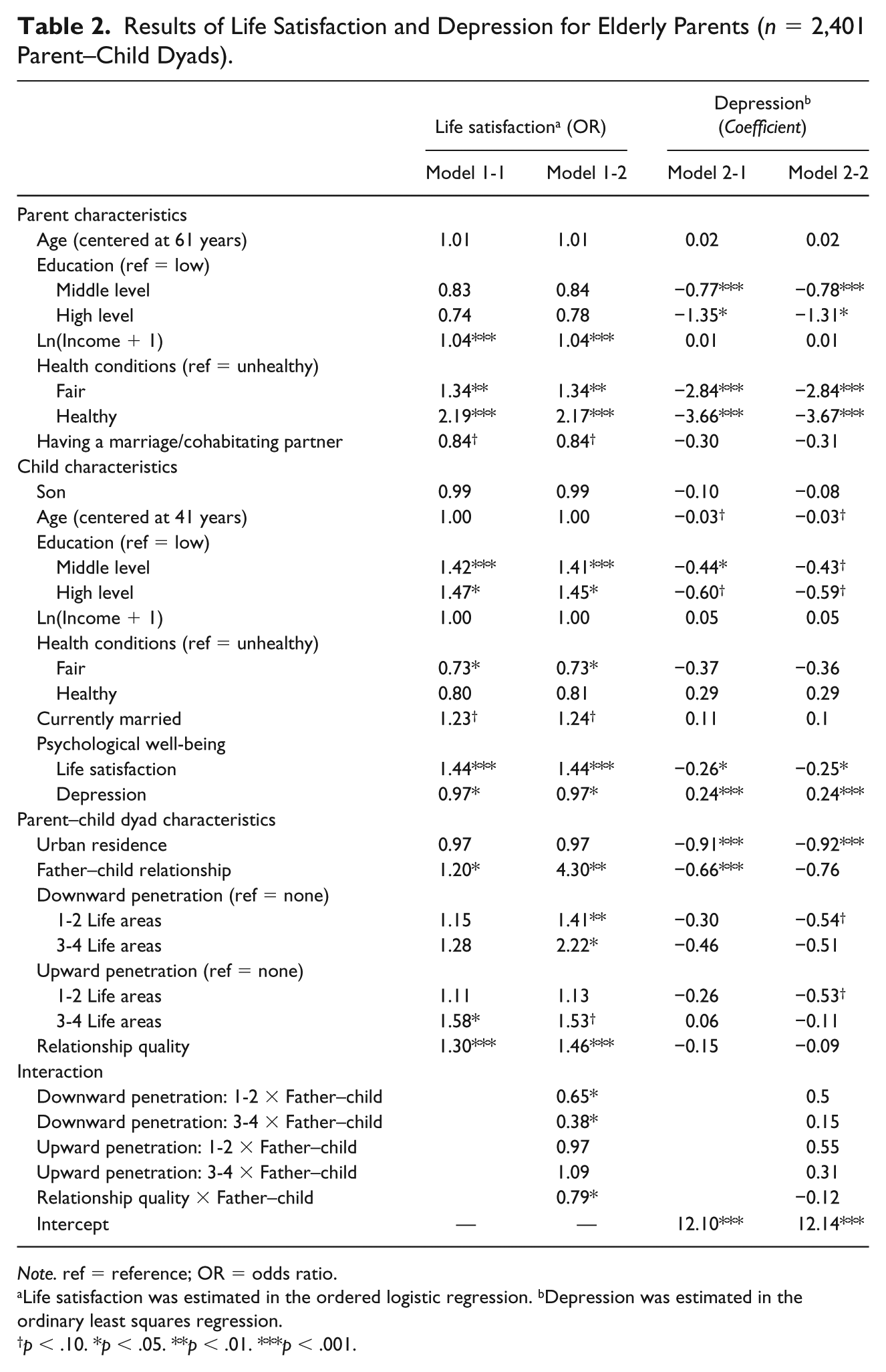
Note. ref = reference; OR = odds ratio.
Life satisfaction was estimated in the ordered logistic regression. bDepression was estimated in the ordinary least squares regression.
p < .10. *p < .05. **p < .01. ***p < .001.
Table 3 displays the corresponding results of the analyses for adult children. As shown in Model 3-1, compared with children with no downward penetration from parents, children are less satisfied with life if they receive downward penetration in three to four life areas. This difference is only observed as marginally significant (p < .10) and disappears for children receiving downward penetration in one or two life areas. Likewise, Model 4-1 indicates that having downward penetration in more life areas has a positive association with children’s depression. Neither upward penetration nor relationship quality has a significant association with children’s psychological well-being. Adding the interaction terms between intergenerational relationships and parental role (see Models 3-2 and 4-2), the analyses suggest that associations between different aspects of parent–child relationships and children’s well-being (i.e., life satisfaction and depression) do not vary between father–child and mother–child relationships. Overall, for both children’s life satisfaction and depression, the likelihood-ratio test showed that the models including the interaction terms are not significantly superior to the ones without the interaction terms, χ2(5) = 4.09, ns; χ2(5) = 3.84, ns, respectively).
Results of Life Satisfaction and Depression for Adult Children (n = 2,401 Parent–Child Dyads).

Note. ref = reference; OR = odds ratio.
Life satisfaction was estimated in the ordered logistic regression. bDepression was estimated in the ordinary least squares regression.
p < .10. *p < .05. **p < .01. ***p < .001.
Discussion
Although a great deal of attention has been paid to the effects of intergenerational relationships on elderly well-being, little is known about the psychological well-being of both adult children and their elderly parents. By applying an attachment theoretical perspective, our study extended previous foci on multidimensional constructs of intergenerational solidarity to examine psychological outcomes with respect to attachment within relationships. The study found that the implications of bidirectional penetration (i.e., downward and upward penetration) and relationship quality for the psychological well-being of the two generations are not consistent across relationship partners. In addition, parent–child relationship quality has stronger positive associations with elderly psychological well-being for mother–child relationships than for father–child attachment relationships in later life.
Partially supporting Hypothesis 1, upward penetration from adult children to elderly parents was positively associated with elderly life satisfaction only (i.e., not with elderly depression), which is consistent with most previous studies of Chinese elderly people (e.g., Peng et al., 2018; Silverstein et al., 2006). In the current study, higher levels of upward penetration reflected greater variability in the kinds of support received by aging parents from their children. In our study, only when elderly parents experienced upward penetration in three to four life areas were they likely to feel more satisfied with life than their counterparts who had no upward penetration from their children. Receiving support from children may help buffer stressful events (e.g., poverty and loss of partner) for aging parents in late life (Antonucci & Akiyama, 1991), thus contributing to enhanced life satisfaction. However, different from autonomy and independence emphasized for late-life intergenerational attachment relationships in Western culture, dependence, particularly receiving support in various life areas to meet potential needs, seems most important for Chinese elderly people. This is consistent with Kagitcibasi’s (2007) model of family relationships, which posits that the family models in modernized Western societies and traditional nonmodernized societies are characterized by intergenerational independence and strong material and emotional interdependence, respectively. In addition, although few Chinese studies on adult child well-being can be referred to in this case, upward support may not necessarily lead to children’s decreased well-being, as suggested by some Western studies (e.g., Merz et al., 2009; Pinquart & Sörensen, 2003). The lack of significant influence of upward penetration on children’s life satisfaction and depression found in this study may be derived from the deeply rooted filial obligations in Chinese family culture. Providing support to elderly parents in various life areas is essentially regarded as filial responsibility and a requirement for Chinese adult children. Their psychological well-being may not be influenced by upward penetration as expected as they may have internalized such activities as rituals. In contrast, downward penetration was not found to be associated with parents’ well-being, whereas it was negatively associated with the psychological outcomes of adult children, partially supporting Hypothesis 2. The findings for elderly parents are consistent with some prior Chinese studies suggesting no associations between the provision of support to children and elderly life satisfaction (J. Chen & Jordan, 2016; Schwarz et al., 2010; Silverstein et al., 2006). Nevertheless, such downward penetration seems very unfavorable for adult children’s well-being as it could intensify children’s depressive conditions and also reduce, to a lesser extent, their overall positive cognitive evaluation of life. As children grow up into middle adulthood, they may become less attached to their parents and prefer their own life without interference by parents (Merz et al., 2007). This particularly makes sense for our sample of adult children as they had just entered middle age in good physical and social functioning. However, adult children may need and appreciate more support from parents when they are physically and psychologically vulnerable. In sum, bidirectional attachment in late-life parent–child relationships suggests the importance of dependence for elderly parents and autonomy and independence for adult children, simultaneously, in Chinese families, highlighting the need for cultural sensitivity when studying late-life parent–child attachment relationships.
Better parent–child relationship quality had a positive association only with elderly life satisfaction, partially supporting Hypothesis 3. Positive, stable, and secure relationships may fulfill a basic need, which is good for well-being. However, such good relationship quality may be advantageous to the well-being of adult children and elderly parents to different extents. As suggested by socioemotional selectivity theory, with advancing age, older people attach greater importance to satisfaction with life and the emotional meanings of intimate family relationships (Carstensen, 1992). Therefore, compared with adult children, the life satisfaction of elderly parents (who, in our sample, were 20 years older than their adult children on average) tends to be more sensitive to good parent–child relationship quality. The findings for elderly parents echo some previous studies, whereas those for adult children are less confirmatory (Merz et al., 2009; Umberson, 1992), which may be due to the different age cohorts of the samples and to cultural diversity. Taking all the aforementioned findings into account, we observed that, in general, late-life parent–child attachment relationships are more salient for Chinese parents’ life satisfaction, while for their children, they seem to be more associated with depression. Such differences particularly help highlight the importance of differentiating well-being outcomes between parents and children with respect to parent–child attachment relationships in future studies of Chinese aging families.
Parental gender differences were expected in late-life parent–child relationships, along with associated implications for parents’ well-being. We found both similarities and differences between fathers and mothers. It was the quality rather than the quantity (e.g., number of life areas supported) in parent–child relationships that mattered for the differences between fathers’ and mothers’ well-being. The positive association between relationship quality and parental life satisfaction was stronger for mothers than for fathers, partially supporting Hypothesis 4. This finding supports the idea that women’s social relationships may place more emphasis on emotional aspects, such as intimacy and closeness, than men’s (Fiori & Denckla, 2012). Cheng and Chan (2006) reported that feelings of relatedness contribute more to the life satisfaction of Chinese older women than to the life satisfaction of older men. In Chinese families, women tend to have more frequent interactions with their adult children than their male counterparts. Having close relationships with children can help facilitate their sense of mattering and is more beneficial for their psychological well-being than for fathers’ psychological well-being (M. Guo et al., 2017). However, contrary to our expectations (Hypothesis 5), the current study indicated that there were no differences between father–child and mother–child relationships in late life in terms of their associations with either children’s life satisfaction or depression. Possibly, despite closer relationships with their mothers than with their fathers due to the latter’s potential “disappearance” in childhood (Jessee & Adamsons, 2018), children in their middle age, such as those in our study, may reconcile with their elderly fathers who are potentially in need of support more than ever, consistent with socioemotional selectivity theory from developmental perspectives (Carstensen, 1992). Future studies should pay more attention to different age cohorts of parent–child relationships, taking into consideration their development over the life span in different cultural contexts.
Our work is not without limitations. First, the one-item measurement of life satisfaction may have culture-specific meanings in the Chinese context. The life satisfaction of elderly Chinese has been found to be strongly related to and defined by family harmony and satisfaction with family support (Huang, 2012). Therefore, the measurement of life satisfaction is limited in its validity and reliability per se and thus may be a biased evaluation of family satisfaction. Second, due to data sampling method, the parents and their children in our analytical sample lived together. The relevance of studying intergenerational interactions in coresiding families is warranted as coresidence likely creates a greater chance of mutual influences of both parties (Fingerman, Pitzer, Lefkowitz, Birditt, & Mroczek, 2008). However, the current study’s findings cannot be applied to bidirectional support between all elderly parents and adult children. In addition, as coresiding parents and adult children may intrinsically indicate their potential good relationships with each other, reports of parent–child relationship quality may be biased at a higher level. Therefore, results in the current study need to be interpreted and generalized to families with other living arrangements with caution. Future studies should extend such studies to families with different structures and to more representative parent–child dyad samples.
Third, there are some limitations of the measurements of upward and downward penetration. The CFPS does not provide information about the frequency, amount, or difficulty of support provision and receipt, limiting our ability to identify the quality and extent of the bidirectional support. Future studies should consider both the quantity and the quality of intergenerational support to capture the full characteristics of parent–child attachment relationships. Additionally, due to data limitations, information on intergenerational relationships in the current study was reported only from the perspectives of elderly parents. According to the intergenerational stake hypothesis, parents tend to report more positive intergenerational relationships than their children (Aquilino, 1999; Birditt, Hartnett, Fingerman, Zarit, & Antonucci, 2015). From an attachment perspective, the current study relied on self-report measures of parent–child attachment relationships, which were originally developed on the basis of Western samples. Self-report measures are likely to be subjected to response bias due to social desirability. Future studies need, on the one hand, to incorporate measures of parent–child attachment relationships from both relational parties (i.e., parents and children) and, on the other hand, to develop culture-sensitive measures to further develop attachment research over the life span in China.
Fourth, although this study focuses on relationships between elderly parents and their biological adult children, it is not yet known how much children-in-law contribute to bidirectional support in parent–child relationships due to the unavailability of relevant information in the data source. It is possible that daughters-in-law rather than biological sons provide support to paternal parents, particularly in Chinese families where patrilocal culture is prevalent (Cong & Silverstein, 2008). In addition to the need to consider the role of in-law relationships, several other factors also deserve more detailed attention than we were able to provide in the current study. Child gender and the gender configuration of parent–child dyads warrant further study as they may moderate the effects of intergenerational relationships on the psychological well-being of both generations. Also, as China is undergoing rapid urbanization and modernization, understanding how rural and urban families differ in terms of intergenerational relationships could be of great interest. Moreover, as having a newborn baby increases the chances of having three generations living together in China (Hao, 2007), the family dynamics in such multigenerational families may be more complex than the relationships across two generations studied here. Future research should incorporate families with diverse structures and characteristics in considering the strength of parent–child attachment relationships in late life. Last, but not the least, although this study sought to test hypotheses derived from a theoretical model, the cross-sectional data analysis applied could not give causal inferences for the associations between intergenerational relationships and psychological well-being. Longitudinal studies will be more helpful in investigating causal relations. Moreover, intergenerational interaction is dynamic rather than static. Qualitative and longitudinal studies are encouraged to observe this dynamic mechanism across generations in the future.
Despite these limitations, this study makes significant contributions to the limited existing literature investigating late-life attachment relationships and their implications for the psychological well-being of adult children and their aging parents. It offers culture-specific contributions to illuminate the complex family dynamics in the Chinese context. Drawing on an attachment perspective, three specific dimensions (i.e., direction, penetration, and relationship quality) were emphasized to enrich the concept of intergenerational solidarity. The deep functions and affections within such attachment relationships and their implications for the well-being of both generations were explored, highlighting the importance of the Chinese cultural expectation of filial piety and parental gender differences. Unlike the recognition of autonomy and independence in terms of elderly parents’ attachment to adult children in most Western studies, our study highlights the importance of interpreting the salience of dependence within the Chinese context, bolstering support for the necessity of being culture sensitive when applying attachment theory. The current study also encourages distinguishing parental gender roles in the research on attachment relationships. Different parental roles could have distinct influences on the parent–child relationship, and this may contribute to different psychological outcomes for both generations. Last, but not the least, the current study provides meaningful practical implications for elderly care and family therapy. In order to enhance family well-being as a whole, social programs in China should particularly target encouraging adult children to provide wider ranges of support to elderly parents while advising elderly parents to practice less penetration into their children’s life areas. Any practice aimed at enhancing the well-being of both generations in aging families should also consider the psychological conditions of both generations to enhance overall family well-being.
Footnotes
Acknowledgements
The authors thank the public data set—CFPS, designed by Peking University (PU) research team, supported by PU 985 funds and implemented by the Institute of Social Science Survey (ISSS) PU. Currently, CFPS has four waves (2010, 2012, 2014, and 2016), which were released on September 2014, March 2015, July 2016, and December 2018, respectively. We also thank helpful comments on earlier version of the article from colleagues at 2017 conference of Society for Social Work and Research.
Declaration of Conflicting Interests
The author(s) declared no potential conflicts of interest with respect to the research, authorship, and/or publication of this article.
Funding
The author(s) received no financial support for the research, authorship, and/or publication of this article.
