



Abstract
Extensive research has demonstrated the positive relationship between parental expectations and adolescents’ academic performance. However, little attention has been paid to the negative influence of parental expectations on adolescents’ emotion well-being. The present study investigated the effects of high parental expectations on both academic performance and depression of adolescents. In addition, it also explored whether these relationships could be mediated through adolescents’ value of academic success, self-efficacy, and supports from parents and school. The sample consisted of 872 adolescents from secondary schools in Hong Kong and the results revealed that high parental expectations were positively associated with adolescents’ academic performance and also positively associated with their depression. The mediating roles of adolescents’ value of academic success and school support frequency were also confirmed. This study provides some implications for parenting practice by clarifying the complex roles of parental expectations and the need for social support for adolescents.
Introduction
Parental expectations are generally defined as parents’ beliefs and judgments about their children’s future achievements as reflected in course grades, how far their children will go in school, expected highest level of education, and so forth (e.g., DiBartolo & Rendón, 2012; Neuenschwander, Vida, Garrett, & Eccles, 2007). Many previous studies have shown that parental expectations are positively associated with children’s high academic performance (Danişman, 2017; Yamamoto & Holloway, 2010; Zhan, 2006) and parental expectations may have a significant long-term effect on children’s academic achievement from childhood until the period of adolescence (Froiland, Peterson, & Davison, 2013). However, relatively few studies focused on the influence of high parental expectations beyond the realm of adolescents’ academic performance to investigate issues such as their depressive symptoms (Supple & Cavanaugh, 2013). Adolescence is a highly significant period accompanied by physical, psychological, and social transformations, and is also characterized with increased vulnerability to depression (Petersen et al., 1993). As adolescents face multifarious types of stressors, depressive symptoms may occur if they are unable to adequately cope with such stressors. When high parental expectations cannot be fulfilled, parents may respond critically to their children’s failures, which in turn may induce stress and depression in adolescents (Ang & Huan, 2006; DiBartolo & Rendón, 2012). Studies have demonstrated that high parental expectations are associated with high parental criticism (DiBartolo & Rendón, 2012; Madjar, Voltsis, & Weinstock, 2015), which may result in adolescents’ negative emotions, such as depression.
Overall, high parental expectations may be a double-edged sword in terms of adolescents’ development. On the one hand, high parental expectations are positively associated with adolescents’ academic performance. On the other hand, high parental expectations may serve as a stressor and induce depression of adolescents. Given that few researchers have simultaneously considered both the positive and negative effects of parental expectations, the present study addresses this gap by examining the associations of high parental expectations with adolescents’ academic performance, as well as their depression. In addition, the mechanisms underlying these relationships would also be investigated in this study.
Parental Expectations and Academic Performance
Although many previous studies have confirmed a positive relationship between parental expectations and their children’s academic performance, little empirical evidence has been provided to explain the mechanisms underlying this relationship. Yamamoto and Holloway (2010) have proposed that parental expectations may influence children’s academic performance through four aspects, including children’s motivation, self-efficacy beliefs, parental involvement, and teachers’ positive evaluations. In the present study, the mechanism underlying the relationship between high parental expectations and adolescents’ academic performance is explored based on these four proposed aspects.
To begin with, high parental expectations indicate that parents place high value on their children’s achievements. Based on the ecological systems theory (Bronfenbrenner, 1979) and expectancy-value theory (Wigfield & Eccles, 2002), it can be determined that adolescents’ expectations and values are influenced by their parents. Adolescents tend to internalize parental expectations and incorporate them into their own expectations for success, which in turn may contribute to their academic achievement (Zhang, Haddad, Torres, & Chen, 2011). Previous studies have supported the idea that parental academic expectations are positively associated with adolescents’ academic expectations (Froiland et al., 2013; Yeung et al., 2010). Research has also shown that parental expectations are associated with children’s engagement and motivation to achieve academic success, which in turn help enhance their academic performance (Lazarides, Viljaranta, Aunola, Pesu, & Nurmi, 2016; Long & Pang, 2016; Yeung et al., 2010). Consistent with previous studies, the present study proposes that high parental expectations are associated with adolescents’ academic performance through the mediating role of adolescents’ value of academic success.
Parental expectation is also associated with children’s self-efficacy (Simpkins, Fredricks, & Eccles, 2012). Researchers have posited that adolescents’ self-concept of ability can be cultivated by the context of feedback, especially feedback from important individuals around them such as parents (Gniewosz, Eccles, & Noack, 2015; Pesu, Aunola, Viljaranta, & Nurmi, 2016). Adolescents with higher parental expectations tend to have higher level of self-efficacy, since their parents are more likely to give encouragement and positive feedback about their abilities, which may contribute to adolescents’ self-concept of ability (Gniewosz et al., 2015; Simpkins et al., 2012). For example, the research of Neuenschwander et al. (2007) has shown that the relationship between parents’ expectations and adolescents’ achievement can be mediated by adolescents’ self-concept of ability. In addition, some previous studies have also shown that self-efficacy is positively associated with adolescents’ academic performance (e.g., Bong, 2001; Zuffianò et al., 2013). Therefore, the positive relationship between high parental expectations and adolescents’ academic performance seems to be mediated by adolescents’ self-efficacy.
Bronfenbrenner’s (1979) ecological model can provide a framework to identify the interactions between individuals and the entire ecological system in which they grow. Parental expectations may facilitate adolescents’ academic performance through the involvement of parents and teachers. Parents with higher expectations are more likely to set higher standards for their children’s performance, be involved in their children’s studies, and provide more supportive resources than parents with lower expectations (Yeung et al., 2010; Zhan, 2006). Prior studies have reported that parents with high expectations are more likely to engage in their children’s achievement-related activities and provide their children with more support, such as helping with their homework and monitoring their academic progress, or providing more educational resources for their children (Englund, Luckner, Whaley, & Egeland, 2004; Long & Pang, 2016; Simpkins et al., 2012). Moreover, children may also receive more school support resources through high parental involvement, such as parental communication with teachers and parents’ attendance at school activities and meetings (Miedel & Reynolds, 2000; Shumow & Miller, 2001). Schools and teachers may hold high expectations and provide more support for children whose parents have high expectations for their academic success (Yamamoto & Holloway, 2010). It has been confirmed that supports from both parents and teachers are positively associated with adolescents’ academic performance (Malecki & Demaray, 2006; Rosenfeld, Richman, & Bowen, 2000). Therefore, high parental expectations seem to facilitate frequent support from parents and schools that, in turn help improve adolescents’ academic performance.
Parental Expectations and Depression
There is hardly any debate among researchers and educators about the fact that parental expectations are pivotal to adolescents’ academic success. However, research about the relationship between high parental expectations and adolescents’ depression is still rare. The ecological systems theory (Bronfenbrenner, 1979), which is used in the present study, shows how the systems that may influence adolescents’ development range from the family context to the entire surrounding culture, and that these have the potential to significantly shape the adolescents’ psychological development. The consequences of parenting can also vary across different cultures (Darling, 2007). Research has found that Asian American children are more likely to have poor psychological and social adjustment, despite their high levels of educational achievement compared with other ethnic groups (Choi, Kim, Kim, & Park, 2013; Qin, 2008), and parental expectations may serve as an external stressor for adolescents. Specifically, in the Asian context, both adolescents’ self-expectations and expectations from others, such as parents and teachers, are particularly associated with academic stress (Ang & Huan, 2006). If adolescents’ own expectations and the expectations of significant others are unable to be met, it may cause them significant amounts stress and potentially result in decreased self-confidence and loss of face among their families, eventually leading to depression (Ang & Huan, 2006). It has been demonstrated that Asian American parents are more likely to hold higher expectations than parents from other ethnic groups, and higher parental expectations are associated with more outstanding academic performance among Asian Americans as compared with other ethnic groups (DiBartolo & Rendón, 2012; Qin, 2008).
In Chinese culture as practiced in Hong Kong, adolescents are generally more collectively minded and obedient to their parents, and in order to meet parental expectations they often work hard to get high grades and avoid disappointing their parents (Chen & Lan, 1998). Chinese traditional Confucian beliefs emphasize parental responsibility for training children and having them achieve success in terms of academic performance, and parents who fail to help their children succeed are often considered to be irresponsible and incapable (Chao, 1994; Kwok & Wong, 1999). Chinese parents tend to have high expectations of their children’s academic performance and be more controlling and restrictive, and all of these aspects of parenting may be associated with adolescents’ stress and negative emotions (Borelli, Margolin, & Rasmussen, 2014; Kwok & Wong, 1999). A study in China found that adolescents place high value on their studies and put great effort into enhancing their academic performance, and if they are unable to meet their parental expectations, they may develop feelings of shame, hopelessness, and worthlessness, which are associated with depression (Wang, Fan, Xue, & Zhou, 2015). It is thus reasonable to assume that the high expectations of Chinese parents would be associated with a high incidence of depression among Chinese adolescents.
The mechanisms underlying the relationship between high parental expectations and adolescents’ depression are also explored in the present study based on the four mechanisms proposed by Yamamoto and Holloway (2010). Although adolescents’ value of academic success may positively relate to their academic performance, the relatively high value of academic success and related high self-expectations may also bring adolescents a considerable amount of academic stress, which then induces depression. Sideridis (2005) has posited that a performance orientation may create a vulnerability to depression in the case of repeated failure. Thus, higher value of academic performance among adolescents may be associated with higher levels of depression. Regarding the mediating role of self-efficacy, many previous studies have confirmed that self-efficacy is negatively associated with adolescents’ negative emotions such as anxiety and depression (e.g., Muris, 2002; Vieno, Santinello, Pastore, & Perkins, 2007). With reference to the mediating roles of support from parents and schools, it has been widely demonstrated that types of social support, including parent and teacher supports, are negatively associated with adolescents’ depression (e.g., Chu, Saucier, & Hafner, 2010; Vieno et al., 2007). Therefore, it is reasonable to propose that the four mechanisms of adolescents’ value of academic performance, self-efficacy, parent support, and school support could also serve as mediators between high parental expectations and adolescents’ depression.
The Present Study
This study has three major objectives. The first objective is to examine the relationship between high parental expectations and adolescents’ academic performance. The second is to investigate the relationship between high parental expectations and adolescents’ depression. It is proposed that high parental expectations are positively associated with adolescents’ academic performance and also positively associated with their depression. The third objective is to identify the indirect effects of high parental expectations on adolescents’ academic performance and depression through the mediating roles of adolescents’ value of academic success, self-efficacy, parental support, and school support.
Method
Participants and Procedure
Data were collected from seven secondary schools in Hong Kong and mainly based on convenience sampling. A total of 929 questionnaires were distributed, with 872 completed questionnaires returned (437 females, 435 males), resulting in a return rate of 94%. Among this sample of 872, the mean age of the participants was 15.65 years (SD = 1.42), with ages ranging from 12 to 18 years.
After receiving ethics approval from the researchers’ university, questionnaires were distributed to the schools via class teachers. All participants completed their questionnaires on a voluntary basis. The questionnaire took approximately 15 minutes to complete. All completed questionnaires were then returned to the researchers via the school.
Measures
High Parental Expectations
High Parental Expectations (HPE; Fuligni, 1997) is a four-item scale used to assess adolescents’ perceptions of the extent to which their parents have high expectations of their academic performance. Participants were asked to rate each item on a 5-point scale ranging from 1 (almost never) to 5 (almost always). Items include statements such as “My parents expect me to be one of the best students in my class,” “My parents would be disappointed if I did not get mostly A’s on my report card,” and “My parents would not be satisfied if I received a B+ on a test.” This scale has good internal consistency, with a Cronbach’s alpha of .77 (Fuligni, 1997). The Cronbach’s alpha in the present study was .80.
Center for Epidemiological Studies Depression Scale for Children
The Center for Epidemiological Studies Depression Scale for Children (CES-DC) is a 20-item scale commonly used for screening depressive symptoms in children and adolescents. Each item is a short and simple statement about the emotional, cognitive, and behavior-related components of depression. This scale is based on a pool of items from the Center of Epidemiologic Studies Depression Scale (CES-D) for adults developed by Radloff (1977) and modified for children. For example, the CES-D item “I felt like everything I did was an effort” was modified to “I felt like I was too tired to do things.” The items are evaluated on a 4-point Likert-type scale in relation to one’s incidence during the previous week. Each item is scored from 0 (rarely or none of the time) to 3 (most or all of the time). Higher scores indicate more symptoms relating to depression. The psychometric properties of the CES-DC are good and there is adequate internal consistency, with Cronbach’s alphas ranging from .71 to .91 (Barkmann, Erhart Schulte-Markwort, & BELLA Study Group, 2008). In the present study, the Cronbach’s alpha of this scale was .84.
Adolescents’ Value of Academic Success
Adolescents’ value of academic success (AVAS) was determined using a modified version of the Parents’ Value of Academic Success (PVAS; Fuligni, 1997), with the target individuals being changed from the parents to adolescents themselves. For example, items were changed to statements such as “I do well in school” and “I get an ‘A’ on almost every test.” Each item is rated on a 5-point scale ranging from 1 (not important) to 5 (extremely important) to reflect how important academic success was to the participant. Fuligni (1997) reported good internal consistency for the AVAS items, with a Cronbach’s alpha of .86. The Cronbach’s alpha in the present study was .88.
General Perceived Self-Efficacy Scale
The General Perceived Self-Efficacy Scale (GPSES; Schwarzer, 1993) consists of 10 items and assesses a general sense of perceived self-efficacy on a 4-point Likert-type scale ranging from 1 (not at all true) to 4 (completely true). The scale assesses belief in one’s capability to handle new and difficult tasks in a variety of different domains. Scholz, Doña, Sud, and Schwarzer (2002) reported that the internal consistency coefficient for a variety of samples and countries ranged from .75 to .91. In the present study, the Cronbach’s alpha was .82.
Child and Adolescent Social Support Scale
The Child and Adolescent Social Support Scale (CASSS; Malecki, Demaray, & Elliott, 2000) is a scale that measures perceived social support. Each subscale corresponds to one of the four types of support (emotional, informational, appraisal, and instrumental). There are 12 items pertaining to each type, with 3 items tapping each of the 4 types of support. The CASSS offers a comprehensive measurement of five sources (parent, teacher, classmate, friend, school) for each of the four different types of support. For the purposes of this study, only the parent and school support sources were explored. Example statements include “My parent(s) help(s) me make decisions.” Frequency ratings are based on a 6-point Likert-type scale ranging from 1 (never) to 6 (always). Reliability analysis has provided evidence that scores on the CASSS demonstrate a strong internal consistency among subscale scores, with internal consistency ranging from .92 to .96 (Malecki et al., 2000). In the present study, the Cronbach’s alphas for the parent and school support subscales were .92 and .83, respectively.
Academic Performance
Academic performance in the present study was measured using the participants’ self-reported overall average score on the recent exam. The item question was “What is the average score you received on your recent exam?” Participants were asked to do the mental calculation and come up with the average mark based on the recent exam. For the purposes of the present study, scores were classified into the five categories of 1 (50 or below), 2 (51-60), 3 (61-70), 4 (71-80), and 5 (81 or above).
Data Analyses
The mean values and standard deviations for each variable were analyzed using the SPSS 20.0 software, and this was followed by analysis of the intercorrelations of variables. Path analysis was applied to calculate the relationships among variables using a maximum likelihood estimator. Additionally, a bootstrapping procedure was used to analyze indirect effects. The path analysis and bootstrapping procedure were conducted using Amos 21.0.
Results
Descriptive statistics and correlations among variables are shown in Table 1. High parental expectations, value of academic success, self-efficacy, parental support frequency, and school support frequency were all positively associated with academic performance. The correlations ranged from low (.08) to moderate (.23). In addition, high parental expectations and adolescents’ value of academic success were both positively associated with depression. Self-efficacy, parental support frequency, school support frequency, and academic performance were all negatively associated with depression, with the correlations ranging from −.11 to −.20.
Means, Standard Deviations, and Correlations Among Variables.
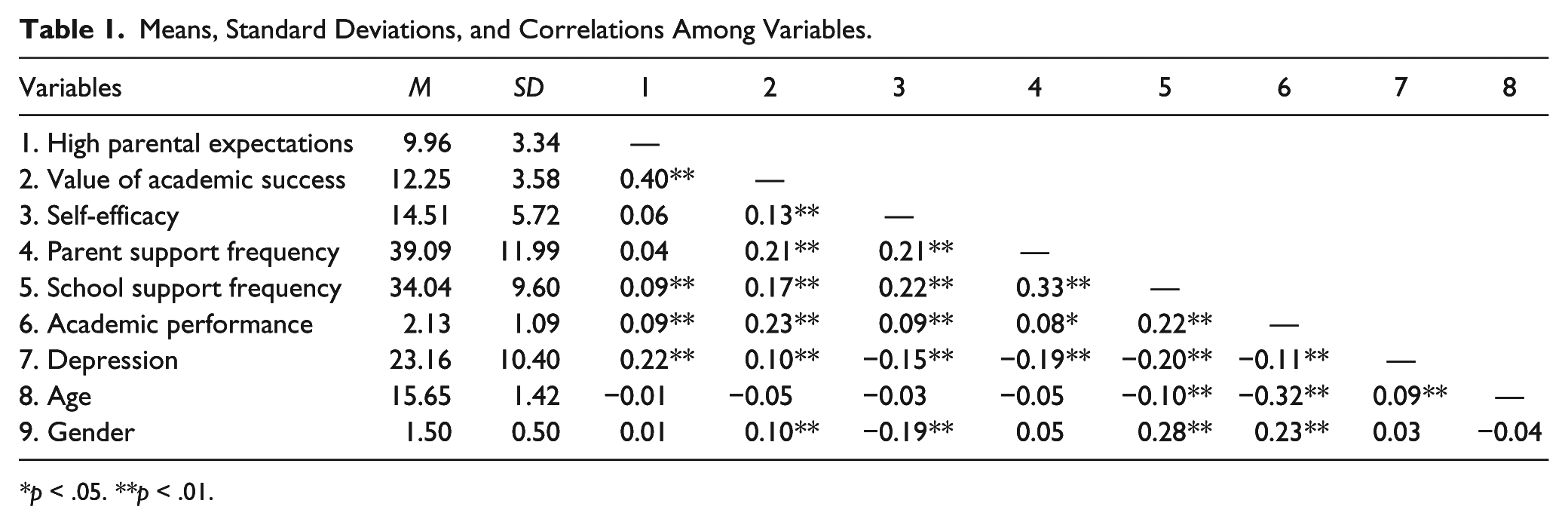
p < .05. **p < .01.
Figure 1 shows the empirical estimations of the proposed theoretical model (standardized estimates reported). Age and gender were controlled in path analysis of the proposed model, and the fitness of the model was found to be acceptable (χ2/df = 2.56, root mean square error of approximation = 0.04, comparative fit index = 0.98, Tucker–Lewis index = 0.93). The results demonstrated that high parental expectations were positively associated with adolescents’ value of academic success and school support frequency. In addition, adolescents’ value of academic success and school support frequency were both positively associated with academic performance. High parental expectations were positively associated with depression. Adolescents’ self-efficacy, parental support frequency, and school support frequency were negatively associated with depression, whereas the value of academic success was positively associated with depression.
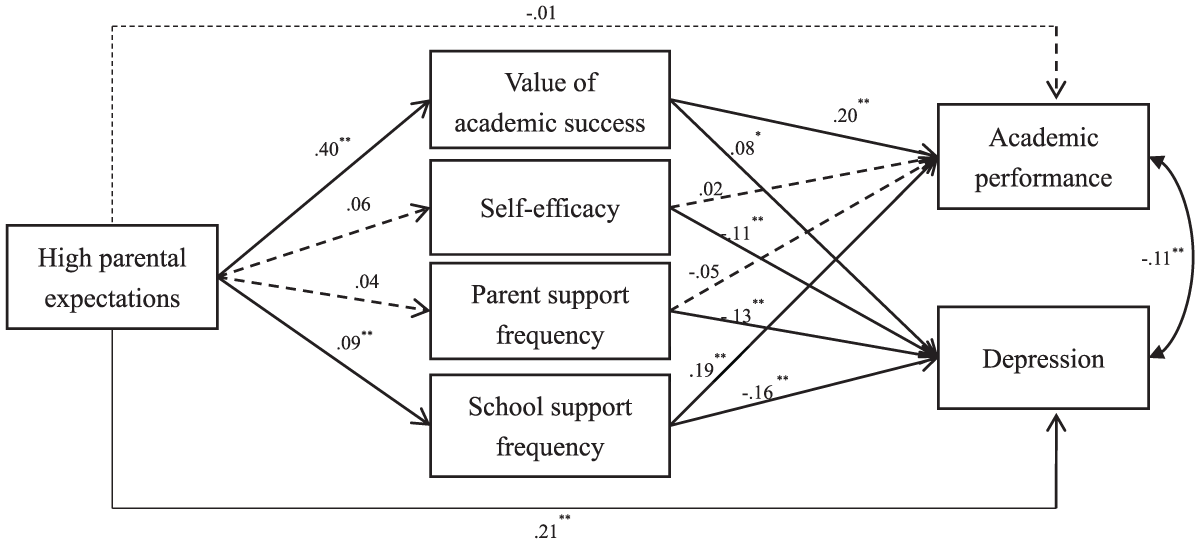
Path diagram of the studied variables.
A bootstrapping procedure of 5,000 samples was used to assess indirect effects. If zero is not included within the lower and upper confidence intervals (CIs), the indirect effects can be considered significant. The total effect of high parental expectations on academic performance was significant (β = .09, bootstrap 95% CI = [.02, .15]), and the indirect effect on academic performance (β = .10, bootstrap 95% CI = [.06, .13]) was also significant. However, the direct effect of high parental expectations on adolescents’ academic performance was not significant (β = −.01, bootstrap 95% CI = [−.08, .07]). With respect to depression, the total effect of high parental expectations on depression was significant (β = .22, bootstrap 95% CI = [.15, .28]), while high parental expectations also had a direct positive effect on depression (β = .21, bootstrap 95% CI = [.14, .28]). The indirect effect of high parental expectations on depression, however, was not significant (β = .01, bootstrap 95% CI = [−.03, .04]).
Overall, the results showed that high parental expectations had a positive total effect on academic performance. As the direct effect of high parental expectations on academic performance was not significant, it was found that the relationship between high parental expectations and academic performance could be fully mediated by the mediating variables of adolescents’ value of academic success and school support frequency. Additionally, high parental expectations also had a positive total effect on depression. The relationship between high parental expectations and depression could not be mediated by the proposed mediating variables in the present study, whereas the direct effect of high parental expectations on depression was significant.
Discussion
The present study has explored an integrative model linking high parental expectations to adolescents’ academic performance and depression through the mediating roles of adolescents’ value of academic success, self-efficacy, parental support frequency, and school support frequency. The results mainly showed that, on the one hand, high parental expectations were positively associated with adolescents’ academic performance through adolescents’ value of academic success and school support frequency, while on the other hand, high parental expectations were directly and positively associated with adolescents’ depression.
As expected, the results showed that high parental expectations could have an indirect effect on academic performance, mainly through adolescents’ value of academic success and school support frequency. Based on the expectancy-value theory, parental expectations may be internalized by their children, which in turn might help improve adolescents’ value of academic success (Zhang et al., 2011). In addition, high parental expectations may lead to improved involvement of teachers. The increased school support frequency could help adolescents improve their academic performance (Shumow & Miller, 2001). However, the results of the present study showed that the effects of high parental expectations on adolescents’ self-efficacy and parental support frequency were not significant. A previous meta-analysis has shown that there are some cultural differences concerning the influence of parental expectations. For Asian cultures such as Chinese and Japanese, parental expectations may not be significantly associated with children’s self-efficacy and parents’ involvement (Yamamoto & Holloway, 2010). A possible explanation may be that, in Asian cultures, although parents generally have high expectations for their children’s academic performance, they are less likely to provide direct help, such as by discussing their children’s school experiences or assisting them with their school work, as compared with other cultural groups (Peng & Wright, 1994). Another reason may be that, in Chinese cultures, parents tend to directly express their expectations and values, but express their love and support less directly, so that their children may perceive less warmth from their parents as compared with what the parents actually feel (Wu & Chao, 2011). Furthermore, in the present study, because parental support frequency was measured from the adolescents’ perceived perspective, adolescents may underestimate the support frequency of their parents due to their parents’ relative lack of direct expression in Chinese culture. The results also reported that the self-efficacy of adolescents could not predict academic performance. This finding is in line with previous research suggesting that self-efficacy is not associated with high achievement of adolescents in Asian cultures, and that their fear of failure is associated with academic performance (Yamamoto & Holloway, 2010). Additionally, parents with high expectations in Chinese culture may exert more control and express criticism rather than direct support toward their children, which in turn might not contribute to their children’s self-efficacy (Eaton & Dembo, 1997; Yamamoto & Holloway, 2010). Overall, the results of the present study are in line with the ecological systems theory, which emphasizes that outside environment systems, such as family, school, and culture, and the complex interactions of these systems may exert a significant influence on adolescent development (Bronfenbrenner, 1979).
With regard to depression among adolescents, the results found that high parental expectations were positively associated with adolescent depression. Adolescents’ value of academic success was also positively associated with depression, while parental support frequency, school support frequency, and self-efficacy of adolescents were all negatively associated with adolescents’ depression. These results are consistent with previous studies, which suggest that high parental expectations may lead to adolescents’ stress and cause depressed moods (Qin, 2008). And social support is an important resource that can help reduce adolescents’ depression (Vieno et al., 2007). The direct effect of high parental expectations on adolescents’ depression was significant, but the indirect effect was not. These results suggest that certain variables, such as adolescents’ self-efficacy, parental support frequency, and school support frequency, did not serve as mediating roles between high parental expectations and adolescents’ depression. A possible reason for this result may be that parents in Chinese culture who have higher expectations of adolescents’ academic performance may not simultaneously provide sufficient support, and instead may be more critical toward adolescents if their expectations are not met. Perception of parental criticism is likely to induce adolescents’ own self-criticism and worries about mistakes, which may in turn lead to depression (Madjar et al., 2015). It is thus necessary to note that, although the positive aspects of high parental expectations may facilitate adolescents’ academic performance, the negative aspects of high parental expectations especially in Chinese culture may also result in high level of depression among adolescents.
Limitations and Implications of the Study
Overall, this study contributes to the existing literature in terms of several aspects. First, it simultaneously investigated the effects of high parental expectations on adolescents’ academic performance and depression. The results supported the idea that high parental expectations exist as a double-edged sword, which might facilitate adolescents’ academic performance and induce their depression at the same time. Second, the present study is an important step in examining the mediating roles, such as adolescents’ value of academic success and school support frequency, between high parental expectations and adolescents’ academic performance and depression, which helps elucidate the underlying mechanisms of high parental expectations on adolescents’ development. Additionally, from a practical perspective, clarifying the different effects of high parental expectations on adolescents’ academic performance and depression may have implications for educators and parents, revealing not only that parental expectations might help adolescents achieve success for academic performance but also that the potential negative impact of high parental expectations on adolescents’ emotional well-being should be taken into consideration. Together with high parental expectations, more social supports should also be provided toward adolescents at the same time.
Some limitations and future implications of the present study should also be noted. First, this study only relied on self-report data from adolescents. Future research should include ratings from parents, teachers, and peers. Additionally, in the present study, measurements of academic performance were taken from adolescents’ self-rated recent exam scores. Future research should utilize a more standardized test or assessment to measure academic performance. Second, with the cross-sectional study design, the causal relationships between variables could not be determined in the present study. Future research is necessary to engage in a longitudinal study to clarify causal relationships. Third, the sample of the present study depends on convenience and voluntary participation, which may induce some self-selected sampling bias. To improve the generalizability of the current results, research on a more random sample is needed to confirm the results. Since this study was conducted in Hong Kong, and its results therefore may only be relevant to this region and not to other countries in Asia or even to Mainland China. Another limitation is that this study only investigated the meditating mechanisms of high parental expectations from positive perspectives, including self-efficacy, parent and school support frequency, and adolescents’ value of academic success, which are more strongly associated with academic performance. Future research should also take into account variables such as parental criticism and adolescents’ perceived stress to explore in depth the mechanisms underlying the relationship between high parental expectations and adolescents’ depression. In general, the findings of this study indicate that parents should be advised to set high expectations, while at the same time providing more supports for adolescents.
Footnotes
Authors’ Note
The author, “Ying Ma” is now affiliated with Shaanxi Normal University, China, Shaanxi.
Declaration of Conflicting Interests
The author(s) declared no potential conflicts of interest with respect to the research, authorship, and/or publication of this article.
Funding
The author(s) received no financial support for the research, authorship, and/or publication of this article.