



Abstract
Changes in immigration and border control legislations in metropolitan countries have led to an increase in the number of fathers deported to the Caribbean. By way of qualitative research, the author examined the experiences of 18 deported fathers whose children remained in the deporting country. The findings reveal the psychosocial effects of deportation on fathers and how fathering roles are challenged by stigma, costly transnational communication facilities and frozen personal assets. Deportation also leads to families adjusting gender roles and family structures. The findings support the family adjustment and adaptation response model by showing how deportation constitutes a stressor which overwhelms the family’s resources to cope and which results in a process of adjustment and adaptation. This study is significant in that it provides a deeper insight into the issues that affect deported fathers and underlines the need for policy interventions that support transnational family ties.
Keywords
The immigration sanctions that came into force immediately after the inauguration of Donald Trump as President of the United States of America have increased international awareness on deportation. These sanctions have been fuelling speculation on how the expected increase in deportation of immigrants might affect immigrant families in the United States, and the deportees themselves in the countries of their birth. “Deportation” is defined as the “act of banishing a foreigner from a country, usually to their country of origin” (Hing, 2006, p. 54). Beckett and Evans (2015) describe deportation as the removal of “criminal aliens,” that is, noncitizens who have been convicted of a crime.
During the period 1997 to 2012, the U.S. government deported approximately 4.2 million people (Golash-Boza & Hondagneu-Sotelo, 2013). Thompson and Cohen (2014) note that there have been more than 3.2 million deportations worldwide over the past 10 years, and that two thirds of nearly 2 million deportations from the United States alone involved Caribbean immigrants. Twenty percent, or about 394,000, deported Caribbean immigrants were convicted of serious crimes, including drug-related offences.
The increasing number of deportations from the United States of America has also affected the Caribbean and Latin America. Figures show that, in 2013, nearly 90% of the total deportations from the United States were men and approximately 97% were deported to Latin America and the Caribbean (Golash-Boza & Hondagneu-Sotelo, 2013). Dowlat (2015) states that 72,371 people with Caribbean links were deported during a 10-year period from 2001 to 2010. A total of 44,422 of this figure were deported for criminal offences (Dowlat, 2015). During this period, Trinidad and Tobago received 4,218 deported men and women, with 2,433 deported for criminal offences (Dowlat, 2015).
Noticeably absent from deportation statistics is any information on how many deported men are fathers, and how many of the fathers were separated from their children following deportation. A study conducted by Headley, Gordon, and MacIntosh (2005) show that 98.5% of the deportees in Jamaica were men, with 75% leaving family members behind in the United States. Boodram (2017) found that, in Trinidad and Tobago, deportation has resulted in the separation of many fathers who returned to their native countries without their children.
Many researchers of diverse academic fields have focused their attention on deportation (Barnes, 2008; Brotherton & Barrios, 2011; Coutin, 2000; Golash-Boza, 2015; Hing, 2006; Kanstroom, 2012). Literature shows that individuals experience psychosocial challenges following deportation, including stress, depression, loss, loneliness, posttraumatic stress disorder symptoms, and psychiatric issues (Boodram, 2018; Brabeck & Xu 2010; Brotherton & Barrios, 2009; Hagan, Eschbach, & Rodriguez, 2008).
Over the past two decades, academic scholarship claimed that the role of the father involves more than being providers and protectors, and instead support fathers assuming more involved roles in their children’s lives (Halford, 2006; Herland, Hauge, & Helgeland, 2015). The “involved” father is considered to have been emotionally connected to and actively engaged in the care of his children (Lamb, 2010). The role of the more “involved” father, however, applies to situations wherein the father and children reside under the same roof or near each other.
The consequences of parental separation on the growth and development of children are well-documented in literature. Contreras and Kerns (2000), for example, argue that father–child relation has significant influence on the child’s ability to develop positive peer relationships and to behave appropriately with peers. Harper (2010) also posits that children from families, where one parent is absent, manifest greater internalizing and externalizing problems, compared with the children who live with both parents. Lopez and Corona (2012) argue that Latina girls, for instance, struggle in coming to terms with their father’s absence, through conflicting feelings that range from indifference to anger.
According to Castaneda and Buck (2011), parental migration results in the emergence of transnational families, which is defined by Parrenas (2001) as systems where familial members are in two or more nation-states. Transnational parenting is defined as the system within which migrant parents enact the role of parenting children across borders (Menjívar, 2012). For families separated by migration, transnational parenting may be maintained by using diverse communication means (Dreby, 2006; Madianou & Miller, 2011), cross-border approaches for child care (Whitehouse, 2009), care sharing (Peng & Wong, 2016), and coparenting (Pribilsky, 2004).
The experiences of deported men and their involvement in fathering, postdeportation, have not been a well-studied area. Furthermore, there are currently no studies exploring the experiences of deported fathers in the Caribbean. This present study, therefore, represents the first attempt to understand the postdeportation experiences of fathers, as expressed by the deported fathers themselves. This study, thus presents a good starting point for social workers and policy makers to understand how deportation affects fathers and how the deported fathers experience forced separation from children.
Literature Review
Literature that explores the experiences of parent–child relationship, following separation caused by migration, continues to accumulate (Mazzucato & Schans, 2011; Parrenas, 2008). However, the focus in recent decades has been on the experiences of mother-away migration (Kilkey, Plomien, & Perrons, 2014; Urbanska, 2009), with the studies concluding that mothers across borders do not abandon what are viewed as the traditional responsibilities of motherhood (Madianou & Miller, 2011; Tolstokorova, 2010; Uy-Tioco, 2007); rather, they attempt to preserve and adjust their traditional roles to meet the changing needs of children after migration.
In the literature, only a few studies discuss the perspectives of migrant fathers’ separation from children. Those studies, however, relate to experiences of fathers in Central America, Asia and Africa and not in the Caribbean and focus on fathers who voluntarily migrate in search of labor or a better life for their families (Nobles, 2011; Schmeer, 2009). Their general finding is that father-away migration often translates to increased economic support for families because of remittances from the father to his family (Kyle, 2000; Parrenas, 2008). Deportation, however, is a process which results in involuntary migration and separation from children and families.
Father Separation From Families
Separation of father from children following migration, results in negative consequences to the migrant father, as well as to the children. Worby and Organista (2007) argue that the inability of Mexican and Central American migrant men to visit their loved ones as one of the factors responsible for the increased use of alcohol by those men. Schmalzbauer (2005) argues that some fathers separated from their children struggle with severe loneliness and depression. In some cases, the migrant male would engage in casual sexual relationships with women as a way of dealing with separation from loved ones.
Only a few researchers have studied the problems arising from deportation of fathers. However, those studies are restricted to examining the problems from the perspective of the children and families left behind, rather than the perspective of the deported father. A key finding of those studies is that the separation has negative consequences for the children left behind in the deporting country, in that it disturbs the family’s economic stability (Capps, 2007; Hagan et al., 2008), particularly when the breadwinner is detained or deported.
Family Coping Styles and Resources
Capps (2007) highlight that families with at least one deported member often experience unusual hardship since there is no significant savings or assets at the time of detention and subsequent deportation. Following deportation, existing family assets and resources are either confiscated or they diminish quickly, consequent to which, extended family or kin networks which previously acted as networks and supports, often assume financial and caretaking responsibilities (Capps, 2007). Families affected by deportation are afraid to seek resources, especially from governmental agencies, even when their children are eligible for those resources (Hagan et al., 2008).
Adaptation of Family Structures
Scholars point out that transnationalism promotes and facilitates adjustments to the forms and structures of families and parenting (Chee, 2005; Le Espiritu, 2003; Levitt, 2001). The adjustment and adaptation of family structures usually involves the change over from a two-parent, two-income household to mostly a single-parent, female-headed household (Dreby, 2006).
Strategies for Maintaining Transnational Parenting
Parrenas (2005) has outlined some measures used by migrant fathers to mitigate the negative effects caused by distance from their children and families. Those strategies include providing remittances to mothers who assume child care responsibilities. Subsequent changes in material supply may provide additional emotional security and reduce mothers’ stress, thus positively influencing parenting behavior and relationship with children.
Some studies highlight the use of telecommunications as a way of maintaining contact with families separated by borders (Dreby, 2006; Madianou & Miller, 2011). Parrenas (2005) and Harper and Martin (2013) argue that frequent telephone communication is the primary way fathers can keep in touch with their children. Since long-distance communication helps in maintaining relationships within transnational families, migrant mothers, for instance, feel empowered when they have a mobile phone that allows them to communicate with their children and reconstruct their role as parents (Madianou & Miller, 2011). Bacigalupe and Lambe (2011) found that transnational families use social technology, and access to internet connectivity and social media in addressing the challenges posed by migration and separation.
Gendered Analysis of Transnational Parenting
While no research offers a gendered analysis of fathering after deportation, Carling, Menjívar, and Schmalzbauer (2012) emphasize that there are gendered differences between transnational mothering and fathering. Studies of voluntary migration of a parent shows how migration can affect power relations and decision making in families. In a study of migration of parents from Mexico, Dreby (2006) suggests that mothers and fathers use similar ways to manage their parent/child relationships, when living away from their children. However, Dreby (2006) also observed that after divorce, transnational fathers strengthen their bonds with children, whereas transnational mothers distance themselves from children temporarily. Schmalzbauer (2005) highlights that in the case of Honduran transnational parenting, fathers are less likely to meet gender expectations, with abandonment of the family often resulting. Dreby (2006) concludes in a study of Mexican transnational parenting that often fathers grew distant from their families because of challenges in fulfilling their roles as providers. In the case of Mexican and Central American fathers’ migration, Worby and Organista (2007) argue that the inability of fathers to visit their loved ones led the men to engage in increased drinking.
Parrenas (2005) claims that traditional gender expectations persist even after a parent’s migration. She further reported that, in the Philippines, despite migration, the ideology of a woman’s domesticity remains intact. From another study, Parrenas found that, in the case of voluntary migration, discussions on transnational fathering do not try to reconstitute the normative gender behavior in the family; instead, they support the existing gender norms, namely that the males are breadwinners and the female’s homemakers (Parrenas, 2008). Ultimately, it was found that gender expectations restricted radical reconfiguration of transnational family relations. Kilkey et al. (2014), for example, argue that migrant men’s narratives about fathering remain embedded within a framework dominated by the division of labor. Yasuike (2011) found that the phenomenon of Japanese fathers who are transnational corporate workers with long absence from home, perpetuated the mother’s duty of taking care of their households and raising children single-handedly. However, no research has been conducted to suggest that a similar situation prevails in families whose fathers are separated from children by deportation.
Theoretical Framework
Social researchers have long studied the impact of stress on the family (Conger & Donnellan, 2007; Conger, Rueter, & Elder, 1999). One model which advances a theoretical understanding of the process and impact of stress on the family, the family adjustment and adaptation response (FAAR) model, suggests that families engage in processes which balance family demands and family capacities in ways which the family adjusts or adapts to stressful situations (McCubbin & Patterson, 1983; Patterson, 2002). A stressor is defined as a “demand placed on the family that produces, or has the potential to produce changes in the family system” (McCubbin, Thompson, & McCubbin, 2001, p. 17). Family stress occurs when there is an imbalance in the ratio between demands and capabilities.
According to Patterson (2002), the FAAR model is associated with three central concepts: demands, meanings, and capabilities. Demands refer to stressors that disrupt the normal equilibrium of the family. Family capabilities include both resources and existing methods that families use to cope with everyday stressors. The FAAR theoretical model posits that families may make different meanings of demands that are placed on them. By applying coping methods, families are able to reach homeostasis by balancing demands and capabilities. Thus, families may face daily challenges but establish stability by making meaning of events in ways which balance the demands with their existing capabilities. However, in some cases, crisis occurs when there is sustained stress in the family because there may be too few resources to meet demands introduced by a stressful event (McCubbin et al., 2001).
The FAAR model explains how families may cope with stress by engaging in a process of adjustment and adaptation. Adjustment involves the family’s use of behaviors and resources to balance the daily demands. The adjustment phase, however, refers to a sequence of interrelated mechanisms which determine whether present family resources and coping skills can maintain family functioning (bonadjustment), or whether a crisis necessitates that the family adapt their regular patterns of functioning (McCubbin et al., 2001). Crisis thus occurs when the demands overwhelm a family’s resources.
Adaptation involves a process through which families restore equilibrium between demands and resources. Thus, families adapt by bringing new levels of balance or new coping skills to reduce stress on the family (McCubbin et al., 2001). Family adaptation results in patterns of functioning which establishes new family structures, adaptive rules and boundaries, relationships, and communication and transactions with the community (McCubbin et al., 2001).
Methodology
This study used a phenomenological qualitative research design for collecting, organizing, and analyzing the experiences of deported fathers. The selection criteria for the sample were that the fathers must have been deported from the United States of America for a criminal offence and that their children remained in the deporting country. Suitable candidates for the proposed study were located by using purposive snowball sampling, which involved placing posters in offices of social service agencies which provide services to the deported. Persons who responded and satisfied the selection criteria were asked for referrals of other potential candidates, who were then contacted and invited to participate in the study. Finally, 18 fathers, deported to Trinidad and Tobago, were recruited for participation in the study. Most participants who responded claimed to have seen the poster at one or more agencies such as the deportee reintegration center, mental health clinics, centers for retraining and unemployment, homeless shelters, social welfare or family services.
Data was collected by conducting semistructured interviews, each lasting approximately 90 minutes. All the interviews were digitally recorded and transcribed. Data analysis were done by using thematic analysis. This involves coding of data and patterns that emerged enabled categorization of the data according to themes. The themes were then listed and compared with the subsamples at different points during the analysis (Guest, MacQueen, & Namey, 2011).
Researcher’s Reflexivity
An essential ingredient in qualitative research is for readers to understand how the investigator became interested in the topic under study. Interest in the phenomenon of deportation and fathering was sparked during my professional experience as a social worker at an agency providing social services to communities in Trinidad and Tobago. During my time at the agency, I saw an increasing number of deported men seeking services from the agency to help them connect with their families abroad. In trying to understand the fathers’ experiences, I found academic literature focusing on the experiences of children who were left behind and not on how deported men negotiate fathering of their children across borders. This awareness marked the beginning of my dedication to explore the experiences of fathers’ who have been separated from their children.
However, qualitative research requires that researchers become conscious of his or her personal motivations and biases, professional experience, and academic epistemologies (Merriam, 2015). Thus, I consciously reflected on the research process to ensure that I did not sift out difficult or uncomfortable experiences that would generate adverse prejudices against the participants. A fundamental strength of this study was to explore the experience of the fathers through their own lens. Thus, I avoided researcher bias by maintaining reflexivity.
In this study, credibility was integrated as a major criterion of trustworthiness. Since this study was conducted following my doctoral studies, I engaged in a process of review and debriefing with academic colleagues-who provided an unbiased check of the research process (Schwandt, Lincoln, & Guba, 2007), which promoted my self-awareness and honesty. This helped ensure that the data continued to stay focused on the purpose of the study.
Transferability in this qualitative research was guided by providing rich, thick descriptions so that the reader can decide whether the transfer of findings to a similar cohort would be possible. This was congruent with Denzin (1988, p. 39) who notes that the thick description is expected to probe “the intentions, motives, meanings, contexts, situations and circumstances of action.” To maintain dependability, the research project was presented at three seminars with my dissertation committee who audited the assessment of methodological decisions, and questioned inquirer bias and the treatment of the data.
Informed Consent and Ethics
All the procedures, involving human participants, were performed in accordance with institutional ethical standards and the 1964 Helsinki Declaration and subsequent amendments. Informed consent was obtained from each participant, selected for the study.
The Participants
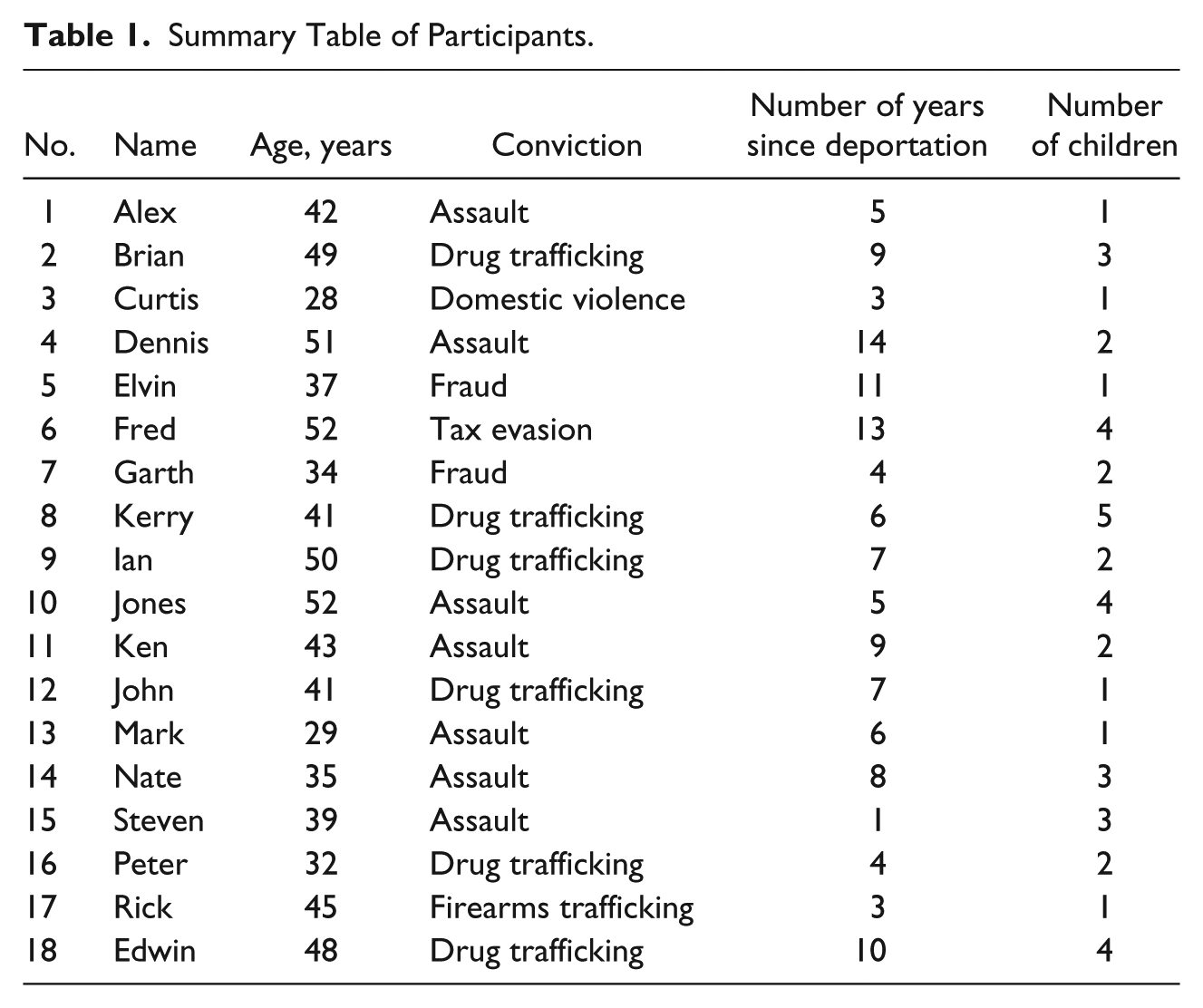
The participants in this study were 28 to 52 years old and were deported from the United States, following a criminal conviction. Prior to their conviction, 11 of them were married, 4 were separated, and 3 were single. The average age of the children who were left behind on deportation was 10.1 years. The youngest child was 3 years old and the oldest was 17 years old at the time of the father’s deportation. Table 1 shows the pseudonyms used in this study for the participants and their details.
Summary Table of Participants.
Findings
The participants in this study claimed that they were trying to continue their fathering roles even though they were removed from the country in which their children are living. They narrated how they experienced grief and loss, isolation, stress, and confusion, following their deportation. They recounted the many challenges they have been facing in trying to maintain their fathering role, which include changes in gender roles and family structures, economic hardship, lack of access to communication, and the burden of the belief that their continued relationship with their children could negatively affect the well-being of those children. The findings suggest that deportation of fathers is a stressful event which forces the family to examine their current coping behaviors and resources to determine whether the family can achieve balance or engage in a process of adjustment and adaptation.
Psychosocial Effects Experienced by Deported Fathers
The participants shared their feelings of intense sadness and loss following their separation from children. At the time of data collection, 9 of the 18 participants were outpatients of mental health clinics and were being treated for mild to severe depression, anxiety, addictions or bipolar disorder. Six of these nine participants were taking medication prescribed for their mental illness.
Their loss was compounded by the weight of deportation and the finality of the condition that deported fathers will not be legally eligible to return to the country in which their children reside. This finality and the sense of permanence of separation led Ken to feel “trapped in a prison from where I could never get out nor can I ever visit my children.” John shared similar feelings.
Curtis spoke of the frequent bouts of depression he has been going through, whenever he thought of his child. His life, he claimed, was built around caring for his offspring and working to give her what his parents could not give him. He considered his daughter as his principal motivator in life. But, unfortunately, since his deportation, his daughter began to exhibit behavioral issues, including truancy and early sexual indulgence. Prior to this study, Curtis was diagnosed with depression, and receives monthly disability cheques. Nate, Rick, and Jones also admitted that they have become outpatients of a mental health clinic in Trinidad and started using antidepression medication. Steven admitted that he had even attempted to commit suicide after his return to Trinidad. The participants expressed that their bouts of depression worsened, whenever their telephonic talks with their children became few and far between. John also admitted to having tried to beat his loneliness by drinking alcohol. He confessed thus:
Every one of us has our own faults and vices. When I came back, I wanted to forget my problems and my loneliness. Leaving my child was the worst thing that could have ever happened to me. I started to drink all the time. I used alcohol to drown my sorrows and get away from loneliness.
Experiences of Fathers following Deportation
Maintaining Contact
Many of the fathers interviewed for this study have been attempting to continue their relationship with their children by using cell phones. Unfortunately, the transient nature of their living arrangements and the challenges they face in getting a steady income acted as barriers to their transnational calls to children. Ian described that the first thing he did when he arrived at the airport in Trinidad was to purchase a prepaid cell phone and call his children. The high cost of telecommunications in Trinidad did not allow him to continue such calls regularly. Dennis, for example, relied on an nongovernmental organization (NGO) for his housing from where he had been using internet connection to talk to his children through Skype. But, after 3 months, the NGO’s support ceased, and he could no longer contact his family via Skype. Additionally, at that time, he was unable to afford regular telephone calls to his children, and very soon he lost contact with them. The number and duration of the calls ranged from 5 to 10 minutes, regardless of the number of children or the length of time since the father was deported. The fathers indicated that the calls were made via the mother or another relative such as a grandparent and that the duration of the calls and frequency between calls were determined by the availability of a mobile telephone.
All the participants indicated that within the first 6 months they made contact at least once per week via Skype or telephone calls. As time progressed and the period since deportation increased, the number of calls became more sporadic, decreasing to once or twice per month. Four participants explained that after 12 months they ended all contact with their families as they felt each call resulted in strong emotional upheaval for the children, who were often crying and sad by the time the conversations were ending. Another five participants claimed that the mother of their children ended all conversations with them after 6 to 12 months had passed. These participants believed that ending the calls and contact would provide less stress for the children.
Changing Roles of Fathers After Deportation
Prior to deportation, participants explained they saw themselves undertaking various roles as fathers. Roles that were commonly shared by all fathers included that of provider, discipliner, and family protector. The fathers also considered themselves to be responsible for molding the masculinity of their sons, regardless of the son’s age. However, prior to detention and deportation, fathers with daughters saw their roles as protector and talent developer more strongly.
Fathers described that their roles had altered following deportation. All fathers explained that they were no longer able to continue to provide for their families. The opportunities to protect their children were also weakened. Steven explained that following his deportation his children were being bullied in school. Ken claimed that his family lived in a high-crime area and the family feared that they would become the victims of crime since he was not there to protect them.
However, there was some level of adaptation of fathers’ roles following deportation. Kerry and Ian explained they took up the role of life coach for their children. Thus, conversations with their children focused on counselling their children and offering supportive guidance regarding their career aspirations.
Discipline
Besides the problems of expensive telephone calls, deportation affected discipline in the family to the extent of transforming the children’s home into a site of conflict. Edwin attempted to maintain his authority and role as a disciplinarian, but his attempts fell short of being effective, because the distance eroded his authority as the decision maker and disciplinarian. Edwin laments:
As the time passed, I realized that my children have been breaking rules and refusing to take my instructions to follow the right path. Their attitude was something like this: “You are no longer here, so, why should I listen to you?”
A similar experience was shared by Nate and Ken who claimed that they lost their “respect and position as the parents responsible for disciplining the children.” The change in his role as disciplinarian left Ken without a sense of participation in the upbringing of his child. He complained that his attempts to discipline over telephone were resented by his child with a defiant and confrontational attitude. Ken further expressed his feelings thus:
I felt humiliated and impotent. Once my son told me “Daddy you are not here anymore; so, you cannot try to correct me.” Some other times, he was very disrespectful when I tried to discuss some of his choices, and I felt I had lost my authority to discipline him.
Ken, Nate, and Edwin realized that their absence weakened their authority to discipline their children. They felt disappointed, because the mothers did precious little to reinforce their (fathers’) authority in disciplining the children. Noticing a gender shift of the person assuming the responsibility of disciplining children, Nate commented thus:
I think as a man, I am supposed to be the rod of correction. I think deportation weakened me as a father, and now the mother of my children is viewed as the disciplinarian. This isn’t right. Men are supposed to maintain that role in the lives of their children. In America they say “Wait till your father gets home,” but that isn’t happening, eh? So much for that. Holding on to my fatherhood is difficult after I was deported. It is like my wife became the father!
Economics and Fathering
The deported fathers revealed how they became financially dependent on their wives to support themselves. They added that they find themselves as having lost their role as the major breadwinner, and now the families abroad must renegotiate for their space and money. All participants expressed challenges in gaining employment. In all cases, the participants acquired temporary jobs which involved unskilled labor such as gas pump attendants, security, construction, and laborers. These jobs were often for only 2- to 3-week periods, punctuated by long periods of unemployment. At the time of the data collection, only 6 of the 18 participants were employed, albeit in temporary jobs; 8 were unemployed and 4 were reliant on social welfare provisions.
Two participants mentioned that when they became employed, they still had problems in maintaining their fathering role, because their salaries were so low that they barely provided for subsistence. Fred, who has been doing menial jobs for short periods, since his return, described his challenges thus:
I don’t know anybody in this country. I cannot get a decent job. Nobody wants to give me a decent job, so that I could take care of myself or send money to my children.
Smith shared similar sentiments thus:
When I go to job interviews and the interviewers hear my accent, they immediately ask me whether I am a deportee and about my “criminal” conviction. No matter what I say at this point, I know I will not get the job.
Jones complained that deported men are stereotyped as sophisticated criminals, and because of that the potential employers are dissuaded from hiring them. For a deportee, not accessing suitable employment is something like a double whammy. Nate commented thus on this situation:
On the one hand, I am unable to financially support myself in Trinidad and that means I cannot send any money to my family. On the other hand, my wife must send me money when I am out of work. This means less money for the children.
For Mark, his deportation became a source of gender conflict, particularly regarding his role as breadwinner and provider. He summed up this experience as:
My wife had to work on two additional jobs provide for the children. It was a role reversal: instead of my providing for the children, she has been providing for me. I couldn’t handle this new role and we argued all the time.
This was echoed by Kerry thus:
I am another one of her dependents, because she must send money for me too. In my mind, I am confused, and we would argue sometimes about what was happening. She cannot understand how I am trying too, but the job situation here is not what it was when I left. We start arguing every time I call her. After some time, she starts to challenge my role as a man by dropping hints like “You don’t wear the pants around here” and “remember I now must send money, like I am the man in this family.”
As discussed earlier, the loss of the role of disciplinarian, combined with the loss of the role of financial provider, has become a contentious issue because of the change in the traditional gender role of the father.
Adjustment and Adaptations to Family Structures Due to Deportation
Whereas the literature on transnational families indicate that the families of migrant men usually echo the structure of a modern nuclear family (Parrenas, 2008), this study shows that the family structure undergoes rapid changes after deportation. Elvin explains this change:
Because of so many challenges in trying to be a father from so far away, the family becomes a single-parent household. My wife had to take upon herself the family responsibilities, totally and completely; it was like I was living in the shadows of other family members. I had no say in the family anymore, because I was far away and struggling to exist in this place here.
Another consequence of deportation is the breakdown of marriage, which further exacerbates the child–father relationship, particularly where the relations between parents are acrimonious. In those cases, the participants often blame the mothers for the child–father relationship problems and for altering the nature of the family structure. In this regard, Fred had this to add:
After a while, every time I spoke with the family, my wife and I would argue.
This caused a rift in my relationship with my child because my wife would not allow me to talk to my child when I want. It was as though my child had a single parent and I was no longer part of my child’s life.
Keeping in view the likelihood of these changes affecting the family structure, Garth argues that the transnational family structure of deportees should be given due recognition. He passionately pleads that the policy makers and social workers would do well to recognize that, although the deportee and his family are geographically separated, the family continues to exist for the deportee, though in a transnational form.
Termination of Parental Rights
Two of the fathers who participated in this study, Brian and Garth, lament that they lost parental rights because of their deportation. They disclosed that, following their deportation, the U.S. government-initiated proceedings for termination of their parental rights, and their children were placed in foster care. In the case of Brian, his deportation and the ailing condition of his mother who was the main caregiver to his children, were cited as the main reasons for placing his children in foster care. In the case of Garth, his deportation was seen as a consequence of his abandonment of his responsibilities toward his children. As there was no relative willing to take parental responsibility, his child was placed in foster care.
Provision of Social Support for Deported Fathers
The participants disclosed they found that there are very limited social services available to them on their return to Trinidad and Tobago. These limited services include social welfare grants, medical services and housing at homeless shelters. The men who used these services claimed that they heard about the services from local individuals and media advertisements and voluntarily accessed these services as walk-in clients. There is only one NGO which receives a government subvention to assist in the reintegration of deported men. However, the focus of that NGO is to provide support to the men in matching them with employment opportunities, providing short-term housing and meet their subsistence needs. Participants claimed that the agency’s mandate was not to strengthen the family life or fathering abilities of the deportees. Thus, the agency provided minimal opportunities for the men to call their families abroad or use social media such as Skype to connect with children.
Ten participants also claimed that they walked into state-welfare services to seek help. The support received included short-term emergency grants. This was delivered by personnel who were appointed as welfare officers and not necessarily trained social workers. None of the fathers in this study attained the age of 65 years or above and so were not qualified to access provisions for the elderly in Trinidad and Tobago.
Discussion
This study makes several contributions to the inquiry on fathering after deportation. First, the research broadens the use of FAAR model to recognize deportation of fathers as a stressful family event which results in psychosocial challenges to fathers and their families left abroad. The study clearly shows how deportees are faced with numerous challenges, including psychological and emotional upheavals because of separation from their children, limited communication with families abroad, lack of financial stability, growing dependence on the families abroad for material needs, legal proceedings leading to termination of parental rights, and gender role conflicts. Using a FAAR theoretical lens, the study shows how deportation of fathers constitutes a stressful event on the family which outweighs the family’s ability to cope using existing resources, structures or behaviors. Thus, the family is forced to make meaning of deportation in ways in which they accept the permanency of the separation caused by deportation and engage in a process of adjustment and adaptation in various ways, including to the family structure, communication patterns, disciplinarians, and financial providers to achieve balance.
The consequences of deportation are manifested by the material, emotional, and mental health challenges experienced by deported fathers. Deportation is associated with long-term separation, because immigration rules forbid deported fathers from legal reentry into the deporting country. Furthermore, deported men are linked to criminality and illegality. Literature suggests that deported men are often highly stigmatized, exploited, and discriminated against, which results in their social marginalization (Barnes, 2008; Brotherton & Barrios, 2011; Golash-Boza & Hondagneu-Sotelo, 2013). These conditions strongly affect the deported men when they attempt to maintain their parenting roles with their children.
The stereotyping of deported men as sophisticated criminals further exacerbates the challenges being endured by the deported fathers in securing employment and thus, in meeting the expenditure of material needs for themselves and their children. This represents a shift from the current perception (Harper & Martin, 2013; Kilkey et al., 2014; Parrenas, 2005, 2008), which links migration of fathers to increase in remittances to nonmigrating family members and improvement in the material conditions of the families they left abroad. This finding is significant in relation to Parrenas’s (2005) study, which shows that monetary contributions by migrant fathers have a mitigating effect on the challenges experienced by children after the migration of the father.
This study also confirms the earlier findings, which highlight the negative psychological, social, and emotional effects of separation between fathers and children, postmigration (Castaneda & Buck, 2011; Contreras & Kerns, 2000; Harper, 2010; Harper & Martin, 2013). The participants in this study shared their feelings of loss, isolation, depression, and mental illness. Unlike the literature, which highlights the experiences of only voluntarily migrated fathers (Kilkey et al., 2014; Nobles, 2011) this study shows how intensively the deported fathers suffer because of the permanence of the father–child separation.
Consistent with the FAAR, findings show how family members employed strategies, adjusted their roles and adapted to withstand the pressures caused by deportation. Mothers assumed greater responsibility as breadwinners, while fathers who were deported became dependent. The study also shows how some families were unable to endure as is, which led to changes in the family structure, strengths, and access to resources. One strategy which was utilized was the use of telephones and Skype to keep in touch. Parrenas (2005) argues that telecommunication is a strategy through which migrant fathers can ease the divide that often psychologically and emotionally separates him from his family. In the Trinidad and Tobago context, however, the participants expressed that high cost of telecommunications is a major barrier in maintaining contact with their children left abroad. Similar to the findings of Parrenas (2005), Madianou and Miller (2011), and Uy-Tioco (2007), this study shows that access to affordable telephone calls and internet, which supports video chats, may help in mitigating the deep-seated feelings of separation and loneliness being experienced by the deported fathers.
Also aligned to the FAAR are the ways by which families rely on networks and adapt the family structures to deal with periods of stress. During the period after deportation of the father, other family members such as mothers and children depended on family networks such as grandparents and family friends to mitigate the threats to the family. This study also contradicts the finding of Parrenas (2008) that women’s migration results in reconfiguration of the gendered division of labor, while men’s migration maintains it. The present finding similarly contradicts the contention of Kilkey et al. (2014) that migrant men’s narratives about fathering remain embedded in a framework dominated by division of labor in two ways: First, the participants who attempted to maintain their disciplinarian role informed how their role diminished over time; and second, the role of provider shifted from the deported father to the mother remaining in the country of removal. While the shift seems to have been shaped by the nature of deportation, it cannot be considered natural and acceptable to both the parents. The interviews with the deported fathers revealed how they feel confused and angered at the changing roles. The deported fathers feel a sense of conflict as they attempt to maintain their roles, because of stress resulting from crossing boundary and the ambiguity of their role.
The findings also suggest that the gender-wise division of labor is reconfigured, following the deportation of fathers from their families. Consequent to the deportation, the mothers assume the responsibility of disciplining and providing finances to the family. This is similar to the Japanese phenomenon, which involves the shifting of the responsibility of household care and child care to mothers from fathers, who are transnational corporate workers and therefore remain away from home (Yasuike, 2011). In several cases, the participants in this study explained how deportation became a site of gender conflict as they no longer enjoy much authority in decision making, when it comes to the family or child care matters. The notion that family structures remain intact despite the migration of fathers (Parrenas, 2008) is not consistent with the revelations of deported men, because they described how, in some cases, the family has become a single-parent family or how the children have been shifted to foster care, consequent on termination of parental rights.
Limitations
First of all, there are limitations with regard to the sampling procedures. This study relies on a small purposeful sample size of 18 fathers whose deportation resulted in fathers leaving their children behind. All the men who participated were biological fathers and there were no questions to determine their sexual orientation. Thus, this study’s findings cannot be transferred to situations involving gay fathers, adopted fathers, and stepfathers. Second, the study focuses on the lived experience of the father. Therefore, information was not gathered on the situations as described by wives and children. However, the findings in this study show that this can be an area of promising research. Third, the length of time which passed between the actual deportation and the interviews with participants deserves attention as it may have been possible that these fathers’ memories might have been eroded or distorted over time. This was addressed through triangulation by guiding the interview to a discussion of events for which the investigator has a record with which to compare the participants’ oral versions. This is done with the purpose of assessing whether people are being honest with their stories, but rather what types of events and details they recall, as to ascertain accuracy in memories of events.
Recommendations for Supporting Families Separated by Deportation
This study raises various recommendations for social work intervention, immigration policy, and further research to support families separated by deportation. From a social work practice perspective, greater emphasis on clinical support should be done in ways that recognize deported fathers as part of a transnational system, instead of as a client unit which is disconnected from a family abroad. In so doing, greater emphasis would be placed on maintaining family connections. By using a wraparound model for social work intervention, local caseworkers in Trinidad and Tobago may explore the possibility of connecting with caseworkers who work with families left abroad. This will allow for the entire family to be supported as a unit and open the possibility for international social work to be done whereby the local social worker can connect with the social worker of the family members left abroad. Social workers can support families affected by deportation through the process of adjustment and adaptation.
NGOs and agencies which offer social support for deported fathers should make greater efforts to encourage fathers to maintain their ties with their families by providing technologies that will facilitate communication. Psychosocial support should not only focus on meeting the material needs of the deported fathers but also include assisting the deported father in making meaning of the changing family structures and roles which may emerge. Spaces should be provided for men to make sense of the changing gender roles and for constructing ways to cope with the separation from family members. Support should also include helping the deported men develop and adopt appropriate strategies for maintaining connections and relationships with family members abroad.
Immigration and deportation policies should also be reviewed to allow judges to consider the impact of deportation of a father on the health and well-being of the children who would be left behind. In many cases, the children endure social, economic, and emotional hardship because of the long-term separation caused by deportation. Thus, decisions to deport fathers should allow for judges giving due consideration to the potential harm deportation can have on family members, especially children who are left behind. This study also calls for additional research to be done on the cost of deportation on the welfare of children separated from parents following deportation and the impact on the family unit.
Conclusion
This study sought to gain a deeper insight into the experiences of deported fathers as they attempt to continue fathering their children in the deporting country. The findings contradict current scholarship which has normalized migrant fathers’ absence from their families as a way of meeting the families’ economic needs. Rather, this study provides insight into the severe economic conditions being faced by the deported fathers, which include unemployment and inability to meet their own material needs. In so doing, the study expands the use of the FAAR model to understand how deportation of fathers is a stressful event on the family.
The study also shows how deported fathers experience numerous emotional and psychosocial challenges, following their separation from children. These include severe psychological reactions to being away from their children, including depression, suicidal tendency, and a feeling of loneliness. Their attempts to maintain close relationships with their children are often hindered by unaffordable telecommunication networks, loss of authority in disciplining the children because of the distance of separation, and the reversal of the role of fathers. In two cases, the participants narrated how their parental rights were terminated following their deportation.
This study’s findings also contradict the current concept, which contends that the experiences of migrant fathers remain embedded in a framework dominated by gender-wise division of labor and fathering roles. On the other hand, this study shows how the experiences of deported men result in changing family structures, shifting of parental roles from father to mother or caregiver, and shifting of the responsibility of discipline to mothers, who remain with the children. The reversal of economic obligations within the transnational family, as a consequence of the deportation of fathers, is also significant as the mothers are required to assume the role of breadwinner for the family and also provide remittances to the deported father.
Overall, the findings underline the need to study deportation, understand its effects on children and consider the emergence of transnational families. President Trump’s move to enable policies and inject more resources to escalate deportation has raised global speculation about how many families will be affected by deportation. The present findings point to the need for a critical reexamination of deportation policies and the provision of welfare services for deported fathers in the countries of their origin. The author suggests that efforts be made to formulate policies that can support transnational families, torn apart by deportation. Furthermore, the policies so formulated must provide an environment that is conducive to transnational fathering by deported men. As research continues to recognize the value of fathers’ involvement in the lives of their children, greater priority would be given, hopefully, to understanding the effects of deportation on fathering practices.
Footnotes
Declaration of Conflicting Interests
The author declared no potential conflicts of interest with respect to the research, authorship, and/or publication of this article.
Funding
The author received no financial support for the research, authorship, and/or publication of this article.