




Abstract
This study explored how low-income documented and undocumented Latina immigrant mothers negotiate motherhood and adapt to life in new cultural and structural contexts. Grounded in ecocultural theory, we analyzed data from 21 in-depth interviews with Latina immigrant mothers to surface how their experiences of motherhood in the United States were shaped by their country of origin experiences and their situatedness in the United States. We documented emergent tensions related to their immigration context, often driven by changes in their legal status as they crossed borders, changes in family and community supports, and differing cultural expectations of their gendered roles as caregivers and family members. These tensions forced mothers to renegotiate and adjust their perceptions, identities, and roles as women, mothers, partners, and members of larger, often transnational kin and community networks. Implications of these tensions and identity and role shifts in the context of immigrant family life in the United States are discussed.
Low-income Latina immigrant mothers in the United States—and especially those who are undocumented—must adapt to life in a new country while confronting poverty, low-wage work, limited financial resources, language barriers, cross-national and cultural differences, unsafe neighborhoods, and, increasingly, nativist, anti-immigrant hostilities that threaten deportation and family separation (Vesely, Letiecq, & Goodman, 2017; Cardoso, Scott, Faulkner, & Lane, 2018; Pew Research Center, 2015). Latina immigrant adaptation to parenthood in the United States is also influenced by their diverse country of origin experiences and histories, their immigration journeys (which for some, can be dangerous, violence exposing, and traumatic), and the cultural and contextual tensions that emerge as families make a life here. Often, low-income and immigrant mothers in the United States are positioned as deficient or lacking resilience and grit as compared with their middle- and upper-class counterparts (Verduzco-Baker, 2015). However, such deficit perspectives likely ignore immigrant mothers’ “social-made” macrocontextual challenges created by immigration laws and policies that structure (and limit) their opportunities and can stymie family adaptation and well-being (Helms, Supple, & Proulx, 2011). Deficit perspectives also ignore immigrant mothers’ strengths and unique ways of adjusting and persisting despite difficult circumstances.
Immigrant families come to the United States carrying their diverse traditions, cultural attitudes and beliefs, ways of knowing, and family hopes and aspirations (Baca Zinn & Wells, 2008). Latino immigrant families likely adhere to certain cultural attitudes and beliefs that relate to and support their mental health, parenting, and family interactions, such as familism (Pollard, Nievar, Nathans, & Riggs, 2014). Familism encourages feelings of loyalty, reciprocity, and solidarity within families and emphasizes the importance of maintenance of family ties (Marano & Roman, 2017). Latino families may also embody a more collectivistic orientation than European American families, where dependence and interdependence are encouraged more than independence and a pull-yourself-up-from-your-bootstraps ethos (Bradley, Corwyn, & Whiteside-Mansell, 1996). These orientations and cultural attitudes and beliefs likely inform immigrant mothers’ perceptions of motherhood as well as their adjustment and adaptation to life in the United States. However, cultural expectations (emanating from both their country of origin and from U.S. culture) may also conflict with immigrant mothers’ situatedness and opportunity structure in the United States (Helms et al., 2011), exposing immigrant mothers to unique individual, familial, and contextual tensions or ambivalences as they negotiate parenthood.
These tensions, born out of the intersecting worlds, cultural milieu, and social structural realities, may force immigrant mothers to adjust their cultural attitudes and beliefs and shift their identities and roles to accord with life in the United States. Tensions may also arise between those identities and roles an individual chooses for themselves (i.e., selected identities) and those identities and roles placed on an individual by society (Collins, 1994), recognizing that immigrants—and particularly undocumented immigrant mothers—are not empowered to choose all their identities and the roles they perform in a given society (Romero, 2008). These tensions and resultant shifts may create opportunities for growth and resilience building, but may also frustrate, challenge, and thwart individual and familial adjustment and well-being.
Grounded in ecocultural theory (Weisner, 1997), in this study, we explore the situatedness of low-income Latina immigrant mothers and how their experiences of motherhood in the United States are shaped by emergent cultural and contextual tensions related to immigration. We pay particular attention to the ways in which documented and undocumented Latina immigrant mothers negotiate the tensions and shift their perceptions, roles, and identities as they adapt to and navigate a challenging and often stressful context on the margins of society. Understanding immigrant motherhood in context is critical to both dispel myths and negative appraisals of vulnerable families and to inform service providers and policy makers as they seek to engage with and promote the well-being of immigrant families. Such research is likewise needed as we work to become more attuned to the unique contextual and cultural realities and situatedness of immigrant families and align services to best support their adaptation.
Low-Income Latina Immigrant Mothering in Context: An Ecocultural Framework
From an ecocultural perspective, mothering is a reflection of the values and expectations of individual mothers, which are informed by cultural norms, individual/familial experiences, and the social structures that facilitate and hinder mothers’ choices. Mothering contexts, according to Weisner (1997), include interactions with macro-level institutions and structures of power that contribute to individuals’ development and their resilience to overcoming adversity and systemic oppression. Within their daily routines, mothers ascribe meaning to various situations based on cultural beliefs. As such, beliefs that are most culturally meaningful shape individuals’ developmental experiences and parenting behaviors (Weisner, 2002).
Understanding the juxtaposition of mothers’ parenting processes within larger social systems, Weisner (1997) and others (e.g., Harkness & Super, 2006; Helms et al., 2011; Huston, 2000) have called for ecocultural research related to children and families’ development that focuses on multiple levels or ecologies. When considering Latina immigrant mothering, ecocultural research should include the study of (a) the beliefs, values, and ideas held by immigrant mothers that are influenced by macro-forces (e.g., immigration laws and socioeconomic conditions) and their cultural milieu and (b) the micro-level processes that occur within the context of families’ everyday lives (Cardoso et al., 2018). Using an ecocultural framework, mothering must be understood at the intersections of family and societal institutions, with a keen focus on how social structural forces facilitate, regulate, and challenge mothers’ opportunities to actualize their beliefs and values as they negotiate and adjust to parenthood in the United States.
Parenting Across Two Worlds: Cultural Models of Motherhood
Consonant with an ecocultural framework, there are a number of cultural models and ethnotheories that likely influence and inform low-income Latina immigrant mothers’ ideas of mothering. Ethnotheories refer to “[s]hared understandings that frame experience, supplying interpretations of that experience and inferences about it, and goals for action” (Quinn & Holland, 1987, p. 6). Thus, parental ethnotheories are shared understandings and beliefs specific to children, parenting, and families that guide parents as they raise their children (Harkness & Super, 2006). Tamis-LeMonda et al. (2008) asserted that immigrants’ parental ethnotheories may be composed of beliefs from both one’s culture of origin and from the United States.
Rooted in their country of origin experiences and values, Latinas may reference a range of cultural beliefs evident in family and other interpersonal relationships, including respeto, or deference based on hierarchical differences related to age, gender, and social class (Marano & Roman, 2017). Familismo, as aforementioned, denotes the collectivistic notion that the family is of paramount importance. Also likely influencing their parental ethnotheories are the gender role expectations referred to as machismo and marianismo that encourage self-sacrifice among women and empower men in the family hierarchy (Marano & Roman, 2017). While Latina immigrants from Mexico and Central and South America are not a homogenous group, these commonly shared cultural beliefs provide insight into the constructions from which Latinas’ may develop ideas of mothering, despite within group differences (e.g., country of origin, immigration histories, legal, and relational statuses). These cultural scripts informing Latina immigrant mothering may be further “structured” or embodied in the U.S. context by mothers’ limited opportunities in the U.S. labor market, given their immigration pathways to the United States and their educational backgrounds, language proficiencies, socioeconomic status, and availability of affordable, high-quality child care options (Vesely, Goodman, Ewaida, & Kearney, 2014; Vesely, Letiecq, & Goodman, 2017).
In the United States, Latina immigrant mothers are also exposed to the dominant constructions of mothering rooted in a White, European American middle-class cultural belief system, which emphasizes intensive mothering (Arendell, 2000; Christopher, 2012; Garey, 1999; Hays, 1996). Intensive mothering ideology reflects ideas that child rearing should be “child-centered, expert-guided, emotionally absorbing, labor-intensive, and financially expensive” and that this rearing should be carried out by the mother as the child’s “central caregiver” (Hays, 1996, p. 8) within a “Standard North American Family” configuration that operates independent of extended kin and community systems (Smith, 1993). Today, U.S. mothering is also influenced by a growing ethos of egalitarianism, where family and work responsibilities are expected to be shared equally regardless of one’s gender (Pessin, 2018). In addition to this focus on White European American mothers within much of the literature, there is some research that provides important portraits of racially and ethnically diverse mothers. Collins (1994) asserts the importance of examining mothering among women of color in the appropriate sociocultural context. Motherwork reflects how the concerns of mothers of color center on their children’s physical survival, empowerment of themselves and their children, and reflect resilience by maintaining their families’ cultural identity even in the face of pervasive structural racism in the dominant culture (Collins, 1994). More recent activist scholarship work among Latina mothers reflects ideas of resilience and motherwork focusing on issues of community survival, empowerment, and the construction of new narratives of self by using racial and social identities for political strategy to address the barriers to achievement for children of color (Fuentes, 2013). As Latina immigrant mothers adjust and adapt to life in a new country, U.S. cultural models of parenthood, likely intersect with models derived from their country of origin experiences, influencing mothers’ ideas of parenting and potentially creating tensions across culture and context that mothers must negotiate.
We know little about the ways in which Latina immigrant mothers from nondominant cultures interact with and experience culturally dominant ideologies (and structures) at the intersections of their race, ethnicity, family structure, socioeconomic status, legal status, and as immigrants in the U.S. Latina immigrant mothers must negotiate the cultural constructions of mothering valued in the United States while positioned in a racialized and marginalized socioeconomic context where new identities and expectations are placed on them not only as a mother but also as an immigrant, a woman, and an ethnic minority. Low-income Latina immigrant mothers must make sense of new cultural expectations, while also managing nativistic hostilities espoused by those harboring anti-immigrant beliefs in the United States (Campbell, 2016). Given low-income Latina immigrants’ marginalized position in the United States, and the vulnerabilities exacerbated by illegality, immigrant mothers face unique challenges and concerns (e.g., poverty, threats of deportation and family separation, and family reunification) that may impede their adoption of and engagement in intensive or other desired forms of mothering. On the other hand, limited economic opportunities and traditional familial roles may promote and bolster an intensive mothering that is experienced and negotiated differently among these women, sans the intergenerational and community supports relied on back home.
Micro-Level Family Processes and Maternal Immigrant Adaptation
As immigrant mothers settle in the United States and confront these cultural and contextual tensions as a function of emergent immigrant parental ethnotheories, their familial processes likely undergo multilayered cultural adaptations or shifts (Baca Zinn & Wells, 2008). These shifts can occur at the individual level, as a parent, as a spouse or partner, across kinship and community systems both in the United States and back home, and as a worker within the U.S. labor market (Cowan & Cowan, 1995, 2000). For Latina immigrants in particular, the experiences of cultural adaptation during the early years of parenthood has the potential to lead to . . . shifts in (a) values regarding marital and parenting roles and responsibilities, (b) attitudes about parenting and gender equality in marriage and child rearing, and (c) beliefs related to the importance of family. (Helms et al., 2011, p. 76)
For example, some Latina immigrant mothers may prefer and aspire to actualize traditional gender roles within their families where mothers provide primary care for their children while relying on their husbands/partners for economic provision. Men in family life, empowered by the cultural value of machismo, may dictate expectations of women’s roles, and mothers may accord to such expectations, placing their family and the collective (and a desire for family harmony) above their individual desires. The collectivistic orientation of Latino culture may also shape mothers’ expectations of intergenerational connectivity and kinship support, where women across generations expect to share child-rearing responsibilities and rely on each other for their familial and collective well-being. However, research shows this traditional split in gender roles is more reflective of transnational mothers, who have children in their countries of origin (Dreby & Adkins, 2010; Hondagneu-Sotelo & Avila, 1997).
Latina immigrant mothers may also experience increased (albeit limited) economic opportunities in the United States and embrace a more individualistic sense of self. They may also desire changes in gender roles within their family system, wanting their male partners to engage in more child care and household production (Helms et al., 2011), especially as they experience shifts away from intergenerational and more communal forms of child rearing. Yet immigrant mothers residing on the social, economic, and legal margins of society must also negotiate and navigate parenthood in the context of deportation threat (Cardoso et al., 2018). In their study of immigrant parents from Mexico, Cardoso et al. (2018) noted how mothers felt “trapped” by their cultural context given the socioeconomic and legal challenges they were confronting. As trapped parents, mothers experienced limited freedom to parent as they might like to in the United States, due to fear of detainment, deportation, and family separation.
Present Study
Despite the increasing number and diversity of Latino immigrant families in the United States, we have limited understanding of the ways in which Latina immigrant mothers integrate beliefs, negotiate motherhood, and adapt to life in the U.S. Studies of undocumented Latina immigrant mothers and their adaptation and adjustment within the context of deportation threat are even more scarce (Cardoso et al., 2018). Drawing on ecocultural theory (Weisner, 2002), we posit that mothers’ ideals of parenthood are likely driven by cultural constructions—from multiple cultural contexts—and the social structural, macro forces that constrain, regulate, and limit their opportunities in the United States. In this study, we explore how immigrant mothers’ parental ethnotheories are instantiated in practice given the pushes and pulls they experience as immigrants occupying multiple roles in family life and in society. Our study is guided by the following two research questions:
Method
A modified grounded theory approach was used for data collection and analyses. This approach, which is rooted in grounded theory, uses qualitative data to build new theories of the population of interest. However, unlike traditional grounded theory methods, it uses and considers other theories and research to inform the study (Cutcliffe, 2005; LaRossa, 2005). Moreover, this qualitative approach is suited to build understandings of contexts and processes of families’ lives (Maxwell & Loomis, 2003). As such, this study was informed by sensitizing concepts from ecocultural theory (i.e., interview questions and initial code development). During data analyses new ideas emerged, particularly in terms of tensions mothers negotiated as they adapted to motherhood in the United States.
Participants
Mothers (N = 21) in this study migrated from various Latin American countries (El Salvador, Mexico, Guatemala. Argentina, and Ecuador) with the majority being from El Salvador (n = 9) and Mexico (n = 7). On average, mothers lived in the United States for 8 years, had two children, and were 31 years old. Mothers’ levels of education varied, with the majority having at least a high school degree (n = 14), and all lived below the federal poverty threshold. Mothers came to the United States with a variety of experiences related to parenting in their countries of origin and across borders. Specifically, five of the mothers were mothers when they arrived in the United States; three of these mothers left their children in their countries of origin, while two traveled with their children to the United States. Among these five mothers, one mother noted that one of her children who was born in the United States decided to go to El Salvador with her father, and all five went on to have additional children in the United States. The majority (n = 15) of the mothers in this study were undocumented. Five mothers were single. Despite being unpartnered, these mothers had other adults in their daily lives who significantly supported their efforts as mothers. Specifically, for three participants their children’s fathers or other male father figures were involved, one participant lived with her brother, and one participant had a roommate. See Table 1.
Participant Characteristics (Frequencies).
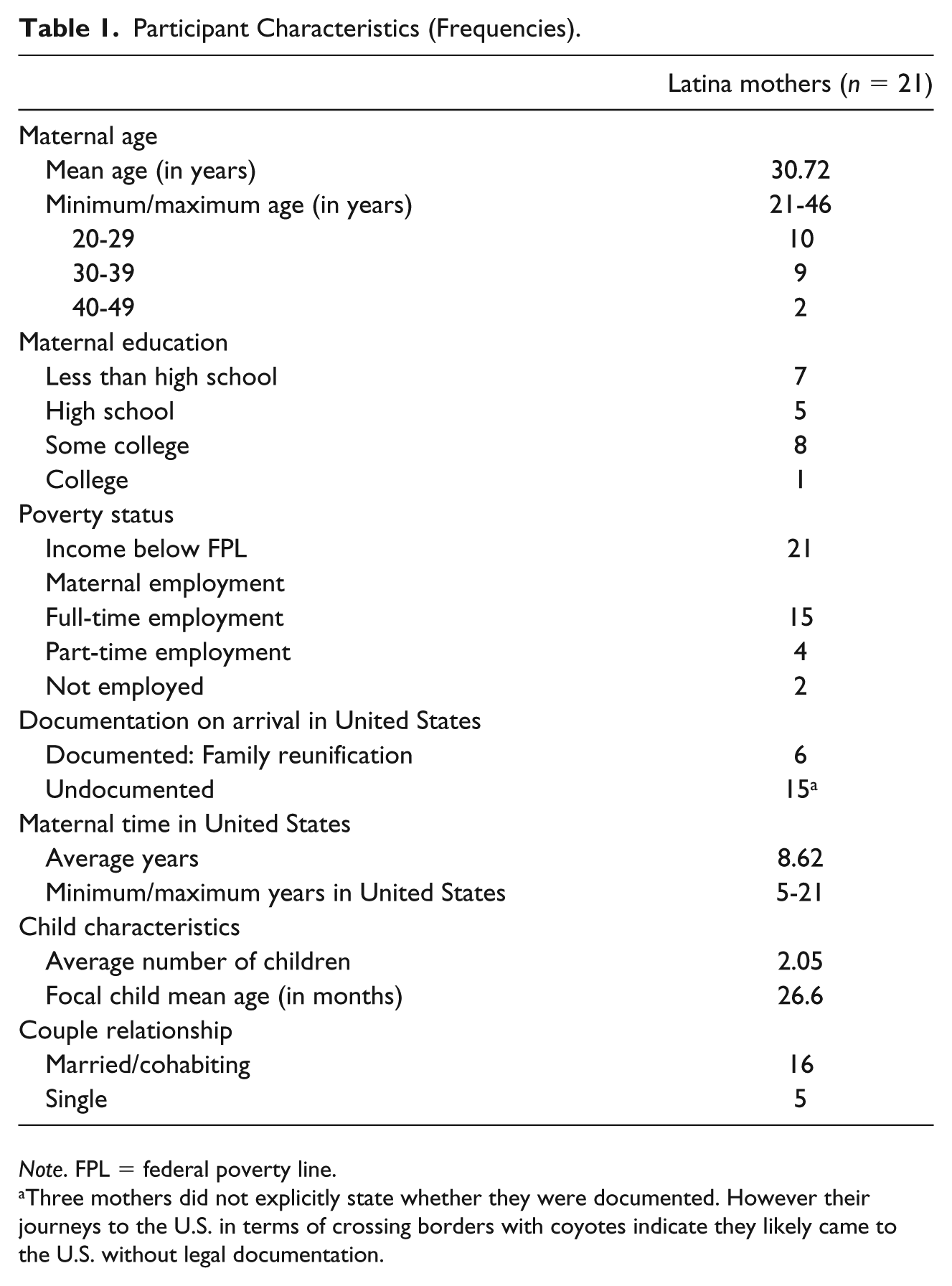
Note. FPL = federal poverty line.
Three mothers did not explicitly state whether they were documented. However their journeys to the U.S. in terms of crossing borders with coyotes indicate they likely came to the U.S. without legal documentation.
Data Collection
Mothers were recruited to participate in this study from three early childhood education programs in a large metropolitan area. On receiving approval from the institutional review board, recruitment of mothers who were low-income (i.e., mothers who qualified for Head Start and were living below the federal poverty threshold), first-generation immigrants from a Latin American country, with a child between the ages of 3 and 5 years began. Prior to participating in the in-depth interviews, informed consent for having their interview audio recorded and transcribed to be used as data for the study was gathered from mothers. The majority of interviews, which lasted between 1 and 3 hours, took place in mothers’ homes. Interviews were conducted in Spanish with the help of undergraduate research assistants (UGRAs) who were bilingual (Spanish and English) and bicultural (Salvadorian and American). These interviews examined various topics including, mothers’ demographic backgrounds, immigration histories, parenting experiences, social support, daily routines, and advice for other immigrants. For the analyses in this article, the following questions elicited the richest data on parenting:
• Tell me what it means to be a good parent in the U.S.
• What does it mean to be a good parent in your country of origin?
• What has been the most challenging aspect of being a parent in the U.S.?
• How is it different raising your children here rather than in your country of origin?
• “Can you walk me through your day yesterday from the time you woke up to the time you went to bed?” (Yoshikawa, Chaudry, Rivera, & Torres, Protocol Visit 1, 2007, p. 4)
• Why are these activities important? How is your daily routine different from what it would be in your home country?
• Is there anything you wish were different in your daily routine or your children?
• Are there certain things you wish you could do with your children throughout the day?
Note. These questions were informed by Weisner (2002) and Yoshikawa et al. (2007).
Data Analyses
All interviews were transcribed and then translated into English. UGRAs checked each other’s transcriptions and translations for accuracy. ATLAS.ti, a qualitative data management software program, was used during the analyses by the first and second authors, which were conducted using a modified grounded theory approach including three waves of coding (LaRossa, 2005). First, during open coding all the transcripts were read, focusing on codes developed a priori related to parenting including ideas about parenting, parenting challenges, daily routines, and parenting supports. During this wave of coding, other codes emerged including individual versus community responsibility for children, gender roles, power and empowerment, and aspirations. During axial coding, using ATLAS.ti, data were drawn such that each code was read separately across all 21 interviews to understand the dimensions of each theme or category. For example, when the text related to “daily routines” was examined aggregately across all 21 interviews, patterns related time constraints and comparisons to life back home emerged. During the third wave of coding, “the main story underlying the analyses” (LaRossa, 2005, p. 850), or how participants negotiated motherhood in the United States, emerged.
Data Quality
Multiple strategies were used to ensure quality of the data and accuracy of the findings. In particular, rich, thick descriptions of lengthy field experiences, and various forms of triangulation were employed (Krefting, 1999). The first author was in the field, observing, recruiting, and interviewing parents and families for 7 months, which contributed to the thick description of the participants’ lives and provided multiple instances for observations of various phenomena. Moreover, several methods of triangulation were employed throughout the study, which contributed to greater depth of understanding of participants’ experiences (Glesne, 2016). First, multiple data sources and methods, including field observations of parents, children, and staff, as well as conducting in-depth interviews with parents, were used. Second, the UGRA’s who assisted with participant interviews also helped interpret these interview and observation data from a cultural perspective—contributing to observer triangulation. Finally, throughout the study, the authors remained reflexive (Glesne, 2016; Krefting, 1999) by regularly engaging in critical conversations among themselves and with others from diverse (i.e., race, ethnicity, immigrant status, and socioeconomic) backgrounds to consider how their background, experiences, and perspectives affected data collection, analyses, and presentation of results. This reflexivity was particularly important as all three authors are White nonimmigrants, from upper middle-class backgrounds.
Findings
As immigrant women adapted to mothering in the United States, they had to negotiate and navigate various tensions between, for example, their parental ethnotheories rooted in their country of origin ideals and experiences (e.g., respeto, marianismo, familismo, and collectivism) and those emergent ethnotheories in the United States (e.g., individualism, autonomy, and intensive mothering). Because of mothers’ situatedness as immigrants to the United States, such negotiations were constrained and regulated by the macro-forces (immigration laws and policies, economic opportunity structure, and anti-immigrant hostilities) bearing down on participants and their individual and familial characteristics (e.g., language proficiency, relational status, and legal status). In this study, mothers described how they made meaning of multiple and intersecting tensions related to immigrant parenthood and how they adapted—or shifted—as individuals, as partners, as parents, and as members of larger, often transnational, kin and community systems. Here, we discuss three ways in which mothers shifted in their perceptions, identities, and roles as they adapted to family life in the United States, including the following: (a) shifts in one’s identity and role as an immigrant parent, (b) gender identity and role shifts at home and work, and (c) intergenerational family and community role shifts.
Shifts Born Out of a New Parental and Legal Context: Life as an Immigrant Mother
Navigating Illegality
The majority of mothers in this study shared stories that revealed their shifting identities as they moved from that of citizen in their country of origin to that of immigrant in the United States. Shifting legal statuses also meant some mothers were negotiating life in the United States as undocumented—or as Dreby (2015) described, mothering in a state of illegality. Mothers discussed these shifts as a life of “two episodes,” reflecting on life premigration to postmigration and how crossing borders resulted in new identities being placed on them as “immigrant” or, most harshly, “illegal immigrant.” Not only did mothers have to navigate a new life where some saw them as reduced, less than, dehumanized and/or criminalized, they also had to confront daily hassles made more challenging due to language barriers and a limited opportunity structure. Daniela, a Salvadorian mother of two, summed up her situatedness: To start with, the language, which is obvious; sometimes the diversity in cultures makes you feel discriminated. The diversity in cultures makes them discriminate [against] you instead of it being the contrary. If you don’t have your documents in order you don’t feel liberated to do whatever you want. If you want to drive you can’t go out and get a license because you don’t have your papers in order. And well of course you miss the other part of your family that you left in your country. What else? Your friends, your friends of your youth—I’ve practically lost them because I have not been able to locate any of them. All your life, all your life . . . I feel that my life divided into two episodes: La del El Salvador y la que hoy tengo aca. Also, that you are always afraid. Is what I will do right? Is what I will do wrong? You don’t know what are your rights. For example, if I lived in El Salvador, I know what my rights are. I know how the laws are. . . . One is always afraid whether something was right or whether something was wrong.
For the majority of participants, mothers’ days were centered on caring for their families (supporting notions of familism) while also being constrained by their documentation status and limited English skills. Despite many participants feeling as though employment was an opportunity they were afforded in the United States (even though wages were low), they also felt constrained in terms of freedom and their choices. Their immigration context, as Cardoso et al. (2018) recently noted, resulted in a form of “trapped parenthood” with few opportunities to actualize a new life in a new way here in the United States. For many, their days began by shuttling their children to school, followed by attending English classes, returning home to make traditional meals for their families, picking their children up from school, readying themselves for their employment responsibilities (often cleaning homes or office buildings), ensuring their children were safe and cared for either by their fathers or a child care provider, and returning home either late in the evening or the next morning after working through the night.
As Guadalupe, a mother of one from El Salvador, lamented, if she had papers, she would have more freedom to find a job that would help support her family: “ . . . with those documents you have the liberty to go and apply and look for any job.” She went on to share more about her job search process. “I have been looking for a job everywhere. I have been filling out applications everywhere. But because they are looking for a good social security [number] I haven’t been able to find anything.” Marisa, also from El Salvador with one child, corroborated this experience, and having been in the United States for many years, she described how times were different compared with the 1990s.
. . . but now it is too hard to find, if you don’t speak English they can fire you or if you don’t have papers they can fire you. [Back then] you could have two jobs, three jobs, four jobs, part-time jobs, full-time jobs, and now you cannot find one job.
For those who were able to find employment, they experienced tension related to time with children. Isabel, a Mexican mother of three, notes these pressures, which were further exacerbated as she was raising her three children without a partner.
Oh it’s tough here . . . you get so busy with work. I think that what you have to do is dedicate as much time as possible to your kids because the other time you spend working. At least in my case, I have to work because I’m alone with them. So I have to pay for rent, food, and other things. But I think that on Saturdays and Sundays it’s important to spend time with them. . . . I try to give them as much attention as possible.
Language Barriers
In addition to the demands of employment and taking care of children’s custodial needs, participants faced English language learning, to improve their employment opportunities and navigate institutions for raising children in the United States. As Selena, a mother of three from El Salvador, noted: The language . . . there’s always . . . the language. . . . [F]or example, in the hospital you have to wait longer for a translator. You can’t just go in. You have to wait more for them to come or . . . for everything, to buy something . . . even with a prescription I have to be sure of what I’m buying. Maybe talking when someone says something to my daughter, maybe, right now I don’t understand everything. I can’t tell her what they are saying.
Sometimes these language barriers created tensions as English or English translation was necessary for navigating institutions connected to raising young children (e.g., schools and health care). Some mothers adapted by developing their English language proficiencies to build agency for themselves and their children. Recognizing the value of bilingualism, mothers balanced their English language learning with efforts to ensure their children developed and maintained their Spanish language skills. Mothers also saw the acquisition of both English and Spanish language skills as a potential source of achievement and empowerment for their children and families. Alejandra wanted her daughters to know both languages “to get ahead, to find better jobs.” Paola, a Mexican mother of two, also described the broader implications of language learning to address discrimination: Knowing two languages is very beneficial because [my children] can communicate with people that I can’t communicate with. So for work . . . it helps my husband a lot at work. He makes more than I do of course because he can speak English. . . . Yes if you don’t know English they’ll pay you what they want . . . if you know English, if you know how to do the job you can say no, if you don’t give me the job I can go somewhere else.
This corresponded with their appraisals of the importance of maintaining aspects of their culture while in the United States but also figuring out how to navigate American culture.
Maintaining Culture
In addition to language, mothers maintained cultural practices in the United States by cooking traditional food daily, attending religious services and festivals, and instilling cultural values such as collectivism and respect for one’s elders in their children. Mothers sought to integrate the best of both worlds by also fostering their children’s adoption of individualism to be successful in an individualistic society. As is common among immigrant families, participants hoped that their children would have better opportunities to pursue education and work in the United States. While maintaining traditions and instilling cultural identity related to familism and collectivism were central to many mothers’ aspirations, mothers also hoped to instill American ideas of egalitarian gender roles and personal autonomy. For instance, Guadalupe said that she preferred the United States because, “here . . . the kids since they are little they are taught to be independent and over there they are more dependent on their [parents].”
Despite facing numerous challenges, mothers’ situations in the United States enabled them to provide opportunities to their children that were different than the ones that they had back home. Beyond the practical importance of education and work, mothers’ aspirations appeared to reflect their desire for empowerment of their children and themselves. When asked about where she preferred to be a mother, Esmeralda, a Mexican mother of one, said the following: [If I] stayed there, I would have gotten married there and [my daughter] would have had the same luck that I had. Over there all the kids have the same luck—not a single kid has a better life than the other. It is better here than there.
Finally, some mothers in our study were also faced with figuring out how to address separation from their children or separation from their parents and extended families in their countries of origin. Participants had to make difficult choices based on options afforded by immigration and other social policies. For example, mothers like Camila, a mother of two from Mexico, hoped to bring children who lived in their home country to the United States, but making this a reality was challenging, dangerous, and often very expensive given the limited legal pathways to reunite immigrant families in the United States, especially those without legal immigration status. Others hoped to return to their home country in the future to reunify with their families and reestablish their lives and communities back home. Teresa, an Argentine mother of two, described the way in which hopes for children can be born from the particular challenges of the immigrant experience: Today, I met, in the English class, a lady . . . she said she had her daughter graduating from the college and her son graduating from the high school, so now she has free time to study English . . . she said that when you come to this country you just come with. . . . No money, no nothing and just work, work, work. And everybody was so proud, and she was proud of herself too that how her daughter now graduated from the college, and I really would like to be like her too. To have my daughters graduated from the college, and have a better future for them too.
Gender Identity and Roles Shifts at Home and at Work
As participants engaged in the daily work of mothering in the United States, they reflected on their experiences growing up in their countries of origin that emphasized traditional gender roles and the importance of entire family systems in raising children. Participants’ situatedness in the United States, a context reflecting steep expectations for mothers to dedicate significant time and resources in raising children coupled with limited access to family for physical support, shaped how mothers adapted by shifting their gender role ideology to be more expansive, and by relying on formal community supports as there were limited kin available for physical support.
Negotiating Gender Roles at Home
As participants negotiated mothering in the United States with increased responsibility for their children, they fostered their own independence and interdependence with their male partners and children’s fathers. As such, some mothers negotiated changing gender roles, with their male partners increasingly involved with raising their children and mothers taking on greater financial responsibilities for their families. Paola explained her relationship with her male partner: Here it is more shared. . . . It’s more equal. . . . Here, I am working, he has to work and if I work, he has to pick up the kids, or drop them off. And [in Mexico] it is the same but he has to work [outside the home] more…and me less, so that I can be home with the kids . . . because here [fathers] have to do the laundry, they have to cook, and [back home], he wouldn’t even touch the dishes.
As Paola’s comment illustrates, parenting roles in mothers’ countries of origin were fairly traditional, even though many had seen tremendous changes in opportunities for women back home throughout their lives. Generally, mothers in their countries of origin were not employed, but stayed at home and cared for the children, and fathers worked outside of the homes and were financially responsible for families. Many mothers indicated that they wanted to raise their children with both men and women contributing to all aspects of child rearing. Still some fathers touted the importance of mothers caring for the children. As such, if fathers were working, mothers’ abilities to be employed were dependent on finding a job that did not interrupt the care of children or the father’s work schedule. Consequently, even mothers who did not work outside of the home at the time of the study had plans to return to work and/or school once their children were older or once they could find employment that aligned with their children’s needs. Daniela explained how she sought employment that fit within her husband’s work schedule: Well the one who contributes the most at home is my husband. He is the one who contributes the most. He pays for the house. He is the pillar financially, but he sacrifices himself by working two jobs. . . . If I am going to work, I have to work during a time that my daughters are not in school. Sometimes it is difficult and if I work at night I would have to leave my daughters alone and he says for me to dedicate my time raising my daughters and that he will work. Well, recently I found a job that is really flexible because I go during the times I am available. It also does not interfere with the time in which I have to pick up [my daughter]. Just that I have to run and rush out, but I do not leave them alone.
Contextual Situatedness of Gender Roles and Work
Decisions about who worked outside the home and who had primary caregiving responsibility were not only influenced by cultural values related to gender roles and power hierarchies within family units but also by the context itself, including availability of work and child care, as well as authorization to work in the United States. Thus, mothers’ expressions of gender roles were a confluence of their values, their access to relational power, and their situatedness. For some mothers, this meant shifting to more traditional gender roles. Guadalupe described her experiences back home in El Salvador where she was employed; she reported that many mothers in her community worked 6 or 7 days per week and relied on grandparents for child care. Once in the United States, however, she was the primary caregiver for her son for the first 2½ years of his life in part because she could not find work due to her lack of legal immigration status. She also did not want to leave her son in informal neighbor care and when she sought formal, publicly funded child care for her son to begin at age three, she was unsuccessful because of waiting lists and paperwork requirements at public programs. Despite Guadalupe’s desire to be employed and have her child in formal child care, the contextual constraints due to her documentation status and availability of child care, precluded her from working outside the home for pay.
For Esmeralda and other mothers with daughters, the hopes for their daughters sometimes focused on the roles available to women and desire for greater empowerment. Daniela, who was raising two daughters, stated the following: I want them to prepare themselves to wherever they choose to go, to let them reach their goal, and for them not to give up. I don’t want for them to start and never finish. I wish to support them, offer them a good path, and support them. If they choose not to go in a good direction I would tell them, “I want to see you both realized, independent, and not depending on others. And if you marry, do not depend on your husband. Be good citizens, and be good in everything you enjoy.”
Esmeralda similarly noted that if they were still in Mexico, the opportunities for her daughter would be more limited and based on whether her father allowed her to go to school: “In Mexico right now she would not be in any school. She would be in the house unless the father was a good person, he would let her go to school.” As such, mothers adopted some United States cultural norms that they found to be advantageous for their children and shifted their mothering if they saw a potential benefit their children. In this way, some mothers seemed to accept the structural/legal and relational boundaries that limited their individual circumstances while holding out hope that their children could be differentially positioned in society to experience greater opportunities and freedoms. In sum, women’s ideas about gender roles and parenting were influenced not only by tensions between their country of origin experiences and their engagement in U.S. society but also by their relational circumstances, and their ability to negotiate and navigate roles within their families and in the labor market.
Intergenerational Family and Community Role Shifts
Mothering Back Home With the Support of Family and Community
Another tension experienced by immigrant mothers was born out of their new familial and community configurations in the United States, which left many feeling isolated and removed from their traditional networks of support and care. Many mothers were raised by their parents along with other family members, both in their homes and in their communities, which they thought made parenting more manageable. Isabel described the availability of family for support that she experienced while raising her first son in Mexico.
Well, over there it would be easier because you have more family that is closer. For example, my sister is over there and my aunts—my family in general. And, well, our family has always been very close and family always helps one another. . . . Having just one [family member] makes it a lot easier too. Sometimes my sister would tell me, “oh, I’ll take him to school” because she and I both worked, but she only worked in the mornings. She would take him to school and in the afternoon, I would pick him up . . .
Like Isabel, some participants’ mothers were employed as they were raised in their countries of origin; however, they were able to rely on others in their family, especially women, to support them in rearing up their children. While other participants, in addition to noting the privilege of family supports available, indicated how their own mothers were able to devote time to them when they were being raised. Alejandra, a Salvadorian mother of two, indicated that even though her mother had five children, things were not as difficult for her mother because their daily rhythm as a family was far simpler back home. As she described, parents in El Salvador assumed traditional gender roles, were guided by notions of collectivism and familism, and were physically situated near family. Her mother was not employed and the children walked themselves to school. As Alejandra described, her parents “did not take care of her so closely” or intensely as parents in the United States do.
Mothering With Limited Familial and Community Supports
Alejandra juxtaposed her experiences as a child with her family’s routines in the United States, including the complexity of Alejandra’s day, which entailed working outside the home as well as transporting her children to and from school, activities, and appointments, while also managing her underlying deportation fear related to her lack of legal status. Unlike her mother, Alejandra had to work outside the home and at the same time had limited support from family. There were a number of participants who experienced this challenge of needing to expand their gender role as a parent to include employment, with limited family around for child care and other supports, and living in the cultural milieu of intensive mothering with pressures to spend significant amounts of time with their children.
As such, when mothers began parenting in the United States, they started to think about and experience the complexity of life in a new country more than they did before parenting children in the United States. They faced the demands of living in the United States with limited familial and community supports but with the experiences of having been raised in cultures where entire family systems, including aunts, uncles, grandparents, and cousins, contributed to raising children. Despite some mothers being able to turn to their families for emotional support and advice across geographic distance, most mothers felt the loss of physical support, including child care. This limited family support in the United States often left mothers feeling as though they were doing it all on their own in a context that was more demanding than back home in terms of cost of living, language, and, for those lacking papers, the constant fear of being detained, deported, and separated from their family. As Selena, a mother of three, who also gave birth to her first child in her country of origin (El Salvador), described as follows: “Here there’s no one. You have to organize yourself well with your work and the school’s schedule.”
Because of the shifting and familial relationships within and across borders, many mothers discussed having to take up institutional supports in the United States to meet their needs and the needs of their children and families. When they could garner access, mothers relied on early care and education programs, libraries, and various social services (e.g., home visiting, food, or nutrition programs). Mothers talked about eliciting advice from both their families “back home” and from “trusted” local institutions, often integrating information about discipline, child development, education, and health-related issues. Valeria, a mother of two, described calling her mother-in-law in Mexico for health advice, particularly when U.S.-endorsed ideas like taking a pain reliever was not working. She said, Well, his mom, I call when they are sick. Sometimes they have a cough or high temperature and well, I make homemade remedies and they are cured, but it is his mom I call instead of taking them to the hospital.
Others would ask their family members and then actively or passively gain a second opinion from early childhood professionals. For example, Guadalupe indicated that when she and her husband were not sure what to do, particularly when their child was sick, they would “grab the phone and talk to [their] parents and they tell [them] to make him soup.” However, when her son was an infant, Guadalupe had planned to follow her mother’s advice and use what was customary among her family in El Salvador to help the belly button heal, until someone at the clinic indicated that alcohol would be fine. Guadalupe decided to use only alcohol and reasoned this was “because [she] is in America.” Sometimes seeking this second opinion was more intentional when mothers did not completely agree with what their family member suggested.
Mothers often wove these sources of support and advice together, selecting what they agreed with most from each source to come up with “new” strategies for parenting their children. Perla, a mother of two, described how she utilized ideas from her family in Mexico as well as what she learned in the United States: In Mexico, I think we are raised in many beliefs, such as your grandmother said this, so I believe this, so I am going to educate you this way. . . . I have taken what has worked for me . . . certain things but other things I take if I think they are correct and they work but other things I learn from other parents or from parenting classes. . . . I have been taking them since Rosa was 2 years old and I always learn that is why I am involved in these classes, because I learn. I take tips and I modify what I already know.
As immigrant mothers settled in the United States, they often lost traditional, extended familial and communal sources of support and care, and had to shift and adopt new modes of parental decision making and child care that included more formal, family, and center-based programs offered in the United States. Mothers’ emergent immigrant parental ethnotheories revealed an adaptive, flexible approach to raising their children. It is in the nuanced, daily experiences of immigrant Latina mothers that one can see the ways in which mothers are navigating across two worlds, shifting their identities and roles, maintaining transnational ties and their cultural roots, while attending to the day-to-day needs of their families, and adjusting to life that is, in many ways, trapped or constrained rather than expanded by their pursuit of the American Dream.
Discussion
Latina immigrant mothers must confront myriad challenges as they navigate life in the United States, often from positions made vulnerable by immigration laws and policies and anti-immigrant hostilities that threaten deportation and family separation. Yet immigrant mothers face the same intensive mothering pressures and expectations as their native, U.S.-born counterparts. As Latina immigrant mothers discussed their experiences parenting their children across two worlds, their stories revealed the ecocultural tensions born out of their immigration to the United States and their changing cultural context. In this study, we explored participants’ parental ethnotheories and adaptive processes as they shifted their beliefs, perceptions, identities, and roles as Latina immigrants, mothers, partners, workers, and members of intergenerational and transnational kinship systems. Critical to our work, from an ecocultural perspective, we first had to situate these mothers in their macro-level context in order to understand their opportunity structure and where they had personal agency in their adaptations and where they were constrained or trapped by forces beyond their control.
Mothers generally were aligned with the notion that life here is better than back home—but this perception seemed to relate to the positionality and opportunity structure of their children, and not necessarily of the mothers personally. This orientation—that “my children are better off here”—revealed mothers’ sacrifice, child focus, and commitment to familism, placing the welfare of their families above their own personal well-being. Mothers who lacked legal authorization to be in the United States, and held onto this commitment to a better life for their families via immigration were in jeopardy of family separation and deportation, which constrained and limited their personal opportunities, yet opened doors for their children. Mothers noted that their children’s language skills, educational opportunities, and U.S. social norms could offer their children the chance for a good future. Importantly, opportunities for their children and the ways in which they could facilitate these opportunities were key in mothers’ sense of their mothering. Many pointed to the barriers caused by language and thus learning English for themselves and often more importantly for their children, became a major emphasis. Most focused on hope for the futures of their children and dedicated time and energy to helping their children actualize these opportunities. While the U.S. context led to challenges that they aspired to overcome (e.g., mastering the English language), a few also noted that the context offered opportunities that their children would not have in their home country (e.g., education, particularly for girls).
However, Latina immigrant mothers not only had to negotiate their positionality, identity and roles as immigrants and mothers but also had to (re)negotiate their identities and roles relationally and in the labor market. Mothers had to grapple with cultural misalignments as their traditional values and ways of knowing (e.g., respeto, machismo, and marianismo) intersected with the intensive mothering and Standard North American Family values that permeate U.S. majority culture (Hays, 1996; Pessin, 2018). Given their legal status, their vulnerabilities and exposures to discrimination and nativistic hostilities, their access to power within familial and social hierarchies, and their ability to generate income and contribute to the family economically (or not), mothers seemed to have limited personal agency to craft their own “selected” identities and perform new roles here (e.g., as an equal partner in their relationships, as a cobreadwinner for their family). For many mothers, their adaptation processes reflected the taking up of opportunities available to them while also coping with and coming to terms with the constraints placed on them due to their situatedness.
For many mothers, settling in the United States engendered changes in traditional parenting and gender roles, including breadwinning and child-rearing roles, reflected in mothers’ daily lives. For some mothers—especially the five participants who were unpartnered—residing in the United States necessitated the need to work in the labor market (often in low-paying shift work) to contribute to their family earnings. This shift often resulted in shared parental duties at home with their male partners and more egalitarian relations that were modeled to their children. For others, life in United States meant continued dependence on husbands as providers as women continued to perform primary care duties for their children. Some mothers viewed these changes in gender and parenting roles positively, while others preferred traditional roles and sought to retain these roles. Their exposure to broader U.S. cultural ideals of gender equality coupled with their experiences (including employment, access to resources and supports) in their countries of origin compared with the United States likely influenced these changes in gender roles. However, mothers’ own cultural and personal values, familial experiences, and ecological situatedness appeared to influence whether these changes were perceived favorably.
Mothers’ adaptation in these complex and dynamic familial, legal, and social systems were further influenced by changes in their networks of care and support, as they lost familial and communal care networks and had to turn to more formal care institutions (if accessible and eligible) to best meet the needs of their families. Many mothers coped and adapted by shifting how they connected to their families back home—seeking advice when physical care was no longer an option—and turned to U.S.-based institutions to learn new strategies for parenting. Mothers shared how they integrated diverse and cross-cultural beliefs about “best” parenting practices, but lamented the loss of extended kinship and community support as many took up the primary care responsibilities and intensively mothered their children often in isolation, sans the intergenerational and communal systems of care on offer back home. As many mothers shared, they found parenting to be “hard here.”
Implications for Practice and Policy
Understanding the cultural and contextual experiences of Latina immigrant mothers in the United States—the tensions and resultant shifts to bolster adaptation—holds ecocultural implications for practitioners and policy makers seeking to support their adaptation. For example, policies and individualized interventions that do not take into account commitments to familism and/or gendered hierarchies within family systems, and/or transnational connectivity to extended kinship systems may add to mothers’ experiences of tensions and stressors rather than supporting their adaptation and functionality. This may be particularly true for mothers with children being raised by other family members in their countries of origin (Hondagneu-Sotelo & Avila, 1997). Recognizing mothers’ constraints to achieve economic liberation and self-sufficiency (e.g., lack of papers, language barriers, gendered power hierarchies within the family, and child care responsibilities) means that many women may be trapped in challenging familial, economic, legal, and social circumstances with few options (Cardoso et al., 2018; Dreby, 2015). It is critical that practitioners and policy makers understand the realities of Latina immigrant mothers and their families.
Given mothers’ situatedness, it is of utmost importance that family practitioners in particular are respectful of the parents’ cultures of origin, immigration histories, and personal/familial preferences, as well as the unique structural challenges Latino immigrant families may face (i.e., threats of deportation and family separation; poverty; English language learning; Cardoso et al., 2018). Parents may have had negative experiences with service providers who are discriminatory or culturally insensitive, a widely reported problem that leads to cultural distress, underutilization of services, and lack of treatment compliance (Blanchard & Lurie, 2004; DeWilde & Burton, 2017).
Given that mothers in the study noted the importance of their families in their countries of origin and the importance of having support, practitioners can assist in finding ways to increase mothers’ support. Incorporating distant family members and their influences and concerns within family therapy discussions and understandings may improve the effectiveness of family services for immigrant parents. For instance, Bacigalupe and Lambe (2011) noted that technology now offers a powerful tool for connecting transnational families that practitioners (e.g., family therapists) can address and actually integrate into therapy sessions (if technology in all locations allows). This support may be particularly helpful for mothers who have children in their countries of origin (Hondagneu-Sotelo & Avila, 1997). However, transnational support should not be overutilized, and must be customized to the particular needs and concerns of the individual or family; as noted, some mothers may not want to cause additional stress or conflict, in which case consultations with families might need to be limited or further discussed.
Beyond their families of origin, immigrant mothers can benefit from the development of additional support structures in their daily lives. This may be especially important for parents from collectivistic cultures who are now away from their primary community and family support. Interventions might include identifying exemplar parents, who become consultants for others. Family practitioners can consider parenting groups or workshops that are customized specifically for immigrant parents and are delivered in places where immigrant parents tend to gather, such as community or faith centers. This could reduce the burden of immigrant parents needing to travel or to go to an unfamiliar social service office within their already busy daily routines.
As immigrant mothers raise their children across two worlds they are navigating unique tensions related to role and identity shifts at the individual, couple, family, and community levels. Understanding these tensions and resulting shifts highlights Latina immigrant mothers’ agency as they integrate cultural beliefs and practices from their countries of origin as well as the dominant cultural milieu of the United States. Yet this study also highlights the structural constraints placed on Latina immigrant mothers that impede their adaptation and functionality. Until U.S. policy makers determine a pathway to citizenship for Latina and other immigrant parents and address global challenges to family health and economic security, these families will likely continue to face extraordinary, social-made burdens as they aspire to a better life.
Footnotes
Acknowledgements
We extend special thanks to all the families and community agencies who graciously participated in the research reported here.
Declaration of Conflicting Interests
The author(s) declared no potential conflicts of interest with respect to the research, authorship, and/or publication of this article.
Funding
The author(s) disclosed receipt of the following financial support for the research, authorship, and/or publication of this article: The data used in this article were collected with support from the Child Care Scholars Dissertation Grant Program in the Office of Child Care within the U.S. Department of Health and Human Services (Grant #90YE0130).