



Abstract
Adolescent alcohol use is a subject of concern. Despite research showing an association between parenting behaviors and alcohol use, scarce research has examined whether associations are similar across immigrant status. This question is relevant given that immigration can disrupt parent–adolescent relations. The aim of the current study was to examine the moderating role of parenting behaviors (support, parental knowledge, and communication) on the association between immigrant status and alcohol use (drunkenness and heavy episodic drinking). The study included representative samples of first- and second-generation immigrant adolescents from the Former Soviet Union (FSU; N = 1,167) and Ethiopia (N = 385), and non-immigrant (N = 6,669) adolescents in Israel. Non-immigrant adolescents reported higher levels of parenting behaviors and lower levels of alcohol use than immigrant adolescents. Parenting behaviors were negatively associated with alcohol use, but there were no interactions between parenting behaviors and immigrant status. However, differences in parenting behaviors partly explained differences in alcohol use across groups.
Introduction
Alcohol use in adolescence is a matter of public health concern due to its interrelation with additional risk behaviors, the tendency for alcohol use to persist into adulthood, and the effect it can have on the adolescent brain and health in general (Marshall, 2014). Alcohol use is the leading cause for cause-specific disability-adjusted life years (DALYs) for young people aged 10–24 years (Gore et al., 2011). Concerns have been expressed regarding immigrant adolescent drinking with a recent study on immigrant adolescents across 23 countries in Europe, showing higher levels of drunkenness among immigrant adolescents than their non-immigrant peers (Barsties et al., 2017). Similar results in Israel show 29% of first-generation immigrant adolescents, aged 11–17 years, from the Former Soviet Union (FSU), and 24%/23% of first-/second-generation Ethiopian adolescents as reporting having been involved in heavy episodic drinking (HED; five or more units in one event) in the past month, as compared with 11% of non-immigrant adolescents (Walsh et al., 2014).
While much research has highlighted the importance of parenting behaviors (e.g., support, parental knowledge, and communication) in adolescent alcohol use (Ryan et al., 2010), little has been written about the associations between parenting behaviors and alcohol use in immigrant families (Lorenzo-Blanco et al., 2016; Lorenzo-Blanco et al., 2019). This is highly relevant since immigration theory suggests that multiple stressors and challenges for immigrant families can make fulfilling parental roles more difficult (Pantin et al., 2003). However, few empirical studies have been able to use representative samples of adolescents to examine whether immigrant adolescents actually report lower levels of parenting behaviors and whether these parenting behaviors may moderate the differences in alcohol use among immigrant adolescents and non-immigrants. In addition, few studies have tried to tease apart issues of the immigrant generation and country of origin (Barsties et al., 2017). Using a representative sample of 8,221 non-immigrant and first- and second-generation immigrant adolescents from the FSU and Ethiopia in Israel, the current study examines whether three parenting behaviors noted for their association with adolescent alcohol use (knowledge, support, and communication) may moderate the relationship between immigrant status and problematic alcohol use (drunkenness and HED). An understanding of the interplay between parenting behaviors and immigrant status for predicting alcohol use among adolescents from different countries and generations is important in developing appropriate intervention and prevention programs.
Parenting Behaviors and Alcohol Use among Adolescents
The association between parenting behaviors and alcohol use among adolescents is well researched. Ryan et al. (2010) in their systematic review of 77 longitudinal studies, found that reduced levels of alcohol use by adolescents were predicted by parental modelling, limiting availability of alcohol to the child, disapproval of adolescent drinking, general discipline, parental knowledge, parental support and communication, and overall parent–child relationship quality. In a second recent integrative review of 42 studies, Carver et al. (2017) pinpoint parent–child connectedness (closeness, warmth, love, and satisfaction that a child feels from his/her parents) and substance use communication as pivotal in reducing levels of substance use in general and alcohol use in particular. Yet despite the challenges in the parent–child relationship following immigration (Kwak, 2003), scarce studies have examined the interplay between immigrant status and parenting behaviors with adolescent immigrant alcohol use (Lorenzo-Blanco et al., 2019).
In the current study, we examine three parenting behaviors which have been consistently found to be related to levels of problematic alcohol use: parental knowledge (i.e., knowledge of activities that the young person is doing, who their friends are, how they spend their time and money etc.; Abar et al., 2015), parental support (i.e., ability for young people to turn to parents for help and support; Wills et al., 2004) and parental communication (i.e., the extent to which young people can talk to their parents about a wide range of activities, feelings, and interests; Ackard et al., 2006). In addition to their proven scientific relevance, they were also chosen for the current study since they are variables which exist in the database of the Health Behaviors of School-aged Children (HBSC) research sample in Israel, which gives a unique opportunity to examine relatively large representative samples of immigrant and non-immigrant youth.
The Impact of Immigration on Parenting Behaviors
Challenges that immigrant families face can affect parental ability to fulfil roles of support and involvement. Based on the Family Stress Model (Conger et al., 2010), Lorenzo-Blanco et al., (2019) in their longitudinal study of Latino adolescents, suggest that parental functioning in immigrant families is effected by multiple sources of stress. In their study (Lorenzo-Blanco et al., 2019), parental cultural stress predicted adolescent-reported family functioning (parental involvement, positive parenting, and family cohesion) which in turn predicted adolescent binge drinking. A lack of cultural knowledge following immigration, together with “intergenerational cultural dissonance (ICD)” (a clash between parents and children over cultural values; Kane et al., 2016) and language barriers (Wang et al., 2012) can lead to immigrant parents being less able or confident to fulfill roles of support and be less involved in the lives of their children (Pantin et al., 2003; Wang et al., 2012). Adolescents may also take on parental roles within the family, leading to a greater sense of autonomy, yet also burden, and lead them to rely emotionally less on parents (Ponizovsky et al., 2012; Weisskirch & Alva, 2002). However, scarce empirical research has examined whether immigrant youth do indeed report lower parenting behaviors and examined the way in which parental behaviors interplay with immigrant status to predict alcohol use (Walsh et al., 2014). A moderating hypothesis, as tested in the current study, suggests that it is in those families in which the parent–adolescent relationship has been weakened (i.e., less support, communication, and parental knowledge) that there will be a stronger relationship between immigrant status and problematic drinking behaviors.
Immigrant Generation and Culture among Immigrant Groups in Israel
Immigrant adolescent alcohol use may vary by immigrant generation (Barsties et al., 2017; Eitle et al., 2009). The second-generation adolescents (those born in the receiving country) may acculturate and integrate, and be more influenced by the receiving country’s culture (Svensson & Hagquist, 2010), while first-generation adolescents may be more influenced by the alcohol culture of the country of origin (Barsties et al., 2017). First-generation immigrant adolescents and their families may also face greater immigration stressors such as cultural and language gaps and higher levels of discrimination (Schwartz et al., 2015), which may cause them to turn to alcohol use to alleviate psychological distress (Lorenzo-Blanco et al., 2016; Walsh et al., 2018). Additionally, immigrant adolescents may also be impacted upon by cultural differences in drinking and in acceptable parenting behaviors (Yakhnich, 2016). This means that the effects of immigrant generation and culture of origin may become confounded. To address this issue, in this study, we examine adolescents from two very different countries of origin (the FSU and Ethiopia) across two immigrant generations.
Statistics report 60,000 adolescents aged 12–17 years with an FSU origin (35% first generation) and 17,900 Ethiopian origin adolescents (45% first generation; Kahan-Strawczynski et al., 2013), the two largest immigrant groups in Israel in recent years. They make up approximately 19% of all 12–17 year olds in Israel 1 . Russia has among the highest levels of alcohol use (Pridemore, 2002) and significantly higher socially accepted levels of alcohol drinking as compared with Israeli culture (Rahav et al., 1999). Research also shows higher levels of alcohol use among adult FSU immigrants in Israel immediately following immigration which converge over time to levels of Israeli natives (Sznitman, Baron-Epel et al., 2013). In contrast, very low levels of alcohol use have been found among Ethiopian adolescents in general (Kebede et al., 2005) and among Ethiopian Jews in villages in particular (Grisaro & Witztum, 2012). Despite studies in the United States, based on the immigrant paradox paradigm (Garcia Coll et al., 2012) showing increased levels of drinking in later generations of immigrants (Bacio et al., 2013), studies in Israel and across Europe show first-generation immigrant adolescents as reporting higher levels of alcohol use than second-generation immigrant adolescents (Barsties et al., 2017; Walsh et al., 2014).
Different cultural contexts also endorse different acceptable parenting behaviors. Cultures differ in the importance given to issues such as autonomy versus authority which may impact the level of intergenerational conflict (Wang et al., 2012). FSU parents have been found to endorse lower levels of autonomy (Roer-Strier & Rivlis, 1998) than non-immigrant Israelis. Their parenting involves high levels of control, discipline, involvement, and demand for children’s obedience and self-restraint (Leipzig, 2006; Shor, 2000; Slonim-Nevo et al., 1999; Yakhnich, 2016), cultural elements which have caused conflict in the move to a more permissive society, undermined parental authority, and reduced parental involvement and supervision (Yakhnich, 2016). Less has been written on Ethiopian parenting behaviors. Immigration to Israel, has been considered to have fragmented the traditional hierarchies and patriarchal culture (Kurman & Ronen-Eilon, 2004) which the Ethiopian community brought with them. Difficulties that Ethiopian parents have had in learning the language and culture, significant illiteracy, and experiences of racism and discrimination on the basis of skin color (Offer, 2007), have impacted strongly on parental ability to provide support and involvement in their children’s lives (Stavans et al., 2009). By examining two very different cultures, both in terms of drinking patterns and parenting behaviors, we can explore the role that culture may play in understanding the role of parenting behaviors in immigrant adolescent alcohol use. While every immigration context is unique (Kwak, 2003), the interplay between parenting behaviors and immigrant status is relevant across cultural contexts.
The Current Study
Research has highlighted the vulnerability of immigrant youth to higher levels of problematic alcohol use as well as the potential impact of the immigration process on parenting behaviors. Yet empirical research is scarce which examines to what extent immigrant adolescents do indeed report lower levels of parenting behaviors and whether these lower levels of parenting behaviors may be interacting with immigrant status to predict problematic alcohol use. In line with previous theory and empirical studies, we hypothesize the following:
Immigrant adolescents (first and second generation) will report higher levels of problematic alcohol use (drunkenness and HED) than non-immigrant adolescents
Due to the stressors of immigration and processes of acculturation, first-generation immigrant adolescents will report higher levels of alcohol use than second-generation immigrant adolescents
Immigrant adolescents (particularly first generation) will report lower levels of parental knowledge, support, and communication than non-immigrant adolescents
Higher levels of parental knowledge, support, and communica-tion will predict lower levels of problematic alcohol use for all adolescents
There will be an interaction between parenting behaviors and immigrant status. Lower levels of parenting behaviors will strengthen the relationship between immigrant status and problematic alcohol use
Methods
Sample and Procedures
This study uses Israeli data from the 2013–2014 HBSC–WHO survey conducted among children aged 11–17 years. The HBSC is a school-based survey of adolescent health behaviors and psychosocial determinants carried out among representative samples of school aged children every four years, across over 40 countries using an international standardized methodological protocol (Currie et al., 2014), involving standardized procedures for sampling and translation of items. To ensure a representative sample (Currie et al., 2014), the Israeli Ministry of Education’s list of schools was used to sample classrooms. All students in sampled classrooms present were included (> 95% pupil response). The research protocol received approval from the chief scientist of the Israeli Ministry of Education and the first authors’ university IRB.
Although pupils at both Hebrew- and Arabic-speaking schools participated in the 2013–2014 study, questions around immigration were only asked in the Hebrew-speaking schools (number of schools = 218). The current study included 1,167 first- (born abroad) and second-generation (born in Israel to at least one immigrant parent) adolescents (47.4% male) with an FSU background and 385 Ethiopia origin adolescents (42.4% male). The non-immigrant group (N = 6,669) was defined as adolescents who were born in Israel and both their parents were also born in Israel (49.4% male).
Measures
All measures in the HBSC study have been cross culturally validated (Currie et al., 2014). Specifically, the alcohol measures (Barsties et al., 2017) and the parenting measures (Walsh et al., 2014) have been well used among immigrant youth in general and immigrant youth in Israel in particular.
Country of origin and immigrant generation
Adolescents were asked three separate questions as to where they and each of their parents were born: “In which country were you/your mother/your father born?” Former research indicates that children as young as 11 years old provide valid responses to these questions (Nordahl et al., 2011). If the respondents reported that they were born abroad, their immigrant generation was defined as “first”. Second generation was defined as adolescents that were born in Israel, but at least one of their parents was from FSU or Ethiopia (no adolescents reported one FSU and one Ethiopian parent).
Socio-demographic variables
Gender was built as a dummy variable with “girls” as the fence category. The HBSC Family Affluence Scale (FAS-II; Torsheim et al., 2016) was used as an indicator of the young people’s socio-economic status. The FAS-II scale is comprised of six items on material assets in the family, for example, “Does your family own a car, van or truck?” (“No” [0], “Yes, one” [1], and “Yes, two or more” [2]), “Do you have your own bedroom?” (“No” [0] and “Yes” [1]). Scale scores were calculated by summing scores of all six items. Reliabilities were α = 0.72 for the FSU origin, α = 0.71 for the Ethiopian origin, and 0.68 for the non-immigrant group.
Analysis
In the first stage, differences between the groups (first- and second-generation Ethiopian, first- and second-generation FSU, and non-immigrants) for drunkenness and HED were examined using chi-square analysis. Differences between groups in parenting behaviors were examined through one-way ANOVA. Logistic regression models were performed to understand the role of immigrant status, immigrant generation, and parenting behaviors in predicting alcohol use. To examine the moderation role of parenting behaviors, we used an interaction logit model. All statistical models were controlled for gender, age, and FAS.
Results
The Relationship between Immigrant Status, Alcohol Use, and Parenting Behaviors
In line with hypothesis 1, the probability of being drunk in the last 30 days was significantly (p < .05) higher among first- (13.6%) and second-(9.2%) generation adolescents from FSU heritage than among non-immigrants (5.3%; see Table 1). First-generation Ethiopian adolescents also reported significantly higher levels of being drunk (9.4%) in comparison to non-immigrants (5.3%). Similarly, the probability of HED in the past 30 days was higher among first- (26.4%) and second- (17.1%) generation FSU adolescents and first-generation Ethiopian immigrants, compared to non-immigrants (14.2%). In addition, in line with the second hypothesis, the rates of alcohol use were higher among adolescents from first generation of both groups compared to the second generation. Levels of drunkenness and HED did not significantly differ between FSU and Ethiopian origin immigrants in either generation.
Alcohol Use among Adolescents by Population Group.

Note. *p < .05, **p < .01.
significant differences between non-immigrants and both FSU generations/first-generation Ethiopian immigrants.
In line with hypothesis 3, the highest level of parental knowledge was reported by non-immigrants (mean = 4.78, SD = 0.63) and it was significantly higher than all other groups. In addition, as hypothesized, parental knowledge was higher among second-generation FSU adolescents (mean = 4.66, SD = 0.75) than among first generation (mean = 4.49, SD = 0.97) (see Table 2). However, the opposite trend was reported by Ethiopian adolescents, for whom the level of parental knowledge was lower for the second generation (mean = 3.35, SD = 1.07) in comparison to the first generation (mean = 4.04, SD = 1.39). In line with hypothesis 3, the highest level of parental communication was reported by non-immigrants (mean = 3.43, SD = 1.04). However, a significant difference was found only between non-immigrants and first-generation FSU adolescents (mean = 3.06, SD = 1.33). Also in line with hypothesis 3, levels of parental communication were higher for second-generation (mean = 3.34, SD = 1.11) FSU adolescents in comparison to the first generation (mean = 3.06, SD = 1.33). In contrast, the level of parental communication among Ethiopian adolescents did not differ by immigrant generation or in comparison with non-immigrants. In line with hypothesis 3, the highest level of parental support was reported by non-immigrant adolescents (mean = 3.49, SD = 1.12) and it was significantly different from all other groups. In addition, a significant difference was found among first- (mean = 2.98, SD = 1.43) and second- (mean=3.31, SD=1.29) generation FSU adolescents. However, the level of parental support among adolescents from Ethiopian heritage did not differ across generations.
Family Affluence and Parenting Behaviors by Population Group.

Note. *p < .05, **p < .01.
Significant difference: between all groups.
Significant difference: between second generation of Ethiopian heritage and all other groups; between second generation of FSU heritage and all other groups; between non-immigrants and all other groups.
Significant difference: between first generation of FSU heritage and second generation of FSU heritage; between first generation of FSU heritage and non-immigrants.
Significant difference: between first generation of FSU heritage and second generation of FSU heritage; between non-immigrants and all other groups.
The significantly (p < .01) highest level of family affluence (FAS = 8.33) was reported among the non-immigrant group (see Table 2). For the first generation adolescents of both FSU and Ethiopian descent, the level of family affluence was significantly (p <.01) lower than among second immigrant generation (FSU: first generation – FAS = 6.50, second generation – FAS = 7.78; Ethiopia: first generation – FAS = 3.81, second generation – FAS = 5.10). Additionally, it can be seen in Table 2, that the lowest levels of family affluence were reported by adolescents from Ethiopian descent.
Parenting Behaviors, Country of Origin, and Immigrant Generation as Predictors of Alcohol Use
In line with hypothesis 4, all three parenting behaviors were negatively related to drunkenness and HED (see Tables 3 and 4). The odds ratios (OR) of drunkenness in the last 30 days were significantly (p < .01) lower for adolescents with higher levels of parenting knowledge (OR = 0.65), parenting support (OR = 0.90), and parental communication (OR = 0.84). The same pattern was obtained for HED (parenting knowledge – OR = 0.76, parenting support – OR = 0.78, and parental communication – OR = 0.79). For both last month drunkenness and HED, immigrant status (FSU/Ethiopian) but not immigrant generation were initially significant. However, once parenting behaviors and immigrant generation were added, OR’s decreased for FSU adolescents and were no longer significant for Ethiopian immigrants. However, in contrast to hypothesis 5, none of the interactions between parental behaviors and country of origin in prediction of drunkenness and HED were significant (p >.05).
Logistic Regression for Prediction of Drunkenness in the Last 30 Days among Adolescents.
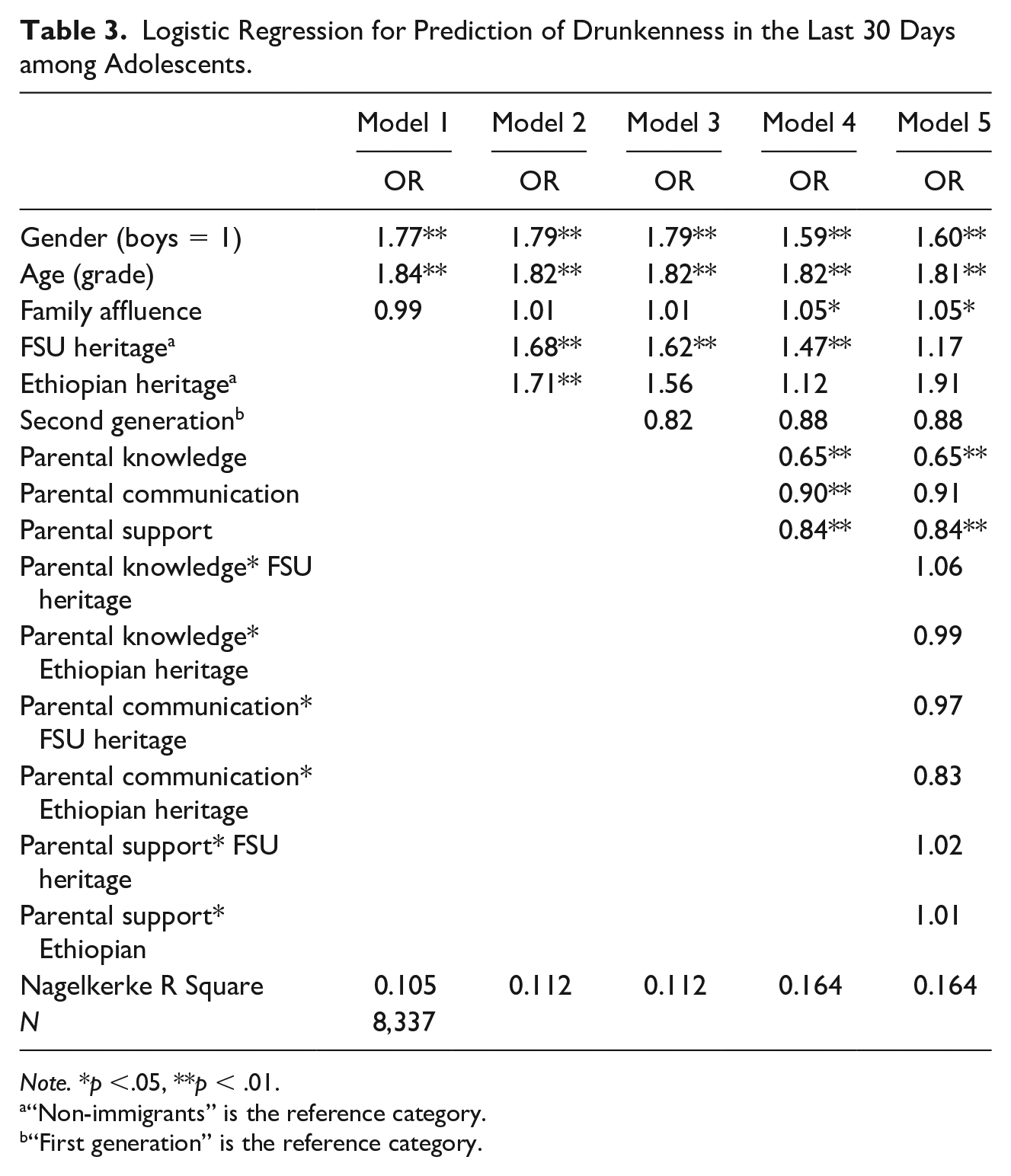
Note. *p <.05, **p < .01.
“Non-immigrants” is the reference category.
“First generation” is the reference category.
Logistic Regression for Prediction of Binge Drinking in the Last 30 Days among Adolescents.

Note. *p < .05, **p <01.
“Non-immigrants” is the reference category.
“First generation” is the reference category.
Discussion
The current study was a unique opportunity to examine the interplay between immigrant status and parenting behaviors in predicting problematic alcohol use among representative samples of first- and second- generation immigrant adolescents and non-immigrant adolescents. In line with hypotheses, non-immigrant adolescents reported higher levels of parental knowledge and support than all immigrant adolescent groups, first and second generation. In the case of communication, the difference was only significant between first-generation FSU and second-generation/non-immigrant adolescents. Despite theoretical perspectives which discuss the effects of immigration of parenting behaviors (Cano et al., 2015; Conger et al., 2010), scarce literature has empirically examined whether immigrant adolescents do indeed report lower levels than their non-immigrants peers. Findings of the current study show lower levels of parenting behaviors among two culturally very different immigrant groups, as compared with non-immigrant adolescents. Immigrant families need to cope with financial and occupational challenges (Leventhal & Brooks-Gunn, 2000), a loss of family and social networks, and the need to learn a new language, culture, and norms (Torres et al., 2012). Intergenerational cultural dissonance (Kane et al., 2016) can make it hard for parents to be involved, particularly as their children may be resistant to accepting their parents’ values and norms. Yet, despite the theory, this is one of the first studies to explore among representative samples of adolescents whether adolescents do indeed report low levels of parenting behaviors. Findings support the hypotheses and point to the disruption and vulnerability of family dynamics among immigrant families.
Yet, patterns of parental behaviors differed across the two immigrant groups. Second-generation Ethiopian adolescents reported the lowest level of parental knowledge, lower than the first generation and both FSU generations, while second-generation FSU adolescents reported significantly higher levels of all three parenting behaviors than first-generation FSU adolescents. Findings suggest differing acculturation and cultural processes across different immigrant groups. In the case of FSU adolescents, findings support an acculturation perspective (Berry, 1997; Kwak, 2003) in which the second generation reported parenting behaviors more similar to those of non-immigrants than the first generation. This is also true for their alcohol use (Svensson & Hagquist, 2010). We suggest that findings may reflect the overall successful integration of the FSU immigrant population in Israel, partially related to their number and substantial human resources (Amit, 2012). Lower levels of positive parenting behaviors (support, communication, and knowledge) in the first generation may reflect both the impact of more proximal immigration on FSU families and a stronger influence of high discipline/lower warmth FSU culture on parent–adolescent relations (Shor, 2000; Yakhnich, 2016). Lower levels of parental knowledge among second-generation Ethiopian adolescents, we suggest, may reflect the particular difficulties of the Ethiopian second generation in Israel. Issues of conflicted identity, on-going racism, lack of opportunities. and language barriers between children (who do not speak Amharic) and their parents (Ben-Eliezer, 2004; Walsh et al., 2018) have left many young people feeling alienated both from Israeli society and their Ethiopian heritage and leaving parents feeling disempowered from their parenting role (Wahle et al., 2017). This can be particularly powerful among second-generation adolescents who have grown up in Israel and expect equal treatment and opportunities.
In addition, first- and second-generation FSU and first-generation Ethiopian adolescents reported higher levels of drunkenness and HED. FSU adolescent alcohol levels were particularly high. Levels of FSU adolescents drinking may reflect socially accepted higher levels of alcohol drinking in Russian culture as compared with Israeli culture (Hasin et al., 1998). However, since levels of alcohol use in Ethiopian Jewish culture are much lower than those in Israel (Grisaro & Witztum, 2012; Kebede et al., 2005), and the higher levels of drinking for both first-generation groups, we suggest that elevated levels of alcohol use among the first-generation are also related to immigration-related stressors. Interestingly, in line with studies in other countries, second generation Ethiopian drinking levels were similar to those of non-immigrants (Eitle et al., 2009; Svensson & Hagquist, 2010). It is also important to note that the significance of immigration status on alcohol use decreased or disappeared once additional variables were introduced to the regression analysis, reinforcing the need to disentangle the particular elements of the immigration experience which may explain increased alcohol use among immigrant adolescents.
Logistic regression analysis confirmed the hypothesized significant negative relationships between alcohol use and all three parenting behaviors. Findings add to the wealth of literature in this area (Carver et al., 2017; Ryan et al., 2010), showing the relationship between parenting behaviors and alcohol use. Yet contrary to hypotheses, there were no interactions between any of the parenting behaviors and immigrant group, suggesting that parenting behaviors are critical for immigrant and non-immigrant adolescents alike. Odds ratios for immigrant groups were lowered when parenting behaviors were included, indicating that they may explain some of the difference in alcohol use. In the case of FSU adolescents, FSU status was still a significant predictor of alcohol use, over and above generation and parenting behaviors, suggesting a strong cultural influence (Rahav et al., 1999). For Ethiopian adolescents, their Ethiopian status was no longer significant when including immigrant generation and parenting behaviors. Findings suggest that parenting behaviors are not sufficient to explain differences between immigrant groups in alcohol levels, but that they have a highly significant relationship to alcohol use across immigrant status.
Implications
Findings have both theoretical and practical implications. On a theoretical level, results reinforce the critical role of parenting in predicting adolescent alcohol use, regardless of origin. As such, parental behavior and parent–adolescent relations are no less important for immigrant, as compared with non-immigrant, adolescents in associations with alcohol use. Moreover, results suggest that it may be this impact of immigration on parenting behaviors which may partly explain higher levels of alcohol use among immigrant adolescents. Cultural barriers, language difficulties, and processes of disenfranchisement by official bodies can lead to prevention and intervention programs focused at the adolescent which ignore the essential role of the immigrant parent (Kogan et al., 2019). Findings indicate a need for family and parent-based programs and intervention strategies. Culturally sensitive interventions which strengthen the position of parents in immigrant families and give them tools to be able to be involved in their children’s lives are critical (Kumpfer & Magalhães, 2018). In particular, family skill-based interventions (Gerrard et al., 2006) which can bring together adolescents and their parents to work on strengthening trust and communication could be very helpful. On a structural level, policy has often undermined immigrant parents by placing immigrant adolescents in boarding schools (Kaplan & Salamon, 1998) and/or promoting programs focusing on the young person but leaving aside the parents (Schmid, 2007). Schools often lack the resources to involve immigrant parents and cultural obstacles can leave them disenfranchised from their children’s education (Turney & Kao, 2009). As such, efforts should be made on a structural level to strengthen immigrant parents’ roles and involvement in their children’s lives.
Limitations
The current study involves a representative sample of immigrant and non-immigrant adolescents in Israel. Yet there are several notable limitations to the study. Limitations related to the nature of the HBSC study include the cross-sectional, self-report nature of data, children as the only source of data, and a restriction on the number of questions which can be asked. Longitudinal research designs are needed to see the causal relationship between parenting behaviors and alcohol use. Further studies should also include multiple sources of data (e.g., parents) and additional relevant variables such as time in Israel, family structure, levels of acculturation, and immigration-related stressors. In addition, every immigration context is unique (Kwak, 2003). Previous research on the relationship between alcohol use and parent–child relations has been almost exclusively in the United States. The current study widens the research arena. Yet Israel is a particular immigration context and has been considered to encourage cultural assimilation amongst its immigrants (Ben-Eliezer, 2004). Further research is needed to explore additional cultural contexts. In addition, the HBSC study, while covering a large number of adolescent health behaviors, does not include parenting behaviors which may be important for an understanding of adolescent alcohol use such as substance use specific communication (Reimuller et al., 2011) or more specific immigration-related variables such as ICD, length of time in Israel or levels of language competence.
Conclusions
Findings of the current study highlight the relationship between parenting behaviors and levels of alcohol use (drunkenness and HED) for both immigrant and non-immigrant adolescents. Findings also suggest that parent–child relationships may be more vulnerable or disrupted in immigrant families. Importantly, results suggest that it is imperative to work with immigrant parents and with immigrant families to help strengthen parental role taking and parental involvement in their children’s lives.
Footnotes
Declaration of Conflicting Interests
The authors declared no potential conflicts of interest with respect to the research, authorship, and/or publication of this article.
Funding
The authors disclosed receipt of the following financial support for the research, authorship, and/or publication of this article: This study was supported by a grant from the Israel Anti-Drug and Alcohol Authority
