




Abstract
There are currently 2.7 million grandparents raising grandchildren in the United States. As grandparent caregiving has become more prevalent, concerns have surfaced regarding the effect of additional caregiving responsibilities placed on an aging population. The following study uses an existing dataset of individuals who graduated from Wisconsin high schools in 1957. The present study examined the impact of grandparenting on measures of cognition, both cross-sectionally and longitudinally. Findings from the cross-sectional analysis show that custodial grandparents outperformed their noncustodial grandparent counterparts on the cognitive tests of word recall, category fluency, letter fluency, and cognitive similarities. Findings from the longitudinal analysis show that though custodial grandparents had initially performed worse on the digit ordering task, their scores declined at a much slower rate than non-custodial grandparents. By using a cross-sectional and longitudinal research design, this study provides a unique opportunity to examine the impact of grandparenting on cognitive performance.
Introduction
Custodial grandparents, adults taking care of their grandchildren on a full-time basis, are an ever-increasing population. In the United States, there are currently 2.7 million grandparents raising their grandchildren (Cancino, 2016). This population is continuing to rise and has grown by 7% since 2009 (Cancino, 2016). As grandchild care has become more visible, concerns have arisen that these benefits may come at the cost of grandparents’ well-being (Hughes et al., 2007). The impact of caring for grandchildren on grandparents’ well-being is an area of particular concern. The additional responsibility of caregiving for grandchildren, particularly at a late age in one’s life, may place exhausting and unrealistic physical, emotional, or financial demands on custodial grandparents. It may be associated with lifestyle changes, social relationships, and social roles (Ochiltree, 2006). In addition, caregiving for small children has been shown to share many features of a chronic stress experience. According to Schultz and Sherwood: “It creates physical and psychological strain over extended periods of time, is accompanied by high levels of unpredictability and uncontrollability, can create secondary stress in multiple life domains such as work, family relationships, and frequently requires high levels of vigilance. (Schultz & Sherwood, 2008, p. 23)
Conflicting evidence, however, suggests that the assumption of additional caregiving responsibilities may be beneficial in some instances, such as serving as a buffer to the onset of cognitive decline for grandparents caring for their grandchildren for less than or equal to one day per week (Burn et al., 2014).
The normal aging process is associated with declines in specific cognitive abilities (Harada et al., 2013). Like other physical structures in the body, the human brain’s ability to perform various functions changes with age (Harada et al., 2013). However, participation in certain activities, building cognitive reserve, and engaging in cognitive retraining may all be approaches to achieving successful aging (Harada et al., 2013). It is possible that custodial grandparents may be participating in some of these reserve-building activities while caring for their grandchildren, such as helping with homework or teaching ABCs. However, there has been little research to date examining the impacts of additional parenting responsibilities placed upon grandparents raising grandchildren on cognition levels. Given the prevalence of such grandparent-headed families, grandparent interests, and the impacts on aging health, these associations warrant careful examination.
Conceptual Framework
One theory used to guide this research is the Disuse Theory of Aging (Christensen, 1993). This commonly-applied theory posits that a decline in psychological abilities during aging arises from the discontinuation of the use of various psychological capabilities, such as one’s working memory, processing speed, and word recall. The employment of these psychological abilities in later life, such as social engagement, has been shown to serve as a buffer in preventing and delaying the onset of cognitive decline and dementia (James et al., 2011, p. 1003). A study done in 2011 examining late-life social activity and cognitive decline concluded that more frequent social activity was associated with subsequently-reduced cognitive decline rates over an average of five years of follow-up (James et al., 2011). The researchers noted that if social activity does have a causal role in preventing cognitive decline, the specific mechanisms are unknown. Social activity, they posit, “challenges older adults to participate in complex interpersonal exchanges, which could promote or maintain efficient neural networks” (James et al., 2011, p. 1005).
Literature Review
Previous Research
Much of the research to date has examined late-life social engagement and its ability to preserve cognition, but few studies have applied this to the grandparent population. There are many vital aspects of grandparenting that may either directly or indirectly affect one’s cognition, such as changing levels of social engagement, or practicing cognitive skills by helping children with homework. Though research examining grandparents’ cognition is limited, three studies have examined this phenomenon (although two did not separate out custodial grandparents within the analyses). A study conducted in 2014 by Arpino and Bordone examined whether providing childcare aids older adults in maintaining better cognitive performance. The study was part of the Survey of Health, Aging, and Retirement in Europe. The sample was restricted to men and women who had at least one child and were ages 50–80 years. Cognitive function was measured using five tests: (semantic verbal fluency, numeracy, immediate recall, delayed recall, and orientation). Researchers confirmed previously-established negative associations between caregiving and cognitive functioning (Arpino & Bordone, 2014). However, they also concluded that semantic verbal fluency was measurably higher among grandmothers and grandfathers who provided childcare. Additionally, higher and more intense levels of grandparents’ involvement with their grandchildren were negatively associated with cognitive functioning (Arpino & Bordone, 2014).
Another study examining cognition in grandparents caring for grandchildren was conducted by the Woman’s Healthy Aging Project (Burn et al., 2014). It examined the relation between grandparenting and cognitive function in postmenopausal women. Three hundred and forty-eight participants were selected from the Women’s Healthy Aging Project (WHAP). Cognition was assessed by administering three cognitive measures assessing one’s verbal, episodic memory, and executive functioning.
Findings suggested that post-menopausal grandmothers who spent time with their grandkids had a lower likelihood of developing disorders that affect memory or cognitive ability, such as dementia. However, these cognitive benefits of grandparenting were moderated by the amount of time spent with the grandchild. Spending one day per week with grandchildren was predictive of higher cognitive performance and faster processing speed than those who had spent more than five days per week with a grandchild. Spending five or more days per week was also predictive of lower working memory performance. These results, similar to those found by Arpino and Bordone (2014), indicate that while moderate levels of grandparenting interaction may be beneficial, highly frequent grandparenting is associated with lower cognitive performance (Burn et al., 2014).
However, it is essential to note that Burn and colleagues did not specifically address custodial grandparenting, but instead defined their variables in the form of “time spent with grandchildren.” This time could incorporate anything from watching children after school until their parents arrived home from work, to being a custodial grandparent, or even grandparents whose failing health had forced them to move in with their adult children and grandchildren (Burn et al., 2014). It is essential to specifically examine cognitive performance levels in custodial grandparents and their peers, to determine the full cognitive impact of this caregiving role.
Despite Burn et al.’s finding that excessive time spent with grandchildren may be linked to lower cognition levels (2014), physical benefits of engaging in custodial grandparenting have also been found. In a study that examined various health outcomes of grandparent caregivers, researchers found no evidence that caring for grandchildren had dramatic and widespread adverse effects on grandparents’ health (Di Gessa et al., 2016). In fact, although cognition was not directly assessed, Di Gessa and colleagues found that even after controlling for socioeconomic status (SES) and chronic conditions, custodial grandmothers enjoyed a positive longitudinal association between physical health and time spent caring for a grandchild (2016).
In the most recent study to examine cognition in grandparent caregivers, Sneed and Schultz (2019) examined the association between non-custodial grandparent caregiving and cognition using the Health and Retirement Study (HRS). Custodial grandparents were considered to be those who provided at least 100 hours of care for a grandchild in the past two years. Participants were asked to quantify their hours of care (100–199 hours; 200–499 hours; or ≥ 500 hours; Sneed & Schultz, 2019). Only non-custodial grandparents who reported not living with their grandchildren over the three waves were included in the analyses. Cognitive performance was assessed using an immediate word recall task, a delayed word recall task, serial 7s, and mental status measures. Grandparent caregiving status and cognition were assessed over three time periods.
Contrary to the aforementioned adverse effects of intense levels of caregiving on cognition, positive associations between the number of waves spent caring for a grandchild and number of hours spent caring for a grandchild were associated with higher scores on tests of immediate and delayed word recall at four-year follow-up (Sneed & Schultz, 2019). Of note, associations were observed among Whites, but not among African Americans. Furthermore, there are some methodological limitations that warrant discussion. First, as cognitive decline is a gradual process that often requires long periods of observation, Sneed and Schultz’s (2019) four-year interval used to assess changes in cognitive performance may not fully capture meaningful changes from caregiving on levels of cognitive performance. Also, asking participants to only report on caregiving responsibilities in a two-year window prior to the first wave of data collection fails to investigate caregiving’s long-term impact on cognitive performance. There may also be impacts on cognitive functioning in grandparents who have incurred fewer than 100 hours of caretaking responsibilities over the past two years. Lastly, tests used to assess cognition were not standardized. According to the Institute of Medicine’s psychological testing manual, cognitive skills and abilities cannot be accurately evaluated without the use of formal standardized psychometric assessments (Institute of Medicine, 2015, p. 21).
Summary
As summarized earlier, older adults’ cognition is affected by the amount of social engagement in which they partake, as well as the time spent caring for their grandchildren. Of the two studies that have examined the direct cognitive implications of grandparenting, Burn and collogues (2014) study found cognitive benefits of minimal care for one’s grandchildren and a negative relation between spending five or more days per week with one’s grandchildren and cognitive performance. Sneed and Schultz (2019) found cognitive benefits of grandparenting, with the number of waves and hours spent caregiving positively associated with increased scores on two cognitive tests. However, to date, no study has yet examined the impacts of grandparent caregiving levels on cognitive performance over an interval longer than four years. Many of the findings discussed earlier are cross-sectional and are thus limited in their ability to imply causality. Cognitive decline, or its associated risk factors, may occur before assuming additional parenting responsibilities, and may thus be incorrectly attributed to one’s status as a custodial grandparent in these instances.
It is important to note that grandparents raising grandchildren tend to have fewer emotional, psychological, financial, and even educational resources than a typical parent in the general population (Kelley et al., 2011). Additionally, grandparents often assume parental roles due to traumatic reasons such as substance use, neglect, death, or even parental incarceration (Kelley et al., 2011). Due to the numerous aversive and impactful experiences custodial grandchildren may face surrounding the change of primary caregiver, it is not surprising that custodial grandchildren are at greater risk for emotional and behavioral problems than their peers (Smith & Palmieri, 2007). The issues that their grandchildren are facing add further stressors to the parenting role.
Through the research cited earlier, we can predict that grandparents raising grandchildren are at an increased risk for cognitive impairments compared to non-caregiving grandparents. Though the previous studies were methodologically robust, mixed findings have emerged, suggesting that further assessment is warranted. However, none of them specifically examined the impacts of custodial grandparenting on cognitive performance over longer intervals of time using standardized cognitive assessments.
It is necessary to determine whether differences in cognition exist between custodial grandparents and their age-matched peers, which has not yet been examined cross-sectionally. However, it is much more crucial to look at these effects in a longitudinal design to determine whether within-subject differences in cognition occur because of caregiving, as opposed to being better explained by a third variable’s influence (e.g., SES). In these instances, differences in those individuals most likely to become custodial grandparents will also result in cognitive performance differences.
Current Study
The primary aims of this investigation were twofold. First, this investigation sought to determine to what extent custodial grandparents differed from non-caregiving grandparents in their cognitive performance levels using a cross-sectional design. Second, this investigation sought to examine the impact of a “time by caregiving status” interaction on cognition levels for custodial and non-caregiving grandparents, using a longitudinal design. This study is the first known to examine either of these questions. To this end, two predictions were formed: It was predicted that custodial grandparents would exhibit lower levels of cognitive performance than non-caregiving grandparents.
It was also predicted that there would be a significant “time by caregiving status” interaction for individual tests of cognition in longitudinal comparisons of cognitive performance over two waves, with custodial grandparents performing worse on tests of cognition.
Though the literature examining cognition in custodial grandparents is somewhat mixed, custodial grandparents were predicted to perform worse at both cross-sectional and longitudinal comparisons for a few reasons: First, increased caregiving has been consistently shown to be associated with increased stress levels, with caregivers reporting higher levels of stress than non-caregivers (Fredman et al., 2009). Thus, due to the degenerative nature of stress on the mind and body, we would expect custodial grandparents to perform worse on cognitive assessments. Second, aside from the deleterious effects of stress, custodial grandparents may be likely to perform worse than non-custodial grandparents over both waves of data collection due to differences in scores that may reflect circumstantial variables such as SES and stereotype threat.
Participants and Procedure
This study is a secondary analysis of data from the Wisconsin Longitudinal Study (WLS). The WLS is a long-term study of a random sample of 10,317 men and women who graduated from Wisconsin high schools in 1957. The WLS is the first extensive longitudinal study of American adolescents. Thus, it provides the first large-scale opportunity to study the life course from late adolescence through the early/mid-sixties, in the context of a complete record of ability, aspiration, and achievement. Participants were selected from the WLS funded by the National Institute on Aging (R01 AG009775; R01 AG033285; Herd et al., 2014) and included grandparents who either did or did not endorse previous caretaking responsibilities for grandchildren. Data were collected using a variety of methods, including in-person and telephone interviews, and mailed surveys. Data from the two most recent waves, 2003 and 2011, was examined within the current project. A one-way Analysis of Variance (ANOVA) was conducted to examine whether custodial grandparents would examine lower cognitive performance than their peers cross-sectionally. To prevent against threats to statistical power, pairwise deletion was used to remove 25.6% of cases with missing data in the cross-sectional analysis. A mixed factorial ANOVA was conducted to examine whether custodial grandparents’ cognitive performance differed from their peers’ over time. Listwise deletion was used to remove 58% of cases with missing data for the longitudinal analysis.
Measures
Measures examined within the current study included cognitive performance, caregiver status, age, gender, and SES of the participants. Throughout the study, participants were assessed on various measures of cognitive ability that included: a general IQ test (i.e., The Henmon-Nelson Tests of Mental Ability) that was administered before the study began, and five measures of cognitive performance: word recall, number series, cognitive similarities, verbal fluency (i.e., semantic fluency and phonemic fluency) and a digit-ordering task. All five cognitive performance measures from the most recent wave of data collections (in 2011) were examined during the cross-sectional comparisons of the study. Additionally, three of these tasks (the cognitive similarities module of cognition, the verbal fluency tasks, and the digit ordering tasks) were assessed in both the 2003 and 2011 waves. These were used for the longitudinal comparisons. Preliminary analyses compared demographic variables of interest (age, gender, and SES) with the primary variable of interest (caregiver status). All analyses were non-significant, such that custodial and non-custodial grandparents did not differ as a result of age, gender, and socioeconomic within both the cross-sectional and longitudinal analyses (p > 10).
Cognition: Word Recall Task
The cognition-word recall module was administered to assess cognitive function, and it involved asking participants to remember and orally recite as many words possible from a list of ten. Raw scores were provided and reflect the number of correct words a participant could recall after 12 minutes had elapsed. Although it occurs in numerous clinical contexts, difficulty with word-recall often presents a diagnostic conundrum where it occurs as a leading or isolated symptom, most often as an indication of a degenerative disease, such as dementia (Rohrer et al., 2008).
Cognition: Number Series Task
A modified version of the McArdle & Woodcock number series task was administered to assess induction and reasoning ability, emphasizing quantitative reasoning. Participants were given a series of numbers (3, 5, 7, 9, 11, _) and were asked to identify the number that correctly completed the series. The task was modified in that participants were only administered six of the fifteen items customarily given. Raw scores were calculated by adding the number of correctly answered items in the second set of items, plus 3, 6, or 9 points depending on the number of questions correctly answered in the first set (1, 2, or 3, respectively), which determined the difficulty of the second set.
Cognition: Cognitive Similarities Task
The cognitive similarities measure of cognition was a modified version of the Similarities subtest of the Wechsler Adult Intelligence Scale (WAIS; Wechsler et al., 2008). For this task, participants were asked to identify the qualitative relationship between two words, and scores were assigned values between 0 and 2, where 2 is the top score. As six items were given, 12 was the highest score that one could obtain. The verbal composite of the WAIS that includes the similarities subtest has been found to be both extremely reliable (α = .97) and valid (r = .91; Sattler & Ryan, 2009).
Cognition: Verbal Fluency Task
The cognition-verbal fluency module is a cognitive measure of verbal functioning and consists of two tasks: semantic fluency and phonemic fluency. For phonemic fluency, participants were asked to think of as many words as possible that start with a particular letter, such as “L” or “A.” For the semantic fluency section, participants were asked to think of as many things that fit into a category as possible, such as “food”, or “animals.” After coding rules were implemented, raw scores were based on a sum of words produced in a 60-second window and could not include proper names, repeat words, or use the same words with different endings. Tests of verbal fluency are often included in neuropsychological assessments, clinical practice, and research.
Cognition: Digit Ordering Task
The cognitive-digit ordering module is a cognitive assessment of verbal working memory, which asks participants to rearrange mentally and verbally restate increasingly lengthy sets of one-digit numbers that are value-ordered from lowest to highest. Scores were determined by summing the points earned by the participant on each digit ordering task level. If the participant correctly rearranged and restated the first number sequence on a level, they were given two points and skipped to the next level. In contrast, those who incorrectly repeated the first sequence but correctly restated the second earned one point. If the participant failed to get both sequences correct, the examiner would discontinue the task. As the task had six levels, a score of “12” was the highest score one could obtain. A study done to examine the adaptive digit ordering test found parallel split-half correlations and a significant correlation with a well-established working memory task (two-back task), both of which have indicated significant reliability and concurrent validity of the digit-ordering task (Werheid et al., 2002). Parallel test reliability was equal to a value of .68, while split-half ranged from .75 - .79 (Werheid et al., 2002).
Caregiver status
Caregiver status (whether a participant is/was a custodial grandparent or not) was determined by a question asking, “Have you ever had increased responsibility for the care of your grandchildren?” during the Wave 1 data collection. Custodial grandparents were defined as those who answered “yes” to having increased responsibility for their grandchildren and reported having at least one grandchild. The comparison, non-caregiving grandparents, were defined as those who had reported “no” to having increased responsibility for their grandchild (during either Wave) and reported having at least one grandchild. Due to the frequently ambiguous nature of the co-parenting versus skipped generation caregiving arrangements, it is relatively common to assess CGP involvement based on levels of increased responsibility (Hayslip & Fruhauf, 2019, p. 160).
Results
Hypothesis 1
To examine Hypothesis 1, that custodial grandparents would exhibit lower cognitive performance levels than their peers, an ANOVA was conducted to assess whether differences in cognitive performance (DV) existed based on caregiver status (IV). The IV of caregiver status consisted of two groups: custodial grandparents (322 participants) and non-custodial grandparents (1,553 participants). 46.6% of our sample was male, while 52.4% was female. The dependent variable of cognition was assessed using the word recall, digit ordering, cognitive similarities, verbal fluency (i.e., phonemic and semantic verbal fluency), and number series tasks from the 2011 Wave (hereafter referred to as “Wave 2”). A power analysis indicated that based on Burn’s (2014) results, an n of approximately 118 total participants would be necessary to obtain statistical power at the recommended 0.8 level (Cohen, 1988).
Normality and homogeneity of variance assumptions were assessed by examining histograms and Levene’s test. Homogeneity of variance was met for each dependent variable. However, the presence of numerous multivariate outliers contributed to stark violations of normality in the word recall, category fluency, verbal fluency, digit-ordering, and number series tests of cognition. The non-parametric Kruskal-Wallis test was performed to correct for such violations of normality.
A Kruskal-Wallis H test showed that there were statistically significant differences on three tests of cognition. Significant differences were found on the word recall test of cognition (χ2(1) = 5.99, p = .014, η2 = .001), with a mean rank test score of 2132.30 for non-custodial grandparents, and 2255.11 for custodial grandparents. Significant differences were found on the semantic fluency test of cognition (χ2(1) = 6.10, p = .013, η2 = .003), with a mean rank test score of 970.09 for non-custodial grandparents, and 1053.77 for custodial grandparents. Significant differences emerged on the letter fluency test of cognition (χ2(1) = 5.73, p = .017, η2 = .001), with a mean rank of 1965.20 for non-custodial grandparents, and 2082.01 for custodial grandparents. There were no significant differences on the number series test of cognition (χ2(1) = .80, p = .37, η2 = .00), with a mean rank of 2145.03 for non-custodial grandparents and 2190.43 for custodial grandparents. As the assumptions were met for our cognitive similarities test of cognition, a one-way ANOVA was performed. Significant differences were found between the custodial and non-custodial grandparents, F (1,3566) = 4.48, p = .034, ηp2 = .00.
As shown in Figure 1, non-custodial grandparent’s mean word recall scores were much lower at wave 2 (M = 5.51, SD = 1.23, 95% CI [5.46, 5.47]) when compared to custodial grandparent’s mean word recall scores at wave 2 (M = 5.65, SD = 1.20, 95% CI [5.57, 5.74]). As shown in Figure 2, non-custodial grandparent’s mean semantic fluency scores were much lower at wave 2 (M = 19.69, SD = 6.01, 95% CI [19.39, 19.98]) when compared to custodial grandparent’s mean semantic fluency scores at wave 2 (M = 20.51, SD = 5.61, 95% CI [19.91, 21.11]). As shown in Figure 3, non-custodial grandparent’s mean phonemic fluency scores were much lower at wave 2 (M = 11.30, SD = 4.10, 95% CI [11.16, 11.44]) when compared to custodial grandparent’s mean phonemic fluency scores at wave 2 (M = 11.69, SD = 4.10, 95% CI [11.38, 12.00]). As shown in Figure 4, non-custodial grandparent’s mean cognitive similarities scores were much lower at wave 2 (M = 6.34, SD = 2.30, 95% CI [6.26,6.41]) when compared to custodial grandparent’s mean cognitive similarities scores at wave 2 (M = 6.56, SD = 2.25, 95% CI [6.39, 6.73]). Mean rank comparisons for the word recall, category fluency, letter fluency, cognitive similarities, and digit-ordering task can be found in Figures 1–3. Mean comparisons on the cognitive similarities task can be found in Figure 4.

Mean rank comparisons on the Word Recall task. The Word Recall task required participants to recall as many words from a list read to participants. Caregiver status is defined as whether or not one had reported increased responsibility for their grandchild.

Mean rank comparisons on the Category Fluency task. The Category Fluency task requires participants to produce as many possible words that belong to a given category. Caregiver status is defined as whether or not one had reported increased responsibility for their grandchild.
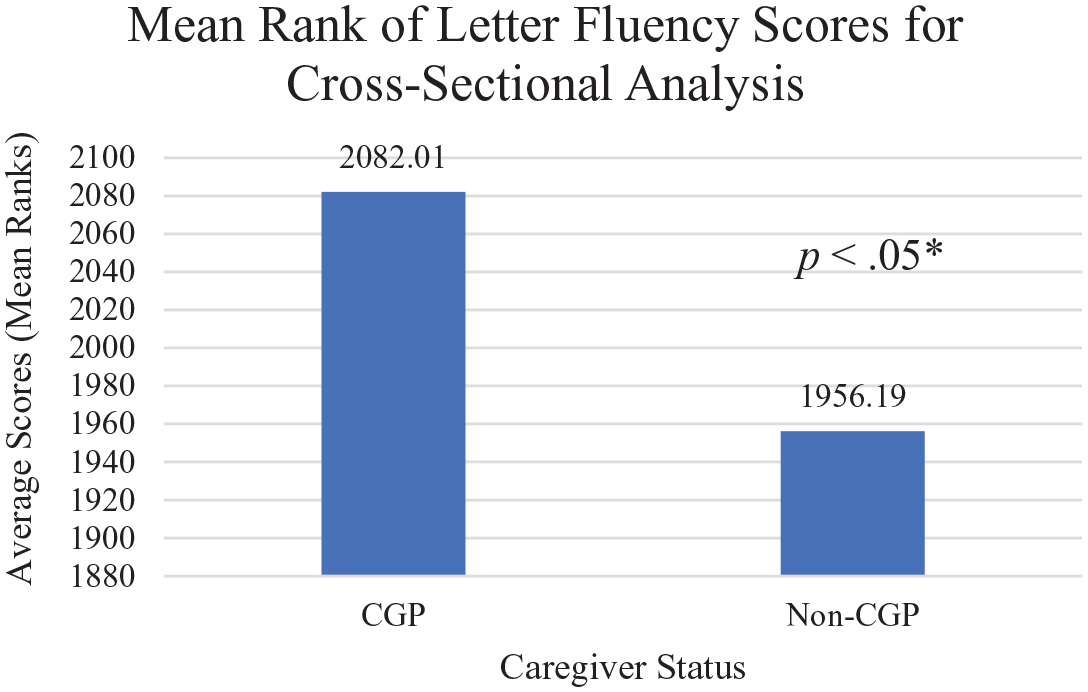
Mean rank comparisons on the Letter Fluency Task. The Letter Fluency task requires participants to produce as many possible words that begin with a given letter. Caregiver status is defined as whether or not one had reported increased responsibility for their grandchild.
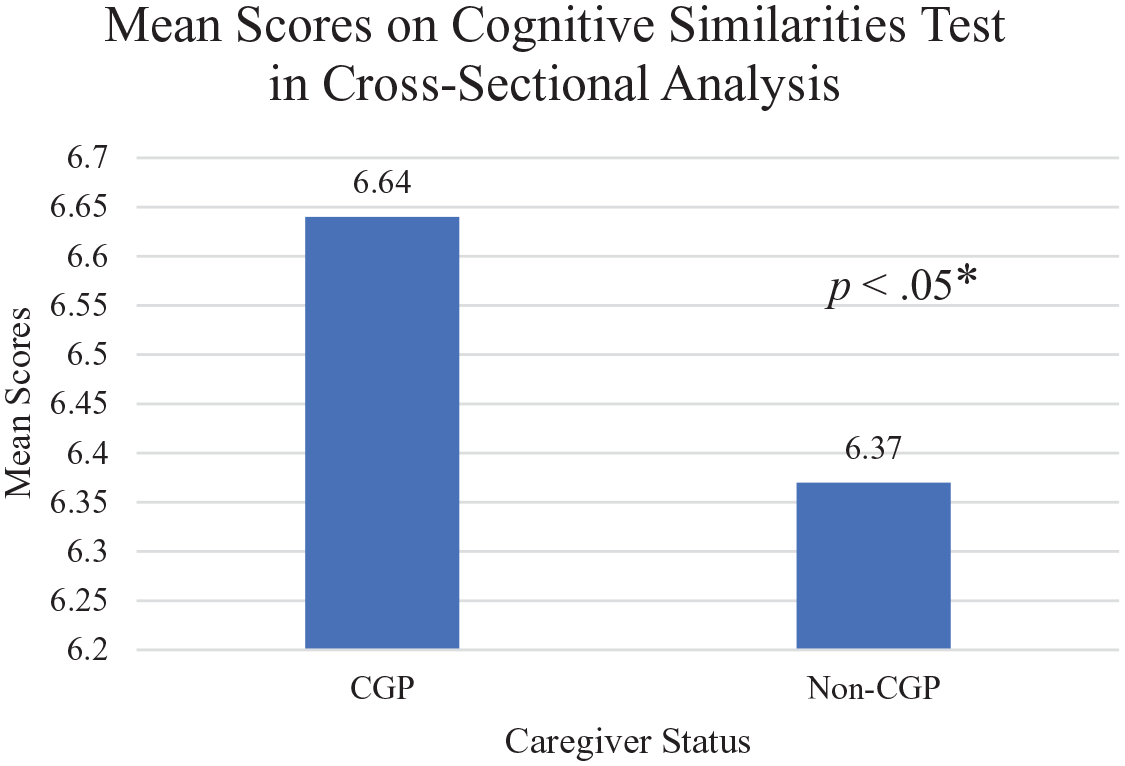
Mean comparisons on the Cognitive Similarities Task. The Cognitive Similarities task requires participants to identify qualitative relationships between sets of two words. Caregiver status is defined as whether or not one had reported increased responsibility for their grandchild.
Hypothesis 2
To examine the hypothesis 2, that there would be a significant time by caregiving status interaction affecting cognitive performance over two waves, a mixed factorial ANOVA was conducted. The IV of caregiver status consisted of two groups: custodial grandparents (312 participants), and non-custodial grandparents (1,097 participants). 45.1% of our sample was male, while 54.9% was female. The dependent variable of cognition was assessed using the cognitive similarities, phonemic fluency, semantic fluency, and digit-ordering tasks from the 2003 and 2011 waves (hereafter referred to as “Wave 1” and “Wave 2”). Based on Burn’s findings (2014), a power analysis indicated that a total of 2,456 participants would be sufficient to provide 0.8 statistical power within these analyses.
The results of the mixed factorial ANOVA indicated that there were significant differences on the digit-ordering task as a result of caregiver status over time, F (1,1407) = 4.44, p = .035, (ηp2) = .00. There were no significant differences on the category fluency task (F [1,1407], = 1.77, p = .184, [ηp2] = .001), letter fluency task (F [1,1407] = .090, p = .764, [ηp2] = .00), and cognitive similarities task (F [1,1407] = .763, p = .383, [ηp2] = .00), as a result of caregiver status over time. Post hoc tests revealed were statistically significant differences on scores of digit-ordering between Wave 1 and Wave 2. As shown in Figure 5, custodial grandparents mean scores on digit ordering were lower at Wave 1 (M = 5.76, SD = 1.57, 95% CI [5.95,5.93]) but declined at a much slower rate to Wave 2 (M = 5.73, SD = 1.36, 95% CI [5.58, 5.88]) when compared to non-custodial grandparents, whose scores were initially much higher at Wave 1 (M = 5.99, SD = 1.57, 95% CI [5.90, 6.08]) but declined at a significantly faster rate to Wave 2 (M = 5.73, SD = 1.36, 95% CI [5.65, 5.81]). The interaction between digit ordering scores over two time points and caregiver status can be found in Figure 5.

Interaction between digit ordering scores over two time points and caregiver status. The digit ordering task required participants to verbally recite a string of numbers from memory. Caregiver status is defined as whether or not one had reported increased reasonability for their grandchild.
Discussion
Results from the cross-sectional analysis indicated that differences between custodial and non-custodial grandparents emerged on tests of word recall, semantic fluency, phonemic fluency, and cognitive similarities, with custodial grandparents performing better than non-custodials on these tasks. Results from the longitudinal analysis indicated differences between custodial grandparents and non-custodial grandparents on the digit-ordering task. Though custodial grandparents’ scores were lower than non-custodials at Wave 1, they declined at a much slower rate than non-custodial grandparents from Wave 1 to Wave 2. There are several reasons to support this disparity in performance. However, the longitudinal analysis findings should be interpreted with caution due to the underpowered nature of our study. In other words, given that the second hypothesis’ power analysis suggested a sample size of 2,456 participants and the current sample has 1,097, it is likely underpowered to detect a significant effect. Though the current sample is significantly less than the suggested sample size, there was a significant time by caregiving status interaction effect detected, affecting cognitive performance over two waves, indicating the importance of further investigation in this area.
When comparing our findings to the results from prior research, the findings are somewhat mixed. For instance, we observed differences across scores on the word recall test. Similar findings emerged in Sneed and Schultz’s (2019) study. However, we also observed differences in the digit ordering test that were not found using somewhat-similar assessment tools across two of the previously mentioned studies. Similar to Arpino and Bordone’s (2014) study results, we also observed differences across both groups of grandparents in the verbal fluency domain.
When generalizing results from our study to prior research findings, essential concerns need to be addressed. For example, the studies mentioned earlier used different assessment tools to examine cognition. As our sample demographics differed across studies, scores were likely normed on different populations. Further, these tests were made by different publishing companies and employed different scoring methods/cut-off scores. As there was also a general IQ test given during the first wave of data collection (1957), archived scores were not available at the time of the study. Thus, it could not be compared to current scores on tests assessing similar areas of functioning. Lastly, previous studies had included tests assessing domains such as mental status (i.e., orientation), processing speed (i.e., Symbol-Digit Modalities test), and episodic verbal memory (i.e., California Verbal Learning Task) that were not only unstandardized but also not directly assessed in our study. Thus, caution must be taken when generalizing findings across domains and various assessment measures in the currently limited number of studies assessing the cognitive impacts of increased grandparent caregiving responsibilities.
As group differences had only emerged on the digit ordering task in the longitudinal analysis, further examination of this finding is warranted. Though custodial grandparents performed worse during the first wave of data collection, they declined at a much-less progressive rate than non-custodial counterparts. Lower performance during the first wave of data collection can possibly be attributed to adverse circumstantial variables (e.g., lower educational attainment, increased stress levels, and stereotype threat; Hughes et al., 2007). However, the less-pronounced cognitive decline over the two data collection waves suggests a potential buffering effect for custodial caregivers. Thus, custodial grandparent’s additional caregiving responsibilities may have resulted in the continued use of cognitive skills, therefore buffering against their deterioration. Consistent with the Disuse Theory of Aging (Christensen, 1993), our findings support the cognitive benefits of engaging in additional caretaking responsibilities that likely require the use and refining of additional cognitive resources. Tasks such as helping with grandchildren’s homework may help these caregivers to remain “sharp” with less additional effort than necessary from their peers.
Though there is no objective definition of what constitutes “successful aging,” the definition in the referenced study by Harada and colleagues’ (2013) includes “The performance on cognitive tests as well as structural deficits on scans utilizing neuroimaging techniques (e.g., hippocampal volumes, grey matter atrophy, and white matter lesions” (Harada et al., 2013, p. 749). Aside from these commonly used assessment techniques, two other methods are frequently used (i.e., self-report/informant report, and assessing of what is important in the aging process at an individual level; Harmell et al., 2014). Though the assessment of “successful aging” is both controversial and encompasses a wide range of outcomes that vary by culture, our study only assessed a small component of what is typically assessed when determining the trajectory of aging at both the individual and group levels.
As outlined in the literature review, there is a well-established research base stressing the harmful effects of becoming a custodial grandparent (e.g., increased levels of perceived stress, increased infections, and insufficient sleep). However, custodial grandparents in our sample are performing almost equal to and even slightly better than their age-matched peers on various tests of cognitive ability.
Limitations
Though our sample size was large, our sample was comprised of graduates of Wisconsin High Schools in 1957, and thus not geographically representative of other states or countries. Our sample was also limited in how custodial grandparenting was defined. However, it was an improvement from prior research, which has typically examined “time-spent” with a grandchild and did not attempt to parcel out custodial grandparents within the analyses. Concerning methodological implications, our research design was limited in that the use of archival data prevented changes from being implemented that would have aided in the assessment of the original research question(s). For example, had we been able to ensure that each participant completed all cognitive assessments over both time points, this might have increased the longitudinal analysis’s statistical power. As there are many techniques used to assess cognitive functioning, we were limited in that we could only utilize the data obtained from objective methods of assessment used by the original researchers. Raw scores were also only provided for all tests of cognition. It is important to note that standardized scores could not be calculated due to the lack of clarity surrounding their slight modification of testing materials. However, our participants were all graduates from Wisconsin high schools in 1957, and thus were likely all in a similar age range at both points of data collection. Additionally, research suggests that using raw scores when using longitudinal data helps to prevent potential floor effects that may emerge through the use of standardized scores. Authors note that standardized scores lack sensitivity in the low ranges where individuals who may be likely to perform poorly on a test may fall (Quintin et al., 2016).
Future Directions
Future studies are encouraged to obtain and examine cross-sectional and longitudinal samples rich in demographically diverse grandparents raising grandchildren. Additionally, examining the number and type of caregiving responsibilities would help better understand the influence of various caregiving responsibilities and the impact of time spent caregiving (i.e., part-time or full-time) on various cognitive tasks. As an extension of this study, future research should aim to elucidate the cognitive impacts of increased caregiving responsibilities in a sample of grandparents using more comprehensive methods to assess cognitive functioning (i.e., self-report, neuroimaging techniques, and scores on cognitive tests) and assessing a wider range of cognitive domains. As the cognitive subtests in our study were garnered from different cognitive tests (e.g., the McArdle & Woodcock achievement test, and WAIS), future research is also encouraged to use subtests taken from a single measure to reduce any testing variability. Lastly, future research should also be sure to use standardized scores, as they reflect an examinee’s performance relative to the standardization sample.
Conclusion
The research findings revealed that custodial grandparents outperformed non-custodial grandparents in the cross-sectional analysis on four tests of cognitive abilities, namely, word recall, cognitive similarities, letter fluency, and category fluency. Findings also revealed that though custodial grandparents performed worse initially on the digit ordering task, their scores over-time declined at a much slower rate than their non-custodial grandparent counterparts. Additionally, findings suggest that custodial grandparenting may influence specific components of one’s cognitive abilities while leaving others in-tact. In sum, the study employed a rigorous methodological and statistical design to address a research question that had not yet been examined. Despite the limitations mentioned, the study has made an essential contribution by explicitly examining the impact of custodial grandparenting on cognition levels.
Footnotes
Authors’ Note
Mississippi State University Office of Research Compliance IRB Approval Number: 17-659.
Declaration of Conflicting Interests
The author(s) declared no potential conflicts of interest with respect to the research, authorship, and/or publication of this article.
Funding
The author(s) received no financial support for the research, authorship, and/or publication of this article.
