



Abstract
Whereas childcare responsibilities are temporary, relationships with children are lifelong. This study examines how parents’ satisfaction with their partners’ relationships with offspring (i.e., “partner–child relationship satisfaction”) influences marital satisfaction, how this compares to the influence of satisfaction with the division of childcare, and how these processes work differently by gender. The author theorizes that partner–child relationship satisfaction shapes marital satisfaction through “impression spillover,” whereby one’s feelings about a relationship between other individuals transfer into feelings about one’s own relationship with one of those individuals. Hypotheses are tested with fixed effects regression using matched-partner data from four waves of the HILDA Survey (N=3804 person-years). Findings suggest that partner–child relationship satisfaction is associated with marital satisfaction, especially among women. Women’s marital satisfaction is influenced more by partner–child relationship satisfaction than by division of childcare satisfaction; conversely, for men, there is little distinction between the two associations. Findings offer support for impression spillover.
Keywords
Parenthood influences marital quality in important ways. Within sociology, one of the most widely studied factors linking parenthood and marital quality is the division of household labor and childcare. Parents who are satisfied with their divisions of labor experience better marital satisfaction (Schieman, Ruppanner, & Milkie, 2018); conversely, those who feel negatively about their divisions of labor are more likely to divorce (Ruppanner, Brandén, & Turunen, 2018). Although past research has examined how marital satisfaction is shaped by the perceived quantitative contributions of one’s partner (e.g., number of hours or tasks), it is less clear how the perceived qualitative components of a partner’s parenting (e.g., their emotional bonds to the children) influence marital satisfaction. Given that relationships with children are irreplaceable and lifelong and poor marital quality has harmful effects on both physical and psychological well-being (Thomas, Liu, & Umberson, 2017; Umberson, Williams, Powers, Liu, & Needham, 2006), parenthood’s ties to marital quality warrant further exploration. In the present study, I examine how parents’ satisfaction with their partners’ relationship with their children (i.e., “partner–child relationship satisfaction”) influences marital satisfaction through a theoretical extension of the spillover hypothesis I term “impression spillover.” I also examine how the influence of partner–child relationship satisfaction compares to the influence of satisfaction with the division of childcare tasks and explore how these processes work differently by the parent’s gender.
This study contributes to family research by offering a theoretical framework for how one’s feelings about a relationship between other family members (e.g., the partner–child relationship) can transfer into feelings about one’s own direct relationship with one of those individuals (e.g., the marriage with one’s partner), and also by bridging research on household labor and spillover. To my knowledge, no studies compare whether marital satisfaction is influenced more by satisfaction with the partner–child relationship or by satisfaction with the division of childcare. This omission is significant because routine childcare is a temporary responsibility but relationships with children last a lifetime. The contributions of this study are underscored by the use of nationally representative, longitudinal, matched-partner data. Past research suggests that the marital satisfaction of one’s partner is an important predictor of one’s own later marital satisfaction (Le, McDaniel, Leavitt, & Feinberg, 2016). However, these effects cannot be accounted for with single-respondent data. As such, this study responds to calls for research on parenting and marital satisfaction that uses longitudinal designs and data from both partners (Schieman et al., 2018).
Theoretical Framework
Families are complex, interdependent systems wherein the dyadic relationships among family members influence and are influenced by one another (Cox & Paley, 1997; Minuchin, 1974). Family systems research often explores these influences through “spillover” and “crossover” (e.g., Zemp, Nussbeck, Cummings, & Bodenmann, 2017). Crossover refers to the transfer of affect between people (Larson & Almeida, 1999; Neff & Karney, 2007), such as a wife’s marital satisfaction influencing her husband’s marital satisfaction. Spillover refers to the transfer of affect between one’s own direct relationships (Almeida, Wethington, & Chandler, 1999; Erel & Burman, 1995), such as a mother’s satisfaction with her relationship with her children influencing her satisfaction with her relationship with her partner. However, neither spillover nor crossover frameworks in their classic conceptions adequately describe the transfer of affect from family relationships that one is not involved in—but still forms impressions about—to family relationships in which one is involved. In other words, neither framework explains how being pleased with the relationship between one’s spouse and one’s children may make one more pleased with one’s spouse. As such, I extend the concept of spillover by hypothesizing that partner-child relationship satisfaction shapes marital satisfaction through what I term “impression spillover,” whereby one’s feelings about a relationship between other individuals transfer into feelings about one’s own direct relationship with one of those individuals.
Theoretical Comparison of Crossover, Spillover, and Impression Spillover.
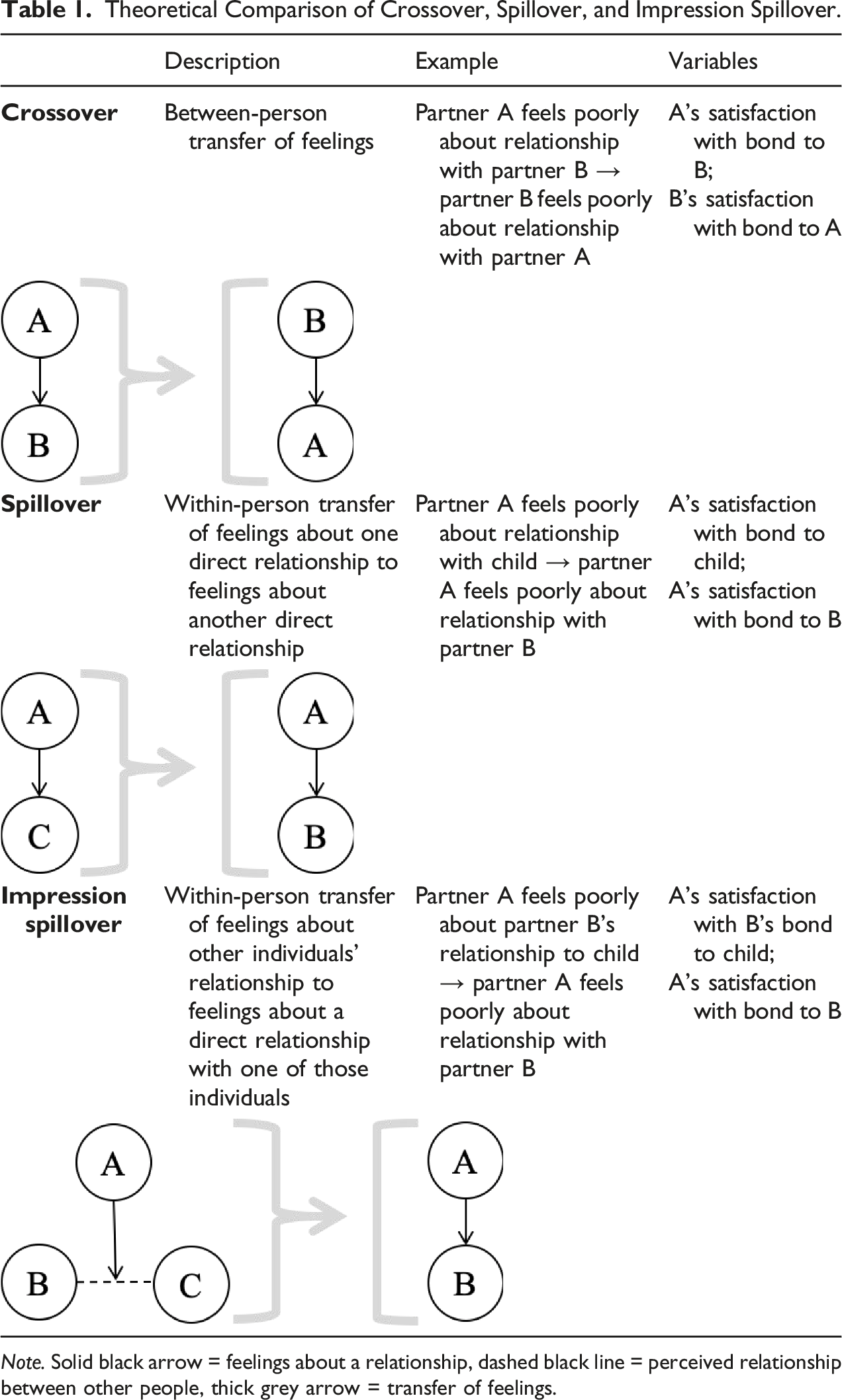
Note. Solid black arrow = feelings about a relationship, dashed black line = perceived relationship between other people, thick grey arrow = transfer of feelings.
Partner–Child Relationship Satisfaction
Although impression spillover provides a theoretical basis for how partner–child relationship satisfaction may be related to marital satisfaction, empirical evidence of this association is scant. In a unique exception, Galovan, Holmes, Schramm, and Lee (2014) found that mothers’ perceptions of father–child relationship quality were associated with their marital quality. However, fathers’ perceptions of mother–child relationship quality were not assessed and participants’ children were all under the age of six, a time in which satisfaction with parenting is often disproportionately higher (Nomaguchi, 2012). Conversely, Pederson (2017) found that fathers’ appraisals for mothers’ parenting were associated with fathers’ marital quality. Both of these studies used cross-sectional designs and small, non-representative samples; nevertheless, their findings provide some reason to expect that impressions of partner-child relationships can spill into marital relationships. H1: Partner–child relationship satisfaction will be positively associated with marital satisfaction.
Gender Differences
The link between partner–child relationship satisfaction and marital satisfaction may differ by gender. In the context of the present study’s specific focus on heterosexual marriages, this association may be stronger among mothers given that mothers may witness more of their partner’s bond with children than do fathers (Craig, Powell, & Smyth, 2014; Mattingly & Bianchi, 2003), thus creating greater opportunity for impression formation. Time use research suggests that although mothers spend more overall time with children, the proportion of mother–child time during which the other parent is also present is comparatively smaller than it is for father–child time (Craig et al., 2014; Mattingly & Bianchi, 2003). Being more present during fathers’ time with children may heighten mothers’ awareness of partner–child relationship quality, creating greater potential for these impressions to spill into their marital satisfaction.
Greater impression spillover among mothers may also be attributable to their greater emotional investment in father–child bonds. “Maternal gatekeeping” describes how mothers may engage in efforts to either constrain or facilitate fathers’ relationships to children (Allen & Hawkins, 1999; Fagan & Barnett, 2003; Meteyer & Perry-Jenkins, 2010), which may suggest that satisfaction with these relationships is also more salient to women’s marital satisfaction. Mothers often act as “gate openers”—devoting great effort toward strengthening father–child ties by facilitating bonding activities, relaying children’s enjoyment, praising and encouraging fathers’ engagement, and organizing family events (Schoppe-Sullivan et al., 2008; Seery & Crowley, 2000). However, some may act as “gate closers”—limiting fathers’ involvement with children, sometimes in order to uphold the superiority of their own bonds with children (Allen & Hawkins, 1999; Altenburger, Schoppe-Sullivan, & Kamp Dush, 2018; Fagan & Barnett, 2003; Schoppe-Sullivan, Brown, Cannon, Mangelsdorf, & Sokolowski, 2008). Both expressions of gatekeeping point to mothers’ roles in shaping partner–child relationships, which suggests that mothers’ feelings about these bonds may be more consequential for their marital satisfaction, resulting in stronger impression spillover. H2: Partner–child relationship satisfaction will be associated with marital satisfaction more strongly for women than men.
Comparing Partner–Child Relationship Satisfaction to Division of Childcare Satisfaction
Given the little research on partner–child relationship satisfaction, comparing its influence on marital quality to the influence of childcare satisfaction, a construct that is more established in the literature, can help contextualize the present study. Past research suggests that satisfaction with or subjective fairness of the division of household labor and childcare is associated with marital quality (Biehle & Mickelson, 2012; Carlson, Hanson, & Fitzroy, 2016; Ruppanner et al., 2018; Schieman et al., 2018). Satisfaction with the division of childcare and partner–child relationship satisfaction can be seen as two sides of the same coin; that is, the former represents satisfaction with the quantitative side (e.g., childcare hours or tasks), and the latter represents satisfaction with the qualitative side (e.g., emotional bonds to children) of a partner’s parenting.
Although past research provides ample reason to expect that childcare distributions play an important role in marital satisfaction, impressions of partner–child relationships may play an even greater role, particularly for women’s marital satisfaction. Focusing narrowly on involvement in childcare tasks excludes a myriad of other ways that parenthood is constructed and enacted. Childcare may not be as central to the social meanings attached to fatherhood as it is to motherhood (Craig, 2006; Lemay et al., 2010; Tropp & Kelly, 2015). Fathers more often build emotional bonds with their children through play, talk, leisure activities, and teaching skills, rather than daily routine care (Craig, 2006; Craig et al., 2014; Creighton et al., 2015; Schoppe‐Sullivan & Fagan, 2020). Fathers may also maintain positive parenting impressions in their wives’ eyes by ensuring their attendance at children’s events, engaging in “public fatherhood” (Shows & Gerstel, 2009) and by providing financially for families (Lemay et al., 2010). Therefore, given that “good” fathering is less synonymous with participation in childcare, mothers’ marital satisfaction may hinge less on their satisfaction with the division of childcare and more on their satisfaction with fathers’ overall relationships to their children.
Motherhood, too, encompasses much more than childcare. Mothers tend to coordinate children’s activities, plan for children’s futures, shoulder childrearing decisions, and take “emotional responsibility” for their children (e.g., Doucet, 2001; Erickson, 2005; Robertson, Anderson, Hall, & Kim, 2019). However, these emotional and managerial aspects of mother–child relationships are arguably less visible to fathers than the play and recreation aspects of father–child relationships are to mothers (Daminger, 2019; Mattingly & Bianchi, 2003; Mederer, 1993; Robertson et al., 2019). Therefore, the lower visibility of mothers’ non-childcare parental involvements offers little reason to expect a meaningful distinction between partner–child relationship satisfaction and satisfaction with the division of childcare in their ties to fathers’ marital satisfaction. H3: Satisfaction with the division of childcare will be positively associated with marital satisfaction. H4: Among women, partner–child relationship satisfaction will be associated with marital satisfaction more strongly than will satisfaction with the division of childcare.
Method
Data
Data came from the Household, Income and Labour Dynamics in Australia (HILDA) Survey. Analyses were limited to waves 6 (2006), 9 (2009), 12 (2012), and 16 (2016) because these were the only waves containing items for all key variables. HILDA is a nationally representative Australian panel survey that began in 2001 and currently has 19 waves (for more detail, see Summerfield et al., 2018). A combination of self-completion questionnaires and face-to-face or telephone interviews were used to interview all household members aged 15 and older in participating households annually. The household response rate (66%) and individual response rate (92%) for Wave 1 are comparable to other similar panel studies (Wooden, Freidin, & Watson, 2002). Wave 1 gathered data from 13,969 individuals nested within 7682 households. Individuals may enter the study temporarily if they join a participating household and may become permanent participants through parenthood with another participant. HILDA’s matched-partner design makes it well suited for analyses of marital satisfaction and gender differences (Gager & Sanchez, 2003; Jackson, Miller, Oka, & Henry, 2014).
To create the analytic sample, data were first restricted to different-sex couples in legal or de-facto marriages wherein both partners participated in at least two of the four waves, had non-missing data on the dependent variable (i.e., three or more of the six items in the marital satisfaction scale), and did not identify as gay or lesbian at any of the four waves. Because divisions of parenting labor differ considerably in single-earner households, the sample was then restricted to person-years at which respondents were in dual-earner relationships, defined as those wherein both partners work a minimum of eight hours (i.e., one standard work day) per week. Next, following past research (Gracia & Ghysels, 2017), the sample was restricted to person-years at which respondents had biological or adopted children under the age of 16 living at home. This was done because as children enter adolescence, their needs for childcare decrease (Kalil, Ryan, & Corey, 2012) and, in particular, their needs for transportation, an important aspect of childcare, may decrease considerably upon reaching legal permit age (Craig, 2006). 1 These restrictions left an eligible sample of 4312 person-year observations, prior to addressing missing data on independent variables.
Descriptive Statistics for Women and Men (N = 3804).
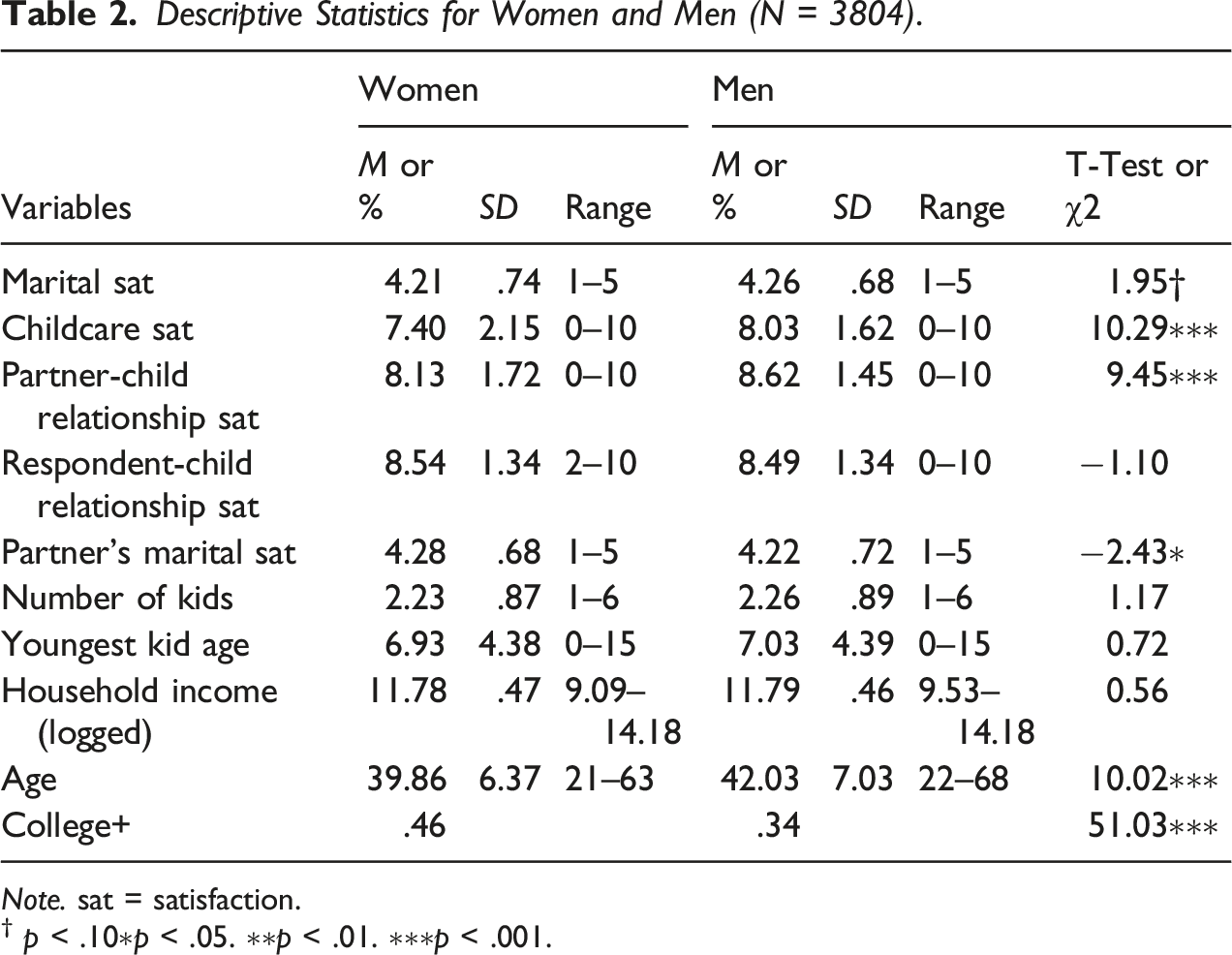
Note. sat = satisfaction.
† p < .10∗p < .05. ∗∗p < .01. ∗∗∗p < .001.
Measures
Analytic Plan
Hypotheses were tested using fixed effects regression. By controlling for any variation due to both observed and unobserved time-stable characteristics, fixed effects enables estimates based solely on within-person variation over time. This allows for a useful examination of how within-person change in predictor variables across a series of time points is associated with within-person change in outcome variables across the same time points (Allison, 2009). Given the non-independence of respondents’ reports due to the clustering of partners and the clustering of person-year observations by respondent ID, robust standard errors were used in all models. Age (which was perfectly collinear with survey wave) was included in all models to account for time. Multicollinearity in Model 3 was assessed with the variance inflation factor (VIF). VIFs for both men’s and women’s Model 3 variables were all under 2.5, indicating no multicollinearity problems (Allison, 1999).
Model 1 regressed marital satisfaction on division of childcare satisfaction. Partner–child relationship satisfaction was added in Model 2. Control variables were added in Model 3 to see if these variables could help clarify the relationships among the focal variables. Post-estimation tests were used to test the gender difference in partner–child relationship satisfaction’s link to marital satisfaction in Model 3, and to test whether partner–child relationship satisfaction and childcare satisfaction differed in their associations with marital satisfaction in Model 3. Testing differences between unstandardized coefficients for partner–child relationship satisfaction and childcare satisfaction was appropriate given that they were measured on the same scales (i.e., 0 ‘Completely dissatisfied’ to 10 ‘Completely satisfied’). Findings are presented separately for men and women.
Results
Gender differences on descriptive statistics were tested using t-tests for continuous variables or chi-square tests on categorical variables (see Table 2). Regarding focal variables, men had higher partner–child relationship satisfaction and division of childcare satisfaction. Regarding control variables, women were younger, more likely to have college educations, and had partners with higher marital satisfaction. Bivariate correlations were also examined prior to turning to regression models. The largest correlations were between partner–child relationship satisfaction and satisfaction with one’s own relationship to one’s children (r = .66, p < .001) and between one’s own and one’s partner’s marital satisfaction (r = .60, p < .001). 2
Summary of Fixed Effects Regressions of Women’s and Men’s Marital Satisfaction (N = 3804).
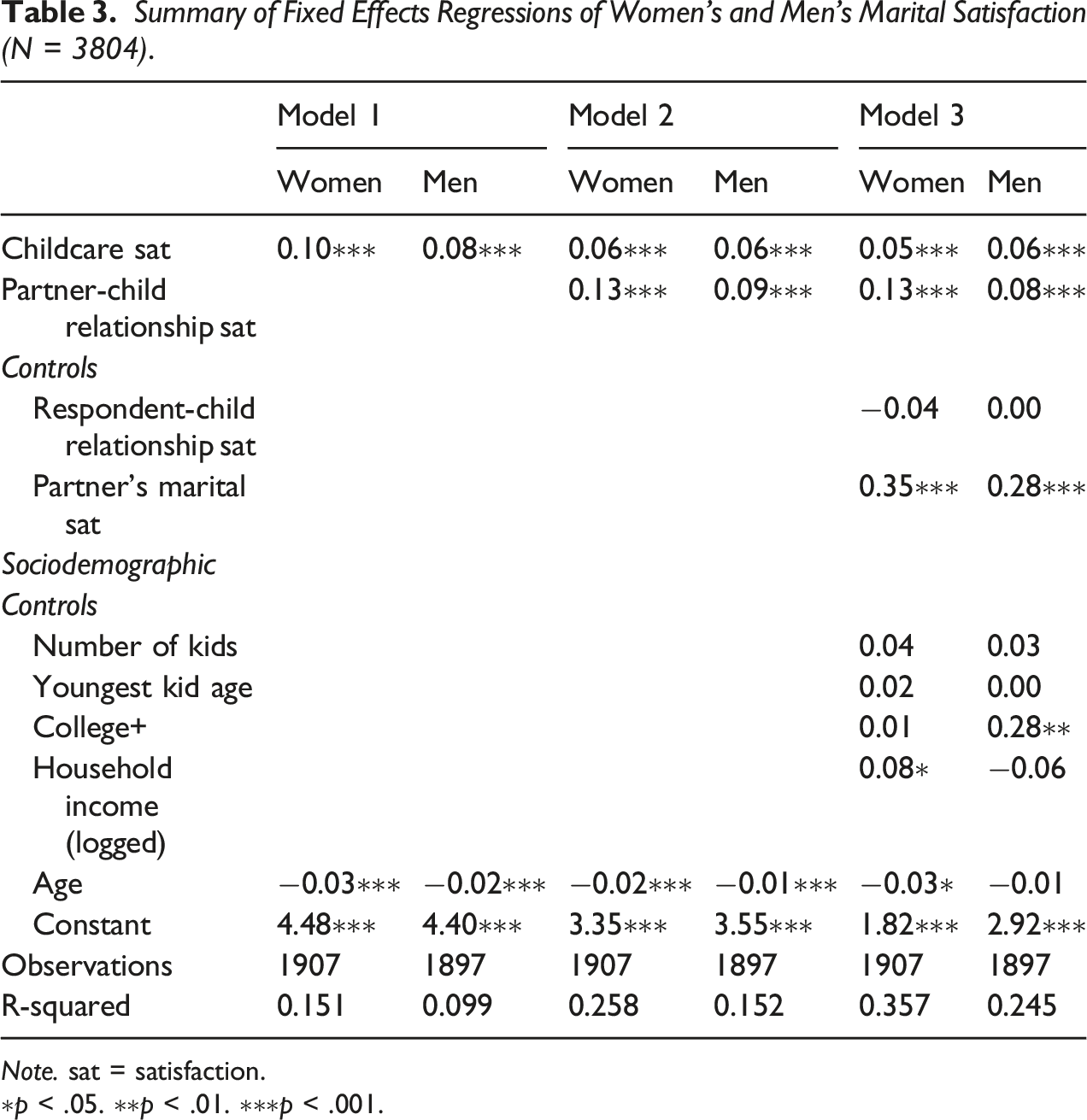
Note. sat = satisfaction.
∗p < .05. ∗∗p < .01. ∗∗∗p < .001.
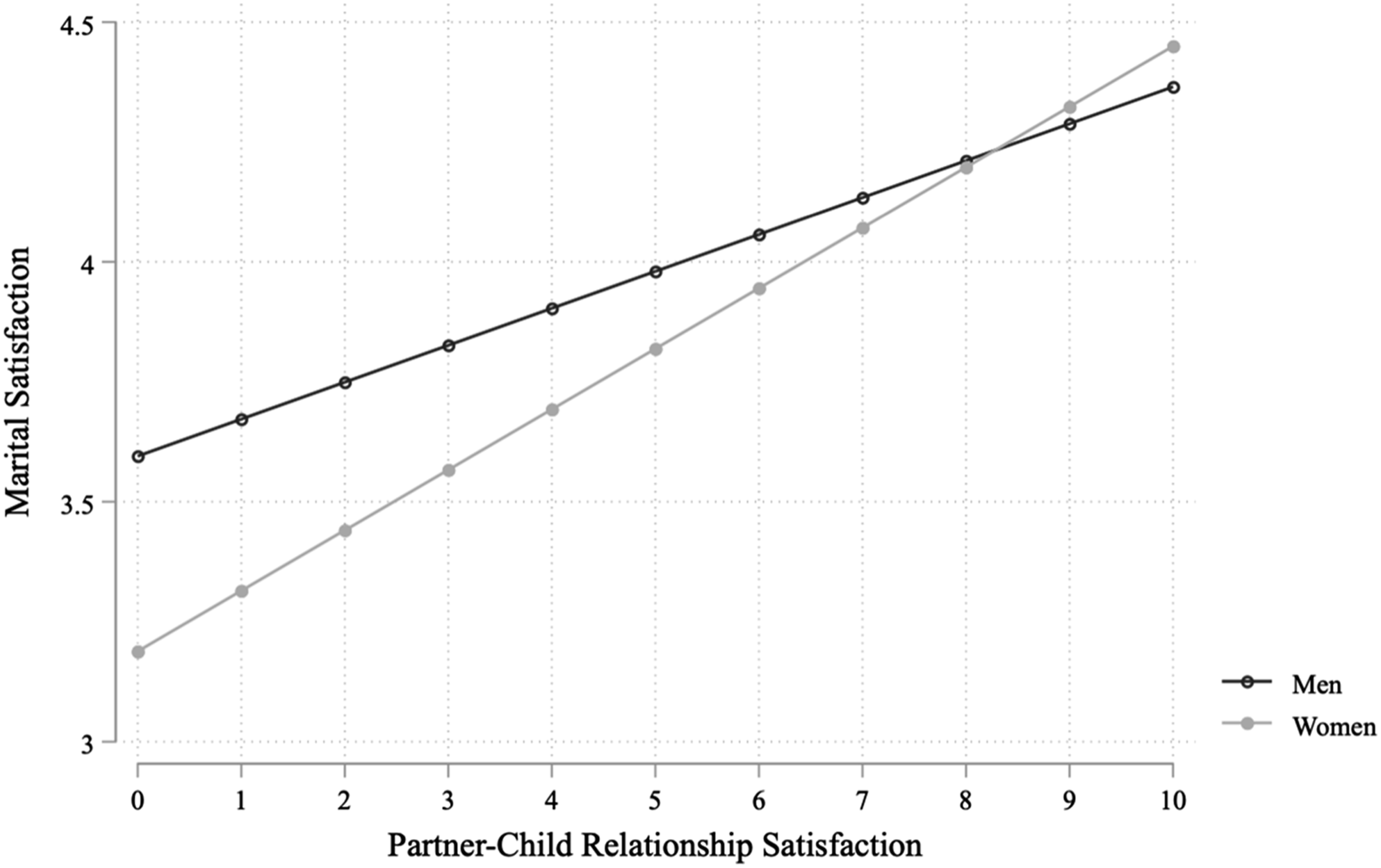
Marital satisfaction based on partner-child relationship satisfaction and gender. Note. Plotted predictions from the men’s and women’s models were combined using Winter (2020) ‘combomarginsplot’ command for Stata.
Finally, turning to the control variables (Model 3), the marital satisfaction of one’s partner was associated with one’s own marital satisfaction for both women and men (bwomen = .35, p < .001; bmen = .28, p < .001), consistent with past research (Le et al., 2016). Additionally, for women, logged household income was associated with higher marital satisfaction (b = .08, p < .05) and age was associated with lower marital satisfaction (b = - .03, p < .05). For men, having a college degree was associated with higher marital satisfaction (b = .28, p < .010).
Discussion
Using four waves of the HILDA survey, I examined how partner–child relationship satisfaction influences marital satisfaction, how this compares to the influence of satisfaction with the division of childcare tasks, and how these processes work differently by gender. I hypothesized that the association between partner-child relationship satisfaction and marital satisfaction could be understood as a form of “impression spillover,” whereby one’s feelings about a relationship between other individuals (e.g., the relationship between one’s spouse and one’s child(ren)) transfer into feelings about one’s own direct relationship with one of those individuals (e.g., one’s marriage). In support of all hypotheses, findings suggest that satisfaction with the partner–child relationship has a strong link to marital satisfaction, that this is especially true for women, and that, although division of childcare satisfaction influences marital satisfaction for both men and women, women’s marital satisfaction is associated more strongly with partner–child relationship satisfaction, whereas for men, the effects of partner–child relationship satisfaction and satisfaction with the division of childcare are not distinguishable in magnitude.
Analyses revealed a strong link between partner–child relationship satisfaction and marital satisfaction, lending support for the impression spillover hypothesis. Put simply, this finding suggests that marriages benefit when spouses see each other as maintaining good relationships with their children. This is consistent with family systems theory’s emphasis on the interdependence of family relationships (Cox & Paley, 1997; Minuchin, 1974). Given this inherent interdependence, perceptions of partner–child relationships can become tightly interwoven with perceptions of one’s own marital relationship to one’s partner, creating the potential for impression spillover.
Although not the focus of this study, it warrants some mention that one’s own relationship with one’s children was not associated with marital satisfaction, net of the other key variables. This offers little support for classic spillover hypotheses regarding the potential for one’s relationship with one’s children to affect one’s relationship with one’s partner (Almeida et al., 1999; Erel & Burman, 1995). These findings do not challenge the notion that daily interactions with one’s partner are shaped by the affect produced by daily interactions with one’s children and vice versa (e.g., Kouros, Papp, Goeke-Morey, & Cummings, 2014; Sherrill, Lochman, DeCoster, & Stromeyer, 2017; Zemp et al., 2017); rather, findings suggest that when examining the interconnections among these relationships across intervals of several years, partner–child relationship satisfaction has a much stronger link to marital satisfaction than does satisfaction with one’s own relationship to one’s children.
This study builds upon past cross-sectional studies of smaller, non-representative samples that suggested links between partner–child relationship satisfaction and marital satisfaction among either mothers (Galovan et al., 2014) or fathers (Pedersen, 2017). Findings suggest longitudinal evidence of this link for both mothers and fathers, although mothers’ marital satisfaction was influenced more strongly by their satisfaction with father–child relationships than fathers’ marital satisfaction was by their satisfaction with mother–child relationships. This is consistent with past research on time use suggesting that a greater portion of fathers’ leisure time with children is “shared,” or in the presence of mothers (Craig et al., 2014; Mattingly & Bianchi, 2003). In contrast, mothers spend more total time with children but fathers are less likely to witness it (Craig et al., 2014; Mattingly & Bianchi, 2003). This higher proportionate visibility of father–child relationships (a point I return to later) likely creates greater opportunity for mothers to form impressions of their partners’ parenting that subsequently influence their marital satisfaction.
Findings also align with maternal gatekeeping research that suggests that mothers are often more invested in father–child bonds, either through “gate opening” to encourage these bonds or “gate closing” to inhibit fathers’ bonds with children (Allen & Hawkins, 1999; Fagan & Barnett, 2003; Seery & Crowley, 2000). The finding that impressions of partner–child relationships showed greater spillover into mothers’ marital satisfaction than fathers’ builds upon gatekeeping literature given that this gender difference can be understood within the context of mothers’ greater investments in managing father–child relationships (Schoppe‐Sullivan & Fagan, 2020; Seery & Crowley, 2000). This highlights how family processes are often gendered processes.
Gender was also salient in the comparison of partner–child relationship satisfaction to satisfaction with the division of childcare. As expected, satisfaction with the division of childcare was related to marital satisfaction for both women and men. This supports the findings of past cross-sectional work on childcare distributions (e.g., Schieman et al., 2018) and is consistent with the bulk of the literature on household and family labor (e.g., Biehle & Mickelson, 2012; Ruppanner et al., 2018). What could not be known from past literature, however, was whether marital satisfaction is shaped more strongly by satisfaction with quantitative contributions of one’s partner (e.g., childcare hours or tasks) or satisfaction with qualitative components of a partner’s parenting (e.g., emotional bonds to children). Findings suggest that the answer to this question differs for men and women.
For women, satisfaction with father–child relationships was associated with marital satisfaction more strongly than was satisfaction with the division of childcare. However, among men, the magnitude of the association between satisfaction with mother–child relationships and marital satisfaction was not distinguishable from the association between satisfaction with the division of childcare and marital satisfaction. Given that childcare is often less central to social meanings of fatherhood (e.g., Tropp & Kelly, 2015), this specific form of parental engagement may be less salient to mothers’ feelings about their partners. Fathering is often constructed around play, shared leisure, teaching skills, financial providing, and attending children’s events, more so than participating in the routine physical care of children (Craig et al., 2014; Creighton, Brussoni, Oliffe, & Olsen, 2015; Schoppe‐Sullivan & Fagan, 2020; Shows & Gerstel, 2009). Thus, there are often more—and, as previously discussed, higher visibility—opportunities outside of childcare for mothers to form impressions of father–child relationships that then spill into feelings about their marriages. In contrast, common aspects of mothering that are distinct from childcare, such as emotion work and family management, are largely invisible and “behind the scenes” work (e.g., Erickson, 2005; Mederer, 1993). These differential constructions of mothering and fathering, along with their differential visibility to partners, help contextualize the finding that partner–child relationship satisfaction was more influential than was childcare satisfaction in shaping women’s, but not men’s, marital satisfaction. Given that women’s dissatisfaction with divisions of labor foreshadows divorce (Ruppanner et al., 2018), this finding is especially important, as it suggests that building strong bonds with women’s children may be one way for their partners to potentially enhance marital quality and help prevent marital dissolution.
Limitations
This study is, of course, not without limitations. First, both focal independent variables were measured with single items. Although single-item measures are less preferable to multi-item scales, they are more common for measuring perceptions of partners’ experiences (Matthews, Del Priore, Acitelli, & Barnes-Farrell, 2006; Young et al., 2014), and are generally common in family research (Akiyama, Elliott, & Antonucci, 1996; Connidis & Campbell, 1995; Spitze & Trent, 2006; Suitor et al., 2009). Moreover, given that measures with lower reliability, including single-item measures, tend to underestimate associations (Allison, 1999), this limitation should increase confidence in these findings, as results may have been even stronger had multi-item measures been available. Second, data limitations prevent a detailed examination of reciprocal effects, so interpretations of causality should be cautious. With waves that are three or more years apart and spaced unevenly, these data are not well suited to test causal directions due to the long duration between waves and potential unmeasured heterogeneity between them. Future research should investigate the degree to which the link between partner–child relationship satisfaction and marital satisfaction may operate reciprocally in the shorter-term, especially given that mothers’ marital satisfaction may influence greater parental involvement from fathers (Schober, 2012). Future research should also examine how children’s gender may interact with the effect of partner–child relationship satisfaction; for example, is mothers’ marital satisfaction influenced more by their feelings about their partners’ relationships with their sons or their daughters? Finally, these processes should also be explored in other family forms such as cohabiting parents, same-sex unions, and stepfamilies. Examining the robustness of the impression spillover hypothesis and exploring the utility of this framework in other family relationships—for example, impressions of siblings’ ties to older parents “spilling” into relationship satisfaction with siblings—can offer fruitful directions for family scholars.
Conclusions
This study makes several novel contributions to family research. Extending the classic spillover hypothesis from family systems literature, I posited that impressions of the relationship between one’s partner and one’s children could influence one’s marital satisfaction through “impression spillover,” whereby one’s feelings about a relationship between other individuals transfer into feelings about one’s own direct relationship with one of those individuals. In support of this theory, findings suggest that partner–child relationship satisfaction influences marital satisfaction, that this is especially true among women, and that, although satisfaction with the division of childcare influences marital satisfaction for both men and women, women’s marital satisfaction is associated more strongly with partner–child relationship satisfaction, whereas for men, there is little distinction between partner–child relationship satisfaction and satisfaction with the division of childcare in their associations with marital satisfaction. Whereas impressions of troubled partner–child ties may threaten marital stability, improving one’s relationships with one’s children may help to improve how one’s partner feels about the marriage. The fact that partner–child relationship satisfaction influenced women’s marital satisfaction over and above satisfaction with the division of childcare is especially noteworthy given that women’s dissatisfaction with divisions of labor can ultimately lead to divorce (Ruppanner et al., 2018). Therefore, building and sustaining strong bonds with women’s children may enable their partners to help maintain marital stability even when women are dissatisfied with the division of labor. Understanding these processes is important because poor marital quality can deteriorate health and well-being (Thomas et al., 2017; Umberson et al., 2006). Thus, this study offers valuable considerations for marriage counselors and other practitioners who work with distressed families.
Footnotes
Acknowledgments
I wish to thank Purdue University’s Center for Families for supporting this research through the Family Research Grant. I also wish to thank Patti Thomas for her supportive advising and useful comments on previous drafts of this paper, Jeremy Reynolds for his guidance on research design and data analysis, and Jill Suitor for her committee service and encouragement.
Declaration of Conflicting Interests
The author(s) declared no potential conflicts of interest with respect to the research, authorship, and/or publication of this article.
Funding
The author(s) disclosed receipt of the following financial support for the research, authorship, and/or publication of this article: This study was supported by the Family Research Grant from Purdue University’s Center For Families.
