




Abstract
Despite being the longest relationships across the lifespan, the sibling dyad is the most under-studied relationship in the family system. Researchers have documented the harmful and beneficial effects of sibling relationships and family dynamics on individual well-being. Extending this research to middle childhood, the current study examined family functioning, sibling relational dynamics, and self-reported adjustment and internalizing symptoms among 8- to 11-year-old children. Path analyses revealed significant direct effects between conflictual family functioning and children’s psychological well-being. Significant interactions between family functioning and sibling dynamics suggested that congruent relational dynamics at multiple levels of the family system had a cumulative impact on the child’s well-being. Findings from the current study highlight the role of family functioning and the unique contributions of sibling relationships to children’s functioning, suggesting that consideration of sibling relational dynamics may improve treatment planning by pointing out additional targets for intervention and/or potential sources of support.
Introduction
National data from 2010 indicated that over 80% of children in the United States were living with at least one sibling (King et al., 2010). At that time, the percentage of children living with a sibling was higher than the percentage of children living with a father figure in the household. Within the family literature, researchers consistently investigate and describe characteristics of the parent-child and marital relationships, with less attention devoted to the sibling relationship, despite it commonly being the most enduring relationship an individual will experience in their lifetime (Cicirelli, 1995; Rosen et al., 2002). While the sibling literature is slowly expanding, more research examining the unique contributions of siblings to individual development and well-being throughout various stages of the lifespan is needed.
In particular, significant developmental changes for both the family and the individual child occur in middle childhood, yet this time period has been largely neglected in the literature on the role of family factors in development (Huston & Ripke, 2006). Middle childhood is the developmental period ranging from age 6 years to 12 years old. During this stage, socio-emotional and cognitive development flourish as children begin taking a more active role in their own development. Children in middle childhood have a greater desire for autonomy, spend more time outside of the home, build social relationships with same-age peers, and develop additional emotional self-regulation strategies, all of which decrease their reliance on their parents (Geerts & Riggs, 2019). The sibling relationship is also changing during this stage of development, with children often spending more time with siblings than with parents (McHale & Crouter, 1996). Siblings aid in the development of self-identity and autonomy (McGuire et al., 2000), and provide support, advice, and friendship throughout middle childhood (Furman & Buhrmester, 1985), which is generally marked by an improvement in the overall quality of sibling relationships (Pike et al., 2005). Drawing from family systems theory, the current study examined associations between positive and negative perceptions of family functioning, sibling relational dynamics, and individual childhood outcomes.
Family systems researchers identify three distinct characteristics of the family system: (a) the family unit is greater than the relationships or individuals within; (b) the family system is comprised of subsystems (e.g., parent, sibling, and parent-child), each with their own unique structure and dynamics; and (c) families are living systems that can adapt and change (Cox & Paley, 2003). Various hypotheses regarding the interactions between subsystems in the family unit have emerged over the years. The Spillover Hypothesis posits that the emotional and behavioral characteristics of one subsystem will “spill over” into other subsystems of the family unit, thus influencing the interactions within both subsystems (Gerard et al., 2006; Nelson et al., 2009). For example, in a longitudinal study examining family functioning and sibling relationships, negativity in the parent-child relationship as well as hostility and conflict within the marital dyad predicted increased conflict in the sibling relationship (Kim et al., 2006). Whereas the Spillover Hypothesis states that similar behaviors occur across subsystems, the Compensatory Hypothesis posits that qualities observed in one subsystem will often be associated with complementary qualities in another subsystem (Engfer, 1988; Erel & Burman, 1995; Nelson et al., 2009). For instance, when there is conflict or negativity present within one family subsystem (i.e., marital discord), other close family relationships (e.g., siblings and grandparents) may buffer the child from negative outcomes by providing consistent support.
Characteristics of the family unit as a whole can affect the psychological and relational functioning of children (Lucia & Breslau, 2006; Luebbe & Bell, 2014). Morris and colleagues (2007) suggested that a positive family environment might enhance children’s ability to manage emotional and behavioral reactions, lessening the risk for developing internalizing or externalizing behaviors when exposed to stressors outside or inside the family. Additionally, low conflict families have likely developed beneficial conflict-resolution and problem-solving strategies, creating a model for children to utilize when they encounter personal conflict or distress (Cummings & Davies, 2002).
Conversely, highly conflictual family environments, characterized by hostility and aggression, are strongly associated with both internalizing (i.e., anxiety, depression, and low self-esteem) and externalizing symptoms in children (Cummings & Davies, 2002; Goeke-Morey et al., 2003). Moreover, family conflict in adolescence predicts more stressful life events in early adulthood (Herrenkohl et al., 2009), which, when combined with poor coping strategies, may result in additional psychological and emotional problems.
From a family systems standpoint, bidirectional effects between the family unit and the individual may also exist. For instance, Kelly and colleagues (2016) found that family conflict was predictive of adolescent depressed mood one year later; however, this increase in adolescents’ depressed mood also resulted in a subsequent increase in family conflict. This finding suggests a reciprocal association between family conflict and maladaptive emotional outcomes (Cui et al., 2007).
Sibling relationships comprise a unique subsystem of the larger family system, with studies noting both benefits and detriments of these relationships. For example, children with siblings appear to be more competent in social settings (McElwain & Volling, 2005) and have a better understanding of other’s emotions (Lam et al., 2012). Poor sibling relationships, however, may contribute to poor child outcomes (i.e., internalizing symptoms, behavior problems, and poor peer relations; Buist & Vermande, 2014; Khan & Cooke, 2013; Tucker et al., 2013).
In support of the Spillover Hypothesis, Cui and colleagues (2002) found that hostility in the parent-child relationship predicted hostile sibling relationships one year later. Similarly, marital discord predicts negative sibling interactions (Brody et al., 1994; O’Connor et al., 1998; Yu & Gamble, 2008). In addition, some researchers report evidence for spillover effects among all three subsystems. For instance, McGuire et al. (1996) found that children in hostile sibling relationships rated both the parent-child relationship and the marital relationship more negatively.
In accordance with the Compensatory Hypothesis, evidence suggests that siblings may serve as sources of emotional security during times of family distress (Kim et al., 2006; Voorpostel & Blieszner, 2008), with some researchers arguing that siblings may be vital for maintaining a sense of safety in novel or frightening situations (Shlonsky et al., 2005). Early findings suggest that older siblings may compensate for parental inadequacies by facilitating exploration (Samuels, 1980), providing comfort (Teti & Ablard, 1989), or serving as an attachment figure in the parents’ absence (Stewart & Marvin, 1984). Studies examining siblings in the context of stressful home environments consistently find that sibling closeness buffers against child behavioral problems (Lockwood et al., 2002). Thus, a sibling relationship characterized by warmth, affection, love, and nurturance may provide children with a sense of safety and security that dampens the harmful impact of family negativity and conflict.
The experience of sibling warmth is linked to numerous beneficial outcomes. Children consistently exhibit more prosocial behaviors (Brody et al., 2003; Whiteman et al., 2007) and emotional support and nurturance (Howe & Rinaldi, 2004) when involved in warm and friendly sibling relationships. Additionally, warm sibling relational dynamics appear to positively influence the sense of self-worth (Buist & Vermande, 2014; Yeh & Lempers, 2004), adjustment, and adaptation (Modry-Mandell et al., 2007), and are predictive of fewer internalizing and externalizing behaviors throughout development (Buist et al., 2013). Overall, this literature suggests that warm sibling relations contribute to emotional well-being and positive adjustment.
Various authors consider conflict among siblings a normative experience in families (e.g., Eriksen & Jensen, 2009; Skinner & Kowalski, 2013; Stocker et al., 2002). In support of the spillover hypothesis, many factors contribute to the presence of sibling conflict including the overall family climate, the marital relationship, the parent-child relationship, and individual child characteristics (Cicirelli, 1995). Aggression between siblings has been cited as one of the most commonly occurring forms of aggression within the family (Khan & Cooke, 2013), and it has been linked to increased emotional distress (Tucker et al., 2013), behavioral concerns (Buist & Vermande, 2014; Snyder et al., 2005), low social competence (Snyder et al., 2005; Stocker et al., 2002), and poorer adjustment at various developmental stages including middle childhood (Bank & Burraston, 2001; Kim et al., 2007; Pike et al., 2005). Evidence also suggests that sibling conflict may trigger or aggravate both internalizing and externalizing behaviors (Buist & Vermande, 2014), with depression and anxiety commonly cited as harmful outcomes associated with sibling conflict (Kim et al., 2007; Stocker et al., 2002). These effects continue throughout the lifespan, influencing later adult adjustment and relationships (Buist et al., 2013). Overall, sibling conflict has a significant impact on a child’s view of self, and it manifests in a variety of emotional and psychological ways in childhood and beyond.
Although researchers have recognized the importance of a family systems approach in family research, the unique contribution of the sibling subsystem has yet to be fully explored. We hypothesize that family functioning and sibling relationships contribute directly to individual children’s psychological functioning. Specifically, we predict that warm family expressiveness is associated with greater personal adjustment and fewer internalizing problems, while higher family conflict is related to lower personal adjustment and more reported internalizing problems (see Figure 1). We also expect sibling conflict to moderate the relationship between warm family expressiveness and personal adjustment, reducing the benefits of warm family expressiveness on individual outcomes. Similarly, our final hypothesis is that sibling warmth moderates the relationship between family conflict and internalizing problems, with sibling warmth acting as a protective factor in conflictual family environments.
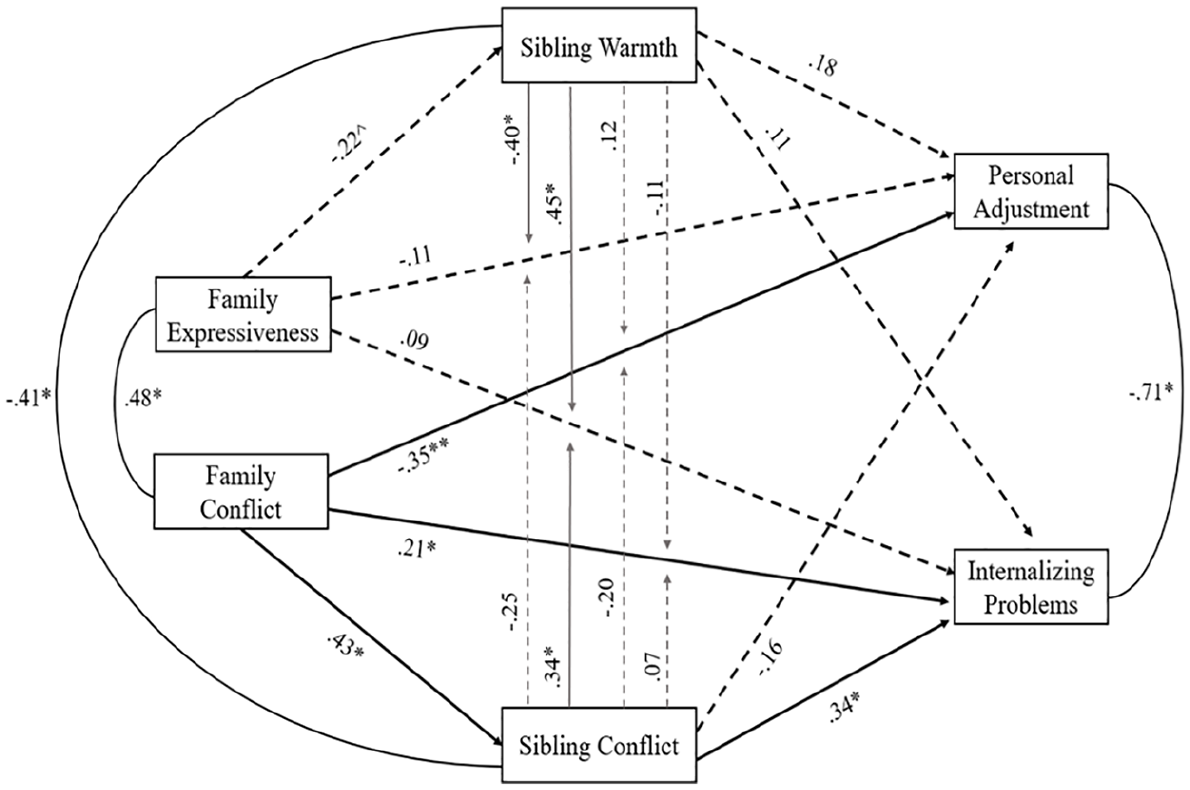
Path model examining the direct effects of family functioning and the moderating effects of sibling relational dynamics on children’s outcomes.
Method
Participants
The current study used data from a larger project examining attachment and family processes in middle childhood. Participants were 86 families with two heterosexual, married parents and at least one child between the ages of 8 years and 11 years old. Of these families, 75 included least two children (M = 2.70) and were eligible for the current study. Most of the families were intact, consisting of two biological parents and biological siblings (88%) and the average length of marriage was 11.61 years (SD = 4.41). The average age was 38.4 years (SD = 4.43) for fathers and 36.4 years (SD = 4.89) for mothers. The majority of families reported their ethnicity as White, non-Hispanic (69.8%), followed by Multiracial (18.5%), African American (5.8%), Hispanic/Mexican American (4.7%), and Asian American (1.2%). Most families participating in the study were in the middle-class to upper-middle class income level, with 51.6% reporting annual family incomes between $30,000 and $75,000. Further, most parents reported having at least a two-year college degree or higher (65.5%). For the purposes of this study, the youngest child in middle childhood was designated as the target child (Mean age = 9 years, 9 months, SD = 1.21), with 39 boys and 36 girls.
Instruments
Background Information Questionnaire
Parents reported demographic data (i.e., age, ethnicity, gender, family income, education, etc.) by completing the Background Information Questionnaire (BGI; Riggs & Jacobvitz, 2002). The BGI collects other information about each family, such as the number of children, adoption status, parental divorce, death of a family member, family psychopathology, and history of psychotherapy.
Behavior Assessment System for Children, Second Edition
The Behavior Assessment System for Children–2nd edition (BASC2; Reynolds & Kamphaus, 2004) is comprised of various self-report measures for multiple respondents commonly used to assess children’s functioning. The 139-item Self-Report of Personality (SRP) measures children’s perception of their own thoughts, feelings, attitudes, and reactions. The current study examined child’s self-reported psychological well-being using the Personal Adjustment Index, which is composed of 31 items related to self-esteem, self-reliance, interpersonal relations, and relations with parents, and the Internalizing Problems Index, which is comprised of 59 items examining atypicality, locus of control, social stress, anxiety, depression, and sense of inadequacy. The target child responded to items on a four-point Likert scale (N = Never, S = Sometimes, O = Often, A = Almost Always), and results are reported as T-scores. In the current study, the BASC-SRP demonstrated adequate or better internal consistency (α) for the Personal Adjustment composite (α = .76) and the Internalizing Problems composite (α = .96).
Sibling Relationship Questionnaire
The Sibling Relationship Questionnaire (SRQ; Furman & Buhrmester, 1985) consists of 48 items assessing a child’s perception of the quality of sibling relationships. For the purposes of this study, we asked the target children to report on the sibling closest in age to the target child. Children rated various aspects of their relationship with the identified sibling on a five-point Likert scale from 1 (hardly at all) to 5 (extremely much). The SRQ yields factor scales in Warmth/Closeness (intimacy, prosocial behavior, companionship, similarity, and admiration of/by sibling, affection), Relative Status/Power (nurturance of/by sibling and dominance of/by sibling), Conflict (quarreling, antagonism, and competition), and Rivalry (parental partiality). In the current study, the Warmth/Closeness and Conflict subscales represented positive and negative sibling relational dynamics, respectively. Both the Warmth (α = .94) and Conflict (α = .93) composites exhibited excellent internal consistency in this study.
Self-Report Family Inventory Version II)
The Self-Report Family Inventory-II (SFI; Beavers et al., 1990) is a 36-item questionnaire that assesses an individual’s perception of his or her family dynamics. A research assistant orally administered the SFI individually to the target child. Participants rated each statement on a five-point Likert scale ranging from 1 (fits our household very well) to 5 (doesn’t fit our household at all). The SFI produces five factor scores in Family Health/Competence (i.e., family acceptance), Conflict (i.e., fighting, blaming), Cohesion (i.e., closeness), Expressiveness (i.e., expression of positive affect), and Directive Leadership (i.e., adult leadership). All SFI scales are interpreted such that lower scores reflect better functioning and higher scores reflect poorer functioning. The SFI has demonstrated good concurrent and convergent validity with other assessments of family functioning. The current study used the target child’s SFI subscales of Conflict and Emotional Expressiveness. The Conflict subscale consists of items about arguing, blaming, negative affect, and unresolved conflict in the family; higher scores represent more conflict. The Emotional Expressiveness subscale measures verbal and nonverbal expressions of warmth, caring, and closeness (Beavers & Hampson, 2000); higher scores represent more problems with the expression of closeness and warmth in the family (i.e., poor family expressiveness). In this study, the target child’s SFI demonstrated adequate internal consistency for the Conflict subscale (α = .70) and Emotional Expressiveness subscale (α = .70).
Procedures
After receiving approval from the university’s Institutional Review Board, we recruited participants by posting and distributing flyers in schools, churches, apartment complexes, non-profit organizations, and businesses in a large southcentral American city and its suburbs. Interested families contacted the researchers. We invited all family members to our university lab for data collection, which took two—three hours. After parents signed informed consent and children gave assent, families participated in an interaction task. Subsequently, parents and target children went to separate rooms to complete questionnaires. Qualified research assistants supervised younger children in a playroom, and target children joined them after completing questionnaires. Upon completion of the study, families were compensated with $30–$40 and a “family fun pack” (i.e., restaurant coupons, tickets for recreational activities, and movie tickets).
Research assistants double-entered data into SPSS version 25 to ensure accuracy. Family Expressiveness and Conflict independently demonstrated a slight positive skew, indicating greater family health; however, the skew was within acceptable limits and further examination of Q-Q plots revealed normally distributed data for all variables. We inspected scatterplots to check assumptions of linearity, homoscedasticity, and homogeneity of error variance. Examination of variables revealed that missing data appeared to be Missing at Random (MAR; Hair et al., 2010; Schlomer et al., 2010). We used regression imputation methods to account for missing data prior to conducting path analyses to model the complex relationships between family functioning, sibling dynamics, and individual child outcomes (Arbuckle, 2017). Traditionally, model fit is evaluated using Chi-square values; however, when using a small sample (e.g., N<100), the Chi-square statistic tends to lack power and is not a good basis for model fit in these cases (Kenny & McCoach, 2003). Thus, the following fit indices were relied on in this study as they are preferred for use with smaller samples (Hooper et al., 2008; Kline, 2011; Tanguma, 2001): The comparative fit index (CFI>.90 signifies good fit), the standardized root mean square residual (SRMR<.8 signifies good fit), and the normed-fit index (NFI>.95 signifies good fit).
Results
Preliminary correlational analyses showed that all primary variables of interest were significantly correlated in the expected directions, with the exception of SRQ Warmth with Internalizing Problems (see Table 1). We conducted one-way ANOVAs to examine relationships between demographic variables and outcome variables. Gender, ethnicity, grade, age, and number of children in home were not significantly related to the outcome variables. Children of non-intact families (i.e., stepchildren), however, reported significantly more Internalizing Problems (F (1, 83) = 11.283, p=.001) and lower Personal Adjustment (F (1, 83) = 5.552, p=.021), than children of intact families. Lower family income (i.e., <$45,000) was also associated with more Internalizing Problems (F (1, 80) = 6.998, p=.01) when compared to children from wealthier families. However, income was not significantly related to Personal Adjustment (F (1, 80) = 2.323, p=.131). AMOS multigroup analyses revealed no significant differences between the predicted models based on income (χ2(12, N=83) = 18.34, p=.106) or intact family structure (χ2(12, N=86) = 19.43, p 08), abd thus these were not included as covariates.
Bivariate Pearson Correlation Table for BASC-SRP, SRQ, & SFI.

Note. SFI = Self-Report Family Inventory Version II; SFI Conflict = Family Conflict Composite; SFI Express = Family Affective Expressiveness Composite; SRQ = Sibling Relationship Questionnaire; SRQ Warmth = Sibling Warmth; SRQ Conflict = Sibling Conflict; BASC-SRP = Behavior Assessment System for Children, 2nd Edition, Self-Report of Personality; BASC-SRP Int Prob = Child’s Internalizing Problems; BASC-SRP Per Adj = Child’s Personal Adjustment.
The hypothesized model examined the direct contribution and the interaction effects of family functioning and sibling relational dynamics to target children’s self-reported psychological health. The model exhibited adequate to good fit on indices preferred for small samples (CFI = .94; SRMR = .06; NFI = .91). Within the model, we found significant direct effects for Family Conflict on Personal Adjustment (B=-.462, p=.001) and Internalizing Problems, (B=.218, p=.046; see Table 2 for standardized path coefficients; see Figure 1 for model), as well as a significant indirect effect on Internalizing Problems through Sibling Conflict (B=.154, p=.007). We also identified significant direct effects for Family Conflict on Sibling Conflict (B=.186, p=.001) and for Sibling Conflict on Internalizing Problems, (B=.830, p=.009).
Main and Interaction Effects of Family Functioning and Sibling Relational Dynamics on Child’s Well-neing.

^p = .05, *p < .05, **p < .001.
Note. Standardized regression coefficients reported. SFI = Self-Report Family Inventory Version II; SFIexp = Family Affective Expressiveness Composite; SFIconf = Family Conflict Composite; SRQ = Sibling Relationship Questionnaire; SRQwarmth = Sibling Warmth; SRQconf = Sibling Conflict.
A number of significant moderation effects also emerged. Notably, Sibling Warmth moderated the relationship between Family Expressiveness and Personal Adjustment (B=-.434, p=.034). As shown in Figure 2, high Sibling Warmth strengthened children’s Personal Adjustment in families, characterized by expressions of warmth and closeness, but had limited effects in the context of families with poor expressiveness. Additionally, Sibling Warmth (B=.392, p=.021) and (Sibling Conflict, B=.253, p=.048) each moderated the relationship between Family Expressiveness and Internalizing Problems. As expected, high Sibling Conflict was associated with increased Internalizing Problems in families with poor expressions of warmth and closeness (see Figure 3), whereas low sibling conflict remained similar regardless of family expressiveness. Contrary to predictions, Sibling Warmth produced a similar moderation pattern, with greater warmth associated with increased Internalizing Problems in the context of lower family expressiveness (see Figure 4). In families with high expressions of warmth and closeness, however, Sibling Warmth was associated with fewer Internalizing Problems.
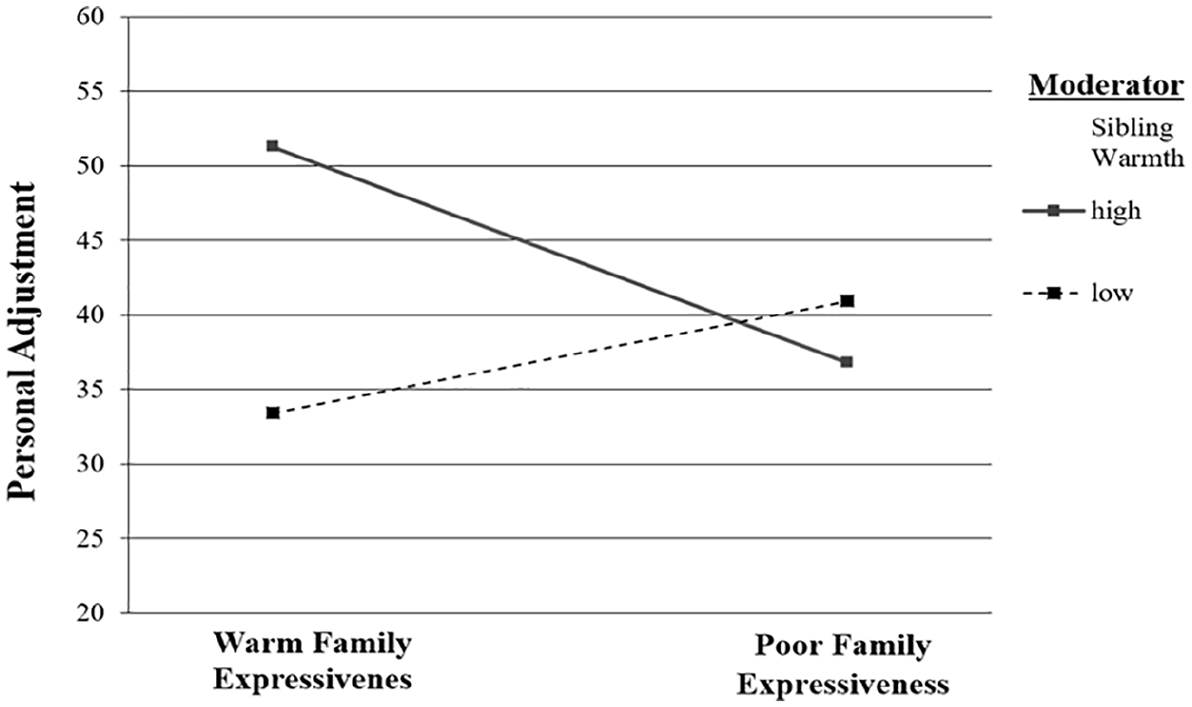
Moderation of family expressiveness and personal adjustment by sibling warmth.
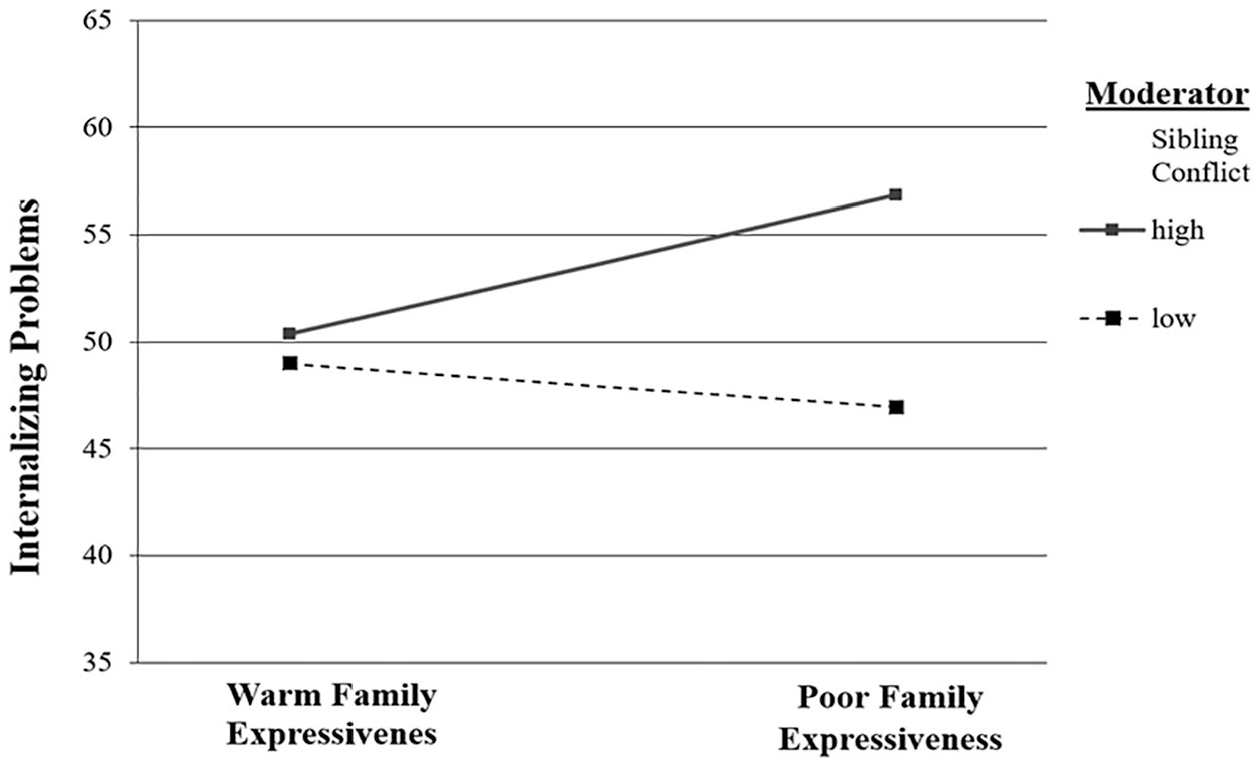
Moderation of internalizing problems and family expressiveness by sibling conflict.

Moderation of family expressiveness and internalizing problems by sibling warmth.
Discussion
Our results produced mixed support for the theoretically based predictions that family functioning and sibling relationship quality in middle childhood interact to affect children’s well-being. As expected, findings revealed that children who reported significantly more internalizing problems and lower personal adjustment also reported higher levels of conflict in the family. Further, negative sibling relational dynamics were associated with increased internalizing problems. Current evidence demonstrating that family and sibling conflict are associated with poor psychological functioning expands prior research findings to middle childhood. We discuss our results and their clinical implications further.
Middle childhood marks a transitional period in the family wherein children are seeking autonomy and becoming more active agents in their development (Kerns & Brumariu, 2016); thus, this period may also be marked by increased family conflict as children and parents navigate these new challenges. Consistent with research showing that family conflict has harmful effects on children’s psychological well-being in middle childhood and early adolescence (Cummings & Davies, 2002; Goeke-Morey et al., 2003; Herrenkohl et al., 2009), current findings support the spillover hypothesis and suggest that the sibling relationship may also be heavily influenced by family conflict at this developmental stage. Additional research examining ongoing changes in the sibling relationship throughout middle childhood is needed, particularly with respect to how potential changes in this subsystem might impact the family system or specific subsystems, and vice versa.
The lack of significant direct associations between healthy family dynamics (i.e., family expressiveness and sibling warmth) and children’s personal adjustment was surprising. The mean score for family expressiveness in our community sample (M = 1.8) was comparable to early adolescent scores in families designated as “healthiest” by observer ratings (M = 1.83) in a combined clinical and non-clinical sample (Hampson et al., 1989). Further, our sample reported lower levels of family conflict (M = 1.88) compared to the healthiest families (M = 2.16). Thus, the relative reported health and reduced range of family expressiveness in our study may have contributed to the lack of significant associations between the healthier family variables. Moreover, negative interactions and events tend to hold greater weight than positive ones across a broad range of psychological phenomena, which may contribute to the lack of direct significance for the positive relational dynamics in this study (Baumeister et al., 2001).
Prior research has yielded ample evidence of “spillover” between various family subsystems (Cui et al., 2002, Yu & Gamble, 2008); however, there is less research examining these subsystems in relation to family-wide spillover effects. Our results suggest that antagonistic sibling relationships may partially explain how negative family environments are related to children’s self-reported internalizing concerns. These findings suggest that conflict in both the sibling subsystem and the whole family system have unique and cumulative effects on child outcomes. However, it is unknown if these spillover effects originate in the sibling subsystem or at the family level. According to family systems theory, family and sibling influences are likely bidirectional in nature, so examining more specific directional factors in future prospective studies would likely enhance our knowledge of how the sibling subsystem impacts the family and vice versa.
As expected, sibling relationship quality significantly moderated the association between family functioning and children’s psychological functioning. Specifically, the association between healthy family expressiveness and the child’s positive personal adjustment is stronger in the context of warm sibling relationships. We found a similar pattern among undesirable variables. That is, the harmful association between low family expressiveness and the child’s internalizing problems is stronger in the context of high sibling conflict. Thus, the quality of the sibling relationship strengthened the beneficial or detrimental psychological outcomes associated with varying family contexts. While researchers have previously reported that family functioning and sibling relational dynamics each have a unique impact on children’s well-being, our findings suggest that the interaction of those relational dynamics may have additional, cumulative effects on the child. Thus, experiencing conflict and negativity at a family level and a sibling level may be more detrimental than experiencing each individually. Alternatively, by fostering growth and warmth in subsystems of the family unit, we can potentially increase beneficial outcomes for the individual and the family as a whole. These findings also reinforce the importance of examining how sibling subsystems interact with the family system.
The Compensatory Hypothesis (Engfer et al., 1995; Nelson et al., 2009) suggests that experiences of warmth in the sibling relationship should buffer against harmful outcomes associated with family negativity. Contrary to these hypotheses, in the current study, reports of high sibling warmth did not protect children living in family environments characterized by low expressions of warmth and closeness from internalizing problems. In fact, children who reported high sibling warmth also reported high levels of internalizing problems, but only when they reported poor family expressiveness. One possible explanation for this unexpected finding is that siblings may internalize more in negative family contexts in order to support other members of the family system. For example, older siblings may be reticent to communicate their instrumental or emotional needs in an attempt to reduce parental burden/stress (spousification) and/or to—directly or indirectly—help a younger sibling with their needs (parentification). This explanation is consistent with findings that siblings of children with chronic illness or mental health concerns tend to have more internalizing problems (Sharpe & Rossiter, 2002), which may be protective of their sibling relationship, parents, or the family system, albeit potentially harmful to the individual child. An alternative explanation may be that children with a caring sibling may be more aware of and distressed by a relative lack of affection and care from their parents compared to children whose siblings are emotionally distant. Thus, in the short-term, sibling warmth may increase symptoms of internalization; we would hope, however, that the effect of sibling warmth would have protective effects over the long-term.
Examining these associations in future prospective research may identify bidirectional influences, such that internalizing behaviors may also help explain the feelings of increased warmth in the sibling dyad. Future researchers may also wish to include both siblings in order to investigate the dyadic interactions occurring within the sibling subsystem, specifically focusing on differences between older and younger sibling perceptions in the dyad.
Sibling conflict is the most common form of family violence and is linked to harmful outcomes for children and families (Khan & Cooke, 2013). When sibling conflict or internalizing child symptoms come to the attention of mental health practitioners, most therapeutic interventions focus on an individual child, with a minority treating the marital dyad or the broader family system. Our findings, however, suggest that decreasing sibling conflict might produce a corresponding reduction in a child’s internalizing problems, which through spillover effects may reduce overall family negativity. Thus, sibling-based interventions have the potential to benefit anxious/depressed children as well as the larger family system. Furthermore, parents report sibling conflict as a primary source of concern in the family (Campbell, 2002); therefore, addressing sibling conflict in family therapy and/or parent training programs may lessen its harmful effects on the family and the children.
To date, the majority of sibling interventions were developed for use with children with special needs, such as when one sibling has a chronic illness or debilitating mental disorder. A recent review found evidence for only five sibling intervention programs targeting sibling conflict and aggression through either child interventions or parent education (Tucker & Finkelhor, 2017). Program outcomes indicate that sibling interventions for typically developing children can improve warmth and closeness, while decreasing conflict and rivalry. The limitations of these intervention studies, however, include small samples, a focus on younger children, and insufficient long-term data associated with individual, sibling, and family outcomes. There is a need for programs targeting sibling aggression, and future studies should address the aforementioned limitations. Developing evidence-based sibling interventions to strengthen siblings’ emotional bonds while decreasing their conflict is likely to produce beneficial outcomes beyond the sibling relationship; just as effective marital therapy can lead to positive change elsewhere in the family system, improving sibling relationships should also increase positive outcomes for individual children and the family.
Results of the current study must be considered in light of several strengths and limitations. Family systems theory provides a strong theoretical basis for research on sibling relationships and psychological well-being in middle childhood, which are understudied. However, the current study utilized a sample consisting of primarily white, middle-class, intact families. A larger, more diverse sample would increase power in the analyses and provide new insights regarding how demographic factors affect the family and sibling systems. Future research should also strive to conduct dyadic analyses using data from both siblings in to obtain a fuller picture of these relationships. Although studies have demonstrated valid self-reporting within this age group (Varni et al., 2007), observational methods and qualitative research may prove better for examining younger children’s experiences or at a minimum reduce common method variance. Finally, this study used a cross-sectional design, which does not allow for causal conclusions.
In conclusion, results of the current study highlight the contributions of family-wide processes and the sibling relationship to child well-being. Specifically, conflictual sibling relational dynamics may help explain the association between family conflict and internalizing symptoms. Further, interactions between congruent sibling dynamics and family functioning enhanced the beneficial or detrimental outcomes on the child. Although family conflict was directly associated with internalizing symptoms, sibling warmth did not buffer against internalizing behaviors in conflictual family environments as expected. Instead, it appeared to exacerbate internalizing symptoms, suggesting that children may internalize their emotions to protect the sibling relationship or their family to the detriment of their own well-being. Taken together, these findings provide evidence for the sibling relationship as a target of clinical interventions; based on the findings of this study, these interventions should promote warmth and closeness in the sibling relationship, as this key variable has the potential to benefit the individual child and the family system as a whole.
Footnotes
Acknowledgments
This study was the thesis research of the first author and part of a larger project supported by a grant awarded to the second author by the Timberlawn Psychiatric Research Foundation. We are grateful to the families for their cooperation and to the many research assistants who contributed to the project.
Authors’ Note
The listed authors certify no financial or non-financial conflicts of interest in the subject matter discussed in this manuscript. Data supporting these findings may be made available upon reasonable request at the discretion of listed authors.
Declaration of Conflicting Interests
The author(s) declared no potential conflicts of interest with respect to the research, authorship, and/or publication of this article.
Funding
The author(s) received no financial support for the research, authorship, and/or publication of this article.
