




Abstract
This study examined parental warmth as a mediator of relations between mothers’ and fathers’ perceptions of dyadic coping and adolescent externalizing outcomes. Data from 472 adolescents, mothers, and fathers were collected over a three-year period from families in China, Kenya, Sweden, and Thailand. For mothers in all four sites and fathers in three sites, better parental dyadic coping at youth age 13 years predicted higher levels of parental warmth at youth age 14 years. For mothers in all four sites, higher levels of maternal warmth were in turn related to less youth externalizing behavior at the age of 15 years, and higher levels of dyadic coping at youth age 13 years were related to less youth externalizing behavior at the age of 15 years indirectly through maternal warmth. Emotional Security Theory helps explain the process by which dyadic coping is related to adolescent externalizing behavior. The results have important implications for parent- and family-based interventions.
A well-established literature affirms that the parent–child relationship serves a primary role in predicting child adjustment across a range of parent and child behaviors. Stress, however, is a natural part of both the co-parenting and the parent–child relationship, and because families operate as interconnected systems, stress experienced by parents that is not managed constructively threatens to affect the parent–child relationship in negative ways. Although much is known about how overt parental conflict, such as arguing and yelling, is related to higher levels of externalizing behavior (see Cummings & Davies, 2010 for overview), conflict does not begin in a vacuum. Understanding more about how parents manage stress within the co-parenting dyad before it rises to the level of conflict informs an understanding of how dyadic-coping behaviors between parents may be related to child adjustment.
Dyadic Coping and Parenting Behaviors
Dyadic coping is defined as the way in which each individual in the dyad manages stressors and how stress felt by one partner is communicated to and received by the other partner (Bodenmann et al., 2011). Because the field of dyadic coping is only recently emerging, research in the field of stress and marital conflict provides the best foundation upon which to study dyadic coping. Stress within the family context is a nearly universal experience around the world (Louie et al., 2017) and is associated with negative outcomes for parents, including poorer psychosocial functioning (Farmer & Lee, 2011) and lower marital satisfaction (Lavee et al., 1996). In the late 1990s, Bodenmann (1997) proposed that individual stress experienced in couples should be reconceptualized as dyadic stress. Even though each parent feels his or her own stress, each person is also influencing the other in the co-parenting relationship by how they manage stress. Specifically, how parents manage stress is related to their relationship with their partner and how each parent or partner interacts with their children. For example, problems at work for one partner may carry over into the couple’s relationship at home in the form of anger, hostility, and withdrawal (Repetti, 1989). Difficulty in the marital relationship may also make parents less willing to spend time together with the family, mainly to avoid a partner, but often resulting in avoiding children. Furthermore, destructive conflicts between parents, such as those that include threats, insults, or defensiveness, can make parents monitor children less and give less attention to children’s behavior (Krishnakumar et al., 2003). Specific strategies for dealing with conflict are linked with cross-parent outcomes as well. Fathers’ negative marital interactions, specifically stonewalling, are related to mothers being unsupportive toward children (Gao et al., 2019).
Dyadic stress does not always originate from an external element like family medical issues, financial worries, or problems with extended family, but sometimes from something in the relationship itself. For example, cohabiting individuals can have different goals in life or different expectations of each other or of family life (Hiller & Philliber, 1986). When faced with either external or internal stress, there are a number of coping mechanisms individuals can use to diminish harmful effects: One partner can take over some of the other partner’s responsibilities (delegated dyadic coping), one partner can express understanding and support for the other partner (supportive dyadic coping), or both partners can make efforts to solve problems together (common dyadic coping) (Donato et al., 2009). Dyadic coping, in general, is related to increased relationship satisfaction and is a predictor of well-being for children (Bodenmann, 1997).
Irrespective of its source, higher levels of stress felt by parents—whether linked to parenting responsibilities, relationship difficulties between a couple, or stress external to the home—predict less adaptive parenting behaviors (Belsky, 1984). Notably, even parenting stress not triggered by challenging child behaviors, such as navigating child schedules, striving for work–home balance, and day-to-day care of children, is both directly and indirectly related to maladaptive management of children’s behavior through parental symptomology like depression and anxiety (Jenkins & Smith, 1991). Parent gender differences are also evident. Higher levels of marital adjustment as defined by consensus, affection, satisfaction, and cohesion are related to increases in maternal warmth over time (Bonds & Gondoli, 2007), but the effects for fathers are less conclusive. Although some studies (Cummings et al., 2010; Schofield et al., 2009) report that father–child relationships are more sensitive to both positive and negative aspects of marital relationships than mother–child relationships, one study (Gao et al., 2019) found that within-parent and cross-parent longitudinal effects were different for mothers and fathers of young children. In Gao et al.’s work, there was no relation between the marital relationship and parenting practices for fathers, but marital conflict was associated with less punitive parenting by mothers, indicating a possible compensatory behavior with children to ameliorate negative interparent interactions. Perceived parental stress is also associated with inadequate communication and inappropriate parenting, which in turn predicts later child externalizing symptoms (Cina & Bodenmann, 2009). Although these studies are important for understanding a process-oriented model of stress and parenting, they are not comprehensive because the samples primarily include only participants from Western cultures and mostly focus on younger children rather than adolescents.
Unlike marital conflict and stress, no studies were found that directly examined the link between dyadic coping and parental warmth. Constructive conflict, such as mutual problem-solving and productive communication, however, shares many characteristics with dyadic coping, so may be informative in the absence of studies specifically targeting dyadic coping. Further, constructive marital conflict—in contrast with destructive conflict—is characterized by mutual respect between parents and a solution-oriented focus. Constructive conflict is linked to warm and affectionate parenting behaviors in both mothers and fathers (McCoy et al., 2013).
Parental warmth as expressed through affection, comfort, and nurturing toward children is one parenting dimension with a decades-long research history (Rohner, 1980). Despite cultural differences in the form and function of expressions of warmth and affection (Bornstein, 1995), a majority of the world’s parents are considered to be loving toward their children (MacDonald, 1992). Previous studies with cross-national samples (Khaleque, 2013; Rothenberg et al., 2019) show that parental warmth and acceptance are important predictors of children’s internalizing and externalizing behavior, even when mean levels of warmth vary across cultures. A meta-analysis of 30 studies from 16 countries on five continents reported a significant relation between children’s perceived parental warmth and psychological adjustment (Khaleque, 2013). Accordingly, parental warmth and acceptance are important predictors of child well-being and adjustment across cultures.
Parenting Behaviors and Adolescent Adjustment
Adolescence is a time of significant change both in the adolescent as an individual and in the parent–child relationship. In cultures around the world, adolescence is a period of increased sensation seeking, risk-taking, and striving for independence, despite some variation in the specific risks and opportunities for risky behavior across cultures (Duell et al., 2018). As children grow and develop through early and mid-adolescence, these changes logically impact the parent–child dyad. For example, adolescents take more control in decision-making, seek autonomy from parents (Steinberg & Silk, 2002), and spend more time outside the home with friends (Laursen & Collins, 2009). In turn, this changing parent–child relationship has implications not just for adolescent development, but also for parents, sometimes in the form of parental conflict or mental health issues (Silverberg & Steinberg, 1990). For this reason, we are interested in how specific parent behaviors around managing stress may be related not only to parent–child interactions, but also to child behavior in the form of externalizing behavior during early-to-mid adolescence. Most of the research examining the relation between parenting and child adjustment focuses on children in early and middle childhood, but research is comparatively scarce when children age into adolescence. Even fewer studies place these relations in cross-national context. Yet, families continue to interact and influence one another through parent–child and couple dyads, and child effects may be particularly strong during periods of physical and emotional change and stress, such as during the transition to adolescence. Furthermore, adolescents are at increased risk for both internalizing and externalizing problems compared to younger children (Steinberg & Morris, 2001). Thus, even though the parent–child relationship may change during adolescence as teens spend less time with parents and more time with peers, adolescents’ emotional security is still a key predictor of healthy development. The increased risk of adjustment problems during adolescence warrants a closer look at the relation between earlier parenting behavior and later adolescent adjustment.
As described earlier, existing literature reveals that better dyadic coping predicts higher levels of adaptive parenting behavior, and adaptive parenting behavior predicts lower levels of child externalizing behavior. Few studies, however, examine an indirect pathway from dyadic coping to child externalizing behavior over time, and no studies we know of investigate this pathway in different cultural contexts. Understanding whether this indirect pathway behaves similarly across cultures would inform a more generalized understanding of coping, parenting behavior, and child adjustment during adolescence.
Emotional Security Theory
Emotional Security Theory (EST,Cummings & Davies, 2010; Davies & Cummings, 1994) provides theoretical grounding that may help explain why and how children’s behavior is related to marital conflict in general, and, more specifically, to dyadic coping. EST acknowledges that multiple pathways of interaction within the family system have an impact on children’s development and adjustment. Unlike other developmental theories that explain children’s adjustment following conflict, however, EST’s defining characteristic is its focus on the development of children’s emotional security as a primary predictor of adjustment. Children with high levels of emotional security are generally stable in their relationship with their parents and unlikely to suffer major setbacks or become highly anxious or fearful when unexpected events occur. EST focuses on the co-parenting relationship as a predictor of children’s emotional security; emotional security forms the basis for adaptive relationships between children and others in their lives. Multiple studies have confirmed the direct and indirect pathways between interparental conflict, emotional security, and child adjustment over time. For example, parental conflict was indirectly related to child adjustment through children’s emotional security in a sample of 11- to 12-year-old children over a one-year period (Harold et al., 2004). In a longitudinal study spanning kindergarten through seventh grade, children’s emotional security mediated the relation between parent conflict during the child’s kindergarten years and internalizing and externalizing behavior in seventh grade (Cummings et al., 2012). EST also provides an explanation by which not all parental conflict is bad for children. Positive coping in the face of conflict or stress, such as when parents demonstrate problem-solving, affection, and, to a lesser extent, calm communication, is linked with positive emotional responses for children (Cummings et al., 2003). We propose that an understanding of EST is needed to fully understand the process by which maladaptive dyadic coping by parents may be related to child outcomes, specifically through related changes in parental warmth. Adopting a process-oriented model allows us to examine both direct and indirect predictors of child adjustment.
Present Study
The current study includes mother, father, and child reports of parent behavior and child adjustment from mean child age of 13–15 years in four countries: China, Kenya, Sweden, and Thailand. These four countries varied widely with respect to gender equality and norms related to gender, with a range in ranking from 2 to 134 of 162 countries based on data from the United Nations Gender Inequality Index. This index takes into account reproductive health, empowerment (proportion of parliamentary seats filled by women, proportion of adult women with at least some secondary education), and labor force participation (Human Development Report, 2019). In addition, rankings on the United Nations Human Development Index ranged from 8 to 147, an index which encompasses indicators of health, education, and income.
This study examines children’s externalizing behavior as predicted by mothers’ and fathers’ reports of dyadic coping and parental warmth. We first tested whether dyadic coping at youth age 13 years (Time 1) predicted parental warmth at age 14 years (Time 2) independently for mothers and fathers. We hypothesize that there may be gender differences between mothers and fathers, regarding if and how dyadic coping at Time 1 may predict parental warmth at Time 2. Because the literature is mixed as to whether effects are stronger for one parent, we do not have a specific hypothesis regarding this research question. We next examined whether parental warmth at the age of 14 years predicted child externalizing at the age of 15 years (Time 3). Consistent with prior research with younger children, we predict that higher levels of parental warmth at Time 2 will predict lower levels of child externalizing behavior at Time 3. Our third and final aim was to examine if dyadic coping reported by each parent at Time 1 indirectly predicted child externalizing behavior at Time 3 through parental warmth at Time 2. We hypothesize that both parents’ reports of higher levels of dyadic coping will be related to lower levels of youth externalizing, but indirectly through parental warmth.
Method
Participants
Mothers, fathers, and youth (N = 472, 52% female youth) were drawn for this study from a larger, nine-country longitudinal study of parenting and child development. Four sites that administered an optional Index of Marital Satisfaction were included in the present study: Shanghai, China, n = 123; Kisumu, Kenya, n = 100; Trollhättan/Vänersborg, Sweden, n = 129; and Chiang Mai, Thailand, n = 120. The measure was only administered to those parents who were married or cohabiting at the time of interview. During the initial phase of recruitment, children were 8 years old, on average. Families were sampled from a diverse range of socioeconomic backgrounds, approximately representative of the income ranges in each site. Letters were sent home with families through the schools in each locality, asking parents to complete a form if they were interested in learning more about the study. Parents were then contacted by phone or in person to follow up. Families were enrolled in the study until the approximate target sample size of 100 families was reached in each site. Each site followed country-specific regulations regarding the recruitment of and interviews with human subjects, and protocols were approved by the cooperating universities’ institutional review boards.
Data for the present study were drawn when the youth were approximately 13 years, 14 years, and 15 years old, corresponding to Times 1, 2, and 3 of this study. At Time 1, child age ranged from a minimum of 11 years to a maximum of 15 years. At the Time 3 (youth age 15 years) assessment, 84% of the original sample recruited initially at the age of 8 years continued to provide data. Compared to the initial sample, the families who remained in the study at the child’s age of 15 years did not differ on parental education [F(1,434) = 0.040, p = 0.842]. However, male youth participants were less likely to be retained in the study as compared to the initial sample, χ2 (1) = 9.29, p = 0.002, so that by the age of 15 years, female youth participants made up 57% of the sample as compared to 52% of the sample at the age of 8 years.
Procedure and Measures
For each wave of the study, trained interviewers facilitated oral, written, or online interviews with participants according to participant need and preference. Interviews were conducted in participants’ homes or other locations chosen by the participants, and mothers, fathers, and children were interviewed separately to avoid participants overhearing responses from other family members. Interviews generally lasted between 60 and 90 minutes. Participants or their schools were provided modest financial compensation in appreciation for their participation, following institutional review board protocol in each site. Forward- and backward-translation of items and a process of cultural adaptation ensured linguistic and conceptual equivalence of measures (Erkut, 2010; Peña, 2007).
Dyadic coping
At Time 1 (youth M age = 12.73 years, SD = 0.974), mothers and fathers completed separate reports of dyadic coping. Eight items drawn from the Dyadic Coping Inventory (DCI; Bodenmann, 2008, Ledermann et al., 2010) comprised this scale to report how well each parent felt supported by his/her partner during stressful times and how well the couple jointly handled stress (e.g., “When one of us is stressed, we consider it as our stress.” and “My partner shows empathy and understanding when I need it.”). Reliability and validity of the DCI were established using French-, German-, and Italian-speaking samples (Ledermann at al., 2010). Respondents chose which of the five responses best characterized their relationship with their spouse or cohabiting partner, where 1 = never/very rarely and 5 = very often. Items were averaged to create separate scales for mothers’ and fathers’ reports. Internal consistency reliability estimates (Cronbach’s α) for the full sample were .85 for both mothers and fathers.
Parental warmth
The parent version of the Parental Acceptance–Rejection/Control Questionnaire–Short Form (Rohner, 2005) was administered at Time 2 (youth M age = 14.22 years, SD = 1.03) to measure self-reported frequency of mothers’ and fathers’ warm and affectionate behavior toward the target child (e.g., “I say nice things to my child” and “I make my child feel wanted and needed”). This measure has well-established reliability and convergent and discriminant validity, and it has been used in more than 60 cultures, including the cultural groups in the present study by our own and other research teams (Lansford et al., 2018; Rohner, 2005). To minimize cultural inconsistencies in the interpretation of the originally published scale, a modified scale was used for this study to capture frequency, where 1 = never or almost never, 2 = once a month, 3 = once a week, or 4 = every day. The eight items in the warmth–affection scale were averaged to create separate scales for mothers’ and fathers’ warmth. Internal consistency reliability estimates were .80 for mothers and .81 for fathers.
Child externalizing behavior
Child externalizing behavior at Time 3 (youth M age = 15.29 years, SD = 1.09) was measured using the 33 parent-reported and 30 youth-reported externalizing items from the Child Behavior Checklist (CBCL) and Youth Self Report (YSR; Achenbach, 1991). Each respondent reported on the frequency of the behavior in the last 6 months, using the following scale: 0 = never or almost never, 1 = sometimes, and 2 = always. The Achenbach measures have been translated into at least 69 languages, used with at least 60 cultural groups and have strong psychometric properties and cross-language equivalence (Achenbach, 1991, 1994). In line with previous work (Noordhof et al., 2008), and to remain consistent with previous cross-cultural multi-reporter studies using this same measure (Lansford et al., 2018; Rothenberg et al., 2019), scores from all three reporters—mothers and fathers reporting on their child and child self-report—were standardized and combined into one multi-reporter composite scale. The externalizing scale included both delinquent and aggressive items, capturing mothers’ and fathers’ reports and youth self-report of arguing, screaming, disobedience, fighting, and threatening behavior. The composite scale internal consistency reliability estimate was .92.
Control variables
Parental education was measured as the highest level of education attained by either parent, measured in years at Time 1. Means for each site ranged from 12.67 years in Kenya to 14.63 years in Sweden, with a minimum of 3 years of education and a maximum of 21 years across all sites. We also controlled for child gender.
Results
Descriptive Results
Table 1 displays the means, standard deviations, and correlations by site for all study variables. The possible range for the mean of dyadic coping ranged from 1 to 5, with 1 indicating that the respondent indicated he/she received little support from his/her partner or spouse in handling stressful situations and 5 indicating that the respondent felt the couple worked together as a team to manage stress and support one another. The mean for most sites fell within the middle-to-upper range of the scale, with site means ranging from 3.43 for fathers in Thailand to 4.09 for mothers in Kenya. With a range of possible means from 1 to 4, with 4 indicating more warmth toward the child, the site means for parental warmth were similar to dyadic coping, falling within the upper range of possible scores, with a low mean of 3.26 for mothers and fathers in China and a high mean of 3.80 for mothers in Sweden. As shown, there was a strong positive correlation between mothers’ and fathers’ reports of dyadic coping and a positive correlation between dyadic coping and mothers’ and fathers’ warmth in all four sites. All of the correlations between parental warmth and child externalizing behavior were in the expected (negative) direction.
Means, SDs, and Correlations of Study Variables.
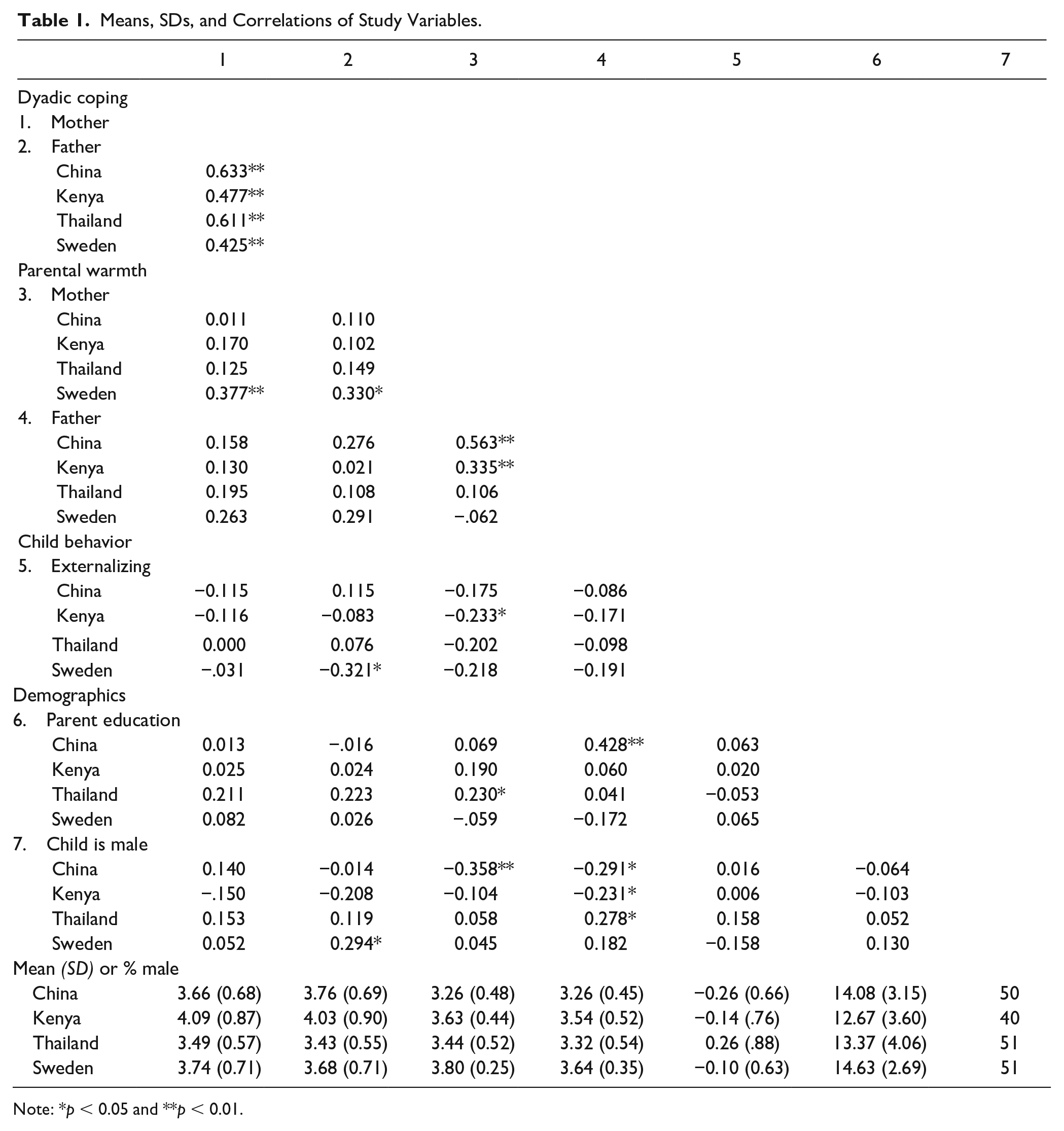
Note: *p < 0.05 and **p < 0.01.
Direct and Indirect Effects of Dyadic Coping on Parental Warmth and Child Externalizing Behavior
To investigate whether dyadic coping indirectly affects child externalizing behavior through parental warmth, a multi-group path model was tested using Mplus Version 7 (Muthén & Muthén, 1998–2012). To test model fit, we used the chi-square statistic, the Root Mean Square Error of Approximation (RMSEA), the comparative fit index (CFI), and Tucker–Lewis Index (TLI). We assumed good model fit if the χ2 p-value was not significant, RMSEA < 0.05, and the CFI and TLI > 0.95 (Bentler, 1990; Bollen, 1990; Kline, 1998). Full information maximum likelihood estimation was used to account for missing data. In the original model, all paths were constrained to be equal across sites, but the data did not fit this model well. Six paths were selectively released, based on modification indices, until good model fit was achieved. These paths included parental education to father’s warmth and child gender to mother’s warmth in China, father dyadic coping to father’s warmth in Kenya, child gender to father’s warmth in Thailand, the covariance between mother’s and father’s parental warmth in Sweden, and the path from parental education to mother’s warmth in Sweden. After freeing the six paths mentioned earlier, the model fit the data significantly better (χ2 [60] = 60.111, p = 0.47, RMSEA = 0.005, CFI/TLI = 0.998) than the initial model with paths constrained to be equal across all four sites: χ2 [66] = 100.659, p = 0.004, RMSEA = 0.079, CFI/TLI = 0.463/0.512. Next, we ran this adjusted model with bootstrapped standard errors to examine the data for indirect effects of mother and father dyadic coping on child externalizing behavior through parental warmth. Our first hypothesis, that dyadic coping would predict parental warmth, was mostly supported. Dyadic coping at youth age 13 years predicted parental warmth at youth age 14 years for all paths except one. A one-point increase on the scale in mothers’ reports of dyadic coping at Time 1 was related to a 0.107-point increase on the four-point warmth scale for mothers in all four sites. Similarly, a one-point increase in fathers’ reports of dyadic coping at Time 1 was related to a 0.185-point increase in fathers’ reports of paternal warmth at Time 2 in China, Thailand, and Sweden. Fathers’ reports of dyadic coping were not significantly related to paternal warmth at Time 2 in Kenya. Our second hypothesis, that child externalizing behavior at Time 3 was predicted by parental warmth at Time 2, was only partially supported. For mothers, a one-point increase in reports of maternal warmth at Time 2 was related to a −0.441 z-score change in Time 3 reports of child externalizing behavior for all four sites. The pathway from paternal warmth to child externalizing behavior, however, was not significant in any of the sites. In sum, results indicated that for mothers in all four sites and fathers in three sites, better dyadic coping at the child’s age of 13 years significantly predicted higher levels of parental warmth at youth age 14 years. In turn, higher levels of maternal warmth at youth age 14 years predicted lower levels of child externalizing behavior at the age of 15 years in all four sites, but paternal warmth was not significantly related to child externalizing behavior in any sites.
Our third hypothesis, that dyadic coping at Time 1 indirectly predicted child externalizing behavior at Time 3 through Time 2 parental warmth, was also partially supported. Greater dyadic coping indirectly predicted lower levels of externalizing behavior via parental warmth for mothers in all sites, but not for fathers in any sites. A one-point increase on the scale in mothers’ reports of dyadic coping was indirectly related to a 0.047 z-score decrease in externalizing behavior. Figures 1 and 2 summarize the path models for mothers and fathers, respectively, and Table 2 provides the model results.

Unstandardized path coefficients in multi-group path model examining links among mother-reported dyadic coping, maternal warmth, and child externalizing behavior. Indirect effect: β = 0.047[−0.115,-0.003].
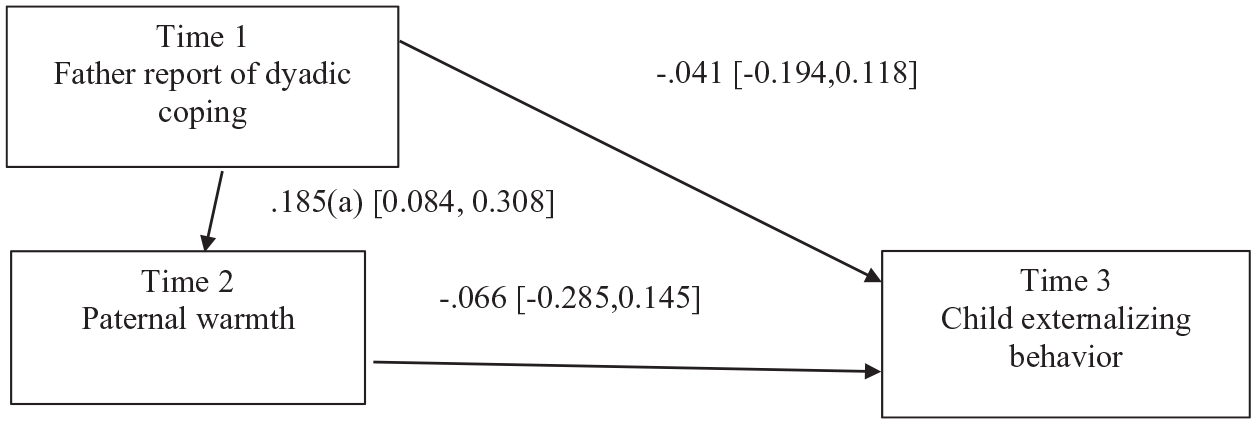
Unstandardized path coefficients in multi-group path model examining links among father-reported dyadic coping, paternal warmth, and child externalizing behavior. Indirect effect: β = −0.012(b)[−0.060,0.028].
Multi-group Model Results.
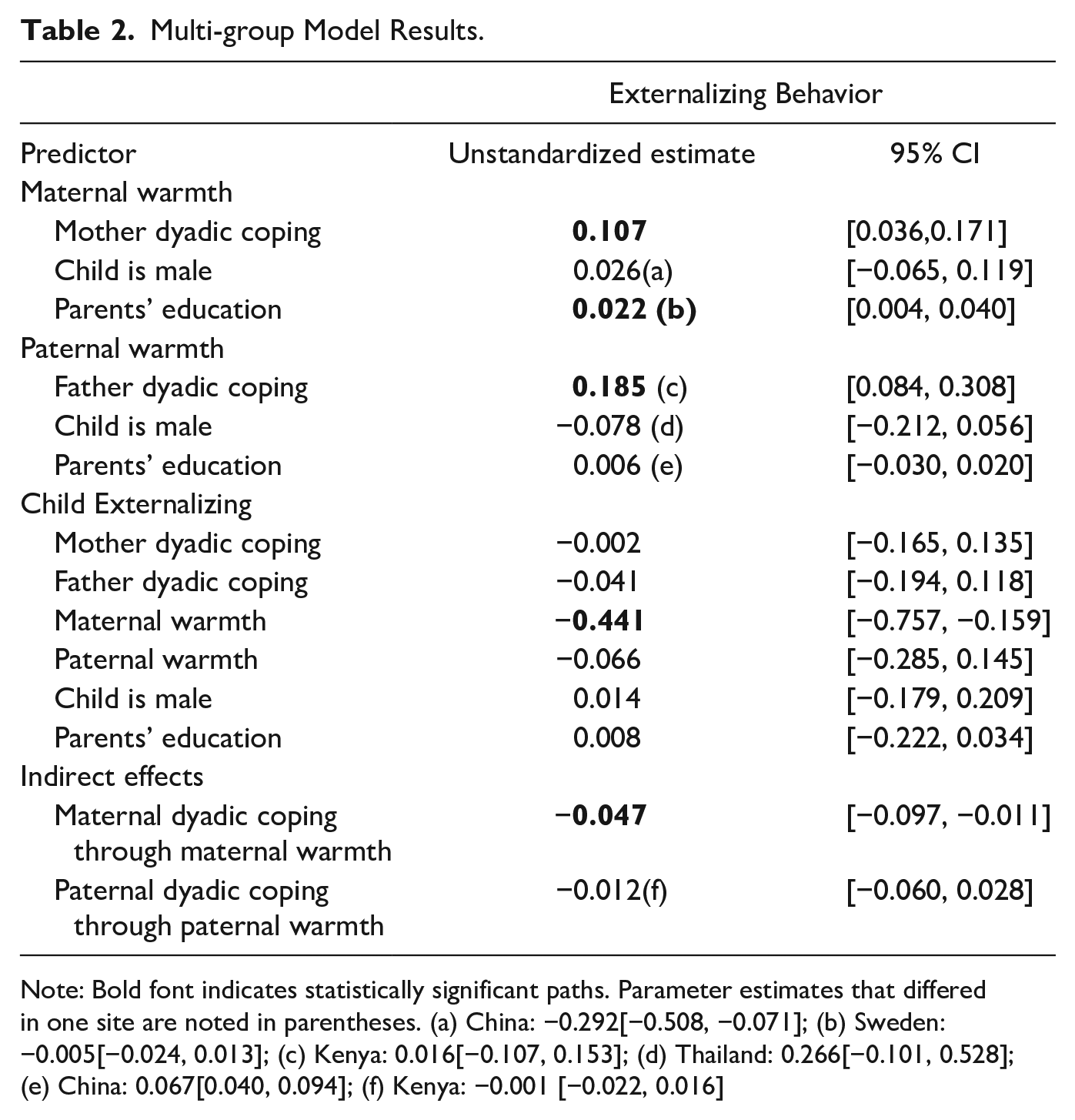
Note: Bold font indicates statistically significant paths. Parameter estimates that differed in one site are noted in parentheses. (a) China: −0.292[−0.508, −0.071]; (b) Sweden: −0.005[−0.024, 0.013]; (c) Kenya: 0.016[−0.107, 0.153]; (d) Thailand: 0.266[−0.101, 0.528]; (e) China: 0.067[0.040, 0.094]; (f) Kenya: −0.001 [−0.022, 0.016]
Discussion
The goal of this study was to further the existing body of work about children’s externalizing behavior by examining both parental dyadic coping and parental warmth as predictors of child outcomes. Using a sample of mothers, fathers, and adolescents with a mean age between 13 years and 15 years across three years in four countries, we hypothesized that high levels of dyadic coping would predict higher levels of parents’ reports of parental warmth, but the literature on parental conflict has been mixed on whether or not effects could be expected for both mothers and fathers. Because prior research has shown that parental warmth is predictive of child adjustment across many cultures (Deater-Deckard et al., 2011), we also hypothesized that less parental warmth would predict subsequent child externalizing behavior. In support of prior research, we found dyadic coping’s direct effect on parental warmth for mothers and fathers to be small but significant. In contrast to earlier work on parental conflict, however, where results were more robust for fathers, we were surprised to find support for an indirect pathway from dyadic coping to child externalizing significant only for mothers. EST has a strong theoretical grounding for the indirect pathway to child externalizing behavior. EST accounts for the processes by which parents’ reactions to stress and dyadic coping during stressful situations may be related to parent–adolescent relationships in ways that could contribute to adolescents’ feelings of insecurity during a time of significant transition in their development.
Results from the study showed that dyadic coping at the age of 13 years predicted parental warmth 1 year later in all sites in both mothers and fathers, except for Kenyan fathers. The similarities across sites support research that parenting roles between parents are becoming more egalitarian across many cultures (Deater-Deckard, 1998). Cultural norms can also influence how couples cope with stress. For example, couples in African countries report more relationship satisfaction and more dyadic coping from their partners compared to their European, North American, and Asian counterparts (Hilpert et al., 2016). In contrast to how dyadic coping predicted maternal and paternal warmth, we found differences between mothers and fathers in how parental warmth predicted externalizing behavior of children aged 15 years. Maternal warmth towards children aged 14 years in all sites predicted lower externalizing behavior for children one year later, but paternal warmth had no significant relation to externalizing behavior in any sites. Divided results between mothers and fathers are also evident when examining the indirect relation between dyadic coping and lower levels of externalizing behavior, where mothers’ reports of better dyadic coping were indirectly but significantly related to decreased child externalizing behavior. These results are interesting, in that mothers’ roles seem to be more alike cross-culturally than mothers and fathers in the same culture. It is possible that even though there is more equality between mothers and fathers in recent decades, there are still some areas in child-rearing where mothers have more indirect influence on their children than fathers across a diverse group of countries. It is also possible that any number of factors not studied here are responsible for a relation between paternal behavior and child externalizing behavior.
EST provides an important model for furthering our understanding of how the process by which parents handle stress—and not simply an examination of direct effects—is important for children’s outcomes. In our study, for example, although dyadic coping had no significant direct predictive effect on child externalizing behavior, the indirect significant pathway through maternal warmth is critical for helping families understand the connections between family members and their behavior over time. Consistent with prior work, dyadic coping is a subtle form of positive conflict resolution, which is related to more positive outcomes for children in high-conflict homes (Cummings et al., 2003). EST also allows us to see that not all conflict is bad. EST posits that even if conflict occurs, as long as it is handled in a way that increases emotional security in the family, children can benefit. Furthermore, as the predictor increases in time and distance from the outcome—as is the case with dyadic coping measured two years prior to child externalizing behavior—other parenting factors like warmth and affection can take a larger role, especially when interpersonal relationships are involved (Grant et al., 2006).
The study adds to the existing literature in a number of ways. First, although many investigations establish a link between marital conflict and parenting behavior, few studies examine dyadic coping as a predictor of parental warmth. This study allows researchers and practitioners to identify a strengths-based, rather than a deficit-based, model; there are practical ways marriage and family counselors can guide couples to improve dyadic coping and mutual support rather than only focusing on areas of deficiency, regardless of the stressor. Similarly, although we often think of spillover only in terms of negative effects, this study highlights that we can also think about spillover in a positive way; when marital quality is enhanced, child adjustment problems may decrease (Schofield et al., 2009). Second, this study utilizes a prospective, longitudinal design across four diverse countries and separately accounts for mothers’ and fathers’ reports of both dyadic coping and parental warmth. Incorporating these two important design elements contributes to a more complete understanding of potential cultural and familial influences in families during stressful times, and it highlights commonalities across a range of countries. In addition, because the study uses a sample of adolescents aged 13 years, 14 years, and 15 years, we can see that parental behavior continues to indirectly predict child externalizing behavior well into adolescence.
Although this study had several notable strengths, a few limitations should be noted. First, we did not examine if or how child behavior may have influenced parental warmth. Child-rearing is an interactive process between parents and children, not simply a unidirectional influence of parents toward children. A bidirectional approach takes both parents’ and children’s behavior into account to explain the interaction between them and includes the development of both children and parents. A child is an active agent who exerts an impact on her/his parents—and vice versa (Kuczynski & DeMol, 2015). Recent studies, for example, have found that adolescent internalizing and externalizing behavior is a strong predictor of subsequent parental warmth (Lansford et al., 2018, Rothenberg et al., 2019). Similarly, we did not account for earlier levels of parental warmth that could be predictive of dyadic coping. We did not have repeated measures of either dyadic coping or child externalizing in all of the years included in the study, so we could not control for prior levels of these constructs. Because dyadic coping is not a static measure, but likely to change throughout the course of a couple’s relationship or based on current life circumstances, our measure could have simply captured a moment in time rather than a long-standing pattern of support.
Parents and children show notable levels of agreement in how they each perceive the quality—constructive or destructive—of parental conflict within the home (Rinaldi & Howe, 2003). Consistent with EST, our study provides cross-cultural evidence for the indirect pathway from dyadic coping to child adjustment because we account for parental warmth predicted by parents’ reports of coping. Like many parenting behaviors, however, dyadic coping is not a fixed trait, and future research should aim to examine within-family effects to account for changes in parents’ coping behaviors over time (Knopp et al., 2017). To better inform and refine therapeutic practice, interventions to improve adolescent outcomes should include assessment of the quality of the parenting relationship—including dyadic coping—throughout childhood and adolescence.
Footnotes
Declaration of Conflicting Interests
The author(s) declared no potential conflicts of interest with respect to the research, authorship, and/or publication of this article.
Funding
The author(s) disclosed receipt of the following financial support for the research, authorship, and/or publication of this article: This research was funded by the Eunice Kennedy Shriver National Institute of Child Health and Human Development grant RO1-HD054805. This research also was supported by National Institute on Drug Abuse (NIDA) Grant P30 DA023026.
