



Abstract
The primary goal of the current study was to examine the dyadic association between communication patterns (CP), dyadic coping (DC) efforts, dyadic adjustment (DA), and parenting practices (PP), using a sample of 340 married couples (N = 680) in India. The findings from the actor–partner interdependence mediation modeling (APIMeM) indicated that the husbands showed both actor and partner effects between all the variables. The actor and partner effects were not significant for the link between communication patterns and dyadic coping for wives. Still, they showed significant actor and partner effects for the association between dyadic coping and dyadic adjustment, as well as parenting practices. One’s own and spouse’s dyadic coping mediated the association between communication patterns and dyadic adjustment and parenting practices for husbands but not wives. These findings shed light on the communication and coping mechanisms and their link with adjustment and parenting practices among couples beyond Western cultural contexts.
Keywords
Communication among couples is considered “a system of positive and negative interdependent patterns of interaction” (Arcuri, 2013, p. 14; Caughlin & Huston, 2002). Several studies had shown that communication among couples is associated with various marital outcomes such as marital quality (e.g., Ledermann et al., 2010), satisfaction (e.g., Chi et al., 2013), marital dissatisfaction (Donato et al., 2014), attachment (Ebrahimi & Ali Kimiaei, 2014), depression in couples (Li & Johnson, 2018), and marital dissolution (e.g., Gottman & Levenson, 2000). While open and constructive ways of communication are linked to better relationship satisfaction (Kim, 2019; Lukman et al., 2020), negative communication patterns, involving demand–withdraw and mutual avoidance–withholding patterns, are linked to reduced satisfaction (e.g., Cornelius et al., 2007; Smith et al., 2008) and predict lower relationship quality (Arcuri, 2013; Christensen & Heavey, 1990). Despite the progress in our understanding of the dynamics of interaction among couples and its effects on marital and family outcomes, most research studies on the couple and family relationship are conducted in Western cultural context, primarily in North American and European contexts (Rusu et al., 2019; Xu et al., 2018). Very little is known about how these effects operate in non-Western cultures, given that several past studies had shown differences in marital and family relationships across Western and non-Western cultural contexts in terms of communication patterns among couples (e.g., Rehman & Holtzworth-Munroe, 2007), familial interdependence (e.g., Chen & Li, 2007), arranged marriages versus marriage of choice (Yelsma & Athappilly, 1988), and marital satisfaction (e.g., Sastry, 1999). Given these trends, the goal of the current study was to explore the dyadic association of spouses’ communication patterns, dyadic coping, dyadic adjustment, and parenting practices in a sample of married couples in India. The results of the study would extend our understanding of the communication and coping mechanisms and their link with marital adjustment and parenting practices beyond Western cultural contexts.
Dyadic Coping in Couples
Stress and coping among couples have long been an important research topic for couples and family researchers (Xu et al., 2018). According to the Systemic Transactions Model (STM; Bodenmann, 1995, 2005), stress experienced by one partner can spill over to the other partner through verbal and nonverbal communication. Through the interdependent stress-coping process, partners can help each other mitigate the effects of internal stress (stress within the relationship) or stress due to external factors (Ledermann et al., 2010; Merz et al., 2014). Such dyadic efforts to cope with stress are known as dyadic coping. Dyadic coping emphasizes mutual efforts between partners to support each other during stressful situations, which can positively affect relationship functioning. Previous studies have shown that dyadic coping not only prevents an increase in negative partner behavior but also makes partners feel understood and cared for, resulting in greater intimacy, trust, and relationship satisfaction (Hilpert et al., 2013). Besides, dyadic coping has been consistently shown to improve constructive communication among couples (Ledermann et al., 2010), relationship stability (Bodenmann & Cina, 1999), and mitigate the effects of stress on verbal aggression and anger (Bodenmann et al., 2010). Furthermore, Papp and Witt (2010) found that dyadic coping contributes to relationship functioning above and beyond individual coping strategies. Several studies had confirmed the mediating role of dyadic coping toward better marital outcomes in couples (e.g., Ledermann et al., 2010). Previous studies had shown that dyadic coping mediates the association between stress outside the relationship and relationship satisfaction (Breitenstein et al., 2018), emotion regulation and relationship satisfaction (Rusu et al., 2019), and emotional intelligence and marital quality (Zeidner et al., 2013). Besides improving marital outcomes in couples, dyadic coping among couples lowered the internalizing and externalizing symptoms and improving prosocial behavior of their children (Zemp et al., 2016), enhancing parental competencies (Gabriel & Bodenmann, 2006), improving parental sensitivity (Klausli & Treach-Owen, 2011), and decreasing parenting stress (Brown et al., 2020; Sim et al., 2017).
Cultural Dimensions of Dyadic Coping
Many past studies had examined dyadic coping across different cultural perspectives (see Falconier et al., 2016, for a review). To what extent couples perceive situations to be stressful and how they use their coping resources and strategies (e.g., communication pattern) could be affected by larger cultural contexts (Falconier et al., 2016, p. 29). For example, in individualistic-oriented cultures, communicating one’s own stress and seeking support from the partner is encouraged, whereas in collectivistic cultures, disclosing a problem and seeking help from the partner might be considered affecting relationship harmony, and partners might choose to refrain from communicating their needs (Yeh et al., 2006). Kayser and Revenson (2016), based on their cross-cultural study across couples from China, India, and the United States, suggested considering four cultural dimensions that might influence dyadic coping across cultures: (a) family boundaries (open–closed: frequency of interaction and involvement of family members); (b) gender roles (differentiated–flexible: distinction/similarity in family roles); (b) personal control (acceptance–mastery: the extent of control over life events); and (d) interdependence (dependence–independence: the sense of togetherness). Given that cultural variations could influence the way couples engage in dyadic coping, it is vital to incorporate a cultural lens when researching couples’ communication and coping mechanisms. Accordingly, the current study aims to examine whether dyadic coping could mediate the relationship between communication patterns and their dyadic adjustment and parenting practices among married couples in India.
Marital Functioning and Parenting Practices
Studies linking marital functioning and parenting are limited. Gao et al. (2019) argue that despite the interdependent nature of marital outcomes and parenting, examining such influences is rarely employed in research. They added that the marital subsystem is considered the driving force of the parent–child subsystem (p. 136). Previous studies have shown that poor relationship patterns among parents would spill over to parent–child relationships (Davies et al., 2009; Krishnakumar & Buehler, 2000), child adjustment (Stroud et al., 2015), child aggression (Stover et al., 2016), children’s physical health (Troxel & Matthews, 2004), social skills development of children (Hosokawa & Katsura, 2017), and child oppositional behavior (Mann & MacKenzie, 1996). Furthermore, Coln et al. (2013) have reported that destructive marital conflict influences negative parenting practices and children’s externalizing and internalizing behaviors. They also added that the spillover of negative communication in a marital discord affects the parent–child relationship, increases poor monitoring, increases inconsistent and harsh discipline, and decreases positive practices such as praise and involvement (Coln et al., 2013, pp. 425–426). Lindahl et al. (1997) reported that parenting behavior was not predicted by pre-child marital functioning but was associated with present marital functioning. In sum, these studies indicate the need to examine the effects of marital functioning (e.g., dyadic coping) on parenting practices.
To our knowledge, none of the previous studies had explored the association between dyadic coping and parenting practices, although a few studies had investigated the importance of parents’ coping for the behavioral problems of children (Alves et al., 2019; Zemp et al., 2016), parenting stress (Brown et al., 2020), parental competencies (Gabriel & Bodenmann, 2006), the number of children, and financial pressure (Johnson et al., 2016).
The Cultural Context of Married Couples in India
Marriage in India is considered a sacred institution, and most of the marriages are arranged by parents, primarily based on caste match (Uberoi, 2006). A clear relational hierarchy exists among couples within a patrilineal and patrilocal family system endorsed by long-established norms and customs (Netting, 2010). While the extent of arranged marriages has declined in many non-Western cultures (e.g., Japan: Ogawa et al., 2006; China: Zang, 2007), nationally representative survey in India shows that extent of arranged marriages had not declined yet (Allendorf & Pandian, 2016; Desai et al., 2007; Desai et al. 2015; Desai et al., 2005)—more than 90% of Indian marriages are arranged by parents. Although evidence shows that the traditional norms in the marital and family system are still in vogue, recent studies suggest shifts in family values and the dynamics of relationship among Indian couples in terms of gender roles, shift toward nuclear families, and dual-career preferences (Desai et al., 2011; Kalliath et al., 2011). Although such a shift has brought positive socioeconomic impacts, Indian couples face issues related to work–family conflict (Panda, 2011; Sandhya, 2009), increased divorce rates (Giridharadas, 2008; Mohan, 2000), and poor well-being (Rao et al., 2003). Marital research in India shows that married couples in India report unhealthy stress levels and conflict in recent times (Kalliath et al., 2011; Panda, 2011; Rajadhyaksha & Bhatnagar, 2000; Rao et al., 2003). However, attempts to formulate family health policies and interventions to mitigate these emerging challenges in Indian families have not progressed sufficiently (Carson et al., 2009). One of the main impediments to understanding the couple and family relationship in India is the dearth of empirical literature on marital and family functioning in the Indian cultural context (Juvva & Bhatti, 2006). Given these trends, the aim of the current study was to examine whether couples’ dyadic coping mediates the association between communication patterns and dyadic adjustment, as well as parenting practices in a sample of married couples in India, using a dyadic framework.
The Current Study
Several studies revealed that communication patterns among couples and dyadic coping are linked to marital outcomes (e.g., Bodenmann et al., 2008). Evidence shows that dyadic coping enhances marital functioning above and beyond positive communication among couples (Nussbeck et al., 2012). However, to date, the link between communication patterns and dyadic coping in predicting dyadic adjustment and parenting practices has not received critical research attention in India. In other words, the interplay among communication, dyadic coping, dyadic adjustment, and parenting practices had not been examined in a unified model. Although there is scholarship addressing the link between couples’ communications and dyadic adjustment, less is known how this association would be mediated by dyadic coping in non-Western couples, given that all of these variables operate differently across cultures.
Furthermore, except for a handful of studies (e.g., Xu et al., 2018), studies investigating marital relationships in non-Western cultural contexts rarely employ dyadic design—involving both the partners in the study. Accordingly, the present study involved married couples from India (both husbands and wives) for examining the dyadic association among the abovementioned variables. The primary goals of the current study were to evaluate: (a) how communication pattern among married couples is linked to dyadic coping, dyadic adjustment, and parenting practices as reported by both the partners and (b) whether one’s own and of the partners’ dyadic coping mediate the association between communication patterns and dyadic adjustment, as well as parenting practices among couples. Additionally, gender differences in these associations were tested to better understand the differences in the patterns of association across husbands and wives. We expected that one’s communication pattern would be linked to one’s own report of dyadic coping, dyadic adjustment, parenting practices (actor effect), and their partner’s dyadic coping, dyadic adjustment, and parenting practices (partner effect). We expected that the actor and partner effects would be similar across husbands and wives, and the actor effects would be stronger than partner effects in both husbands and wives. Furthermore, we hypothesized that one’s own and of the partner’s dyadic coping would mediate the association between communication pattern with dyadic adjustment and parenting practices of oneself and of the partner.
Method
Participants and Procedure
The ethical approval for the study was granted by the Institute Ethics Committee (Human Studies) of the University in India. Couples were recruited from few towns of Puducherry and Tamil Nadu regions in south India. We distributed flyers in schools and at the various establishments (business organizations, industrial units, hospitals) as well as on social media platforms such as WhatsApp, Facebook, and email addresses of the known contacts. Participants had to meet the following inclusion criteria: (a) married couples who are living together for a minimum period of six months and (b) at least one of their children attending school (from grade I to XII) currently. Interested couples who contacted the research assistants were given the sealed envelope, consisting of two consent forms and two booklets of questionnaires and two sealable covers for both the spouses. In order to ensure the independence and the privacy of the reports, couples were asked to fill out the questionnaire separately and place it inside the sealable covers provided. Couples returned the filled-out questionnaire either via post or through the school/establishment’s contact person from where they collected the envelopes. Couples who completed the questionnaire were compensated with ₹150 ( ≈ 2 USD) in the form of a gift article or prepaid recharge vouchers for mobile phones, based on their choice.
Out of 390 couples who showed interest in participating in the study, 351 couples returned the filled-out questionnaires. We excluded questionnaires with identical responses for both partners on all the measures (seven couples) and questionnaires filled out by only one partner (four couples). The final valid sample constituted 340 married couples. The mean age of husbands was 39.57 years (SD = 6.10; 26 years ≥ range ≤ 58 years) and the wives was 35.33 years (SD = 5.72; 23 years ≥ range ≤ 54 years). The couples were married for an average of 11.84 years (SD = 4.91; range = 5–38 years), and 65% had an arranged marriage, 50.4% of the couples had two or more children, and 44% had a single child. The majority of the participants (89%) reported to be in the middle-income category and 63.8% resided in urban and semi-urban areas.
Measures
Translation and validation of measures
The following measures used in the current study were translated and validated in two recent studies involving married couples in India (Indumathy, 2021; Kanth et al., 2020). The measures were translated from the original language into Tamil—one of the widely spoken languages in India and South Asia by over 76 million people and an official language in India, Sri Lanka, and Singapore (Lewis et al., 2009).
Analytic Strategy
The data were analyzed using IBM SPSS (version 19) and IBM AMOS (version 19, Arbuckle, 2010). The mean differences between husbands and wives were assessed using paired t-test. Pearson product–moment correlation analysis was carried out for both husbands and wives for all the study variables to examine the intercorrelations. The actor–partner interdependence mediation modeling (APIMeM) proposed by Ledermann et al. (2011) was used to investigate the direct and indirect effects of communication patterns on dyadic adjustment and parenting practices. To establish the significance of the indirect effects, bootstrapping was used with 5,000 samples (Preacher & Hayes, 2008); and the fit indices were assessed using the recommendations by Hu and Bentler (1999): a nonsignificant value in chi-square test, root-mean-square error of approximation (RMSEA < 0.06), comparative fit index (CFI > 0.95), and root-mean-squared residual (SRMR < 0.08). In order to examine differences in the magnitude of the actor and partner effects, equality constraints were imposed on the paths compared, and χ2 difference test (Δχ2) between the constrained and the unconstrained models was used to evaluate the differences.
Results
Preliminary Analyses
Table 1 shows the means, standard deviations, and the results of the correlation analysis for husbands and wives. The results indicate that couples show similar levels of communication patterns, dyadic coping, and dyadic adjustment, except for parenting practices—wives reported better parenting practices. To better understand the differences in study variables among working women and homemakers, we disaggregated data from working women and homemakers and compared their mean scores across the study variables. The results showed that the working women and homemakers did not differ in the variables, except for parenting practices—homemakers showed better parenting practices than working women (t(1) = 2.10, p<0.05). The correlation analysis results across husbands and wives (presented along the diagonal line, boldfaced) showed a high correlation between husbands and wives on all the variables, suggesting nonindependence of the data. The potential covariates—age and years of marriage—did not significantly correlate with any of the variables. Hence, they were not included in the APIMeM models. In addition, the results reveal that communication pattern showed a significant positive relationship with all the variables across husbands and wives. Dyadic coping, dyadic adjustment, and parenting practices showed substantial intercorrelation among themselves.
Descriptive Statistics, t-Values and Correlation for the Variables.
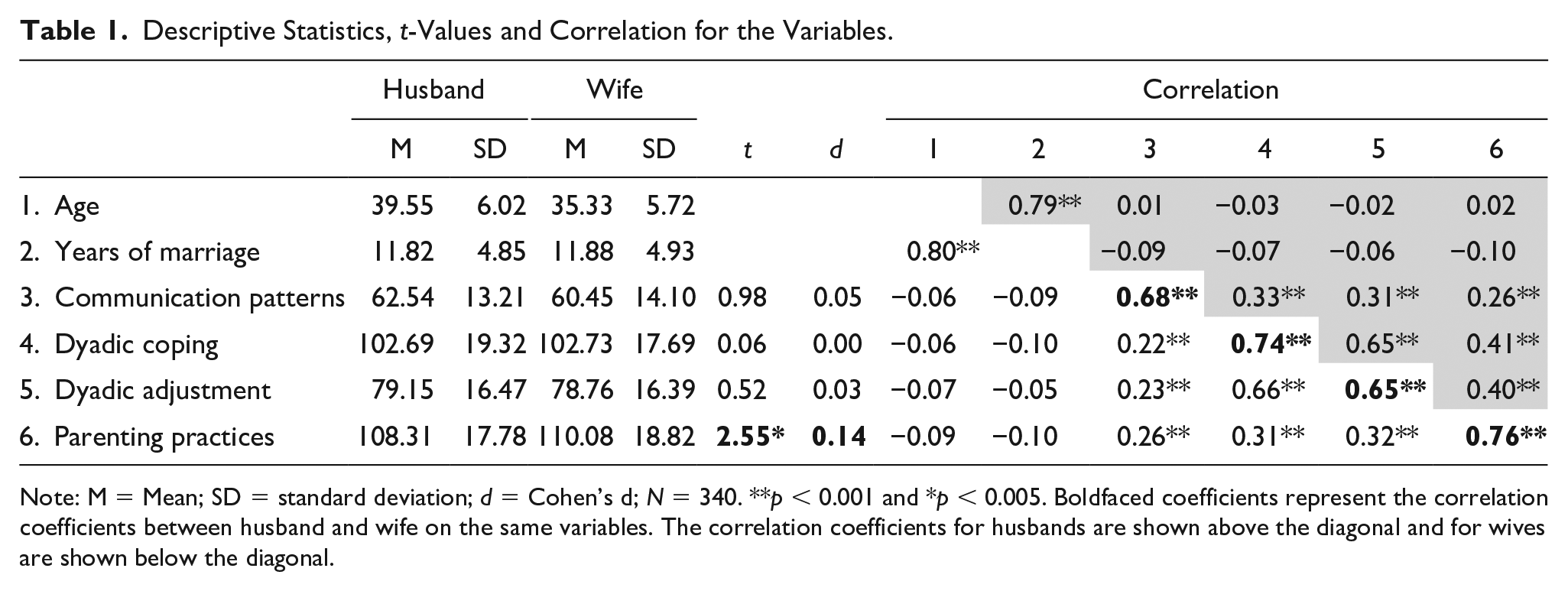
Note: M = Mean; SD = standard deviation; d = Cohen’s d; N = 340. **p < 0.001 and *p < 0.005. Boldfaced coefficients represent the correlation coefficients between husband and wife on the same variables. The correlation coefficients for husbands are shown above the diagonal and for wives are shown below the diagonal.
Direct Effects
To test our hypothesis of actor and partner effects between the study variables, we conducted APIMeM with communication patterns as the independent variable, dyadic coping as the mediator and dyadic adjustment, and parenting practices as outcome variables, using husbands’ and wives’ reports as shown in Figure 1. The model showed a good fit to the data (χ2 = 16.75 (4), p = 0.002, CFI = 0.991, GFI = 0.988, RMSEA = 0.097, SRMR = 0.030). Out of the eight direct effects between independent variables (husbands’ and wives’ communication patterns) and both the outcome variables (husbands’ and wives’ dyadic adjustment and parenting practices), six of them were not significant, except for the effects of wives’ communication patterns, with their own dyadic adjustment and parenting practices.

Actor–partner interdependence mediation model for dyadic coping. Unstandardized estimates are displayed. Nonsignificant paths are not shown for brevity.
Communication patterns and dyadic coping
Both the actor and partner effects were significant for the association between communication patterns and dyadic coping for husbands (βActor = 0.36, p = 0.001; βPartner = 0.25, p = 0.486; but not for wives (βActor = 0.05, p = 0.486; βPartner = 0.05, p = 0.486). Gender difference analysis by constraining the actor and partner effects of husbands and wives to be equal indicated that both the actor effects and partner effects were stronger for husbands than the corresponding effects of wives (Δχ2Actor (1) = 6.875, p = 0.009; Δχ2Partner (1) = 5.966, p = 0.015). Similar analysis across husbands’ actor and partner effects showed that they were significantly different (Δχ2Husbands (1) = 4.896, p = 0.027)—actor effects were greater in magnitude than partner effects, while the corresponding actor and partner effects for wives were not significant.
Dyadic coping and dyadic adjustment
The actor and partner effects were significant for husbands (βActor = 0.60, p = 0.001; βPartner = 0.14, p = 0.022), but, for wives, only actor effect was significant (βActor = 0.55, p = 0.001; βPartner = 0.07, p = 0.272). The actor and partner effects between dyadic coping and dyadic adjustment were similar for husbands and wives (Δχ2Actor (1) = 0.128, p = 0.721; Δχ2Partner (1) = 0.674, p = 0.412). Furthermore, the actor effects were significantly greater than the corresponding partner effects of both husbands and wives (Δχ2Husbands (1) = 43.197, p = 0.001; Δχ2Wives (1) = 54.359, p = 0.001).
Dyadic coping and parenting practices
Only actor effect of the husbands was significant for the association between dyadic coping and parenting practices (βActor = 0.28, p = 0.001; βPartner = 0.04, p = 0.637). However, wives’ dyadic coping showed significant actor and partner effects with parenting practices (βActor = 0.25, p = 0.001; βPartner = 0.16, p = 0.022). The actor effects between dyadic coping and parenting practices were similar across husbands and wives (Δχ2Actor (1) = 0.004, p = 0.950; Δχ2Partner (1) = 0.719, p = 0.396, respectively). In addition, for husbands, the actor effects were greater than the corresponding partner effects (Δχ2Husbands (1) = 13.094, p = 0.001), while the actor and partner effects for the wives were similar (Δχ2Wives (1) = 3.035, p = 0.081).
All the significant actor and partner effects were positive, which means better communication patterns among spouses improve dyadic coping among them, and dyadic coping in spouses enhances dyadic adjustment and parenting practices. Overall, these results indicate that both husbands and wives show predominantly actor-only pattern, which means that dyadic coping was influenced by one’s own communication pattern, and dyadic adjustment and parenting practices were influenced by one’s own dyadic coping compared to the influence by their partner. These findings partially support our hypothesis that actor and partner effects exist between one’s own communication patterns, dyadic coping, dyadic adjustment, and parenting practices across husbands and wives.
Mediating Role of Dyadic Coping
Indirect effects
It was hypothesized that couples’ dyadic coping would mediate the association between communication patterns on adjustment and parenting practices. In the model presented in Figure 1, there were 16 indirect effects, involving both the outcome variables (eight indirect effects each). The indirect effects were tested using bootstrapping with 5,000 samples (Preacher & Hayes, 2008), and bias-corrected confidence intervals were used to test the significance of the indirect effects (Sadler et al., 2011). Out of all these 16 indirect effects estimated, six indirect effects were found to be significant. The estimates of these indirect effects are presented in Table 2. The APIMeM in Figure 1 permits the assessment of four types of mediation effects, as follows (Arcuri, 2013):
Four actor–actor-mediated effects (e.g., the association between one’s own communication pattern and dyadic adjustment is mediated by one’s own dyadic coping);
Four actor–partner-mediated effects (e.g., the association between one’s own communication pattern and partner’s dyadic adjustment is mediated by one’s own dyadic coping);
Four partner–actor-mediated effects (e.g., the association between one’s own communication pattern and their partner’s dyadic adjustment is mediated by their partners’ dyadic coping); and
Four partner–partner-mediated effects (e.g., the association between one’s own communication pattern and their dyadic adjustment is mediated by their partners’ dyadic coping).
Indirect Effects of APIMeM for Communication Patterns on Adjustment and Parenting Practices Mediated by Dyadic Coping.

Note: CP: Communication patterns, DC: dyadic coping, DA: dyadic adjustment, PP: parenting practices, H: husband, W: wife, U.E: unstandardized estimates, and CI: confidence interval 95% bias-corrected.
The association between husband’s communication pattern and their own dyadic adjustment is mediated by their own dyadic coping (actor–actor). On the other hand, the association between husband’s communication patterns and wives’ dyadic adjustment was mediated by both husbands’ and wives’ dyadic coping (actor–partner, partner–actor).
At the same time, the association between husbands’ communication patterns and parenting practices was mediated by their own and their wives’ dyadic coping (actor–actor, partner–partner). These results show that mediation occurs not only through the actor effects within a person but also through partner effects between dyadic coping and dyadic adjustment. However, the association between husband’s communication patterns and wives’ parenting practices was mediated by wives’ dyadic coping only (partner–actor). It is pertinent to note that wives’ communication patterns did not show any indirect effects. This result may be because (a) wives’ communication patterns did not significantly associate with both the mediators’ (b) direct effects between wives’ communication patterns and parenting practices. These findings partially support our hypothesis that the association between one’s own communication patterns and their respective dyadic adjustment and parenting practices will be mediated by one’s own and of their partners’ dyadic coping.
Discussion
Actor and Partner Effects
The goal of the present study was to test the dyadic association between the communication patterns, dyadic coping, dyadic adjustment, and parenting practices in a sample of married couples in India. In addition, we examined whether dyadic coping mediates the association between communication patterns and dyadic adjustment and parenting practices among the dyads. The findings from APIMeM indicated that the couples showed both actor and partner effects between communication patterns, dyadic coping, dyadic adjustment, and parenting practices, although the actor effects were stronger and predominant. Specifically, husbands’ significant actor effects showed that communication patterns improve their dyadic coping efforts, and, in turn, their own dyadic coping augments their dyadic adjustment and parenting practices. The dyadic coping efforts of wives improved their dyadic adjustment and parenting practices.
On the other hand, partner effects demonstrate that wives show higher dyadic adjustment when the husbands demonstrate higher dyadic coping, while husbands show better parenting practices when the wives show greater dyadic coping. In other words, dyadic coping exerts a differential partner effect across husbands and wives—husbands link dyadic coping of wives with their own parenting practices, while wives link dyadic coping of their husbands with their own dyadic adjustment. Our results revealed that the direct dyadic association between communication patterns and dyadic adjustment and parenting practices were not significant (except for the link between wife’s communication patterns and their dyadic adjustment and parenting practices). These results would probably be due to the full mediation effect of dyadic coping between communication patterns with dyadic adjustment and parenting practices in husbands.
Overall, the link between dyadic coping among couples and their marital satisfaction in the current study converges with previous studies with Western couples. Many research studies have indicated that higher dyadic coping helps enhancing relationship satisfaction (Brown, 2012; García-López et al., 2016; Rusu et al., 2015), commitment (Landis et al., 2014), and well-being among couples (Rusu et al., 2015). In addition, a few researchers have found that training on coping skills improves marital adjustment and satisfaction (Bodenmann, 2005; Bodenmann et al., 2014; Eisanejad & Alizadeh, 2020). Furthermore, the proportion and strengths of actor–partner effects found in the present study are consistent with past studies, linking dyadic coping and dyadic adjustment using the APIM framework—the association between couples’ dyadic coping and dyadic adjustment show predominantly actor-only effects, and the actor effects were stronger than partner effects (García-López et al., 2016; Rusu et al., 2019; Vedes et al., 2016). These findings indicate that dyadic adjustment was more frequently influenced by one’s own dyadic coping than their partners’ dyadic coping.
Gender Differences
The results of gender difference analyses illustrated that actor and partner effects of the association between communication patterns and dyadic coping were stronger for husbands than wives. The relationship between dyadic coping with dyadic adjustment and parenting practices was similar across husbands and wives. The lack of association between communication patterns and dyadic coping among wives shows that the dyadic coping efforts of the wives are not necessarily linked to the quality of marital interaction with their husbands. In other words, wives in India seem to practice dyadic coping irrespective of the interaction with their husbands. Previous studies on marital interaction among Indian couples have found that the cultural traditions and family’s role structures have not changed significantly in India (Ramu, 1987). The gender role responsibilities of supporting and caregiving to one’s spouse are central to a woman’s role in the family irrespective of the quality of relationship she enjoys with her husband (Aziz, 2004; Kalliath et al., 2011; Noor, 2004). There is considerable empirical evidence from the past literature to show that differential family role structure and wider societal beliefs within the society can bring about gender-based social pressure, whereby women are expected to support the husband, undertake the household task, and provide care for children and family members to be a “good wife, good mother and good homemaker” (Daly et al., 2008; Kalliath et al., 2011).
The results comparing working women and homemakers showed no difference in the marital outcomes, except for parenting practices. This shows that women’s career status did not differentiate marital outcomes: communication patterns, dyadic coping, and dyadic adjustment. However, nonworking mothers (i.e., homemakers) showed better parenting practices—more involvement, warmth, appreciation, and less harsh punishment.
The actor and partner effects of wives’ dyadic coping on parenting practices are similar in magnitude. This result indicates that the wives, through dyadic coping, influence not only their parenting practices but also their husbands’ parenting practices. This result demonstrates that Indian wives endorse the traditional marital and family roles of a woman, whereby she undertakes the responsibility of raising the children as well as supporting the husband in parenting. The partner effects of the couples’ dyadic coping showed that husbands link dyadic coping with wives’ dyadic adjustment, whereas wives’ dyadic coping is linked to husbands’ parenting practices. This result indicates a clear differential spousal support expectation between husbands and wives—through dyadic coping efforts, husbands influence wives’ dyadic adjustment, whereas wives influence husbands’ parenting practices. Previous studies in India had demonstrated that the availability of spousal support was important for women in the relationship, and women showed better coping, well-being, and reduced work–family conflict when their spouse offered support (Rajadhyaksha & Bhatnagar, 2000; Rao et al., 2003). Sastry (1999) found a positive impact for Indian women on home satisfaction with parent–child relationships and argued that women would derive higher satisfaction from serving traditionally ascribed roles and duties such as bearing and caring for children due to more rigidly established social roles in India. Similarly, husbands emphasized receiving support from their spouses as they do not alter the breadwinner role for the family (Ramu, 1987).
Mediation Effects of Dyadic Coping
The results of indirect effects provide evidence for the mediational mechanism between communication patterns, dyadic adjustment, and parenting practices and support the previous research findings on mediating role of dyadic coping in predicting marital outcomes with couples from Western cultural context (Breitenstein et al., 2018; Donato et al., 2015; Levesque et al., 2017; Vedes et al., 2016). Xu et al. (2018) found similar mediation effects of dyadic coping in a sample of Chinese couples. The fact that dyadic coping mediates the association between communication pattern and dyadic adjustment indicates that couples improve their dyadic efforts to cope with better communication patterns. In turn, dyadic coping improves overall adjustment among them. However, in the present study, wives’ communication patterns did not endorse the mediation mechanism; instead, it acted directly on their own dyadic adjustment and parenting practices. In other words, although wives’ dyadic coping did not mediate the association between their own communication pattern and dyadic adjustment, it did mediate the link between husbands’ communication patterns with the outcome variables. This result that wives support—by engaging in dyadic coping—the marital and parenting outcomes of husbands, although they could not produce a similar effect through their own dyadic coping, endorses the cultural constructions of filial duties for wives surrounding marriage (Sastry, 1999) and less emphasis they place on mutual or interdependent family roles. Yelsma and Athappilly (1988) noted that married couples in India were bonded more by a sense of filial dedication and an indelible adherence to cultural tradition than feelings of closeness, intimacy, and egalitarian expectation with marriage partners.
Given that dyadic coping mediates in improving marital outcomes, only a few studies explored the association between dyadic coping and parenting. This research gap was investigated in the current study. We found that husbands’ communication patterns predict both husbands’ and wives’ parenting practices, mediated by their own dyadic coping. This result converges with prior studies with Western couples. For example, Zemp et al. (2016) found that parents’ dyadic coping was significantly related to their child’s prosocial behavior, internalizing behavior, and externalizing behavior. Another research carried out among couples with children with autism spectrum disorder found that dyadic coping was negatively linked to parenting stress, suggesting an essential implication of dyadic coping for parenting stress (Brown et al., 2020). Overall, our results show that couples help each other in parenting their children through their combined coping efforts. Dion and Dion (1993) proposed that in collectivist cultures, the parent–child relationship is more nurturing and satisfying than in individualistic cultures. This may be because collectivist societies emphasize elderly subordination and selfless subservience and encourage more childcare and nurturing (Sastry, 1999).
Gender, Patriarchy, and Women’s Agency
Although our results demonstrate that couples in India support each other, the gender differences in actor and partner effects and the mediation analysis results demonstrate that certain gender disparity issues prevail among Indian couples. The findings that (a) wives support the husbands in parenting amidst diminished opportunities for them to communicate, and (b) although wives could not link their own dyadic coping with communication pattern, they supported the husbands in improving husbands’ dyadic adjustment and parenting through dyadic coping, demonstrate that wives in India play traditional marital roles—doing the “carer” role irrespective of the “care” that they receive for themselves. In the past 30 years, the Indian society has undergone social, cultural, and economic changes due to globalization, urbanization, and migration that have brought a rising challenge to the marriage and family institutions (Girase et al., 2016; Netting, 2010; Thadathil & Sriram, 2019). Particularly better access to education has brought women to a higher social status and status in their family (Thadathil & Sriram, 2019). However, our results on wives’ communication pattern specifically demonstrate that although the Indian family system has moved toward more liberal and egalitarian structures in recent years (Desai et al., 2011; Sonawat, 2001), the agency for women in negotiating terms with her partner is not fully achieved—patriarchy still prevails in the Indian families. India ranks 131 in gender development and gender inequality indexes (United Nations Development Programme, 2020), which clearly demonstrates gender disparity in Indian society. Further, a few recent studies exploring divorce rates in India (see Thadathil & Sriram, 2019) demonstrated the lack of agency for women in communication—major reasons for divorce were lack of understanding, communication, desertion, and neglect by the spouse (Kaneez, 2015; Ramachandrappa, 2012; Vasudevan et al., 2015).
In patriarchal societies like India, women/wives are expected to be tolerant, humble, and disciplined; accept their husbands’ imperfections and misbehaviors; and obey them in all ways possible (Go et al., 2003). Further, the expectations of women—as a wife, for spousal support (Kalliath et al., 2011), egalitarian family (Netting, 2010), individual status, and self-reliance (Medora, 2007)—are ignored to a larger extent. Dalal & Lindqvist (2012) argued that women’s empowerment is often reflected by combined measurement of education, working status, and economic independence. However, in patriarchal societies, when women try to achieve empowerment, it conflicts with their husbands’ beliefs of superiority, which induces friction in the relationship and domestic violence against women (Dalal & Lindqvist, 2012). Moreover, many past studies had shown that marital discord, domestic violence, and divorce rates were reported more in families with working women (Dalal & Lindqvist, 2012; Hussain, 2014; Vasudevan et al., 2015). Patriarchy plays a significant role in India and even in many economically advanced nations in Asia (Lesthaeghe, 2010). Although arranged marriage system and patrilocal residence decreased the divorce rates in India (Dommaraju & Jones, 2011), women avoided divorce at the cost of reduced agency for them (Maitra & Gayathri, 2015) and for the sake of children (Gurjar, 2016). Straughan (2009) argued that “the traditional family where the husband works and the wife stays home to take care of the family full-time have not yet been successfully replaced by a new family structure which adapts well to the absence of a full-time domestic manager” (p.103). Even when women are in full-time paid work, the prevailing gender ideology still entrusts women to most domestic and carer tasks (Tsuya et al., 2004; Straughan, 2009), and women who embrace liberal gender expectations are less likely to stay happily in their marital union unless their spouses also adopt liberal gender expectations (Straughan, 2009).
A review of divorce literature in India showed that when men proposed separation and divorce, women tried for reconciliation due to their lesser participation in the labor force, which, in turn, instilled insecurity feelings among them in taking care of themselves and the children (Rao & Sekhar, 2002, Thadathil & Sriram, 2019). In India, women are perceived to have vital parenting roles and limit men to marginal parental role involvement (Daly et al., 2008). They further argued that women are mostly unwilling to give parenting responsibility to their husbands as women assume them to be less competent and experienced. Hence, motherhood has a higher primacy when compared to fatherhood. This situation remains the same even for working women—wives/mothers have a vital role in parenting and daily household tasks (Manimekalai et al., 2019).
Implications
The current study has theoretical implications for future research and practice of family and couple therapy in non-Western cultural contexts, especially in India. We have provided empirical evidence for the first time that the systemic transactional model (Bodenmann, 2005), evolved in the Western context, can be applied to Indian couples and their culture. The results of the study clearly show how married couples in India can help each other in improving their marital and parenting outcomes. Given that India is the world’s second most populous country (Desa, 2019), and evidence shows that marital experiences vary greatly from the cultural context of the West, indigenous studies on couples and family ties are critical for a global understanding of the families in the world. However, studies on marital and family functioning in the Indian context are sparse. Given these trends, the results of the present study add to the small collection of couple and family studies in India and lay the foundation for understanding the dyadic associations of communication and coping processes among married couples in India. We expect that our study could motivate more research on these topics in non-Western cultural contexts. Our research also indicates a few practical implications for scholars and clinicians working with married couples. The findings of the study, especially dyadic coping as a mediator, illustrate that improving dyadic coping skills (e.g., Couples Coping Enhancement Training (CCET); Bodenmann & Shantinath, 2004) in couples may be a promising approach to enhance their marital relationship and their cooperation in better parenting. Our results could encourage studies aiming at indigenous development and validation of such marital education programs in the Indian cultural context or cultural validation of existing training programs (e.g., CCET) to improve communication and coping among Indian couples.
Strengths, Limitations and Future Directions
There are important strengths in the current study: (a) using an under-explored sample from Asia (Indian couples), (b) relatively larger sample size ensures the reliability of results and (c) tools translated and validated in the cultural context to collect data, and, (d) lastly, data from both husband and wife accounted for interdependence, utilizing sophisticated statistical analysis (i.e., APIMeM), reporting actor, partner, and mediated effects and also examining gender differences. However, there are few limitations in our study: (a) it is not possible to bring out causal inferences on the mechanisms based on cross-sectional research design, since the stability of mediation effect over time is not assured (MacKinnon & Fairchild, 2009); (b) data were collected using self-reports, which increases the chances of subjectivity and social desirability. Future studies must focus on longitudinal research (e.g., daily diary), quasi-experimental or experimental explorations to attain a deeper understanding of the dyadic coping process in Indian couples. The goal of our study was to examine the dyadic association of the variables across husbands and wives. In order to gain a deeper understanding of women’s agency in the context of employment status, future studies might consider comparing the association among the study variables, across working and nonworking women, using separate models.
Footnotes
Declaration of Conflicting Interests
The author(s) declared no potential conflicts of interest with respect to the research, authorship, and/or publication of this article.
Funding
The author(s) disclosed receipt of the following financial support for the research, authorship, and/or publication of this article: This research study was supported by doctoral dissertation fellowship awarded to the first author by the University Grants Commission (UGC), Government of India (Grant No. SVSGC-2018-19-OB-TAM-3956). We thank UGC for the grant support.
